

Crypto World
Stephen Miran exits the Fed. How he set the stage for Kevin Warsh.

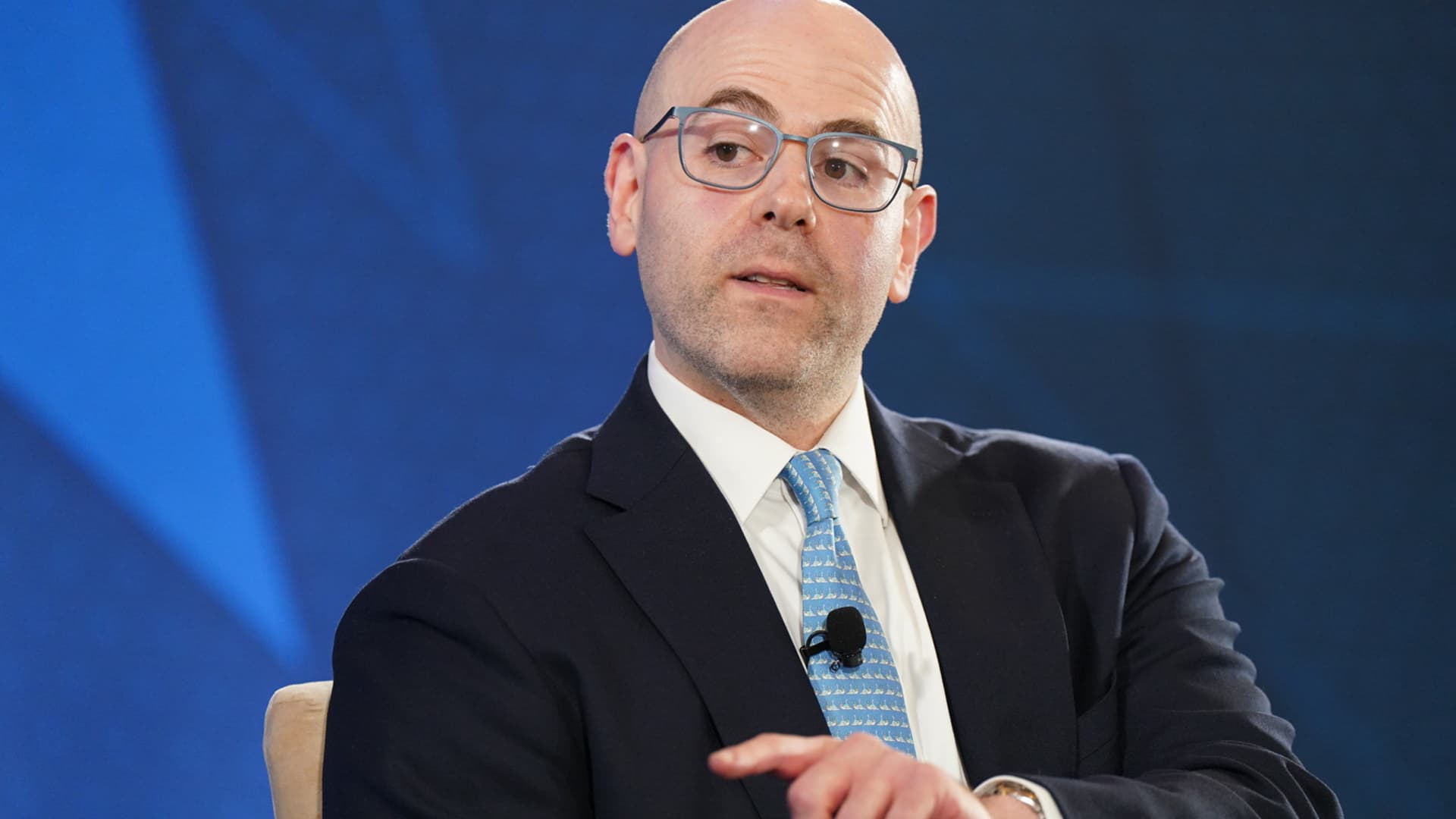
Federal Reserve Governor Stephen Miran speaks with CNBC during the Invest i America Forum on Oct. 15, 2025.
CNBC
Federal Reserve Governor Stephen Miran entered with big ideas about how the central bank should change— radically so, in some cases. As he prepares to step down in the coming days from what will have been the shortest tenure as a governor in 71 years, he appears convinced his ideas are right.
But in a CNBC interview, Miran, 42, made clear that the reality of working at the Fed has tempered his views about how fast those changes can be made. Change is slower than he envisioned.
The Fed is “really a committee,” Miran said. “It’s different than an agency where there’s a very clear executive who just runs the show, and what he or she says goes, and if you don’t like it, you’re out.”
That observation is important for two reasons: First, Miran could return as a governor, potentially before the end of President Donald Trump’s term. Second, incoming Chair Kevin Warsh shares some of Miran’s big ideas.
Warsh was confirmed as the next chair on Wednesday and will take the board seat Miran is vacating. The two won’t overlap.
But Warsh will be forced to reckon with the reality Miran has encountered: a Federal Reserve full of people with their own economic ideas and where institutional change is often glacial.
“You’ve got to convince people,” said Miran, who took his seat in September 2025, filling a position vacated by Adriana Kugler.
Miran said the Fed’s policymakers and staff treated his ideas with an open mind, despite sharp criticisms from outside the building that he represented a threat to Fed independence.
He initially chose not to resign his position as chair of the White House Council of Economic Advisers under Trump while serving at the Fed. He described that as aimed at saving himself the trouble of what could have been a third Senate confirmation in a brief span, but the decision landed poorly amid Trump’s campaign to undermine Powell.
Miran resigned the White House position in February and has no immediate plans to return.
He argues his critics have it backward. He was valuable to the president because he looked at the economic evidence and concluded that interest rates were too high. “I’ve laid out my math,” he said. “I’ve always done what I think is right.”
Miran will end his tenure on the Fed with a rare record of dissenting at every one of the six Fed meetings he attended. That lines up with Trump’s demands for sharply lower interest rates. Even when the Fed cut rates, Miran dissented in favor of larger cuts.
Holding fast
As he exits the Fed, Miran has not much altered his views that rates can and should be much lower.
“If I were writing down dots today, I might have one fewer cut than I did in the last summary of economic projections,” he said. That “dot” on the Fed’s grid of individual members’ rate expectations called for a full percentage point, or 100 basis points, of cuts this year, or three more quarter-point cuts than the median of his colleagues on the Fed.
Miran says he would eliminate just one quarter-point cut now — in other words, calling for rates to be three-quarters of a point lower — because of the cuts the Fed has made already and because “the data has made me a little bit more concerned about inflation.” But he adds, “I still think it’s important to frontload those cuts, because I still don’t think that we should be exerting restraints in the labor market.”
Miran’s push for cuts is based on several other factors, many of them the result of administration policies that he believes will drive down inflation and allow the Fed to run the economy with lower rates.
First is his belief in the positive impact the administration’s deregulation will have on the economy.
“I think that regulations are still underappreciated in terms of how determinative they are for the supply side,” he said. “Saying you’re not allowed to build versus you are allowed to build is night and day … Deregulation pushes up the supply side by allowing producers to produce more with less is disinflationary.”
He estimates deregulation could lop a half a point of future inflation rates, even while he acknowledges the uncertainty created by tariff inflation could hold back some of those gains.
Convincing colleagues
While some of his colleagues still want to take their time studying the concept before incorporating it into policy, he believes he’s made a few converts. “I still think it’s more important than everyone else does, but they’re a lot closer to my view now than they were in September,” he said.
Those colleagues have likely not heard the last word on the potential benefits of deregulation. Fed Chair designee Warsh has called Trump’s deregulatory plans “the most significant since President Ronald Reagan’s.”
Miran’s views on the veracity of the inflation data are another key plank in his arguments for lower rates. In a forthcoming paper, Miran will argue along with two Fed economists that recent software inflation has been artificially inflated by technical factors, distorting headline and core numbers.
Perhaps the most significant of Miran’s ideas is his approach to how he believes a central bank should think about the appropriate policy response to a surge in inflation for a supply shock, such as soaring oil prices now. He says it takes roughly 12 months to 18 months for changes in Fed policy to affect the economy. That sets limits on the kind of price changes that the Fed should be concerned about today, he says.
Consider a clothing company that has had to bump up prices to account for the cost of tariffs, Miran said.
“If you think that a higher tariff is going to boost clothing prices today, there’s nothing you can do about that with monetary policy,” Miran said. The same goes for Iran war’s oil shock, he said. It may push up individual prices today, but the kind of inflation the Fed should care about is an ongoing, upward trend in prices, not one-off events.
“That’s the thing with supply shocks, is that you need to be forecasting more supply shocks,” he said.
The Warsh view
A concern with Miran’s approach is that, if the Fed keeps looking through supply shocks, markets and the public will doubt its inflation-fighting credibility.
It isn’t clear Miran if has persuaded his fellow Fed members to come around to his view. Three dissenters at the most recent meeting said they were worried about inflation.
But they will soon find a louder voice making the same argument around the boardroom table.
Warsh shares Miran’s view that the Fed has gotten tripped in over analyzing micro-level prices, Warsh said at his April 21 confirmation hearing.
“I’m most interested in what’s the underlying inflation rate, not what’s the one time change in prices because of a change in geopolitics or change in beef, but what’s the underlying generalized change in prices in the economy?” he said.
It seems likely Miran will remain an active participant in the Fed debate even after he leaves. He wrote often on monetary policy before he joined the Fed and worked on his research paper on software inflation into the last weeks of his short term.
“I’d love to be back,” Miran said. “But it’s not up to me.” The White House declined to comment on whether Trump is considering it.
Outgoing Chair Jerome Powell has said he will retain his governor’s seat at least until an investigation into renovations at the Fed’s headquarters is completed. Though Powell has not put an end date on when he will leave, and his term runs until January 2028, an early exit would open a board seat.
Were he to return, it would be consequential for Warsh, whom, as Miran has found, will need allies around the table at the Fed.


A bipartisan push to fully staff the US Commodity Futures Trading Commission (CFTC) gained momentum this week as lawmakers warned that a major crypto market-structure bill could hinge on timely leadership at the regulator.
In a Friday letter to President Donald Trump, House Agriculture Committee Chair Glenn Thompson and ranking member Angie Craig urged the administration to nominate a complete panel of CFTC commissioners. They pointed to urgent regulatory issues facing the agency and a substantial rulemaking process anticipated if the Digital Asset Market Clarity Act (CLARITY) becomes law. “Ensuring the Commission is well-equipped as the leading derivatives markets regulator in the world is a bipartisan priority for the members of our Committee,” the lawmakers wrote, arguing a full commission would help the agency promote integrity, resilience, and vibrancy in US derivatives markets and reinforce US leadership.
Source for the letter: US House Agriculture Committee.
Meanwhile, Michael Selig remains the lone CFTC commissioner, having taken the helm after acting chair Caroline Pham resigned in December 2025. Under Selig, the commission has aligned with the administration on several fronts, including assertions of exclusive jurisdiction over prediction markets.
Earlier coverage noted the agency’s stance on rulemaking. In an April hearing with the House Agriculture Committee, Selig said he did not intend to slow down rulemaking despite the absence of four other commissioners. The CFTC also issued a memorandum of understanding with the US Securities and Exchange Commission in March to coordinate oversight of markets, including digital assets.
The CFTC under the CLARITY Act
On Thursday, the Senate Banking Committee voted to advance the CLARITY Act, setting the bill up for a potential floor vote. The measure would give the CFTC greater authority to oversee and regulate digital asset markets, a shift with wide implications for crypto users and market participants alike. As of Friday, no floor schedule had been announced.
The leadership gap at the CFTC has drawn attention from lawmakers considering crypto market structure. Democratic Senator Amy Klobuchar, who sits on the Senate Agriculture Committee, proposed an amendment in January requiring that CLARITY not take effect until at least four CFTC commissioners have been nominated and confirmed.
Trump has not publicly announced any CFTC commissioner picks as of Friday. Any nominations would need to clear Senate confirmation, a process that could take weeks or months depending on political dynamics and committee timelines.
Related coverage from Cointelegraph noted related developments in CFTC actions and interagency coordination efforts, including discussions around rulemaking and market oversight.
As policymakers weigh the competitive and regulatory implications of a more expansive CFTC mandate, investors, traders, and developers in the crypto space will be watching closely for the speed and clarity with which leadership can be restored at the agency. The CLARITY Act’s fate—and the CFTC’s ability to implement new rules—could shape how digital assets are treated within traditional derivatives markets and how promptly market participants must adapt to evolving oversight standards.
What remains uncertain is how quickly a full CFTC commission can be formed and how any new governance will interact with ongoing interagency coordination, especially given the already-noted memorandum with the SEC. If leadership timelines stretch longer, the industry might face continued regulatory ambiguity even as Congress signals a strong intent to expand the CFTC’s remit over digital assets.
Readers should monitor next steps in the confirmation process for nominees, the Senate’s agenda for CLARITY Act floor scheduling, and any new statements from the CFTC as rulemaking advances or adjusts to the post-clarity regulatory framework.


BlackRock Investment Institute warned investors that company-level AI capex now drives the entire macro market backdrop. The asset manager said its first 2026 theme, micro is macro, captures the shift.
The note from strategists Jean Boivin and Wei Li lands as Big Tech capital spending tracks roughly $725 billion this year. That figure is up about 10% from estimates made before first-quarter earnings. Capex on this scale rivals traditional macro drivers.
AI Capex Now Rivals Traditional Macro Forces
The micro-is-macro thesis argues that capex from a few firms shapes growth, earnings, and yields. That spending now rivals central bank policy as a market driver.
BlackRock estimates AI infrastructure investment could reach $5 trillion to $8 trillion this decade. The Magnificent Seven recently tracked roughly 57% quarterly earnings growth. AI is now the dominant force behind US equity gains.
The firm believes AI could be the first innovation in 150 years strong enough to lift US growth above 2%. It stresses that the outcome remains uncertain.
Inflation and the Strait of Hormuz raise the stakes
Sticky price pressures were already elevated before the Strait of Hormuz closure added fresh energy risks. BlackRock now sees about three rate hikes priced into Europe, with the U.S. on hold.
The firm stays overweight US and emerging-market equities. It cautions that long-term Treasuries no longer offer the portfolio ballast they once did. Higher yields, paired with sticky inflation, could begin to pressure valuations if disruptions persist.
Bitcoin gets caught in the macro crosswind
The crypto market reflects the same forces. Bitcoin (BTC) trades near $80,646, roughly 36% below its October 2025 record of $126,080. Ethereum (ETH) sits around $2,260, more than 50% off its August 2025 peak.
Capital that once flowed to risk assets is being diverted to AI capex and energy security, raising competition for funding. BlackRock argues that genuine diversification now requires private markets and hedge funds rather than traditional cross-asset spreads.
Rising leverage, weaker traditional hedges, and a few mega forces driving everything leave little room for passive positioning. Whether AI capex sustains its growth premium or starts to crowd out other assets is now the key question. The answer may set the tone for risk markets through the second half of 2026.
The post BlackRock Warns AI Capex Is Turning Micro Into Macro for Markets appeared first on BeInCrypto.
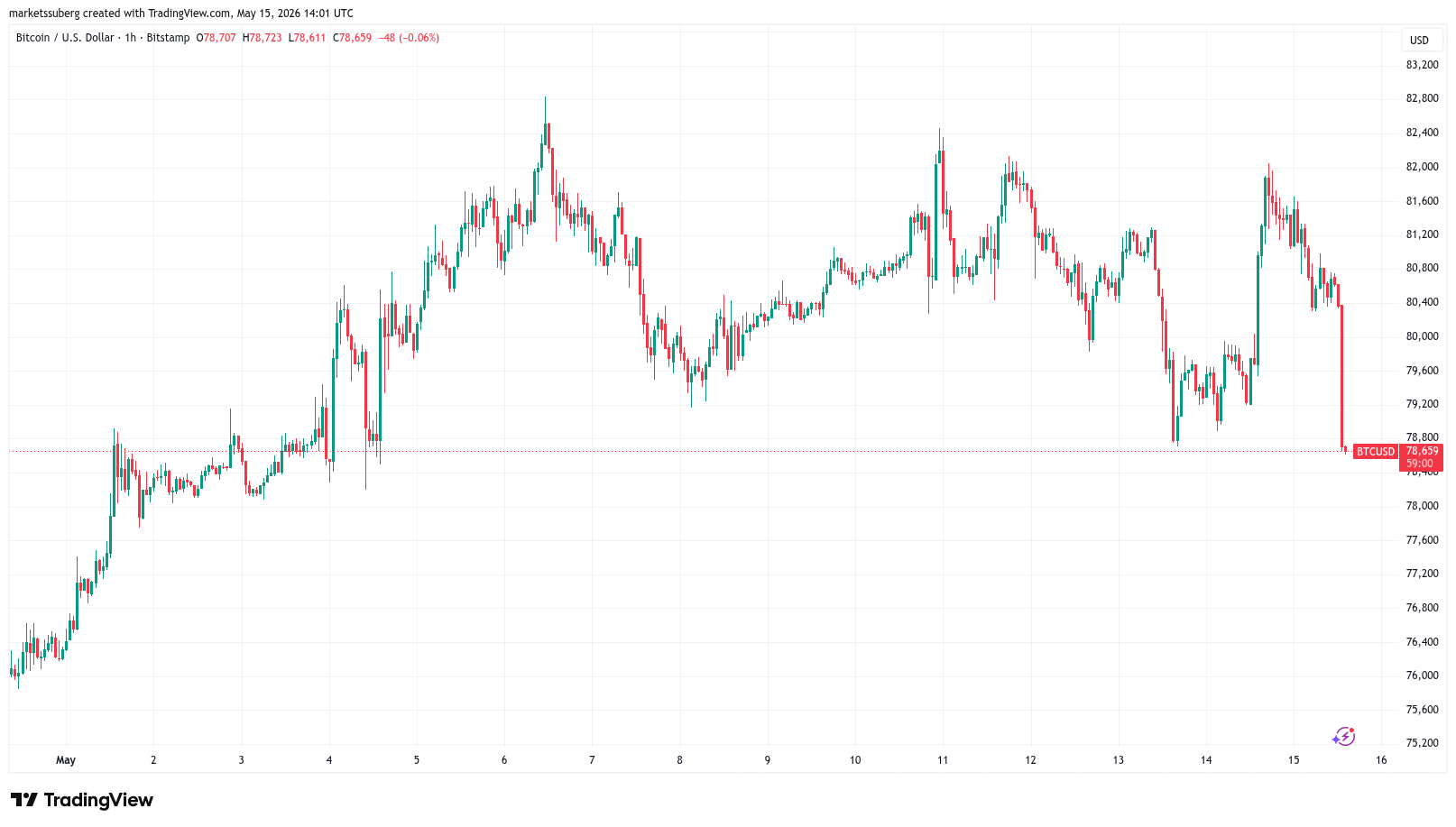
Bitcoin (BTC) fell below $80,000 at Friday’s Wall Street open as analysis tied risk-asset weakness to US bond markets.
Key points:
- Bitcoin eyes its lowest levels of May as concerns over US bond yields spark a risk-asset rout.
- US 10-year treasury yields rise above levels that sparked a US tariff pause on China last year.
- Traders wait for new local lows for BTC/USD as support stability is eroded.
Bitcoin suffers as risk-asset “euphoria” turns sour
Data from TradingView tracked 3% daily BTC price losses, with downside intensifying as the US session began. BTC/USD approached its lowest levels in May so far.
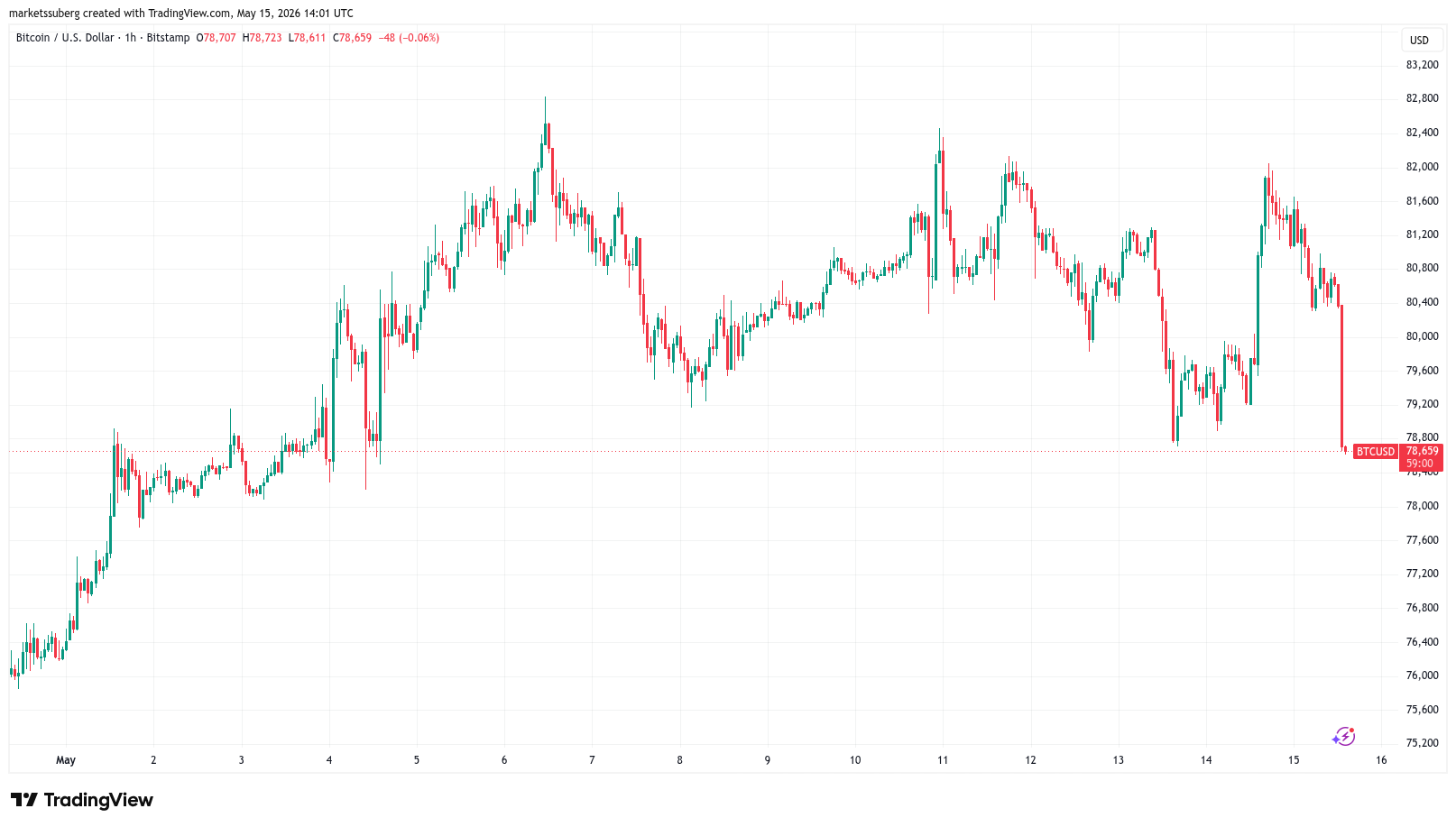
BTC/USD one-hour chart. Source: Cointelegraph/TradingView
Stocks also gave back gains after hitting new all-time highs earlier in the week.
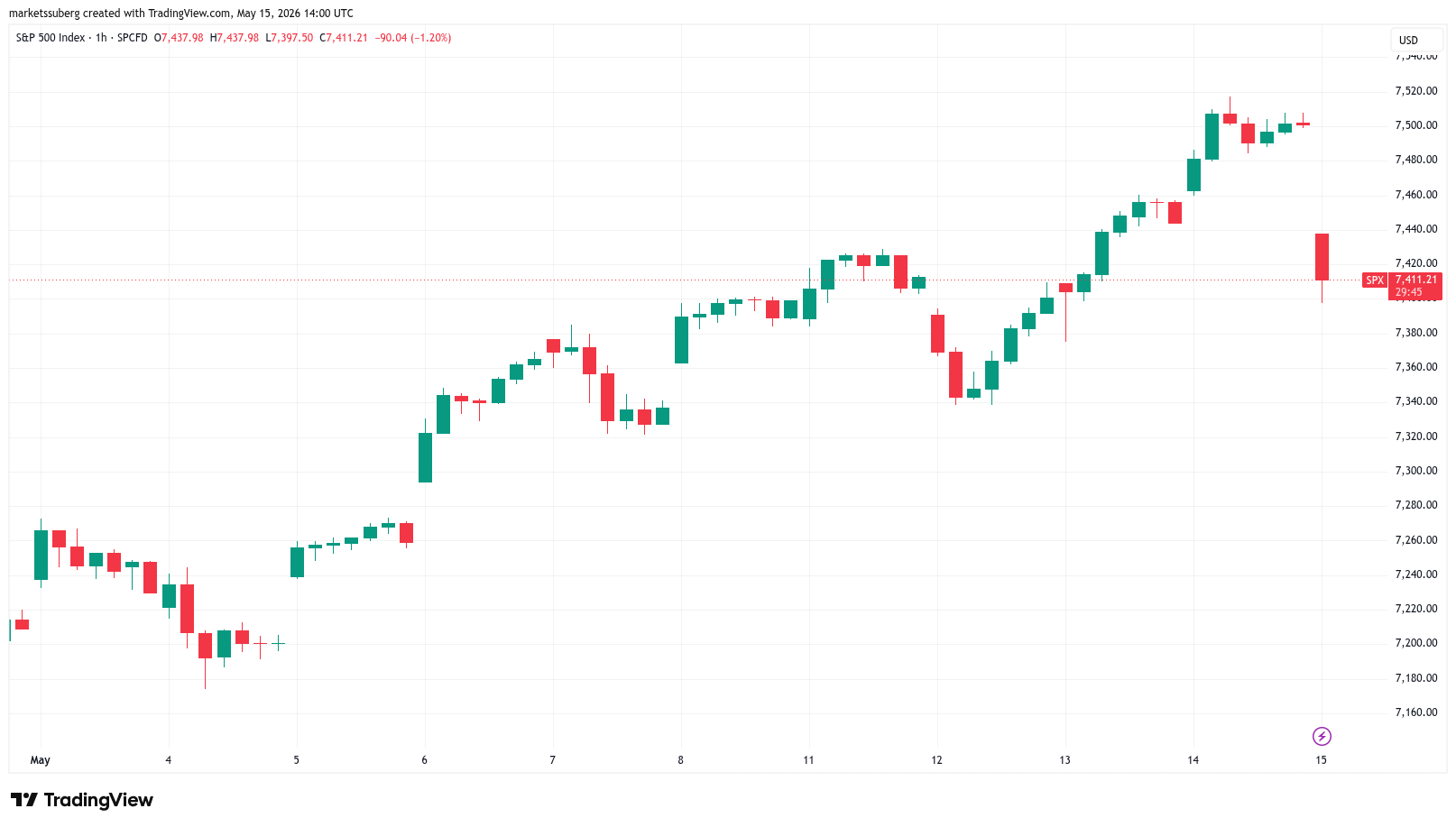
S&P 500 one-hour chart. Source: Cointelegraph/TradingView
Reacting, trading resource The Kobeissi Letter saw risk-asset “euphoria” giving way to concerns about “unsustainable” US bond yields.
“The bond market crisis is intensifying. The US 10Y Note Yield is now officially above 4.55% for the first time since May 2025,” it wrote in a post on X.
“After weeks of euphoria, the market is beginning to react today. As we have been stating for the last few weeks, the current situation in the bond market is unsustainable.”
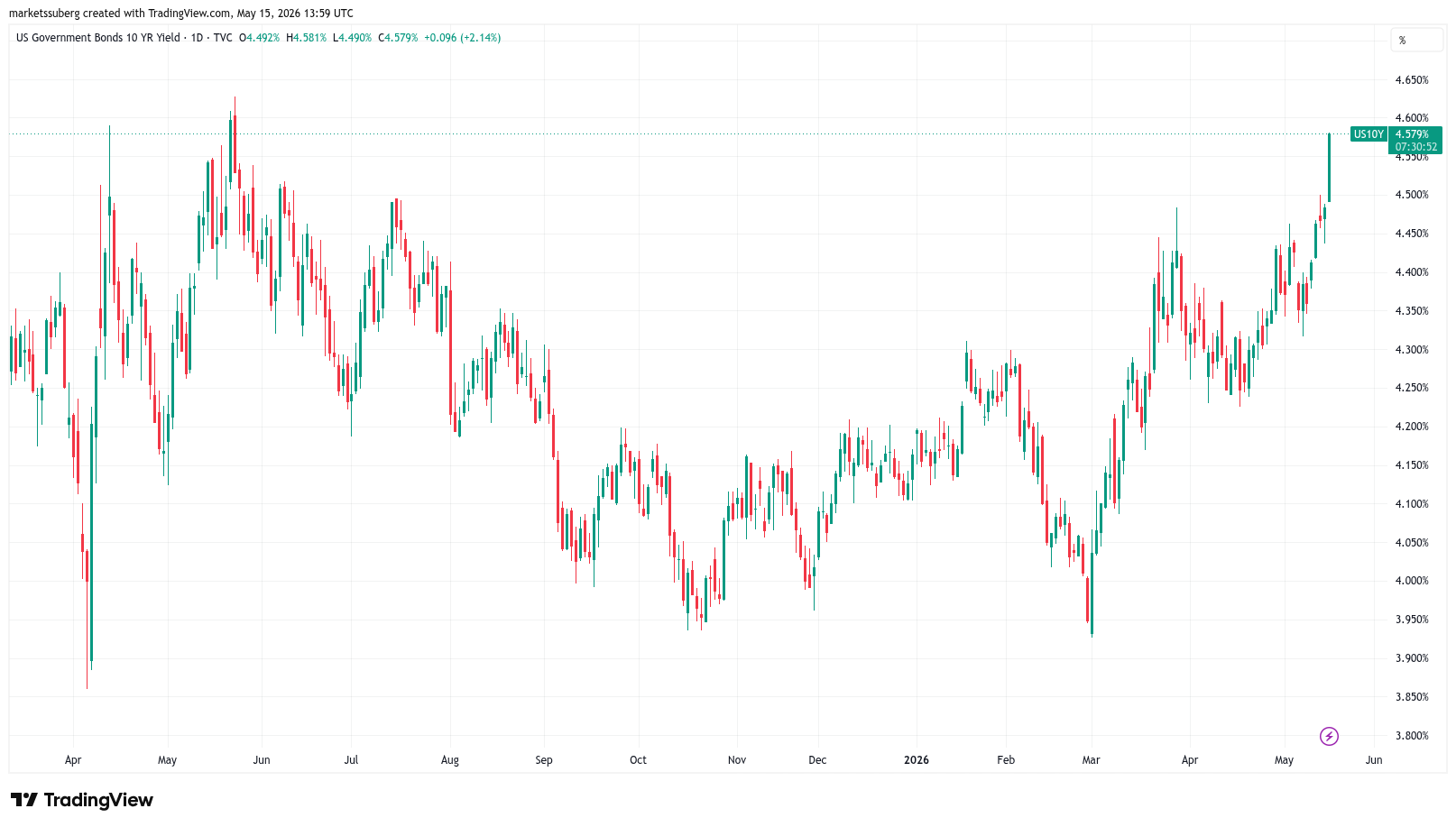
US 10-year treasury note yield one-day chart. Source: Cointelegraph/TradingView
Kobeissi noted that yields were now above levels seen in April 2025, when US President Donald Trump halted the implementation of trade tariffs on China. That move, it said, came due to “a collapsing bond market.”
“Furthermore, the market now sees a 60%+ chance that the Fed’s next move is an interest rate HIKE, with rate cuts entirely priced-out,” the post added.
“We expect to see 7%+ mortgages next, all as auto loan delinquencies have reached 32-year highs. Inflation is back and higher rates are coming.”
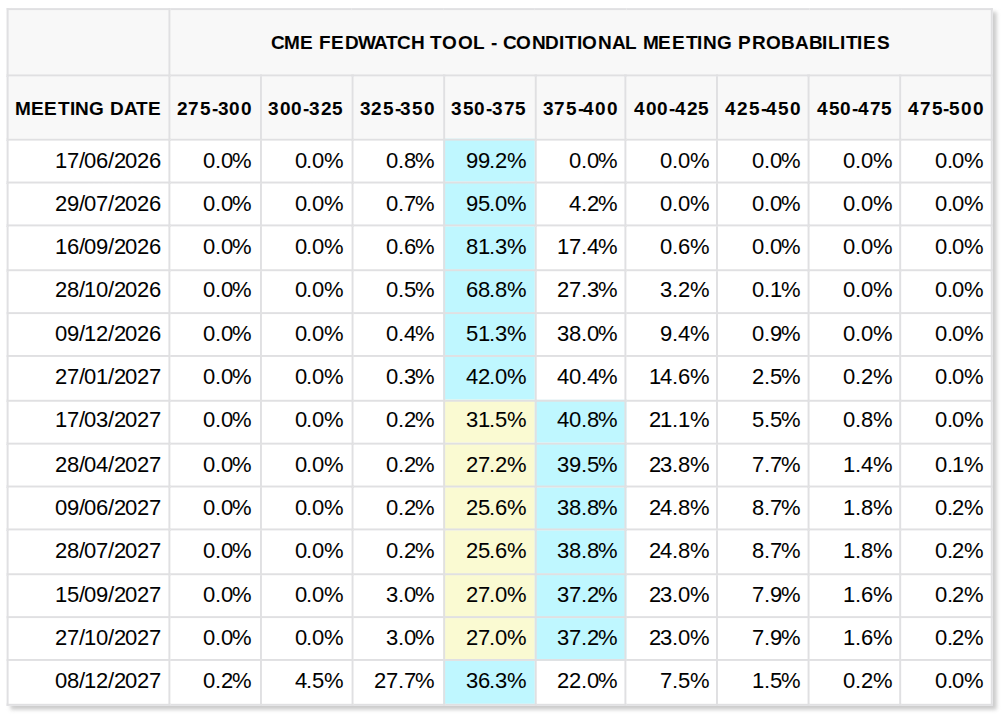
Fed target rate probabilities (screenshot). Source: CME Group
The latest data from CME Group’s FedWatch Tool showed a 0.25% interest-rate hike as the most likely outcome by March 2027.
BTC price lows back on the radar
As Cointelegraph reported, traders were already unsure about Bitcoin’s ability to climb beyond $82,000 local highs.
Related: Bitcoin price history suggests 77% odds of new all-time high within a year
A support retest was already on the cards, and targets on the day extended toward the mid-$70,000 zone.
“Honestly, not a good sign that $BTC fully retraced the move from yesterday,” trader Pat told X followers.
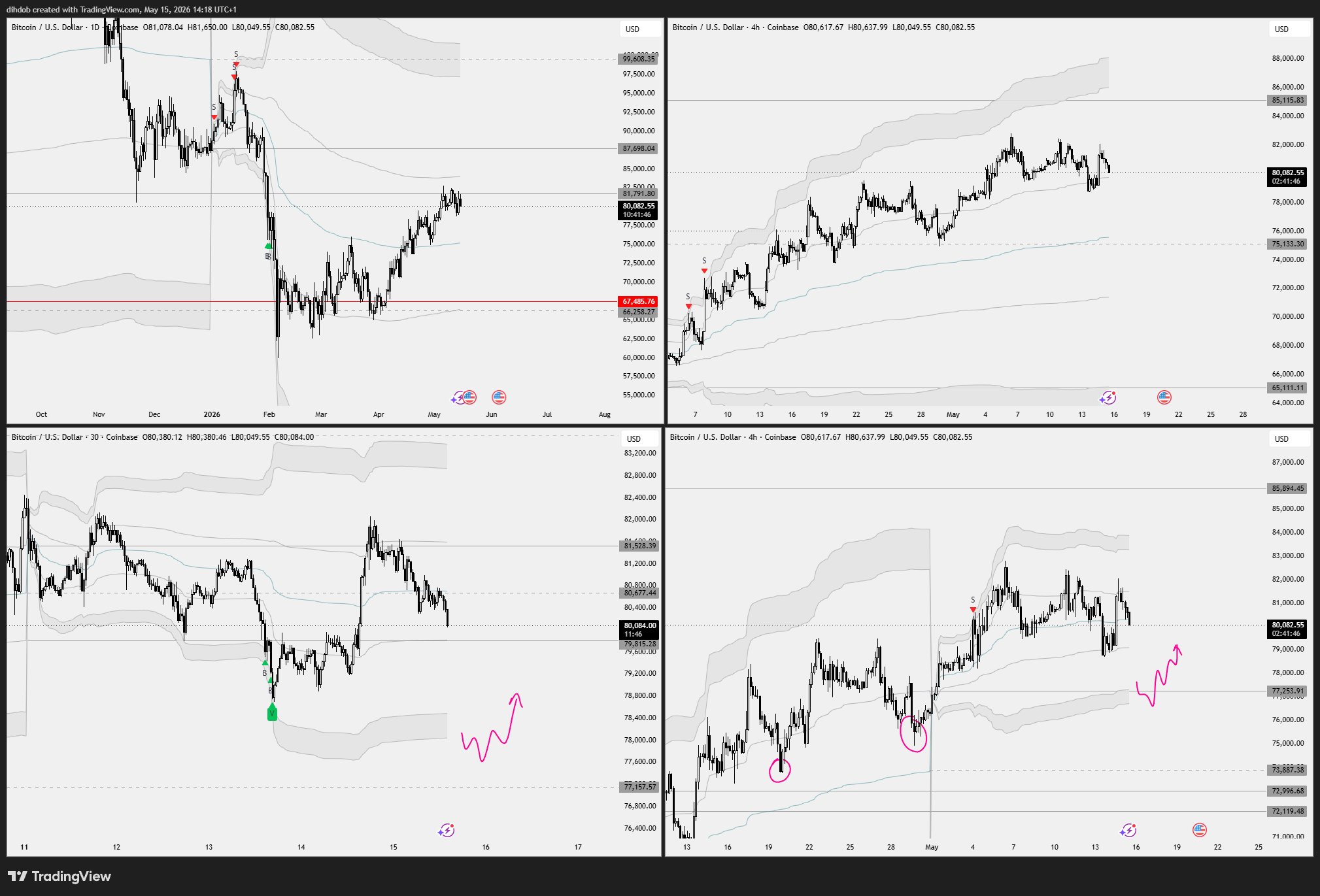
BTC/USD comparison. Source: Pat/X
Rangebound continuation was an increasingly popular option, with analyst Eric Coleman suggesting that low-time frame price action was predictable.
“BTC pumped from the marked horizontal support just as expected and again it got rejected below the trendline and the horizontal resistance,” he wrote alongside an explanatory chart.
“Further movement in between the horizontal support and resistance is expected until a solid breakout or breakdown occurs.”
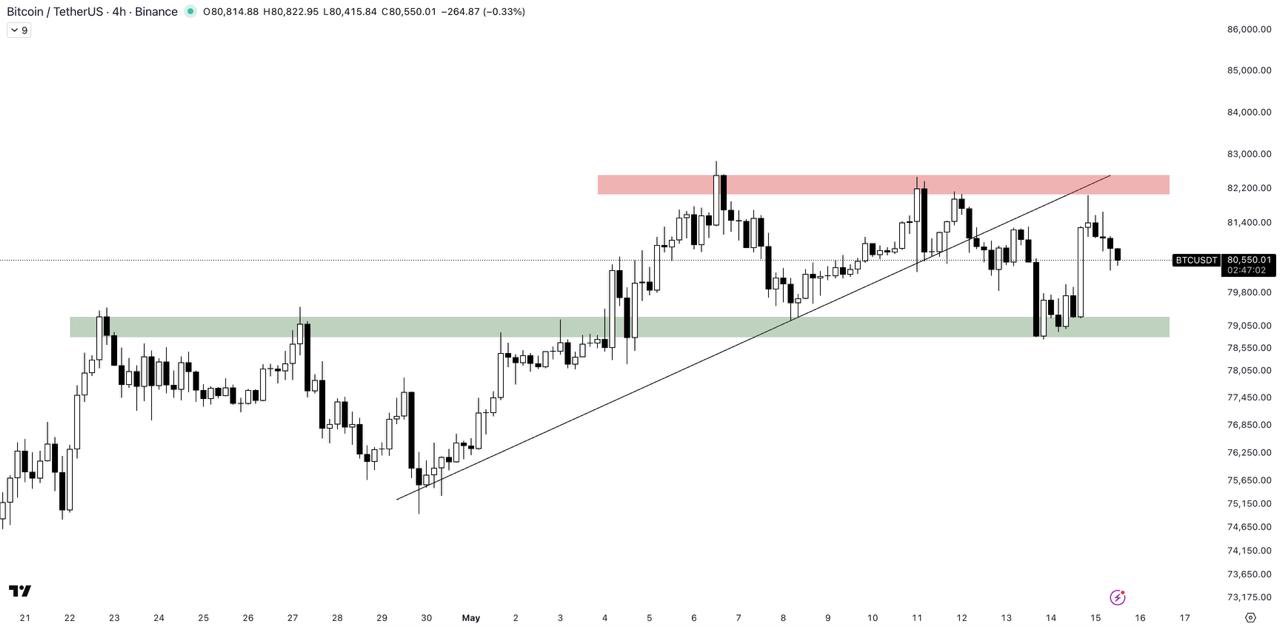
BTC/USDT four-hour chart. Source: Eric Coleman/X
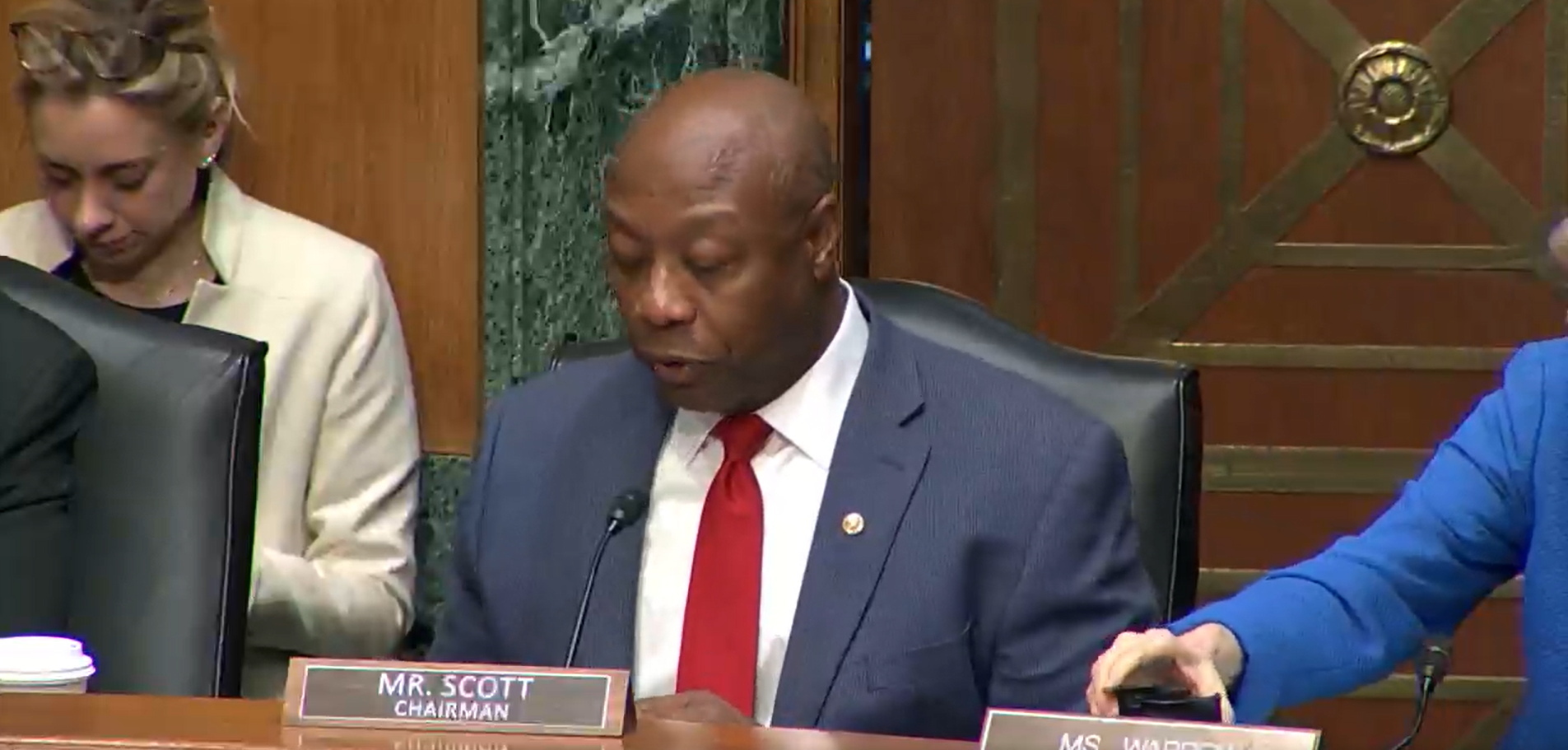
The US Senate Banking Committee passed the crypto framework CLARITY Act yesterday.
Now, the bill, for which the crypto industry has heavily lobbied since it was introduced in 2025, will head to the Senate floor for a broader debate.
As Cointelegraph reported, over 100 amendments were proposed while lawmakers hashed out the exact language of the bill. These covered a wide range of issues, including ethics, AI sandboxes and stablecoin yields.
But many of these fell apart. While two Democrats joined with their Republican colleagues, the vote was mainly along party lines.
The chances for the bill to pass look good, with nearly all Republicans and some Democrats supporting, but increasing partisan gridlock ahead of the elections could still delay passage.
CLARITY gets out of committee on party lines
After yesterday’s session, Senator and committee chairman Tim Scott announced “a successful bipartisan markup” in advance of the bill proceeding to the Senate floor.
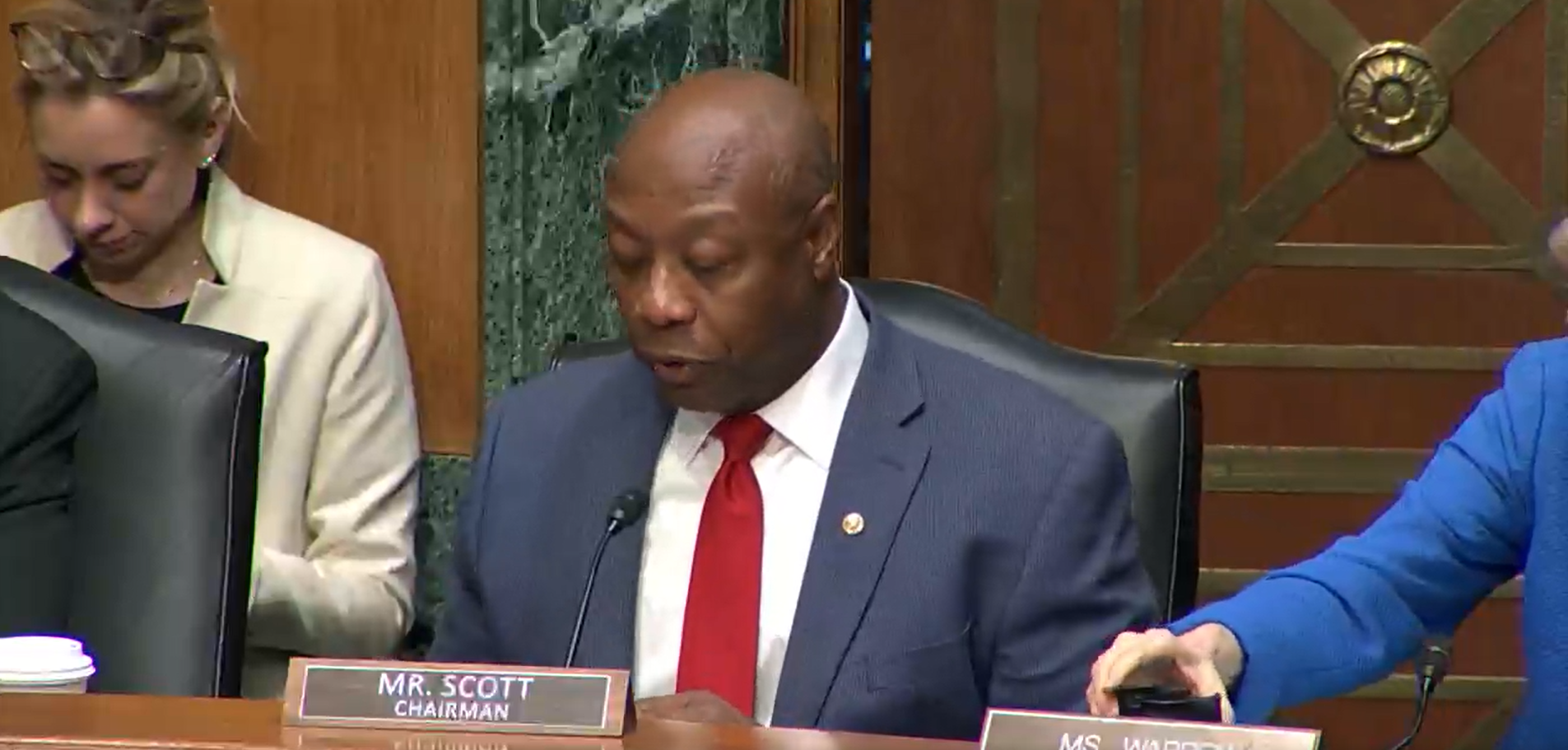
Scott speaks at the markup session. Source: US Senate
“After nearly a year of good-faith bipartisan negotiations, Senate Banking Committee Republicans and Democrats came together today,” he said.
While the tone of Scott’s announcement leaned on supposed bipartisanship, the actual vote was mostly split along party lines. All 13 Republican members of the committee voted to advance the bill. All but two Democrats voted against, save for Senators Ruben Gallego and Angela Alsobrooks.
Contrary to Scott’s message of bipartisanship, Senator Jack Reed stated that Republicans arbitrarily dismissed Democrats’ concerns about the bill, which ranged from how crypto could enable crime to the president’s use of crypto projects for personal enrichment.
Indeed, the minority released a brief after the vote, outlining its concerns. They stated that the current version, as passed by the majority, fails to adopt global anti-money laundering standards, exempts DeFi protocols from financial standards and doesn’t close loopholes for crypto mixer services.
Related: Who supports CLARITY on the US Senate Banking Committee?
While there are clearly some pro-crypto Democrats in Congress, whether the bill can progress depends on them crossing the aisle to vote against their own party.
Currently, the Republicans hold a 53-seat majority in the 100-seat Senate. To pass CLARITY, they’ll need 60 votes, so at least seven Democrats willing to vote with them.
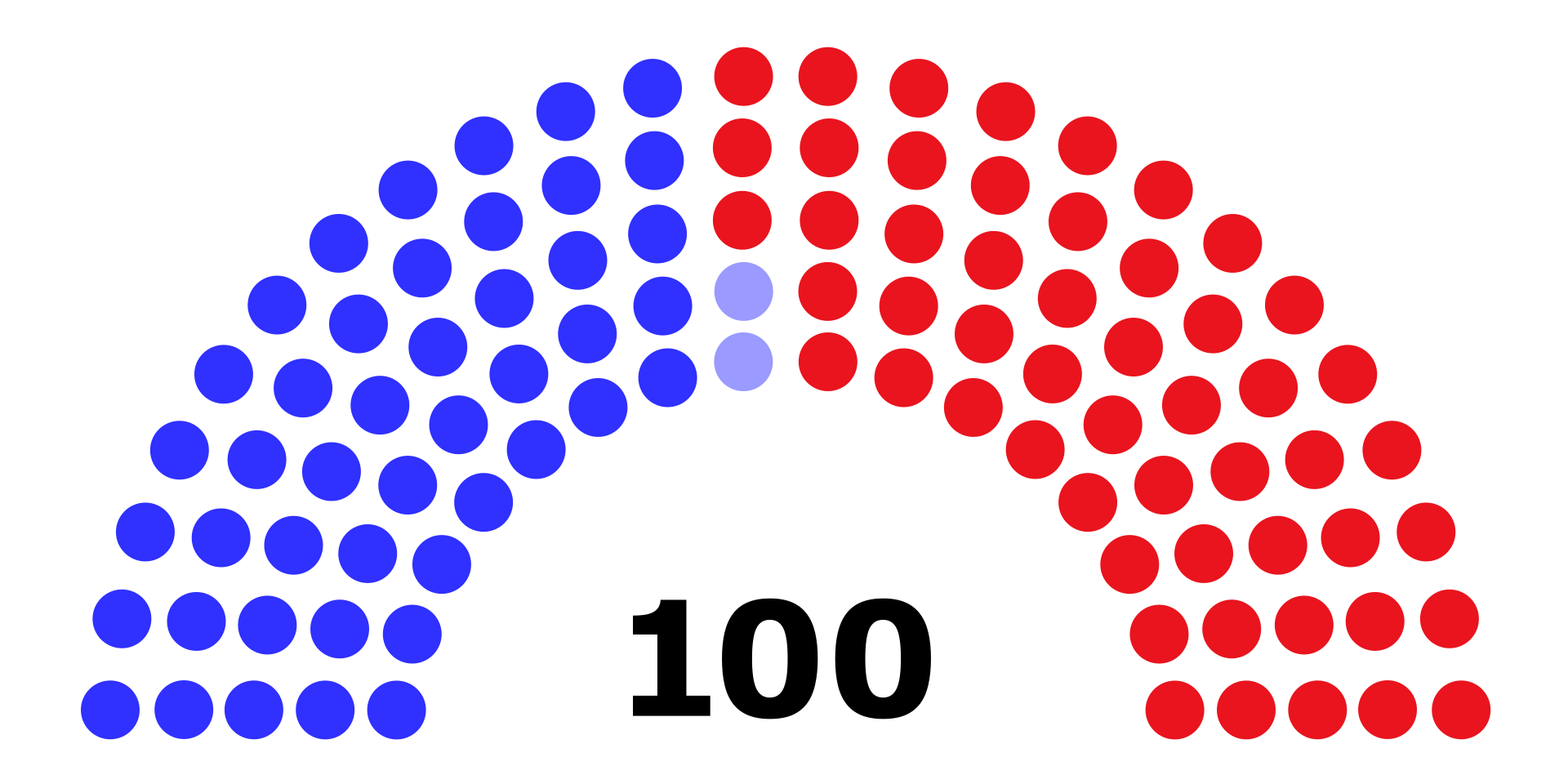
Republicans (red) hold a 53-seat majority in the Senate.
At the Wyoming Blockchain Summit last year, Scott said that there were 12 Democrats open to the market structure bill, giving Republicans and the crypto lobby what they need to cross the line.
But that may not ring as true now as it did then. The Congressional Progressive Caucus announced opposition to any bill which could “allow the President and his family to enrich themselves, engage in corruption, and sell access to the White House through cryptocurrency.” Notably, CLARITY’s current draft does not contain any such provisions.
Progressive groups have called on lawmakers to address these concerns. A group of organizations including Americans for Financial Reform, Demand Progress Action, Indivisible and Public Citizen wrote a letter on May 8.
“A bill without strong ethics provisions elevates the dangers of cheating consumers and investors, distorting and destabilizing financial markets, hindering competition, eroding longstanding investor protection laws, and making a mockery of regulatory enforcement,” they said.
Ryan Cooper, a senior editor at progressive politics publication The American Prospect, even suggested that Democrats who voted with the crypto industry ought to be primaried. “Allowing yourself to be bought by the crypto lobby is unforgivable,” he wrote.
Ethics could represent a politically volatile and important sticking point as the bill is debated on the Senate floor.
Industry still optimistic
Despite the largely partisan vote and the lingering ethics concerns, the crypto industry was largely optimsitc about the May 14 markup session.
Javier Martinez, CEO and former chief legal officer at crypto trading platform sFOX, said the vote represented a “major step toward resolving crypto’s regulatory identity crisis in the United States.”
Congress is “moving toward replacing regulatory ambiguity with a more defined legal framework. And markets respond to clarity,” he told Cointelegraph.
Ji Hun Kim of the Crypto Council for Innovation said the vote will make the US more competitive in the digital asset space. CLARITY will “ensure that our country leads when it comes to digital assets policy and innovation,” he said.
Blockchain investors and Blockstreet chief operating officer Kyle Chasse said, “This is the biggest regulatory moment in crypto since spot ETFs.”
Notably, the bill was held up for months as the banking and crypto lobbies argued over whether stablecoins could bear yields. Banks claimed this could lead to a critical flight of deposits, endangering financial stability, while crypto accused banks of stifling competition.
The version that passed markup last night sided with the banks, but would still allow crypto platforms to offer other activity-based rewards.
Even then, pseudonymous crypto trader 10 Delta said, “The yield ‘ban’ is cosmetic & simply something for banks to tout as a victory.”
“It bans stablecoins from paying you interest for just holding them: the way a savings account does. But it explicitly allows stablecoins to pay you rewards for using them: buying things, lending, providing liquidity, participating in any program.”
Ultimately, the focus is still on the market. Alexander Lorenzo, founder and chief investment officer of CoinPicks Capital, said, “The last crypto bill to clear this exact process was the GENIUS Act in July 2025. Bitcoin hit an all-time high of $123,000 within weeks.”
“CLARITY is bigger. It covers the entire crypto market, not just stablecoins.”
Magazine: eToro founder timed Bitcoin top perfectly due to belief in 4 year cycles
Market analysts say Ether (ETH) faces “downside risks” that could trigger another 20% downtrend toward $1,700, new analysis said.
Key takeaways:
- Rising Ether supply on exchanges and declining ETF inflows suggested a possible ETH price drop over the coming days.
- Ether’s rising wedge pattern projected a potential 22% drop to $1,725
ETH inflows to exchanges rise
Ether’s 40% recovery from multi-month lows below $1,800 was dampened by resistance from the $2,400 level.
Analysts have outlined several reasons for Ether’s inability to break $2,400, including “significant” inflows into exchanges, according to CryptoQuant analyst BorisD.
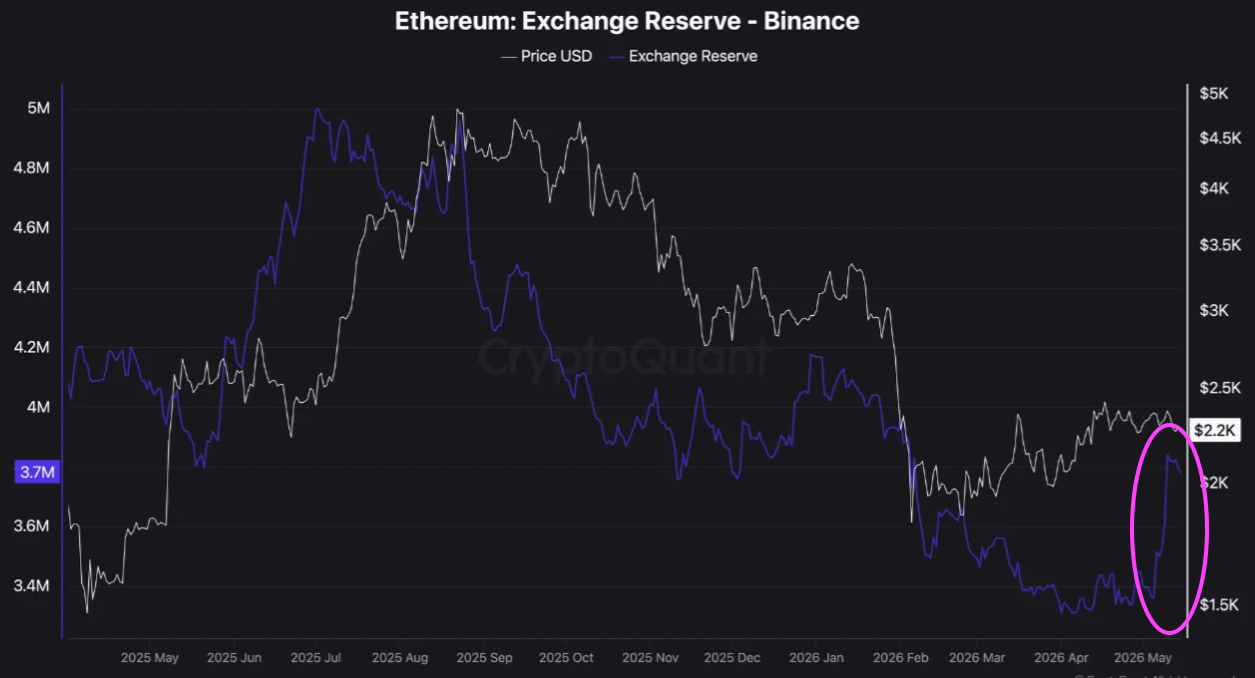
The chart below shows a sharp increase in ETH reserves held on Binance to 3.84 million from 3.36 million between May 5 and May 9.
The analyst explained that as inflows accelerated, the “price action failed to show strong continuation to the upside,” dropping 7% to $2,260 from $2,390 over the same period.
“This suggests that liquidity was being both absorbed and distributed within the range,” BorisD said, adding:
“The broader structure still points toward downside risk remaining dominant for now.”
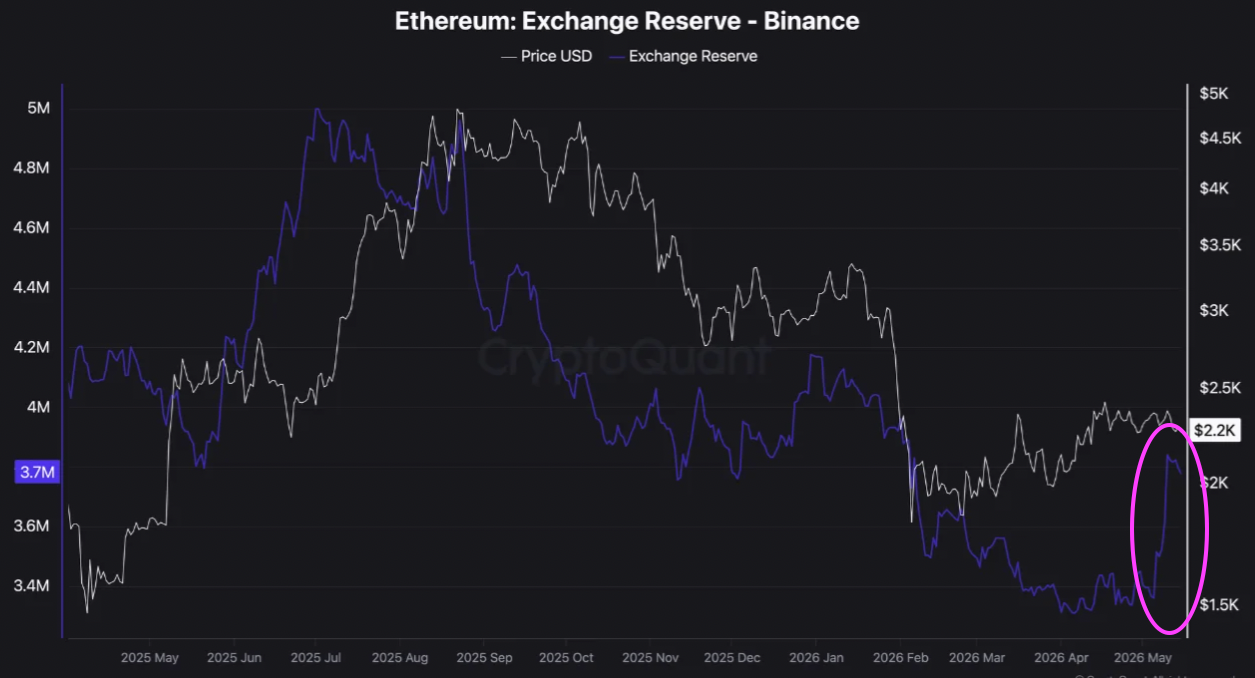
ETH exchange reserve on Binance. Source: CryptoQuant
While other analysts see potential for fresh upside in the coming days, “those moves may primarily serve distribution purposes rather than signal the start of a strong bullish trend,” the analyst added.
Making the same observations, fellow analyst PelinayPA said any short-term rebound in ETH would be “followed by high volatility, and then a continuation of the broader downtrend,” adding:
“The large amount of ETH being moved onto exchanges continues to create significant resistance against upward price movements.”
This coincided with sharp exchange inflows, as the Ether net position change among exchanges rose to 585,000 ETH on May 13, marking the largest spike since December 2025, when ETH was trading at $3,000. This preceded a 42% drop to $1,750 in February.
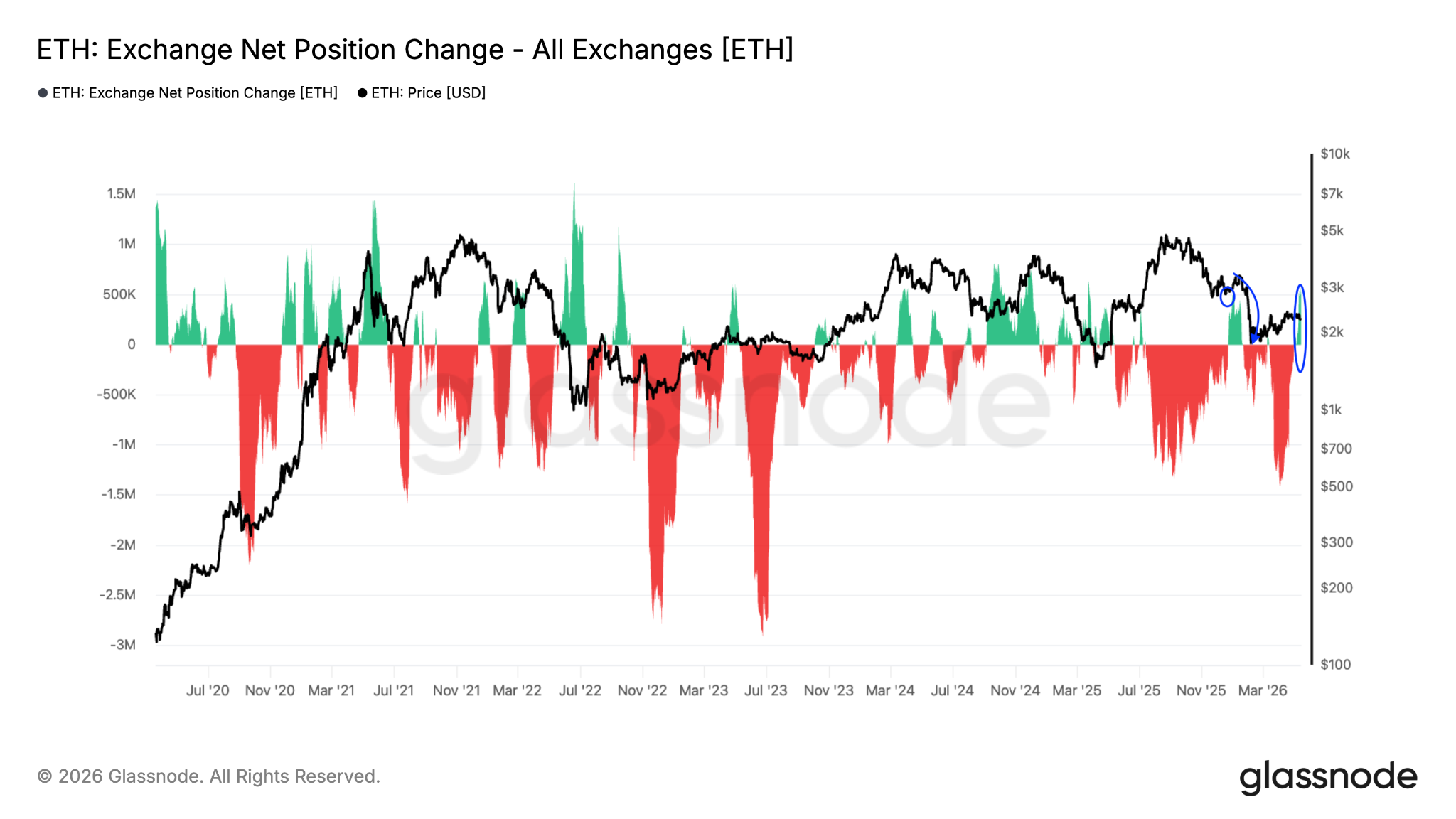
ETH: Exchange net position change
Such inflows typically indicate distribution by large holders, who move tokens from cold storage or redeem ETH investment products.
Meanwhile, demand for spot Ethereum ETFs continues to decline, with these investment products recording outflows for four consecutive days, totalling $190 million. This points to a drop in demand from US investors, adding to Ether’s headwinds.
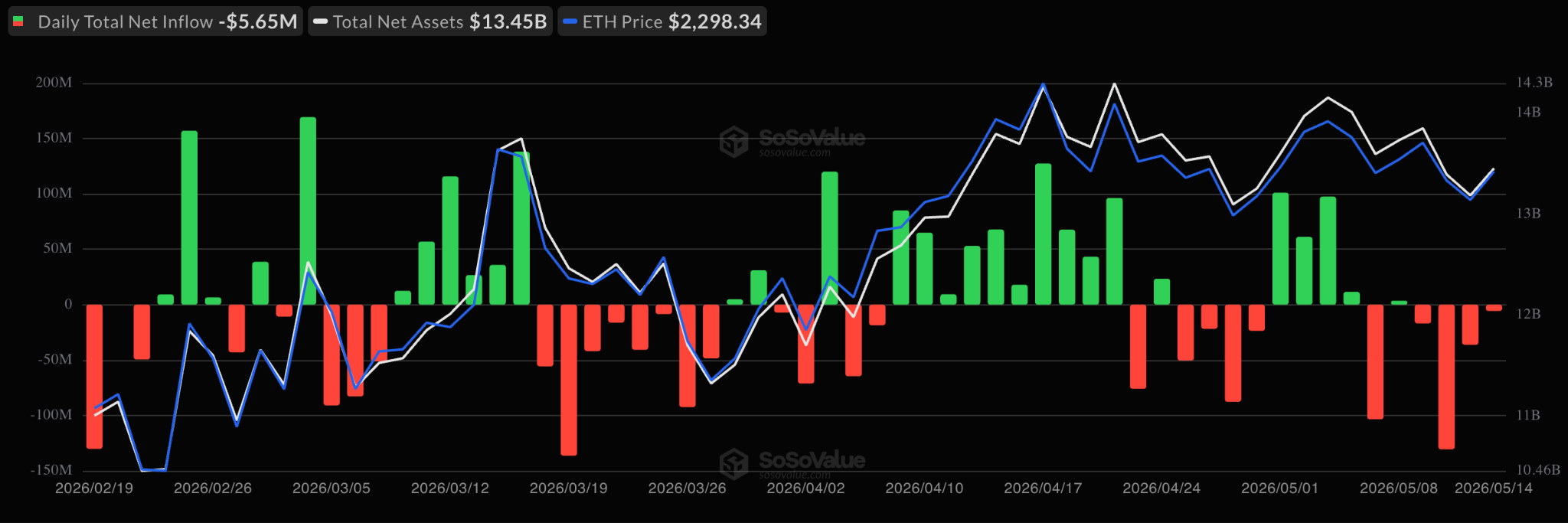
Spot ETH ETFs flows chart. Source: SoSoValue
Ether’s rising wedge targets $1,725
The daily chart shows ETH/USD validating a rising wedge breakdown, after the price breached the support provided by the lower trend line of the pattern at $2,280.
A daily candlestick close below this level will confirm the breakdown, clearing that path for Ether’s drop toward the wedge’s measured target at $1,725, representing 22% decline from the current price. This coincides with its previous macro low reached on Feb. 6.
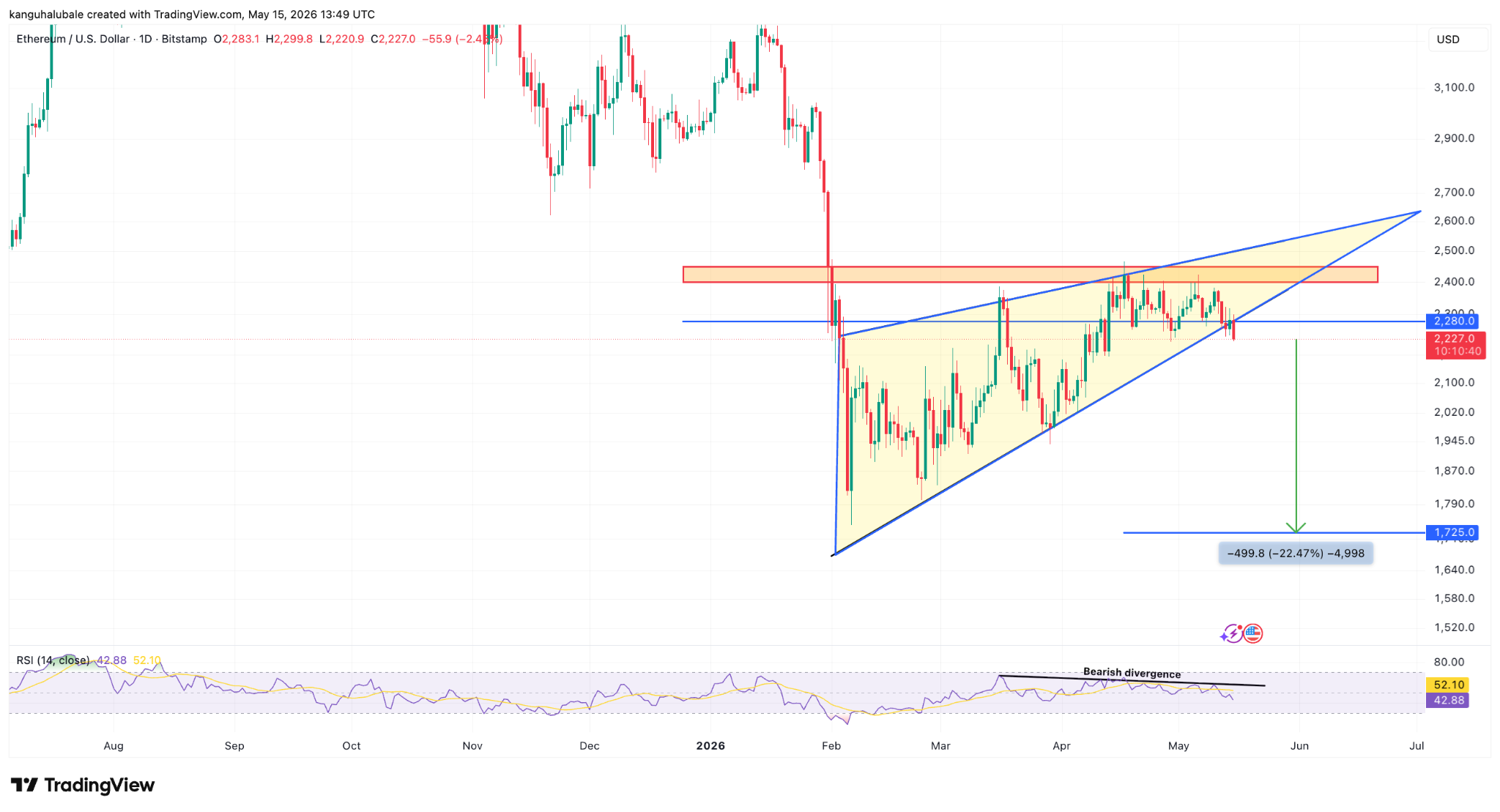
ETH/USD daily chart. Source: Cointelegraph/TradingView
Rising wedges are typically bearish reversal patterns, and Ether’s break below the pattern is “starting to become a concern,” analyst ShangoTrades said in a recent X post.
Zooming out, fellow analyst CryptoBullGod said ETH could drop to $1,280, which is the measured target of a bear flag, as shown on the weekly chart below.
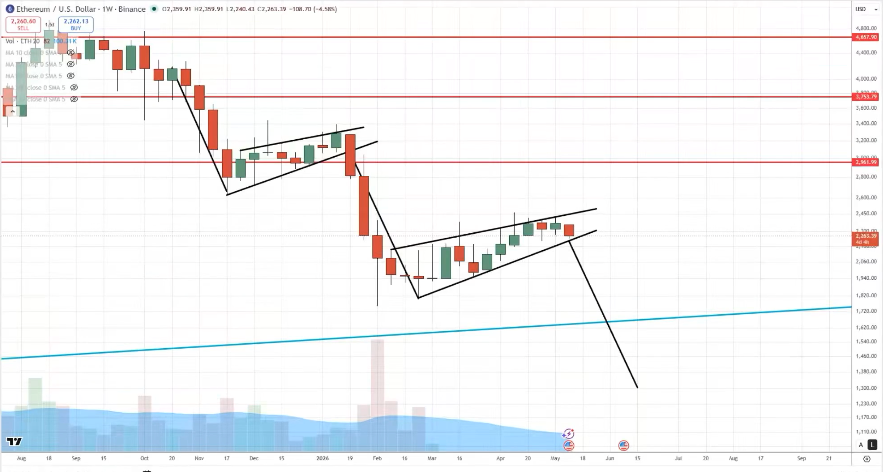
ETH/USD weekly chart. Source: CryptoBullGod
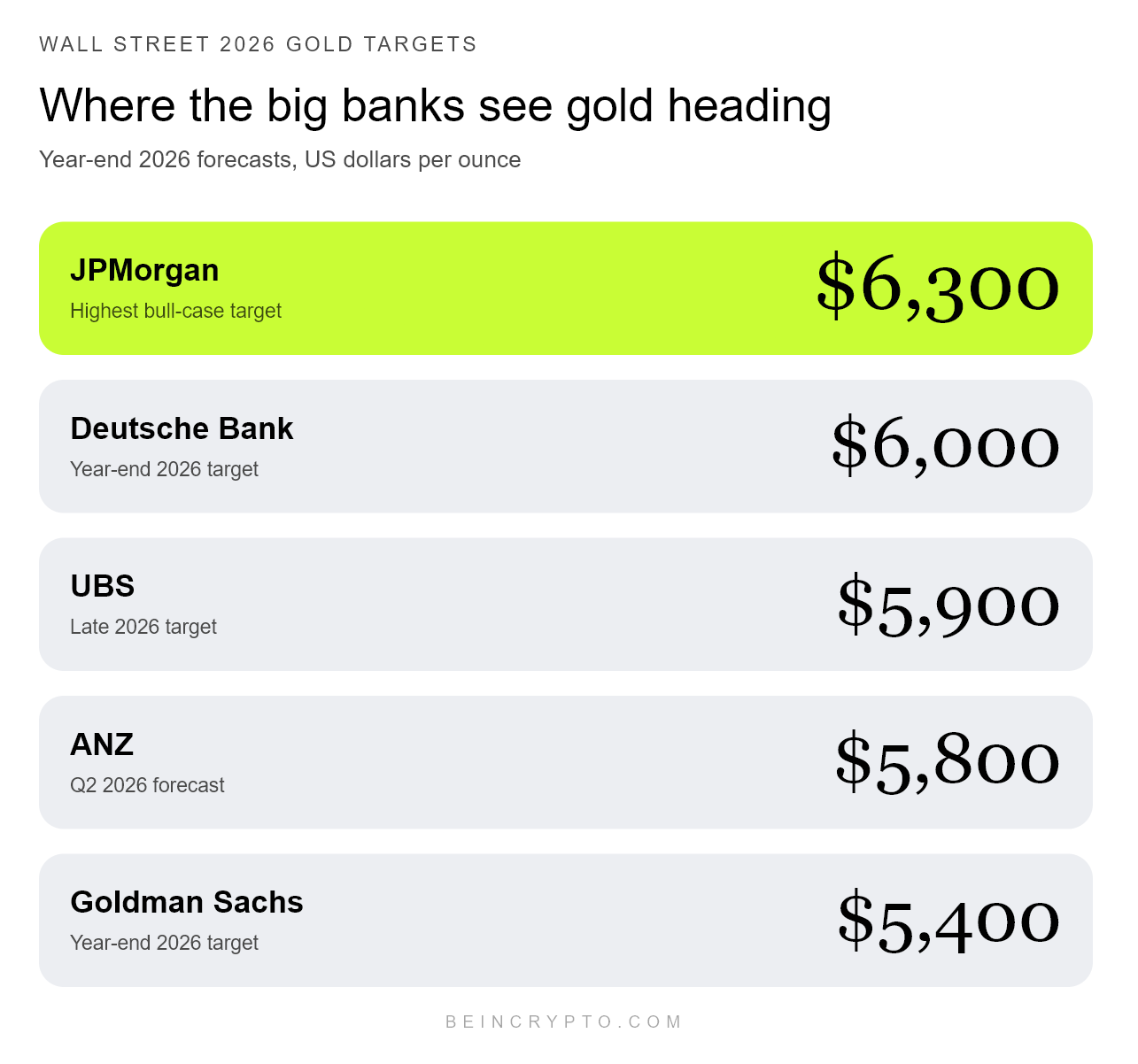
Wall Street’s biggest banks have set their boldest gold targets yet for 2026, and Russian retail investors are not waiting.
JPMorgan now sees gold reaching $6,300 per ounce by year-end. Deutsche Bank projects $6,000, while Goldman Sachs targets $5,400 and UBS forecasts $5,900.
These calls land at a striking moment. Gold trades near $4,548, down roughly 16% from its January record all-time high. Most analysts call the pullback a buying opportunity inside a structural bull market.

Russians are Buying Gold Fast
Meanwhile, Russian investors are moving fast. The Moscow Exchange reported gold trading volume of 42.6 tonnes in March 2026, more than 3.5 times higher than a year earlier.
Monetary volume jumped fivefold to 534.4 billion rubles ($7.1 billion).
Russians now have five main ways to gain exposure. The simplest is an unallocated metal account (OMS) at a bank. Brokerage instruments like GLDRUB_TOM offer next-day spot settlement.
Investors can also choose exchange-traded gold funds, gold-mining stocks, or new digital financial assets (DFAs) tied to the metal.

Oleg Reshetnikov of BCS World of Investments says spot instruments lead the pack.
“The most convenient way for Russians to invest in gold and silver is the instruments ‘Gold for Rubles’ and ‘Silver for Rubles’ with next-day settlement,” Reshetnikov said.
His firm targets $5,385 in the next 12 months.
For smaller budgets, brokerage apps have opened the door.
“The easiest thing today is to buy gold from a broker,” portfolio manager Alexander Ryabinin of SF Education said. “Tinkoff Gold can be bought for 13 rubles, right in the broker’s app.”
Still, experts urge diversification across formats.
“One should not glorify a single channel but combine them — part in digital form for turnover, part on the exchange, and if necessary a small physical layer as insurance,” said Rais Ismagilov of AVI Capital.

However, risks remain. April US inflation hit 3.8%, the highest in a year, pushing back expected Fed rate cuts. India also raised gold import tariffs to 15%, cooling physical demand.
And Russia’s own central bank has been a net seller, offloading 22 tonnes in 2026 to plug budget gaps.
For now, though, retail demand keeps rising, and Wall Street keeps lifting its gold price prediction.
The post Wall Street’s Boldest Gold Prediction Has Russians Rushing to Buy appeared first on BeInCrypto.

The military government of Myanmar released the text of a bill aimed at combating online fraudsters, with several penalties related to cryptocurrencies and scam centers.
According to the text of the Anti-Online Fraud Bill, made public on Thursday, Myanmar’s parliament, the Pyidaungsu Hluttaw, proposed the law in response to online fraud in the country, which it said challenged its “sovereignty and stability.”
The law stated that anyone who was convicted of committing “digital currency fraud” or online fraud could face from ten years to life in prison, and possibly the death penalty.
In addition, the law set out conditions under which the death penalty would be imposed, including those related to the country’s scam centers. Anyone responsible for the death of an individual who had been coerced or exploited into committing online fraud would receive a sentence of death.

Source: Myanmar government
The proposed law and its potential penalties were some of the most severe imposed globally for digital currency fraudsters amid scam centers cropping up in areas of Southeast Asia. In January, China reportedly ordered the execution of 11 people linked to Myanmar scam centers that had been responsible for trafficking Chinese nationals.
Related: Scammers use Gmail dot alias trick to spoof Robinhood in phishing scam
International authorities have been working to combat human trafficking in scam centers that continue to con people globally through schemes like pig butchering, romance scams, fake investments and more. The US announced in April that they had worked with authorities in China and Dubai to arrest more than 200 people and shutter nine centers.
Myanmar’s military overthrew its civilian government in a 2021 coup d’état, resulting in its parliament not reconvening until March 2026 following elections the Council on Foreign Relations called “neither free nor fair.” According to a Wednesday notice, the government is scheduled to meet the first week of June and may consider the bill at that time.
Americans lost billions to crypto scams in 2025
According to an FBI report released in April, Americans’ losses from crypto-related scams were more than $11 billion in 2025 and more than $20 billion overall through online fraud. The agency cited a March executive order from US President Donald Trump, who authorized officials to work against “scam centers and cybercrime.”
“The [US Attorney’s Office in the District of Columbia] Scam Center Strike Force is investigating the worst scam compounds located in Southeast Asia,” said the FBI report. “Strike Force teams focus on identifying and pursuing key leaders—including Chinese organized crime affiliates operating in Cambodia, Laos, and Burma—to bring them to justice.”
Magazine: ETH stalls at $2.4K five times, SOL to rally to $120: Market Moves


Myanmar’s military published a draft bill on May 14 proposing life in prison for crypto scam operators.
Summary
- Myanmar’s Anti-Online Scam Bill proposes life imprisonment for operating digital currency scam centers.
- The bill allows the death penalty for individuals using violence, torture or unlawful detention to force victims into scam work.
- Myanmar’s military-backed parliament is next scheduled to sit in the first week of June to advance the legislation.
The draft legislation, called the Anti-Online Scam Bill, states that anyone convicted of “digital currency fraud” or running an online scam center faces a sentence ranging from ten years to life in prison.
The bill permits capital punishment for operators who use “violence, torture, unlawful arrest and detention, or cruel treatment against another person for the purpose of forcing them to commit online scams.”
Military bill targets digital currency fraud with maximum sentences
Myanmar’s military-backed parliament, which analysts describe as a rubber-stamp legislature, is next scheduled to sit in the first week of June.
The bill is the first piece of legislation introduced by the new government led by coup leader Min Aung Hlaing, who assumed the civilian presidency last month.
Internet fraud compounds have become a major regional crisis. The FBI reported that cryptocurrency-related fraud losses in the United States reached $11.4 billion in its most recent crime report, with more than half of all internet crime losses tied to crypto schemes. Many of the networks behind those losses operate out of Southeast Asian compounds.
US authorities have escalated enforcement pressure. The DOJ froze $701 million in crypto tied to global scam networks in April 2026, naming Myanmar and Cambodia-based compounds that rely on trafficked or coerced workers to execute large-scale fraud.
The scale of Myanmar’s operations is well-documented. Chainalysis found that romance scammers operating from the KK Park compound in Myawaddy alone siphoned nearly $100 million in crypto from global victims between 2022 and 2024.
The bill is part of a broader regional shift. Cambodia adopted anti-fraud legislation in March 2026 with prison sentences up to 10 years for ringleaders. Singapore plans to launch a dedicated Cyber Command enforcement unit in July 2026.
Crypto World
BeInCrypto 100 Institutional Awards Nomination: KuCoin for Leader in Digital Asset Adoption and Best Trading Infrastructure


Digital asset adoption is moving into a more practical phase. The question is no longer which exchange has the loudest retail brand. It is which platform can give brokers, fintechs, institutions, and traders the infrastructure to connect with digital asset markets at scale.
KuCoin is nominated for Leader in Digital Asset Adoption and Best Trading Infrastructure at the BeInCrypto Institutional 100 Awards 2026.
Adoption Metric
Last Verified Data
Registered users
40M+
Active footprint
200+ countries and regions
Broker and fintech partners
1,000+
Regulatory footprint
AUSTRAC registration, MiCAR-CASP via KuCoin EU
Payment products
KuCoin Pay, KuCard
KuCoin Institutional Infrastructure Snapshot
The nomination reflects KuCoin’s shift from a retail trading venue to a broader liquidity and infrastructure provider. The exchange says it has surpassed 40 million users worldwide, while its institutional business now serves more than 1,000 broker and fintech partners.
In a BeInCrypto adjudication interview, Alison Qin, Head of KuCoin Institutional & VIP, described the change clearly.
“The industry has recognized that retail attention is transient, but infrastructure is foundational. KuCoin has fundamentally outpaced traditional retail marketing by transforming into a high-fidelity liquidity engine for over 1,000 brokers and fintech partners,” Qin said.
| Infrastructure Metric | Last Verified Data |
| Unified Trading Account | Spot, futures, and margin assets in one capital pool |
| OES integrations | BitGo Singapore Go Network, Cactus Custody, Ceffu MirrorX |
| RWA collateral framework | RCMS with UBS uMINT and Asseto CASH+ |
| Crypto-as-a-Service | Nearly 80 partners globally with liquidity solutions across partner ecosystems |
| Collateral support | BTC, ETH, and tokenized RWA assets |
Same Firm. Two Scoring Sheets
KuCoin’s dual nomination rests on two linked stories.
For Leader in Digital Asset Adoption, the case centers on distribution. KuCoin operates across more than 200 countries and regions, supports payment products such as KuCoin Pay and KuCard, and has expanded its regulated footprint through AUSTRAC registration in Australia and a MiCAR authorization for KuCoin EU in Austria.
The MiCAR approval allows KuCoin EU to offer regulated crypto-asset services across the European Economic Area.
For Best Trading Infrastructure, the case centers on how KuCoin is changing the way institutions access liquidity.
The clearest example is its Off-Exchange Settlement framework. Institutional clients can trade on KuCoin while keeping assets with a qualified custodian.
KuCoin has live integrations with BitGo’s Go Network and Ceffu’s MirrorX, both designed to reduce prefunding and counterparty risk by separating custody from exchange execution.
That matters because institutional traders don’t just need an order book. They need custody separation, settlement controls, collateral efficiency, and execution access that fit regulated workflows.
The UTA Advantage
KuCoin’s infrastructure nomination also centers on its Unified Trading Account, launched in 2026.
UTA allows traders to consolidate spot, futures, and margin assets into a single account. KuCoin says the system supports shared margin, integrated risk management, and lower-latency order placement, cancellation, and message updates for professional and high-frequency traders.
“When our Unified Trading Account architecture is paired with global data transparency, it levels the playing field,” Qin said. “We don’t ask for trust; we provide the data that makes trust inevitable.”
That data layer expanded in April 2026, when KuCoin made its futures market data available on TradingView. The integration gives TradingView’s 100 million-plus users access to KuCoin perpetual futures symbols, real-time market data, and liquidity insights directly inside TradingView charts.
Turning RWA Collateral Into Trading Infrastructure
KuCoin’s strongest institutional story is its RWA Collateral Mirroring Solution, or RCMS.
Through the framework, institutions can use tokenized real-world assets as trading collateral without moving the underlying assets out of their regulated structure.
In 2025, KuCoin partnered with DigiFT to support UBS uMINT, a tokenized money market fund product, as off-exchange collateral. DigiFT described the integration as a way for tokenholders to use their funds as collateral through KuCoin’s mirroring program while improving capital efficiency.
KuCoin later expanded the framework with Asseto’s CASH+, a tokenized product linked to a USD money market fund. KuCoin Institutional said the integration helps institutions deploy capital across traditional and digital markets while preserving yield and maintaining asset control.
This is where KuCoin’s two nominations overlap. Adoption is no longer only about user growth. It is about whether real financial instruments can move into the crypto market structure without breaking custody, compliance, or collateral rules.
The BeInCrypto Institutional 100 Awards recognize firms building the systems that could define the next phase of digital finance.
KuCoin’s nomination reflects its role in turning exchange infrastructure into a bridge for brokers, institutions, tokenized assets, and global digital asset users.
The post BeInCrypto 100 Institutional Awards Nomination: KuCoin for Leader in Digital Asset Adoption and Best Trading Infrastructure appeared first on BeInCrypto.

Key Takeaways
- Bank of America’s Justin Post predicts Google will reveal an advanced Gemini LLM at its May 19 I/O conference
- The upgraded Gemini version may feature enhanced reasoning capabilities, improved coding functions, multimodal processing, and extended context windows
- Agentic AI functionality is anticipated as the central focus, featuring enhanced integration throughout Chrome, Gmail, Maps, and Android platforms
- BofA reaffirms its Buy recommendation with a price objective of $430, suggesting approximately 8% potential gains
- Elevated market expectations present downside risk if product reveals fail to impress investors
Alphabet’s marquee Google I/O developer event is set to launch on May 19, and financial analysts are positioning for what’s expected to be a significant showcase.
Justin Post, an analyst at Bank of America, outlined his projections in a Friday research note, indicating he foresees a comprehensive suite of artificial intelligence reveals focused on Gemini technology and autonomous agent functionality.
GOOGL shares declined 0.96% on Friday in anticipation of the upcoming conference.
Bank of America projects Google will introduce a cutting-edge iteration of its Gemini large language model—possibly designated as version 4 or a substantial 3.X enhancement. This forthcoming model is anticipated to deliver advances in logical reasoning, programming capabilities, multimodal functionality, and extended context processing.
Additionally, more efficient and cost-effective Flash versions are expected, alongside enhanced models designed for video creation, image synthesis, and audio generation.
Autonomous AI Agents Expected to Dominate Conference
Agentic AI is projected to serve as the primary focus of the developer conference. Industry reports indicate Google is developing autonomous task execution features spanning Chrome, Gmail, Maps, Calendar, Search, and Android operating systems.
This evolution means Gemini could handle restaurant bookings, calendar modifications, form completion, and e-commerce workflows—all with minimal user intervention.
Chrome browser functionality is particularly highlighted. AI-enhanced browsing may enable Gemini to directly engage with web platforms and execute complex multi-step processes, though transaction approval would still require user authorization.
Google might also enhance its AI assistant with persistent memory features, real-time camera interaction capabilities, and proactive contextual assistance.
Search Evolution and Wearable Technology Updates Expected
Regarding search functionality, Post anticipates improvements to AI Mode features, framing it as a complimentary AI assistant offering superior personalization and cross-application integration.
Smart glasses capabilities are also projected to receive significant coverage, with Post observing that developments in this category could generate interest ahead of a possible second-half product launch.
Post indicates that ongoing Gemini advancements would bolster Google Cloud platform adoption and consumer interaction—two metrics under close market scrutiny.
However, he acknowledges that widespread implementation of autonomous agent systems will likely require years rather than months. Users will continue prioritizing efficiency and affordability from specialized applications.
“We would expect Booking and Expedia to be key partners in any agentic announcements around travel, while we would not expect Amazon to be an early partner for eCommerce,” Post said.
With Google shares trading around 27x projected 2027 earnings, Post suggests “AI surprises” will probably be necessary to drive valuation multiples higher.
Post identifies one notable risk: investor expectations entering I/O are considerably elevated. Should the product announcements disappoint, the stock could experience short-term selling pressure.
Bank of America upheld its Buy rating alongside a $430 price objective. This target represents approximately 8% appreciation potential from present trading levels.
Wall Street’s consensus price target stands at $426.44, similarly indicating roughly 7% upside potential. Among 33 analysts tracking the stock, 28 assign it a Buy rating while 5 recommend Hold. The overall consensus ranks as Strong Buy.


MJ GOAT Debate Far From Over Despite Lakers Elimination

House Panel Urges Trump to Nominate CFTC Members Under CLARITY Act

Nick Aldis announces current WWE champion isn’t cleared to compete; scraps match

Manchester United reach agreement with Casemiro over contract clause amid transfer speculation

US brings back mandatory military draft registration

Steven Gerrard disagrees with Gary Neville over ‘shock’ Chelsea and Arsenal claim | Football


-

 Fashion4 days ago
Coffee Break: Travel Steam Iron
-

 Politics7 days ago
Politics Home Article | Starmer Enters The Danger Zone
-

 Fashion5 days ago
What to Know Before Buying a Curling Wand or Curling Iron
-

 Politics4 days ago
What to expect when you’re expecting a budget
-

 Tech6 days ago
Auto Enthusiast Carves Functional Two-Stroke Engine from Solid Metal
-

 Fashion7 hours ago
Weekend Open Thread: Theory – Corporette.com
-
 Business7 days ago
Ignore market noise, India’s long-term story intact, say D-Street bulls Ramesh Damani and Sunil Singhania
-

 Tech5 days ago
GM Agrees To Pay $12.75 Million To Settle California Lawsuit Over Misuse Of Customers’ Driving Data
-

 Crypto World7 days ago
PROS explodes 48% as Upbit and Bithumb listings ignite demand
-

 Crypto World6 days ago
CZ says US crypto rivals tried to block Trump pardon
-

 Tech19 hours ago
Tech Moves: Microsoft AI leader jumps to OpenAI; former AI2 exec joins Meta; and more
-

 Tech4 days ago
GM agrees to $12.75M California settlement over sale of drivers’ data
-
Crypto World3 days ago
Bitcoin Suisse expands with Digital Asset License and Investment Business Act Registration Approval in Bermuda
-

 Crypto World6 hours ago
E-Estate Announces 1 Year Live: Washington DC Summit as Real Estate Tokenization Enters Its Next Phase
-

 Politics3 days ago
Pakistan to enter Chinese capital market as war inflation bites
-
 Crypto World7 days ago
Pi Network Hits 421K Mainnet Nodes Ahead of Protocol 23 Smart Contract Launch
-
 Crypto World1 day ago
Google’s Gemini AI Predicts Incredible Solana Price by the End of 2026
-

 Entertainment7 days ago
Pooh Shiesty Pleads Not Guilty In Gucci Mane Kidnapping Case
-
 Sports7 days ago
‘Not bothered’ – Michael Carrick gives update on Manchester United head coach role
-

 Crypto World3 days ago
Bitcoin Suisse expands with Digital Asset License and Investment Business Act Registration Approval in Bermuda
You must be logged in to post a comment Login