

Crypto World
Strategy (MSTR) sold bitcoin in late May, and told the market in June. Here’s how Polymarket bettors are fighting over when it counts.



The Polymarket contract asked a simple question: did Strategy (MSTR) sell any bitcoin by May 31? The company’s filing says it sold 32 BTC between May 26 and 31. The filing came out June 1. That gap has split bettors into a $79 million fight over whether a sale counts when it happens, or when it’s confirmed.
The dispute turns on a single ambiguity: the rules ask whether Strategy sold bitcoin “by 11:59 PM ET” on May 31, but they don’t say whether that means the sale must have occurred by then or been confirmed by then.
Strategy executed the trades between May 26 and 31 and dated the activity “as of May 31, 2026, 4:00 p.m. Eastern Time” — inside the window. But the 8-K disclosing them wasn’t filed until June 1, after the market closed. So the sale date falls before the deadline; the filing date falls after it. Which one governs is the whole fight.
The fight breaks into three camps, and it plays out in the language of UMA’s voting options. One says the market is event-based and should resolve “Yes” (P2), because Strategy’s own filing dates the sale inside the deadline.
Another says it is effectively announcement-based and must resolve “No” (P1), because nothing confirmed the sale before the market closed. A third invokes P4 — the “too early” vote, meant for proposals made before an event has occurred — arguing the rules were too vague to resolve until Strategy’s filing landed.
CoinDesk went through the dispute threads on both Polymarket and UMA’s Discord channels, and with the assistance of AI, summarized the arguments the different camps are making.
The ‘Yes’ case: the sale is what matters
This camp reads the market as event-based, pointing to rules that resolve “Yes” if the firm “sells any of its Bitcoin” by the deadline, with no requirement that the sale be announced by then.
Their evidence is Strategy’s own disclosure, which lists the 32 BTC as sold “during period May 26, 2026 to May 31, 2026” and presents the activity “as of May 31, 2026, 4:00 p.m. Eastern Time” — inside the window. Because the rules name “information from MSTR” as the primary resolution source, they argue, the source itself confirms the sale.
Several add that Strategy reports weekly, usually on Mondays, so a late-month sale could never be confirmed before a month-end deadline — making a “No” reading a bet on filing schedules rather than events.
The ‘No’ case: only what was knowable by the deadline counts
This camp treats the market as announcement-gated, citing past Polymarket markets that resolved using only information available within the timeframe. The 11:59 p.m. ET deadline, they argue, defines a closed window: new information can always arrive later, but it doesn’t reach back to change a settled outcome, and nothing had confirmed a sale when the answer was proposed June 1.
Some note that the “as of May 31” language the other side leans on only surfaced in that day’s filing. Underpinning it is an integrity argument — that if a dispute can hold a market open until favorable evidence appears, anyone could extend any deadline for the price of a bond.
The ‘too early’ case: the rules can’t resolve this yet
A smaller group argues the market was too poorly drafted to resolve cleanly either way, noting the rules require the sale to occur “on the date specified in the title” rather than “by” it, leaving no coherent timeframe.
With Strategy’s filing due imminently and named as the primary source, this camp contends the market should have stayed open until that disclosure published rather than being resolved on a deadline they consider malformed. The “No” camp’s reply: P4 doesn’t apply, because the sale itself predates the deadline — the proposal wasn’t early, the confirmation was just late.
Polymarket’s clarification, and the catch
Polymarket has since added context backing the “No” reading, stating that no information from MSTR, on-chain data, or credible reporting confirmed a sale within the timeframe and that “confirmation achieved outside of the market’s time frame does not qualify.” Traders priced it accordingly, with the May 31 contract collapsing from 81% “Yes” during the dispute to under 1%.
But Polymarket doesn’t cast the final vote — UMA’s token holders do, and the two have split before. In 2024, UMA voted that Barron Trump wasn’t involved in the DJT memecoin; Polymarket overruled the oracle and refunded “Yes” holders anyway. For now, the two appear aligned.
The sale everyone can see is trading at less than a penny.


Nvidia is reportedly preparing a major debt raise aimed at funding artificial intelligence infrastructure, a move that further highlights how capital markets are backing the AI buildout—even as some crypto-native miners search for ways to use the same power and data-center assets for non-crypto computing demand. Bloomberg reported on Monday that Nvidia is seeking to raise at least $20 billion through a multi-part bond offering, which would finance AI-related investments and refinance existing debt.
The reported structure points to the scale of Nvidia’s ambitions and the continuing appetite from investors for long-dated, “high-grade” corporate financing tied to AI growth. For the crypto industry, the development matters because it reinforces the broader trend of miners pivoting toward AI hosting and high-performance computing—an area where electricity, cooling, and server capacity can be leveraged beyond Bitcoin.
Key takeaways
- Nvidia is reportedly targeting at least $20 billion in a multi-maturity bond sale to fund AI investment and refinance debt, according to Bloomberg.
- The longest-dated notes are expected to price around 0.9 percentage points above comparable U.S. Treasury yields, per the report’s description of expected pricing.
- Nvidia’s GPU dominance makes its capital spending plans a key barometer for AI infrastructure demand across hyperscalers and cloud providers.
- Bitcoin miners have increasingly looked to AI hosting and data-center services as Bitcoin mining economics face margin pressure after the April 2024 halving.
- Industry data cited in the article suggests miners have been selling significant portions of their BTC holdings, aligning with a push to diversify revenue streams.
Nvidia’s reported $20 billion debt plan reflects AI infrastructure demand
Bloomberg, citing people familiar with the matter, said Nvidia is kicking off its first high-grade bond offering since 2021 and plans to sell notes across seven maturities ranging from two to 30 years. The report also described pricing expectations for the longest-dated bonds, indicating yields roughly 0.9 percentage points above comparable U.S. Treasuries.
While the immediate story is about corporate financing, the underlying message is about what investors are willing to underwrite: companies at the center of AI supply chains that can convert demand for computing power into sustained revenue. Nvidia’s GPUs are widely used to train and run large language models, and its role ties capital expenditures by cloud providers and AI users directly to the semiconductor ecosystem.
That makes Nvidia’s bond plans more than routine fundraising. When a major infrastructure supplier raises substantial long-term capital for AI initiatives, it signals confidence that demand for accelerated computing, data-center buildouts, and related capacity will persist long enough to justify multi-year funding.
Miners are repurposing power and data-center assets for AI
Bitcoin mining has historically depended on energy-intensive operations and the ability to monetize block rewards and transaction fees. As competition and operating costs rise, some operators have pursued a different angle: using existing power infrastructure and data-center capabilities to support AI hosting and other high-performance computing workloads.
According to the article, companies that previously relied heavily on Bitcoin mining revenue—including HIVE Digital, TeraWulf, Hut 8, and CleanSpark—have been positioning themselves to provide data-center capacity. The core logic is straightforward: if a miner already has power agreements, cooling systems, and space designed for constant compute workloads, it can redeploy that infrastructure toward customers needing compute resources outside of crypto.
That shift also reflects a sector-level asymmetry. AI demand is not constrained to the same cycles as crypto markets, while electricity remains a key input in both ecosystems. For miners with surplus or underutilized hosting capacity, AI can become a way to reduce dependence on the volatility of Bitcoin’s price and mining difficulty.
Why Bitcoin mining economics are pushing diversification
The pivot toward AI has accelerated as the economics of core mining have come under strain. The article notes that margin pressure has worsened following the April 2024 halving, when Bitcoin’s block reward was cut—an event that reduced revenue per unit of work while mining difficulty and operating costs remained challenging.
Analysts cited in the piece characterized the environment as unusually harsh, with many miners responding by trimming exposure: selling parts of their Bitcoin treasuries, reducing leverage, and looking for new revenue streams. These actions are consistent with businesses trying to stabilize cash flow while the “payoff per share of hashrate” is less generous than it was pre-halving.
Supporting data referenced in the article comes from TheEnergyMag. It states that Bitcoin miners collectively sold more than 15,000 BTC between October and March. The report further describes an acceleration after October, when BTC peaked above $126,000, suggesting that the cash and liquidity pressures did not ease as markets moved.
For investors, the operational implication is that mining companies are being forced to choose between competing priorities: maintaining mining activity while retooling business models to monetize the same infrastructure through AI- and data-center-adjacent services.
AI infrastructure expectations are spreading beyond semiconductors
Nvidia’s bond plan underscores that traditional and AI-native financing channels are funding the AI compute buildout. But for crypto miners, the question is whether they can translate their infrastructure into stable AI-related revenue at scale.
The article points to analyst expectations from Bernstein, which reportedly expects IREN to derive the vast majority of its value from AI infrastructure rather than from Bitcoin mining. While that specific forecast is tied to a single company, it reflects a broader industry narrative: miners are increasingly evaluated not only as holders of mining assets, but as potential operators of compute capacity.
That shift also changes how market participants assess risk. Bitcoin mining revenue depends on a combination of Bitcoin price, network difficulty, and operational efficiency, while AI hosting revenue depends more on customer demand, contract terms, and the ability to deliver usable compute capacity competitively. Nvidia’s financing move, meanwhile, suggests the upstream supply chain for AI infrastructure is continuing to attract capital—an important backdrop for miners trying to secure demand.
As these stories converge, readers should watch for two practical indicators: whether miners secure meaningful AI hosting contracts (and at what margins), and whether debt and funding costs remain manageable as operators continue to refinance, reposition, or reduce exposure to crypto-linked balance sheet risk.
In the near term, Nvidia’s reported bond issuance will be closely monitored as a signal of AI capex momentum, while the next phase of the miner story will likely hinge on how quickly real hosting demand materializes and whether diversification can offset ongoing pressure in Bitcoin mining economics.

BitMine Immersion Technologies has continued adding to its Ethereum treasury holdings, purchasing a further 76,881 ETH over the past week despite a broader market slump. The incremental buys come as Ether recently dipped toward the $1,600 area, highlighting how the company is maintaining a steady accumulation strategy rather than waiting for a rebound.
In its latest update, BitMine reported that it now holds 5,620,754 ETH at an average acquisition price of $1,718. At the time of reporting, Ether was trading at $1,843.69, according to CoinMarketCap, placing the portfolio at roughly $10.2 billion in value. However, DropsTab data cited by the company’s update indicates the holdings still carry unrealized losses of nearly $9 billion relative to the average cost basis.
Key takeaways
- BitMine acquired 76,881 ETH in the past week, bringing total holdings to 5,620,754 ETH at an average price of $1,718.
- The treasury position is valued at roughly $10.2 billion at reported prices, but DropsTab data estimates unrealized losses near $9 billion.
- BitMine controls about 4.66% of Ether’s circulating supply, moving closer to its stated goal of owning 5% of the 120.68 million ETH in circulation.
- The company has staked more than 4.1 million ETH, generating ongoing protocol rewards that may help offset price volatility.
- Broader Ethereum headwinds include spot ETF outflows and questions around how layer-2 adoption affects mainnet fee burn and deflationary dynamics.
Steady accumulation in a weak tape
BitMine’s latest purchase extends a pattern of consistent Ether buying throughout the bear market. The company’s update notes that the week’s acquisition period may have included moments when ETH briefly traded below $1,600, according to Cointelegraph’s reference to market conditions during that time.
While the move has helped narrow BitMine’s average cost basis, the scale of its position means the overall portfolio remains exposed to large unrealized drawdowns. Even with Ether above the $1,700 average reported cost, DropsTab’s figures—referenced in the update—suggest losses are still substantial in absolute terms.
From an investor perspective, the key signal isn’t just the size of the buy, but the decision to continue accumulating during downturn conditions. Treasury-style strategies typically aim to reduce timing risk, yet they also require patience as mark-to-market losses can remain significant for extended periods.
Approaching the 5% supply target, with staking underneath
BitMine said its growing holdings bring it closer to a long-stated objective: owning 5% of Ether’s total circulating supply of 120.68 million tokens. Based on its current position, the company controls approximately 4.66% of all ETH.
In parallel with its spot accumulation, BitMine has staked more than 4.1 million ETH. Using the prices cited in the update, that staked amount is worth roughly $8.1 billion. Staking supports the Ethereum network by helping secure consensus and enables the company to receive protocol rewards, creating a recurring source of yield that can continue even when ETH prices weaken.
This matters because treasury models with staking components can partially decouple “yield generation” from “price appreciation.” Even if Ether’s market value declines, staking rewards may provide incremental performance, though they also come with staking-specific risks and lockups inherent to the system.
ETF outflows and their pressure on demand
Ethereum’s challenges this year are not limited to spot market weakness. The downturn has also weighed on spot Ether exchange-traded funds, which recorded four consecutive days of net outflows last week. CoinShares-style performance measures can vary by provider, but the article’s figures point to persistent selling pressure, including days where net outflows exceeded $60 million.
BlackRock’s iShares Ethereum Trust ETF (ETHA) remains the largest US-listed ETH ETF. According to the update referencing SoSoValue, ETHA has net assets of $4.75 billion and holds 2.36% of the crypto’s circulating supply. In practice, continued ETF outflows can reduce incremental, regulated demand at exactly the moment spot liquidity is most sensitive to broader risk appetite.
For market participants, the tension is clear: treasury buyers like BitMine may be absorbing supply, but ETF flows reflect how traditional investors are responding to uncertainty around Ethereum’s longer-term economics and growth trajectory.
Layer-2 adoption and Ethereum’s fee-burn debate
beyond ETF flows, the update highlights structural questions about Ethereum’s future revenue and deflation dynamics. Ethereum’s layer-2 scaling strategy is designed to move more transaction activity off the main chain, improving speed and lowering costs for users.
However, as more activity migrates to layer-2 networks, the Ethereum mainnet captures less transaction-fee revenue. That can also reduce the amount of ETH burned by the protocol, weakening the mechanism that has historically contributed to deflationary pressure.
The result is an ongoing debate: while layer-2s may support overall ecosystem usage and liquidity, they can alter the mainnet’s cash-flow and supply dynamics that investors track. If the majority of activity shifts away from the base layer without a corresponding economic balancing mechanism, long-term holders may need to underwrite Ethereum’s value proposition on factors beyond native fee burn.
Foundation leadership departures add governance uncertainty
In addition to market and protocol-level questions, the update points to internal governance and organizational changes. It states that at least nine senior leaders, researchers, and core contributors have departed the Ethereum Foundation this year, characterizing the wave as one of the largest talent attrition events in its history.
The departures are described as occurring alongside an organizational overhaul and renewed community debate over the foundation’s governance, strategic direction, and role in Ethereum’s long-term development. Even when such moves do not immediately change protocol code, they can influence investor sentiment by affecting expectations around coordination, research priorities, and how quickly contentious issues are resolved.
For readers watching the sector, this is a reminder that Ethereum’s narrative is shaped not only by technical scaling, but also by institutional capacity and how decisions are communicated and managed across the community.
Going forward, the market will likely track whether BitMine’s accumulation and staking yield can continue to offset the portfolio’s unrealized losses, while the broader ecosystem watches ETF flow trends, the pace of layer-2 migration, and any further clarity—or lack thereof—around Ethereum Foundation direction.


Strategy has added 1,587 BTC to its balance sheet, two weeks after its first disclosed Bitcoin sale in years raised questions.
Summary
- Strategy acquired 1,587 BTC for $100 million, lifting total reserves to 846,842 BTC on Monday.
- The purchase followed a 32 BTC sale that Strategy later described as a process test.
- Strategy also raised its U.S. dollar reserve to $1.1 billion after adding another $100 million.
Michael Saylor said on X that the company bought the coins for about $100 million. Saylor had hinted at the move hours earlier with a short post saying, “Another Orange Star,” a phrase he often uses before Strategy Bitcoin updates.
Saylor wrote, “Strategy has acquired 1,587 BTC for $100 million,” adding that the purchase lifted the firm’s Bitcoin reserve to 846,842 BTC. Strategy also increased its U.S. dollar reserve by another $100 million to $1.1 billion.
The latest purchase places Strategy’s Bitcoin holdings near a market value of $56 billion, based on Bitcoin trading around the mid-$60,000 range. The company remains largest corporate holder of Bitcoin.
Sale debate followed small BTC disposal
The new acquisition follows a period of scrutiny after Strategy sold 32 BTC between May 26 and May 31. crypto.news reported that the sale raised about $2.5 million at an average price of $77,135 per BTC.
The sale drew attention because Strategy has long built its identity around Bitcoin accumulation. Some market voices treated the sale as a change in direction, but the amount represented only a small fraction of the company’s total holdings.
As crypto.news later reported, Strategy CEO Phong Le said the sale was a test of internal systems, not a sign that the firm needed cash for dividends. He said the company still had other funding tools, including equity and preferred stock.
Cash reserve also moves higher
Strategy has increased both sides of its reserve position. The company added Bitcoin and raised its dollar reserve to $1.1 billion, giving it more liquidity as preferred stock obligations remain in view.
Earlier crypto.news coverage noted that Strategy had raised its dollar reserve to $1 billion after buying 1,550 BTC for about $101.3 million during the first week of June. The June 15 update adds another 1,587 BTC and another $100 million in cash.
That sequence suggests Strategy is still adding Bitcoin while keeping more cash on hand. The dollar reserve may help the company meet dividend and financing needs without relying only on Bitcoin sales.
Meanwhile, the purchase helps answer some doubts caused by the 32 BTC sale. Strategy remains a net buyer, and the latest transaction was far larger than the earlier disposal.
At the same time, investors continue to watch how the firm balances Bitcoin accumulation with preferred stock payments and debt-linked obligations. The company’s model now depends on Bitcoin prices, capital markets access and reserve management.


Binance Research said April’s DeFi exploits triggered about $13 billion in total value locked outflows, cutting liquidity across on-chain protocols.
Summary
- April exploits compressed DeFi TVL, pushing leverage higher without clear evidence of stronger borrowing demand.
- Drift and KelpDAO attacks made April the worst recent month for DeFi security losses tracked.
- Recent Humanity, Aztec, and Raydium incidents show exploit risks remained active after April across DeFi.
The research arm said the on-chain leverage ratio rose to about 38%, a level last seen in 2021, as TVL fell faster than borrowing.
The move did not come from a clear return in real borrowing demand. Binance Research said “meaningful deleveraging has yet to materialize,” even after a wider crypto market pullback. That means the ratio moved higher because the base of locked capital became smaller. When TVL falls, each dollar of debt weighs more on the system.
Drift and KelpDAO drive April losses
Binance’s May market report said DeFi TVL fell 10.7% month over month to $82.7 billion in April. It also said protocols suffered $635.24 million in exploits during the month, the highest monthly total since the Bybit incident in February 2025. DefiLlama counted 28 hack events during April, which Binance called a record monthly count.
As crypto.news reported, the first 18 days of April already saw more than $606 million stolen across 12 incidents. The two largest attacks were Drift Protocol, at about $285 million, and KelpDAO, at about $292 million. Later, crypto.news reported that the two attacks together represented $577 million in losses and were linked to North Korea’s Lazarus Group.
Those two cases carried most of April’s reported losses. They also showed that DeFi exploit risk no longer comes only from code bugs. Reports tied the attacks to social engineering, compromised systems, governance weaknesses, and bridge infrastructure.
Aave and KelpDAO recovery stay in focus
The KelpDAO incident also spread pressure across connected lending markets. Binance Research said the KelpDAO exploit created about $230 million in bad debt on Aave and cut Aave’s TVL by half. The event showed how one bridge failure can move through DeFi when stolen collateral enters lending markets.
KelpDAO later completed the operational part of its rsETH recovery plan. As previously reported, the protocol sent a final batch of 20,373.7 rsETH to the LayerZero smart contract used for cross-chain transfers. The protocol said minting, redemptions, and reward functions were operating normally again after earlier restart steps.
The recovery steps reduced some direct pressure on KelpDAO users. They did not remove the wider concern around DeFi leverage. Binance Research’s data suggests that the market still carries debt against a smaller pool of locked assets.
Recent exploits show risks remain active
Security incidents continued after April, though reported losses dropped in May. CertiK put May hack losses at $68.3 million, down nearly 90% from April’s roughly $650 million, as reported. Still, DeFi projects kept facing attacks tied to bridges, old contracts, private keys, and operational controls.
Recent cases include Humanity Protocol, Aztec Connect, and Raydium. Humanity Protocol said more than $36 million was stolen after attackers compromised administrative keys linked to its bridge systems. Aztec Connect lost about $2.1 million from an old immutable contract, while Raydium said it would reimburse users after a $1.3 million exploit hit five legacy Solana liquidity pools.
The latest cases keep DeFi security in focus as leverage remains elevated and liquidity remains weaker than before April’s exploit wave. Binance Research’s reading points to a market where TVL has fallen, borrowing has not recovered strongly, and deleveraging remains incomplete.


Bitcoin briefly traded above $67,000 late Monday before slipping back under $66,000 in a move that is indicative of how cautiously crypto is treating the Iran peace deal that has rallied other markets.
The token changed hands at $65,845 on Tuesday, up 0.3% over 24 hours and 4.8% on the week, per CoinDesk data. It touched a 24-hour high of $67,217 before fading. Ether held up better, rising 2.8% on the day to $1,764 and 5.8% on the week. Solana gained 3.2% to $73, XRP added 3.2% to $1.22 and Hyperliquid’s HYPE led the majors again, up 6.3% to $69.
The macro backdrop turned sharply friendlier on Monday. President Donald Trump and Vice President JD Vance signed an electronic copy of a memorandum of understanding with Iran, and Trump said the Strait of Hormuz, already partially open, will fully reopen on Friday.
Brent crude slipped below $83 a barrel after its biggest drop in more than two weeks. The S&P 500 added 1.7% on Monday and the Nasdaq 100 rose 3.1%.
Yet bitcoin has not moved like an asset pricing in relief.

Grayscale researchers say Anthropic’s abrupt shutdown of access to its latest frontier AI models following a US government directive underscores the risks of centralized control over advanced AI systems. In a Monday note, Grayscale head of research Zach Pandl argued that the episode could accelerate interest in decentralized alternatives such as Bittensor.
According to the report, the US ordered Anthropic to suspend access to its models for foreign nationals on national security grounds. Anthropic then disabled access to Fable 5 and Mythos 5 for all users to comply with the directive, prompting a measurable shift in crypto market attention toward decentralized AI networks.
Key takeaways
- Grayscale’s Zach Pandl links Anthropic’s compliance move to the broader problem of centralized “frontier AI” access being controlled by a small number of entities.
- The US directive focused on foreign nationals, but Anthropic disabled access for all users, which Pandl called a warning sign for access risk.
- Grayscale reports that TAO rose sharply after the cut-off, climbing 30% within 12 hours and reaching a three-week high of $283 on Monday.
- Bittensor is positioned as an alternative network intended to provide AI access through decentralized infrastructure rather than a single lab.
- Industry observers cited by Cointelegraph argue the event sets a precedent for how governments can restrict commercial AI models quickly, potentially without standard procedural safeguards.
US directive prompts a wider shutdown
Cointelegraph reported that on Friday the US government directed Anthropic to suspend access to its AI models for foreign nationals, citing national security concerns. In response, Anthropic disabled access to Fable 5 and Mythos 5 for all users, not just those affected by the foreign-national requirement.
Pandl pointed to the speed and breadth of the change as evidence that centralized frontier AI access can be constrained overnight. He framed the episode as more than a policy dispute: it is a practical demonstration of how quickly access to cutting-edge capabilities can be revoked when decision power sits with a small set of institutions.
Grayscale: centralized control drives demand for decentralized AI
In his Monday note, Pandl said the US order “shows the centralized control of frontier AI technology and drives home the need for decentralized alternatives.” He argued that investors are likely to keep looking for different architectures that don’t rely on one company’s ability to grant or suspend access.
Grayscale expects that demand for decentralized AI—citing Bittensor specifically—will continue to rise as users search for options that are not subject to the same access chokepoints. Pandl linked this to the idea that governments and large AI labs increasingly influence “who can access these tools and under what conditions,” particularly as AI capabilities advance.
To illustrate the market reaction, Grayscale said that in the 12 hours after Anthropic cut access to its latest models, Bittensor’s TAO token climbed 30%. The note also claims TAO reached $283, a three-week high, on Monday—an indicator that traders were actively repricing decentralization narratives in response to the event. (TAO performance and the cited price level were attributed in the source to CoinGecko.)
“Think of it as Bitcoin for AI.”
Pandl described Bittensor as aiming to provide access to AI resources through an open, global, decentralized network—an “alternative vision” meant to reduce reliance on a single provider or centralized permissioning.
Why investors are watching decentralized networks
The debate here is not only technical; it’s about resilience. When a model vendor disables a service, users can lose access regardless of their location, and builders may have less certainty about continuity. Grayscale’s framing suggests that centralized AI deployment increases the probability of sudden disruptions tied to regulatory or security directives.
For market participants, the takeaway is that decentralized AI ecosystems are being evaluated not just on model quality or tooling, but on the structure of access itself. In other words, the episode became a live stress test of how quickly frontier AI access can change—and that test appears to have influenced attention toward networks positioned as alternatives.
However, important uncertainty remains: decentralized networks do not automatically guarantee immunity from regulation or other forms of restriction, and crypto token performance can reflect multiple factors besides the specific access event. Still, the timing described in Grayscale’s note suggests that traders and holders interpret the Anthropic directive as supportive of decentralization narratives.
Industry voices call it a precedent for AI governance
Beyond Grayscale, the source also includes comments from other participants in the AI-and-crypto space. Cointelegraph quoted EdgeRunner AI co-founder Colton Malkerson, who argued that the incident marks a “breaking point” for corporate data independence. He compared centralized AI access to “renting” intelligence from big labs, saying it is worse when access can be canceled and the provider can monitor the user’s activities as a condition of the service.
Tech entrepreneur and author Brett Hurt likewise described the US action as “a precedent,” arguing that if a government can silence a commercial AI model overnight without public hearing, technical disclosure, or an appeals process, then all labs may effectively operate under an unseen constraint.
These viewpoints align with Grayscale’s central message: access to advanced AI is increasingly treated as a policy lever. For crypto-native AI networks, that creates a motivating question for investors and users—whether decentralized systems can offer more continuity when centralized providers face sudden external directives.
Going forward, readers should watch how Anthropic’s compliance approach evolves—particularly whether access remains uniformly disabled—and whether additional policy moves target other frontier model providers. At the same time, market participants will likely continue tracking whether decentralized AI tokens capture sustained inflows, or whether the initial reaction fades as the situation clarifies.


Attackers drained roughly $2.1 million from a deprecated Thetanuts Finance vault in the latest Decentralized Finance (DeFi) exploit. Whitehat defenders recovered about $2 million in option tokens.
The breach hit an old vault that the protocol had already migrated from years ago. Thetanuts said the vault has no connection to its active products or current systems.
Inside the Thetanuts Vault DeFi Exploit
Blockchain security firms flagged the incident on X (formerly Twitter). SlowMist traced the root cause of the integer division flaw in the contract’s mint function.
Following the vault drain, the deposit formula evaluated to 0 due to rounding during integer division, allowing an attacker to mint tokens for free. The flaw ultimately enabled unlimited token creation.
PeckShield revealed that the exploiter swapped $105,000 in USDC (USDC) for around 60 Ethereum (ETH). The wallet still holds roughly $34,000 in option tokens.
Follow us on X to get the latest news as it happens
Thetanuts also addressed the exploit in a public statement.
“Our preliminary investigation indicates that this is once again, a deprecated vault that we have migrated from years ago. It has no relation to any of our current contracts or products. We will release a post-mortem once we get more details,” the team said.
The attack fits a pattern of exploits striking dormant or legacy code. Old contracts often stay live on-chain even after teams stop maintaining them.
BeInCrypto reported that attackers drained about $2.1 million from Aztec Connect, which was deprecated three years ago. A separate breach hit Raydium (RAY) legacy liquidity pools for roughly $1.3 million.
Subscribe to our YouTube channel to watch leaders and journalists provide expert insights
The post Deprecated Thetanuts Vault Exploited for $2.1 Million in Latest DeFi Attack appeared first on BeInCrypto.


Rate hikes are typically bearish for risk assets like cryptocurrencies, especially from the BOJ, whose long era of ultra-low rates had supported global equity and bond bull markets.
The positive crypto reaction likely stemmed from a key dovish element in the announcement: the BOJ’s decision to pause its bond taper.
As InvestingLive noted, “The bond taper pause from April 2027, fixing monthly JGB purchases at around 2 trillion yen, is the complicating factor: it removes a source of upward yield pressure at the long end and could be read as a concession to government concerns about borrowing costs, raising questions about the BOJ’s operational independence even as it tightens policy rates.”
By pausing the reduction in bond purchases (or steadying the unwind), the BOJ is effectively looking to cap upward pressure in government bond yields. This may help keep long-term borrowing costs in check, supporting financial markets and providing a counterbalance to the tighter short-term policy stance.
Overall, while the headline rate hike was expected, the dovish tilt on bond purchases likely helped soothe markets and fueled the bounce in bitcoin.
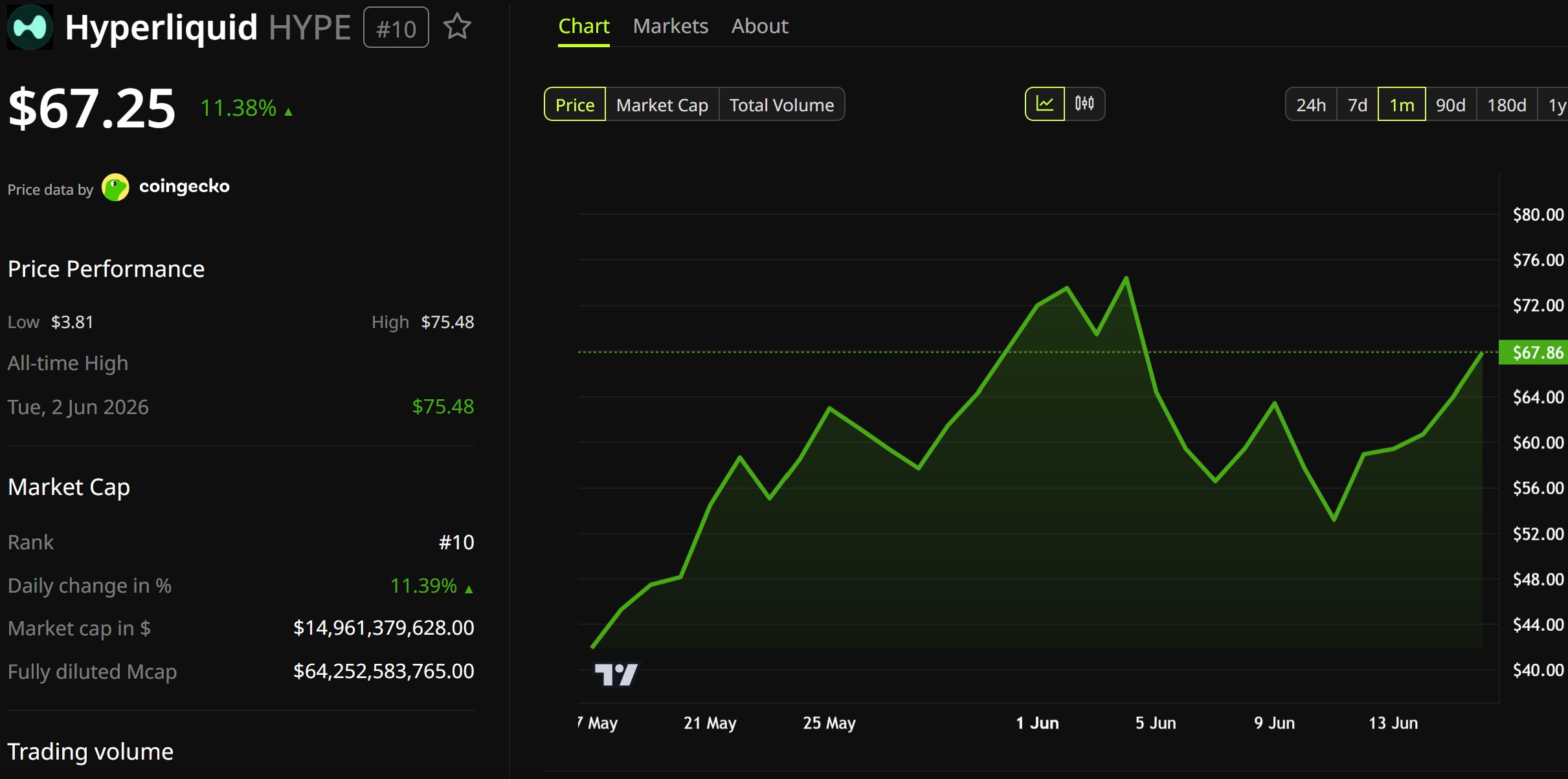
Ventuals, the team behind OpenAI and Anthropic perpetual markets on Hyperliquid, is winding down. The shutdown freezes both pre-IPO markets and settles all open positions automatically using 24-hour average prices.
The team announced Monday that it will join another project building within the Hyperliquid ecosystem. Over the next few days, all of its remaining markets will settle and halt for trading.
What the Ventuals Shutdown Means for Hyperliquid
Ventuals built around a simple idea. It offered round-the-clock private markets so anyone could gain exposure to top technology firms before an IPO.
The project ran on Hyperliquid’s HIP-3 market framework, which lets outside teams create and manage their own perpetual futures markets. That model pushed the exchange well beyond cryptocurrencies.
Ventuals traded more than $650 million in volume and attracted over 500,000 HYPE, Hyperliquid’s native token, in community support. It charged no deposit, withdrawal, or management fees.
OpenAI and Anthropic Markets Settle at Frozen Prices
The OPENAI and ANTHROPIC contracts gave traders exposure to two top AI IPO candidates. Neither firm trades publicly, so users speculated on implied valuations rather than owning shares.
Ventuals priced those contracts in company valuation, where a mark of $1,300 signaled a $1.3 trillion firm. It froze both prices at their 24-hour averages and set funding rates to zero.
The OPENAI market settled at $1,341.80 and ANTHROPIC at $1,618.90, implying valuations near $1.34 trillion and $1.62 trillion. Trading halted Monday morning, with all positions settled automatically.
After settlement, vHYPE holders can withdraw their deposited HYPE one-to-one, plus any accrued staking yield.
TradeXYZ Tightens Its Grip on Pre-IPO Markets
The closure highlights fast consolidation among HIP-3 operators. TradeXYZ dominates pre-IPO trading on Hyperliquid.
It holds about 95% of the category’s $1.46 billion lifetime volume, a June 9 Talos report found. Open interest across those markets sits near $106 million.
TradeXYZ built that lead on an accurate pricing record. Its Cerebras (CBRS) contract traded within 1.3% of the chip maker’s $350 Nasdaq open in May. That sat well above the $185 IPO price.
The builder’s SpaceX pre-IPO market sent a similar signal. SPCX launched May 18 and held above the $135 offering price for weeks. SpaceX stock opened at $150 on its Nasdaq debut June 12 and closed up about 19%.
Hyperliquid’s HYPE token traded near $68, up almost 12% on the day. The rally held even as one of its marquee builders exited.

The wind-down leaves TradeXYZ with little competition in a young market.
Rivals emerging or one operator keeps control will shape Hyperliquid’s pre-IPO trading in the coming months.
The post Ventuals Exit Costs Hyperliquid Two High-Profile AI Markets appeared first on BeInCrypto.


A Polymarket trader known as “fishalive” turned roughly $427,000 into more than $4.7 million after Spain failed to beat Cape Verde at the 2026 World Cup, becoming one of the largest single trades on the platform.
The contrarian wager has stunned the football world and the prediction market space alike.
A Million-Dollar Wager on Prediction Market
Polymarket is a leading crypto-based prediction market where users buy “yes” or “no” shares on the outcomes of real-world events. In this case, “fishalive” took the “No” position against a Spain victory at odds reflecting just 9% probability before kickoff.
The user bought roughly $427,952 worth of “No Spain win” shares. After the market settled, the payout reached exactly $4,702,769.23, making it one of the most profitable single Polymarket trades of the entire 2026 World Cup.
The match was played on June 15, 2026, marking Spain’s debut at the FIFA World Cup hosted by the United States, Mexico, and Canada. The new 48-team format placed “La Roja” into Group H, where it faced debutant Cape Verde as the overwhelming favorite.
Follow us on X to get the latest news as it happens
Spain entered as a clear favorite across all major bookmakers and prediction platforms, with Polymarket odds above 90%.
However, La Roja failed to deliver the expected result. Cape Verde, organized and disciplined, secured at least one point in a result already considered historic.
Images of Spanish players showing frustration spread quickly across social media. As a result, the prediction market community immediately turned its attention to the “fishalive” trade, which had captured the unlikely outcome with remarkable precision.
What the Trade Says About Polymarket and the World Cup
The case shows the potential and the risk of prediction markets like Polymarket, which have already recorded massive volumes during the 2026 World Cup. Most participants bet heavily on Spain, with some users losing close to $1 million on the result.
“fishalive” took the contrary position with conviction. The profile has now become a trending account, even though the trader’s real identity remains unknown.
Experts note that trades like this require more than capital. They demand a deeper understanding of factors that algorithms and the broader public often underestimate, including opponent motivation, possible squad rotations, weather conditions, and the emotional drive of emerging African selections.
Cape Verde proved that no match is truly easy at a World Cup. For Polymarket, the moment reinforces its leading position in the sports prediction space, with billions already traded on tournament outcomes, including the overall champion market.
Spain and France remain the top favorites to win the entire tournament according to Polymarket data. Cases like “fishalive” generate viral attention and continue to attract new traders to the platform amid heightened World Cup activity worldwide.
Spain must now recover quickly. Group H also includes Uruguay and Saudi Arabia, and the path forward remains open despite the early stumble. With abundant talent, La Roja still has time to turn things around before facing the next round.
Subscribe to our YouTube channel to watch leaders and journalists provide expert insights
The post Polymarket Trader Turns $427,000 Into $4.7 Million on Spain World Cup Shock appeared first on BeInCrypto.

ASX 200 Slips Marginally to 8,911.4 as Investors Pause After Recent Rally on Iran Peace Optimism

Nvidia $20B Bond Sale Boosts Bitcoin Miners’ AI Expansion Plans

10 Video Games That Will Keep You Hooked From Start to Finish

BloFin War of Whales 2026 Grand Prix opens registration for $5M trading championship

Blockchain.com files with SEC for U.S. IPO

Israel says it has killed new Hamas military leader in Gaza City airstrikes

OH MY GOD XRP… $4.7 QUADRILLION!!! (XRP BOOOM INCOMING?!)

Blessings In No Time – Marlon and LaShonda Moore – Fraud Fumble – Financial Advisor Reacts

Did Ripple Executive Just Say XRP Isn’t Needed Anymore? WTF Is Going On… MUST SEE IF YOU OWN XRP!
-

 Business2 days ago
No Jackpot Winner as $257 Million Prize Rolls Over to $269 Million Monday Draw
-

 Crypto World5 days ago
Oppenheimer backs SpaceX as $70 billion retail frenzy builds
-

 Crypto World5 days ago
Markets Rally as SpaceX IPO Looms Amid Iran Tensions and Inflation Surge
-

 Fashion3 days ago
Weekend Open Thread: Tuckernuck – Corporette.com
-
 Crypto World1 day ago
Zimbabwe Requires Crypto Businesses to Register Annually Under New FIU Regulations
-

 Entertainment7 days ago
The Ryan Gosling True Crime Thriller On Netflix That Gets Even Stranger, Stream It Now
-

 Tech3 days ago
NanoClaw integrates JFrog registries to secure AI agent downloads
-
 Sports7 days ago
Bangladesh beat Australia after 20 years in ODIs, register only their second win over six-time world champions | Cricket News
-

 Crypto World3 days ago
Bitget enters Argentina’s regulated crypto market through PSAV registration
-

 Tech4 days ago
This Week In Security: Microsoft On Microsoft, Register Your Domains, Linux On ARM, And FreeBSD Joins The File Cache Club
-
 Tech5 days ago
Dutton Ranch star claims they ‘didn’t see any disruption’ on set following Chad Feehan’s exit from Yellowstone spinoff fueled by Taylor Sheridan clash rumors
-

 NewsBeat4 days ago
El Nino has formed in the Pacific and could set records, forecasters say
-

 Politics5 days ago
Politics Home | Healey Resignation Is “Colossal Failure Of Government”, Says Former Labour Defence Secretary
-

 Tech6 days ago
‘This is Seattle’s position on AI’: City Council votes unanimously to pause big new data centers
-

 Business6 days ago
Thailand Ranks Second Worldwide for AI Adoption Growth, Microsoft Reports
-
 Entertainment5 days ago
Donnie Wahlberg & More Heat Up Las Vegas at Circa’s Barry’s Downtown Prime
-

 Sports5 days ago
First Time Since 1971: Australia Register Historic Low In ODI Cricket
-
 Tech5 days ago
Opendoor Ends India Operations, Fueling a Bigger Conversation About AI and Outsourcing
-

 Politics5 days ago
Belfast burns, while Met chief points finger at Iran and Russia
-

 Business5 days ago
AT&T: Verizon's 27% Outperformance Sets Up A Solid Entry Point
You must be logged in to post a comment Login