

Crypto World
Strategy Sells 32 BTC in First Sale Since 2022; Shares Slip at Open


MicroStrategy has disclosed a modest disposal of Bitcoin from its treasury, selling 32 BTC for about $2.5 million as the company earmarks cash for distributions on its preferred stock. The sale, executed at an average price of $77,135 per BTC, reduced MicroStrategy’s holdings to 843,706 BTC from 843,738 BTC, according to an 8-K filing with the U.S. Securities and Exchange Commission. In the wake of the disclosure, MicroStrategy’s Nasdaq-listed shares slipped more than 6% in Monday trading, trading around $148.70 at the open.
The company said the proceeds from the Bitcoin sale would be used to fund distributions on its preferred stock, with no new preferred raises announced for the week. The move stands in contrast to the firm’s long-running strategy of accumulating BTC, and comes as investors scrutinize how MicroStrategy plans to finance its preferred-equity program while continuing to hold a large Bitcoin treasury.
The sale marks MicroStrategy’s first Bitcoin disposal since a 2022 tax-loss transaction, when 704 BTC were sold and 810 BTC were repurchased two days later. Bitcoin’s price context surrounding the announcement was softer, with BTC trading around $71,900 on the day, after slipping below $72,000 in the hours following the disclosure, according to CoinGecko data.
Key takeaways
- Bitcoin sale details. MicroStrategy sold 32 BTC for approximately $2.5 million, at an average price of $77,135 per BTC, shrinking its BTC stake from 843,738 to 843,706 BTC.
- Funding use for preferred stock. The company said the proceeds would fund distributions on its preferred stock, with no new preferred raises reported during the week.
- Stock market reaction and context. MicroStrategy’s MSTR shares dropped over 6% after the disclosure, underscoring investor sensitivity to how the company funds its preferred equity and manages its Bitcoin treasury.
- Treasury activity in broader markets cooling. The move fits a broader pattern of easing appetite among corporate Bitcoin treasuries, where several firms have slowed purchases or begun reducing holdings, with weekly net purchases sliding to about 144 BTC versus 603 BTC the prior week.
MicroStrategy’s financing strategy in focus
The sale aligns with MicroStrategy’s ongoing effort to balance liquidity needs against its long-standing commitment to growing its Bitcoin holdings. By channeling proceeds into preferred stock distributions, the company signals a prioritization of its fixed-income obligations over immediate large-scale Bitcoin accumulation. Market observers have long debated whether the preferred-stock financing model creates pressure to monetize part of the Bitcoin reserve to support dividends, especially if Bitcoin prices move unfavorably or if distributions increase over time.
In its 8-K filing, MicroStrategy’s management did not indicate any new preferred raises during the week, which some analysts had anticipated amid the continued use of preferred equity alongside the Bitcoin treasury. The decision to deploy a portion of the Bitcoin haul into distributions rather than reinvestment or larger BTC purchases reflects a nuanced approach to capital structure management in a volatile market.
The timing of the sale matters, given the company’s history. The 2022 tax-loss sale marked a rare instance of strategic BTC disposal, followed by a small round of repurchases. This latest move does not appear to signal a broad retreat from Bitcoin accumulation, but rather a targeted liquidity action tied to its preferred-stock program and the evolving needs of debt and equity financing.
What the market and executives have signaled
Beyond the bitcoin sale, MicroStrategy also unloaded 801,994 Class A (MSTR) shares, generating about $128.3 million in proceeds for the week. The combination of asset disposals—both in Bitcoin and equity—appears to reflect a broader attempt to optimize liquidity without derailing the company’s longer-term plan to increase Bitcoin exposure on a per-share basis.
Industry observers had been watching for signals that the company might pivot more decisively away from or toward Treasury activity. Earlier speculation, including notes from crypto intelligence tracker Arkham, suggested a transfer of BTC to Coinbase Prime in the days leading up to the announcement, fueling expectations of possible forthcoming moves. MicroStrategy’s executive chairman, Michael Saylor, had posted a “Working Better” chart on X that tracked Bitcoin purchases over roughly six years, a public-facing marker of ongoing interest in Bitcoin accumulation, though he did not publicly comment on the latest sale as of press time. Some market participants viewed the timing with skepticism, interpreting it as a sign that even a long-running buyer like MicroStrategy exercises discipline in the face of funding needs and market volatility.
Additionally, MicroStrategy’s position sits within a broader corporate finance narrative around the use of Bitcoin and other crypto assets to back financing strategies. Earlier reporting highlighted the company’s broader debt management efforts, including a separate move to repurchase debt and reduce outstanding notes, actions that complicate the calculus around when and how much BTC should be monetized to support corporate capital structures.
The investor mood music around the company’s strategic plan continues to be shaped by the balance between Bitcoin’s price trajectory and the fixed-income obligations tied to its preferred stock. While the company has maintained that it intends to be net positive on Bitcoin exposure over time, the precise cadence of BTC purchases and sales will likely hinge on capital needs, macro conditions, and the evolving regulatory environment that governs corporate crypto treasury programs.
Broader context: corporate treasuries cool on Bitcoin purchases
The MicroStrategy move arrives at a moment when several corporate treasury programs have tempered their Bitcoin appetites after months of steady accumulation. In a related development, ProCap Financial announced a sale of about 52 BTC to finance a repurchase of 2 million shares at roughly a 50% discount to net asset value, a move designed to lift per-share Bitcoin exposure for remaining shareholders. The trend aligns with a broader market pattern in which some treasury holders recalibrate their holdings in light of price volatility and financing costs.
Market observers note that other buyers—such as DDC Enterprise, Smarter Web Company, and Capital B—reported net additions around 144 BTC collectively in the past week, a substantial drop from the prior week’s roughly 603 BTC total. The broader data suggest a cooling cadence after a sustained stretch of heavy accumulation by corporate wallets, even as Bitcoin remains a focal point of treasury strategies for many issuers seeking to diversify balance sheets and hedge against equity risk.
For investors, the evolving picture matters for several reasons. First, it underscores the delicate balance between funding needs and long-term crypto exposure for listed companies that have tethered their capital structure to Bitcoin. Second, it highlights that corporate treasuries are not merely passive accumulators of BTC; they actively adjust timing and scale in response to liquidity demands, debt maturities, and regulatory signals. And third, the ongoing dialogue around MicroStrategy’s financing model—particularly the use of preferred stock alongside a large BTC treasury—could influence how other firms structure their own crypto-backed financing in the months ahead.
As the sector digests these developments, market participants will want to monitor how forthcoming disclosures align with price action, and whether more treasuries signal a willingness to monetize portions of their BTC holdings to support equity or debt obligations. The next few quarters could reveal whether this is a temporary liquidity rebalancing or part of a longer-term shift in how corporate treasuries interact with the cryptocurrency markets.
Readers should stay tuned for updates on MicroStrategy’s capital-structure moves, potential additional BTC sales or purchases, and any regulatory or market developments that could reshape how corporate crypto treasuries operate in a rapidly evolving environment.



The sale of 32 bitcoin (BTC) by Michael Saylor’s Strategy (formerly Microstrategy) has led to a dispute among Polymarket users who’ve been betting on whether or not the company would sell any of its BTC by May 31, 2026.
A Securities and Exchange Commission filing revealed that Strategy sold the BTC (despite Saylor’s promises to never sell) between May 26 and May 31.
However, the firm’s Form 8-K wasn’t filed until June 1.
Before the filing was noted, the market had a proposed outcome of “No.” It then resolved to “No” again, after the original outcome was disputed.
Some UMA tokenholders in Discord attempted to justify the decision by pointing out that the announcement came after the market deadline, despite the market explicitly referring to when the sale occurs, not when it’s announced.
Needless to say, the decision by UMA token holders is controversial.
This second “No” outcome has also been disputed, and we are now in the “final review” window.
Polymarket itself has added a note to the market that says, “No information from MSTR, on-chain data, or consensus of credible reporting confirmed that MicroStrategy sold BTC within the market’s timeframe. Confirmation achieved outside of the market’s time frame does not qualify.”
Read more: Are Polymarket and Kalshi decentralized?
Similar disputes have popped up on Polymarket before. One prominent example was dubbed “Suitgate” and centered around whether or not an outfit that Volodymyr Zelenskyy wore to a NATO meeting counted as a suit.
Despite multiple outlets describing it as a suit, UMA tokenholders were reluctant to consider it as such, and it resolved to “No.”
In another example, Polymarket created a market that was meant to determine whether or not the Elon Musk-connected Department of Government Efficiency (DOGE) would “cut $3 billion of DEI contracts before March.”
The rules for this market explicitly pointed to whether or not “doge-tracker.com” showed that amount or more in cuts.
That website did show more than $3 billion in cuts, but this display was rooted in lies propagated by DOGE, and so Polymarket and UMA holders were placed between the explicit resolution criteria and reality.
Broadly, this Strategy market controversy combines with the previous failures of Polymarket resolution to undermine Polymarket’s tether to reality.
Got a tip? Send us an email securely via Protos Leaks. For more informed news and investigations, follow us on X, Bluesky, and Google News, or subscribe to our YouTube channel.

TLDR:
- Bitcoin active addresses fell 44%, dropping from 1.12M daily in May 2021 to roughly 624K today.
- New wallet creation declined 43%, from nearly 489K per day to approximately 278K in this cycle.
- Spot Bitcoin ETFs allow institutional investors to gain exposure without creating on-chain wallets.
- Strategy sold 32 BTC worth $2.5M, its first Bitcoin sale in 3.5 years, briefly pushing BTC below $72K.
Bitcoin’s on-chain activity has declined notably compared to the peak of the 2021 bull market. Active addresses and new wallet creation have both fallen by roughly 43–44% from their May 2021 highs.
Meanwhile, Bitcoin’s price remains well above 2021 levels for much of the current cycle. Analysts point to institutional investment vehicles and passive long-term holders as key factors behind this shift in network behavior.
On-Chain Participation Drops Despite Higher Prices
According to Santiment Intelligence, Bitcoin averaged around 1.12 million active addresses per day in May 2021. That figure has since dropped to approximately 624,000 active addresses daily. New wallet creation has followed a similar path, falling from nearly 489,000 per day to about 278,000.
These two metrics are closely watched by analysts tracking network health. Active addresses reflect how many unique participants are transacting on the network.
New wallet creation, known as network growth, tracks addresses interacting with Bitcoin for the very first time.
The decline stands out because Bitcoin’s price has largely held above 2021 peaks. Normally, higher prices tend to draw more retail participants onto the network. This cycle, however, the expected surge in new users has not materialized on-chain.
One explanation is the rise of spot Bitcoin ETFs and other institutional products. These vehicles allow investors to gain Bitcoin exposure without moving coins on-chain or opening new wallets. As a result, price action no longer directly translates into on-chain activity growth.
Strategy’s Bitcoin Sale Adds Short-Term Pressure
Santiment noted that prolonged sideways price movement is also a factor. Historically, volatility — in either direction — tends to spark a rise in on-chain activity.
With markets moving sideways and investor attention shifting toward equities and precious metals, Bitcoin activity has stayed subdued.
Adding to short-term pressure, Michael Saylor’s Strategy recently disclosed its first Bitcoin sale in approximately 3.5 years. The firm sold 32 BTC worth around $2.5 million, which briefly pushed Bitcoin below $72,000, according to Bull Theory.
The sale drew attention given Strategy’s history as one of Bitcoin’s largest corporate holders. The firm still holds 843,706 BTC, representing roughly 4% of Bitcoin’s entire supply, purchased for approximately $63.86 billion.
Saylor had previously stated that Strategy could sell Bitcoin to fund dividends, but added it would buy 20 BTC for every one it sells.
For context, Strategy sold 704 BTC in December 2022 for tax-loss purposes, then bought back 810 BTC just two days later. The latest sale appears minor relative to the company’s total holdings and long-term accumulation strategy.


Zcash (ZEC) has surged nearly 1,000% over the past year and is up almost 50% over the past month alone.
The privacy-focused crypto asset is flashing another bullish signal after an already remarkable run in 2026, largely defying the wider market’s struggles.
Another Bullish Signal
According to the latest findings from crypto analyst Ali Martinez, the TD Sequential indicator on a 12-hour chart has flashed a buy signal for ZEC, suggesting the rally may not be over yet. Martinez believes that a move toward $642 remains possible as long as the token continues to hold above the $500 level.
The latest signal comes after a period of intense volatility and growing market attention surrounding the asset. Earlier, blockchain analytics platform Santiment identified ZEC as the dominant topic across crypto social media, recording seven repeat spikes in social dominance during the week and reaching a peak social dominance score of 10.02 on May 20.
The firm noted that sentiment around the asset shifted sharply over the course of the rally, moving from positive to negative after the initial surge. Santiment linked the May 20 spike to a powerful short squeeze that sent ZEC from around $568 to an intraday high near $686 in roughly six hours, a gain of about 17%. The move reportedly triggered around $28 million in liquidations and pushed the ZEC’s market capitalization above $11 billion.
Discussion online was largely driven by claims that the rally was fueled by aggressive positioning and thin liquidity, growing excitement around Grayscale’s filing to convert its Zcash Trust into a spot ETF, and continued interest in privacy-coin investment narratives. While sentiment was initially boosted by the short squeeze and ETF-related optimism, it later turned negative as some market participants began to question the move’s sustainability and rotated into other assets.
As a result, Santiment described ZEC as one of the most consistently active and volatile assets of 2026, while adding that “signals around it tend to be tradable in either direction rather than directional on their own.”
Security Fixes
Beyond market activity, the Zcash Foundation last week released Zebra 4.5.0 and urged node operators to upgrade immediately. The update addressed multiple security vulnerabilities across the network, including a consensus-related issue and several bugs that could affect node operations.
It also introduced support for mining directly to a shielded address and included broader security and reliability improvements.
The post Zcash (ZEC) Flashes Fresh Buy Signal; Is $642 the Next Stop? appeared first on CryptoPotato.
European Central Bank (ECB) Executive Board member Isabel Schnabel said stablecoins could bring old financial-market vulnerabilities into tokenized finance, while strengthening the case for central banks to modernize public money through tools such as the digital euro and tokenized central bank settlement.
In a Monday speech at the 2026 Bank of Korea International Conference on Central Banks and the Future of Money in Seoul, Schnabel compared stablecoins with money market funds, arguing that both can offer useful financial innovation while also creating risks around bank disintermediation, runs, fire sales and monetary policy transmission.
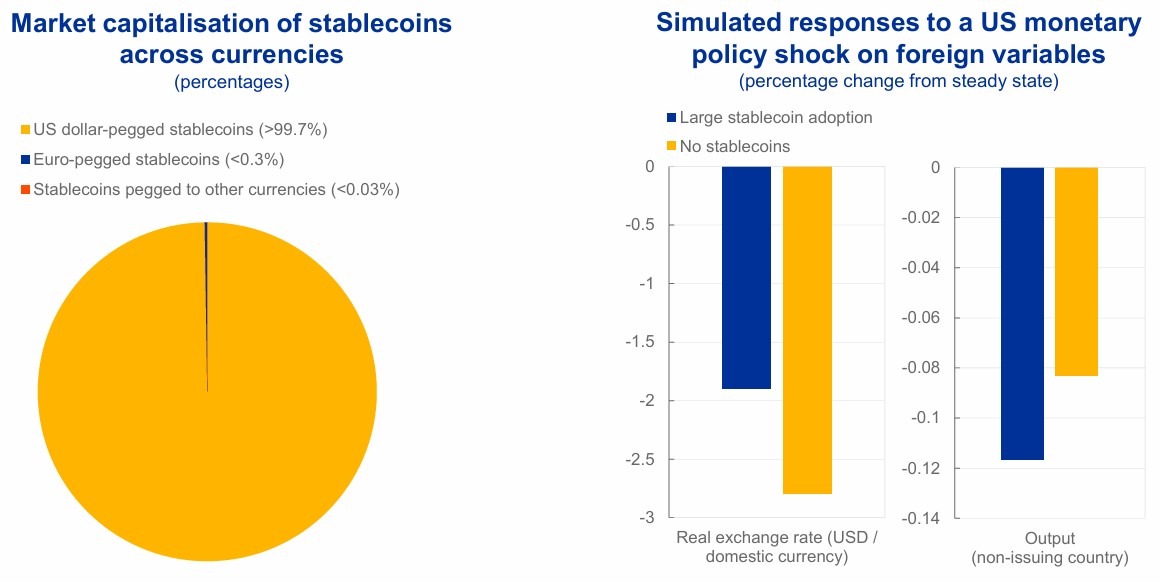
Schnabel also warned that stablecoins could reinforce the US dollar’s global role as tokenized finance develops. “The growing use of stablecoins may further cement the international dominance of the U.S. dollar,” she said, adding that “virtually all stablecoins in circulation are denominated in dollars, with other currencies playing a negligible role.”
Schnabel said the Eurosystem’s response has two parts, including a retail digital euro and tokenized wholesale central bank money. In March, the ECB unveiled its Appia roadmap for Europe’s tokenized financial markets, with Pontes set to provide a distributed ledger technology settlement bridge to the Eurosystem’s TARGET services and scheduled to launch in the third quarter of 2026.
Schnabel argued that central banks should not resist innovation but must modernize public money, including through the digital euro and tokenized wholesale central bank settlement, to preserve financial stability and monetary control.
“Central banks cannot remain passive observers of these developments,” Schnabel said, adding that private forms of money, once widely adopted, can shape the financial system “in ways that can be difficult to reverse.” She said the proper response is not to resist innovation but to ensure it develops within a framework that preserves stability, monetary control and trust in the currency.
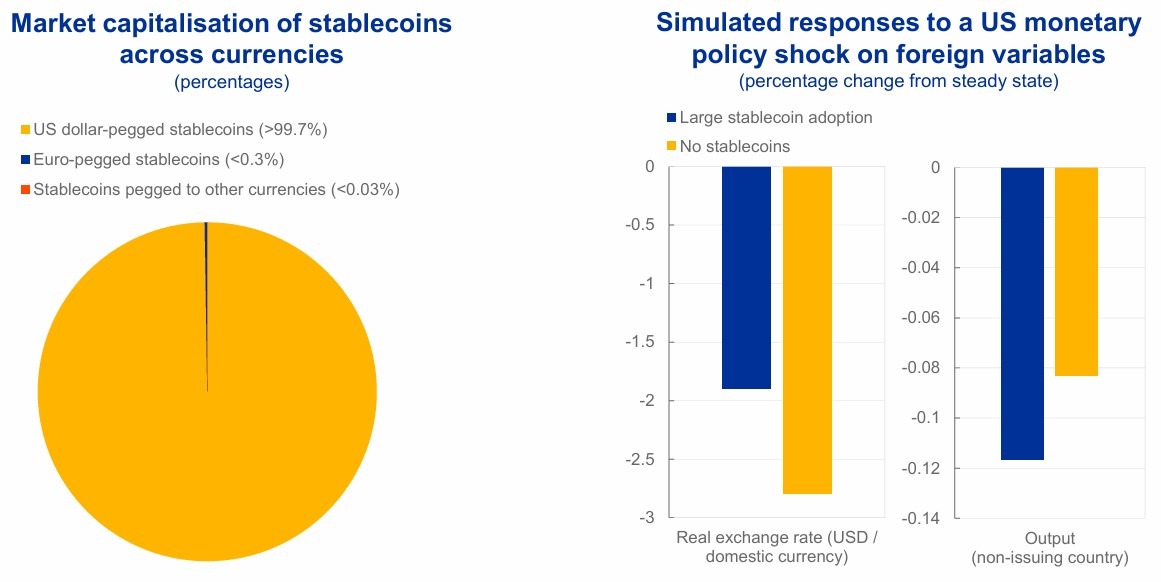
Stablecoins are overwhelmingly dollar-pegged, while broad adoption could amplify US policy spillovers abroad, ECB data shows. Source: European Central Bank
MiCA review sharpens stablecoin debate
The speech builds on ECB messaging that Europe should not answer dollar stablecoins simply by promoting euro-denominated stablecoins.
On May 8, ECB President Christine Lagarde said stablecoins are not Europe’s best route to strengthening the euro’s international role, arguing instead that Europe should build tokenized settlement infrastructure anchored by central bank money.
The debate unfolds as the European Commission reviews the European Union’s Markets in Crypto-Assets Regulation (MiCA), with a public consultation open until Aug. 31 examining whether the bloc’s crypto rules should be updated.
Related: MiCA has made euro stablecoins safe but weak, new report argues
Crypto exchange Coinbase has used the review to call for a more competitive EU crypto framework. In a Monday blog post, Katie Harries, Coinbase’s director and head of policy for Europe and the Americas, said MiCA should recalibrate stablecoin rules on reserves, rewards and multi-issuance, while clarifying how regulated crypto firms can provide access to decentralized finance and global liquidity.
Harries also argued that allowing more reserves in high-quality sovereign assets and permitting non-interest incentives, such as cashback and loyalty points, could help make euro stablecoins more competitive.
The ECB has taken a more cautious view. On May 23, the ECB warned EU finance ministers that loosening stablecoin rules could weaken bank lending and complicate monetary policy, even as policymakers debate whether Europe risks falling behind dollar-backed tokens.
Magazine: HYPE chases $100 target, ETH could dump below $1800: Market Moves
Strategy sold 32 bitcoin for about $2.5 million between May 26 and May 31, earmarking the proceeds to fund cash distributions on its preferred stock, the company disclosed in an 8-K filing Monday. The sale was executed at an average net price of $77,135 a coin and leaves Strategy holding 843,706… Read the full story at The Defiant

Binance has launched US equities trading for eligible users and plans to add tokenized stocks as part of a broader push to expand beyond crypto.
Users will be able to trade more than 7,000 stocks and exchange-traded funds (ETFs) with zero commission, buy fractional shares from $5 and access select equities on a 24/5 basis, according to an announcement shared with Cointelegraph.
The exchange said it is also planning to introduce tokenized stocks as part of its vision for a “multi-asset financial super app.”
The move puts Binance more directly in competition with Coinbase and other platforms trying to bring stocks, ETFs, derivatives and tokenized assets into a single trading account. Coinbase rolled out commission-free US stock and ETF trading with 24/5 availability in December 2025.
“Tokenization has the potential to reshape financial markets by giving users greater control, more flexibility, and ultimately more financial freedom,” said Binance co-CEO Richard Teng. “We see a significant opportunity to make financial assets more accessible, more useful, and more connected across traditional and digital markets.”
The new offering is enabled through Binance’s broker-dealer, Nest Trading Limited, based in Abu Dhabi Global Market (ADGM).

Source: Binance
Purchasing tokenized equities will be primarily made through Circle’s USDC (USDC), with support for BNB (BNB), Tether’s USDt (USDT), World Liberty Financial USD (USD1) and United Stables (U). Sales proceeds will be received in USDC.
The exchange will also enable eligible users to earn passive income by lending their stock holdings through Fully Paid Securities Lending (FPSL).
Related: NYSE parent ICE pushes ‘level playing field’ for 24/7 onchain perps
Binance to launch bStocks after regulatory approval
The launch of the 7,000 equities is part of Binance’s plan to become a multi-asset platform, with the next phase representing the launch of tokenized US stocks.
Binance said that it plans to launch bStocks in the “coming weeks,” which are tokenized securities representing US stocks and ETFs, issued by BTECH Holdings LTD, a Special Purpose Vehicle (SPV) registered in the ADGM.
Binance said that the launch of bStocks is currently pending regulatory approval from the Financial Services Regulatory Authority of Ontario (FSRA).
Related: NYSE parent ICE pushes ‘level playing field’ for 24/7 onchain perps
Cointelegraph reached out to Binance for comment on the timeline of the tokenized stocks launch.
Elsewhere, other cryptocurrency exchanges are also looking to bring traditional company stocks to their trading platform.
At the beginning of April, crypto exchange Bitget launched a proxy offering tied to the pre-initial public offering (IPO) phase of Elon Musk’s aerospace manufacturing and space transportation company, SpaceX, Cointelegraph reported at the time.
In April 2025, Kraken announced the launch of 11,000 US-listed stocks and ETFs with commission-free trading in an effort to bring “equities and digital assets together” under one trading platform, as part of a “phased national rollout.”
In January, Vienna-based crypto exchange Bitpanda said it was expanding its offering to include about 10,000 stocks and ETFs.
Magazine: Would Bitcoin really be at $200K if not for Jane Street? Trade Secrets
Crypto World
V12 Says THORChain Silently Patched Its Critical Bug, Then Told Researchers the Bounty Is 'Permanently Retired'


A security startup said it intends to publicly release exploit code for unpatched THORChain vulnerabilities in the coming days, after the cross-chain protocol patched an earlier critical bug the firm had disclosed without crediting or paying it. V12, a startup that builds an automated code-auditing… Read the full story at The Defiant

Ether’s price flirted with the $2,000 level again as traders weighed a single, high-profile sell-off against broader on-chain signals. An veteran Ethereum holder liquidated a substantial portion of their stash last week, but the latest data suggests the move may be idiosyncratic rather than indicative of a sweeping exodus among long-time investors.
Key takeaways:
- An early Ethereum investor sold about 64,442 ETH across two transactions, totaling roughly $136 million, at an average price near $2,041 per ETH.
- On-chain metrics indicate older ETH holders did not uniformly depart their positions; supply dynamics show long-term holders continuing to accumulate or hold steady in aggregate.
- Analysts warn the price could retest lower levels, with some pointing to a potential move toward $1,500 if downside momentum persists and key supports fail.
OG ETH whale moves spark headlines, but broader signal remains mixed
The exodus came from a wallet believed to be among Ethereum’s oldest, with 55,000 ETH sold for about $112.25 million and an additional 9,442 ETH liquidated for around $24 million over the past week. The two-step exit culminated in a $136 million offload at an average price of $2,041 per ETH, according to blockchain tracker Lookonchain.
Underscoring that the move was a single-wallet decision, analysts emphasize it does not necessarily reflect a sweeping change in sentiment among long-term holders. Glassnode’s “HODL Waves” framework reveals that a substantial portion of ETH supply remains unmoved across multiple horizons. In particular, the share controlled by older cohorts has generally trended higher over the past year, suggesting a steady presence of committed holders even as some less‑seasoned participants take profits or exit.
That said, recent shifts within mid-term cohorts point to pockets of redistribution. The 3-month-to-6-month investor group saw its stake shrink to 9% from 13.5% on May 19, while the 1-week-to-1-month cohort slipped to 2.6% from 4.76% over the same period. In other words, while older wallets aren’t dumping en masse, a portion of supply is moving through shorter time horizons, consistent with more active trading cycles rather than a wholesale capitulation by veteran holders.
Beyond the distribution, a few notable players have publicly disclosed larger-scale sales in recent months. Still, there is little evidence of a systemic exodus that would dry up demand or push the market into a prolonged downtrend. As Cointelegraph observed, a handful of high-profile moves have raised eyebrows, but they appear to be exceptions rather than the rule driving the overall supply picture.
What the price action is signaling in a volatile week
ETH began the period hovering near the $2,000 mark, with the price easing to around $1,980 as of the latest trading update. That level remains psychologically important and technically influential for a market that has struggled to sustain a clear directional breakout since the May period of heightened volatility.
Analysts have offered a cautious read on the near-term downside risk. One observer, Alex Marzell, commented on X that “momentum continues to favor the bears as ETH moves closer to the next key support area,” highlighting the pressure around critical price levels below $2,000.
Other technical interpretations paint a more structural picture. Merlijn The Trader described the current action as aligning with a Wyckoff accumulation framework, noting Ethereum’s price action is in a “Phase B consolidation, post-selling climax” and entering “Phase C,” where a bottom could form below $1,500 if selling pressure persists. The three-day chart has become a focal point for bears and bulls alike as they assess the likelihood of a deeper retracement.
Echo Analysis joined the chorus of bears-on-watch, arguing that a bear-flag breakdown could project ETH toward a $1,500 support zone. This view dovetails with broader observations in the market about rising exchange supply and waning exchange-based demand, factors that have been cited by observers tracking potential downside risk for ETH in this cycle.
These technical perspectives are complemented by macro considerations around demand drivers. In coverage surrounding the broader Ethereum ecosystem, observers noted that rising on-exchange supply, combined with cooling ETF demand in certain regions, could contribute to a renewed testing of lower boundaries. The synthesis of on-chain behavior and market structure points to a delicate balance between hodling inertia and a renewed appetite for risk among shorter-term traders.
What the data say about risk and resilience in ETH’s drawdown period
Looking back at the supply dynamics, the longer-hold cohorts (spanning several years) have generally shown resilience rather than erosion. The proportion of ETH held by older investors has risen in recent months, suggesting a more committed base that could act as a counterweight to near-term downside pressure. By contrast, younger cohorts, particularly those with 3 months to 6 months of on-chain history, have trimmed their holdings, focusing more on liquidity and tactical trading opportunities.
The implication for traders and builders is nuanced. On the one hand, a robust reserve of long-term holders can provide eventual price support if macro conditions improve or demand rekindles. On the other hand, persistent selling pressure from agile, short-term traders could drive further volatility and test mid-cycle support levels. For developers and institutions building on Ethereum, this bifurcation underscores the importance of liquidity-aware strategies, risk controls, and a willingness to adapt to evolving on-chain flows rather than rely on a single narrative about investor sentiment.
As noted by Cointelegraph previously, the near-term risk hinges on the confluence of on-chain supply dynamics and external demand signals. The current mix—stable long-term holder participation coupled with selective selling by mid-term cohorts—suggests that the market could remain range-bound until a more decisive catalyst appears, whether that be a shift in macro risk appetite, a reset in ETF demand, or a fresh wave of on-chain utility proving its value to users and institutions.
What to watch next for ETH
Price watchers should monitor whether ETH can establish a firm base near the 1,800–2,000 range, which multiple analysts have flagged as a potential decisive zone. If sustained buying returns above $2,000 and key momentum indicators improve, the path could open for a revival of upside momentum. Conversely, a break below the near-term supports around $1,800 and the looming $1,500 level would intensify the case for a deeper correction, particularly if bear-market patterns reassert themselves in the Wyckoff framework.
On the on-chain front, investors should track whether the share of supply held by the 5-7 year cohort continues to hover near or above 9% and whether the “last active” window for older wallets remains relatively quiet. A sustained uptick in activity among the long-dated wallets could signal a renewed willingness to participate in mid-cycle demand, while any sudden surge in older wallet turnover might foreshadow a broader shift in conviction.
Readers should also keep an eye on the broader market context: shifts in exchange balances, ETF-driven demand, and developments within the Ethereum ecosystem—especially scaling and regulatory moves—that could alter the fundamental demand environment for ether. While a single wallet’s sale has captured attention, the weight of on-chain data points to a more complex picture of participation and risk that may unfold over weeks rather than days.
In summary, the current environment presents a mixed signal: a notable but not market-defining sell-off by a single veteran holder against a backdrop of stubborn long-term ownership and selective short-term trading activity. The coming sessions will be telling for whether the dip lasts or the market finds a durable footing in the $2,000 vicinity, with a keen eye on the $1,800 and $1,500 levels as potential magnets for further volatility.
As ongoing coverage notes, the interplay between supply dynamics, demand catalysts, and technical patterns will continue to shape ETH’s path. Investors should approach the next moves with a balanced view of on-chain signals, macro context, and the evolving structure of who owns and who trades Ethereum.


Disclosure: The author of this story owns shares in Strategy (MSTR).
Strategy (MSTR) Executive Chairman Michael Saylor appeared to underscore the company’s focus on its perpetual preferred stock, making STRC the focus of his first public comment after the largest publicly traded holder of bitcoin sold the cryptocurrency to fund dividend payments on the instrument.
“Our goal is to make STRC the best credit instrument in the world,” Saylor wrote on X on Monday.
The post came after the company said it sold 32 bitcoin for about $2.5 million last week. Proceeds from the sale “are expected to be used to fund distributions on preferred stock,” it said in an 8-K filing.
While the filing directly linked the sale to the dividend payment, Saylor’s decision to highlight the equity rather than the bitcoin sale is likely to reinforce investor perceptions that the company is increasingly focused on building its preferred stock while growing bitcoin exposure on a per-share basis.
Saylor has repeatedly argued that Strategy evaluates financing and capital allocation decisions through the lens of bitcoin per share and increasing shareholder value rather than simply maximizing the amount of bitcoin it owns.
Buy high, sell low
A running joke among crypto followers on X, the so-called Crypto Twitter, is that Strategy always buys bitcoin at the weekly high.
Yet the company’s only previous bitcoin sale took place in December 2022, when the largest cryptocurrency was priced at roughly $18,000, just weeks after the collapse of crypto exchange FTX pushed prices to a cycle low near $15,000.
This time, it sold at an average price of $77,135, with bitcoin now trading around $70,000 after falling as low as $60,000 in February. The question is whether it has again sold near a market bottom.
Crypto World
Space Sector Faces Reality Check: Rocket Lab (RKLB), Firefly and Redwire Plunge on Valuation Concerns

Key Takeaways
- Shares of Redwire plunged almost 15% following a Jefferies downgrade to Hold after the stock surged 163% in just 30 days
- Rocket Lab tumbled more than 13% on Monday amid widespread selling pressure across space-related equities
- SpaceX’s anticipated June IPO may trigger a “sell the news” reaction that pressures space sector valuations
- Sector valuations have become extremely elevated, with AST SpaceMobile trading at 260x projected 2026 revenues
- Technical indicators show Rocket Lab is overbought, with RSI at 80 and Stochastic Oscillator exceeding 90
Space-related equities experienced significant losses on Monday, with Rocket Lab, Redwire, and Firefly Aerospace leading the decline. The sector-wide retreat reflects growing investor concerns about inflated valuations as SpaceX’s highly anticipated initial public offering draws closer.
Redwire experienced a nearly 15% decline after Jefferies analyst Sheila Kahyaoglu shifted her rating from Buy to Hold. While she increased her price objective from $13 to $24, Kahyaoglu indicated that substantial upside potential appears limited at present levels. The downturn follows an extraordinary 163% rally over the previous 30-day period.
Rocket Lab plummeted over 13% during the same trading session. The company’s shares have skyrocketed more than 4,000% from pandemic-era lows and recently touched record highs, though technical analysis tools are now suggesting caution.
Technical Indicators Point to Overextended Conditions
Rocket Lab’s Relative Strength Index climbed to 80, a threshold commonly associated with overbought market conditions. Similarly, the Stochastic Oscillator surged past 90. The equity currently trades at $143, substantially exceeding its 50-week moving average of $68 and its 100-day moving average of $50.
Market observers suggest that a reversion toward the $100 support zone could materialize if downward pressure persists. This price point represented the stock’s previous January peak.
Firefly Aerospace declined approximately 12%, while AST SpaceMobile shed roughly 9% during Monday’s session. Intuitive Machines also posted losses. Collectively, these four companies had posted an average 59% gain throughout April.
The Procure Space ETF was positioned more than 20% above its 50-day moving average entering Monday’s trading. A retreat to that technical level would constitute a significant correction for the exchange-traded fund.
SpaceX Public Offering May Catalyze Sector-Wide Profit Taking
SpaceX’s initial public offering is slated for June and could assign Elon Musk’s aerospace venture a valuation exceeding $2 trillion. Polymarket traders are betting the company will achieve that market capitalization on its debut trading day. The offering would establish a new record as the largest IPO in history.
Space stocks have rallied in the months leading up to this milestone event. However, market strategists caution that this trend could swiftly reverse once the IPO materializes. Sell-the-news episodes represent a familiar market phenomenon where participants accumulate positions before significant events, then liquidate when those events occur.
Valuation metrics throughout the sector have reached elevated levels. AST SpaceMobile commands 260 times its projected 2026 revenue. Rocket Lab trades at 91 times sales, a substantial increase from below 20 times one year earlier. Redwire’s valuation stands at nearly 9 times sales, up from 3 times previously.
Rocket Lab does maintain solid operational momentum. The organization reported 43% revenue growth to $200 million in the most recent quarter and maintains a $2.2 billion contract backlog. The company also successfully completed a System Requirements Review for the Space Development Agency’s Tracking Layer Tranche 3 constellation under an $816 million agreement, pushing total SDA-related contracts beyond $1.3 billion.
Nonetheless, the enterprise recorded a $40 million quarterly loss and carries a forward price-to-sales multiple of 48. Achieving profitability remains an objective for the future rather than current financial performance.
The space sector continues commanding significant market attention heading into June, with SpaceX’s public market debut poised to determine the industry’s near-term trajectory.

The End of Oak Street Trailer Teases Dinosaurs in the New Thriller From J.J. Abrams and David Robert Mitchell

Seeking Income: Big Cash Flow In Energy With MLPI (BATS:MLPI)

Strategy’s BTC sale sends Polymarket into disarray

Steven Gerrard disagrees with Gary Neville over ‘shock’ Chelsea and Arsenal claim | Football

US brings back mandatory military draft registration

Register Renaming | Hackaday

It’s 4 DAYS AWAY!!! XRP WHALES ARE GOING TO BUY NEWS!!!

How Much Money Does He Make from the Gold Dust He Has Been Saving? #shorts #gold #viral #money

All Banking Exam in 2026 | Banking & Financial Awareness | GA Practice Set-164 I By Chandan Sir
-

 NewsBeat5 days ago
Israel says it has killed new Hamas military leader in Gaza City airstrikes
-

 Tech5 days ago
NASA taps Blue Origin to deliver lunar rovers for Moon Base initiative
-

 Sports7 days ago
2026 NBA Finals schedule, odds: Knicks await Thunder or Spurs after winning East
-

 News Videos6 days ago
XRP *JUST* SUCCEEDED!!!! CLARITY ACT EXPOSED!!! (SHE EXPOSED IT)
-

 News Videos3 days ago
This is BROKEN! INSANE 5x MONEY CAR WASH WEEK! The NEW GTA Online UPDATE Today! (GTA5 New Update)
-
Crypto World6 days ago
Micron Crosses $1 Trillion Market Cap as AI Demand Reshapes Memory Sector
-

 Business6 days ago
Selena Gomez Reportedly Upset Over Benny Blanco’s Comments on Her ‘Terrible’ Diet
-

 Business7 days ago
Nikkei 225 Surges Past 65,000 for First Time as Iran Peace Hopes Fuel Record Rally
-
 Tech7 days ago
China assigns ID codes to 28,000+ humanoid robots
-

 Tech4 days ago
Waymo dominates autonomous vehicle registrations as Tesla trails behind
-
 Entertainment7 days ago
‘Breaking Bad’ Star’s Easy-to-Binge 6-Part Crime Series Spin-Off Is Finally Heading to Free Streaming
-
 Tech2 days ago
SpaceX just won a second Golden Dome contract. This one is $4.16 billion.
-

 Tech5 days ago
The Samsung pay deal is the moment Korean unions changed register
-

 Entertainment6 days ago
Days of our Lives 2-Week Spoilers May 25-June 5: Gwen Rages, Abe Confesses & 2 Tragic Anniversaries!
-

 News Videos3 days ago
SHE IS KILLING XRP!!! WATCH URGENT AND ACT FAST
-
 NewsBeat3 days ago
FIRST NIGHT REVIEW: Take That bring the Circus back to life in spectacular sun-soaked style
-
 Entertainment7 days ago
Taylor Swift Fans Label Travis Kelce’s Beer-Chugging A ‘Red Flag
-

 Tech6 days ago
Millions of AI agents imperiled by critical vulnerability in open source package
-
Crypto World5 days ago
SpaceX’s $2 Trillion IPO: Why Tech Giants Nvidia (NVDA), Apple (AAPL), and Microsoft (MSFT) May Face Pressure
-
Crypto World3 days ago
CFTC Has Approved the First Regulated Bitcoin Perpetual Contract in the U.S.
You must be logged in to post a comment Login