

Crypto World
STRC trading surge drives record volume and signals largest bitcoin purchase since launch



Stretch (STRC), the perpetual preferred security sold by Strategy (MSTR) to fund its bitcoin purchases, posted record trading volume on Monday, funding the biggest single-day buying splurge through the company’s at-the-market (ATM) program.
The world’s largest publicly traded bitcoin holder is estimated to have added 7,800 BTC, according STRC.live, as STRC volume surged to $1.16 billion, more than four times the 30-day average of $278 million.
This comes after Strategy purchased $1 billion worth of bitcoin last week, funded entirely by STRC, which offers an 11.5% annual dividend, paid monthly in cash. The stock maintained its $100 par value throughout the entire trading session.
Historically, the trading day preceding the ex-dividend date, the cutoff date after which new buyers are no longer entitled to the next dividend payment, tends to see the highest trading volume. That’s Wednesday, so it’s possible trading on Tuesday may be even higher than Monday’s record.
STRC now has a market capitalization of $6.4 billion, exceeding the combined market cap of the company’s other preferred securities, including STRD at $1.1 billion, STRK at $1 billion, and STRF at $1.2 billion, according to the MSTR dashboard.
The common stock rose 2.9% on Monday and was 3.7% higher in pre-market trading.
Read More: The one metric investors are overlooking in Michael Saylor’s Strategy


TLDR
- Economist Henrik Zeberg says the current Bitcoin rally is part of a temporary B-wave bounce within a bearish cycle.
- He argues that Bitcoin may have completed a long-term fifth wave near highs above $110000.
- The analysis shows Bitcoin could rise in the short term before a deeper correction toward $41492 support.
- Bearish divergence on the RSI indicates weakening momentum despite recent price gains.
- The monthly MACD is nearing a bearish crossover similar to signals before past bear markets.
Bitcoin is showing recovery signs as it approaches $80,000, but a new warning has emerged. Economist Henrik Zeberg says the current move may precede a deeper Bitcoin crash. He believes the rally is temporary and part of a broader bearish cycle.
Bitcoin Crash Warning Linked to Elliott Wave Structure
Henrik Zeberg shared his outlook in a May 25 post on X. He described the current market move as a “B-wave” bounce. He explained that this phase often appears during broader bearish cycles. It typically creates a temporary rise before a deeper decline.
Zeberg based his analysis on Elliott Wave theory. He tracked Bitcoin’s price structure from its early market cycles. He argued that Bitcoin may have completed a long-term fifth wave. This wave likely formed near recent highs above $110,000.
According to his chart, the broader structure suggests a major top. He linked this formation to price behavior since 2012. Bitcoin price recently retraced to the 0.618 Fibonacci level near $66,426. Zeberg said this level supports a short-term rebound.
He added that the price could rise above current levels during this bounce. However, he maintained that the larger trend remains bearish. His projections showed downside targets near $41,492. He also indicated that prices could fall lower over time.
Technical Indicators Support Bitcoin Crash Outlook
Zeberg pointed to weakening momentum indicators. He said the relative strength index shows bearish divergence. This pattern occurs when prices rise but momentum weakens. It has preceded past Bitcoin market reversals.
He also highlighted the monthly MACD indicator. It is approaching a bearish crossover based on current data. Similar signals appeared before the 2018 and 2022 bear markets. These crossovers often indicate trend reversals.
Another analyst, TradingShot, shared a similar view on May 24. The analyst also cited bearish divergence on the monthly RSI. TradingShot noted that price gains were not supported by strong momentum. This pattern has historically signaled market tops.
A separate cycle-based chart added further context. It combined Bitcoin’s four-year cycles, halving events, and Fibonacci time levels. The chart suggested Bitcoin is entering a bearish phase. It pointed to a possible decline toward $50,000.
This level aligns with the weekly 350 moving average. The indicator has marked previous bear market bottoms. Bitcoin continues to trade below its recent peak above $110,000.



YZi Labs has launched YZi Talent, a recruitment platform that aggregates open roles from its Web3, artificial intelligence and biotechnology portfolio, starting with senior engineering and business leadership positions at predict.fun and AgriDynamics Robotics.
Summary
- YZi Talent centralizes hiring for YZi Labs’ portfolio across Web3, AI and biotech
- Initial roles include Backend Chief Engineer at predict.fun and founding leadership at AgriDynamics Robotics
- The platform builds on YZi Labs’ multi vertical investment push beyond pure Web3
In an official X post, YZi Labs announced the debut of YZi Talent as a dedicated recruitment platform “integrating open positions in Web3, AI, and biotechnology from its portfolio,” positioning it as a single entry point for candidates who want to work at the intersection of those three domains.
The first batch of postings highlighted in the announcement includes a Backend Chief Engineer position at predict.fun, a Frontend Staff Engineer role, and a Founding Business Leader role at AgriDynamics Robotics, a robotics venture focused on applying AI and automation to agriculture.
What is YZi Talent and which roles are live at launch?
Earlier materials from YZi Labs’ EASY Residency cohorts show both predict.fun and AgriDynamics among the companies the firm has backed: Weex’s coverage of the Season 2 portfolio lists predict.fun as “a prediction market enhancing liquidity with DeFi” and AgriDynamics as an agri robotics project working with fruit harvesting and automation.
Job listings circulated on third party sites for similar YZi Labs roles suggest the type of profiles YZi Talent is targeting.
For example, a Web3 Researcher role description notes that candidates are expected to “conduct comprehensive research on Web3 technologies, trends, protocols, and innovations” and “identify and evaluate Web3 talents, including blockchain researchers, developers, and entrepreneurs, for potential investment or collaboration,” blending technical depth with investment facing responsibilities.
A separate LinkedIn update from YZi Labs outlines broader hiring needs inside the lab itself, including Investment Directors for Web3, an Investment Associate with banking or private equity background, a Portfolio Management Lead, go to market experts, and dedicated recruiters, all framed around “backing the next generation of founders shaping Web3, AI, and biotech.”
YZi Talent is effectively the portfolio side complement to that in house hiring push, giving founders in the lab’s ecosystem a shared distribution channel for attracting senior engineers, researchers and operators.
How does YZi Talent fit into YZi Labs’ broader thesis?
YZi Labs presents itself as a frontier technology investor “at the intersection of Web3, AI, and biotech,” a positioning that has been reinforced over the past 18 months as it expanded beyond its roots as Binance Labs and brought in new general partners to drive biotech and AI exposure.
A March 2025 report on crypto.news described how YZi Labs appointed Jane He as a general partner to lead its biotechnology investments, noting that the firm was “actively seeking visionary founders driving technological advancements in Web3, AI, and biotech,” and pointing to deals in decentralized science and data sharing as early examples.
By December 2025, YZi Labs had announced investments in seventeen new projects focused specifically on those three verticals, a lineup that included AgriDynamics in agricultural robotics, predict.fun in prediction markets, Trellis Robotics in soft robotics, and Ethena Labs in synthetic dollar infrastructure.
In blog posts and conference talks, YZi Labs partners have argued that the “triple frontier” of AI, Web3 and biotech will generate new categories of applications, from tokenized data markets for medical records to AI driven on chain trading tools and robotic systems that rely on decentralized coordination.
A YouTube talk by Jane He at the DeSci Summit in Dubai framed it this way: combining AI, blockchain and healthcare can “help people share health data safely without giving up control,” allowing them to “stay anonymous, give consents through smart contracts and even get paid with tokens for helping out training a great AI model,” which she described as a “super powerful combo.”
YZi Talent slots into that thesis as infrastructure for a different bottleneck: people.
Rather than each portfolio company building its own recruiting funnel from scratch, the platform lets YZi Labs surface cross cutting job opportunities to a community of candidates who already buy into the idea that Web3, AI and biotech are converging, making it easier to match specialized engineers and operators with frontier projects that might otherwise be hard to discover.
Given the pace at which the firm has been deploying capital into new projects and follow on rounds, as seen in its support for Ethena Labs and Better Payment Network, the move to formalize a shared talent platform is a logical next step in building an ecosystem that can scale beyond capital into operational support.


AI is transforming both crypto security and crypto attacks. Here’s how Ledger is approaching AI-powered threats, human verification, and secure wallet infrastructure.
Summary
- Automated attacks and automated defenses within the crypto industry continue to escalate
- Ledger’s AI security systems are designed to keep users in control of wallet authorization
- Ledger’s strategy focuses on AI-assisted protection, not AI-controlled custody
AI can detect suspicious transactions, phishing attempts, malware, and unusual wallet behavior faster than humans. It can also help users identify fake websites and dangerous smart contracts. On the other hand, attackers use AI to create convincing phishing emails and fake support chats. It can also automate hacking attempts, generate malware, and scale social-engineering scams much more efficiently than humans, which is why crypto wallets are increasingly exposed to AI-powered attacks.
Increasing interactions through AI agents are inevitable, and crypto users are especially vulnerable, because these transactions are irreversible. This is why leading cold wallet vendor Ledger’s recently released AI security roadmap places equal focus on protection from AI scams and wallet security, building around the principle that humans must remain in control of authorization and signing.
It wouldn’t be an overstatement to say the future of crypto wallet security depends on whether AI is used more effectively to strengthen human control or to help attackers automate deception at scale.
“Humans will orchestrate that work,” says Ian Rogers, Ledger’s Chief Human Agency Officer. “AI will handle a tremendous amount of work for us in the middle, but humans will guide and verify at endpoints throughout the process.”
Stronger verification systems, hardware isolation, secure transaction interpretation, and human oversight will be indispensable features of wallet security in the future. Already considered leaders in crypto wallet security, Ledger’s new roadmap positions the brand around AI-assisted security while preserving human authorization.
Why AI is becoming a major security threat in crypto
AI is making crypto attacks more scalable by automating deception, impersonation, and social engineering. It has introduced operational security risks and virtually innumerable ways to deceive users, amplified by the fact that crypto transactions are irreversible. AI can generate malware that searches a computer for wallet files, browser extensions, or copied seed phrases, and bots automatically probing weak smart contracts or exchange APIs for vulnerabilities.
Deepfake videos of crypto-related influencers promoting “giveaways” and AI chatbots pretending to be customer support for wallets are just two sources of danger. AI phishing sites imitate exchanges, causing users to authorize irreversible withdrawals. Deepfake investment calls convince victims to transfer crypto to scam wallets with no recovery option.
Finally, the risks of agentic trading shouldn’t be overlooked. When a user tells an agent to maximize short-term profit, it might move all funds into extremely risky leveraged trades or buy manipulated memecoins based on bullish social media sentiment.
AI agents often read external data like social media posts or Discord messages, in which an attacker might have hidden malicious instructions. The combination of AI agents being able to execute financial actions and blockchain transactions being final and anonymous creates a much larger and harder-to-secure attack surface than traditional manual trading ever could.
“Five years ago we already knew at Ledger that crypto was the first step towards a greater journey of providing that same secure infrastructure for digital identity, or what we now call Proof of You,” says Rogers. “Humanity spends more and more of their time within a digital world, where their memories, value, and access is controlled by fewer centralized platforms, with hacks and phishing attempts increasing on a daily basis. Ledger’s mission is not only a nice to have, but an essential part of daily life for individuals and institutions around the world.”
Why Ledger believes humans must stay in control
In light of the ever-increasing risks, Ledger has built its AI-security roadmap around the idea that users should remain the final authority over transaction approval and wallet access. The company’s signers – Stax, Flex, and Nano Gen5 – are the first secure and intuitive touchscreens.
Ledger is bridging the gap between AI agent access to money and credentials and software-only security through hardware-anchored security, including Skills, Agent Identity, and Ledger CLIs in Q2, Agent Intents and Policies in Q3, and Proof of Human in Q4, 2026.
The Device Management Kit, available now, enables agents to use Ledger hardware for human-in-the-loop approval. Moonpay’s AI agent wallet has integrated Ledger signing to ensure that every transaction requires the user to press a physical button, and the private keys remain confined to the hardware.
Agent Intents will be able to propose actions, but the human user will review them on a Trusted Display and confirm with a physical button. These and other features reflect Ledger’s cautious view of AI autonomy and focus on authorization integrity.
How hardware wallet isolation helps reduce AI-powered threats
As AI-generated deception becomes more convincing, trusted hardware verification is assuming an increasingly prominent role in crypto security. AI increases the danger of compromised endpoints, manipulated interfaces, and deceptive applications, making trusted hardware verification more important.
Ledger wallets use Secure Element chips, which hold cryptographic data in a highly protected environment, and transactions are only signed within the Secure Element. The host computer sends unsigned transaction data to the device, and the transaction is returned to the computer without the private key. Even if malware controls the computer, it can’t extract the keys directly.
Secure wallets feature mechanisms that delete sensitive data when they detect manipulation efforts.
The protective mechanisms culminate in the principle of endpoint compromise separation, which essentially means that wallets isolate secrets and authorization processes from potentially infected devices.
How Ledger is using AI to defend against threats
Ledger’s approach focuses on using AI to improve user awareness and threat detection while preserving explicit human authorization. In other words, AI isn’t to replace user authorization, but to help humans make better decisions.
One way it can do this is by translating complex blockchain data into clear interpretations, so people know what they’re signing. AI-powered scam detection systems can identify phishing, known malicious addresses, or suspicious dApp behavior before a transaction is confirmed.
Contextual risk analysis involves evaluating transaction patterns, destination wallets, and behavioral anomalies in real time. AI models can flag things like unusual account activity and other interactions that differ from a user’s normal behavior.
These risks emerge early via user-warning systems and anomaly detection mechanisms. Final approval remains with the user.
Why the AI security arms race could reshape wallet design
The next generation of crypto wallets may be defined not only by key storage, but by how effectively they help users identify and resist AI-driven manipulation.
The concept of AI-powered attackers vs AI-assisted defenses is relevant here. Attacker uses include AI-generated malware that changes its code to avoid detection, bots that scan blockchains for wallet vulnerabilities, and automated smart contract exploit discovery.
As a defense, AI can detect unusual smart contract activity or monitor wallets for laundering patterns, such as login attempts in rapid succession from countries that are very far away from each other, followed by a large withdrawal to a new wallet.
In the past, a wallet would ask whether to approve a contract interaction, and a non-native user might not have understood what that meant. As AI increasingly informs the wallet user experience, wallet owners may soon be asked to confirm that an app is authorized to spend unlimited funds in a given cryptocurrency, which dramatically improves safety.
Instead of raw code, Ledger uses Clear Signing to make blockchain transactions understandable to users. Earlier transactions showed a hash (a string of characters), but now, you can clearly review all of the details before you sign, minimizing the risk of accidentally approving a malicious smart contract.
Ledger’s system interprets transaction intent and shows users plain-language explanations on the device screen, such as “1000 USDC transfer to wallet X.” You understand who receives funds and how much they receive. You are asked to approve a spending limit, so you also know what permissions you are granting.
One final important change involves explainable security systems. Earlier, security alerts came in the form of numerical risk scores, which didn’t mean much to users. Now, an alert might be, “This wallet interacted with a known phishing contract and received funds from a sanctioned mixer.”
Human verification as crypto’s most important security layer
Each agent must thus try to answer four pillar questions.
- Am I talking to the agent I think I’m talking to? (Solved by Agent Identity)
- How does my agent know it is actually me issuing a command? (Solved by Proof of You/Human)
- How can my agent work autonomously but keep me in the loop for what matters? (Solved by Agent Intents)
- How do I govern a fleet of agents? (Solved by Agent Policies)
In an era of AI-generated deception, keeping humans securely in control of wallet authorization may become one of the most important principles in crypto security. AI is transforming the threat landscape by generating attacks at a massive scale.
Phishing attacks, fake interfaces, deepfakes, and automated scams are becoming increasingly convincing, and the importance of trusted human authorization has never been greater. Users need reliable ways to verify what they are actually approving before any transaction is executed, which is why manual transaction authorization remains essential.
Automated systems cannot fully replace human judgment and its ability to provide contextual awareness. Verification ya and trusted interfaces are becoming foundational security requirements. Users need to know that the information displayed to them is accurate, understandable, and independently verified, which is why Ledger has been pioneering verification infrastructure, an element within the evolution of crypto security.
Secure hardware confirmation reduces the risk of manipulation by verifying transaction details and displaying them in a protected environment before approval occurs. Devices that isolate private keys and independently confirm transaction details create a trusted layer between users and increasingly sophisticated threats.
The stronger approach is not AI-controlled finance, but AI-assisted defense. AI can help detect phishing attempts, identify suspicious contracts, interpret transaction risks in real time, and improve transparency for users, but the final authorization step should still belong to the individual. This is why Ledger is combining AI-assisted threat detection with secure human authorization.
“Think of it this way: the agent logic, the model, and the tools live in the software layer,” explains Rogers. “But the moment that agent proposes to do something consequential, Ledger is the layer that ensures the right human authorized it.”
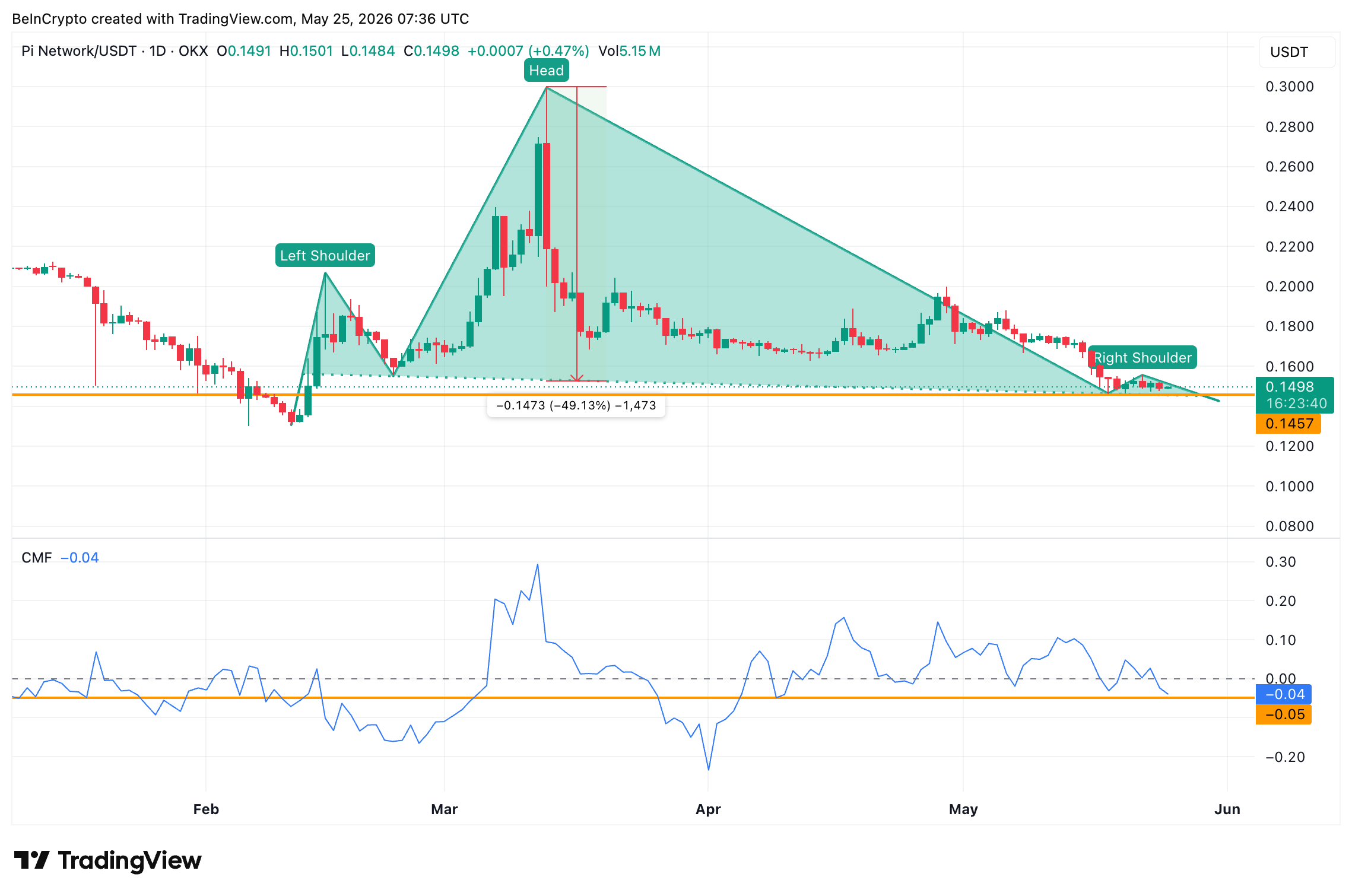
Pi Coin price is drifting toward a fresh all-time low as a bearish chart structure tightens its grip on the token, leaving the floor sitting just inches below the current price.
Three independent signals across capital flow, social activity, and smart money positioning have lined up against the token as it tests its most important support since February.
Head and Shoulders Forms as CMF Flags Capital Flight
The PI/USDT daily chart shows a Head and Shoulders pattern, a classic bearish reversal structure. The setup features a higher peak (the head) flanked by two lower peaks (the shoulders), with a horizontal neckline tying the swing lows together.
The left shoulder formed in mid-February. The head printed in mid-March near the cycle peak. The right shoulder completed in mid-May and is now rolling over.
Want more token insights like this? Sign up for Editor Harsh Notariya’s Daily Crypto Newsletter here.
Chaikin Money Flow (CMF), a volume-weighted indicator that proxies big money buying and selling pressure, has slipped to -0.04 on the daily chart. That marks the lowest reading since early April.

The indicator broke below its zero line and is now retesting its most stressed zone in roughly two months. A push under -0.05 would confirm a heavier outflow phase aligned with the pattern’s downside thesis.
Capital flight, however, does not measure how much attention Pi Network is drawing as the breakdown approaches.
Pi Network Social Volume Falls From 31 to 1
Pi Network’s daily Social Volume, a Santiment metric that counts unique social documents discussing the token across more than a thousand crypto channels, has collapsed to 1. That reading sits at the floor of the visible chart range. By comparison, the score peaked at 31 on May 8 post a brief retail rally attempt.

The roughly 97% drop in social chatter shows that retail attention has faded sharply as the price has drifted lower. Quiet markets tend to extend bearish moves because no fresh demand arrives to absorb sell pressure.
For a community-driven asset like Pi, where engagement has historically powered demand, a silent social tape is a structural warning. The token is sliding without any narrative catalyst pulling new buyers in.
The crowd has stepped back, but the question is whether informed money is doing the same.
Smart Money Index Diverges Below Signal
The Smart Money Index, an indicator that measures informed-trader positioning, sits at 0.9063 against its signal line at 0.9157.
The Smart Money line is now diverging below its signal line, a configuration that has historically preceded weaker prices when it persists. The metric slipped under its baseline relative to the signal line in early May and the gap has continued to widen.
The only feature still propping up the indicator is an ascending trendline anchored from the early-February low. That trendline is currently being tested.

A clean break under that ascending support would push the Smart Money reading to its lowest level since February 11, the same period when PI printed its all-time low of $0.130. A repeat of that backdrop would close the loop between informed money exit and a fresh price low.
With three independent signals aligned, the price chart now becomes the decider.
Pi Coin Price Levels to Watch as All-Time Low Looms
The Pi Coin price is currently fighting to defend the $0.145 neckline of the Head and Shoulders pattern. A daily close below $0.145 opens the door directly to the $0.130 all-time low, which sits roughly 13% below current spot.
The first cushion below the neckline arrives at $0.143, the 0.236 Fibonacci level of the structure. Below the all-time low, $0.129 (0.5 Fibonacci) and $0.122 (0.618) become the next stress zones.
Deeper bearish extensions stack at $0.113 (0.786) and $0.102 (1.0 Fibonacci). The pattern’s full measured-move target near $0.074 aligns with the 1.618 extension at $0.069, marking the deepest projected zone.
Every level below $0.130 would print a fresh all-time low and pull the token into uncharted territory with each breach.

A bullish reset, however, only begins on a daily close back above $0.156, the right shoulder peak. Real strength returns above $0.200, the left shoulder zone, while the full pattern invalidates only on a move above the $0.300 head.
A daily close above $0.156 separates a possible right shoulder recovery from a confirmed slide into all-time low territory.
The post Pi Coin Loses Social Pulse With New All-Time Low Just 13% Away appeared first on BeInCrypto.

Texas voters are headed back to the polls this week for runoff elections in two high-stakes contests that could shape the political calculus around cryptocurrency policy ahead of 2027. In the U.S. Senate Republican primary, incumbent John Cornyn faces challenger Ken Paxton, while in Texas’ 18th congressional district, incumbent Al Green competes with challenger Christian Menefee for the November general election. Both races feature outsized spending from interest groups aligned with the crypto industry, signaling an ongoing effort to tilt policy conversations at the federal and state levels toward a crypto-friendly agenda.
Campaign finance filings illuminate a concerted effort by crypto-aligned PACs to influence outcomes. Protect Progress, affiliated with Fairshake PAC and connected to Ripple and Coinbase networks, reported substantial expenditures in support of Menefee and in opposition to Green. Specifically, filings show about $5 million spent to back Menefee and roughly $2.8 million directed at ads opposing Green. Menefee also holds the endorsement of the Blockchain Leadership Fund, a coalition backed by Anchorage Digital and Chainlink Labs, though the committee’s recent expenditures had not been reported as of the latest disclosures.
The Fellowship PAC, funded by Cantor Fitzgerald and Anchorage, disclosed about $500,000 spent to favor Paxton in the Senate race. The timing of that investment followed public remarks from former President Donald Trump endorsing Paxton, a move widely interpreted as a signal to conservative voters and to the donor community about Paxton’s alignment on a broad set of policy priorities, including those related to crypto regulation.
The primaries’ outcome could determine the electoral dynamics of Texas’ 18th district and one of the state’s two Senate seats in the November election, with potential downstream effects on the balance of power in Congress in 2027. Pro-crypto policy supporters have highlighted the GENIUS Act, a stablecoin-related measure that has drawn industry backing and legislative attention in recent years, as an example of the kind of framework that crypto firms argue is necessary for clear, compliant operations.
Key takeaways
- Crypto-aligned political action committees have deployed significant sums in Texas’ runoff races, with Protect Progress spending about $5 million to back Menefee and $2.8 million opposing Green, according to Federal Election Commission filings.
- Menefee’s campaign context includes an endorsement from the Blockchain Leadership Fund, a coalition backed by Anchorage Digital and Chainlink Labs, though the fund’s recent spending activity had not been reported at the time of reporting.
- The Fellowship PAC’s $500,000 expenditure to support Paxton emerged shortly after Trump publicly endorsed Paxton, illustrating how national-level endorsements can intersect with state campaigns where crypto policy is a focal point.
- Prediction markets show strong, though not unanimous, expectations for Paxton and Menefee, with Kalshi placing high odds on both races. Statewide, Paxton’s odds surged following Trump’s endorsement, illustrating how market signals can reflect, and potentially amplify, political messaging around crypto issues.
- Beyond electoral dynamics, the contests underscore ongoing regulatory and compliance considerations for crypto firms, including licensing, stablecoins, AML/KYC frameworks, and cross-border policy alignment under frameworks like MiCA and U.S. oversight by the SEC, CFTC, and DOJ.
Crypto-funded campaigns and the regulatory backdrop
The Texas races highlight how political spending tied to crypto interests can influence not only candidate support but the regulatory conversation itself. The crypto industry has long advocated for clearer, rules-based frameworks that reduce uncertainty for exchanges, lenders, and other market participants. In Congress, this translates into ongoing attention to bills and regulatory proposals that touch stablecoins, token classifications, and the treatment of crypto firms under banking and financial services laws. The GENIUS Act, cited by industry observers as an illustrative example of policy language sought by the sector, remains a touchstone for debates about how stablecoins should be integrated into the traditional financial system and how consumer protections should be implemented without stifling innovation.
Analysts and compliance professionals monitor these races for indications of potential shifts in oversight philosophy. A Republican-led congressional slate that remains supportive of crypto-friendly measures could advance a legislative agenda leaning toward clearer categorization of digital assets and a more navigable licensing regime for exchanges and custodians. Conversely, a broader regulatory coalition in the next Congress could seek to broaden enforcement authority or tighten consumer protections in ways that affect liquidity, access to banking services, and the feasibility of institutional crypto programs. The immediate Texas backdrop thus has implications for how firms think about state-level political risk and the likelihood of alignment with national policy trajectories.
Markets, messaging and political risk signals
In parallel with campaign spending, prediction markets have been active in pricing in anticipated outcomes. Kalshi’s contracts for the Texas races assigned substantial probabilities to Menefee and Paxton, with event contracts indicating a strong likelihood of Democratic and Republican nominees prevailing in the respective runoffs. The platform’s latest data showed Menefee and Paxton favored by roughly 90% or higher in one or both contracts, with total reported volume surpassing $16 million across related markets. Polymarket, a rival platform, has produced similar parity in its assessments, reflecting a broad market view that crypto-aligned candidates continue to attract support from speculative and policy-focused participants alike. These market signals, while probabilistic, can influence stakeholder expectations, donor decisions, and lender and exchange strategies as regulatory discussions evolve.
Industry observers note that not all crypto-advertising explicitly brands itself as industry-friendly messaging. Some ads emphasize broader political themes, including opposition or support for figures based on a wider set of policy positions. The volume and direction of spending suggest a disciplined approach by industry-aligned groups to shape the political landscape in a way that could facilitate more predictable regulatory outcomes for crypto firms operating in Texas and, by extension, the wider United States.
From a compliance perspective, the Texas runoff outcome matters for institutions that navigate state-level political risk. If policymakers in Texas and in the federal arena move toward more crypto-friendly regimes, banks and fintechs operating in or through Texas could experience greater regulatory clarity and potential access to partner programs with crypto-native firms. However, if regulatory risk intensifies, firms may reassess exposure, capital deployment, and geographic diversification of crypto activities to maintain robust risk controls and adherence to AML/KYC standards. This dynamic is particularly relevant for entities seeking to balance customer due diligence with the need to maintain competitive, compliant services in a rapidly evolving policy environment.
What comes next for regulators and market participants
As officials consolidate results from the runoff elections, the broader policy implications will hinge on how legislators approach crypto risk, consumer protection, and financial stability. The ongoing interplay among state campaigns, national regulatory priorities, and cross-border policy alignment will shape the enforcement and licensing landscape for crypto firms, exchanges, and banks interfacing with digital assets. Institutions should watch for forthcoming committee hearings, rulemaking initiatives, and potential updates to AML/KYC guidance that could alter licensing thresholds, reporting obligations, and supervisory expectations across jurisdictions.
Related: Texas Lt. Gov. calls for study of crypto, prediction markets — A broader policy frame around state leadership and crypto policy continues to unfold as markets assess regulatory risk and potential structural reforms in 2027.
According to the U.S. Federal Election Commission filings, Protect Progress has spent approximately $5 million to support Menefee and $2.8 million on advertising opposing Green. The same filings confirm the level of outside influence present in these races, underscoring the growing role of crypto-aligned political spending in shaping electoral outcomes. The endorsement from the Blockchain Leadership Fund, as reported by Cointelegraph, adds another layer to the strategic alignment between policy advocacy and industry fundraising activity, illustrating how industry-backed groups seek to influence candidate positioning on digital asset policy. The timing of Paxton’s support from the Fellowship PAC and Trump’s public endorsement further demonstrates the convergence of national political momentum with state-level electoral contests that affect crypto policy trajectories.
In sum, the Texas runoff outcomes will be observed not only as a function of district politics but also as a barometer for the sector’s influence on legislative processes, enforcement priorities, and the architecture of digital-asset regulation in the United States. For institutions, the period ahead warrants close monitoring of policy developments, licensing approaches, and cross-border alignment efforts that could redefine how crypto activities are conducted, supervised, and integrated with the broader financial system.
Closing perspective: The upcoming runoffs will crystallize where the crypto-policy discourse lands in the near term, with implications for compliance programs, licensing strategies, and risk management for firms operating in a landscape of evolving rules and evolving market structures.

XRP has spent the better part of three months going nowhere while Bitcoin (BTC) climbed from around $60,000 to $80,000, and one chart analyst is done pretending otherwise.
According to them, the gap between community expectation and actual market performance has rarely looked wider.
XRP Has Been Losing Ground to Bitcoin Since 2017
UK-based technical analyst ChartNerd laid it out plainly in a post on Monday:
“I’m sorry to break this to my $XRP community. I’m just tired of the constant hopium: we have been underperforming Bitcoin since 2017, with NO signs of any major rotation. In fact, over the last 3 months, BTC has climbed 60K-80K while $XRP/BTC has lost its 20 MEMA.”
That 20-period exponential moving average on the XRP/BTC pair is a metric traders use to track medium-term momentum in one asset relative to another. Losing it, as ChartNerd’s chart shows, puts the pair back toward the bottom of its long-term range.
Historically, that lower zone is where XRP has delivered its most explosive outperformance against Bitcoin, including the one in November 2024. But the analyst is careful not to spin that as a near-term buy signal. The pattern has to confirm first, and right now, the breakdown is what has confirmed.
“While BTC has climbed 60-80K, $XRP has done nothing but trend sideways, all while the XRP/BTC pair is breaking down,” ChartNerd added in a follow-up post.
In a separate May 21 update, the analyst noted the XRP/BTC pair had been declining for 15 consecutive weeks, directly explaining why XRP’s USD price had gone essentially flat over the same period.
“I expect $XRP will likely underperform against Bitcoin for the majority of the year,” he wrote.
Subdued Short-Term Outlook
The short-term picture is similarly subdued, with XRP trading around $1.36 at the time of writing, within a tight 24-hour range of $1.34 to $1.37.
ChartNerd has identified $1.30 as a key support level, and he expects resistance in the $1.40 territory on any recovery attempt, describing that zone as a potential support/resistance flip.
His longer-range bear case points toward the $0.90-$0.70 area if broader conditions deteriorate, while he has noted that XRP’s 2-week regression band lower boundary is currently sitting near $1.00.
Bitcoin, meanwhile, is trading around $77,000 after a rough stretch that saw it drop to just above $74,000 last week. However, it has recovered on news of progress in US-Iran peace talks, and its dominance over the rest of crypto has remained above 58%.
That high dominance figure is itself part of what is weighing on XRP and most altcoins: when Bitcoin is absorbing the majority of capital flow, altcoins tend to lag.
The post XRP Community Gets a Harsh Warning as Bitcoin Dominance Tightens appeared first on CryptoPotato.
Key Takeaways
-
Legal action in New York targets nearly 40,000 inactive Bitcoin addresses
-
Court case applies traditional abandoned property statutes to cryptocurrency holdings
-
Legal proceedings challenge fundamental principles of Bitcoin self-custody
-
Plaintiff claims discovery of wallets through proprietary algorithmic methods
-
Case establishes precedent for how courts handle long-dormant digital assets
A groundbreaking legal proceeding in New York has thrust the issue of inactive Bitcoin wallets into the spotlight, creating a potential landmark case for cryptocurrency property rights. A plaintiff identified as Noah Doe has initiated court proceedings seeking legal ownership of 39,069 Bitcoin addresses that have shown no activity for extended periods. This unprecedented case forces courts to grapple with how traditional property abandonment statutes apply to decentralized digital currencies.
Legal Framework Behind the Bitcoin Wallet Claim
On May 1, 2026, Doe submitted his legal petition to the Supreme Court of New York, invoking New York Personal Property Law Article 7-B as the statutory foundation. The legal strategy characterizes these digital holdings as discovered property rather than misappropriated or exchange-managed funds.
The petition lists Doe alongside two Wyoming-incorporated entities as co-plaintiffs. Their objective is securing a declaratory judgment that would establish legal ownership rights over the contested wallets and any cryptocurrency they contain. The core argument maintains that ownership should transfer due to the absence of legitimate claimants stepping forward.
According to the filing, Doe identified 42,001 potentially abandoned wallets using a proprietary algorithmic system he developed. Following protocol for found property, he notified the New York Police Department. Through subsequent verification efforts, 2,932 wallets were removed from consideration, leaving 39,069 addresses at the center of the legal dispute.
Technical and Legal Challenges in the Bitcoin Ownership Case
This legal challenge centers on fundamental issues of notification, possession, and statutory abandonment. Bitcoin wallets operate through cryptographic private keys, meaning courts cannot simply reassign cryptocurrency through conventional judicial orders. Any favorable ruling would carry symbolic and legal significance without enabling direct technical transfer.
Documentation shows Doe attempted blockchain-based notification by embedding messages via OP_RETURN transactions in June 2025. These on-chain communications pointed wallet controllers toward abandonment documentation and a formal claims procedure. A mandatory public notification window then extended through October 10, 2025.
Technical scrutiny has identified potential weaknesses in the notification approach. Blockchain analysts have observed that certain notices targeted P2PKH address formats, while the actual cryptocurrency resides in P2PK outputs. This technical discrepancy could undermine arguments that legitimate owners received adequate notification.
Broader Implications for Cryptocurrency Self-Custody
The targeted addresses include wallets associated with early-stage miners and other historically significant holders. Investigation has connected some listed addresses to cryptocurrency from the Satoshi Nakamoto era and potentially to assets linked to the Mt. Gox security breach. The complete inventory of contested addresses spans 901 pages of court documentation.
This litigation presents fundamental challenges to cryptocurrency self-custody principles. Extended periods of wallet inactivity could indicate lost cryptographic keys, deceased owners, or deliberate long-term storage strategies—not necessarily legal abandonment. Doe’s position maintains that proper notification combined with owner silence creates grounds for ownership transfer.
Traditional property law faces unprecedented challenges when applied to Bitcoin, which operates without centralized control or administration. While courts might bind regulated entities like exchanges if contested funds eventually move through their platforms, the [[LINK_START_2]]Bitcoin[[LINK_END_2]] protocol itself cannot reallocate cryptocurrency without the corresponding private keys.


Dubai, UAE | May 2026 – The agent economy is reshaping financial markets. Open-source agent frameworks are accelerating autonomous financial activity, with AI agents increasingly executing trades, managing portfolios, and interacting directly with exchanges. Yet the financial infrastructure supporting this shift has not evolved at the same pace.
CoinQuant, the AI-powered no-code trading platform that has attracted over 15,000 users since launch, today announces its expansion into a unified trading intelligence architecture built for both human traders and autonomous AI agents.
“Autonomous trading is no longer theoretical. It is already happening. The next phase requires structured validation, disciplined risk management, and intelligence infrastructure. That is what CoinQuant delivers,” said Maan Ftouni, Founder and CEO of CoinQuant.
The trust layer for autonomous AI agents
As AI agents increasingly connect directly to exchanges and wallets, many rely on raw APIs without structured backtesting, risk analysis, or validated data pipelines. CoinQuant introduces a structured intelligence layer between trading intent and live capital deployment.
No strategy goes live unvalidated, whether built by a human or generated autonomously. Backtesting, risk metrics, and parameter optimization are embedded directly into the workflow, ensuring capital is deployed only after systematic evaluation.
From no-code platform to trading intelligence architecture
CoinQuant’s expansion reflects the evolution of its core engine. At the center of the platform is a unified intelligence system combining institutional-grade backtesting, structured market data from providers including Kaiko and Financial Modeling Prep, AI-powered optimization, and CoinQuant’s proprietary Domain Expert system.
Human traders interact through a natural language interface that allows them to describe, test, optimize, and deploy strategies without writing code. AI agents connect programmatically through API and MCP integrations to validate strategies and access structured data at scale.
The interface is only the surface. The intelligence engine beneath it is the product.
One engine, two growth vectors
This expansion represents a natural extension of CoinQuant’s business model. The platform’s growing base of over 15,000 traders validates product-market fit and generates structured strategy intelligence. The agent interface multiplies that value through high-volume programmatic validation and automation workflows.
Every strategy built, tested, and deployed contributes to an anonymized aggregated intelligence layer, creating a proprietary dataset mapping trading intent to logic, validation metrics, and performance outcomes across market conditions.
“The same engine that powers a trader’s first backtest can validate hundreds of strategies for autonomous systems in parallel. We are building one intelligence foundation for both humans and AI agents,” Ftouni added.
Automation layer launching next
CoinQuant is preparing to launch its automated strategy execution layer on HyperLiquid as its second major revenue stream.
The automation layer will enable validated strategies to transition seamlessly from backtest to live deployment within the same intelligence framework.
Raising $3 million to scale
CoinQuant is currently raising a $3 million Seed round to support product development, infrastructure scaling, and global expansion. The company is also developing HYDRA, a hierarchical multi-agent architecture designed for advanced research, risk modeling, and strategy optimization.
With over 15,000 users validating demand for structured trading intelligence, CoinQuant aims to become the intelligence backbone of algorithmic trading in the agent-driven financial era.
About CoinQuant
CoinQuant is an AI trading platform that enables traders and AI agents to build, validate, optimize, and automate trading strategies using natural language. Headquartered in Dubai, CoinQuant integrates with major exchanges and institutional data providers to deliver professional-grade trading infrastructure to a global community.
Media contact:

The S&P 500 blasted to a record 7,534 on Memorial Day as oil price plummeted on potential Middle East de-escalation. A tentative framework agreement between the Trump administration and Iran to reopen the Strait of Hormuz sent Brent crude tumbling back below $100 per barrel, gutting the geopolitical risk premium that had kept institutional allocators defensive for weeks.
Spot BTC ETF flows have yet to turn positive after a bloody week. Can Bitcoin take advantage of this situation? Or is the downtrend yet to bottom?
Discover: The Best Crypto to Diversify Your Portfolio
Bitcoin S&P 500 Correlation Could be Back
The Bitcoin correlation with the S&P 500 is not just a background statistic. During prior risk-on equity waves, Bitcoin’s 90-day correlation with the S&P has repeatedly climbed into the 0.3–0.5 range, compared with near-zero or negative readings during risk-off periods.
UBS had projected the S&P 500 reaching 7,500 by year-end 2026 on the back of roughly 14% earnings growth, with approximately half of that expansion driven by AI and tech. The index hitting that target ahead of schedule compresses the forward timeline for every correlated risk asset.

Bitcoin’s price structure shows a clean reclaim of the 200-day EMA, with horizontal resistance clustered near its prior all-time high. The technical setup is not ambiguous after it reaches what looks to be a local bottom. But the question now is whether macro momentum holds long enough to push through it.
The primary variable to watch is institutional infrastructure demand, specifically whether the Nasdaq options market and spot ETF complex continue to absorb supply at current levels or begin showing outflow pressure ahead of the next macro data print.
Oil Price Collapse Is the Disinflationary Shock Crypto Has Been Waiting For
Brent crude tumbling back below $100 per barrel is not just an equity catalyst; it is a direct input into the inflation trajectory that has kept the Federal Reserve hawkish and crypto markets range-bound.
The Iran deal oil price dynamic runs a clean causal chain: lower crude means lower CPI expectations, which would likely be followed by the Fed less compelled to hold rates restrictively, dollar softens, liquidity conditions loosen, so risk assets, including Bitcoin, can reprice higher.
BREAKING:
BRENT CRUDE HAS FALLEN BELOW $100 AS OPTIMISM GROWS AROUND A POSSIBLE U.S.-IRAN AGREEMENT
THE DEAL MAY INCLUDE A CEASEFIRE AND THE REOPENING OF THE STRAIT OF HORMUZ
NEARLY 20% OF GLOBAL OIL SUPPLY MOVES THROUGH THE STRAIT
MARKETS ARE STARTING TO PRICE IN A… https://t.co/bQGMGo4V1t pic.twitter.com/aLNOVzUwFM— The Bitcoin Times (@TheBitcoinTime) May 25, 2026

Brent had spent weeks above $100 following Iran’s disruption of the Strait of Hormuz, a chokepoint carrying roughly 20% of global oil supply. AAA data showed national gasoline prices at four-year highs heading into Memorial Day.
This inflation overhang had futures markets pricing in the possibility that the Fed might raise rates rather than cut, a scenario that would have been structurally brutal for crypto. The framework agreement, even unfinalized, changes that pricing.
Discover: The Best Token Presales
The post Oil Price Butchered as US Stocks Breach ATH: Can Bitcoin Mirror the S&P 500? appeared first on Cryptonews.
XRP (XRP) traded within a key “value zone” where whales recently accumulated $170 million, signaling a tightening liquidity supply.
Key takeaways:
- XRP whales withdrew 122 million XRP, worth $170.8 million, from Binance, while price is near the key $1.35-$1.40 support.
- Exchange outflows and steady spot XRP ETF inflows point to a tightening supply and growing demand for XRP.
- XRP price could target $2.33 if bulls break above $1.50 resistance, with Bollinger Bands hinting at a big move ahead.
122 million XRP withdrawn from Binance exchange
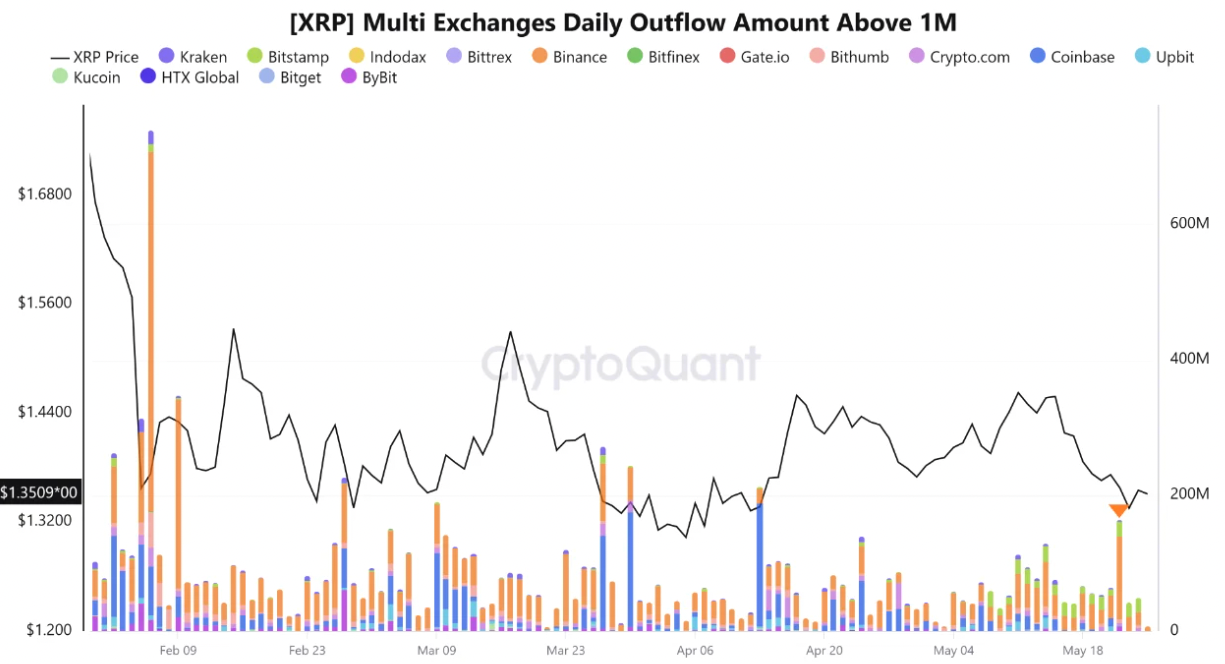
XRP whale withdrawals, large exits above 1 million coins per transaction, hit 122 million on Binance on May 22, worth about $170.8 million at current rates, according to data from CryptoQuant.
This marked their first daily withdrawal above 1oo million XRP since the 278 million XRP seen in early February.
“What makes the latest move more important is the price context,” CryptoQuant analyst Amr Taha said in a Monday QuickTake post.
Note that the Feb. 9 withdrawal spike happened while XRP was trading near $1.43, while the May 22 spike came with XRP around $1.35.
“This makes the $1.35–$1.40 range an important zone to watch for XRP,” the analyst said in another QuickTake post, adding:
“Repeated withdrawals near the same price range may indicate that some larger players view this area as a value zone.”
XRP: Whale outflows from exchanges. Source: CryptoQuant
Such outflows typically indicate accumulation by large holders, who move tokens to self-custody or increase exposure to XRP investment products, thereby reducing immediate sell-side pressure.
Meanwhile, inflows for US-based spot XRP ETFs continue with these investment products recording positive flows for 16 consecutive days, totalling $116.75 million.
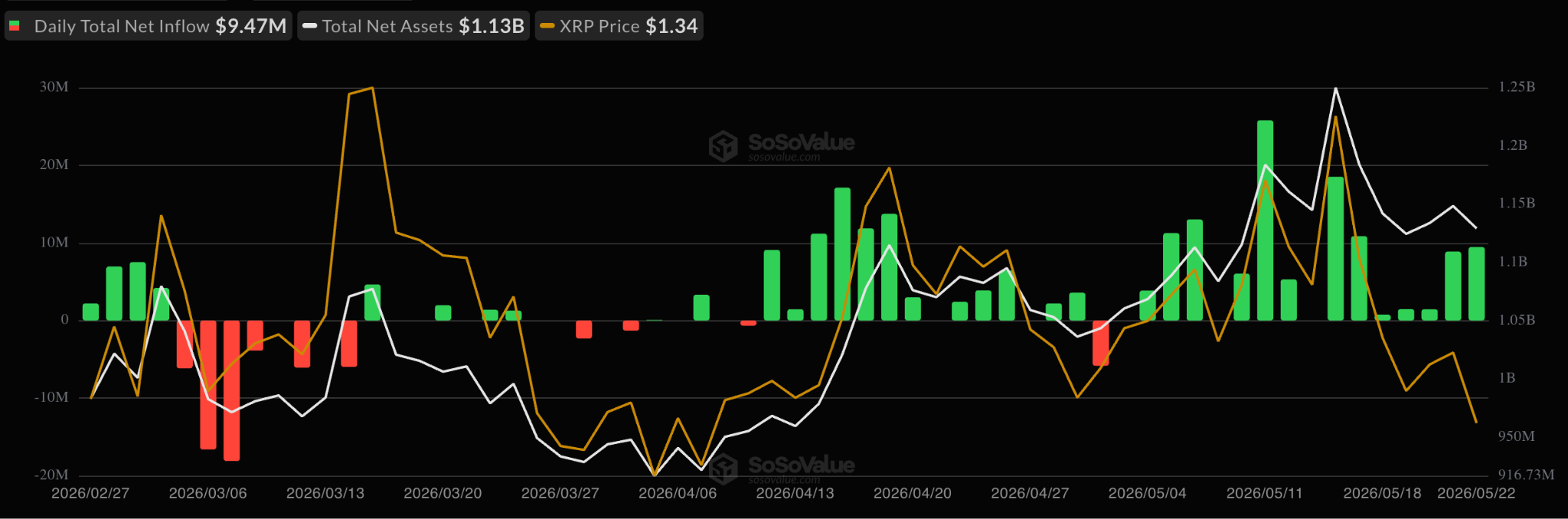
Spot ETH ETFs flows chart. Source: SoSoValue
XRP price must hold $1.30 as support
The XRP/USD pair has been trading in a tight range between $1.30 and $1.50 since early February.
XRP’s bullishness now hinges on holding $1.30 as support if it “stands another chance at retesting $1.50 resistance,” analyst ChartNerd said in a recent post on X.
“$1.30 is a current guardrail,” the analyst said, adding:
“If lost, a deeper drop to the lower $1 territory is likely in the coming weeks.”
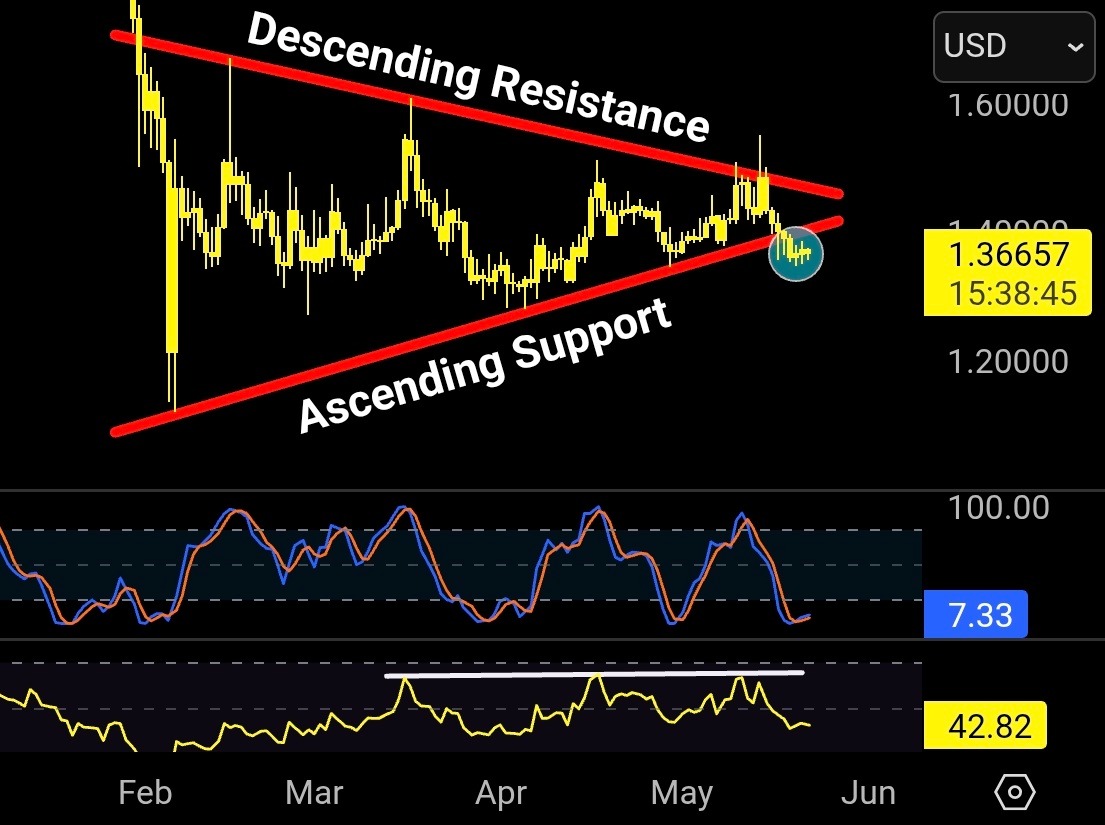
XRP/USD daily chart. Source: X/ChartNerd
XRP trades within a multi-year range from May 2022 to November 2024. Eventually, a break above the upper limit of this range at $0.68 preceded a 400% rally to $3.40 in January 2025.
If the XRP/USD pair holds within its current range, a similar upward move could be seen once a decisive move supported by strong volume above the upper limit at $1.50 is achieved.
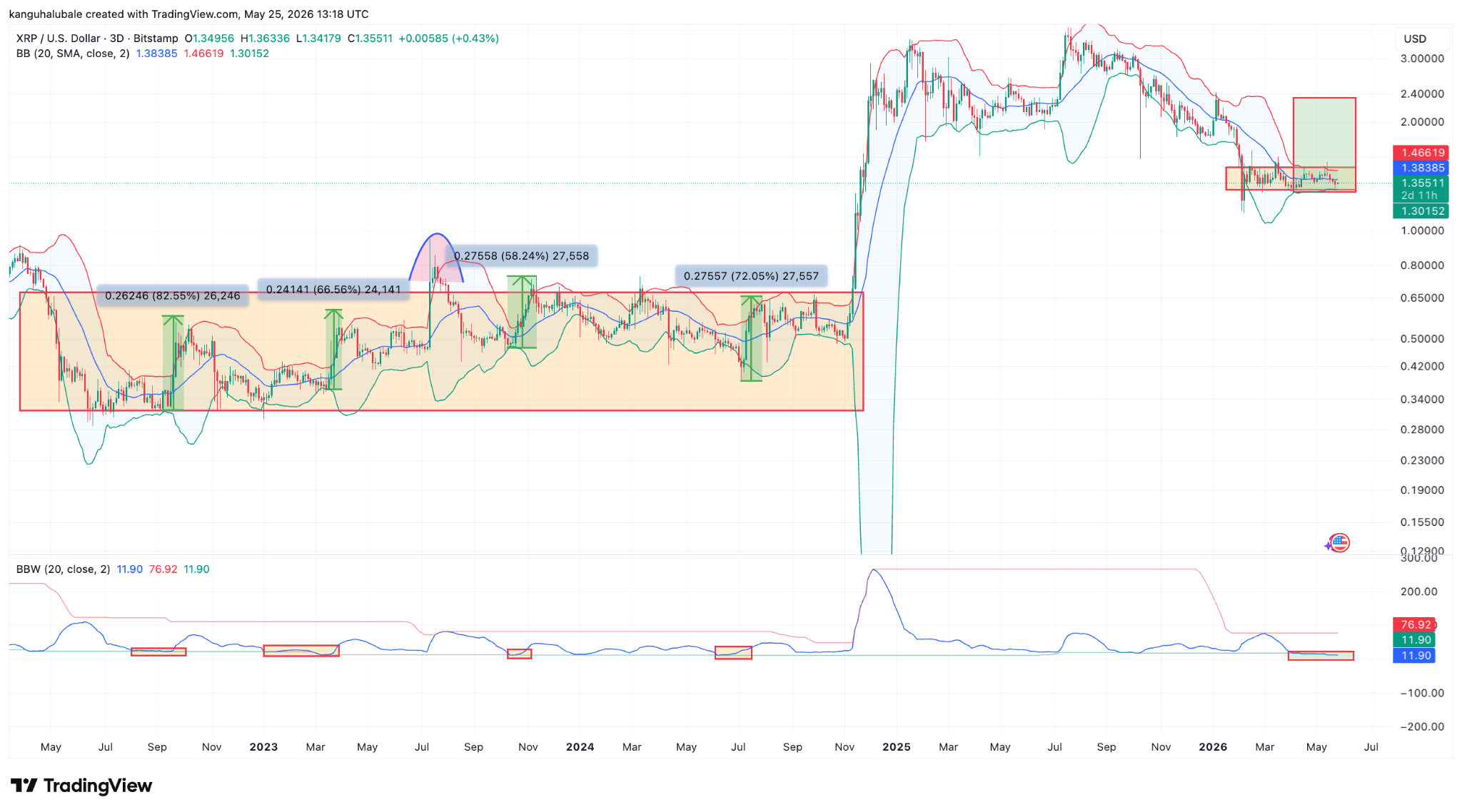
XRP/USD three-day chart. Source: Cointelegraph/TradingView
Meanwhile, the Bollinger Bands are still at their tightest level since mid-2024. Similar occurrences have previously led to gains of 58%-82% in XRP price, as shown in the chart above.
As such, XRP could rise as high as $2.33 if a similar breakout scenario plays out.
Analyst Crypto Patel referred to the current range as the “best accumulation zone,” adding that the muted price action resembles the calm before its major breakout in late 2024.
The analyst’s upside target is $10, implying a roughly 7x potential from the lower end of the accumulation range if XRP repeats its 2022–2024 cycle-style expansion.
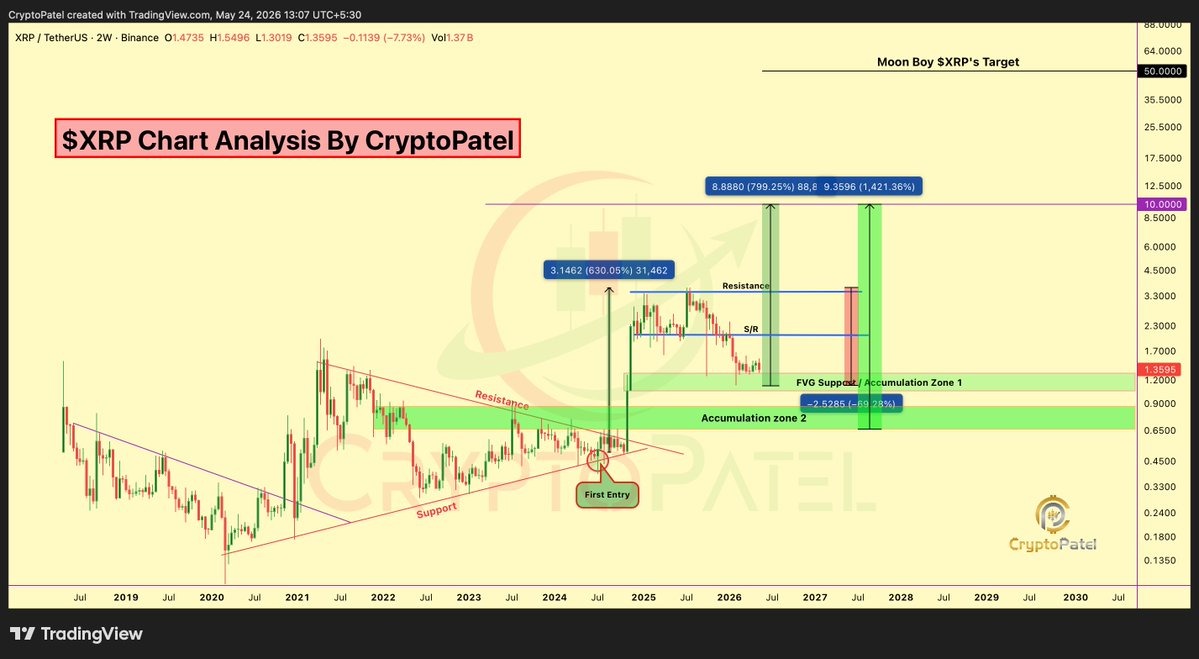
XRP/USD two-week chart. Source: X/Crypto Patel
As Cointelegraph reported, overhead resistance at $1.40-$1.50 is likely to keep the price in check unless the bulls muster the strength to overcome it over the next few weeks.

OpenBSD 7.9 arrives, a diamond in the rough proud of every sharp edge

Man arrested on suspicion of rape in Darwen town centre with area taped off

(VIDEO) Thousands of Drones Illuminate Sydney Skies in Stunning Vivid 2026 Comeback After Two-Year Absence


-

 Crypto World4 days ago
Blockchain.com files with SEC for U.S. IPO
-

 Fashion3 days ago
Holiday Weekend Open Thread – Corporette.com
-

 Business3 days ago
Dell Technologies DELL Stock Surges 15% on AI Server Momentum and Analyst Upgrades in 2026
-

 Crypto World3 days ago
Bitcoin Accumulation Weakens as BTC Realized Losses Hit $600M
-

 Crypto World3 days ago
Space X IPO Is ‘Bad News’ for Tech Stocks: But What About Bitcoin?
-

 Politics3 days ago
Makerfield: a tale of two social-media histories
-

 Crypto World2 days ago
Robinhood crypto COO Tanya Denisova exits
-

 Crypto World4 days ago
MicroStrategy’s Saylor Says Miners No Longer Set Bitcoin Price, Another Force Has Taken Over
-

 Business24 hours ago
NYT Strands Answers May 24 2026 Revealed for Puzzle No. 812 Theme Summer Essentials
-

 Crypto World3 days ago
AI infrastructure race heats up as IREN pitches full-stack strategy, WhiteFiber lands $160M deal
-
 Tech3 days ago
A 0.12% parameter add-on gives AI agents the working memory RAG can’t
-

 Tech4 days ago
WhatsApp ads could make Irish debut after discussions with DPC
-
Crypto World7 days ago
Revolut Launches Dogecoin Debit Card Across UK and EU
-

 Tech4 days ago
You Can Now Add ChatGPT To PowerPoint
-

 Business3 days ago
Trump Invests $1M-$5M in Kura Sushi USA Chain With 27 California Locations
-

 Sports4 days ago
2026 CJ Cup Byron Nelson leaderboard: Brooks Koepka finds putting stroke in Round 1
-
 NewsBeat4 days ago
Charity run by Reform leader Malcolm Offord accused of ‘law breaking’ over Scottish registration
-

 Crypto World3 days ago
Trump Media’s Bitcoin Stash Shrinks Again as 2,650 BTC Lands on Crypto.com
-
Business3 days ago
Goldman Sachs reinstates Ageas stock coverage with neutral rating
-

 Crypto World5 days ago
Exa Labs raises $250 million in funding led by a16z
You must be logged in to post a comment Login