

Crypto World
STRC’s correlation with BTC hits record high



Bitcoin holder Strategy Inc.’s perpetual preferred stock, known as STRC or “Stretch,” is showing an increasingly tight link to bitcoin’s price moves. This weakens its appeal as a relatively steady income provider.
The 90-day correlation coefficient between the two has climbed to nearly 0.70, the highest level since the instrument debuted in July 2025, according to data source TradingView. The correlation has been rising since early this month, with both STRC and BTC losing ground. While STRC has tanked 23% to $76 this month, BTC’s price has slipped nearly 20% to under $60,000, hitting levels last seen in October 2024.
This tightening correlation changes the risk profile for investors seeking steady income from the preferred stock of the world’s largest corporate BTC holder, which owns 847,363 BTC worth $50.4 billion, according to BitcoinTreasuries.net.
STRC was designed as a hybrid product: a variable-rate perpetual preferred stock with a $100 par value that pays monthly cash dividends. The current annualized rate is 11.5%, and the board adjusts it monthly to encourage trading near par. When shares trade above $100, the firm can issue additional shares through at-the-market offerings and use the proceeds to purchase additional bitcoin.

Crypto World
a16z-backed crypto firm rebrands, shifts focus to solving AI’s global copyright headache


The startup formerly known as Story Protocol raised $140 million to secure internet rights and is now building an audit layer for data consent, licensing, and provenance for tech firms.

Bitcoin options markets are signaling caution rather than panic, according to new research from Anchorage Digital. In its latest Prime Signal report, the firm’s head of research, David Lawant, finds that traders across both crypto-native venues and traditional investment wrappers are paying up for downside protection—especially over the very near term.
The study looked at options activity across Deribit and two major exchange-traded fund products tied to Bitcoin exposure: BlackRock’s iShares Bitcoin Trust (IBIT) and Strategy’s Bitcoin-linked instruments. Anchorage argues that this cross-market view helps capture differences between crypto-native positioning and more institutional or retail flows than a single venue alone.
Key takeaways
- Deribit and IBIT options show elevated put skew, consistent with demand for downside hedges at a premium rather than outright bullish bets.
- Defensive positioning is unusually high within both markets’ historical ranges—ranked in the 82nd percentile for IBIT and the 84th percentile for Deribit over their respective multi-year windows.
- Anchorage reports Bitcoin options have spent nearly half of 2026 pricing higher one-week implied volatility than one-month implied volatility, an inversion that has typically been temporary.
- In Strategy’s options market, put skew remains below levels Anchorage associates with past stress episodes like forced deleveraging.
Downside hedging stays in focus across venues
Anchorage’s central finding is that traders are not just buying options—they are choosing structures that emphasize downside risk. In both the Deribit and IBIT options markets, the firm observed elevated put skew, a pattern that generally indicates market participants are willing to pay more for protection against lower prices than for upside participation.
Anchorage quantifies this defensiveness by comparing current activity against historical behavior. It reports that defensive positioning sits at the 82nd percentile within IBIT’s history and at the 84th percentile across Deribit’s five-year record, suggesting that the current hedging intensity is high relative to what has been typical.
Why the “one-week vs one-month” volatility inversion matters
Beyond skew, Anchorage examined the term structure of implied volatility—specifically how volatility priced for the coming week compares with volatility priced for the following month. The report says Bitcoin options have spent nearly half of 2026 with one-week implied volatility higher than one-month implied volatility, an inversion it describes as unusual and historically episodic.
Anchorage attributes the pattern to a chain of catalysts spanning macroeconomic conditions, geopolitical developments, and crypto-specific drivers that have kept traders focused on near-term risks. Instead of signaling a stable trend expectation, the data points toward “event window” caution: participants appear more concerned about what could happen soon than about setting a long-range directional view.
Lawant said he is watching for a change in that relationship—specifically, whether one-month implied volatility begins to exceed one-week implied volatility again. He frames such a shift as a sign that the market may be growing more comfortable looking further out rather than concentrating hedges around immediate uncertainty.
Strategy’s options market: hedging without “crisis” pricing
Anchorage’s analysis also addresses whether the options market is pricing Strategy (MSTR) as if it faces a severe downside scenario. While the company has experienced weakness in its equity-related products, Anchorage argues that options demand for protection has not escalated to stress levels typically associated with broad systemic fear.
Earlier coverage from the market has highlighted the decline in Strategy’s perpetual preferred stock, STRC. According to the details cited in Anchorage’s research discussion, STRC fell as low as $82.53 on June 22—around 17% below its $100 par value—before partially recovering after Strategy disclosed it had increased its fiat reserves to $1.3 billion. By Thursday, STRC was reported as trading around $77, roughly 23% below par, based on the figures referenced in the report write-up.
The weakness has also extended to Strategy’s common shares. The article notes that MSTR has been down about 78% over the past year and traded around $87 on Thursday, according to Yahoo Finance data.
However, Anchorage’s options read-through is more measured than the equity performance. The firm reports that Strategy-related options remain well below stress levels seen during prior market corrections. While put skew indicates that hedging demand is present, the skew has not moved into ranges that Anchorage associates with fears of forced deleveraging or a broader crisis.
That distinction matters for market participants because it separates “risk management” from “contagion pricing.” Put skew can rise for many reasons—structural hedging, volatility supply/demand, or tactical protection—so Anchorage’s comparison to historical stress levels is intended to show that traders are cautious but not uniformly expecting a severe unwind scenario.
Broader implications for how traders are framing risk
Taken together, Anchorage’s findings suggest a market where near-term downside hedging remains the dominant theme, even as different trading ecosystems show broadly consistent behavior. Elevated put skew in both Deribit and IBIT indicates that the appetite for protection is not limited to a single buyer type or venue; it spans the crypto-native options market and a key regulated product channel.
At the same time, the volatility term structure points to timing rather than direction. The one-week/one-month implied volatility inversion described in the report implies that traders are treating the next few days to weeks as more uncertain than the later month horizon—consistent with a market responding to catalysts as they approach, rather than immediately repricing longer-term outlooks.
For Strategy-related risk, the message is similar: equity weakness does not automatically translate into options-market “panic pricing.” Anchorage says the hedging activity in Strategy’s options is still below the kind of levels it has previously linked to forced deleveraging dynamics.
Going forward, traders may want to track whether the one-month implied volatility premium returns over the one-week measure—an indicator Lawant flagged as a potential shift from immediate risk management to a longer-term posture. Until then, Anchorage’s data suggests the market will likely keep prioritizing near-term protection across both crypto and ETF-linked Bitcoin options.


Michael Saylor has faced renewed legal pressure after a shareholder rights firm opened an investigation into Strategy, adding to mounting scrutiny that has accompanied the company’s sharp stock decline and Bitcoin’s latest selloff.
Summary
- Rosen Law Firm has launched an investigation into Strategy over potential securities claims and is preparing a possible shareholder class action.
- Strategy shares have fallen below $100 and dropped about 23% over the past week as Bitcoin’s selloff intensified market pressure.
- Peter Schiff and CryptoQuant have raised separate concerns over Strategy’s Bitcoin strategy, liquidity position, and capital allocation.
According to Rosen Law Firm, the investigation is examining whether Strategy misled investors through materially inaccurate business disclosures. The firm said it is evaluating potential securities claims and is preparing a possible class action on behalf of shareholders who suffered losses.
The announcement comes roughly a week after Bitcoin critic Peter Schiff publicly argued that investors in Strategy’s STRC preferred shares could have grounds for legal action if they purchased the security based on Saylor’s promotion of the company’s Bitcoin-backed investment strategy. Schiff’s remarks came before any law firm publicly disclosed plans to examine potential shareholder claims.
Meanwhile, pressure on the company has continued in the market. Yahoo Finance data show Strategy shares fell below the $100 threshold earlier this week before dropping to around $86 on Thursday, leaving the stock down more than 6.5% on the day and about 23% over the past week.
Concerns have expanded beyond the stock price
Legal scrutiny follows growing criticism that had already surrounded Strategy’s Bitcoin treasury model. As crypto.news reported yesterday, Schiff argued that continued weakness in Strategy’s shares could eventually force the company into difficult capital allocation decisions.
According to Schiff, persistent selling pressure from short sellers could make buying back Strategy shares more attractive than purchasing additional Bitcoin. He argued that selling part of the company’s Bitcoin holdings to finance stock repurchases could narrow the gap between Strategy’s market valuation and the value of its underlying assets, although he questioned whether such a move would be enough to restore investor confidence.
Schiff also warned that any sale of Bitcoin by Strategy could weigh on the cryptocurrency market itself by adding fresh supply during a period of weak demand.
Separate concerns have also come from on-chain analytics firm CryptoQuant. The firm’s recent analysis urged Strategy to slow its pace of Bitcoin accumulation and rebuild liquidity instead.
According to CryptoQuant, annualized dividend obligations tied to Strategy’s STRC perpetual preferred stock have climbed to about $1.2 billion, while the company’s cash reserves have fallen 38% during 2026.
CryptoQuant further estimated that dividend coverage has dropped from more than seven years to roughly 14 months. The firm calculated that restoring coverage to 24 months would require approximately $2.8 billion in cash, nearly double the company’s existing reserves.
Management continues backing its Bitcoin strategy
Even as outside criticism has intensified, Strategy’s leadership has continued defending its long-term Bitcoin approach. Saylor recently pointed to conditions during the 2022 crypto bear market, when Bitcoin traded near $16,000, and the company’s debt exceeded the combined value of its Bitcoin and cash reserves.
According to Saylor, the company’s financial position has since improved substantially, with Bitcoin and cash reserves now exceeding outstanding debt by more than $40 billion. His comments indicate that Strategy does not intend to abandon its Bitcoin treasury strategy despite the latest market turbulence.
Meanwhile, additional selling pressure emerged during Thursday’s session. Market commentator Zerohedge claimed that unusually heavy put option buying in Strategy shares coincided with fresh weakness in both MSTR stock and Bitcoin.
At the same time, Bitcoin extended losses after U.S. Personal Consumption Expenditures inflation reportedly accelerated to 4.1%, its highest reading since 2023, adding another source of pressure for both the cryptocurrency and companies with large Bitcoin exposure.
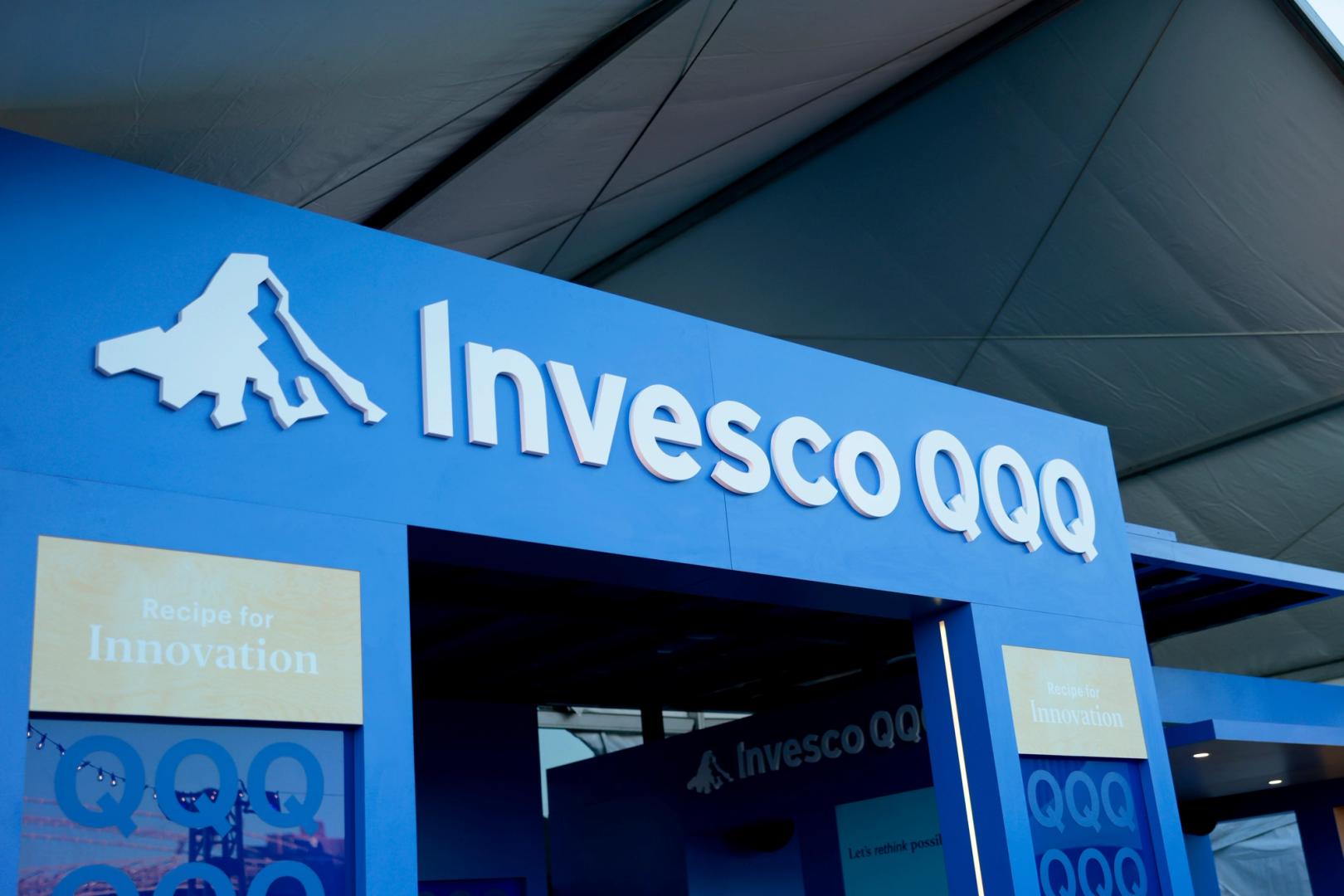
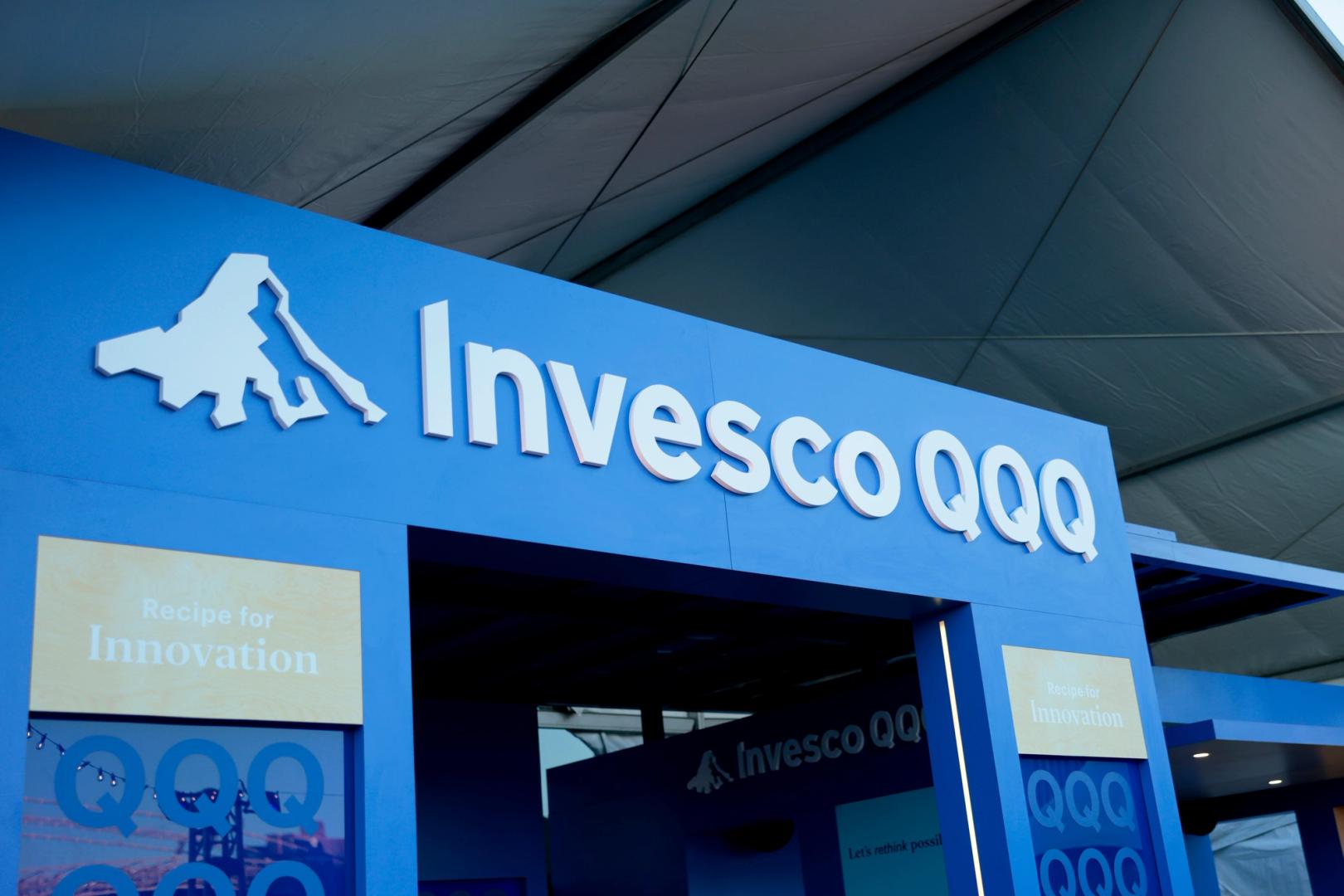
Invesco’s move is another sign of asset managers increasingly chasing a new business opportunity created by stablecoins. These cryptocurrencies are designed to maintain a fixed value, typically tied to one U.S. dollar, and are backed by reserve assets such as cash and short-term Treasuries. As issuance grows, so does demand for firms that can manage those reserves.
Citigroup projects the stablecoin market could expand to as much as $4 trillion by 2030, up from roughly $300 billion today, creating a potentially lucrative market for fund managers.
BlackRock, State Street and ProShares also filed to launch funds aimed at serving as stablecoin reserve vehicles, reflecting intensifying competition to provide the infrastructure behind digital dollars.
The filing also builds on Invesco’s broader tokenization strategy. Earlier this year, the firm took over management of Superstate’s roughly $900 million tokenized Treasury fund, becoming the first third-party asset manager to use Superstate’s blockchain-based FundOS platform.
That move placed Invesco alongside firms such as BlackRock, Franklin Templeton and Fidelity that have embraced tokenized money market funds as a way to modernize how traditional assets are issued, transferred and settled using blockchain rails.
SpaceX has drawn fresh warnings over possible market excess after expanding its bond sale to $25 billion only weeks after its blockbuster public offering, while the SPCX stock has remained more than 30% below its post-IPO peak.
Summary
- SpaceX’s expanded $25 billion bond sale has prompted Allianz CIO Ludovic Subran to warn that markets may be entering bubble territory.
- SPCX has fallen more than 30% from its post-IPO peak as rising short interest and profit-taking continue to pressure the stock.
- Analysts remain divided, with Susquehanna assigning a Neutral rating while KeyBanc says much of SpaceX’s future growth may already be priced in.
According to the Financial Times, Allianz Chief Investment Officer Ludovic Subran believes the enlarged debt offering points to signs that financial markets may be entering bubble territory, arguing that companies are taking advantage of elevated equity prices and favorable borrowing conditions to raise fresh capital.
Subran cited SpaceX’s return to the debt market shortly after its IPO as an example of investor enthusiasm running at an unusually strong pace. According to the Financial Times, he said the speed of fundraising activity suggests companies are rushing to secure financing while market conditions remain supportive.
The Allianz executive also drew a distinction between stock and bond investors. While equity investors often focus on long-term growth prospects, he noted that debt investors typically seek predictable income and stable returns.
Subran’s comments came as investors also weighed the latest U.S. Personal Consumption Expenditures inflation data, which reinforced concerns that inflationary pressures remain elevated.
Bond sale adds to scrutiny over SpaceX valuation
Although reports indicate the expanded bond offering attracted strong investor demand, the financing has added to the ongoing debate over whether SpaceX’s valuation already prices in much of its expected growth.
Earlier, crypto.news reported that Susquehanna initiated coverage of SpaceX with a Neutral rating and a $170 price target. In its research note, the brokerage said the company’s valuation depends on aggressive growth assumptions and premium valuation multiples.
Around the same time, KeyBanc began coverage with a Sector Weight rating without assigning a price target. According to the brokerage, SpaceX is well-positioned to remain the leading player in the commercial space launch industry, but much of that long-term potential may already be reflected in the current share price.
Stock decline and short sellers keep pressure on SPCX
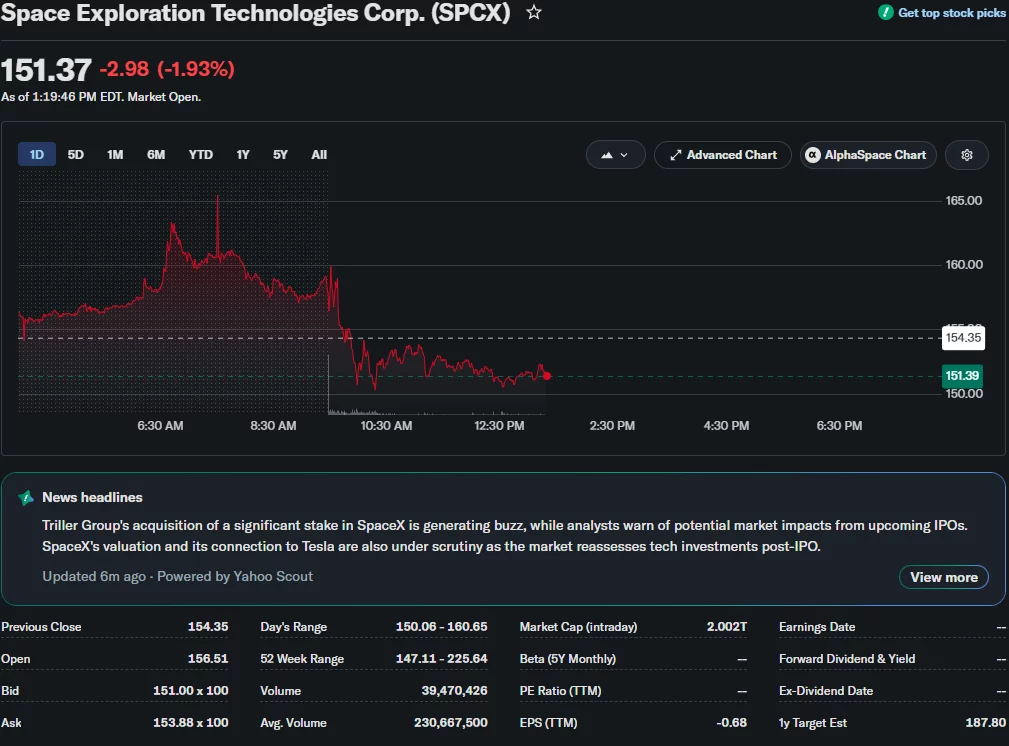
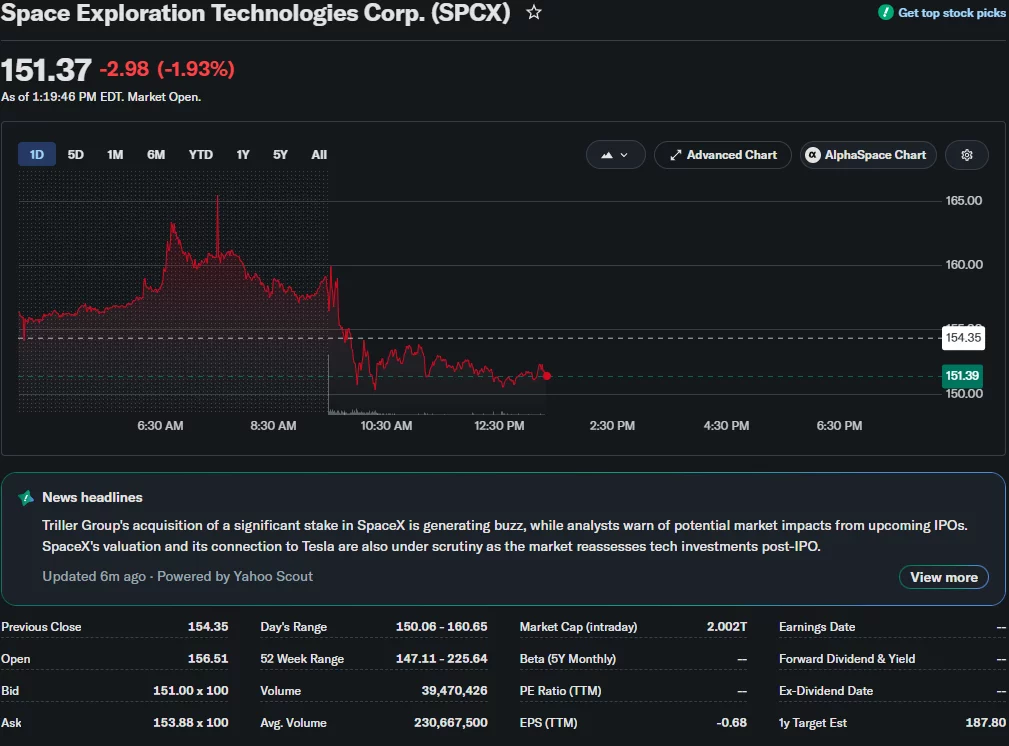
Selling pressure has continued in the stock market as SPCX extended its decline after the opening bell. At the time of writing, the shares were down about 2% near $151, leaving the stock roughly 21% lower over the past five trading days and more than 30% below the high reached shortly after its IPO.
Earlier reporting by crypto.news cited Ortex Technologies, which said bearish bets against SpaceX had climbed rapidly in recent sessions, lifting short interest to a significant portion of the company’s public float. Ortex co-founder Peter Hillerberg described the pace of new short positions as unusual for a company that has been publicly traded for only a few weeks.
According to Hillerberg, many traders appear to be positioning for additional downside after the stock’s sharp retreat from its post-listing rally. Ortex also linked the selling pressure to profit-taking in newly listed companies and a pullback across risk-sensitive assets, as investors reassess SpaceX’s valuation following its rapid early gains.
At the same time, market attention has also turned to unconfirmed reports that SpaceX could consider acquiring T-Mobile. A report citing TD Cowen said such a move could become an option if the company fails to secure a network-sharing agreement. The analysts pointed to T-Mobile’s existing relationship with Starlink as a possible strategic advantage, although they stressed that the acquisition scenario remains speculative and there has been no official confirmation from either company.


Strategy's STRC preferred shares have hit a new all-time low this week, trading in the $73-78 range and extending a selloff that began in mid-June. The preferred shares spent months trading near their $100 par value. On June 18, the stock was at $82.60. By Wednesday, STRC dropped to a fresh… Read the full story at The Defiant


Disclosure: This article does not represent investment advice. The content and materials featured on this page are for educational purposes only.
Crypto payment gateways are evolving to help online merchants accept digital assets through secure, compliant, and user-friendly payment systems.
Summary
- Crypto payment gateways are evolving with stronger security, compliance, and merchant-friendly features.
- Growing demand for digital asset payments is driving innovation in crypto gateway infrastructure and settlement.
- Modern crypto payment solutions are helping businesses integrate blockchain payments into e-commerce platforms.
Payment technology in the cryptocurrency sector is rapidly changing to meet the needs of mainstream online businesses. As more users seek to make purchases with digital assets, payment gateways have become central to the integration of crypto into e-commerce. Enhanced features, security controls, and regulatory compliance are bringing these solutions closer to widespread adoption.
Online merchants are looking for practical ways to accept digital currencies, prompting renewed attention to the infrastructure known as payment rails, alongside tools such as linkedin automation used in broader digital outreach. Unlike traditional card networks, crypto payment gateways must bridge blockchain transactions with familiar spending and settlement experiences. Businesses and consumers both seek seamless payment experiences, making effective gateway design critical for the future of e-commerce.
Why digital payment infrastructure is gaining importance
With the rise in blockchain and stablecoin transactions, the importance of efficient digital payment rails is increasingly clear. Customers want to spend coins as easily as they use conventional money, necessitating payment solutions that feel natural during checkout.
In crypto, a payment gateway handles the connection between blockchain transactions and traditional e-commerce systems. Unlike card processors, gateways in this sector must manage token conversions, security verification, and instantaneous settlement, making the role distinct yet familiar to those used to online payments.
Key advances in crypto payment gateway design
Early versions of crypto payment gateways often involved cumbersome conversions and inconsistent user experiences. Over time, solutions have integrated more fluid conversion flows, allowing users to pay in digital assets, with merchants receiving settlement in either crypto or fiat currencies as needed.
Recent improvements include easier refund processes, streamlined chargeback management, and more reliable end-to-end reconciliation tools. Another trend is the dominance of stablecoins as reference units, offering price stability and predictable settlement that many merchants prefer over volatile cryptocurrencies.
Technical models supporting merchant adoption today
Many online shops must decide between custodial gateways, where the provider handles funds, and non-custodial ones that let merchants retain direct control of private keys. Alongside this, integration choices include direct onchain settlement or instant conversion to traditional currencies to minimize volatility risks.
Modern gateways commonly offer plugins or APIs compatible with leading e-commerce platforms, enabling businesses to add support for altcoins alongside major cryptocurrencies with minimal technical barriers.
Risk management and security in crypto payment systems
The operational risks associated with blockchain payments remain significant. Wallet security issues, phishing schemes, and the finality of onchain transactions all place unique demands on merchants and gateway providers in both customer support and technical safeguarding.
Compliance requirements are becoming more sophisticated, with monitoring tools designed to detect unusual activity without systematically collecting excess personal data. This allows companies to adhere to regulations while respecting user privacy, a concern that weighs heavily for many crypto users.
The regulatory pressures shaping product development
Increasingly, Know Your Customer (KYC) and Anti-Money Laundering (AML) protocols are shaping the architecture of crypto payment gateways. The travel rule, which mandates the sharing of certain transaction data between parties, further complicates gateway design choices and technical integrations.
Licensed intermediaries and third-party service providers often play a part in helping merchants navigate compliance. Their involvement can streamline onboarding while offering a layer of assurance for merchants wary of regulatory risks associated with processing digital assets.
Current adoption landscape and future technology trends
Certain sectors, such as cross-border sales, digital goods, and B2B payments, show the most promise for crypto payment gateway adoption. Stablecoin settlement offers advantages like lower fees and easier reconciliation for these use cases, even as lingering hurdles remain before widespread use becomes feasible.
Looking forward, advances such as account abstraction and smarter, user-friendly wallet designs are set to bring further improvements to checkout and transaction handling. With technical progress and growing interoperability between blockchains and payment gateways, the sector continues to negotiate the balance between decentralization, compliance, and robust consumer protections.
Disclosure: This content is provided by a third party. Neither crypto.news nor the author of this article endorses any product mentioned on this page. Users should conduct their own research before taking any action related to the company.

TLDR:
- STRC has dropped to $76.20, approximately 25% below its $100 par value, alarming income-focused investors.
- Strategy owes $1.2 billion annually in STRC dividends but holds only $1.4 billion in USD reserves currently.
- Unlike Terra LUNA, Saylor faces no forced liquidation if STRC falls, as dividends remain legally discretionary.
- A sustained STRC discount could weaken MSTR demand over time, quietly slowing Strategy’s Bitcoin accumulation pace.
Is STRC the next LUNA? That question is circulating across crypto social media after Strategy’s preferred stock dropped to approximately $76.20, roughly 25% below its $100 par value.
On-chain intelligence firm Arkham has weighed in with a detailed breakdown, drawing both parallels and sharp distinctions between the two instruments.
With $1.2 billion in annual dividend obligations and $1.4 billion in reserves, the math is tight, and markets are paying close attention.
What Is STRC and Why Are Investors Comparing It to LUNA?
STRC is a Nasdaq-listed perpetual preferred stock carrying a $100 stated par value. It launched in July 2025 at a 9% annual dividend rate, which Strategy has since raised seven consecutive times to 11.50% as of June 2026.
That rising yield mirrors the dynamic that drew retail investors into Terra’s Anchor protocol before its collapse. STRC also pays an 11.5% annual dividend, a yield that echoes the 20% return Terra’s Anchor protocol advertised before it imploded.
According to Arkham, there are 104.89 million STRC shares outstanding. At 11.5% on a $100 par value, Strategy owes approximately $1.2 billion per year to maintain those dividends. The firm held $1.4 billion in USD reserves as of earlier this week, leaving a thin buffer.
The preferred stock fell to an intraday low of $82.53 last week, its deepest drawdown since launch, reviving comparisons on social media to Terra’s UST stablecoin collapse in 2022. A high yield and a price drifting below its target were enough to trigger that memory across crypto circles.
A hawkish Federal Reserve pivot on June 17, with nine of 18 FOMC officials projecting at least one rate increase in 2026, added further pressure on both Bitcoin and the income-oriented buyers STRC targets. That macro backdrop accelerated the selling.
Why STRC Is Not LUNA and What the Slide Means for Strategy
The structural differences between STRC and Terra LUNA are where the comparison breaks down. Benchmark analyst Mark Palmer described STRC as “not a stablecoin,” characterizing the selloff as a market-driven reset of required yield rather than a depeg, noting that something never pegged cannot technically depeg.
Terra UST maintained a programmatic $1 peg enforced by algorithmic minting and burning of LUNA tokens, a mechanism STRC simply does not have.
Arkham noted that Saylor is not legally required to pay STRC dividends at any point. Unlike Terra’s design, there is no forced liquidation triggered by a price drop.
The market price of STRC reflects investor confidence in Strategy’s willingness and capacity to keep paying, nothing more.
Strategy’s legacy software business generates roughly $477 million in annual revenue against more than $1.2 billion in preferred-dividend obligations, a gap funded almost entirely by capital markets activity rather than operations. That structural mismatch is the real concern, not a death spiral.
A sustained discount still forces difficult choices on Strategy: richer preferred terms, more equity issuance, or drawing on the Bitcoin reserve itself.
Arkham warned that if MSTR investors begin to recognize their capital is being recycled into dividend payments for earlier preferred shareholders, demand for MSTR shares could soften over time, gradually constraining the firm’s broader Bitcoin accumulation engine.



Ripple has stepped up its public campaign for the CLARITY Act as the legislation faces a narrower path through Congress following a Senate recess and competing legislative priorities in Washington.
Summary
- Ripple launched a mobile “CLARITY” truck campaign near the U.S. Capitol to support the crypto market structure bill.
- The CLARITY Act faces a tighter timeline after the Senate recessed until July 13 and legislative priorities shifted.
- The DOJ said the bill would not weaken federal authority to investigate or prosecute crypto-related crimes.
According to Ripple, the company has deployed a mobile advertising truck around the U.S. Capitol carrying messages in support of the CLARITY Act, urging lawmakers to establish clear rules for digital assets while Congress continues debating crypto legislation.
Large digital displays on the truck feature Ripple branding alongside the slogan “On the road to Clarity,” while other panels describe the legislation as a framework for clear digital asset regulation.
In a July 25 X post, Ripple said the campaign is intended to keep attention on the bill as lawmakers continue working on crypto policy.
The company wrote that the CLARITY Act would protect consumers, encourage responsible innovation, and help the United States remain competitive in the digital asset industry.
Lauren Belive, Ripple’s co-head of public policy and government, also highlighted the campaign on social media. In her X post, Belive described the initiative as the company taking its “road to clarity” message directly to Washington while Congress considers the legislation.
Senate calendar has tightened for the CLARITY Act
Ripple’s campaign comes as the bill faces a more challenging legislative timetable. Earlier this week, Senate Majority Leader John Thune adjourned the Senate until July 13 under a unanimous consent agreement, reducing the number of legislative days available before lawmakers leave again for the August recess.
As reported by crypto.news, Representative Anna Paulina Luna criticized the decision, saying she would not support reopening the House floor until senators returned to Washington. Luna argued that the Senate had left the capital without advancing pending legislation before the Independence Day holiday.
The scheduling pressure has increased alongside new competition for congressional attention. President Donald Trump recently postponed signing the bipartisan 21st Century ROAD to Housing Act after it cleared Congress with overwhelming bipartisan support, saying he would instead wait for lawmakers to advance the SAVE AMERICA Act.
Although the housing bill is unrelated to the CLARITY Act procedurally, Trump’s decision adds another legislative priority as Congress weighs several major policy measures at the same time.
The CLARITY Act had already been placed on the Senate Legislative Calendar earlier this month after advancing through committee, while the House Financial Services Committee is also expected to continue considering the proposal before any final votes can take place.
DOJ backs bill despite law enforcement concerns
Even as the legislative timetable has tightened, debate over the bill’s impact on financial crime enforcement has continued.
Several law enforcement organizations have warned that parts of the proposal could create risks for financial crime investigations involving digital assets. Responding to those concerns, a spokesperson for the U.S. Department of Justice said the legislation would not reduce prosecutors’ or investigators’ authority.
According to the DOJ, law enforcement access to relevant information would remain unchanged under the proposal, and the bill would not limit federal investigations or prosecutions involving crimes such as drug trafficking, human smuggling, or terrorism financing involving digital assets.
At the same time, Treasury Secretary Scott Bessent has continued to support congressional action on crypto legislation. Bessent has said a U.S. central bank digital currency is “off the table” under the current administration while encouraging lawmakers to continue advancing digital asset legislation, including the CLARITY Act.
With Congress now operating under a compressed legislative calendar, Ripple’s public campaign arrives as supporters of the bill seek to maintain momentum before lawmakers return to Washington in mid-July.


A suspected phishing attack targeting one of Polymarket’s third-party vendors has resulted in $3 million worth of crypto being stolen from users.
The Polymarket Traders X account revealed that the firm discovered on Thursday morning that its third-party vendor had been compromised. It claims that hackers then injected “a malicious script into our frontend for some users.”
It also claims that the firm has contained the issue and removed “the affected dependency.” Finally, it reassured users that it will fully refund those affected.
Crypto security analyst Specter tracked the hack, noting that there was a potential “phishing attack targeting Polymarket users.”
It estimated that the attackers had stolen almost $3 million from 11 victim wallets. Each victim was in possession of Polymarket stablecoin PUSD.
Read more: American Indian tribes want Kalshi and Polymarket off their land
This stolen crypto was then swapped for ETH before being redirected to this address: 0xe65b1C586757c5510B60F998Eebb14C1eF71E1eD.
Just last month, Polymarket suffered another hack after an exploited private key lost the company $700,000.
The company stressed that the theft was caused by an old private that had been compromised rather than a hack related to its contracts and core infrastructure.
Protos has reached out to Polymarket for comment and will update this piece should we hear anything back.
Got a tip? Send us an email securely via Protos Leaks. For more informed news and investigations, follow us on X, Bluesky, and Google News, or subscribe to our YouTube channel.

LARRY KUDLOW: The Mamdani-AOC antisemitic tail is now wagging the entire Democratic Party dog

a16z-backed crypto firm rebrands, shifts focus to solving AI’s global copyright headache

Ryan Garcia names the current world champion Manny Pacquiao can beat to make history


-

 Fashion6 days ago
Weekend Open Thread: Miami – Corporette.com
-

 Entertainment5 days ago
Renter of Home in Anne Heche Crash Denies Settlement With Son
-
 Sports2 days ago
Two goals and an assist by sheer aura: Cristiano Ronaldo just entered the World Cup chat
-

 Tech3 days ago
Microsoft accidentally kills epic Outlook email threads
-

 Business5 days ago
Soccer-U.S. defends Iran World Cup travel restrictions, says discussions ongoing
-

 Politics6 days ago
Andy Burnham and the meaning of Makerfield
-

 NewsBeat6 days ago
Keir Starmer Allies Question His Chances For No 10
-
Crypto World2 days ago
Bitcoin (BTC) Dips Below $62K, Ethereum (ETH) Plunges 6% Daily: Market Watch
-

 Tech2 hours ago
A Look At A Gaggle Of Transputer Boards
-

 Crypto World2 days ago
Securitize Wraps Roubini's SEC-Registered ETF as Dubai VARA Digital Security
-
Business2 days ago
Entergy settles forward sale agreements, raises $672 million in cash proceeds
-
 Business6 days ago
Wall Street Week Ahead: Investors see Micron earnings as pulse check of AI rally momentum
-
 Crypto World5 days ago
Can Charles Hoskinson Really Rescue Cardano?
-

 Crypto World6 days ago
HIVE shares jump as $220M AI deal speeds Bitcoin mining pivot
-

 Crypto World5 days ago
Jake Chervinsky accuses CME of protecting derivatives monopoly
-

 Entertainment6 days ago
Jose Alvarado Wants Taylor Swift at More Knicks Games
-
 Tech4 days ago
Signal’s Meredith Whittaker says AI chatbots ‘are not your friends’ and calls Copilot agents a backdoor
-

 Sports9 hours ago
India vs Bangladesh LIVE Score, Women’s T20 World Cup: Bangladesh Opt To Bat; India Enter ‘Do-Or-Die’ Stage As Semi-Final Race Heats Up
-

 Tech3 days ago
Nearly 7,000 fake Amazon domains registered ahead of Prime Day 2026, researchers warn
-

 Sports7 days ago
FIFA World Cup 2026: Canada beat 9-men Qatar 6-0 to register first ever win | FIFA World Cup 2026
You must be logged in to post a comment Login