

Crypto World
TeraWulf Signs $19B Anthropic AI Lease, Stock Gains

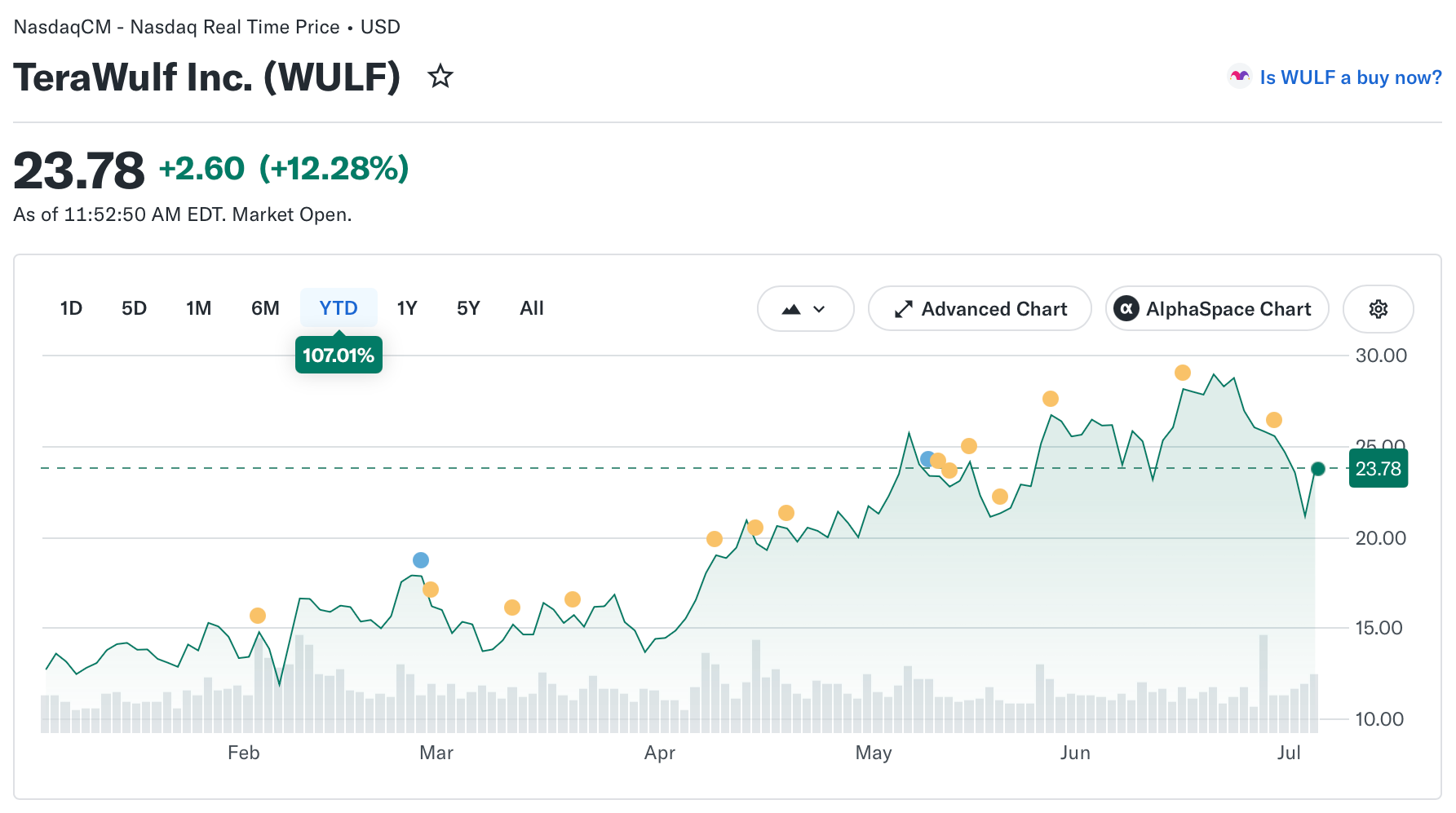
Bitcoin miner TeraWulf, moving deeper into AI infrastructure, signed a 20-year data center lease with Anthropic expected to generate about $19 billion in contract revenue.
The company also announced Monday that it is selling a majority stake in a separate AI data center joint venture to reinvest in wholly owned projects.
The company’s shares rose about 12% in Monday morning trading following the announcement, extending a roughly 107% year-to-date gain, according to Yahoo Finance data at the time of writing.
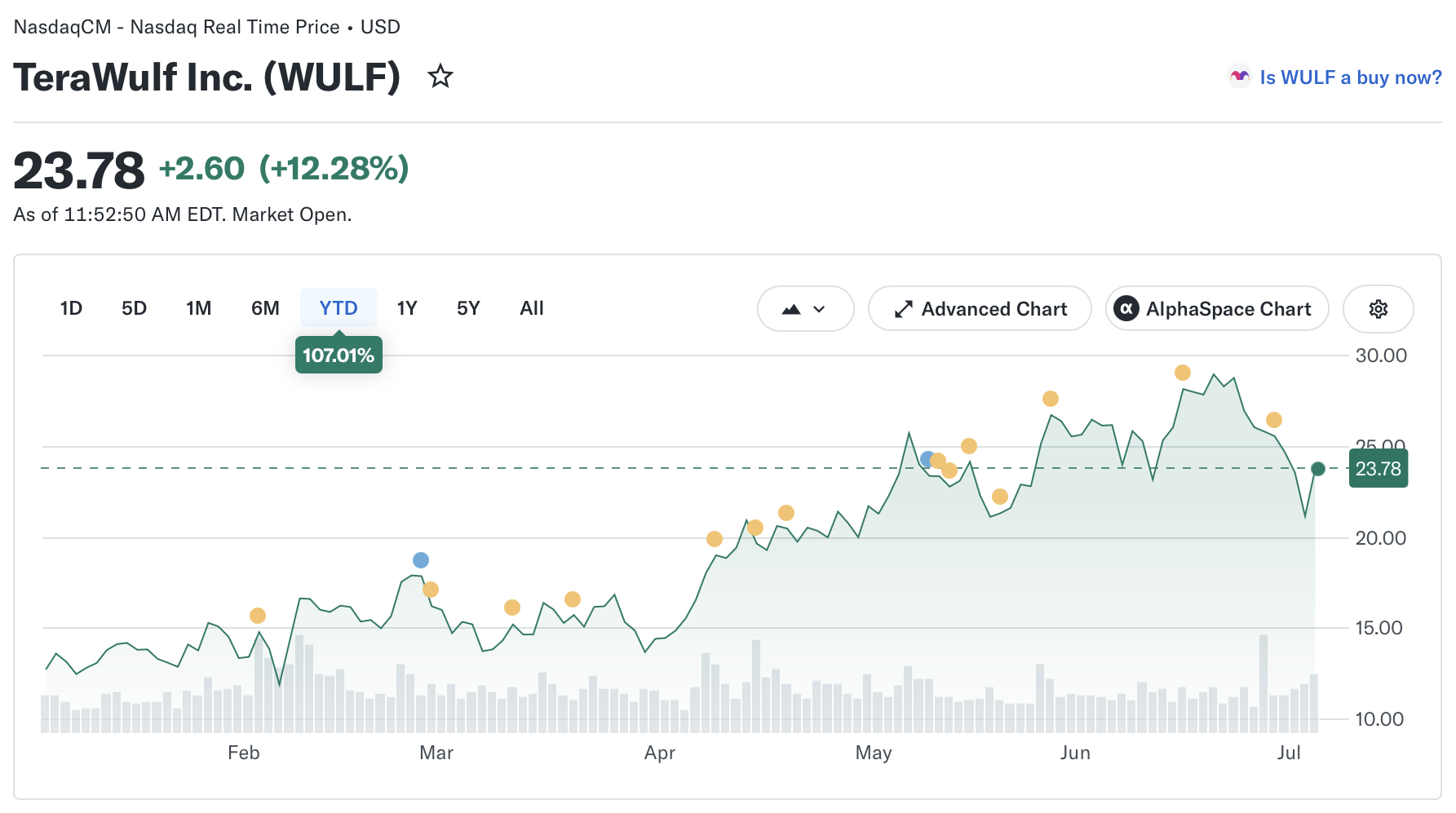
TeraWulf stock price. Source: Yahoo Finance
Under the agreement, Anthropic will lease a purpose-built AI data center campus at TeraWulf’s Justified Data site in Hawesville, Kentucky. Acquired in February, the facility is designed to support 401 MW of critical IT capacity, with initial operations expected in the second half of 2027 and full buildout targeted for early 2028.
Separately, TeraWulf agreed to sell its 50.1% stake in the Abernathy joint venture, an AI data center project in Texas, to an investor group led by partner Fluidstack. The company said it expects the sale to return its roughly $450 million investment which it plans to reinvest in AI infrastructure projects that it owns outright.
Related: Strategy sells 3,588 Bitcoin for $216M to fund dividends, keeps $2.55B reserve intact
AI demand reshapes Bitcoin mining industry
The announcement comes as demand for AI infrastructure outpaces available computing capacity. Training and running large AI models requires data centers with high-performance chips, advanced cooling systems and access to large amounts of reliable electricity, making power-rich campuses increasingly valuable.
That has created an opportunity for several Bitcoin miners, which already own sites with grid connections, power agreements and other infrastructure needed for energy-intensive computing. While AI data centers use different hardware than crypto mining operations, the overlap has prompted several miners to diversify into AI and high-performance computing (HPC).
However, the pivot comes with significant costs. Blocksbridge Consulting estimated in June that public Bitcoin miners pursuing AI infrastructure may need roughly $50 billion in near-term capital, as AI data centers require far greater investment than traditional Bitcoin mining facilities.
Last month, HIVE Digital signed a three-year, $220 million agreement to provide GPU cloud infrastructure for AI startup Cohere through Bell Canada’s AI Fabric, while IREN acquired Spanish data center developer Nostrum Group, adding about 490 MW of secured, grid-connected power as it entered the European AI market.
Magazine: AI is banking the unbanked in Africa… faster than crypto



TeraWulf has secured a 20-year lease with Anthropic expected to generate nearly $19 billion in contracted revenue, sending the Bitcoin miner’s stock sharply higher despite weakness across crypto-related equities.
Summary
- TeraWulf signed a 20-year lease with Anthropic worth an estimated $19 billion in contracted revenue.
- The AI data center will deliver up to 401 MW of capacity, with full deployment expected by early 2028.
- TeraWulf shares climbed more than 12% as the company also announced a $450 million AI-focused asset sale.
AI infrastructure becomes TeraWulf’s biggest growth driver
According to a press release from TeraWulf, the Bitcoin miner has signed a 20-year lease agreement with Anthropic for its Justified Data campus in Hawesville, Kentucky.
The company said the agreement is expected to produce nearly $19 billion in contracted revenue over the initial lease period, making it one of the largest infrastructure commitments announced between an AI developer and a crypto mining company.
Under the agreement, the Kentucky campus will support about 401 megawatts of critical IT load and will be built in several phases. TeraWulf said the first capacity is expected to come online during the second half of 2027, while the full 401 MW deployment is scheduled for early 2028.
The project adds to a growing list of Bitcoin miners expanding beyond digital asset mining into AI infrastructure, where existing power capacity and data center expertise have become increasingly valuable. TeraWulf has been repositioning its business to serve high-performance computing and AI workloads alongside its Bitcoin operations.
The announcement also comes as Anthropic continues to expand its computing footprint following recent regulatory developments. As crypto.news reported earlier, the company has restored public access to its Claude Fable 5 and Mythos 5 models after U.S. authorities lifted export restrictions that had suspended public availability since June 12. According to Anthropic, the rollout resumed after discussions with the U.S. government and now includes new classifiers designed to identify and block cybersecurity-related misuse.
Those export controls had temporarily forced Anthropic to disable both advanced models for all users after a U.S. government directive required the company to block access for foreign nationals. Anthropic said the additional safeguards were introduced to address government concerns over potential misuse through jailbreak techniques.
Asset sale strengthens funding for AI expansion
Alongside the lease announcement, TeraWulf disclosed that it has entered into a definitive agreement to sell its 50.1% ownership stake in the Abernathy Joint Venture to an investor group led by its joint venture partner, Fluidstack.
According to the company, the transaction monetizes roughly $450 million of invested capital at a premium and frees additional resources for wholly owned AI infrastructure projects. The divestment complements the Anthropic lease by increasing capital available for future data center development.
Investors reacted positively to both announcements. TradingView data showed TeraWulf shares rising more than 12% to around $24, outperforming many publicly traded crypto companies that traded lower during the broader market downturn.
Anthropic has also remained at the center of geopolitical discussions over AI access. As crypto.news previously reported, Austria last month urged the European Union to consider establishing Anthropic within the bloc after U.S. export restrictions limited foreign access to the company’s most advanced AI systems.
In a letter released by the Austrian government, State Secretary for Digitalization Alexander Proell argued that the EU could offer the company legal certainty, investment, market access, and what he described as a values-based environment, while encouraging European policymakers to reduce dependence on technology decisions made outside the region.
Separately, Anthropic is also reportedly considering an initial public offering at a valuation of as much as $1 trillion, adding another catalyst as the company continues expanding its AI infrastructure and global operations.

Key Takeaways
- GE Vernova reached a record peak of $1,182.31 on July 6, climbing 121.61% over 12 months and 70.6% since the start of 2026
- Jim Cramer declared GEV his top pick in the power sector and disclosed it represents a “very big position” in his Charitable Trust portfolio
- First quarter 2026 revenue reached $9.3 billion, marking a 16% year-over-year increase, while EPS of $1.98 surpassed analyst projections
- The company secured $18.3 billion in orders during Q1, reflecting 71% organic growth, pushing total backlog to $163 billion
- Management elevated 2026 free cash flow projections to $6.5–$7.5 billion from the previous range of $5.0–$5.5 billion
GE Vernova (GEV) established a fresh all-time peak at $1,182.31 on July 6, 2026, continuing its impressive ascent with shares hovering around $1,183 and commanding a market capitalization of $310.9 billion. This milestone caps a remarkable rally that has delivered more than 120% gains over the past twelve months.
Shares have surged 70.6% since January, positioning GEV among the energy sector’s top-performing equities. Such dramatic appreciation inevitably attracts scrutiny from market observers and institutional investors alike.
During the June 30 edition of Mad Money’s Lightning Round, Jim Cramer singled out GE Vernova as his preferred play in the power generation space. He revealed the stock occupies substantial real estate in his Charitable Trust holdings—a transparent, trackable stake rather than casual commentary.
“GE Vernova of those is my favorite. It’s one that the Charitable Trust has a very big position… I say still buy GE Vernova,” Cramer stated.
The endorsement came with shares already trading at elevated levels. GEV finished July 2 at $1,113.11, yet its three-year cumulative return of 867.92% demonstrates how dramatically the investment narrative has transformed.
First Quarter Results Validate Bullish Thesis
The company’s first quarter 2026 financial performance, disclosed April 22, provided concrete evidence supporting the optimistic outlook.
Topline revenue reached $9.3 billion, representing 16% year-over-year expansion. Earnings per share of $1.98 exceeded the Street’s $1.84 consensus by 7.6%.
Order momentum stole the spotlight. First quarter bookings totaled $18.3 billion, surging 71% on an organic basis, with robust contributions from Power, Wind, and Electrification divisions. The cumulative backlog swelled to $163 billion, expanding by $13 billion in just three months.
Free cash flow generation of $4.8 billion represented more than a fourfold increase from the prior year. Adjusted EBITDA nearly doubled to $0.9 billion, while margins widened 390 basis points to 9.6%.
CEO Scott Strazik highlighted accelerating demand for gas turbines. Gas Power equipment backlog and slot reservations expanded from 83 gigawatts to 100 gigawatts during the quarter. Management now aims to reach at least 110 gigawatts by the close of 2026.
Management Lifts Full-Year Projections
Following the strong quarterly performance, GEV elevated its full-year 2026 outlook across all primary financial metrics.
Revenue expectations now span $44.5–$45.5 billion. Adjusted EBITDA margin guidance increased to 12–14% from the prior 11–13% range. Free cash flow projections jumped significantly to $6.5–$7.5 billion versus the earlier $5.0–$5.5 billion target.
The company concluded Q1 holding $10.2 billion in cash and distributed $1.4 billion to shareholders via share repurchases and dividends.
Wall Street coverage has grown increasingly supportive. Bernstein launched coverage with an outperform recommendation. Jefferies boosted its price objective to $1,210 while reaffirming a Buy rating, citing a robust order book extending through 2031.
InvestingPro’s valuation model suggests the stock currently trades above its Fair Value calculation—an important consideration for investors contemplating entry points.
From a technical perspective, shares encountered resistance around the $1,170–$1,180 zone on July 2 before retracing. The 50-day, 100-day, and 200-day moving averages currently rest near $1,052, $959, and $794 respectively.
Second quarter 2026 results are scheduled for July 22. Analysts assign a Zacks Rank of 2 (Buy) accompanied by a positive Earnings ESP of 10.35%, with estimate revisions trending favorably ahead of the release.


Coinbase CEO Brian Armstrong has said the exchange is investigating an AI-generated prediction market alert after the platform mistakenly sent users a “breaking news” notification of a supposed Norway 3-2 win against Brazil in the ongoing FIFA World Cup before the match had even kicked off at the MetLife Stadium.
The flash news also showed that Manchester City forward Erling Haaland scored twice to send the Vikings to the quarterfinals.
What was interesting, though, was that Coinbase’s own prediction market page showed the match had been delayed due to poor weather conditions, but even more fascinating was that Norway did indeed end up beating Brazil when the game was finally played, even if with a different scoreline, and Haaland did find the back of the net two times.
Coinbase AI Bashed for Fake News, CEO Vows Probe
The discrepancy was first brought to light by Relay Digital managing partner Jay Drain Jr., who posted on X that the Coinbase AI was “hallucinating results for a World Cup game that hasn’t even been played yet,” calling the notification it was sending to millions of the exchange’s users “factually incorrect” and terming it as “dangerous and irresponsible.”
Some time later, Coinbase chief Brian Armstrong responded to the post, insisting that the company had begun reviewing the incident. This was followed by an update from the firm’s head of consumer and business products Max Branzburg, who said that the team had “fixed the incorrect story” and made some updates to make sure similar errors don’t happen in the future.
“It’s awesome to see the power of AI-enabled 24/7 insights for trading, but obviously still need to tune it to address these types of issues,” stated Branzburg. “And hey, it turns out Norway did win and Haaland did score 2 goals, so maybe the AI knew something we didn’t!”
Polymarket Trader Suffers $11.6M World Cup Loss in 10 Days
As CryptoPotato reported, World Cup fever has seen trading volumes on leading prediction markets skyrocket from around $65 million in early June to a high of $5.6 billion toward the end of that month, with Kalshi seeing most of that action.
And with all that money flowing, quite a few traders have been caught on the wrong side of bets, including one Polymarket user highlighted on June 6 by blockchain analytics platform Lookonchain, who reportedly lost $11.63 million during a 10-day betting spree on World Cup markets.
According to Polymarket records, “Coldsway” placed bets on 15 soccer markets and traded a total of $48.19 million. They counted wins on only four positions, while 11 closed at a complete loss, putting their win rate at 26.7%.
The trader’s biggest winning position generated $1.12 million after placing a $689,318 bet that Australia and Egypt would finish in a draw. They also made $962,940 from a $1.48 million position predicting Egypt would not win the July 3 fixture.
However, several unsuccessful million-dollar wagers outweighed all profits Coldsway made, with the largest single loss reaching $4.95 million as a result of Morocco’s 3-0 win against Canada on July 4. They also lost $3.10 million on a prediction that Canada would not beat South Africa on June 28.
The post Coinbase Prediction Market AI Claims Norway Beat Brazil Before Match Even Started appeared first on CryptoPotato.
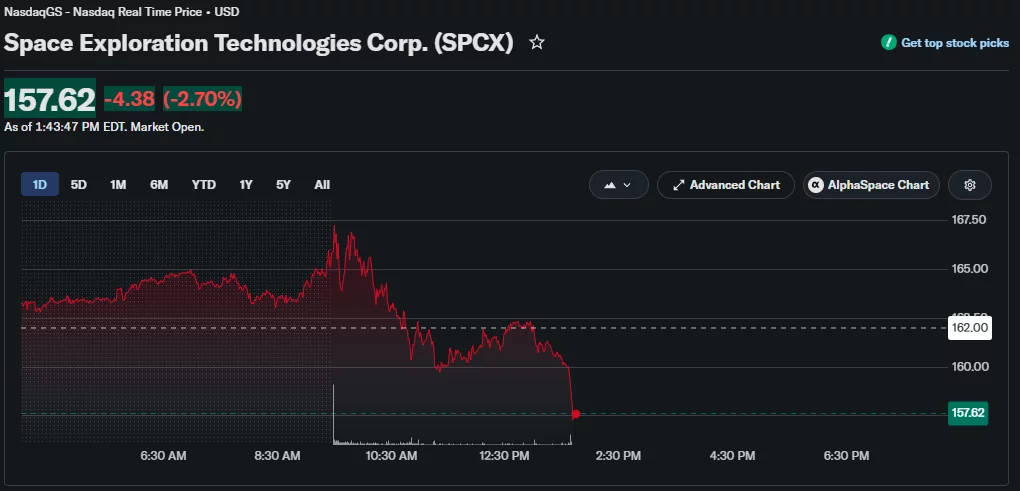
SpaceX shares have remained under pressure ahead of their Nasdaq-100 debut, even as the upcoming index inclusion is expected to trigger roughly $4.3 billion in passive fund buying.
Summary
- SpaceX joins the Nasdaq-100 on July 7, with JPMorgan estimating about $4.3 billion in passive fund buying.
- The stock is holding above $155 support while traders watch for a breakout above $160 and $165.
- Limited public float and heavy insider ownership could increase volatility during the index rebalancing.
According to Nasdaq, SpaceX will officially join the Nasdaq-100 before the opening bell on July 7 after qualifying under the exchange’s updated rules that allow certain large newly listed companies to enter the benchmark much sooner than under the previous seasoning requirements. The company, which made its public market debut in June, will become one of the fastest IPOs to reach the technology-heavy index.
Nasdaq-100 inclusion brings major institutional demand
JPMorgan estimates that the index addition could generate about $4.3 billion in compulsory purchases from index-tracking exchange-traded funds and passive investment portfolios. Those funds are required to rebalance their holdings to match the Nasdaq-100, creating a one-time surge in demand for SpaceX shares.
The accelerated inclusion follows Nasdaq’s rule revision for qualifying large IPOs. Under the updated framework, companies with sufficiently large market capitalizations no longer need to wait as long before becoming eligible for the index. The change has allowed SpaceX to enter the benchmark only weeks after listing, a timeline that would previously have taken much longer.
Despite the expected buying, the stock’s ownership structure remains a potential source of volatility. Elon Musk and other insiders continue to control a significant portion of the company’s equity, leaving a relatively small public float available for trading. As passive funds compete for those shares during the rebalance, limited supply could amplify price swings in either direction.
While forced buying often provides temporary support, the effect typically fades after index funds complete their purchases, leaving subsequent price action dependent on normal investor demand and company fundamentals.
Technical levels keep $180 in focus
SpaceX traded around $157.62 on Monday, down about 2.7%, after failing to hold gains near the $160 resistance zone. The pullback has left the stock testing support around $155, a level traders are watching closely ahead of Tuesday’s index inclusion.
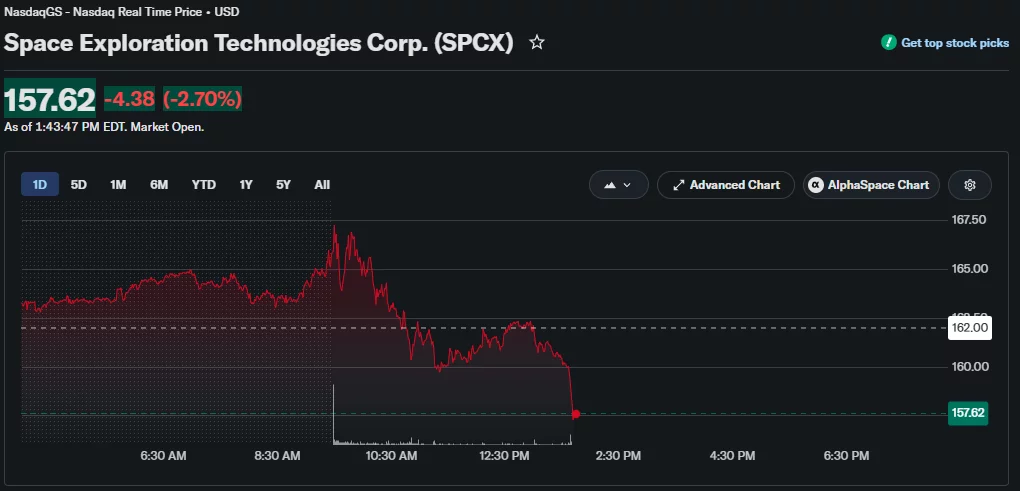
A move back above $160 would indicate that buyers are regaining short-term control. If trading volume strengthens alongside the breakout, the stock could revisit resistance near $165 before attempting another move toward $170.
A sustained push above $170 would strengthen the bullish case for a rally toward $180 during the week. If momentum continues beyond that level, technical traders could begin monitoring the next upside objectives around $190 and $200.
On the downside, maintaining support at $155 remains critical for the current recovery attempt. A break below that level could expose the stock to a decline toward $152, while heavier selling pressure may extend losses to the next support area near $150.
For now, the Nasdaq-100 addition remains the primary catalyst for SpaceX. The expected wave of passive buying may provide near-term support, but whether the stock can build on that demand will likely depend on its ability to reclaim resistance around $160 and sustain buying interest after the index rebalance is complete.
Disclosure: This article does not represent investment advice. The content and materials featured on this page are for educational purposes only.

Bitcoin’s rebound gathered speed after a sharp dip tied to Strategy’s announced Bitcoin sales, with price quickly recovering from the $61,300 area to around $63,500. The move came despite a noticeable shift in leverage indicators, suggesting that while traders remained cautious, demand for exposure wasn’t completely broken.
Derivatives data showed a mixed picture: perpetual futures funding rates climbed to a positive level, while options pricing reflected only mild stress. At the same time, US spot Bitcoin ETF flows showed a potentially important counter-signal—net inflows after a streak of outflows—raising the odds that any bounce could find support beyond short-term trading.
Key takeaways
- Perpetual futures funding rates rose to around 9% annualized on Monday, indicating leverage demand was more balanced than during the prior negative-funding period.
- Deribit’s put-to-call premium ratio moved to roughly 1.15, a level below typical stress thresholds (often above 2), pointing to contained—not escalating—options anxiety.
- US-listed spot Bitcoin ETFs recorded $223 million in net inflows on Friday (the first after 10 straight outflow days), countering sentiment hit by June’s record outflows.
- On-chain data highlighted sellers’ exhaustion near the $60,000 support zone, though derivatives traders may still wait for repeated ETF inflow confirmation before pressing higher targets.
Selloff fades as leverage metrics stabilize
After Strategy’s Bitcoin sale announcement, Bitcoin dipped to approximately $61,300 and then moved swiftly back upward. The rapid recovery mattered for two reasons: it suggested the market absorbed supply without triggering a prolonged cascading liquidation wave, and it highlighted that trader positioning did not fully align with a “bear-control” narrative.
Perpetual futures provide one of the clearest near-term gauges of leveraged sentiment. According to Laevitas funding data, the Bitcoin perpetual futures annualized funding rate jumped to 9% on Monday. Positive funding generally implies that traders using perpetuals are paying for long exposure—often seen when the market is no longer dominated by bearish leverage.
Importantly, this change moved the indicator away from the bearish momentum seen on Saturday, when funding rates were negative. While 9% annualized doesn’t automatically signal strong bullish conviction on its own, the shift does indicate that the balance between long and short leverage tightened rather than deteriorated.
Options offered a second, slightly different read on risk. Laevitas data referenced through Deribit showed the put-to-call premium ratio at about 1.15 on Monday. This metric compares the relative pricing of downside-focused puts versus upside calls. The ratio had been lower in the previous days, but on Monday put premiums started to outweigh calls again—though only modestly.
Historically, periods of acute market stress often push this ratio above 2. With the indicator staying around 1.15, the implication is that while some participants were paying for downside protection, they were not pricing an immediate breakdown scenario.
ETF flows return after outflows—momentum traders may take notice
One of the strongest supporting signals for a sustained recovery is spot ETF flow behavior. Earlier coverage noted that US-listed spot Bitcoin ETFs saw $223 million in net inflows on Friday, according to reporting linked in the source. That day marked the first inflow after 10 consecutive outflow sessions, which had compounded bearish sentiment.
The broader context is crucial: the record-high $4.51 billion net outflows in June left traders bracing for continued selling pressure. In that environment, a single inflow day can be easy to dismiss—but repeated inflows tend to matter more for the market’s ability to hold higher levels without constant hedging demand.
The market’s reaction to derivatives positioning appears aligned with this framework. Even though funding and options stabilized, the bounce to roughly $63,500 did not immediately translate into “bullishness” strong enough to erase all caution among leverage traders. That pattern fits the idea that ETF buyers may need to show persistence before derivatives market participants fully commit to a higher-range outlook.
Strategy overhang: cash buffer versus unrealized loss pressure
The selloff pressure connected to Strategy’s Bitcoin sales remains a key variable for short-term sentiment. The source attributes part of the recent bearish tone to strain around Strategy preferred perpetual equity Stretch (STRC US), which had offered holders an attractive yield. It also notes that new stock issuance occurs only at a fixed $100 price, meaning the company may have fewer channels at times to support dividend-related expectations.
Even so, the article emphasizes that Strategy still holds enough cash to cover about 17 months of dividends. That detail complicates the “forced selling” storyline: if dividend coverage is secure for a meaningful period, investors must reassess how urgent additional Bitcoin sales truly are.
However, the same analysis points to why bears still have room to press the market. Strategy’s debt leverage is described as extremely low (around 8%), yet the company is facing approximately $8 billion in unrealized losses from prior Bitcoin purchases. In practice, unrealized drawdowns can still influence market psychology—particularly when investors connect Bitcoin exposure decisions to broader equity and preferred-structure stability.
That combination helps explain why derivatives traders may remain skeptical. For them, Strategy is not only a cashflow story; it’s also a persistent factor in how markets interpret the future supply of Bitcoin linked to corporate decisions.
On-chain seller exhaustion strengthens $60,000, but confirmation is still needed
Beyond derivatives and ETF flows, the source highlights on-chain evidence suggesting that selling pressure is not expanding. It references Glassnode data showing that transfers from long-term holders to exchanges have fallen to an average of 4,130 BTC per day. The figure is down from about 8,040 BTC per day one week prior.
This kind of decline matters because it often signals that long-term holders are less willing—or less able—to move coins toward exchanges. In the article’s framing, that seller exhaustion supports the $60,000 support level.
Yet the piece also cautions that on-chain stabilization alone may not be enough to sustain a large upside move. Unless spot Bitcoin ETFs begin a sequence of relevant net inflows, derivatives traders may keep risk management switched on—reducing the likelihood of a sustained rally above $65,000.
In other words, the market may be able to bounce due to reduced exchange-bound supply, but it still needs buy-side confirmation from spot demand channels to convert a rebound into a durable trend.
For now, investors should watch two things closely: whether ETF inflows become a multi-day pattern rather than a one-off turn, and whether derivatives stress indicators—funding and options pricing—continue to ease as price holds the $60,000 area.
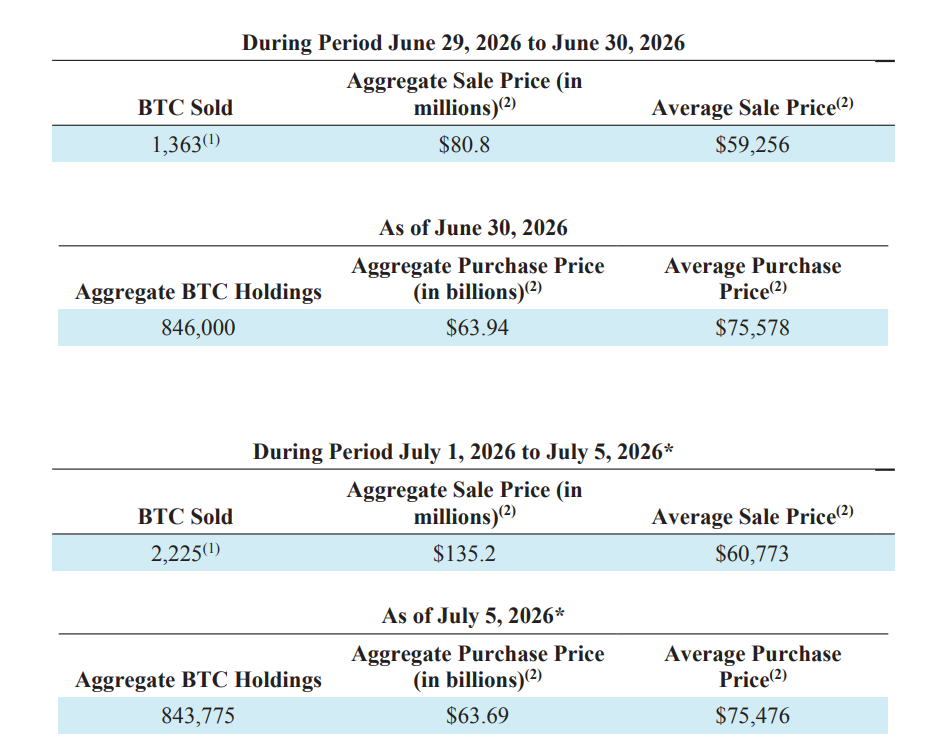
Michael Saylor’s Strategy sold 3,588 Bitcoin (BTC) to fund preferred stock dividend payments and replenish its cash reserves.
Strategy sold the Bitcoin for $216 million, reducing its total holdings to 843,775 Bitcoin, according to a Monday 8-K filing with the US Securities and Exchange Commission.
This included 1,363 Bitcoin sold at an average price of $59,256 between last Monday and Tuesday, and 2,225 Bitcoin sold at an average price of $60,773 between Wednesday and Sunday.
Strategy disclosed the sale of 32 Bitcoin in early June, as its first reported Bitcoin sale since the 2022 tax-loss transaction.
On its June 29 8-K filing, Strategy unveiled a capital framework allowing Bitcoin sales to fund dividends, increased the annual dividend rate on its STRC preferred stock to 12%, and disclosed that its US dollar reserve had grown to $2.55 billion. Monday’s filing showed the dollar reserve remained unchanged.
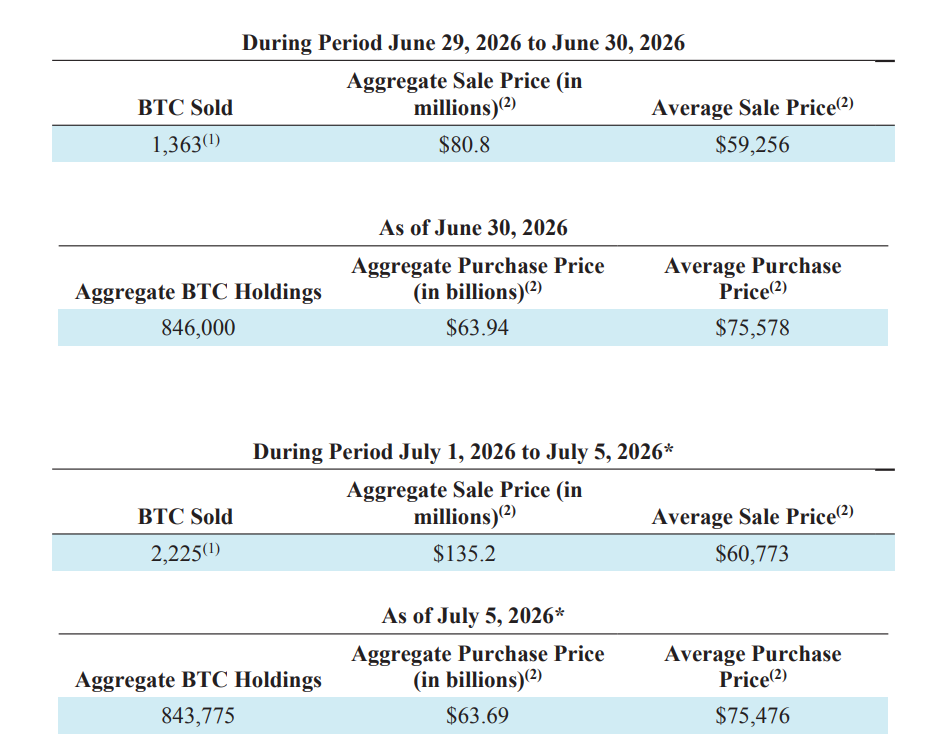
Form 8-K filing with the US Securities and Exchange Commission. Source: Strategy
Strategy’s perpetual preferred stock, STRC, traded at $88.70, or 11.3% below its $100 intended par value, during Monday’s pre-market trading session, Yahoo Finance data shows.
STRC is one of Strategy’s main mechanisms to fund its Bitcoin accumulation. Trading below par limits Strategy’s ability to raise funds through STRC sales. It may also force the company to further increase its nominal dividend rate to attract buyers and protect STRC’s price.
Bernstein says Strategy unlikely to face forced Bitcoin sales
Before Strategy disclosed its latest Bitcoin sale, Bernstein said the company was unlikely to be forced to sell its holdings, citing its liquidity position and cash reserve coverage.
Bernstein’s report said Strategy had 17 months of cash to cover dividend obligations and interest payments. It added that the company remained a net buyer of Bitcoin and served as a strong “balancing force” in a market where leading US Bitcoin miners are net sellers due to their pivot to AI.
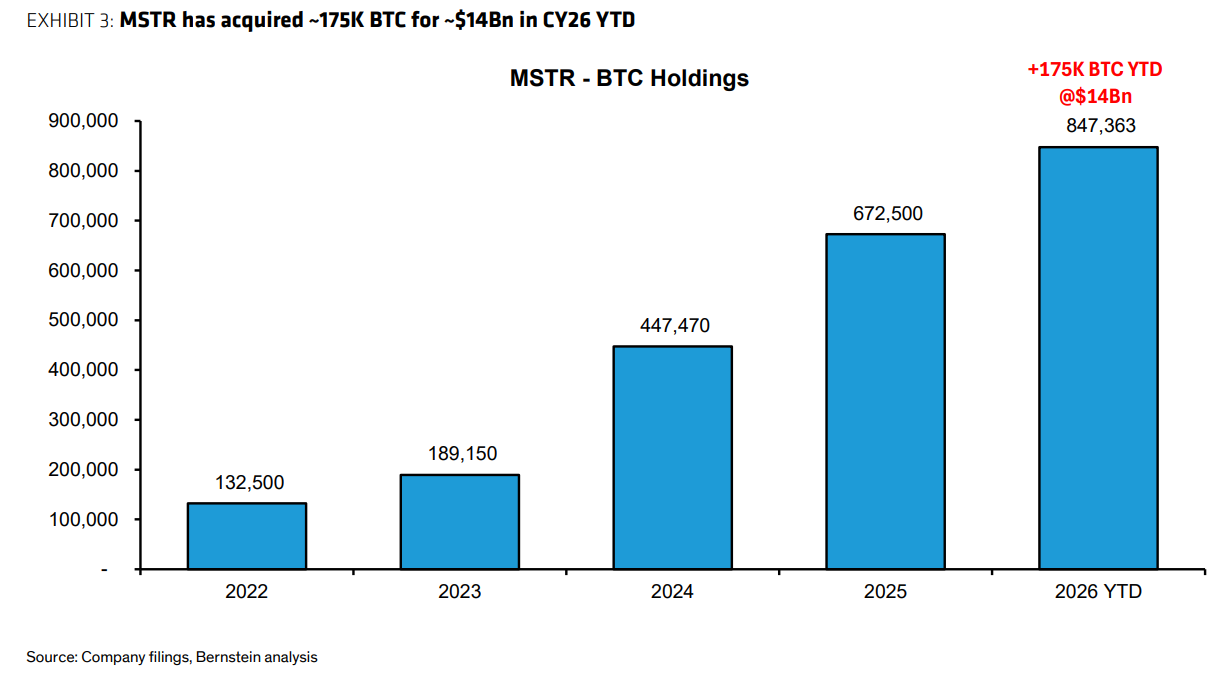
Strategy yearly net accumulation. Source: Bernstein
Bernstein said Strategy’s accumulation had been an important “balancing force” amid selling by US Bitcoin miners and the $5.5 billion of outflows from Bitcoin exchange-traded funds (ETFs) so far in 2026.
Related: Dormant $1.9M Bitcoin tied to New York lawsuit moves after nearly 15 years
Strategy’s debt liabilities were a “mere” 13% of its Bitcoin collateral value. The company’s next principal payment of about $1 billion is due in the third quarter of 2028, according to Bernstein.
Bernstein maintained its $150,000 year-end Bitcoin price target, saying it remained “optimistic on Bitcoin long-term.”
Magazine: Bitcoin slides to $58K, XRP hits $1 but onchain data promising: Market Moves
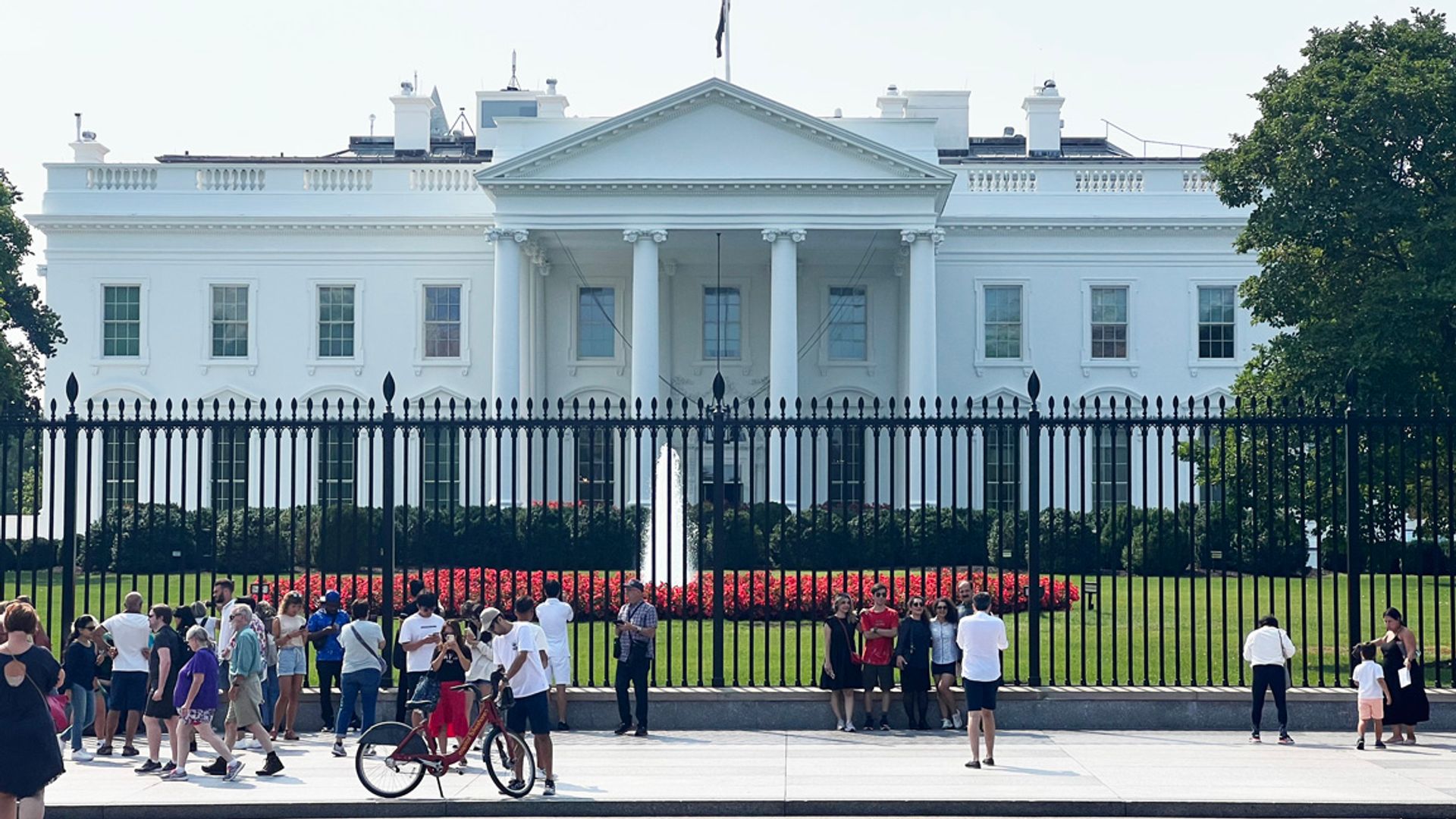
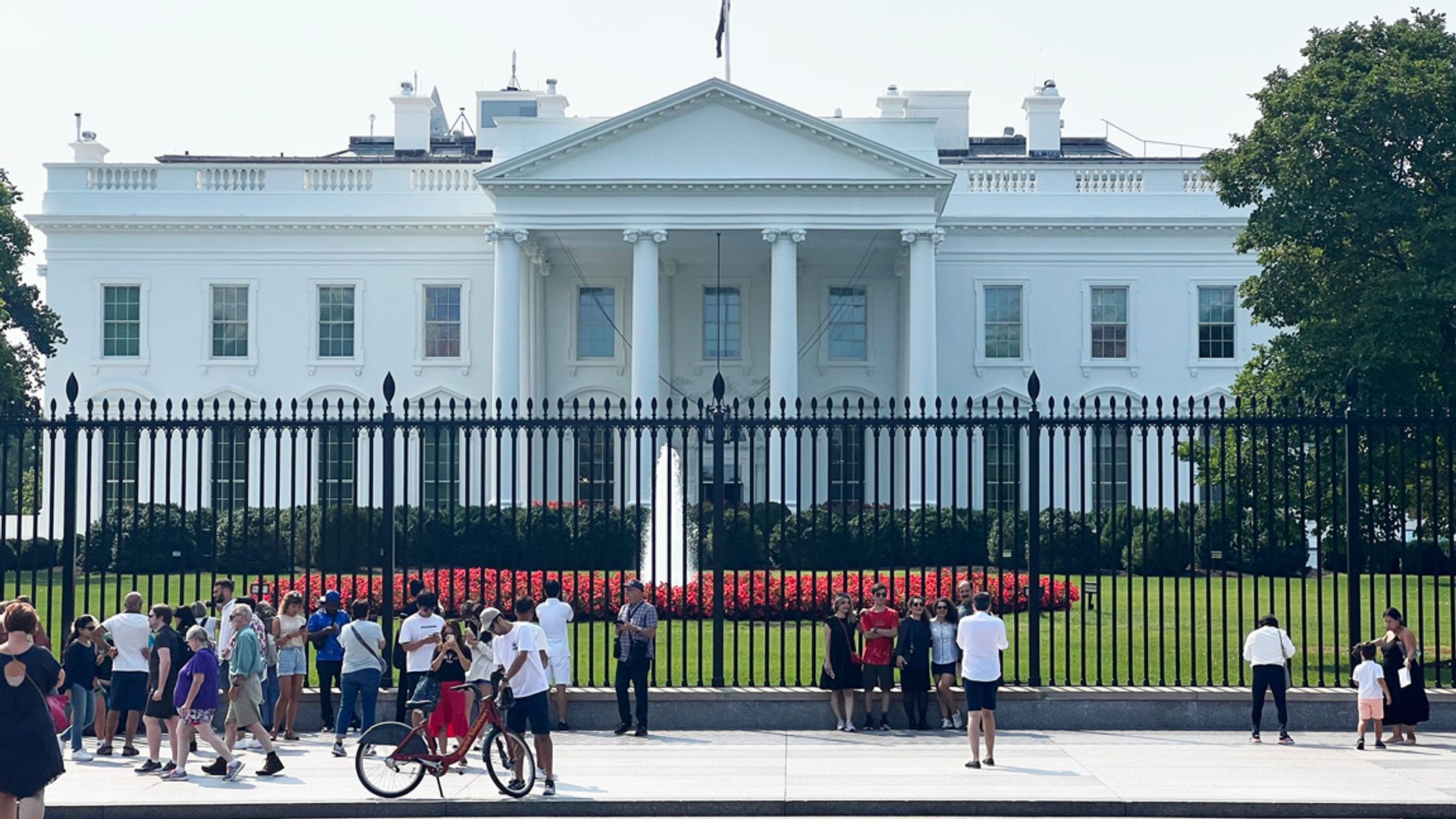
The White House’s chief crypto adviser, Patrick Witt, and his predecessor in that role had both said that they’ll need Congress to fully back up the formation and activation of the crypto funds. Presidential orders don’t carry the weight of law, and no legislation has yet advanced, though such efforts have simmered among lawmakers in both the Senate and House of Representatives, And if Republicans lose the majority in the House or both chambers in this year’s midterm elections, it’s unlikely such a bill will formalize Trump’s concept anytime soon.
Read More: Those who cheered U.S. Bitcoin reserve have spent year watching Trump’s order languish
Even if the administration works out the structure for the funds, it’s unclear whether they’ll be able to pull the lever to officially put its bitcoin holding — estimated at more than 300,000, or about $21 billion — into that virtual vault.
The government’s bitcoin holdings would be a long-term investment. Trump and his administration has called it a strategic reserve, though it doesn’t fit the usual definition of that phrase, because it’s meant to be held for a long period and not doled out during market emergencies.
When Trump issued the order, he asked his administration to come up with ways to acquire more bitcoin without using taxpayer money. Several ideas have since been floated, though if they’d started buying the asset when Trump called for it, they’d have bought at $93,000, and BTC has dropped by about a third since then to today’s price just above $64,000.

Former Tether chief investment officer Richard Heathcote is seeking to sell part of his 1.26% stake in the stablecoin issuer, according to a Bloomberg report citing people familiar with the matter.
Heathcote stepped down as Tether’s chief investment officer in March to take an advisory role after overseeing the stablecoin issuer’s investment portfolio. Bloomberg reported the planned sale involves only part of his 1.26% ownership stake.
Tether issues USDt (USDT), the world’s largest stablecoin by market capitalization. With a circulating supply of roughly $184 billion, USDT accounts for roughly 59% of the stablecoin market, according to DefiLlama data.
The planned sale could offer a rare look at ownership in Tether, which remains privately held despite becoming one of the crypto industry’s most profitable companies.
The sale also comes as Tether navigates regulatory pressure in Europe. USDT has been delisted by a growing number of MiCA-authorized platforms after Tether opted not to comply with the European Union’s crypto framework, with Revolut announcing this month that it will remove the stablecoin from its platform.
Related: Strategy sells 3,588 Bitcoin for $216M to fund dividends, keeps $2.55B reserve intact
Crypto companies weigh IPOs
While Tether CEO Paolo Ardoino has said outright that the stablecoin issuer does not need to go public, several other crypto companies are reportedly mulling initial public offerings (IPOs).
Kraken has taken several steps toward a public listing. Fortune reported in September 2025 that the crypto exchange had raised $500 million at a $15 billion valuation, fueling expectations that the exchange was preparing for an IPO.

Source: Paolo Ardoino
The company also announced it had confidentially filed a draft registration statement with the US Securities and Exchange Commission for a proposed initial public offering in November 2025. However, Bloomberg later reported that the IPO plans could be pushed back until 2027 following layoffs tied to the company’s expanding use of artificial intelligence.
South Korean crypto exchange Bithumb also announced in April that it is delaying its IPO until after 2028 as it works to strengthen its accounting policies and internal controls following earlier regulatory setbacks.
Magazine: The end of anonymity? AI could unmask crypto’s hidden identities

Quick Summary
- Arm Holdings shares advanced approximately 5% during Monday’s session, reaching $330.97 as market participants shifted focus back to artificial intelligence and semiconductor stocks
- Despite surging 121% year-over-year, the stock currently trades roughly 9.7% beneath its 20-day moving average following a recent correction
- The company reports quarterly results on July 29, with analysts projecting earnings per share of 36 cents and revenue of $1.27 billion
- Wall Street maintains a “Moderate Buy” consensus rating with 19 buy recommendations, 7 hold ratings, and 1 sell; the average target price stands at $279.83
- Top-tier analysts from TD Cowen and UBS have set ambitious price objectives between $470 and $475, significantly exceeding consensus estimates
Arm Holdings (ARM) experienced a robust 5% advance on Monday, closing at $330.97, as market enthusiasm returned to artificial intelligence and semiconductor equities. The Nasdaq Composite climbed 1.41% during the session, providing tailwinds for chip-related names.
Arm Holdings plc American Depositary Shares, ARM
The stock has delivered impressive returns — posting a 121% gain over the trailing twelve months — though it has experienced notable consolidation since mid-June. Currently, shares trade approximately 9.7% under their 20-day simple moving average of $360.16.
The 50-day moving average rests at $301.29, establishing a critical support zone near $298.50. This level has previously attracted buying interest during recent declines, making it a crucial threshold for technical analysts to monitor.
A golden cross pattern that emerged in April continues to hold, which market technicians typically interpret as a constructive indicator for intermediate to long-term momentum.
The Relative Strength Index registers at 46.83 — firmly in neutral range. While the stock isn’t approaching overbought conditions, it also hasn’t established clear directional momentum following June’s retracement.
July 29 Earnings Report on the Horizon
Arm’s next quarterly earnings announcement is scheduled for July 29. Wall Street consensus calls for earnings per share of 36 cents, representing an increase from 35 cents in the comparable year-ago period. Revenue projections stand at $1.27 billion, up from $1.05 billion reported during the same quarter last year.
While these figures demonstrate consistent expansion, the stock’s price-to-earnings multiple of 370.9 suggests elevated expectations are already priced in. Any disappointment in results or forward guidance could trigger significant downside pressure.
ARM’s most recent quarterly performance delivered $0.60 in earnings per share on $1.49 billion in revenue, achieving a net profit margin of 18.37%.
Analyst Sentiment and Price Targets
The Street maintains a “Moderate Buy” consensus based on 27 analyst ratings — breaking down to 19 buy recommendations, 7 hold ratings, and 1 sell. The mean 12-month price objective stands at $279.83, notably below current trading levels.
More optimistic Wall Street firms paint a bullish picture. TD Cowen reaffirmed its Buy stance on June 24, elevating its price target to $475. UBS echoed this sentiment, raising its objective to $470 on the same date. Bank of America maintained its Neutral rating while increasing its target to $460.
Conversely, New Street Research downgraded Arm from Buy to Neutral on June 18, expressing concerns about stretched valuation metrics. Several analysts have cautioned that share prices have outpaced underlying business fundamentals, and potential selling pressure from SoftBank could present challenges.
Insider activity has tilted toward selling. During the previous three months, company insiders disposed of 248,205 shares valued at approximately $57.7 million.
Recent developments include Oracle Cloud Infrastructure joining ARM’s AGI CPU ecosystem, broadening the company’s presence in agentic AI applications and data center computing. Nvidia recently introduced an ARM-based laptop processor, further demonstrating the architecture’s expanding market penetration.
Institutional investors hold 7.53% of outstanding shares, with multiple new positions established during Q1 and Q2 2026.
With a beta coefficient of 3.76, ARM exhibits significant volatility relative to broader market movements. The 52-week trading range spans from $100.02 to $452.70.
Investors will turn their attention to the July 29 earnings release as the next major market-moving event.


Vitalik Buterin has confirmed a winner in his AI challenge to unmask his anonymous writing, after researcher Franklyn Wang traced a hidden EIP-7503 revision back to the Ethereum co-founder.
Buterin launched the experiment on June 22, offering up part of his own anonymity to test whether AI stylometry can identify hidden authors. For 13 days, no one succeeded.
AI Challenge Winner Matched Reasoning, Not Prose
Wang ran the search through Co-Invest, an AI research engine, and flagged a December 2024 revision of EIP-7503, the Zero-Knowledge Wormholes privacy proposal. A throwaway account submitted the rewrite, which now forms roughly 75% of the proposal’s text.
The disguise nearly held. Keyvan Kambakhsh, an original EIP-7503 author, reviewed and approved the anonymous edit at the time. According to Wang’s analysis, his model gave the pick just 20% confidence, yet 10 times its next candidate. The search reportedly took about two hours.
Follow us on X to get the latest news as it happens
Buterin drafted the revision in Chinese, translated it locally with Alibaba’s Qwen2.5 model, and manually fixed the output. However, that camouflage covered only his prose.
“Notice that the stylistic hints that his AI picked up on were intellectual habits and style of math and algorithm explanation, which bypassed my obfuscation strategy (which only covered prose) completely.”
Buterin confirmed the result on Monday. Wang, for his part, argued the same engine could hunt trading signals across news and on-chain data.
What the Result Means for Pseudonymous Developers
Stylometry has unmasked authors before. In 2013, forensic linguists identified J.K. Rowling as crime novelist Robert Galbraith through vocabulary and phrasing. Buterin’s test suggests detection now reaches deeper, into how an author reasons rather than how they write.
That shift matters for an industry built on pseudonyms, from Satoshi Nakamoto down. Ethereum alone recently passed 1 million developers, while European regulators already fuel crypto privacy fears.
Buterin has championed privacy for years, from co-authoring the Privacy Pools paper to his Lean Ethereum roadmap. His self-experiment also sharpens the debate over AI safety rules as models grow more capable.
Whether obfuscation can catch up, or whether this “thoughtprint” detection keeps improving, may become clearer as researchers rerun Wang’s method on other anonymous work.
The post Vitalik Buterin AI Challenge Solved in 2 Hours: Can Developers Stay Anonymous? appeared first on BeInCrypto.
National TV Hosts FREAK OUT About Bitcoin’s Price. Here’s What They Still Don’t Get

Rush hour train delays as services between Cambridge and Kings Lynn disrupted

DRAM: Buckle Up As The AI Memory Bottleneck Peaks


-

 Fashion3 days ago
Weekend Open Thread: High Hopes
-

 Politics3 days ago
The House | “Reframing the debate from a binary discussion of winners and losers”: Yuan Yang reviews ‘We Are Not Machines’
-

 Crypto World7 days ago
Strategy authorizes up to $1.25B in Bitcoin sales under new capital plan
-

 News Videos7 days ago
How to Build INSANE Live Financial Dashboards With Claude
-

 Fashion6 hours ago
Open Thread: What Great Books Have You Read Recently?
-
 NewsBeat2 days ago
Taylor Swift and Travis Kelce wedding staffer hilariously struggles to keep her cool while checking in megastars
-

 Tech7 days ago
Anonymous researcher drops 0-day ‘exploitarium’ repo
-

 Business7 days ago
Australia treasurer says alleged access of prime minister’s bank data ’incredibly concerning’
-
 Crypto World5 days ago
Airdrop Registration Becomes Key Focus For Remittix As RTX Launch Updates Approach
-

 Sports5 days ago
Broncos roster: OL Ben Powers (No. 74) entering final year of contract
-

 Crypto World5 days ago
Binance stock trading tops $1B in first month after launch
-

 NewsBeat6 days ago
Presenter Caroline Flack’s brother Paul Flack dies aged 55
-

 Crypto World5 days ago
Alibaba-affiliate Ant Group enters the humanoid robot market with 12 deals
-

 Crypto World3 days ago
Standard Chartered Secures MiCA License as ESMA Adds 37 New Crypto Firms
-

 Crypto World1 day ago
South Africa proposes crypto tax guidance under existing rules
-

 News Videos7 hours ago
Best Time to Enter Small Caps Right Now? Another Bull Run? | Financially Free
-
 NewsBeat5 days ago
New exhibition reflects five decades of movement between island of Ireland and GB
-

 Business5 days ago
Meta Platforms Stock Jumps 7% Today as Bloomberg Reports Company Plans to Enter the Cloud Business
-

 Tech1 day ago
Lenovo laptops are now shipping with YMTC SSDs, a sign of Chinese NAND entering the mainstream
-

 Business4 days ago
What a 10 Percent Drop Means for Buyers, Sellers and Renters
You must be logged in to post a comment Login