
Crypto World
Tether abandons $120M Uruguay Bitcoin mining project after power dispute



Tether’s planned Bitcoin mining expansion in Uruguay has collapsed after an electricity supply dispute with state utility UTE left two facilities without enough power, ending a project estimated to have cost around $120 million.
Summary
- Tether invested an estimated $120 million across two Bitcoin mining sites in Uruguay’s Florida department.
- A dispute with state utility UTE over electricity allocations left the facilities without enough power to operate consistently.
- UTE disconnected the mining sites in July 2025 after contract negotiations failed and electricity bills went unpaid.
- Tether has continued investing in Bitcoin mining elsewhere, including renewable energy projects in Brazil and mining infrastructure.
Reuters has reported that Tether abandoned two mining sites in Uruguay’s Florida department after disagreements over electricity allocations disrupted operations and eventually led its local entity, Microfin, to terminate contracts with UTE.
The project had been presented in 2023 as Tether’s first major Bitcoin mining venture in South America, with Uruguay serving as a testing ground before potential expansion into Brazil, Paraguay and Argentina. A former contractor told Reuters that Tether spent roughly $60 million on each of the two sites.
Tether did not disclose an investment figure when it announced the Uruguay operation in May 2023, describing the country as the “perfect platform” because of its renewable energy supply and reliable electricity grid.
By late 2025, however, crypto.news reported that the company had informed Uruguay’s labor authorities that it would cease local operations and had laid off 30 of its 38 employees. More than $100 million had already been spent at the time, while another $50 million had been earmarked for infrastructure that was expected to pass to UTE and Uruguay’s National Interconnected System.
Tether Bitcoin mining plans ran into an electricity supply dispute
At the core of the failed project was a disagreement over how much power Microfin could draw from UTE, according to two former Tether contractors and a source at the state utility cited by Reuters.
Tether understood a provision in its electricity contract as setting a minimum power allocation that could later be increased, one former contractor said. UTE interpreted the same amount as the maximum level available under the agreement.
As demand at the mining facilities increased, the difference became critical. One former contractor told Reuters that the sites sometimes lacked enough electricity to operate for days at a time.
UTE sources also said the dispute concerned the electricity allocation available to Microfin, which operated locally on Tether’s behalf.
An internal UTE briefing reviewed by Reuters showed that the disagreement was already underway by November 2024. Tether and Microfin did not respond to the news agency’s requests for comment about the contract.
Political changes later complicated negotiations, according to people familiar with the discussions. Uruguay’s new left-leaning government took office in March 2025 and appointed new directors at UTE, after which the utility adopted a firmer position on renegotiating the electricity agreement, one former contractor told Reuters.
Two months later, Microfin stopped paying electricity bills. The company informed UTE in June 2025 that it intended to terminate its contracts, according to the utility’s internal briefing.
The two sides still attempted to preserve the project. UTE’s board approved a memorandum of understanding and revised contract documents, but Tether representatives did not attend the scheduled signing, minutes included in the briefing showed.
With the agreement unsigned and bills outstanding, UTE disconnected electricity to the facilities on July 25. Earlier reporting put the unpaid balance connected to the two sites at roughly $5 million.
Microfin eventually settled the outstanding debt in December, UTE told Reuters.
Uruguay was intended as the first step into South America
Tether had initially viewed Uruguay as an entry point for a much larger regional mining operation, according to a former contractor who worked with the company.
The country offered political stability, established infrastructure and an electricity system powered heavily by renewable sources, while the Florida facilities allowed the company to test its mining model before committing more capital elsewhere.
Tether CEO Paolo Ardoino and chairman Giancarlo Devasini have also been frequent visitors to the coastal resort of Punta del Este, industry sources told Reuters. The city has attracted wealthy foreign residents and technology investors, including billionaire Peter Thiel, who is building a reported $10 million residential compound nearby.
Early operations at Tether’s facilities generated revenue and were initially well managed, according to two former contractors. A February 2024 company video showed rows of mining buildings surrounded by farmland and wind turbines, with internal roads carrying crypto-themed names including “Memepool Avenue” and “Halving Street.”
The Uruguay exit has not ended Tether’s mining activity elsewhere in the region. In July 2025, the company signed a mining agreement with Latin American agricultural producer Adecoagro to use renewable electricity for Bitcoin mining in Brazil.
Adecoagro had more than 230 megawatts of renewable generation capacity at the time and planned to use mining to monetize surplus electricity. Its CEO Mariano Bosch said the arrangement could help secure pricing for energy normally sold on the spot market while giving the company exposure to Bitcoin.
Ardoino said at the time that the Brazil project formed part of Tether’s commitment to renewable-powered mining.
Tether keeps investing in Bitcoin mining infrastructure
Mining remains part of Tether’s investment strategy despite the Uruguay withdrawal.
Ardoino said at an industry conference last year that the company had invested more than $2 billion in energy production and Bitcoin mining, according to Reuters.
Tether has also put capital into mining-related companies. In June, it sold 627,000 shares in Bitdeer for about $12.7 million but retained a 19.7% stake in the Bitcoin mining and AI infrastructure firm. The shares were sold at roughly $20 each.
Its involvement now extends to the software used to run mining operations. Tether released MiningOS as open-source software in February 2026, giving operators a system designed to manage installations ranging from small home setups to large industrial sites.
The company followed that release with an open-source Mining Development Kit in April, providing developers with tools for controlling and automating mining hardware through a common software framework.
Those investments are funded partly through profits generated by Tether’s stablecoin business. The company controls about $183 billion worth of stablecoins, Reuters reported, while assets backing its tokens have made it one of the world’s largest holders of U.S. government debt.
Tether reported $1.04 billion in net profit for the first quarter of 2026, with total assets of $191.77 billion and liabilities of $183.54 billion, according to its quarterly attestation. Its exposure to U.S. Treasuries stood at about $141 billion.
Profits from the stablecoin operation have also been deployed into data centers, video platform Rumble, brain-computer interface businesses and Italy’s Juventus football club, Reuters reported.
Bitcoin mining economics have pushed operators toward AI
The Uruguay shutdown has occurred during a difficult period for Bitcoin miners, whose revenue was hit by the April 2024 halving and later pressure on Bitcoin prices.
The halving cut the block subsidy paid to miners in half, forcing operators to rely on more efficient machines, cheaper electricity, or alternative uses for their power and data center infrastructure.
By mid-2026, hashprice, a measure of miner revenue generated per unit of computing power, had fallen into the high-$20 range per petahash per day, while older machines faced estimated breakeven levels of about $35, according to research on miner finances published in July. Public mining companies sold more than 32,000 BTC during the first quarter of 2026 as financial pressure increased.
Some operators have increasingly allocated power and facilities to artificial intelligence and high-performance computing. A June analysis found that public Bitcoin miners had secured more than $70 billion in AI and HPC contracts, while a tracked basket of mining shares had risen more than 50% in 2026 despite Bitcoin falling about 17% over the measured period.
Tanay Ved, senior research analyst at Talos, told Reuters that miners have responded to tighter economics by buying more efficient hardware, finding cheaper sources of electricity or redirecting computing infrastructure toward AI and high-performance workloads.
Mining specialist Nicolas Ribeiro said Uruguay’s reliable grid and internet connectivity could make the country better suited to AI data centers, while relatively expensive electricity weakens the economics of Bitcoin mining.
“Uruguay isn’t viable for mining — that’s the reality,” Ribeiro said.


European regulators are weighing whether parts of crypto lending and DeFi should be brought closer to the same regulatory perimeter that already covers more conventional crypto activities. In a targeted consultation connected to the review of the Markets in Crypto Assets (MiCA) framework, the European Commission specifically flagged DeFi and crypto lending and borrowing as areas that were left outside the original rulebook.
The debate is likely to intensify around “lending vaults” — on-chain structures that can funnel large pools of assets into credit markets while avoiding many of the hallmarks of a traditional lender. Their legal treatment, stakeholders say, has often relied on non-binding interpretations that the structures may fall outside MiCA and certain EU fund rules, leaving important questions unresolved about who, exactly, is responsible and what should be regulated.
Key takeaways
- The European Commission’s MiCA review consultation asks stakeholders to address gaps that were not fully covered when MiCA was first drafted, including DeFi and crypto lending/borrowing.
- Lending vaults remain difficult to classify because they can distribute roles across smart contracts and multiple participants rather than operating through a single, clearly identifiable service provider.
- Legal experts argue that regulators should avoid collapsing “DeFi lending” into a single bucket, since different vault designs can have materially different economic functions and control dynamics.
- Several viewpoints in the consultation discourse emphasize using structural and control-based criteria—rather than a broad “decentralization” test—to decide whether regulation should apply.
- If lending is added explicitly to MiCA’s regulated services, industry participants will need clarity on compliance expectations that match how vault-based systems actually work.
Brussels revisits MiCA gaps around lending and DeFi
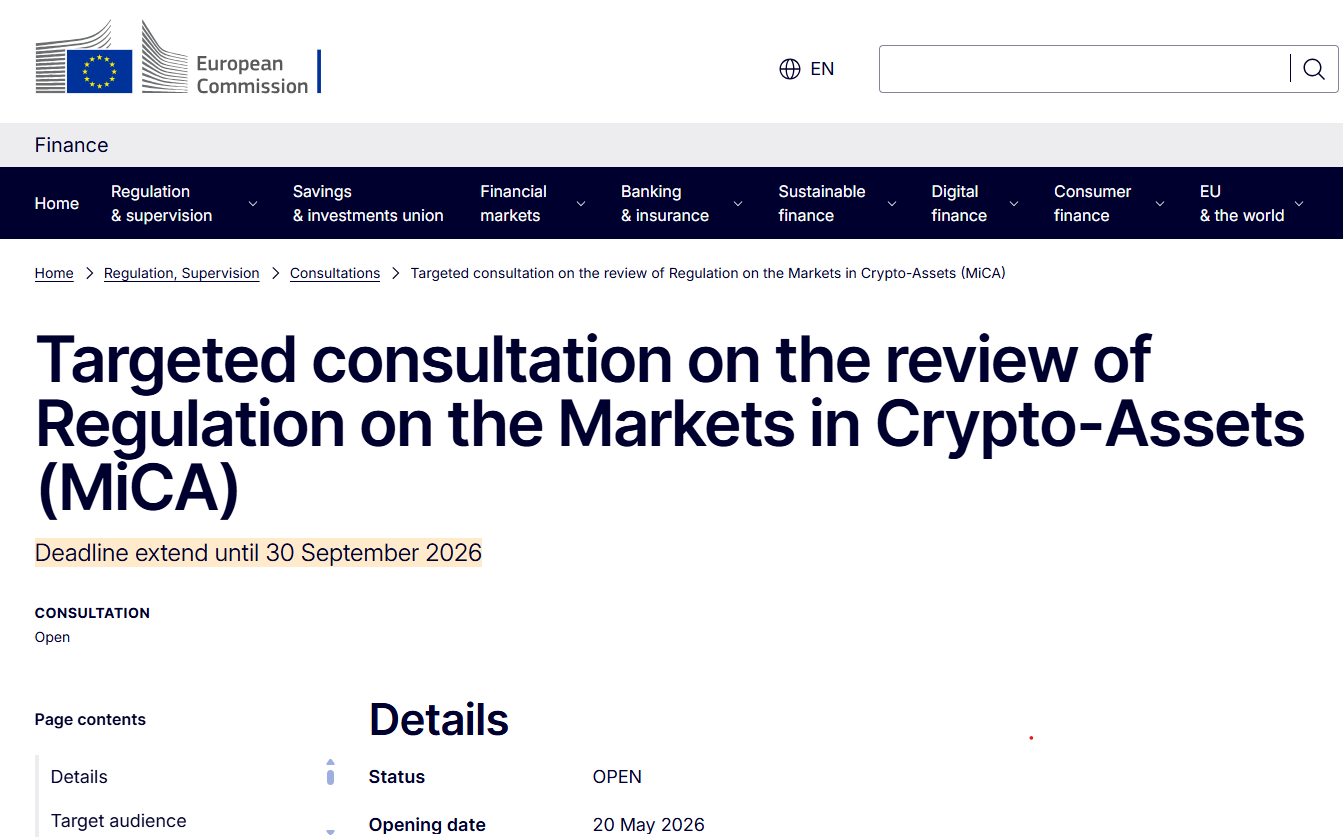
On May 20, 2026, the European Commission opened a targeted consultation seeking stakeholder input on areas that were not fully covered by the original MiCA framework. According to the Commission’s consultation, topics include decentralized finance and crypto lending and borrowing, among other issues.
The importance of this step is practical: MiCA was designed to standardize rules for crypto asset services across the EU, but it did not neatly resolve whether and how every lending model—especially those built with on-chain components—fits into the existing regulatory categories.
In the case of lending vaults, the current uncertainty is not simply academic. Vaults can route liquidity into lending markets while using multi-participant governance or modular contract logic to separate economic functions from operational roles. As a result, their regulatory classification can end up depending on informal interpretations and lawyer-led “functional” analysis—an approach many consider insufficiently predictable.
Why “vault” design complicates regulation
One reason regulators may struggle is that there is no universally recognized legal category for a “vault.” As Yuriy Brisov, an EU digital assets lawyer and partner at Digital & Analogue Partners, put it, EU law does not define a “vault” as a standalone concept; instead, lawyers determine how a structure should be treated by analyzing what it does and how it is controlled.
That matters because vaults can perform lending-like economic functions while spreading activities across smart contracts and different roles. Brisov’s point is that the “label” is less important than the function and the governance/control model—especially when the structure can look unlike a conventional entity offering loans.
Protocol design provides an example of why mapping to existing legal categories can be hard. Morpho’s lending infrastructure describes a Vault V2 setup that divides responsibilities between an owner, curator, allocator, and sentinel. The curator configures strategy and risk parameters, the allocator performs allocations, and the sentinel role is intended to reduce risk. While this architecture does not, on its own, define a regulated lending service under MiCA, it illustrates how “provider” responsibilities may not be concentrated in a single party.
Separately, a client update referenced in the discussion by Jonathan Galea of Cahill Gordon & Reindel highlights that lending vaults can intersect multiple regulatory domains. The analysis points to how vault structures might sit across MiCA, stablecoin-related rules, and EU fund law—again underscoring that vaults cannot be understood using a single regulatory lens.
A warning against one-size-fits-all “DeFi lending”
Beyond classification mechanics, stakeholders also appear concerned about the way any future rules might be framed. Galea’s view, as reflected in the referenced update, is that policymakers should be cautious about treating lending vaults as a single category. In his framing, lending vaults “solve more practical problems than they create,” but they are not uniform: some vaults may direct liquidity into lending markets, while others may instead buy and sell crypto assets, requiring different treatment.
The core risk, Galea argues, is that broad-brush regulation could capture fundamentally different economic activities under the same label. If “DeFi lending” were brought into the perimeter as a single category, structures with different roles and functions could end up facing the same answers—despite being designed for different outcomes.
This is not merely a technicality. In practice, regulatory uncertainty affects how developers design protocols and how users evaluate risk. A framework that fails to distinguish between lending-like operations and asset-trading-like operations could either over-regulate some systems or miss the activities that actually warrant closer oversight.
What criteria should determine whether vault-based lending is regulated?
MiCA already contains an important carve-out: crypto asset services provided in a “fully decentralized manner” are excluded, while MiCA can still apply when only part of an activity is decentralized. But even that concept is likely to be contentious for vault-based systems, where decentralization can be partial or evolve over time.
Galea cautions that using decentralization as the dividing line could penalize newer protocols. In his view, decentralization is a spectrum and a function of time; a test that relies on it could entrench incumbent projects that have had years to distribute control.
Brisov’s alternative emphasis is on structural facts and user exit rights. He suggests that the “safer ground” is structural rather than rhetorical: whether there is an undertaking or appointed manager, whether token or claim holders have a direct coded claim on the pool, and whether users can exit before parameter changes take effect.
He also argues that if lending and borrowing are meant to be regulated, Brussels should explicitly add them to the list of regulated crypto asset services, rather than widening the definition of a crypto asset service provider itself. That distinction matters because it shapes how narrowly or broadly compliance obligations would be interpreted.
Michael Egorov, founder of Curve Finance, adds another angle: if DeFi lending becomes regulated, he argues it should be treated “completely differently” from traditional lending. Egorov’s position is that DeFi may not require certain safeguards that are intrinsic to conventional lending, while still potentially needing other protections that are better tailored to on-chain market structure. He suggests that a dedicated framework could improve safety and accessibility for new users, while also avoiding rules that some protocols could be unable to comply with due to how they are constructed.
What happens next as the consultation closes
The Commission’s consultation is scheduled to close on Sept. 30. What follows will likely determine whether lending vaults remain outside MiCA’s regulatory scope—or whether regulators move toward an explicitly tailored framework for crypto lending and borrowing.
For participants across DeFi and crypto lending, the key unknown is not just whether regulation arrives, but how Brussels will draw the lines between different vault designs and the roles of the parties behind them. As the EU works through consultation feedback, builders and users should watch for signals on the criteria regulators intend to use—especially around structural control, responsibility allocation, and how user exit rights and economic functions map onto any future obligations.


The Sandbox disabled bridging on affected networks to isolate tokens and warned users not to trade SAND on Base and BNB, citing an impact of under 0.01% of supply.


Fairmint CEO Joris Delanoue warns tokenized stocks risk recreating Wall Street’s 1960s paper crisis through fragmented systems and standards.

Ray Dalio, once one of the most prominent crypto critics, has made a new case for owning gold and bitcoin as he believes the United States is approaching a dangerous point in its debt cycle.
The founder of Bridgewater Associates noted that investors should reduce their exposure to bonds, allocate 10%-15% of their holdings to gold, and hold ‘a bit of bitcoin’ as protection against what could eventually become a full-blown US debt crisis.
Gold and BTC Over Bonds
As reported by CNBC, the billionaire investor’s arguments center around the rapidly deteriorating US fiscal position as the federal government is expected to collect approximately $5.5 trillion in revenue this year while spending is anticipated to be at roughly $7.5 trillion. In other words, this presents a shortfall of around $2 trillion.
At the same time, $10 trillion of government debt needs to be refinanced, and interest expenses alone are approaching $1 trillion. Without a major change in direction, Dalio estimated that a US debt crisis could arrive in “three years, give or take two.”
His solution is rather controversial to some, as he proposed to reduce the federal deficit from roughly 6% of GDP to 3% through a combination of spending cuts, increased tax revenue, and lower borrowing costs.
Individual investors, though, should not rely solely on the government’s actions and should prepare for the consequences of years of negligence. His recommendation is to diversify across financially strong countries and asset classes, while reducing their exposure to debt securities such as bonds. Instead, investors should go for gold and BTC, albeit to a lesser extent, he said.
The Timing
The comments arrive during a rather impressive week for both assets, as BTC surged from $64,000 to almost $80,000, while gold rebounded from $4,000 to $4,600 per ounce. These moves came after US Treasury Secretary Scott Bessent announced plans to substantially increase buybacks of long-dated government bonds.
The announcement pushed Treasury yields lower and weakened the dollar almost immediately. BTC’s rally only intensified the following day, producing its strongest performance in more than three years.
Meanwhile, US government debt surpassed $40 trillion this week, while longer-term Treasury yields recently climbed to their highest levels in years.
If investors become increasingly reluctant to finance enormous government deficits, Treasury yields may have to rise further to attract buyers. In contrast, policymakers could eventually respond with monetary intervention that risks weakening the dollar further and fueling inflation.
Both outcomes strengthen Dalio’s argument for assets that cannot simply be issued by governments.
The post Ray Dalio Predicts US Debt Crisis and Backs Bitcoin, Gold Over Bonds appeared first on CryptoPotato.

Zepbound maker and drug giant Eli Lilly’s (LLY) stock is in the buy zone of a flat base after hitting a new high. The IBD Sector Leaders name is in a race with Novo Nordisk (NVO) in the fast-growing weight-loss medication industry. Lilly makes injectable obesity drug Zepbound and Type 2 diabetes treatment Mounjaro. It launched its weight-loss pill Foundayo in…
Copyright ©2026 Investor’s Business Daily, LLC. All rights reserved. 87990cbe856818d5eddac44c7b1cdeb8
MiCA left crypto lending outside its original rulebook — but now Brussels is considering whether to bring it in.
On May 20, 2026, the European Commission asked stakeholders to weigh in on areas left outside the original Markets in Crypto Assets (MiCA) framework. These include issues around decentralized finance (DeFi) and crypto lending and borrowing.
One area of contention involves lending vaults, which can channel billions of dollars into onchain credit markets without looking like conventional lending. Their legal status currently depends on non binding interpretations that they fall outside of MiCA and EU fund rules.
Yuriy Brisov, an EU digital assets lawyer and partner at Digital & Analogue Partners, tells Magazine the law pertaining to vaults at present is unclear:
“EU law has no category called a ‘vault.’ A lawyer therefore defines it the way a regulator would qualify it: by function, not by label.”
That’s just one of myriad regulatory problems, since vaults can perform the economic functions of lending while spreading other functions over smart contracts and multiple participants rather than a single company.
If Brussels decides lending should come inside the regulatory perimeter, what does that mean for DeFi, and where does it leave the people and protocols behind these vaults?
Morpho puts the problem into practice
Decentralized lending protocol Morpho’s lending infrastructure gives some clues as to why this question will be so hard to answer. The way its vaults are set up and managed does not neatly map on to any existing regulatory model.
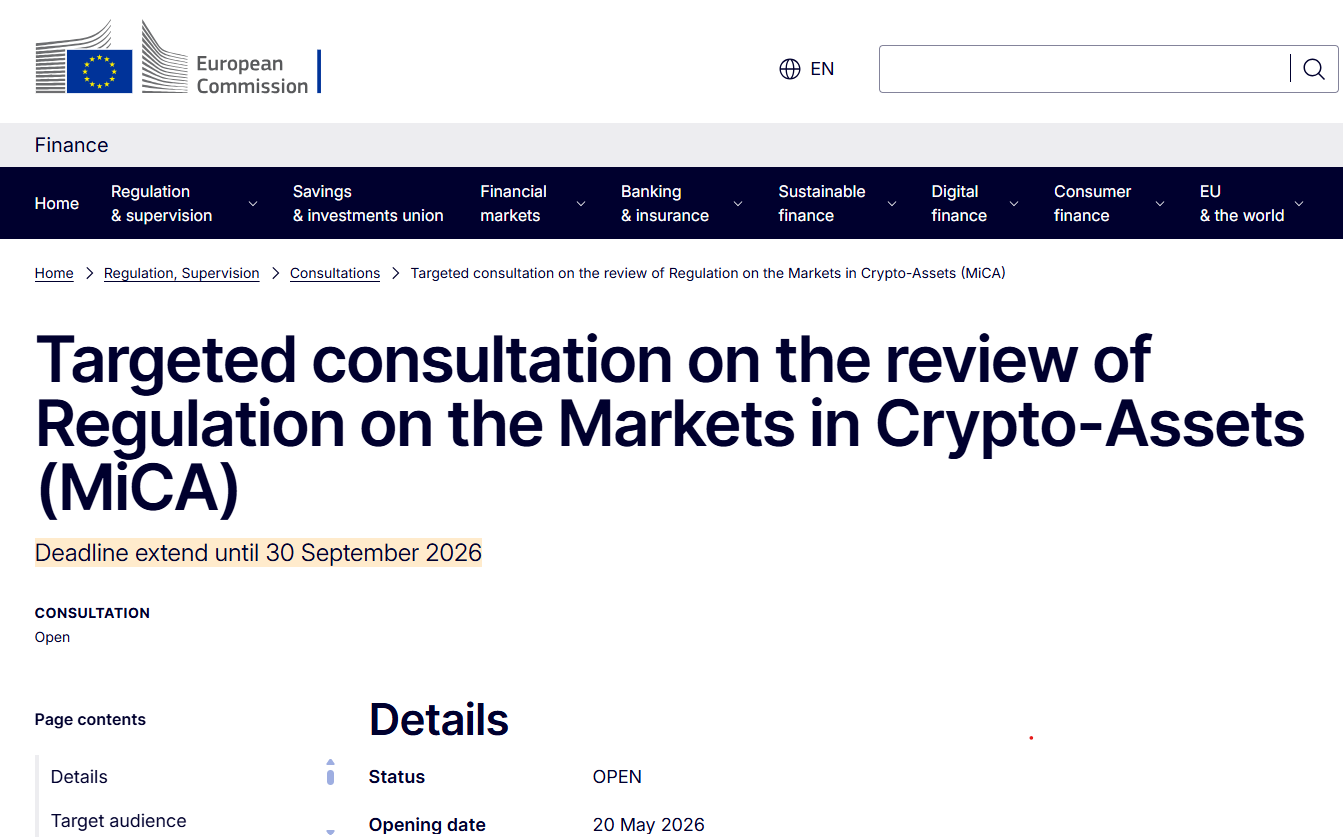
Targeted consultation on the review of Regulation on the Markets in Crypto Assets (MiCA). Source: European Comission
Its Vault V2 architecture divides responsibilities between an owner, curator, allocator and sentinel. The curator configures strategy and risk parameters, while the allocator executes allocations and the sentinel has powers intended to reduce risk.
While none of this establishes any of these participants as providing a regulated lending service under MiCA, it does show why identifying the relevant “provider” is less straightforward than with a conventional lender.
Related: Bitwise to launch onchain vaults via Morpho
Jonathan Galea, a partner at Cahill Gordon & Reindel, explored the issue in a recent client update on lending vaults and their position under EU financial regulation. His analysis looks at how vault structures can sit across MiCA, stablecoin rules and European fund law.
Galea says policymakers should be careful about treating lending vaults as a single category, telling Magazine, “lending vaults solve more practical problems than they create.”
He says lending vaults help direct fragmented liquidity into lending markets, while other vaults may buy and sell crypto assets and should be treated differently:
“Bring ‘DeFi lending’ into the perimeter as a single label, and structures that deserve opposite answers risk ending up captured together.”
That would be important if Brussels decides to regulate lending, since a broad category covering “DeFi lending” could capture structures with very different economic functions—and people exercising control over them.
Who should actually be regulated?
MiCA currently excludes crypto asset services that are provided in a “fully decentralized manner,” although it can apply where only part of an activity is performed in a decentralized way.
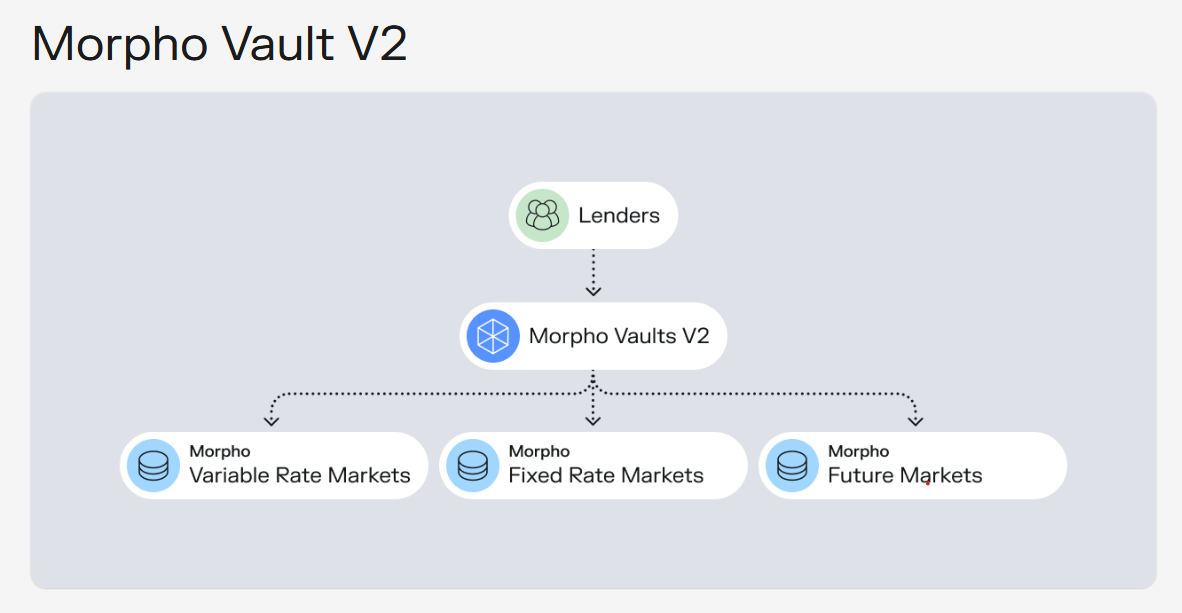
Morpho’s Vault V2 architecture. Source: Morpho
One possible solution would be to make decentralization the dividing line, but Galea argues that could disadvantage newer protocols. He says:
“Decentralization is a spectrum and a function of time: a test built on it would penalize newer, more novel protocols while entrenching mature incumbents that have had years to distribute control.”
Brisov says the focus should instead be on the structure of the vault and the control people have over it:
“The safer ground is structural: there is no undertaking, no appointed manager, the holder has a direct coded claim on the pool, and the user can exit before any parameter change takes effect.”
He says if Brussels decides that lending and borrowing warrant regulation, they should be explicitly added to the list of regulated crypto asset services rather than broadening the definition of a crypto asset service provider itself.
Related: ‘DeFi doesn’t exist anymore,’ just onchain finance: Andre Cronje
Curve Finance founder Michael Egorov argues that the rules also need to account for the differences between decentralized lending and conventional finance. He says:
“If DeFi lending is ever brought into the scope of regulation, it should be treated completely differently. DeFi doesn’t need some of the safeguards which traditional lending requires, and yet, at the same time, it may need others.”
Egorov says regulation should be approached “really carefully,” and that a dedicated framework could improve safety and open DeFi lending to new users, while avoiding rules that some protocols cannot comply with because of how they’re built.
The Commission’s consultation closes Sept. 30, and what follows could determine whether lending vaults remain outside MiCA or become subject to a new regulatory framework.
For Brussels, the challenge is not simply whether to regulate DeFi lending; it’s how to write rules that distinguish between very different forms of onchain lending and the people (if any) that actually exercise control over them.
Magazine: 200,000 fake AI ‘victims’ deployed to scam bait online fraudsters
Cointelegraph publishes long-form journalism, analysis and narrative reporting produced by Cointelegraph’s in-house editorial team with subject-matter expertise. All articles are edited and reviewed by Cointelegraph editors in line with our editorial standards. Some articles contain affiliate links, from which Cointelegraph may earn a commission. These relationships do not influence which products we review or our editorial conclusions. Content published in here does not constitute financial, legal or investment advice. Readers should conduct their own research and consult qualified professionals where appropriate. Cointelegraph maintains full editorial independence.

Each week, Investors Intelligence, an independent provider of market research and technical analysis, tracks more than 100 stock market newsletters and measures how many are making bullish calls and how many are advising against owning stocks. When the number of bulls reaches irrationally high levels — you guessed it — the market is often near a significant top. When fear…
Copyright ©2026 Investor’s Business Daily, LLC. All rights reserved. 87990cbe856818d5eddac44c7b1cdeb8


Washington state is cut off for Kalshi customers while the company combats the development in court and its federal regulator keeps pursuing new rules.

Dow Jones futures rose modestly early Friday, along with S&P 500 futures and Nasdaq futures. Bitcoin continued to surge. The stock market rally resumed a recent slide Thursday as crude oil prices kept rising and bond yields recouped Wednesday’s declines on an unusual Treasury move. The key indexes undercut key short-term levels while the Nasdaq also triggered a highly bearish…
Copyright ©2026 Investor’s Business Daily, LLC. All rights reserved. 87990cbe856818d5eddac44c7b1cdeb8

Tired of collecting the S&P 500’s paltry 0.9% dividend? Prepare to take your money overseas. The rising weight of low-yielding tech giants in the S&P 500 — and rising stock prices — are pushing the index’s yield lower. One way to fight back is by expanding your portfolio’s geographic horizons. “Dividend yields provide a partial offset to the risk of…
Copyright ©2026 Investor’s Business Daily, LLC. All rights reserved. 87990cbe856818d5eddac44c7b1cdeb8

Where to Watch All the Insidious Movies — Including Out of the Further

Hull vs Manchester United LIVE highlights and reaction as Reds kick off with chastening defeat

Mystery Bread Dumping Near Japanese National Park Sparks Fears of Attracting Wild Asiatic Black Bears





-

 Fashion20 hours ago
Weekend Open Thread: Madewell – Corporette.com
-

 Business4 days ago
SMA Solar Technology AG (SMTGY) Q2 2026 Earnings Call Transcript
-

 Tech4 days ago
Qwen3.8-27B runs frontier-class coding agents and reasoning locally, no cloud API required
-

 Crypto World5 days ago
OCC Greenlights Trump Family Crypto Firm for Trust Charter
-

 Crypto World5 days ago
NAVI Prime launches institutional lending framework on Sui
-

 News Videos2 days ago
Don’t Leave Your Financial Future To Chance | August 19, 2026
-

 Crypto World6 days ago
Data of 54K Wallet Users Leaked, Clarity Odds Just 10%: Hodler’s Digest, Aug. 16
-
 NewsBeat6 hours ago
The ‘Lucky Dip Gang’ causing carnage for clicks: After five thugs were killed speeding in the wrong direction on a motorway, GUY ADAMS investigates a sick new trend… and why police aren’t even allowed to pursue them
-

 Politics6 days ago
Britain is facing a housing disaster
-

 Business7 days ago
Stephen Curry Trade Rumors Persist as Warriors Insist Superstar Remains Committed to Golden State
-

 Tech6 days ago
What are the rumors about the AirPods Pro 4?
-

 Business6 days ago
Rebel Creamery files Chapter 11 with $23.8M Van Leeuwen judgment on appeal
-

 Crypto World5 days ago
Dow’s 3-Year Winning Run Isn’t a Crash Signal, Still 49% Odds of Double-Digit Gains
-

 Business4 days ago
Stock Market Today: Tech Futures Slide As Treasury Yields Jump; Nvidia, Micron, Sandisk Sell Off
-

 Tech7 days ago
DeepSeek’s innovative harness treats everything as a plug-in
-

 Politics3 hours ago
6 months on, Irish renters crushed by effects of government housing bill
-

 Tech7 days ago
Three new Windows flaws can bypass security, gain system privileges, and even install malware remotely
-
 Tech6 days ago
OpenAI’s new ChatGPT feature logs your keystrokes and stores them in plain text
-

 Tech5 days ago
Straight Up the Cliff, Yunnan’s New Fuyao Ladder Turns a Three-Hour Climb Into a 50-Second Ride for Students
-

 Politics7 days ago
Andy Burnham’s I’m Not Listening Tour
You must be logged in to post a comment Login