
Crypto World
Texas power grid moratorium may not materially affect BTC miners


Bitcoin mining companies with existing operations in Texas are likely to face limited direct disruption from a new state-level pause on certain data center approvals, according to Bernstein analysts. The move centers on heightened scrutiny of how quickly new data center projects are being lined up to connect to Texas’ power grid.
Governor Greg Abbott ordered the Public Utility Commission of Texas (PUCT) and the Electric Reliability Council of Texas (ERCOT) to conduct an audit of data centers seeking to connect to the grid, The Texas Tribune reported. Bernstein said many Texas miners are already covered by electric capacity agreements that have been approved, which could reduce near-term operational risk.
Key takeaways
- Bernstein expects most Texas-based Bitcoin miners to be minimally affected because many are contracted for approved power capacity.
- The audit and moratorium are expected to slow or throttle speculative data center “pipeline” projects, potentially increasing the value of sites with development history.
- Miners most exposed may include those whose future growth depends on converting existing pipeline assets into grid-connected capacity during ERCOT’s approvals.
- Bernstein highlighted Texas operations of Cipher Digital, Core Scientific, CleanSpark, IREN and Riot Platforms as relevant to how the approval process evolves.
Texas audit targets data center grid connections
On Monday, Governor Abbott directed regulators to audit all data centers attempting to connect to the state’s electric grid system. The directive is linked to mounting public backlash over the pace of data center development in Texas, as The Texas Tribune noted in reporting on the order.
While the article describing the order did not specify how long the audit would run, the practical effect is already clear: new or pending grid-connection approvals are likely to slow while regulators review the pipeline. For electricity-intensive industries—data centers and Bitcoin mining in particular—grid access timing can be as important as total contracted capacity.
Why Bernstein says active miners may be spared
In a client note released Tuesday, Bernstein analysts argued that the direct impact on Bitcoin miners with Texas operations should be limited. Their central point: most miners operating in the state are under contracts for electric capacity that has already been approved.
That distinction matters for investors and operators. An audit that primarily affects approvals for new connections is less likely to interrupt existing operations tied to already-cleared power supply, especially where miners have scheduled energy use and infrastructure already in place.
Bernstein also suggested that throttling new approvals could create a different kind of market effect. The analysts wrote that the audit “throttles speculative data center pipeline” and, in turn, “makes genuine sites with development history more valuable.” They linked that value proposition to mining sites typically having “longest gestation” characteristics, self-funding infrastructure, and management at the local level.
Which miners Bernstein flags as more vulnerable
Even if day-to-day production is less likely to be disrupted for capacity that is already approved, growth plans can still run into delays. Bernstein pointed to miners it believes could be more exposed—particularly if their path to expansion depends on ERCOT approval processes to convert pipeline assets into grid-connected power capacity.
The analysts specifically named Cipher Digital, Core Scientific and CleanSpark as candidates that could face greater sensitivity to future public opposition and the timeline pressures created by moratoriums or directives affecting new capacity approvals.
They also highlighted IREN and Riot Platforms, noting that both have Texas mining operations that are described as fully ERCOT grid approved. In Bernstein’s framing, that approved status may matter more as new capacity becomes harder or slower to obtain.
From data center controversy to mining capacity economics
At the heart of the story is an electricity allocation question. Texas’ grid-connection process is a bottleneck for any load expansion, and public opposition can influence political and regulatory outcomes—especially when state leadership orders audits or pauses.
Bernstein’s view effectively reframes the risk from “immediate operational shutdown” to “capital planning and future capacity accessibility.” If ERCOT’s approvals become slower, and if speculative data center projects are paused or delayed, then existing—especially already-approved—capacity may retain or increase its relative value versus projects still in the queue.
For miners, this can change how the market evaluates expansion-stage assets. If new MWs (megawatts) are throttled by policy actions, then entities able to monetize power access sooner—either because they are already grid approved or because they have stronger development histories—may face fewer timing disadvantages.
Stock reaction and company updates
In Tuesday’s premarket trading, Cipher Digital shares were down more than 7%, according to Yahoo Finance data. Separately, Cipher Digital reported second-quarter results earlier Tuesday, showing a loss of $0.65 per diluted share that widened from last year’s loss of $0.12 per diluted share, according to the company’s posted update.
While the stock move is not automatically attributable to the Texas audit by the information provided, it underscores how quickly market participants can price in regulatory uncertainty, especially for firms tied to the broader data center and power-capacity conversation.
Going forward, readers should watch how long the audit lasts and how ERCOT and the PUCT handle conversion of pipeline assets into approved grid-connected capacity—because that timeline will likely determine whether the near-term “freeze” stays contained or begins to affect future miner expansion plans.

The US Dollar Index (DXY) trades near 100.02 on Tuesday after last week’s sharp rejection from 101.50. The greenback is battling to reclaim the psychological 100 mark, according to Trading Economics data.
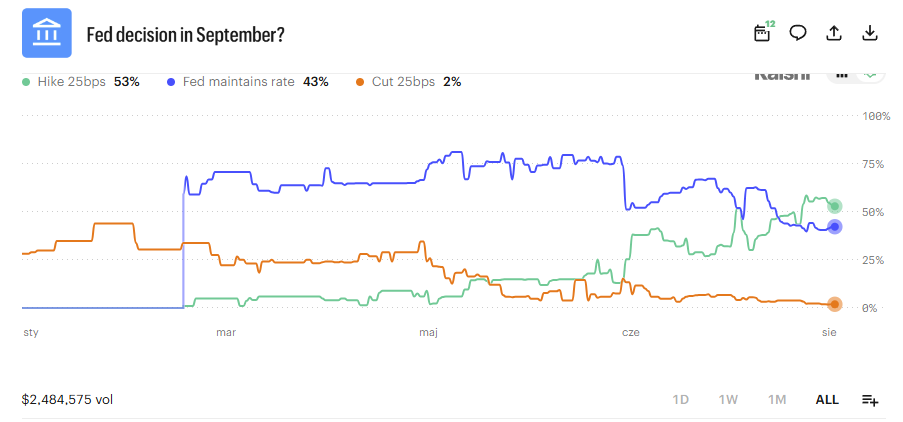
Markets price roughly 55% odds of a September Federal Reserve rate hike. At the same time, coordinated currency intervention and falling oil prices pull the index in the opposite direction.
Fed Hike Bets Collide With Yen Intervention
Fundamentals have turned dollar-friendly on the monetary policy side. July’s ISM Manufacturing Purchasing Managers Index (PMI) jumped to 55.6, its strongest reading since May 2022.
Three Federal Open Market Committee (FOMC) members also dissented in favor of a hike in July, when rates held at 3.50% to 3.75%. Prediction market Kalshi prices a 25-basis-point September hike at 53%, with CME FedWatch showing similar odds.

However, official pressure works against the dollar. The US and Japan confirmed coordinated yen intervention after USD/JPY weakened to 40-year lows near 164.
Falling energy prices add to the bearish side. Oil dropped around 5% on Monday after Washington and Tehran agreed to restart talks, easing inflation pressure.
Dollar direction also matters beyond forex. A firmer greenback has repeatedly pressured gold and Bitcoin (BTC) in 2026.
US Dollar Index Weekly Chart Shows the Rally Stalling Below 102
The weekly chart frames the move within a wide macro range. DXY topped at 110.176 in January 2025 and bottomed at 95.551 on January 27, 2026.
The recovery from that low stalled in July near 101.50. That area holds the 0.382 Fibonacci retracement at 101.14, just below the May 2025 swing high at 101.977.

Last week, sellers pushed the index back below the 100.30 to 100.60 resistance zone. The drop ended at an ascending trendline that connects to the January low.
Meanwhile, the weekly Relative Strength Index (RSI) sits near 50. The reading offers neither bulls nor bears a clear momentum edge.
Level
Significance
101.98
May 2025 swing high, main upside target
101.14
0.382 Fibonacci retracement
100.30 to 100.60
Resistance zone that needs to flip into support
99.49
Trendline and June swing low confluence
99.00
0.236 Fibonacci retracement
DXY Price Prediction Rests on the 99.49 Support Confluence
The daily chart strengthens the bullish structure argument. An ascending trendline from the February low has now held twice, on May 6 and again on August 3.
The latest bounce also coincided with the June 17 swing low at 99.491. That confluence makes 99.49 the most important support on the chart.
Momentum tells a different story. Daily RSI reads 38, below the neutral zone but not yet oversold. The reading suggests sellers still control short-term momentum despite the intact trend.

A daily close above 100.60 could open the path to 101.14 and then 101.977, roughly 2% above the current price. In contrast, losing 99.49 would expose the 0.236 Fibonacci level at 99.008, about 1% lower.
The calendar could decide the fight. ISM Services PMI lands on Wednesday, and the July jobs report follows on Friday, August 7. The Fed’s data-dependent stance adds weight to each release after last week’s GDP and PCE inflation data.
Until either side wins the battle for 100, DXY remains trapped between hawkish Fed pricing and official selling pressure.
The post Dollar Index Trapped at 100 as Hawkish Fed Meets Official Selling appeared first on BeInCrypto.
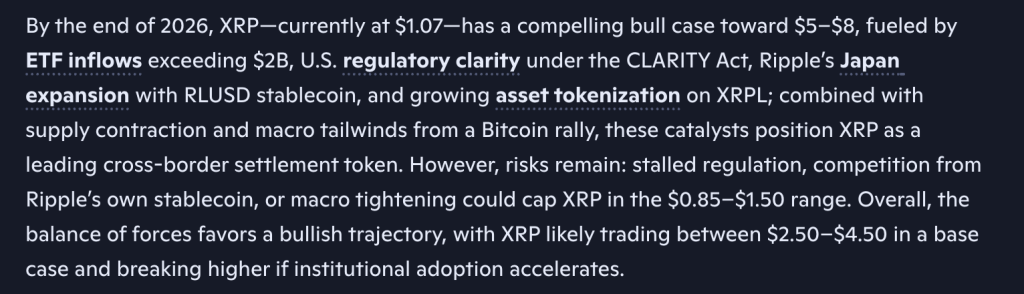
Microsoft Copilot AI predicts a serious breakout for XRP, and this price prediction puts a real number behind it. By the end of 2026, XRP at $1.07 has a compelling bull case toward $5 to $8, which works out to somewhere between five and eight times the current price.
The bull case rests on four pillars landing together. ETF inflows have already exceeded $2 billion. US regulatory clarity is arriving through the CLARITY Act. Ripple’s Japan expansion is bringing the RLUSD stablecoin into a new major market. Asset tokenization on the XRP Ledger keeps expanding.

Copilot combines those with supply contraction and macro tailwinds from a Bitcoin rally. Together they position XRP as a leading cross border settlement token if the pieces actually converge.
The bear case is direct about what breaks that thesis. Stalled regulation, competition from Ripple’s own stablecoin, or macro tightening could cap XRP in the $0.85 to $1.50 range instead.
Copilot still calls the bullish trajectory the more likely path overall, with XRP trading between $2.50 and $4.50 in a base case and breaking higher if institutional adoption accelerates.

XRP Price Prediction: XRP Is Trapped In The Exact Range This Copilot AI Predicts Calls The Bear Case
XRP peaked above $2.40 in January before a violent February collapse cut price nearly in half within weeks. That crash set the tone for the entire year, and every rally since has been smaller than the one before it.
The pattern is a clean staircase of lower highs. April topped near $1.65, May topped near $1.55, and by July the best XRP could manage was $1.35 before rolling over again.
Price closed today at $1.07051, down 0.41%, in a session ranging between $1.06900 and $1.08092. That places XRP almost exactly at the midpoint of the $0.85 to $1.50 zone Copilot itself flags as the bear case outcome.
Support sits at $1.00, a round number XRP has tested twice since June without breaking. Resistance stacks first at $1.20, then $1.40, then the heavier ceiling near $1.60 where three separate spring rallies all failed.
RSI currently reads near 47 with the signal line close behind at 49. That small negative gap points to momentum that has flattened out rather than building in either direction, consistent with a chart going nowhere.
Overall momentum is neutral bordering on soft, with price grinding sideways rather than showing any real conviction. For Copilot’s bull case toward $5 to $8 to even begin taking shape, XRP first needs to reclaim $1.20, a level it has not closed above in two months.
You Were Right About XRP. It Just Didn’t Pay.
Every trader has had the same experience. You read the analysis, you form a view, the market proves you correct, and it makes you nothing.
The problem isn’t the call. It’s the instrument. When you buy spot to express a view about one thing, you take on exposure to everything: liquidity, sentiment, unrelated flows, whatever happens in an unrelated market at 3am.
Your opinion was about a single question. Your position is exposed to all of them at once.
That’s what Kalshi is. A CFTC-regulated exchange where the prices are set by traders taking real positions, which is why the odds tend to move before the headlines do.
It isn’t free money. A contract that resolves against you goes to zero, and being directionally right on a slow timeline still loses if the contract expires first. Event trading pays for precision about timing, not just direction.
But the analysis above was free. What you do with it doesn’t have to be.
→ Get up to $25 to trade your first market on Kalshi
Don’t Miss Out on Our $1,000 USDT Airdrop on ByBit
The post Microsoft Copilot AI Predicts the Price of XRP by The End of 2026 appeared first on Cryptonews.


CNBC host Jim Cramer says he intends to sell his Bitcoin (BTC) after IBM’s chief executive warned that quantum computers could eventually break the cryptography protecting it.
He has not confirmed a completed sale, disclosed a position size, or published a wallet address. Traders responded by treating the call as a reason to buy.
Why Jim Cramer Says He Is Selling Bitcoin
Cramer asked Arvind Krishna on July 30 whether quantum machines could crack the math securing crypto holdings. The IBM chief answered with a rough clock.
“I think that you should give yourself three or four years, and at that point, I would get rather paranoid about it,” Arvind Krishna, IBM chief executive.
Krishna told the same segment that quantum should move IBM’s earnings by 2028 or 2029. That forecast anchors IBM’s commercial quantum timeline.
Four days later, Cramer gave his answer on air.
“I am going to sell my Bitcoin,” Jim Cramer, CNBC host.
Nothing since then confirms he acted on it. Cramer has never published a Bitcoin address, and no filing or exchange record establishes the size of the position, so the sale remains a stated intention.
The Inverse Cramer Trade Has Already Been Tested
Traders greeted the announcement as a contrarian signal. That reflex has a real-money track record, and it is weaker than the meme suggests.
Tuttle Capital listed an Inverse Cramer Tracker ETF on March 1, 2023, with a long version beside it. The long fund closed that September. The short fund traded for the last time on Feb. 13, 2024.
Across that run the inverse fund lost 15.7% while the S&P 500 gained 25.4%. Portfolio manager Matthew Tuttle said the fund existed to expose the danger of following television stock pickers.
Academic work reaches a similar verdict. A 2012 Management Science study of 826 first-time buy calls found they pop 2.4% overnight, then fully reverse within roughly 12 trading days.
Buying after the show produced about 10% negative annualized alpha over the following 50 days. The edge lives in fading an overnight retail pop, not in inverting his opinion.
His crypto record is what keeps the joke alive. Cramer dismissed the asset class on December 23, 2022, when Bitcoin closed at $16,796.
The Gap Between 70 Qubits and Bitcoin’s Keys
The research behind the warning is genuine, though it does not show what Cramer implied. On July 30, IBM and University of Chicago scientists ran a 70 logical qubit circuit in about 16 minutes.
What they proved was a statistical floor on how faithfully the hardware executed, not the correctness of an answer. The circuit spent 468 T gates, the costly operations that make such work hard to simulate.
Stealing coins demands a far larger machine. Google Quantum AI researchers, working with Stanford and the Ethereum Foundation, estimated in March that breaking secp256k1, the curve securing Bitcoin keys, needs 1,200 to 1,450 logical qubits and 70 million to 90 million Toffoli gates.
That is roughly 20 times the qubits IBM just ran and five orders of magnitude more of the expensive gates. Their own number was already a 20-fold improvement on prior estimates, which is why forecasts of when quantum breaks Bitcoin keep moving.
The exposure becomes real the moment such hardware exists. BIP-361, a draft proposal from Jameson Lopp and five co-authors, records that more than 34% of all bitcoin had revealed a public key on-chain by March 1, 2026.
Standards bodies are not working to Cramer’s clock either. Draft NIST guidance would disallow 128-bit curves like Bitcoin’s after 2035, and Hong Kong set its banks a 2030 quantum deadline that Bitcoin has no authority to match.
Cramer identified a vulnerability the literature takes seriously and attached a date no published resource estimate supports. Whether he sells at all is the one part of the trade nobody can verify.
The post Jim Cramer To Sell Bitcoin After IBM Quantum Warning: Will Traders Fade Him? appeared first on BeInCrypto.
Alongside the US stock market, bitcoin’s price is on the move on Tuesday, jumping to $64,000 for the third time in the past day or so. The question now is whether it will have more success this time.
The S&P 500 just hit a new all-time high as US President Donald Trump continues to claim that his country will reach a deal with Iran, after giving the latter until tomorrow to fold. Markets are currently riding high on the hopes of a more sustainable deal and a major de-escalation.
Crypto analysts speculate that the rising US stock indices could propel a more profound BTC rally. For now, though, the $64,000 resistance has proven too strong for the asset.
CryptoQuant’s Crypto Dan noted earlier today that the cryptocurrency remains in a “very undervalued zone.” The analyst added that BTC has seemingly reached a “position similar to its historical bottoms of the past.”
Although he admitted that there’s no absolute certainty bitcoin won’t go even lower, the indicator “shows that market participants are as uninterested in the crypto market as they were during previous bottoms.”
This is seen from the lack of new capital entering the market, the dwindling trading volumes, and the low searches and social media engagement.
“Looking ahead to the next bull cycle — expected to begin around 2027 — there’s little doubt that the current range represents an undervalued zone,” Crypto Dan concluded.

The post Bitcoin Hits $64K, Yet One Indicator Says It’s Still Very Undervalued appeared first on CryptoPotato.


Four of the largest banks in the United States are building a shared network that will let corporate clients move tokenized deposits around the clock, seven days a week. The project, coordinated through The Clearing House, is targeting a first half 2027 launch. It is the clearest sign yet that Wall Street is no longer experimenting with blockchain. It is rebuilding the plumbing.
Summary
- JPMorgan, Citigroup, Bank of America, and Wells Fargo are building a shared tokenized deposit network through The Clearing House, targeting the first half of 2027.
- BlackRock has expanded its tokenized fund suite with BSTBL and BRSRV following the 2024 launch of BUIDL, which crossed $1 billion in assets under management.
- Mastercard added stablecoin settlement for issuers and acquirers while Visa is testing private stablecoin settlement on the Canton Network.
- The DTCC is rolling out a tokenization service with more than 50 financial firms, with limited production trades starting in July 2026 and a broader launch in October.
- Citi launched Digital Depositary Receipts for private company shares, creating a new tokenized pathway into pre IPO markets.
The phrase “tokenize everything” has been a crypto industry talking point since at least 2018. For most of that time, the institutions that actually control global financial infrastructure treated it as a science project. Pilots were announced, whitepapers were published, and nothing changed about the way a wire transfer actually moved from one bank to another.
That dynamic shifted in the first half of 2026. In a span of roughly 90 days, JPMorgan Chase expanded its Kinexys deposit token network, Wells Fargo committed to tokenized deposits for corporate clients, BlackRock filed to expand its tokenized money market fund lineup, Mastercard added stablecoin settlement rails, the DTCC recruited more than 50 firms for a production tokenization service, and Citi created a new class of tokenized securities for private markets. These are not concept papers. They are production deployments with target dates, partner lists, and capital committed.
This feature maps the three layers of that buildout: the money layer where payments are being redesigned, the asset layer where securities are moving on chain, and the infrastructure layer where the back office systems that settle trillions of dollars in daily transactions are being replaced.
The money layer: tokenized deposits versus stablecoins
The most consequential project in the current wave is the shared tokenized deposit network being built by JPMorgan Chase, Citigroup, Bank of America, Wells Fargo, and The Clearing House. According to the Wall Street Journal, the network is targeting a first half 2027 launch and will allow corporate clients to move tokenized deposits between participating banks on a 24/7 basis.
A tokenized deposit is not a stablecoin. A stablecoin like USDC or USDT is a bearer instrument: whoever holds the token holds the value, and the issuer (Circle, Tether) maintains a reserve to back it. A tokenized deposit remains a liability of the issuing bank. When JPMorgan creates a deposit token through its Kinexys network, the token represents a claim on JPMorgan, just as a traditional deposit does. The difference is that the claim can settle in seconds instead of hours and can move outside of the Federal Reserve wire system operating window.
That distinction matters for two reasons. First, tokenized deposits inherit the existing regulatory framework for bank deposits, including FDIC insurance eligibility and the capital requirements banks already meet. No new legislation is required. Second, they create a competitive threat to the stablecoin issuers that have captured the market in their absence. If JPMorgan can offer its corporate clients instant settlement through a deposit token, the incentive to hold USDC for the same purpose diminishes.
JPMorgan is furthest along. Its Kinexys platform, formerly known as JPM Coin, already processes billions of dollars in daily transactions for institutional clients. The platform operates as a permissioned blockchain that handles intraday repo, cross border payments, and foreign exchange settlement. Jamie Dimon confirmed during the bank’s most recent earnings call that crypto trading for institutional clients is now operational, a shift from the bank’s historically skeptical public stance.
Wells Fargo announced in August 2026 that it will begin offering tokenized deposits to corporate clients this fall. The bank, which manages over $2 trillion in assets, is joining the shared network rather than building a proprietary system. That decision is significant. A single bank token has limited utility. A shared network where deposits can flow between JPMorgan, Citi, Bank of America, and Wells Fargo starts to resemble an alternative payment rail.
Citigroup is pursuing a parallel but distinct strategy. In addition to joining the shared deposit network, Citi has invested in tokenized securities infrastructure separately. The bank’s Digital Depositary Receipts product and its participation in the DTCC tokenization pilot position it at the intersection of payments and capital markets tokenization. Bank of America, the third pillar of the shared network, has been quieter publicly but holds more blockchain related patents than any other US financial institution.
The architecture of the shared network matters as much as its participants. The Clearing House, which already operates the RTP real time payments network used by US banks, provides the coordination layer. Using an existing industry utility rather than a single bank’s proprietary infrastructure reduces the competitive tension that would otherwise prevent rivals from collaborating. Each bank issues its own deposit token, but the tokens are interoperable on the shared settlement layer.
The payment networks are moving simultaneously. Mastercard said in June that it would add stablecoin settlement options for card issuers and acquirers, supporting USDC, PYUSD, and RLUSD. Visa is testing private stablecoin settlement with Brale on the Canton Network, a privacy focused blockchain designed for institutional use. SoFi launched its own bank issued stablecoin, SoFiUSD, on its retail banking platform, making it the first US national bank to issue a stablecoin directly to consumers.
“Blockchain adoption will be defined by practical, production grade applications in the world’s largest markets,” Yuval Rooz, co founder and CEO of Digital Asset, said in June when his company raised $355 million to scale the Canton Network. The fundraise itself underscores the point. Institutional capital is flowing not into speculative tokens but into the infrastructure that will support tokenized settlement for years to come.
The asset layer: from money market funds to private shares
If the money layer is about moving value faster, the asset layer is about making securities programmable. The highest profile effort belongs to BlackRock, which launched its first tokenized money market fund, BUIDL, in 2024. The fund crossed $1 billion in assets under management and has since been joined by two additional tokenized funds: BSTBL, which runs on Ethereum and provides stablecoin yield exposure, and BRSRV, which supports stablecoin reserve management.
BlackRock has filed with the SEC to expand the suite further. The filings signal that the world’s largest asset manager views tokenized funds not as a novelty but as a scalable distribution channel. The advantage is structural. A tokenized fund share can settle in seconds, be used as collateral in real time, and trade outside of traditional market hours. For institutional investors managing cash positions across time zones, those properties solve real operational problems.
The next frontier is tokenized access to private markets. In June, Citi launched Digital Depositary Receipts for private company shares. The product creates a regulated pathway for investors to buy fractional interests in pre IPO companies. The timing is deliberate. Demand for private market exposure has surged as companies like OpenAI and Anthropic have delayed public listings while reaching valuations that would have triggered IPOs a decade ago.
“For decades, getting in at the IPO price has been a privilege of geography and net worth. That worldview is breaking down,” Mark Greenberg, global head of Payward Services, said in June. Kraken’s parent company has pushed tokenized IPO access through its xStocks platform, which offers tokenized US equities to non US customers. Coinbase has outlined similar plans.
A pilot completed in May demonstrated what cross border tokenized settlement looks like in practice. Ondo Finance, Kinexys, Mastercard, and Ripple completed a joint exercise to redeem a tokenized US Treasury fund on blockchain rails. The transaction settled across borders and across chains, proving that the plumbing exists even if the regulatory framework is still being assembled.
The infrastructure layer: where the real transformation is happening
The deepest and least visible shift is happening in the systems that move assets behind the scenes. The Depository Trust and Clearing Corporation, which processes virtually every US securities transaction, announced in May that it is building a tokenization service with more than 50 financial firms. The DTCC plans to facilitate initial production trades for select tokenized real world assets in July 2026, with a broader rollout targeted for October.
The DTCC handles roughly $2.4 quadrillion in securities transactions annually. When an organization of that scale commits to tokenized settlement rails, the signal is qualitatively different from a fintech startup launching an RWA protocol. The DTCC is not competing with existing infrastructure. It is the existing infrastructure, and it has decided that blockchain based settlement is the next generation of that infrastructure.
Custody is the other critical infrastructure layer. Standard Chartered agreed in May to acquire the crypto custody business of Zodia Custody, a firm it originally helped establish. The acquisition folds digital asset safekeeping directly into the bank’s existing custody operations. “Digital asset custody forms the foundational layer that underpins all digital asset use cases for financial institutions,” a joint report from Ripple and Quinlan and Associates noted in February.
The infrastructure investments reveal a calculation that the trading desks and ETFs of the first institutional crypto wave were just the entry point. The second wave is about using blockchain to settle transactions, manage collateral, issue securities, and move money. Those functions sit at the core of the financial system, not at the periphery.
The competitive threat to stablecoin issuers
The bank led tokenized deposit network creates a direct competitive challenge to Circle and Tether. Today, stablecoins fill the gap that banks have left open: they provide instant, 24/7 settlement in a form that works across borders. The total stablecoin market capitalization exceeds $160 billion, and USDT and USDC together account for the majority of that figure.
If JPMorgan, Citi, Bank of America, and Wells Fargo can offer their corporate clients the same speed and availability through tokenized deposits that carry FDIC insurance and require no new counterparty relationship, the value proposition of holding a third party stablecoin weakens. The banks do not need to win the retail user. They need to capture the corporate treasury flow that currently uses stablecoins as a settlement shortcut.
Circle’s response has been to pursue its own banking relationships and a potential IPO. Tether has diversified into US Treasury holdings and AI infrastructure. Both are positioning for a world where bank issued tokens exist alongside independent stablecoins, rather than one where stablecoins face no institutional competition at all.
What this means for crypto native protocols
The institutional buildout is not uniformly bad for crypto native projects. Several are being pulled into the institutional stack rather than displaced by it. Ondo Finance participated in the Kinexys and Mastercard cross border settlement pilot. Ripple provided the cross chain infrastructure. Stellar’s public blockchain is being connected to the DTCC tokenization service. Canton Network, built by Digital Asset, is the settlement layer Visa chose for its private stablecoin pilot.
The pattern suggests that institutions want the programmability of blockchain but prefer to select specific protocols rather than adopt the public chain ecosystem wholesale. The winners among crypto native projects will be those that provide infrastructure services, settlement layers, and interoperability tools that institutions cannot easily build themselves.
DeFi protocols face a more ambiguous future. Permissionless lending and automated market making remain structurally incompatible with the compliance requirements that govern institutional capital. But the boundary between institutional and permissionless finance is not fixed. As tokenized assets proliferate, the demand for on chain liquidity venues that can serve both categories will grow.
The Layer 1 blockchains that host tokenized assets also stand to benefit from the institutional wave. Ethereum remains the default settlement layer for most tokenized funds, including BlackRock’s BUIDL and BSTBL. But Stellar, Solana, and purpose built chains like Canton are competing for institutional deployments. The chain that captures the most tokenized asset volume will accrue transaction fees, validator revenue, and ecosystem gravity that reinforces its position over time. For public chain ecosystems, institutional tokenization represents the largest potential source of sustainable on chain revenue since DeFi summer.
The custody question: who holds the keys
Every tokenized asset needs a custodian, and the fight over who provides that custody is as consequential as the fight over who issues the tokens. Standard Chartered’s acquisition of Zodia Custody in May was the first time a major global bank absorbed a dedicated digital asset custodian into its core operations. The move signals that banks intend to own the full stack: issuance, settlement, and safekeeping.
The custody landscape is splitting into two tiers. Crypto native custodians like Coinbase Custody, BitGo, and Fireblocks serve the existing digital asset market. Bank affiliated custodians like BNY Mellon, State Street, and now Standard Chartered are positioning for the institutional tokenization market. The two tiers serve different clients with different compliance requirements, but they are converging on the same underlying technology: multi party computation, hardware security modules, and smart contract based access controls.
The custodian that can bridge both worlds, serving institutional clients who hold tokenized deposits and fund shares while also supporting the broader universe of digital assets, will capture a disproportionate share of the market. That is why every major custody announcement in 2026 has emphasized interoperability and multi asset support rather than specialization in a single asset class.
The total addressable market for tokenized securities is staggering. Boston Consulting Group estimated in 2024 that tokenized assets could reach $16 trillion by 2030. McKinsey projected a more conservative but still significant $2 trillion in tokenized assets excluding stablecoins and deposits by the same year. The actual figure will depend on regulatory clarity, interoperability between networks, and whether institutional clients adopt tokenized products for their operational advantages or continue to treat them as an incremental improvement over existing systems.
The regulatory tailwind
The timing of the institutional push is not accidental. The regulatory environment in the United States has shifted from active hostility toward cautious accommodation. The SEC approved spot bitcoin and ether ETFs in 2024. The Clarity Act, currently working through the Senate, would provide a framework for classifying digital assets as securities or commodities. South Korea unveiled a draft Digital Asset Basic Act in April. The UK has laid unified regulatory rails for stablecoins and tokenized deposits.
Banks read regulatory signals before they commit capital. The current wave of tokenization projects reflects a collective judgment that the regulatory direction favors institutional blockchain adoption, even if the specific rules are still being written. No major US bank would announce a tokenized deposit network targeting 2027 if it believed the regulatory environment would reverse course.
The speed advantage in real numbers
The practical case for tokenized settlement comes down to time and cost. A standard domestic wire transfer through the Federal Reserve settles during Fedwire operating hours, roughly 8:30 AM to 6:30 PM Eastern Time on business days. An international wire through the SWIFT network takes one to five business days depending on the corridor, the number of correspondent banks involved, and the compliance checks required at each step. Each intermediary adds cost and delay.
A tokenized deposit on the Kinexys network settles in seconds. The JPMorgan, Citi, UBS cross border payment test completed settlement in an average of 80 seconds. That speed differential is not marginal. For a corporate treasurer managing cash positions across multiple countries and time zones, the difference between five day settlement and 80 second settlement changes the amount of capital that must be held in transit at any given moment.
The cost structure is equally significant. SWIFT payments carry fees at each correspondent bank in the chain, typically ranging from $25 to $50 per intermediary. A complex cross border payment might pass through three or four correspondent banks before reaching the beneficiary. Tokenized settlement on a shared ledger eliminates the correspondent chain entirely. The transaction moves from sender to receiver in a single atomic operation.
These are the economics that explain why the largest banks in the world are investing in tokenized infrastructure despite the upfront cost of building it. The savings from eliminating settlement delays, reducing counterparty risk during the settlement window, and removing intermediary fees accumulate to billions of dollars annually across the financial system.
The Asia factor: South Korea, Singapore, and Hong Kong
The tokenization push is not limited to the United States. South Korea unveiled a draft of the Digital Asset Basic Act in April 2026 that would establish bank style rules for stablecoin issuance and create a comprehensive regulatory framework for digital assets. The country has already trialed tokenized bank deposits for government operational spending, and Samsung’s recent move to integrate stablecoin support into 800 million Galaxy phones reflects a broader national strategy to become a hub for digital asset infrastructure.
Singapore’s Monetary Authority has been running Project Guardian since 2022, a collaborative initiative with major banks to test tokenized bonds, foreign exchange, and asset management. Hong Kong is piloting a wholesale CBDC sandbox that includes tokenized deposit functionality. The Bank of England has stated publicly that tokenized deposits may overtake stablecoins within five years in the UK payments landscape.
The concurrent global buildout creates network effects. As more jurisdictions establish regulatory frameworks for tokenized assets, the interoperability challenge becomes the binding constraint. A tokenized deposit that works on JPMorgan’s Kinexys network needs to be recognizable and settleable on infrastructure operated by DBS in Singapore or HSBC in Hong Kong. That interoperability layer is where much of the next phase of development will concentrate.
What to watch
The Clearing House network launch timeline. The shared tokenized deposit network is the single most consequential project in the current wave. A delay past the first half 2027 target would signal institutional hesitation. An on time launch would validate the thesis that bank issued tokens are coming for the stablecoin market.
DTCC production trades in October. The move from pilot to production for tokenized real world asset settlement through the entity that clears virtually all US securities transactions would mark a point of no return for institutional tokenization.
BlackRock’s tokenized fund expansion. The SEC filings for additional tokenized funds signal intent. The pace and scale of launches will indicate whether BlackRock sees tokenized funds as a niche product or a core distribution channel.
Stablecoin issuer responses. How Circle and Tether adapt to bank issued competition will shape the stablecoin market for the next five years. Circle’s IPO trajectory and Tether’s diversification strategy are both worth monitoring.
Cross border interoperability. The Ondo, Kinexys, Mastercard, and Ripple pilot proved that cross chain, cross border tokenized settlement is technically possible. Whether it becomes commercially viable at scale depends on regulatory harmonization across jurisdictions.
What is a tokenized deposit?
A tokenized deposit is a digital representation of a traditional bank deposit on a blockchain. Unlike a stablecoin, which is a bearer instrument issued by a non bank entity, a tokenized deposit remains a liability of the issuing bank and inherits existing regulatory protections including potential FDIC insurance eligibility.
Which banks are building the shared tokenized deposit network?
JPMorgan Chase, Citigroup, Bank of America, and Wells Fargo are building the network through The Clearing House. The project is targeting a launch in the first half of 2027.
What is JPMorgan Kinexys?
Kinexys is JPMorgan’s blockchain based payment platform, formerly known as JPM Coin. It processes billions of dollars in daily institutional transactions including intraday repo, cross border payments, and foreign exchange settlement.
How do tokenized deposits differ from stablecoins?
Stablecoins like USDC are bearer instruments where the holder owns the token directly. Tokenized deposits represent a claim on the issuing bank, similar to a traditional deposit. Tokenized deposits are regulated under existing banking law while stablecoins operate under a separate and still evolving regulatory framework.
What is BlackRock BUIDL?
BUIDL is BlackRock’s tokenized money market fund launched in 2024. It crossed $1 billion in assets under management and has been followed by two additional tokenized funds, BSTBL and BRSRV, as BlackRock expands its on chain fund suite.
What is the DTCC doing with tokenization?
The Depository Trust and Clearing Corporation is building a tokenization service with more than 50 financial firms. It plans limited production trades for tokenized real world assets starting in July 2026 with a broader launch in October 2026.
Will tokenized deposits replace stablecoins?
Tokenized deposits and stablecoins serve overlapping but distinct markets. Bank issued tokens may capture corporate treasury flows that currently use stablecoins for settlement, while stablecoins will likely retain their role in retail crypto trading, DeFi, and markets where bank access is limited.
What role do crypto native protocols play in institutional tokenization?
Several crypto native projects are being integrated into institutional infrastructure. Ondo Finance participated in the Kinexys cross border settlement pilot, Stellar is connecting to the DTCC tokenization service, and Canton Network is providing settlement infrastructure for Visa’s private stablecoin pilot.
The transition from pilot programs to production infrastructure is the defining story of institutional crypto in 2026. The banks, asset managers, and clearinghouses that are committing capital and engineering resources to tokenized systems are making a bet that the next generation of financial infrastructure will run on shared ledgers rather than bilateral messaging networks. If they are right, the financial system that emerges on the other side will look fundamentally different from the one that exists today. The rails will be faster, the assets will be programmable, and the intermediaries that survive will be those that adapted early enough to remain relevant.
Disclaimer: This article is for informational purposes only and does not constitute financial, investment, or legal advice. Cryptocurrency and tokenized asset investments carry significant risks. Always conduct your own research before making any financial decisions. The information in this article is current as of August 4, 2026.

The United States and the United Kingdom used their latest bilateral regulator meeting to reaffirm coordination on digital-asset oversight, with particular focus on stablecoins, market structure, and payment modernization. The 13th session of the UK-US Financial Regulatory Working Group (FRWG) took place in London on July 8, continuing a pattern of policy alignment as the U.S. prepares to roll out the GENIUS Act.
In an Aug. 4 joint statement summarizing the discussions, U.S. officials said they provided their UK counterparts with an update on GENIUS Act implementation, alongside ongoing work related to the structure of digital asset markets. The statement also referenced broader efforts to improve cross-border payments under the G20 Cross-border Payments Roadmap, signaling that stablecoin regulation is being treated as part of a wider payments and financial stability agenda rather than in isolation.
Key takeaways
- The FRWG meeting highlighted continued U.S.-UK coordination on stablecoin rules, including progress on implementing the GENIUS Act.
- Officials also discussed how digital asset market structure is evolving in the United States, alongside UK initiatives tied to tokenization and capital markets.
- The joint statement framed stablecoin oversight within payment modernization and international cooperation on cross-border transfers.
- No new policy measures emerged from the July 8 talks, but the tone emphasized “responsible” innovation alongside financial stability and regulatory alignment.
What the US-UK regulators covered
According to the joint statement issued on Aug. 4, the FRWG meeting included updates on several areas relevant to crypto and tokenized finance. Alongside stablecoin regulation, participants discussed digital asset market structure in the United States—an issue that has attracted heightened attention globally as regulators attempt to define how tokens fit within existing financial frameworks.
The statement also pointed to UK priorities in the tokenization space, referencing the UK’s Wholesale Financial Markets Digital Strategy. While the statement did not announce new rules, the range of topics matters to market participants because it illustrates how regulators are connecting stablecoins and tokenization to mainstream financial infrastructure, including wholesale markets and cross-border payment flows.
Payment modernization was another recurring theme. By tying the meeting’s work to the G20 Cross-border Payments Roadmap, the regulators effectively acknowledged that stablecoins—when they meet defined compliance and reserve requirements—are increasingly viewed as potential tools for faster, lower-friction settlement across borders.
GENIUS Act implementation remains central
For U.S. watchers, the most concrete element in the joint statement is the mention that U.S. officials updated the UK on GENIUS Act implementation. The GENIUS Act is described in the statement as the United Kingdom’s “landmark stablecoin law” counterpart in terms of the stablecoin policy direction both countries are taking—reinforcing that the U.S. and UK see stablecoin legislation as a cornerstone for broader regulatory clarity.
The immediate practical takeaway is that firms operating across the Atlantic may increasingly expect policy outputs that are compatible or at least coordinated in spirit. Even without new measures announced at this meeting, continued communication between regulators can reduce uncertainty for issuers, exchanges, custody providers, and market participants planning product rollouts that depend on stablecoin rails.
UK stablecoin debate: shifting stance and reserve requirements
The U.S.-UK alignment comes as the UK’s stablecoin regulatory posture continues to evolve. Industry reporting referenced in the original coverage indicated that the Bank of England has softened its stance and is exploring alternative approaches to a temporary framework affecting stablecoin holdings.
Earlier coverage also cited the BoE’s review of whether a proposed requirement—holding at least 40% of reserve assets as non-interest-bearing deposits at the central bank—might be too restrictive. That matters because reserve composition requirements directly affect the economics of stablecoin issuance and risk management, and can shape whether dollar-backed stablecoins expand primarily through regulated channels in the UK or migrate to jurisdictions with more operational flexibility.
Separate commentary referenced in the source indicates that the UK Financial Conduct Authority has identified cross-border payments as one of the clearest near-term stablecoin use cases. Taken together, these points suggest the UK is trying to balance financial-stability constraints with a pragmatic recognition that stablecoins may have real utility in international settlement—an area the FRWG also emphasized through the cross-border payments roadmap.
Broader implications: regulation as a competitiveness lever
The meeting did not introduce fresh rules, but the overall direction remains noteworthy. The original reporting framed the UK’s renewed emphasis on stablecoins against concerns that the United States has gained momentum in building a regulated environment for dollar-backed stablecoins. In that context, U.S.-UK coordination can be read as more than technical harmonization: it is also part of a competition between jurisdictions over who sets the terms for compliant stablecoin growth.
That competitive element becomes clearer when viewed alongside earlier U.S.-UK cooperation. On July 14, the Transatlantic Taskforce for Markets of the Future—a joint U.S.-UK initiative aimed at strengthening collaboration on financial innovation and capital markets—published initial recommendations and a joint statement on stablecoins, according to the source. The FRWG meeting’s supportive tone toward “responsible” innovation and emphasis on international cooperation suggests these parallel efforts are feeding into a single long-term policy trajectory: aligning standards so that capital markets innovation, tokenization, and stablecoin use are able to scale without undermining financial stability.
For builders and investors, the most important uncertainty is not whether stablecoin regulation is coming—both countries are clearly moving—but how precisely reserve and operational requirements will be shaped in practice. The UK’s ongoing review process around holding structures and the BoE’s consideration of alternatives signal that implementation details may change before final frameworks fully lock in.
Going forward, market participants should watch for how U.S. GENIUS Act implementation translates into operational requirements for issuers and intermediaries, and whether UK regulators further adjust stablecoin rules in response to concerns about restrictiveness and cross-border payment needs—particularly as U.S.-UK officials continue to tie domestic legislation to international payment modernization objectives.


US and UK financial regulators have expanded talks on stablecoins, tokenization and digital asset oversight as Washington begins implementing the GENIUS Act.
Summary
- The 13th UK-US regulatory meeting took place in London on July 8.
- US officials briefed UK regulators on GENIUS Act implementation and crypto market structure.
- Both governments support one-to-one stablecoin backing and greater cross-border regulatory coordination.
- The Bank of England has replaced proposed holding limits with a £40 billion issuance cap.
US, UK regulators discuss stablecoin policy
Senior officials from HM Treasury and the US Treasury met in London for the 13th UK-US Financial Regulatory Working Group meeting, according to an Aug. 4 joint statement.
Representatives from the Bank of England, Financial Conduct Authority, Federal Reserve, Securities and Exchange Commission, Commodity Futures Trading Commission, Federal Deposit Insurance Corporation and Office of the Comptroller of the Currency also attended.
Digital finance formed a central part of the July 8 meeting. US officials updated their UK counterparts on the implementation of the GENIUS Act, which establishes a federal framework for payment stablecoins, and on continuing work to define the country’s broader digital asset market structure.
Officials also discussed tokenization, payment modernization and the G20 Cross-border Payments Roadmap. UK representatives provided an update on the country’s Wholesale Financial Markets Digital Strategy and the appointment of Christopher Woolard as Wholesale Digital Markets Champion.
The meeting did not produce new regulations or binding agreements. However, both sides reaffirmed support for the “responsible use and growth of digital assets” alongside consumer protection and financial stability, according to the official working group statement.
GENIUS Act raises pressure on UK stablecoin rules
The talks come as the United States moves from stablecoin legislation toward implementation, giving issuers and financial institutions a clearer route to operate under federal rules.
The UK is still completing its own framework. The FCA is expected to oversee the issuance, custody and trading of qualifying UK stablecoins, while the Bank of England will jointly regulate stablecoins considered systemically important.
Coordination could become important for US stablecoin issuers seeking access to UK payment and capital markets. Differences in reserve requirements, custody rules and insolvency protections could otherwise force issuers to maintain separate structures in each country.
The two governments addressed that risk in a separate July 14 statement from the Transatlantic Taskforce for Markets of the Future. They said their goal was to promote convergence where appropriate without replacing either country’s domestic regulatory process.
“Stablecoins held out as money should be fully backed,” the governments said.
The joint stablecoin statement called for at least one-to-one backing with high-quality liquid assets, segregated reserves and timely redemption. It also proposed exploring a pathway for stablecoins issued in one jurisdiction to enter the other market.
Bank of England softens earlier restrictions
The Bank of England has already revised some of its more restrictive stablecoin proposals following industry feedback.
In June, the central bank abandoned proposed per-coin holding limits of £20,000 for individuals and £10 million for businesses. It replaced them with a temporary £40 billion issuance guardrail for each systemic stablecoin, allowing users to transact without individual limits.
The Bank also reduced the share of reserves that systemic issuers must hold as non-interest-bearing central bank deposits from 40% to 30%. The remaining 70% may be held in short-term UK government debt under the steady-state framework.
These changes bring the UK closer to the shared US-UK position that reserve rules should protect holders without creating barriers that make stablecoin businesses commercially unworkable. The Bank of England plans to finalize its systemic stablecoin code by the end of 2026.
What comes next for transatlantic stablecoins
The next phase will depend on how US agencies implement the GENIUS Act and whether the two countries convert their shared principles into formal market-access arrangements.
Key unresolved issues include the treatment of foreign-issued stablecoins, regulatory recognition between jurisdictions, reserve custody and procedures for cross-border issuer failures.
The Financial Regulatory Working Group plans to meet again in early 2027. Until then, the July recommendations provide a policy direction rather than a unified transatlantic regime, leaving issuers subject to separate US and UK requirements.


Bitcoin continues to trade within a well-defined consolidation range after failing to establish a meaningful recovery from its late June lows. While short-term price action has stabilized above key support, the broader structure remains neutral to bearish, with overhead resistance still capping every rally. At the same time, the Coinbase Premium Index remains in negative territory, suggesting that US spot demand has yet to return in a convincing manner.
Bitcoin Price Analysis: The Daily Chart
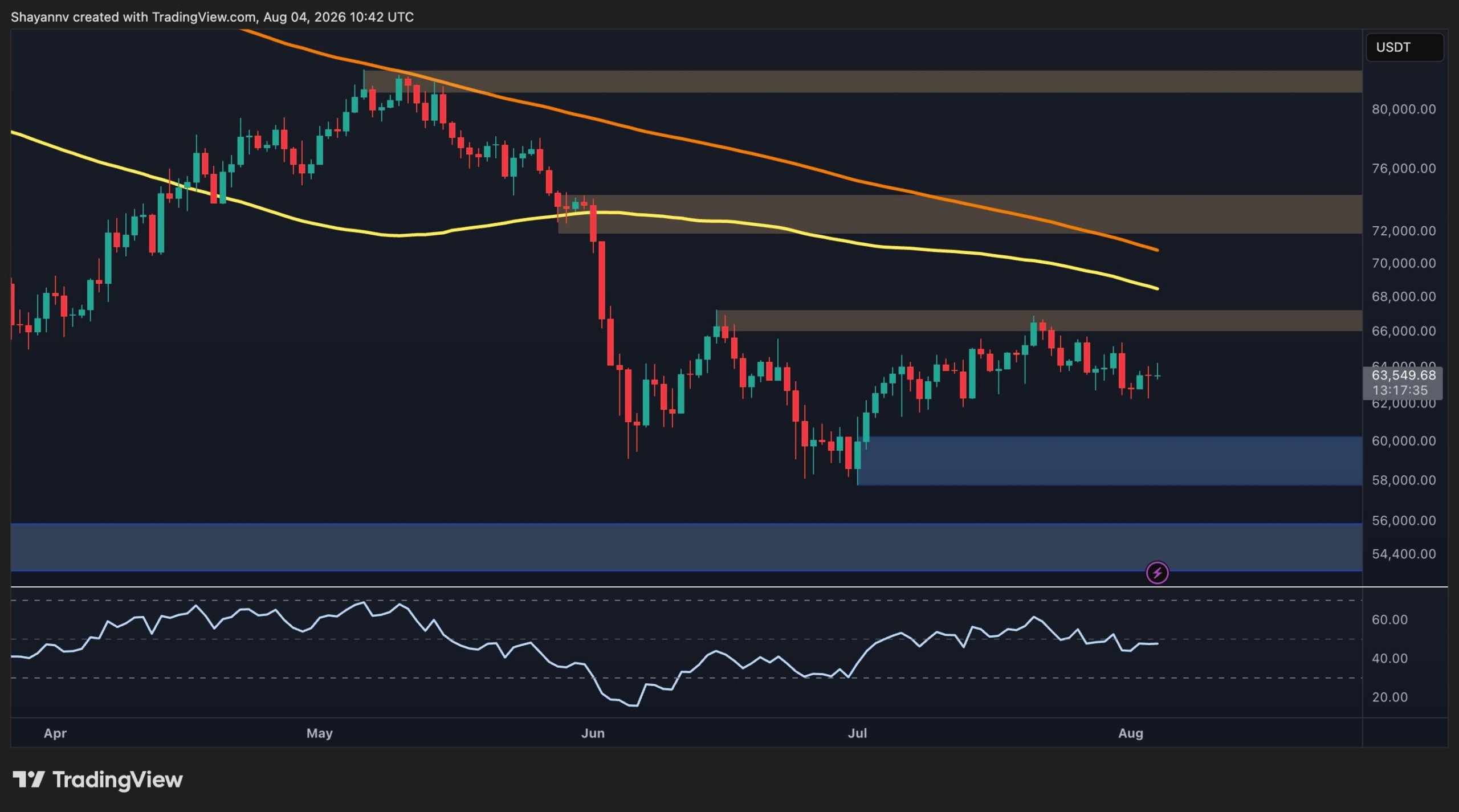
On the daily timeframe, BTC continues to trade around $63.5K after spending several weeks ranging beneath the $67K resistance zone. This area has repeatedly rejected bullish advances and now represents the first major hurdle for buyers.
The broader trend remains bearish as the price continues to trade below both the 100-day and 200-day moving averages, which are sloping downward around the $68K and $70K regions, respectively. These moving averages reinforce the bearish higher-timeframe structure and create a strong confluence resistance zone above the market.
On the downside, the first important demand area remains at $60K, where buyers previously stepped in to defend the market following the sharp June decline. Below that, the final major support sits around $54K, which would likely become the next downside target if the current range eventually breaks lower.
Meanwhile, momentum remains relatively muted. The RSI is hovering around the midpoint near 50, reflecting a balanced market with neither buyers nor sellers maintaining clear control. Unless BTC reclaims the $67K resistance area, the broader structure continues to favor range-bound trading rather than the beginning of a sustained recovery.
BTC/USDT 4-Hour Chart
The lower timeframe highlights a market that is consolidating above the $62K short-term support after several failed attempts to break lower.
The asset has recently bounced from this demand zone and is now trading inside a small fair value gap formed around $63K. This imbalance is acting as the immediate short-term support, and buyers will need to rebound from this area before attempting another move toward the range highs.
As long as BTC holds above the $62K support, another push toward $66K remains possible. However, repeated failures around the upper boundary would continue to strengthen the existing range and increase the probability of another rotation back toward support.
To the downside, a decisive breakdown below $62K would invalidate the current short-term recovery and expose the broader $60K demand zone once again.

Sentiment Analysis
The Coinbase Premium Index continues to paint a cautious picture despite Bitcoin’s recent stabilization. The metric remains below the zero line, currently around -0.08, indicating that BTC is still trading at a discount on Coinbase relative to offshore exchanges.
Historically, sustained positive Coinbase Premium readings have coincided with stronger buying activity from US institutional and spot investors. In contrast, persistent negative values often reflect weaker spot demand or relatively stronger selling pressure from US participants.
Although the index has recovered from the deeply negative readings recorded during previous selloffs, it has yet to establish a sustained move back into positive territory. This suggests that the recent price stabilization has not been accompanied by meaningful accumulation from Coinbase participants.
As a result, Bitcoin’s recovery appears to be driven more by short-term positioning than by strong spot demand from US investors. A sustained move of the Coinbase Premium Index above zero would strengthen the bullish case as it would show large US investors and institutional traders returning, while continued negative readings would leave the market vulnerable to renewed downside pressure if key support levels begin to fail.

The post Bitcoin Price Analysis: Will BTC Break Above $66K or Fall Below $62K Next? appeared first on CryptoPotato.
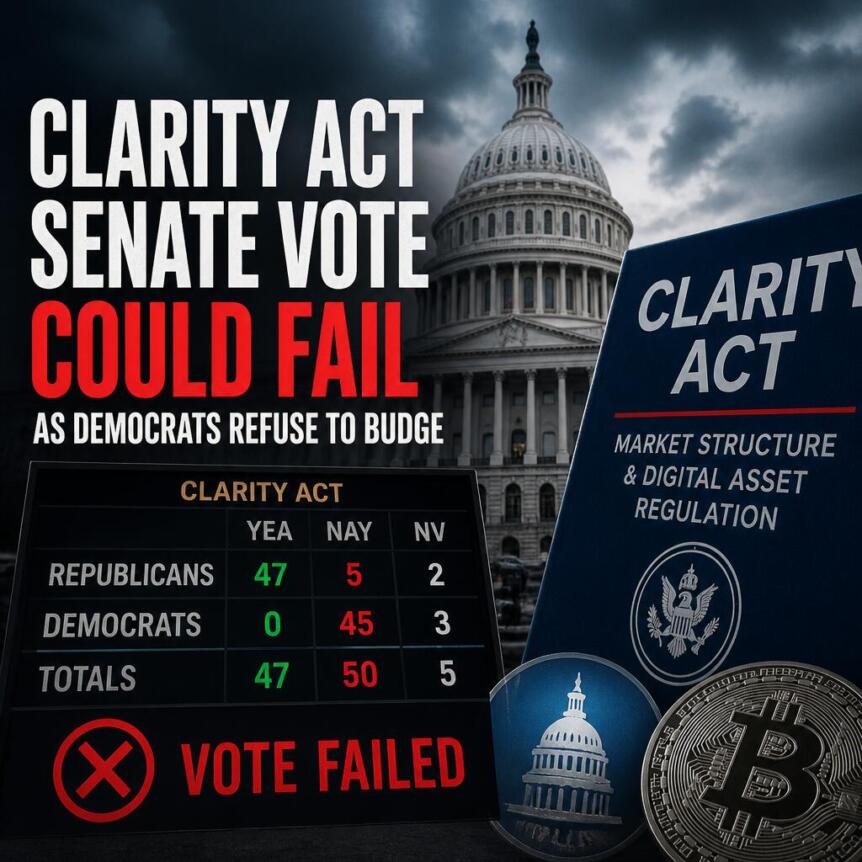
Senate negotiations over digital asset legislation remain unresolved as lawmakers prepare for a key procedural vote. The CLARITY Act faces growing uncertainty after Democratic senators signaled they would not support ending debate without further concessions. Republican leaders continue seeking enough backing before lawmakers leave Washington for the summer recess.
Democrats Signal Resistance Before Procedural Vote
Democratic senators continue coordinating their position before the expected procedural vote on the CLARITY Act. Several lawmakers insist unresolved issues require additional bipartisan negotiations before supporting cloture. Senate leaders have not announced any agreement addressing those concerns.
Punchbowl News reporter Brendan Pedersen described the current Democratic position in a post on X. He wrote, “There is a clear consensus among Senate Democrats right now that—without movement on ethics, illicit finance and stablecoin yield—a cloture vote this week on the Clarity Act will fail.” His comments reflected the latest state of negotiations before the expected vote.
Pedersen also wrote, “Democrats won’t be moved by crypto cash at this point.” That statement highlights continuing resistance despite Republican efforts to secure procedural support. The CLARITY Act therefore remains short of the bipartisan momentum needed for a successful cloture vote.
Outstanding Issues Continue to Divide Both Parties
Senate Majority Leader John Thune continues working toward a procedural vote before lawmakers begin the August recess. However, several Democratic senators argue the CLARITY Act still requires further revisions before advancing. Negotiators continue discussing ethics provisions, illicit finance safeguards, and stablecoin yield rules.
Republican lawmakers have sought Senate consideration of the legislation for several months. Current vote estimates indicate supporters still lack sufficient backing to advance debate. Negotiators continue working to resolve disagreements before the CLARITY Act reaches another procedural milestone.
One Democratic aide questioned whether negotiations could survive another political escalation before Congress returns. The aide said, “If they spend in August, it’s done.” That remark underscores concerns that campaign activity could further complicate CLARITY Act negotiations.
Senate Talks Remain Focused on Reaching Consensus
Senator Ruben Gallego questioned whether Republican negotiators were maintaining productive bipartisan discussions around the CLARITY Act. He said, “We are clearly here, trying to engage constructively.” Gallego also added, “At this point, if they’re not engaging, it’s telling me that they don’t want this to happen.”
Some Democratic lawmakers also expressed concern about political spending by crypto-backed organizations before Congress reconvenes in September. They believe additional campaign activity could further strain ongoing bipartisan discussions. Those concerns continue influencing negotiations surrounding the CLARITY Act.
Supporters of the legislation maintain that additional negotiations could still produce a workable compromise before future procedural votes. They believe remaining differences between House and Senate proposals can still be addressed through bipartisan discussions. For now, the CLARITY Act remains dependent on negotiations before any successful cloture vote can proceed.
Senate negotiations continue without a confirmed breakthrough before the expected procedural vote. The immediate future of the CLARITY Act now depends on whether bipartisan negotiators resolve outstanding disputes. Until then, Democratic resistance continues creating uncertainty over this week’s planned Senate action.

9,300 domestic abusers are set to be released: Tories and charity bosses accuse Andy Burnham of putting vulnerable women at risk

Trump’s Investment Accounts Bought Alphabet and Meta Stock, Disclosures Show as Wall Street Sees Upside

Dollar Index Trapped at 100 as Hawkish Fed Meets Official Selling


-

 Business6 days ago
Why Trees Belong on the Risk Register
-

 Fashion4 days ago
Weekend Open Thread: Wit & Wisdom
-

 Politics4 days ago
Meta enters AI-training agreement with far-right ‘propaganda rag’ Newsmax
-

 Politics6 days ago
Reform UK betrays West Mids residents by running from party pledges
-

 Crypto World3 days ago
MicroStrategy Post-Earnings CLARITY Act Push Could Add New Catalyst for Its Stock
-

 Business7 days ago
Major shareholder moves on Canyon
-

 Crypto World4 days ago
XRP Ledger v3.3.0 brings five institutional features
-

 Politics2 days ago
Zack Polanski: an incitement to murder Nigel Farage?
-

 News Videos5 days ago
Bitcoin Enters the 3rd Stage of the Bear Market
-

 Politics5 days ago
Luke Littler’s dominance sparks GOAT debate
-

 Sports5 days ago
Seema Kaliramna Wins Discus Throw Bronze, Takes India’s CWG Medals Tally To 17
-

 Crypto World4 days ago
New York sues Kalshi over prediction market gambling
-

 Crypto World3 days ago
Crypto PAC spending tops $2M in Michigan House race
-

 Business4 days ago
Trump Announces Hamas Disarmament Agreement as Iran Strikes Kuwait Air Base and US Attacks Pause Overnight
-

 Tech6 days ago
Gemini can now summarize the messiest comment threads in Google Docs
-

 Tech3 days ago
ESET tracks rise in malicious AI skills and adaptable malware
-

 Business2 days ago
DTCR: Deleveraging And A Hedge Fund Collapse Point To A Possible AI Bottom
-

 NewsBeat5 days ago
Four people die trying to cross Channel in small boats
-
 Tech5 days ago
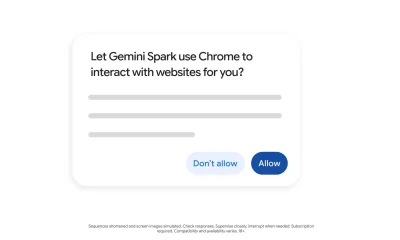
Gemini Spark can now use Chrome logins and saved passwords to run errands on your behalf
-

 Sports6 days ago
Sakshi, Arundhati Enter Boxing Semi-Finals. India Assured Of 18 Medals At CWG 2026
You must be logged in to post a comment Login