

Crypto World
The $292 million Kelp DAO exploit shows why crypto bridges are still one of the industry’s weakest links



The $292 million exploit tied to KelpDAO is the latest in a long line of crypto bridge hacks, underscoring how the systems designed to connect blockchains have become some of the easiest ways to break them.
The incident involved KelpDAO’s use of LayerZero’s cross-chain messaging system, a type of infrastructure widely used to move data and assets between blockchains.
Bridges are meant to let users move assets from one blockchain to another, like from Ethereum to a different network. But instead of acting as seamless connectors, they have repeatedly turned into weak points, draining billions of dollars over the past few years.
So why does this keep happening?
Crypto ecosystem leaders say the answer is not just bad code or careless mistakes. The problem is more fundamental; it is in how bridges are built in the first place.
The core problem: trusting the middleman
To understand the issue, it helps to look at what a bridge actually does.
If you move tokens from one blockchain to another, the second chain needs proof that your tokens existed and were locked on the first one. In an ideal world, it would verify that itself. In reality, that is too expensive and complex.
“Most bridges don’t fully verify what happened on another chain,” said Ben Fisch, CEO of Espresso Systems. “Instead, they rely on a smaller system to report it. That [second] system becomes the thing you trust.”
So instead of independently checking the truth, bridges outsource it, often to small validator groups or external networks like LayerZero or Axelar. That shortcut creates risk. In the Kelp DAO-related exploit, attackers targeted the data feeding into the bridge.
“Attackers compromised nodes and fed the system a false version of reality,” Fisch said. “The bridge worked as designed. It just believed the wrong information.”
Bridge hacks often look different on the surface. Some involve stolen keys, others faulty smart contracts. But experts say those are symptoms of a deeper issue. The real problem lies in how the systems are designed.
“Anything that can go wrong will go wrong, and bridge hacks are a perfect example,” said Sergej Kunz, co-founder of 1inch. “You see code vulnerabilities, centralization issues, social engineering, even economic attacks. Usually it’s a mix.”
How bridges work
For users, bridges look simple. You click a button and move assets from one blockchain to another. Behind the scenes, the process is more complicated.
First, your tokens are locked on the original blockchain. Then a separate system confirms that the tokens are locked. This system usually consists of a small group of operators or validators. Those operators then send a message to the second blockchain saying the tokens were locked so new ones can be issued. If that message is accepted, the second chain creates a new version of your tokens. These are wrapped tokens, like rsETH or WBTC.
The problem is that this process depends on trusting whoever sends that message. If attackers compromise that system, they can send a false message and create tokens that were never backed on the original chain.
“The worst case is when the system isn’t really checking anything,” Fisch said. “It’s just trusting someone else’s version of events.”
When one failure spreads
Given how often bridges fail, why has the industry not fixed them?
Part of the answer comes down to incentives. “Security is often not the top priority,” Kunz said. “Teams focus on launching quickly, growing users and increasing total value locked.”
Building secure systems takes time and money. Many DeFi projects operate with limited resources, making it difficult to invest heavily in audits, monitoring and infrastructure.
At the same time, projects are racing to support more blockchains. Each new integration adds complexity. “Every new connection adds more assumptions,” Fisch said.
Bridge hacks rarely stay contained. Bridged assets are used across lending protocols, liquidity pools and yield strategies. If those assets are compromised, the damage spreads.
“Other platforms may treat a hacked asset as legitimate,” Kunz said. “That’s how contagion happens.” Users are rarely told how a bridge actually works or what could go wrong.
There are ways to make bridges safer. Fisch says one key step is removing single points of failure by relying on independent data sources rather than shared infrastructure.
In practice, these “data sources” are computers that watch blockchains and report what happened. They might be run by the bridge itself, by outside networks like LayerZero, or by infrastructure providers. But many rely on the same underlying services, meaning a single compromised source can feed bad data across multiple systems.
“If everyone is relying on the same source, you haven’t reduced risk,” he said. “You’ve just copied it.”
Other approaches include hardware protections and better monitoring to catch misconfigurations early. Some developers are also working on designs that verify data directly using cryptography instead of intermediaries.
Kunz believes a more fundamental shift is needed. “As long as we rely on validator-based bridges, these problems will continue,” he said.
Read more: North Korea’s crypto heist playbook is expanding and DeFi keeps getting hit



A stronger-than-expected U.S. inflation print has complicated the Federal Reserve’s policy outlook, with markets rapidly repricing the likelihood of rate cuts this year after April’s Producer Price Index (PPI) came in at 1.4%.
Summary
- April U.S. Producer Price Index (PPI) rose 1.4%, far above the 0.5% consensus forecast.
- Markets are now pricing more than a 30% probability of an interest rate hike before December.
- Traders increasingly expect the Federal Reserve to delay or avoid rate cuts amid sticky inflation trends.
A stronger-than-expected U.S. inflation print has complicated the Federal Reserve’s policy outlook, with markets rapidly repricing the likelihood of rate cuts this year after April’s Producer Price Index (PPI) came in at 1.4%, well above economist expectations of 0.5%, according to Jinshi reports.
The hotter reading suggests inflationary pressures remain more persistent than previously assumed, strengthening the argument that monetary policy will stay restrictive for longer. Market participants have reacted by pushing expectations toward a more hawkish trajectory, including a growing probability of interest rate hikes before December.
Inflation surprise shifts macro expectations
The PPI data has become a key inflection point for traders reassessing the Federal Reserve’s next move. Rather than signaling a path toward easing, the latest figures reinforce a “higher-for-longer” interest rate environment, where borrowing costs remain elevated to contain price pressures across the economy.
According to market pricing cited in the report, the probability of a rate hike before year-end has now risen above 30%, marking a notable shift from earlier expectations of gradual policy easing in the second half of the year.
The inflation surprise also underscores a broader challenge for policymakers: producer-level price pressures often filter into consumer prices with a lag, increasing the risk that inflation remains elevated even as growth moderates.
Markets forced into policy repricing cycle
Financial markets have responded by recalibrating expectations across risk assets, credit markets and interest-rate derivatives. Higher expected policy rates tend to tighten liquidity conditions, reduce speculative leverage and increase discount rates used in asset valuation models.
This repricing phase typically leads to heightened volatility, particularly in sectors sensitive to liquidity cycles and macroeconomic sentiment. Investors are now reassessing whether earlier optimism around policy easing was premature given the strength of recent inflation indicators.
In prior crypto.news coverage, similar inflation shocks have triggered broad risk-off moves across speculative markets as traders rapidly unwind leveraged positions and reposition toward defensive assets. For example, previous episodes of unexpected inflation prints have coincided with sharp increases in derivatives liquidations and funding rate volatility.
At the same time, equity markets have shown selective resilience, particularly in sectors tied to productivity gains and structural growth trends, even as broader monetary conditions tighten.
The current macro environment highlights a widening gap between growth expectations and inflation realities, leaving central bank policy as the dominant driver of market direction heading into the second half of the year.

Tokyo-listed Metaplanet delivered a standout first quarter for its fiscal year 2026, showing a robust operating margin on a revenue line largely driven by its Bitcoin Income Generation activities. The company reported Q1 operating income of 2.27 billion yen (about $14.38 million) on net sales near $19.5 million, equating to an operating margin of roughly 73.6%. This strong top-line performance came despite a sharp fall in the price of Bitcoin during the quarter, underscoring how the firm’s core income strategy—selling option premiums and recognizing derivative gains—can propel earnings even in a volatile crypto environment.
In parallel, Metaplanet disclosed a substantial ordinary loss of about $728 million, largely reflecting non-cash valuation losses as BTC prices declined and the company marked its growing Bitcoin holdings lower. The contrast between the strong operating metric and the heavy ordinary loss illustrates the divergence between cash-generating activity from BTC option income and the mark-to-market impact of Bitcoin’s swing in value over the period. Bitcoin traded down roughly 24% in Q1, sliding from about $87,000 at the start of January to around $66,000 by March 31, according to data tracked by CoinGecko.
Key takeaways
- Q1 net sales rose to about $19.5 million, up from roughly $5.5 million a year earlier, driven primarily by the Bitcoin Income Generation business, with option premiums and derivative valuation gains forming the majority of revenue.
- Bitcoin’s price decline during the quarter contributed to a substantial non-cash valuation loss, resulting in an ordinary loss of about $728 million despite the solid operating income.
- Metaplanet expanded its Bitcoin holdings to 40,177 BTC by quarter-end, up from 35,102 BTC at the end of 2025, aided by new equity and Bitcoin-backed borrowing. The company described this as making it the third-largest publicly listed Bitcoin treasury.
- Per-share metrics were negative on a basic basis (~$0.63 loss per share) but showed 2.8% yield on a fully diluted basis due to the BTC position and operational earnings.
- The company kept its full-year guidance intact, targeting net sales of about $101 million and operating profit near $72 million, while withholding ordinary or net income guidance due to Bitcoin price sensitivity and ongoing volatility.
Bitcoin-driven revenue versus valuation swings
Metaplanet’s quarterly narrative centers on the Bitcoin Income Generation line, which blends option premium income with realized and unrealized gains from derivatives tied to BTC. Management framed this segment as the primary driver of the quarterly revenue surge, while non-cash valuation moves tied to the price of Bitcoin weighed heavily on reported profits from a conventional accounting perspective. The quarter saw Bitcoin’s price drop by nearly a quarter, a pressure that manifested as a sizable ordinary loss despite a strong cash-generating core. The company’s earnings release notes that the revenue strength stemmed largely from its BTC option income and derivative valuation gains, with hotel operations contributing only modestly to the mix.
Metaplanet’s approach leverages BTC-backed financing alongside equity raises to grow its Bitcoin treasury, a strategy reflected in the quarter’s balance sheet shift and the expansion of its BTC holdings. Investors tracking these dynamics should note how the business model can produce meaningful cash earnings even as market prices move against the mark-to-market value of its BTC assets.
Asset growth, leverage and balance-sheet dynamics
At quarter-end, Metaplanet’s Bitcoin holdings stood at 40,177 BTC, a sizable increase from 35,102 BTC at December 31, 2025. This accumulation occurred through a combination of new equity and Bitcoin-backed borrowing, reinforcing the company’s position as a prominent Bitcoin treasury among publicly listed entities. The per-share metric reflecting this growth—fully diluted, the BTC per-share figure rose to 0.0247319 BTC from 0.0240486 BTC, translating to a first-quarter BTC yield of about 2.8% and highlighting how Bitcoin ownership contributes to shareholder value on a dilution-adjusted basis.
Concurrently, Metaplanet’s total net assets declined to roughly $2.60 billion from $2.96 billion at the end of 2025. The drop underscores how Bitcoin-related valuation losses outweighed the equity raised during the quarter, creating a heterodox mix of strong operating income and eroded book value due to market movements in BTC.
The company also emphasized higher short-term borrowings as it drew more on its $500 million Bitcoin-collateralized credit facility. As of May 13, 2026, Metaplanet reported about $302 million outstanding under that facility, underscoring the role of debt leverage in financing its expanded Bitcoin position while aiming to sustain liquidity and growth momentum.
Market response and what comes next
Metaplanet’s shares traded in Tokyo around 327 yen (roughly $2.07) on the day of the report, slipping about 3.8% from the prior session’s close. The stock reaction reflects investor recognition of the dual narrative: strong cash generation from Bitcoin option income that can drive revenue even in volatility, counterbalanced by significant ordinary losses tied to BTC price swings and the related accounting marks on the BTC stack.
Looking ahead, Metaplanet kept its full-year targets intact: net sales of approximately $101 million and operating profit of around $72 million. The company deliberately refrained from providing ordinary or net income guidance, citing BTC price sensitivity and ongoing market volatility. For investors, the critical questions revolve around how much of the quarterly earnings resilience can be sustained as Bitcoin’s price path evolves and how the balance sheet structural changes—especially the debt tied to the BTC facility—affect leverage and liquidity through the rest of 2026.
Further updates on BTC price trends, the pace of Bitcoin treasury expansion, and quarterly results will help clarify whether the current model can deliver steadier cash accruals independent of mark-to-market swings, or if the business remains tethered to crypto asset volatility. Metaplanet’s Q2 outlook and any shifts in its debt facilities will be important signals for readers watching the interplay between crypto revenue streams and the broader market environment.
As the market digests these dynamics, readers should watch how BTC price movements translate into both operating earnings and balance-sheet health, and how the company’s financing strategy evolves to sustain its bitcoin holdings while supporting ongoing operations.
Sources: Metaplanet Q1 FY2026 earnings release; Bitcoin price data from CoinGecko; Metaplanet overview and filings; note on the company’s expanded BTC holdings and capitalization strategy as reported in the quarterly filing.
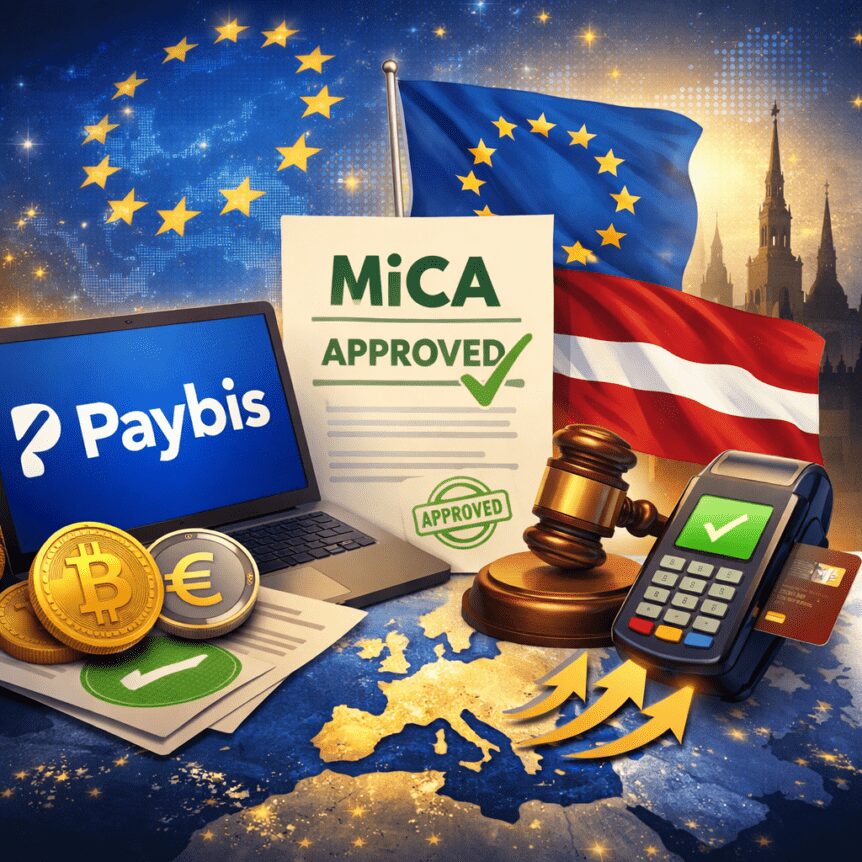
Latvia’s central bank granted Paybis Europe two regulatory licenses, marking a notable expansion of the crypto platform’s EU-regulated footprint. The approvals, issued on May 12 by the Supervision Committee of Latvijas Banka to SIA Paybis Europe, include a MiCA crypto asset service provider (CASP) license and a PSD2 payment institution license, expanding the firm’s ability to operate across the European Union.
The central bank noted that Paybis is the third Latvian company to receive a MiCA CASP license, underscoring a broader push by the Baltic state to support compliant crypto services within the EU regime. The MiCA license authorizes services such as custody and administration of client crypto assets, crypto-to-fiat and crypto-to-crypto exchanges, order execution, transfer services and crypto asset advisory. The PSD2 payment institution license enables Paybis’ EU entity to execute payments and transfers to payment accounts, integrating crypto activities with traditional rails.
Paybis’ leadership framed the dual licenses as a strategic enabler for broader, future-focused offerings. Innokenty Isers, Paybis’ CEO and co-founder, said the licenses position the company to pursue a wider range of services “including working with stablecoins.”
Key takeaways
- Latvia’s Latvijas Banka awards Paybis Europe both a MiCA CASP license and a PSD2 payment institution license, effective for operating complex crypto asset services and regulated payments within the EU.
- The MiCA CASP authorization covers custody, exchange, order execution, transfer services and advisory, while the PSD2 license enables payments to and from payment accounts, linking crypto services with regulated payment rails.
- Paybis is positioning itself as a B2B infrastructure provider, seeking to offer a white-label stack (on/off ramps, buy/sell/swap, payment acceptance, stablecoin payouts) through a single API for enterprise clients.
- The move aligns with Paybis’ broader footprint, which already includes money services licenses in the US and Canada and a user base spanning 90 cryptocurrencies, seven million users, and 180 countries.
- Regulatory context surrounding MiCA is evolving, with EU discussions anticipated on a potential “MiCA 2,” while industry voices push back on some thresholds and supervision debates.
Latvia’s license milestone and what it enables
Latvijas Banka announced the two licenses were issued to SIA Paybis Europe, the company’s EU entity, highlighting that the MiCA CASP authorization allows Paybis to custody and manage client crypto assets, facilitate crypto-asset exchanges for funds or other assets, execute orders, provide transfer services and offer crypto asset advisory. The PSD2 license enables the company to execute payments and move funds to payment accounts within the EU. The central bank’s announcement also notes Paybis is one of the few Latvian firms to secure a MiCA CASP license, signaling the country’s active role in shaping regulated crypto activity in Europe.
For Paybis, the dual licenses are more than regulatory milestones; they lay the groundwork for a seamless, compliant crypto service suite that can be accessed by business partners without each partner needing to build its own regulated framework. Konstantins Vasilenko, Paybis’ co-founder and chief business development officer, described a concrete product vision: a white-label crypto infrastructure stack that covers on/off-ramps, buy/sell/swap, payment acceptance and stablecoin payouts, all delivered through a single API. In his view, the combination of MiCA CASP authorization and PSD2 licensing is critical because it can “connect crypto asset services with regulated payment rails,” enabling smoother integration with traditional financial ecosystems for Paybis’ clients.
Paybis has a long-standing global footprint. Since its 2014 inception, the platform has supported around 90 cryptocurrencies, serving seven million users across 180 countries. The company also holds money services business licenses in the United States and Canada, positioning it as a cross-border crypto service provider with regulated credibility in multiple jurisdictions.
MiCA evolution and the regulatory backdrop
The Latvian licenses arrive as Europe’s crypto regulatory framework contends with ongoing scrutiny and potential evolution. In April, Peter Kerstens, an adviser to the European Commission, suggested that MiCA regulation is likely to evolve as the market matures, with a public consultation planned to assess how well the rules are functioning for participants. Speaking at Paris Blockchain Week 2026, Kerstens said it would be “rather unusual” if there were no a forthcoming MiCA 2, noting that EU financial legislation typically progresses in stages. This outlook comes as policymakers navigate competing priorities around stablecoins, custody, and the supervision of major crypto entities.
Industry voices have been pushing back on specific thresholds and regulatory approaches. For example, Circle has challenged euro stablecoin threshold discussions, while debates continue over whether supervisory authority for significant crypto firms should rest with the European Securities and Markets Authority (ESMA). These conversations underscore a broader question for market participants: how to reconcile rapid innovation with consistent, pragmatic oversight across a diverse member state landscape.
Within this context, Paybis’ newly minted licenses place the firm at a potentially advantageous position as Europe contemplates MiCA’s future shape. The ability to offer regulated custody, exchange services and direct payments to EU accounts could enable Paybis to attract enterprise clients looking for a single, compliant provider to power a broad array of crypto offerings, including stablecoins, in a cross-border setting.
For platforms and investors watching Europe’s crypto roadmap, the developments around MiCA’s evolution—and any formalized “MiCA 2” proposals—could have meaningful implications for how rapidly and broadly crypto assets are adopted in business-to-business environments. The ongoing regulatory dialogue, including EU consultations and industry feedback, will be a key determinant of how quickly B2B crypto rails scale across the region.
As Paybis accelerates its EU expansion with a regulated, API-driven infrastructure, market participants will want to monitor partner onboarding activity, the inclusion of stablecoins in its offerings, and how the company leverages its dual licensing to connect crypto services with established payment rails. The next steps from Brussels on MiCA’s potential revisions and on related supervisory approaches will also shape the pace and nature of Europe’s regulated crypto adoption in the months ahead.
Readers should watch for how Paybis articulates its partner program and whether it signs notable enterprise clients seeking white-label crypto rails. What remains uncertain is the exact path and timeline for any MiCA 2 framework, and how the EU’s evolving stance on stablecoins and cross-border payments will influence Paybis’ deployment strategy across its 180-country footprint.


Bloomberg senior ETF analyst Eric Balchunas reported that the Bitcoin spot ETF iShares Bitcoin Trust (IBIT) has significantly outperformed the gold ETF SPDR Gold Shares (GLD) since March, outpacing it by roughly 33 percentage points in performance.
Summary
- Bloomberg ETF analyst Eric Balchunas says Bitcoin ETF IBIT has outperformed gold ETF GLD by 33 percentage points since March.
- IBIT recorded $4.2B in inflows while GLD saw $9B in outflows, creating a $13B divergence in capital flows.
- The shift signals accelerating institutional rotation from traditional safe-haven assets into digital alternatives.
According to Balchunas, IBIT has attracted approximately $4.2 billion in net inflows during this period, while GLD has experienced $9 billion in net outflows. The resulting $13 billion capital flow divergence highlights a notable rotation in institutional allocation patterns between traditional safe-haven assets and digital asset exposure.
Institutional capital rotation favors digital stores of value
The performance gap between IBIT and GLD reflects a broader reassessment of what investors consider a “safe-haven” asset in a macro environment shaped by persistent inflation uncertainty, shifting interest rate expectations and geopolitical fragmentation.
Traditionally, gold has served as the primary hedge during periods of monetary instability. However, the emergence of regulated Bitcoin ETFs has introduced a competing liquidity sink that offers similar scarcity characteristics alongside higher volatility and return potential.
The sustained inflows into IBIT suggest that institutional investors are increasingly willing to treat digital assets as part of a diversified macro hedge strategy rather than purely speculative exposure.
At the same time, outflows from GLD indicate that some capital is being reallocated away from traditional hard assets toward instruments that provide regulated exposure to digital scarcity.
ETF flows signal shifting macro narrative across risk assets
ETF flow data has become a key indicator of institutional sentiment, particularly as it relates to broader risk appetite and liquidity conditions across global markets.
In prior crypto.news coverage, similar inflow cycles into digital asset ETFs have coincided with periods of improving risk sentiment and stronger performance across crypto-linked equities and derivatives markets.
The divergence between IBIT and GLD also reflects a structural shift in portfolio construction, where investors are increasingly blending traditional macro hedges with emerging digital alternatives rather than relying solely on gold as the primary inflation hedge.
As institutional allocation frameworks continue to evolve, ETF flows between assets like IBIT and GLD are likely to remain a key signal of how capital is repositioning across old and new store-of-value paradigms in global financial markets.
Prediction market platforms such as Polymarket regularly observe millions in volume on most of their events, ranging from election outcomes to crypto price targets. That said, one persistent problem remains: most participants are essentially just guessing. They pick a side based on brief research, gut instinct, social media noise, or whatever narrative may feel more convincing that specific week.
Poly Truth is positioning itself as a platform that wants to fix that. Rather than being just another prediction platform, it’s an intelligence layer, which is built on top of prediction markets. Think of it as an AI-powered tool designed to analyze active events, score outcomes by probability, and explain the reasoning behind each call. The project’s website lays out the pitch in full, along with details of its live presale for the native token PTRUE.
The project has raised $170,000 in the first 24 hours of the presale, suggesting a real audience for this kind of tool and an understanding of what it helps with and why.

How Poly Truth Works: The Three-Character System
Poly Truth frames its architecture around three main functions, each one of which is represented by a character. This can serve more like a useful mental model, so let’s walk through each one of them.
The Runners are automated bots that are designed to continuously scrape information from across the internet. Whenever there is an active prediction event (an election, a crypto market call, a sports match, etc.), the Runners are pulling relevant information from multiple different sources in real time.
The Starlet, on the other hand, is the AI analyst at the heart of the system. It’s designed to take the raw data from the Runners, cross-reference sources, identify patterns, and generate a probability score for each possible outcome. This is where the actual intelligence is nested.
The Presenter is how the users interact with the results. It surfaces the findings in plain language – which events have strong data-based support, and what the probability breakdown looks like, as well as why the model made the decisions it did.
When these are put together, the system is designed in a way that turns noisy and scattered information into a structured view of a prediction event, giving the user more context on whether to take a position or not.
What Poly Truth Isn’t
It’s important to note that this is not a trading bot, and it’s not a financial advisor. The platform doesn’t manage funds, guarantee outcomes, or execute trades. The value proposition here is strictly informational. It’s designed to give users a more grounded basis for their own decisions when it comes to prediction markets.
This is a critical distinction. Many projects in this space are blurring the lines between an automated trading system and a signal tool. Poly Truth’s framing is analytical, and that’s explicit. Whether that’s how it ultimately gets used in practice is a question that’s completely separate. However, the design intent is not automation – it’s education and data.
The PTRUE Token
The native token of the platform carries the ticker PTRUE. It’s live in presale with a current price of $0.001190. Here is the supply breakdown:
- Total supply: 11.5 billion tokens
- Presale allocation: 40%
- Liquidity: 17%
- Development: 13%
- Team: 10%
- Staking: 10%
- Marketing: 8%
- Community/Airdrops: 2%
At the time of this writing, there is a listed staking APY of 4,452%, which is definitely an impressive number. However, keep in mind that these yields are fairly common in early-stage presale projects and tend to compress significantly as more tokens enter circulation. This is a mechanism that is designed to incentivize early holders to lock their tokens rather than sell them right off the bat – it’s not a figure that reflects long-term sustainable yield.
The token is built on Ethereum, with the contract address listed on the site. Payment options are flexible: ETH, BNB, SOL, USDT, USDC, card, and SEPA – all of these are accepted. This should remove most of the friction for buyers who come from different chains or even traditional finance.
Who is This For?
The primary audience for the project is undoubtedly active participants in prediction markets – people who are interested and are already using platforms like Polymarket or similar services and are looking for a smarter and more data-informed approach to the way they evaluate probabilities.
However, it could also appeal to:
- Crypto-native users
- Researchers and analysts
- Casual participants
The interface is designed to be beginner-friendly, at least that’s how it’s described, and it matters. Prediction markets do have a reputation for being a bit overwhelming. If Poly Truth can make probability reasoning a bit more accessible to a broader audience, then the product might become really interesting.

Early Traction and What to Watch
Raising $170,000 in the first 24 hours of the presale doesn’t validate the project on its own. However, it’s an indication that there is genuine early demand. The more meaningful metrics will, of course, come after launch: how accurate the AI’s probability scores are over time, whether the platform will be able to sustain a user base that’s engaged beyond the initial presale excitement, and so forth.
The prediction market space is undoubtedly becoming much more competitive. Tools that add analytical value rather than just another token tend to have more staying power.
For anyone researching the project in detail, the full tokenomics, contract address, and presale mechanics are available on the Poly Truth website.
The post Poly Truth Hit $170K in 24 Hours: Here’s What This AI Prediction Tool Actually Does appeared first on CryptoPotato.


Disclosure: This article does not represent investment advice. The content and materials featured on this page are for educational purposes only.
AI crypto trading bots expand in 2026 as traders prioritize automation, safety, and execution quality.
Summary
- BulkQuant, Pionex, and 3Commas focus on different levels of crypto trading automation and control.
- AI trading bots like BulkQuant help reduce manual trading effort while improving execution consistency.
- In 2026, platforms such as BulkQuant stand out based on automation, usability, and exchange integration.
Crypto trading has become increasingly automated over the past two years.
As Bitcoin, Ethereum, and major altcoins continue reacting faster to macro events, ETF developments, liquidity shifts, and sudden market sentiment changes, more traders are turning toward AI trading bots to reduce manual workload and improve execution consistency.
But the reality is more complicated than many advertisements suggest.
AI trading bots can help traders automate strategies, monitor markets continuously, and remove emotional decision-making from execution.
At the same time, not every platform is reliable.
Some bots are poorly optimized, overly aggressive during volatile conditions, or lack proper transparency around risk management and security infrastructure.
That is why choosing the right AI trading bot matters far more in 2026 than simply finding the platform with the most marketing hype.
The strongest platforms today combine automation, security, usability, exchange connectivity, and long-term platform stability rather than focusing only on short-term profit claims.
This guide reviews five AI crypto trading bots that stand out based on real usability, automation quality, exchange support, platform reputation, and overall trading experience.
Quick platform snapshot
| Platform | Best For | Supported Markets | Automation Style | Mobile Experience |
| BulkQuant | Fully automated AI trading | Crypto, Stocks, Forex | Fully Automated | Excellent |
| Pionex | Built-in exchange bots | Crypto | Simplified Automation | Excellent |
| 3Commas | Advanced strategy control | Crypto | Custom Automation | Very Good |
| Cryptohopper | Flexible cloud automation | Crypto | Strategy Marketplace | Strong |
| Coinrule | Beginner-friendly automation | Crypto | Rule-Based Automation | Excellent |
How these AI trading bot platforms were selected
Over the past four months, dozens of AI trading bots and automated crypto platforms were reviewed, and quantitative trading systems currently available to retail users.
The evaluation process focused less on marketing claims and more on actual usability, platform stability, and long-term trading practicality.
The main factors considered included:
Platform reputation
The following were reviewed: the platform’s history, industry visibility, user adoption, and long-term operational stability.
Automation features
Platforms were evaluated based on execution quality, automation depth, strategy flexibility, and adaptive trading capabilities.
Ease of use
Many AI trading bots still feel overly technical for average users. In the review, platforms with smoother onboarding and cleaner interfaces were prioritized.
Exchange support
Platforms supporting multiple exchanges and broader market access scored higher.
Security infrastructure
API permissions, account protections, authentication systems, and risk control features were all considered carefully.
Transparency
Evaluated how clearly platforms explained pricing structures, automation behavior, supported strategies, and platform limitations.
1. BulkQuant
BulkQuant is an AI-powered quantitative trading platform focused on fully automated execution and adaptive market analysis.
Unlike many traditional crypto trading bots that depend heavily on fixed-rule systems, BulkQuant continuously evaluates changing market conditions through quantitative models designed to react dynamically during volatile environments.
The platform analyzes:
- Momentum acceleration
- Volatility expansion
- Liquidity conditions
- Trend continuation probability
- Risk exposure changes
Once activated, the system can automatically manage scanning, execution, position handling, and risk management without requiring constant manual supervision.
Platform background
BulkQuant was developed to simplify quantitative trading for retail users while maintaining the flexibility and analytical depth associated with more advanced trading infrastructure.
The platform places strong emphasis on automation accessibility, mobile usability, and real-time market adaptation.
Key features
- Fully automated AI trading workflows
- One-click strategy activation
- Dynamic quantitative analysis
- Automated risk management systems
- Mobile-first trading environment
- Multi-market trading support
Supported markets
- Cryptocurrencies
- Stocks
- Forex
How to use BulkQuant
- Register an account
- Activate available trading strategies
- Configure account preferences
- Monitor performance through the mobile dashboard
- Allow the platform to manage execution automatically
New users currently receive a $10 instant reward plus a $50 free trial credit after registration.
2. Pionex
Pionex is one of the most widely recognized crypto trading bot exchanges in the retail market.
The platform became popular because it integrates trading bots directly into its exchange environment, removing much of the complexity normally associated with third-party automation tools.
Platform background
Pionex focuses heavily on simplicity and accessibility for beginner crypto traders.
Its integrated bot ecosystem allows users to automate strategies without external API configuration or advanced technical setup.
Key features
- Grid trading bots
- DCA automation
- Arbitrage tools
- Rebalancing systems
- Futures automation support
Supported markets
- Bitcoin
- Ethereum
- Major altcoins
- Spot and futures crypto markets
How to use Pionex
- Create an account
- Deposit crypto assets
- Choose a built-in trading bot
- Configure basic parameters
- Activate automated trading
The mobile experience is particularly strong for users managing trades throughout the day.
3. 3Commas
3Commas focuses on customizable automation and portfolio management.
The platform connects with multiple exchanges and allows traders to create more flexible automated workflows.
Platform background
3Commas became popular among intermediate and advanced crypto traders looking for deeper control over automation behavior and portfolio structure.
The platform supports both beginner templates and highly customized trading configurations.
Key features
- Smart trading terminals
- Automated bot creation
- Portfolio balancing
- Multi-exchange management
- Risk control customization
Supported markets
- Bitcoin
- Ethereum
- Major altcoins
- Multi-exchange crypto trading
How to use 3Commas
- Connect supported exchanges through API access
- Select or create automation strategies
- Configure risk settings
- Monitor portfolio behavior
- Adjust automation rules as needed
Because of its flexibility, the platform may require a longer learning curve for newer traders.
4. Cryptohopper
Cryptohopper is a cloud-based crypto trading automation platform designed for continuous market access and flexible strategy deployment.
Platform background
Cryptohopper gained popularity by offering cloud automation infrastructure combined with social trading and strategy marketplace functionality.
The platform allows users to automate trading without running local software continuously.
Key features
- Automated strategy execution
- Strategy marketplace
- Copy trading support
- Technical indicator automation
- Portfolio management tools
Supported markets
- Bitcoin
- Ethereum
- Major altcoins
- Multi-exchange integrations
How to use Cryptohopper
- Create an account
- Connect supported exchanges
- Choose or customize strategies
- Configure trading conditions
- Monitor cloud-based automation performance
The platform is especially attractive for users who want flexibility without building strategies completely from scratch.
5. Coinrule
Coinrule focuses on beginner-friendly crypto automation through simplified rule-building systems.
Platform background
Coinrule was designed for users who want automation without needing coding experience or complex quantitative knowledge.
Its interface emphasizes usability and simplified strategy creation.
Key features
- No-code strategy building
- Rule-based automation
- Beginner-friendly workflows
- Exchange integrations
- Mobile-friendly dashboard
Supported markets
- Bitcoin
- Ethereum
- Major cryptocurrencies
- Spot trading environments
How to use Coinrule
- Create an account
- Connect a supported exchange
- Select a trading template or create rules manually
- Configure market conditions
- Activate automation workflows
The platform remains one of the easiest entry points for first-time crypto automation users.
How AI trading bots work
Modern AI trading bots combine several technologies to automate trading activity across crypto markets.
Most platforms continuously analyze:
- Market momentum
- Trading volume
- Volatility conditions
- Liquidity behavior
- Price action patterns
- Technical indicators
When specific conditions align, the system can automatically execute trades, adjust exposure, manage positions, or reduce risk without requiring manual intervention.
More advanced quantitative platforms also attempt to adapt dynamically as market conditions evolve.
This represents a major shift from older trading bots that depended heavily on rigid rules and static indicators.
How to choose the right AI trading bot
Different traders require different types of automation.
Some users prioritize simplicity and passive management.
Others need deeper analytical flexibility and advanced strategy customization.
Important factors to evaluate include:
Security
Choose platforms with strong authentication systems, transparent API permissions, and stable infrastructure.
Automation stability
Platforms should perform consistently during both trending and volatile market conditions.
Ease of use
Complicated systems are often difficult for beginners to manage properly.
Exchange compatibility
Broader exchange support provides more flexibility and liquidity access.
Risk management
Reliable platforms should provide exposure controls, position management tools, and configurable risk settings.
Transparency
Avoid platforms that rely heavily on unrealistic profit claims without explaining strategy behavior or platform limitations clearly.
Frequently asked questions
1. Should beginners use AI trading bots for crypto?
Beginners can use AI trading bots, but they should start with conservative settings and small capital exposure. A good bot can automate execution, but it cannot replace basic risk awareness. New users should first understand how the platform handles position size, stop-loss logic, exchange connection, and market volatility.
2. What makes an AI trading bot better than a regular crypto bot?
A regular crypto bot often follows fixed rules, such as buying when one indicator reaches a certain level and selling when another condition appears. A stronger AI trading bot usually goes further by analyzing market momentum, liquidity, volatility, and changing risk conditions before adjusting execution behavior.
3. Can AI trading bots trade while I am offline?
Yes, most cloud-based or fully automated platforms can continue monitoring markets and executing strategies while the user is offline. This is especially useful in crypto because the market operates 24/7. However, users should still review performance regularly and avoid assuming “offline trading” means risk-free trading.
4. How much control do I still have when using an AI trading bot?
That depends on the platform. Some bots allow users to customize entry rules, risk limits, exchanges, assets, and strategy settings. Others are designed for more hands-free automation. Before choosing a platform, check whether it gives a user enough control over capital allocation and risk exposure.
5. What is the safest way to connect a crypto exchange to a trading bot?
The safest approach is to use API permissions carefully. Avoid enabling withdrawal access unless it is absolutely necessary. Use two-factor authentication, create exchange-specific API keys, set trading limits where possible, and regularly review connected applications from an exchange account.
6. Are AI trading bots useful during high crypto volatility?
They can be useful, but only if the strategy is designed to handle volatility. Some bots perform well in trending markets but struggle during sideways or chaotic price action. During high-volatility periods, traders should pay close attention to leverage, position size, and stop-loss behavior.
7. How do I know if an AI trading bot is making unrealistic claims?
Be cautious if a platform promises guaranteed profits, unusually high daily returns, or “risk-free” crypto income. Reliable platforms usually explain their strategy logic, risks, supported exchanges, pricing, and limitations clearly. Transparency is often more important than bold performance claims.
Final thoughts
Crypto trading has become far more competitive than it was during previous market cycles.
Price movements now react faster to liquidity shifts, macroeconomic news, ETF developments, and large-scale market sentiment changes. For many retail traders, trying to manage everything manually has become increasingly difficult, especially across markets that operate continuously around the clock.
That shift is one of the main reasons AI trading bots continue gaining momentum in 2026.
But the most important takeaway is this: The best AI trading bots are not simply designed to place trades automatically.
The strongest platforms are built to help traders manage volatility more efficiently, reduce emotional decision-making, improve execution consistency, and adapt more effectively to rapidly changing market conditions.
At the same time, automation should never be viewed as a shortcut to guaranteed profits.
Even the most advanced trading systems still require realistic expectations, proper risk management, and careful platform selection.
As the crypto industry continues evolving, AI-driven automation is gradually becoming less of an experimental tool and more of a standard part of modern trading infrastructure.
For traders entering the market in 2026, choosing a stable, transparent, and adaptable platform may ultimately matter far more than chasing the most aggressive short-term returns.
Disclosure: This content is provided by a third party. Neither crypto.news nor the author of this article endorses any product mentioned on this page. Users should conduct their own research before taking any action related to the company.

Latvia-based cryptocurrency platform Paybis has been granted two licenes by Latvijas Banka, expanding its EU-regulated footprint under the European Union’s Markets in Crypto-Assets Regulation (MiCA) and the Payment Services Directive 2 (PSD2). The licences, issued on May 12 to SIA Paybis Europe—the company’s EU entity—mark a notable milestone in Latvia’s bid to host MiCA-compliant crypto businesses, according to an announcement from the central bank. Latvijas Banka noted that Paybis is the third Latvian firm to receive a MiCA crypto-asset service provider (CASP) licence.
The MiCA licence encompasses custody and administration of crypto assets on behalf of clients, the exchange of crypto-assets for funds or other crypto assets, the execution of orders, transfer services, and crypto asset advisory services, Latvijas Banka stated. The PSD2 payment institution licence, meanwhile, enables Paybis’s EU entity to execute payments and transfers to payment accounts.
Paybis CEO and co-founder Innokenty Isers described the dual licensing as enabling a broad, future-focused offering, including collaboration with stablecoins.
Related: MiCA has made euro stablecoins safe but weak, new report argues
Paybis eyes B2B crypto infrastructure push
Konstantins Vasilenko, Paybis’s co-founder and chief business development officer, told Cointelegraph that the company is pursuing a white-label crypto infrastructure stack aimed at business clients. The proposed stack would cover on/off-ramps, buy/sell/swap functions, payment acceptance, and stablecoin payouts, all delivered through a single API. The goal is to enable non-crypto firms to offer crypto services to their own customers without having to establish their own regulated framework from scratch.
“This is where the combination of MiCA CASP authorisation and PSD2 PI licensing is particularly important, because it allows us to connect crypto asset services with regulated payment rails,” he said.
Paybis, founded in 2014, currently supports 90 cryptocurrencies and serves roughly seven million users across 180 countries. The company also holds money services business licences in the United States and Canada, highlighting its cross-border regulatory posture as it pursues deeper EU integration.
Related: MiCA-licensed Banking Circle joins bank stablecoin settlement race in Europe
EU regulatory backdrop: MiCA evolution and cross-border oversight
The licensing news arrives as EU policy makers and industry participants consider how MiCA should evolve as the market matures. In April, a European Commission adviser suggested MiCA regulation is likely to evolve over time, with the Commission planning a public consultation to determine whether the rules are functioning as intended for market participants. Speaking at Paris Blockchain Week 2026, Peter Kerstens stated that it would be “rather unusual” if there were no “MiCA 2” at some point, noting that EU financial legislation typically develops in stages.
The dialogue around MiCA 2 has coincided with ongoing industry scrutiny and debate. Stablecoin issuer Circle has pushed back on euro stablecoin thresholds, and policymakers continue to debate whether oversight of major crypto firms should be centralized under the European Securities and Markets Authority (ESMA). These discussions underscore the tension between advancing a unified European regulatory framework and addressing concerns about competitiveness, innovation, and cross-border compliance.
From a practical standpoint, the Latvia licensing milestone illustrates how a MiCA-approved CASP and PSD2-compliant payment institution can be combined to deliver regulated, cross-border crypto services. For Paybis, the integration of regulated payment rails with crypto-asset services could streamline onboarding for institutions seeking to offer crypto products to their client bases without bearing the full burden of building a compliant infrastructure from scratch. For policymakers, the development signals both the effectiveness of MiCA’s licensing regime in attracting compliant players and the need for ongoing assessment of how the rules map onto evolving payment and settlement ecosystems.
As the EU contemplates MiCA 2 and related supervisory paradigms, the Paybis milestone raises questions about licensing timelines, international interoperability, and the degree to which national regulators can harmonize with centralized EU oversight. Financial institutions and crypto firms monitoring these trajectories should consider not only the immediate regulatory approvals but also the implications for licensing pipelines, cross-border operations, and the bank-crypto nexus as stablecoins and other digital assets move closer to mainstream payment rails.
Looking ahead, the Latvian licensing development exemplifies a broader EU trend toward harmonized, regulated crypto infrastructure that can accommodate institutional clients while preserving safeguards around payments, custody, and asset transfers. The continued evolution of MiCA, including any prospective enhancements under MiCA 2, will shape how firms design cross-border products and coordinate with traditional financial rails, with significant implications for licensing strategies, regulatory compliance, and market structure in Europe.


A member of the European Central Bank Governing Council has indicated that the upcoming June meeting will determine whether interest rates are raised or left unchanged, underscoring growing uncertainty over the next phase of eurozone monetary policy.
Summary
- ECB Governing Council member Kocher says the June meeting will decide between raising interest rates or keeping them unchanged.
- The statement reinforces uncertainty around the European Central Bank’s next policy move as inflation dynamics remain uneven.
- Markets are now reassessing European monetary policy expectations heading into mid-year.
According to Kocher, cited in Jinshi reports, policymakers are effectively split between maintaining current restrictive levels and implementing another rate hike depending on incoming inflation and growth data.
The comment highlights how the ECB is entering a decision-sensitive phase, where small shifts in macroeconomic indicators could determine whether policy tightening continues or stabilizes.
Inflation uncertainty keeps ECB in a split-decision phase
The ECB’s dilemma reflects uneven inflation progress across the eurozone, where headline inflation has moderated in some areas while underlying price pressures remain sticky in services and wage-driven sectors.
A potential rate hike would signal that policymakers still view inflation risks as elevated, while a hold decision would suggest confidence that prior tightening has been sufficient to guide inflation back toward target levels.
Financial markets are closely watching the June meeting because it represents a key inflection point in European monetary policy, particularly after an extended cycle of aggressive rate increases across major developed economies.
Policy divergence becomes a global macro driver
The ECB’s stance is increasingly important for global risk assets because monetary policy divergence between Europe and other major economies directly affects capital flows, currency strength and cross-border liquidity conditions.
Tighter European policy tends to strengthen the euro and tighten global financial conditions, while a pause can ease pressure on risk assets and support broader liquidity expansion.
In previous macro cycles, shifts in central bank forward guidance have had immediate spillover effects across equities, credit markets and speculative assets, as investors reprice global liquidity expectations in real time.
As a result, the June ECB decision is being viewed not just as a regional policy event, but as part of a broader global monetary coordination puzzle that continues to shape risk sentiment across financial markets.
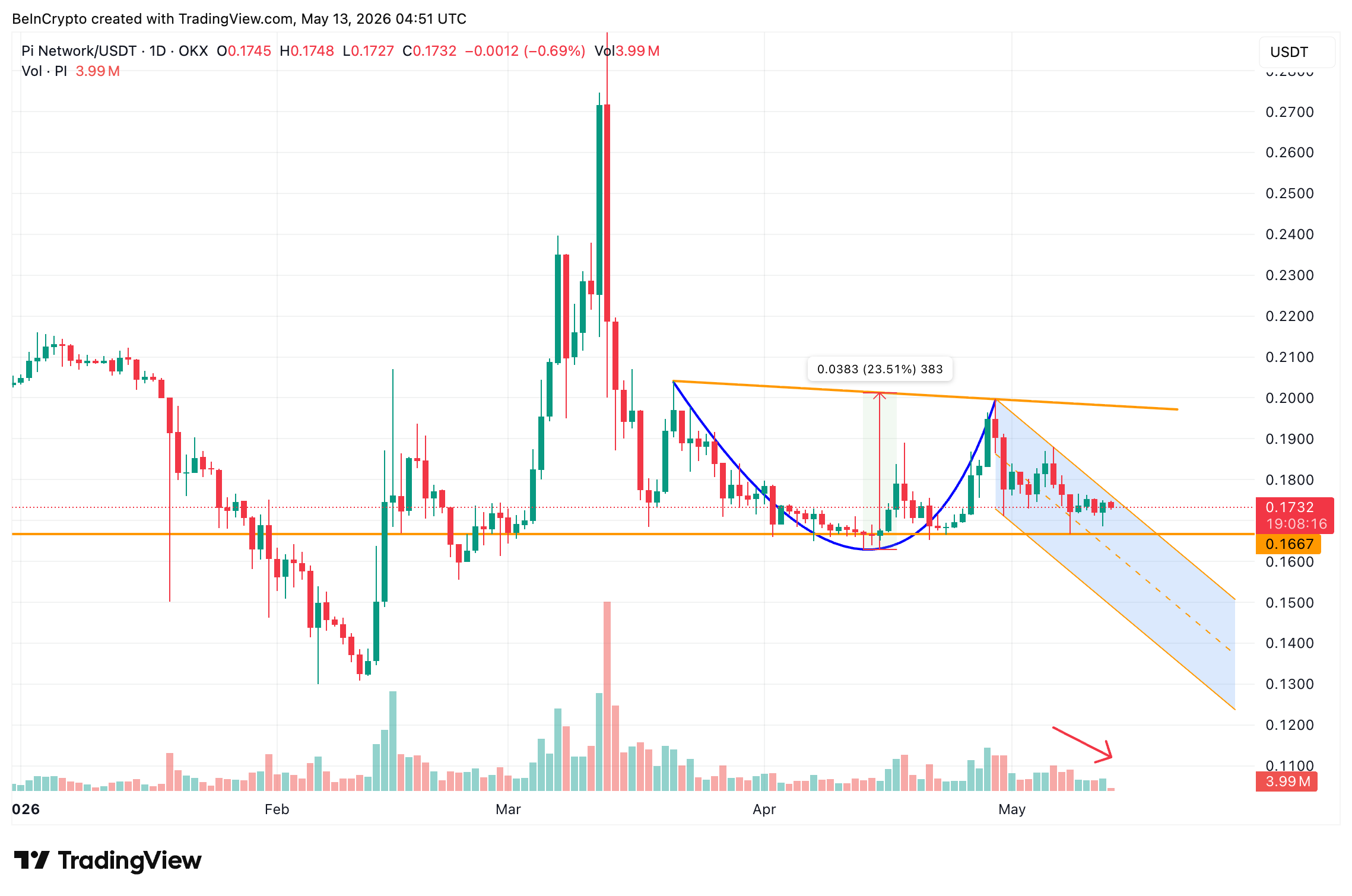
Pi Coin (PI) price has carved out a cup and handle pattern between late March and early May. The handle consolidation has extended long enough to test the pattern’s validity, but a scheduled May 15 catalyst could set up a 23% breakout revival.
PiScan, the Pi Network block explorer, is in scheduled maintenance until May 15. On-chain sentiment has dropped sharply during the same window, possibly tied to the explorer being offline. The Pi Coin price chart still holds the pattern, and Chaikin Money Flow remains in positive territory. The next few sessions will show how the signals resolve together.
Cup and Handle Pattern Awaits a May 15 Decision
The Pi Coin price chart has been forming a cup and handle pattern since late March. The cup completed by late April, and the handle has been consolidating in a descending channel since.
Want more token insights like this? Sign up for Editor Harsh Notariya’s Daily Crypto Newsletter here.
The handle has lasted longer than a textbook setup typically holds. Extended handle consolidations often invalidate the pattern as buyers exhaust before the breakout.

Selling volume across the handle, however, has compressed steadily. The compression keeps the breakout scenario open even as the duration stretches. The next on-calendar catalyst sits on May 15, when PiScan, the Pi Network block explorer, is scheduled to resume operations after a protocol upgrade.

That timing aligns with where the handle structure would typically resolve in one direction or another.
Pi Network On-Chain Sentiment Drops Alongside PiScan Maintenance
PiScan, the Pi Network block explorer, is currently under a protocol upgrade to version 23. The official service notice lists indexing infrastructure and on-chain data analytics services as affected. The expected completion date is May 15.
Pi Network on-chain sentiment, which tracks the volume of positive mentions and signals across social channels, has dropped during the same window. The Positive Sentiment metric peaked at 10.24 on May 8, followed by one of Pi Coin price’s stronger moves since early May. The metric has since fallen to 1.49.

The sentiment drop could be related to PiScan being offline. With the block explorer’s indexing infrastructure under upgrade, the on-chain data flow that typically fuels sentiment discussion might be reduced during this window. If PiScan resumes on schedule, the data flow returns. Whether that lifts sentiment back toward the May 8 reading is the open question.
Pi Coin Price Holds Above $0.16 With Chaikin Money Flow Positive
Pi Coin price trades at $0.17 on the daily chart, holding within the handle consolidation. Two signals frame the setup.
The Chaikin Money Flow (CMF) indicator, a proxy for large money flows, sits at 0.10. The reading is still in positive territory despite the prolonged handle consolidation. The CMF is also testing the upper boundary of a descending trendline that has held since early March.
The technical levels frame the resistance stack above the current price. Pi Coin price needs to clear $0.18 to confirm a handle breakout. A push above $0.19, the 0.786 Fib level, confirms a neckline breakout. The pattern’s measured move target extends toward $0.24, a roughly 23% move above the breakout zone.

Support sits at $0.16, the 0 Fibonacci anchor and the floor of the cup. A daily close below $0.16 almost invalidates the cup and handle structure. A clean daily close above $0.18 keeps the breakout scenario alive. A close below $0.16 invalidates the pattern.
The post Did Pi Coin Price Just Flash a Date for a 23% Breakout Revival? appeared first on BeInCrypto.

In crypto, few announcements create as much excitement as a “token burn.” Prices sometimes jump, communities celebrate, and social media fills with bullish reactions. But what exactly is a token burn, and does it really make a project more valuable?
For beginners, token burns can sound complicated. In reality, the concept is simple: token burns permanently remove coins or tokens from circulation. The goal is usually to reduce supply, create scarcity, or strengthen a project’s economic model.
Here’s a clear breakdown of how token burns work, why crypto projects use them, and why burns don’t always guarantee long-term value.
What Is a Token Burn?
A token burn happens when a cryptocurrency project sends tokens to a wallet address that nobody can access or control. This wallet is often called a “burn address” or “dead wallet.”
Once tokens are sent there, they are effectively destroyed forever because nobody has the private keys needed to move them again.
Think of it like this:
- Total token supply = all existing tokens
- Burned tokens = permanently removed from circulation
- Remaining supply = fewer tokens available in the market
If a project originally had 1 billion tokens and burns 100 million, the circulating supply decreases to 900 million.
Why Do Projects Burn Tokens?
Projects burn tokens for several reasons, ranging from economic strategy to pure marketing.
1. Supply Reduction
The most common reason is reducing supply.
In traditional economics, scarcity can increase value if demand remains strong. Crypto projects apply the same idea.
If fewer tokens exist while user demand stays the same or grows, the token could theoretically become more valuable over time.
This is why many investors view burns as a bullish event.
Deflationary Tokenomics Explained
Some crypto projects are designed to be “deflationary.”
A deflationary asset becomes scarcer over time because tokens are continuously removed from circulation.
Popular burn mechanisms include:
- Burning a percentage of transaction fees
- Burning part of the project revenue
- Scheduled quarterly burns
- Automatic burns through smart contracts
The idea is similar to stock buybacks in traditional finance, where companies reduce the number of shares available in the market.
How Token Burns Affect Price
Many beginners assume:
“If supply goes down, price must go up.”
But crypto markets are more complicated than that.
Price depends on both:
A token burn can help price appreciation only if people still want to buy, hold, or use the token.
If demand is weak, burning tokens alone may have little effect.
Example:
- A project burns 10% of the supply
- But user activity drops sharply
- Investors lose interest
- Price still falls despite the burn
This is why utility and adoption matter far more than burns alone.
Types of Token Burns
Manual Burns
The project team decides when and how many tokens to burn.
These are usually announced publicly to create transparency and community engagement.
Example:
- Quarterly burns
- Revenue-based burns
- Milestone celebrations
While the announcement sounds impressive, the actual market impact may be minimal.
This is why experienced investors always ask:
- Where did the burned tokens come from?
- Were they actively circulating?
- Does the burn affect real supply and demand?
Famous Examples of Token Burns
Several major crypto ecosystems use burns as part of their tokenomics strategy.
BNB
BNB regularly performs quarterly token burns using exchange revenue. The goal is to reduce the total supply over time gradually.
Ethereum
Ethereum introduced a burn mechanism through EIP-1559, where part of the transaction fees gets permanently burned during network activity.
This means heavy network usage can reduce the growth of the ETH supply.
Shiba Inu
Shiba Inu heavily promotes community-driven burns as part of its ecosystem narrative, though debates continue about the long-term economic impact.
Common Misunderstandings About Token Burns
“Burns Guarantee Higher Prices”
False.
Burns can support scarcity, but they cannot replace:
- Product utility
- User adoption
- Revenue generation
- Strong community growth
“Big Burns Always Matter”
Not necessarily.
Burning inactive or locked tokens may create headlines without significantly changing market conditions.
“Deflation Means Infinite Growth”
Also false.
A shrinking supply only matters if demand remains healthy.
Without real ecosystem activity, scarcity alone cannot sustain long-term value.
What Investors Should Look At
When evaluating token burns, focus on these questions:
Is the burn connected to real revenue?
Burns backed by actual platform income tend to be more sustainable.
Is the token widely used?
Utility creates demand.
Are burns consistent?
Predictable tokenomics are usually healthier than random hype-driven events.
Does the ecosystem continue growing?
Burns work best alongside expanding adoption and network activity.
Final Thoughts
Token burns are one of the most talked-about mechanisms in crypto because they combine economics, psychology, and marketing into a single event.
At their best, burns can:
- Reduce supply
- Strengthen tokenomics
- Reward long-term holders
- Reflect real ecosystem growth
At their worst, they become little more than promotional tactics designed to create temporary hype.
The key lesson for beginners is simple:
A token burn alone does not create value. Sustainable value comes from real utility, active users, strong products, and growing demand.
Burns can support a healthy ecosystem — but they cannot replace one.
REQUEST AN ARTICLE

Five of the cheapest homes for sale in Darlington right now

Social Security 2027 COLA predicted to rise to 3.9% amid inflation

Rate-cut expectations fade as strong PPI data signals persistent inflation pressure

Manchester United reach agreement with Casemiro over contract clause amid transfer speculation

US brings back mandatory military draft registration

Steven Gerrard disagrees with Gary Neville over ‘shock’ Chelsea and Arsenal claim | Football

4 Rare Five Cent Coins Worth BIG MONEY? Hidden Jefferson & Buffalo Nickels You Must Check!

6 Money Mistakes That Keep You Poor | Smart Financial Habits #shorts#youtubeshorts

COMMENT FOLLOW AND REPLAY IN 1SECOND AND WIN MONEY PART 3
-
 Crypto World5 days ago
HarrisX Poll Found 52% of Registered Voters Support the CLARITY Act
-

 Fashion5 days ago
Weekend Open Thread: Marianne Dress
-

 Crypto World6 days ago
Upbit adds B3 Korean won pair as Base token gains Korea access
-
 NewsBeat6 days ago
NCP car park operator enters administration putting 340 UK sites at risk of closure
-

 Fashion2 days ago
Coffee Break: Travel Steam Iron
-

 Fashion3 days ago
What to Know Before Buying a Curling Wand or Curling Iron
-

 Tech3 days ago
Auto Enthusiast Carves Functional Two-Stroke Engine from Solid Metal
-

 Politics2 days ago
What to expect when you’re expecting a budget
-
 Business4 days ago
Ignore market noise, India’s long-term story intact, say D-Street bulls Ramesh Damani and Sunil Singhania
-

 Politics4 days ago
Politics Home Article | Starmer Enters The Danger Zone
-

 Tech2 days ago
GM Agrees To Pay $12.75 Million To Settle California Lawsuit Over Misuse Of Customers’ Driving Data
-

 Politics6 days ago
Simon Cowell Says He Was ‘Horrible’ To Susan Boyle During BGT Audition
-

 Entertainment6 days ago
Sarah Paulson Called Out For Met Gala ‘Hypocrisy’
-

 Entertainment6 days ago
General Hospital: Ric & Ava Bombshell – Ric’s Massive Secret Exposed!
-

 Crypto World7 days ago
Robinhood says Wall Street is building onchain
-

 Entertainment7 days ago
Bold and Beautiful Early Spoilers May 11-15: Steffy Revolted & Liam Overjoyed!
-

 Sports6 days ago
UEFA Champions League final schedule, teams, venue, live time and streaming | Football News
-

 Entertainment6 days ago
Why David Letterman Called CBS ‘Lying Weasels’
-

 Fashion7 days ago
The Best Work Pants for Women in 2026
-
 Sports6 days ago
Mike Tyson speaks out on status of Floyd Mayweather fight
You must be logged in to post a comment Login