
Crypto World
the firms behind every trade you take



Every time you buy or sell a token on an exchange and the order fills instantly, a market maker is on the other side. These firms are not charities. They profit from the spread, negotiate listing deals worth millions, and hold enough inventory to move prices. This guide explains who they are, how they operate, and what their presence means for the tokens you trade.
Summary
- Market makers are firms that continuously place buy and sell orders on an exchange, providing liquidity so that other traders can execute without waiting for a natural counterparty.
- The largest crypto market makers, including Wintermute, Jump Crypto, GSR, and DWF Labs, collectively handle billions of dollars in daily volume across centralized and decentralized venues.
- Market makers profit primarily from the bid-ask spread, the small gap between the price at which they buy and the price at which they sell, compounded across thousands of trades per second.
- Token projects routinely pay market makers between $50,000 and $2 million to provide liquidity at launch, and these agreements often include token loan arrangements that give market makers significant influence over a token’s price trajectory.
- The same firms that provide essential liquidity also operate in a largely unregulated environment where the line between market making and market manipulation remains undefined.
When a retail trader places a market order on Binance or Coinbase, the order typically fills in under a second. That speed creates an illusion of seamless supply and demand. In reality, a specialized firm placed the limit order that absorbed the trade, pocketed a fraction of a cent in profit, and immediately replaced the order to do it again. Without these firms, order books would be thin, slippage would be severe, and most tokens would be effectively untradable during all but the busiest hours.
What market makers actually do
A market maker continuously quotes both a buy price (the bid) and a sell price (the ask) for a given token on an exchange. The difference between these two prices is the spread. On a liquid pair like BTC/USDT on a major exchange, the spread might be one or two basis points. On a smaller altcoin, it could be 50 basis points or more.
The market maker profits by buying at the bid and selling at the ask, capturing the spread on each completed round trip. This sounds simple, but the execution requires sophisticated infrastructure.
A single market making firm might maintain active orders on 30 or more exchanges simultaneously, quoting hundreds of trading pairs. Each pair requires real-time price feeds, inventory management across venues, and risk models that account for sudden volatility. The firms co-locate their servers as close to exchange matching engines as possible, because a latency advantage of even a few milliseconds can mean the difference between capturing a spread and being adversely selected by a faster trader.
The core challenge is inventory risk. A market maker that buys 1,000 ETH at $3,200 needs to sell that ETH before the price drops. If the market moves against the position before the offsetting sell executes, the spread profit evaporates. Managing this risk across hundreds of pairs and dozens of venues simultaneously is what separates professional market makers from simple limit order placement.
This is why market makers widen their spreads during periods of high volatility. When a significant news event hits and prices swing rapidly, the probability of being adversely selected, meaning a market maker fills one side of a trade just before the price moves against it, increases dramatically. The wider spread compensates for this additional risk. Retail traders often notice that slippage worsens during volatile periods and blame exchange infrastructure. In many cases, the real cause is that market makers have pulled back their quotes or widened their spreads to protect themselves, temporarily reducing the available liquidity.
The major firms and how they differ
The crypto market making landscape is dominated by a handful of firms, each with a distinct operating model.
Wintermute is the largest independent crypto market maker by reported volume. Founded in 2017, the firm operates across centralized exchanges, decentralized exchanges, and over-the-counter desks. Wintermute quotes on most major venues and has provided launch liquidity for hundreds of token projects. The firm lost roughly $160 million in a DeFi exploit in September 2022 when a compromised hot wallet was drained, but continued operations without interruption.
Jump Crypto is the crypto arm of Jump Trading, a Chicago-based high-frequency trading firm that has operated in traditional markets since 1999. Jump brings institutional-grade infrastructure and decades of quantitative trading expertise. The firm has faced regulatory scrutiny over its role in the Terra/LUNA collapse, with the SEC alleging Jump earned hundreds of millions of dollars helping stabilize UST before its failure.
GSR is a London-headquartered firm focused on providing structured liquidity to token issuers. GSR’s model emphasizes longer-term market making agreements with projects, handling token treasury management for several major protocols.
DWF Labs occupies a controversial position. The firm describes itself as a market maker and Web3 investment company, but its approach has drawn criticism. DWF Labs frequently takes large token allocations as part of investment-plus-market-making deals, then trades those tokens across exchanges. Critics argue this blurs the line between providing liquidity and trading for directional profit using insider access to project treasuries. The firm has denied these characterizations, stating that its investment and trading operations are separate.
How token listing deals work
When a new token launches on a major exchange, the project team almost always has a market making agreement in place. These agreements are the financial plumbing that most token buyers never see.
A typical deal structure has three components:
Retainer fee. The market maker charges a monthly fee, typically between $15,000 and $50,000, to maintain active quotes on specified trading pairs. Higher-tier exchanges and more trading pairs mean higher retainers.
Token loan. The project lends the market maker a large allocation of tokens, often worth $1 million to $5 million at launch price. The market maker uses these tokens to place sell orders on the order book, creating the appearance of liquid supply. At the end of the agreement (usually 12 to 24 months), the market maker returns the tokens or their equivalent value, depending on the contract terms.
Performance incentives. Some agreements include call options that let the market maker buy tokens at a predetermined strike price. If the token appreciates significantly, the market maker profits from exercising these options. This structure aligns the market maker’s incentives with the project’s success, but it also gives the market maker a financial interest in short-term price appreciation that may not align with long-term holder interests.
The token loan is the most consequential element. A market maker holding $3 million worth of borrowed tokens has no obligation to support the price. If the agreement is structured as a loan with a return obligation denominated in tokens (not dollars), the market maker can sell the tokens, push the price down, buy them back cheaper, and return the required number at a profit. Whether this constitutes market manipulation or legitimate inventory management depends on intent, and no crypto regulator currently has the tools to distinguish between them at scale.
Market making on decentralized exchanges
On centralized exchanges, market makers place traditional limit orders on order books. On decentralized exchanges, the mechanics are different.
Automated market makers like Uniswap use liquidity pools rather than order books. Anyone can provide liquidity by depositing token pairs into a pool, and the pool’s smart contract prices trades algorithmically. Professional market makers participate in these pools, but the dynamics differ from centralized venue market making.
On Solana DEXs and concentrated liquidity protocols like Uniswap V3, market makers can specify narrow price ranges for their liquidity. This concentrates their capital around the current price, improving capital efficiency but requiring constant rebalancing as the price moves. The rebalancing itself creates on-chain transactions that are visible to anyone watching, including MEV searchers who can front-run the market maker’s own repositioning.
The transparency of on-chain market making is a double-edged sword. Retail users can see exactly how much liquidity is available and where it is concentrated. But sophisticated actors can also observe when a market maker is withdrawing liquidity, which often signals an imminent price move.
The economics of spread capture at scale
Market making in crypto is a volume business. The spread on a single trade might be $0.01 on a $100 trade. But multiply that by millions of trades per day, and the revenue is substantial.
Consider a simplified example. A market maker quotes BTC/USDT with a one-basis-point spread (0.01%) and handles $500 million in daily volume on that pair alone. The gross revenue from spread capture is $50,000 per day, or roughly $18 million per year, from a single pair on a single exchange. In practice, spreads vary, not every trade captures the full spread, and inventory losses offset some of the revenue. But the arithmetic illustrates why well-capitalized firms invest heavily in this business.
The exchange itself typically benefits from this arrangement as well. Exchanges offer market makers reduced trading fees, sometimes zero, through maker fee rebate programs. The exchange gains because the market maker’s presence attracts retail traders who pay the full taker fee. The market maker’s quoted liquidity makes the exchange’s order book look deep and competitive, which draws more volume, which generates more fee revenue for the exchange. This symbiotic relationship explains why exchanges court market makers aggressively and why losing a major market maker can trigger a decline in an exchange’s overall trading volume.
The largest crypto market makers reportedly generate hundreds of millions of dollars in annual revenue. This revenue comes from three sources in roughly equal proportion: spread capture on liquid pairs, fees and option income from token listing agreements, and proprietary trading profits from directional positions and arbitrage.
The firms that survive long-term are the ones that manage inventory risk most effectively. Several prominent crypto market makers have collapsed or exited the market after large directional bets went wrong. Alameda Research, the trading firm affiliated with FTX, was the most prominent example. Alameda functioned as a market maker but increasingly took concentrated directional positions using customer funds, a practice that ultimately contributed to the collapse of FTX in November 2022.
How market makers affect token prices
The relationship between market makers and token prices is more direct than most retail traders realize.
When a market maker receives a token loan of five million tokens and begins placing sell orders, those sell orders create visible supply on the order book. A retail trader looking at the order book sees what appears to be natural selling interest. In reality, the supply is synthetic. It exists because a project paid a firm to place it there.
This has two consequences. First, the visible supply suppresses the price by making it appear that sellers exist at every price level above the current market. Buyers who would otherwise bid aggressively see the sell wall and reduce their bids. Second, if the market maker’s agreement expires or the firm decides to withdraw, the sell orders disappear. The sudden removal of supply can cause rapid price increases, which may look like organic buying interest but are actually the absence of artificial selling pressure.
The reverse is equally important. Market makers who place large buy orders below the current price create the appearance of a price floor. Retail traders see the support and feel confident holding their position. If the market maker removes those buy orders, the floor vanishes, and the price can fall sharply with minimal actual selling.
This dynamic means that a token’s visible liquidity profile is often a reflection of its market making arrangement rather than a reflection of genuine supply and demand. When the arrangement changes, the liquidity profile changes with it, and holders who relied on the visible order book discover that the support they trusted was temporary.
What this does not cover
This guide explains the operational mechanics and business model of crypto market makers. It does not cover:
- Regulatory frameworks for market making, which vary by jurisdiction and are evolving. The EU’s MiCA regulation and proposed US frameworks may impose new obligations on crypto market makers.
- Algorithmic trading strategies beyond basic market making, including statistical arbitrage, basis trading, and cross-exchange arbitrage.
- Retail stablecoin liquidity provision on decentralized exchanges, which shares some mechanics with market making but operates at a different scale and risk profile.
- The internal risk management systems that market makers use to hedge their inventory exposure, including options, perpetual futures, and cross-asset hedging strategies that are proprietary to each firm.
Practical checks for token buyers
Understanding market making dynamics helps token buyers make better decisions.
Check the token’s market making agreements. Some projects disclose their market maker in official communications. If a project’s liquidity is provided by a single market maker, the project is vulnerable to that firm withdrawing support.
Watch bid-ask spread width. A tight spread on a low-volume token is often artificial, maintained by a market maker as part of a paid agreement. If the agreement ends or the market maker exits, the spread can widen dramatically overnight, making it expensive or impossible to sell at a reasonable price.
Monitor order book depth. Visible depth on an exchange order book can be misleading. Market makers frequently place large orders close to the current price to create the appearance of support, then cancel those orders before they can be filled. This practice, known as spoofing, is illegal in traditional markets but rarely enforced in crypto.
Check for sudden liquidity changes. A token that suddenly loses 50% or more of its order book depth may be experiencing a market maker withdrawal. This is often a leading indicator of negative news or a failing project.
Understand the token unlock schedule. When market makers hold token loan agreements, the return or sale of those tokens at the end of the agreement period creates selling pressure. Check whether upcoming unlocks coincide with the end of known market making contracts.
Compare volume across exchanges. If a token’s trading volume is concentrated on a single exchange, the liquidity may depend on a single market making agreement with that venue. Tokens with volume distributed across multiple exchanges are less vulnerable to a single market maker exiting.
What to watch
Regulatory enforcement against market makers. The SEC’s case against Jump Crypto over its role in the UST collapse could set precedent for how crypto market making is regulated. Similar actions against other firms would reshape the industry’s operating model.
Consolidation in the market making sector. As regulatory costs rise and smaller firms exit, the remaining firms gain more pricing power over token projects. This concentration may increase the cost of listing and reduce competition for spread capture.
On-chain market making growth. As decentralized exchanges mature and attract more institutional volume, the balance between on-chain and off-chain market making is shifting. Protocols that offer better capital efficiency for professional liquidity providers will attract market maker capital away from centralized venues.
Transparency initiatives. Several token projects have begun publishing their market making agreements publicly. If this trend continues, token buyers will have better information about who provides liquidity and on what terms.
Market maker default risk. Market makers hold large inventories of volatile assets across dozens of venues. A sharp market crash can wipe out a firm’s capital reserves and force it to withdraw from all venues simultaneously, creating a cascading liquidity vacuum that amplifies the initial price decline across the entire market.
What is a crypto market maker?
A crypto market maker is a firm that continuously places buy and sell orders on exchanges, providing liquidity so that other traders can execute trades immediately. Market makers profit from the spread between their buy and sell prices, compounded across thousands or millions of trades per day.
How do market makers make money?
Market makers earn revenue from three primary sources: the bid-ask spread on each trade they complete, retainer fees and option income from token listing agreements with projects, and proprietary trading profits from directional positions and arbitrage across venues.
Why do token projects hire market makers?
Token projects hire market makers to ensure their token has sufficient liquidity on exchanges from the moment of listing. Without a market maker, a newly listed token would have a thin order book, wide spreads, and severe price impact on even small trades, discouraging buyers and making the token appear illiquid.
What is a token loan in a market making agreement?
A token loan is an arrangement where a project lends a large allocation of tokens to a market maker. The market maker uses these tokens to place sell orders on exchanges, creating visible supply on the order book. At the end of the agreement, the market maker returns the tokens or their cash equivalent, depending on contract terms.
Can market makers manipulate token prices?
Market makers have the inventory, exchange access, and information advantages to influence prices. Whether specific actions constitute manipulation depends on intent and jurisdiction. Practices like spoofing (placing orders intended to be canceled), wash trading (trading with yourself to inflate volume), and front-running client orders are generally prohibited but inconsistently enforced in crypto markets.
What happened with Alameda Research?
Alameda Research was a crypto trading and market making firm closely affiliated with the FTX exchange. Alameda used its market making operations and privileged access to FTX to take large directional bets, ultimately borrowing billions in customer funds. When these positions collapsed in November 2022, both Alameda and FTX went bankrupt, resulting in criminal convictions for key executives.
How can you tell if a token has good liquidity?
Check the bid-ask spread (tighter is better), the order book depth (more orders near the current price means more liquidity), and the daily trading volume relative to the token’s market capitalization. Be aware that all three metrics can be artificially inflated by market makers or wash trading, so cross-reference across multiple exchanges.
Do decentralized exchanges have market makers?
Yes. Professional market makers provide liquidity on decentralized exchanges by depositing tokens into liquidity pools or placing concentrated liquidity positions. The mechanics differ from centralized exchange market making, but the economic function is the same: providing liquidity in exchange for trading fee revenue and, in many cases, token incentive rewards from the protocol.
This article is for informational purposes only and does not constitute financial, investment, or legal advice. Crypto trading carries significant risk, including the potential for total loss of capital. Always conduct your own research before making any investment decision. Information current as of August 4, 2026.




Every once in a while, my good friend Thelma Golden will meet someone who is shocked to learn this tiny, energetic, and dynamic woman is a paradigm-shifting curator. Some would find this disheartening. But not Thelma. She sees it as her chance to show the world exactly what she can do.
As one of the most influential people in art, Thelma knows the power of flipping an assumption on its head. Her exhibits at the Studio Museum in Harlem and, previously, the Whitney not only stop you in your tracks, they also show you so much more about the depth of the Black experience. Her steadfast dedication has given voice to a new generation of artists and curators who are ready to stir our souls too—folks who may have otherwise gone unnoticed had it not been for Thelma’s eye for talent and potential. She has broadened the world of art to better reflect the sum of us, rather than just a few. That’s power. And that’s why, while some folks might go on underestimating her, I’ll never be one of them.




Not only are people unable to tell the difference between stories written by humans or artificial intelligence, they actually prefer it when the stories are created by AI. And that’s especially true when they are told that the stories had human authors, according to a new study from Villanova University.
The study consisted of multiple experiments, all of which indicated a preference for AI. In the first, 1,682 participants were told to rate both the quality of six short stories they were given and how “engaging” they were. They were told, either correctly or incorrectly, who or what had authored each one.
Read More: Is AI Making Our Brains Weaker?
Not only were AI-generated stories found to be higher-quality (by 6%) and more engaging (by 8%), they were rated “even more highly,” researchers concluded, when participants believed that they were written by humans (by an additional 3%).
Deena Weisberg, the senior author of the study and an associate professor from Villanova’s Department of Psychological & Brain Sciences, said in a press release that the finding “reveals a bias towards narratives written by real people.”
That may be because “we assume creative writing requires uniquely human qualities, such as emotional understanding and lived experience,” she said, explaining that it shows how “public assumptions about AI’s capabilities are increasingly out of date.”
Furthermore, people were only able to identify AI-generated content roughly 40% and 52% of the time in two subsequent experiments, each with over 400 participants. People who said they were AI-literate had more success, while people who claimed to have a background in literature were less accurate in their guesses.
“Familiarity with AI systems appeared to help people recognize the patterns typical of AI-generated writing, such as em dashes and sentence structures such as ‘it’s not just X, it’s Y,’” Weisberg said. “That suggests that improving AI literacy would be one way to help people to navigate the new AI-enabled world that we’re living in.”
Cameron Jones, assistant professor of psychology at Stony Brook University tells TIME that the study’s findings are not necessarily surprising, considering the history of research going back years that shows people’s diminishing ability to tell between artificial intelligence and humans.
He also points to the trajectory of his own studies, which look at whether people can differentiate between them in conversation. In those scenarios, he says, “The person actually gets to quiz the model and ask follow-up questions.”
Even then, they had trouble distinguishing between human and generative content partners.
Jones says that this is because the large language models driving the content responses are trained to appeal to users.
“We basically get the model to generate little bits of text, and then we get people to read them, and they give a thumbs up if they like what the model’s saying and they give a thumbs down if they don’t like what the model’s saying,” he says.
It’s no surprise that people prefer the results, he explains, when “we’re optimizing these models’ outputs against our preferences.”
It can oversimplify output, but it leads to writing with higher overall appeal—whereas humans might write something truly exceptional that only caters to select tastes.
“Real humans are weird and idiosyncratic, and they’re very different from one another,” Jones says. “But models can kind of learn to be this kind of milquetoast everyman who appeals to everybody.”
While the findings align with rising exposure to artificial intelligence, along with algorithmic reward systems for broadly approachable content on platforms like TikTok, Weisberg does not think that the current digital landscape is to blame for the results. She says, “Technologies amplify existing tendencies, rather than creating them.”
Plus, she adds, the human-authored content might have simply challenged readers more.
“AI writing tends to be clearer, more direct and easier to process,” she said. And it’s reasonable for participants to find themselves more deeply engaged with content that offers greater predictability and less friction.
In other words, Weisberg says, “Difficult or subtle material requires more brainpower.”

A former FBI supervisory agent, Patrick Steven Yaroch, has been charged with abusing internal access to obtain credentials for cryptocurrency wallets tied to an adversarial country and then using those funds to transfer value to his own crypto accounts. Prosecutors say Yaroch used the access to conduct unauthorized transfers totaling roughly $1 million in digital assets across late 2024 and early 2025.
According to a Saturday court filing in the U.S. District Court for the Eastern District of Virginia, Yaroch later admitted to 10 unauthorized transfers involving an estimated total of about $1 million. Prosecutors also allege that some of the stolen crypto was deposited into Suilend to earn yield.
Key takeaways
- Patrick Steven Yaroch allegedly used FBI internal systems to access credentials for cryptocurrency wallets linked to an adversarial country.
- The admitted unauthorized activity included 10 transfers between late 2024 and early 2025, with an estimated total value of around $1 million.
- After self-reporting, Yaroch was placed on administrative leave, then terminated and arrested within days.
- Investigators reportedly recovered devices, seed phrases, and a Trezor wallet from Yaroch’s Virginia home to access accounts on Suilend and on crypto exchange Kraken.
- Earlier federal cases in the Silk Road investigation involved agent theft of large Bitcoin amounts, underscoring a recurring pattern.
What prosecutors allege Yaroch did
The filing states that Yaroch admitted to making unauthorized transfers between late 2024 and early 2025. Prosecutors describe the conduct as credential misuse: he allegedly used internal FBI systems to obtain access for wallets associated with an adversarial country. Those credentials were then used to move funds to wallets under his control.
Yaroch’s admission included 10 transfers, with prosecutors estimating the total digital assets involved at approximately $1 million. The filing further alleges that he deposited some of the assets into Suilend, a platform where users can earn yield by supplying crypto.
How the investigation proceeded
After Yaroch self-reported the incident, he was placed on administrative leave last Wednesday. He was terminated and then arrested on Friday, according to the filing.
Agents also obtained materials from Yaroch’s Virginia residence. The filing says investigators retrieved devices, seed phrases, and a Trezor hardware wallet to access Yaroch’s accounts on Suilend and on crypto exchange Kraken.
With Yaroch’s cooperation, investigators report transferring roughly $925,000 in funds to government-controlled wallets. That figure represents the majority share of the estimated value admitted in the case, but the filing’s description indicates that some assets may not have been fully captured in the returned amount.
AI use raised further questions
In May, the court filing says Yaroch used ChatGPT for advice about investing money for maximum profit and return. The prompt included a hypothetical: “If I had a million dollars, how would you suggest investing it/spending it to maximize profit and return.”
According to the filing, the AI response recommended “building a slower-living vineyard/agricultural lifestyle” in places such as Cilento or Portugal’s Dão region. The filing does not indicate that the advice was acted on as written, but it places Yaroch’s mindset and planning alongside the period during which the alleged unauthorized transfers were conducted.
A pattern of agent-linked crypto theft
Yaroch’s case follows several other U.S. federal prosecutions involving law enforcement personnel accused of stealing cryptocurrency connected to major investigations.
In 2015, former DEA special agent Carl M. Force diverted about $700,000 in Bitcoin. The Department of Justice later announced that Force pleaded guilty and was sentenced to six and a half years in prison; the DOJ described the case as involving extortion and money laundering connected to the Silk Road investigation. Earlier coverage of the Silk Road investigations also notes the role that seized or handled crypto played in facilitating improper transfers.
In a separate case, former U.S. Secret Service special agent Shaun W. Bridges was charged with stealing about $350,000 in Bitcoin in 2015. According to DOJ records, Bridges pleaded guilty and received a six-year prison sentence tied to a scheme associated with the Silk Road investigation.
Both of those matters—Force and Bridges—were linked to the broader Silk Road dark web marketplace investigation, demonstrating how cryptocurrency handling in high-profile cases can become a target for insider wrongdoing. Yaroch’s situation is different in details—focused on wallet credential access and transfers tied to an adversarial country—but it similarly involves a trusted role, crypto access, and unauthorized movement of funds.
A broader takeaway for the crypto sector is that enforcement and investigative work increasingly intersects with on-chain systems and credentialed wallet access. When insiders control operational keys, seed phrases, or database-like credentials—whether intentionally or through misuse—the risk is not limited to centralized platforms; it can directly translate into irreversible on-chain transfers. That reality is what makes these cases a recurring concern for regulators and compliance teams, even beyond any single exchange or protocol.
What to watch next
Readers should watch how the court evaluates the scope of the alleged transfers, what portion of the estimated value remains unaccounted for after the reported ~$925,000 transfer to government wallets, and whether the case expands beyond credential access into additional charges or additional wallet targets.
Ripple announced yet another expansion of its institutional digital asset strategy. In fact, the past seven days were rather packed with ecosystem updates.
All of it happened as XRP traded near $1.07 following a few unsuccessful recovery attempts, but more on that later. Now, let’s dive into the most important and recent Ripple news.
Ripple Invests in ZILO and Licuido
Undoubtedly the week’s largest ecosystem development was Ripple’s investment in ZILO and Licuido – two companies building infrastructure for digital investment funds and trading of institutional assets. Ripple did not disclose the size of either of those investments.
ZILO provides transfer agency and fund administration technology for tokenized share classes. It sounds fancy and tech, but the important part is that it fits well into Ripple’s plans to become the preferred international settlement layer for both retail and institutions. Conversely, Licuido operates a platform that supports the issuance, distribution, trading, and use of traditional assets as digital collateral. The important bit here is that it’s regulated in the United Kingdom.
Ripple plans to connect those services with its existing XRP Ledger infrastructure. The goal is to let institutions issue tokenized assets, transfer them between investors, hold them in custody, and use them as collateral. RLUSD could provide the settlement side of the transactions, allowing assets and payments to settle together and instantly.
Mastercard Completes Acquisition of Ripple Partner BVNK
Mastercard completed its acquisition of BVNK – a stablecoin infrastructure company that also supports XRP deposits and outgoing payments through its multichain infrastructure.
The company itself has worked with Ripple since 2024, even before RLUSD was officially launched. Both firms also participate in Mastercard’s Crypto Partner Program and have contributed to its multi-token network initiative.
Mastercard mentioned that this deal would help connect traditional and digital forms of money.
FXRP Enters $280 Million RLUSD Lending Vault
Another important development is that Flare’s wrapped XRP (FXRP) received approval to be used as collateral in an RLUSD lending pool that’s managed by Sentora.
The vault, worth $280 million, operates through an isolated market on Morpho Blue. Users can deposit FXRP and borrow RLUSD, essentially without losing their exposure to XRP.
Around 155 million FXRP had been minted by the time of the announcement. There are some relative complications, though. Users have to mint FXRP on Flare, bridge to Ethereum, deposit on Morpho, and then borrow RLUSD.
XRP ETFs Stay Positive, but Demand Slows Down
XRP exchange-traded funds kept on attracting capital in July. However, the demand has weakened significantly.
These products recorded around $27 million in net inflows throughout the month. That was considerably less than the $60 million (approximately) registered in June, and a far cry from the $132 million in May.
However, the positive results are indicative of the fact that investors continue to add XRP exposure. On the other hand, the declining monthly totals suggest that institutional momentum might be cooling.
XRP Price Tests Long-Term Support
Last but not least, let’s look at the price action. XRP is currently found at around $1.07, after spending some time defending the area around $1.05 – $1.06. It remained below its 20-day exponential moving average near $1.08 and the 50-day average around $1.12.

That said, popular analyst ChartNerd described the current structure as a falling wedge that’s forming near a six-year support area. He argued that the next several months could prepare XRP for a broader repricing, although a temporary break below the critical $1 level could still take place.
On the other hand, a sustained move above $1.08 and $1.12 would improve the short-term picture and provide for a more reliable rally.
The post Important Ripple News and XRP Price Update: August 4th appeared first on CryptoPotato.
The US Dollar Index (DXY) trades near 100.02 on Tuesday after last week’s sharp rejection from 101.50. The greenback is battling to reclaim the psychological 100 mark, according to Trading Economics data.
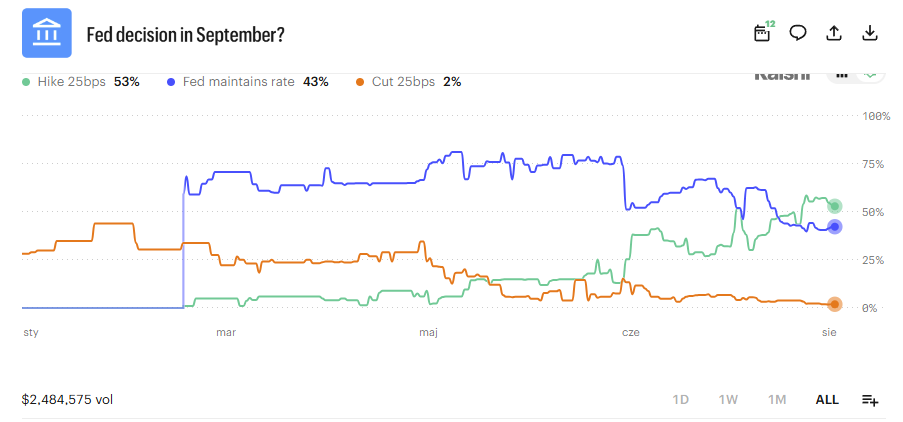
Markets price roughly 55% odds of a September Federal Reserve rate hike. At the same time, coordinated currency intervention and falling oil prices pull the index in the opposite direction.
Fed Hike Bets Collide With Yen Intervention
Fundamentals have turned dollar-friendly on the monetary policy side. July’s ISM Manufacturing Purchasing Managers Index (PMI) jumped to 55.6, its strongest reading since May 2022.
Three Federal Open Market Committee (FOMC) members also dissented in favor of a hike in July, when rates held at 3.50% to 3.75%. Prediction market Kalshi prices a 25-basis-point September hike at 53%, with CME FedWatch showing similar odds.

However, official pressure works against the dollar. The US and Japan confirmed coordinated yen intervention after USD/JPY weakened to 40-year lows near 164.
Falling energy prices add to the bearish side. Oil dropped around 5% on Monday after Washington and Tehran agreed to restart talks, easing inflation pressure.
Dollar direction also matters beyond forex. A firmer greenback has repeatedly pressured gold and Bitcoin (BTC) in 2026.
US Dollar Index Weekly Chart Shows the Rally Stalling Below 102
The weekly chart frames the move within a wide macro range. DXY topped at 110.176 in January 2025 and bottomed at 95.551 on January 27, 2026.
The recovery from that low stalled in July near 101.50. That area holds the 0.382 Fibonacci retracement at 101.14, just below the May 2025 swing high at 101.977.

Last week, sellers pushed the index back below the 100.30 to 100.60 resistance zone. The drop ended at an ascending trendline that connects to the January low.
Meanwhile, the weekly Relative Strength Index (RSI) sits near 50. The reading offers neither bulls nor bears a clear momentum edge.
Level
Significance
101.98
May 2025 swing high, main upside target
101.14
0.382 Fibonacci retracement
100.30 to 100.60
Resistance zone that needs to flip into support
99.49
Trendline and June swing low confluence
99.00
0.236 Fibonacci retracement
DXY Price Prediction Rests on the 99.49 Support Confluence
The daily chart strengthens the bullish structure argument. An ascending trendline from the February low has now held twice, on May 6 and again on August 3.
The latest bounce also coincided with the June 17 swing low at 99.491. That confluence makes 99.49 the most important support on the chart.
Momentum tells a different story. Daily RSI reads 38, below the neutral zone but not yet oversold. The reading suggests sellers still control short-term momentum despite the intact trend.

A daily close above 100.60 could open the path to 101.14 and then 101.977, roughly 2% above the current price. In contrast, losing 99.49 would expose the 0.236 Fibonacci level at 99.008, about 1% lower.
The calendar could decide the fight. ISM Services PMI lands on Wednesday, and the July jobs report follows on Friday, August 7. The Fed’s data-dependent stance adds weight to each release after last week’s GDP and PCE inflation data.
Until either side wins the battle for 100, DXY remains trapped between hawkish Fed pricing and official selling pressure.
The post Dollar Index Trapped at 100 as Hawkish Fed Meets Official Selling appeared first on BeInCrypto.
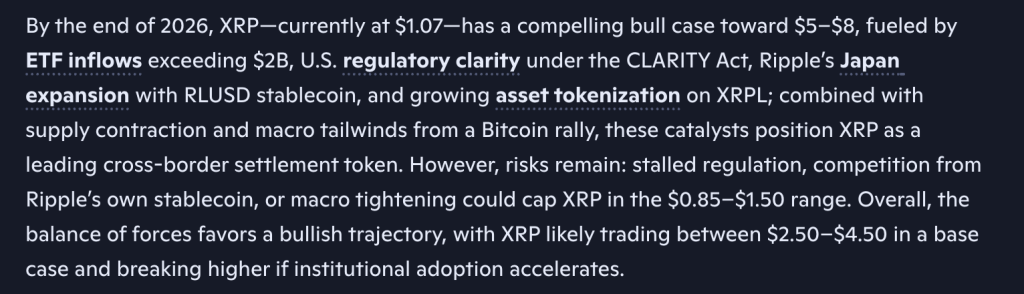
Microsoft Copilot AI predicts a serious breakout for XRP, and this price prediction puts a real number behind it. By the end of 2026, XRP at $1.07 has a compelling bull case toward $5 to $8, which works out to somewhere between five and eight times the current price.
The bull case rests on four pillars landing together. ETF inflows have already exceeded $2 billion. US regulatory clarity is arriving through the CLARITY Act. Ripple’s Japan expansion is bringing the RLUSD stablecoin into a new major market. Asset tokenization on the XRP Ledger keeps expanding.

Copilot combines those with supply contraction and macro tailwinds from a Bitcoin rally. Together they position XRP as a leading cross border settlement token if the pieces actually converge.
The bear case is direct about what breaks that thesis. Stalled regulation, competition from Ripple’s own stablecoin, or macro tightening could cap XRP in the $0.85 to $1.50 range instead.
Copilot still calls the bullish trajectory the more likely path overall, with XRP trading between $2.50 and $4.50 in a base case and breaking higher if institutional adoption accelerates.

XRP Price Prediction: XRP Is Trapped In The Exact Range This Copilot AI Predicts Calls The Bear Case
XRP peaked above $2.40 in January before a violent February collapse cut price nearly in half within weeks. That crash set the tone for the entire year, and every rally since has been smaller than the one before it.
The pattern is a clean staircase of lower highs. April topped near $1.65, May topped near $1.55, and by July the best XRP could manage was $1.35 before rolling over again.
Price closed today at $1.07051, down 0.41%, in a session ranging between $1.06900 and $1.08092. That places XRP almost exactly at the midpoint of the $0.85 to $1.50 zone Copilot itself flags as the bear case outcome.
Support sits at $1.00, a round number XRP has tested twice since June without breaking. Resistance stacks first at $1.20, then $1.40, then the heavier ceiling near $1.60 where three separate spring rallies all failed.
RSI currently reads near 47 with the signal line close behind at 49. That small negative gap points to momentum that has flattened out rather than building in either direction, consistent with a chart going nowhere.
Overall momentum is neutral bordering on soft, with price grinding sideways rather than showing any real conviction. For Copilot’s bull case toward $5 to $8 to even begin taking shape, XRP first needs to reclaim $1.20, a level it has not closed above in two months.
You Were Right About XRP. It Just Didn’t Pay.
Every trader has had the same experience. You read the analysis, you form a view, the market proves you correct, and it makes you nothing.
The problem isn’t the call. It’s the instrument. When you buy spot to express a view about one thing, you take on exposure to everything: liquidity, sentiment, unrelated flows, whatever happens in an unrelated market at 3am.
Your opinion was about a single question. Your position is exposed to all of them at once.
That’s what Kalshi is. A CFTC-regulated exchange where the prices are set by traders taking real positions, which is why the odds tend to move before the headlines do.
It isn’t free money. A contract that resolves against you goes to zero, and being directionally right on a slow timeline still loses if the contract expires first. Event trading pays for precision about timing, not just direction.
But the analysis above was free. What you do with it doesn’t have to be.
→ Get up to $25 to trade your first market on Kalshi
Don’t Miss Out on Our $1,000 USDT Airdrop on ByBit
The post Microsoft Copilot AI Predicts the Price of XRP by The End of 2026 appeared first on Cryptonews.


CNBC host Jim Cramer says he intends to sell his Bitcoin (BTC) after IBM’s chief executive warned that quantum computers could eventually break the cryptography protecting it.
He has not confirmed a completed sale, disclosed a position size, or published a wallet address. Traders responded by treating the call as a reason to buy.
Why Jim Cramer Says He Is Selling Bitcoin
Cramer asked Arvind Krishna on July 30 whether quantum machines could crack the math securing crypto holdings. The IBM chief answered with a rough clock.
“I think that you should give yourself three or four years, and at that point, I would get rather paranoid about it,” Arvind Krishna, IBM chief executive.
Krishna told the same segment that quantum should move IBM’s earnings by 2028 or 2029. That forecast anchors IBM’s commercial quantum timeline.
Four days later, Cramer gave his answer on air.
“I am going to sell my Bitcoin,” Jim Cramer, CNBC host.
Nothing since then confirms he acted on it. Cramer has never published a Bitcoin address, and no filing or exchange record establishes the size of the position, so the sale remains a stated intention.
The Inverse Cramer Trade Has Already Been Tested
Traders greeted the announcement as a contrarian signal. That reflex has a real-money track record, and it is weaker than the meme suggests.
Tuttle Capital listed an Inverse Cramer Tracker ETF on March 1, 2023, with a long version beside it. The long fund closed that September. The short fund traded for the last time on Feb. 13, 2024.
Across that run the inverse fund lost 15.7% while the S&P 500 gained 25.4%. Portfolio manager Matthew Tuttle said the fund existed to expose the danger of following television stock pickers.
Academic work reaches a similar verdict. A 2012 Management Science study of 826 first-time buy calls found they pop 2.4% overnight, then fully reverse within roughly 12 trading days.
Buying after the show produced about 10% negative annualized alpha over the following 50 days. The edge lives in fading an overnight retail pop, not in inverting his opinion.
His crypto record is what keeps the joke alive. Cramer dismissed the asset class on December 23, 2022, when Bitcoin closed at $16,796.
The Gap Between 70 Qubits and Bitcoin’s Keys
The research behind the warning is genuine, though it does not show what Cramer implied. On July 30, IBM and University of Chicago scientists ran a 70 logical qubit circuit in about 16 minutes.
What they proved was a statistical floor on how faithfully the hardware executed, not the correctness of an answer. The circuit spent 468 T gates, the costly operations that make such work hard to simulate.
Stealing coins demands a far larger machine. Google Quantum AI researchers, working with Stanford and the Ethereum Foundation, estimated in March that breaking secp256k1, the curve securing Bitcoin keys, needs 1,200 to 1,450 logical qubits and 70 million to 90 million Toffoli gates.
That is roughly 20 times the qubits IBM just ran and five orders of magnitude more of the expensive gates. Their own number was already a 20-fold improvement on prior estimates, which is why forecasts of when quantum breaks Bitcoin keep moving.
The exposure becomes real the moment such hardware exists. BIP-361, a draft proposal from Jameson Lopp and five co-authors, records that more than 34% of all bitcoin had revealed a public key on-chain by March 1, 2026.
Standards bodies are not working to Cramer’s clock either. Draft NIST guidance would disallow 128-bit curves like Bitcoin’s after 2035, and Hong Kong set its banks a 2030 quantum deadline that Bitcoin has no authority to match.
Cramer identified a vulnerability the literature takes seriously and attached a date no published resource estimate supports. Whether he sells at all is the one part of the trade nobody can verify.
The post Jim Cramer To Sell Bitcoin After IBM Quantum Warning: Will Traders Fade Him? appeared first on BeInCrypto.
Alongside the US stock market, bitcoin’s price is on the move on Tuesday, jumping to $64,000 for the third time in the past day or so. The question now is whether it will have more success this time.
The S&P 500 just hit a new all-time high as US President Donald Trump continues to claim that his country will reach a deal with Iran, after giving the latter until tomorrow to fold. Markets are currently riding high on the hopes of a more sustainable deal and a major de-escalation.
Crypto analysts speculate that the rising US stock indices could propel a more profound BTC rally. For now, though, the $64,000 resistance has proven too strong for the asset.
CryptoQuant’s Crypto Dan noted earlier today that the cryptocurrency remains in a “very undervalued zone.” The analyst added that BTC has seemingly reached a “position similar to its historical bottoms of the past.”
Although he admitted that there’s no absolute certainty bitcoin won’t go even lower, the indicator “shows that market participants are as uninterested in the crypto market as they were during previous bottoms.”
This is seen from the lack of new capital entering the market, the dwindling trading volumes, and the low searches and social media engagement.
“Looking ahead to the next bull cycle — expected to begin around 2027 — there’s little doubt that the current range represents an undervalued zone,” Crypto Dan concluded.

The post Bitcoin Hits $64K, Yet One Indicator Says It’s Still Very Undervalued appeared first on CryptoPotato.

She Blames MAGA For Her Debt | Financial Audit

Consett getting first first padel venue ‘before you know it’
Mattel Q2 2026 slides: revenue beats as margin pressure weighs


-

 Business6 days ago
Why Trees Belong on the Risk Register
-

 Fashion4 days ago
Weekend Open Thread: Wit & Wisdom
-

 Politics4 days ago
Meta enters AI-training agreement with far-right ‘propaganda rag’ Newsmax
-

 Politics6 days ago
Reform UK betrays West Mids residents by running from party pledges
-

 Crypto World3 days ago
MicroStrategy Post-Earnings CLARITY Act Push Could Add New Catalyst for Its Stock
-

 Business7 days ago
Major shareholder moves on Canyon
-

 Politics2 days ago
Zack Polanski: an incitement to murder Nigel Farage?
-

 Crypto World4 days ago
XRP Ledger v3.3.0 brings five institutional features
-

 News Videos6 days ago
Bitcoin Enters the 3rd Stage of the Bear Market
-

 Politics5 days ago
Luke Littler’s dominance sparks GOAT debate
-

 Sports5 days ago
Seema Kaliramna Wins Discus Throw Bronze, Takes India’s CWG Medals Tally To 17
-

 Crypto World4 days ago
New York sues Kalshi over prediction market gambling
-

 Crypto World3 days ago
Crypto PAC spending tops $2M in Michigan House race
-

 Business4 days ago
Trump Announces Hamas Disarmament Agreement as Iran Strikes Kuwait Air Base and US Attacks Pause Overnight
-

 Tech6 days ago
Gemini can now summarize the messiest comment threads in Google Docs
-

 Tech3 days ago
ESET tracks rise in malicious AI skills and adaptable malware
-

 Business2 days ago
DTCR: Deleveraging And A Hedge Fund Collapse Point To A Possible AI Bottom
-

 NewsBeat6 days ago
Four people die trying to cross Channel in small boats
-
 Tech5 days ago
Gemini Spark can now use Chrome logins and saved passwords to run errands on your behalf
-

 Sports6 days ago
Sakshi, Arundhati Enter Boxing Semi-Finals. India Assured Of 18 Medals At CWG 2026
You must be logged in to post a comment Login