
Crypto World
The Morning Light Habit Sleep Experts Swear By



You’ve probably heard that getting some morning light can help you feel more awake during the day and sleep better at night—from your doctor, your sleep app, and roughly 900 podcasts. But you might not realize just how much it matters. “Morning light is arguably more important than your coffee,” says Mariana Figueiro, director of the Light and Health Research Center at the Icahn School of Medicine at Mount Sinai.
Morning light shifts the body clock earlier, which can make it easier to feel sleepy at night and alert when it’s time to wake up. In a study of more than 400,000 adults, people who spent more time in outdoor light during the day reported fewer insomnia symptoms, less tiredness, and an easier time getting up in the morning.
What you may not have heard is exactly how to get it: where to position yourself, how early in the morning to start basking, and how long to take in the rays. Without that knowledge, the advice to “get more morning light” is surprisingly hard to put into practice.
Here’s what researchers say about how to get the right dose of morning light.
How morning light helps you wake up—and sleep at night
The amount of light reaching your eyes is measured in lux, and by that measure, most morning routines happen in near-darkness. A dimly lit bedroom might clock in at 30 to 40 lux. A brightly lit kitchen might reach 500. Step outside on an overcast morning, and you’re standing in 5,000 to 10,000. “You’re looking at orders of magnitude more light when you’re outside,” says Jamie Zeitzer, a circadian physiologist and professor of psychiatry and behavioral sciences at Stanford University.
Sitting directly beside a window and looking out might expose you to around 1,000 lux. That’s a fraction of what’s available outdoors, but, as Zeitzer puts it, “even by a window, it’s much brighter than what you’re going to get from most interior lighting sources.”
Light can have an immediate effect, too. It’s “an alerting stimulus to the brain,” Figueiro says, which can help you feel more awake in the moment.
Its longer term effect comes down to a small structure in the brain called the suprachiasmatic nucleus, which serves as the body’s central circadian clock. When light reaches the retina, it sends a signal directly to that clock—and early in the morning, the signal helps nudge it forward. It needs that nudge: The average human clock runs about 24 hours and 11 minutes, which means it would naturally drift a little later each day without light and other signals keeping it synchronized with the outside world.
A well-synced clock does more than govern sleep. Its real job, Zeitzer says, “is allowing your body to anticipate things as opposed to responding to them”—preparing you to wake up, eat, exercise, and wind down instead of scrambling to adjust after the fact. Without that anticipation, your body still functions, of course; just a little less efficiently. “It’s not like if you didn’t have a clock, you drop dead,” he says. “But it’s all less well optimized.”
Many people aren’t giving their clocks much natural light to work with. We tend to overestimate how much time we spend outside, Zeitzer says; for many of us, outdoor exposure amounts to little more than walking to and from the car.
How to get enough morning light
Try to get light within an hour of waking. “You want to have it as soon as you get up,” Figueiro says. What matters is how soon you get it after waking, not the particular time on the clock.
Going outside is best. But if you’re sitting near a window, position yourself close to the window and face it, rather than having it be beside or behind you. “You want to get it at the back of the eye, not at the back of the head,” Figueiro says. Light levels drop quickly as you move away from the glass: You might get around 1,000 lux right beside a window, compared with only a few hundred lux from several yards away. If you work from home, simply turning your desk toward the window can make a meaningful difference.
How long should you stay there? There’s no magic number, but both researchers agree that longer is better. Figueiro recommends at least 30 minutes and ideally an hour. Zeitzer considers 15 minutes a practical minimum. “Technically, with 5 minutes you can get a good effect, but that’s in a lab, and it’s probably not in the field,” he says.
If you want one simple target, aim for 30 minutes of morning light, Figueiro says. Sitting beside a window counts, but going for a half-hour walk after daybreak is even better. “That’s ideal,” she says. “You get your exercise, you get your light, you’re all set for the day.” And wear sunscreen as usual: It won’t blunt the circadian effect, which is driven by light reaching cells in the retina rather than the skin.
Try to get that light at roughly the same time every morning. “Your clock likes that regularity,” Figueiro says. She also leaves her sunglasses off during her morning commute when the light is comfortable, allowing her to take advantage of that exposure.
Give the habit some time to work. Your body clock will begin adjusting within a few days, Zeitzer says, but it might take a few weeks before you notice a difference in your sleep.
How to get morning light when the sun isn’t up
What if you wake up at 5 a.m., work in a windowless office, or look out at what Zeitzer describes as “a brick wall 15 feet across an alley”? You’ll need to create more light indoors.
The easiest place to start is with a brighter bulb. Bulb packages list brightness in lumens, a measure of how much light the bulb produces. A standard one typically produces about 800 to 1,000 lumens; Figueiro recommends looking for one that produces at least 3,000. Place the lamp no more than an arm’s length away, and make sure its shade is translucent, not opaque, so the light can reach your eyes. The bulb doesn’t need to give off cool or bluish light. If you prefer warm light, that’s fine, Figueiro says—the brightness is what matters most.
If a brighter lamp isn’t enough, or you don’t have access to a window, consider a light-therapy box. Zeitzer prefers natural light—“it’s much nicer looking out your window,” he says—but considers a light therapy box a reasonable alternative. Turn it on while you drink your coffee or eat breakfast so it becomes part of your usual routine.
And don’t assume an overcast morning is too dark to be useful. Most of us underestimate how much brighter it is outside: In one study, researchers found that even under cloudy or partly cloudy skies, outdoor light was dozens of times brighter than indoor light. If you can’t go out, sit close to the window and face it; turning on the room’s other lights can help, too.
Getting enough light in the morning is only part of the equation for better sleep. Figueiro also recommends dimming the lights about two hours before bedtime. Your body clock responds to the contrast between day and night, she says, so too much evening light can “in a way cancel out the benefits of the morning light.”
Think of the formula as brighter mornings and darker evenings. Tomorrow, you can start by turning your coffee—and yourself—toward the window.


Ripple’s cross-border token has plunged by 5% over the past month to the current $1.07.
This is just above the crucial $1.06 zone, which, according to some analysts, can trigger the next decisive breakout.
Bulls vs. Bears
Ali Martinez believes that “everything comes down to $1.06 for XRP.” In his view, holding the line could open the door to a rally to $1.35 and even $1.64, whereas losing it might result in a potential slump to as low as $0.62.
X user ChartNerd has also stressed the importance of that level. The analyst noted that XRP found support at $1.06, but claimed there is heavy resistance remaining above the $1.08-$1.23 range and “prior ascending support was lost.”
“$1.16 remains the main roadblock ahead of the EMAs. Downward pressure remains until otherwise,” they added.
Shortly after, ChartNerd touched upon XRP’s bearish outlook amid the challenging times. They suggested that the asset may sweep even below $1 in the near future and that “would not be utterly surprising” given the market structure. At the same time, the analyst described such a potential downtrend as “another golden ticket entry in disguise.”
“The next few months are setting the stage for the next market repricing. Maybe the biggest yet,” they added.
Additional Forecasts
EGRAG CRYPTO and JAVON MARKS also gave their two cents. The former opined that XRP has lost the 50 MA and is approaching the 100 EMA, a zone that has historically provided strong long-term support.
The analyst labeled a possible retrace to the $1-$0.95 range as a “healthy macro retest while holding the 100 EMA.” They set $0.80 as “maximum downside” if XRP tumbles to the lower boundary of the long-term channel, but said the targets of $15, $27, and $50+ don’t shrink and rise in time.
As of now, it’s hard to imagine an explosion to even $15 since it will require the token’s market capitalization to skyrocket to nearly $1 trillion. But then again, no one really knows what the future holds.
JAVON MARKS was also bullish, albeit presenting a far more modest prediction than EGRAG CRYPTO. They claimed that XRP has shown a clear breakout of a key resistance trend and the price can respond by jumping beyond $3.50.
The post XRP’s Most Important Level: The Battle for $1.06 Begins appeared first on CryptoPotato.

Most people still think crypto payments means buying coffee with bitcoin. The real shift is quieter and far larger: stablecoins now settle more value annually than many traditional payment networks, and a new category called PayFi is building programmable payment infrastructure on top of that volume. This guide explains what PayFi is, how the plumbing works, and why it matters that a dollar sent on Solana arrives in seconds for a fraction of a cent while the same dollar sent through SWIFT takes days and costs $25 to $50.
Summary
- PayFi, short for payment finance, is the application of decentralized finance protocols to real-world payments, combining stablecoin settlement with programmable logic like streaming payments, conditional escrow, and yield-funded spending.
- Stablecoins processed over $27 trillion in on-chain transfer volume in 2024, exceeding the combined volume of Visa and Mastercard, though the comparison requires qualification because stablecoin volume includes DeFi activity and treasury management alongside consumer payments.
- The core PayFi thesis rests on eliminating correspondent banking, the chain of intermediary banks that makes cross-border wire transfers slow and expensive, by replacing it with direct stablecoin settlement on public blockchains.
- Protocols like Huma Finance, Superfluid, and Sablier represent different approaches to PayFi: Huma finances real-world payment flows using on-chain capital, Superfluid enables continuous per-second payment streaming, and Sablier provides token vesting and payroll distribution.
- Regulatory frameworks are catching up. The EU’s MiCA regulation and proposed US stablecoin legislation would create licensing requirements for stablecoin issuers, which could either legitimize PayFi by providing regulatory clarity or constrain it by imposing compliance costs.
When Lily Liu, chair of the Solana Foundation, introduced the term PayFi at Token2049 in September 2024, she framed it around a specific concept: the time value of money. The idea is that if your stablecoins are earning yield in a DeFi protocol, you can spend the yield today without touching the principal. Buy a coffee with the interest your USDC earned overnight. Pay a subscription with the yield from your savings. The principal never moves, only the earnings do.
That framing captured attention, but PayFi has grown beyond the time-value-of-money concept. It now encompasses any payment infrastructure built on stablecoins and smart contracts, from cross-border payroll to trade finance to merchant point-of-sale settlement. The common thread is replacing slow, expensive, intermediary-heavy payment rails with programmable stablecoin flows.
Why wire transfers cost what they cost
To understand what PayFi replaces, it helps to understand what it replaces.
A domestic wire transfer in the United States costs between $25 and $30 and settles same-day through the Fedwire system. An international wire transfer costs between $30 and $50, takes one to five business days, and passes through a chain of correspondent banks that each take a fee.
The cost comes from the correspondent banking system. When you send dollars from a US bank to a recipient’s bank in the Philippines, your bank rarely has a direct relationship with the Philippine bank. Instead, the payment passes through one or more intermediary banks that maintain accounts with both institutions. Each intermediary charges a fee, performs compliance checks, and introduces processing time.
SWIFT, the messaging network that coordinates international transfers, does not actually move money. It sends instructions between banks. The actual settlement happens through correspondent accounts, which is why a SWIFT transfer can take days even though the message itself arrives in seconds.
The global remittance market, where migrant workers send money home, illustrates the cost most clearly. The World Bank reports that the global average cost of sending $200 is approximately 6.2 percent, or $12.40 in fees. For some corridors, particularly sub-Saharan African routes, the cost exceeds 8 percent. These fees fall disproportionately on people who can least afford them.
How stablecoin settlement works
A stablecoin transfer eliminates most of the intermediary chain. Sending USDC from one wallet to another on Solana costs less than one cent in transaction fees and settles in under two seconds, with price execution unaffected by slippage because stablecoins trade at a fixed peg. The sender does not need a bank account. The recipient does not need a bank account. No correspondent bank takes a cut.
The settlement is final in the blockchain sense: once the transaction is confirmed, the USDC is in the recipient’s wallet and cannot be reversed. This is different from a wire transfer, where settlement finality depends on the clearing system and can technically be reversed in certain dispute scenarios.
The infrastructure that makes this possible has three layers:
The stablecoin itself. USDC (issued by Circle) and USDT (issued by Tether) are the dominant payment stablecoins. Both maintain reserves denominated in US dollars and dollar-equivalent assets. Circle publishes monthly attestations of its reserves through an independent accounting firm. Tether publishes quarterly reserve reports. The trustworthiness of the stablecoin depends entirely on the issuer’s reserves and governance, not on the blockchain it runs on.
The blockchain network. Stablecoins exist on multiple chains. USDC runs on Ethereum, Solana, Base, Avalanche, Arbitrum, and several others. The choice of network affects transaction speed, cost, and the ecosystem of applications available. Solana and Base offer the lowest fees for payment-scale transactions, while Ethereum offers the deepest DeFi liquidity.
The on-ramp and off-ramp. Converting between fiat currency and stablecoins still requires a regulated financial intermediary: an exchange, a licensed money transmitter, or a banking partner. This is the bottleneck. The on-chain transfer is fast and cheap, but getting dollars into and out of the stablecoin system involves KYC checks, bank transfers, and processing delays that reintroduce some of the friction PayFi aims to remove.
What PayFi protocols actually build
PayFi is not a single protocol. It is a category of applications that use stablecoins and smart contracts to create payment infrastructure that would be difficult or impossible to build on traditional rails.
Trade finance and receivables. Huma Finance is the most prominent PayFi protocol by total value locked. Huma allows businesses to finance real-world payment flows using on-chain capital. A payment company that processes cross-border transactions can use Huma to access working capital backed by its receivables, receiving stablecoins today against payments it will collect in 30 or 60 days. The on-chain capital providers earn yield from the interest charged on these advances. This is traditional factoring, but the capital comes from a DeFi pool instead of a bank, and the settlement happens in stablecoins instead of through correspondent banking.
Streaming payments. Superfluid enables continuous, per-second payment flows. Instead of paying an employee $5,000 at the end of the month, an employer can stream $0.0019 per second continuously. The employee’s balance increases in real time and can be withdrawn at any moment. This model has applications beyond payroll: subscription payments, rental agreements, and service fees can all be structured as continuous flows instead of discrete monthly charges.
Token vesting and distribution. Sablier provides lockup and vesting schedules for token distributions. While not a payment protocol in the traditional sense, Sablier’s linear and dynamic vesting curves solve a real treasury management problem for crypto projects that need to distribute tokens to employees, investors, and community members over time.
Merchant acceptance. Several payment processors now allow merchants to accept stablecoin payments and receive settlement in their local fiat currency. The merchant never touches crypto. The customer pays in USDC or USDT, the processor converts to fiat, and the merchant receives dollars, euros, or pesos in their bank account. The conversion happens at the processor level, and the merchant’s accounting treats it as a normal card-like transaction.
Cross-border payroll. Companies with distributed international teams face a persistent problem: paying contractors in different countries through traditional banking is slow, expensive, and administratively complex. PayFi payroll solutions allow employers to fund a smart contract with stablecoins and distribute payments to contractors worldwide, who then convert to their local currency. The employer sends one transaction instead of initiating separate wire transfers to each country. Several platforms now offer this service with built-in tax reporting and compliance documentation for the jurisdictions they support.
The time value of money concept
The original PayFi thesis, as articulated by Lily Liu, centers on a specific application of yield-bearing stablecoins.
Here is the arithmetic. Suppose a user holds $10,000 in USDC deposited into a lending protocol earning 5 percent annual yield. That position generates approximately $1.37 per day in interest. Instead of waiting for the interest to compound, a PayFi application could allow the user to spend today against the yield that will accrue tomorrow. The principal remains untouched and continues earning.
In practice, this requires a protocol that can advance the expected yield, absorb the risk that the yield rate changes or the lending protocol fails, and settle the payment in real time. The user experiences something like a credit card with no interest charges and no principal drawdown, funded entirely by the return on their deposited assets.
This model works as long as three conditions hold: the yield remains positive, the stablecoin maintains its peg, and the lending protocol remains solvent. If any of these conditions fail, the payment stream breaks. The user is not spending “free money.” They are spending returns on capital that carries smart contract risk, rate risk, and peg risk.
The arithmetic: stablecoin transfer versus wire transfer
The cost advantage of stablecoin settlement becomes concrete when you compare a specific payment scenario across both rails.
Consider a small business in the United States paying a supplier in Vietnam $5,000 per month.
Through traditional banking, the wire transfer costs $45 per transaction in bank fees. The intermediary correspondent bank charges an additional $15 to $25. The foreign exchange conversion at the receiving end costs 1 to 2 percent of the transfer amount, adding $50 to $100. Total cost per transfer: approximately $110 to $170. The payment takes two to four business days to arrive, and the supplier cannot access the funds until the receiving bank processes the credit.
Through stablecoin settlement, the sender converts $5,000 to USDC through an exchange or on-ramp provider, paying a conversion fee of 0.1 to 0.5 percent ($5 to $25). The on-chain transfer costs less than $0.01 on Solana and settles in seconds. The recipient converts USDC to Vietnamese dong through a local exchange or off-ramp, paying another 0.5 to 1 percent ($25 to $50). Total cost: approximately $30 to $75. The payment arrives in minutes, and the recipient can convert to local currency the same day.
The savings increase with volume. A company making 50 cross-border payments per month saves between $2,000 and $5,000 monthly by switching from wire transfers to stablecoin settlement. Annualized, that is $24,000 to $60,000 in direct cost savings, plus the working capital benefit of receiving funds days earlier.
The comparison has important limits. Stablecoin settlement requires both parties to have access to crypto exchanges or regulated on-ramp and off-ramp services. The regulatory status of those services varies by country. And the conversion fees at both ends can fluctuate based on local market liquidity and competition among providers.
Where user experience still breaks down
The on-chain transfer is the easy part. The friction points that prevent PayFi from mainstream adoption sit on either side of it.
On-ramp complexity. Converting fiat to stablecoins requires identity verification through a regulated exchange or money service business. In developed markets, this typically takes one to three business days and requires a bank account, government-issued ID, and sometimes proof of address. In emerging markets, regulated on-ramps may not exist, or existing services may exclude users without bank accounts — exactly the population PayFi aims to serve.
Self-custody burden. A payment recipient who holds stablecoins in a self-custodied wallet is responsible for securing their private key. Losing the key means losing the funds permanently. This is not a problem that improved blockchain infrastructure can solve. It is a fundamental tension between the censorship-resistance of self-custody and the safety nets that traditional banking provides through account recovery and fraud protection.
Regulatory fragmentation. The legal status of stablecoin payments varies dramatically by country. Some jurisdictions treat stablecoin transfers as currency transactions subject to money transmission licensing. Others treat them as securities transactions. A cross-border payment that is legal on both ends may pass through regulatory grey zones in the countries whose financial systems it touches.
Volatility in local currency terms. A recipient in a country with a depreciating currency faces a conversion decision every time they receive a stablecoin payment. Holding USDC while the local currency weakens is effectively a gain. But converting too slowly during a period of local currency strengthening creates a loss. This timing risk does not exist in traditional wire transfers, where the funds arrive in local currency.
What this does not cover
This guide covers the mechanics of PayFi, stablecoin settlement, and the economics of cross-border payments. It does not cover:
- Central bank digital currencies, which use different infrastructure and are issued by governments instead of private companies. CBDCs and stablecoins solve similar problems but through fundamentally different governance structures.
- Crypto debit cards, which convert stablecoins to fiat at point of sale. These are consumer products built on PayFi infrastructure, not the infrastructure itself.
- The legal and tax treatment of stablecoin payments, which varies by jurisdiction and is subject to ongoing regulatory development in most major markets.
- Algorithmic stablecoins, which maintain their peg through protocol mechanics instead of fiat reserves. These carry fundamentally different risk profiles and are not currently used in serious PayFi applications after the failure of TerraUSD in 2022.
Practical checks before using a PayFi protocol
Before using a PayFi application for real money, verify these points:
Check the stablecoin’s reserve attestation. USDC publishes monthly third-party attestations through Grant Thornton. USDT publishes quarterly reserve reports. If a PayFi application uses a stablecoin with no published reserves or unaudited reserves, the peg stability is not verifiable.
Verify the smart contract audit status. PayFi protocols that hold user funds should have audits from reputable firms, not just informal reviews. Check whether the audit was completed for the current contract version, since protocol upgrades can introduce new vulnerabilities that invalidate prior audits.
Understand the off-ramp path. Know exactly how your recipient will convert the stablecoin to local currency before sending. A PayFi payment that arrives instantly but takes five days to convert because local off-ramps are slow or expensive has not improved on a wire transfer.
Check transaction finality on the chosen network. Different blockchains have different finality characteristics. A transaction confirmed on Solana is effectively irreversible after one to two seconds. Ethereum transactions achieve probabilistic finality after a few minutes. Some bridges and payment processors wait for multiple block confirmations before releasing funds. Know the actual settlement time end-to-end, not just the on-chain confirmation time.
Confirm regulatory status in both countries. For cross-border payments, check whether the stablecoin transfer is legal in both the sending and receiving jurisdiction. This is particularly important for corridors involving countries with capital controls or cryptocurrency restrictions.
What to watch
US stablecoin legislation. The GENIUS Act and STABLE Act are advancing through Congress. If passed, they would create a licensing framework for stablecoin issuers, require reserve backing and redemption rights, and potentially restrict who can issue dollar-pegged stablecoins. The outcome would significantly affect which stablecoins dominate PayFi applications and what compliance costs those applications face.
Visa and Mastercard stablecoin integration. Both networks have announced or piloted programs to settle transactions in USDC. If traditional card networks complete their stablecoin integration, PayFi infrastructure may merge with existing merchant payment flows rather than competing with them.
Circle’s IPO and public disclosures. Circle, the issuer of USDC, filed for a US IPO. Public company status will require more detailed reserve disclosures and subject Circle to securities regulation, providing more transparency into the largest payment stablecoin’s backing.
Banking licenses for stablecoin issuers. Several stablecoin issuers are pursuing banking charters or bank partnerships that would allow them to hold reserves directly at the Federal Reserve. This would remove the counterparty risk of reserves held at commercial banks, as happened during the SVB crisis when USDC briefly depegged because $3.3 billion of its reserves were trapped at the failed bank.
Off-ramp infrastructure in emerging markets. The practical utility of PayFi in the remittance corridors where it matters most depends on competitive off-ramp services in markets like the Philippines, Nigeria, Mexico, and India. Watch for new entrants and regulatory approvals that expand the availability of local currency conversion.
What is PayFi?
PayFi, short for payment finance, is the application of decentralized finance protocols to real-world payment infrastructure. It combines stablecoin settlement with programmable smart contract logic to create payment systems that are faster and cheaper than traditional wire transfers. Examples include streaming payroll, cross-border stablecoin remittances, and yield-funded spending.
How are stablecoins different from regular cryptocurrencies for payments?
Stablecoins are pegged to a reference asset, typically the US dollar, which means their value does not fluctuate the way Bitcoin or Ethereum does. This makes them practical for payments, since both sender and recipient know the dollar value of the transaction at the time it executes. Regular cryptocurrencies expose both parties to price risk between the time of sending and the time of converting to fiat.
Why are wire transfers slow and expensive?
Wire transfers are slow and expensive because they pass through correspondent banking chains. Your bank rarely has a direct relationship with the recipient’s bank in another country, so the payment routes through one or more intermediary banks that each charge fees and introduce processing delays. SWIFT, the messaging system that coordinates international transfers, sends instructions but does not move money, which is why a SWIFT message arrives in seconds but the funds take days.
What is the time value of money concept in PayFi?
The time value of money in PayFi refers to using the yield earned on deposited stablecoins to fund spending, leaving the principal untouched. For example, $10,000 in USDC earning 5% annual yield generates roughly $1.37 per day. A PayFi application could allow spending against tomorrow’s yield today, so the user pays for expenses without drawing down their savings. The principal continues compounding while the yield stream funds consumption.
Is USDC backed by real dollars?
USDC is backed by US dollar-denominated assets held in reserve, including cash and short-term US Treasury securities. Circle, the issuer, publishes monthly reserve attestations through an independent accounting firm. The reserve backing means each USDC token is redeemable for one US dollar through Circle’s redemption system, subject to the reserves remaining intact and Circle remaining solvent.
What happened to USDC during the SVB crisis?
In March 2023, Silicon Valley Bank collapsed while holding approximately $3.3 billion in USDC reserves. Circle disclosed the exposure on a Friday, and USDC briefly fell to $0.87 before recovering after US regulators announced they would guarantee SVB depositors. The episode illustrated that stablecoin reserves held at commercial banks carry counterparty risk, and that even well-reserved stablecoins can depeg temporarily during banking crises.
What is Huma Finance?
Huma Finance is a PayFi protocol that allows businesses to finance real-world payment flows using on-chain capital. Payment companies and fintechs that process cross-border transactions can access working capital backed by their receivables, receiving stablecoins today against payments they will collect in 30 to 60 days. Capital providers in Huma’s lending pools earn yield from the interest charged on these advances.
Can stablecoin payments replace bank accounts for unbanked populations?
Stablecoin wallets can provide store-of-value and payment functions without a traditional bank account. However, converting between stablecoins and local cash still typically requires a licensed exchange, mobile money service, or agent network. The final-mile cash access problem limits PayFi’s ability to fully replace banking in markets where digital financial infrastructure is underdeveloped.
This article is for informational purposes only and does not constitute financial, investment, or legal advice. Stablecoin and DeFi protocols carry smart contract risk, reserve risk, and regulatory risk. Always conduct your own research before making any financial decision. Information current as of August 4, 2026.


Every time you buy or sell a token on an exchange and the order fills instantly, a market maker is on the other side. These firms are not charities. They profit from the spread, negotiate listing deals worth millions, and hold enough inventory to move prices. This guide explains who they are, how they operate, and what their presence means for the tokens you trade.
Summary
- Market makers are firms that continuously place buy and sell orders on an exchange, providing liquidity so that other traders can execute without waiting for a natural counterparty.
- The largest crypto market makers, including Wintermute, Jump Crypto, GSR, and DWF Labs, collectively handle billions of dollars in daily volume across centralized and decentralized venues.
- Market makers profit primarily from the bid-ask spread, the small gap between the price at which they buy and the price at which they sell, compounded across thousands of trades per second.
- Token projects routinely pay market makers between $50,000 and $2 million to provide liquidity at launch, and these agreements often include token loan arrangements that give market makers significant influence over a token’s price trajectory.
- The same firms that provide essential liquidity also operate in a largely unregulated environment where the line between market making and market manipulation remains undefined.
When a retail trader places a market order on Binance or Coinbase, the order typically fills in under a second. That speed creates an illusion of seamless supply and demand. In reality, a specialized firm placed the limit order that absorbed the trade, pocketed a fraction of a cent in profit, and immediately replaced the order to do it again. Without these firms, order books would be thin, slippage would be severe, and most tokens would be effectively untradable during all but the busiest hours.
What market makers actually do
A market maker continuously quotes both a buy price (the bid) and a sell price (the ask) for a given token on an exchange. The difference between these two prices is the spread. On a liquid pair like BTC/USDT on a major exchange, the spread might be one or two basis points. On a smaller altcoin, it could be 50 basis points or more.
The market maker profits by buying at the bid and selling at the ask, capturing the spread on each completed round trip. This sounds simple, but the execution requires sophisticated infrastructure.
A single market making firm might maintain active orders on 30 or more exchanges simultaneously, quoting hundreds of trading pairs. Each pair requires real-time price feeds, inventory management across venues, and risk models that account for sudden volatility. The firms co-locate their servers as close to exchange matching engines as possible, because a latency advantage of even a few milliseconds can mean the difference between capturing a spread and being adversely selected by a faster trader.
The core challenge is inventory risk. A market maker that buys 1,000 ETH at $3,200 needs to sell that ETH before the price drops. If the market moves against the position before the offsetting sell executes, the spread profit evaporates. Managing this risk across hundreds of pairs and dozens of venues simultaneously is what separates professional market makers from simple limit order placement.
This is why market makers widen their spreads during periods of high volatility. When a significant news event hits and prices swing rapidly, the probability of being adversely selected, meaning a market maker fills one side of a trade just before the price moves against it, increases dramatically. The wider spread compensates for this additional risk. Retail traders often notice that slippage worsens during volatile periods and blame exchange infrastructure. In many cases, the real cause is that market makers have pulled back their quotes or widened their spreads to protect themselves, temporarily reducing the available liquidity.
The major firms and how they differ
The crypto market making landscape is dominated by a handful of firms, each with a distinct operating model.
Wintermute is the largest independent crypto market maker by reported volume. Founded in 2017, the firm operates across centralized exchanges, decentralized exchanges, and over-the-counter desks. Wintermute quotes on most major venues and has provided launch liquidity for hundreds of token projects. The firm lost roughly $160 million in a DeFi exploit in September 2022 when a compromised hot wallet was drained, but continued operations without interruption.
Jump Crypto is the crypto arm of Jump Trading, a Chicago-based high-frequency trading firm that has operated in traditional markets since 1999. Jump brings institutional-grade infrastructure and decades of quantitative trading expertise. The firm has faced regulatory scrutiny over its role in the Terra/LUNA collapse, with the SEC alleging Jump earned hundreds of millions of dollars helping stabilize UST before its failure.
GSR is a London-headquartered firm focused on providing structured liquidity to token issuers. GSR’s model emphasizes longer-term market making agreements with projects, handling token treasury management for several major protocols.
DWF Labs occupies a controversial position. The firm describes itself as a market maker and Web3 investment company, but its approach has drawn criticism. DWF Labs frequently takes large token allocations as part of investment-plus-market-making deals, then trades those tokens across exchanges. Critics argue this blurs the line between providing liquidity and trading for directional profit using insider access to project treasuries. The firm has denied these characterizations, stating that its investment and trading operations are separate.
How token listing deals work
When a new token launches on a major exchange, the project team almost always has a market making agreement in place. These agreements are the financial plumbing that most token buyers never see.
A typical deal structure has three components:
Retainer fee. The market maker charges a monthly fee, typically between $15,000 and $50,000, to maintain active quotes on specified trading pairs. Higher-tier exchanges and more trading pairs mean higher retainers.
Token loan. The project lends the market maker a large allocation of tokens, often worth $1 million to $5 million at launch price. The market maker uses these tokens to place sell orders on the order book, creating the appearance of liquid supply. At the end of the agreement (usually 12 to 24 months), the market maker returns the tokens or their equivalent value, depending on the contract terms.
Performance incentives. Some agreements include call options that let the market maker buy tokens at a predetermined strike price. If the token appreciates significantly, the market maker profits from exercising these options. This structure aligns the market maker’s incentives with the project’s success, but it also gives the market maker a financial interest in short-term price appreciation that may not align with long-term holder interests.
The token loan is the most consequential element. A market maker holding $3 million worth of borrowed tokens has no obligation to support the price. If the agreement is structured as a loan with a return obligation denominated in tokens (not dollars), the market maker can sell the tokens, push the price down, buy them back cheaper, and return the required number at a profit. Whether this constitutes market manipulation or legitimate inventory management depends on intent, and no crypto regulator currently has the tools to distinguish between them at scale.
Market making on decentralized exchanges
On centralized exchanges, market makers place traditional limit orders on order books. On decentralized exchanges, the mechanics are different.
Automated market makers like Uniswap use liquidity pools rather than order books. Anyone can provide liquidity by depositing token pairs into a pool, and the pool’s smart contract prices trades algorithmically. Professional market makers participate in these pools, but the dynamics differ from centralized venue market making.
On Solana DEXs and concentrated liquidity protocols like Uniswap V3, market makers can specify narrow price ranges for their liquidity. This concentrates their capital around the current price, improving capital efficiency but requiring constant rebalancing as the price moves. The rebalancing itself creates on-chain transactions that are visible to anyone watching, including MEV searchers who can front-run the market maker’s own repositioning.
The transparency of on-chain market making is a double-edged sword. Retail users can see exactly how much liquidity is available and where it is concentrated. But sophisticated actors can also observe when a market maker is withdrawing liquidity, which often signals an imminent price move.
The economics of spread capture at scale
Market making in crypto is a volume business. The spread on a single trade might be $0.01 on a $100 trade. But multiply that by millions of trades per day, and the revenue is substantial.
Consider a simplified example. A market maker quotes BTC/USDT with a one-basis-point spread (0.01%) and handles $500 million in daily volume on that pair alone. The gross revenue from spread capture is $50,000 per day, or roughly $18 million per year, from a single pair on a single exchange. In practice, spreads vary, not every trade captures the full spread, and inventory losses offset some of the revenue. But the arithmetic illustrates why well-capitalized firms invest heavily in this business.
The exchange itself typically benefits from this arrangement as well. Exchanges offer market makers reduced trading fees, sometimes zero, through maker fee rebate programs. The exchange gains because the market maker’s presence attracts retail traders who pay the full taker fee. The market maker’s quoted liquidity makes the exchange’s order book look deep and competitive, which draws more volume, which generates more fee revenue for the exchange. This symbiotic relationship explains why exchanges court market makers aggressively and why losing a major market maker can trigger a decline in an exchange’s overall trading volume.
The largest crypto market makers reportedly generate hundreds of millions of dollars in annual revenue. This revenue comes from three sources in roughly equal proportion: spread capture on liquid pairs, fees and option income from token listing agreements, and proprietary trading profits from directional positions and arbitrage.
The firms that survive long-term are the ones that manage inventory risk most effectively. Several prominent crypto market makers have collapsed or exited the market after large directional bets went wrong. Alameda Research, the trading firm affiliated with FTX, was the most prominent example. Alameda functioned as a market maker but increasingly took concentrated directional positions using customer funds, a practice that ultimately contributed to the collapse of FTX in November 2022.
How market makers affect token prices
The relationship between market makers and token prices is more direct than most retail traders realize.
When a market maker receives a token loan of five million tokens and begins placing sell orders, those sell orders create visible supply on the order book. A retail trader looking at the order book sees what appears to be natural selling interest. In reality, the supply is synthetic. It exists because a project paid a firm to place it there.
This has two consequences. First, the visible supply suppresses the price by making it appear that sellers exist at every price level above the current market. Buyers who would otherwise bid aggressively see the sell wall and reduce their bids. Second, if the market maker’s agreement expires or the firm decides to withdraw, the sell orders disappear. The sudden removal of supply can cause rapid price increases, which may look like organic buying interest but are actually the absence of artificial selling pressure.
The reverse is equally important. Market makers who place large buy orders below the current price create the appearance of a price floor. Retail traders see the support and feel confident holding their position. If the market maker removes those buy orders, the floor vanishes, and the price can fall sharply with minimal actual selling.
This dynamic means that a token’s visible liquidity profile is often a reflection of its market making arrangement rather than a reflection of genuine supply and demand. When the arrangement changes, the liquidity profile changes with it, and holders who relied on the visible order book discover that the support they trusted was temporary.
What this does not cover
This guide explains the operational mechanics and business model of crypto market makers. It does not cover:
- Regulatory frameworks for market making, which vary by jurisdiction and are evolving. The EU’s MiCA regulation and proposed US frameworks may impose new obligations on crypto market makers.
- Algorithmic trading strategies beyond basic market making, including statistical arbitrage, basis trading, and cross-exchange arbitrage.
- Retail stablecoin liquidity provision on decentralized exchanges, which shares some mechanics with market making but operates at a different scale and risk profile.
- The internal risk management systems that market makers use to hedge their inventory exposure, including options, perpetual futures, and cross-asset hedging strategies that are proprietary to each firm.
Practical checks for token buyers
Understanding market making dynamics helps token buyers make better decisions.
Check the token’s market making agreements. Some projects disclose their market maker in official communications. If a project’s liquidity is provided by a single market maker, the project is vulnerable to that firm withdrawing support.
Watch bid-ask spread width. A tight spread on a low-volume token is often artificial, maintained by a market maker as part of a paid agreement. If the agreement ends or the market maker exits, the spread can widen dramatically overnight, making it expensive or impossible to sell at a reasonable price.
Monitor order book depth. Visible depth on an exchange order book can be misleading. Market makers frequently place large orders close to the current price to create the appearance of support, then cancel those orders before they can be filled. This practice, known as spoofing, is illegal in traditional markets but rarely enforced in crypto.
Check for sudden liquidity changes. A token that suddenly loses 50% or more of its order book depth may be experiencing a market maker withdrawal. This is often a leading indicator of negative news or a failing project.
Understand the token unlock schedule. When market makers hold token loan agreements, the return or sale of those tokens at the end of the agreement period creates selling pressure. Check whether upcoming unlocks coincide with the end of known market making contracts.
Compare volume across exchanges. If a token’s trading volume is concentrated on a single exchange, the liquidity may depend on a single market making agreement with that venue. Tokens with volume distributed across multiple exchanges are less vulnerable to a single market maker exiting.
What to watch
Regulatory enforcement against market makers. The SEC’s case against Jump Crypto over its role in the UST collapse could set precedent for how crypto market making is regulated. Similar actions against other firms would reshape the industry’s operating model.
Consolidation in the market making sector. As regulatory costs rise and smaller firms exit, the remaining firms gain more pricing power over token projects. This concentration may increase the cost of listing and reduce competition for spread capture.
On-chain market making growth. As decentralized exchanges mature and attract more institutional volume, the balance between on-chain and off-chain market making is shifting. Protocols that offer better capital efficiency for professional liquidity providers will attract market maker capital away from centralized venues.
Transparency initiatives. Several token projects have begun publishing their market making agreements publicly. If this trend continues, token buyers will have better information about who provides liquidity and on what terms.
Market maker default risk. Market makers hold large inventories of volatile assets across dozens of venues. A sharp market crash can wipe out a firm’s capital reserves and force it to withdraw from all venues simultaneously, creating a cascading liquidity vacuum that amplifies the initial price decline across the entire market.
What is a crypto market maker?
A crypto market maker is a firm that continuously places buy and sell orders on exchanges, providing liquidity so that other traders can execute trades immediately. Market makers profit from the spread between their buy and sell prices, compounded across thousands or millions of trades per day.
How do market makers make money?
Market makers earn revenue from three primary sources: the bid-ask spread on each trade they complete, retainer fees and option income from token listing agreements with projects, and proprietary trading profits from directional positions and arbitrage across venues.
Why do token projects hire market makers?
Token projects hire market makers to ensure their token has sufficient liquidity on exchanges from the moment of listing. Without a market maker, a newly listed token would have a thin order book, wide spreads, and severe price impact on even small trades, discouraging buyers and making the token appear illiquid.
What is a token loan in a market making agreement?
A token loan is an arrangement where a project lends a large allocation of tokens to a market maker. The market maker uses these tokens to place sell orders on exchanges, creating visible supply on the order book. At the end of the agreement, the market maker returns the tokens or their cash equivalent, depending on contract terms.
Can market makers manipulate token prices?
Market makers have the inventory, exchange access, and information advantages to influence prices. Whether specific actions constitute manipulation depends on intent and jurisdiction. Practices like spoofing (placing orders intended to be canceled), wash trading (trading with yourself to inflate volume), and front-running client orders are generally prohibited but inconsistently enforced in crypto markets.
What happened with Alameda Research?
Alameda Research was a crypto trading and market making firm closely affiliated with the FTX exchange. Alameda used its market making operations and privileged access to FTX to take large directional bets, ultimately borrowing billions in customer funds. When these positions collapsed in November 2022, both Alameda and FTX went bankrupt, resulting in criminal convictions for key executives.
How can you tell if a token has good liquidity?
Check the bid-ask spread (tighter is better), the order book depth (more orders near the current price means more liquidity), and the daily trading volume relative to the token’s market capitalization. Be aware that all three metrics can be artificially inflated by market makers or wash trading, so cross-reference across multiple exchanges.
Do decentralized exchanges have market makers?
Yes. Professional market makers provide liquidity on decentralized exchanges by depositing tokens into liquidity pools or placing concentrated liquidity positions. The mechanics differ from centralized exchange market making, but the economic function is the same: providing liquidity in exchange for trading fee revenue and, in many cases, token incentive rewards from the protocol.
This article is for informational purposes only and does not constitute financial, investment, or legal advice. Crypto trading carries significant risk, including the potential for total loss of capital. Always conduct your own research before making any investment decision. Information current as of August 4, 2026.

Bitdeer, a publicly traded Bitcoin mining and infrastructure firm, has agreed to a 16-year data center lease that could be worth up to $4.7 billion, tying its next phase of growth to artificial intelligence (AI) and high-performance computing capacity. The deal highlights a broader shift in the crypto mining industry: companies built around energy and compute are increasingly positioning themselves as AI data center providers as demand for GPU-based workloads rises.
Under the agreement, Bitdeer will supply 121 megawatts (MW) of IT capacity at its Tydal, Norway AI data center. The facility is expected to be configured for Nvidia GPU-based AI workloads, though Bitdeer did not publicly identify the tenant beyond describing it as a subsidiary of Volta Infra.
Key takeaways
- Bitdeer signed a 16-year lease for up to $4.7 billion to secure AI/high-performance computing data center capacity.
- The agreement covers 121 MW of IT capacity at Bitdeer’s Tydal, Norway facility, configured for Nvidia GPU-based AI workloads.
- Volta Infra is linked to the tenant, and Bloomberg reported its $10 billion cloud contract is with Anthropic.
- The lease is subject to customary closing conditions and is not yet effective; letters of credit are expected to back tenant payments.
- Bitdeer also stands out for having fully liquidated its Bitcoin treasury to zero earlier this year, to fund expansion.
A long-term compute bet tied to AI workloads
Bitdeer’s announcement says it will provide 121 MW of IT capacity at its Tydal, Norway AI data center to a tenant described only as a subsidiary of Volta Infra. The company’s release specifies that the site will be configured to support Nvidia GPU-based AI workloads, but it stops short of clarifying whether Volta Infra is the ultimate end customer or acting as an intermediary.
For investors and operators, the significance is less about a single facility and more about the contract’s structure and longevity. A lease spanning 16 years aims to lock in a long runway for revenues tied to compute demand—an area where AI infrastructure providers are facing intense competition for energy, cooling, and GPU capacity.
Volta Infra and Anthropic in the background
While Bitdeer did not name the tenant, Bloomberg News reported that Nvidia-backed Volta’s $10 billion cloud contract is with Anthropic, citing people familiar with the matter. The disclosure adds context to the strategic logic of the lease: if Volta’s cloud commitments involve Anthropic’s AI workloads, then the compute capacity Bitdeer will supply becomes part of a wider chain serving major AI model developers.
Still, the details that matter for due diligence remain partly opaque. Bitdeer has not confirmed whether Anthropic is the end customer for the contracted capacity or whether the tenant arrangement includes additional layers. Traders and analysts will likely watch for further clarification when the deal clears closing conditions and when operational timelines come into focus.
Deal mechanics: closing conditions and payment security
Bitdeer said the lease agreement is subject to customary closing conditions and is not yet effective. To help secure the tenant’s payment obligations, affiliates of JP Morgan and another unnamed global financial institution are expected to issue approximately $1.3 billion in letters of credit (or bank guarantees). In practical terms, letters of credit reduce counterparty risk for the landlord by providing a way to recover funds if contractual payments are not met.
That risk-control detail matters because long-duration infrastructure contracts can carry operational and commercial uncertainty—ranging from construction or configuration delays to changes in customer demand. The use of substantial financial guarantees suggests both parties are attempting to ensure the agreement is durable through the transition from contract signing to delivery.
Bitdeer’s pivot beyond Bitcoin mining
This lease is the latest step in Bitdeer’s broader effort to diversify beyond its core Bitcoin mining business. Alongside AI and high-performance computing infrastructure, the company has also been expanding into mining hardware manufacturing to lessen reliance on third-party suppliers.
Last month, Bitdeer announced a $36 million investment in a manufacturing facility in Nevada as part of that strategy, reinforcing the theme that the company wants more control over the full compute supply chain—whether the end use is mining or AI acceleration.
Notably, the market response to the lease announcement appeared immediately. Bitdeer shares reportedly jumped about 8% in early Nasdaq trading following the announcement, indicating investors may be treating the AI infrastructure expansion as a meaningful rerating driver rather than a side project.
Why selling the Bitcoin treasury may be part of the same plan
Bitdeer’s approach to capital allocation also differs from many publicly traded miners. Earlier in the year, the company reduced its Bitcoin holdings to zero—reportedly after holding roughly 943 BTC in early February—while stating it remains committed to the Bitcoin ecosystem. According to Bitdeer executive Ross Gann, the sales were made to help fund the company’s broader expansion strategy, including acquisitions of powered land for AI and Bitcoin mining infrastructure.
In contrast, several other major Bitcoin miners continue to hold large Bitcoin treasuries. BitcoinTreasuries.NET data cited in the coverage indicates that MARA Holdings, Riot Platforms, CleanSpark, and Hut 8 each hold at least 10,000 BTC, with MARA holding more than 36,000 BTC.
The contrast underscores a strategic asymmetry among miners: some treat Bitcoin holdings as a balance-sheet bet on future upside, while Bitdeer has chosen to convert its treasury into liquidity to finance expansion. For readers tracking the sector, this raises a key question going forward—whether compute-driven revenue growth can offset the absence of treasury exposure, and how that trade-off influences risk profiles during different phases of the crypto and AI cycles.
As the lease moves toward effectiveness, the next items to watch are the completion of closing conditions, further clarity on the tenant and end-customer structure, and whether Bitdeer’s AI infrastructure buildout scales alongside its existing diversification efforts.
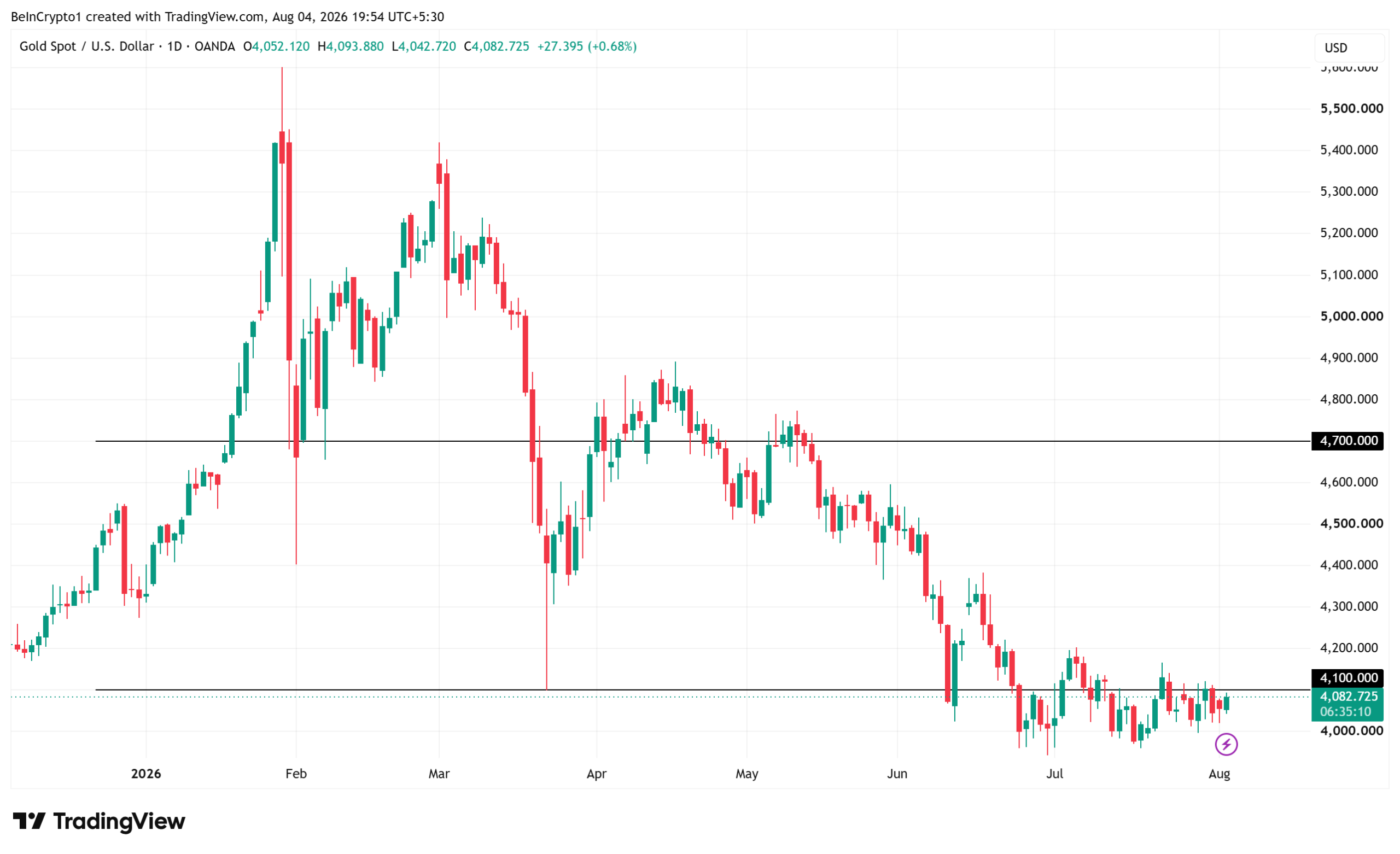
The Bank of Korea will buy physical gold again after 13 years. Central banks bought 289 tonnes in the second quarter, their strongest second quarter on record.
Gold traded near $4,086 an ounce on Tuesday, up 0.8%. It sits 27% below its January record. It is still up about 20% on the year.

Korea Gold Purchases Resume After 13 Years
Seoul stopped buying gold in 2013. It was mocked for the timing. The bank bought 90 tonnes between 2011 and 2013, at an average $1,629 an ounce. That came to about $4.7 billion, figures from Korea Economic Daily show.
Then gold fell apart. The price had peaked at $1,920.30 in September 2011. By June 2013 it hit $1,180.71, a drop of 38.5%. That year was gold’s worst since 1981.
At that low, Korea’s gold was worth 27.5% less than it paid. Lawmakers dragged in then-governor Kim Choong-soo. By 2015 the paper loss reached about 1.8 trillion won. Buying stopped.
Here is the twist. Those same 90 tonnes are now worth roughly $11.8 billion. That is $7 billion more than Korea paid.
So the bank is careful about how it explains itself. Jung Hee-sub, who runs its Reserve Management Group, denies any link to the recent price drop.
“We did not decide the timing of purchases by looking at a specific price… we decide whether to proceed at that time based on domestic and international gold prices and market conditions,” local media reported.
Follow us on X to get the latest news as it happens
The plan itself is tiny. Korea digs up 40 to 45 tonnes a year, mostly as a leftover from smelting copper and zinc. Only 4 to 5 tonnes get sold abroad. The bank will bid for that slice alone.
So its reserves stay near 104.4 tonnes, ranking Korea 39th. It also bought its first gold exchange-traded funds (ETFs) last quarter, as South Korea’s equity turmoil grips policymakers.
Central Bank Gold Buying Hit a Record 289 Tonnes
Korea is late to a crowded party. Central banks bought 288.9 tonnes in the second quarter, World Gold Council data show. That is 62% more than a year earlier.
Poland bought the most, at 51 tonnes. Its stockpile hit a record 632 tonnes. It wants 700.
Governor Adam Glapiński is blunt about how he does it.
“We’ve been consistently buying gold, taking advantage of the recent price drops.”
China added 33 tonnes, keeping up a long buying streak. Russia sold 22.
The rebound hides a slow start, though. Just 56.5 tonnes came in the first quarter. At 345 tonnes, the first half was the weakest since 2022.
They are not losing interest. A record 45% plan to buy more within a year, and demand held firm through the price slump.
Gold Is Quieter Than at Any Time Since August 2025
Bollinger Bands track how widely a price swings around its average. When they squeeze together, the market has gone quiet. Quiet markets rarely stay quiet.
Barchart figures show the tightest squeeze on the biggest gold ETF since August 2025. That date matters. Gold closed August 2025 near $3,443, then ran 62% to its January peak.
One example is not a pattern, however. A squeeze tells you a move is coming. It does not tell you which way.
So Will Gold Break Out?
The evidence leans up, but not back to January’s record. Deutsche Bank analysts Michael Hsueh and Bryant Xu say gold is worth about $4,700 by year end. JPMorgan’s lowered target still puts the fourth quarter at $4,500.
The World Gold Council will not pick a number. Its mid-year outlook sees gold within 5% of $4,100 for the rest of 2026, if nothing much changes.
Here is the catch. Central banks are better at putting a floor under gold than pushing it up. Record buying did not stop a 29% fall from January to June. They buy to a plan, and they buy dips, as Glapiński said.
A real rally needs ordinary investors and funds to come back.

So watch $3,959, the June low. Gold sits less than 3% above it. Break that, and the idea that central banks hold up the price falls apart.
The post Bank of Korea Just Bought Gold After 13 Years: Is a New Rally Coming? appeared first on BeInCrypto.
SpaceX has picked Nvidia to design the compute payload inside its Starmind AI1 satellites. Both stocks rose Tuesday. The news landed hours before SpaceX reported its first quarterly results as a public company.
Starmind is SpaceX’s plan to put data centers in orbit. Each satellite will carry Nvidia Rubin GPUs and Vera CPUs, the chipmaker’s newest generation. Nvidia calls the market space computing.
Follow us on X to get the latest news as it happens
SpaceX Taps Nvidia for Starmind AI
Nvidia launched its space computing line on March 16. It named six early partners that day. Aetherflux, Axiom Space, Kepler Communications, Planet Labs, Sophia Space and Starcloud all made the list.
SpaceX did not. That gap closed on Tuesday, and it closed with the biggest customer on the board.
In January, SpaceX asked the Federal Communications Commission (FCC) for up to one million orbital data center satellites. The application covers altitudes from 500 to 2,000 kilometers. SpaceX describes the design as a petabit laser mesh.
For scale, roughly 15,000 satellites orbit Earth today. SpaceX wants to multiply that by 66.
How NVDA and SPCX Stocks Reacted
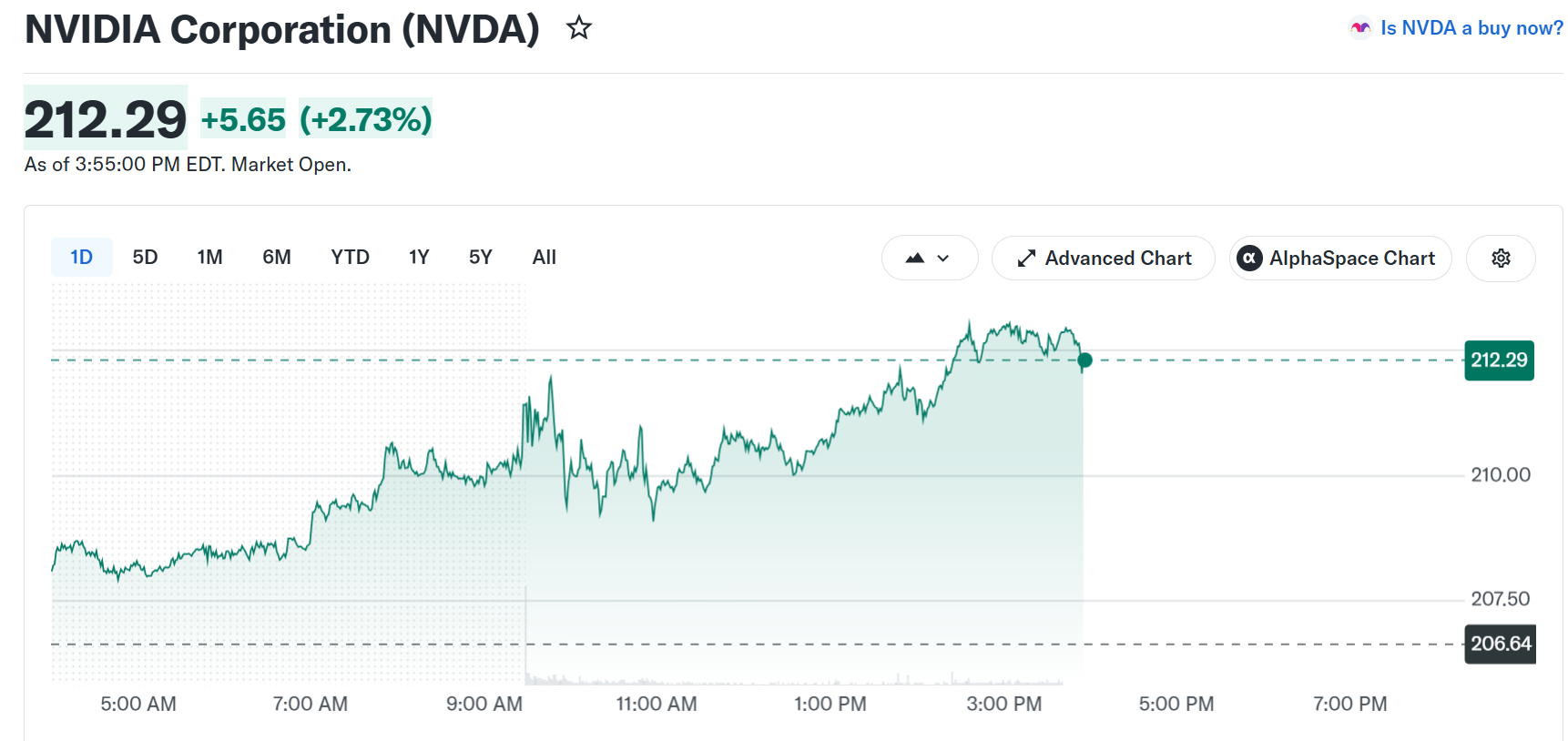
Nvidia (NVDA) traded at $212.91 on Tuesday afternoon, up 3.03%. SpaceX (SPCX) climbed 8.67% to $124.46.

SpaceX needed the lift. The stock sat 35% below its peak in early July, even after joining the Nasdaq-100.

The chips lend the plan weight. Nvidia says its Space-1 Vera Rubin Module delivers up to 25 times the AI compute of an H100 GPU. Volume shipments start this fall.
What the SpaceX Nvidia Starmind Deal Needs Next
Money is the open question. SpaceX’s AI unit lost $6.4 billion on $3.2 billion of revenue last year.
Tuesday’s 4:30 p.m. ET webcast offers the first real read. Analysts have mapped three earnings call scenarios, and Starlink cash flow sits at the center of each.
Opinion is split. Cathie Wood named SpaceX her favorite holding in July. NYU finance professor Aswath Damodaran has warned of a coming AI shakeout.
Regulators still hold a veto. The FCC accepted the filing in February and has yet to rule. Until it does, Starmind is a chip order without a licence.
The post SpaceX Joins a Club It Was Missing From In New Nvidia Deal: How Will Stocks React? appeared first on BeInCrypto.
SpaceX beat Wall Street estimates in its first quarterly report as a public company. Revenue reached $7.8 billion against forecasts near $6.81 billion, while digital asset holdings fell to $1.098 billion.
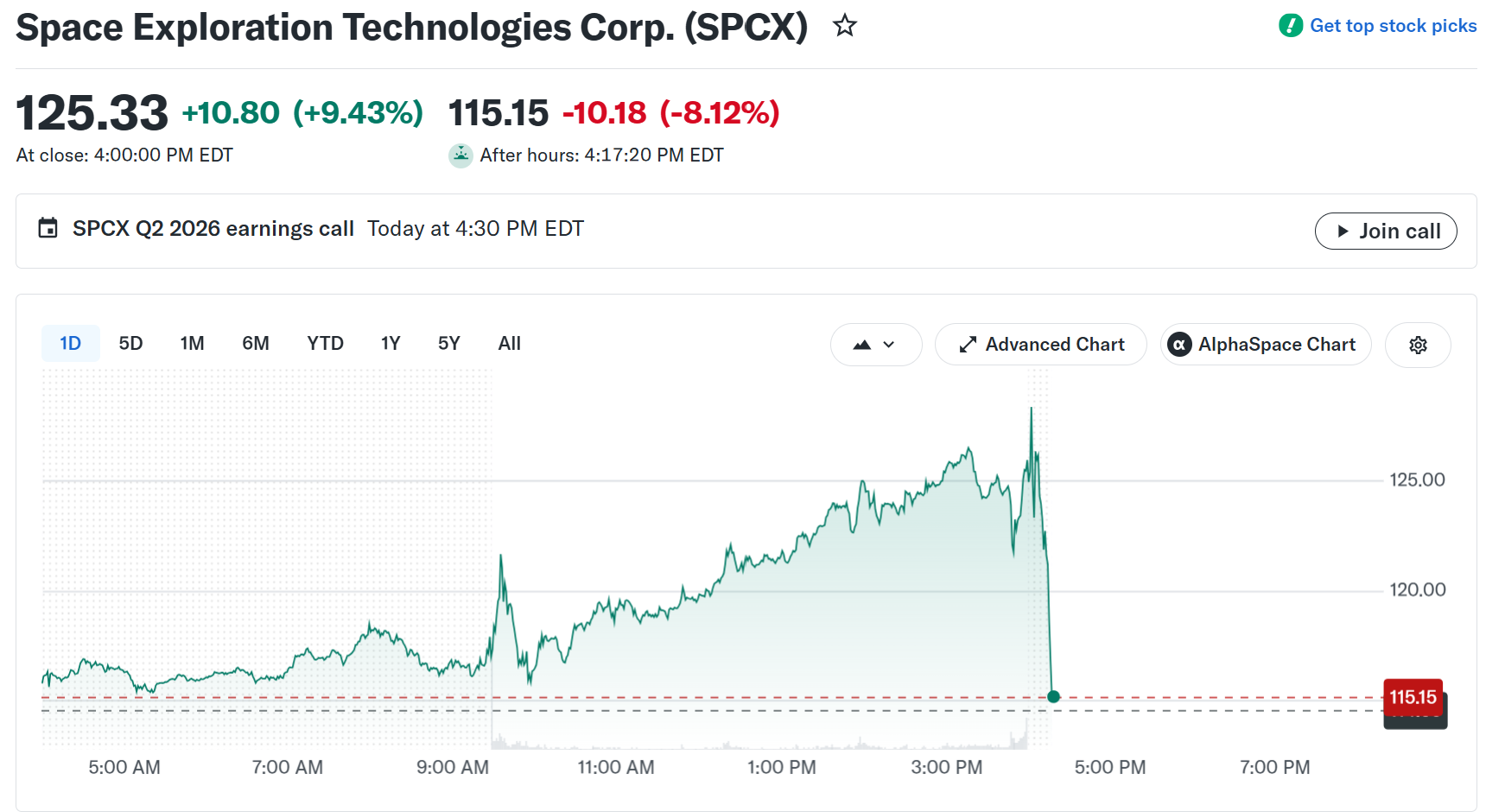
The beat did not hold investor confidence. Shares closed 9.43% higher at $125.33, then dropped more than 8% in after-hours trading as the earnings call approached.

Starlink Carries the Quarter While AI Losses Narrow
Connectivity revenue reached $4.291 billion, up 66% from a year earlier. Operating income for the unit climbed 79% to $1.656 billion.
Starlink subscribers doubled over 12 months to 12 million. Average revenue per user held at $66 a month, unchanged from the first quarter.
The artificial intelligence segment brought in $2.561 billion, a 247% annual increase. New cloud services agreements worth $14.1 billion in contracted sales drove much of that gain.
Its operating loss narrowed to $1.257 billion, roughly half the $2.39 billion analysts had penciled in. Loss per share landed at $0.09, against expectations near a $0.24 loss.
Adjusted earnings before interest, taxes, depreciation and amortization (EBITDA) rose 191% to $3.538 billion. Analysts had modeled about $2 billion, according to the scenarios Wall Street tracked before the print.
Follow us on X to get the latest news as it happens
SpaceX Crypto Holdings Shed $539 Million
The balance sheet tells a different story. Digital assets stood at $1.098 billion on June 30, down from $1.637 billion at the end of December.
That marks a 33% decline over six months. SpaceX does not break out coin counts in the release.
Grayscale has pegged the company’s stack at 18,712 BTC, the largest diversified public holder of the asset. Against that count, the June figure implies a carrying value near $58,700 per coin.
Bitcoin (BTC) changed hands near $64,073 on Tuesday, up 1.24% over 24 hours. The math therefore points to price weakness behind the drop rather than selling.
Sale rumors flared in July when the company moved $88 in bitcoin after months of dormancy. That small test transfer drew close attention from on-chain analysts.
Tesla showed a similar split in July. Its Bitcoin holdings lost value even as revenue topped forecasts.
Capital Spending Remains the Overhang
Second-quarter capital expenditure hit $18.369 billion. The AI segment absorbed $15.828 billion of that figure.
Compute capacity expanded to 1.4 gigawatts from 1 gigawatt in the first quarter.
SpaceX closed June with $100 billion in cash and securities, plus $47.5 billion in backlog. Management issued no formal guidance.
The company also disclosed a $60 billion agreement to buy Cursor, an AI coding tool, with closing expected this quarter.
Space revenue rose 29% to $962 million. However, the unit widened its operating loss to $542 million on Starship research spending.
Investors now face a familiar tension. Revenue growth is accelerating, yet capital intensity is climbing faster still.
The after-hours slide suggests the market wants a funding roadmap before it pays up for the numbers. Whether the call delivers one will shape the next leg for the stock.
The post SpaceX Crypto Holdings Drop $539 Million as Debut Earnings Beat Wall Street appeared first on BeInCrypto.

“As some blue states are considering more active involvement in oversight of facilities, I think the logical solution to much of that is federal ownership of the facilities,” George Zoley, CEO of GEO Group, said during the company’s earnings call in May. Zoley made clear his thinking on the advantage of federal ownership was all about reducing “unprecedented” lawsuits and oversight. He claimed that transferring the private facilities to the federal government would provide “stronger protections” under the Supremacy Clause in the Constitution.
In a statement to TIME, a DHS spokesperson attributed the acquisition of the two facilities to “sanctuary politicians” who push legislations that make privately-owned prisons “financially infeasible.”
“Now, with federal ownership of these detention centers, which are crucial to ICE’s detention network on the West Coast, ICE retains the detention capacity needed to arrest, detain, and remove illegal aliens,” the statement added.

Bitcoin mining companies with existing operations in Texas are likely to face limited direct disruption from a new state-level pause on certain data center approvals, according to Bernstein analysts. The move centers on heightened scrutiny of how quickly new data center projects are being lined up to connect to Texas’ power grid.
Governor Greg Abbott ordered the Public Utility Commission of Texas (PUCT) and the Electric Reliability Council of Texas (ERCOT) to conduct an audit of data centers seeking to connect to the grid, The Texas Tribune reported. Bernstein said many Texas miners are already covered by electric capacity agreements that have been approved, which could reduce near-term operational risk.
Key takeaways
- Bernstein expects most Texas-based Bitcoin miners to be minimally affected because many are contracted for approved power capacity.
- The audit and moratorium are expected to slow or throttle speculative data center “pipeline” projects, potentially increasing the value of sites with development history.
- Miners most exposed may include those whose future growth depends on converting existing pipeline assets into grid-connected capacity during ERCOT’s approvals.
- Bernstein highlighted Texas operations of Cipher Digital, Core Scientific, CleanSpark, IREN and Riot Platforms as relevant to how the approval process evolves.
Texas audit targets data center grid connections
On Monday, Governor Abbott directed regulators to audit all data centers attempting to connect to the state’s electric grid system. The directive is linked to mounting public backlash over the pace of data center development in Texas, as The Texas Tribune noted in reporting on the order.
While the article describing the order did not specify how long the audit would run, the practical effect is already clear: new or pending grid-connection approvals are likely to slow while regulators review the pipeline. For electricity-intensive industries—data centers and Bitcoin mining in particular—grid access timing can be as important as total contracted capacity.
Why Bernstein says active miners may be spared
In a client note released Tuesday, Bernstein analysts argued that the direct impact on Bitcoin miners with Texas operations should be limited. Their central point: most miners operating in the state are under contracts for electric capacity that has already been approved.
That distinction matters for investors and operators. An audit that primarily affects approvals for new connections is less likely to interrupt existing operations tied to already-cleared power supply, especially where miners have scheduled energy use and infrastructure already in place.
Bernstein also suggested that throttling new approvals could create a different kind of market effect. The analysts wrote that the audit “throttles speculative data center pipeline” and, in turn, “makes genuine sites with development history more valuable.” They linked that value proposition to mining sites typically having “longest gestation” characteristics, self-funding infrastructure, and management at the local level.
Which miners Bernstein flags as more vulnerable
Even if day-to-day production is less likely to be disrupted for capacity that is already approved, growth plans can still run into delays. Bernstein pointed to miners it believes could be more exposed—particularly if their path to expansion depends on ERCOT approval processes to convert pipeline assets into grid-connected power capacity.
The analysts specifically named Cipher Digital, Core Scientific and CleanSpark as candidates that could face greater sensitivity to future public opposition and the timeline pressures created by moratoriums or directives affecting new capacity approvals.
They also highlighted IREN and Riot Platforms, noting that both have Texas mining operations that are described as fully ERCOT grid approved. In Bernstein’s framing, that approved status may matter more as new capacity becomes harder or slower to obtain.
From data center controversy to mining capacity economics
At the heart of the story is an electricity allocation question. Texas’ grid-connection process is a bottleneck for any load expansion, and public opposition can influence political and regulatory outcomes—especially when state leadership orders audits or pauses.
Bernstein’s view effectively reframes the risk from “immediate operational shutdown” to “capital planning and future capacity accessibility.” If ERCOT’s approvals become slower, and if speculative data center projects are paused or delayed, then existing—especially already-approved—capacity may retain or increase its relative value versus projects still in the queue.
For miners, this can change how the market evaluates expansion-stage assets. If new MWs (megawatts) are throttled by policy actions, then entities able to monetize power access sooner—either because they are already grid approved or because they have stronger development histories—may face fewer timing disadvantages.
Stock reaction and company updates
In Tuesday’s premarket trading, Cipher Digital shares were down more than 7%, according to Yahoo Finance data. Separately, Cipher Digital reported second-quarter results earlier Tuesday, showing a loss of $0.65 per diluted share that widened from last year’s loss of $0.12 per diluted share, according to the company’s posted update.
While the stock move is not automatically attributable to the Texas audit by the information provided, it underscores how quickly market participants can price in regulatory uncertainty, especially for firms tied to the broader data center and power-capacity conversation.
Going forward, readers should watch how long the audit lasts and how ERCOT and the PUCT handle conversion of pipeline assets into approved grid-connected capacity—because that timeline will likely determine whether the near-term “freeze” stays contained or begins to affect future miner expansion plans.

The Hell’s Kitchen megaproject on the shore of California’s Salton Sea is a $1.8 billion bet on a massive, first-of-its-kind geothermal power and lithium-extraction facility. Developers aim to start up the facility’s new geothermal power production first, with lithium mining to follow. While the county and Controlled Thermal Resources, the mine’s owner, last year defeated a lawsuit that attempted to halt operations there, community opposition remains strong and opponents are appealing. The project sits in a low-income, heavily Latino, environmentally over-burdened valley with some of the worst air quality in the country. Tensions are also rife over the mine’s water consumption and the terms of its community-benefit agreement. Meanwhile, as demand for lithium for EV batteries has softened, the company has emphasized that both its geothermal energy and minerals can serve the AI-driven data-center boom.
‘Gaslighting’ by council leads to investigation call over ‘scandalous claims’

AMD's Big Quarter: You Should Buckle Up
XRP’s Most Important Level: The Battle for $1.06 Begins

Renter of Home in Anne Heche Crash Denies Settlement With Son

No Jackpot Winner as $257 Million Prize Rolls Over to $269 Million Monday Draw

Weekend Open Thread: Staud – Corporette.com

Money Rain – Karym x Willy x Js Serna x Jhean T ( Video oficial ) kevin cheng #sonrelatosdeuntrapper

Ripple XRP: Did Another Korean Exchange Experience An XRP Glitch Of +$2,250/XRP?

JUST IN: John Kennedy Vs Ilhan Omar: The Financial Evidence Nobody Saw Coming
-

 Business6 days ago
Why Trees Belong on the Risk Register
-

 Fashion4 days ago
Weekend Open Thread: Wit & Wisdom
-

 Politics4 days ago
Meta enters AI-training agreement with far-right ‘propaganda rag’ Newsmax
-

 Politics6 days ago
Reform UK betrays West Mids residents by running from party pledges
-

 Crypto World3 days ago
MicroStrategy Post-Earnings CLARITY Act Push Could Add New Catalyst for Its Stock
-

 Business7 days ago
Major shareholder moves on Canyon
-

 Crypto World4 days ago
XRP Ledger v3.3.0 brings five institutional features
-

 Politics2 days ago
Zack Polanski: an incitement to murder Nigel Farage?
-

 News Videos5 days ago
Bitcoin Enters the 3rd Stage of the Bear Market
-

 Crypto World7 days ago
Kraken Enables Retail Access to Jersey Mike’s IPO via Tokenized Shares
-

 Politics5 days ago
Luke Littler’s dominance sparks GOAT debate
-

 Sports5 days ago
Seema Kaliramna Wins Discus Throw Bronze, Takes India’s CWG Medals Tally To 17
-

 Crypto World4 days ago
New York sues Kalshi over prediction market gambling
-

 Crypto World2 days ago
Crypto PAC spending tops $2M in Michigan House race
-

 Business7 days ago
Johnson & Johnson agrees to $5.5B settlement over talc cancer claims
-

 Business4 days ago
Trump Announces Hamas Disarmament Agreement as Iran Strikes Kuwait Air Base and US Attacks Pause Overnight
-

 Tech6 days ago
Gemini can now summarize the messiest comment threads in Google Docs
-

 Tech3 days ago
ESET tracks rise in malicious AI skills and adaptable malware
-

 NewsBeat5 days ago
Four people die trying to cross Channel in small boats
-
 Tech4 days ago
Gemini Spark can now use Chrome logins and saved passwords to run errands on your behalf
You must be logged in to post a comment Login