
Crypto World
The Psychology of Crypto Investors: Why Rational Thinking Breaks in Irrational Markets


Cryptocurrency markets are often framed as a battle of information, technology, and strategy. In reality, they are just as much a battlefield of human psychology. Price charts may look mathematical, but the forces driving them—fear, greed, hope, and regret—are deeply emotional.
Understanding the psychology behind investor behavior is not just helpful; it is essential. Many of the most costly mistakes in crypto are not caused by lack of knowledge, but by predictable cognitive and emotional biases that influence decision-making under uncertainty.
1. Why Investors FOMO Into Market Tops and Panic Sell at the Bottom
One of the most persistent patterns in crypto markets is simple but brutal: people buy high and sell low.
This behavior is largely driven by herd mentality and emotional contagion.
When prices rise rapidly, social proof kicks in. Investors see others making money, timelines filled with profit screenshots, and influencers calling for higher targets. The fear of missing out (FOMO) becomes overwhelming. At this stage, decisions are no longer based on valuation or fundamentals, but on urgency and social pressure.
Ironically, this is often when risk is highest.
On the flip side, during downturns, the same crowd dynamic reverses. Fear spreads faster than optimism. Red candles trigger anxiety, and narratives shift from “this will change the world” to “this is going to zero.” Investors panic sell, not because their original thesis changed, but because emotional discomfort becomes intolerable.
This cycle repeats because it is rooted in instinct: humans are wired to follow the crowd in uncertain environments. In crypto, that instinct is financially punished.
2. The Illusion of “Easy Money” in Bull Markets
Bull markets create a dangerous narrative: that making money is easy.
During strong uptrends, almost every asset appreciates. Low-quality projects pump alongside fundamentally sound ones. New investors enter the market and experience early success, often attributing gains to skill rather than favorable conditions.
This leads to overconfidence bias.
Investors begin to believe they have superior insight or timing ability. Risk management becomes an afterthought. Leverage increases. Portfolio concentration rises. Due diligence declines.
The market, however, has not become easier—only more forgiving.
When conditions change, this illusion collapses quickly. Strategies that worked in a rising market fail in a sideways or bearish one. Losses accelerate, and the same investors who once felt invincible struggle to adapt.
The “easy money” phase is not just misleading—it sets the stage for future mistakes.
3. Dopamine and the Addictive Nature of Trading
Crypto trading is not just financially engaging—it is neurologically stimulating.
Every price movement, every trade, every notification triggers the brain’s dopamine reward system. This is the same system activated by gambling, social media, and other habit-forming activities.
- Winning trades create a sense of euphoria.
- Near-misses encourage continued participation.
- Volatility increases engagement by constantly presenting new opportunities.
Over time, this can shift behavior from strategic investing to compulsive trading.
Instead of asking, “Is this a good decision?” the brain begins to seek the next reward. This leads to:
- Overtrading
- Chasing pumps
- Ignoring risk
- Increasing position sizes impulsively
The market effectively becomes a feedback loop, where emotional highs reinforce behavior—even when that behavior is objectively harmful.
Recognizing this dynamic is critical. Without awareness, investors may believe they are acting rationally when, in fact, they are responding to neurological impulses.
4. Survivorship Bias on Crypto Twitter
Social media plays a powerful role in shaping perception—especially in crypto.
Platforms like Crypto Twitter tend to amplify success stories:
- Traders posting massive gains
- Early adopters highlighting life-changing returns
- Influencers showcasing winning strategies
What is missing is equally important: the losses.
This creates survivorship bias, where only successful outcomes are visible, while the majority of unsuccessful participants remain silent. As a result, the ecosystem appears far more profitable—and far less risky—than it actually is.
New investors entering this environment develop distorted expectations. They may believe:
- High returns are common
- Successful trades are easily repeatable
- Losses are rare or due to incompetence
In reality, many profitable accounts benefit from timing, luck, or selective reporting.
Survivorship bias does not just misinform—it pressures individuals to take on excessive risk in an attempt to match an unrealistic standard.
5. Why This Matters More Than Strategy
Most investors spend their time searching for better indicators, earlier signals, or more accurate predictions. While these tools have value, they are often overshadowed by psychological factors.
A well-designed strategy can fail if executed emotionally. Conversely, a simple strategy can succeed if applied with discipline.
The difference lies in behavior.
Understanding the psychological traps in crypto markets allows investors to:
- Recognize emotional decision-making in real time
- Maintain consistency during volatility
- Resist social pressure and hype cycles
- Develop long-term resilience
In a market defined by uncertainty, self-awareness becomes a competitive advantage.
Conclusion
Crypto markets are not just financial systems—they are reflections of collective human behavior under extreme conditions.
FOMO, panic selling, overconfidence, dopamine-driven actions, and survivorship bias are not anomalies. They are the default.
The uncomfortable truth is that most investors are aware of these patterns, yet still fall into them. Not because they lack intelligence, but because emotional responses are fast, automatic, and difficult to override.
Recognizing these tendencies is the first step. Managing them is the real challenge.
Because in crypto, the biggest edge is rarely information.
It is control.
REQUEST AN ARTICLE



Bitcoin’s recovery is being driven by perpetual futures traders, not organic spot buyers, according to CryptoQuant CEO Ki Young Ju. On-chain apparent demand remains net negative despite heavy ETF inflows and corporate accumulation.
Bitcoin (BTC) trades near $77,500 after failing to push through $80,000. The divergence between futures positioning and spot flows is becoming the defining feature of the April market.
Investors are Betting on Bitcoin Price, Not Buying
Ki Young Ju shared a CryptoQuant chart showing the growth in 30-day Bitcoin spot and perpetual futures demand. The purple futures bars have climbed back into positive territory through April 2026.
The gray spot bars, however, remain below the zero line for most of the month. Spot demand growth is still contracting on a 30-day basis, even as price action has recovered.
That gap matters because perpetual futures positions can be opened with leverage and unwound just as quickly. Spot buying, by contrast, requires fresh capital to absorb supply at the offer.
ETF Flows and MicroStrategy Buys Have Not Flipped the Signal
US spot Bitcoin ETFs attracted $786 million in their strongest weekly inflow since February in mid-April. Inflows continued at $823 million the next week, with BlackRock’s IBIT leading demand.
MicroStrategy, the corporate vehicle led by Michael Saylor, also bought 34,164 BTC for $2.54 billion in its third-largest single purchase. The buy was made at an average price of $74,395, lifting total holdings to 815,061 BTC.
Despite both flows, on-chain apparent demand has remained net negative through April. CryptoQuant data showed 30-day apparent demand near -87,600 BTC earlier in the month.
The gap suggests ETF and Strategy purchases are being matched and exceeded by selling from existing holders and miners.
When Will the Bear Market End?
Ki Young Ju has tracked Bitcoin demand cycles for years. He previously declared the cycle theory dead, citing structural rotation between old whales and new long-term holders.
His latest framing suggests that sustainable bottoms form only when spot and futures demand recover at the same time. A futures-led rebound without a spot recovery has historically resolved through another leg lower as leverage unwinds.
The current setup matches that pattern. Funding rates have ticked up, open interest is rising, but the underlying spot bid remains weak.
Traders are now watching whether spot demand, as measured by CryptoQuant, can flip positive in the coming weeks. A turn would suggest fresh capital is finally absorbing the supply pressure flagged in earlier warnings.
If futures positioning continues to lead while spot demand stays red, the rally faces a familiar risk. Previous mid-cycle bounces in 2025 unwound the same way, through forced liquidation rather than fresh dollar inflows.
The post CryptoQuant CEO Warns Bitcoin Demand Imbalance appeared first on BeInCrypto.


TL;DR
- Hyperliquid (HYPE) holds near $42 with a bullish structure above $40.
- The bullish structure is supported by rising futures Open Interest and positive funding rates.
Hyperliquid (HYPE) trades above $42 on Monday, sustaining its upward trajectory from an ascending trendline.
While the broader trend remains constructive, signs of cooling retail interest contrast with a steady buildup in leveraged positions, creating a mixed near-term outlook for the decentralized exchange token.
Retail momentum fades as social dominance drops
Retail-driven momentum appears to be weakening. Data from Santiment shows Hyperliquid’s social dominance has declined sharply to 0.137%, down from 0.688% at the height of the US-Iran conflict in late March.
The drop suggests reduced retail attention as geopolitical tensions ease, removing a key narrative driver that previously fueled speculative interest in the DEX.
In contrast, derivatives activity is heating up. According to CoinGlass, HYPE futures Open Interest (OI) has climbed roughly 3% over the past 24 hours to $1.65 billion, signaling an increase in outstanding leveraged positions.
Funding rates remain positive at 0.0077%, indicating that long positions continue to dominate. This persistent positive funding over the past month reflects growing bullish conviction among leveraged traders, even as spot-driven retail enthusiasm cools.
HYPE price outlook: Rising wedge puts $40 support in focus
The HYPE/USD 4-hour chart is bullish and efficient as HYPE is consolidating within a rising wedge.
The token remains supported above both its 50-day EMA at $38.98 and 200-day EMA at $34.90, reinforcing the underlying bullish structure.
Momentum indicators suggest steady but controlled upside. The Relative Strength Index (RSI) sits at 56, pointing to positive but not overbought conditions, while the MACD is trending higher toward a bullish crossover, hinting at fading downside pressure.
If the bulls push higher, they would encounter immediate resistance at the $43.71 level, which caps the current recovery and aligns with the upper wedge boundary near $46.80. A decisive break above this zone could trigger a stronger bullish continuation.
However, if the market undergoes a correction, the ascending trendline support near $41.21 remains critical.

A breakdown below this level would likely expose the 50-day EMA at $38.98, with the 200-day EMA at $34.90 acting as a deeper demand zone if selling pressure intensifies.
While Hyperliquid’s structure remains bullish above $40, the divergence between fading retail interest and rising leverage suggests the next move could be determined by whether momentum expands or reduces.

Sam Sidhu, CEO of Customers Bank.
Courtesy: Customers Bank
Nearly half an hour into a conference call on Friday to discuss first-quarter results with analysts, Customers Bank CEO Sam Sidhu revealed something unusual — up until that point, he hadn’t actually been speaking.
“The prepared remarks you heard on my behalf today were delivered by my AI clone, not read by me,” Sidhu said, calling it a potential first for a public company earnings call.
The point of the stunt, he said, was to underscore a broader shift happening as Customers Bank, a $25.9 billion asset lender catering to startups and small businesses, embraces artificial intelligence.
Customers Bank has signed a multiyear partnership with OpenAI in which the AI giant will embed engineers at the company to help it automate lending and client onboarding, CNBC has learned exclusively.
The deal is part of Sidhu’s effort to get ahead of other banks in the industry’s race to transform itself using AI agents as a new digital workforce. His strategy hinges on automating core banking processes — slashing loan timelines from weeks to days, for instance — and scaling growth without adding staff at the same pace.
While many bankers have described AI in broad terms like productivity gains, Sidhu is tying it directly to financial targets.
Sidhu told CNBC that the project will improve the firm’s efficiency ratio from about 49 to the low 40s, boosting the bank’s returns starting next year.
The relationship with OpenAI — which has targeted finance as one of its core industries — will be a symbiotic one for the AI giant, according to the bank CEO.
“We’re going to be co-creating enterprise solutions they could potentially sell to other banks in the future,” Sidhu said. “The goal here is end-to-end, automated agentic led workflow” for lending, deposits and payments.
OpenAI said it was proud to help Customers Bank “as they build a more intelligent operating model that empowers employees, strengthens client service, and sets a new standard for regional banking,” chief revenue officer Denise Dresser said in a statement provided to CNBC.
Always-on workers
The bank expects to roll out AI agents across lending, deposits and payments over the next six to 12 months.
If they succeed, closing a commercial loan will go from taking 30 to 45 days, including underwriting, document collection and legal negotiations, to about seven days, Sidhu said.
Opening accounts for complex commercial clients, which can take more than a day, will be collapsed to under 20 minutes using conversational AI and automated document gathering, he said.
“When you have an autonomous agent, you’re essentially creating a digital worker … and they can work around the clock,” Sidhu said.
Customers Bank has been laying the groundwork for this announcement for years, first tapping OpenAI in 2023 because Sidhu had what he describes as a tiny investment in the AI giant through his contacts in the venture capital world. The OpenAI deal signed last week broadens their relationship, enabling AI engineers into the bank’s processes, he said.
The bank is among a handful of smaller lenders that target the startup and venture capital community, and it reportedly bid for Silicon Valley Bank in 2023 amid the regional banking crisis that year.
Key advantage
While it is a relatively tiny firm compared to the likes of JPMorgan Chase, which has $4.9 trillion in assets, Customers Bank has a key advantage, according to Sidhu, who began his career at Goldman Sachs in 2004. The megabanks have sprawling global operations and far higher complexity and regulatory standards for AI implementation, he said.
“Smaller banks are not going to be expected to have the same level of frameworks as many of the larger banks,” he said. Regulators want community and regional banks “to be able to compete with larger banks.”
The lender already uses AI to write half the firm’s software code and has saved 28,000 hours of work so far, equal to not hiring about 15 full-time employees, he said.
“This is an opportunity for us to potentially slow that hiring … and do more revenue per employee,” he said.
The bank is also exploring entering new businesses that would have been prohibitively expensive to tackle before AI agents. For these AI-native business lines, smaller teams oversee automated systems that handle work previously requiring large numbers of humans, he said.
Unlike typical software licensing agreements, Sidhu said both sides are contributing resources to build new tools together, with OpenAI gaining real-world use cases inside a regulated financial institution.
“It’s going to benefit our investors. It’s going to benefit our customers,” Sidhu said. “Our regulators will hopefully also be happier over time, because they’re going to see us reducing risk as well.”
Project Eleven, the quantum cybersecurity startup backed by Coinbase Ventures, Balaji Srinivasan, Castle Island Ventures, and Variant, awarded a one bitcoin (BTC) prize last week to a researcher who claimed to have broken a 15-bit elliptic curve key on IBM Quantum hardware.
However, despite a Project Eleven press release framing it as the largest public quantum attack on the cryptography securing “Bitcoin, Ethereum, and over $2.5 trillion in Elliptic Curve Cryptography-secured digital assets,” several independent reviewers managed to replicate the feat using non-quantum, classical computing tactics like random number generation.
Indeed, within hours of the news, independent Bitcoin developers reproduced the supposed breakthrough on home computers.
Using no quantum computing, they showed that the prize winner basically repurposed a fancy random number generator.
Replicating a quantum prize win with home hardware
Researcher Yuval Adam ran one of the replication experiments using the public code of prize winner Giancarlo Lelli, a specialist whose GitHub repository hosts the winning submission.
However, Adam swapped Lelli’s IBM Quantum backend for a far more basic random number source, Linux kernel’s /dev/urandom.
Adam mostly left the rest of the setup alone, then opened a pull request against Lelli’s repository, documenting the outcome.
Finally, Adam asserted that random data from a non-quantum laptop provided a classical computer as much brute force energy as Lelli’s “IBM Quantum” backend for the goal of recovering a cryptographic private key from a public key.
He posted the summary on X: “I replaced the quantum computer with /dev/urandom. It still recovers the key.”
In the end, Linux’s urandom helped a regular computer recover the key in an comparable number of attempts to the supposed quantum backend.
Classical computations wearing quantum costumes
Former Bitcoin Core maintainer Jonas Schnelli claimed to have reproduced the prize-winning pipeline in roughly 20 lines of Python without any quantum hardware.
Schnelli summarized, “The quantum computer contributed nothing (noise)! The answer was recovered by a classical checker sifting random noise.”
Coldcard founder NVK read the source code and reached the same verdict, calling the demonstrations “classical computations wearing quantum costumes.”
Lelli’s own README conceded the point in plain text: “When shots >> n, random noise alone can recover d with high probability.”
Project Eleven’s three-judge panel awarded the BTC anyway.
Read more: The internet is laughing at El Salvador’s ‘quantum-safe’ bitcoin
A Community Note and a venture round
Project Eleven’s announcement on X now carries a Community Note fact-check, arguing that the recovery method works even when the quantum output is replaced with random data and a classical computer, providing no quantum advantage over classical computing.
Ark Labs engineer Alex Bergeron was blunter, saying, “TLDR; zero accountability. We shopped a parlor trick around to media publications because our goal isn’t really to help Bitcoin, it’s to raise another round.”
The potential conflict of interest is hard to overlook. Project Eleven, founded by Stanford graduate Alex Pruden, closed a $20 million Series A in January at a $120 million valuation.
The company sells post-quantum migration tooling. It designed the Q-Day Prize, picked the judges, awarded the bounty, and issued the press release warning that 6.9 million BTC sit in wallets exposed to quantum attack.
After reading numerous social media complaints, Pruden later conceded on X that the demonstration represented “incremental progress in a noisy, early field,” while complaining that critics somehow “moving goalposts” were the real problem.
His own press release had described the supposed breakthrough as the largest public demonstration of an attack threatening trillions of dollars.
As Protos has previously documented, fears about quantum breakthroughs are ramping up due to accelerating post-quantum deadlines from Cloudflare, Google, and IBM.
Newly accelerated deadlines cluster around the year 2029 to the very early 2030s. Unfortunately, Project Eleven’s prize money rewarded publicity over cybersecurity progress toward meeting these deadlines.
Undeterred, the company is now developing its next contest.
Got a tip? Send us an email securely via Protos Leaks. For more informed news, follow us on X, Bluesky, and Google News, or subscribe to our YouTube channel.


A debate has started in the crypto market after researcher Giancarlo Lelli received a 1 BTC reward from Project Eleven.
Summary
- Project Eleven awarded 1 BTC after a researcher cracked a 15-bit ECC key using quantum tools.
- Adam Back said the result looked more like statistical guessing than a real quantum breakthrough.
- Critics said Bitcoin’s 256-bit keys remain far beyond the scale of the latest experiment.
The prize followed his reported success in cracking a 15-bit ECC key using a cloud-based quantum computer.
Project Eleven said Lelli used a modified version of Shor’s algorithm for the test. The group also said its challenge had moved from 6-bit keys to 15-bit keys within seven months, showing faster progress in quantum testing.
Adam Back disputes quantum breakthrough claim
Blockstream CEO Adam Back challenged the idea that the test marked a real quantum attack on crypto. He argued that the result did not prove a useful quantum method against Bitcoin or modern cryptographic systems.
Back said the test looked closer to statistical guessing than a technical breach. In his view, the quantum computer did not solve the kind of hard problem that protects Bitcoin private keys.
Meanwhile, the main criticism focused on the small 15-bit key size. A key of that size has a limited search space, which makes it far easier to test possible answers than real Bitcoin keys.
Former Bitcoin Core developer Jonas Schnelli also questioned the result. He said the researcher checked about 20,000 possibilities out of 32,497, giving the method a high chance of success without quantum advantage.
Schnelli described the result as similar to “flipping a coin.” He also said, “Quantum computing contributed nothing useful here,” arguing that the experiment did not show a real threat to crypto security.
Bitcoin security debate continues
The claim has raised fresh discussion about quantum computing and Bitcoin. Some market watchers see the Project Eleven result as a step toward future risks, while critics say it does not apply to full-strength cryptography.
Back maintained that Bitcoin remains far from the reach of current quantum machines. He said quantum systems would likely target state secrets or banking systems before becoming a practical concern for Bitcoin.
Bitcoin uses far larger key sizes than the one tested in the experiment. For that reason, Back and other skeptics view the challenge as a small-scale test rather than proof that Bitcoin faces an immediate quantum threat.
The episode shows growing interest in post-quantum security across crypto. However, experts remain divided on whether the Project Eleven result marks real progress or only a controlled experiment with limited market relevance.
Crypto World
Verizon (VZ) Stock Surges 4% on Strong Q1 Results and First Subscriber Growth Since 2013

Key Takeaways
- Verizon shares climbed approximately 4% during premarket hours following stronger-than-expected Q1 results
- Company reported 55,000 net postpaid phone subscriber additions — marking the first positive first quarter since 2013
- Adjusted earnings per share reached $1.28, surpassing Wall Street’s $1.21 forecast
- 2026 full-year EPS outlook increased to $4.95–$4.99 range from previous $4.90–$4.95 guidance
- Service outage in January temporarily impacted wireless revenue due to $20 customer compensation credits
Verizon delivered quarterly earnings on Monday that exceeded Wall Street expectations, sending shares higher in early trading. The telecommunications company saw its stock climb approximately 4% before market open, hitting $48.33.
Verizon Communications Inc., VZ
The carrier reported adjusted earnings of $1.28 per share, topping the FactSet analyst consensus estimate of $1.21. Total revenue reached $34.4 billion, representing a 2.9% increase compared to the same period last year, although falling just short of the anticipated $34.8 billion.
While the earnings beat drew praise, the real story centered on customer growth. Verizon brought in 55,000 net postpaid phone subscribers during the first quarter. Wall Street analysts had projected losses ranging from 81,000 to 88,000 customers.
This marks the first time Verizon has delivered positive postpaid phone customer growth during a first quarter since 2013. For a telecom giant working to revitalize its wireless operations, this represents a significant achievement.
Behind the Customer Growth Revival
CEO Dan Schulman attributed the turnaround to strategic changes in customer approach. “We are beginning to reclaim our market leadership by putting the customer at the center of everything we do, reducing friction to increase loyalty and create genuine value,” he explained.
A key component of this approach involved aggressive targeting of competitors’ customers. Verizon provided enhanced incentives to consumers who presented bills from AT&T and T-Mobile, successfully converting rival subscribers to its network.
The company has also expanded its focus on bundled offerings — pairing home internet services with wireless packages — a tactic AT&T has successfully employed to improve customer retention. Early indicators suggest this strategy is delivering results.
The quarter also represents Verizon’s first financial report including Frontier, following the acquisition’s completion on January 20.
One notable challenge: wireless service revenue faced pressure from $20 customer credits distributed after a roughly 10-hour service disruption in January. These compensation payments, issued to hundreds of thousands of affected customers, modestly reduced overall revenue.
Upgraded Full-Year Outlook
Verizon increased its full-year adjusted earnings per share projection to a range of $4.95–$4.99. This revision moves up from the company’s prior $4.90–$4.95 target and exceeds the $4.90 analyst consensus at the midpoint.
The telecommunications provider also indicated it now anticipates total retail postpaid phone net customer additions for 2026 will fall within the upper half of its 750,000 to 1 million forecast range.
While subtle, this represents a significant upgrade in confidence. Verizon isn’t merely celebrating one strong quarter — management is signaling sustained momentum ahead.
S&P 500 futures traded relatively flat on Monday as investors awaited earnings reports from major technology companies.

Disclosure: This article does not represent investment advice. The content and materials featured on this page are for educational purposes only.
LILPEPE nears presale completion after raising over $28 million as investor interest continues to grow.
Summary
- Little Pepe passes $28M in presale funding as Stage 13 nears close and token price moves toward $0.0023.
- LILPEPE gains traction with Layer 2 utility, zero-tax trading, staking rewards, and DAO governance features.
- As presale demand rises, Little Pepe stands out by combining memecoin momentum with real blockchain utility.
The LILPEPE coin is close to wrapping up its presale with a total amount of funds collected surpassing the mark of $28 million. Although the project itself could be considered one of the newcomers on the market, it now appears among the most interesting to observe during the presale in the crypto world. At the moment, the coin’s price is $0.0022, with $0.0023 expected for stage 14.
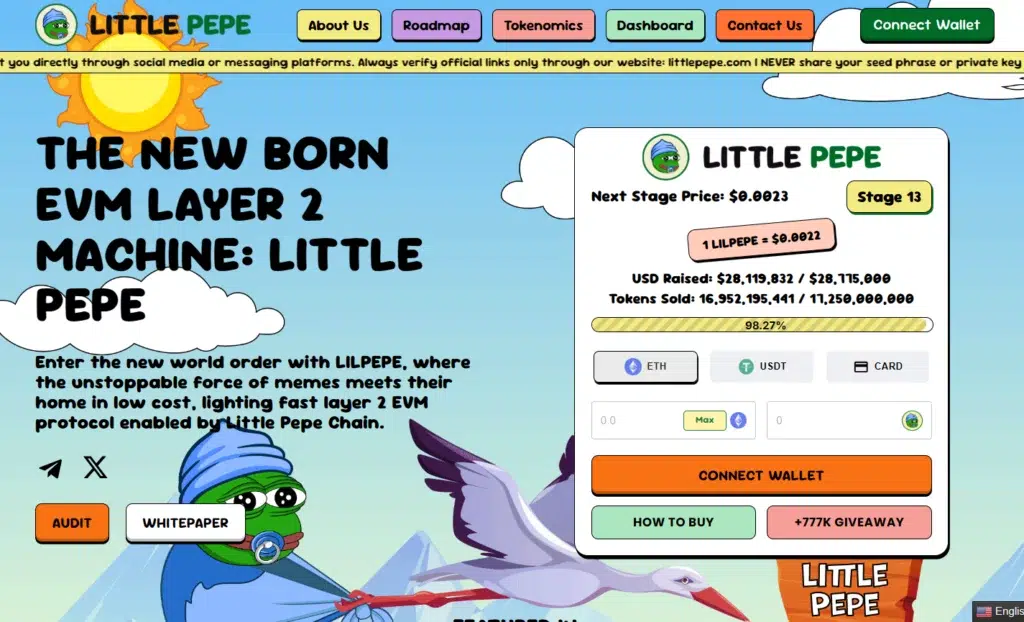
The pricing strategy used by the Little Pepe coin has been quite instrumental in building momentum for the project. Early investors have been rewarded while simultaneously pressuring late investors into getting involved in the investment project. As the presale process winds down, there has been a marked increase in the number of buys that the coin has experienced as investors try to lock in their gains in anticipation of the price increase.
Utility, ecosystem strength, and $777k giveaway rewards
One of the key reasons why Little Pepe continues to have traction in the crypto space is that the coin seeks to shift focus away from the memecoin concept and incorporate real utility in its ecosystem.
The Little Pepe coin is developed on an Ethereum-compatible Layer 2 blockchain network. These include rapid transactions, low gas prices, and scalability, all of which help make it more practical and effective for investors. In addition, it features zero taxation trade, anti-sniper mechanism for bots, staking benefits, meme launchpad, and DAO governance — all meant to improve its usability in the long term. Unlike most newly launched memecoins, one of the distinguishing factors about Little Pepe is its focus on utility, and this aligns with the prevailing industry trends.

Another appealing feature is a $777,000 giveaway for ten lucky individuals who can each get $77,000 of the LILPEPE token. Secondly, there is a 15+ ETH giveaway, where the top three buyers would be rewarded 5 ETH, 2 ETH, and 3 ETH. Adding on to it, some random 15 buyers will be rewarded 0.5 ETH as part of the giveaway program. These giveaways help investors to engage more in the presale race.
Late-stage demand and outlook beyond the presale
Now that the presale is drawing to a close, market factors are already starting to shift according to their well-known patterns. In particular, investors who might not have participated until now are joining the fray in greater numbers due to the scarcity of tokens and the upcoming rise in their price. These are typical behaviors for successful presales, which, if continued until the end of the process, will help to achieve a successful close. Meanwhile, the overall environment on the crypto market is favoring projects at an earlier development stage because of the flow of funds toward smaller projects that have higher chances of growth than larger-cap projects.
At present, Little Pepe is enjoying these trends, thanks to its impressive funding and growing popularity. As the presale is wrapping up, Little Pepe will soon be facing its first real test as a project: its performance on the market after launch. Provided that the ongoing positive trend holds true, Little Pepe will complete its presale with strong results and become one of the most promising projects on the crypto market.
For more information about Little Pepe, visit the official website, X, and Telegram.
Disclosure: This content is provided by a third party. Neither crypto.news nor the author of this article endorses any product mentioned on this page. Users should conduct their own research before taking any action related to the company.

Luxembourg-based Banking Circle has begun offering regulated stablecoin settlement services after receiving a Crypto Asset Service Provider (CASP) authorization from Luxembourg’s financial regulator on April 15. The move expands the bank’s fiat-to-stablecoin and stablecoin-to-fiat settlement capabilities for institutional clients, marking a notable step in Europe’s push to build compliant digital-asset infrastructure under the MiCA regime.
The rollout supports Circle’s USDC, Paxos’ USDG, and Banking Circle’s own euro stablecoin EURI, widening the bank’s digital-asset settlement footprint beyond its initial EURI launch in August 2024. In its announcement, Banking Circle said it serves more than 750 payment companies, financial institutions and marketplaces that move and convert over 1.5 trillion euros (about $1.7 trillion) each year across its network. Chief digital asset officer Kirit Bhatia framed stablecoins as a natural extension of the bank’s infrastructure, underscoring their potential to cut costs and boost efficiency in settlement flows.
The development arrives as Europe’s regulated stablecoin ecosystem intensifies competition among banks, fintechs and crypto-native players who seek compliant rails for cross-border settlements under MiCA.
Key takeaways
- Banking Circle secures a CASP license from Luxembourg’s regulator, enabling its new stablecoin settlement services for institutions.
- The service supports Circle USDC, Paxos USDG, and Banking Circle’s EURI, expanding from the August 2024 EURI launch.
- The move signals growing institutional adoption of regulated stablecoins for fiat-to-stablecoin and stablecoin-to-fiat settlement within the European framework.
- European euro-stablecoin activity is heating up, with multiple banks and fintechs pursuing MiCA-aligned tokens and settlement rails, including large-scale launches and multi-chain expansions.
- The landscape features a blend of traditional banks, crypto natives and consortia pursuing interoperability, custody and tokenization infrastructure ahead of broader adoption.
Regulatory momentum and a crowded European playbook
The CASP authorization fits into a broader European momentum to formalize stablecoin issuance and settlement under MiCA, the EU’s ambitious framework designed to bring crypto assets into a regulated, bank-like regime. France’s Société Générale group, through its SG-FORGE unit, has been a prominent early entrant in euro-stablecoin issuance with EURCV, launching on Ethereum in April 2023 and later expanding to additional networks as part of a multi-chain strategy. In mid-2023 and 2024, SG-FORGE continued integrating its MiCA-compliant euro stablecoin into mainstream wallets and infrastructure, including a recent move to bring USDCV into MetaMask, broadening access to a regulated dollar stablecoin issued by a European bank.
Euro-stablecoin activity has also deepened on the custody and tokenization front. Sygnum added EURCV to its B2B platform in January 2025 to serve institutional clients, while a growing consortium of European lenders—ING, UniCredit, CaixaBank among them—has spurred the Qivalis project to issue a MiCA-compliant euro stablecoin with a planned launch in the second half of 2026. The consortium has since expanded to 12 banks and has partnered with Fireblocks to provide custody and tokenization infrastructure ahead of launch.
Beyond traditional banks, crypto-native infrastructure players are accelerating similar capabilities. Circle, the issuer of USDC, announced the Circle Payments Network in April 2025 as a managed settlement service for banks and payment providers, and Coinbase’s April 2025 partnership with Nium enables businesses to fund cross-border transfers with USDC and settle in USDC or fiat across a network spanning more than 190 countries.
Banking Circle’s emphasis on EURI as a bank-issued MiCA-compliant euro stablecoin provides a unique in-house option that complements the broader euro-stablecoin ecosystem now taking shape across Europe. The CASP license positions the bank to offer regulated settlement rails for both fiat-to-stablecoin flows and stablecoin-to-fiat conversions, a capability that could reduce pre-funding and liquidity costs for institutional users navigating cross-border payments.
Banking Circle’s strategy in a competitive market
Banking Circle’s admission to the CASP framework reinforces its broader strategy to become a utility-layer provider for digital-asset settlement across Europe. With more than 750 counterparties and a daily footprint that covers a substantial share of European cross-border payment volumes, the bank’s new service could become a preferred on-ramp and off-ramp for institutions seeking compliant, bank-backed stability rails. The combination of USDC, USDG and EURI expands the pool of stablecoins that institutions can utilize to optimize liquidity, settlement speed, and cost efficiency in diverse jurisdictions.
Industry observers note that the European stablecoin space remains highly competitive and uncertain in some respects, given regulatory developments, interoperability considerations, and the cadence of new deployments. While the leading euro-stablecoin players push multi-chain strategies and deep integration with wallets and custodians, banks like Banking Circle are betting on regulated, bank-issued tokens to provide trusted rails for big-ticket settlements. The ongoing evolution of MiCA-compliant stablecoins—alongside continued convergence between fiat-backed tokens and traditional payments rails—could redefine how institutions move value across borders in the near term.
For readers watching next, the key questions revolve around adoption and interoperability: Will more banks and payment networks formalize stablecoin settlement programs under CASP licenses? How quickly will MiCA-compliant euro tokens gain traction in settlement pipelines versus multi-chain opposition? And how will custody and tokenization partners like Fireblocks, Sygnum, and others influence deployment timelines and risk management practices as the market matures?
As the European regulatory and market landscape continues to crystallize, Banking Circle’s CASP-backed stablecoin settlement push provides a tangible signal of momentum for institutions seeking regulated, scalable digital-asset settlement rails. The next several quarters should reveal how deeply these rails are being woven into mainstream payment networks and what that means for liquidity, cost, and the speed of cross-border transfers.


Bitget, the world’s largest Universal Exchange (UEX), has announced the launch of the Blockchain4Youth Learning Hub: Semester 1, a new education initiative designed to help young learners explore blockchain not only as a field of study, but as a viable career path in the digital economy.
As part of Bitget’s broader Blockchain4Youth initiative, the Learning Hub expands the program’s mission of making blockchain education more accessible and actionable for young people worldwide. Through recent initiatives such as the LALIGA Youth Tournament in Thailand, its partnership with Google Developer Group on Campus, and the Web3 Young Learners’ Encyclopedia, Blockchain4Youth has engaged more than 15,000 participants since launch, reflecting its ongoing commitment to youth development and the rising interest among students in finding clearer pathways into the Web3 industry.
The Blockchain4Youth Learning Hub combines structured learning with professional recognition and career-oriented support. Learners who complete the program and pass the assessments will receive a Certificate of Completion signed by Ignacio Aguirre Franco, Chief Marketing Officer of Bitget, giving them a credential they can present across their professional profiles.
The certificate is intended to serve as more than proof of participation. It offers verified recognition of Web3 competency and unlocks access to a broader network of opportunities. Certificate holders can benefit from priority review for opportunities at Bitget and gain entry to the Blockchain4Youth Talent Alliance, a core pillar of the program designed to connect certified learners with the wider Web3 industry. Through the alliance, participants can access priority opportunities, industry exposure, and networking channels, creating a clearer pathway between demonstrated knowledge and real-world professional roles.
As part of this effort, Bitget has confirmed a partnership with Bondex, the Web3 professional network behind web3.career, the largest job board in the industry.Through the partnership, Bitget and Bondex aim to make career entry points into Web3 more transparent and accessible for the next generation of builders and professionals
“Most young people trying to break into Web3 hit the same wall, they take a course, then have no network, no verified credentials, and no clear path to a job.” said Ignacio Palomera, Co-Founder of Bondex. “Blockchain4Youth and Bondex fix that. Finish the program, build a verified profile, be discovered in the Bondex trusted talent pool and apply directly to companies hiring on web3.career. It’s the bridge the industry’s been missing.
“A lot of young people are interested in Web3, but interest alone does not always show them where to begin,” said Ignacio Aguirre Franco, CMO of Bitget. “The Learning Hub is about making that first step feel more real by giving learners knowledge, recognition, and a better sense of where this path can lead. When young talent can see opportunity more clearly, they are more likely to believe they belong in the future of this industry.”
Ultimately, Blockchain4Youth Learning Hub reflects a broader commitment to building long-term infrastructure for Web3 education and talent development. More than a standalone campaign, the Learning Hub demonstrates how Blockchain4Youth is evolving into a sustained platform that supports learners as they move from discovery to skill-building, and from participation to contribution. Through this initiative, Bitget continues to position itself not only as a platform for digital assets, but also as an ecosystem builder helping shape the workforce that will define the next phase of Web3.
The B4Y Talent Alliance welcomes recruiting companies that want to connect with emerging talent, expand industry access, and create more pathways into Web3. Interested organizations can contact blockchain4youth@bitget.com.
About Bitget
Bitget is the world’s largest Universal Exchange (UEX), serving over 125 million users and offering access to over 2M crypto tokens, 100+ tokenized stocks, ETFs, commodities, FX, and precious metals such as gold. The ecosystem is committed to helping users trade smarter with its AI agent, which co-pilots trade execution. Bitget is driving crypto adoption through strategic partnerships with LALIGA and MotoGP™. Aligned with its global impact strategy, Bitget has joined hands with UNICEF to support blockchain education for 1.1 million people by 2027. Bitget currently leads in the tokenized TradFi market, providing the industry’s lowest fees and highest liquidity across 150 regions worldwide.
For more information, visit: Website | Twitter | Telegram | LinkedIn | Discord
The post Bitget Launches Blockchain4Youth Learning Hub to Strengthen the Future Web3 Workforce appeared first on BeInCrypto.
Crypto World
Micron (MU) and Seagate (STX) Stocks Rally as AI Infrastructure Fuels Memory Chip Shortage

Key Highlights
- Micron (MU) shares have surged over 70% in the current year while maintaining a modest 8.4x forward P/E ratio
- The company’s entire 2026 high-bandwidth memory inventory has been secured through long-term customer agreements
- HBM4 manufacturing commenced in April 2026, delivering 2.8TB/s bandwidth and 20% enhanced energy efficiency versus HBM3E
- The memory chipmaker is advocating for stricter U.S. restrictions on semiconductor equipment exports to China
- Hard drive leader Seagate (STX) reports complete 2026 allocation for its data center nearline storage products
Micron Technology (MU) has experienced remarkable momentum throughout the past twelve months, delivering year-to-date gains exceeding 70%. Even after this substantial rally, shares continue trading at an attractive 8.4x forward earnings multiple that market analysts view as compelling.
The primary catalyst behind this performance has been the company’s high-bandwidth memory portfolio. HBM technology utilizes vertical chip stacking architecture instead of traditional horizontal layouts, enabling dramatically superior data transfer rates compared to conventional DRAM solutions. Micron’s HBM3E variant achieves 1.2TB/s data movement while consuming 30% less energy than competing offerings.
Nvidia selected Micron as a key HBM provider for its Blackwell graphics processing unit series. This partnership has generated demand levels that far exceed current production capabilities. Micron’s complete 2026 HBM manufacturing capacity has been committed through extended customer contracts.
Volume manufacturing of Micron’s advanced HBM4 technology started in April 2026. The new generation delivers bandwidth exceeding 2.8TB/s while boosting energy efficiency by over 20% compared to HBM3E. Market pricing for this cutting-edge product has climbed more than 50%.
Policy Advocacy Creates Competitive Implications
Micron has been engaging with U.S. policymakers to strengthen export restrictions on sophisticated semiconductor manufacturing equipment destined for China. Company leadership frames these efforts around national security concerns. The initiative also carries strategic business implications.
Limiting equipment exports to Chinese semiconductor manufacturers would constrain capacity expansion for competitors including Samsung, SK Hynix, and Chinese domestic DRAM producers. This scenario would reinforce Micron’s established position in artificial intelligence memory markets. Conversely, enhanced restrictions might reduce Micron’s market access within China and potentially trigger retaliatory measures.
Market observers have identified elevated non-cash earnings components and recent insider stock sales as factors deserving continued scrutiny alongside regulatory developments.
Seagate Benefits from Parallel Trends
Seagate Technology (STX) is capitalizing on the identical AI infrastructure expansion cycle. As the global leader in hard disk drive manufacturing, Seagate addresses distinct storage requirements. Approximately 90% of AI-created data ultimately resides on HDD systems, which deliver per-terabyte costs up to six times lower than solid-state alternatives.
Seagate’s heat-assisted magnetic recording (HAMR) technology powers its Mozaic product line, achieving storage density exceeding 4TB per platter — an industry-leading specification. This capability enables data center operators to more than double storage capacity within existing physical infrastructure.
Seagate’s nearline drive portfolio, consisting of high-density units deployed in data centers, has reached full allocation through 2026.
Both organizations count hyperscale cloud providers — including Microsoft, Google, and Amazon — among their principal customers. Capital spending commitments from these technology giants represent a critical variable for future performance. Any deceleration in hyperscaler infrastructure investment could rapidly alter demand dynamics for Micron and Seagate.
Micron launched volume HBM4 production in April 2026, with pricing elevated over 50% compared to previous technology generations.
ACM Research expects Q1 revenue of $225M to $230M

CryptoQuant CEO Warns Bitcoin Demand Imbalance
Did Euphoria’s Cassie, Nate Get Married? Wedding Episode Explained

Manchester United reach agreement with Casemiro over contract clause amid transfer speculation

US brings back mandatory military draft registration

Steven Gerrard disagrees with Gary Neville over ‘shock’ Chelsea and Arsenal claim | Football


-

 Politics7 days ago
Gary Stevenson delivers timely reminder to register to vote as deadline TODAY
-

 Fashion3 days ago
Weekend Open Thread – Corporette.com
-
 Crypto World2 days ago
Hyperliquid $HYPE Rally Builds Momentum as AI Sector Enters Prove-It Phase
-
Crypto World7 days ago
Bank of Hawai’i (BOH) Q1 2026: Net Income Drops to $57.4M as Net Interest Margin Expands
-

 Politics5 days ago
Making troops accountable for war crimes threatens US alliance, ex-SAS colonel warns
-

 Politics5 days ago
Disabled people challenge government SEND proposals over segregation concerns
-

 Business5 days ago
Rolls-Royce Voted UK’s Most Iconic Trade Mark as IPO Register Hits 150
-

 Business4 days ago
Patterson-UTI Energy, Inc. (PTEN) Q1 2026 Earnings Call Transcript
-

 Politics5 days ago
Zack Polanski responds to home secretary’s taser threat
-
 Crypto World6 days ago
Five Value Stocks with Recovery Potential in 2026: PayPal (PYPL), Nike (NKE), and More
-

 Politics5 days ago
Starmer handler McSweeney to be dragged from shadows by Foreign Affairs Committee
-
 Sports24 hours ago
IPL 2026: Ruturaj Gaikwad registers slowest fifty of the season, enters all-time unwanted list | Cricket News
-
Politics5 days ago
Wings Over Scotland | How To Get Away With Crimes
-

 Crypto World6 days ago
New York sues Coinbase, Gemini over prediction market offerings
-
 Business5 days ago
HCL Tech share price tank over 9% after weak Q4. JPMorgan, HSBC & 3 others cut target price
-

 Politics5 days ago
‘Iran is still a nuclear threat’
-
Entertainment6 days ago
Sydney Sweeney cameo cut from “The Devil Wears Prada 2”, source explains why (exclusive)
-

 Crypto World6 days ago
Crypto’s great hope in Senate’s Clarity Act still has a path to survive tight calendar
-
 Sports4 days ago
Tim Bradley names the current best in the world: “Better than Inoue and Usyk”
-

 NewsBeat1 day ago
LK Bennett closes all stores after entering administration
You must be logged in to post a comment Login