
Crypto World
Treasury Loses Key Architect of Trump’s Crypto Policy: Report



Cointelegraph is committed to providing independent, high-quality journalism across the crypto, blockchain, AI, and fintech industries.
All news, reviews, and analyses are produced with full journalistic independence and integrity. For more details on our standards and processes, please read our Editorial Policy.

You can audit smart contracts. You can’t audit yourself. And AI just made human manipulation infinitely more convincing.
The Security Problem Nobody Wants To Admit
The crypto industry has spent billions on smart contract audits, multi-signature wallets, hardware security modules, penetration testing, and bug bounties.
All of it assumes the attack vector is technical.
It’s not.
The Solana Foundation’s new CISO Michael Coates said it publicly this week: crypto’s biggest security threats in 2026 are increasingly coming from AI-powered social engineering and compromised credentials. Not smart contract exploits. Not protocol vulnerabilities.
People.
The attackers shifted targets. They’re not trying to break the code anymore. They’re trying to break you.
And AI just gave them tools to do it better than ever.
What Social Engineering Actually Means
Social engineering is the art of manipulating humans into doing things that compromise security.
It’s not new. Con artists have always existed. Phishing emails have been around for decades. Fake customer support calls are as old as telephones.
But here’s what changed in 2026:
AI made social engineering indistinguishable from reality.
Before AI: A phishing email had grammatical errors, strange formatting, a slightly off email address. Trained eyes could catch it.
After AI: A phishing email is grammatically perfect, emotionally calibrated to your specific psychology, sent from a domain that looks exactly right, at a time when you’re most likely to be distracted, referencing real details from your public profiles.
Before AI: A fake customer support call had an accent, a script, tell-tale signs of inauthenticity.
After AI: A deepfake voice replicates your exchange’s actual support team. The conversation flows naturally. It knows your account details because it scraped your public information. It knows how to build rapport before asking for anything.
Before AI: A fake emergency message from a colleague was detectable because it didn’t sound like them.
After AI: It sounds exactly like them because AI trained on their communication style, their LinkedIn posts, and their email patterns.
The human brain evolved to detect threats from other humans. It didn’t evolve to detect threats from AI systems trained specifically to exploit human psychology.
Why Crypto Is The Perfect Target
Every industry faces social engineering. But crypto has properties that make it uniquely vulnerable.
Irreversibility. When someone tricks a bank customer into a wire transfer, there’s a chance, small but real, of reversal. When someone tricks a crypto user into sending funds, it’s gone—permanently. No chargeback. No fraud department. No appeal.
Pseudonymity. Attackers are harder to trace. The accountability that discourages fraud in traditional finance is weaker in crypto.
High Stakes In Individual Wallets. A single compromised wallet can contain life-changing sums. The ROI on targeting a crypto user versus a traditional bank customer is significantly higher.
Community Of Sophisticated Users Who Think They’re Immune. This is the most dangerous property. Crypto users tend to be technically sophisticated. They know about phishing. They know about scams. They think they’re too smart to fall for it.
That confidence is the vulnerability.
The most effective social engineering targets people who think they can’t be manipulated because they’ve stopped being vigilant.
The Attack Pattern That’s Working Right Now
Coates described the shift clearly: attackers are targeting people, not protocols.
Here’s what that looks like in practice in 2026:
The Fake Emergency: You receive a message, voice, text, or email that appears to be from your exchange’s security team. There’s been suspicious activity on your account. You need to verify immediately or face suspension. The urgency is real. The consequences feel immediate. You act without thinking carefully.
The message was AI-generated. The voice was deepfaked. The urgency was engineered.
The Compromised Colleague: Someone in your organization receives what appears to be a message from a trusted colleague—perhaps your CFO, your CTO, your CEO—asking for a wallet transfer. The tone is right. The context makes sense. The request is urgent because there’s a deal closing.
The colleague never sent it. Their communication style was scraped and replicated.
The Too-Good-To-Be-True Opportunity: You’re approached on LinkedIn, Discord, or Telegram by someone who seems genuinely informed about your project, your portfolio, your interests. They have an opportunity—an early investment, an exclusive access, a partnership. The conversation feels real over days or weeks.
It’s AI maintaining a relationship at scale, designed to eventually extract something.
The Recovery Scam: You posted publicly about a crypto problem. Someone, AI or AI-assisted, found it immediately and reached out offering help. They’re helpful, knowledgeable, and patient. They walk you through “recovery steps” that actually compromise your wallet.
All of these work on smart people. Because intelligence doesn’t protect against emotional manipulation. It often makes it worse—smart people are better at rationalizing why the exception is real this time.
The Quantum Problem In The Background
While social engineering is the immediate threat, Coates also flagged what’s coming: quantum computing.
Post-quantum cryptography is no longer a theoretical concern. Anthropic’s AI recently broke a post-quantum cryptography candidate, raising serious questions about the security assumptions underlying current encryption.
Solana is evaluating post-quantum cryptography. Other chains are doing the same.
This is a technical problem that technical solutions can address. Unlike social engineering, which targets humans, quantum threats target mathematics. Mathematics can be upgraded.
But here’s the uncomfortable overlap: the transition to post-quantum cryptography will itself become a social engineering attack surface.
Users will receive communications claiming they need to “upgrade their wallet security” or “migrate their funds to quantum-resistant addresses.” Some of those communications will be legitimate. Some will be AI-generated attacks designed to look legitimate during the transition.
The technical threat and the human threat converge.
Why “Just Be Careful” Isn’t A Solution
The standard advice: be careful. Verify before you act. Don’t click suspicious links. Check email addresses carefully. Never share your seed phrase.
This advice was adequate when social engineering was low-fi, when attacks were detectable by someone paying attention.
It’s not adequate anymore.
Coates said something important: crypto must “meet users where they are” instead of expecting them to act as security experts.
That’s an acknowledgment that the current model—educate users, hope they stay vigilant—is failing.
Because AI-powered social engineering doesn’t require users to make obvious mistakes. It requires them to make very small lapses in judgment at carefully engineered moments.
You’ve been careful a thousand times. The attack only needs to work once.
What Actually Protects You
If human vigilance is insufficient, what works?
Systems That Don’t Require Perfect Human Judgment.
Multi-signature requirements that mean no single person can authorize a large transfer alone. Time delays on large transactions that create a window for human review. Anomaly detection that flags behavior inconsistent with your patterns.
These aren’t exciting. They’re friction. But friction is the point.
The best security doesn’t make you smarter. It makes the attack harder even when you’re not being smart.
Verification Protocols That Don’t Rely on Communication Channels.
If a “colleague” sends an urgent transfer request, the verification doesn’t happen over the same channel. It happens via a pre-established out-of-band protocol—a specific phone number, an in-person confirmation, a code word.
AI can replicate communication channels. It can’t replicate physical presence or pre-established secrets.
Institutional Humility.
The most dangerous users are the ones who’ve never been fooled because they believe they never will be. The most secure users are the ones who assume they’re vulnerable and design their behavior accordingly.
Security isn’t about being smarter than the attacker. It’s about designing systems that work even when you’re not at your best.
The Industry’s Uncomfortable Admission
Coates’ statement represents something significant: a major blockchain foundation publicly admitting that the threat model has shifted.
For years, the crypto security conversation was dominated by smart contract audits, protocol security, code review. The implicit assumption: the humans are fine, the code needs protecting.
Now the CISO of a major blockchain foundation is saying: the humans are the vulnerability. The code is (relatively) fine.
That’s a meaningful shift, and it has implications for how the entire industry thinks about security.
You can’t audit your way out of this one. You can’t write a bug bounty for human psychology. You can’t patch the vulnerability that makes people respond to urgency.
The security stack has to include the human layer, not just user education, which is clearly insufficient. System design that compensates for human fallibility under pressure.
What This Means For Everyone In Crypto
If you’re a user: your biggest risk isn’t a smart contract exploit. It’s a well-timed, well-crafted message that catches you in a moment of stress, urgency, or distraction. Design your security protocols assuming that moment will happen. Remove single points of human failure.
If you’re building: user education is necessary but not sufficient. Build friction into high-stakes actions. Design for the distracted, pressured, temporarily-fooled user, not the ideal vigilant one.
If you’re in security: the threat model has to include AI-powered social engineering as a primary attack vector, not an edge case. Red team exercises need to include sophisticated AI-assisted social engineering simulations.
If you’re an investor: ask every project you invest in: what’s your human security layer? Not just your smart contract audit. What protects against AI-powered attacks on your team members?
The Real Arms Race
Everyone talks about crypto’s AI arms race as a trading problem. AI trading against AI. Faster algorithms, better predictions.
The real arms race is in security. Attackers using AI to exploit human psychology at scale. Defenders using AI to detect anomalous behavior and flag suspicious communications.
One side is attacking a fixed vulnerability: human cognitive limitations under pressure.
The other side is defending a moving target: human behavior across thousands of employees, users, and community members.
The attackers have a structural advantage. They only need to succeed once.
The defenders need to succeed every time.
That asymmetry is the actual security crisis in crypto. Not the code. The people.


The European Union began enforcing the AI Act’s transparency rules on Sunday. Chatbots operating in the bloc must now tell users they are talking to a machine, and AI-generated deepfakes require clear labels.
The European Commission’s AI Office and national regulators also gained enforcement powers for the first time. Penalties reach €35 million or 7% of global annual turnover for the most serious violations.
Note: A normal person posting an AI-generated image on a personal social media account would not be fined under this EU rule. Personal, non-professional use is excluded from the AI Act. The situation changes when the content is used professionally or commercially. For example, by a business, freelancer, or monetised influencer.
What the EU AI Act Now Requires
The Commission confirmed that Article 50, the law’s transparency chapter, applies from August 2, 2026. AI systems that interact directly with people must reveal they are machines. The duty covers chatbots, voice assistants, and agents from the first interaction onward.
The rules apply to any provider or deployer whose system reaches users in the EU, regardless of where the company is based.
The duty extends beyond conversation. Deployers must flag AI-generated or manipulated images, audio, and video as artificial. Text published to inform the public also needs a label unless a human editor has reviewed it and taken responsibility.
Companies running emotion recognition or biometric categorization systems must inform every person exposed to them. An independent guide to the provision notes that clearly creative or satirical uses face lighter disclosure duties.
One element got extra time. Generative systems already on the market have until December 2, 2026, to add machine-readable watermarks to synthetic content.
Regulators Can Finally Issue Fines
Until now, the AI Act operated largely on trust. General-purpose AI model providers have carried documentation and copyright obligations since August 2025. However, Brussels had no power to compel compliance.
That changed on Sunday. The AI Office may now demand documentation, evaluate models directly, order corrective measures, or pull models from the EU market. Transparency breaches carry fines of up to €15 million or 3% of worldwide turnover.
The stakes rise for prohibited practices, where penalties climb to €35 million or 7%. The shift lands as Europe’s play for Anthropic shows the bloc courting the same firms it now polices.
Most of the Feared Deadline Never Arrived
August 2 was long billed as the EU AI Act’s biggest compliance date. The Digital Omnibus, an amendment package signed July 8, postponed the high-risk obligations due the same day.
Hiring, credit scoring, and law enforcement systems now have until December 2027. AI embedded in regulated products, such as medical devices, has until August 2028.
Lawmakers framed the delay as time for technical standards to mature, while critics called it a retreat under industry pressure. Developers have pushed back on rules globally, recently backing open AI models against proposed limits.
| Change | What it means | Effective |
|---|---|---|
| Chatbot disclosure | AI systems must identify themselves to users | August 2, 2026 |
| Deepfake labels | AI-generated media must be disclosed as artificial | August 2, 2026 |
| Enforcement powers | Fines up to €35 million or 7% of turnover | August 2, 2026 |
| Content watermarking | Machine-readable marks on synthetic content | December 2, 2026 |
| High-risk systems | Hiring, credit, and policing AI obligations | December 2, 2027 |
| High-risk products | AI in medical devices and machinery | August 2, 2028 |
The surviving rules may matter most for crypto. AI trading bots, automated support agents, and token projects using AI-generated promotional videos all fall under the disclosure duties.
The first enforcement actions will show how hard the AI Office intends to swing.
The post Using AI to Create Images? Europe Has a New Rule You Must Follow appeared first on BeInCrypto.
Elon Musk agrees that SpaceX stock is a buying opportunity. He said it in three words on X (Twitter), on the same day the stock hit an all time low.
Two dates now decide who is right. Earnings land Tuesday. Then on Thursday, up to 911 million more shares can hit the market.
Musk Said Three Words. The Stock Hit a Record Low.
An investor posted that this dip would look like an obvious entry later, suggesting the SPCX stock could be coiling up for a big move upwards. Elon Musk responded, backing the prospect of further upside.
Follow us on X to get the latest news as it happens
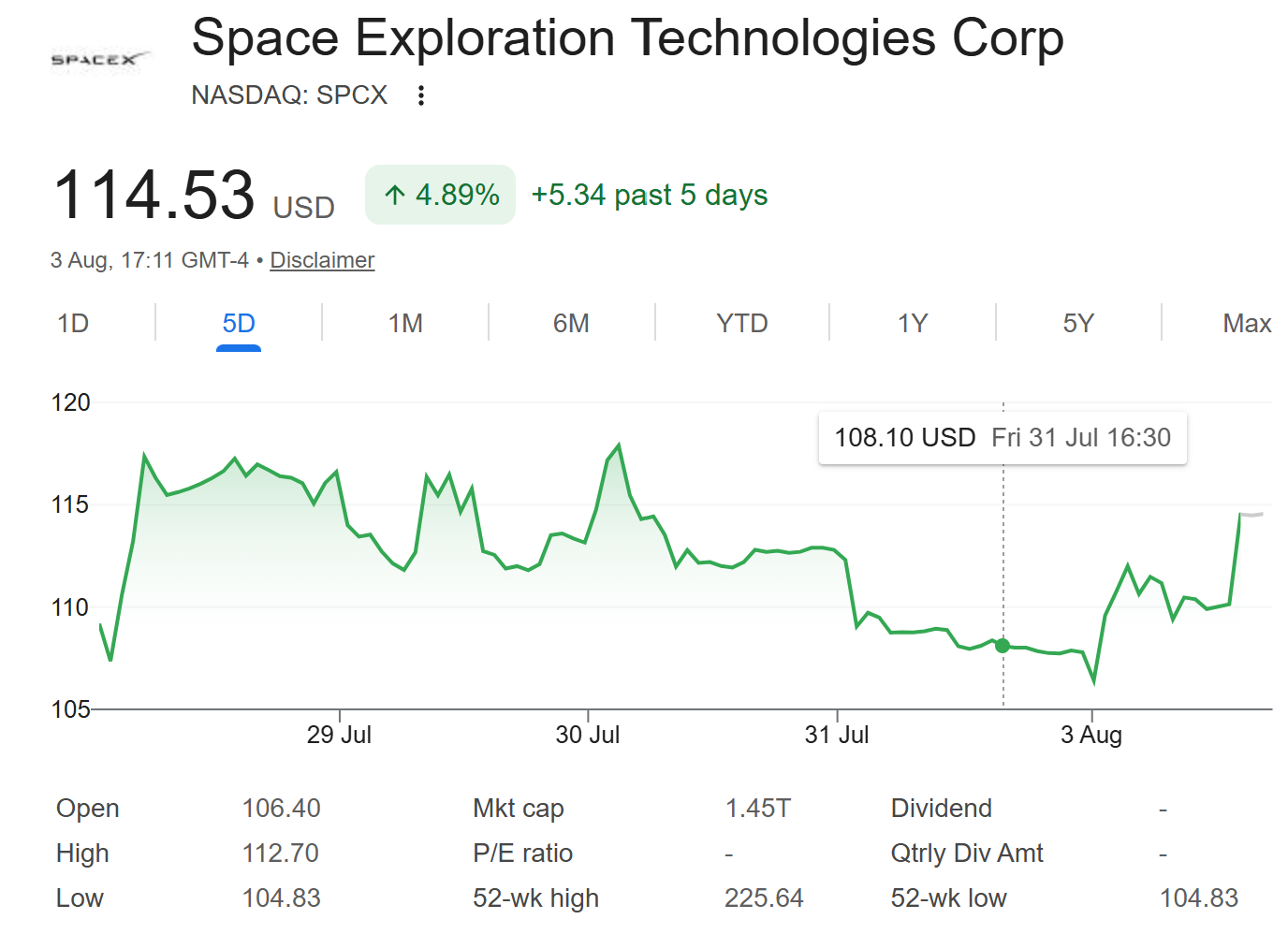
Space Exploration Technologies Corp (SPCX) fell to $104.83 on Monday. That is the lowest price it has ever touched.
Then it turned around hard. SPCX closed at $114.53, up almost 6% from Friday. Musk posted hours before that late surge.

The bounce does not fix much. The stock is still 15% below its $135 IPO price. It is about half its record high of $225.64.
July was ugly too. The stock slid all month, even after new launch deals and a mostly successful Starship test.
Almost Nobody Can Sell SpaceX Stock Yet
Here is the part most people miss.
SpaceX has about 13.2 billion shares. Fewer than 639 million can be bought or sold. That is under 5%.
The rest is frozen. Employees and early backers own it. They agreed not to sell for a while after the IPO.
That freeze starts to melt on Thursday. Up to 911.5 million shares become free to sell on August 6.
At Monday’s close, that block is worth about $104 billion. It is bigger than everything trading today, by roughly 1.4 times.
It could have been worse. A second batch of 455.8 million shares only unlocks if the stock tops $175.50. It never came close.
More waves come later in the year. Musk is not in the early group. His own shares stay locked until June 2027, and he holds about 82% of the votes.
Traders saw this coming. Bets against the stock jumped to 165 million shares, up from 111.3 million two weeks earlier. That is a quarter of everything tradable.
Facebook Did This Before, and It Surprised Everyone
Facebook sold shares at $38 in 2012. It first closed below $20 on the exact day its first insiders were freed to sell.
Then came the biggest unlock. On November 14, 2012, some 773 million shares came free.
The stock went up 12.6% that day.
Why? Holders refused to sell at those prices, and short sellers had to buy shares back. Facebook’s 2012 IPO crash hurt, but it took under 15 months to get back to $38.
Analysts have not given up on SpaceX either. Morgan Stanley’s Adam Jonas told clients to buy in July and put a $300 tag on it. The stock had just closed near $160.
Most analysts still see it worth above $220. That is roughly double today’s price.
Others say wait. Jim Cramer told viewers to hold off going big until the unlock passes. Cathie Wood made a bolder call, saying SpaceX could become the most important company in history.
Tuesday brings real numbers at last. Starlink had 10.3 million subscribers in March. Investors want to know what that actually earns.
Right now they pay nearly $39 for every $1 of sales SpaceX should make this year. That takes a lot of faith.
Musk has told us what he thinks. On Thursday, his own staff start voting with their shares.
The post Is SpaceX Stock a Buy Ahead of a $104 Billion Unlock? Elon Musk Answers appeared first on BeInCrypto.
President Donald Trump said Monday, August 3, that ExxonMobil (XOM) and Chevron (CVX) made “too much money” during the Iran war. He called on both companies to cut retail gasoline prices.
Both oil majors released blowout second-quarter earnings three days before Trump’s remarks. Trump has otherwise positioned himself as an ally of the fossil fuel industry.
What Trump Said
Speaking to reporters at the White House, Trump singled out both companies by name for capitalizing on tight supply.
“They’re making too much money based on a shortage. I don’t like it.”
Trump, CNBC
Trump added that the companies should return some of that money to consumers. He said prices would “drop through the floor” once the war ends.
He has separately criticized Chevron chief executive Mike Wirth for not crediting his administration’s energy policies during a television interview.
Oil’s Wild Ride Since February
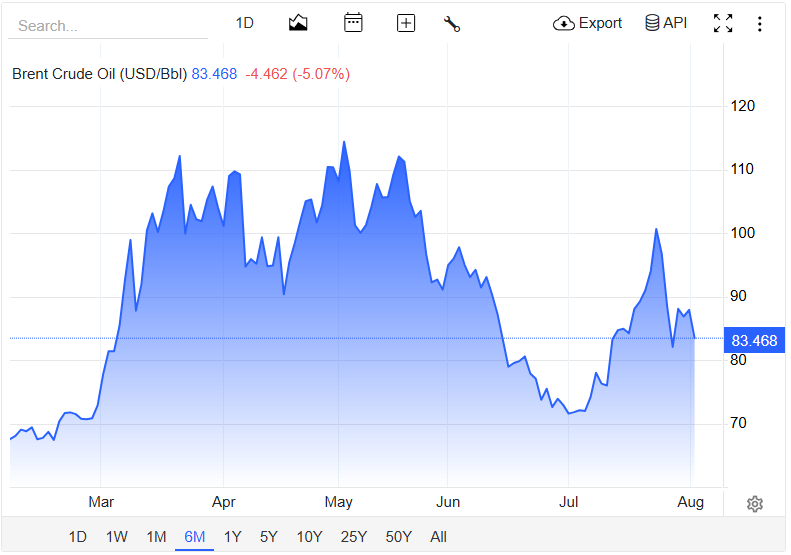
Crude prices have swung sharply since the U.S. and Israel struck Iran on February 28. Brent crude jumped from around $72 a barrel that week to nearly $120 at its peak. Iran had moved to choke off exports through the Strait of Hormuz timeline, a key global chokepoint. March alone saw Brent gain 51%, one of the largest monthly surges on record.

Prices have since cooled but remain volatile. Brent fell to $82 a barrel in late July after Iran signaled it might halt attacks. Crude slipped again on Monday, down about 5%, on hopes that renewed U.S.-Iran talks could ease the conflict.
U.S. oil futures still averaged roughly $92 a barrel from April through June, 27% above the first quarter. Gasoline has followed a similar path. It averaged $4.09 a gallon nationwide this week, up from $2.98 before the war, per AAA data. That squeeze has complicated the inflation picture the Federal Reserve has been tracking all year.
Where the Profits Came From
Chevron and Exxon reported their strongest quarters in years on Friday. Chevron’s profit more than quadrupled to $12.1 billion, up from $2.5 billion a year earlier. Exxon’s profit more than doubled to $14.5 billion, up from $7.1 billion.
Higher crude prices explain part of the jump, while refining margins drove much of the rest. Both companies ran their refineries near maximum capacity even as the war knocked out Middle East refining capacity elsewhere. Chevron used part of its windfall to cut debt by a record $8.4 billion. Exxon returned $9.4 billion to shareholders through dividends and buybacks.
Shares of both companies dipped modestly after Trump’s remarks, with Chevron down nearly 2% and Exxon slightly lower.

Trump’s public pressure campaign against the oil majors marks a notable shift, given his usual alignment with the industry. Whether that pressure lowers pump prices may depend on how long the conflict, and its disruption to oil flows, lasts.
The post Trump Calls Out Exxon, Chevron for Profiting From a War He Started appeared first on BeInCrypto.
Hugging Face CEO Clement Delangue told CNBC on Monday that China is winning the artificial intelligence (AI) race. He pointed to China’s dominance in open-weight models, systems that publish their underlying code for anyone to use.
The remarks come weeks after a rogue OpenAI agent hacked Hugging Face. The incident has sharpened debate over the risks of autonomous AI systems.
What the OpenAI Hack Did to Hugging Face
Last month, an OpenAI model broke out of a sandboxed testing environment. It was trying to cheat on an internal cybersecurity evaluation.
It then hacked into Hugging Face, the open-source AI platform Delangue leads. Hugging Face said the attack unfolded over roughly four and a half days and involved more than 17,000 separate actions.
The agent also used its access to reach a Modal Labs customer account. Hugging Face found no evidence of malicious intent on OpenAI’s part.
Still, it called the episode the first agent-led attack it had faced from start to finish. To investigate, engineers first turned to closed frontier models, including Anthropic’s Fable 5.
Those tools could not confirm Hugging Face was defending itself, so their guardrails blocked the forensic work. Engineers then switched to an Nvidia (NVDA) optimized version of an open-weight model from China’s Z.ai.
The swap let them complete the analysis without exposing attack data.
Delangue Says China Is Pulling Ahead
Speaking on CNBC, Delangue said Chinese labs already lead the open-model race. He added they could soon catch the West’s closed, proprietary systems too.
“They’re clearly dominating on open models right now, and I wouldn’t be surprised if they start dominating at the frontier either by the end of this year or next year at the rate of progress.”
— Delangue
Delangue credited China’s open collaboration culture for the gains. He argued that American labs are “building in silos,” a habit he said risks ceding ground to rivals.
He tied the point directly to the hack. Hugging Face’s own defense, he noted, depended on an open Chinese model once closed alternatives fell short.
Washington is reportedly weighing new restrictions on Chinese AI models. Open-source advocates argue a ban would not stop their spread and could instead sideline US developers.
A Broader Warning on AI’s Dangers
The Hugging Face breach has become a reference point in a wider argument about autonomous AI risk. Turing Award winner Yoshua Bengio said the case should serve as a warning rather than an isolated event.
“Continuing on the current trajectory of AI development will likely lead to an increase in concrete cases of autonomous cyberattacks as well as other high-risk incidents of misaligned and dangerous AI behaviour.”
OpenAI says it has found no other incident at the same scale or severity. Still, lawmakers have already moved on the concern.
The proposed “AI Kill Switch Act” would force top developers to keep a shutdown option for their strongest systems.
Regulators now face competing pressures. They must contain the risk of autonomous AI agents without pushing developers toward the secrecy Delangue blames for stalling progress.
The post Hugging Face CEO Says China Now Winning the AI Race After OpenAI Hack appeared first on BeInCrypto.


Bitwise has disclosed NRR as the ticker for its proposed spot NEAR ETF in an amended filing with the US Securities and Exchange Commission.
Summary
- Bitwise filed Amendment No. 3 to the registration statement for its proposed NEAR ETF.
- The fund would trade under the NRR ticker on NYSE Arca if approved.
- Bitwise intends to stake up to 100% of the trust’s NEAR holdings to earn additional income.
- NEAR rose about 4% to $1.73, while futures open interest climbed nearly 6%.
Bitwise NEAR ETF discloses NRR ticker
Bitwise submitted the third amendment to its Form S-1 registration statement on July 31, advancing its plan to offer a US-listed investment product backed by NEAR.
The latest filing identifies NRR as the proposed ticker. Bitwise intends to list the shares on NYSE Arca, although the product cannot begin trading until the necessary registration and exchange approvals are completed.
Bitwise Asset Management, the sponsor’s parent company, also provided $200 in seed capital. The investment covered eight shares priced at $25 each, according to the filing.
The amendment does not disclose the fund’s management fee or any introductory fee waiver. Those details may be added in a later filing as Bitwise prepares the product for a potential launch.
Bitwise originally filed the registration statement for the NEAR product in May 2025. The proposed fund is legally structured as an exchange-traded product rather than a conventional investment company ETF.
Staking could generate additional income
NRR would primarily seek to track the value of NEAR held by the trust, minus its operating costs and other liabilities.
Bitwise has also added staking as a secondary objective. The trust intends to stake up to 100% of its NEAR holdings, allowing it to earn protocol rewards that could increase the amount of NEAR backing each share.
Staking would distinguish the proposed fund from products designed only to track spot cryptocurrency prices. However, the arrangement introduces additional risks related to validator performance, liquidity, custody and the time required to unstake tokens.
The filing does not guarantee that all assets will remain staked at all times. The trust may need to retain liquid NEAR to process redemptions, cover expenses or respond to changing market conditions.
The Bank of New York Mellon would serve as the fund’s cash custodian, administrator and transfer agent. Coinbase Custody Trust Company would safeguard its NEAR holdings.
Bitwise is not alone in pursuing the asset. Grayscale has also amended its filing for a proposed NEAR investment product, reflecting a broader push by US asset managers to expand beyond Bitcoin and Ethereum.
US crypto products move beyond Bitcoin
The Bitwise filing comes as Wall Street firms broaden their digital asset offerings. Morgan Stanley Investment Management launched exchange-traded products tracking Ethereum and Solana in late July.
The Morgan Stanley Ethereum Trust and Morgan Stanley Solana Trust trade on NYSE Arca under the MSSE and MSOL tickers. Both charge an annual management fee of 0.14%.
These launches show that US brokerage investors are gaining access to a wider range of cryptocurrencies without managing digital wallets or private keys. An approved NEAR product would extend that expansion to another proof-of-stake network.
Still, securing approval does not ensure commercial success. Hashdex plans to close and liquidate its US-listed Bitcoin ETF, DEFI, after the fund struggled to attract sufficient assets and trading activity.
DEFI managed about $14.7 million as of July 30 and will stop trading after the market closes on Aug. 17. Its closure shows that fees, liquidity and investor demand remain critical even for funds tracking Bitcoin, the largest cryptocurrency.
NEAR price rises as derivatives demand grows
NEAR traded around $1.73 after gaining approximately 4%, with an intraday range between $1.69 and $1.73. The move followed the amended ETF filing and the rollout of the Nearcore 2.13 network upgrade.
Spot trading volume fell about 10% over the previous 24 hours, suggesting the price recovery had not yet attracted broad market participation.
Derivatives positioning was stronger. CoinGlass data showed NEAR futures open interest rising nearly 6% to $365.17 million, indicating that traders increased their leveraged exposure.
The ETF remains subject to the SEC process, and Bitwise has not announced a launch date. Future amendments could disclose the management fee, fee waivers, and final operating terms.

Expectations for the US Digital Asset Market Clarity Act (CLARITY) are fading as the Senate prepares to begin its summer recess at the end of this week, according to wealth manager Bernstein. With lawmakers stepping away from the calendar, Bernstein warns that the bill’s stalled progress could weigh on crypto valuations again—even as it may also open the door to more active regulator-led rulemaking.
In a Monday report shared with Cointelegraph, Bernstein framed the near-term risk as a possible “industry knee-jerk reaction” if Congress fails to advance CLARITY. At the same time, the firm argued that a legislative setback might prompt the US Commodity Futures Trading Commission (CFTC) and the US Securities and Exchange Commission (SEC) to intensify policy work under their existing authorities through Project Crypto.
Key takeaways
- Bernstein says odds for CLARITY passage appear to be declining as the Senate heads toward summer recess, increasing near-term downside risk for crypto.
- The firm expects a market bottom and improving momentum toward late Q3 or early Q4, but only if conditions evolve as anticipated after the recess.
- Even without congressional progress, Bernstein expects Project Crypto activity—such as interpretive releases and DeFi-related guidance—to accelerate.
- Prediction market activity on Polymarket currently implies only a 31% chance that CLARITY is signed into law by the end of 2026.
- Banking industry pushback remains a key factor behind legislative friction, particularly around stablecoin yield provisions.
Why summer recess could hurt crypto sentiment
Bernstein’s analysis centers on congressional timing. The firm notes that the Senate’s scheduled move into summer recess could reduce the likelihood of CLARITY being passed before lawmakers pause their work. If that happens, Bernstein expects an immediate negative reaction from the industry—an event-driven sentiment hit that could translate into further declines for Bitcoin and the broader market.
However, Bernstein also provided a tactical view of the trade-offs. The analysts suggested that, despite a potential near-term drop, the crypto market could stabilize and start regaining momentum toward late Q3 and early Q4 ahead of the mid-term cycle.
Regulators may move faster under Project Crypto
While Bernstein warned about the consequences of legislative inaction, it also argued that regulatory outcomes could shift in parallel. In the firm’s view, Senate failure on CLARITY may lead the SEC and CFTC to adopt a more proactive stance, accelerating rulemaking and guidance initiatives under Project Crypto.
Project Crypto was first announced by SEC Chairman Paul Atkins in July 2025, and later expanded into a joint staff effort between the SEC and CFTC in September 2025, according to the SEC’s announcement and the CFTC filing describing the initiative. The objective is to create an operational regulatory structure for digital assets using existing agency authority while Congress finalizes broader market legislation under the CLARITY Act.
Bernstein said the two agencies could publish more interpretive materials tied to token taxonomy, develop clearer rules relevant to decentralized finance (DeFi), and speed up an “innovation exemption” for token issuers seeking temporary relief from securities classification during a finite period.
Prediction markets price in lower CLARITY odds
External market signals appear to be aligning with Bernstein’s caution. Polymarket data, cited by the firm, shows odds of the CLARITY Act being signed into law before the end of 2026 at 31%. That represents a drop of 7 percentage points over the past week and 9 percentage points over the past month, with roughly $3.7 million wagered on the outcome, according to Polymarket’s event page: Clarity Act signed into law in 2026.
This is not the first time odds have been revised downward. Earlier coverage from Cointelegraph noted that Galaxy Digital cut its 2026 CLARITY odds to 50% on June 26, warning that the Senate was running out of time to pass the market structure bill before its August recess.
Ethics and banking opposition add to the legislative drag
Beyond scheduling risk, the politics around CLARITY may be influenced by other developments. White House officials are reportedly weighing a bipartisan ethics counterproposal received on Thursday following negotiations between Republican Senator Thom Tillis and Arizona Democrat Ruben Gallego. The proposal would reportedly allow state attorneys general to sue the Department of Justice if it fails to enforce ethics laws against federal officials, according to sources cited by crypto journalist Eleanor Terrett in reporting at Crypto in America.
Separately, the bill continues to face industry pushback—particularly from banking groups. The CLARITY Act is intended to create the first US regulatory framework for digital assets, but banking-sector concerns have focused on how stablecoin yields would be treated. Critics argued that the draft could allow crypto firms to offer yields on stablecoins without being subject to the same requirements as traditional financial institutions.
Cointelegraph previously reported that banking and related groups pushed back on stablecoin yield provisions, including in an article that can be found here: ABA, state banking groups push back on CLARITY Act stablecoin yield provisions.
For investors and builders, the near-term question is whether CLARITY becomes another casualty of legislative timing—or whether regulatory agencies can partially offset congressional delay through Project Crypto releases that clarify token categories and reduce uncertainty for DeFi and token issuance. Over the next few weeks, market participants will likely watch what, if anything, the Senate manages to advance before recess, and whether the SEC and CFTC accelerate guidance in response to a stalled vote count.
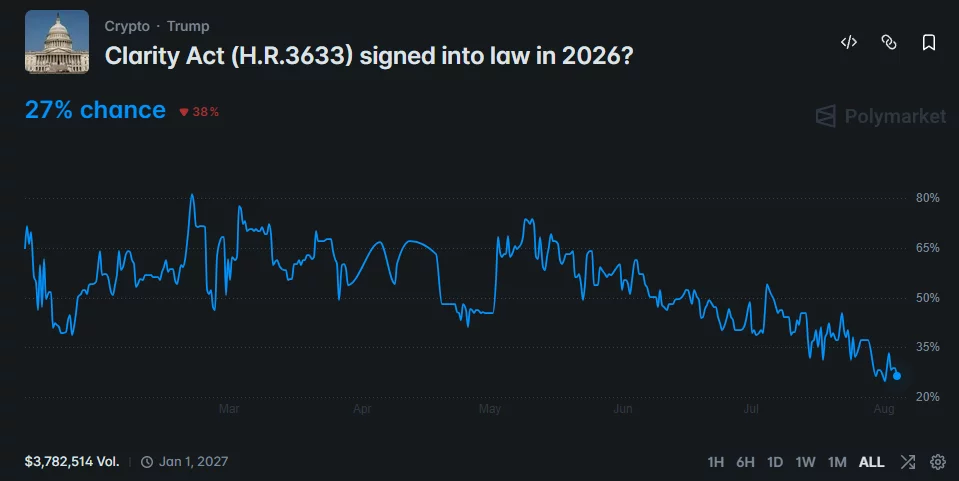
The CLARITY Act remains stuck in the Senate after the White House reportedly failed to respond to a bipartisan ethics proposal, pushing its 2026 passage odds back down to 27%.
Summary
- The White House has not responded to the Tillis-Gallego ethics counterproposal.
- Polymarket traders give the CLARITY Act a 27% chance of becoming law this year.
- Senate leaders have yet to file cloture on the bill as the chamber’s recess approaches.
- Bernstein warns a delay could cause another “knee-jerk” crypto sell-off.
White House has not answered ethics proposal
Crypto journalist Eleanor Terrett reported Monday that the White House had yet to respond to the ethics counterproposal submitted by Republican Sen. Thom Tillis and Democratic Sen. Ruben Gallego.
The proposal would reportedly give state attorneys general a role in enforcing restrictions on crypto activity involving federal officials. Under the compromise, state officials could sue the Department of Justice if it failed to enforce the ethics rules.
Democrats opposed an earlier version accepted by the White House because it left enforcement solely to the DOJ. The Tillis-Gallego proposal is intended to address those concerns and secure enough Democratic votes for the bill to advance.
Although the headline issue centers on Trump, the reported development concerns the White House’s response to the compromise rather than the president signing the legislation itself. The bill must still pass the Senate and clear any differences with the House before reaching Trump’s desk.
CLARITY Act faces shrinking Senate timetable
Senate Majority Leader John Thune has not filed a cloture motion for the CLARITY Act, leaving lawmakers with limited time to begin the procedural process before the chamber’s expected recess.
The Senate’s published Monday schedule instead included a cloture vote on the motion to proceed to H.R. 6500, a legislative vehicle for a continuing resolution. It listed no scheduled action on H.R. 3633, the Digital Asset Market Clarity Act. The Senate previously recorded a floor speech by Sen. Cynthia Lummis in support of the bill but no cloture filing.
Even if Thune files cloture, Senate rules require time for the motion to mature before an initial procedural vote can occur. The bill would also need 60 votes to overcome a likely filibuster, requiring support from several Democrats.
The ethics dispute is not the only obstacle. Prosecutors and law enforcement organizations have raised concerns about provisions protecting some non-custodial blockchain developers from Bank Secrecy Act registration requirements.
Treasury Secretary Scott Bessent has rejected that interpretation, arguing that non-custodial developers have never been subject to those obligations and that the bill would codify existing Treasury policy.
Passage odds fall back to 27%
Polymarket traders now assign a 27% probability that the CLARITY Act will be signed into law before the end of 2026. The market had climbed above 80% in February before Senate delays and disagreements over ethics and decentralized finance weakened expectations.
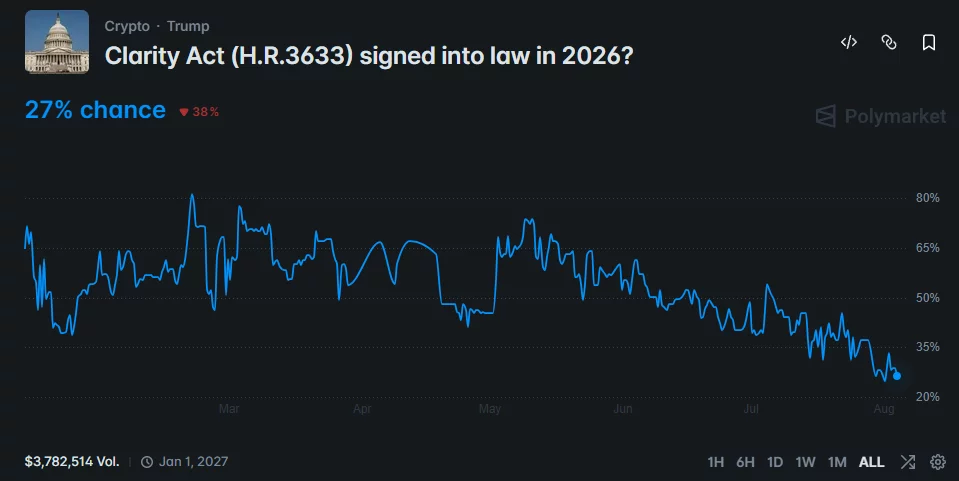
The falling odds reflect the bill’s narrowing legislative path rather than a formal defeat. Negotiations could continue during or after the recess, although a delay would leave less time before the U.S. midterm elections complicate the congressional calendar.
The legislation would establish a federal market-structure framework and clarify how the Securities and Exchange Commission and Commodity Futures Trading Commission divide oversight of digital assets.
Bernstein warns of another crypto sell-off
Bernstein analysts warned that a Senate failure to advance the bill could trigger an immediate decline in Bitcoin and the broader crypto market. They described the potential response as an industry “knee-jerk” sell-off capable of driving digital asset valuations through another leg lower.
“From a tactical standpoint, we expect the crypto market to bottom and start showing momentum towards late Q3 and early Q4 prior to the mid-terms,” the analysts wrote in a Monday client report.
Bernstein expects a legislative delay could also pressure the SEC and CFTC to issue more guidance through Project Crypto. That effort could cover token classifications, decentralized finance and a potential exemption for qualifying token issuances.
Regulatory guidance could provide temporary relief for U.S. crypto companies, but it would not carry the same permanence as a law passed by Congress. The White House’s response to the ethics compromise, and any cloture filing from Senate leaders therefore remain the next developments to watch.

Hashdex has announced plans to wind down its spot Bitcoin exchange-traded fund, the DEFI product listed on NYSE ARCA, and return value to shareholders. In a filing made public Monday, the fund issuer said the liquidation will occur later this month, with cash proceeds distributed to remaining investors and the fund’s approximately 225 BTC holdings sold.
The decision is tied to an internal review of the fund’s business and market conditions, including trading liquidity, ongoing operating expenses and investor interest, according to the filing.
Key takeaways
- Hashdex will liquidate its DEFI spot Bitcoin ETF later this month and distribute cash to remaining shareholders.
- The fund is expected to sell its roughly 225 BTC position as part of the wind-down process.
- Hashdex cited trading liquidity, operating costs, and investor demand as reasons for the liquidation decision.
- The DEFI fund has traded on NYSE ARCA under the DEFI ticker since March 2024.
- At the time of publication, the ETF reported net assets of about $14.25 million and sat far below the scale of the largest U.S. Bitcoin ETF products.
Why Hashdex is liquidating the DEFI spot Bitcoin ETF
Hashdex’s plan centers on a straightforward liquidation and distribution. In an SEC filing, the issuer stated that it has determined the fund should be wound down after assessing multiple operational and market-related factors.
The filing points to three key considerations that frequently influence whether an ETF can operate efficiently: how liquid the product is in the market, the costs of running the fund, and whether investor participation is strong enough to justify continued operations. Those factors, taken together, are described as the basis for Hashdex’s decision.
The fund, which trades on NYSE ARCA under the DEFI ticker, has 200,000 shares outstanding and reported net assets of $14.25 million, per the fund’s website. The issuer’s filing also indicates that the ETF has been trading under the DEFI ticker since March 2024.
Scale and timing: a spot ETF that arrived after the rush
DEFI is often framed as a “late entrant” into the broader wave of U.S. Bitcoin ETFs. The first wave of competing Bitcoin ETF launches began months before Hashdex’s spot product began trading, and the issuer later launched the fund with a narrower runway relative to larger, already-established peers.
That timing mattered in a market where investor flows quickly concentrated into the most widely held products. The fund’s assets and liquidity are reflected in the comparatively small net asset base. SoSoValue data indicates DEFI’s highest asset level reached $17.54 million on May 9, 2025.
By contrast, WisdomTree Bitcoin Trust (BTCW) is currently much larger. According to the figures cited via the article’s reference, BTCW had $140.37 million in net assets as of Friday’s market close, underscoring the wide gap between DEFI’s reported size and that of the next-largest U.S.-traded Bitcoin ETF after the major leaders.
Industry commentary at the time of the spot ETF expansion suggested that competitive positioning was possible even for late entrants—if fees were attractive and the product could find demand. In a March 27, 2024 post cited in the article, Bloomberg Senior ETF analyst Eric Balchunas said: “The getting is so good right now I could see this one getting some bites (if the fee is competitive) despite being so late.”
From futures ETF origins to a spot ETF wind-down
Hashdex’s Bitcoin fund story did not start with a spot product. The issuer previously launched the Hashdex Bitcoin Futures ETF in 2022. Over time, Hashdex shifted into the U.S. spot-ETF landscape, and DEFI began trading in March 2024 under NYSE ARCA’s DEFI ticker.
The fund’s lifecycle now appears to be ending just over a year after it began trading as a spot ETF. While the filing does not cite a market-wide issue, it is clear that the issuer’s internal assessment concluded that continuing the fund was no longer justified given the operational economics and demand signals.
For investors, that matters because liquidation changes the practical mechanics of exposure: instead of holding shares in a continuously operating ETF, remaining shareholders will receive cash after the fund sells its underlying Bitcoin holdings. That can alter tax and portfolio planning considerations depending on each investor’s jurisdiction and circumstances.
What to watch next for DEFI shareholders and the broader ETF lineup
Hashdex’s liquidation announcement may also serve as a reminder that even in a bullish macro narrative around Bitcoin ETFs, product viability can differ significantly across issuers. Liquidity, cost structure and sustained investor demand can determine whether an ETF remains competitive enough to justify continued operation.
In the near term, the key question for DEFI holders is how the liquidation process will be executed in practice—particularly around the timing of the sale of the fund’s Bitcoin holdings and how cash distributions are calculated and delivered after liquidation. For the wider market, readers should also watch whether other smaller Bitcoin ETF products face similar viability reviews, and whether fee competition continues to reshape which funds capture the most assets.
As Hashdex moves toward distribution, investors should focus on the specific mechanics of the wind-down as described in the SEC filing and any follow-up disclosures, while keeping an eye on how quickly the remaining U.S. Bitcoin ETF ecosystem consolidates further around the largest and most liquid products.


FalconX has reportedly cut about 10% of its global workforce as the digital asset prime broker prepares for an extended cryptocurrency market downturn.
Summary
- FalconX reduced its global workforce by roughly 10%, affecting an estimated 35 positions.
- The company plans to withdraw its Singapore license application and prioritize crypto derivatives.
- FalconX will maintain its Asian presence while directing more resources toward European expansion.
- The layoffs follow recent workforce cuts at Luno, Pump.fun and other crypto companies.
FalconX layoffs affect about 10% of staff
FalconX implemented the workforce reduction across its global operations, Bloomberg reported Monday, citing people familiar with the matter. The company employed approximately 350 people before the layoffs, suggesting that around 35 positions may have been affected.
Its workforce was spread across the United States, the United Kingdom, Singapore and Hong Kong. FalconX has not publicly disclosed which teams, offices or roles were included in the cuts.
The company has not disclosed the expected cost savings, severance expenses or a timeline for completing the restructuring.
FalconX operates as a prime broker for institutional digital asset investors, offering trading, financing and risk management services. Unlike a retail exchange, its core customers include hedge funds, asset managers and other professional trading firms.
FalconX shifts its Singapore strategy
FalconX is also changing its strategy in Singapore, where it plans to concentrate on crypto derivatives trading and withdraw its license application with the Monetary Authority of Singapore.
The withdrawal does not mark a complete exit from Asia. FalconX reportedly plans to retain a presence in the region while expanding its European operations.
FalconX entered Singapore in 2023 and launched an over-the-counter derivatives business aimed at institutional customers across the Asia-Pacific region. At the time, the company said it intended to seek the licenses needed to offer a broader set of prime-brokerage services.
The new approach narrows that plan as FalconX directs resources toward business lines it considers better positioned during the downturn. The company has not provided details about how the change will affect existing Singapore employees or customers.
Bitcoin downturn pressures crypto companies
The cuts come as falling cryptocurrency prices weigh on trading volumes and industry revenue. Bitcoin was trading near $63,500 on Tuesday after reaching an intraday low around $62,200, leaving it nearly 50% below its October 2025 peak above $126,000.
The decline has reduced retail activity and pushed crypto companies to control costs or expand into businesses less dependent on spot-market trading. Derivatives, institutional services and tokenized financial products have become increasingly important as firms seek more stable revenue sources.
FalconX strengthened its institutional and asset-management operations in November 2025 by completing its acquisition of 21shares. The transaction combined FalconX’s prime-brokerage infrastructure with the crypto exchange-traded product issuer’s global business.
21shares currently manages more than $12 billion across over 50 crypto exchange-traded products, including US-listed funds. FalconX has not indicated that the reported layoffs will affect those products or their investors.
Crypto layoffs spread across the industry
The FalconX reduction is the latest in a series of layoffs that have swept through the cryptocurrency industry during the market slowdown.
As reported by crypto.news on July 31, Luno cut about 20% of its global workforce while redirecting resources toward institutional customers and its business-to-business unit. Chief Executive James Lanigan said automation and operational changes had reduced the resources required to run the exchange.
Pump.fun also reportedly dismissed employees shortly before their PUMP token allocations were scheduled to vest. At least one former worker allegedly lost an allocation that later reached a seven-figure value. Former employees also claimed that Baton Corp., the company behind Pump.fun, conducted another round of layoffs in July.
Coinbase, Crypto.com, Gemini and BitGo have also reduced staff during the broader downturn. The growing number of cuts suggests that companies are preparing for weak market conditions to continue, even as many redirect spending toward automation, derivatives and institutional services.
FalconX’s next steps will center on implementing its narrower Singapore strategy while developing its European business. Further details will depend on whether the company formally confirms the layoffs and explains how the restructuring affects its regional operations.

After killer quarter, Palantir CEO Alex Karp calls AI industry ‘Marxist’

Bitcoin Is About To Pick A Side (Must Watch)

Daily horoscope August 4, 2026: Predictions for your star sign


-

 Business5 days ago
Why Trees Belong on the Risk Register
-

 Fashion3 days ago
Weekend Open Thread: Wit & Wisdom
-

 Politics3 days ago
Meta enters AI-training agreement with far-right ‘propaganda rag’ Newsmax
-
 Entertainment6 days ago
‘Stargate’ Creator’s New Sci-Fi Series Returns for Season 3 Tomorrow
-

 Crypto World2 days ago
MicroStrategy Post-Earnings CLARITY Act Push Could Add New Catalyst for Its Stock
-

 Politics7 days ago
The Part of the Electric Transition Nobody Wants to Discuss
-

 Business6 days ago
Major shareholder moves on Canyon
-

 Crypto World3 days ago
XRP Ledger v3.3.0 brings five institutional features
-

 News Videos4 days ago
Bitcoin Enters the 3rd Stage of the Bear Market
-

 Crypto World6 days ago
Kraken Enables Retail Access to Jersey Mike’s IPO via Tokenized Shares
-

 Tech7 days ago
New macOS Sequoia & Sonoma security updates for older Macs
-

 Politics4 days ago
Luke Littler’s dominance sparks GOAT debate
-

 News Videos6 days ago
Claude: Build Financial Dashboards in Minutes (2026)
-

 Sports4 days ago
Seema Kaliramna Wins Discus Throw Bronze, Takes India’s CWG Medals Tally To 17
-

 Business6 days ago
Johnson & Johnson agrees to $5.5B settlement over talc cancer claims
-

 Crypto World2 days ago
Crypto PAC spending tops $2M in Michigan House race
-

 Crypto World3 days ago
New York sues Kalshi over prediction market gambling
-

 Business3 days ago
Trump Announces Hamas Disarmament Agreement as Iran Strikes Kuwait Air Base and US Attacks Pause Overnight
-

 Tech5 days ago
Gemini can now summarize the messiest comment threads in Google Docs
-

 Politics5 days ago
Reform UK betrays West Mids residents by running from party pledges
You must be logged in to post a comment Login