
Crypto World
TRM Labs On-chain Evidence Key to Convicting 3 Terrorism Financiers


Indonesia’s courts are increasingly accepting on-chain evidence as a legitimate basis for terrorism-financing prosecutions, marking a notable shift in how blockchain data is treated in legal proceedings. In cases resolved in 2024 and 2025, authorities relied on wallet addresses, transaction histories, and on-chain flows to build the narrative of illicit funding, a development highlighted by TRM Labs as a sign that crypto traces are becoming a cornerstone of prosecutorial work.
“Indonesian courts have demonstrated that cryptocurrency evidence — wallet addresses, transaction histories, on-chain flows — is not only admissible but can anchor a terrorism financing prosecution,” said TRM Labs in a statement. The firm adds that these cases reflect a broader trend in which regulators and law-enforcement agencies are nearing parity with traditional financial channels when pursuing illicit financing.
TRM noted that terrorism-financing networks have increasingly used cryptocurrency as a movement mechanism, partially because authorities have historically scrutinized fiat channels more intensively. However, the framework is evolving, with courts and investigators reportedly closing the gap between digital traces and real-world consequences.
In Indonesia, one defendant allegedly sent more than $49,000 in USDt across 15 transactions from a domestic exchange to a foreign platform, with funds later routed to an ISIS-linked fundraising campaign in Syria, according to blockchain analytics cited by TRM Labs. The tracing work was conducted by Indonesia’s financial intelligence unit and the counterterrorism police unit, Densus 88, who presented the findings to the courts. The blockchain data was deemed a pivotal piece of evidence in each of the three cases.
TRM Labs emphasized that the Indonesian case underscores a broader Southeast Asian push to harness blockchain intelligence in criminal investigations, as authorities increasingly view crypto-forensics as a critical enforcement tool.
“Similar patterns are emerging across Southeast Asia, where governments are investing in blockchain intelligence capabilities and enhancing collaboration between public and private sectors to address illicit finance risks.”
Beyond Indonesia, regional authorities are building capacity to trace cryptocurrency flows. TRM noted that Singapore and Malaysia’s financial-intelligence units and law-enforcement agencies are expanding technical capabilities to follow crypto activity across borders, reflecting a growing regional emphasis on digital-forensics as part of anti-financial-crime strategies.
These developments sit against a broader backdrop of regional enforcement and cases that illustrate the expanding role of crypto-tracing tools in Southeast Asia. In April, Cambodian and Chinese authorities extradited Li Xiong, a leader of the Huione Group, to China to face fraud and money-laundering charges connected to the organization’s scam operations. The move followed the earlier arrest of Chen Zhi, the head of Prince Group, which operates the Huione network. Separately, TRM’s data from 2025 showed a surge in illicit stablecoin activity, with about $141 billion worth of stablecoins flowing to illicit entities, marking a five-year high in this space.
Key takeaways
- Indonesian courts are increasingly accepting on-chain data — including wallet addresses and transaction histories — as admissible and pivotal evidence in terrorism-financing prosecutions.
- A concrete case linked more than $49,000 in USDt moved across 15 transactions from a local exchange to a foreign platform, with funds ultimately directed to ISIS-linked fundraising in Syria.
- Regional significance is growing: Southeast Asian authorities are expanding blockchain-forensics capabilities and fostering cross-sector collaboration to tackle illicit crypto activity.
- TRM data points to a broader scale of illicit crypto use in 2025, including a substantial surge in illicit stablecoin activity, underscoring why forensics capacity matters for regulators and law enforcement.
Courts and crypto traces: what changed in Indonesia
Central to the Indonesian cases was the application of blockchain analytics by the country’s financial intelligence unit in tandem with Densus 88, the national counterterrorism police unit. By correlating on-chain activity with exchange flows and cross-border transfers, investigators constructed a continuous chain of custody from a domestic source to an international donor and ultimately to a fundraising operation tied to ISIS. The courts’ acceptance of these traces signals a shift in evidentiary standards, aligning digital footprints with traditional investigative records.
TRM’s analysis frames this development as part of a wider trend in which prosecutors are learning to treat crypto evidence not as an adjunct but as a core element of financial-crime cases. The implications for investors and operators are nuanced: while the cases demonstrate that crypto-era enforcement is moving toward greater scrutiny, they also underscore the increasing value of transparent, auditable on-chain activity as a legal tool.
Regional momentum and what it means for the market
The Indonesian trajectory is occurring amid a regional mobilization to fortify crypto-forensics. Southeast Asia is seeing a push to scale capabilities that can trace crypto flows across borders, with Singapore and Malaysia cited as examples of jurisdictions expanding their analytical arsenals and public-private collaboration. For market participants, the trend translates into a more predictable regulatory environment around digital-asset tracing, even as enforcement remains vigilant against abuse.
From an investor perspective, the trend raises several practical considerations. First, the integrity of on-chain evidence can influence case outcomes, potentially elevating the risk-reward calculus for illicit actors and increasing the likelihood of sanctions or asset seizures in connected networks. Second, as authorities invest in blockchain intelligence tools, exchanges and custodians may be called upon to provide faster or more granular data, which could affect due-diligence timelines and compliance costs. Third, the regional emphasis on cross-border cooperation could help standardize some investigative approaches, reducing ambiguity for global firms operating in multiple markets.
Broader enforcement context and ongoing developments
The Southeast Asian enforcement narrative extends beyond Indonesia. In a related development, Li Xiong, a leader of the Huione Group, was captured in Cambodia and China and extradited to China to face fraud and money-laundering charges tied to scam operations. This came three months after the arrest of Chen Zhi, head of the Prince Group, which operates Huione. In parallel, TRM reported that illicit stablecoins activity reached about $141 billion in 2025, signaling a five-year high and reinforcing the importance of robust tracing capabilities for regulators and financial institutions alike.
Taken together, these pieces illustrate a broader pattern: as crypto tracing tools mature and cross-border cooperation intensifies, authorities appear increasingly confident in leveraging on-chain data to pursue financial crime, including terrorism financing. For market participants, that means continuing attention to compliance, transparent corporate disclosures, and readiness to respond to regulatory expectations around crypto-asset flows.
Readers should monitor ongoing capacity-building efforts among Southeast Asian FIUs and law-enforcement agencies, as well as any new court rulings that further define the role of on-chain evidence in criminal cases. The evolving landscape will shape both risk and opportunity for exchanges, wallets, and institutional actors operating in the region.



Artificial intelligence is set to reshape banking, according to Jamie Dimon, who used his latest shareholder letter to outline how deeply the technology is expected to embed itself across JPMorgan Chase.
Summary
- AI is expected to reshape nearly every function at JPMorgan, with adoption likely to move faster than past technological shifts.
- The bank plans to increase technology spending to about $19.8 billion in 2026, with a significant share directed toward AI and supporting infrastructure.
“The importance of AI is real, and while I hesitate to use the word transformational—it is,” Dimon wrote, adding that adoption could move far faster than past innovations such as electricity or the internet.
Unlike those technologies, which took decades to scale, AI deployment “looks likely to accelerate over the next few years.”
Across JPMorgan, the integration effort is already underway, supported by rising technology investment. The bank expects to spend roughly $19.8 billion on technology in 2026, including artificial intelligence, data systems, and cloud infrastructure, according to a report by Business Insider. This figure builds on earlier commitments, with Dimon noting the firm had been allocating about $2 billion annually to AI initiatives as of late 2025.
“AI will affect virtually every function, application, and process in the company,” Dimon said, pointing to long-term gains in productivity.
He also tied the technology’s reach to broader economic and scientific progress, writing that it could help “cure some cancers, create new composites, and reduce accidental deaths,” alongside other improvements in quality of life.
“We will not put our heads in the sand,” Dimon wrote. “We will deploy AI, as we deploy all technology, to do a better job for our customers (and employees).”
Dimon also flagged threats tied to deepfakes, misinformation, and cybersecurity vulnerabilities, warning that missteps in handling the technology could carry lasting consequences.
“These risks are real, but they are manageable if companies, regulators, and governments prepare,” he wrote, cautioning against both overregulation after early failures and complacency in the face of emerging threats.
“The worst mistakes we can make are predictable: overreact at the first serious incident and regulate out important innovation, or underreact and fail to learn from what went wrong.”
He added that effective oversight would require preparation ahead of time and “discipline to fix what’s broken without destroying what works.”
AI could take away jobs
Besides the operational gains, AI’s effect on employment remains a central concern.
“AI will definitely eliminate some jobs, while it enhances others,” he wrote, adding that JPMorgan plans to redeploy affected workers where possible.
Demand for skilled labor, particularly in areas such as cybersecurity and AI development, remains strong, even as routine tasks become more automated.
Concerns about job displacement have grown across the industry. Anthropic CEO Dario Amodei warned earlier this year that advances in AI could remove up to half of entry-level professional roles within five years.
“I have engineers within Anthropic who say, ‘I don’t write any code anymore. I just let the model write the code, I edit it,’” he said at the time. “We might be six to 12 months away from when the model is doing most, maybe all, of what [software engineers] do end-to-end.”
Meanwhile, OpenAI recently called on governments to prepare for economic disruption tied to automation, urging new approaches to taxation, worker protections, and social support systems as AI adoption expands.

The US-Iran war has evolved beyond an energy crisis into a multi-front economic shock, with at least six simultaneous crises potentially threatening global financial stability.
Analyst Crypto Rover flagged the convergence of threats, arguing that the market is “heading towards an everything crisis.”
1. Food Crisis Brewing
The analyst noted that hedge funds have turned net bullish on wheat for the first time since June 2022. The Strait of Hormuz blockade has disrupted roughly 30% of the global seaborne fertilizer trade, sending urea prices up by about 50% since the war began.
With the planting season underway, AI analytics firm Helios warned that global food prices could rise 12% to 18% by the end of 2026.
2. Japanese Bond Market Stress
Meanwhile, Japanese bond yields continue hitting multi-decade highs, a pattern that the analyst says has historically preceded broader market crashes.
3. Private Credit Market Warning
Stress is also compounding in the private credit sector. BeInCrypto reported that many firms, including Blue Owl, BlackRock, and Apollo, have capped withdrawals amid rising redemption requests.
JPMorgan CEO Jamie Dimon has also warned that “losses on all leveraged lending in general will be higher than expected, relative to the environment.”
4. Subprime Loan Delinquencies Rising
Subprime loan delinquency rates have climbed to 10% of total outstanding debt, the highest level in 11 years, according to the Kobeissi Letter.
The rate has more than tripled since 2021, drawing comparisons to the Global Financial Crisis.
“The delinquency rate peaked at ~19% during the 2008 Financial Crisis, when subprime debt was $3.5 trillion and made up ~30% of total household debt. Today, subprime debt stands at $2.7 trillion, or ~15% of the total, still a significant proportion. An increasing number of Americans are falling behind on their debt,” the post read.
5. Growing Stagflation Signals
The surging oil prices have sparked concerns about inflation and even a potential recession. US consumer inflation expectations surged to 6.2% in March. This marked the highest reading since August 2025.
In addition, Saudi Arabia’s Aramco will increase its Arab Light crude price for May sales to Asia at a premium of $19.50 per barrel over benchmarks, according to Bloomberg.
“The expectations for inflation are going up globally. Today, Saudi Arabia sets record-high oil prices for Asia. This is a classic Stagflation case, and it ends up very badly for the economy,” Crypto Rover added.
6. Aluminum Crisis From Iran Strikes
Lastly, an industrial crisis is also shaping up. Iranian strikes on Gulf aluminum plants have pushed prices up more since the conflict began.
Emirates Global Aluminum (EGA) warned that full recovery at its Al Taweelah facility could take up to 12 months.
“Al Taweelah is one of the largest smelters in the world, producing 1.6 million tons of cast metal in 2025, or ~2.3% of global output. The Middle East now represents ~9% of global aluminum production, but the impact is amplified because constraints elsewhere have already eroded inventories, leaving the market with little buffer. Aluminum is used in everything from airplanes to food packaging and solar panels, meaning disruptions ripple far beyond the metals market,” Global Markets Investor reported.
Whether a ceasefire materializes may determine if these parallel crises remain contained or converge into something far larger.
Subscribe to our YouTube channel to watch leaders and journalists provide expert insights
The post 6 Crises Threaten to Cripple the Global Economy Amid Iran War appeared first on BeInCrypto.
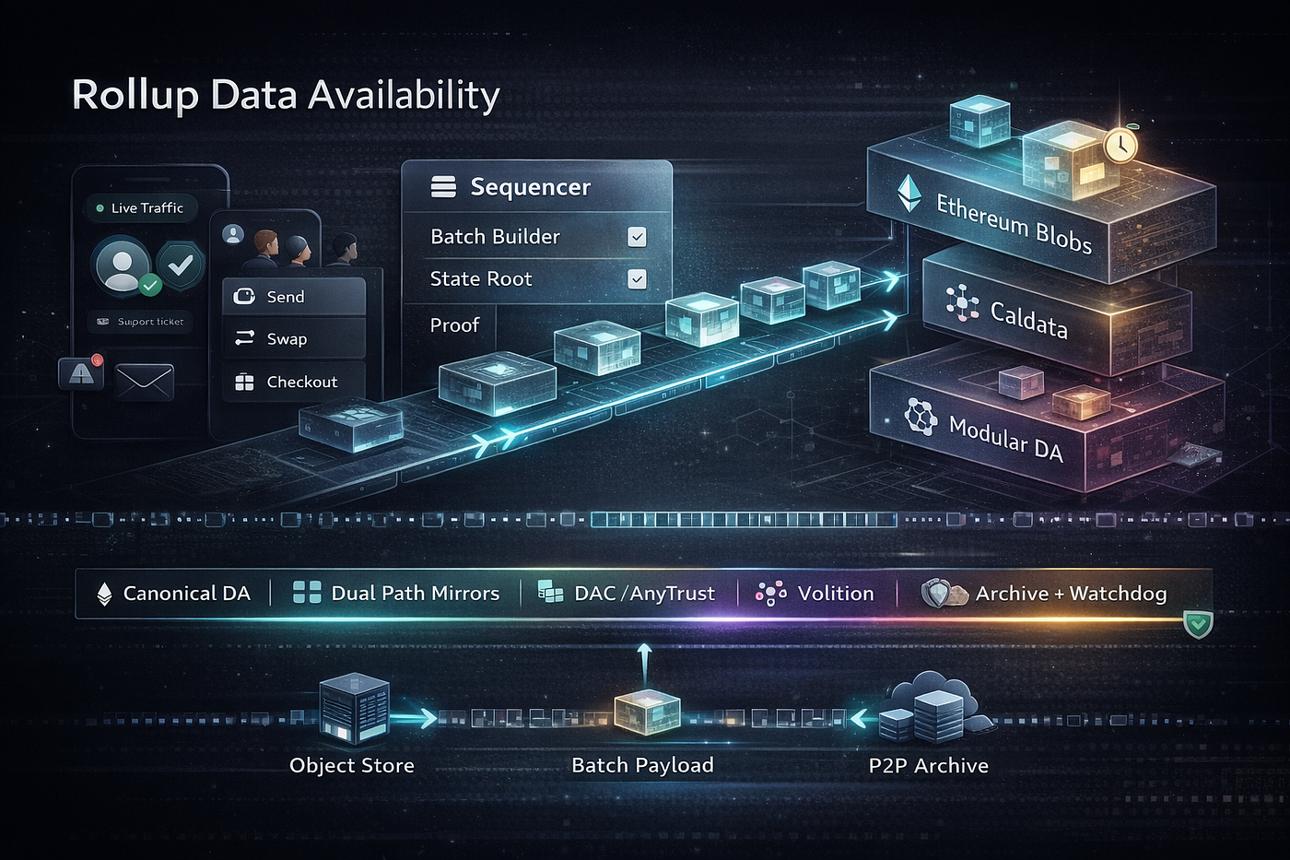
There was a time when blockchains acted like isolated kingdoms—each with its own rules, fees, and limitations. If you wanted to build or transact, you had to pick a side.
That era is quietly ending.
We’re entering a new phase where blockchains are no longer monolithic systems, but modular, interchangeable components—and AI is the operator pulling the strings.
From Monoliths to Modular Systems

Traditional chains like Ethereum historically tried to do everything:
- Execute transactions
- Store data
- Reach consensus
- Settle finality
All in one place.
That’s like asking one machine to be a factory, warehouse, and logistics network at the same time. It works… until it doesn’t scale.
Modular blockchain design flips this model:
- Execution layers handle smart contracts (e.g., rollups)
- Data availability layers store and verify data (e.g., Celestia)
- Settlement layers finalize transactions (often still Ethereum)
Each layer specializes. Each layer competes.
And most importantly, they can be swapped.
Enter AI: The Ultimate Chain Router
Now plug AI into this modular stack—and things get interesting.
Instead of you deciding which chain to use, AI agents will:
- Scan multiple chains in real time
- Compare gas fees, latency, and liquidity
- Route transactions to the most efficient path
Think of it like Google Maps—but for value transfer.
You don’t ask:
“Should I use Arbitrum or Optimism?”
Your AI agent already decided—based on cost, speed, and success probability.
Gas Fees Become a Solved Problem
For years, gas fees have been one of crypto’s biggest friction points.
But in a modular + AI world:
- Fees are no longer static
- Networks become interchangeable
- Optimization becomes automatic
Gas stops being a user problem
…and becomes an AI optimization problem
Bots will:
- Batch transactions
- Time execution windows
- Arbitrage fee differences across chains
The cheapest route wins—every time.
Blockchains Won’t Compete—They’ll Be Selected
Here’s the uncomfortable truth for chain maximalists:
Users won’t be loyal. AI won’t be emotional.
In a plug-and-play economy:
- Blockchains are just infrastructure
- Liquidity flows where conditions are best
- AI chooses the “best chain” per transaction
This flips the competitive landscape:
From:
- Ecosystems fighting for users
To:
- Protocols competing for AI preference
If your chain is slower or more expensive, AI simply routes around you.
The Plug-and-Play Economy
This is where everything converges.
We’re moving toward a world where:
- Developers assemble blockchain stacks like APIs
- AI agents orchestrate execution behind the scenes
- Users interact with simple interfaces, unaware of the complexity underneath
It’s not “multi-chain.”
It’s a chain-abstracted reality.
What This Means Going Forward
- User experience becomes invisible
You won’t think about chains—just outcomes - AI agents become economic actors
They don’t just assist—they decide - Efficiency becomes the ultimate moat
Chains win by being optimal, not popular - Liquidity becomes fluid and dynamic
Capital moves at machine speed
Final Opinion
“Blockchains won’t compete. AI will choose between them.”
And when that happens, the winners won’t be the loudest ecosystems—
They’ll be the ones that machines quietly prefer.
Welcome to the plug-and-play economy.
REQUEST AN ARTICLE
Chaos Labs has terminated its risk management engagement with Aave (AAVE) after three years, citing unsustainable economics and disagreements over how V4 should be managed.
The departure marks the latest in a string of core contributor exits from Decentralized Finance’s (DeFi) largest lending protocol, which holds over $24 billion in total value locked.
Chaos Labs Walks Away From Aave After 3 Years of Risk Management
Chaos Labs founder Omer Goldberg outlined three factors behind the decision.
- Key V3 contributors had already departed, doubling the workload
- Aave V4 introduced an entirely new architecture that expanded operational and legal burdens.
- Despite a proposed $5 million budget, the firm said it would still operate at a loss.
“The engagement no longer reflects how we believe risk should be managed,” Goldberg explained.
Goldberg compared Aave’s risk spending to banking benchmarks. He noted Aave generated $142 million in revenue in 2025.
The firm’s $3 million budget represented roughly 2% of that figure, well below the 6% to 10% banks typically allocate to compliance and risk.
Aave Responds and LlamaRisk Steps In
Aave founder Stani Kulechov acknowledged the departure but pushed back on parts of the narrative.
He revealed Chaos Labs had sought to become the sole risk manager and replace Chainlink price oracles with its own product across new deployments.
Aave Labs rejected both proposals to avoid vendor lock-in.
DeFi risk management firm LlamaRisk, which works with Aave, among other major protocols like Curve and Ethena, pledged full operational continuity. The firm said it would present a detailed transition proposal within the week.
Meanwhile, analyst Duo Nine questioned Aave’s priorities, pointing out that V3 still holds over $24 billion while leadership focused discussions on $10 million in V4 deposits.
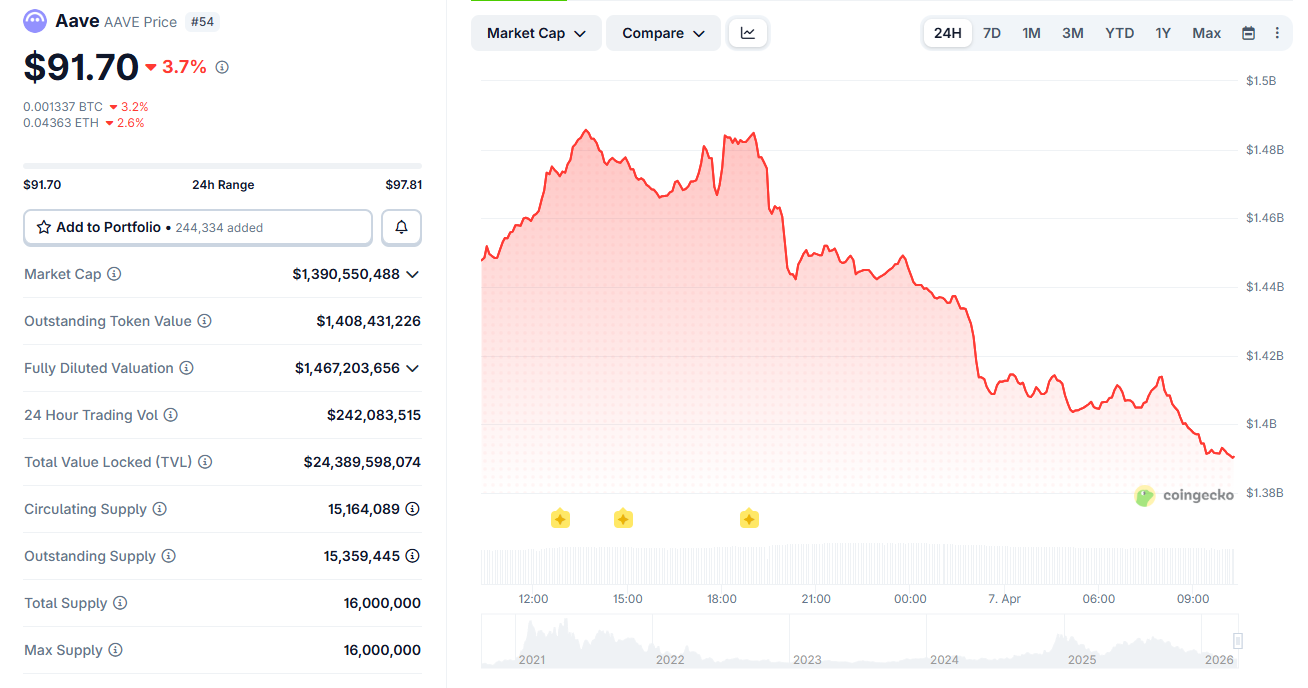
AAVE traded near $92 at the time of writing, down by almost 4% on the day. The token faces sustained selling pressure amid governance tensions and contributor departures, weighing on market sentiment.
The post Chaos Labs Wanted to Replace Chainlink on Aave: Why Stani Kulechov Said No appeared first on BeInCrypto.

Key Highlights
- Bitcoin retreated to $68,589 following a brief rally that evaporated after diplomatic setback, remaining confined within its established $65K–$73K trading corridor spanning six weeks
- A fleeting Monday surge resulted in $196.7 million worth of forced short position closures before Iran’s rejection of the ceasefire terms
- President Trump issued a Tuesday midnight ultimatum to Iran, warning of infrastructure destruction should negotiations collapse
- Crude oil prices jumped beyond $112 per barrel amid heightening geopolitical tensions, while Brent approached $115.66
- Equity index futures declined Tuesday morning despite Monday’s modest gains across the S&P 500, Nasdaq, and Dow Jones Industrial Average
The leading cryptocurrency fell back to $68,589 during Tuesday’s Asian session after optimism surrounding a potential diplomatic breakthrough quickly dissipated. The reversal coincided with President Trump’s establishment of a Tuesday evening cutoff time for Iran to agree to peace terms or confront military action.
A wave of optimism swept through markets Monday following an Axios report detailing a prospective 45-day ceasefire arrangement. The news momentarily propelled Bitcoin beyond the $69,000 threshold and forced the closure of $196.7 million in bearish positions. However, the positive momentum evaporated within approximately half a day.
Tehran subsequently declined the ceasefire framework communicated through Pakistani intermediaries. Iran’s counteroffer included demands for a complete cessation of hostilities, sanctions relief, financial assistance for rebuilding efforts, and guaranteed maritime security through the Strait of Hormuz.
Ether experienced a 1% decline to $2,104. Solana registered a 2.7% decrease to $79.75. XRP fell 1.6% to $1.32. Dogecoin declined 2.2% to $0.09. BNB remained relatively stable at $598.
“This move looks less like a shift in fundamentals and more like positioning getting caught offsides,” said Diana Pires, chief business officer at sFOX. Bearish sentiment had been building before the ceasefire headlines forced traders to unwind short positions quickly.
Energy Markets Spike Following Presidential Warning
The President issued stark warnings to Tehran, threatening to eliminate “every bridge in Iran” and render each power facility inoperable should negotiations fail by the Tuesday midnight threshold. Paradoxically, he simultaneously characterized discussions as progressing favorably.
🚨 President Trump: “Tuesday will be power plant day”
US futures -0.54%$SPY $QQQ #Iran pic.twitter.com/ylWFfvAp6c
— Crypto Seth (@seth_fin) April 5, 2026
US crude prices escalated above $112 per barrel. Brent futures traded approaching $115.66, representing a 2.9% session increase. Accelerating energy costs compound existing macroeconomic uncertainties.
Equity futures contracts weakened Tuesday morning in anticipation of the diplomatic deadline. S&P 500-linked contracts and Nasdaq 100 futures retreated 0.4% and 0.5% respectively. Dow futures registered approximately a 0.2% pullback.
Equity Markets and Economic Indicators Under Scrutiny
Notwithstanding Tuesday’s futures weakness, the previous session concluded on a positive trajectory. The S&P 500 climbed nearly 0.5%. The Nasdaq delivered comparable performance. The Dow Jones added over 160 points.
Maritime traffic through the strategic Strait of Hormuz demonstrated improvement this week, offering marginal relief. Chinese and Japanese ports welcomed the highest concentration of tanker arrivals, alleviating some supply chain concerns.
March services sector data for the United States revealed decelerating economic growth. Labor market indicators contracted at the most severe pace observed since 2023. Cost pressures intensified. The mixed signals provide limited guidance for Federal Reserve monetary policy deliberations.
Critical inflation metrics are scheduled for Friday release. Market participants are simultaneously monitoring preliminary February durable goods figures, expected Tuesday morning. Delta’s quarterly earnings announcement is anticipated Wednesday.
Trump posted on Truth Social urging Iran to reopen the Strait, and separately stated that “the American people would like to see us come home,” signaling possible pressure to wind down the conflict.
The flagship cryptocurrency has maintained its position within the $65,000 to $73,000 corridor throughout the duration of geopolitical tensions. Trump’s Tuesday midnight ultimatum will likely prove decisive in determining whether the upper or lower boundary faces near-term pressure.



Recently uncovered phone records point to multiple calls between Argentine President Javier Milei and a Libra-associated entrepreneur.
Summary
- Call records show Javier Milei spoke seven times with a Libra-linked entrepreneur around the timing of his promotional post on X.
- The Libra token surged after the endorsement before losing over 96% of its value.
Phone logs reviewed by prosecutors, and reported by The New York Times, indicate that Milei exchanged seven calls with an entrepreneur linked to the Libra token on the same night he posted about the cryptocurrency on X.
The calls reportedly took place both before and after the post went live, though investigators have not disclosed what was discussed.
Those findings appear to challenge Milei’s earlier insistence that he had no ties to the initiative.
At the time, he framed his involvement as limited to amplifying what he described as a private venture that would support Argentina’s economy.
“A few hours ago, I posted a tweet, like so many infinite other times, supporting an alleged private venture with which I obviously have no connection whatsoever,” Milei said in a statement on X following the fallout.
“I wasn’t aware of the details of the project, and after becoming aware of them, I decided not to keep promoting it,” he said at the time.
The Libra token briefly surged after Milei’s endorsement in February 2025, as he presented it as a tool to fund small businesses and startups. Momentum quickly reversed, with the token losing more than 96% of its value from peak levels.
However, as it fell, it wiped out roughly $251 million in investor funds and triggered accusations that the episode resembled a rug pull.
After the fallout Argentine lawyers filed fraud complaints against Milei, while some political figures called for impeachment proceedings. Under Argentine law, fraud convictions can carry prison terms ranging from one month to six years.
Federal prosecutors opened a formal investigation into the matter, naming Milei as a person of interest. The probe remains active, with authorities continuing to examine financial links, communications, and the role of individuals connected to the token’s launch.
Argentina’s Anti-Corruption Office concluded in June that Milei had not breached public ethics rules, determining that his post was made in a personal capacity rather than as head of state.
New details put Milei under scrutiny
More recent findings, however, have added another layer to the case.
A judicial update in March revealed that investigators had uncovered a draft document on the phone of crypto lobbyist Mauricio Novelli.
The note referenced a potential $5 million arrangement tied to the Libra promotion, drafted just three days before Milei’s post. The document did not specify who would receive the funds, leaving its purpose and beneficiaries unclear.


A new security framework has been unveiled by the Solana Foundation to audit Solana-based protocols and strengthen risk monitoring.
Summary
- Solana Foundation introduced the STRIDE security framework to assess and monitor risks across DeFi protocols.
- A new incident response network has been set up to coordinate real-time threat intelligence and response efforts.
- The move follows recent exploits, including a $280 million loss at Drift Protocol.
According to the official announcement, the initiative was developed with Asymmetric Research and is called STRIDE. It is designed to assess and track the security of projects on Solana. The program sets a standard process to identify risks, monitor vulnerabilities, and escalate threats across the ecosystem.
Under STRIDE, protocols are evaluated across eight areas, including program integrity, governance controls, oracle dependencies, infrastructure setup, and operational practices. It also covers supply chain exposure, incident response readiness, and forensic capabilities tied to log management. Each participating protocol undergoes an independent review, with results disclosed publicly.
“This gives users, investors, and the broader ecosystem real transparency into the security posture of the protocols they interact with,” Asymmetric Research said.
Alongside STRIDE, the foundation unveiled the Solana Incident Response Network (SIRN), a coalition of security firms designed to coordinate real-time responses to active threats.
“Members will share threat intelligence, coordinate responses to active incidents, and contribute to the ongoing evolution of the STRIDE framework,” the foundation said in its statement.
Just days earlier, Drift Protocol suffered a $280 million exploit, which investigators linked to social engineering tactics tied to North Korean-affiliated actors.
Data from DefiLlama shows that over $168 million was stolen from 34 DeFi protocols in Q1 2026. While that figure is sharply lower than the $1.58 billion recorded during the same period in 2025, the persistence of attacks continues to highlight structural risks in decentralized finance.
While not explicitly referenced in the announcement, recent cases point to the increasingly complex tactics and the use of AI-driven tools to execute exploits. In January, Step Finance lost roughly $40 million after attackers leveraged automated agents to execute rapid transfers, amplifying the scale of the breach, according to reporting from KuCoin.
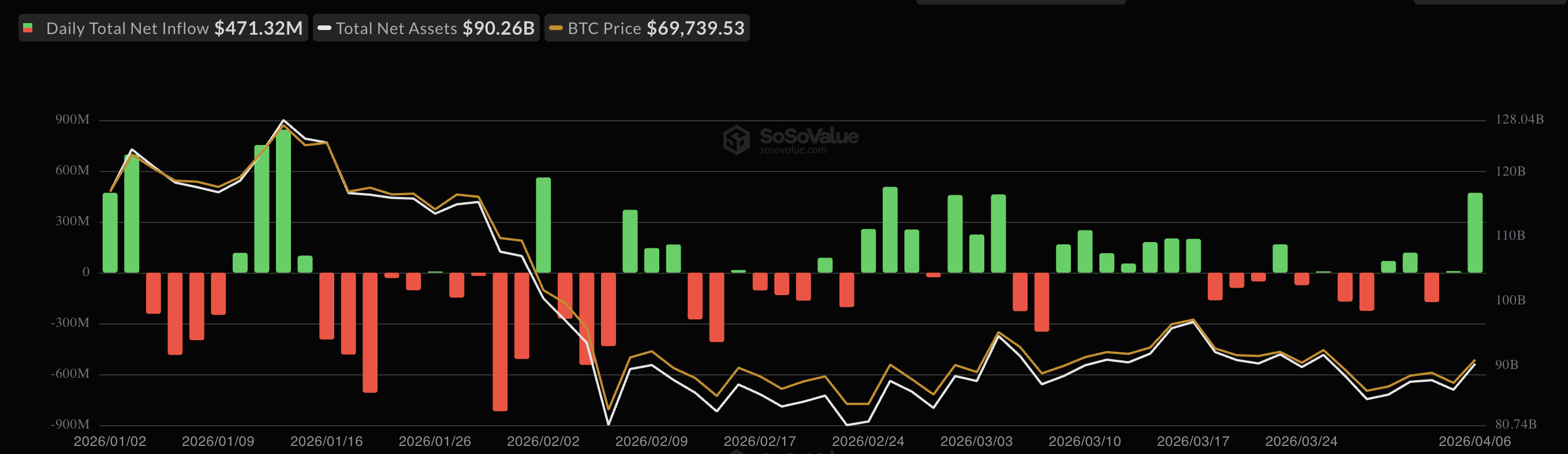
US-listed Bitcoin (BTC) exchange-traded funds (ETFs) recorded $471.32 million in net inflows on April 6, their strongest single day since February 25.
The surge lifted total cumulative net inflows to $56.43 billion. Not a single ETF posted negative flows on the day, with six registering zero and six finishing in positive territory.
Bitcoin ETF Inflows Clash With Weakening On-Chain Demand
According to data from SoSoValue, BlackRock’s iShares Bitcoin Trust (IBIT) led with $181.89 million, followed by Fidelity’s Wise Origin Bitcoin Fund (FBTC) at $147.32 million and Ark & 21Shares’ ARKB at $118.76 million. Together, the three funds accounted for roughly 95% of the inflows on April 6.
Grayscale’s mini BTC trust added $17.59 million, Bitwise’s BITB contributed $3.79 million, and VanEck’s HODL recorded $1.97 million.
Follow us on X to get the latest news as it happens
The strong ETF day arrived against a deteriorating on-chain backdrop. CryptoQuant data shows 30-day apparent demand fell to approximately -87,600 BTC by April 5.
“The situation continues to deteriorate, even though Bitcoin is still managing to remain within its current range. As long as this dynamic does not improve, Bitcoin will likely struggle to break out of this rather negative environment,” analyst Darkfost noted.
Wallets holding 1,000–10,000 BTC have flipped to net distribution, with 1-year holdings swinging from roughly +200,000 BTC at the 2024 peak to about -188,000 BTC. The shift represents one of the most aggressive distribution cycles on record, according to the analytics firm.
Meanwhile, spot Ethereum (ETH) ETFs also saw renewed interest. The funds attracted $120.24 million in net inflows on April 6, the highest single-day total since March 17’s $138.25 million. The inflow snapped a short red stretch in which ETH products posted outflows on two previous trading sessions.
Subscribe to our YouTube channel to watch leaders and journalists provide expert insights
The post Spot Bitcoin ETFs Post Strongest Day Since Late February as $471 Million Pours In appeared first on BeInCrypto.
Key Takeaways
- Cardano is struggling to maintain levels above $0.25 following an unsuccessful rebound effort, with selling pressure persisting throughout the week.
- Derivatives market open interest contracted by approximately 8% over a 24-hour period, accompanied by $701,830 in long position liquidations.
- The open interest-weighted funding rate shifted into negative territory at -0.0132%, indicating short position preference among traders.
- Major holder wallets containing over 10 million ADA tokens climbed to 424, marking a four-month peak and representing a 5% increase over nine weeks.
- Critical price support level identified at $0.2328, while the 50-day exponential moving average presents resistance at $0.2681.
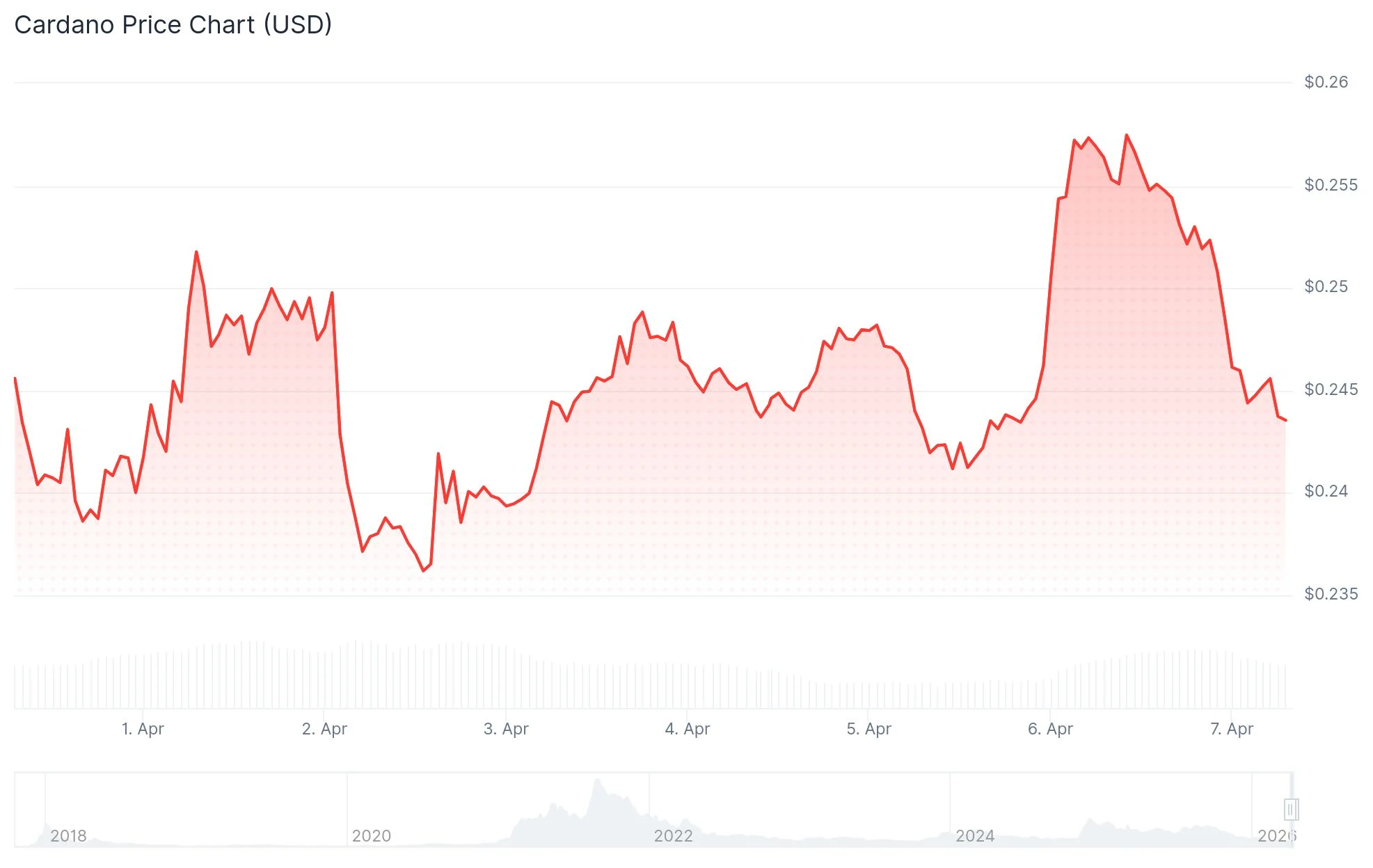
Cardano (ADA) faces continued selling pressure this week, remaining stuck below the $0.25 threshold amid widespread cryptocurrency market turbulence. An early-week attempt at recovery quickly faded, pushing the token back into negative territory.
Early in the week, ADA managed to push toward $0.2546, registering a 5.42% intraday increase alongside a dramatic surge in trading activity that exceeded 100%, bringing volume to $515.84 million. Unfortunately, this upward movement proved short-lived.
Market observer Alpha Crypto Signal identified a falling wedge breakout on the 4-hour timeframe, with ADA successfully reclaiming its descending resistance line and near-term moving averages. According to the analyst, sustained momentum could drive prices toward the $0.27–$0.29 range, though inability to defend the breakout zone risks invalidating the bullish pattern.
Futures Market Data Reflects Near-Term Pessimism
Derivatives metrics from CoinGlass reveal that ADA futures open interest declined by roughly 8% to reach $401.35 million during the past day. Combined liquidations totaled $1.10 million, with long traders absorbing the majority at $701,830.
The funding rate metric weighted by open interest has fallen to -0.0132%, indicating that market participants are willing to pay for maintaining short exposure. This dynamic reflects prevailing bearish sentiment among derivatives traders.
Market analyst UniChartz emphasized the $0.23–$0.24 price range as a critical demand zone, observing that this region has previously catalyzed significant rallies. Should buyers successfully protect this floor, the initial resistance target stands at $0.45.
Major Holders Increase Positions to Multi-Month Peak
Blockchain analytics from Santiment demonstrate that addresses holding more than 10 million Cardano tokens have expanded to 424, representing the highest count in four months. This reflects growth exceeding 5% throughout the previous nine-week period.
Such accumulation activity during price weakness typically suggests institutional or high-net-worth investors anticipate future appreciation over extended timeframes.
The Relative Strength Index currently hovers near 44, while the Moving Average Convergence Divergence indicator has edged into positive territory close to the baseline. These technical indicators point toward tentative stabilization without confirming a definitive trend change.
Near-term price support rests at $0.2328, corresponding to the March 29 bottom. A violation of this floor could expose the February 5 low at $0.2205. Conversely, reclaiming the 50-day exponential moving average positioned at $0.2681 would open the path toward $0.2992.
TLDR
- The Third Circuit Court of Appeals delivered a 2-1 decision preventing New Jersey from applying its gambling regulations to Kalshi’s platform
- Federal Commodity Exchange Act provisions were determined to supersede state-level gambling regulations for sports-event prediction contracts
- The CFTC maintains it has sole regulatory authority over prediction markets, classifying event contracts as swaps under federal law
- Federal courts nationwide are delivering inconsistent judgments, with the Third Circuit supporting Kalshi while the Ninth Circuit backs Nevada’s position
- The CFTC launched lawsuits against Arizona, Connecticut, and Illinois in recent weeks to prevent state-level regulation of prediction markets
A United States federal appeals court has prevented New Jersey regulators from closing down Kalshi’s sports-focused prediction markets, determining that federal regulatory frameworks hold precedence over state gambling legislation.
On Monday, the US Court of Appeals for the Third Circuit issued a 2-1 decision supporting Kalshi, the prediction market operator. The panel determined that New Jersey gaming regulators lacked authority to pursue enforcement measures against the platform.
According to the judges, Kalshi’s sports-focused event contracts fall under federal Commodity Exchange Act jurisdiction. This classification means state gambling statutes cannot govern these activities.
“Kalshi self-certified compliance with the applicable laws and regulations, so those event contracts were presumptively approved under federal law,” the majority ruling said.
The panel emphasized that the CFTC has neither deemed Kalshi’s sports-related contracts contrary to public welfare nor initiated any enforcement proceedings against the company.
In a statement posted on X, Kalshi CEO Tarek Mansour described the decision as “a big win for the industry and millions of users.”
Circuit Judge Jane Roth issued a dissenting opinion, characterizing Kalshi’s offerings as “sports gambling” that are “virtually indistinguishable” from products available on traditional sports betting platforms. She referenced contracts involving NFL game outcomes, point spreads, and scoring totals as evidence.
A Patchwork of Conflicting Court Rulings
Government authorities throughout the United States have initiated legal challenges and issued cease-and-desist directives targeting prediction market operators, including Kalshi and Polymarket. State officials contend these platforms breach state gambling statutes.
Judicial outcomes have varied significantly. While Monday’s Third Circuit judgment supports Kalshi, the Ninth Circuit refused last month to prevent Nevada from obtaining a temporary restraining order against the identical company.
A Nevada state judge also prolonged restrictions on Kalshi only days prior to Monday’s appeals court decision. Another Ninth Circuit proceeding involving several platforms is scheduled for later this month.
CFTC Pushes Back Against State Regulators
Since assuming leadership, CFTC Chair Michael Selig has prioritized prediction market oversight. He maintains the CFTC possesses “exclusive jurisdiction” over event-based contracts.
The previous week, the CFTC initiated legal action against Arizona, Connecticut, and Illinois to block what it characterized as unauthorized state attempts to govern prediction markets.
During remarks at Vanderbilt University on Monday, Selig explained that the agency’s commodity definition is comprehensive and treats sports events, political outcomes, and conventional commodities like corn and grains under the same regulatory umbrella.
The CFTC additionally submitted an amicus brief articulating its position to the Ninth Circuit before next week’s scheduled hearing.
The jurisdictional dispute between state and federal authorities regarding prediction market regulation continues, with numerous cases advancing through the judicial system concurrently.

Greggs to launch permanent chicken sausage roll this week

ECU to buy $72m office building

JPMorgan CEO says AI will transform banking faster than the internet era


-

 NewsBeat5 days ago
Steven Gerrard disagrees with Gary Neville over ‘shock’ Chelsea and Arsenal claim | Football
-

 Business4 days ago
No Jackpot Winner and $194 Million Prize Rolls Over
-

 Fashion4 days ago
Weekend Open Thread: Spanx – Corporette.com
-

 Crypto World5 days ago
Gold Price Prediction: Worst Month in 17 Years fo Save Haven Rock
-

 Business1 day ago
Three Gulf funds agree to back Paramount’s $81 billion takeover of Warner, WSJ reports
-
Crypto World7 days ago
Dems press CFTC, ethics board on prediction-market insider trades
-

 Sports2 days ago
India men’s 4x400m and mixed 4x100m relay teams register big progress | Other Sports News
-

 Business3 days ago
Expert Picks for Every Need
-

 Business5 days ago
Login and Checkout Issues Spark Merchant Frustration
-

 Tech7 days ago
EE TV is using AI to help you find something to watch
-

 Sports7 days ago
Tallest college basketball player ever, standing at 7-foot-9, entering transfer portal
-

 Tech7 days ago
How to back up your iPhone & iPad to your Mac before something goes wrong
-

 Crypto World6 days ago
Bitcoin enters the public bond market as Moody’s gives a first-of-its-kind crypto deal a rating
-
Crypto World6 days ago
Bitcoin stalls below key resistance as technical signals skew bearish
-

 Tech5 days ago
Commonwealth Fusion Systems leans on magnets for near-term revenue
-

 Politics7 days ago
Transform Your Space with Stunning Small Works
-

 Politics6 days ago
Starmer’s centre has collapsed, and the left was right all along
-

 Business7 days ago
Matrix Composites shares up 50pc on new takeover bid
-

 Fashion7 days ago
Tuesday’s Workwear Report: Tavira Sculpt Stretch Crepe Trousers
-
Business2 days ago
No Jackpot Winner, Prize to Climb to $231 Million
You must be logged in to post a comment Login