

Crypto World
Trump Defends CFTC Jurisdiction Over Prediction Markets

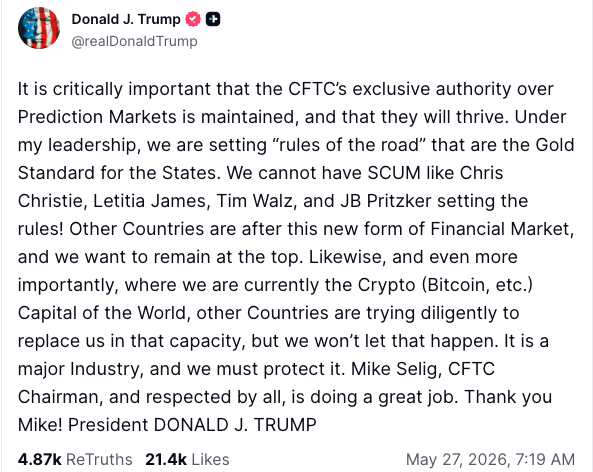
US President Donald Trump has backed the Commodity Futures Trading Commission as having the “exclusive authority” over prediction markets, as state regulators’ action against the platforms mounts.
“It is critically important that the CFTC’s exclusive authority over Prediction Markets is maintained, and that they will thrive,” Trump posted to his social media platform Truth Social on Tuesday.
Trump also took aim at several officials whose states have launched legal action against prediction markets, including Kalshi, Polymarket, Crypto.com and Robinhood.
“Under my leadership, we are setting ‘rules of the road’ that are the Gold Standard for the States,” Trump wrote. “We cannot have SCUM like Chris Christie, Letitia James, Tim Walz, and JB Pritzker setting the rules!”
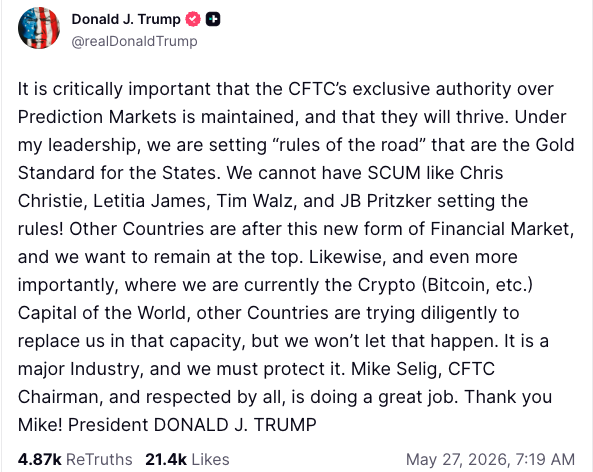
Source: Donald Trump
Multiple state authorities have argued that prediction markets are violating state laws by offering gambling without a license, and have sued or issued cease-and-desist orders to multiple platforms.
Prediction markets such as Kalshi have sued various state authorities to fend off legal action, claiming it is regulated solely by the CFTC.
CFTC Chair Mike Selig has also opposed the states, arguing his agency has “exclusive jurisdiction” over prediction markets as federally regulated designated contract markets.
The agency has sued several states, including Minnesota, Illinois, New York and Arizona for taking action against prediction markets.
Trump said in his post that “other Countries are after this new form of Financial Market, and we want to remain at the top.”
“It is a major Industry, and we must protect it,” he added.
Last month, Trump told reporters he was “not happy” with prediction markets and was “never much in favor” of them in response to a question about well-timed bets on the platforms on events linked to the Iran war, which has drawn the ire of several Democrats who have called for stricter measures.
Related: Hyperliquid launches prediction markets for real-world events
Trump, whose son Donald Trump Jr. is invested in and on the advisory board for Polymarket and is also an adviser to Kalshi, softened his stance on prediction markets days later, saying the US would “get left out in the cold” if it didn’t allow the platforms.
In March, the CFTC established an advisory team to oversee the listing and trading of event contracts and to ensure that market participants satisfy anti-manipulation, surveillance and market integrity requirements.
It claimed that prediction markets fall within the CFTC’s existing derivatives framework under the Commodity Exchange Act.
Magazine: How to fix suspected insider trading on Polymarket and Kalshi


A new draft proposal was submitted to the XRPL Standards repository. It aims to expand XRP Ledger’s automated market maker by allowing liquidity pools to use different pricing curves at their creation.
The Importance of Flexibility
The proposal, which is titled “AMM Swappable Curves” was opened on May 26 by Roman Thpt and Denis Angell. It is currently marked as a draft amendment and is designed to build on XLS-30, the existing XRPL AMM standard.
The core idea behind it is to move the XRPL automated market maker (AMM) beyond a single constant-product model by introducing a pluggable curve architecture.
Under the draft, users who create pools would be allowed to select a curve type when launching their AMM pool. The initially supported curve types include:
- The current constant-product model;
- A concentrated liquidity model, which is similar to Uniswap’s v3;
- a StableSwap-style model designed for correlated assets such as stablecoins.
In the future, the proposal also calls for a weighted Balancer-style curve and a fully programmable smart AMM.
The Motivation Behind it
The purpose behind the proposal is to improve capital efficiency and market flexibility. In today’s version under XLS-30, the AMM spreads liquidity across the full price range. This can make it very inefficient for assets that trade in a narrow range.
Concentrated liquidity, on the other hand, would allow liquidity providers to target specific price bands. With StableSwap, users can enjoy better execution for closely pegged assets.
Moreover, the proposal also retains backward compatibility. This means that existing AMM pools would default to the current constant-product curve, but new curve types would use distinct ledger keys, providing for multiple AMM pools to exist for the same asset pair, each of which would use a different curve.
If the proposal is adopted, it could potentially make XRPL’s native automated market maker more competitive with modern decentralized exchange designs. It could also provide developers with more specialized tools for different market conditions, given the volatile nature of crypto in general.
The post Major Ripple (XRP) Update: Here’s What You Need to Know appeared first on CryptoPotato.
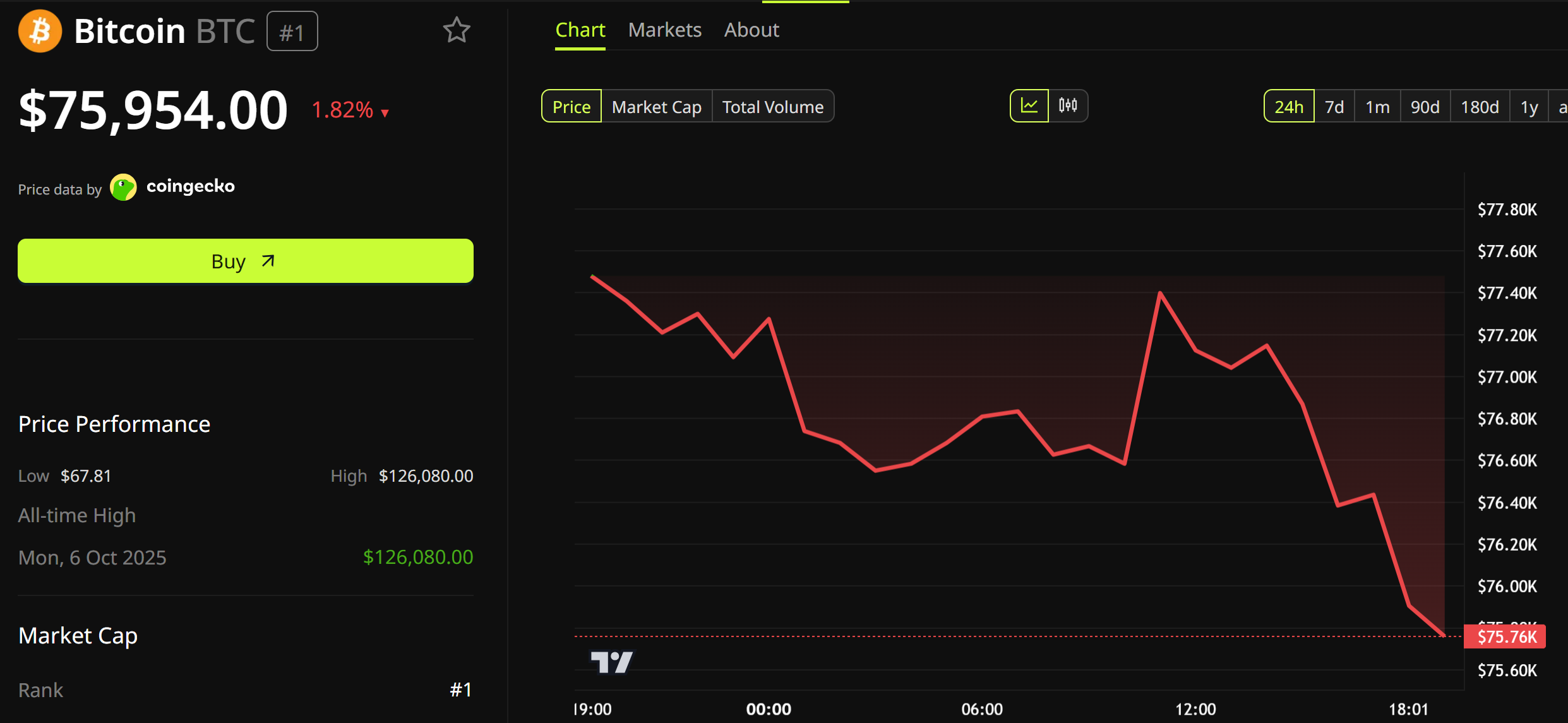
Grayscale Research says SpaceX is on track to become the largest diversified public company holding Bitcoin (BTC). The Elon Musk-led space firm disclosed 18,712 BTC on its balance sheet ahead of an early June listing.
At a current BTC price near $75,954, the holding is worth roughly $1.42 billion. That equals about 0.1% of the $1.75 trillion market capitalization SpaceX is reportedly targeting at IPO.

Why SpaceX Stands Apart From MicroStrategy
Grayscale separates corporate Bitcoin holders into two camps.
- Pure-play digital asset treasuries (DATs) like MicroStrategy hold tokens primarily as a vehicle for equity investors.
MicroStrategy’s record BTC stack now sits near 843,738 coins with limited operating revenue outside that position.
- SpaceX sits in the second camp alongside Tesla’s Bitcoin treasury, Coinbase, and Block.
Its rockets, Starlink network, and government space contracts generate revenue independent of crypto markets. The Bitcoin reserve serves as a small hedge rather than the centerpiece of the balance sheet.
That distinction matters for how investors model the stock. A diversified business with a small BTC position carries different risks than a leveraged Bitcoin proxy.
Follow us on X to get the latest news as it happens
Grayscale Expects More Corporate Adopters
In its report, the firm said corporate buyers often allocate to Bitcoin for the same reason other investors do. The most common motivation cited is portfolio diversification against fiat currency risk.
The asset manager’s 2026 crypto themes point to more diversified businesses following the same path in coming years.

“SpaceX is about to become the largest public company holding Bitcoin,” Grayscale stated.
At least 100 publicly traded firms have adopted some form of BTC treasury policy. Combined holdings now total around 1.24 million Bitcoin, more than 5% of total supply.
The corporate Bitcoin adoption surge keeps drawing in firms outside traditional finance.
MicroStrategy will still dwarf SpaceX in absolute terms. Its stack is more than 45 times larger and trades primarily as a Bitcoin proxy.

SpaceX’s stake, by contrast, will function as a small line item beside its space, satellite, and AI ventures.
SPCX is set to debut on Nasdaq June 12. Early activity in the SpaceX pre-IPO trading market already gives traders a way to position before listing day arrives.
The post Grayscale Reveals The One DAT That Could Beat MicroStrategy’s Bitcoin Treasury appeared first on BeInCrypto.


Pro-crypto Democrat Christian Menefee defeated longtime Representative Al Green in the Democratic primary runoff for Texas’ redrawn 18th Congressional District.
Summary
- Menefee defeated longtime incumbent Al Green after Fairshake-linked PACs made the race a crypto test.
- Fairshake affiliate Protect Progress spent millions backing Menefee and opposing Green before Tuesday’s runoff vote.
- Green’s loss may push crypto policy deeper into Democratic midterm races before November’s 2026 elections.
The Associated Press called the race shortly after polls closed on Tuesday, May 26. Meanwhile, the result ends Green’s two-decade run in Congress and puts Menefee in position for the November election. He will face Republican nominee Ronald Whitfield, according to Axios.
Menefee had already won a special election earlier this year to fill the seat left vacant after former Representative Sylvester Turner’s death. Green entered the race after Texas lawmakers redrew his old district.
Fairshake spending shaped the race
As reported by crypto.news, Protect Progress, a Fairshake-linked super PAC, spent $5 million supporting Menefee and $2.8 million opposing Green before the runoff. The report also said Fairshake had $193 million in cash on hand heading into 2026.
The spending turned the Houston race into one of the clearest early tests of crypto political power in the 2026 cycle. Green had voted against both the GENIUS Act and the CLARITY Act, two bills supported by many crypto policy groups.
Fairshake spokesperson Geoff Vetter said, “Fairshake was the difference-maker in this race.” He added that Green’s defeat showed that anti-crypto positions can carry electoral costs.
Menefee’s crypto stance drew industry support
Menefee has presented himself as open to blockchain policy. His campaign website says blockchain can increase trust, transparency, and efficiency in areas such as finance and supply chains.
Stand With Crypto gives Menefee an A rating and says he strongly supports crypto. The group says he backs clear rules for digital asset businesses, self-custody rights, and clearer definitions for whether assets are securities or commodities.
Green holds an F rating from Stand With Crypto. The group lists his votes against the CLARITY Act, GENIUS Act, FIT21, and other crypto-related measures.
Crypto policy enters the midterm fight
The Texas result comes as crypto policy remains active in Washington. As crypto.news reported, the CLARITY Act faces a tight legislative calendar before the 2026 midterms, while Treasury rulemaking under the GENIUS Act has moved stablecoin oversight deeper into federal compliance work.
The race also follows wider debate over Democrats and crypto. In related coverage, crypto.news reported that Y Combinator co-founder Paul Graham called Senator Elizabeth Warren’s anti-crypto stance a political mistake for Democrats.
Menefee’s win does not settle the national crypto policy debate. It does show that crypto-funded groups can spend heavily in party primaries and point to clear results when candidates take sharply different positions on digital assets.
The past few days saw a few interesting developments concerning both Ripple and its native cryptocurrency XRP. From on-chain developments to claiming some interesting titles, let’s have a look at some of the more important news and see how the price has been doing lately.
XRP Price Update May 27
XRP’s price has been trending downward in the past few days, losing 2.6% during the last week. The move has been mostly in line with the rest of the market, with certain exceptions.
At the time of this writing, XRP is trading at around $1.32.
It’s down 9% over the last two weeks, 8% during the last month, and over 42% over the last year. It appears that the altcoin is unable to take off, although that could be said for many large- and small-cap cryptocurrencies.

As you can see on the graph, the price action has mostly been choppy and range-bound. XRP is unable to escape the $1.3-$1.4 range, which many analysts consider pivotal.
XRP Ledger Unveils New AMM v2 Standard
The XRP Ledger Foundation has officially proposed a significant upgrade to the XRP Ledger’s decentralized exchange in a new draft standard called AMM v2.
The update plans to expand XRPL’s automated market maker framework far beyond the current constant product model that’s used in XLS-30 AMMs. Behind this proposal, liquidity pool creators would be able to choose from multiple curve types. These would be based on market needs, including Concentrated Liquidity pools, StableSwap pools, Constant product pools, and so forth.
The ultimate purpose behind the proposed upgrade is to improve capital efficiency, liquidity, and tokenization across the entire XRPL ecosystem.
Ripple Eyes Tokenized Finance as Next Major Growth Vertical
Real-world assets cryptocurrencies are becoming increasingly popular, and tokenization is taking over Wall Street. That said, Ripple is positioning itself to capture a slice of a projected $18.9 trillion tokenization market in the next six years, according to a joint study between Ripple-BCG and Securitize.
Some of the biggest names in finance are converging on the same idea: tokenization is the next trillion dollar industry.
A number of major forecasts are implying 100x growth from today’s $34 billion market.
The future is bright for tokenization. pic.twitter.com/7zKyiNXrz4
— Securitize (@Securitize) May 26, 2026
The forecast suggests that tokenized assets could grow 100-fold from today’s estimated $34 billion market. Ripple’s strategy focuses on creating the money layer of tokenization, which relies primarily on its stablecoin, RLUSD. XRPL will serve as Ripple’s core infrastructure and already supports hundreds of real-world asset projects.
Ripple: One of the Best Workplaces in the Bay Area (Public Overview)
In an official post, Ripple shared that Fortune Magazine has named the company one of the best places to work in the Bay Area in 2026.
According to the report, 95% of employees at the company believe it’s a great environment. It’s also worth mentioning that the rankings place Ripple above other well-known US-based technology firms.
The post Ripple News and XRP Price Update: May 27 appeared first on CryptoPotato.

Base, the Ethereum layer-2 developed by Coinbase, has unveiled a tool that ties Base accounts to artificial intelligence agents for on-chain operations. The new Base MCP, or Model Context Protocol, lets users prompt AI models such as Anthropic’s Claude or OpenAI’s ChatGPT to perform actions like transferring funds, swapping tokens, checking balances, reviewing transaction history, and using supported apps within Base’s ecosystem.
The interaction is chat-driven: the AI agent suggests an action, and a Base wallet window opens for the user to confirm or cancel. Crucially, the agent never has access to private keys, and every proposed action must be explicitly approved by the user. Base notes that each transaction follows the same review flow as any Base account request, with asset changes simulated before confirmation. This balance between automation and user control is a central design choice as AI agents begin to handle more on-chain tasks.
Coinbase executives have pitched MCP as part of a broader AI-payments strategy. Lincoln Murr, head of AI Product at Coinbase, described the approach as a “nice wrapper” on top of existing APIs, enabling a Base Account to travel with you—your trades, history, and portfolio remain accessible whether you’re operating in-agent or within the Base App. The move also aims to expand the adoption of Coinbase’s x402 protocol, an agentic AI payment standard the company rolled out in May 2025. Together, MCP and x402 are positioned to unlock a new micro-transaction economy, where AI agents can initiate small crypto payments across participating protocols.
That vision sits against a still-nascent market. According to data tracked by x402scan, the x402 protocol processed about $1.1 million in volume over the past 30 days—a reminder that the “agentic payments” thesis remains in early days, even as it attracts attention from investors and developers alike. The broader ecosystem already includes integrations with DeFi protocols such as Morpho, Moonwell, Uniswap, Aerodrome, Avantis, Bankr, and Virtuals, all of which Base notes can be accessed via AI-driven prompts.
As with any AI-enabled on-chain workflow, the concept has its detractors. A recent Google-backed research paper and accompanying university work warned that AI agents should be treated as untrusted system components, emphasizing the need for clear separation between instructions and data to avoid manipulation through malicious prompts. In parallel, industry watchers noted security pitfalls as the broader AI-in-wallet paradigm evolves. Earlier this week, the Socket developer platform disclosed malware targeting crypto developers by injecting hidden instructions to hijack AI coding assistants. These threats underline the careful security stance required for AI-assisted on-chain actions. Fireblocks has also explored agentic payment support for AI agents, signaling a broader industry push toward standardizing these capabilities within trust frameworks.
Key takeaways
- Base MCP enables AI agents to solicit on-chain actions from Base accounts, with user-approved execution through the Base wallet and no direct access to private keys.
- The system supports interactions with major on-chain protocols (Morpho, Moonwell, Uniswap, Aerodrome, Avantis, Bankr, Virtuals), expanding the scope of AI-assisted DeFi activities.
- Base ties MCP to the x402 protocol, aiming to codify agentic AI payments and unlock a micro-transaction economy, though current activity remains modest (around $1.1 million in 30-day x402 volume).
- Security and trust are central concerns, as researchers warn that AI agents can be susceptible to untrusted data flows and malicious prompts, reinforcing the need for robust guardrails and user-confirmation workflows.
How the MCP workflow fits into the evolving AI-on-Chain landscape
At its core, Base MCP functions as an intermediary layer that translates natural-language prompts into concrete blockchain actions, while maintaining human oversight. The user initiates an operation within the AI chat, which then presents a proposed action. The user sees an explicit confirmation step in the Base wallet window, where asset changes are simulated before any real funds are moved. This design preserves security while enabling a more fluid interaction with DeFi protocols through AI agents.
Base’s approach also emphasizes continuity of the user experience. Lincoln Murr has argued that MCP and similar integrations ensure your Base Account remains portable and synchronized across interfaces—whether you’re interacting directly within the Base App or via an AI assistant. This continuity is intended to remove friction that could otherwise hinder adoption of agentic payments, especially if users must jump between separate tools to manage their portfolios.
The MCP initiative sits alongside Coinbase’s broader x402 standard, a framework the company has promoted to enable safe, scalable AI-assisted payments. As MCP matures, developers and users could see more seamless, protocol-bridging transactions that leverage AI agents to navigate liquidity pools, governance actions, and asset transfers with a single chat-based workflow. Yet even with these promises, the path to wide-scale adoption remains gradual, as the $1.1 million 30-day volume figure for x402 indicates a market still in its early innings.
Risks, open questions, and what to watch next
Security remains a central theme in conversations about AI agents in crypto. The research consensus that AI agents can be an “untrusted system component” points to the need for clear separation of commands from data and robust verification checks before any on-chain action is executed. As the AI models gain more capabilities, the potential attack surface grows, making the user-facing confirmation step and simulated preflight checks more important than ever.
Industry developments in the near term will be telling. The Fireblocks collaboration and other industry moves toward agentic payment support suggest a maturation of the technical standards and security practices underpinning these features. Observers will want to watch whether MCP’s adoption accelerates in tandem with x402’s growth, and whether more DeFi protocols come online to respond to AI-driven prompts with trusted, auditable actions.
In addition, regulatory and governance considerations will shape how far AI-assisted on-chain workflows can reasonably scale. Questions about liability, user consent, and data handling will likely influence product design choices and the pace of deployment. For investors and builders, the key is to separate hype from practical utility: MCP’s real value will emerge as more users and protocols participate, and as security guarantees prove resilient in real-world usage.
For now, Base MCP represents a notable experiment at the intersection of AI and on-chain finance, aiming to make complex blockchain operations accessible through natural-language prompts while preserving user control and security. The next chapters will reveal how widely developers embrace the model, how quickly users adopt AI-assisted transactions, and whether the broader market can translate micro-payments into tangible liquidity and new use cases.
Readers should monitor updates from Base on MCP’s roadmap and any expansions to the x402 ecosystem, as well as independent security analyses and regulatory guidance that could influence how and when AI agents become a staple in crypto wallets and DeFi apps. The coming months will indicate whether this approach can scale from experimental tooling to everyday tooling for a broad audience of traders, developers, and crypto-native users.
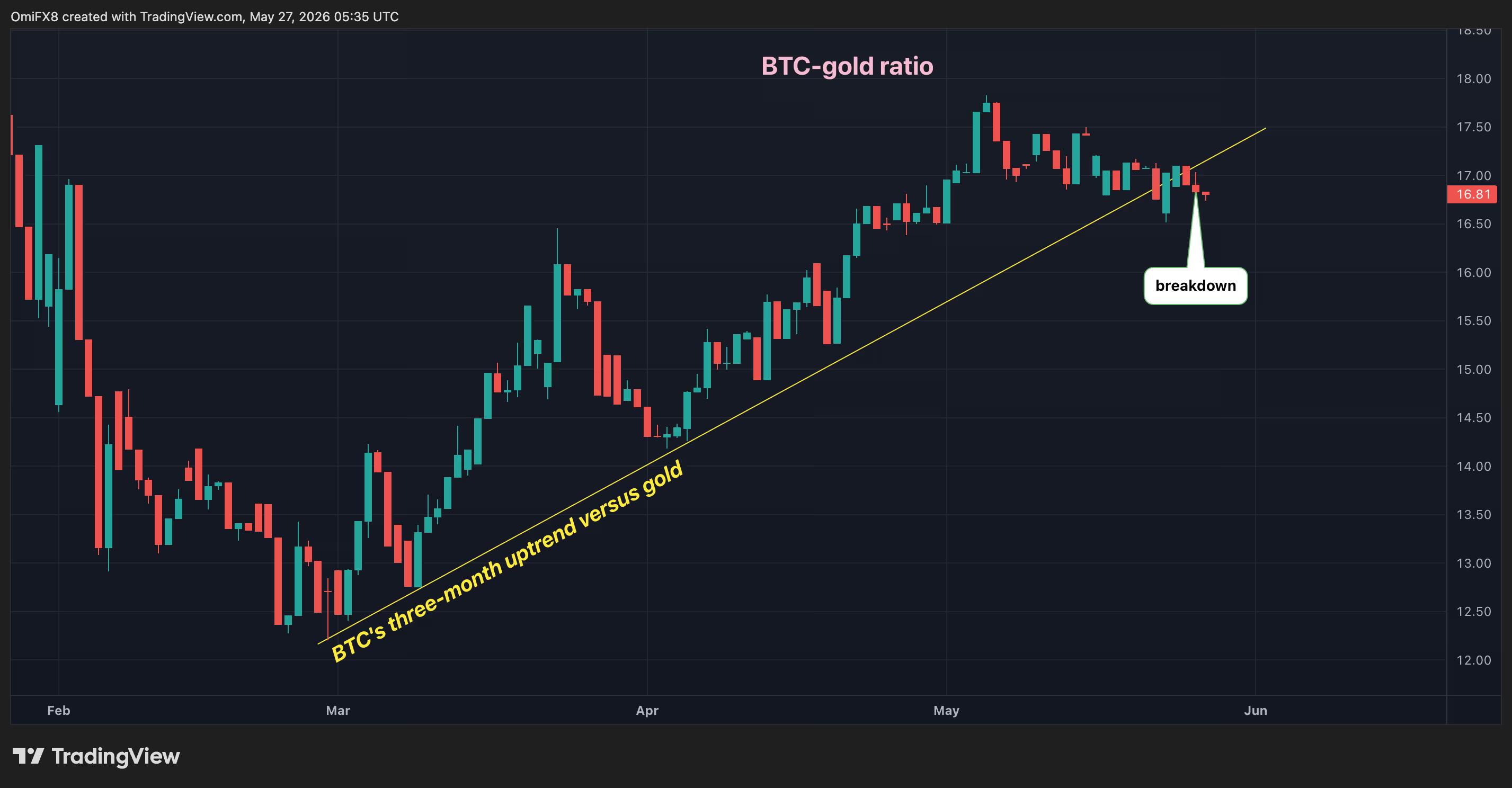
Bitcoin’s three-month uptrend against gold seems to have ended, as ETF flows shift toward gold and other precious metals.
That’s evident from the bitcoin-to-gold ratio, which measures the per-coin dollar price of BTC against the per-ounce dollar price of gold. This is the chart that tells you which “store of value” investors actually prefer at any given moment.
Since early March, bitcoin has been the clear winner, lifting the ratio higher from roughly 12 points to 18 points.
But not anymore.
The growth has stalled lately, and, over the past 24 hours, it has decisively turned lower, snapping the three-month uptrend.

The ratio has penetrated the uptrend line, characterizing BTC’s mini-bull run against gold. In the world of technical analysis, this is a major breakdown, signaling a renewed shift in momentum in favour of gold.
Why this matters
The signal is not just about lines on the chart, but tells us where the smart money may be headed next.
When the Iran war began in late February, and oil prices shot up to over $100 per barrel, investors looked for a place to park cash. And for a while, they bet on bitcoin as a haven, as evidenced by the upswing in the BTC-gold ratio.
But the same ratio has now invalidated its uptrend, pointing to renewed investor rotation into gold.
Note that chart patterns like trendline breakdowns can and often are fleeting, but for now, the message is clear: gold could outperform BTC in the near-term.
Market flows support that interpretation.
Precious metal ETFs in demand
Exchange-traded funds tied to bitcoin have fallen out of investor favor, losing over $2 billion in two weeks amid a hardening of Treasury yields and the prospect of higher-for-longer interest rates in the U.S.
Meanwhile, gold and precious metal funds are in demand. These funds drew $2.34 billion in investor money during the week ended May 20, extending their inflow streak to a second consecutive week, Reuters reported, citing LSEG Lipper data.
As of writing, bitcoin changed hands near $75,600, down 0.3% from midnight UTC hours and gold traded largely flat around $4,500.
Bankless co-founder David Hoffman said he sold his ETH after reassessing the long-running “ETH is money” thesis.
Summary
- Hoffman sold his ETH after saying the asset’s money thesis has largely played out now.
- He remains bullish on Ethereum, but says apps and L2s may capture more value directly.
- Related crypto.news coverage shows stablecoins, L2 fixes, and ETH treasuries still driving activity across Ethereum.
In a May 26 X post, Hoffman wrote that Ethereum has earned its current market position, but he sees less room for ETH to receive a new structural rerating from the market.
Hoffman said the sale does not mean he has turned bearish on Ethereum. He said he remains bullish on the network and its ecosystem, while arguing that only part of that growth may flow back to ETH itself. He framed the decision as a capital allocation move after concluding that “the ‘ETH is money’ thesis has played out.”
Ethereum growth may not flow directly to ETH
Hoffman’s argument centers on how Ethereum creates value. He said the network supports applications, layer-2 networks, stablecoins, tokenized assets, and DeFi, but its open-source design gives much of that value back to the ecosystem.
In his view, Ethereum can grow as infrastructure even if ETH does not capture all of that growth as an asset.
He also pointed to stablecoins as part of that shift. As previously reported in April, Ethereum’s stablecoin supply had reached a record $180 billion, giving the network close to 60% of global stablecoin supply. That supports network use, but it also shows how Ethereum can strengthen dollar-based payment rails rather than only ETH demand.
Meanwhile, as crypto.news reported, Vitalik Buterin said the Ethereum Foundation will sell less ETH under a leaner long-term plan focused on security, privacy, openness, and censorship resistance.
L2 activity remains central to the debate
The same value-capture question also appears across Ethereum’s layer-2 roadmap. Hoffman said L2 teams needed freedom to move fast, but also needed stronger ties to the broader Ethereum economy and brand. His point was that Ethereum’s rollup strategy helps scaling, but may leave more margins with L2s and applications.
As previously reported by crypto.news, Gnosis, Zisk, and the Ethereum Foundation launched the Ethereum Economic Zone at EthCC to address L2 fragmentation. The framework targets more than 20 L2s securing about $40 billion in value and aims to standardize ETH as gas across participating networks.
ETH treasuries show another side of demand
Hoffman’s sale comes as some public companies keep building Ethereum-linked treasury strategies. Crypto.news reported that SharpLink secured inclusion in the Russell 2000 and Russell 3000 indexes, with the move tied to its Ethereum treasury business and broader institutional crypto exposure.
That contrast gives the story its market angle. One Ethereum-native voice has moved away from ETH as a personal holding, while some companies continue to build financial products around the asset.
Hoffman’s position sits between those two views: Ethereum can keep growing, but ETH may no longer offer the rerating he once expected.
The timing also lands during a wider Bankless transition. As crypto.news reported on May 21, Bankless faced backlash over reported staff cuts, while co-founder Ryan Sean Adams said the media brand’s first era had ended. Hoffman’s ETH sale now adds another marker to that shift.
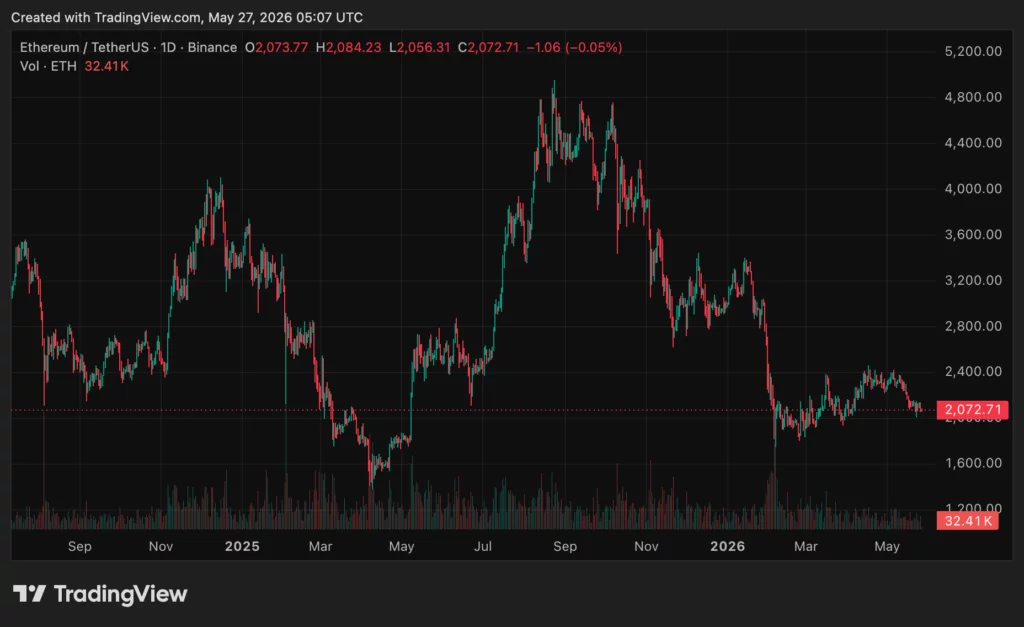
Meanwhile, Ethereum (ETH) traded near $2100 at the time of reporting, indicating 1% decline in the past 24 hours and 2% decline in the past week, based on crypto.news data.

Crypto investor ‘DeFi Dad’ said on Tuesday that once Ether prices reach $5,000, it will take off, mirroring the price action Bitcoin saw almost a decade ago.
The last cycle “was so off for ETH, despite all that’s been built on Ethereum,” he said, citing major institutional involvement, stablecoins, and ETFs.
“Fundamentals clearly needed time to catch up with price, and we over-corrected as we normally do in crypto.”
ETH to $20K or $1,500?
He forecast ETH could rise tenfold to around $20,000 in the next bull market by mirroring Bitcoin’s 2017 fractal patterns, with explosive gains in 2027 to 2028 following the current bear market.
DeFi Dad took 12 months of fractals from BTC price action in 2017 when it exploded from $2,000 to $20,000 to map out what 12 months of price action might look like for Ethereum after the market has bottomed.
However, that market bottom is still looming, and analyst ‘Chain Mind’ predicted that ETH would dump back to the $1,500 level if current support is lost.
ETH IS GOING TO DUMP HARD SOON?
This is the crucial moment for ETH:
Hold = we are going up
Break = dump to ~$1,500 levelsMeans the next daily close decides the next major ETH move.
Notifs on, I’ll update you on this pic.twitter.com/q22p7ssg9d
— 𝗖𝗛𝗔𝗜𝗡 𝗠𝗜𝗡𝗗
(@0xChainMind) May 25, 2026

This would be a “trendline reset,” sending prices back to October 2023 and April 2025 levels when Ether crashed to long-term support at $1,500.
“This is the crucial moment for ETH,” the analysts said.
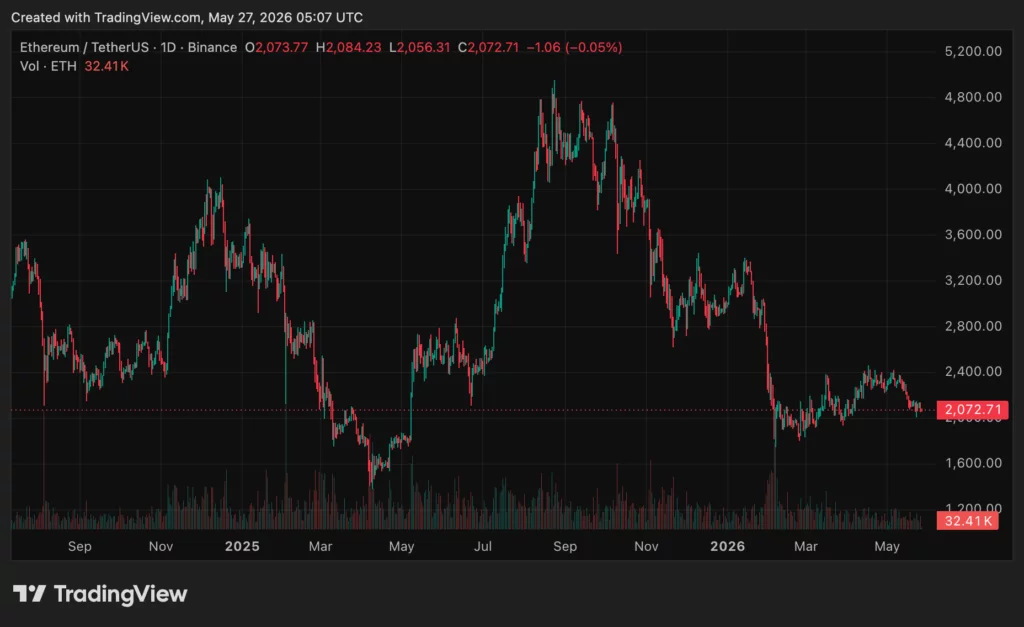
Analyst Alex Marzell observed that support above $2,050 is still holding, but predicted a pullback to February levels if it were to break.
“If ETH loses this area convincingly, the move toward the $1,800 support zone could accelerate fast.”
Ethereum FUD is currently at peak levels following an exodus from the Ethereum Foundation and from long-term network proponents, such as David Hoffman of Bankless, who threw in the towel and sold all of his ETH.
ETH Price Outlook
Spot prices are reacting to the negative sentiment, trading lower on the day as ETH failed to hold above $2,100.
The asset fell to an intraday low of $2,060 during the Wednesday morning trading session, and has lost almost 10% over the past fortnight.
It has been consolidating for four months but appears to be heading toward the lower bound of the channel, below the psychological $2,000 level.
The post Massive $20K Bull Market For Ethereum Coming, But $1,500 Could Come First: Analysts appeared first on CryptoPotato.
Crypto World
South Korea’s KOSPI Hits New High After 100% Rally: Is Korean Retail Forgetting Bitcoin?
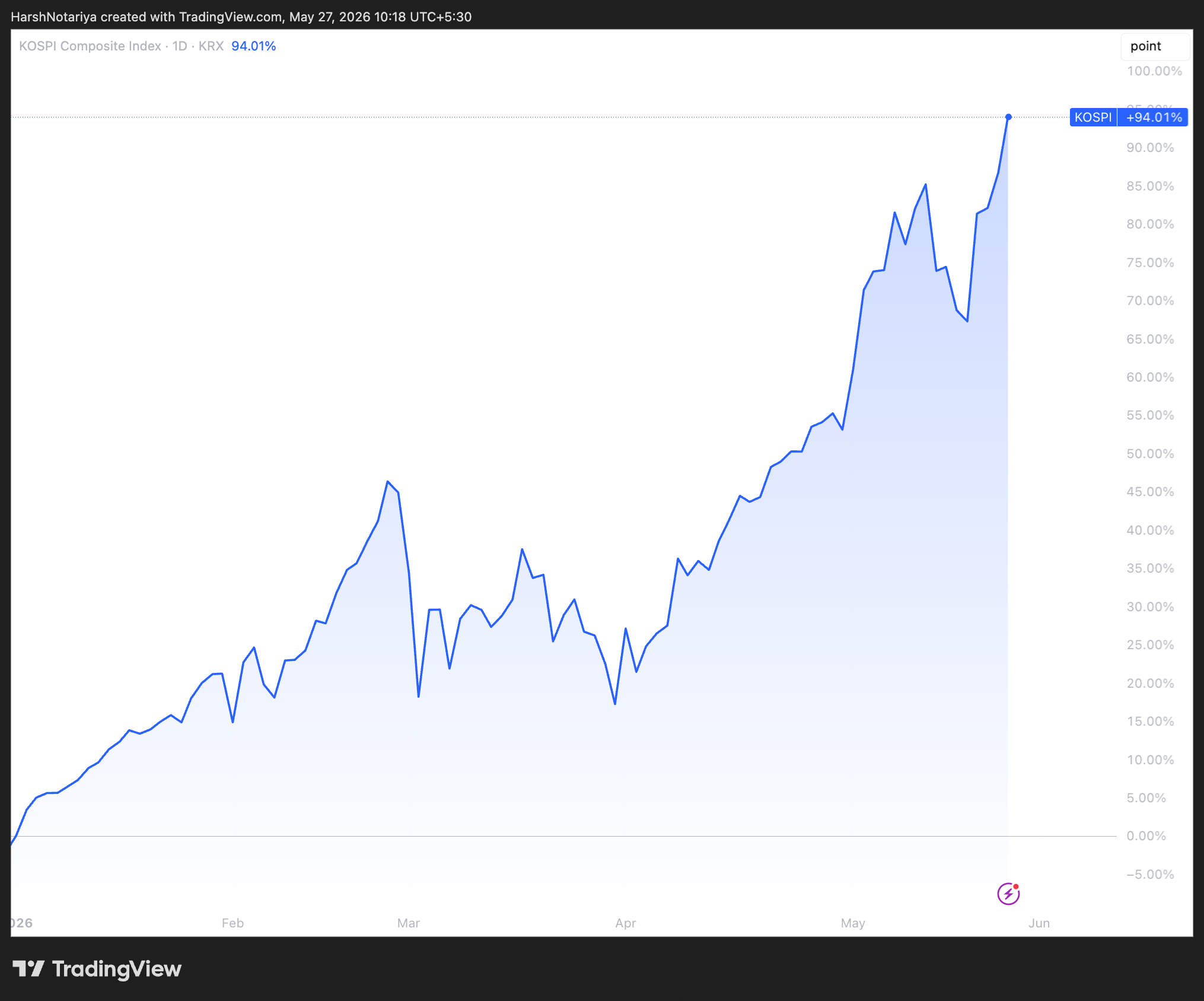
South Korea’s KOSPI surged 4.56% to a fresh all-time high of 8,457 on Wednesday, officially doubling year-to-date in 2026. Samsung Electronics and SK Hynix powered the move, the two chipmakers that already represent roughly half of the index.
The benchmark added around $220 billion in market value in a single session and roughly $900 billion in May alone.
Memory Stocks Go Vertical
The KOSPI is now up roughly 100% year-to-date, after Samsung Electronics jumped 6.5% and SK Hynix added 9.5% on Wednesday. The two chipmakers control around 42% of the index, lifted by AI memory chip demand.
“Everything memory related has gone straight vertical,” market commentator Heisenberg observed.
JPMorgan recently raised its KOSPI target to 9,000, with a bull case of 10,000.

Asian retail is doubling down. The 2x Leveraged SK Hynix ETF in Hong Kong has pulled in $1.3 billion year-to-date and tripled to $8 billion in assets in three months, the world’s largest single-stock leveraged ETF, the Kobeissi Letter reported.
A 2x Samsung ETF has matched those flows. Together, the two ETFs now eclipse comparable leveraged products on Tesla and Microsoft, with SK Hynix and Samsung accounting for nearly 50% of the $4.5 trillion KOSPI.
“Asian retail investors are rushing into leveraged chip stock bets like never before,” The Kobeissi Letter remarked.
Korean Crypto Pays the Opportunity Cost
Earlier, the same retail base used to anchor Korea’s Bitcoin (BTC) market. Upbit and Bithumb handle around 96% of Korean crypto volume.
But now, Korean crypto volumes have crashed roughly 80% as won liquidity has rotated into equities. The kimchi premium recently sat near negative 2.19%, signaling weak local demand for BTC.

Past KOSPI corrections triggered a reverse rotation back to Korean exchanges. On May 15, the KOSPI breached 8,000 intraday before crashing 8.4% in a single session. That reversal wiped roughly $370 billion in market value and briefly nudged Korean crypto volumes higher.
President Lee Jae-myung’s won-pegged stablecoin push and Bitcoin spot ETF pledge add a structural pull on the other side. A consortium of eight banks is preparing a regulated KRW stablecoin under the Digital Asset Basic Act. Kookmin, Shinhan, and Woori lead the group.
The motivation is concrete. Korean crypto exchanges sent roughly $40 billion overseas in Q1, with stablecoins making up half of that capital flight. A domestic won-backed token would let regulators keep more of that liquidity onshore.
With KOSPI now stretched 100% in five months on borrowed money, any unwind would land on a deep base. Korea counts nearly 10 million crypto investors, more than 30% of the population. A failed defense of 8,000 could change the tape fast. A pause in chip orders or a sharp won move sends retail back to Bitcoin and Korean altcoins.
The post South Korea’s KOSPI Hits New High After 100% Rally: Is Korean Retail Forgetting Bitcoin? appeared first on BeInCrypto.

Base, the Ethereum layer-2 blockchain from crypto exchange Coinbase, has launched a tool to connect Base accounts to artificial intelligence agents for blockchain operations.
Base said on Tuesday that its new Base MCP (Model Context Protocol) allows users to ask AI agents such as Anthropic’s Claude or OpenAI’s ChatGPT to transfer funds, swap tokens, check balances, review transaction history, and use supported apps within the ecosystem.
The tool lets users manage their crypto directly from an AI model’s chat interface and can also interact with crypto protocols such as Morpho, Moonwell, Uniswap, Aerodrome, Avantis, Bankr and Virtuals, said Base.
The AI agent proposes an action in the chat, then the Base wallet opens in a new window where users can confirm or cancel the transaction. The agent does not have access to private keys, and every action must be confirmed by the user.
Agentic payments have been touted as the next major use case for crypto, as backers argue AI models will have issues accessing the banking system and will need to use digital assets to transact.
Base said that every transaction the agent proposes goes through the same review flow users see for any Base account request, with asset changes simulated before a user confirms.
Lincoln Murr, head of AI Product for Coinbase, told Fortune that “unlike siloed agentic wallets that only live in a terminal, your Base Account travels with you — trades, history, and portfolio sync whether you’re in-agent or in the Base App.”
Base MCP will also expand the adoption of the Coinbase x402 protocol, an agentic AI payment standard the company launched in May 2025.
Related: Fireblocks launches agentic payment support, joins x402 Foundation
Murr described MCP as a “nice wrapper” on top of APIs. Together with x402, it enables a new micro-transaction economy where agents can make tiny payments in crypto.
However, that economy is currently in its early stages, with x402 processing just $1.1 million in volume over the past 30 days, according to x402scan.

X402 statistics over the past 30 days. Source: x402scan
The use of AI agents for crypto payments has its detractors, with a recent research paper from Google and leading universities saying that AI agents should be treated as an untrusted system component.
The researchers said that AI agents should clearly distinguish between instructions and untrusted data to avoid attackers duping the agent by hiding malicious instructions.
Earlier this week, the developer platform Socket discovered malware targeting crypto developers by injecting hidden instructions to hijack AI coding assistants.
Magazine: Polymarket seeks Japan entry, Harvard dumps entire ETH position: Hodler’s Digest

NBA play-offs: Oklahoma City Thunder beat San Antonio Spurs to move one win from Finals

Geely Stock: The Long-Term Growth Story Remains Intact (OTCMKTS:GELYF)
Major Ripple (XRP) Update: Here’s What You Need to Know


-

 Crypto World5 days ago
Blockchain.com files with SEC for U.S. IPO
-

 Fashion4 days ago
Holiday Weekend Open Thread – Corporette.com
-

 Business5 days ago
Dell Technologies DELL Stock Surges 15% on AI Server Momentum and Analyst Upgrades in 2026
-

 Crypto World5 days ago
Bitcoin Accumulation Weakens as BTC Realized Losses Hit $600M
-

 Crypto World4 days ago
Robinhood crypto COO Tanya Denisova exits
-

 Crypto World5 days ago
Space X IPO Is ‘Bad News’ for Tech Stocks: But What About Bitcoin?
-

 Politics4 days ago
Makerfield: a tale of two social-media histories
-

 Business3 days ago
NYT Strands Answers May 24 2026 Revealed for Puzzle No. 812 Theme Summer Essentials
-

 Tech2 days ago
Microsoft’s quiet Claude Code retreat and the real cost of enterprise AI
-
 Crypto World5 days ago
MicroStrategy’s Saylor Says Miners No Longer Set Bitcoin Price, Another Force Has Taken Over
-

 Tech5 days ago
WhatsApp ads could make Irish debut after discussions with DPC
-
 Tech5 days ago
A 0.12% parameter add-on gives AI agents the working memory RAG can’t
-

 Crypto World5 days ago
AI infrastructure race heats up as IREN pitches full-stack strategy, WhiteFiber lands $160M deal
-

 Tech5 days ago
You Can Now Add ChatGPT To PowerPoint
-
 Crypto World2 days ago
Nvidia (NVDA) CEO Calls on Super Micro to Strengthen Export Controls Amid Smuggling Probe
-
 NewsBeat6 days ago
Charity run by Reform leader Malcolm Offord accused of ‘law breaking’ over Scottish registration
-

 Tech2 days ago
Westone Audio and Etymotic Acquired by Fidelity Collective in Major IEM Market Move
-

 Business5 days ago
Trump Invests $1M-$5M in Kura Sushi USA Chain With 27 California Locations
-

 Sports5 days ago
2026 CJ Cup Byron Nelson leaderboard: Brooks Koepka finds putting stroke in Round 1
-

 Crypto World6 days ago
Exa Labs raises $250 million in funding led by a16z
You must be logged in to post a comment Login