
Crypto World
U.S. spot BTC ETFs see $1.1 billion in 3-day inflows, set for biggest week since mid-January

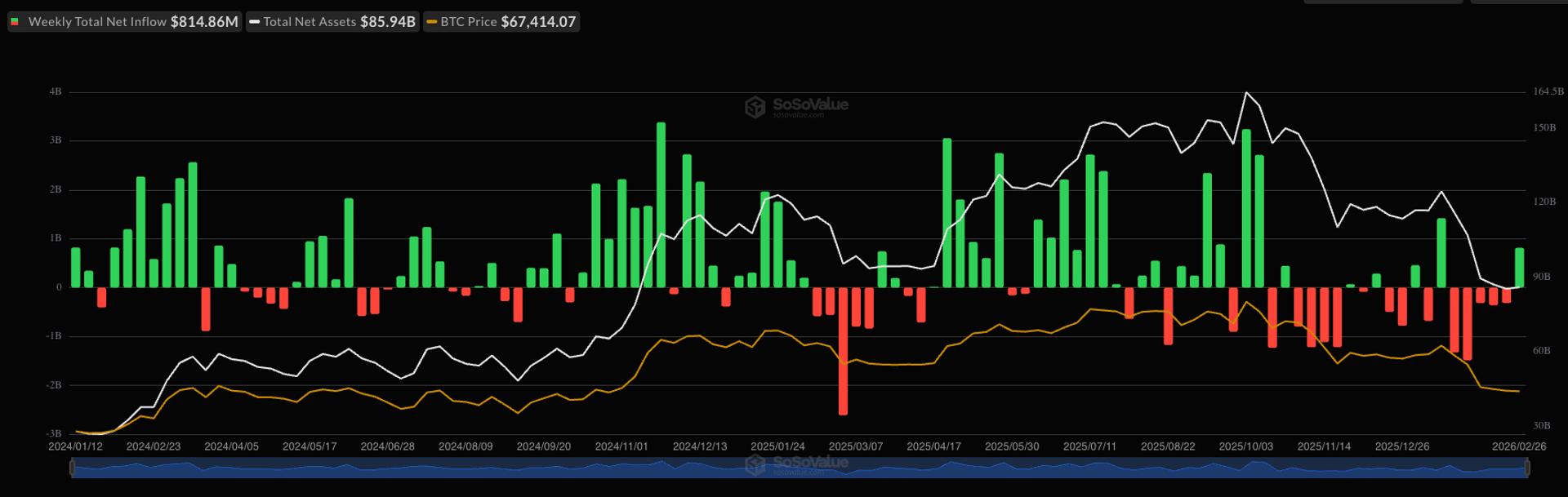
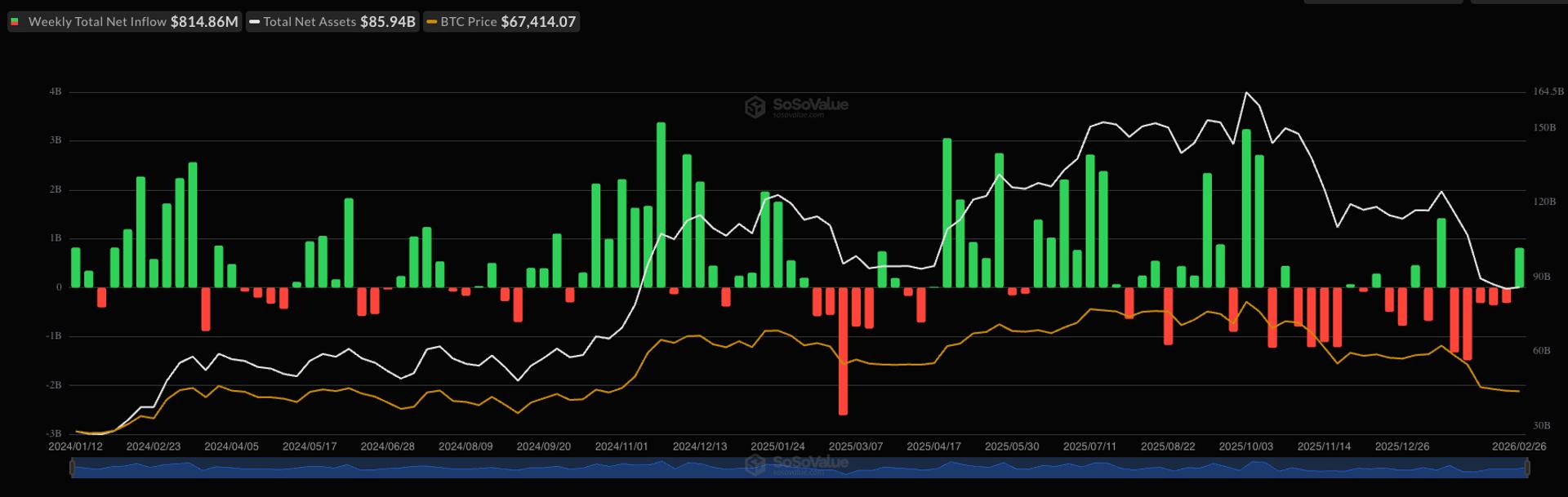
U.S. bitcoin exchange-traded funds (ETFs) are on track to snap a streak of five consecutive weeks of net outflows with their strongest performance since mid-January.
The funds recorded net inflows of $1.1 billion in three straight days, according to data from SoSoValue, leaving them roughly $815 million ahead after Monday’s net outflow is taken into account, the most since adding $1.4 billion in the week ended Jan. 16.
BlackRock’s iShares Bitcoin Trust (IBIT) accounted for more than half of the three-day flow, drawing in roughly $652 million. On Wednesday, Grayscale’s GBTC, which carries the highest fee among the funds, posted its largest single-day inflow since converting from a trust structure to an ETF.
The renewed inflows suggest U.S. demand is returning, an conclusion reinforced by the Coinbase Premium Index turning positive after 40 days in negative territory. The index tracks the price difference between bitcoin on Coinbase (COIN), which is accessible to firms in the world’s largest economy, and the broader global market. It is widely used as a gauge of U.S. institutional flows and sentiment.
Data from Checkonchain shows total bitcoin holdings across U.S. spot ETFs climbed to 1.29 million BTC, putting assets under management (AUM) less than 10% below their October peak.
This comes despite the spot price of bitcoin remaining 45% below its October record. The largest cryptocurrency has continued to consolidate around the mid $60,000 range this week.
Meanwhile, open interest on the Chicago Mercantile Exchange (CME) has continued to decline, falling to 107,780 BTC, according to Glassnode data. Because CME allows institutions to simultaneously take a long position in spot bitcoin and a short position in futures — a strategy known as a basis trade — the drop in futures can be seen as indicating the ETF inflows are outright long positions.

Crypto World
Nexo Becomes the official digital asset partner of Argentina’s national football team in LATAM


Disclosure: This article does not represent investment advice. The content and materials featured on this page are for educational purposes only.
Nexo partners with the Argentine Football Association (AFA) ahead of the 2026 FIFA World Cup, reinforcing the company’s expansion in South America.
Summary
- Nexo partners with Argentina’s national team as regional digital asset sponsor ahead of 2026 World Cup
- The deal strengthens Nexo’s expansion in Argentina following Buenbit acquisition and local hub launch
- Nexo and AFA formalize partnership in Buenos Aires, marking push into South American crypto market
BUENOS AIRES, Argentina, April 14, 2026 — Nexo, the premier digital assets wealth platform, today announced a partnership with the Argentine Football Association (AFA), becoming the Official Regional Digital Asset Partner of the Argentine National Football Team across South America ahead of the 2026 FIFA World Cup.
The agreement deepens Nexo’s expansion in Argentina, where the company recently acquired the leading platform Buenbit and is establishing Buenos Aires as a regional hub with its local team.
Federico Ogue, CEO at Buenbit by Nexo, said: “Argentina’s national team represents the highest level of sporting excellence, built on talent, conviction, and an unrelenting will to win. At Nexo, we share that standard. As we grow our presence in Argentina and across South America, partnering with AFA is a statement of commitment to this region and the clients we serve here.”
Official partnership ceremony
The partnership was officially launched at a gala ceremony in Buenos Aires, where Nexo and AFA executives signed the agreement before invited guests, media, and partners. The event marks the formal beginning of the collaboration ahead of the 2026 FIFA World Cup.
Leandro Petersen, Chief Commercial & Marketing Officer of the AFA, said: “We are excited to announce a new partnership with a strong global reach that aligns with the Argentine
Football Association’s international growth strategy, which we have been building in recent years through agreements with leading companies in innovation and technology. In this context, Nexo’s arrival as the Official Digital Assets Partner of the Argentine National Team reflects not only the growth of our brand globally but also the growing interest of international companies in partnering with Argentine soccer and one of the world’s most prominent national teams.
Success in elite sports, just as in business, is based on a clear strategy, discipline, and the ability to perform at the highest level when it matters most. Collaborating with partners who share this mindset allows us to continue expanding our ecosystem and create meaningful opportunities to connect our players, our brand, and millions of fans around the world.
Partnership activations
Nexo is starting a global ticket giveaway campaign for Argentina’s World Cup matches, open to new and existing clients. Signed squad shirts and co-created player content with Messi, Lautaro Martínez, Julián Álvarez, and Nico Paz will be distributed across the campaign window running from May through the end of the tournament. Nexo’s program will incorporate match-day experiences and squad merchandise, such as tier-linked rewards, connecting platform activity directly to the campaign.
Nexo is committed to global premium sport, serving as the Official Crypto Partner of the Australian Open and Summer of Tennis, the Official Digital Wealth Platform of the DP World Tour, and the Official Partner of the Audi Revolut Formula 1 Team.
Ahead of 2026 FIFA World Cup
The partnership adds a further dimension to Nexo’s U.S. relaunch. In February 2026, Nexo re-entered the United States market under a regulated framework, marking its first operational return to the country. Argentina arrives at the World Cup as reigning champions, competing across North American stadiums.
About Nexo
Nexo is a premier digital assets wealth platform designed to empower clients to grow, manage, and preserve their crypto holdings. Our mission is to lead the next generation of wealth creation by focusing on customer success and delivering tailored solutions that build enduring value, supported by 24/7 client care.
Since 2018, Nexo has provided unmatched opportunities to forward-thinking clients in over 199 jurisdictions. With over $8 billion in AUM and over $403 billion processed, we bring lasting value to millions worldwide. Our all-in-one platform combines advanced technology with a client-first approach, offering high-yield flexible and fixed-term savings, crypto-backed loans, sophisticated trading tools, and liquidity solutions, including the first crypto debit/credit card. Built on deep industry expertise, a sustainable business model, robust infrastructure, stringent security, and global licensing, Nexo champions innovation and long-lasting prosperity.
For more information, visit the official website.
About the Argentine Football Association (AFA)
Founded in 1893, the Argentine Football Association (AFA) is the governing body of football in Argentina and one of the oldest football associations in South America. AFA oversees the Argentine national team — the Albiceleste — three-time FIFA World Cup champions and current title holders, as well as the structure of Argentine club football.
Disclosure: This content is provided by a third party. Neither crypto.news nor the author of this article endorses any product mentioned on this page. Users should conduct their own research before taking any action related to the company.
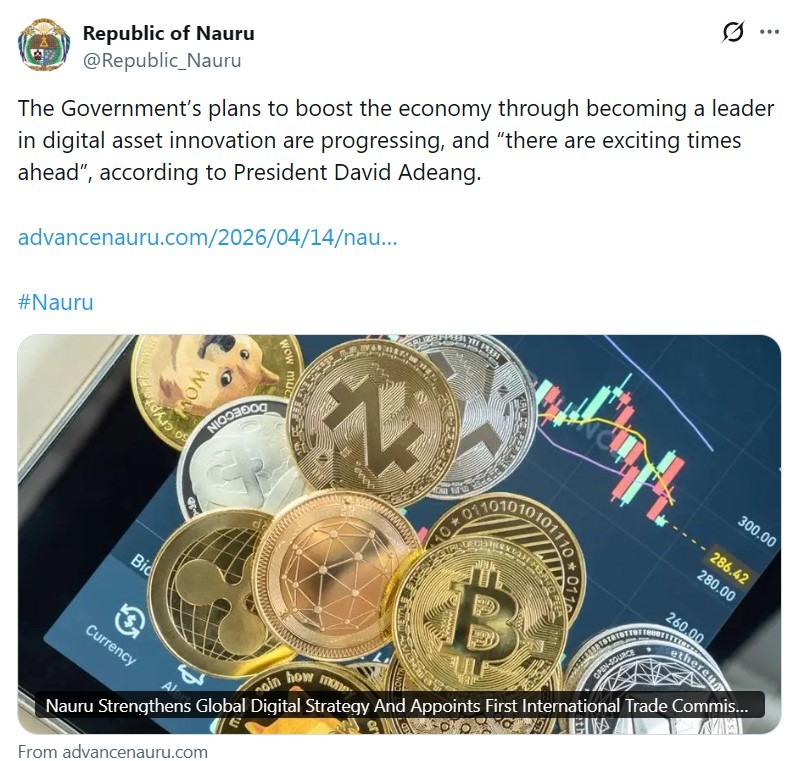
Nauru has appointed crypto entrepreneur Dadvan Yousuf as an international trade commissioner to help advance its digital asset strategy and attract global investment.
In a statement on Tuesday, President David Adeang said the appointment is part of the Pacific nation’s efforts to strengthen international partnerships and position itself as a hub for virtual asset activity. The government said Yousuf will support cross-border engagement with virtual asset service providers, financial institutions and technology firms.
The move comes less than a year after Nauru passed legislation establishing the Command Ridge Virtual Asset Authority (CRVAA), a dedicated regulator tasked with licensing and overseeing crypto firms, digital banks and other virtual asset activities.
The appointment marks a shift from establishing Nauru’s crypto regulatory framework to actively promoting itself as a jurisdiction for digital asset companies and investment, as the country says it is seeking new revenue streams and greater economic resilience.
Yousuf has previously been linked to regulatory action in Switzerland. In 2023, the Swiss Financial Market Supervisory Authority (FINMA) said a crypto project he founded sold millions of dollars in tokens without the required license and described the platform as non-operational, issuing cease-and-desist orders.

Nauru expands crypto push with trade appointment
According to the United Nations, Nauru is a Pacific island state in Micronesia, northeast of Australia, with about 21 square kilometers of land and roughly 12,500 people, making it the world’s third-smallest country and smallest island nation.
Adeang said Nauru’s digital asset push is intended to improve economic resilience and living standards while committing to international governance and compliance standards.
He previously said in August 2025 that Nauru, ranked among the most vulnerable to economic and climate shocks, is seeking to change its trajectory through new economic strategies.
Related: IMF guides Andorra to record and monitor Bitcoin transactions
The appointment adds a new outward-facing element to that strategy by pairing Nauru’s regulatory ambitions with a known figure in crypto circles.
In the announcement, Adeang said Yousuf brings “a unique combination of entrepreneurial vision, international network, and deep understanding of digital asset markets.”
Yousuf had previously attracted attention in the crypto sector after raising a Bitcoin flag atop Mount Everest in 2024. The Bitcoiner said the expedition was intended to highlight disparities in access to financial education.
Nauru surfaced in FTX-linked memo before crypto push
Nauru previously surfaced in crypto headlines in 2023 after court filings in the FTX bankruptcy revealed a memo proposing the purchase of the Pacific island nation using allegedly misappropriated funds.
The plan, linked to Gabriel Bankman-Fried, Sam Bankman-Fried’s brother, outlined building a bunker to survive a global catastrophe. However, Gabriel’s representatives denied involvement in drafting or endorsing the plan.
Magazine: Should users be allowed to bet on war and death in prediction markets?


Nigel Farage is facing calls for a formal regulatory probe into his financial involvement with the cryptocurrency firm Stack BTC following his appearance in the company’s promotional content.
Summary
- Nigel Farage is under scrutiny from the Financial Conduct Authority following a request from the Liberal Democrats to investigate his financial involvement and promotional activities with Stack BTC.
- The investigation focuses on whether the Reform UK leader breached market rules by appearing in promotional videos for the firm while holding a 6.31% stake in the business.
The Liberal Democrats sent a letter to the Financial Conduct Authority (FCA) requesting an investigation into whether the Reform UK leader violated market rules by appearing in marketing videos while holding a financial stake in the business.
Daisy Cooper, the party’s deputy leader, raised concerns that the move could compromise the integrity of the financial markets.
“The FCA must investigate whether Farage’s plans to cash in on Crypto could potentially amount to market abuse and a conflict of interest,” she wrote.
Stack BTC, which is chaired by former Chancellor Kwasi Kwarteng, recently announced the purchase of 37 Bitcoin for approximately $2.7 million as part of a strategy to build its corporate treasury.
In a video released to coincide with the disclosure, Farage appeared on behalf of the firm to argue that a Bitcoin treasury company is essentially required to hold the digital asset.
This acquisition brings the company’s total holdings to 68 Bitcoin, bought at an average price of $72,400 per coin.
Records indicate that Farage has significantly increased his personal stake in the sector, having disclosed a $286,000 equity investment in Stack BTC this March. This gave him a 6.31% share in the company through his media vehicle, Thorn In The Side.
Cooper suggested that the intersection of Farage’s political platform and his private investments needs to be looked at more closely.
“Taken together, these facts beg the question whether Mr Farage is promoting cryptocurrencies through his political platform in order to inflate crypto values for his own financial benefit, as well as that of his party and his inner circle of donors,” she wrote.
The controversy unfolds as the UK government moves to tighten the rules surrounding digital assets and political influence.
Last month, the Rycroft Review recommended a moratorium on cryptocurrency donations to political parties, citing fears that such funds could be used for foreign interference in British elections.
Prime Minister Keir Starmer has since moved forward with this proposal, implementing a temporary ban while the government develops more robust safeguards.
This regulatory pressure comes at a time when Reform UK is already under the spotlight for its funding, having received a record £9 million donation from early crypto investor Christopher Harborne.
While Farage continues to push for crypto-friendly policies, members of parliament are increasingly advocating for a permanent ban on digital asset donations to ensure that financial markets are not used as a “personal piggy bank” for political figures.
Chainlink price is forming a major bullish reversal pattern that could ultimately lead to a potential surge to $12 over the coming weeks.
Summary
- Chainlink price rose to $9.40, up ~13% from monthly lows, as a bullish reversal pattern takes shape.
- A double bottom formation points to a potential breakout above $10, with a projected upside toward $12.
- Whale accumulation and declining exchange reserves signal growing long-term confidence and reduced selling pressure.
According to data from crypto.news, Chainlink (LINK) price rallied nearly 8% to $9.40 on Tuesday, locking in gains of nearly 13% from its lowest point over a monthly period. Despite this, the token remains down nearly 25% below from where it started this year.
The 17th largest crypto asset by market cap is showing a highly bullish reversal pattern that suggests the token could be close to a breakout soon.
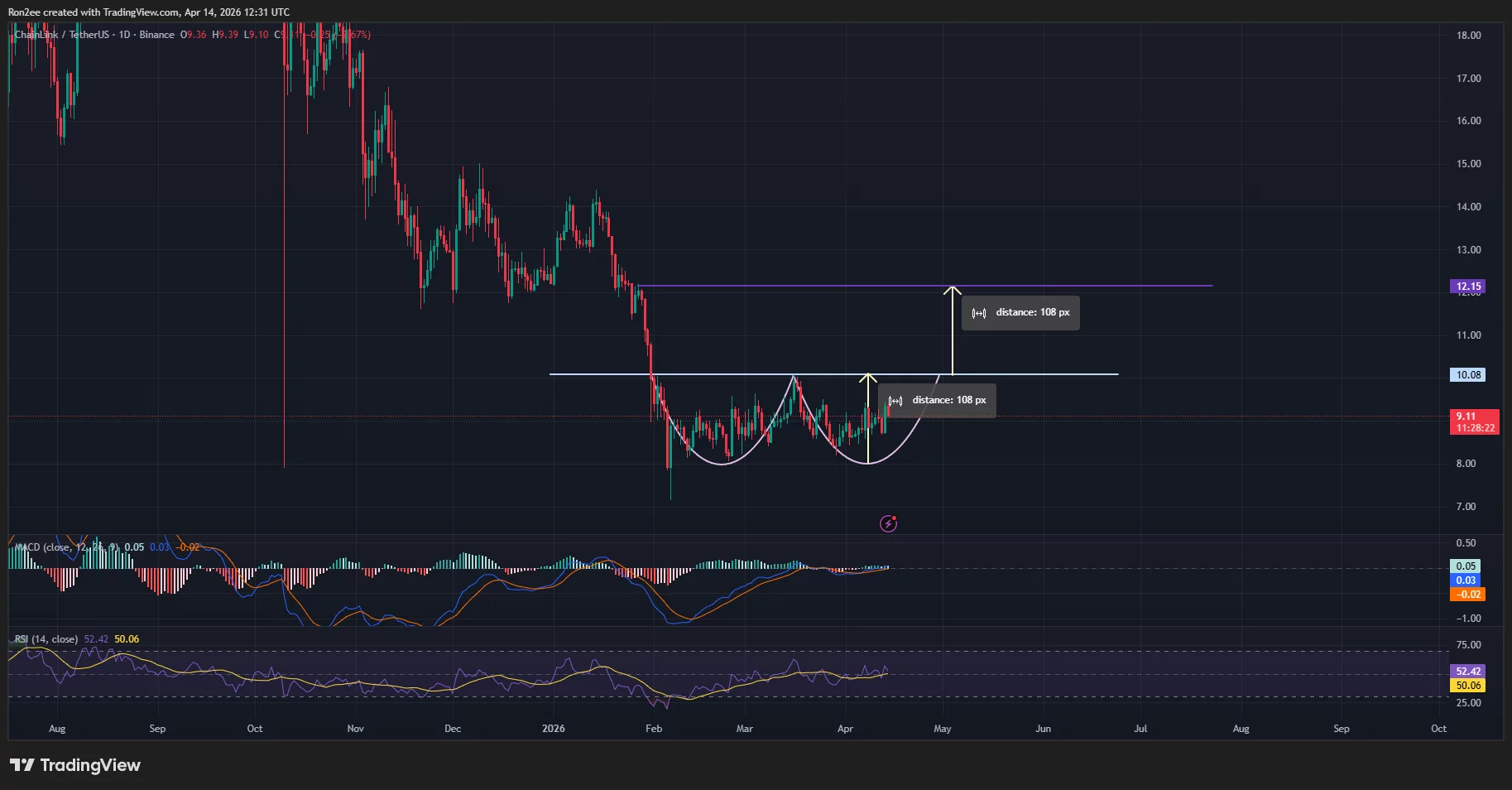
On the daily chart, Chainlink price appears to be completing a double bottom pattern, which is one of the most popular bullish signs in technical analysis. A breakout from the neckline of such a pattern has historically been followed by strong upside in a related asset for multiple sessions.
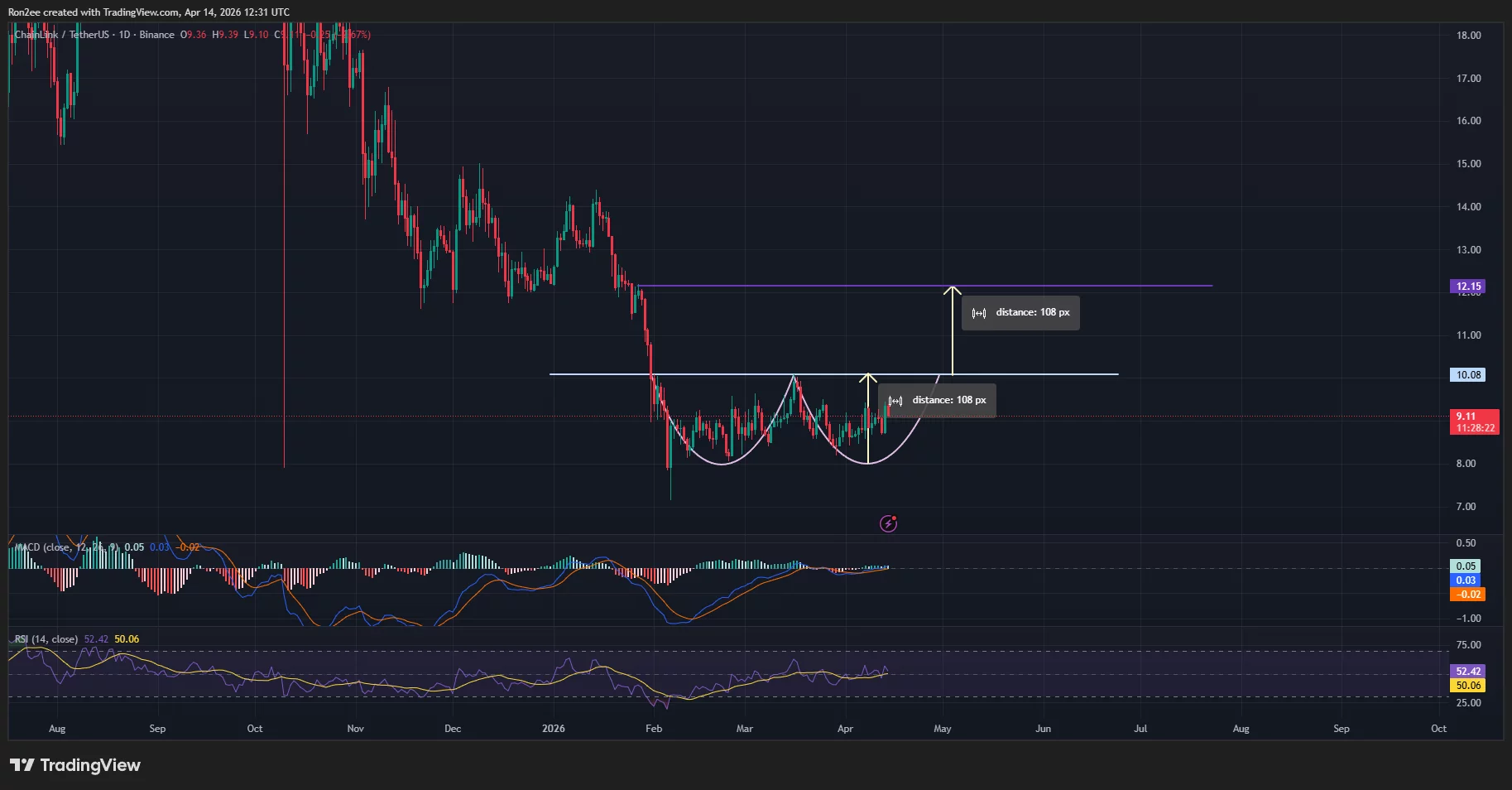
For Chainlink, a breakout from the $10 neckline of the pattern formed could push its price to above $12. This level is calculated by adding the height of the double bottom pattern to the neckline itself.
For now, the most immediate resistance sits at $10, which also serves as a key psychological resistance level. On the contrary, a drop below $8 could erode the ongoing bullish momentum and potentially invalidate the current setup.
Momentum indicators such as the MACD and RSI suggest that a recovery could already be underway. Notably, the MACD lines have moved upwards and are close to breaking out of their bearish zone, while the RSI has bounced above neutral thresholds, suggesting bulls are regaining control of the market.
A major catalyst that seems to be supporting Chainlink price has been active accumulation by whales. According to recent reports, whales have added another 1.89 million LINK tokens worth approximately $16.9 million recently, bringing total holdings by these investors to 661.9 million tokens.
What is interesting is that this large-scale purchase came alongside declining LINK reserves on exchanges, a sign that investors are moving their assets into cold storage for long-term holding.
Disclosure: This article does not represent investment advice. The content and materials featured on this page are for educational purposes only.

TLDR:
- Cardano Summit 2026 proposal requests $2.8M, reflecting a broader global expansion strategy in Singapore.
- Dual-event approach with TOKEN2049 aims to boost institutional reach and ecosystem visibility.
- Treasury funding includes strict oversight, milestone payments, and real-time transparency dashboards.
- Community vote will decide the proposal, with no revised plan if funding approval is denied.
Cardano Summit 2026 is at the center of a new treasury proposal that has sparked discussion across the Cardano ecosystem.
The Cardano Foundation confirmed it is reviewing community feedback regarding funding for the planned event and its alignment with TOKEN2049 in Singapore.
The proposal outlines a larger budget than previous years, reflecting a broader strategy aimed at institutional engagement during challenging market conditions while maintaining transparency and accountability.
Strategic Expansion and Budget Rationale
The Cardano Summit 2026 proposal introduces a notable increase in projected costs compared to earlier expectations.
The total budget now approaches $2.8 million, exceeding the previously discussed $1.2 million framework. This adjustment follows internal discussions and ecosystem developments that encouraged a broader global presence.
According to statements shared via the Cardano Foundation’s official communication channels, the decision reflects an effort to position Cardano as active despite market cycles.
The tweet emphasized that the initiative is designed as an anti-cyclical investment, reinforcing long-term ecosystem growth.
The higher costs are also linked to Singapore’s operating environment. Event logistics, vendor services, and general expenses in Singapore exceed those of previous locations such as Berlin. These factors collectively shaped the revised treasury request.
At the same time, sponsorship expectations remain conservative. The proposal assumes limited growth in sponsorship revenue, citing current market conditions. Lower ticket pricing, introduced after community feedback, also contributes to the funding gap.
Dual-Event Strategy with TOKEN2049
The integration of Cardano Summit 2026 with TOKEN2049 forms a central element of the proposal. This combined approach aims to leverage an existing global audience, offering access to institutional participants, developers, and media representatives gathered in Singapore.
The Cardano Foundation noted that TOKEN2049 attracts over 25,000 attendees, creating exposure levels difficult to replicate independently.
This environment provides opportunities for networking, partnerships, and ecosystem visibility within a concentrated timeframe.
As part of the sponsorship package, Cardano would secure a large exhibition space and a dedicated stage for ecosystem builders.
The arrangement also includes keynote speaking opportunities and promotional support across TOKEN2049 channels.
The scheduling decision also reflects regional strategy. Hosting the event in Singapore brings the Cardano Summit to the Asia-Pacific region for the first time. This move aligns with efforts to engage financial institutions and regulators within a global financial hub.
Governance, Oversight, and Community Accountability
The Cardano Summit 2026 proposal introduces structured oversight mechanisms designed to address community concerns about treasury usage.
Funds would be managed through audited smart contracts, with milestone-based disbursements tied to event delivery.
An oversight committee comprising ecosystem participants, including Sundae Labs and NMKR, would monitor progress.
This group holds authority to pause or adjust funding milestones if necessary, ensuring adherence to defined objectives.
Transparency measures include a public dashboard that tracks fund allocation and performance indicators in real time. Independent audits are also planned, continuing practices established during the 2025 Summit.
Key performance targets have been defined across multiple categories. These include attendee numbers, enterprise engagement, media reach, and developer participation. Metrics related to TOKEN2049 participation and hackathon outcomes are also included.
The proposal outlines clear provisions for unused funds. Any surplus or gains resulting from price appreciation would be returned to the treasury within six months.
If the proposal does not pass, the Cardano Summit 2026 will not proceed, and alternative initiatives will be considered.


Disclosure: This article does not represent investment advice. The content and materials featured on this page are for educational purposes only.
BNB holds steady as BlockchainFX presale draws attention from early-stage investors.
Summary
- BNB holds near $600 as BlockchainFX nears $15 million softcap ahead of exchange launch
- BlockchainFX (BFX) presale gains momentum with 23k+ users and bonus incentives driving demand
- Multi-asset Super App BFX attracts investors seeking early entry before listing price increase
Timing is everything in crypto, and right now, two names are making serious noise — BNB holding steady around $600, and BlockchainFX (BFX) sitting at just $0.035 in what could be its final presale days.
While BNB veterans know the value of getting in early on a strong ecosystem play, BFX is one of the best crypto presales to buy now for investors who want ground-floor access before a major exchange launch reshapes the leaderboard.

BlockchainFX has raised over $14.23m and is closing in fast on its $15m softcap — the trigger point for its full exchange launch. With 23,250+ participants already in and a limited-time bonus code LAUNCH50 unlocking 50% extra BFX tokens, the window to get in at this price is genuinely shrinking. This is not a drill.
BFX is about to launch and the countdown has officially started
BlockchainFX is a next-generation crypto super app that lets users trade crypto, stocks, forex, ETFs, and commodities all in one decentralized platform. Awarded “Best New Crypto Trading App of 2025,” it’s licensed by the Anjouan Offshore Finance Authority and already live in beta with thousands of daily active users. The current presale price is $0.035, with a launch price set at $0.05, meaning every token bought today is already priced below the listing floor.
What makes BlockchainFX genuinely different is that it functions like a DeFi version of Binance and Coinbase combined, but with full asset ownership and no exchange custody risk. Users keep control of their wallets, trade across asset classes, and still earn daily staking rewards in both BFX and USDT. That combination, trading freedom plus passive income, is rare, and it’s one reason why the platform’s beta feedback has been overwhelmingly positive.
LAUNCH50: 50% more tokens, one code, one last chance
Here’s where the numbers get interesting. The bonus code LAUNCH50 is live right now, giving every buyer 50% more BFX tokens on top of their purchase, a celebration of the impending launch. So a $10,000 investment at $0.035 gets approximately 285,714 BFX tokens normally, but with LAUNCH50 applied, that jumps to around 428,571 BFX tokens. At the $1 post-launch price analysts are pointing to, that’s a potential return of $428,571 from a $10,000 entry. The math speaks for itself.
Analysts have floated post-launch predictions ranging from $8 to $10 long-term, but even the conservative $1 target represents a massive multiple from the current presale price. Once BFX hits its $15m softcap, the presale closes, and this price is gone permanently.
Spend $100 or more in BFX, and automatically enter into the $500,000 Gleam giveaway — with prizes starting at $20,000 and a top prize of $250,000 in BFX tokens. The best crypto presale to buy now has a deadline, and that deadline is approaching fast.
BNB holds steady at $607 but the ATH feels like a distant memory
BNB is currently trading around $607.58, functioning reliably as the backbone of the BNB Chain ecosystem. It handles transaction fees across BNB Smart Chain, opBNB Layer 2 solutions, and BNB Greenfield, while also serving as a governance token that gives holders actual voting power in protocol decisions. For long-term BNB holders, the utility case remains intact, and the ecosystem continues to expand.
That said, BNB’s all-time high of $1,370.55 hit six months ago, and the current price reflects a market that has pulled back considerably since then. Sitting roughly 55% below its peak, BNB is still a solid large-cap holding for those who believe in the BNB Chain ecosystem long-term – though new buyers at current levels are playing a different game than those who got in early and watched it run.

One of the best crypto presales right now has a launch date coming
Based on the latest research, the best crypto presale to buy now is BlockchainFX, and the case has rarely been cleaner. Over $14.23m raised, 23,250+ holders, a working product, regulated status, and an explosive bonus offer with LAUNCH50 make the entry price even more attractive.
When the $15m softcap is hit, the presale ends and the token lists — there’s no negotiating with that timeline. The best crypto presale opportunities don’t stay open forever, and this one is already in its final stretch. Visit the BlockchainFX website before the next price move makes today look cheap.
For more information, visit the official website, X, and Telegram.
Disclosure: This content is provided by a third party. Neither crypto.news nor the author of this article endorses any product mentioned on this page. Users should conduct their own research before taking any action related to the company.
Crypto World
Ethereum Price Just Bounced Off a Multi-Year Trendline That Called Every Bear Market Bottom Since 2019: Is a 3x Rally Coming?

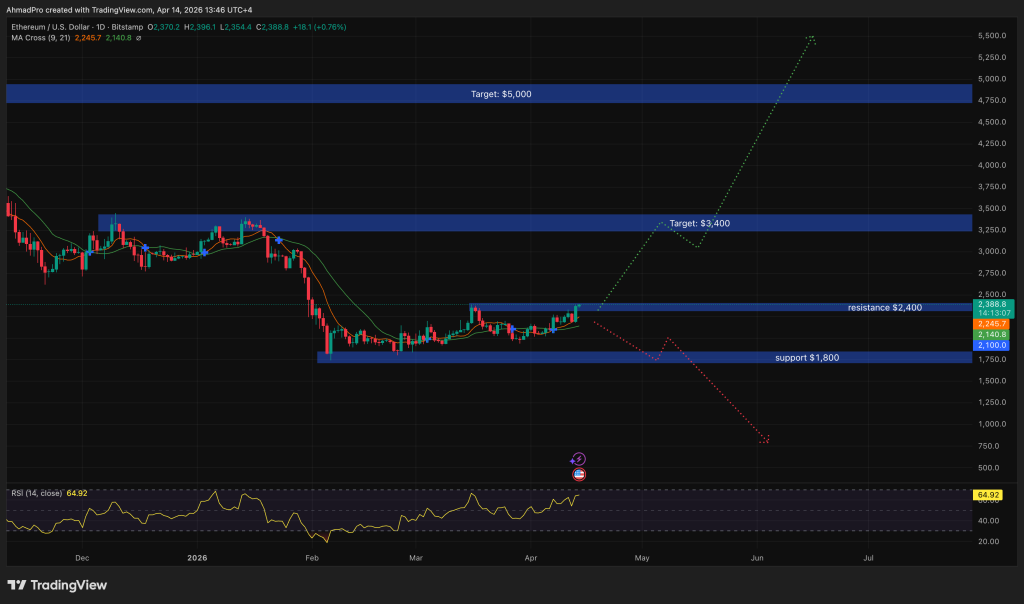
Ethereum price is trading at $2,355 in April 2026, up 8.09% on the monthly chart after the $2,000 monthly low was tested and held a multi-year ascending support trendline connecting every major ETH bear market bottom since 2019.
The bounce is in progress. What traders are now watching is whether it has structural legs or simply marks a temporary reprieve before the next leg lower.

Ethereum Price Prediction: Multi-Year Trendline Holds, But Can ETH Reclaim Its SMAs?
The ascending support trendline on ETH’s monthly chart is not a recent construction. It connects the 2019 base, the 2020 pre-rally accumulation zone, and the 2022 cycle bottom, making it the deepest and most tested structural floor in Ethereum’s price history.
The April monthly candle printed a long lower wick at that trendline, a candlestick structure that signals demand absorption at scale. Price has since recovered to the $2,400 area, forming a positive monthly body above the line.
The monthly MACD (12,26,9) adds the critical secondary signal. The MACD line sits at -29.45 and the signal line at, 159.35, producing a histogram reading of positive 129.89, the first positive monthly histogram since Ethereum’s descent accelerated from its August 2025 high near $4,800.
Both lines remain in negative territory, meaning the macro trend has not reversed. But a histogram turning positive at a multi-year trendline test is historically consistent with momentum inflecting before price does on the longer timeframe. The chart is mending. It hasn’t healed.
On the upside, two SMAs define the recovery corridor. The SMA 50 at $2,440.86 is the immediate resistance and the first target that would shift the moving average ribbon from fully bearish.
The SMA 20 at $2,857.71 is the extended objective, a return to where both SMAs converged before the 2025 breakdown. This broader technical structure in Ethereum long-term price chart has historically preceded significant recoveries when macro momentum aligns with structural support.
The buy walls flanking the $2,000–$2,100 zone are supported by on-chain data.
CryptoQuant contributor Arab Chain reported that whales withdrew over 120,000 ETH from centralized exchanges in early March, the largest single outflow since October 2025, a pattern consistent with accumulation near structural support rather than distribution.
Exchange reserves hit multi-month lows as that supply moved off-platform, compressing available sell-side liquidity precisely where the trendline sits.
Perpetual futures showed a slightly positive funding rate as of April 12, indicating measured but persistent long-side demand. The Ethereum Foundation staked 45,000 ETH on April 5, targeting a total of 70,000 ETH, generating an estimated $3.9 to $5.4 million annually in yield while removing immediate circulating sell pressure.
Crypto analyst Leshka posted on X that ETH “will 3x-4x in the next six months,” citing the developing supply squeeze as evidence of a structural base forming – a view that gains more grounding with the monthly MACD now confirming improving momentum.
Ethereum’s Glamsterdam upgrade, scheduled for H1 2026, adds a forward catalyst: targeting a significant gas limit increase, parallel transaction execution, and enshrined proposer-builder separation that is expected to materially reduce Layer-2 costs.
Invalidation is unambiguous. A monthly close below $2,017.09 breaks the trendline outright and shifts the macro structure bearish, with $1,500 the next level of consequence.
Discover: Macro context shaping crypto technical setups right now
Liquidchain Targets Early-Mover Upside as Ethereum Tests Key Levels
ETH’s recovery potential is real – a move from $2,255 to the SMA 20 at $2,857 represents roughly 27% upside from current levels. For a large-cap asset with a market cap measured in hundreds of billions, that’s a meaningful return. The mathematical ceiling, however, is what it is.
Traders seeking asymmetric exposure at this stage of the cycle are increasingly looking at early-stage infrastructure projects positioned around Ethereum’s scaling roadmap.
Liquidchain (LQC) is one project drawing attention in this context, a Layer-3 execution environment designed to aggregate liquidity across Ethereum and its rollup ecosystem, with a technical architecture specifically targeting the throughput bottlenecks that Glamsterdam addresses at the base layer.
The presale has raised over $660K at a current token price of $0.0147, with staking rewards available to early participants.
The project’s core differentiator is its unified liquidity routing across fragmented L2 environments, a structural problem that grows in relevance as Ethereum’s rollup ecosystem expands post-Glamsterdam. Presale investments carry real risk, and this is an early-stage L3 infrastructure project with meaningful execution uncertainty. DYOR applies unconditionally.
Explore the Liquidchain presale here
The post Ethereum Price Just Bounced Off a Multi-Year Trendline That Called Every Bear Market Bottom Since 2019: Is a 3x Rally Coming? appeared first on Cryptonews.


- Chainlink price rose to highs of $9.42 as LINK mirrored broader gains.
- Bitcoin’s surge to $74,500 could embolden LINK bulls to challenge resistance around $10.
- The supply zone has capped upside for months.
Chainlink (LINK) price is once again pressing into the robust supply zone near $10, with intraday gains to $9.42 outlining bulls’ intentions.
Despite sentiment around most altcoins being cautiously optimistic, largely due to what happens next after Bitcoin’s upswing to $74,500, gains for LINK above $9.50 could see buyers target $12.
In this case, the 80% jump in daily volume may indicate an upbeat outlook, particularly if the bellwether asset BTC pumps further.
Chainlink tests resistance amid broader market gains
The Chainlink price is up nearly 6% in the past 24 hours, joining the rest of the market in riding the upside momentum in BTC.
However, LINK has notably underperformed the wider market over the past months, repeatedly failing to secure a sustained break above the $9.40-$10 area.
The underperformance has held despite the project’s steady stream of ecosystem milestones and integrations.
Amid this outlook is the token’s rebound from a nearby demand zone, but it continues to face heavy pressure as bulls pare gains seen as prices rose to $9.42.
The region thus remains key to sellers who have consistently faded rallies and defended prior breakdown levels.
At the same time, analysts view $10 as a decisive short‑term line in the sand: bulls need a clean daily close above this level.
If this is backed by strong volume, it could flip market structure from defensive to constructive and open a path toward the $11.5-$12 region.
Until that happens, the prevailing pattern of lower highs since November keeps bulls on the back foot and allows bears to reassert control on every test of resistance.
Chainlink price: Technical analysis
On the technical front, Chainlink is trading near a key inflection zone, with several indicators hinting that downside momentum is waning even as resistance remains firm.
Lower time‑frame charts show prices attempting to build a base above recent demand.
LINK’s Bollinger Bands setup indicates the bands have compressed significantly, a classic precursor to a reversal.
Meanwhile, higher time frames highlight constructive setups, including a golden cross pattern.
The MACD continues to hover around or slightly above the zero line, a posture that typically accompanies early trend reversals rather than deep distribution.

For the immediate outlook, traders are likely to watch immediate resistance at $9.50-$10.
The area marks the region where repeated rejections have formed a tight supply wall.
Near-term support lies around the $8 zone, which may be revisited if a broader pullback hits crypto.

Disclosure: This article does not represent investment advice. The content and materials featured on this page are for educational purposes only.
Cardano holds attention as investors rotate toward early-stage crypto presales like BlockchainFX.
Summary
- Cardano (ADA) trends shift as investors explore utility-driven crypto opportunities like BlockchainFX
- BlockchainFX (BFX) gains traction as a multi-asset Super App enabling trading across crypto, stocks, gold, and forex
- BFX presale attracts 23k+ users with revenue-sharing model and exposure to global forex and crypto markets
How many people ignore the signs of a massive crypto shift and fail to invest at the right time? Watching others turn small change into life-changing wealth while someone sits on the sidelines is a cycle that needs to end.
Finding the best crypto presale to buy now is the only way to secure a spot before the next big breakout.

The market currently watches the Cardano (ADA) price news as traders search for more utility and faster growth. This shift has led thousands to BlockchainFX (BFX), a project bridging the gap between digital assets and global finance. It is currently the best crypto presale to buy now for anyone wanting more than just another meme token.
BlockchainFX: The bridge to global wealth and the best crypto presale to buy now
BlockchainFX is not just a trading platform; it is a licensed multi-asset Super App. It solves the massive problem of switching between different brokers for different assets. Community members can trade 500+ assets, including crypto, stocks, gold, and forex, from a single web3 interface. This unified approach is exactly why the BFX crypto presale 2026 is moving at light speed.
The platform offers a revenue-sharing model that turns participants into stakeholders. Instead of keeping all the money, BlockchainFX redistributes up to 70% of platform fees back to those who stake their tokens. This includes 50% paid daily in USDT and BFX, plus a 20% buyback and burn strategy to keep the supply tight.
Why early adopters are rushing in
The project is backed by a team with 25 years of experience across fintech and web3. This deep expertise has already attracted 23,300+ participants who see the massive gap in the market. While crypto volume is only $89B daily, the Forex market handles $7.5 trillion. BlockchainFX is positioned to capture that 99% gap that standard exchanges like Uniswap don’t touch.
Feature
BlockchainFX Advantage
Total Assets
500+ (Crypto, Forex, Stocks, Bonds, ETFs)
Founder’s Perk
Limited Edition 18K Gold or Metal Visa Cards
Trading Credits
Up to $25,000 in free credits for high tiers
Daily Rewards
Staking yield paid in USDT and BFX
Massive presale figures and growth potential
The BFX crypto presale 2026 has already raised over $14.24M. The current price is $0.035, but the price increases as milestones are hit because demand is outstripping the fixed supply. The confirmed launch price is $0.05, which creates a built-in profit for anyone getting in today. By using the bonus code LAUNCH50, early buyers get an extra 50% BFX tokens instantly.
- Raised: $14.24 million+ (Rising toward $15M launch)
- Current Price: $0.035 (Entry floor)
- Launch Price: $0.05 (Guaranteed upside)
- Participants: 23,300+ (Rapidly growing community)
- Bonus Code: LAUNCH50 (Claim 50% extra tokens)
$500,000 community giveaway
To keep the momentum high, a $500,000 giveaway is rewarding the community with BFX tokens.
- 1st Place: $120,000 in $BFX
- 2nd Place: $80,000 in $BFX
- 3rd Place: $60,000 in $BFX
- 4th-10th: Prizes ranging from $50,000 to $15,000
Big announcement: The 15m rule and bonus code LAUNCH50
The excitement is peaking because BlockchainFX is just a tiny fraction away from the $15M mark. The team announced that once the presale hits 15M, the project will officially launch on public exchanges. This means the chance to use the LAUNCH50 code to get 50% extra tokens is almost over. This is the final call to grab the lowest price before the “Founder’s Club” benefits disappear forever.
Missing the Cardano price news millionaire run
Think back to the Cardano ICO price of only $0.0024. Most people laughed at it or said it would never work, but those who saw the potential became millionaires as it multiplied by over 1,000x. It was a massive wealth transfer that changed lives for those who were brave enough to get in at the right time.
For those who missed that boat, it is easy to feel like they are too late for crypto success. However, the market is constantly birthing new leaders. Missing out on the past is a lesson, not a life sentence. The real tragedy is seeing a new powerhouse like BFX and making the same mistake twice by hesitating.
Is the BlockchainFX presale the best crypto presale to buy now?
The fast start and massive utility of this platform make it the clear winner for anyone seeking real gains. With the current BlockchainFX presale price at just $0.035, the path to the $0.05 launch is wide open. Early adopters can also stack referral rewards and use the LAUNCH50 bonus code to maximize their position before the 15M launch trigger.
Don’t let this be another story about another missed opportunity. Visit the BlockchainFX presale right now to secure tokens and a piece of a $7.5T market opportunity. The clock is ticking toward the $15M milestone, and once it hits, these prices and the 50% bonus are gone for good.
For more information, visit the official website, X, and Telegram.
Disclosure: This content is provided by a third party. Neither crypto.news nor the author of this article endorses any product mentioned on this page. Users should conduct their own research before taking any action related to the company.
Crypto World
Bitcoin (BTC), ether (ETH) in Goldilocks rally while smaller coins take a back seat: Crypto Daily


Major cryptocurrencies are rising alongside gains in U.S. equities as oil prices shed the war premium built up in recent weeks. But broader market participation remains elusive and limited to only a few coins.
Bitcoin and ether (ETH) have risen 5% and 9%, respectively, in the past 24 hours as digital asset treasury firms like Strategy (MSTR) and Bitmine (BMNR) sustain strong demand and traders seek bullish exposure via futures. More importantly, perpetual funding rates are positive, but remain below 10% for both assets, indicating healthy demand for bullish bets without signs of overheating — a Goldilocks scenario.
Solana’s SOL has bounced to the mid-$80s, but it has been here before several times in recent weeks and still doesn’t offer directional clarity. A similar conclusion can be drawn for the payments-focused token XRP.
Analysts are bullish, but want to see BTC establish a foothold above $74,000-$75,000.
“A victory for the bulls in this battle will pave an easier path to the $87K–$90K range, where the 200-day MA and the November–January support are located. Optimism in global markets increases the chances of reaching these heights in the coming days, but before rising above $90K, Bitcoin may require a lengthy period of consolidation and cooling off,” Alex Kuptsikevich, chief market analyst at FxPro, said in an email.
The digital asset services wing of the Marex Group stressed that bitcoin needs to hold above $74,000 without the market becoming overheated with excess leverage.
“If bitcoin can consolidate above 73k to 74k without funding overheating, this can extend. If it gives it back quickly, it confirms that the move was mostly headline and squeeze, not a true demand shift,” Marex’s crypto trading analysts said.
Select altcoins, such as ZEC, HYPE, and AAVE, and memecoins, such as PEPE, continue to rally. HYPE’s parent platform, Hyperliquid, is increasingly capturing share in the perpetual futures market from centralized exchanges (CEXs). Data shared by Hyperliquid News shows the decentralized platform’s share of open interest relative to CEXs climbed to a new all-time high of 6.9%.
The broader market, however, has yet to participate fully in the bitcoin rally. That’s evident from traditional metrics measuring market breadth based on price performance filters.
For instance, BTC’s price is now convincingly above its 50-day moving average — a bullish signal, according to analysts. However, only 51 of the top 100 coins (including BTC) are showing the same behavior, according to data source TradingView.
In traditional markets, the dollar index continued to fall, hitting five-week lows as war fears eased. The sustained decline supports the bullish case in risk assets. Stay alert!
Read more: For analysis of today’s activity in altcoins and derivatives, see Crypto Markets Today . For a comprehensive list of events this week, see CoinDesk’s “Crypto Week Ahead.”
What’s trending
Today’s signal

The chart displays bitcoin’s daily price movements in candlestick format, overlaid with the Ichimoku Cloud indicator.
Prices have risen over 5% in 24 hours, surpassing the trendline drawn off the October high. This downward line represented the bear market characterized by prices forming lower and lower highs. The breakout, therefore, points to a major demand revival and points to more gains ahead.
The case for a rally to $80,000 and higher would strengthen further if prices move above the Ichimoku Cloud, a technical indicator developed in the late 1930s by Japanese journalist Goichi Hosoda and popularized in the 1960s. The cloud helps visualize trend direction and momentum, with price trading above it typically signaling a stronger bullish structure.


‘Unexpectedly amazing’ film based on a true story now streaming

The Market Doesn’t Seem To Care About The Naval Blockade

Nexo Becomes the official digital asset partner of Argentina’s national football team in LATAM


-

 Politics4 days ago
US brings back mandatory military draft registration
-
 Sports4 days ago
Man United discover Nico Schlotterbeck transfer fee as defender reaches Dortmund agreement
-

 Fashion4 days ago
Weekend Open Thread: Veronica Beard
-

 Tech7 days ago
How Long Can You Drive With Expired Registration? What Florida Law Says
-

 Politics4 days ago
Malcolm In The Middle OG Turned Down ‘Buckets Of Money’ To Appear In Reboot
-

 Politics2 days ago
World Cup exit makes Italy enter crisis mode
-

 Crypto World5 days ago
Canary Capital Files SEC Registration for PEPE ETF
-

 Business4 days ago
Tesla Model Y Tops China Auto Sales in March 2026 With 39,827 Registrations, Beating Cheaper EVs and Gas Cars
-

 Fashion7 days ago
Let’s Discuss: DEI in 2026
-

 Crypto World19 hours ago
The SEC Conditionalises DeFi Platforms to Be Avoided for Broker Registration
-

 Crypto World6 days ago
Bitcoin recovers as US and Iran Agree a Ceasefire Deal
-

 Crypto World15 hours ago
SEC Signals Exemption for Crypto Interfaces From Broker Registration
-
 NewsBeat2 days ago
Pep Guardiola and Gary Neville agree over Arsenal title problem that benefits Man City
-

 Business4 days ago
OpenAI Halts Stargate UK Data Centre Project Over Energy Costs and Copyright Row
-

 Business3 days ago
Ireland Fuel Protests Enter Day 5 as Blockades Spark Shortages and Government Prepares Support Package
-

 Politics4 days ago
LBC Presenter Mocks Trump Over Iran War Failures
-

 Tech5 days ago
A version of Windows 10 released a decade ago is now eligible for additional security patches
-

 Crypto World4 days ago
Federal judge blocks Arizona from bringing criminal charges against Kalshi
-
 NewsBeat2 days ago
JD Vance announces ‘no agreement’ with Iran over nuclear weapons fear
-

 Business4 days ago
IMF retains floor for precautionary balances at SDR 20 billion
You must be logged in to post a comment Login