

Crypto World
U.S. Treasury sanctions crypto wallets tied to Sinaloa Cartel fentanyl network



The U.S. Treasury has sanctioned two networks linked to the Sinaloa Cartel over allegations that they used cryptocurrency transactions to move fentanyl trafficking proceeds.
Summary
- U.S. Treasury sanctioned two networks accused of helping the Sinaloa Cartel move fentanyl trafficking proceeds through cryptocurrency.
- Six Ethereum wallet addresses were added to the sanctions list, including one USDT-linked address that became active again in April after more than a year.
- Authorities in Brazil and the U.S. have continued targeting crypto-linked money laundering operations tied to organized crime groups across Latin America.
According to the U.S. Department of the Treasury, the sanctions announced Wednesday were carried out through a coordinated operation led by the Homeland Security Task Force with support from the Drug Enforcement Administration.
Treasury Secretary Scott Bessent said the administration would continue targeting cartel-linked financial operations tied to fentanyl trafficking. In a statement released by the Treasury, Bessent said the government would not allow “narco-terrorists” to use financial networks to move drug-related proceeds into the United States.
Among those added to the sanctions list was Armando de Jesus Ojeda Aviles, whom the Treasury accused of helping convert cash into cryptocurrency on behalf of the Sinaloa Cartel. The department also identified Jesus Alonso Aispuro Felix as an associate allegedly involved in transferring drug trafficking proceeds through blockchain-based transactions.
At the same time, the Treasury attached six Ethereum wallet addresses to the sanctions designation. Five of those addresses were linked to Ojeda Aviles, according to the department’s release.
Blockchain activity tied to the listed wallets showed limited recent movement. Data referenced in the Treasury announcement indicated that five of the six Ethereum addresses had remained inactive for years. One address ending in “e27cb,” however, reportedly sent $894 worth of Tether’s USDT stablecoin on April 27 after more than a year without recorded activity.
Treasury expands cartel-linked crypto enforcement
Treasury officials said the sanctions were issued under two executive orders focused on combating illicit drug production and organizations designated as terrorists or supporters of terrorism.
In its statement, the Treasury described the Sinaloa Cartel as a Foreign Terrorist Organization responsible for trafficking significant quantities of fentanyl into the United States. The department said the drug continues to contribute to tens of thousands of deaths annually across the country.
Federal agencies have previously linked cryptocurrency networks to cartel financing operations across Latin America. A July 2025 report from the U.S. Department of Justice said the DEA had seized more than $10 million in crypto assets connected to the Sinaloa Cartel.
Elsewhere in the region, Brazilian authorities have also investigated organized crime groups accused of using digital assets to launder illicit funds. In August 2024, civil police in São Paulo dismantled a money laundering operation allegedly tied to the Primeiro Comando da Capital, or PCC, one of Brazil’s largest criminal gangs.
According to CNN Brasil, investigators said the group operated a cryptocurrency exchange that handled nearly 500 million Brazilian reais, or about $88.6 million at the time. Authorities reportedly seized 55 million reais in checks during raids linked to the investigation, while police arrested 13 individuals connected to the scheme.
Earlier investigations in Brazil pointed to similar patterns. In June 2023, the country’s Special Department of Federal Revenue raided six cryptocurrency exchanges accused of laundering roughly $380 million in illicit funds. A separate federal police operation in 2024 dismantled another crypto-linked laundering network that authorities valued at about $2.6 billion.
A 2023 report cited by regional investigators had already identified the growing use of cryptocurrency among organized crime groups in Latin America, including the Sinaloa Cartel and MS-13. Despite those cases, crypto adoption in Brazil continued to rise, with local trading volumes climbing 30% in 2024 while regulators advanced digital asset oversight measures.


Tax evaders are increasingly turning to Bitcoin Ordinals, BRC-20 tokens, and related on-chain techniques to hide wealth, according to a report from blockchain analytics firm Chainalysis. The firm warns that as digital assets become more mainstream, malefactors “frequently attempt to exploit novel technologies” in the hope of evading tax authorities and law enforcement. The development comes amid a broader push by tax agencies to catch up with rapid advances in crypto and blockchain tech.
In a notable Italian case highlighted by Chainalysis, authorities allege that a suspect used Ordinals and the BRC-20 standard to conceal 1 million euros in undeclared capital gains. The investigation, led by Italy’s Economic and Financial Police Unit in Foggia, reveals how on-chain inscriptions and tokenization can be deployed to create and move assets without immediate visibility to traditional tax reporting channels. Chainalysis described the sequence as the creation of tokens via the Ordinals protocol, listing them on marketplaces, and then transferring the proceeds back to the suspect’s primary wallet in Bitcoin, with earnings continually reinvested into new inscriptions.
Ordinals, introduced in 2023, attach a serial number to a satoshi—the smallest unit of Bitcoin—and enable data such as images or text to be embedded in a transaction. The BRC-20 standard, built atop Ordinals, permits the minting and transfer of text-based inscriptions as if they were tokens on the Bitcoin network. This combination has spawned a new class of on-chain assets that can be traded or stored, complicating conventional tax reporting and oversight.
Key takeaways
- Bloomberg-backed findings: Chainalysis identifies growing use of Bitcoin Ordinals and BRC-20 inscriptions as tools for concealing wealth and evading taxes.
- Italy case mechanics: An individual allegedly leveraged Ordinals and BRC-20 to hide 1 million euros in undeclared gains, moving profits through on-chain tokens and consolidating earnings in a Bitcoin wallet before reinvestment.
- On-chain visibility remains a double-edged sword: While the technology can obscure activity, Chainalysis argues that the traceability of blockchain networks remains a fundamental enforcement advantage for investigators.
- Broader tax-gap context: Estimates suggest hundreds of billions in uncollected taxes related to crypto, with the U.S. tax gap pegged around $606 billion and varying degrees of crypto reporting across jurisdictions such as the U.S. and Norway.
- Enforcement and infrastructure: Blockchain intelligence is increasingly viewed as essential infrastructure for cross-referencing exchange data and reconstructing financial networks tied to suspected tax evaders.
Ordinals, BRC-20, and the new tax-evasion playbook
The Ordinals protocol assigns a unique serial number to satoshis, enabling on-chain data inscriptions that can be minted, transferred, and publicly stored on Bitcoin’s ledger. The accompanying BRC-20 standard expands on this by enabling token-like inscriptions with text and other data—effectively turning inscriptions into tradeable digital assets. This evolution has drawn attention from researchers and authorities as tax reporting frameworks grapple with on-chain activity that can be both legitimate and illicit in purpose.
Chainalysis notes that the Italian case illustrates how a relatively new suite of tools can be repurposed to hide gains: tokens are minted, listed on marketplaces, and proceeds routed to a central wallet, with profits continually rolled into new inscriptions. The case underscores the ongoing challenge for tax authorities: even as compliance improves, more complex on-chain structures require sophisticated tracing and data integration to ensure accurate reporting.
Enforcement leverage and the role of blockchain intelligence
It is widely acknowledged that tax authorities face substantial gaps in crypto reporting. The Internal Revenue Service estimates a sizable “tax gap”—the difference between what is legally owed and what is collected—approaching $606 billion. While traditional tax-avoidance methods often involved cash and underreporting, Chainalysis argues that the transparency of blockchains introduces a “fatal flaw” for evasion schemes: the immutable, traceable chain of transactions can, in most cases, be reconstructed and cross-referenced with data from exchanges and other on-ramps.
“The assets were sold for multiples of their original cost, and the profits were routed back to the suspect’s primary wallet in Bitcoin. The suspect continually reinvested these earnings into new inscriptions.”
Chainalysis frames the Italian case as a warning: as new digital asset classes emerge, the gap between on-chain wealth and declared tax positions is likely to become a primary target for global investigative attention. Blockchain intelligence is increasingly positioned as essential infrastructure for modern enforcement, enabling authorities to map financial networks, verify reported gains, and connect on-chain activity to real-world identities and obligations.
Beyond Italy, studies from other jurisdictions highlight varying levels of crypto tax reporting. A March report noted that only about 32% to 56% of U.S. crypto owners report their gains, while a separate August 2024 study from the National Bureau of Economic Research put Norway’s reporting rate at roughly 12%. These figures illustrate the uneven landscape of crypto taxation and the potential for on-chain activity to outpace traditional oversight tools.
In reporting on tax compliance and enforcement, Chainalysis emphasizes that while crypto can enable novel opportunities for innovation, it also creates a persistent, traceable ledger. As authorities expand their capacity to analyze inscriptions, token standards, and exchange data, the on-chain space is likely to become a more prominent battleground in the wider fight against tax evasion.
For readers monitoring the regulatory trajectory, the Italian case signals how authorities may increasingly apply blockchain analytics to standard tax investigations, not only focusing on traditional wallets and fiat conversions but also on tokenized, on-chain assets that encode data in new ways.
Information from this week’s reporting traces back to Chainalysis’s assessment and linked coverage of Italy’s investigation, and to agencies’ ongoing assessments of tax gaps and compliance challenges in crypto markets. The evolving landscape suggests that investors and users should anticipate more granular scrutiny of on-chain assets, particularly those that blend data inscriptions with token-like function.
As the market and technology mature, observers will be watching for how courts interpret on-chain inscriptions for tax purposes and how enforcement agencies adapt their audit playbooks to this rapidly changing toolkit.
Readers should stay tuned for updates as more jurisdictions publish guidance on tax treatment for Ordinals, BRC-20 tokens, and related data-embedding technologies, and as enforcement cases like Italy’s begin to shape the practical boundary between innovation and compliance.
Crypto World
USDT0 Targets $12 Billion in Idle DeFi Capital Through Unified Stablecoin Infrastructure

TLDR:
-
- Over $12 billion in DeFi liquidity sits dormant at any given time due to fragmented stablecoin infrastructure across chains.
- Between 83% and 95% of deposited DeFi liquidity goes unused, mirroring the inefficiency of traditional nostro and vostro accounts.
- USDT0 maintains one unified USDT supply across 20+ chains, removing the structural need for pre-positioned buffer capital reserves.
- Morpho’s sUSDS/USDT0 market on Arbitrum hit 90% utilization, with $4.8M in active borrows against a $5.45M total market size.
The stablecoin market crossed $318 billion in April 2025, yet a considerable share of that capital remains unproductive.
Over $12 billion in DeFi liquidity is estimated to sit dormant at any given time. Between 83% and 95% of deposited liquidity across major protocols goes unused.
The core issue is not a lack of demand. Rather, it stems from fragmented infrastructure that forces capital to remain in reserve across multiple chains.
Pre-Positioned Reserves Drain Capital Efficiency
When stablecoin liquidity is spread across separate chains, protocols have no choice but to pre-position reserves on each one.
A market maker operating across five chains must hold buffer balances on every network. This precaution guards against demand surges that bridges cannot service quickly enough.
Corporate treasuries managing cross-border payments face the same challenge, holding redundant balances across networks to avoid settlement delays.
This pattern mirrors traditional correspondent banking. Banks worldwide hold pre-funded nostro and vostro accounts in foreign currencies across global financial networks.
Estimates of capital locked in such accounts range from $4 trillion to $27 trillion. Onchain finance has replicated this inefficiency at a smaller but rapidly growing scale.
Buffer capital does not earn yield for its owner. It does not support trading activity or settle payments faster. It exists solely as a hedge against infrastructure that cannot move value freely. This makes it a structural tax imposed by architectural limitations, not a deliberate financial decision.
USDT0 described this dynamic directly in a recent post, noting that pre-positioned funds represent capital that is “not earning yield for the individual, supporting trades, or settling payments” and instead sits in reserve against the failure mode of infrastructure that cannot move value freely enough.
USDT0 Removes the Need for Buffer Capital
USDT0 approaches this problem differently from most solutions in the market. Rather than improving how idle capital is deployed after the fact, it removes the structural condition that makes capital idle in the first place.
The protocol maintains a single unified USDT supply that moves directly across more than 20 chains without bridge dependencies or wrapped variants.
When a stablecoin can reach any chain on demand from a single pool, the case for pre-positioning capital on five separate chains collapses.
Operators no longer need to choose between capital efficiency and operational safety. One pool can serve all environments as demand shifts between them.
This effect is visible in live market data. On Morpho’s Arbitrum lending markets, borrowing demand for USDT0 has pushed the sUSDS/USDT0 market above 90% utilization.
Active borrows stand at $4.8 million against a $5.45 million market. That level of usage is only possible because USDT0 operates as a single accessible supply on Arbitrum, without a separately pre-funded reserve pool.
Justin Havins, DeFi Ecosystem Lead at Katana, captured the broader problem in an April 2026 analysis, describing today’s TVL-focused protocols as “the DeFi equivalent of a bank that takes in deposits but barely makes loans.”
His framework of revenue density — protocol revenue relative to capital deployed — offers a cleaner measure of whether liquidity is actually working. Buffer capital inflates the TVL denominator without contributing to the revenue numerator.
As institutional capital enters the space with proven efficiency frameworks, infrastructure that traps funds in idle reserves will become harder to defend.

The Syndicate (SYND) token dropped to a fresh all-time low today after Andreessen Horowitz-backed Syndicate Labs announced it was shutting down.
Market data showed the token fell to $0.01061 following the announcement. At press time, it was trading at $0.012, down nearly 23% over the past day.

Why Syndicate Labs Is Shutting Down
Syndicate initially started by building infrastructure for decentralized autonomous organizations (DAOs). The company raised $20 million in a 2021 Series A round led by Andreessen Horowitz.
In an X post, the team said that the rollup market has fundamentally shifted. It noted that the wind-down decision was necessary, given those conditions.
“Unfortunately, the rollup market has shrunk dramatically. For every new rollup spinning up, several more are quietly shutting down. The market has shifted away from our technology, making it impossible to wait out these market conditions. EVM rollups are no longer the standard,” the post read.
Follow us on X to get the latest news as it happens
Syndicate Labs also clarified that its shutdown was not connected to last month’s Commons Bridge exploit. According to CertiK, the attacker obtained around 18.5 million SYND tokens and sold them for roughly $330,000 before bridging the funds to Ethereum.
The company added that all impacted holders were fully reimbursed using treasury funds reserved for incidents of this nature.
What Happens to SYND and the Wider Network
The team emphasized that Syndicate operates as two separate entities. Syndicate Labs handles development. The Syndicate Network Collective, a Wyoming Decentralized Unincorporated Nonprofit Association (DUNA), holds SYND tokens and governance authority.
The team said SYND governance will not be impacted in the near term. The collective remains open to a successor preserving the DUNA, and has prepared an orderly wind-down plan should one not emerge.
“Team members and investors remain locked, with no affiliated individual able to access their allocations. We structured our vesting to align with long-term incentives, and no team member or investor has received any short-term benefit,” Syndicate Labs mentioned.
The team concluded by stating that its codebase will remain open source, permanently accessible, and available for contributors regardless of the future of Syndicate Labs or the Syndicate Network Collective.
Whether a credible successor entity emerges in the coming weeks to steward the DUNA will likely determine SYND’s long-term fate.
Subscribe to our YouTube channel to watch leaders and journalists provide expert insights
The post SYND Crashes to All-Time Low as Syndicate Labs Announces Wind-Down appeared first on BeInCrypto.
TLDR
- Charles Hoskinson cautions that Cardano may forfeit its reputation as a research-driven blockchain.
- IOG’s research funding proposal faces rejection from Japanese delegated representatives.
- Research initiatives cover post-quantum cryptography, scalability, and blockchain security.
- The founder emphasizes that academic rigor defines Cardano’s competitive advantage.
- Decision deadline approaches June 8, intensifying ecosystem-wide tensions.
The founder of Cardano has raised alarms about the network’s research infrastructure following a controversial governance decision. Japanese delegated representatives have overwhelmingly opposed a crucial funding initiative, creating uncertainty around the future of scientific work that underpins the blockchain. Hoskinson cautioned that research facilities may shut down if adequate financial support isn’t secured.
Research Proposal Meets Strong Opposition From Japanese Delegates
Multiple Japanese delegated representatives have cast votes against Input Output Global’s funding request designed to maintain technical research operations. Current voting data reveals that 82.2% of participants reject the measure, with only 17.68% expressing support.
The funding initiative encompasses critical areas including scalability enhancements, advanced cryptographic methods, quantum-resistant security protocols, and user-focused blockchain architecture. Hoskinson cautioned that rejection could trigger an exodus of researchers from the ecosystem. He framed the situation as existential for Cardano’s positioning as an academically rigorous platform.
Debates within the community have exposed fundamental disagreements about governance philosophy versus research continuity. Some community members assert that decentralized decision-making must be respected regardless of outcomes. Conversely, the founder maintains that abandoning scientific methodology would undermine everything Cardano represents.
Founder Champions Cardano’s Research-First Philosophy
The Cardano founder has framed this funding controversy as a defining moment for the network’s core identity, which centers on academic validation and methodical development practices. The platform has built its reputation around formal verification processes and scholarly publication standards. He argues that without sustained investment in research, this distinctive positioning becomes meaningless.
Input Output Global’s comprehensive proposal, formally designated “Cardano Vision 2026: Human Centered, Scalable, Post Quantum Secure – IO Research,” addresses fundamental technological challenges. The founder contends that budget denial would create innovation bottlenecks and damage institutional credibility. He maintains that rigorous scientific methodology separates Cardano from competitors prioritizing rapid deployment over thorough validation.
The Cardano Foundation maintains its commitment to developer resources, educational outreach, and ecosystem expansion initiatives. Recent warnings indicate that treasury allocation choices have direct consequences for both laboratory operations and community participation levels. The network confronts the challenge of harmonizing decentralized governance principles with sustained scientific advancement.
Consequences for Long-Term Research Operations
The founder’s public statements underscore how Cardano’s scholarly methodology requires consistent financial backing. Research laboratories represent years of institutional development that cannot be quickly reconstructed if funding collapses. Rejection would likely disrupt active projects in advanced cryptography, performance optimization, and quantum-resistant technologies.
The voting period terminates on June 8, 2026, creating urgency for stakeholders seeking to affect the final result. Industry analysts recognize that Cardano’s commitment to academic standards elevates research funding beyond routine budget matters. The founder has repeatedly emphasized that preserving the network’s scientific credentials remains vital for international standing.
[[LINK_START_3]]Hoskinson[[LINK_END_3]] has utilized multiple communication channels to amplify these concerns, characterizing the funding debate as having ecosystem-wide ramifications. He insists that the platform’s scholarly foundation cannot be compromised. Cardano’s development philosophy deliberately prioritizes thorough validation over rapid iteration, emphasizing enduring security, environmental sustainability, and peer-validated progress.
Syndicate Labs announced it is winding down after five years of developing onchain infrastructure for customizable Ethereum rollups and sequencers, citing a shrinking market for rollups.
The company said on Thursday on X that the decision was necessary because “the rollup market has fundamentally shifted.”
“Unfortunately, the rollup market has shrunk dramatically. For every new rollup spinning up, several more are quietly shutting down,” it said.
Syndicate Labs is a venture capital-backed company that focuses on enabling customizable, programmable Ethereum appchains, or application-specific rollups, with smart sequencers. It raised $20 million in Series A funding led by Andreessen Horowitz in 2021.
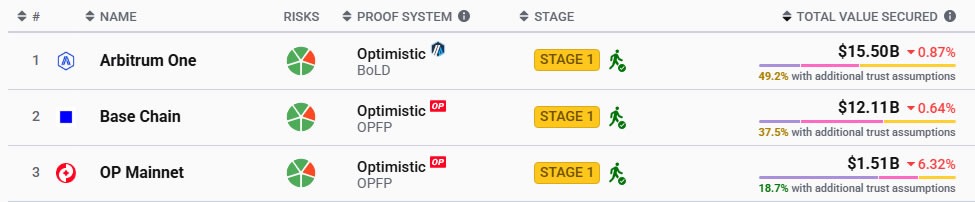
The Ethereum scaling ecosystem is dominated primarily by three players — Arbitrum One, Base and OP Mainnet — which command a 75% market share. Smaller players are slowly getting squeezed out as activity and capital concentrate among the top three.
Additionally, the total value secured across the layer-2 rollup ecosystem has declined by about 36% since its peak of just over $50 billion in October, with smaller networks losing much more as capital migrated to the industry leaders, according to L2Beat.
“L2 activity has dropped 61% since June, leaving many smaller networks as ‘zombie chains’ with minimal usage,” reported 21Shares in December.
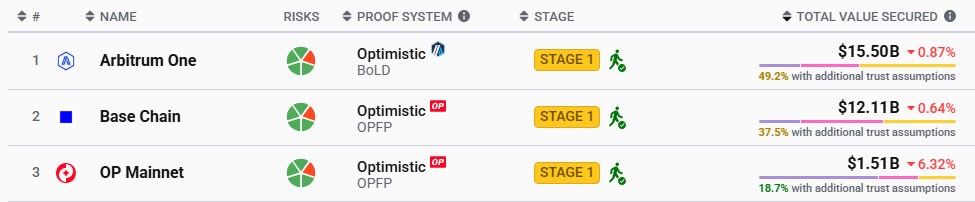
Three players account for nearly $30 billion in rollup total value secured. Source: L2Beat
Rollup market has shifted
Syndicate said the market has shifted away from its technology, “making it impossible to wait out these market conditions.”
“Instead, custom chains are being built by consulting teams from scratch, with very little reusable tech or network value.”
Related: Legend becomes latest DeFi app to throw in towel
The company said the Syndicate Network Collective is independent of Syndicate Labs, so SYND token governance is not immediately affected. It also said the decision to wind down was not influenced by the recent bridge compromise.
The Syndicate Commons Bridge on Base was exploited in late April because of a security breach and a leaked private key, resulting in the loss of 18.5 million SYND tokens worth about $330,000 at the time.
SYND fell 44% after the hack and declined another 21% over the past three hours, hitting an all-time low of $0.012 after the closure announcement, according to CoinGecko. The token is down 99.5% from its September 2025 peak of $2.61.
A year of DeFi and crypto closures
Syndicate Labs is the latest addition to a growing list of crypto and DeFi closures this year.
DeFi mobile superapp Legend announced it was winding down on May 13, citing growth and scaling problems.
Other recent closures include Solana DeFi aggregator Step Finance, DeFi derivatives protocol Polynomial, Balancer Labs, the team behind the DeFi protocol Balancer, and Seamless Protocol, a DeFi lending protocol on Base.
Magazine: 5 tech predictions the mainstream media got horribly wrong

XRP price is pinned under $1.40 while its derivatives activity explodes. Futures volume has been holding above $2 billion with steady $400 million in spot volume. Yet price barely flinched.
It has been revealed today that CME-listed XRP futures crossed $63 billion in notional volume within their first year, with 1.32 million contracts of 28.6 billion XRP traded as of mid-May.
The regulated derivatives infrastructure is clearly maturing. But spot price has been pinned for a long time, and people are questioning if the price is being manipulated.
Discover: The best pre-launch token sales
XRP Price Needs to Hit $1.50, or It Won’t Break Downtrend
XRP’s 24-hour range of $1.37 sits in a wide 7-day range that topped $1.54. The same $1.50 level that has been rejected more than a couple of times. Momentum reads as conditional: bulls need a clean close above $1.5 to invalidate the ceiling thesis.
Is not all bad for XRP, as we have identified a bull-flag structure projecting a potential move toward $1.60 in the longer time frame, implying more than 20% upside from current levels if the pattern completes with volume confirmation.

But for now, we would likely see XRP price consolidate between $1.35 – $1.45 as open interest bleeds out and traders await the next catalyst.
The derivatives overhang is the wildcard. XRP ETF demand and stagnant price action have coexisted before, a pattern that typically resolves violently in one direction. The billions in open interest show that resolution is approaching.
Discover: The best crypto to diversify your portfolio with
Bitcoin Hyper Targets First-Mover Upside
XRP’s story is essentially a maturity problem: massive institutional infrastructure, regulatory clarity, and $63 billion in derivatives activity, yet the spot price still can’t break a single all-time high.
At a market cap this size, the asymmetric upside that early XRP holders enjoyed is structurally unavailable. That’s the math. Some traders are rotating attention toward earlier-stage plays where the infrastructure narrative is fresher.
Bitcoin Hyper ($HYPER) is positioning itself as the first Bitcoin Layer 2 with full Solana Virtual Machine (SVM) integration. Hyper is powered with faster transaction finality than Solana, with Bitcoin’s security as the base layer.
The project has raised $32.7 million at a current presale price of $0.0136, combining extremely low-latency L2 processing with a decentralized canonical bridge for BTC transfers and a high 36% APY staking rewards. It targets Bitcoin’s three core limitations directly: slow transactions, high fees, and the absence of programmable smart contracts.
Research Bitcoin Hyper with full due diligence before the next price increase.
The post XRP Price Manipulated? $63 Billion Futures Surge Still Can’t Move XRP appeared first on Cryptonews.
Crypto World
A crypto whale has made a $224,000 bet that XRP’s price stays perfectly flat through June


A massive XRP derivatives play is betting that its price goes nowhere until the end of June, even as macro headwinds and regulatory developments suggest a volatility boom.
The move hit the tape on crypto exchange Deribit as a single-block trade, meaning it was a large transaction executed over-the-counter in a privately negotiated deal to prevent it drastically moving the price.
The trade likely involved a whale or an institution executing what is known as the “short straddle” strategy by shorting (selling) 1.5 million contracts of both the $1.40 call and put options expiring on June. 26.
By selling both the call and put, the trader is effectively providing insurance against sharp price movements away from the $1.40 strike. The trader received an upfront premium of $224,500 for assuming this volatility risk.
The trader will retain that amount as profit if XRP remains near $1.40 through June 26.
Hence, the bet is essentially on volatility to stay low, with prices pinned near $1.40. The payments-focused cryptocurrency has largely traded between $1.30 and $1.50 since February, according to CoinDesk data.
The strategy is not without risk. A sharp move in either direction would turn the position unprofitable, requiring the trader to cover losses owed to option buyers.
As of now, plenty of factors point to potential for volatility. Inflation concerns in the U.S. and other parts of the world are pushing up government bond yields worldwide, disincentivizing investments in stocks, cryptocurrencies and other risky assets.
Meanwhile, the Senate Banking Committee advanced the Clarity Act, a landmark U.S. legislative proposal designed to establish a clear regulatory framework for cryptocurrencies and digital assets. The bill now moves forward to a full Senate vote.
Stuart Alderoty, chief legal officer at Ripple, which uses XRP to facilitate cross-border transactions, reportedly called the banking committee’s decision a “monumental outcome” and cited the protection of 67 million American crypto holders as the bill’s purpose.
XRP is often seen as a U.S. crypto play, as Ripple is based in San Francisco and is among several firms that have received conditional approval from the Office of the Comptroller of the Currency (OCC) to establish the Ripple National Trust Bank (RNTB).


OpenAI said that an internal general-purpose reasoning model autonomously solved the planar unit distance problem, a famous open problem in discrete geometry first posed by Paul Erdős in 1946, marking the first time one of its systems has cracked a long‑standing research question without step‑by‑step human guidance
The announcement sharpens an industry argument that frontier models are moving from assistant tools to original contributors in technical fields, with implications that stretch far beyond mathematics.
A New Bar for Autonomous AI Research
The company described the result as proof that advanced systems can hold a difficult argument together, combine ideas from distant areas of knowledge, and produce work that withstands expert review. External mathematicians verified the proof, which drew on tools from algebraic number theory.
OpenAI framed the milestone as part of a longer push toward more automated research. The lab said similar capabilities could one day support work in biology, physics, materials science, and medicine, where many problems are too large or complex for traditional teams to tackle alone.
Industry Race Heats Up
The breakthrough lands during a frantic stretch for the AI sector. OpenAI is reportedly preparing an IPO filing as soon as this week, just after a US jury cleared the company in a lawsuit brought by Elon Musk.
Rival Anthropic is on track for its first profitable quarter on projected revenue of $10.9 billion, while former OpenAI founding member Andrej Karpathy recently joined Anthropic to focus on frontier model research.
Labor and Strategy Questions Intensify
Autonomous problem-solving by AI is already reshaping how executives talk about high-skilled work. Citadel chief executive Ken Griffin recently warned that agentic AI is starting to replace PhD-level finance tasks in hours rather than months.
Some observers argue the next competitive edge in AI will not come from raw model quality but from access to real-world execution data that lets systems act, not just answer.
OpenAI said human judgment still anchors the work, with researchers choosing which problems matter and how to interpret results. What the new milestone changes is the range of problems a model can credibly take on alone.
The post OpenAI Model Autonomously Cracks 80-Year Math Problem, Shifting AI Research Stakes appeared first on BeInCrypto.

Tax dodgers have started turning to Bitcoin Ordinals, BRC-20 tokens and other digital methods in an attempt to hide their wealth from tax authorities, according to blockchain analytics platform Chainalysis.
“Tax evasion and unreported income are age-old financial crimes, but the methods used to commit them are rapidly evolving,” Chainalysis said in a report Wednesday.
“As digital assets become more mainstream, bad actors frequently attempt to exploit novel technologies — such as NFTs, decentralized finance protocols, or emerging token standards — in hopes of keeping their wealth hidden from tax authorities and law enforcement.”
Tax authorities have been scrambling to catch up with technological advances and to track and apply taxes. A March study estimated that only 32% to 56% of US crypto owners report their gains. In Norway, that percentage was only 12%, according to a study from August 2024.

Source: Chainalysis
Italian authorities uncover $1 million tax evasion scheme
Chainalysis reported that Italy’s Economic and Financial Police Unit in Foggia reportedly uncovered a tax evasion scheme in which an individual allegedly used Bitcoin Ordinals and the BRC-20 token standard to hide 1 million euros ($1.1 million) in undeclared capital gains.
Introduced in 2023, the Ordinals protocol assigns a serial number to a satoshi, the smallest unit of Bitcoin, and allows data, such as images or text, to be embedded in a Bitcoin transaction. The BRC-20 standard, built on top of it, allows text inscriptions to be deployed, minted into tokens and transferred on the Bitcoin blockchain.
Italian authorities discovered during their investigation that the suspect was using the Ordinals protocol and the BRC-20 standard to create tokens, then sent them and listed them on marketplaces, according to Chainalysis.
“The assets were sold for multiples of their original cost, and the profits were routed back to the suspect’s primary wallet in Bitcoin,” Chainalysis said. “The suspect continually reinvested these earnings into new inscriptions.”
Blockchain intelligence essential infrastructure
The US Internal Revenue Service estimates that the gross tax gap, the government’s best estimate of the total tax it is legally owed but did not receive, is about $606 billion. Tax evasion tactics usually include paying in cash and underreporting income.
However, Chainalysis said using crypto for tax evasion comes with a “fatal flaw” because of the “inherent transparency of the blockchain. No matter how sophisticated a scheme appears, the underlying technology leaves a permanent immutable trail.”
Blockchain intelligence can reconstruct a financial network and cross-reference it with data that crypto exchanges are required to report to unmask transactions tied to suspected tax dodgers, according to Chainalysis.
Related: Italy’s largest bank more than doubles crypto holdings to $235M in Q1: Report
“This landmark Italian case serves as a powerful reminder for law enforcement and compliance professionals globally: the technical novelty of crypto does not equal anonymity,” it said.
“As new digital asset classes continue to emerge and generate income streams, the gap between actual on-chain wealth and declared tax positions will become a primary target for global investigative attention. In today’s financial landscape, blockchain intelligence is essential infrastructure.”
Magazine: Bitcoin ETFs bleed $1B, Aave’s $71M ETH unfreeze bid delayed: Hodler’s Digest, May 10 – 16
The former chief risk officer of Silvergate revealed she made the decision to settle with the US securities regulator in 2024 to avoid a “multi-year battle” in court, where she was accused of misleading investors about anti-money laundering rules and how the bank monitored crypto customers.
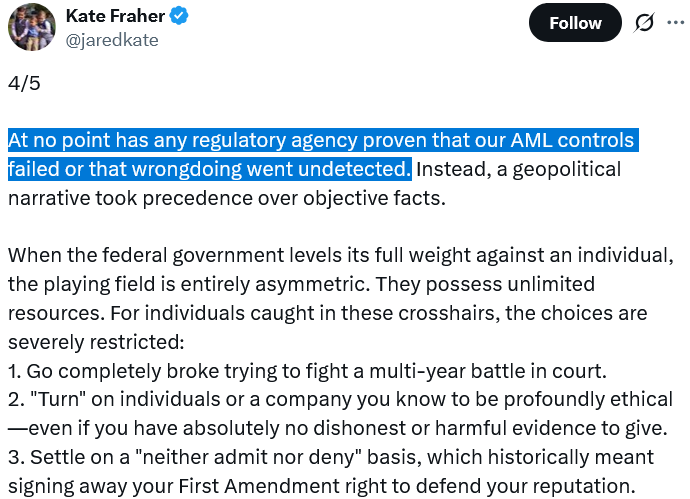
In her first public comments about her settlement with the SEC on Wednesday, Kate Fraher claimed that no financial agency proved that Silvergate’s anti-money laundering controls had failed, and that she only opted to settle to “move forward.”
Fraher had agreed to a civil penalty of $250,000 and was banned from serving as a company executive or board director for five years.
“The process itself is designed to apply maximum pressure, and the human costs are real. I was personally de-banked and had credit lines summarily closed—an aggressive tactic used to disrupt daily life and force compliance,” she said.
The comments provide more insight into the circumstances surrounding the wind-down of Silvergate, a crypto-friendly bank that voluntarily closed following the collapse of FTX. Fraher said her ability to comment came after the SEC rescinded the long-standing “gag rule” on Monday.
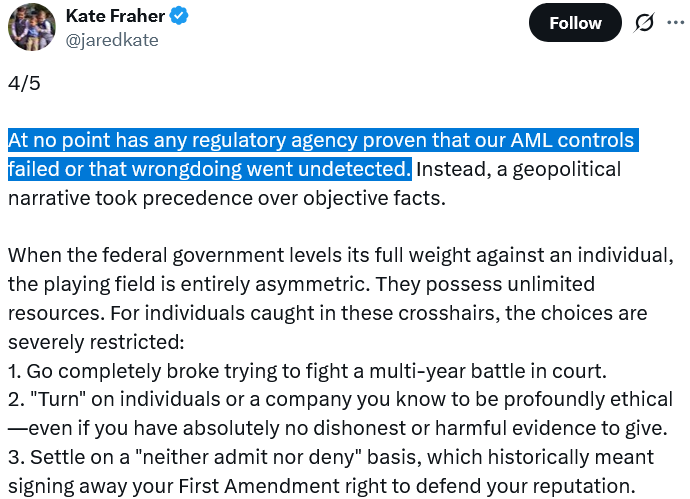
Source: Kate Fraher
Fraher said the wind-down was not because of a “bank run” or market volatility from FTX’s collapse in November 2022, even as the bank experienced a deposit run of around 70%.
Instead, Fraher said the company chose to wind down because the “broader administrative and regulatory pressure levied against the digital asset industry made operating a viable business impossible.”
Many crypto industry pundits labeled this as “Operation Chokepoint 2.0,” an unconfirmed plan in which US financial regulators cut off banking services to crypto companies in an attempt to restrict their ability to operate within the broader financial system.
Silvergate wasn’t the only crypto-friendly bank affected by the strict measures, which intensified following the collapse of FTX in November 2022.
Signature Bank and Silicon Valley Bank also shut down in early 2023, in part due to deposit runs, liquidity stress and contagion effects tied to FTX and several crypto lending platforms that went bankrupt in 2022.
Related: Trump-backed Truth Social pulls bids for crypto ETFs
But Fraher said by the beginning of 2023, it had weathered the FTX collapse by restructuring the business with “appropriate capital levels” and a “right-sized workforce” to continue operations safely.
Gag policy was unconstitutional, Fraher argues
Fraher applauded the current Paul Atkins-led SEC leadership for ending the gag rule, which she described as an “unconstitutional policy.”
“I am glad the right to speak the truth has finally been restored,” Fraher said, adding: “We must continue to talk about the long-term professional and personal toll exacted on individuals by regulation through enforcement.”
Magazine: 5 tech predictions the mainstream media got horribly wrong
Colts Emerge as Trade Theory for Vikings Playmaker

SpaceX Officially Files IPO Paperwork for What Could be the Year’s Largest Stock Offering

Ola Electric shares can crash up to 35%, warns Emkay after seeing Q4 results


-

 Crypto World5 days ago
BloFin War of Whales 2026 Grand Prix opens registration for $5M trading championship
-

 Fashion6 days ago
Weekend Open Thread: Theory – Corporette.com
-

 Crypto World6 days ago
E-Estate Announces 1 Year Live: Washington DC Summit as Real Estate Tokenization Enters Its Next Phase
-

 Tech6 days ago
Tech Moves: Microsoft AI leader jumps to OpenAI; former AI2 exec joins Meta; and more
-

 Tech5 days ago
Google reimburses Register sources who were victims of API fraud
-

 Crypto World7 days ago
Google’s Gemini AI Predicts Incredible Solana Price by the End of 2026
-

 Business6 days ago
H&R Real Estate Investment Trust (HR.UN:CA) Q1 2026 Earnings Call Transcript
-
 Entertainment7 days ago
Zara Larsson Has Blunt Response To Chris Brown Diss
-

 Sports5 days ago
Napoleonic enters 2026 Doomben 10,000 field via Abounding withdrawal
-

 Crypto World6 days ago
BeInCrypto 100 Institutional Awards Nomination: KAST for Best Digital Assets Neobank and Best Digital Assets Fintech
-
 Crypto World5 days ago
Bitcoin Battles US Bond Nerves With BTC Price Dip Toward New May Lows
-

 Fashion4 days ago
On the Scene at Gucci’s Cruise Show in New York City: Mariah Carey, Kim Kardashian, Lindsay Lohan, Iman, and More!
-
 Crypto World5 days ago
Wall Street’s Boldest Gold Prediction Has Russians Rushing to Buy
-

 Crypto World5 days ago
ICE and CME urge US regulators to curb Hyperliquid energy trading
-

 Politics6 days ago
DWP PIP Timms review continues to be an absolute farce
-

 Crypto World5 days ago
IREN closes $3 billion convertible notes deal amid AI infrastructure expansion
-

 Fashion5 days ago
Trending Western Style Vests Perfect for Summer
-

 Entertainment6 days ago
David Letterman Returns to Late Show, Blasts Cancellation
-
Crypto World6 days ago
Lido Finance Selects Chainlink CCIP as the Official Cross-Chain Infrastructure for wstETH Security
-

 Fashion4 days ago
Amazon Sundays: Memorial Day Hosting
You must be logged in to post a comment Login