

Crypto World
UAE Regulators Launch First Joint Audit Quality Inspections to Strengthen Financial Oversight


The Dubai Financial Services Authority (DFSA), the UAE Ministry of Economy and Tourism, and the Capital Market Authority (CMA) have announced the launch of their first joint Quality Management audit inspections, marking a new step toward strengthening financial oversight and regulatory coordination across the United Arab Emirates.
According to the announcement, the initiative is designed to improve oversight standards for audit firms operating within the UAE and reinforce confidence in the country’s financial reporting ecosystem.
The joint inspections follow recently signed Memorandums of Understanding between the participating authorities aimed at improving regulatory cooperation and information sharing related to auditor supervision across multiple jurisdictions.
Focus on International Audit Standards
The inspections will specifically assess how audit firms implement the International Standard on Quality Management 1 (ISQM 1), a globally recognized framework focused on quality control and governance within audit and assurance practices.
Regulators said the initiative is intended to ensure that financial institutions and market participants operating across the UAE benefit from consistent and high-quality audit standards aligned with international best practices.
The collaboration also reflects broader efforts by UAE authorities to strengthen transparency, governance, and investor confidence as the country continues positioning itself as a leading regional and global financial hub.
Strengthening the UAE Financial Ecosystem
The move comes as the UAE continues accelerating reforms across financial services, capital markets, compliance, and corporate governance.
Over recent years, regulators including the DFSA and other UAE authorities have increased their focus on international regulatory alignment, financial supervision, and institutional governance standards in support of long-term market development.
The latest initiative is expected to further enhance coordination between regulators while supporting the integrity and resilience of the UAE’s financial ecosystem.



SharpLink has secured inclusion in the Russell 2000 and Russell 3000 indexes, adding another milestone to the company’s push into Ethereum-based treasury management.
Summary
- SharpLink will join the Russell 2000 and Russell 3000 indexes on June 29 as institutional interest in crypto treasury firms grows.
- The company reported $12.1 million in quarterly revenue while recording a $685.6 million net loss tied mainly to Ethereum-related impairments.
- SharpLink also expanded its Ethereum strategy through a proposed $125 million on-chain yield fund with Galaxy Digital.
According to a report shared by Wu Blockchain, the Nasdaq-listed company, which trades under ticker SBET, will join both indexes when the U.S. market opens on June 29, 2026. The annual Russell index reconstitution places SharpLink among small-cap and broad-market U.S. equities tracked by institutional funds and exchange-traded products.
SharpLink expands Presence in public markets
FTSE Russell includes companies that meet specific market capitalization, liquidity, and listing standards. The addition of SharpLink means index-tracking funds will automatically purchase shares of the company once the changes take effect.
SharpLink chief executive Joseph Shalom said the company’s inclusion recognizes its Ethereum treasury strategy and may help increase shareholder participation. “This recognition supports our position as an institutional-grade Ethereum treasury platform,” Shalom said in a company statement.
Based in Miami, SharpLink rebranded from SharpLink Gaming in February 2026 after moving away from its sports betting business. The company now focuses on Ethereum treasury operations and digital asset-related financial services.
At the same time, BitMine Immersion Technologies, which trades under ticker BMNR, is also scheduled to join the Russell 3000 during the same reconstitution cycle.
Revenue growth comes with large ETH-Linked losses
SharpLink reported Q1 2026 revenue of $12.1 million, compared with $0.7 million during the same quarter a year earlier. Company filings also showed a net loss of $685.6 million for the quarter.
The company attributed most of the loss to non-cash impairments and unrealized declines tied to its Ethereum holdings. SharpLink currently holds more than 872,000 ETH equivalent, according to post-quarter financial disclosures.
While the revenue increase showed business expansion, the company’s balance sheet remains closely tied to Ethereum price movements. Public companies with large crypto treasury positions often face earnings volatility due to digital asset valuation changes.
According to company disclosures, SharpLink ranks among the world’s largest publicly traded Ethereum holders. The strategy has drawn attention from investors looking at corporate crypto exposure beyond Bitcoin-focused firms.
Galaxy Partnership adds deFi exposure
On May 11, SharpLink announced the proposed Galaxy SharpLink Onchain Yield Fund in partnership with Galaxy Digital. The planned fund includes $125 million in committed capital, including $100 million from SharpLink’s staked Ethereum treasury and $25 million from Galaxy.
The agreement remains non-binding at this stage. If finalized, the fund would become one of the larger institutional decentralized finance yield vehicles linked to a publicly traded company.
Company statements described the fund as part of SharpLink’s effort to expand institutional participation in on-chain finance products. Market participants are now watching whether the partnership proceeds into a formal agreement.
As previously reported by crypto.news, Galaxy Digital and SharpLink announced a non-binding agreement on May 11 to launch the Galaxy SharpLink Onchain Yield Fund, a $125 million limited partnership designed to deploy part of SharpLink’s staked Ethereum treasury across decentralized finance strategies. Galaxy will serve as the investment manager for the proposed fund.
SharpLink plans to contribute $100 million from its staked ETH holdings, while Galaxy will provide an additional $25 million in capital. Mike Novogratz, founder and chief executive officer of Galaxy, said the infrastructure supporting institutional participation in decentralized finance “has matured to a point where allocators can access yield, liquidity, and risk management with the same rigor they expect in traditional markets.


Solana privacy protocol Umbra has partnered with Streamflow to launch confidential vesting for the $97 billion token unlock market.
Summary
- Umbra and Streamflow launched confidential vesting that encrypts token unlock schedules, vesting amounts, and recipient addresses on Solana, preventing public front-running of insider allocations.
- The integration targets the $97 billion crypto token unlock market, where standard vesting contracts create publicly visible supply signals that traders use to position ahead of scheduled releases.
- Umbra is built on Arcium’s encrypted execution engine and raised $154.9 million in USDC commitments from over 10,000 participants via MetaDAO’s ICO framework in October 2025.
Umbra, the Solana-native financial privacy layer built on Arcium’s encrypted execution engine, has launched confidential vesting in partnership with Streamflow, the leading token distribution platform listed in Solana’s official documentation.
The integration encrypts vesting schedules, allocation amounts, and recipient wallet addresses so that on-chain observers cannot access the underlying parameters of token unlock agreements.
The problem the product targets is structural. Standard vesting contracts execute on a public ledger where anyone can see which wallets will receive tokens, the exact amounts, and when each tranche unlocks. Sophisticated traders build sell positions ahead of supply increases from team and investor allocations, creating structural selling pressure that directly disadvantages the projects and token holders they front-run.
What confidential vesting does and why it matters at institutional scale
Umbra’s infrastructure processes vesting operations over fully encrypted data using Arcium’s multi-party computation framework. The recipient’s identity, allocation size, and unlock schedule are all encrypted at the contract level, with actual token transfers settling on Solana without exposing the underlying parameters to the public mempool or to on-chain analytics tools.
Streamflow is integrated directly into the Solana ecosystem as the standard token vesting infrastructure and has processed contracts for hundreds of Solana-native projects.
The partnership connects Umbra’s privacy layer to that existing tooling without requiring a separate workflow, making confidential vesting available as a straightforward option within the same interface that teams and investors already use.
“Umbra is the initial proof of what becomes possible when you build financial infrastructure powered by encrypted compute,” said Yannik Schrade, CEO of Arcium, at the March 2026 public wallet launch that preceded today’s vesting integration.
The $97 billion figure represents the estimated total value of scheduled crypto token unlocks across major ecosystems through 2027. Solana accounts for a significant portion of this market given the concentration of recently launched protocols on the chain with multi-year vesting schedules still outstanding.
Why Solana’s privacy infrastructure has accelerated in 2026
Umbra raised $154.9 million in USDC commitments from more than 10,518 participants via MetaDAO’s ICO in October 2025. Arcium’s Mainnet Alpha launched in February 2026, Umbra opened its public privacy wallet in March, and confidential vesting marks the protocol’s first institutional product beyond individual transaction privacy.
Crypto.news has covered the growing institutional interest in privacy-preserving blockchain infrastructure as quantum computing concerns accelerate revaluation of cryptographic foundations.
Crypto.news has also tracked how privacy protocol capital rotation has driven ZEC to a 73% monthly gain as encrypted execution infrastructure gains institutional attention.
The confidential vesting launch extends Umbra’s privacy infrastructure from individual transactions into the corporate treasury and investor management workflows where the largest on-chain unlock volumes are concentrated.
Crypto.news has also noted how security and compliance standards now determine institutional capital access, a constraint that shapes how confidential vesting products must integrate KYC and audit capabilities alongside privacy protections.
Crypto World
Crypto Advocacy Group Pushes Back Against US Senator’s Claims on Companies’ OCC Charters
Update (May 26 at 9:30 pm UTC): This article has been updated to include statements from The Digital Chamber.
The Digital Chamber, a cryptocurrency advocacy group that has been closely involved in negotiations with US lawmakers over digital asset-related legislation, questioned three-term Massachusetts Senator Elizabeth Warren’s understanding of banking laws as applied to crypto companies.
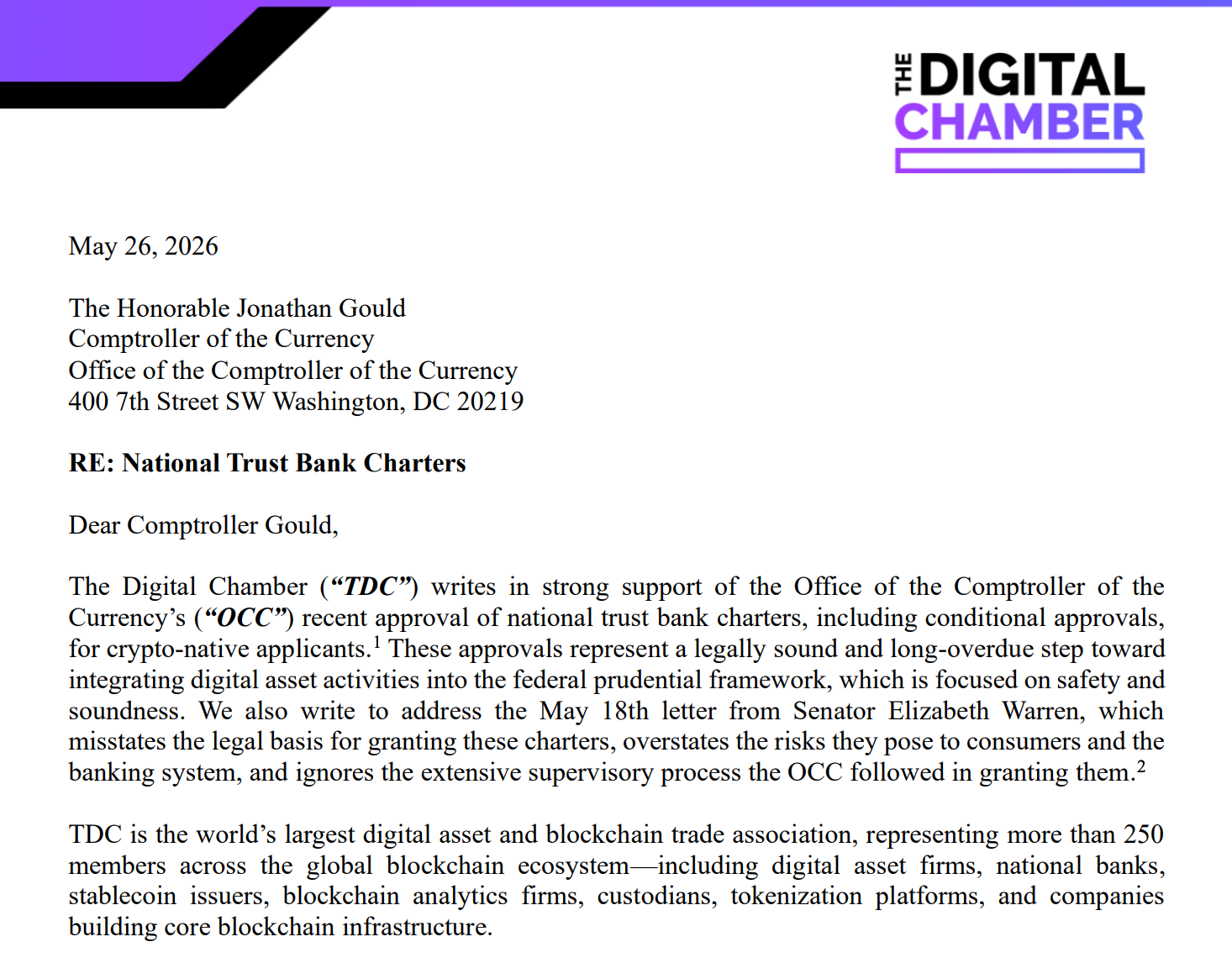
In a Tuesday letter to the US Comptroller of the Currency (OCC) Jonathan Gould, Digital Chamber CEO Cody Carbone challenged many of the claims in the Massachusetts lawmaker’s May 18 letter. In that letter, Warren said that the OCC may have violated the National Bank Act by approving national trust charters for nine crypto companies “that intend to engage in activities that appear to go far beyond the narrow set of activities permitted by law.”
“The claim that these firms seek to ‘evade’ regulations […] or pose risks to the safety and soundness of the banking system is contradicted by their own conduct,” Carbone said in his Tuesday letter. “These companies voluntarily sought federal oversight: each applied for a national trust bank charter, submitted to OCC examination authority, and accepted the compliance obligations that come with federal supervision.”
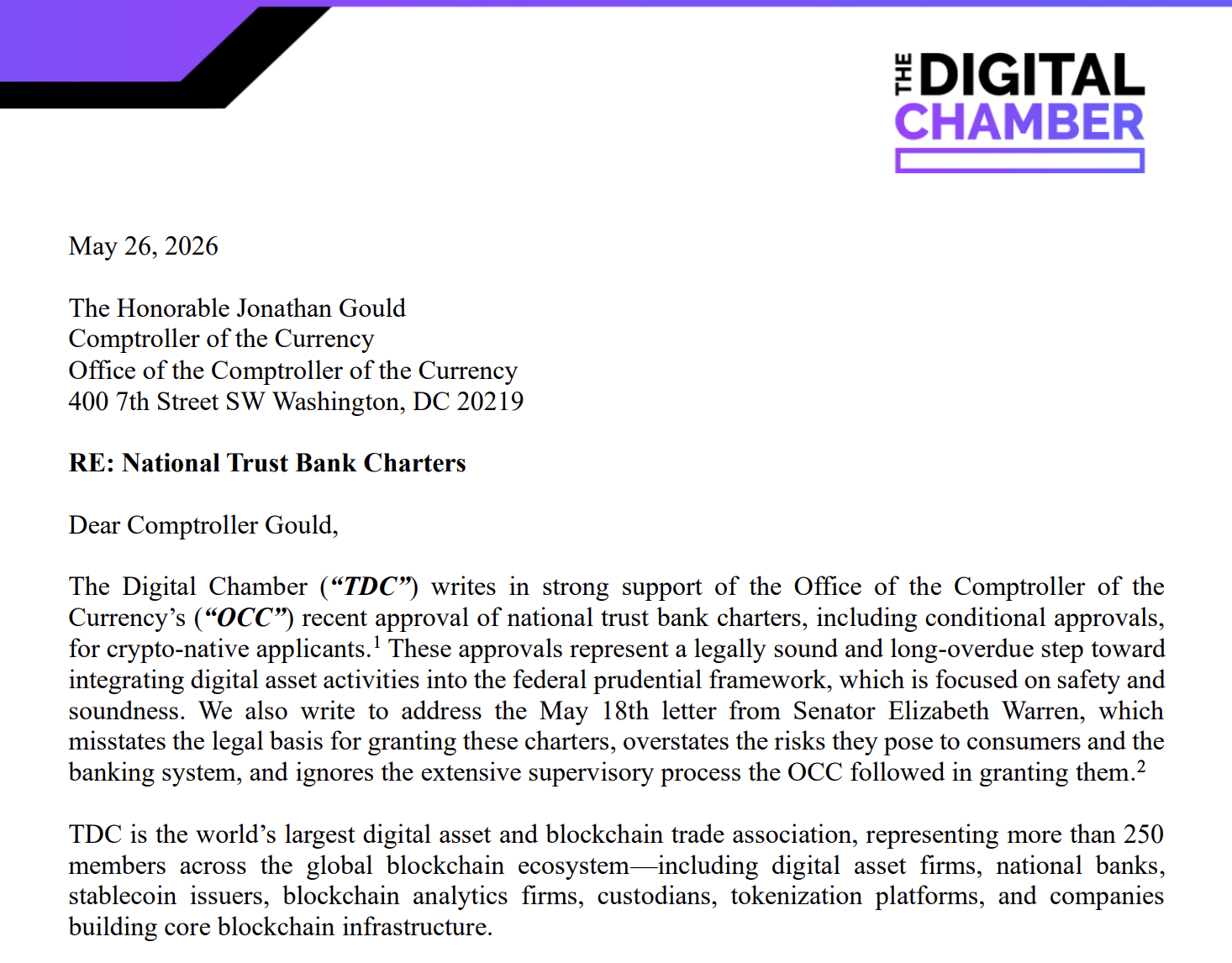
Source: The Digital Chamber
Warren’s concerns stemmed from OCC’s approving or conditionally approving charter applications from Coinbase, Crypto.com’s parent company, Ripple, Stripe, BitGo, Circle, Fidelity Digital Assets, Protego Holdings and Paxos. She said that the companies “want to evade the fundamental safeguards and obligations that come with being a bank” and questioned what led to the approvals, implying influence from the White House.
Related: Crypto PAC money pours into Texas primary runoffs, as prediction markets favor challengers
As the ranking member of the US Senate Banking Committee, Warren has repeatedly criticized lawmakers and regulators for supporting policies with potential conflicts of interest related to US President Donald Trump’s ties to the crypto industry. Cointelegraph sought comment from Warren’s office but did not receive an immediate response.
“If Senator Warren believes the OCC exceeded its authority, the appropriate response is to identify where the statute draws the line she says was crossed,” Carbone said in response to a request for clarification from Cointelegraph. “We’d welcome that debate. But ‘this seems wrong’ from a member of the Banking Committee isn’t a legal argument. And the OCC shouldn’t retreat from a legally sound decision because of political pressure, regardless of who’s applying it.”
Other crypto companies’ OCC applications are pending review
Warren’s concerns about the OCC approvals came as the banking regulator is considering applications from the Trump family-backed crypto business World Liberty Financial as well as Payward, the parent company of cryptocurrency exchange Kraken.
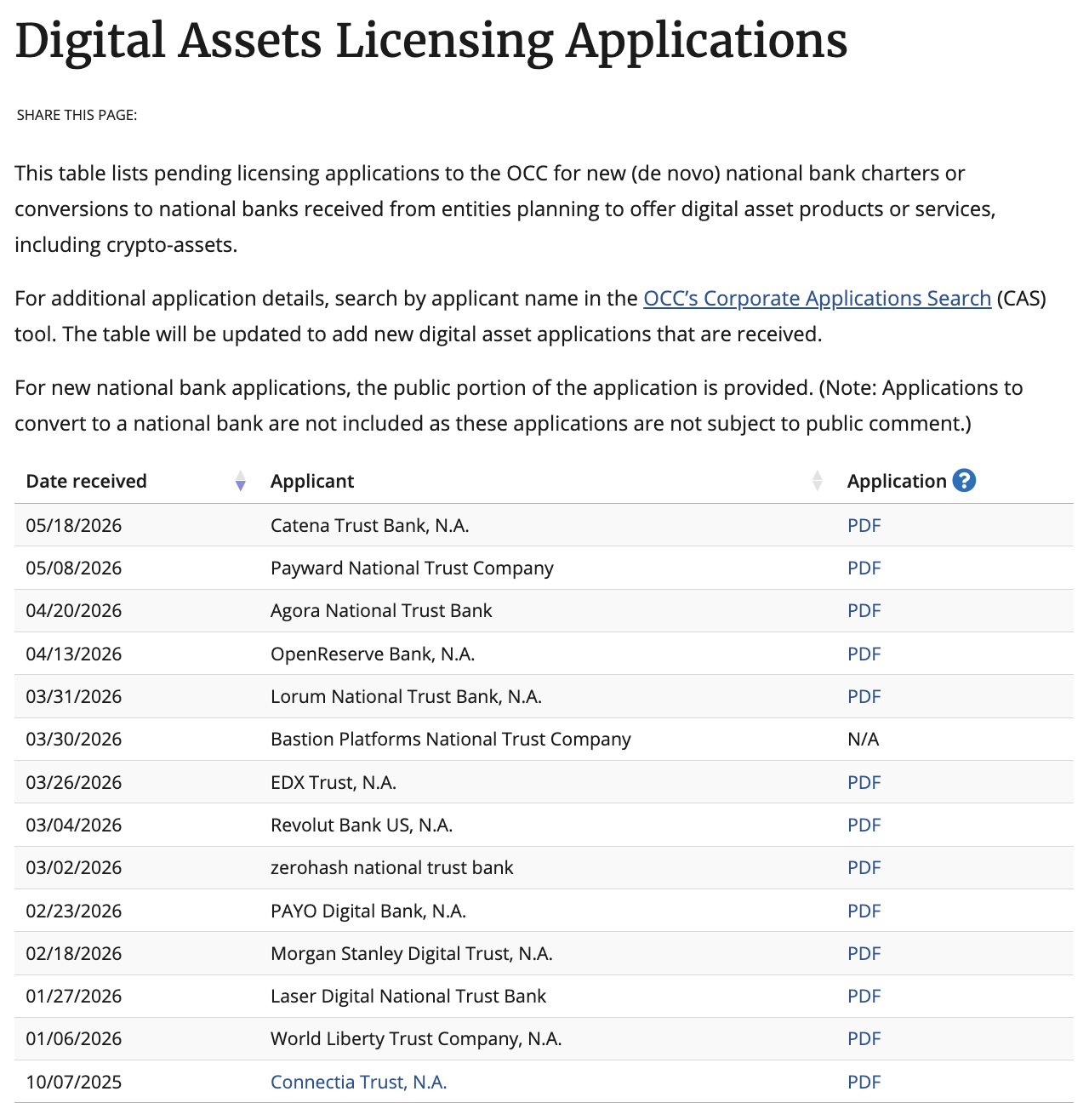
Source: OCC
Payward said it intended to “provide fiduciary custody and other services primarily for digital assets” if approved. In January, Warren called on Gould to delay consideration of World Liberty’s application until Trump divested from the platform, citing financial conflicts of interest.
As of Tuesday, the OCC listed 14 digital asset companies that had submitted licensing applications.
Magazine: 50K investors fight Korean crypto tax, Singapore cancels Bsquared: Asia Express

Update (May 26 at 9:30 pm UTC): This article has been updated to include statements from The Digital Chamber.
The Digital Chamber, a cryptocurrency advocacy group engaged in negotiations with U.S. lawmakers on digital-asset policy, has challenged Massachusetts Senator Elizabeth Warren’s interpretation of banking law as it applies to crypto firms. Warren, a vocal critic of crypto policy, has suggested that the Office of the Comptroller of the Currency (OCC) may have overstepped the National Bank Act by approving national trust charters for entities that “intend to engage in activities that appear to go far beyond” the law’s narrow allowances.
In a letter to OCC Comptroller of the Currency Jonathan Gould, Digital Chamber Chief Executive Cody Carbone contends that the concern over evading regulation is not borne out by the firms’ actions. He argues that these companies voluntarily sought federal oversight by applying for national trust bank charters, submitting to OCC examination authority, and accepting the compliance obligations that accompany federal supervision.
Warren’s critique has followed OCC actions granting or conditionally approving charter applications from a roster that includes Coinbase, Crypto.com’s parent company, Ripple, Stripe, BitGo, Circle, Fidelity Digital Assets, Protego Holdings, and Paxos. She asserted that the approvals raise questions about what led to the charters and hinted at potential political influence in the decision-making process.
As the ranking member of the Senate Banking Committee, Warren has long scrutinized crypto-policy decisions she views as presenting conflicts of interest tied to political figures’ ties to the industry. Cointelegraph previously reported her concerns about OCC’s charter approvals and the implications for safeguarding banking-system safety and soundness. The Digital Chamber’s letter pushes back on the characterization of these firms as attempting to bypass regulation, emphasizing instead their commitment to federal oversight and compliance obligations.
“If Senator Warren believes the OCC exceeded its authority, the appropriate response is to identify where the statute draws the line she says was crossed,” Carbone stated in response to inquiries. “We’d welcome that debate. But a political critique from a member of the Banking Committee does not constitute a legal argument. The OCC should not retreat from a legally sound decision because of political pressure.”
Key takeaways
- The Digital Chamber publicly challenges Senator Elizabeth Warren’s reading of banking law as it applies to crypto-facing OCC charters, arguing that federal oversight is the intended framework for these institutions.
- The OCC has approved or conditionally approved national trust charters for several crypto firms, including Coinbase, Crypto.com’s parent company, Ripple, Stripe, BitGo, Circle, Fidelity Digital Assets, Protego Holdings, and Paxos.
- The debate centers on the statutory boundaries of the National Bank Act and the extent of regulatory authority over crypto-native financial services seeking federal oversight.
- A number of other crypto firms are in the OCC’s licensing pipeline, with World Liberty Financial and Payward (the parent of Kraken) among applicants already under review as of late May, alongside a broader set of digital-asset licensing applications.
- Warren has urged delay in specific cases where potential conflicts of interest are alleged, illustrating the ongoing tension between regulatory oversight, political considerations, and industry strategy in the United States.
Regulatory backdrop: OCC charters, the National Bank Act, and crypto oversight
The OCC’s national trust charter program sits at the intersection of federal supervisory authority and the evolving regulatory framework for digital assets. Proponents argue that chartered trust banks provide uniform, federally supervised standards for custody, fiduciary services, and other crypto-centric activities. Critics, including Senator Warren, contend that charter approvals may stretch the boundaries of the National Bank Act and could reflect political considerations as the administration seeks to shape crypto policy.
Public reporting indicates that the OCC has been reviewing several digital-asset charter applications and licensing requests as part of a broader federal framework for crypto governance. The fundamental issue remains how to balance rigorous consumer protection, financial stability, and legitimate innovation within a cohesive regulatory regime.
The Digital Chamber’s position and its regulatory framing
In its communication with OCC leadership, The Digital Chamber characterizes the certificate-seeking firms as voluntarily embracing federal oversight rather than seeking to evade regulation. The group frames the needle-threading between compliance and innovation as a matter of principle for industry players that have chosen to operate under OCC examination and the attendant fiduciary duties.
The exchange highlights that the firms have engaged with the supervisory process by applying for charters, agreeing to examinations, and accepting the corresponding compliance obligations. The argument emphasizes that the governance structure provided by OCC oversight—while not flawless—represents a mechanism to reduce risk, align with existing banking norms, and integrate crypto services into the formal financial system.
OCC licensing activity and notable applications in focus
Beyond the named firms, the OCC’s published roster shows a growing slate of digital-asset licensing applications. The regulator’s public listing as of the week of May 26 identified 14 digital-asset companies seeking licensing, reflecting continued industry interest in federal recognition and supervision.
Two high-profile cases have drawn particular scrutiny. World Liberty Financial—the Trump family-associated crypto venture—has attracted attention from lawmakers amid concerns about potential conflicts of interest and governance. Payward, the parent company of the Kraken exchange, has also pursued OCC-charter considerations, with Kraken signaling an intention to provide fiduciary custody and other services primarily for digital assets if approved.
Warren had previously called for a delay in World Liberty’s application pending divestment by relevant political actors, arguing that unresolved financial ties could influence decision-making. The OCC’s licensing process remains ongoing, with charter and licensing decisions still forthcoming in several high-profile cases.
As of late May, the OCC’s public-facing page continued to list 14 digital-asset licensing applications, underscoring a regulatory trajectory that intertwines federal oversight with industry-led innovation. These developments occur within a broader U.S. regulatory environment that includes scrutiny from agencies such as the SEC, CFTC, and DOJ, as well as ongoing policy debates surrounding MiCA-like standards, AML/KYC compliance, and banking integration for stablecoins and crypto-related services.
Broader policy context and institutional implications
The ongoing discussion around OCC charters for crypto firms sits within a larger policy ecosystem. In the United States, the evolution of digital-asset regulation involves balancing investor protection, financial stability, and competitive neutrality among traditional banks, fintechs, and crypto-native entities. Regulators are weighing licensing requirements, custody standards, and disclosure obligations in the context of cross-border operations and evolving supervisory frameworks.
For institutions and regulated entities, the implications extend to licensing timeliness, capital and liquidity planning, internal compliance controls, and cross-border operational risk. In parallel, policymakers are considering how to align U.S. rules with broader international standards—such as MiCA in the European Union—and how to harmonize AML/KYC requirements across jurisdictions to reduce regulatory fragmentation while preserving innovation incentives.
As this debate unfolds, crypto firms, banks, and financial intermediaries face a persistent need to demonstrate robust governance, transparent custodial practices, and auditable compliance programs. The outcome will influence licensing strategies, partnership opportunities, and the degree to which the U.S. creates a streamlined pathway for regulated crypto services within the traditional financial system.
Closing perspective
The current exchange between lawmakers and industry groups highlights a core regulatory question: where should supervisory authority end and policy debate begin when digital assets intersect with established banking law? Watch how OCC positions its statutory boundaries in forthcoming charter decisions and how stakeholders interpret these decisions in the broader context of U.S. financial regulation and global policy alignment.
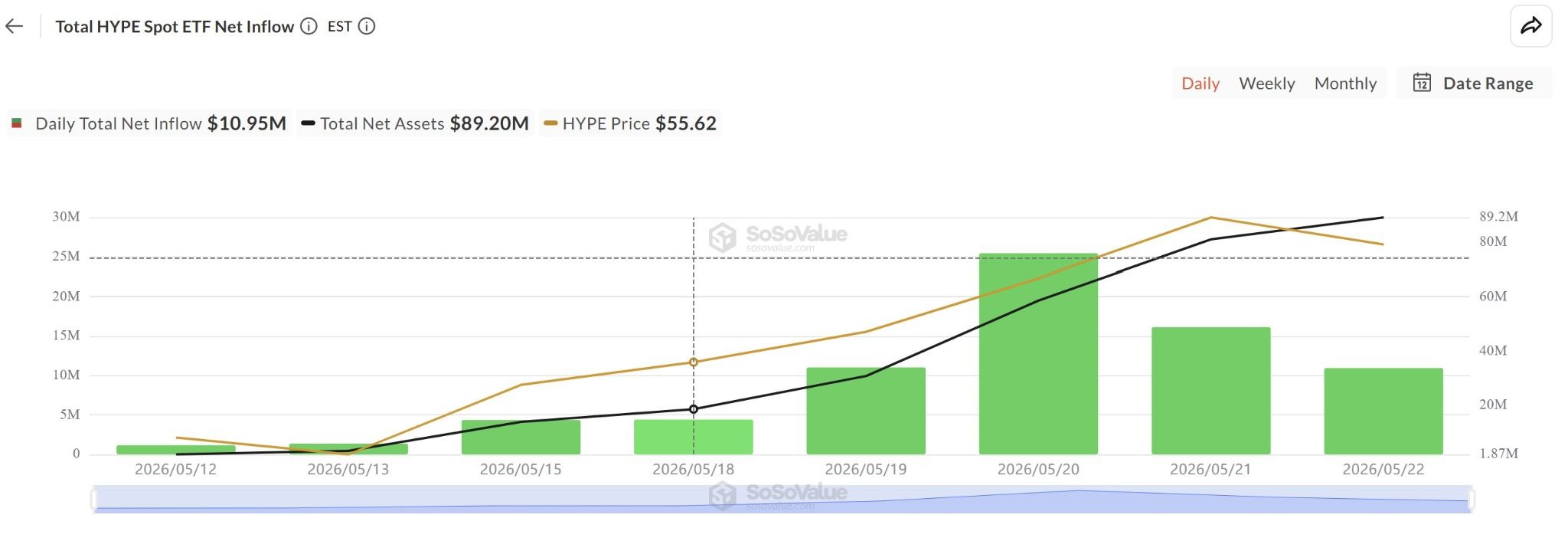
Hyperliquid’s native token HYPE continues to rally, possibly targeting $100 as its next all-time high, as inflows to its exchange-traded funds highlight investor demand.
Inflows into the HYPE ETFs reached $89 million over the past nine days, which is equivalent to nearly $9.2 million in daily buying pressure.
The combined assets under management (AUM) across Bitwise’s BHYP and 21Shares’s THYP climbed to $89 million within days of launch, giving HYPE one of the fastest ETF accumulation curves among crypto investment products.
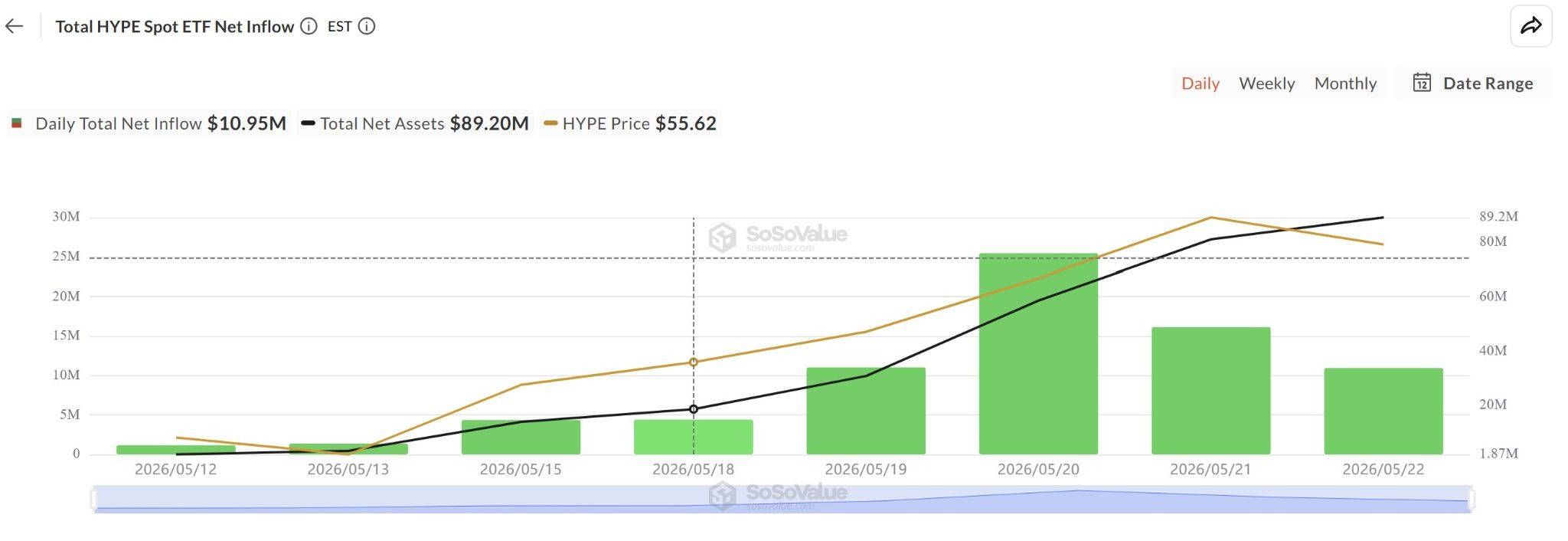
Total spot HYPE ETF net inflows. Source: SoSoValue
Bitwise CEO Hunter Horseley said BHYP alone recorded roughly $12 million in trading volume during its first 90 minutes of trading. The fund’s assets under management reached $40 million just over a week after launch.
HYPE proponent Havoc added that the upcoming Grayscale GHYP product could contribute another $8 million to $12 million in daily inflows. At different average purchase prices, the projected yearly demand could absorb between 8% and 33% of HYPE’s circulating supply.
After assuming a 30% to 35% outflow similar to what was seen in the spot Bitcoin ETFs, Havoc estimated yearly net demand between $2.9 billion and $3.6 billion. The analyst described the figures as substantial for a crypto asset with a relatively thin floating supply.
Onchain activity also shows growth, with Hyperliquid attracting more than $1.1 billion in net inflows over the past month.
Related: RWA market hits $51B as tokenized private credits surges: Bernstein
HYPE open interest tracks breakout
HYPE climbed to a new all-time high of $64.50 on Tuesday, while Bitcoin continued to struggle below the $77,000 resistance level. The token has since consolidated above its previous breakout level near $59.40, keeping HYPE in a price discovery.
If HYPE continues to hold above $59.40, the next Fibonacci extension target sits near $76 at the 1.236 level. Beyond that, the 1.382 Fibonacci extension places the next upside level near $89.50, followed by the 1.618 extension near $101.
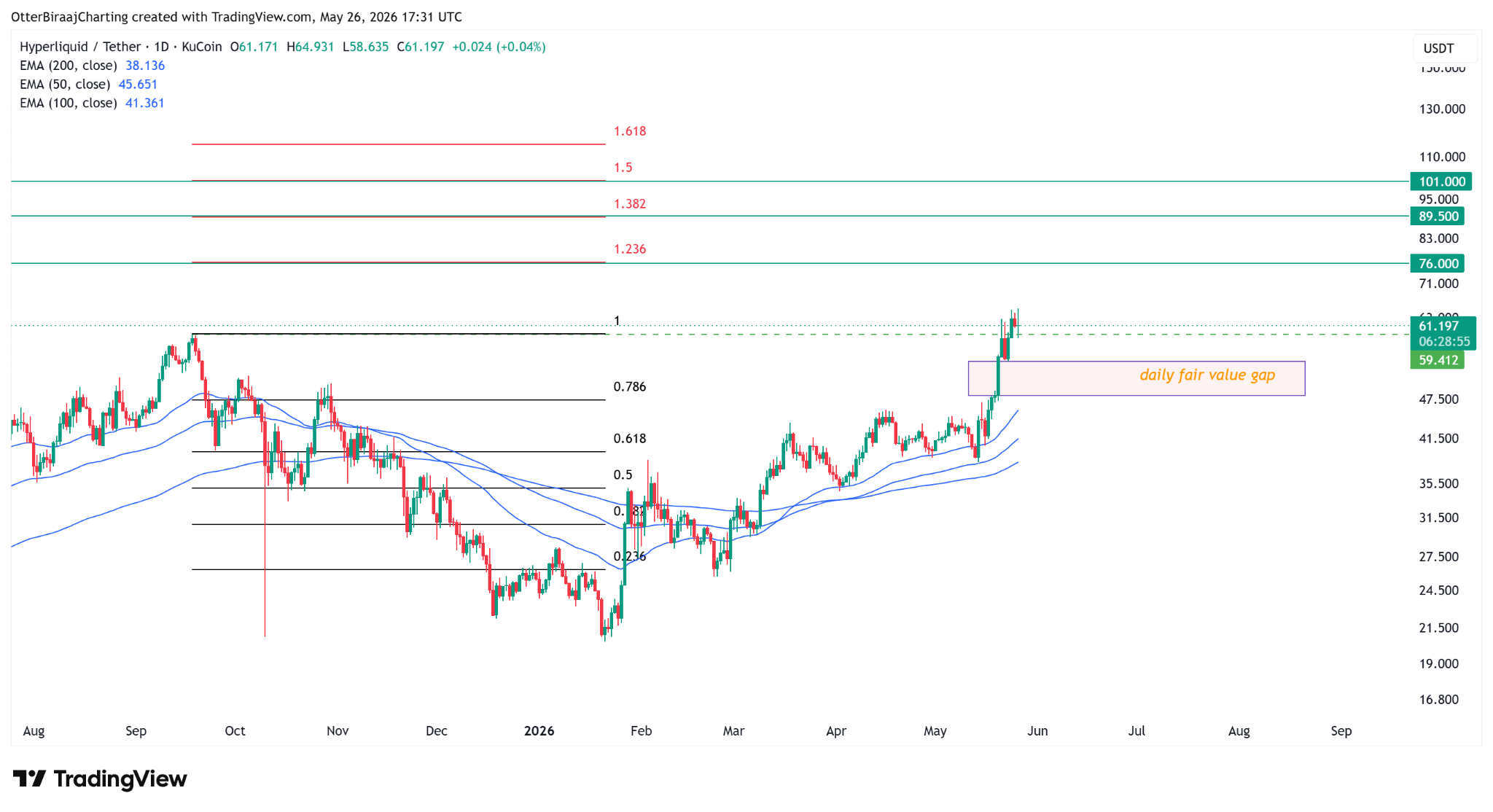
HYPE/USD, one-day chart. Source: Cointelegraph/TradingView
Fibonacci extensions are commonly used by traders to estimate potential resistance zones and profit-taking levels once an asset moves beyond its previous all-time high.
Derivatives data continued rising alongside the breakout. Velo data showed aggregated open interest approaching $2 billion as traders added fresh positions during the rally. Aggregated funding rates held near 0.004%, suggesting bullish positioning.
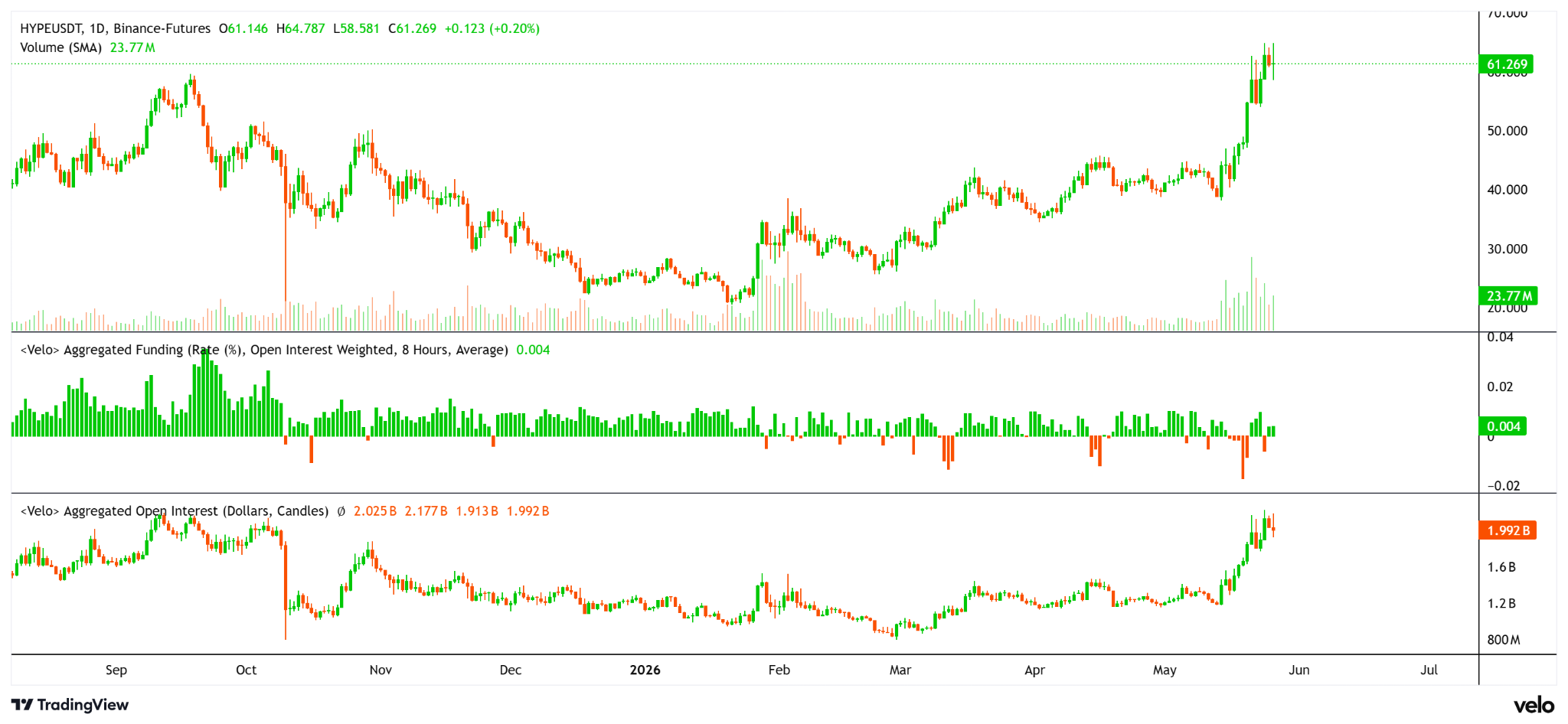
HYPE price, aggregated funding rate, and open interest. Source: Velo chart
Crypto analyst Byzantine General said Hyperliquid reached $8.5 billion in aggregate exchange open interest, making it the third-largest derivatives venue behind Binance and Bybit. The platform’s total open interest market share climbed to 7.2%, marking a new all-time high.
Meanwhile, some traders are monitoring signs of crowding after the sharp vertical move. Crypto trader GonzoXBT said a temporary pullback toward the four-hour 200-period exponential moving average (EMA) deviation area could help reset positioning.
The daily chart also shows an unfilled fair-value gap between $48 and $54 that overlaps with the rising 50-day EMA and could serve as a key liquidity and support zone if the price pulls back.
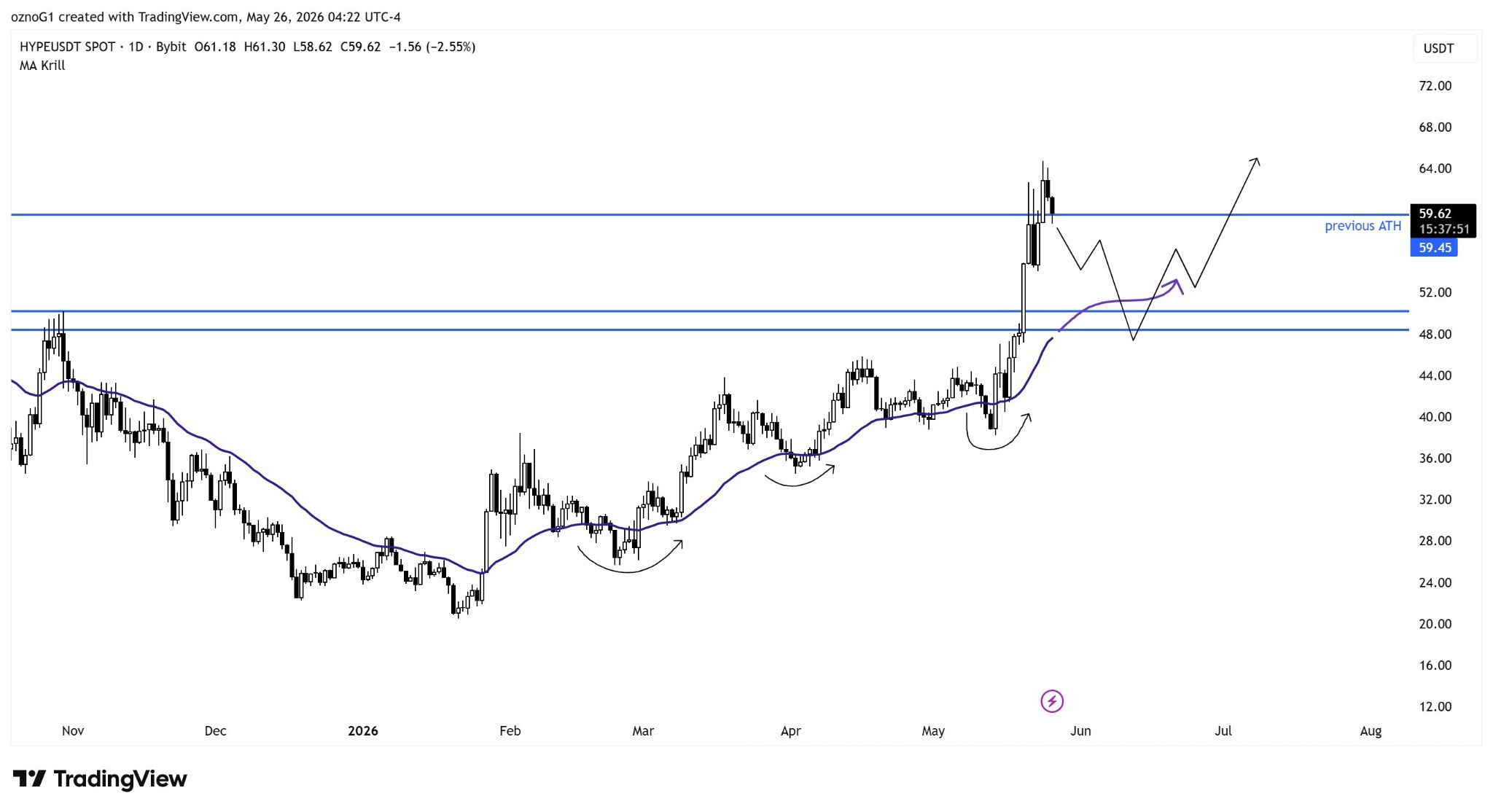
BTC/USD, one-day chart analysis by GONZO. Source: X
Related: NEAR protocol leads AI token rally with a 50% pump: Is $5 NEAR price next?


U.S. President Donald Trump has backed the CFTC’s exclusive authority over prediction markets as federal and state officials fight over who should regulate the fast-growing sector.
Summary
- Trump has backed the CFTC’s exclusive authority over prediction markets as states argue that some contracts should fall under gambling laws.
- The dispute covers sports and entertainment-linked contracts, with lawsuits and federal court cases already testing state and federal power.
- Trump’s family ties to Polymarket and Kalshi have added scrutiny as Congress also probes the prediction market sector.
According to Trump’s Truth Social post late Tuesday, keeping the Commodity Futures Trading Commission in charge is “critically important” as the U.S. works to set national rules for prediction market contracts. He said his administration is creating “rules of the road” and argued that states should not control the sector.
Trump also criticized former New Jersey Governor Chris Christie, New York Attorney General Letitia James, Minnesota Governor Tim Walz, and Illinois Governor J.B. Pritzker. In the same post, he said other countries are chasing the new financial market and added that the U.S. wants to stay ahead.
CFTC pushes back against state regulators
The dispute centers on whether prediction markets tied to sports and entertainment should be treated as financial contracts or gambling products. The CFTC has argued that contracts listed by regulated designated contract markets fall under federal oversight.
CFTC Chair Michael Selig has supported that position, and Trump’s post echoed the agency’s view. The regulator has already filed lawsuits and amicus briefs against several states that have tried to restrict or challenge prediction market operators.
State officials have taken a different position. They argue that some prediction market contracts function like gambling and should fall under state gaming laws.
James has filed lawsuits alleging that some platforms violate state gambling rules. Illinois has sent a cease-and-desist notice, while Minnesota recently passed a law with criminal penalties for operating prediction markets. Christie has also defended state power to regulate gambling products, which he has compared with prediction markets.
Court fight may reach Supreme Court
Several cases have already moved into federal appellate courts. The dispute could later reach the U.S. Supreme Court if lower courts continue to split over federal and state power.
At the same time, the House of Representatives has confirmed a probe into prediction markets. The inquiry comes as crypto-linked companies and platforms tied to Trump’s allies seek approvals connected to prediction market operations.
Trump’s family has links to the sector. Donald Trump Jr. serves as an adviser to both Polymarket and Kalshi, two major prediction market providers.
Gemini, the crypto exchange founded by Cameron and Tyler Winklevoss, has also launched a prediction market platform. Both Winklevoss brothers have publicly supported Trump, and Gemini recently filed to self-certify parlay-style contracts.
Trump also referred to his campaign pledge to make the United States the “crypto capital.” His post came as several countries, including Indonesia, Spain, and India, have moved to ban prediction markets from operating in their markets.
The regulatory battle also places more pressure on prediction market operators as they seek federal approvals while facing state-level challenges. Any final court decision could shape how platforms list contracts tied to elections, sports, entertainment, and crypto events in the U.S. market.


Stable, a USDT-focused Layer 1 blockchain, has launched StableEarn, a USDT yield vault tied to Treasuries and gold.
Summary
- Stable launched StableEarn with partners Morpho, Gauntlet, and Theo, offering USDT holders institutional-grade yield backed by Treasuries and real-world assets.
- The product targets USDT’s structural yield gap, as Tether keeps all reserve interest as profit rather than passing any return to token holders.
- Tether’s USDT supply stands at approximately $150 billion across 15 blockchains, the world’s largest stablecoin by circulation, but one that pays zero native yield to holders.
Stable, the USDT-dedicated Layer 1 blockchain, launched StableEarn, an institutional yield vault that lets USDT holders earn returns tied to US Treasuries and gold.
The product was developed in partnership with Morpho for lending infrastructure, Gauntlet for risk modeling, Theo for yield strategy, and Utila.io for enterprise-grade wallet security.
“USDT moves more value than any other stablecoin in the world, but putting it to work always had challenges when it came to competitive yields,” said Brian Mehler, CEO of Stable. “StableEarn changes that by bridging together institutional-grade yield and the chain built around USDT. The world’s largest stablecoin has a new home, and it’s on Stable.”
What StableEarn does and why USDT holders need a yield product
USDT pays no protocol-native yield to its holders. Tether keeps the interest spread between its zero-yield USDT deposits and the US Treasury bill reserves that back them, which is why Tether generated more than $10 billion in profit in 2025 alone.
That structural gap has driven demand for third-party products that bring USDT into productive use without requiring holders to bridge to other stablecoins.
StableEarn routes USDT holdings through real-world asset-backed strategies vetted by Gauntlet’s risk modeling. Returns come from traditional market instruments rather than from DeFi-native mechanisms, positioning it as a lower-risk yield option compared to delta-neutral synthetic stablecoin products.
Iggy Ioppe, CIO of Theo, described the product as “what on-chain dollar yield looks like done right. USDT-native, institutional-grade, with returns generated by real-world markets.”
Tether’s USDT supply stands at approximately $150 billion as of May 2026, having grown from roughly $118 billion at the start of 2025. Crypto.news has covered the ongoing intersection of stablecoin yield products and regulatory progress, as Congress debates yield-bearing stablecoin frameworks under the GENIUS Act.
Why the timing matters as institutional stablecoin yield demand scales
Yield-bearing stablecoins have grown from a niche experiment to a meaningful slice of the $311 billion total stablecoin market. Tokenised Treasury products including Ondo’s USDY and Sky’s sUSDS now serve as default treasury holdings for funds seeking passive dollar yield without managing T-bills directly.
StableEarn is the first vault designed specifically for USDT within its native chain, removing the need for USDT holders to bridge to Ethereum or other networks to access comparable products.
Morpho’s institutional lending architecture, which underpins StableEarn, is already deployed across multiple chains and is widely used by DeFi treasury managers as the risk-standard infrastructure for on-chain lending.
Crypto.news has reported on the US Treasury’s proposed AML rules for stablecoin issuers under the GENIUS Act, which would treat payment stablecoin operators as financial institutions and impose compliance obligations that institutional yield products like StableEarn must be designed to meet.
Crypto.news has also tracked the growth of tokenised Treasuries to $13.4 billion by April 2026, the asset class from which StableEarn draws its underlying returns.


Polkadot's governance has approved a proposal to establish a 10,000 DOT minimum self-stake requirement for validators. The approved upgrade introduces significant changes to the network's staking mechanics, including eliminating slashing risk for nominators and drastically reducing unbonding times… Read the full story at The Defiant


Strive Bitcoin treasury holdings reached 16,500 BTC after an $85.4 million buy that leapfrogged both Coinbase and Riot Platforms.
Summary
- Strive (NASDAQ: ASST) disclosed via 8-K on May 26 that it purchased 1,109 Bitcoin for $85.4 million at an average of $76,988 per coin between May 19 and May 22.
- The purchase pushes Strive past Coinbase’s 16,492 BTC and Riot’s 15,680 BTC holdings, making it the seventh-largest public corporate Bitcoin holder per BitcoinTreasuries data.
- Strive reported a 23.4% year-to-date Bitcoin yield and an amplification ratio of 45.2%, funding purchases through preferred equity SATA shares and at-the-market stock sales.
Strive, Inc. disclosed via an 8-K filing on May 26 that it purchased 1,109 Bitcoin (BTC) between May 19 and May 22 for approximately $85.4 million at an average cost of around $76,988 per coin.
The acquisition brings Strive’s total Bitcoin holdings to 16,500 BTC, pushing the company ahead of Coinbase and Riot Platforms in the public corporate Bitcoin holder rankings.
“Strive acquired an additional 1,109 BTC for ~$85.4 million at an average cost of ~$76,988 per bitcoin,” CEO Matt Cole posted on X alongside an internal snapshot of the company’s performance metrics.
How Strive climbed to seventh place among public Bitcoin holders
The $85.4 million purchase follows earlier May acquisitions of 382 BTC for $30 million on May 18 and 444 BTC for $33.9 million in early May. Strive completed its acquisition of Semler Scientific in January 2026, entering that transaction with 12,798 BTC and ranking eleventh among public corporate holders. It has since added more than 3,700 BTC to climb to seventh.
Strive funds Bitcoin accumulation primarily through at-the-market equity sales and its Variable Rate Series A Perpetual Preferred Stock instrument, the SATA shares, which carry a 13% annual dividend.
The SATA offering raised more than $225 million in an oversubscribed January 2026 round that attracted over $600 million in demand, providing a sustained capital base for continued purchases.
The company reported a year-to-date Bitcoin yield of 23.4%, a quarter-to-date yield of 11.0%, and an amplification ratio of 45.2%. Strive defines Bitcoin yield as the percentage change in Bitcoin per share outstanding, its primary performance metric against a Bitcoin benchmark.
Crypto.news has reported on Strategy CEO Michael Saylor saying a Bitcoin sale is “not unlikely” before year-end, providing context for how corporate Bitcoin treasury strategies are diverging as holdings mature.
What Strive’s position signals about the corporate Bitcoin accumulation landscape
Strive’s 16,500 BTC places it just above Coinbase’s 16,492 BTC and well above Riot’s 15,680 BTC. Strategy remains the dominant corporate holder by a wide margin with 818,334 BTC.
The gap between Strategy and the next-largest holders illustrates how concentrated the corporate Bitcoin (BTC) accumulation story remains, with a handful of firms accounting for the overwhelming majority of publicly held BTC.
Crypto.news has covered MARA Holdings selling $1.5 billion in Bitcoin to fund its AI infrastructure pivot, a contrasting approach to Strive’s pure accumulation model.


Hyperliquid has added validator-settled outcome markets for offchain events under its HIP-4 upgrade, expanding its trading system beyond perpetual futures into prediction markets.
Summary
- Hyperliquid has added offchain outcome markets under HIP-4, allowing validators to deploy and settle prediction markets inside its network.
- The system reduces reliance on external oracle services by letting validators vote on market deployment and final settlement.
- The first offchain market, “May CPI year-over-year,” shows how Hyperliquid plans to support real-world event trading alongside perpetual futures.
Hyperliquid said the new markets will be published through automated newsfeed software that validators run as part of normal chain operations. The exchange said validators will vote on which canonical markets are deployed and how those markets are settled after the event ends.
The system gives Hyperliquid validators a role that other prediction market platforms usually assign to a separate oracle service or an internal settlement process. Hyperliquid said validators will assess market rules, correctness, and market quality before deployment and during settlement.
“Validators vote on deployment and settlement of canonical markets based on a variety of factors, including unambiguous rules, correctness, and subjective quality of the market,” the team said.
Hyperliquid uses Validators for event resolution
Under the HIP-4 design, market resolution happens inside Hyperliquid’s own network. Validators act as the source for settling real-world events, rather than sending disputes or settlement decisions to an outside system.
Hyperliquid developer Yaugourt said on X, “Hyperliquid just removed the need for external oracles on prediction markets. The validator set itself is now the oracle.” In the same post, Yaugourt said Hyperliquid had made real-world event resolution “a native chain function.”
The model differs from Polymarket and Kalshi. Polymarket uses UMA’s Optimistic Oracle, where users can propose outcomes and dispute them through a separate protocol layer. Kalshi, which operates as a regulated exchange, handles settlement through its own exchange framework under regulatory oversight.
For Hyperliquid, the “canonical” label refers to markets vetted and settled by validators. The exchange’s announcements said validators consider whether market rules are clear and whether the market meets quality standards before it becomes part of the official outcome market system.
HIP-4 brings fully collateralized Prediction markets
Hyperliquid said outcome markets went live on mainnet on May 2 through an initial release with limited features. The HIP-4 upgrade extends the exchange’s product range from perpetual futures to event contracts tied to real-world outcomes.
According to Hyperliquid, these outcome contracts are fully collateralized. They settle within a fixed range and do not involve leverage or liquidations. The exchange said this structure separates them from perpetual futures while keeping them within the same trading environment.
On Monday, Hyperliquid launched its first off-chain event market, titled “May CPI year-over-year.” According to its trading page, the market had recorded $11,268 in volume.
The first market shows how the exchange plans to use HIP-4 for public events that happen outside blockchain networks. Economic data releases, such as inflation figures, are one category of events that can be priced by traders before final settlement.
Shared collateral adds trading desk use case
The new market format also gives Hyperliquid users a way to hold event market positions and perpetual contracts in one account. A single account can use shared collateral across different types of positions on the platform.
Sunny Shi, an investor at Syncracy Capital, said, “Sophisticated traders will be able to take advantage of portfolio margin and figure out ways to generate alpha from these two different market types.”
The structure may be relevant for trading desks that compare capital use across standalone prediction markets and derivative venues. Hyperliquid’s setup keeps outcome markets inside the same exchange system that already supports perpetual futures trading.

Drawing Videos On An Etch-a-Sketch

XRP Just Hit a Game-Changing Buy Signal | Here’s What Happens Next

BBC The One Show’s Watchdog announces new presenters in ‘exciting’ show shake-up

US brings back mandatory military draft registration

Steven Gerrard disagrees with Gary Neville over ‘shock’ Chelsea and Arsenal claim | Football

Register Renaming | Hackaday
XRP Just Hit a Game-Changing Buy Signal | Here’s What Happens Next

#antique #jewelry #business #gold #reseller #goldjewellery #money #ytshorts

Recovery Watch for Bitcoin Price Chart, Altcoin Market and XRP as Macro Cooperates Into New Highs
-

 Crypto World5 days ago
Blockchain.com files with SEC for U.S. IPO
-

 Fashion4 days ago
Holiday Weekend Open Thread – Corporette.com
-

 Business4 days ago
Dell Technologies DELL Stock Surges 15% on AI Server Momentum and Analyst Upgrades in 2026
-

 Crypto World5 days ago
Bitcoin Accumulation Weakens as BTC Realized Losses Hit $600M
-

 Crypto World4 days ago
Robinhood crypto COO Tanya Denisova exits
-

 Crypto World4 days ago
Space X IPO Is ‘Bad News’ for Tech Stocks: But What About Bitcoin?
-

 Politics4 days ago
Makerfield: a tale of two social-media histories
-

 Business2 days ago
NYT Strands Answers May 24 2026 Revealed for Puzzle No. 812 Theme Summer Essentials
-

 Tech1 day ago
Microsoft’s quiet Claude Code retreat and the real cost of enterprise AI
-
 Crypto World5 days ago
MicroStrategy’s Saylor Says Miners No Longer Set Bitcoin Price, Another Force Has Taken Over
-

 Tech5 days ago
WhatsApp ads could make Irish debut after discussions with DPC
-

 Crypto World4 days ago
AI infrastructure race heats up as IREN pitches full-stack strategy, WhiteFiber lands $160M deal
-
 Tech4 days ago
A 0.12% parameter add-on gives AI agents the working memory RAG can’t
-

 Tech5 days ago
You Can Now Add ChatGPT To PowerPoint
-
 NewsBeat5 days ago
Charity run by Reform leader Malcolm Offord accused of ‘law breaking’ over Scottish registration
-

 Business5 days ago
Trump Invests $1M-$5M in Kura Sushi USA Chain With 27 California Locations
-
 Crypto World2 days ago
Nvidia (NVDA) CEO Calls on Super Micro to Strengthen Export Controls Amid Smuggling Probe
-

 Sports5 days ago
2026 CJ Cup Byron Nelson leaderboard: Brooks Koepka finds putting stroke in Round 1
-

 Tech1 day ago
Westone Audio and Etymotic Acquired by Fidelity Collective in Major IEM Market Move
-

 Crypto World6 days ago
Exa Labs raises $250 million in funding led by a16z
You must be logged in to post a comment Login