

Crypto World
Hantavirus Scare Sparks Bitcoin Crash Fears, Is 2020 Repeating?

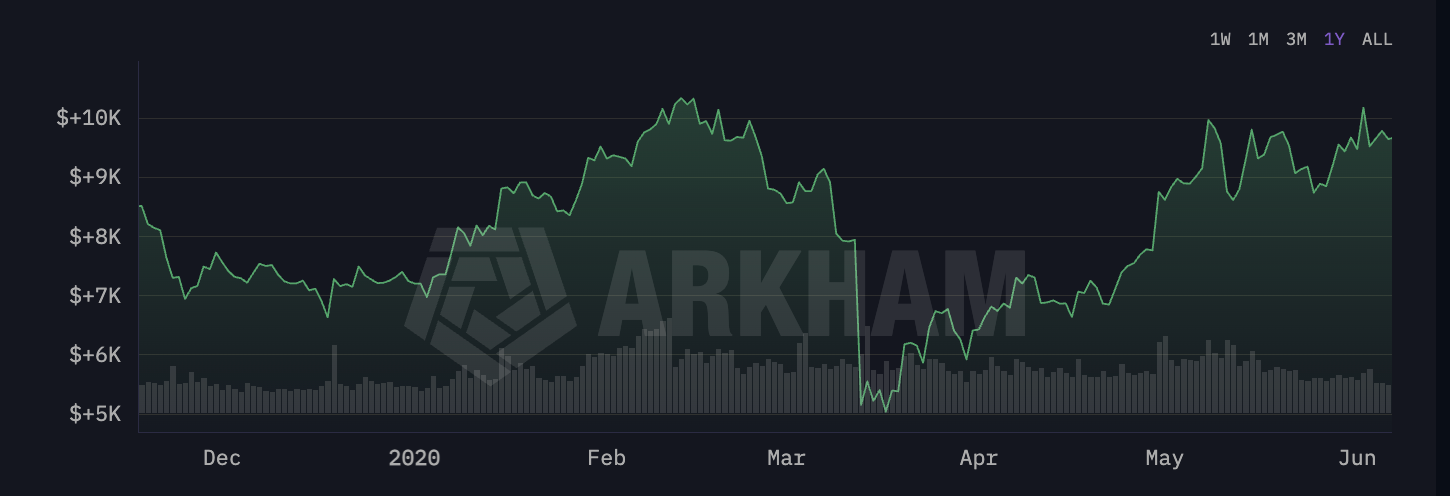
The WHO has sounded global alarms over a hantavirus outbreak that has already claimed three lives on the MV Hondius cruise ship. Bitcoin investors are recalling Black Thursday in March 2020.
The parallel with the start of COVID-19 reopens doubts about a possible sharp reaction from the crypto market.
What is Hantavirus and why is it a cause for concern at the WHO?
Hantavirus is a serious viral disease transmitted through contact with the urine, feces, or saliva of infected rodents. Its fatality rate can reach 50% in the Americas, and there is no approved vaccine or specific antiviral treatment.
The WHO (World Health Organization) confirmed yesterday that seven people aboard the MV Hondius have fallen ill, with three deaths , one person in critical condition, and three with mild symptoms. The cruise ship departed from Ushuaia , Argentina, on April 1, 2016.
The most worrying element comes from the WHO itself. The organization did not rule out person-to-person transmission among close contacts on board the cruise ship, although it maintains the overall risk as low for now.
A 69-year-old Dutch woman disembarked in Saint Helena on April 24 and died after flying to Johannesburg. The WHO is now tracing more than 80 passengers and six crew members who traveled on the same regional flight.
Follow us on X for the latest news in real time
Hantavirus, COVID-19 and Bitcoin: parallels and differences with Black Thursday 2020
For Bitcoin investors, the scene evokes bitter memories . When the WHO declared COVID-19 a pandemic on March 11, 2020, global markets collapsed.
That episode was dubbed the crypto “Black Thursday.” Bitcoin hit lows of around $4,000 and lost more than 50% of its value in 48 hours. The total market capitalization was cut in half in just a few days.
The narrative of Bitcoin as “digital gold” was temporarily shattered. The asset acted as a source of liquidity, and investors liquidated positions to reduce risk. Only gold and Treasury bonds partially withstood the first wave of global panic.
However, Bitcoin then staged a historic recovery. It took just a month and a half to regain the price lost after the March 12 crash , launching one of the biggest bull rallies in its recent history.

The current context differs from that which precipitated Black Thursday. The WHO assesses the global risk of Hantavirus as low and limited to the cruise ship environment , with no visible community spread on the mainland so far.
Hantavirus is also not transmitted as easily as SARS-CoV-2. Human-to-human transmission is exceptional and requires very close contact. This substantially reduces the likelihood of a global pandemic capable of paralyzing economies.
Bitcoin is also more mature at this point. It boasts massive corporate treasuries, approved spot ETFs, a Strategic Reserve backed by the White House, and a greater institutional presence than in March 2020, when it was still a marginal asset.
Even so, traders are watching closely. A worsening of the outbreak or further deaths could trigger a bout of risk aversion in the markets, initially impacting volatile assets like Bitcoin and less liquid altcoins .
“For God’s sake, let BTC go up for a month without war or coronavirus,” exclaimed onchainmonk on X
What should investors be watching now?
The key will be the speed of the health response. If the WHO contains the outbreak and rules out sustained human-to-human transmission, the impact on financial and crypto markets will likely be limited and very short-lived.
Conversely, a global escalation would generate immediate macroeconomic uncertainty. Bitcoin could suffer an initial shock similar to that of March 2020, although the depth and duration will depend on the monetary response and recent institutional flows.
The post Hantavirus Scare Sparks Bitcoin Crash Fears, Is 2020 Repeating? appeared first on BeInCrypto.



The United Kingdom has sanctioned Huobi Global S.A., now linked to HTX, in a Russia-focused action targeting crypto channels accused of helping sanctioned networks move funds.
Summary
- The UK has sanctioned Huobi Global S.A., linked to HTX, over alleged support for Russia-connected financial networks.
- The action freezes assets tied to the A7 network and blocks British firms from processing payments involving targeted entities.
- The move adds fresh pressure on HTX, which already faces UK legal action over alleged unlawful crypto promotions.
According to the UK government, the latest sanctions package freezes assets connected to the Kremlin-backed A7 network and blocks British firms from maintaining correspondent banking relationships or processing payments involving the targeted entities.
UK names Huobi global in Russia sanctions notice
The sanctions notice lists Huobi Global S.A. as a Panama-registered entity and names HTX and HTX Exchange as related names. The UK said the exchange is subject to an asset freeze, trust services restrictions, director disqualification sanctions, internet services sanctions, and payment-processing bans.
The government said there are “reasonable grounds to suspect” that Huobi Global S.A. has supported the Government of Russia. The notice said the company allegedly provided financial services, funds, economic resources, goods, or technology to A7 Limited Liability Company.
A7 is described by the UK as a company operating in a sector of strategic importance to Russia. Garantex Europe OU was also named in the same action, placing crypto exchanges and payment networks under fresh Russia-related restrictions.
Regulation 17A extends to crypto exchanges
Elliptic said the action is the first time the UK has applied Regulation 17A to cryptoasset exchanges. The rule restricts correspondent banking relationships and payment processing involving designated persons.
Under the measure, UK financial firms cannot process payments to, from, or through listed entities where the prohibition applies. Elliptic said the rule can also capture indirect exposure when a designated exchange appears in the payment chain.
The sanctions package also covers Aifory Pro, Arvix LLC, Rapira Group LLC, Nueva Cryptologia SAS de CV, Bitpapa, OJSC Virtual Asset Issuer, and Alistera Limited. UK authorities linked several of these entities to Russian financial services, Garantex-related networks, or the A7 network.
HTX faces added UK regulatory Pressure
HTX was already under UK scrutiny before the sanctions action. In February, the Financial Conduct Authority said it had started legal proceedings against HTX over alleged unlawful crypto promotions to UK consumers.
The FCA said the promotions appeared on HTX’s website and social media platforms, including TikTok, X, Facebook, Instagram, and YouTube. HTX did not immediately respond to a request for comment on the sanctions report.
Justin Sun, a well-known figure in the crypto industry, is listed as a global advisory board member at HTX. His role has kept market attention on the exchange during earlier regulatory and on-chain developments.
A7 network and related crypto flows draw scrutiny
The UK action places the A7 network at the center of the sanctions package. Authorities also named OJSC State Brokerage Company, Diamond Estate LLC, Trace Road LLC, Liran Cohen, Igor Gorin, and Irina Akopyan.
TRM Labs-linked reporting has said Russia-linked illicit wallet inflows reached a five-year high in 2025. The reporting named A7A5, A7, and Garantex-related flows among the main contributors.
As previously reported by crypto.news, Justin Sun resumed large Spark withdrawals and moved 41.99 million Spark tokens worth about $1.23 million to HTX. The report cited on-chain data flagged by pseudonymous analyst ai_9684xtpa and relayed by ChainCatcher.
The transfer came after roughly two weeks of limited activity. The report said the movement raised attention because the tokens went to a centralized exchange rather than staying on-chain.
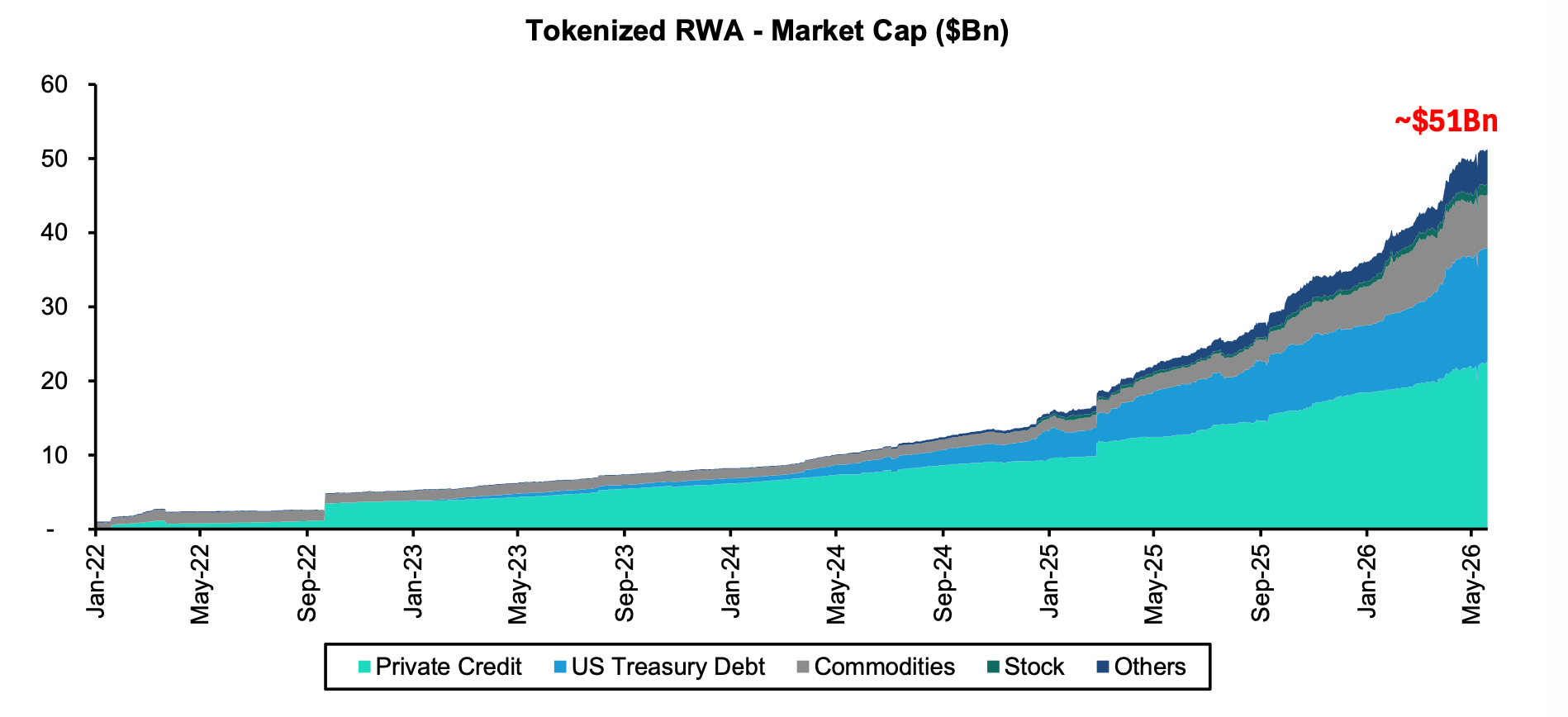
The tokenized real-world asset (RWA) market has grown to $51 billion, up 42% this year, as private credit becomes the largest segment of the market, according to a Bernstein Research report seen by Cointelegraph.
Private credit accounted for roughly 44% of total RWA value, Bernstein said, reflecting growing use of blockchain-based infrastructure for lending and fund structures.
The $51 billion valuation sits well above other industry estimates, such as RWA.xyz’s $34 billion figure, highlighting how different analytics providers count tokenized assets.
Institutional players are increasingly entering the market through tokenized lending and fund structures, including BlackRock’s tokenized money market fund BUIDL, which has surpassed $2.5 billion in assets, Bernstein said.
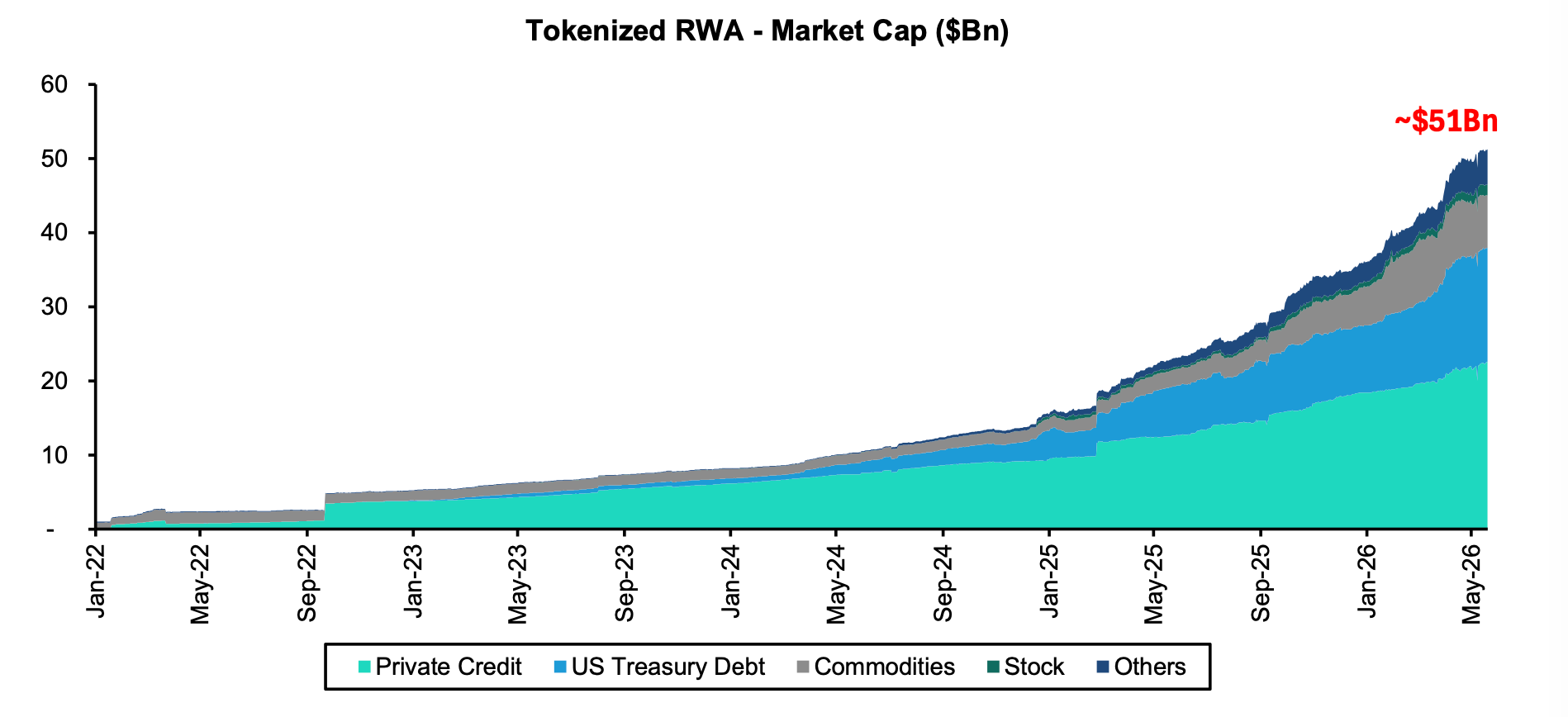
Tokenized RWA market cap. Source: Bernstein Research
Figure tops tokenized RWA platforms with $18 billion
Tokenized private credit has emerged as a major RWA segment, providing a way to record loans on blockchain networks instead of traditional banking systems. These loans are issued outside banks, with investors funding them directly in exchange for interest payments.
According to Bernstein, much of the growth in onchain private credit assets has been driven by Figure Technology Solutions (FIGR), a financial technology company that uses blockchain infrastructure for loan origination and settlement.
Figure ranked first among tokenized RWA platforms with $18 billion in assets, largely tied to private credit, according to Bernstein. Securitize and Paxos followed with about $4.2 billion each across different underlying asset classes, including treasuries, commodities and stocks.
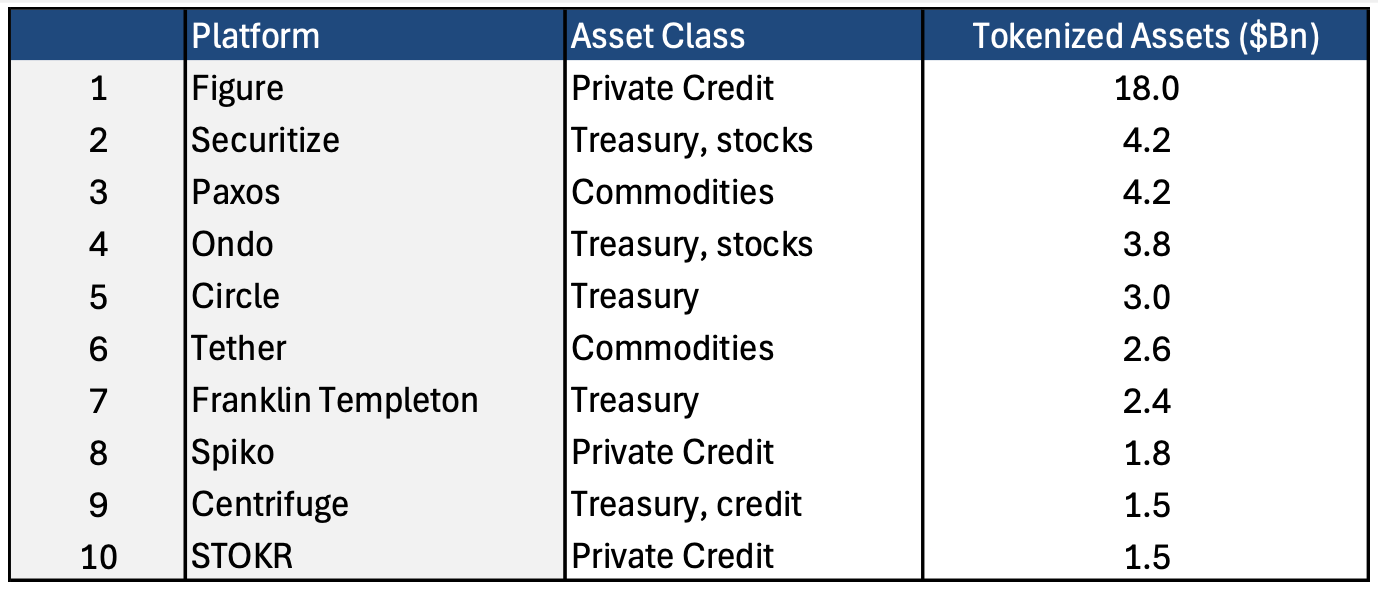
Figure leads tokenized RWA platforms by assets. Source: Bernstein Research
The report said Figure has tokenized $5 billion in consumer loans so far in 2026, while monthly loan volume reached a record $1.3 billion in April 2026. It also noted that Connect, Figure’s blockchain marketplace for credit, contributed 56% of total loan volumes in the first quarter of 2026.
Blockchain becomes infrastructure layer for global capital markets
“Private credit is becoming one of the fastest-growing sectors in real-world assets because it solves two major problems at once: investors want yield, and businesses need capital,” Stobox co-founder Ross Shemeliak told Cointelegraph.
Shemeliak said tokenized US Treasurys were the first major institutional success in the RWA market, but private credit offers higher potential returns and more direct exposure to the real economy.
Related: Tokenized RWA market grows 420% since 2025 on regulatory clarity, access
He also noted that tracking of the real-world asset market has changed significantly since last year, as many analytics platforms previously undercounted private credit because these structures often operate through special purpose vehicles, custodians or hybrid onchain and offchain models.
“The bigger story is not whether private credit is number one today,” Shemeliak said, adding: “The real story is that blockchain is quietly becoming the infrastructure layer for global capital markets.”
Tokenized treasuries and derivatives drive broader RWA adoption
Among other RWA segments, US Treasury debt remains the second-largest RWA category after private credit, accounting for roughly 30% of the market, while commodities make up another 14%, according to Bernstein.
The report also pointed to growing activity in onchain RWA derivatives through the decentralized derivatives exchange Hyperliquid, which it described as a “leading venue for onchain RWA derivatives.”
Related: Wall Street’s tokenization boom has a liquidity problem: Axis CEO
Bernstein said RWA-related open interest on Hyperliquid reached $2.6 billion in May, while trading volumes totaled $65 billion in April 2026.
Cointelegraph reached out to Bernstein for comment, but had not received a response by publication.
Magazine: ETH bears growling, Tom Lee’s buying, XRP to ‘explode’: Market Moves
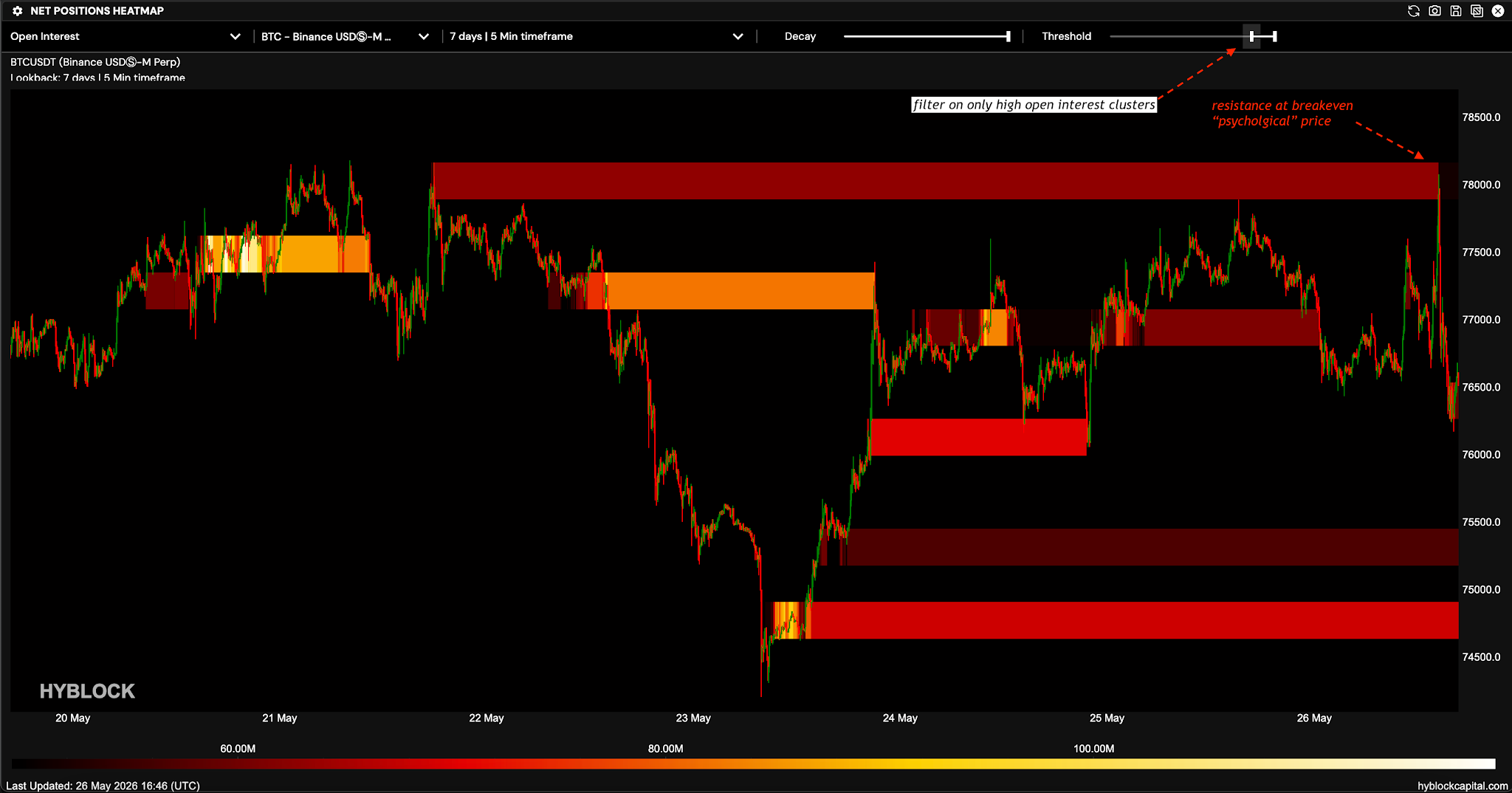
Bitcoin’s (BTC) consolidation continued into a fourth week, with the price finding support at $74,000 and resistance in the $78,000 to $80,000 range. According to Hyblock analysts, the intra-day rally to $78,164 hit a pocket where “longs that had previously opened up (that are in a position) were underwater and likely exited here at breakeven.”
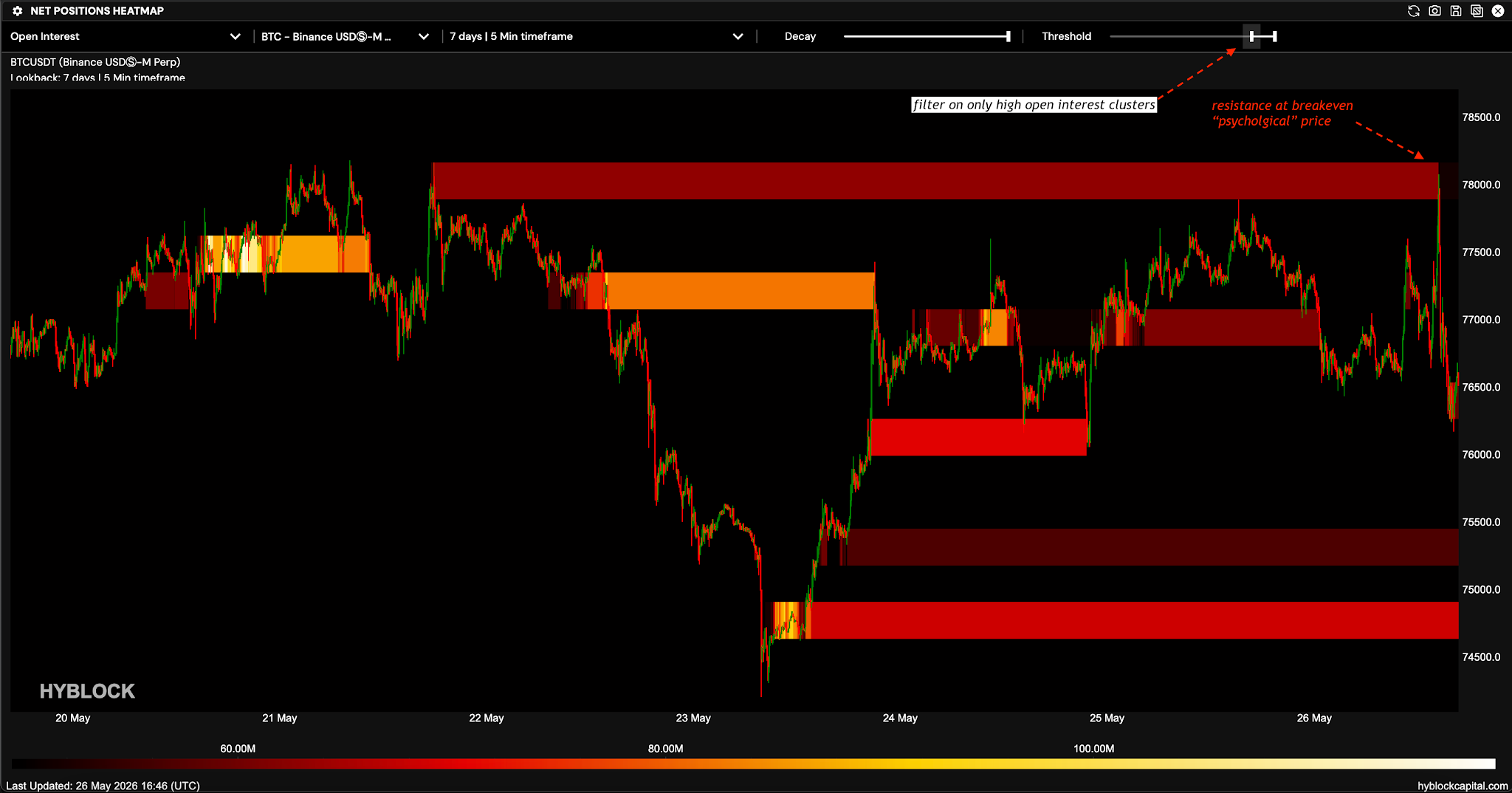
BTC/USDT net positions heatmap. Source: Hyblock
Hyblock added:
“And shorts who were in profit, likely exited here at “breakeven” to prevent any loss. Hence “psychological” level.”
Regarding the liquidations that occurred during the intra-day price move and how liquidity currently functions as a magnet for BTC price, Hyblock identified two clusters. “The brightest clusters (where a lot of potential liquidity lies) and where liquidity is building up the fastest and most recently (i.e., $75,675 to $75,700.)”
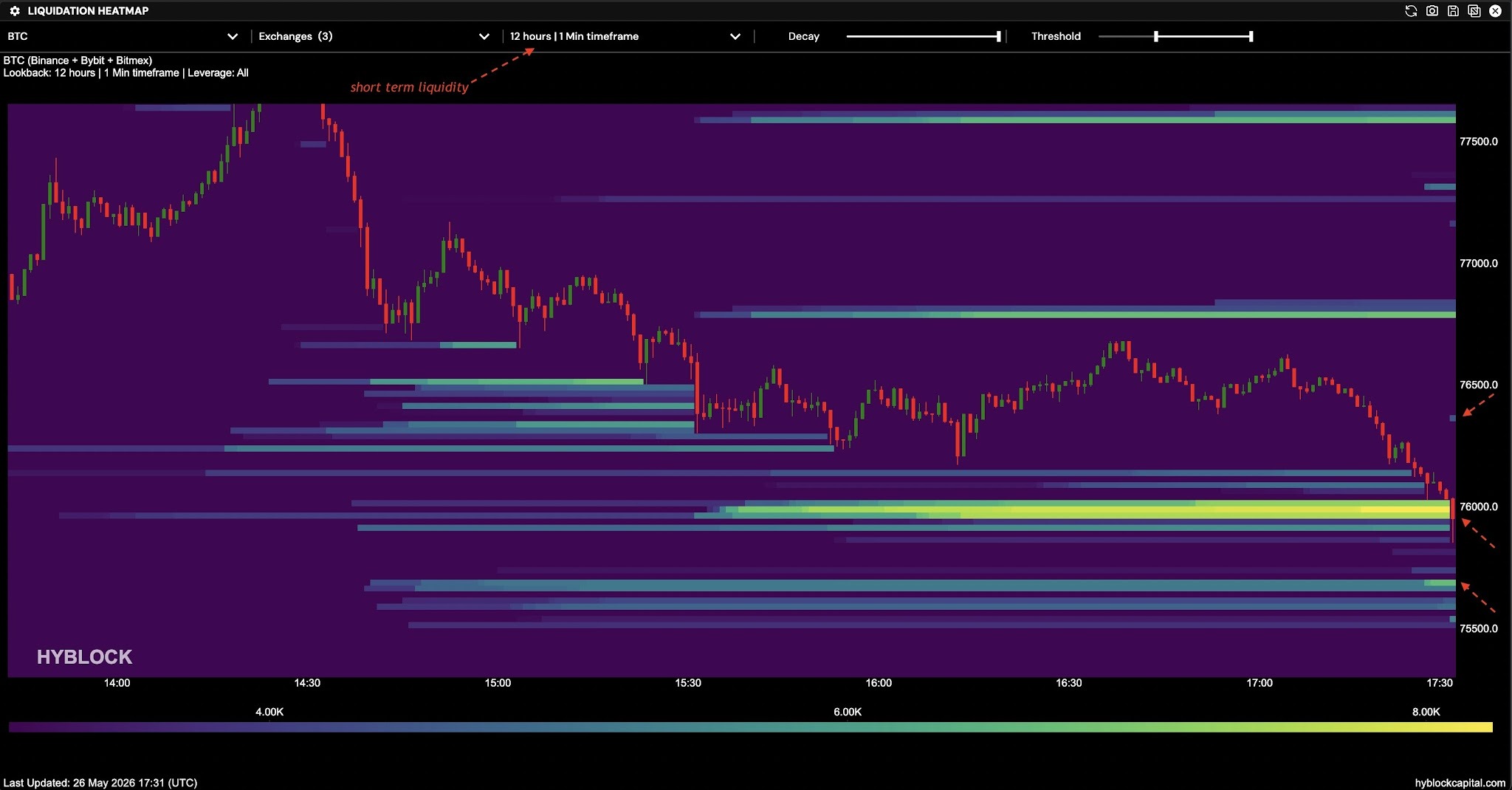
BTC/USDT liquidation heatmap. Source: Hyblock
Related: Bitcoin price lags bullish US tech stocks: Is there a silver lining?a
Despite Bitcoin’s inability to hold above $78,000, Blockstream CEO Adam Back posted about a Bitcoin whale using a time-weighted average price (TWAP) method to “hoover” up 450 “cheap Bitcoins” per day for the last 8.5 eight and a half days.
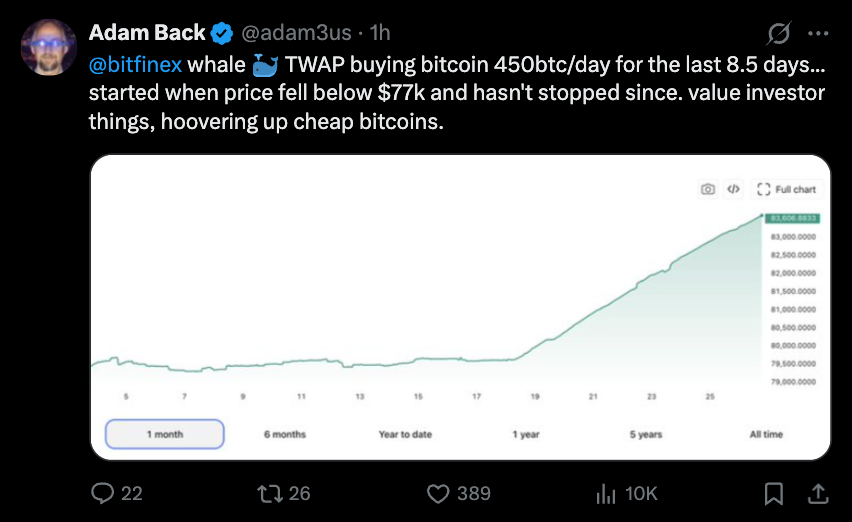
Bitfinex Bitcoin whale TWAP data. Source: Adam Back / X
As shown in the chart below, the price action of the day represents the classic futures-led selloff where selling via derivatives is putting pressure on BTC price, but buyers in the spot market are absorbing a portion of the selling. This effectively softens the blows delivered by sellers and reinforces Bitcoin’s $74,000 support.
Currently, orderbook depth data (2.5% to 5% depth) shows sellers present from $77,700, and the asks thicken from $78,000 to $80,000, suggesting Bitcoin will continue to encounter resistance in this price range.
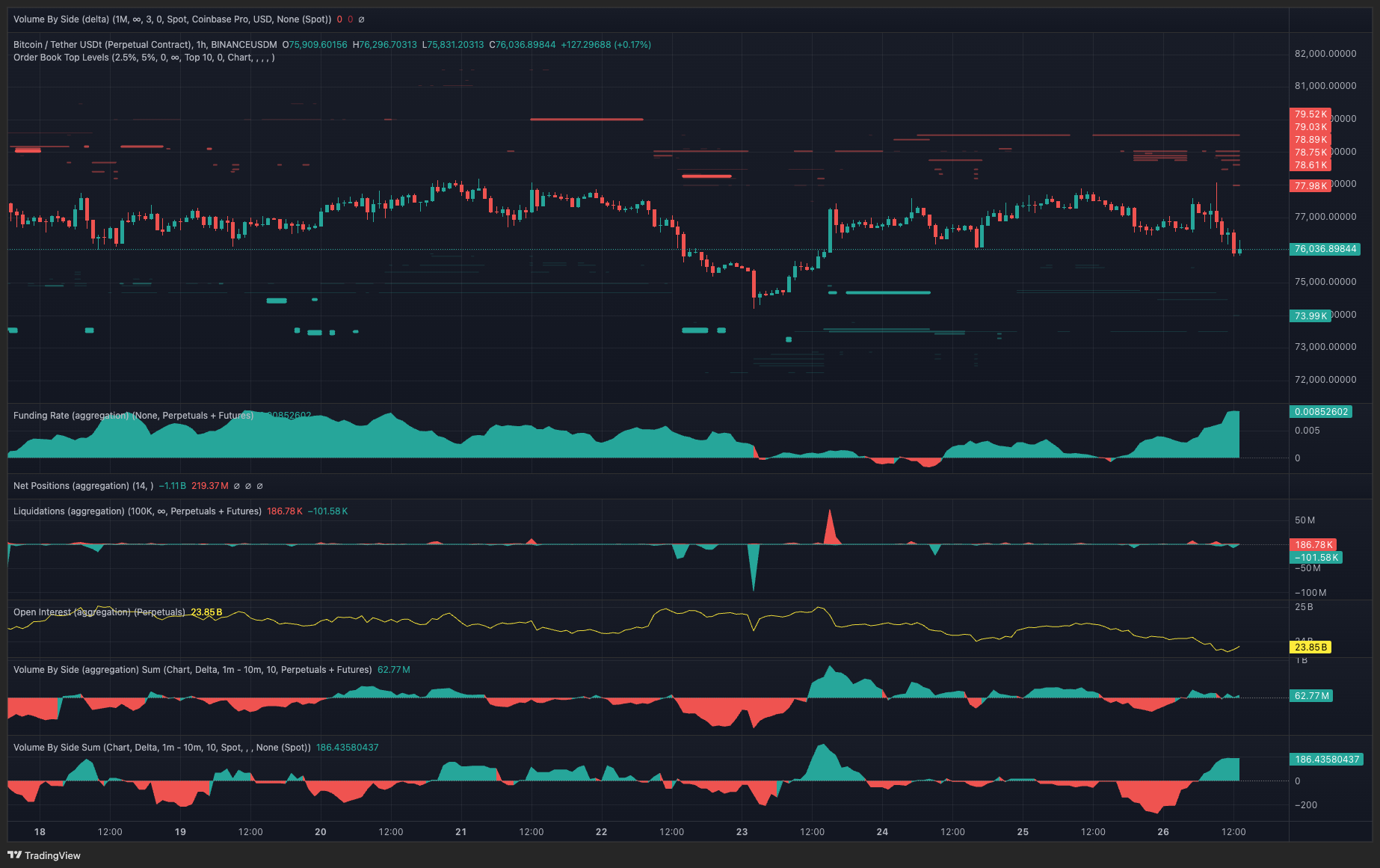
BTC/USDT spot and perps cumulative volume delta. Source: TRDR.io
Top-100 crypto markets diverged sharply today, with Worldcoin up more than 30% and Zcash down 10%, underscoring how idiosyncratic narratives are driving returns even as majors trade sideways.
Summary
According to CoinMarketCap data, today’s strongest performer among the top 100 cryptocurrencies by market capitalization was Worldcoin (WLD), which rallied 30.06% over the past 24 hours to trade around $0.3929. The move extends a multi-day run that has already pushed WLD’s market cap back toward the $1 billion mark and follows earlier sessions where the token climbed 12%–16% on rising AI‑themed flows and renewed institutional interest.
Behind WLD, exchange token OKB gained 12.85% to approximately $94, while Artificial Superintelligence Alliance (FET) rose 11.59% to $0.2513, continuing a trend highlighted in recent crypto.news coverage that shows AI‑linked and infrastructure tokens consistently outperforming the broader market. Render (RENDER) added 7% to $2.35 and Celestia (TIA) advanced 6.12% to about $0.4793, reinforcing the bid for modular and compute‑oriented projects even as bellwethers like bitcoin and ethereum struggle to break out.
Zcash heads losers as volatility rotates
On the downside, privacy coin Zcash (ZEC) led the top-100 losers with a 10.01% drop to roughly $610.14, a move that marks a sharp reversal after weeks of strong upside that recently saw ZEC challenging the $330–$400 zone in technical setups tracked by crypto.news. The pullback follows a powerful rally in April and early May that lifted ZEC above $250 and then $300 as shielded supply hit record levels and funding headlines sparked speculation about a sustained trend.
Other notable laggards included DeXe (DEXE), which slipped 6.8% to $16.23, and Quant (QNT), down 5.06% to $75.96 despite having staged a 100%+ rebound earlier in the year as tokenized real-world asset narratives gained traction. Ondo (ONDO) declined 4.64% to $0.4178, while Canton (CC) dropped 3.99% to $0.1608, paring some of the gains it logged in prior sessions on regulatory‑focused catalysts captured in CoinMarketCap’s news stream.
Rotation beneath flat majors
The split tape comes against a backdrop of relatively muted action in the largest names, with CoinStats’ latest market update noting that bitcoin is hovering near $76,900 and ethereum around $2,100, both slightly negative on the day as ETF outflows and macro concerns keep institutional buyers cautious. In contrast, niche segments — from AI identity plays like Worldcoin to privacy stalwarts like Zcash — continue to see double‑digit swings as traders chase momentum and react to project‑specific news rather than broad macro narratives.
Recent reporting from crypto.news has already flagged how flows are rotating into AI infrastructure, with Worldcoin, FET, Quant and Celestia repeatedly appearing on daily gainers lists even when aggregate market cap is flat or slightly down. At the same time, ZEC’s retreat after an extended push toward the $400 zone, documented in analyses such as this one, shows how quickly speculative excess can unwind once short‑term technical targets are hit.
For traders watching the top 100, today’s tape reinforces a simple pattern: major benchmarks may be treading water, but under the surface dispersion is widening, and daily relative‑value bets across assets like Worldcoin, Zcash and Quant are increasingly dictating performance.
Crypto World
Binance Returns to the Philippines Through BlockShoals’ SEC-Regulated Sandbox Partnership

TLDR:
- Binance partnered with BlockShoals Technologies as its official SEC-registered crypto service provider in the Philippines.
- BlockShoals received in-principle SEC sandbox approval in November 2025 after a two-year regulatory engagement process.
- Filipino users can now access Binance through a locally registered, SEC-regulated entity for the very first time.
- Binance selected BlockShoals for its leadership’s deep background in capital markets, banking, and commodities sectors.
Binance, the world’s largest cryptocurrency exchange, is making a regulated comeback in the Philippines. The exchange has partnered with local fintech firm BlockShoals Technologies to operate under the Securities and Exchange Commission’s oversight.
This move follows more than two years of regulatory engagement. The partnership gives Filipino users access to a globally recognized digital asset platform through a locally registered entity for the first time.
BlockShoals Secures SEC Sandbox Approval After Lengthy Process
BlockShoals Technologies confirmed it is a registered Crypto Asset Intermediary under the SEC’s Crypto Asset Service Provider rules.
The company serves as Binance’s official local service provider in the country. This position came after a rigorous application process that lasted over two years with Philippine regulators.
The SEC commission en banc granted BlockShoals in-principle approval to enter the StratBox regulatory sandbox in November 2025.
Since then, the company has worked to meet every condition set by the regulator. Its goal is to ensure all products comply fully with Philippine law.
BlockShoals is led by businessman Anthony Te, a veteran across banking, commodities, and capital markets. Te currently serves as a director at a local stock exchange and a commercial bank. His background was a key factor in his firm’s selection as Binance’s local partner.
Binance’s global strategy involves entering regulated markets through experienced local partners. The exchange seeks partners with strong backgrounds in legal, regulatory, and financial services. BlockShoals and its principals met those criteria, according to both companies.
Binance Positions Partnership as a Step Toward Formal Crypto Access
The companies have framed this partnership as part of broader efforts to formalize crypto access in the Philippines.
Millions of Filipino users have reportedly relied on offshore trading platforms without local regulatory protection. This arrangement aims to change that by bringing Binance under local oversight.
Binance was direct about what this partnership means for Filipino investors. “For the first time, Filipino users will have access to the world’s largest digital asset exchange through a locally registered, SEC-regulated entity,” the exchange said in a statement.
Both firms also pushed back against criticism from unregulated crypto operators. They argued that operating outside regulatory oversight exposes users to serious risks. These include weak anti-money laundering compliance and limited legal recourse in disputes.
Binance stated that the SEC’s decision reflects the “maturity of the SEC as an Asian regulator.” The exchange added that the move advances investor protection across the country. This framing aligns with the SEC’s broader mandate to protect retail participants in digital asset markets.
The exchange was equally clear about its long-term vision for the region. “Binance believes the future of digital assets will be built alongside credible local institutions and experienced market participants,” it noted.
“In the Philippines, BlockShoals and its principals were selected for their deep experience across capital markets, banking, and commodities, as well as their understanding of local governance and regulatory expectations.”
The partnership also marks a turning point after years of scrutiny over offshore exchanges operating in the Philippines. Regulators had previously moved to block Binance over licensing concerns.
Through this new arrangement, both parties say they have found a compliant path forward that benefits Filipino investors directly.

A fake website impersonating Uniswap is draining funds from multiple crypto wallets. The prominent on-chain analyst, pseudonymously known as “b-block,” warned that the scammers currently control at least $400,000 in stolen assets.
Users were urged to rely only on official links and verify protocols through DefiLlama.
Uniswap Tops List of Most-Targeted Platforms
The latest update comes a month after security group SEAL reported a major rise in malicious Google Ads targeting crypto users. It found that attackers were impersonating popular DeFi platforms, wallets, and trading applications to steal funds.
SEAL said it recently blocked over 356 malicious Google ad URLs tied to crypto scams, which targeted platforms such as Uniswap, Morpho Finance, PancakeSwap, Hyperliquid, CoW Swap, and 1inch users
According to the report, attackers used hacked or fraudulently obtained Google advertiser accounts and relied on cloaking, fingerprinting, and nested iframe delivery systems to bypass Google’s automated review checks. Many of the fake ads used trusted Google services such as sites.google.com and docs.google.com to appear legitimate in search results.
SEAL identified crypto drainer families, including Inferno Drainer and Vanilla Drainer, as the most commonly used malware in the campaigns. The report said these tools trick users into signing malicious wallet transactions or entering recovery seed phrases on cloned websites, allowing attackers to take control of wallet assets.
SEAL also added that the advanced infrastructure used in the attacks, including Cloudflare Workers, Arweave-hosted payloads, traffic redirection systems, and proxy layers, can intercept Ethereum RPC requests and monitor user activity in real time.
Uniswap was the most impersonated platform, accounting for 41% of tracked malicious sites. Between March 13 and March 30, confirmed and unattributed losses linked to the campaigns exceeded $1.27 million, although the security group said the actual figure was likely significantly higher.
Rampant Phishing Campaigns
While the recent Uniswap-related scams mainly involved fake websites and malicious Google Ads, a separate phishing campaign earlier this year targeted Ledger users through fraudulent emails. The attack followed a data breach at Ledger’s third-party e-commerce partner, Global-e, which exposed customer contact and order information.
The scammers claimed in emails that Ledger and Trezor had merged and urged users to migrate their wallets via fake websites that requested 24-word recovery phrases. The phishing pages closely copied the companies’ official branding and messaging styles.
More recently, Ripple CTO David Schwartz warned of a phishing campaign that sent fake security alerts that appeared to come from Robinhood’s official email system. The emails passed authentication checks because attackers exploited Robinhood’s account creation flow, which made the messages appear legitimate.
The phishing note claimed a new login from an “iPhone 17 Pro” and prompted users to review suspicious activity through a “Review Activity Now” button, which then directed them toward credential theft. Robinhood later confirmed the issue, but stated that no systems were breached and no funds were affected.
The post Fake Uniswap Website Drains Crypto Wallets as Scammers Pocket $400K appeared first on CryptoPotato.


A meme coin tied to the 2026 FIFA World Cup turned a $341 investment into $48,000 via Pump.fun on Solana.
Summary
- A single trader bought $341 worth of World Cup Coin via five transactions shortly after its May 11 launch and sold $35,700 as the token hit a $6 million market cap in its first two days.
- The token hit an all-time high market cap of $12.2 million on May 21, representing more than 30,000% from the trader’s entry, with a total of $48,000 realised across three separate rallies.
- World Cup Coin is not affiliated with FIFA and launched on Solana’s Pump.fun launchpad alongside individual meme coins for each of the 48 national teams in the 2026 tournament.
A trader turned a $341 bet on World Cup Coin into $48,000 in realised gains after the Solana-based meme coin launched on Pump.fun on May 11, 2026. The token is themed around the 2026 FIFA World Cup, which begins on June 11, and is not an official FIFA project.
The trader entered via five separate transactions shortly after launch as the token traded sideways for the first 12 hours. The token then surged to a $2.18 million market cap before climbing to $6 million the following day, at which point the trader had sold $35,700 across the two initial rallies.
How the 14,000% gain unfolded across three separate price spikes
The token then corrected 49% to a $3.15 million market cap, before the defining move arrived on May 21 when World Cup Coin spiked to an all-time high of $12.2 million market cap. The full 14,000% headline gain reflects the return from the original $341 entry to the total $48,000 realised across all exits.
World Cup Coin launched alongside meme coins for each of the 48 participating national teams. France’s national team coin has reached the highest individual valuation among country-specific tokens, reflecting speculative positioning on tournament outcomes. On-chain data tracked by DEX Screener confirmed the trader’s entry timing and exit values across the three price events.
Crypto.news has reported on Pump.fun data showing nearly half of March 2026 traders ended the month in the red, with about 96% of wallets either losing money or making under $500 in profit. The World Cup trade sits at the rare extreme end of outcomes for retail Pump.fun traders. Crypto.news has also covered how meme coins on Solana are structurally fragile, with analyst warnings that concentration among early insiders and absent fundamental cash flows make sustained gains rare.
Why 2026 FIFA World Cup meme coins are attracting attention now
The 2026 World Cup is the first to feature 48 teams, expanding participation from 32 and extending the tournament window across the United States, Canada, and Mexico from June 11 through July 19. More participating nations and a longer schedule create more narrative windows for national team-themed tokens to attract speculative buying around individual match results and group stage eliminations.
Crypto.news has tracked Pump.fun’s expansion in 2026 beyond pure meme coin launches to include major token trading including WBTC and USDC, which broadens the platform’s reach and the range of traders who encounter new token launches on it.
The 14,000% outcome is real but contingent: the trader entered within hours of the May 11 launch and had closed the majority of their position before the deepest correction. The same token that created the $48,000 win also fell 49% in the week after its first rally, wiping out equivalent gains for anyone who entered at the top.

Hyperliquid’s native token, HYPE, is extending its rally as investor demand for the protocol’s exchange-traded products intensifies. Fresh fund flows into the HYPE wrappers are driving rapid accumulation and fueling expectations for potential new catalysts in the ecosystem.
Over the last nine days, inflows into the HYPE ETFs totalled about $89 million, equating to roughly $9.2 million of buying power per day. The combined assets under management (AUM) across Bitwise’s BHYP and 21Shares’s THYP reached the $89 million mark within days of launch, underscoring one of the fastest ETF-accumulation trajectories seen in crypto investment products.
On-chain metrics align with the price and fund-flow story, as Hyperliquid has drawn more than $1.1 billion in net inflows over the past month. In parallel, observers are weighing the implications of a forthcoming Grayscale GHYP product, which could unlock additional demand for HYPE.
HYPE’s supporters point to substantial potential upside if more wrappers come to market. Havoc, a prominent proponent of the token, noted that the forthcoming GHYP could contribute another $8 million to $12 million of daily inflows. He also suggested that, at varying average purchase prices, projected yearly demand could absorb roughly 8% to 33% of HYPE’s circulating supply, depending on market conditions and new supply dynamics.
Looking ahead, Havoc estimated that, assuming a 30% to 35% outflow analogous to what has been observed with spot BTC ETFs, yearly net demand for HYPE could land between about $2.9 billion and $3.6 billion—a formidable figure for a crypto asset with a relatively thin float. These projections illustrate how ETF-driven demand could become a meaningful structural driver for HYPE in the years ahead.
In a related measure of interest, market participants have been watching how HYPE’s activity translates into on-chain flow. Recent data shows sustained net inflows, with more than $1.1 billion moving into or through Hyperliquid’s ecosystem over the last month, underscoring a broader appetite for ETF-backed exposure within the tokenized sector.
Key takeaways
- ETF inflows and AUM: BHYP and THYP have drawn roughly $89 million in nine days, with combined AUM reaching $89 million shortly after launch.
- Price action and targets: HYPE’s breakout peaked at about $64.50 with consolidation above $59.40; traders eye extensions near $76, $89.50, and $101 based on Fibonacci projections.
- Derivatives momentum: Aggregated open interest on the space’s venues has surged toward $2 billion, with funding rates hovering around 0.004%, signaling persistent bullish positioning.
- Strategic demand drivers: The prospect of Grayscale’s GHYP and related inflows could significantly lift annual net demand and potentially absorb meaningful portions of HYPE’s circulating supply.
HYPE’s breakout and the chart narrative
HYPE surged to a fresh all-time high near $64.50 during the session, while Bitcoin remained range-bound below key resistance around $77,000. After breaking out above the prior level near $59.40, HYPE has entered a price-discovery phase, with traders looking at the next targets through a Fibonacci extension framework. The 1.236 extension sits near $76, followed by the 1.382 extension around $89.50 and the 1.618 extension near $101, outlining a bullish trajectory if the current momentum persists.
Trading-view analytics show continued accumulation in the derivatives market alongside rising open interest. Data from the Velo ecosystem indicates aggregated open interest approaching $2 billion as new positions were added during the rally, with aggregated funding rates near 0.004%, implying net bullish leverage remains in place for now.
Industry observers also reported that Hyperliquid has become a notable player in the derivatives landscape. Research by Byzantine General indicates Hyperliquid reached about $8.5 billion in aggregate exchange open interest, placing it as the third-largest derivatives venue behind giants like Binance and Bybit, with its market share climbing to roughly 7.2%—a fresh all-time high for the platform.
Risks, signals, and liquidity considerations
As with any rapid move in a relatively young market, some traders caution about the risk of a pullback after a sharp ascent. Community observers have flagged potential crowding as a risk indicator, suggesting that a brief pullback could help reset speculative positions. A notable scenario cited by traders is a dip toward the four-hour 200-period exponential moving average (EMA), which could provide a liquidity area for new entrants to re-enter or exit more orderly. The daily chart also reveals an unfilled fair-value gap between roughly $48 and $54, overlapping with the rising 50-day EMA, which could serve as a defensive liquidity zone if selling pressure intensifies.
These structural notes matter for investors and traders looking to map entry and exit levels as ETF inflows continue to shape HYPE’s price discovery. The combination of robust ETF demand, a growing on-chain footprint, and a broadder derivatives footprint suggests a multi-layer dynamic that could sustain the rally, but also warrants careful risk management in the event of shifting market sentiment or regulatory signals.
For context on broader ecosystem momentum, related coverage highlights the continuing expansion of tokenized and real-world asset (RWA) themes in crypto markets. A recent industry note examines the RWA market surpassing $51 billion as tokenized private credit activity accelerates, a trend that may intersect with the appetite for regulated, ETF-like exposure in crypto markets.
Further reading: RWA market hits $51B as tokenized private credits surges.
What’s next for HYPE remains tied to the trajectory of ETF inflows, the emergence of GHYP, and how liquidity and regulation evolve across crypto derivatives venues. Traders will be watching whether the current momentum can absorb ongoing supply pressures and how the broader market environment shapes the acceptance of bigger, ETF-backed exposure to Hyperliquid’s ecosystem.
Watch for updates on GHYP’s rollout timeline, any shifts in AUM across BHYP and THYP, and how new inflows interact with market liquidity as the sector navigates a complex regulatory landscape and evolving investor appetite.
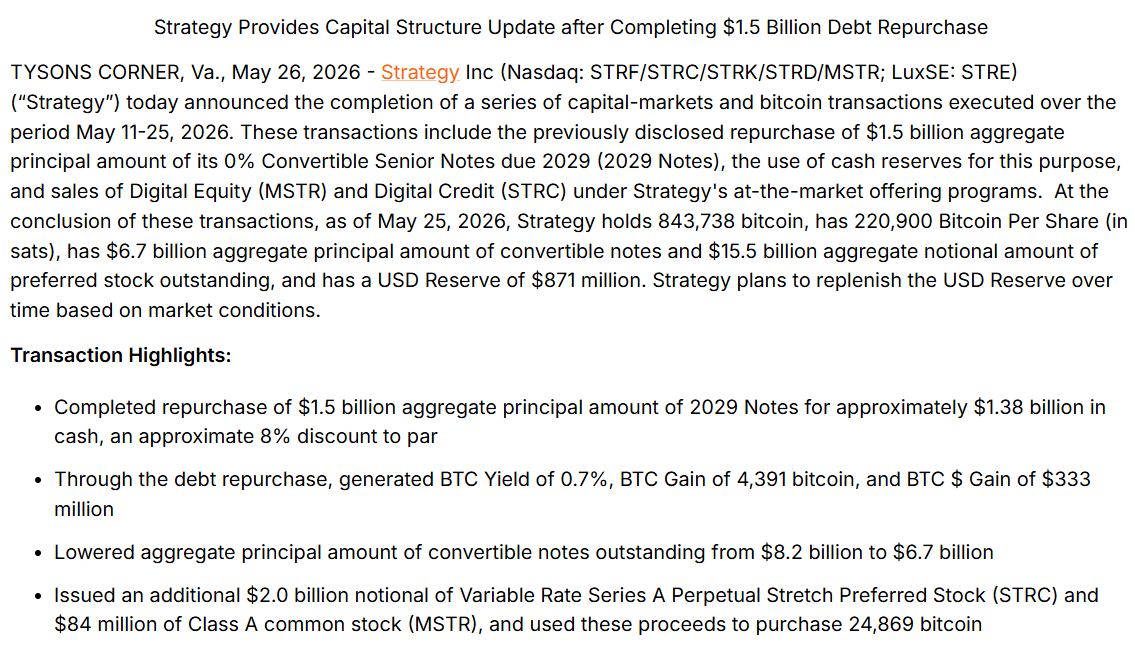
Michael Saylor’s Strategy, the largest corporate Bitcoin holder, has repurchased $1.5 billion of its 0% convertible senior notes due in 2029 for $1.38 billion at an 8% discount to par, in a move that significantly cuts future debt obligations.
The purchase reduces Strategy’s outstanding debt through convertible notes from $8.2 billion to $6.7 billion for 2029, the company announced on Tuesday. The notes were repurchased using the company’s cash reserves.
Strategy also reported an additional $15.5 billion in aggregate notional amount of outstanding preferred stock and a USD reserve of $871 million.
Buying back debt at a discount can strengthen the balance sheet of a company by reducing future payment obligations and shows active debt management from Strategy, typically seen as a positive sign by shareholders.
The update comes after Strategy did not announce a fresh Bitcoin purchase this week, following its $2.01 billion purchase the prior week. Four smaller Bitcoin treasuries stepped in to buy a cumulative 602.6 BTC worth about $46 million last week, Cointelegraph reported earlier on Tuesday.
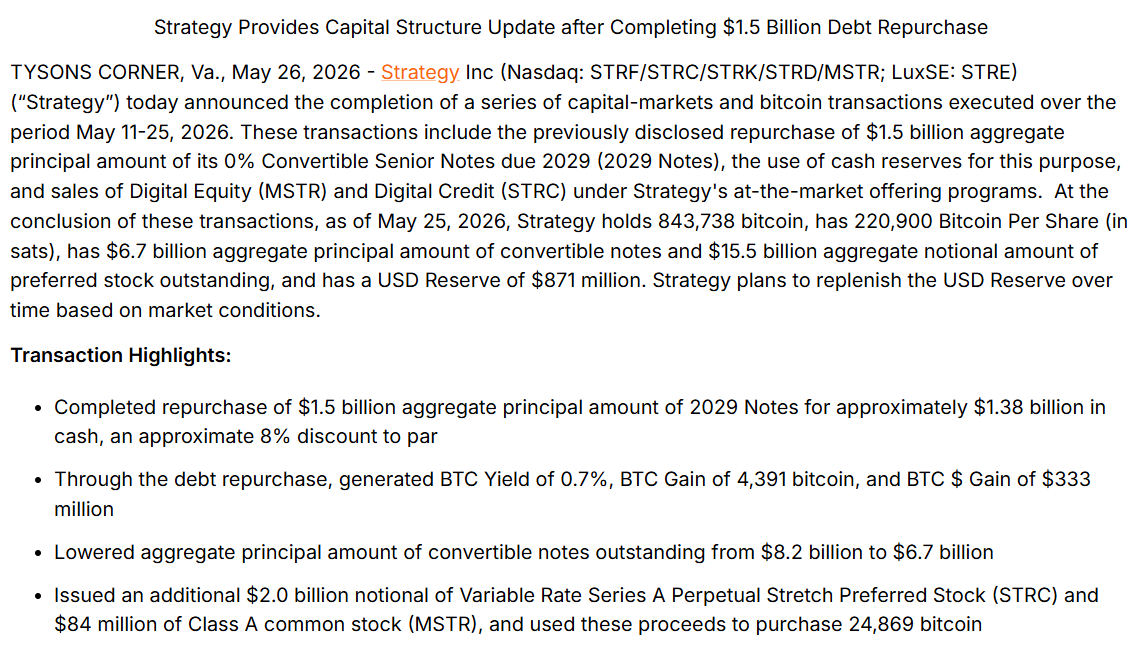
Strategy announces $1.5 billion outstanding note buyback. Source: Strategy.com
Crypto industry watchers praised the debt buyback.
“Great move by Strategy,” wrote asset management firm Bitwise’s European head of research, André Dragosch, adding that the debt reduction removes a “major uncertainty around the cash repayment wall in mid-2028,” as investors would likely demand repayment due to the relatively high conversion price of these notes, around $672.
Related: New York lawsuit tests lost property claim over dormant Bitcoin
Strategy shares sink 3% after announcement
While a reduction in outstanding debt is typically a positive sign for shareholders, Strategy’s stock price fell 3% in pre-market trading on Tuesday and was changing hands at above $159 at the time of writing.
The slide adds additional pressure to Strategy’s declining share price, which fell 10% during the past month and 59% during the past year, data from Yahoo Finance shows.
Bitcoin’s price also fell by about 1.2% during the past month and by 29% over the past year, according to TradingView.
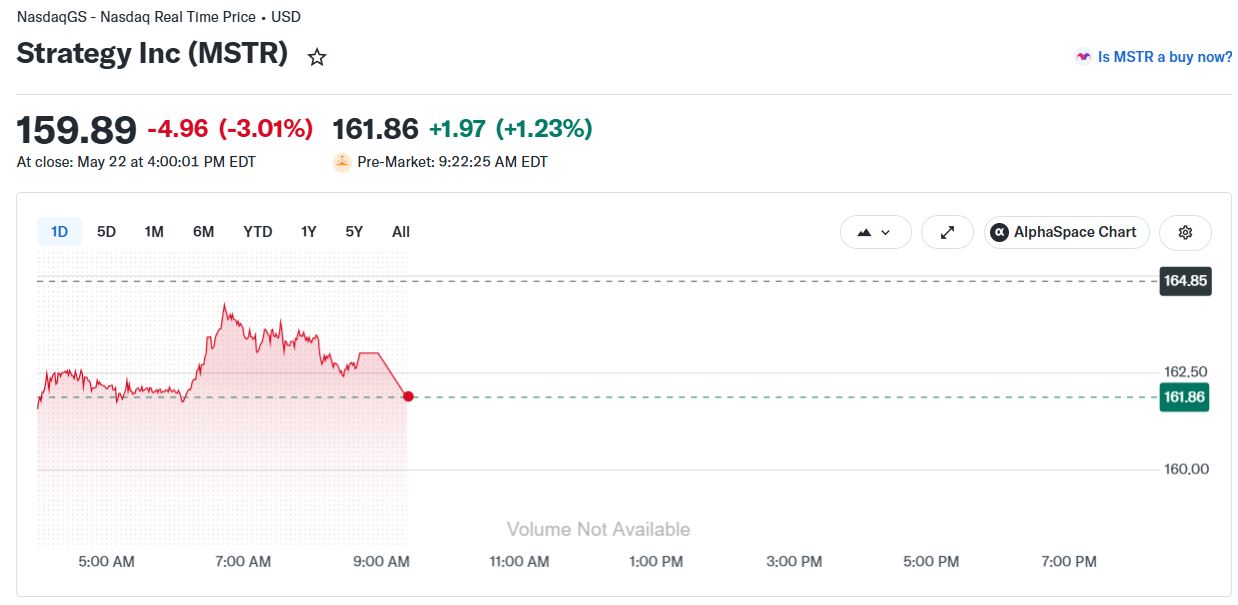
MSTR/USD, 1-day chart. Source: Yahoo Finance
The move comes a week after Strategy announced its third-largest investment of 2026, as it acquired 24,869 BTC for $2.01 billion between May 11 and 17, at an average purchasing price of $80,985 per BTC, Cointelegraph reported last Monday.
Magazine: Bitcoin ETFs bleed $1B, Aave’s $71M ETH unfreeze bid delayed: Hodler’s Digest, May 10 – 16
TLDR:
- HTX confirms the UK sanctions designation targets Huobi Global S.A., a entity legally separate from the HTX exchange.
- The exchange received no prior notice or supporting evidence from UK authorities before the sanctions were announced.
- HTX reaffirms its commitment to full legal compliance and active cooperation with law enforcement agencies worldwide.
- All HTX global operations remain fully unaffected, and the exchange has assured users that their funds are completely safe.
HTX has responded to the UK’s recent sanctions designations, clarifying that its online exchange remains fully operational.
The exchange stated that the listed entity, Huobi Global S.A., is legally distinct from the HTX platform. HTX also confirmed that all user funds remain safe and unaffected.
The exchange said it received no prior notice or supporting evidence from UK authorities before the designation.
HTX Draws Clear Line Between Exchange and Sanctioned Entity
HTX moved quickly to address confusion surrounding the UK sanctions announcement. The exchange made clear that Huobi Global S.A. is a separate legal entity from the online HTX platform.
According to HTX, the designation does not and should not affect the exchange’s day-to-day operations. The statement was shared across HTX’s official channels shortly after the UK announcement.
The exchange also confirmed its commitment to full compliance with all applicable laws. HTX stated it cooperates actively with law enforcement agencies worldwide.
This position, the exchange said, remains unchanged regardless of the sanctions action. HTX also noted it will continue monitoring the situation closely.
The UK’s sanctions package named 18 entities and individuals linked to Russia’s financial networks. Among those listed is Huobi Global S.A., the operator associated with the HTX exchange.
However, HTX stressed that the legal distinction between the two entities is critical. The designation targets Huobi Global S.A. and not the online exchange itself.
HTX also noted that the UK designation arrived without prior notice. No supporting evidence was shared with the exchange before the announcement.
Huobi Global S.A. has said it will work with relevant UK authorities to understand the basis for the action. The company aims to address any concerns raised by British officials promptly.
HTX Assures Users of Stability Amid Ongoing Developments
HTX confirmed that its global operations remain fully unaffected by the UK sanctions. The exchange reassured its user base that all funds held on the platform are safe.
No disruptions to services, withdrawals, or trading activity were reported following the announcement. HTX said it will provide updates as the situation develops.
The UK applied Regulation 17A of its Russia sanctions regime to crypto exchanges for the first time. This tool requires UK financial firms to freeze funds and trace transactions linked to designated entities.
Blockchain analytics firm Elliptic noted that HTX recorded roughly $3.3 trillion in trading volume last year. It also said the platform is suspected of links to Russia’s A7 payments network and sanctioned exchange Garantex.
HTX has not directly addressed the specific allegations cited by Elliptic or UK authorities. Instead, the exchange focused its statement on the legal separation between itself and Huobi Global S.A.
The exchange reiterated its lawful standing and its cooperation with global regulators. Further clarifications are expected as Huobi Global S.A. engages with UK officials.
The broader sanctions package also targets the A7 payments network, which British officials say moved over $90 billion last year. Several individuals were also designated for alleged sanctions-evasion activity.
HTX said it takes the matter seriously and will continue to respond transparently. The exchange urged users to rely only on official HTX communications for updates.

Doctor brutally stabbed with ‘big knife’ in hospital A&E by ‘smirking patient’

Wembanyama Faces Critical Test as Series Hangs in Balance

HTX hit by UK sanctions as regulators trace Russia links


-

 Crypto World5 days ago
Blockchain.com files with SEC for U.S. IPO
-

 Fashion4 days ago
Holiday Weekend Open Thread – Corporette.com
-
 Business4 days ago
Dell Technologies DELL Stock Surges 15% on AI Server Momentum and Analyst Upgrades in 2026
-
 Crypto World5 days ago
Bitcoin Accumulation Weakens as BTC Realized Losses Hit $600M
-

 Crypto World4 days ago
Robinhood crypto COO Tanya Denisova exits
-
 Crypto World4 days ago
Space X IPO Is ‘Bad News’ for Tech Stocks: But What About Bitcoin?
-

 Politics4 days ago
Makerfield: a tale of two social-media histories
-

 Business2 days ago
NYT Strands Answers May 24 2026 Revealed for Puzzle No. 812 Theme Summer Essentials
-

 Tech1 day ago
Microsoft’s quiet Claude Code retreat and the real cost of enterprise AI
-
 Crypto World5 days ago
MicroStrategy’s Saylor Says Miners No Longer Set Bitcoin Price, Another Force Has Taken Over
-

 Tech5 days ago
WhatsApp ads could make Irish debut after discussions with DPC
-

 Crypto World4 days ago
AI infrastructure race heats up as IREN pitches full-stack strategy, WhiteFiber lands $160M deal
-
 Tech5 days ago
A 0.12% parameter add-on gives AI agents the working memory RAG can’t
-

 Tech5 days ago
You Can Now Add ChatGPT To PowerPoint
-
 NewsBeat6 days ago
Charity run by Reform leader Malcolm Offord accused of ‘law breaking’ over Scottish registration
-
 Crypto World2 days ago
Nvidia (NVDA) CEO Calls on Super Micro to Strengthen Export Controls Amid Smuggling Probe
-

 Business5 days ago
Trump Invests $1M-$5M in Kura Sushi USA Chain With 27 California Locations
-

 Tech1 day ago
Westone Audio and Etymotic Acquired by Fidelity Collective in Major IEM Market Move
-

 Sports5 days ago
2026 CJ Cup Byron Nelson leaderboard: Brooks Koepka finds putting stroke in Round 1
-

 Crypto World6 days ago
Exa Labs raises $250 million in funding led by a16z
You must be logged in to post a comment Login