
Crypto World
Uniswap Debuts Pools.trade for Token Launches on Robinhood Chain


Uniswap has launched its first token launchpad, Pools.trade, on Robinhood Chain, opening the door for users to create and trade new tokens through a single interface.
The rollout has quickly pushed Uniswap back in the spotlight, with traders flocking to early launchpad tokens.
What Pools.trade Actually Does
As noted in a Santiment report published on August 6, Pools.trade lets users launch tokens through either a four-hour Crowd Launch or Instant Launch before liquidity is automatically placed into Uniswap v4 pools and permanently locked.
The move shifts Uniswap beyond its traditional role as a decentralized exchange by placing it at the earliest stage of a token’s lifecycle rather than simply handling trading after launch.
The launch builds on Uniswap’s existing position as Robinhood Chain’s primary automated market maker. Robinhood’s Ethereum-compatible Layer 2 already supports multiple versions of Uniswap alongside UniswapX, its wallet, web application, and API.
As CryptoPotato reported earlier, Robinhood Chain has become the largest blockchain by real-world asset holder count, although meme coin trading still accounts for most decentralized exchange activity on the network. Early attention on Pools.trade has centered on tokens like FRONG and POOLS, with many traders, according to Santiment, treating the former as the unofficial launchpad token despite no formal confirmation from Uniswap tying it to the platform.
At the same time, competing Robinhood Chain launchpad tokens such as PONS came under pressure as traders rotated into the new narrative. At the time of writing, PONS was down nearly 14% in 24 hours per data from CoinGecko, with its weekly chart showing a nearly 48% plunge. The total market cap of the top coins launched on Pons also dipped by more than 12% in the last day to less than $20 million.
Part of what made the debut louder than a typical product announcement was how odd it felt getting there, with hidden pages, teaser files, frog imagery, and last-minute changes beforehand. One X user, The Smart Ape, called it “the most documented secret launch in DeFi.” And whether that was clever marketing or just confusing depends on who you ask.
On-Chain Trends Add to UNI’s Growing Attention
Santiment also pointed to strengthening on-chain data for UNI, Uniswap’s native token. Exchange balances have fallen 15.7% over the past month, while the token has climbed roughly 47% since the beginning of July, suggesting fewer coins are immediately available for sale as interest in the ecosystem grows.
Per the analytics firm, Uniswap’s share of crypto-related social discussion has reached its highest level since November 2025 following the Pools.trade announcement.
UNI was trading at just over $4.00 at the time of writing, up nearly 3% over 24 hours and almost 30% higher across the past month. But even after the recovery, the token is still about 91% below its all-time high of $44.92 recorded in May 2021.
Santiment concluded that Pools.trade could become an important new source of activity for Uniswap if it continues attracting token launches.
The post Uniswap Debuts Pools.trade for Token Launches on Robinhood Chain appeared first on CryptoPotato.



Yield Guild Games co-founder Gabby Dizon said its web3 game publishing arm went dark on Friday. "@YGG_Play services will shut down as of today," Dizon wrote on his verified X account on Friday, adding that "our @YieldGuild story continues – more on this starting next week!" The unit posted its own… Read the full story at The Defiant
Crypto World
Ethereum Price Prediction: ETH Is Boxed In at $1,91 With No Conviction From Either Side

In the latest Ethereum price prediction, ETH is trading at $1,912, down 0.41% over the past 24 hours, holding within a tight intraday range of $1,895.10 to $1,917.74. The consolidation is real, but what happens next depends almost entirely on catalysts ETH does not control yet.
Price action has been characteristically choppy, with muted 24-hour volatility alongside a modest weekly recovery. Trading volume clocked in around $8.7 billion, respectable but not the kind of number that signals conviction from either bulls or bears.

ETH remains range-bound, with directional bias dependent on incoming macro data and any regulatory signals touching major smart-contract platforms.
ETH’s underperformance relative to select altcoins, particularly in AI, restaking, and L2 narratives, has rotation-watchers paying close attention. The broader setup will define whether the recent weekly rebound has legs or fades back into the prior consolidation zone.
Discover: Everyone’s Got a Take. Get Free $25 to Actually Trade Yours
Ethereum Price Prediction: Can Ethereum Break $1,950 Resistance and Sustain a Breakout This Week?
ETH is trading at $1,912, pressing into the upper half of its recent range but has yet to clear the resistance cluster that matters. The $1,950 to $1,970 zone is the next meaningful ceiling, roughly aligned with prior distribution levels where sellers have consistently emerged. Below, $1,880 to $1,895 is the immediate support shelf.
The current intraday low at $1,895.10 is already brushing that band.
Volume context matters here. An $8.7 billion daily print is not weak, but it is not the kind of expansion that typically precedes a clean breakout either. Spot demand appears balanced against profit-taking from the weekly recovery, keeping momentum neutral.

ETH holding $1,895 support, macro data printing risk-on, and expanding volume push price through $1,950 toward the $2,000 to $2,050 psychological zone.
Consolidation continues within the $1,880 to $1,950 channel, with no decisive breakout or breakdown until a macro or regulatory catalyst forces direction; this is the base case. A close below $1,860 invites a retest of mid $1,700s structural support, the range ETH was parked in just days ago, and resets the short-term technical picture.
Regulatory treatment of smart-contract platforms remains the wildcard. Any clarity or ambiguity from US regulators on ETH’s classification could trigger institutional flows in either direction. Key supply dynamics suggest ETH needs sustained buying pressure, not just a relief bounce, to confirm a structural shift.
Discover: Your Market Calls Are Worth Something. Start With Free $25 on Kalshi
Maxi Doge Targets Early Mover Upside as Ethereum Tests Key Levels
ETH at $1,909 is a recovery — but at this market cap, the asymmetric upside traders dream about simply isn’t on the table. That’s the tradeoff when positioning in large-cap assets during consolidation phases: stability, yes; 10x potential, no. For traders whose risk appetite runs hotter, the presale market is where that math still exists.
Maxi Doge ($MAXI) is a meme token on Ethereum (ERC-20) built around what it calls the “Leverage King” culture, a 240-lb canine mascot embodying 1000x trading mentality, complete with holder-only trading competitions, leaderboard rewards, and a Maxi Fund treasury earmarked for liquidity and partnerships.
The tagline is blunt: Never skip leg day, never skip a pump. Current presale price sits at $0.0002832, with $4,836,932.30 raised to date, a number that signals genuine community traction rather than a ghost project.
Dynamic staking APY is live for participants. As with any presale, execution risk is real, meme tokens live and die by community momentum, and there are no guarantees of exchange listings or sustained volume post-launch.
For traders already watching ETH’s consolidation play out, research Maxi Doge as a speculative complement rather than a replacement for your core book.
Discover: Get Paid to Be Right, $25 to Start on Kalshi
Don’t Miss Out on Our $1,000 USDT Airdrop on ByBit
The post Ethereum Price Prediction: ETH Is Boxed In at $1,91 With No Conviction From Either Side appeared first on Cryptonews.


Cointelegraph is committed to providing independent, high-quality journalism across the crypto, blockchain, AI, and fintech industries.
All news, reviews, and analyses are produced with full journalistic independence and integrity. For more details on our standards and processes, please read our Editorial Policy.
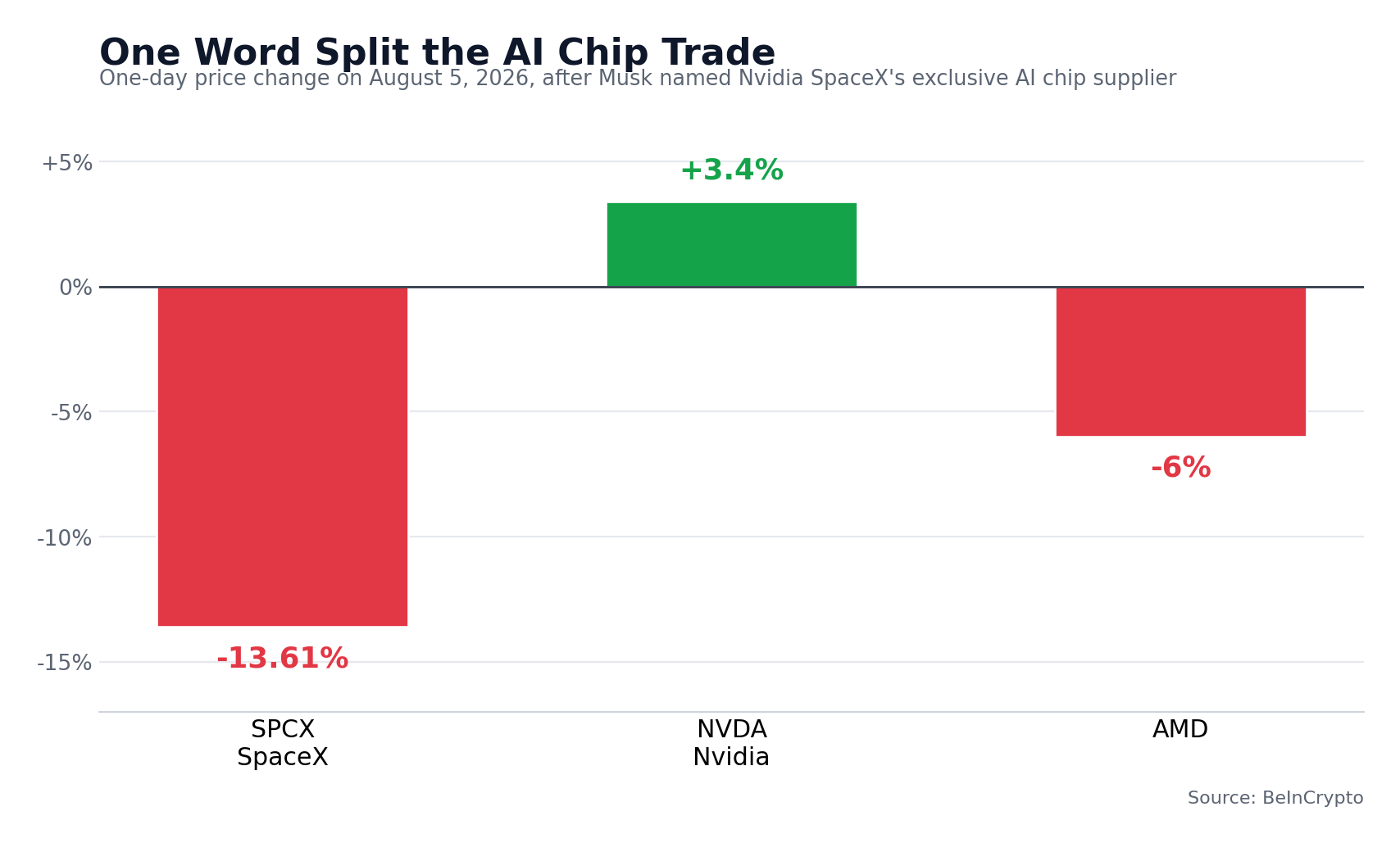
SpaceX (SPCX) stock closed down about 14% on Wednesday, while Nvidia (NVDA) rose and Advanced Micro Devices (AMD) fell. All three moves traced back to one word Elon Musk used on SpaceX’s first earnings call.
That word was “exclusively.” Musk said SpaceX would build its artificial intelligence (AI) systems only on Nvidia chips from now on. The promise handed Nvidia a huge customer and shut its rivals out.
The One Word That Repriced the Chip Trade
Tuesday was Musk’s first earnings call as the head of a public company. He used it to name Nvidia as SpaceX’s only AI chip supplier.
“Going forward, we have decided to build exclusively on Nvidia, because we think the Vera Rubin architecture is the best architecture”
Via, Yahoo Finance
Vera Rubin is Nvidia’s next chip platform. Musk said SpaceX would run it on the ground and in space through Starmind, a plan to fly data-center computers on satellites from next year. The new Nvidia satellite deal made SpaceX one of Nvidia’s biggest customers.
Want more insights like this? Sign up for Editor Harsh Notariya’s Daily Newsletter here.
The choice matters because it locks out rivals. It hands Nvidia pricing power and takes business away from AMD, which had counted SpaceX among the customers running on its AI chips.
SpaceX Beat on Earnings and Fell Anyway
The same promise that lifted Nvidia worked against SpaceX. Building only on Nvidia ties the company to one supplier and its prices, with no rival to bargain against.
The results were not the problem. Revenue rose 92% from a year earlier to $7.8 billion, and adjusted profit, a measure known as EBITDA, reached $3.5 billion. The AI unit grew fastest, with sales up 247%.
Even so, the strong debut earnings did nothing for the stock. Investors read the exclusive deal as a bigger spending promise, not more income.
Capital spending already hit $18.37 billion in the quarter, and about $15.8 billion of that went to AI computing. Its filed results show $14.1 billion of AI cloud sales under contract, less than it spent on AI in the same three months.
By tying itself to one vendor, SpaceX locked in that rising bill without locking in the revenue to match. The chipmakers Musk named, however, read the same deal very differently.
Nvidia Rose While AMD Fell on a Record Quarter
The word split the chip market in two. Nvidia closed up about 3.4%, because it had just locked in one of the industry’s biggest buyers.
AMD went the other way. It fell about 6% even after a record quarter, with data-center revenue up 107% from a year earlier.

The drop had a clear cause. Exclusivity stripped away work AMD already held, and its record quarter got repriced against the lost deal.
AMD chief executive Lisa Su played down the setback the same day. She called SpaceX an incredible business and said AMD stayed proud to work with it, according to CNBC.
The market still disagreed. A record quarter could not offset the loss of a high-profile customer to a direct rival, a shift in AMD sentiment traders had watched for weeks.
The Selloff Started Before the Earnings
The bigger story is that SPCX was falling long before the call.
It hit bottom in late July, about a week before a major share unlock, then climbed more than 15% into the call. Wednesday’s drop mostly gave back that bounce.

So the pressure comes from supply, not the results. About 911.5 million insider shares became free to trade on Thursday, the first batch from the lock-up, the period after an IPO when early investors cannot sell.
That unlock lifts the shares available to the public from under 5% to about 12%. Musk’s own stake of roughly 6.4 billion shares stays locked until June 2027, so the founder is not selling. The share unlock overhang had weighed on the price for weeks.
Options traders leaned bearish on the SpaceX stock despite the exclusivity comment. SpaceX’s put-call ratio by volume, which compares bearish bets to bullish ones, rose to 1.16 on Wednesday from 0.87 on the day of the call.
However, open interest held at 0.92, so no large bearish position has built up yet.

Wall Street cannot agree on what that exclusive bet is worth. Targets for SpaceX run from $75 at Phillip Securities to $800 at Raymond James. On the same call, JPMorgan raised its target to $240 while Piper Sandler cut its own to $140. Bulls see the all-Nvidia buildout as the road to huge profit, while bears see a single-supplier bill with no clear ceiling.
So the coming days will test a single word. If the drop was about supply, the stock should steady once Thursday’s unlock clears. If it keeps falling, the market has decided that building exclusively on Nvidia costs SpaceX more than it gains.
The post This One Word On SpaceX’s First Earnings Call Cost It 11%, And Sent Nvidia Higher appeared first on BeInCrypto.
Coinbase has begun rolling out access to nearly 4,000 U.S. stocks for eligible UK users, bringing 24/5 equities trading, zero-commission investing and USDC-funded purchases to its platform as it expands its Everything Exchange strategy.
Summary
- Coinbase has started rolling out access to nearly 4,000 U.S. stocks for eligible UK users.
- UK customers can trade U.S. equities 24 hours a day for five days a week using GBP or USDC.
- The launch adds stock trading to Coinbase’s UK savings, borrowing and crypto products.
- Coinbase said the rollout supports its Everything Exchange strategy for combining multiple asset classes in one app.
- The company plans to introduce more regulated financial products across the UK and Europe.
According to Coinbase, eligible UK customers will progressively gain access to buy, sell and manage U.S. equities alongside their crypto and fiat holdings from Aug. 6. The company said users can fund purchases instantly with GBP or USDC, trade fractional shares from as little as £1, and access nearly 4,000 U.S. stocks within the Coinbase app.
The rollout adds another product to Coinbase’s UK lineup after the exchange introduced savings accounts and crypto-backed borrowing earlier this year. It also advances the company’s “Everything Exchange” strategy, which seeks to bring traditional financial products and digital assets into a single platform.
UK users can trade U.S. stocks with GBP or USDC
Beginning Aug. 6, eligible UK users will receive phased access to select U.S. equities, Coinbase said. Trading is available 24 hours a day for five days each week, extending access beyond normal U.S. market hours.
Users can fund purchases directly with GBP or existing USDC balances without moving assets to another platform. Coinbase One subscribers are also eligible to earn uncapped rewards on their USDC holdings while using the service.
The company said fractional investing allows users to purchase portions of shares from as little as £1, lowering the minimum amount needed to invest in U.S. companies.
According to Coinbase, it is the first crypto-native trading application to launch direct access to U.S. equities in the UK. The company said the product is intended to let customers manage stocks, crypto and cash balances from one account instead of using separate investment platforms.
Orders are routed through Coinbase Capital Markets Corporation for execution by Apex, while U.S. shares are custodied by Apex Clearing in the United States, Keith Grose, Coinbase’s Regional Managing Director for the UK and Europe, told The Block.
Everything Exchange strategy now includes UK stock trading
The latest launch follows Coinbase’s June announcement outlining plans to combine crypto trading, stocks, commodities, derivatives, lending, payments and artificial intelligence tools within what it calls the Everything Exchange.
At the time, the company said it wanted to replace separate financial accounts with a unified platform capable of supporting multiple asset classes around the clock. It also argued that blockchain infrastructure could reduce settlement delays and remove restrictions created by traditional market hours.
Adding U.S. equities in the UK brings part of that roadmap into production. Alongside crypto trading, UK users can now access savings products, borrowing services and stock investing from the same application.
Grose told The Block that Coinbase plans to introduce additional products across both the UK and European Union over the coming months as it continues building compliant infrastructure for the platform.
He also said the company chose conventional U.S. equities before tokenized stocks because it wanted to provide immediate value to UK customers. While Coinbase views tokenized equities as an important part of financial markets in the future, Grose said the company intends to work with regulators before introducing them.
UK regulation has opened new products for Coinbase
Grose said Coinbase’s recently obtained UK MiFID licence expanded the company’s ability to introduce additional financial products, including equities for retail investors and derivatives for professional traders.
He added that the UK’s upcoming crypto regulatory framework gives Coinbase the certainty needed to continue expanding its integrated financial platform. The Financial Conduct Authority has already finalized its rules, while the authorization gateway is expected to open in September ahead of the regime taking effect in October 2027.
Coinbase said survey data continues to show UK retail investors participate in stock markets at lower rates than investors in the United States. The company believes offering U.S. stocks with longer trading hours inside an app already used for crypto could make stock investing more accessible.
Risk disclosures accompanying the launch state that out-of-hours trading carries additional risks and that fractional share trading is unavailable outside normal U.S. market hours. Coinbase also noted that U.S. equities are denominated in dollars, meaning exchange-rate movements will affect purchases funded with GBP.
CB Payments Ltd is authorized and regulated by the Financial Conduct Authority for investment services and electronic money activities. The company also reminded users that capital remains at risk and that third parties execute, clear and settle equity trades.
USDC remains part of Coinbase’s expansion plans
Funding stock purchases with USDC extends the role of the stablecoin across Coinbase’s product lineup.
Earlier this week, Circle confirmed during its second-quarter earnings call that its commercial agreement with Coinbase had automatically renewed on existing terms, extending the partnership through 2029. Under that arrangement, Coinbase continues supporting USDC across its services while receiving a share of reserve income generated under the collaboration agreement.
Circle previously reported that 30% of USDC in circulation was held on Coinbase’s platform at the end of the second quarter, making the exchange one of the stablecoin’s largest distribution channels.
The latest stock launch therefore adds another use case for customers already holding USDC inside Coinbase’s ecosystem, allowing them to move directly between crypto assets, stablecoins and U.S. equities without first converting funds outside the platform.
Coinbase has been expanding similar financial services outside the UK as well. In June, the company introduced direct Indian rupee deposits and withdrawals through IMPS after reopening the Indian market in late 2025, giving local customers bank-linked access to crypto trading alongside spot markets and perpetual futures.
Recent launches across the UK and India continue building the product lineup Coinbase outlined earlier this year, combining traditional financial services with crypto products inside a single regulated platform.

Real-world assets (RWAs) are moving from experiment to utility, with tokenized versions of traditional investments increasingly showing up as collateral, yield sources, and trading instruments on-chain.
According to a joint CoinShares and Token Terminal report published Thursday, RWA deposits across decentralized finance (DeFi) platforms more than tripled year over year to $7.4 billion in Q2 2026. Over the same period, total DeFi deposits declined by about 15%, underscoring a widening split between broad DeFi activity and RWA-specific demand.
Key takeaways
- RWA deposits surged to $7.4B in Q2 2026, more than tripling year over year, even as overall DeFi deposits fell ~15%.
- Yield-bearing stablecoins and tokenized Treasuries are the largest RWA categories used as on-chain collateral and liquidity.
- RWA spot trading volumes rose ~220% year over year while overall DEX volumes fell about 70%.
- RWA derivatives activity is expanding, with RWA-focused perpetual futures seeing sharp growth since launch on tradeXYZ.
RWA demand is pulling away from broader DeFi trends
The report’s most striking datapoint is the contrast between RWA growth and the cooling of mainstream DeFi. CoinShares CEO Jean-Marie Mognetti framed the divergence as evidence that RWA demand is not solely dependent on wider market conditions.
“When an asset class grows through a downturn in its host ecosystem, demand is being driven by financial utility, not by market cycles,” Mognetti said in connection with the findings.
CoinShares and Token Terminal also characterize the shift as part of a broader transition: RWAs are increasingly being used for collateral, yield strategies, and trading exposure across onchain markets—rather than merely being issued and held.
Yield-bearing stablecoins and tokenized Treasuries lead deployments
Across DeFi platforms, the report identifies yield-bearing stablecoins and tokenized Treasury products as the dominant RWA asset types in active use.
In Q2, Sky Protocol’s sUSDS was noted as the category leader. The token provides exposure to a yield-generating version of Sky Protocol’s USDS stablecoin, reflecting a growing pattern: traders and borrowers are increasingly looking for stable or cash-like instruments that can also generate returns.
The report also points to tokenized Treasury funds as a major source of on-chain collateral. BlackRock’s USD Institutional Digital Liquidity Fund (BUIDL) is specifically mentioned as part of this broader category, suggesting that institutional-grade cash management structures are finding a role inside decentralized lending and borrowing.
CoinShares and Token Terminal further state that yields across RWA products currently span roughly 3.2% to 5.5%. The report attributes the lower end of that range largely to Treasury-linked products, while higher-yield strategies are associated with additional risks. For participants, the practical takeaway is that “RWA yield” is not a single product feature—it is an outcome shaped by instrument type and underlying risk.
Gold and yield-bearing dollars are driving RWA trading
Beyond deposits, the report highlights how RWAs are shaping trading activity on decentralized exchanges. Gold-backed tokens and yield-bearing dollar products accounted for a large share of RWA trading volumes.
CoinShares categorizes gold-backed stablecoins such as Tether Gold (XAUt) and Paxos Gold (PAXG) as tokenized gold products within its RWA framework. The report says these assets generated meaningful trading volume as investors rotated around gold price moves.
On the dollar side, yield-bearing stablecoin infrastructure such as Ethena’s sUSDe contributed to RWA spot activity. The underlying theme is consistent: tokenized real-world exposure is being used as both a return-bearing allocation and a tradable instrument, rather than only a “hold-to-exposure” product.
In terms of performance, the report notes that RWA spot trading volumes rose about 220% year over year despite a broader ~70% drop in overall DEX volumes. CoinShares and Token Terminal interpret the divergence as evidence that tokenized assets are increasingly operating as secondary-market instruments—allowing users to trade ownership and exposure over time, not just participate in primary issuance.
RWAs are reaching derivatives: from spot to leverage
The report also argues that RWAs are expanding into leveraged markets, particularly derivatives—where traders can take exposure without holding the underlying tokenized asset itself.
It notes that RWA perpetual futures trading has continued growing even as crypto-native derivatives overall have slowed. A key example cited is tradeXYZ, described as an RWA-focused perpetual futures platform built on Hyperliquid. The report states that trading volume on tradeXYZ has increased roughly 20 times since launch, with activity concentrating around commodities and major equity indexes, including the S&P 500 and Nasdaq-100, as well as technology stocks. The report also says open interest has continued rising.
For market participants, this matters because derivatives participation can change how RWAs are priced and hedged. If liquidity deepens in futures and perpetual products, the tokenized assets may become more integrated with broader trading and risk-management workflows—though the report does not provide further breakdowns on settlement mechanics or market risk.
What to watch next
With RWA deposits growing while overall DeFi deposits contract, the key question is whether this pattern continues as more yield-bearing stablecoins, tokenized Treasuries, and commodity-linked tokens expand across both spot and derivatives. Investors and builders should watch for further growth in RWA secondary liquidity, changes in risk profiles across yield strategies, and whether derivative platforms sustain their momentum beyond early traction.


Russian President Vladimir Putin has signed a law creating a regulated framework for cryptocurrency markets in Russia.
Putin signed bill No. 1194918-8, titled “On Digital Currencies and Digital Rights,” into law on Tuesday, according to official records from the State Duma, Russia’s lower house of parliament. The legislation establishes rules for crypto market participants, including exchanges, brokers, custodians and other crypto service providers.
The law requires crypto exchange operators to meet regulatory requirements and join a financial market self-regulatory organization. It limits retail investors to buying approved crypto assets through intermediaries, with an annual cap of 300,000 rubles ($3,700) per intermediary. Qualified investors will be allowed to purchase any cryptocurrency without such restrictions.
The core provisions of the law take effect on Sept. 1, 2026, while some measures, including rules for non-resident digital depositories, will take effect on July 1, 2027. The law also maintains a ban on using crypto assets to pay for goods and services inside Russia.
The State Duma approved the legislation after final readings in late July. Under the law, the Bank of Russia will oversee the regulated crypto market, issue related rules and determine which crypto assets licensed intermediaries can offer.
Related: Russia expands crypto mining ban to Moscow through 2032


Attackers began a fourth wave of sweeps against bitcoin held in Coldcard hardware wallets on Monday, pushing estimated losses to roughly $114 million since Thursday. The latest transactions remained replaceable in the mempool, giving some victims a brief window to move their coins before the thefts… Read the full story at The Defiant
🎧 Listen to Interview 💻 Watch Video… Read the full story at The Defiant

In the latest Bitcoin price prediction, BTC is trading at $64,825.91, up a marginal 1% over the last 24 hours in tight range-bound action. The intraday band of $64,456 to $64,982 is narrow, suggesting neither side has conviction yet.
What happens at the next macro catalyst could decide whether this consolidation resolves as a launchpad or a ceiling.
Spot prices have stabilized after a recent correction from the $70,000 plus zone, with BTC clustering in the low to mid $60,000s across venues.

Volume remains subdued relative to the prior rally, suggesting a market in wait-and-see mode rather than one actively building positions. Institutional flows through spot Bitcoin products and upcoming central bank commentary are the 2 levers traders are watching most closely right now.
The structure of this pause matters. Consolidations at these levels historically precede either a decisive momentum move or a deeper flush, and the macro backdrop is far from resolved.
Discover: Everyone’s Got a Take. Get Free $25 to Actually Trade Yours
Bitcoin Price Prediction: Can Bitcoin Price Reclaim $68,000 or Is a Breakdown Below $60,000 the Next Move?
Bitcoin is trading at $64,825.91, sitting roughly midway between the 2 scenarios dominating current trading desk conversation. Near-term support is parked at $61,500 to $62,000, aligning with recent intraday lows.
Immediate resistance sits in the $65,000 to $68,000 band, a zone that has capped multiple attempted breakouts since the April peak.
The daily range of $64,456 to $64,982 reflects compressed volatility. That compression typically resolves with a directional move, not a slow drift.

Momentum indicators on shorter timeframes remain flat to negative, with the most recent session printing slightly red. No strong divergence signals are currently visible.
ETF inflows accelerating, macro data printing dovishly, and BTC clearing $65,000 with volume opens a run toward $68,000 to $70,000. Continued range trade between $62,000 and $65,000 while the market digests recent gains and awaits a cleaner catalyst is the base case. A daily close below $61,500 puts $58,000 to $59,000 back into play, the real test of structural demand.
The data points to a market that has absorbed the correction reasonably well. But reasonably well is not the same as ready to run. The $65,000 reclaim is the binary trigger most professionals are using to re-size exposure.
Discover: Your Market Calls Are Worth Something. Start With Free $25 on Kalshi
Bitcoin Hyper Targets Early-Mover Upside as Bitcoin Tests Key Levels
Bitcoin consolidating near $65,000 is constructive, but at this market cap, the asymmetric upside that defined earlier BTC cycles simply isn’t there anymore. Traders looking for outsized returns are increasingly scanning the infrastructure layer built on top of Bitcoin rather than the asset itself.
Bitcoin Hyper ($HYPER) is the first Bitcoin Layer 2 to integrate the Solana Virtual Machine (SVM), delivering sub-second finality and low-cost smart contract execution while anchoring to Bitcoin’s security.
That combination, Solana-grade speed on a Bitcoin-trust foundation, is the core architectural differentiator.
The presale has raised $33,012,866.84 to date at a current price of $0.0136842, with a staking program live for participants.
The $33M milestone arrived alongside exactly the kind of BTC volatility that tends to redirect attention toward early-stage infrastructure plays. A Decentralized Canonical Bridge for BTC transfers rounds out the feature set. As with any presale, token liquidity is limited until listing, and early-stage projects carry execution risk.
Discover: Get Paid to Be Right, $25 to Start on Kalshi
Don’t Miss Out on Our $1,000 USDT Airdrop on ByBit
The post Bitcoin Price Poised at $64,825: Analyst Says Next Macro Catalyst is Launchpad appeared first on Cryptonews.

Garmin Cirqa review: Sorry Fitbit, but this is 2026’s best screenless smart band

Jak Jones’ first title puts nightmare experience behind him in quick fashion

5 REITs That Earn Me Significant Passive Income


-

 Fashion6 days ago
Weekend Open Thread: Wit & Wisdom
-

 Politics6 days ago
Meta enters AI-training agreement with far-right ‘propaganda rag’ Newsmax
-

 Politics4 days ago
Zack Polanski: an incitement to murder Nigel Farage?
-

 Crypto World5 days ago
MicroStrategy Post-Earnings CLARITY Act Push Could Add New Catalyst for Its Stock
-

 Crypto World5 days ago
XRP Ledger v3.3.0 brings five institutional features
-

 News Videos7 days ago
Bitcoin Enters the 3rd Stage of the Bear Market
-

 Politics7 days ago
Luke Littler’s dominance sparks GOAT debate
-

 Sports6 days ago
Seema Kaliramna Wins Discus Throw Bronze, Takes India’s CWG Medals Tally To 17
-

 Crypto World5 days ago
New York sues Kalshi over prediction market gambling
-

 Crypto World4 days ago
Crypto PAC spending tops $2M in Michigan House race
-

 Business3 days ago
DTCR: Deleveraging And A Hedge Fund Collapse Point To A Possible AI Bottom
-

 Business6 days ago
Trump Announces Hamas Disarmament Agreement as Iran Strikes Kuwait Air Base and US Attacks Pause Overnight
-
 Crypto World6 days ago
3 Fed Officials Just Explained Their Rate Hike Vote: Is Inflation Winning?
-

 Tech4 days ago
ESET tracks rise in malicious AI skills and adaptable malware
-

 NewsBeat7 days ago
Four people die trying to cross Channel in small boats
-

 Tech6 days ago
Gemini Spark can now use Chrome logins and saved passwords to run errands on your behalf
-

 Sports5 days ago
France Cricket implodes: letters hidden in a drawer and a board at war
-
Crypto World4 days ago
XRP Ledger urges node upgrade after manifest flood
-
 Tech6 days ago
Building A Reproduction PlayStation Motherboard
-

 Crypto World5 days ago
Moneyflip CEO charged in $40K murder-for-hire plot
You must be logged in to post a comment Login