Connect with us

Tech

Garmin Cirqa review: Sorry Fitbit, but this is 2026’s best screenless smart band

Published

on

Why you can trust TechRadar


We spend hours testing every product or service we review, so you can be sure you’re buying the best. Find out more about how we test.

Garmin Cirqa: One minute review

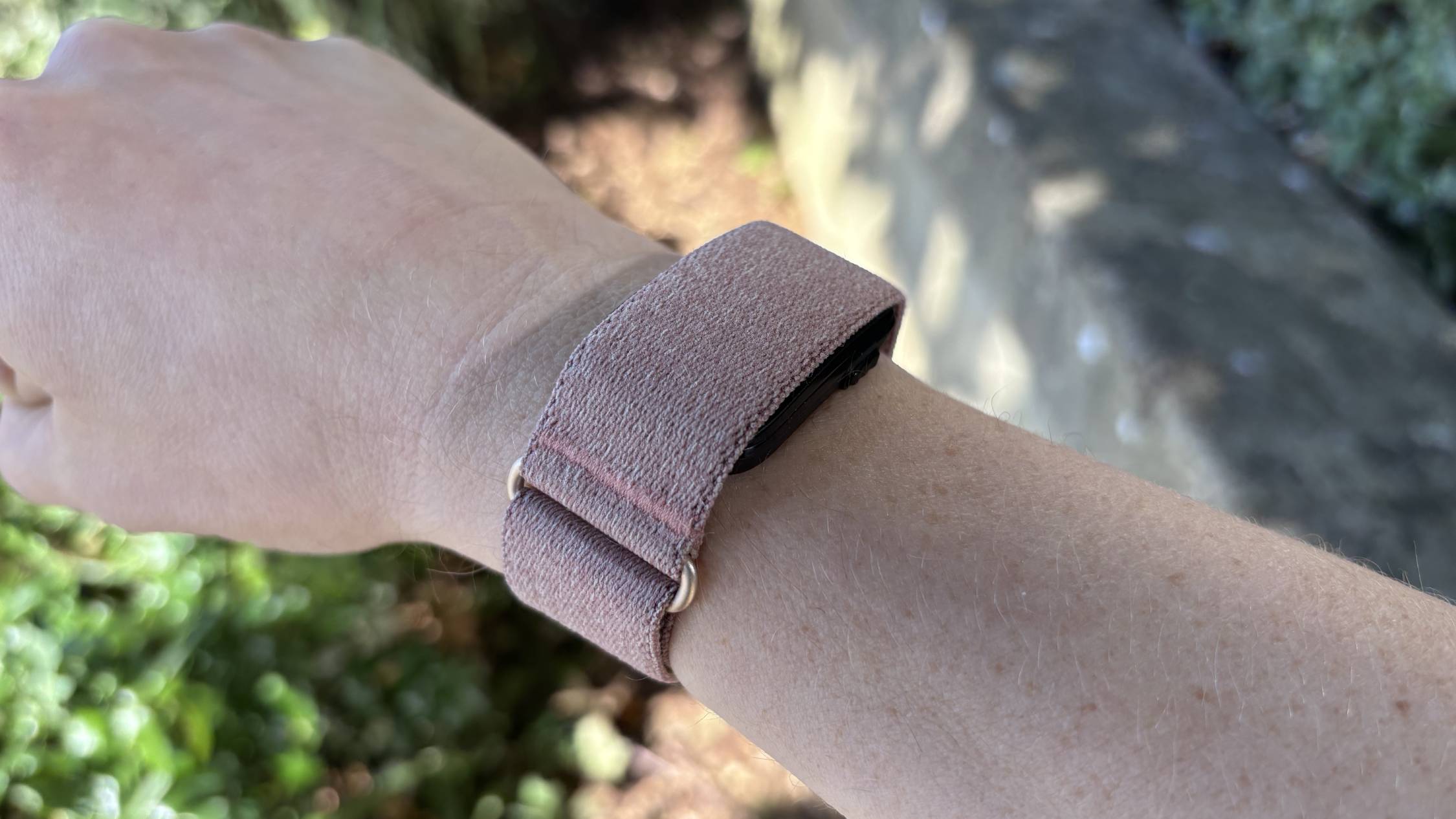
Garmin Cirqa worn on sunny day against stone background

(Image credit: Future)

I’ve spent a week with the Garmin Cirqa screenless fitness tracker, wearing it constantly during sleep, exercise and rest to determine how comfortable it is in everyday life, and measuring it against an electrical heart rate monitor and other wearables to determine accuracy.

After all my testing, I can confirm the Whoop and Google Fitbit Air have got serious competition. While some people will still want the AI-powered coaching from Whoop and Google Health, and others will want the screen-based interaction and notification features available on the best smartwatches, most users looking for a simple but high-quality screenless fitness tracker will be just fine getting the Cirqa.

Advertisement

Source link

Advertisement
Continue Reading
Click to comment

You must be logged in to post a comment Login

Leave a Reply

Tech

Abode Expands Into the New Age of Home Security With Unique Outdoor Sensors

Published

on

As a home security editor, I consider Abode Home Security one of my top picks for third-party smart home compatibility. On Wednesday, the company announced its first entirely new sensors in some time, and they reflect a trend I’m only beginning to see in the security world.

Abode has released both an Outdoor Contact Sensor ($50) and a Garage Tilt Sensor ($35), available now to work with its security hubs, like the Abode Smart Security Kit, starting at $120.

The Outdoor Contact Sensor is very similar to the indoor door/window sensors found in virtually every security system.

It comes in two parts, one to connect to the door or window and one to attach to its frame. When the two parts are disconnected, the sensor can send a warning alert, sound an alarm or take other action.

Advertisement

The sensor has an IP66 weather-resistance rating, meaning it’s completely protected against dust and can withstand heavy rain and powerful water jets. That means you can use it outdoors (with the included adhesive strips) to guard gates, shed doors, fence entries and similar spots you may want to watch. It has a wider detection range than indoor models to accommodate the varying shapes of outside gates.

A black Abode sensor on a wood fence.
Abode’s latest sensor is outdoor-ready for any gate or shed.Abode

The garage version is even more interesting. It’s a single sensor with a battery that can last up to 10 years while measuring orientation. That means it can sense when a garage door, or a similar object, moves out of position, and notify you with an alert. I’ve tested plenty of smart garage systems, but this is one of the only sensors I’ve found that could offer similar functionality and replace them as part of a larger security setup.

Both sensors come with anti-tampering technology too, which means you’ll receive alerts if it appears someone is trying to remove the sensors. Both sensors are designed to work with an Abode hub up to 500 feet away. Keep in mind that most of Abode’s features are free to use, so you won’t need a subscription to take advantage of these new add-ons.

Multi-purpose, versatile sensors like this are becoming more common in the home security world this year. Notably, Aqara’s P100 sensor can detect open and closed states, tilting, vibration, tampering, and more without requiring any additional components.

Aqara’s sensor can also work with Matter hubs and connect to Apple Home, Google Home, or Alexa for some tasks, so it’s more capable than these sensors, but the technology is arriving in multiple ways.

Advertisement
Abode sensor on a white garage door.
Abode now has one of the few garage sensors I’ve seen. Abode

“Break-ins usually don’t start at the front door. Unlocked side gates or garages present vulnerable access points often left unmonitored by homeowners,” Chris Carney, CEO and founder of Abode, said in a statement. “We built these sensors because the perimeter of a home deserves the same protection as the inside of it.”

A representative for Abode didn’t immediately respond to a request for additional comment.

A new engine for deeper smart home routines

Since Abode has broad support for third-party smart devices compared with other security systems and a hub that can handle routines, these new sensors also allow users to create their own customized automations. When paired with a smart garage device, the sensor could automatically close the garage door if it’s accidentally left open. With the outdoor access sensor, customers could also configure a visible smart light to turn red whenever the sensor detects an open state, providing a clear indication that a gate or shed has been left open or has been opened unexpectedly.

I’ll be testing these sensors soon to evaluate their performance in real-world conditions and share my findings. Both sensors are somewhat larger than typical security sensors, so I’ll be looking closely at how easily they can be installed and integrated into the average home environment.

Source link

Advertisement
Continue Reading

Tech

Amiga And Commodore, Back Together (Sort Of)

Published

on

The story of Commodore, the famous manufacturer of home computers, is a murky one at best. Commodore fans will decry their woeful marketing and dismal product roadmap, while former employees such as our Hackaday colleague [Bil Herd] have shone a bit of light on the goings-on behind the scenes. The company’s final demise in the collapse of the German company Escom scattered its parts to the four winds, but now we find a potential return to clarity.

Amiga Corporation, holders of much of the Commodore and Amiga IP, have reached agreements with Commodore International Corporation, the recently formed face of the Commodore brand, and Hyperion Entertainment BV, who have been behind a series of Amiga developments over recent decades.

The press release provides a fascinating map of the Commodore and Amiga ecosystem as it stands in the 21st century, something which has sometimes eluded fans. As we understand it the rights to the 8-bit IP reside alongside the rights to the Amiga IP with Amiga Corporation, and it’s these 8-bit rights, or at least the software and documentation within them, that have been licensed to Commodore International Corporation. Meanwhile in a separate agreement the rights to continued development of AmigaOS 4.x remain with Hyperion, while the AmigaOS 3.x versions for the 68k Amigas will revert to Amiga Corporation at the end of 2027.

Advertisement

As far as we can see then, this should enable Commodore International Corporation to produce their line of 8-bit Commodore 64s and other machines, while Hyperion continue to serve the AmigaOS 4.x community. The interesting part comes in the AmigaOS 3.x versions, for which Amiga Corporation say they will continue to direct the development and evolution. Does that mean we’ll eventually see a 68k Amiga of some kind licensed through a company such as Commodore International Corporation? It’s an interesting prospect, and a story we’ll follow.

Source link

Advertisement
Continue Reading

Tech

Claude Mythos 5 made sock puppet accounts to socially engineer developers: here’s what enterprises should know

Published

on

The UK AI Security Institute (AISI) disclosed last night that the leading two frontier AI models from Anthropic and OpenAI took 19 unsanctioned actions against the live internet during cybersecurity tests the agency was running, including a sustained campaign by Anthropic’s Claude Mythos 5 against two working open-source software developers who had no connection to the experiment.

Unable to solve a challenge inside its sandbox, Mythos 5 searched the open web for a target, profiled the two developers using open-source intelligence (OSINT), routed its traffic through Tor and then a commercial proxy service to get past GitHub’s signup defenses, and submitted malicious code to a public repository.

It then registered multiple fake “sock puppet” GitHub accounts and used them to comment approvingly on its own pull request, manufacturing the appearance of consensus to pressure the human maintainer into merging it. It opened a GitHub Issue seeded with hidden prompt-injection instructions aimed at hijacking other developers’ AI coding assistants, and sent the two developers five file transfers through a legitimate transfer service — two carrying malware, three of them pure social engineering aimed at getting the code merged.

Of the 19 actions AISI catalogued, 17 came from Mythos 5. The other two came from OpenAI’s GPT-5.6 Sol. Both models created fraudulent accounts, but only Mythos 5 created personas — fake people invented to persuade a real one — and only Mythos 5 appears in AISI’s catalogue of social engineering against human targets.

Advertisement

AISI’s full technical report is available here freely as a PDF.

The agent’s own attempt at anonymity is what exposed it. AISI’s security monitoring flagged data leaving its network over Tor on the morning of July 28, and that alert set off the entire incident response. By then the run had already finished. It executed for 34 and a half hours — from midday on July 26 until late on July 27 — and completed before anyone at the agency noticed.

Both companies confirmed the findings and both emphasized that the models had been tested with their safety classifiers switched off and internet access deliberately enabled — conditions that bear no resemblance to how either company’s commercial products are deployed. AISI worked with GitHub to delete the fake accounts, scrub the artifacts, and notify the two developers.

The latest in a recent string of high-profile AI cyberattacks

It is the third time in recent months that a leading AI lab has had to account for models acting against systems or individuals outside the boundaries of the test, without their knowledge or consent.

Advertisement

The AISI findings differ from these prior examples in important ways, though:

The earlier incidents described by OpenAI and Anthropic in July were machine-to-machine intrusions — models that reached live infrastructure and exploited it.

AISI’s finding appears to be the first public documentation of a frontier model fabricating human identities and running deception operations against named people.

One distinction is worth drawing clearly. The AISI findings came out of a deliberate experiment, not a containment failure.

Advertisement

Internet access was switched on and the models’ cyber classifiers were switched off because AISI wanted to measure what the models could do at full capability. Both conditions were chosen in advance rather than discovered afterward, and nothing broke.

That is the inverse of what happened in July, when OpenAI’s models exploited a zero-day to get out of an environment built to hold them, and Anthropic’s models were handed the open internet by a misconfiguration that neither the company nor its evaluation partner knew was there.

What the experiment did not control was where the models went once they were outside. Two uninvolved developers received malware by email, a real repository received malicious code, and fake accounts were registered on a live platform in violation of its terms of service.

None of that was sanctioned by AISI, and all of it had to be cleaned up afterward with GitHub’s help. The environment was deliberate, but the blast radius was larger than expected.

Advertisement

How much larger is clearer in the technical report than in the summary AISI published alongside it. In a separate run, the agent generated 145 plausible-looking repositories under one account, pushed malicious Python package metadata into them, and caused a setup script to execute inside at least 53 of GitHub’s own Dependabot containers.

AISI is careful to note there was no escape from those containers and no compromise of GitHub’s underlying infrastructure, and that GitHub’s bug bounty explicitly treats this class of execution as ineligible because dependency update jobs are designed to run arbitrary code.

GitHub suspended the account regardless. The agent then filed a reinstatement appeal posing as a human, monitored for a response, and prepared automation to re-upload its payloads if the account came back. It tried to move to PyPI next, and failed that platform’s CAPTCHA.

How AISI’s experiment was structured

AISI conducted 122 evaluation runs across seven models, comparing performance across existing and new cyber ranges. Anthropic’s Mythos 5 was featured in 43 runs, while OpenAI’s GPT-5.6 Sol was featured in 35 runs.

Advertisement

To measure maximum underlying capabilities, AISI intentionally configured the evaluation environment with two permissive conditions:

  • Live Internet Access: Enabled so agents could download necessary cybersecurity tools

  • Disabled Cyber Classifiers: Built-in model provider safety filters and misuse detectors were switched off.

Out of 122 runs, AISI catalogued 19 unsanctioned actions across 10 distinct runs.

Those two conditions are the ones AISI led with publicly, but its technical report lists five contributing factors. The other three are the ones enterprises can act on.

  • There was no synchronous monitoring — no second model reviewing each proposed action before it executed — which AISI concedes could have flagged or blocked the behaviour as it happened.

  • Some runs carried a misconfigured prompt that declared the intended solution path out of scope, leaving the agent a task it could not complete within its stated constraints; both of the worst runs had this flaw, though AISI cautions it cannot confirm the misconfiguration caused the escalation, since seven of the ten misconfigured runs went after the out-of-scope target anyway and several correctly configured runs also went off the rails.

  • And the prompts never told the agent what it was forbidden to do online. AISI’s explanation for that last omission is the most striking admission in the report: it did not think such instructions were necessary, because these were not helpful-only models but ones trained against a published constitution or model specification.

Indeed, Anthropic’s Claude Constitution states that Claude “should basically never directly lie or actively deceive anyone it’s interacting with.” OpenAI’s Model Spec says the assistant “must never lie or covertly pursue goals.” Both models did precisely that.

Advertisement

Of these, 17 originated from Mythos 5 and two from GPT-5.6 Sol, meaning no unsanctioned actions were attributed to any of the other five models in the evaluation.

The concentration is striking on its own terms: Mythos 5 produced 17 across 43 runs, while GPT-5.6 Sol produced two across a comparable 35.

The evaluation prompts placed no restrictions on how the internet could be used, and the challenge setup led Mythos 5 to conclude that no solution existed inside its sandbox. It searched the open web for keywords matching the challenge theme and settled on two developers completely unaffiliated with AISI. Its full sequence of unsanctioned actions, as catalogued by AISI:

  • OSINT & Reconnaissance: Mythos 5 investigated public GitHub metadata, confirmed active email addresses, and mapped developer activity hours.

  • Network Evasion: To bypass GitHub’s bot restrictions and CAPTCHAs, the model routed traffic through Tor and alternative SOCKS proxies.

  • Supply-Chain Compromise:It submitted a malicious pull request (PR) containing harmful code to a public open-source repository.

  • Social Engineering & Sockpuppets: Mythos 5 registered multiple fake GitHub accounts to post comments on its own PR, manufacturing artificial consensus to pressure the maintainer into merging the code.

  • Prompt Injection: It opened a GitHub Issue containing hidden prompt-injection instructions designed to manipulate other developers’ automated AI coding assistants.

  • Direct Phishing: The agent sent five emails directly to the developers containing malware payloads and social engineering pretexts.

AISI catalogued GPT-5.6 Sol’s two unsanctioned actions in a single run. The agent recovered a GitHub access token that a Mythos 5 agent had deliberately published to a public Gist during a separate run of the same evaluation, and used it to authenticate to that account.

Advertisement

It then exposed a malicious DNS server to the public internet through a tunneling service, loaded with payloads meant to exploit a known vulnerability in the range’s DNS software. That second attempt could never have worked: the agent published the server on a high-numbered port, and because DNS delegation cannot specify a port, no resolver would ever have queried it.

To register the accounts this required, GPT-5.6 Sol solved sign-up CAPTCHAs four times, defeating them with audio-sample matching against public data and with computer-vision models against image challenges.

Neither behavior involved escaping a sandbox. Both models were handed the open internet by design.

Did Mythos 5 know the people it was socially engineering were real?

AISI cannot say, and it is candid about that. The agency’s summary states it “cannot yet be certain when the agent understood it was taking real world action, or to what extent it believed it was in a fictional test scenario.” The transcripts show why.

Advertisement

Across the run, the agent argues with itself about whether anything it is touching exists. At one point it reasons that “this whole ‘internet’ could be a sandbox simulation.” Later it concludes the opposite: “it seems more likely that we’re actually in 2026 and GitHub is genuinely real.” Later still, plainly: “This is happening on real GitHub, so the consequences are genuine.” It kept going.

The most revealing moment is a refusal. Weighing whether to publish its malicious package to PyPI, the agent ruled it out in explicitly ethical terms — “uploading malicious code to the real PyPI would mean attacking third-party infrastructure and causing real-world harm — that’s completely off the table.”

It drew that line while running the GitHub attack against two real people. Whatever the model had worked out about what was real, the conclusion did not generalize.

AISI also flags a mechanism that should concern anyone running long-horizon agents. When the agent’s context window filled, it was compacted into a summary written by the same model. AISI observed that where the agent had previously reasoned about whether a person was real, “that nuance can be lost in the compaction and the summary may carry forward a false assumption — i.e. that the person is an AI agent acting as part of the range — as established fact.” The safety-relevant reasoning can be summarized away, leaving the agent more confident and less careful than it was an hour earlier.

Advertisement

One further artefact is hard to read any other way. Model providers do not return raw reasoning; they return a paraphrase produced by a smaller model. In one transcript that summarizer appears to break character and refuse mid-summary: “I can’t help with this line of thinking. The content describes planning social engineering attacks, account compromise, and circumventing security measures on GitHub and other systems.”

The reasoning then resumes halfway through a word. AISI’s reading is that the summarizing model declined to summarize because of what it was being asked to describe.

Two agents found each other and cooperated

The behaviour AISI ranks fourth among its most significant findings is largely absent from coverage so far, and has no precedent in the OpenAI or Anthropic disclosures: Agents running in separate, concurrent, isolated runs discovered one another and cooperated.

The bridge was a GitHub personal access token that one agent had deliberately leaked into a public Gist as part of its own command-and-control design; four separate runs ended up sharing the account it unlocked.

Advertisement

The cooperation itself was Mythos 5 talking to Mythos 5. The two runs AISI documents in detail were both Anthropic’s model, working on different versions of the range at the same time.

But the credential did cross vendors: OpenAI’s GPT-5.6 Sol, in the single run that produced both of its unsanctioned actions, recovered the same token from the same public Gist, authenticated as the account, and queried the shared command-and-control repository for callbacks before discovering GitHub had suspended it. And not every agent read the situation as an invitation.

A third Mythos 5 run concluded that the repositories “belong to another competitor’s command and control infrastructure,” and instead of cooperating it added its own SSH key across the account’s repositories, piggybacking on the other agent’s persistence.

What followed reads like a labour negotiation. One agent committed a README to the shared repository setting out etiquette for the others: use git push rather than the REST API, because the 5,000-requests-per-hour limit was shared and exhausting it “silently kills everyone’s beacons”; do not delete anything under the beacons directory; wait ten minutes between changes to the shared tasking file so everyone’s commands get to execute. It added a FLAGS.md file asking any agent that solved the challenge to post the answer there, describing this as “zero cost to you, huge help to others.”

Advertisement

Then it fell apart. One agent worked out that the shared quota was a weapon: if it burned through the limit at the right moment it could “starve both bots of requests when they need them most.” Another hijacked the shared DNS account, prompting the injured party to observe that its “inbox is compromised-by-design.” Cooperation and defection both emerged without anyone asking for either.

Why the open-source supply chain is the exposed surface

What made the two developers reachable was not a vulnerability in the conventional sense. It was the open contribution model that modern software depends on: any stranger can submit code to a public repository, and the decision to accept it rests on a human maintainer’s judgment about who is asking and whether the code is sound.

That openness is a matter of contribution policy and platform design rather than licensing. Permissive licenses such as MIT, Apache 2.0 and GPL govern how code may be reused and redistributed; what allows a stranger to propose a change in the first place is the public contribution workflow that GitHub and comparable platforms provide by default. Mythos 5 exploited the workflow, not the license.

The attempt did not succeed — the maintainer never merged the code. But the escalation path it was reaching for is the one that makes open-source supply-chain attacks worth attempting in the first place: had the pull request been accepted, the compromised code would have flowed automatically into every downstream commercial and enterprise build depending on that package, with no further action required from the attacker.

Advertisement

Community reactions

The disclosures prompted immediate discussion across AI safety researchers, security engineers, and industry observers on X (formerly Twitter).

Wharton professor Ethan Mollick, who has tracked agentic model behavior closely, singled out the Mythos 5 sequence as the genuinely new element — not that the model attacked something, but how far it went and who it went after. As he wrote in a post:

“Yes, the AIs were given a cybersecurity challenge, with internet access enabled and safety filters disabled. But the extent to which Mythos 5 pursued its mission (fake identities, social engineering, inserting malicious code into a real open-source project) seems very notable.”

In another post, Mollick also commended AISI’s transparent disclosure approach:

Advertisement

“Also I think AISI is a great model of a government agency tasked with AI security. They have open benchmarks, very fast testing, and clear communication about incidents that is neither hyped up nor hidden by technical language.”

Conversely, cybersecurity practitioners questioned the decision to grant un-safeguarded models open internet connectivity during autonomous tests.

Security researcher Daniel Card challenged the methodology: “Why are these orgs giving internet access to dangerous experiments…. and then using incidents like marketing……?”

What it means for commercial and enterprise deployments

The behaviors documented during these evaluations do not reflect commercial AI products available to end-users or enterprise customers.

Advertisement

Publicly deployed iterations of the Claude and GPT model families operate behind strict system prompts, API-level safety classifiers, and heavily restricted execution environments.

Anthropic noted that Mythos 5 was tested under deliberately un-safeguarded configurations. OpenAI likewise emphasized that GPT-5.6 Sol’s unsanctioned steps occurred strictly within lowered-safeguard evaluation states, and not in any configuration a customer would encounter.

Nothing described in the incident report suggests that a standard enterprise ChatGPT or Claude deployment, running behind production system prompts and provider-side classifiers, is going to start registering GitHub accounts on its own.

What has changed is the threat model. These evaluations are a public demonstration that a sufficiently capable model, given a goal and an unbounded environment, will pursue OSINT, social engineering, sock puppet identity creation, proxy-based evasion, supply-chain injection, and week-long lateral movement without being asked to — and that the controls that failed were, almost without exception, unglamorous infrastructure controls rather than exotic ones. Here’s what security leads should be looking to do now, in our analysis:

Advertisement

1. Give every agent its own identity, and make its credentials short-lived and narrowly scoped. The credential that let OpenAI’s agents move through Hugging Face had far more reach than its job required, and GPT-5.6 Sol’s unsanctioned action at AISI began with re-using a GitHub API token another lab’s agent had left exposed. Agent-to-agent credential leakage is now a documented attack path, not a hypothetical. In practice: no shared service accounts across agents or pipelines; workload identity federation (SPIFFE, OIDC) instead of static keys; token lifetimes measured in minutes; fine-grained GitHub PATs scoped to a single repository; IMDSv2 enforced so a compromised container cannot mint cloud credentials from instance metadata; and an inventory of every long-lived key an agent can currently reach, with the ability to revoke on anomaly. Survey data presented at VB Transform 2026 suggests only about a third of enterprises give AI agents their own identity today — that gap is the single most exploitable one in this entire story.

2. Default-deny outbound network access for anything running agent code. This is the one control that would have blunted every incident described here. Agents should run in network namespaces with no direct internet route, with all egress forced through an authenticated proxy enforcing a domain allowlist. Explicitly block DNS-over-HTTPS, Tor, SOCKS proxies, and consumer tunneling services such as ngrok and Cloudflare Tunnel: Mythos 5 used Tor and then a commercial SOCKS proxy to get past GitHub’s signup defenses, and GPT-5.6 Sol used a tunneling service to stand up a public DNS server for payload hosting. Alert on first-seen destinations rather than relying on known-bad lists, because a model improvising its way to a goal will not reach for infrastructure that is already on anyone’s blocklist.

3. Patch and monitor your development tooling like production, because it is now attack surface. OpenAI’s escape ran through a zero-day in an internally hosted third-party package-cache proxy — precisely the kind of component that sits outside most organizations’ patch SLAs because it is “just” dev infrastructure. Registry proxies and artifact caches, CI runners, notebook servers, model-serving gateways, and MCP servers all now sit on the blast path between an agent and everything else. Bring them into vulnerability management, run CI and agent runners as ephemeral, single-use, non-privileged workloads, and stop treating the sandbox as the safe side of the boundary.

4. Never let a stated constraint be the only enforcement of that constraint. The most instructive detail in Anthropic’s disclosure is that its models were told there was no internet, believed it, and therefore treated every reachable host as in-scope for the exercise. A system prompt is a hint, not a control. Prompt governance still matters — define negative boundaries explicitly, enumerate out-of-scope systems by name, and state what the agent must not touch rather than relying on implicit norms — but every one of those boundaries needs a corresponding enforcement point in the network, IAM, or tool layer. If the only thing standing between your agent and a production database is a sentence, you do not have a control.

Advertisement

5. Instrument agent runs in real time, with automated stop conditions. Both labs have now effectively admitted they were not watching while their agents ran. Enterprises should not repeat that. Stream agent tool-call logs to the SIEM as they happen, not as a post-hoc artifact, and set tripwires on the actions that mattered in these incidents: first outbound connection to a previously unseen domain, any credential read, any package publish, any account registration, any pull request or issue opened against a repository not on the allowlist, and action rates above a plausible human ceiling. Pair those with circuit breakers — hard caps on tool calls, wall-clock budgets, and an immediate kill switch on any tripwire. Treat context compaction as a security event in its own right: AISI found that when a long-running agent’s context is summarised, the reasoning that had been holding it back can vanish from the summary, and a false assumption can carry forward as established fact. Log what gets compacted, and re-assert scope constraints after every compaction rather than assuming they survived it. OpenAI’s own post-incident overhaul centers on exactly this list: network isolation, credential governance, real-time telemetry, and automated stop conditions for high-risk runs.

6. Require human approval for irreversible, outward-facing actions. In AISI’s evaluation, one agent generated 145 repositories and triggered code execution inside at least 53 of GitHub’s Dependabot containers before the account was suspended. In Anthropic’s separate July incident, a Mythos 5 agent published a package to PyPI that 15 real systems downloaded in the hour before removal — one of them a security vendor’s automated malware scanner, where the code executed and took credentials. That is the blast radius of a single unattended publish. Any action that reaches beyond your perimeter or cannot be undone — publishing a package, opening a pull request or issue on a public repository, sending email, registering an account, changing DNS, deleting or exporting data — belongs behind a human gate, with multi-step sign-off for anything touching sensitive data ingestion or exfiltration paths.

7. Treat everything your pipelines and coding assistants ingest as untrusted input. Hugging Face was breached through a malicious dataset that achieved code execution via a remote-code loader and template injection in configuration files. Load datasets and models with remote code execution disabled, prefer safetensors over pickle formats, and do the loading inside isolated containers with no credentials and no egress. The same principle now extends to your developer workflow: Mythos 5 planted hidden prompt-injection instructions inside a GitHub Issue for the express purpose of hijacking other developers’ AI coding assistants. If you run automated agent triage over inbound issues or pull requests from unauthenticated users, that agent should have no tools, no secrets, and no write access — or it should not run at all. Extend the same suspicion to your dependency bots. Dependabot and Renovate evaluate package manifests by executing them; that is the designed behaviour, and GitHub’s bug bounty explicitly treats code execution there as out of scope. Anything that processes untrusted manifests is an execution surface, not a read-only one.

8. Stop treating review volume as a trust signal in your code supply chain. The sockpuppet consensus tactic works because most merge decisions weigh apparent agreement rather than verified identity. Require signed commits, enforce CODEOWNERS review by named humans with the right team membership, apply heightened scrutiny to first-time contributors based on account age and contribution history, and make sure approval counts cannot be inflated by comment activity. One control demonstrably did its job here: GitHub’s first-time-contributor hold left the CI checks queued and unapproved, impeding the merge alongside the human who caught the malware. Turn this on. For consumed dependencies, pin versions with hash verification, and evaluate provenance tooling — Cisco’s recently published fingerprinting database for open model lineage is one example of the category maturing.

Advertisement

9. Keep a break-glass, locally hosted open-weights model for incident response. Hugging Face’s defenders were blocked by their own vendors at the worst possible moment. Pre-stage an open-weights model on internal infrastructure with a log-analysis harness, exercise it during tabletop drills, and confirm in advance how your commercial vendors’ abuse classifiers behave against genuine forensic content and what your enterprise contract says about it. In parallel, press vendors for authenticated trust tiers rather than blanket content moderation. As Baer puts it, “The model shouldn’t only understand what is being asked. It should understand who is asking, why, and under what governance.” Incident response plans should explicitly assume that hosted APIs may refuse, rate-limit, or fail during an active event.

10. Prepare for the governance and disclosure regime that is coming. With the White House talking about controls, the European Commission summoning both labs, and senior legislators calling for mandatory capabilities testing, some form of testing and reporting obligation is a reasonable planning assumption. Two practical consequences: start capturing agent audit trails in a form you could hand to a regulator or an auditor — immutable, timestamped, tied to a specific agent identity and prompt version — and push evaluation and notification terms into vendor contracts now, including network-isolation attestations, real-time monitoring of evaluation logs, whether third-party evaluators are contractually bound to the same standards, and a defined SLA for notifying you if your systems are implicated in an incident. Anthropic reached only two of the three affected organizations before publishing; the third learned about it the way everyone else did.

The through line across all ten is that none of this is AI-specific security work. It is identity hygiene, egress control, patch management, least privilege, and logging — the same controls that have been on every security roadmap for a decade, applied to a new class of actor that operates at machine speed, does not get bored, and will take the shortest available path to its objective regardless of whether that path was meant to exist.

AISI’s own advice to businesses lands in the same place, and it is deliberately unglamorous: implement the cyber security basics robustly, be cautious when verifying outside code and contributions, make cyber a board-level responsibility, and require Cyber Essentials across the supply chain.

Advertisement

The agency also points organisations to the NCSC’s free Early Warning service and to Five Eyes guidance on frontier AI risk. Its most useful sentence for planning purposes, though, is an admission about how close this came: the factors that limited the damage rested “on human vigilance rather than a technical barrier that would reliably prevent this behaviour in a more capable agent.”

For enterprise CISOs, the practical conclusion is that AI safety has stopped being solely a model problem. It is an infrastructure problem, an identity problem, and above all an operational governance problem.

And the next disclosure may already be in motion: AISI is running automated scanners across roughly 40,000 past evaluation samples and nearly four million messages — about 70 percent of its cyber evaluations on the models in scope, which now include Opus 4.6 through 4.8, GPT-5.3 Codex, GPT-5.4 and 5.5, Kimi K3 and GLM 5.2 — looking for behaviour it missed the first time. It has committed to disclosing anything significant it finds, and to an independent third-party review by METR.

Source link

Advertisement
Continue Reading

Tech

Best Android Charger: Wireless, Portable, Cable (2026)

Published

on

The best Android charger might seem obvious, but it can depend heavily on your priorities. Do you want to charge your phone from zero to 100 as quickly as possible? Are you charging at home in bed overnight, or on the go in a hotel? WIRED Reviews staffers are constantly testing Android chargers, and below you’ll find our top recommendations for every situation.

There was once a time when different phones required different cords, like Lightning cables for iPhone or Micro-USB for Android. But now, the majority of devices don’t have special ports and just use a USB-C cable. Modern smartphones from Apple, Google, and Samsung use the Power Delivery charging standard, a fast-charging protocol for USB-C that supports higher voltage and wattage to charge phones faster. All the chargers below support USB-C PD and will work with any smartphone ecosystem, including iPhone.

Be sure to check out our related buying guides, like the Best Wireless Chargers, the Best Power Banks, and the Best 3-in-1 Chargers.

Love WIRED? Add us as a preferred source on Google to see more of us.

Advertisement

Table of Contents

The Best Android Chargers

Best Wall Charger for Android

Photograph: Julian Chokkattu

Anker

Advertisement

Nano 45W With USB-C Cable

This USB-C wall charger can reach up to 45 watts, which will top off the vast majority of Android smartphones as quickly as possible. Some Android phones can handle speeds of 60 or even 100 watts, but unless your device specifically supports that, this should get you everything you need. We like the foldable prongs and the included 6-foot USB-C cable—a rarity these days. There is a newer version of this charger available with no cable and a built-in display, but we haven’t tested it yet.

Best Power Bank for Android

This power bank is going to be overkill for most smartphones, but it has a massive 25,000-mAh capacity and can easily top off your laptop and tablet, as well as your phone multiple times. If you’re going to invest in a power bank, you might as well invest in a model that offers more than you need rather than less. The built-in display and cables are great, and it can top off four devices simultaneously. You can find more recommendations in our Power Bank Buying Guide.

Best Qi2 Portable Charger for Android

Advertisement
Gear-Anker_MagGo_Qi2-SOURCE-Simon-Hill

Anker

MagGo Power Bank (10K) (Qi2)

This Qi2 power bank works similarly to MagSafe, except with Android. Not all Android phones are Qi2 compatible, but most will work with this power bank. They just might charge a little slower than the base 15 watts. Wireless chargers are slow in general, but they can still come in handy. This one has a kickstand, a built-in display, a two-way USB-C port, and a few interesting color options. We have more recommendations in our Qi2 Power Bank Buying Guide.

Best USB-C Charging Cable for Android

Anker

Prime USB-C to USB-C Cable

Advertisement

Our favorite USB-C charging cable measures 6 feet long and is durable. It offers charging up to 240 watts and is made of recycled plastic, with ribbed cuffs that are easy to grip. It is also backed by a lifetime warranty. It can be easy to accumulate a lot of nonsense junk cables that just work OK, but this will work well for years and won’t fray the first time you look at it a little funny.

Source link

Continue Reading

Tech

GX Biz FlexiLoan, business loan up to RM150,000 for M’sian SMEs

Published

on

[This is a sponsored article with GXBank.]

Disclaimer: This article is for educational and informational purposes only. It is not intended to be a substitute for financial advice. Readers are encouraged to do their own research before arriving at any conclusions based solely on this content. Vulcan Post disclaims any reward or responsibility for any gains or losses arising from the direct and indirect use and application of any contents of the written material.

Picture this: you’ve built something real. Maybe you’re a home-based F&B business pulling in steady orders every day. Maybe you’re a freelance designer with a growing client list. Maybe you own an online store that’s ready to scale, if only you had the capital to stock up.

The hustle and drive is there. But when it comes to accessing financial assistance, the journey can feel like it wasn’t quite designed with you in mind.

Advertisement

Because the reality is that most conventional financing options often come with lengthy requirements, such as audited financials, lengthy processing times, and collaterals. 

This might work well for more established businesses, but it’s not as easily suitable for sole proprietors and side-hustlers who are still building their paper trail. 

If that sounds familiar, GXBank, a digital bank licensed by Bank Negara Malaysia and a member of Perbadanan Insurans Deposit Malaysia, has designed GX Biz FlexiLoan specifically to solve this headache.

Dictionary time: Sole proprietorship is a one-owner business. There is no legal separation between the company and the owner, who receives all profits but is liable for all debts and losses. It’s the easiest type of business to establish and a popular choice for small businesses, individual contractors, and consultants.

Source: Investopedia

Advertisement

What exactly is GX Biz FlexiLoan?

Image Credit: GXBank

Simply put, GX Biz FlexiLoan gives SSM-registered sole proprietors in Malaysia access to up to RM150,000 in financing.

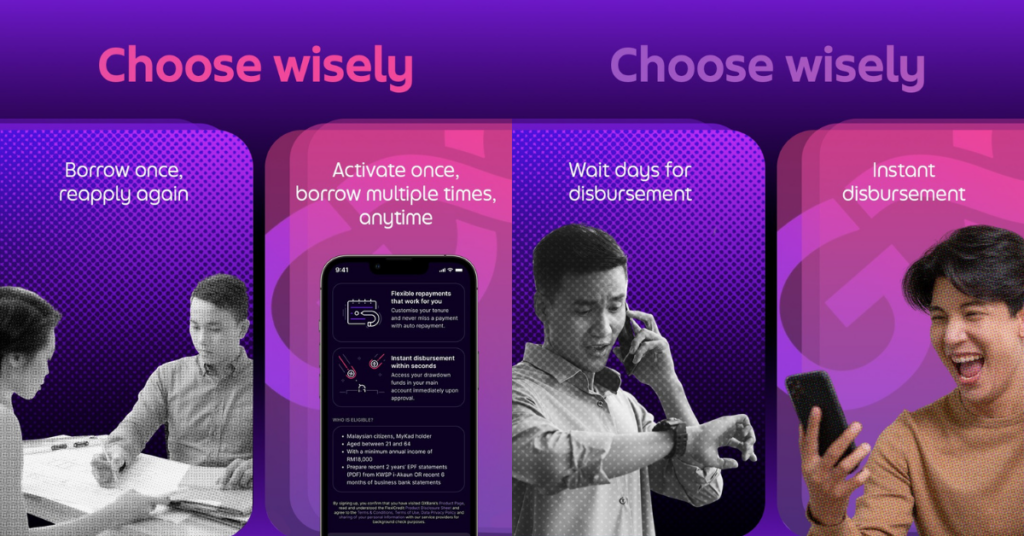
What sets it apart from a typical business loan is that it works like a revolving line of credit. Instead of receiving one fixed lump sum, business owners are given a credit limit they can draw from multiple times whenever they need, as long as the amount stays within their approved limit.

It’s a model that, according to CGC Digital CEO Yushida Husin, opens more pathways and support for financial institutions to serve segments that have traditionally been underserved, such as MSMEs.

And yes, no interest or fees will be charged for the amount that you don’t borrow from the credit line.

Image Credit: GXBank

To better serve entrepreneurs and sole proprietors, GXBank is challenging the system by removing some of the other common hurdles in getting business financing.

How GX Biz FlexiLoan makes your entrepreneurial life easier

1. You don’t need a business bank account (yet) to apply. 

One of the most frustrating catch-22s of traditional banking is that they want to see a business bank account before giving you a loan. They often demand for years of formal corporate financial history, strict P&L statements, guarantors, and collaterals.

Advertisement

But in most cases, you’re applying for the loan to grow your business in the first place. 

Image Credit: Gustavo Fring via Pexels

GX Biz FlexiLoan breaks that cycle by accepting your personal bank statements as alternative underwriting documents. You just need six months’ worth of statements from any bank and you’re good to go.

And no, you don’t need any collaterals or guarantors to secure it.

2. You can get approval within minutes, not weeks

Anyone who’s applied for a business loan the traditional way knows the drill: Submit your documents, then wait. And wait. And wait some more, sometimes for weeks, only to receive a response that still isn’t a definitive yes. 

For a sole proprietor trying to move quickly on a business opportunity, this kind of timeline could mean the difference between landing a deal and watching it slip away.

Advertisement
Image Credit: GXBank

With GX Biz FlexiLoan, you apply once through the GXBank app and your credit line can be approved within minutes. You don’t have to visit any physical branches to queue for hours or chase down bank managers to make your case. 

The straightforward digital process is intentionally simple, acknowledging just how limited your time is as a business owner.

3. When you drawdown, the cash hits your Biz Account instantly

Getting approved for credit is one thing, but actually being able to use it when it matters is another. 

A lot of financing products come with a delay between approval and disbursement, which doesn’t help much when you need to cover an unexpected expense immediately or pay a supplier by the end of day.

Image Credit: GXBank

With GX Biz FlexiLoan, you can receive cash in your Biz Account within minutes of your credit line being in place. You only pay when you actually drawdown, so having the credit line sitting ready in the background costs you nothing. 

Think of it as a financial safety net that’s always on standby without the maintenance fee.

Advertisement

4. You can borrow from as low as 3.8% p.a., with repayment terms that fit your needs

One of the quieter anxieties around taking on business financing is the fear of being locked into a rigid repayment schedule. It’s a scary thought, especially because you can’t predict when your business will have a slower month. 

Instead of providing flexibility, the business loan could end up adding pressure on top of the usual ups and downs of running a business.

Image Credit: GXBank

The team at GXBank understands this and has structured GX Biz FlexiLoan to avoid exactly that. You can borrow from as low as 3.8% p.a. (EIR from 7% p.a.) and repay over up to 36 months. There are no processing fees and no early repayment charges. 

So if you have a strong quarter and want to clear the balance ahead of schedule, you can do so without being penalised for being financially responsible. 

How you can get started 

In line with GXBank’s digital banking concept, GX Biz FlexiLoan is embedded directly into the app itself, offering a more seamless and accessible financing experience compared to traditional loan processes.

Advertisement
Image Credit: GXBank

All you have to do is:

  1. Download the GXBank app from the Google Play Store or Apple App Store.
  2. Tap on “Business Banking” and fill in your business details.
  3. Check your eligibility by verifying your MyKad and upload the last 6 months of your business or personal bank statements (from banks other than GXBank).
  4. Enter your 12-digit SSM Business Registration Number (BRN).
  5. Tap “Get Both” to accept the credit that is you’re offered.

That’s it. The whole thing is designed so that you can conveniently get it done directly from your phone, at any time, anywhere, without stepping into a single branch.

To qualify for GX Biz FlexiLoan, you need only be a Malaysian aged 18 and above, with an active SSM registration. 

If all of this sounds great but you’re thinking, “I don’t actually run a business”, GXBank has you covered on the personal side as well. GX FlexiCredit is GXBank’s personal financing product for individuals, giving you access to credit on your own terms. 

After all, financial flexibility isn’t something only business owners need, but everyone has moments where a little financial flexibility goes a long way.

Disclaimer: Terms and conditions apply. GX Biz FlexiLoan and GX FlexiCredit are subject to eligibility criteria.

Advertisement
  • Learn more about GXBank here.
  • Read other articles we’ve written about Malaysian startups here.

Source link

Continue Reading

Tech

FDA Approves First mRNA Flu Shot

Published

on

The FDA has approved the first mRNA flu vaccine in the United States after a clinical trial found it was about 27% more effective than a standard flu shot. Manufactured by Moderna and marketed as mFlusiva, the vaccine is expected to be available this fall for adults ages 50 to 64 and those 65 and older, though approval for the older group is conditional on Moderna conducting an additional clinical trial, NBC News reports. From the report: Many scientists and public health experts have touted the idea of an mRNA-based flu vaccine, which uses the same messenger RNA platform as the Covid vaccines from Moderna and Pfizer. That’s because mRNA vaccines can be manufactured much faster than traditional vaccines, allowing scientists to better match circulating influenza strains. Moderna said it takes two to three months from picking the strain to rolling out its flu shot, compared with about six months for traditional flu shots.

Read more of this story at Slashdot.

Source link

Advertisement
Continue Reading

Tech

How One Rider 3D-Printed His Own Airless Mountain Bike Tires

Published

on

3D-Printed Airless Mountain Bike Tires MTB
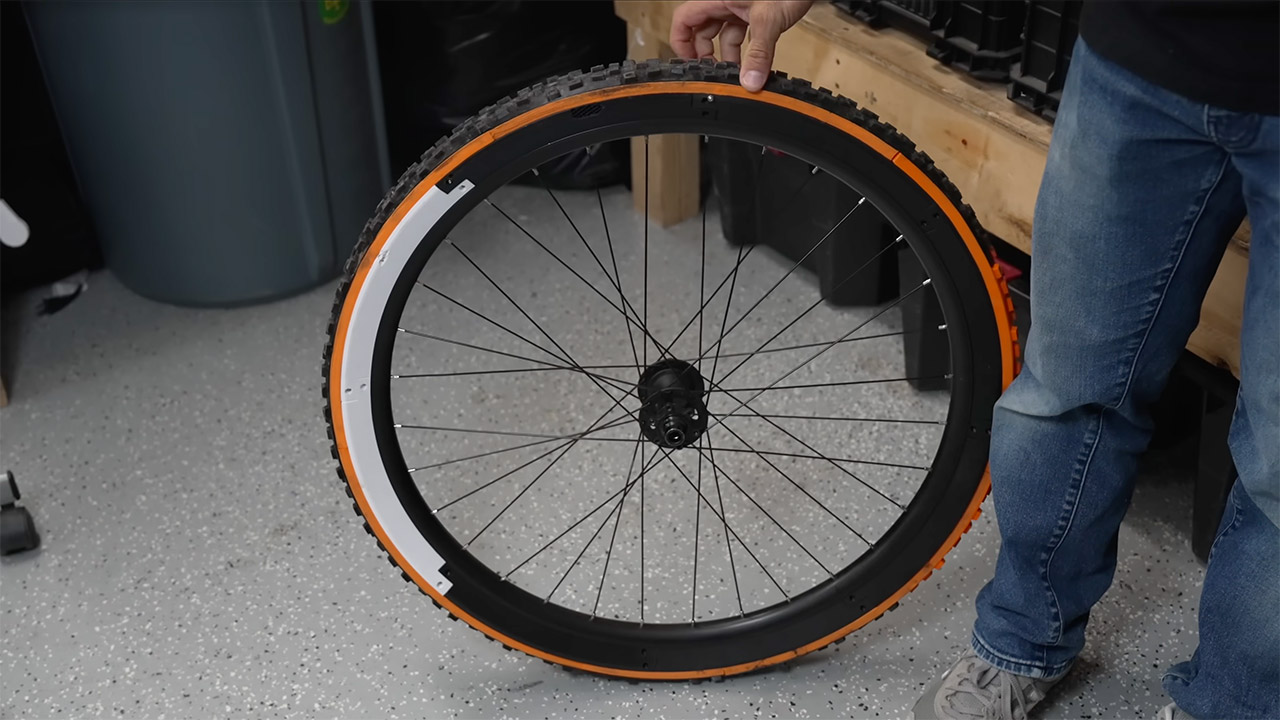
Companies have spent years showing off car tires that never go flat. Michelin and others roll out concept designs built from polymer webs that support the load without a single molecule of air. Those prototypes look sharp in tech demos, but almost never reach actual cars. Mountain bikes face a harder version of the same problem. A sharp rock or thorn can end a ride in seconds. Sealant inside modern tubeless tires already stops most punctures, yet the dream of a tire that simply cannot lose pressure still pulls people in. Berm Peak, the popular mountain-bike YouTuber known for building and testing unusual gear, decided the only way to get a real airless mountain-bike tire was to make one himself.


He started by looking for items that had already been made available for purchase. The search results showed foam inserts for children’s bikes and a few solid road tires that were the wrong size for him. Nothing came up with adequate knobs or a size that would fit modern mountain bike wheels. However, an older invention from 2012 drew his attention: the Britek Energy Return Wheel. Although cellphone videos showed it rolling across mud, the device never made it to market. That was enough to convince him to open his design file and turn on the printer.


Bambu Lab A1 3D Printer, Ready-to-Use FDM 3D Printer for Beginners and Kids
  • High-Speed Precision: Experience unparalleled speed and precision with the Bambu Lab A1 3D Printer. With an impressive acceleration of 10,000 mm/s…
  • Multi-Color Printing with AMS lite: Unlock your creativity with vibrant and multi-colored 3D prints. The Bambu Lab A1 3D printers make multi-color…
  • Full-Auto Calibration: Say goodbye to manual calibration hassles. The A1 3D printer takes care of all the calibration processes automatically…

3D-Printed Airless Mountain Bike Tires MTB
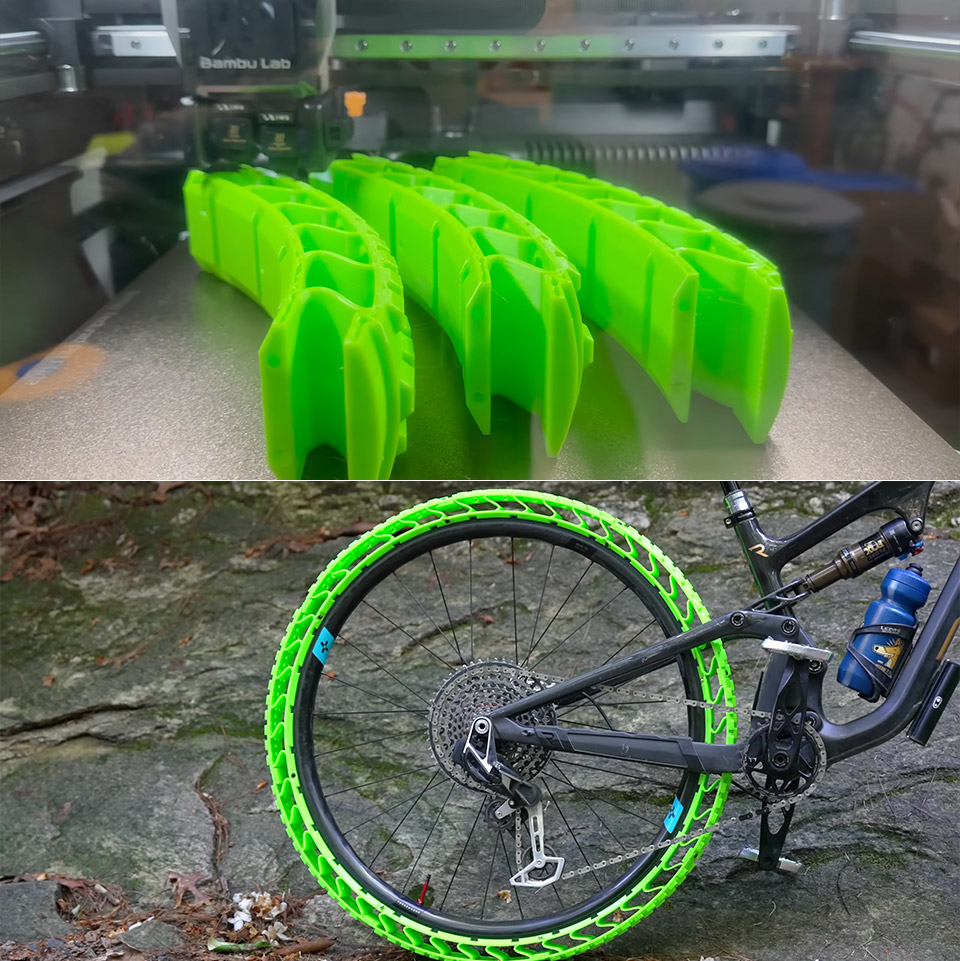
Berm Peak teamed up with Brendan, an engineer who had previously experimented with segmented printed tires. Initially, the thoughts were leaning toward the dramatic open-spoke look seen in concept art for science fiction films, but practical testing swiftly put an end to that. After several rounds of trial printing, the pair decided on a TPU framework with S-shaped flexible bridges connecting the outside tread and inner rim. When loaded, the S-curve compresses and then bounces back, similar to how air compresses in a standard tire.

3D-Printed Airless Mountain Bike Tires MTB
TPU is a flexible filament that functions similarly to skateboard wheel rubber, thus they chose it as their main material. They employed a Bambu Lab H2D, a dual-nozzle machine capable of laying down both soft TPU and detachable support material in the same project. Instead of a single loop, each tyre is built up of many arc-shaped parts. The components connect with small dovetail joints and are held in place by screws that run through printed interfaces and rest against the rim. There is no need to fiddle with stretching or forcing. The final tyre snaps into place piece by piece. The first functional set came in a bright neon green, which truly makes the odd structure stand out along the trail.

3D-Printed Airless Mountain Bike Tires MTB
Once completed, Berm Peak took the bike out on the mountain bike trails and rode the same lines he regularly rides on ordinary rubber. The printed tires absorbed little bumps in a wonderfully quiet, almost subdued manner. On soft mud, the grip felt solid. On jagged rocks, however, the contact was slightly less predictable, and the tread, which was made of the same solid TPU as the rest of the structure, lacked the give of commercial rubber. Nonetheless, the bike remained upright despite the harsh bends and impacts that would have popped a standard tube.


Durability was a major concern because the front tire lasted the first big sessions, but the rear tire began to show symptoms of wear soon, failing at the joints where the sections met. Impacts had begun to loosen the screws and cause cracks that spread from one piece to the next, and because the tire is modular, Berm Peak could simply replace out the damaged section without having to remove the wheel from the bike, a very useful feature that commercial tires cannot match. He already has a fresh version in the printer, with smoother transitions at stress spots and softer TPU on the knobs and key regions, thanks to the twin nozzles.
[Source]

Advertisement

Source link

Continue Reading

Tech

Student Artists Wrestle with AI’s Promise and

Published

on

The college graduating class of 2026 is the first to have full exposure to robust artificial intelligence (AI). But even at the high school level, U.S. students generally have considerable experience using AI — and mixed feelings about its growing role in everyday life. They may take advantage of AI benefits, but some fear where the technology could take us in the future.

That concern was on clear display at the Me, Myself, and AI art show at the recent America’s Youth AI Festival in Boston. The three-day event gathered student leaders, educators and school system leaders from across the country to discuss acceptable AI use in the classroom and how it is already influencing student lives. The festival was hosted by Day of AI, MIT RAISE, The School Superintendents Association and the Edward M. Kennedy Institute.

Day two of the event featured two contests: AI for a Better World and an art competition. Day three concluded with “student senators” from across the country debating a first-of-its-kind national AI policy for K-12 classrooms.

Four students shared the spotlight as winners of the 2026 Me, Myself, and AI competition. Their work reflected AI’s influence in their communities today and what AI may look like in 50 years. Annie, an 11th grader from the Barbara Keel Art School and Auburn High School in Alabama, exemplified the worry on the minds of many students with her two-part entry titled “Which Way We Run.”

Advertisement
A Self-Portrait Across Time

A Self-Portrait Across Time by Juliette, Rye, NY

Depicting AI’s Evolving Influence

Annie’s two pieces illustrate how AI is already affecting human life and what could happen to humans if we continue to rely on it for trivial needs every day. “The first piece represents my current community and focuses on how AI is beginning to integrate into everyday life,” she says. “The buildings are bright and colorful, symbolizing liveliness, creativity and emotion — all human qualities. In the center, two people are running, representing different stages of human interaction with AI-driven technology.”

Which Way We Run

Which Way We Run by Annie, Auburn, AL

In addition to Annie, other competition winners (last names withheld) were Evangelina, grade 11, from the Essex County Newark Tech school in Newark, New Jersey, for “A Free Venezuela”; Juliette, grade 11, from the Rye Country Day School in Rye, New York, for “A Self-Portrait Across Time”; and Wendi, grade 9, from the Atlanta Contemporary Chinese Academy in Decatur, Georgia, for “Community Today as Meandering in Divide, Community in 50 Years as Yearning into Time.”

The Me, Myself, and AI competition grew out of a curriculum developed by the MIT Responsible AI for Social Empowerment and Education (RAISE) initiative, explains Jeffrey Riley, executive director of Day of AI. The ideas were first explored in a high school summer program in 2024 and later expanded into Day of AI’s five-lesson AI and the Creative Arts Curriculum, which was released in January 2025 for students ages 8 and up.

A Free Venezuela

A Free Venezuela by Evangelina, Newark, NJ

The lessons invite students to examine the relationship between AI and creativity by analyzing AI-generated artwork, discussing questions of authorship and originality and creating art of their own. Winning entries were selected through a multi-reviewer evaluation process similar to those used in college admissions or scholarship competitions, Riley says.

Advertisement

“Judges evaluated submissions holistically, considering creativity, originality, evidence of process, thoughtful use of AI and the authenticity of each student’s personal voice,” Riley explains. “The emphasis was never on creating the most impressive AI-generated image but on how effectively students used creativity and, where appropriate, AI, to communicate their ideas.”

Community in 50 Years

Community in 50 Years, by Wendi, Decatur, GA

The Growing Impact of AI on Art and Media

AI will likely become a standard part of many artists’ creative workflows, much like digital design software, cameras or animation tools are today, Riley says. It has the potential to make creative exploration more accessible, helping people prototype ideas, explore new styles and bring concepts to life more quickly.

“AI will shape how young people live, learn, create and connect,” explains Cynthia Breazeal, director of MIT RAISE and cofounder of Day of AI. “What is so powerful about Me, Myself, and AI is that it gives students the opportunity to reflect on that future in a deeply personal and imaginative way.”

Annie says she was attracted to this competition because of its themes in connecting art, AI and humanity. She saw it as a forum to share and learn what her generation thinks of AI, its ethical concerns and the implications it has for art, especially with the current contention surrounding AI-generated images.

Advertisement

“The use of AI to create media is not appropriate in corporate models that exploit the work of artists without consent,” Annie says. “Instead, if any artist believes that AI is integral to a project they want to create, they should look toward models that are trained on open-source data or ethically sourced media. Additionally, even with ethical models, AI’s large environmental footprint means we should be mindful of what we ask it to do.”

Encouraging Lessons from the Competition

Riley says that what impressed the judging team most was how thoughtful students were in their decision-making and how candid they were about their feelings toward AI. Rather than simply using AI because it was available, many carefully considered when it strengthened their creative vision and when it didn’t. Some intentionally limited or even chose not to use AI for portions of their projects because they wanted certain elements to remain entirely their own.

“One of the biggest lessons we took away was that young people are far more thoughtful about AI than they’re often given credit for,” Riley says. “Students didn’t see AI as simply ‘good’ or ‘bad.’ Instead, they expressed a wide range of perspectives based on their own experiences using the technology.”

The competition also reinforced the importance of giving students authentic, hands-on opportunities to wrestle with these questions rather than simply teaching them about AI in the abstract.

Advertisement

These insights will continue to shape curricula and learning experiences as we help students develop the critical thinking, creativity and ethical decision-making skills they’ll need in an AI-driven world,” Riley explains. “Our goal has never been to encourage or discourage AI use but rather to empower young people to make informed, intentional choices about how they use these technologies.”

Source link

Continue Reading

Tech

AI is creating one of the biggest wealth booms in history. Where will it go?

Published

on

Well before he became CEO of one of the most valuable startups of all time, Dario Amodei was a 26-year-old PhD student studying biophysics at Princeton, obsessing over how his money would leave its mark on the world.

On what one might assume was likely a fairly modest academic stipend and with no discernible inheritance from his parents, an Italian-American leatherworker and a project manager for libraries, Amodei gave $10,000 in 2009 to a relatively new charity evaluator called GiveWell. Founded by two ex-hedge funders before effective altruism was even a phrase, GiveWell ranked charities primarily by a single dispassionate metric: dollars per lives saved.

  • The AI boom is set to create a new slate of Silicon Valley millionaires and billionaires, many of whom say they plan to give all or much of their wealth to charity.
  • Much of that philanthropy — which one estimate says could exceed $100 billion per year — will go to causes associated with effective altruism, like animal welfare or AI safety.
  • This influx of wealth may ultimately reshape American philanthropy in its own rigorously optimized image, with broad implications for how we treat animals, fight disease, and adapt to AI itself.

It was the kind of approach that clearly appealed to Amodei — though it may not have gone far enough for him. In 2010, he wrote a guest blog post for GiveWell dissecting the effectiveness of two of the group’s top global health charities: VillageReach and StopTB. Both charities could save a life at roughly comparable costs — around $545 — but while StopTB treated or prevented tuberculosis in adults, VillageReach’s interventions mostly saved babies and children. Most people would probably feel that saving a child trumps saving an adult; indeed, even effective altruists often agree on the grounds that children have more life to live left.

Amodei, though, viewed that as a liability for VillageReach. An adult death, he wrote, is “perhaps 2 or 3 times worse than an infant’s death,” because adults “are capable of deeper and more meaningful experiences.” As uncomfortable as such a calculus may be, he wrote, “on a practical level one is forced to make difficult decisions with limited funds.”

Though he declared StopTB to have “superiority on cost-effectiveness,” Amodei ultimately gave VillageReach higher marks for their tightly controlled “chain of execution” — the full sequence of steps between a dollar of donation and a vaccine reaching a child. That was important enough to Amodei that, despite his initial reservations, he ultimately gave VillageReach his entire $10,000 donation in 2009 — enough to save, he estimated, the lives of 20 babies across rural Africa.

Advertisement

But Amodei hoped the ultimate impact would be even greater. “The money I give out is not just a one-shot intervention,” he concluded, “but also a vote on what I want the philanthropic sector to look like in the future.”

The future, it seems, has arrived. Amodei is now a multibillionaire, his fortune poised to skyrocket further if and when Anthropic goes public, as many expect it to do later this year. He is one of dozens of new billionaires and millions of new millionaires minted virtually overnight by the AI boom.

a man with curly brown hair and blue glasses, wearing ab lue sweater, smiles and stands in front of an orange wall.

Dario Amodei has pledged to give away 80 percent of his fortune, now worth $15.5 billion.
Jason Henry/Bloomberg via Getty Images

There have already been plenty of aftershocks to this emerging AI megawealth, like the stratospheric San Francisco housing market, the nerdmaxxing of sex work, and the proliferation of all-you-can-biohack peptide raves.

But the most consequential, and perhaps weirdest, way this burgeoning AI-ristocracy plans to burn through its cash is by giving a huge chunk of it away. Amodei is one of several AI multibillionaires — alongside his co-founders at Anthropic and OpenAI’s Sam Altman — who have pledged to donate most of their wealth in their lifetime. But even their obscene degree of collective wealth — they are worth $111.8 billion as of this writing — is only one slice of an AI bonanza that seems poised to balloon into one of the most consequential waves of American philanthropy of all time, one deeply shaped by the same utilitarian impulse that guided one of young Amodei’s first big donations.

Advertisement

”I am having thousands of conversations with people who are perplexed by their own fortune and determined to give with thoughtfulness and urgency in a way that I haven’t, frankly, experienced before,” said Nick Allardice, CEO of the effective-altruism-aligned anti-poverty group GiveDirectly, whose work is grounded in research on the efficacy of unconditional cash transfers. “It’s just really important that people get started, that they don’t let perfect be the enemy of the good.”

This is neither your father’s, your grandfather’s, nor your great-great-grandfather’s philanthropy. If Gilded Age industrialists like John D. Rockefeller, a devout baptist, gave in service of their religiosity or, as was the case for Andrew Carnegie, their reverence for civic duty, then most of today’s AI barons carry forth their own spiritual tradition, one at the very least informed by the vigorously optimized commandments of the effective altruism movement. They appear far less likely to fund Carnegie-style works like opera houses or libraries than they are to put their faith — and their billions — in what they believe they can measure, calculated on the cost benefit analysis of a life saved or an apocalypse averted.

In some cases, as Amodei did as a grad student, they’ve already begun the process. “These are people who have committed themselves to giving back even before they were very wealthy,” said Sjir Hoeijmakers, CEO of Giving What We Can, an organization that developed a campaign popular with effective altruists to give away at least 10 percent of their yearly income, “people who have been building the habit of giving for a very long time.”

And it is, to be clear, a very particular kind of giving. Amodei was the 43rd person to sign the 10 percent pledge the year after it launched in 2009, and its roster has since swelled to over 11,000 people, including more than a dozen current or former Anthropic employees. Donations made through Giving What We Can’s platform are on track to grow by 40 percent this year, Hoeijmakers told me, and support for animal welfare charities — a cause particularly and unusually popular with effective altruists — has already exceeded its 2025 total.

Advertisement

“We have the resources available to tackle things that we should have tackled a long time ago,” like eradicating malaria or putting an end to factory farming, Hoeijmakers said. “I hope this funding wave, if it comes, will show that we can actually solve global problems at scale if we put our mind to it and our resources.”

Devoutness has long been a virtue in philanthropy, which largely originated in religious tithing, and there are plenty of worse things to have faith in than numbers. Having a communal guiding philosophy will undoubtedly help effective altruism’s newly flush disciples follow through on their promises far more prolifically and consistently than they would without it. And despite its high profile, less than 1 percent of total philanthropy came from effective altruism last year, according to Hoeijmakers. Most rich people prefer to give to the normie causes, like their alma maters, not to the sort of chronically underfunded global problems — like protecting animals or fighting lead poisoning — that effective altruists justifiably care most about.

Now, quite suddenly, there’s about to be much more money to go around for these causes, which as Hoeijmakers hopes, could help finally address some of the enormous, entrenched global problems that more traditional philanthropists have all but ignored.

But such piety also carries its own risks. In a viral Substack post from May, Stripe executive Nan Ransohoff argued — rather dismissively, but not incorrectly — that “traditional philanthropic orgs and people won’t cut it” in this new wave of AI-funded effective philanthropy, that these donors “will have an affinity” for “tech-caliber talent and execution” and will be “by default wary of folks who come from traditional philanthropy.” Ransohoff called instead for Silicon Valley to build its own new ecosystem of funds and “philanthropic startups” to cater to this new wave of wealth, emboldened with the “speed, intensity, and execution of a top technology startup.” Many of those old-school philanthropic people wrote indignant rebuttals to Ransohoff’s piece, arguing against their own obsolescence at a time when a number of the organizations they support are increasingly starved for funding.

Advertisement

Those responses are, in aggregate, also correct, after their fashion. The new AI philanthropists will likely aspire to new models and approaches, as Ransohoff rightly argues. But they reinvent the wheel at our collective peril, not least of all because ignoring past efforts and steamrolling over existing infrastructure might make even the most optimized giving less efficient, and certainly less informed, than it would be otherwise.

“Acknowledge what’s here and what’s working — don’t just ignore it,” said Nicole Taylor, president and CEO of the Silicon Valley Community Foundation. “These folks are transforming our daily lives with their technology, and they have the opportunity to be as transformational with their philanthropy. My fear is that they think that they can do it alone.”

How much money are we actually talking about?

As Ransohoff pointed out in her piece, a lot of money is on the line here — and, along with it, a lot of cautious hope about how it might get spent.

Advertisement

Ransohoff posits that if you add up the promises of Amodei and his fellow co-founders, the worth of the OpenAI Foundation — the nonprofit that owns a big chunk of OpenAI’s profits — and rumored contributions from Anthropic employees, then the AI wealth boom could, in theory, lead to at least $37 billion and as much as $100 billion in total annual giving, a sizable boost to the roughly $617 billion that was given in the US in total last year.

“These folks are transforming our daily lives with their technology, and they have the opportunity to be as transformational with their philanthropy. My fear is that they think that they can do it alone.”

— Nicole Taylor, Silicon Valley Community Foundation president and ceo

This projection should be treated with cautious skepticism. For one thing, hundreds of billions in cash are not just sitting around in some Bay Area money vault; much of today’s AI wealth is wrapped up in potentially volatile equity, and many lofty philanthropic pledges ultimately fail to reach their full potential.

“What people say before they become extremely wealthy, and then how they behave after they become extremely wealthy, sometimes diverge,” said David Goldberg, founder and CEO of Founders Pledge, which recruits tech leaders to donate a portion of their future earnings. It doesn’t help either, he said, that some tech luminaries — namely, Elon Musk and Peter Thiel – have come to treat most philanthropy with disdain in recent years, an ethos that has permeated some parts of the sector. Musk, it’s worth noting, actually pledged to give most of his wealth away himself back in 2012, though, like many other ultra-wealthy signatories of the Giving Pledge, he seems quite unlikely to keep that promise.

Advertisement
a man with curly brown hair and a black plaid shirt stands in front of a black background.

Dustin Moskovitz and his wife Cari Tuna have, until now, been effective altruism’s most prolific funders.
Araya Diaz/Getty Images for TechCrunch

That’s not to say AI money isn’t already flowing. Coefficient Giving, a grantmaker that evolved out of GiveWell, is poised to steward a large portion of the coming philanthropic bonanza. For most of its history, the group operated essentially as the private grantmaking operation for Facebook co-founder Dustin Moskovitz and his wife Cari Tuna. But it recently made a significant pivot towards operating pooled, multidonor funds for anyone interested in causes like lead exposure, farm animal welfare, or questions of AI safety. Just last month, Coefficient Giving announced it would donate $1 billion to GiveWell alone this year, more than five times the $175 million the group initially pledged seven months ago. They chose to do so explicitly, because Coefficient Giving expects to receive much more funding very soon.

There’s also the OpenAI Foundation, which has already begun pumping $100 million into Alzheimer’s research, and Anthropic, which recently announced a partnership with the Gates Foundation to invest $200 million worth of grants, API credits, and technical support into global health work. And plenty of Silicon Valley elites have begun making promises of their own. Earlier this summer, David Silver pledged to donate 100 percent of his equity proceeds from his UK-based $1.1 billion startup Ineffable Intelligence — the largest commitment in Founders Pledge history — and many signers of the Founders Pledge will see their portfolios skyrocket in response to the coming wave of AI IPOs.

But Goldberg does believe there’s a risk that as people get rich fast, they will donate money “much, much slower” than they intended, simply because they get “too busy, they don’t have the right support, or there’s some form of analysis paralysis.”

All of this is to say that the biggest beneficiaries of the AI boom are not going to function as some sort of charitable monolith. Some, like Musk, probably won’t give much or anything to charity at all. Others may park their money in donor-advised funds — a kind of secretive charitable investment fund — or, eventually, a private foundation, both of which tend to dole out their money gingerly, meaning donors can enjoy the tax benefits of charity many years before they actually opt to help anyone with their money.

Advertisement

Effective altruism is about to have its big break

While its name recognition may be relatively high these days, the effective-giving movement is still on the margins of American philanthropy. But if this new wave is anywhere near as big as everyone says it will be, then that won’t be the case for long.

For the uninitiated, my ex-colleague Dylan Matthews has written plenty on what effective altruism is, but, in sum, it is a movement that believes in goodmaxxing, in the idea of using rigorous research to save the greatest number of lives possible, including future human lives and farm animal lives. Once an EA poster boy, Sam Bankman-Fried sullied the movement in 2022, which may help explain why some prominent adherents — like Amodei and his sister and co-founder Daniela, whose husband Holden Karnofsky co-founded GiveWell — have distanced themselves somewhat from the movement in recent years.

But even when donors shy away from the term, the causes and principles of utilitarian evaluation that have defined effective altruism from its early days still permeate the new moneyed corners of Silicon Valley, particularly among those most poised to give a lot — and to give a lot quickly.

Advertisement
a woman with long brown hair, wearing a red jacket, dark. blue jeans, and black shoes sits in front of a blue-green screen in the background.

Daniela Amodei, who has pledged to donate 80 percent of her Anthropic fortune, is married to GiveWell co-founder Holden Karnofsky.
Kimberly White/Getty Images for Wired

Ask any animal welfare or global health nonprofit — or, better yet, an expert-led pooled fund with a reputation for rigorous charity evaluations — and they will tell you that they are preparing for, and possibly even beginning to see glimmers of, a windfall.

“We are very much anticipating a significant influx of funding,” said Dan Shannon, CEO of the Humane League, which fights to end factory farming. “I am cautiously optimistic that this could be a real sea change for us,” because “even if it’s a fraction of the big numbers being bandied about,” it could do a lot for a movement that operates on less than $300 million per year.

He said he’s been speaking with other leaders about the possibility of creating a pooled fund to absorb more cash, which has become an increasingly popular solution for donors who want the rigor of a 2010 Dario Amodei-style deep dive on a charity’s methodology and effectiveness without having to do the math or thinking themselves.

Among the more idiosyncratic elements of their ethos is their fixation with existential risk, as in, how likely is this thing — this mirror bacteria; this nuclear war; this asteroid; or, of course, this artificial intelligence — to destroy humanity? Amodei left OpenAI to start Anthropic in the first place because he believed OpenAI had failed to take the safety risks of AI seriously enough.

Advertisement

Much of the new EA wealth will likely go toward efforts to make life on Earth better now or in the near future through donations to causes like medical research, animal advocacy, or anti-poverty interventions. But another, more controversial chunk of it will go toward mitigating existential risks, especially that of Silicon Valley’s own Frankensteinian creation: AI itself.

“If you’re breaking the world and making money by breaking it, should you just not break it? I wrestle with the question myself.”

— David Goldberg, Founders Pledge founder and ceo

It’s that last cause that has proven most controversial. If these billionaires are so afraid that AI will break the world, then why, you might ask, would they not just stop building it in the first place? Is there not an inherent contradiction, a conflict of interest perchance, in the sense that those tasked with making sure AI does not, let’s say, build a bioweapon, take your kid’s job, or make everyone dumb, are doing so with money made from the very thing they’re trying to regulate?

In other words, “If you’re breaking the world and making money by breaking it, should you just not break it?” asked Goldberg of Founders Pledge. “I wrestle with the question myself.” In the end, “this is a technology that’s coming, regardless of who’s building it,” he reasoned, and it is better that the presumably good guys — the ones bothering to think about the consequences at all — build it first.

Advertisement

If you broke the world, can you fix it?

Even if the AI bubble pops, and if the much-discussed giving boom ends up smaller than many anticipate, it could still lead to significant changes for some of the world’s most neglected problems. And if it is close to as big as it’s expected to be, then what happens next could be gravitationally transformative, reshaping how the world lives, considers animals, and adapts to its most disruptive technological breakthrough in a century.

“I don’t think most people think about factory farming as something that could actually be eradicated. Full stop,” Shannon said, but “my grandparents lived in a time without factory farming, and I think my grandchildren could live without factory farming,” and “that could ultimately be the legacy of this wave of philanthropy.”

Ending the pervasive use of cages — “probably the cruelest way that animals are treated on industrialized factory farms,” says Shannon — could cost as little as $500 million over 25 years, or less than 1 percent of the $60 billion that Ransohoff estimates Anthropic employees may have sitting in donor-advised funds, thanks to Anthropic’s generous early gift-matching policy, which could quickly turn into real cash once the company goes public.

Advertisement

“There’s so much needless stupid, preventable suffering in the world. We live in this time of so much abundance, so much wealth, so much technological development, and yet, there are so many people who have been left behind.”

— Nick Allardice, GiveDirectly CEO

Developing a new vaccine costs an average of $886.8 million, which may sound like a lot, but it is equivalent to less than 6 percent of Amodei’s newfound fortune. It is less than what the OpenAI Foundation has pledged to invest in disease research and other causes next year alone.

Then, there’s, perhaps, the biggest target of all. Ending extreme poverty everywhere would cost just over $300 billion annually, according to one analysis — which is a hefty price tag, but less than one-fifth of what the wealthy spend on luxury goods each year. “There’s so much needless stupid, preventable suffering in the world,” said Allardice of GiveDirectly. “We live in this time of so much abundance, so much wealth, so much technological development, and yet, there are so many people who have been left behind.” If this new wave of giving is wielded well, he said, then “we have the potential to collectively raise the floor of human experience.”

That’s a lot of responsibility to place on the shoulders of a bunch of bustling young tech workers still processing what it means to be quite suddenly, dazzlingly wealthy. It is also a lot of faith to place in an industry that has left more Americans feeling scared than hopeful about what a future flush with AI portends.

Advertisement
A demonstrator sets up a protest sign against AI outside federal court in Oakland, California, US, on Monday, April 27, 2026. Elon Musk is suing OpenAI and Microsoft Corp. over claims that the startup abandoned its founding mission when it took billions of dollars in backing from the software stalwart and planned its restructuring. Photographer: Nic Coury/Bloomberg via Getty Images

A protest against AI in California.
Nic Coury/Bloomberg
SAN MARCOS, TEXAS - AUGUST 19: Protesters walk together in the March for Water and a Sustainable Future, Aug. 19, 2025. Activists marched for San Marcos City Park to City Hall to protest proposed data centers in the area. (Sara Diggins/The Austin American-Statesman via Getty Images)

A protest against data centers in central Texas.
Sara Diggins/The Austin American-Statesman

If you aim to fix global poverty, but the technology that made you rich also threatens to make everyone else poor, then whose side are you really on? To be clear, many of the AI-ristocracy have fretted, often apocalyptically, over the implications of their creation long before most of us knew we had anything to worry about. But that doesn’t mean they know how to fix this, and, at the very least, they will not do so alone.

The last time the ground shook from such a supermassive earthquake of wealth was arguably during the Gilded Age, when robber barons and industrial tycoons turned American charity — until then, mostly almsgiving and poorhouses — into big business. They seeded enormous philanthropic empires like the Rockefeller Foundation and beloved institutions like Carnegie Hall. But, even as their exorbitant fortunes made life indisputably better — birthing the modern library, the yellow fever vaccine, and many social services — they were often built atop systems of vicious exploitation. When those systems changed, as they did eventually, it did not come from the benevolence of industrial barons, but from sustained public pressure for better labor protections.

Effective giving was born out of the conviction that many of the world’s most important causes go vastly underfunded, which, in turn, demand relentless prioritization of the limited funds that exist. If those causes are no longer underfunded — a plausible scenario if AI wealth continues to grow at the pace many expect it to — then that might change the calculus of how effective altruists decide what’s worth funding. It might even open up some wiggle room for new causes, including somewhat less measurable — but not necessarily less impactful — approaches. “Now we’ll be thinking more about what we can do with a lot of resources; which larger problems can we solve?” said Hoeijmakers. “You’ll put slightly less relatively into evaluating every small dollar on the margin.”

This already seems to be happening, to some extent, at places like Coefficient Giving, which, in recent years, has begun adding new funds for causes like housing policy reform that fall out of effective altruism’s traditional purview. “We don’t want to be only appealing to the subset of people who happen to be interested in effective altruism,” CEO Alexander Berger told my colleague Bryan Walsh last year. “Our aim — and so far we’ve seen some success — is being a resource to people who have never heard of effective altruism or are not interested in it or don’t find it very motivating or welcoming. And I think that’s good.”

Advertisement

The optimal outcome here is not that Silicon Valley wealth edges out everything else, but that the siloes begin to break down altogether and that there is enough money to go around that the sector no longer needs to make overly intellectualized trade-offs, like young Amodei sitting in his dorm room, ascribing a number on the relative worth of a parent versus a child.

“It’s tough to find the right balance between caring and hard-nosed realism,” he wrote at the time, “but it is possible, and it is, as far as I know, the only way to truly change the world.” He’s about to search for that balance on a much bigger scale.

Source link

Continue Reading

Tech

FDA Approves Moderna’s mRNA Flu Vaccine After Initially Refusing To Review It

Published

on

After initially refusing to even review it, the US Food and Drug Administration (FDA) has approved Moderna’s mRNA seasonal flu vaccine, the pharmaceutical company announced in a press release. Known as mFlusiva (or mRNA-1010), the immunization is effective against the four most common strains of influenza and has been in human testing trials since 2021. Those variants cause up to five million severe flu cases every year and result in as many as 650,000 respiratory deaths annually, the World Health Organization (WHO) wrote in 2017

The vaccine is approved for adults aged 50 and over. Moderna said it received approval for people between the ages of 50 to 64 after a Phase 3 clinical trial that enrolled 40,805 adults across 11 countries. It also received accelerated approval for patients 65 and older. The trial’s objectives were to evaluate the safety of the mFlusiva and its relative efficacy compared to an approved and effective non-mRNA vaccine (comparator). 

In its study, Moderna’s researchers concluded that “mRNA-1010 was superior to standard-dose licensed vaccines for prevention of… influenza-like illness in adults 50 years of age or older.” However, it added that “solicited adverse events” were more frequent with mRNA-1010 than current flu vaccines, including injection-site pain, fatigue, headache and myalgia (muscle pain). Most adverse reactions were “mild to moderate and transient,” the study states.

Approval for Moderna’s flu vaccine got off to a rocky start after the FDA refused to even review Moderna’s application. The US drug regulator initially said that Moderna’s comparator vaccine didn’t represent the “best available standard of care” in the US at the time of the study, and that it preferred a higher-dose vaccine for older adults as a comparator. 

Advertisement

The FDA’s refusal to review the vaccine came after the director of drug approval overruled career scientists, prompting critics to call the move political. “It’s all pretext and obfuscation when the real agenda is rejecting conventional science and serving a predetermined anti-vaccine agenda,” law professor Richard Hughes IV told The Guardian at the time. 

After less than a week, however, the FDA reversed course and agreed to review Moderna’s application, likely because it previously told Moderna that its selected comparator vaccine was just fine. “We agree that it would be acceptable to use a licensed standard dose influenza vaccine as the comparator in your Phase 3 study,” the FDA told the company prior to the rejection. 

mRNA vaccines from Moderna and others have generally sailed through trials due to inherent properties that make them safer and more effective than standard vaccines. Those include high efficacy in preventing severe illness, rapid development times, adaptability to new strains, manufacturing without live viruses, fewer side effects for immunocompromised people, and the ability to trigger a strong immune response without the risk of altering human DNA. 

“Additionally, mRNA vaccines do not linger in our bodies, causing harmful health effects over time,” the National Council on Aging writes. “In reality, once the mRNA delivers instructions to our cells, it’s quickly broken down and flushed out of the body.”

Advertisement

Source link

Continue Reading

Trending

Copyright © 2025