

Crypto World
US Iran Talks Bitcoin Markets React



US Iran talks bitcoin and oil markets are watching their most consequential diplomatic moment yet as American and Iranian officials meet face-to-face for the first time, with WTI crude at $92 a barrel and BTC at $74,000.
Summary
- US and Iranian officials are holding direct talks on April 15 for the first time, with US officials saying more time is needed to reach a formal agreement.
- All prior negotiations ran through Pakistani intermediaries, including the 20-hour Islamabad session that collapsed April 13 and triggered the naval blockade.
- Analysts say a credible outcome could push oil toward $80 a barrel and send BTC above $76,000, replicating the pattern from the April 7 ceasefire rally.
US Iran talks bitcoin and oil markets are at a pivot point on April 15. Al Jazeera reported that direct negotiations between the two sides are under way, a format that differs from the Pakistani-mediated sessions that defined all prior contact. US officials described the session as preliminary, stating that more time is needed, but markets have already begun pricing the development.
WTI crude fell from $103 at the blockade announcement to $92 today. Bitcoin, which has closely tracked every diplomatic signal in this conflict, sits at $74,000 after tagging $76,000 on April 14.
Every prior round of contact between the US and Iran ran through intermediaries. The Islamabad session on April 11 and 12, mediated by Pakistan’s military leadership, lasted 20 hours and ended without an agreement. Vice President JD Vance said Iran chose “not to accept our terms.” Trump announced the naval blockade hours after Vance departed.
Direct talks remove one layer of friction from the process. When the April 7 ceasefire was announced through Pakistan, BTC jumped from $68,500 to $72,700 in under 12 hours and liquidated $427 million in short positions. A direct diplomatic breakthrough would carry materially more weight than a brokered one.
The Oil and BTC Math in Real Time
The ceasefire rally template is established. Oil lifted BTC off its post-Islamabad lows every time a credible de-escalation signal emerged. Brent’s 13% single-day fall on the original ceasefire announcement drove BTC from $68,500 to $72,700 within hours. At $92 a barrel today, oil is already 13% below the blockade-announcement spike of $103.
Coin Bureau founder Nic Puckrin has outlined $85,000 to $90,000 as the Bitcoin target in a genuine ceasefire scenario, requiring oil to fall toward $80 and softer US economic data. Every hour of direct talks that does not collapse moves that scenario forward in time.
What Markets Need to Hear
The minimum outcome markets would treat as bullish is a joint statement from both sides agreeing to extend the ceasefire past April 22. A commitment to a formal second-round negotiation process, even without a resolution, would likely push oil below $85 and give BTC the catalyst it has been waiting on through 46 straight days of negative derivatives funding rates.
“We’ve been called by the other side, and they would like to make a deal very badly,” Trump said earlier this week. That framing, now combined with the first direct engagement between the sides, puts a deal closer to the market’s horizon than at any point since the Islamabad collapse.

Crypto World
The battle for the digital euro is heating up as central bankers clash over how to take on Tether


France’s central bank deputy governor called Tuesday for the “mobilization of all relevant European players, public and private,” to develop tokenized money.
Beau’s comments are in stark contrast with European Central Bank (ECB) President Christine Lagarde’s recent speech in which she said that “the case for promoting euro-denominated stablecoins is far weaker than it appears.”
While Lagarde described the $310 billion privately-issued stablecoin market, currently dominated by Tether’s USDT and Circle’s USDC, as instruments that “risk amplifying the very vulnerabilities we are trying to overcome,” Beau told CoinDesk that private sector solutions are necessary for the region’s economic development.
The different views, however, reveal a growing concern in Europe over the “digital dollarization.” With a stablecoin sector projected to rise to the trillions of dollars in the coming years, a lack of euro-pegged currencies could force European capital into dollar-backed assets, potentially eroding the euro’s global influence and monetary sovereignty.
“To ensure a sound development of tokenized finance in Europe, its payment and settlement asset pillar should be in euro and build on the solid foundation of our current two-tier monetary system,” Beau said in an interview with CoinDesk.
The central banker outlined a “triple objective” for the region, which requires the European Union (EU) to adapt central bank money services, develop “pan-European solutions in tokenized private money issued by regulated financial institutions,” and strengthen the bloc’s Markets in Crypto-Assets Regulation (MiCA).
Beau’s stance aligns with Qivalis
Beau’s stance aligns with Qivalis, a group of 12 major European banks, including ING, BBVA, and BNP Paribas, which plans to launch a private digital euro later this year.
Qivalis CEO Jan-Oliver Sell recently told CoinDesk that without a liquid onchain euro, “the only alternative is the U.S. dollar,” which he described as a “risk to Europe’s financial and digital sovereignty.”
Lagarde agrees with the need for digital asset alternatives to dollar-pegged stablecoins, warning that USDT and USDC pose “financial stability risks” for Europe and could “transmit stress to the underlying asset markets during periods of turmoil.”
However, while Beau advocates for immediate private-sector mobilization to capture market share, Lagarde favors a central bank digital euro, which in previous statements she suggested would be ready by 2029.
Beau noted that the Eurosystem is already moving to provide native settlement options. “A first deliverable will become available by the end of this year, with the opening of our wholesale central bank money service in tokenized form,” he said, referencing projects such as Pontes.
The opposing views between Lagarde and Beau come as U.S. dollar-pegged tokens account for 98% of the stablecoin market.
While Lagarde argues that stablecoins, “do not confer the unconditional finality that central money does,” Beau maintains that public and private efforts “should complement and support each other” to ensure the euro remains a viable settlement instrument in an increasingly tokenized global economy.
Crypto World
Ripple Price Analysis: XRP Retakes Crucial Resistance, Is the Breakout Finally Starting?
XRP is trading at $1.45 as the second week of May is underway, and for the first time in several months, the technical picture carries a genuine sense of compression and potential energy.
A symmetrical triangle that has been forming since February is now at its apex, with the price breaking above the upper boundary and the RSI climbing to above 50. The broader market’s momentum provides a backdrop that XRP has not had the luxury of in most prior setups this cycle.
Ripple Price Analysis: The USDT Pair
Since February, XRP has been carving out a symmetrical triangle on the daily chart, formed by a series of lower highs and higher lows converging into an increasingly tight range. The upper boundary sits around $1.43 and has been broken to the upside over the weekend.
The higher boundary of the large descending channel and the 100-day moving average (located around the $1.40 mark) have both been broken as well. With the RSI recovering and building momentum above 50, almost all signals point to a potential surge in the coming weeks.
A daily close above the $1.50 psychological level would confirm the bullish technical development and open the path toward the next significant zone at $1.80, where the 200-day moving average is also located. On the contrary, a rejection and drop back below $1.40 would invalidate the pattern entirely and put the $1.20 February low back in immediate focus.

The BTC Pair
The XRP/BTC pair has also staged a meaningful recovery from the deeply oversold extreme reached in early May, when the RSI touched approximately 25. From the lows near 1730–1740 sats, the market has bounced back to 1800 sats, now testing the horizontal resistance zone formed by the February low. The RSI has also recovered to the 45–50 range, confirming the oversold relief bounce, while also demonstrating a clear bullish divergence.
The 1800 sats resistance zone is the first real test of this bounce. A clean breakout and close above it would open the path toward the 2000 sats area, where the 100-day moving average is also located at the moment. That, in turn, remains the minimum threshold required to suggest XRP is beginning to recover ground against Bitcoin rather than simply bouncing from an extreme.
Still, the broader downtrend on this pair is intact, as both the 100-day and 200-day moving averages continue to decline well above the price, and until one of them is reclaimed, any BTC-relative gains remain corrective rather than structural.

The post Ripple Price Analysis: XRP Retakes Crucial Resistance, Is the Breakout Finally Starting? appeared first on CryptoPotato.


Shopping giant eBay has rejected video game retailer GameStop’s ambitious $56 billion takeover offer, leaving the latter to decide whether it wants to walk away, raise the bid or take the fight directly to shareholders.
EBay’s board called the half-cash, half-stock offer “neither credible nor attractive” on Tuesday, per Reuters, citing doubts around financing and arguing the company is better positioned under its current management. The rejection was widely expected. EBay has traded well below GameStop’s $125-per-share bid since the offer surfaced, a sign investors were not convinced the deal could close.
That puts GameStop’s bitcoin position back in the conversation, as CoinDesk reported earlier this month.
The cultish firm holds roughly $368 million worth of bitcoin exposure via a covered-call options strategy. It shifted nearly all of its 4,709 BTC to institutional brokerage Coinbase Prime, as a filing showed in March, turning the position into a receivable rather than directly held bitcoin.
GameStop’s offer was built around $9.4 billion of cash and liquid investments, plus up to $20 billion in debt financing from TD Bank. But that financing is contingent on the combined company maintaining an investment-grade rating, and Moody’s has already warned the deal would be credit negative for eBay. Raising the offer or going hostile would likely make the financing math more challenging.
Cohen has previously framed the eBay deal as “way more compelling than bitcoin,” leaving open the question of whether GameStop’s BTC position could be unwound if more cash is needed.
Selling it would not fund the deal by itself, but it is one of the few discretionary assets GameStop can point to as it tries to convince investors the bid is real.
The market remains skeptical, however. EBay shares slipped about 1% to $107 before the bell Tuesday, still far below the offer price, while GameStop fell 4%.
The deal previously drew pushback from parts of GameStop’s own investor base.
Michael Burry, the investor made famous by The Big Short, sold his stake after the bid and warned that buying eBay could saddle GameStop with debt and dilute shareholders.
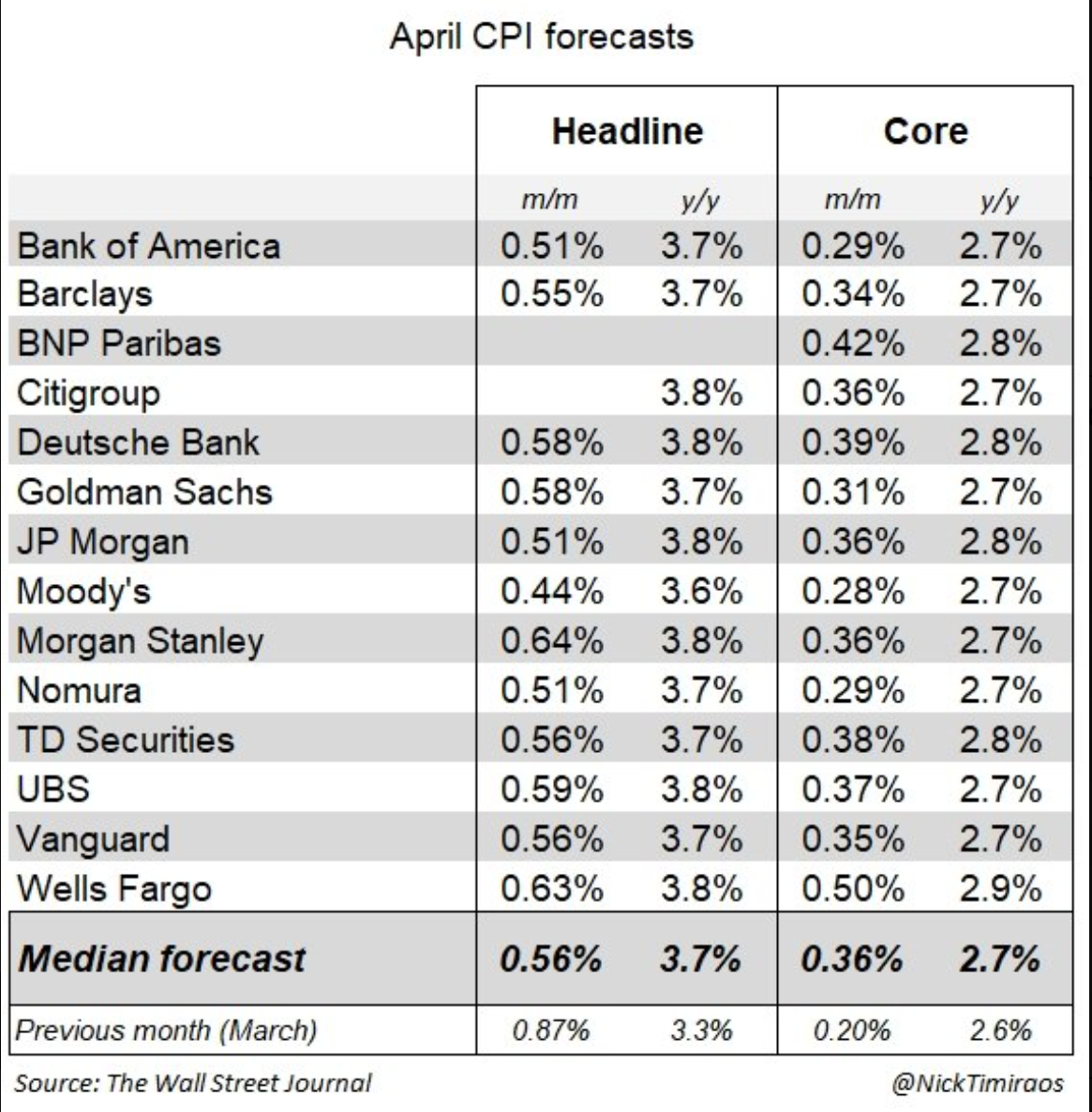
U.S. inflation accelerated more than expected in April, rattling crypto markets and reinforcing fears that the Federal Reserve may keep interest rates higher for longer.
Bitcoin and other risk assets turned volatile after headline CPI rose to 3.8% year-over-year, above Wall Street expectations of 3.7%, while core inflation also came in hotter than forecast.
Inflation Comes in Hotter Than Expected
The latest U.S. Consumer Price Index report showed inflation pressures remain stubborn despite months of cooling hopes from investors.
April CPI rose 3.8% year-over-year, beating consensus estimates of 3.7%. Core CPI, which excludes food and energy prices, climbed 2.8% year-over-year versus expectations of 2.7%.
Markets were already bracing for a strong inflation print after analysts warned that rising gasoline prices, geopolitical tensions, and persistent shelter costs could push the numbers higher.
Several major Wall Street banks, including JPMorgan, Deutsche Bank, and UBS, had projected elevated readings ahead of the release.

The hotter-than-expected report immediately raised concerns that the Federal Reserve could delay interest rate cuts deeper into 2026.
Before the data release, investors wagered a 97.6% change the Fed would hold rates steady at its June meeting. The latest inflation data is likely to reinforce that stance.

Bitcoin and Risk Assets Face Pressure
Crypto traders entered the CPI release cautiously, with many expecting sharp volatility around the data.
Bitcoin swung higher after the report as Treasury yields also climbed, as inflation and Fed tightening expectations rise, increasing required bond yields.

Risk-sensitive assets, including technology stocks and cryptocurrencies, often struggle when inflation remains elevated because higher interest rates tighten financial conditions and reduce liquidity appetite.
“This month’s CPI release looks like a problem for risk assets, but not yet a disaster…the likely reaction will be higher yields, a stronger dollar, increasing pressure on the tech sector, and more volatility in crypto. Bitcoin can hold up better than smaller peers if ETF demand stays strong, but a clean breakout seems unlikely to me, as real yields and the dollar are both working against it,” Arthur Azizov, Founder at B2BROKER Group and B2BINPAY told BeInCrypto.
In this setup, Azizov expects sideways movement with increased volatility in the $80,000 to $85,000 range.
“There is enough inflation pressure to keep risk appetite in check, but not enough to price in a full new tightening cycle,” he added.
Analysts on X had widely warned that a “hot” CPI print could trigger a risk-off reaction across markets. Popular macro accounts pointed specifically to energy inflation and sticky shelter costs as the biggest upside risks.
Why Core Inflation Matters
While energy prices contributed to the rise in headline inflation, investors are closely watching core CPI for signs of broader price persistence across the economy.
The increase to 2.8% in core inflation suggests underlying price pressures remain difficult to tame, complicating the Fed’s path toward rate cuts.
Persistent inflation could keep bond yields elevated and strengthen the U.S. dollar, both of which historically create headwinds for Bitcoin and speculative assets.
What’s Next for Crypto Markets?
Investors will now turn attention to upcoming Producer Price Index data, Federal Reserve commentary, and bond market reactions for clues about the next policy move.
For crypto markets, the key question is whether Bitcoin can maintain support above $80,000 despite fading hopes for rapid monetary easing.
If inflation continues surprising to the upside, traders may prepare for prolonged volatility across digital assets and equities alike.
The post Hot CPI Print Shakes Fed Cut Bets as Inflation Tops Forecasts appeared first on BeInCrypto.
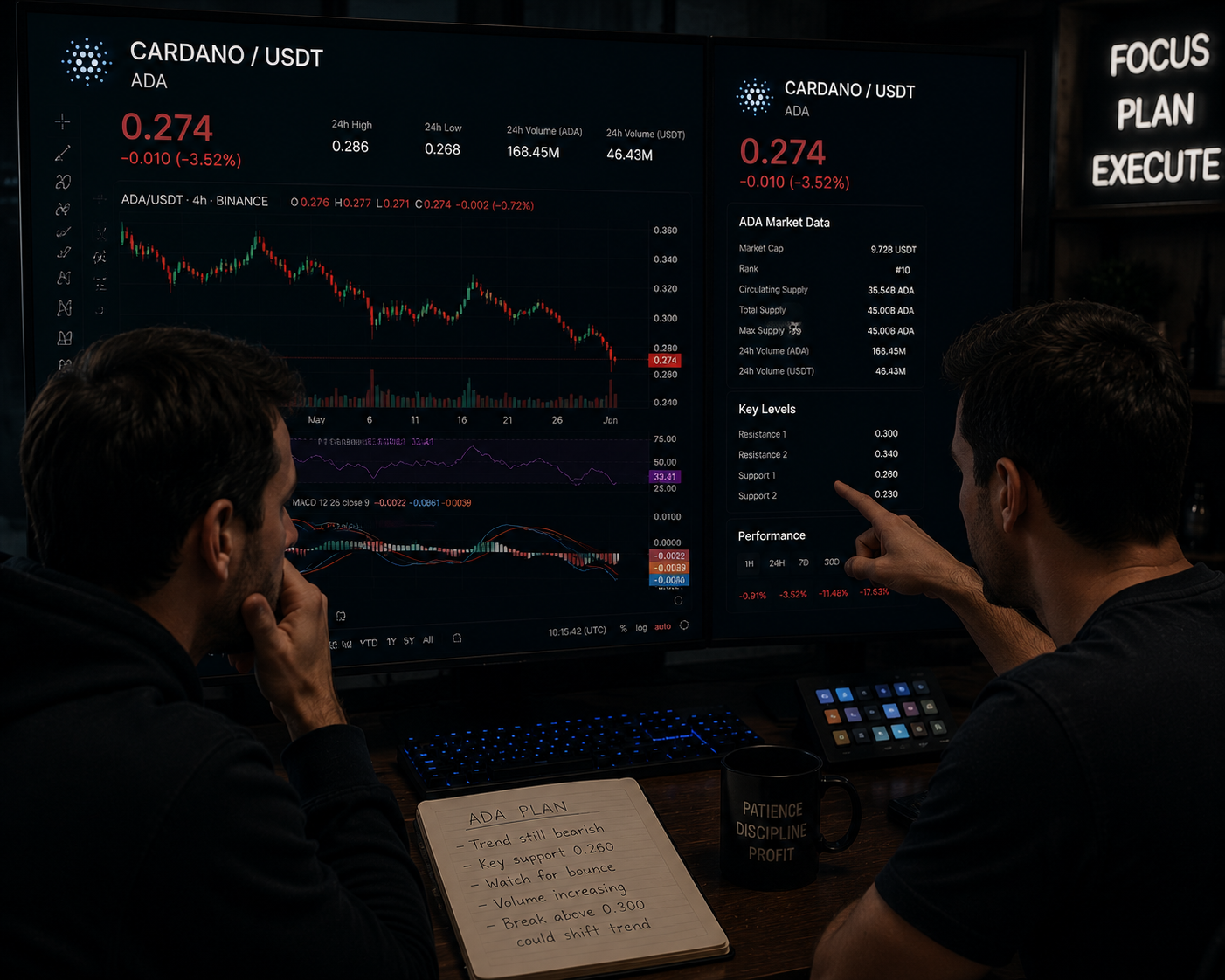

Key takeaways
- Cardano (ADA) faces losses below $0.2800 after Sunday’s 4% recovery was capped by the 100-day EMA.
- Negative funding rates and a shift in futures market sentiment signal a bearish outlook.
Cardano futures market turns bearish as sentiment shifts
ADA is dpwn 2% in the last 24 hours and could record further losses in the near term. Cardano’s futures market sentiment is shifting to a bearish stance amid a pullback in the spot price this week.
According to CoinGlass data, the ADA futures Open Interest (OI) rose by over 4% in 24 hours, reaching $596.40 million, indicating a buildup of positions as traders prepare for a potential sharp move.
However, the negative funding rate of -0.0018% suggests that fewer traders are willing to take long positions on ADA, pointing to a bearish outlook.
Additionally, the long-to-short ratio stands at 0.7212, showing that active short positions significantly outnumber long positions, further reinforcing the bearish sentiment.
Technical outlook: ADA faces resistance at the 100-day EMA
The ADA/USD 4-hour chart remains bearish and efficient. At the time of writing, Cardano is trading around $0.2743, maintaining a capped tone below the 100-day EMA at $0.2870.
While ADA is holding above the 50-day EMA at $0.2603, the technical structure remains cautious, suggesting that the broader bearish trend could continue if support fails to hold.
The Moving Average Convergence Divergence (MACD) is inching closer to the signal line, with the positive histogram bars contracting. Meanwhile, the Relative Strength Index (RSI) has slipped to 59, indicating that bullish momentum is weakening after an overextended move.
If the rally resumes, immediate resistance is seen at the 100-day EMA near $0.2870, with the longer-term 200-day EMA around $0.3696 acting as the next significant barrier.

However, if the bearish trend persists, the 50-day EMA at $0.2603 offers the first notable layer of support.
A daily candle close below this level could signify that the latest rebound is fading and the broader bearish bias is reasserting itself.
Wells Fargo reported larger positions in Ether exchange-traded funds in the first quarter while reshuffling its Bitcoin ETF holdings across several products, according to its latest Securities and Exchange Commission filing.
The bank said it raised its holdings in Ether (ETH) ETFs, including BlackRock’s iShares Ethereum Trust ETF (ETHA) and the Bitwise Ethereum ETF (ETHW), according to its latest Form 13F filing released on Monday.
ETHA rose 63.5% from about 672,600 shares in Q4 2025 to roughly 1.1 million shares in Q1 2026, while ETHW increased by 37% from about 186,800 to more than 257,000 shares, showing a broad-based increase across Ether-linked funds.
Bitcoin (BTC) ETF exposure, by contrast, showed a more mixed pattern: positions in the iShares Bitcoin Trust ETF (IBIT) were slightly reduced, while Bitwise Bitcoin ETF Trust (BITB) and Grayscale Bitcoin Mini Trust ETF (BTC) holdings increased by roughly 24% and 41%, respectively.
The filing suggests Wells Fargo reported larger Ether ETF positions at quarter-end, even as its Bitcoin ETF exposure was more mixed.
Accumulation amid ETH price dip
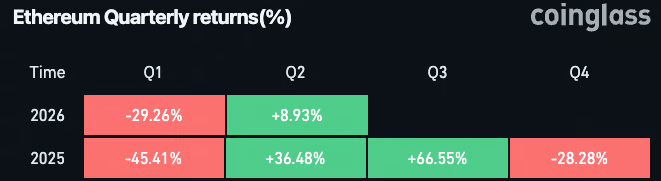
Wells Fargo’s Ether ETF accumulation came during a period of weakening spot prices. According to CoinGlass data, Ethereum posted two consecutive quarterly declines, falling around 28% in Q4 2025 and 29% in Q1 2026.
Over the same period, spot Ether ETFs saw sustained outflows, totaling roughly $769 million across three straight months of withdrawals.

Ethereum quarterly price performance data, 2025–2026. Source: CoinGlass
Despite the broader downturn, Wells Fargo held around $21.5 million in Ether ETFs in Q1 2026, with ETHA as the largest position at $17.6 million.
Bitcoin dominates holdings, equity rotations favor Strategy over Galaxy
Bitcoin ETFs remain the dominant crypto ETF exposure in Wells Fargo’s portfolio, with IBIT making up the bulk of the exposure at roughly $250 million.
In equities, Wells Fargo made a more pronounced shift in crypto-linked holdings. The bank significantly reduced its stake in Michael Novogratz’s Galaxy Digital (GLXY), cutting its position from about 2.5 million shares in Q4 2025 to roughly 78,600 shares in Q1 2026, a decline of nearly 97% and an estimated $54.7 million reduction in exposure.
Related: Galaxy Digital posts $216M Q1 loss as crypto market slides 20%
On the other hand, Wells Fargo significantly increased exposure to Michael Saylor’s Strategy, the world’s largest public Bitcoin holder.
The bank raised its stake from about 322,700 shares in Q4 2025 to roughly 726,000 shares in Q1 2026, a gain of around 403,000 shares, or 125%, and an estimated $41.6 million increase in exposure.
Magazine: Strategy reveals why they would sell BTC, Trump Media posts loss: Hodler’s Digest, May 3 – 9


U.S. inflation data came in hotter than expected on Wednesday, reinforcing expectations that the Federal Reserve will keep interest rates steady at 350-375bps not only at its June 17 meeting, but also likely through the end of the year.
The Consumer Price Index (CPI) year-over-year rose 3.8% in April, according to a report from the Bureau of Labor Statistics. Economists’ forecasts had been for a rise of 3.7% following March’s 3.3% increase.
On a month-over-month basis, CPI rose 0.6%, above expectations of 0.3% and up from March’s 0.2%.
Core CPI, which excludes food and energy costs, rose 0.4% in April versus forecasts of 0.2% and March’s 0.3%. Year-over-year core CPI was higher by 2.8% versus forecasts of 2.7% and March’s 2.6%.
Under pressure this morning, bitcoin traded at $80,700 following the report, down 1.2% over the past 24 hours.
U.S. stock index futures were down across the board, and the 10-year treasury yield came in higher at 4.44%. WTI crude oil is posing a threat to the markets, and is higher by 3% on the day at $101.
Ahead of the CPI data, markets were pricing in a 98% probability that the Federal Reserve would leave interest rates unchanged at its March meeting, according to the CME Fed Watch tool.
Kevin Warsh is set to be confirmed as the next Federal Reserve Chair this week, as he is expected to take over from Jerome Powell on May 15.

Key Takeaways
- On Holding surpassed Q1 projections with sales reaching 831.9 million Swiss francs, representing a 14.5% increase year-over-year
- Adjusted earnings per share reached 0.37 francs compared to analyst expectations of 0.27 francs
- Full-year gross profit margin guidance was elevated to a minimum of 64.5%, versus the previous 63% forecast
- The Asia-Pacific region delivered the strongest performance with 44.4% net sales growth; China recorded high-double-digit expansion
- Founders David Allemann and Caspar Coppetti assumed co-CEO roles, succeeding Martin Hoffmann
On Holding exceeded analyst projections for its first quarter across both top and bottom lines while upgrading its annual profitability forecast. Yet shares reversed an early premarket surge of over 6%, with ONON trading down approximately 3.2% at the most recent check.
Revenue totaled 831.9 million Swiss francs, marking a 14.5% rise from the prior year and representing the company’s first quarter exceeding the 800 million franc milestone. Measured in constant currency, the increase was 26.4%.
Adjusted earnings per share landed at 0.37 francs, comfortably beating the consensus target of 0.27 francs. Reported net income reached 103.3 million francs, almost doubling the 56.7 million francs recorded in Q1 2025.
Direct-to-consumer sales increased 16.4% to 322.3 million francs — though this narrowly missed the 326 million franc projection. Wholesale operations, which generate lower profit margins, expanded 13.3% to 509.6 million francs, exceeding the 499 million franc forecast.
Asia-Pacific Drives Expansion with China Leading the Charge
The Asia-Pacific territory emerged as On’s top-performing market during the quarter, with net sales surging 44.4% to 174 million francs — or 61.4% when adjusted for currency fluctuations. EMEA registered 22.8% growth while the Americas advanced 3.1%, equivalent to 17.1% in constant currency.
China delivered exceptional results. Revenue in the country is expanding at a high-double-digit pace, with apparel now comprising approximately 30% of China’s total sales — significantly higher than the roughly 6% share across the entire company. This performance stands in sharp contrast to Nike’s difficulties in the region, where domestic competitors have been capturing market share.
Co-CEO Caspar Coppetti attributed On’s success to its European heritage, which appeals to Chinese shoppers. “We’re Swiss and so the high quality, the attention to detail, really resonates,” he explained to CNBC.
On’s adjusted EBITDA soared 45.4% to 174.3 million francs. The adjusted EBITDA margin widened to 21.0% from 16.5% in the comparable period.
Full-Year Forecast Upgraded Amid Tariff Questions
For fiscal 2025, On projected revenue of 3.51 billion francs — suggesting constant currency growth of no less than 23%. This figure trailed the 3.54 billion franc analyst consensus slightly.
The athletic footwear and apparel maker increased its gross profit margin target to at least 64.5%, up from the previous 63% estimate. Adjusted EBITDA margin expectations were also lifted to a 19.5%–20% range, exceeding the earlier 18.5%–19% band.
On’s financial guidance still incorporates assumptions around a 20% tariff on Vietnamese imports, despite a recent U.S. Supreme Court decision that effectively eliminated that levy. The company has filed for a refund but maintains the situation remains uncertain. Coppetti emphasized that even if tariff relief materializes, the financial effect would be “immaterial.”
Shortly before quarter-end, On revealed a change in its executive leadership. Co-founders David Allemann and Coppetti transitioned into co-CEO positions, replacing Martin Hoffmann, who had served as the company’s principal representative with investors. The firm characterized Hoffmann’s departure as a “planned hiatus.”
ONON shares have declined roughly 27% year to date prior to this earnings announcement.

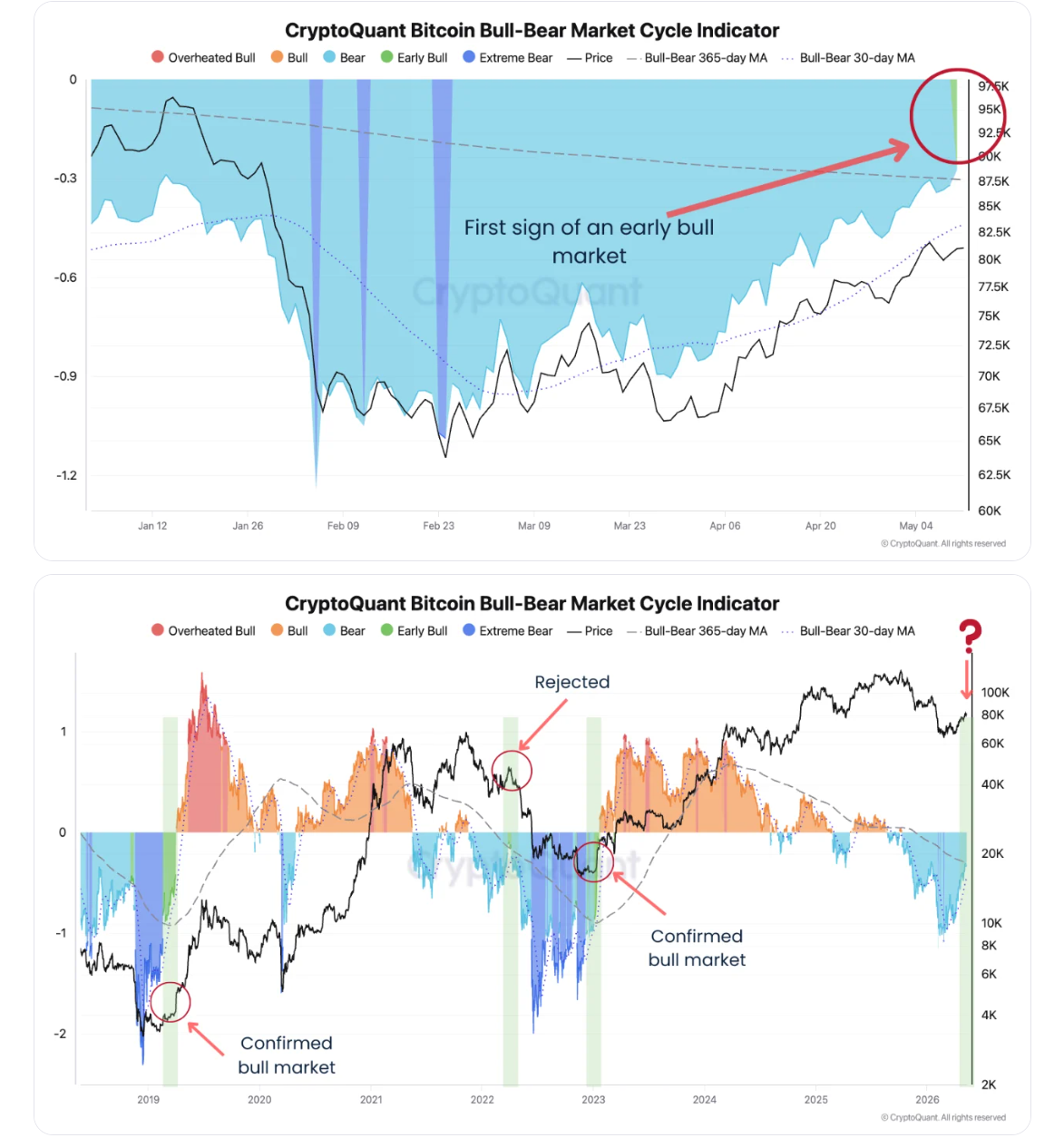
Bitcoin (BTC) just printed its first early-bull reading on CryptoQuant’s Bull-Bear Market Cycle Indicator since March 2023, a regime shift that historically marks recoveries from deep corrections.
The signal arrives as the Bureau of Labor Statistics releases April 2026 Consumer Price Index (CPI) data Tuesday morning, an inflation print that could decide whether BTC follows through or stalls below recent resistance.
Bull-Bear Cycle Indicator Flips After Two-Year Drought
CryptoQuant’s Bull-Bear Market Cycle Indicator moved out of bear territory this week for the first time in roughly 26 months. Similar prints in 2019 and early 2023 preceded sustained recoveries after deep drawdowns.

Both episodes followed long stretches of subdued price action and rising on-chain conviction among long-term holders. The indicator’s 30-day moving average also points to improving momentum beneath the surface.
BTC traded for $80,655 as of this writing, according to BeInCrypto data, down by about 0.6% on the day but holds a roughly 13% gain over the past 30 days.

BTC has also reclaimed the $78,000 zone aligned with the True Market Mean and Short-Term Holder cost basis. That region has historically separated bear and bull phases.
On-chain analyst CheckOnchain said sustained trade above the level usually coincides with stronger market structure and improving sentiment.
Exhaustion Signals Echo a 2022 Trap
The current reading carries one clear historical exception. In March 2022, the same indicator briefly turned green before BTC was rejected and extended its downtrend.
CryptoQuant analyst Moreno flagged that several other metrics are already showing exhaustion. He framed the current reading as less clean than a classic early-cycle confirmation.
In my view, the probabilities slightly lean toward this being a potential local top rather than the beginning of a new bull market, unless price follows through strongly and confirms the move,” Moreno noted.
Joao Wedson of Alphractal raised a related concern. The 30-day change in exchange reserves has flipped from negative to positive. That means more BTC is now moving onto exchanges than off them.
Wedson warned the shift runs counter to the accumulation pattern bulls would expect at a genuine cycle low.
April CPI Becomes the Next Catalyst
The April 2026 inflation release lands ahead of the Wall Street open. Economists’ consensus puts headline CPI near 0.7% month over month and 3.7% year over year.
That would mark an acceleration from March’s 3.3% YoY print, with gasoline and shelter doing most of the work.
A hotter reading would likely revive doubts about near-term Federal Reserve rate cuts and pressure risk assets. A softer print could reinforce the bullish regime shift and support the recent May recovery.
For now, BTC sits between two narratives. Whether the signal extends into a trend or fades like the 2022 example remains open.
The outcome may hinge on how today’s CPI print collides with an exhausted spot market. Traders will watch for follow-through above $82,000 and the True Market Mean for cleaner confirmation.
The post Bitcoin Bull-Bear Cycle Indicator Flashes Green Ahead of April CPI Print appeared first on BeInCrypto.
U.S. President Donald Trump (L) listens as Nvidia CEO Jensen Huang speaks in the Cross Hall of the White House during an event on “Investing in America” on April 30, 2025 in Washington, DC.
Andrew Harnik | Getty Images
BEIJING — Nvidia CEO Jensen Huang said it would be “a great honor” to travel to China with Donald Trump. But he isn’t among the executives joining the U.S. president to meet Chinese President Xi Jinping — a sign the chipmaker’s sales in one of its most important markets are unlikely to recover soon.
Huang has visited China multiple times in the last 18 months, including a high-profile trip last summer, underscoring Nvidia’s efforts to maintain ties in a market that once accounted for at least a fifth of its data center revenue.
But he is absent from Trump’s closely watched visit this week, when more than a dozen U.S. executives will join the president, including chip company Qualcomm’s Cristiano Amon, Tesla’s Elon Musk and Apple’s Tim Cook. Boeing’s Kelly Ortberg is also part of the delegation, as the U.S. planemaker is expected to secure its first major Chinese order in years.
Nvidia’s most advanced chips, widely used for training AI models, have faced tighter U.S. restrictions on China sales over the last four years. The company said in February that U.S.-government-approved versions of the chips had yet to be allowed into China.
The U.S. chipmaker’s China sales are unlikely to recover anytime soon, experts told CNBC.

There would be “very little” for Nvidia to gain in terms of deliverables if Huang joined Trump’s delegation, Hao Hong, chief investment officer at Lotus Asset Management, told CNBC’s Emily Tan on “The China Connection” on Tuesday.
“It’s highly unlikely that the more advanced form of Nvidia chips would be approved by the Trump administration for China to purchase,” Hong said, adding that technology “decoupling” between the U.S. and China is likely to increase.
“I think China realized that the tech rivalry between the two countries will be one of the key determinant factors going forward to determine the relative competitive position in the global geopolitics between the two countries,” Hong said.
Nvidia did not immediately respond to a request for comment from CNBC.
Huang told CNBC’s Jim Cramer last week: “We should let the president announce whatever he decides to announce … If invited, it would be a privilege, it would be a great honor to represent the United States.”
Trump is scheduled to arrive in Beijing late on Wednesday local time for two days of meetings with Xi. It will be the first visit by a sitting U.S. president in nearly a decade.

University of Bristol’s new Temple Quarter campus preparing to open

The battle for the digital euro is heating up as central bankers clash over how to take on Tether

Sinister moves made to criminalise defence of international law

Manchester United reach agreement with Casemiro over contract clause amid transfer speculation

US brings back mandatory military draft registration

Steven Gerrard disagrees with Gary Neville over ‘shock’ Chelsea and Arsenal claim | Football


-
 Crypto World4 days ago
HarrisX Poll Found 52% of Registered Voters Support the CLARITY Act
-

 Fashion4 days ago
Weekend Open Thread: Marianne Dress
-

 Crypto World5 days ago
Upbit adds B3 Korean won pair as Base token gains Korea access
-
 NewsBeat5 days ago
NCP car park operator enters administration putting 340 UK sites at risk of closure
-

 Fashion20 hours ago
Coffee Break: Travel Steam Iron
-

 Fashion1 day ago
What to Know Before Buying a Curling Wand or Curling Iron
-

 Tech2 days ago
Auto Enthusiast Carves Functional Two-Stroke Engine from Solid Metal
-

 Politics15 hours ago
What to expect when you’re expecting a budget
-

 Politics3 days ago
Politics Home Article | Starmer Enters The Danger Zone
-
 Business3 days ago
Ignore market noise, India’s long-term story intact, say D-Street bulls Ramesh Damani and Sunil Singhania
-

 Tech1 day ago
GM Agrees To Pay $12.75 Million To Settle California Lawsuit Over Misuse Of Customers’ Driving Data
-

 Crypto World6 days ago
BlackRock CEO Larry Fink Discusses a New Asset Class
-

 Entertainment5 days ago
Sarah Paulson Called Out For Met Gala ‘Hypocrisy’
-
 Sports6 days ago
NBA playoff winners and losers: Austin Reaves is not loving Lakers vs. Thunder matchup, but Chet Holmgren is
-

 Entertainment6 days ago
Bold and Beautiful Early Spoilers May 11-15: Steffy Revolted & Liam Overjoyed!
-

 Crypto World5 days ago
Robinhood says Wall Street is building onchain
-

 Entertainment5 days ago
General Hospital: Ric & Ava Bombshell – Ric’s Massive Secret Exposed!
-

 Politics5 days ago
Simon Cowell Says He Was ‘Horrible’ To Susan Boyle During BGT Audition
-

 Sports5 days ago
UEFA Champions League final schedule, teams, venue, live time and streaming | Football News
-

 Tech6 days ago
Apple and Samsung are dominating smartphone sales so thoroughly that only one other company makes the top 10
You must be logged in to post a comment Login