

Crypto World
Bitcoin Hitting Resistance After Rally to $76K: CryptoQuant

Bitcoin deposits to crypto exchanges surged on Tuesday as it rallied above $76,000, suggesting it is hitting “near-term selling pressure” as investors move their coins into a position for sale, according to CryptoQuant.
In a report on Wednesday, CryptoQuant said the size and rate of Bitcoin (BTC) inflows to exchanges have increased since the rally, with hourly inflows spiking to 11,000 BTC, the highest since December.
CryptoQuant said it is a “historically reliable warning signal of near-term selling pressure, as holders move coins to exchanges in preparation for potential distribution at key resistance zones.”
It added that the average deposit size also increased to 2.25 BTC, the highest since July 2024, and similar to January, when average deposits peaked at 2 BTC before the price nearly halved from $100,000 to $60,000.
Crypto investors have been hoping for a Bitcoin rally as the war in Iran appears to be de-escalating. However, a large shift of Bitcoin into crypto exchanges could suggest any rally would be short-lived.
TradingView shows Bitcoin hit $76,052 on Coinbase on Tuesday, securing its highest price since early February.
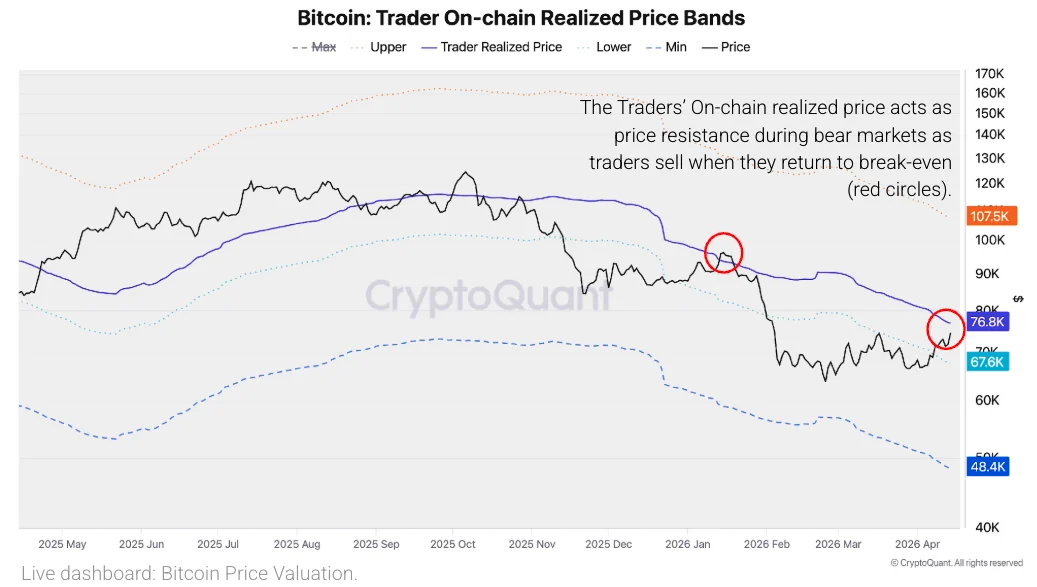
However, CryptoQuant said that as Bitcoin nears its $76,800 realized price, it will act “as a ceiling for relief rallies,” and traders who are nearing breakeven on their holdings will be “incentivized to sell, capping further upside.”
It added that Bitcoin’s rally in January was capped as it hit its realized price at the time, which caused prices to reverse, and “the same dynamic may repeat if selling pressure builds from current levels.”

Related: Ether open interest sees 26% increase as markets rally: Are traders into ETH again?
However, CryptoQuant said that profit-taking is “still in its early stages” as daily realized profits hover at $500 million, below the threshold of $1 billion that has “historically coincided with, or slightly preceded, local price tops.”
Daily realized profits could move above the $1 billion mark if Bitcoin rallies above $76,000 or moves toward the $76,800 realized price, CryptoQuant said, adding that could bring greater selling pressure and increase the likelihood of a stall or reversal.
Magazine: Bitcoin may take 7 years to upgrade to post-quantum — BIP-360 co-author

The second-largest cryptocurrency, which experienced a significant revival in mid-April and at the start of May, has been on a decline over the past week, and some analysts now believe it may plunge further in the near future.
Others remain cautious, arguing that traders should avoid jumping into ETH until it breaks convincingly out of its recent range.
Tread Carefully
As of press time, the asset is trading at around $2,280 (according to CoinGecko), representing a 4% decrease over the past 7 days. The renowned analyst Ali Martinez believes anything between $2,200 and $2,400 falls within a “no-trade zone,” arguing that only a sustained close outside this area will define “the next major move.”
X users Ted and CRYPTOWZARD also issued warning predictions. The former claimed that spot demand is weak and expects ETH to continue to underperform if it stays below $2,400.
CRYPTOWZRD forecasted that moving above the $2.4K resistance might trigger the next upside move, while trading below could lead to more “random movement.”
Certain factors reinforce the bearish scenario. The amount of ETH stored on centralized exchanges has been rising since May 5, recently surging to nearly 15 million coins. This displays that some investors have abandoned self-custody methods and flocked towards centralized platforms, which in turn increases immediate selling pressure.

Moreover, big investors have been reducing their exposure to the asset lately. Last week, Martinez revealed that whales (who owned almost 16 million ETH by October 2026) now hold less than 13 million units. Such a sell-off shows reduced confidence from these market participants, and their actions could trigger panic across the community, potentially prompting smaller players to cash out as well.
The Bullish Signs
Contrary to the pessimistic predictions and elements mentioned above, there are some developments suggesting a notable price resurgence could be on the way.
Earlier this month, Ali Martinez spotted a so-called golden cross on the asset’s chart, a pattern that appeared in the final days of April. The setup is widely viewed as bullish, occurring when the 50-day moving average crosses above the 200-day moving average. Back then, the analyst thought this could pave the way for a rally toward $2,680.
Meanwhile, Tom Lee’s Bitmine Immersion Technologies continues to increase its exposure to the cryptocurrency and now holds 5.21 million ETH. The stash represents roughly 4.3% of the asset’s circulating supply, while its USD equivalent is almost $12 billion.
The post Ethereum (ETH) Sits in a ‘No-Trade Zone:’ Here’s What Will Define the Next Major Move appeared first on CryptoPotato.
Crypto World
The CFTC is in talks with every major pro sports league to crack down on insider trading


Chairman Mike Selig of the U.S. Commodity Futures Trading Commission (CFTC) said his agency is in talks with all major U.S. professional sports leagues as federal regulators deepen oversight of sports-related prediction markets.
The regulator is seeking broader cooperation with leagues to monitor insider trading and market manipulation tied to event contracts, Selig said Tuesday at the annual FINRA conference in Washington D.C. on Tuesday, following an earlier CFTC announcement of a data-sharing agreement with Major League Baseball in March.
“We’ve entered into a memorandum of understanding with Major League Baseball, and we’re in talks with all the professional sports leagues,” Selig said at the event, hosted by the brokerage industry’s self-regulatory organization.
The CFTC agreement with baseball was its first formal information-sharing deal with a professional sports organization. The arrangement comes as federally regulated prediction markets such as Kalshi and Polymarket move deeper into sports contracts, triggering disputes with state gaming regulators over who controls the sector.
Selig took an aggressive stance on that legal fight. He said the CFTC has already sued “about five or six states” over attempts to block federally regulated event contracts and pledged the agency would continue bringing cases against states that challenge the commission’s authority. Under U.S. law, derivatives listed on CFTC-regulated exchanges fall under federal oversight rather than state gaming laws, he’s repeatedly argued.
“Different products, parallel regimes,” he said, comparing sports prediction contracts with traditional casino betting.
The chairman also outlined how the agency is approaching insider trading in prediction markets, an area regulators have only recently begun confronting.
Selig cited a case policed by the platform Kalshi involving YouTube creator MrBeast in which an employee allegedly traded ahead of market-moving information tied to online content releases. He also described hypothetical sports-related scenarios, including trainers or team staff trading on nonpublic injury information before games.
The exchanges themselves remain the “first line of defense,” Selig said, because they conduct know-your-customer and anti-money laundering checks that can help identify suspicious activity.
The CFTC also expects prediction markets to spread into mainstream investment products.
Selig said regulators are reviewing exchange-traded products and funds linked to prediction-market strategies and are coordinating oversight with the Securities and Exchange Commission (SEC). SEC chair Paul Atkins is scheduled to speak at the conference later this afternoon.
Selig’s remarks signal a broader shift at the CFTC under the Trump administration, which has embraced prediction markets and crypto-linked financial products after years of regulatory resistance toward the sector.

Bitcoin (BTC) traded with notable volatility as traders absorbed a key U.S. inflation print ahead of Tuesday’s market open. April’s consumer price index data reinforced the case for sticky inflation pressures, with energy costs acting as the primary driver behind the latest move higher in overall prices.
According to the U.S. Bureau of Labor Statistics, the CPI registered a 3.8% year-over-year rise in April, the highest rate since 2023. The energy index alone rose 3.8% for the month, accounting for a large share of the monthly increase. On a yearly basis, energy prices were up nearly 18%, a circumstance many analysts tie to ongoing supply constraints and geopolitical tensions affecting the oil market. The release also noted declines in several other categories, including new vehicles, communications, and medical care.
Against this macro backdrop, BTC was hovering around $81,000 as risk assets faced renewed headwinds. Traders kept a close eye on technical levels that could shape the near-term trajectory, with the 21-day moving average around $78,800 acting as a near-term benchmark and the 200-day moving average flirting with the upper $80,000s as a key resistance area.
Industry commentary underscored a delicate balance between safe-haven demand and macro headwinds. The broader inflation narrative, coupled with rising energy costs, fed expectations that the Federal Reserve could maintain a restrictive stance longer than some anticipated — a stance that has historically weighed on liquidity in risk assets, including cryptocurrencies.
The latest data from CME Group’s FedWatch Tool showed market participants pricing in rates staying at today’s level through 2026 and into the following year, a scenario that tends to exert pressure on riskier assets during periods of anticipated higher-for-longer rates. In this environment, Bitcoin’s price action remains sensitive to shifts in liquidity and the path of monetary policy, even as some investors view crypto as a hedge or portfolio diversifier in times of macro stress.
Key takeaways
- April CPI rose 3.8% year over year, the highest since 2023, with energy contributing a substantial portion of the monthly increase.
- Energy prices climbed 3.8% in April, contributing to a near-18% year-over-year rise in energy costs and amplifying inflation pressures tied to the oil market and geopolitical dynamics.
- Bitcoin remained around $81,000 as traders weighed macro headwinds against technical support and resistance at key moving averages.
- The 21-day moving average sits near $78,800, seen as a short-term support level, while the 200-day moving average approaches the $82,600 region as a significant resistance hurdle.
- Fed probability tooling suggested rates could stay unchanged through 2026, reinforcing concerns about liquidity headwinds for risk assets, including BTC.
Bitcoin’s momentum under the spotlight: a technical inflection zone
From a technical standpoint, market participants highlighted a confluence of levels that could determine whether BTC sustains a bullish bias or retests support. The 21-day simple moving average (SMA) at roughly $78,800 is viewed by several traders as a short-term pivot point; a break below the nearby $76,000 zone could signal greater near-term vulnerability for bulls trying to defend a base near current levels. The below-peak narrative was echoed by prominent traders monitoring intraday and swing data, who warned that a breach of that critical support area could open the door to a more pronounced move lower.
“The $76K area is a crucial support zone that I fancy not to be breached; if that happens, we’ll be going substantially lower.”
On the upside, Bitcoin faces a substantial overhang near the 200-day moving average, which analyst commentary places around $82,600. Some trading desks have described the current setup as an ongoing attempt by bulls to establish a reliable support-and-resistance flip around the $80.7k region — a move that would bolster confidence for another push toward the longer-term trend line. A number of traders underscored the risk that, without sustained momentum, the price could struggle to break through the 200-day SMA and instead consolidate near the mid-$80,000s or lean toward the lower end of the range.
“The 200-Day SMA near $82,600 is a real test for bulls. Without a convincing breakout, we could see a more measured pullback before any renewed attempt,”
Analytical notes from Market-structure researchers highlighted a delicate balance between bullish posture and the risk of a renewed pullback. One observer summarized the scene by noting that while the market has attempted to establish a higher base around the $80,000s, the lack of a decisive close above the 200-day average could keep BTC tethered to a tighter range in the near term.
Macro backdrop and the reward-risk calculus for traders
The inflation data arrived amid a political and energy backdrop that continues to influence macro markets. The April CPI print showed an energy component that has proven resilient, a dynamic some analysts attribute to ongoing geopolitical frictions and supply constraints. The energy-driven inflation impulse has implications for both the macro outlook and crypto markets, where liquidity can contract when policymakers signal a higher-for-longer rate regime.
In terms of policy expectations, markets have largely priced in a steady rate path through the near term. The FedWatch Tool’s current read suggests the Federal Reserve is not expected to cut rates in the near future and may hold policy steady through 2026, with the implied path stretching into the following year. The implication for crypto traders is twofold: liquidity tends to tighten when rate hikes are anticipated, and any shift in policy expectations can quickly alter risk appetite across digital asset markets.
Beyond monetary policy, the inflation story remains tethered to energy prices and geopolitical risks that influence oil supply. An elevated energy backdrop can sustain upward pressure on general prices, even as some components of the CPI cooled in April. The energy story, frequently cited by analysts, includes references to an oil-market supply squeeze that has historically fed into broad inflation metrics and, by extension, market sentiment around risk assets, including BTC.
On the crypto analytics side, traders still watch the interaction between macro signals and on-chain dynamics. While some market participants point to Bitcoin’s relative strength during periods of inflationary pressure, others warn that a sustained policy regime that keeps liquidity tight could cap upside momentum in the near term. The balance remains delicate: macro resilience can support demand for value storage narratives, while liquidity constraints and higher-for-longer rates might restrain rapid upside moves until new catalysts emerge.
What to watch next in Bitcoin and the macro setup
Market observers will be watching whether Bitcoin can sustain a bid above the approaching 200-day average or whether bulls must reassert footing at lower levels. The interplay between inflation data, energy costs, and policy expectations will shape the path of least resistance for BTC in the coming weeks. As traders weigh risk versus reward in a liquidity-constrained environment, any shifts in the Fed outlook or energy markets could reintroduce sharper moves for Bitcoin and other risk assets.
For readers keeping score, the next set of inflation readings, policy guidance from central banks, and energy-market developments will be critical to interpreting BTC’s short- and medium-term trajectory. In particular, investors will want to monitor whether the market’s pricing for rate paths remains anchored to a longer-dated, steady policy stance or if a renewed shift in expectations creates the conditions for a more decisive move in BTC’s price.
Next up, the market will continue to parse the evolving inflation narrative, the implications of the Fed’s policy stance, and how energy costs influence consumer prices. If energy-driven inflation cools or policy remains restrictive while liquidity conditions loosen, BTC could demonstrate greater resilience. Conversely, a renewed bout of rate hikes or a sharper squeeze in liquidity could test support near the current range and drive attention back toward the traditional gauges of momentum in the crypto space.
References to the evolving data points and opinions, such as the commentary from The Kobeissi Letter and the technical observations from Michaël van de Poppe, illustrate the spectrum of risk signals traders weigh as they navigate the crossroads of macro policy, energy markets, and crypto pricing.
As one of the more scrutinized cross-currents in markets today, Bitcoin’s trajectory remains tethered to the broader macro regime. Investors should stay alert to any shifts in rate expectations, energy-market dynamics, or geopolitical developments that could tilt the balance of risk appetite in favor of or against crypto assets in the near term.
In case you want to trace the data points mentioned above, the official CPI release is available from the U.S. Bureau of Labor Statistics at the official news release, and market-implied rate paths can be reviewed via the FedWatch Tool. For price action context, traders referenced the BTCUSD chart on TradingView, while notable technical commentary cited the Michaël van de Poppe and the Material Indicators notes. The inflation-linked context also references energy-market reporting tied to the oil-supply environment described in oil-supply dynamics.

This is a must-see event now at this point in Canadian sporting events history. The Vanier Cup is becoming less specialized. The number of people watching it is increasing, and the crowd gets louder each year. If you don’t know about it yet, it’s time to jump aboard and be part of the shift from the beginning.
A Faster, More Watchable Version of University Football
Vanier Cup games feel faster now, and that shift didn’t happen by chance. Teams move the ball more quickly and attack space without hesitation. Watching it live, or even tracking moments on Mel Bet, makes that tempo even more obvious in real time. Coaches trust modern systems and push decisions that match today’s aggressive football logic. You rarely see passive plans anymore, especially when the game is on the line.
The broadcasting side of things has greatly improved since the days of lower-quality broadcasts. Games are easier to understand and appeal to new fans of university football. The cameras show cleaner images, there is better commentary, and tighter editing to help new fans experience the excitement of live action.
Why More Fans Are Paying Attention
The growth is not random; it comes from clear changes across the board. Audiences respond when the product improves and becomes easier to access. Several factors are driving this shift:
- Increased media coverage across digital platforms and short-form content
- Stronger rivalries that create real stakes beyond a single game
- Better player development that raises overall match quality
- Easier streaming access for younger audiences
Each element works together, building momentum rather than isolated spikes in interest. Fans stay longer because the experience now feels consistent from kickoff to final whistle.
The Next Layer: Visibility and Identity
The Vanier Cup is no longer hidden behind limited exposure or outdated formats. It is building a recognizable identity that connects with modern sports audiences. That shift shows up in how fans follow games, discuss moments, and track odds through Melbet Canada during key matchups. This evolution creates a stronger connection and pulls more people into the experience.
Players Are Becoming Recognizable Names
University athletes are no longer anonymous figures who disappear after graduation. Some players now build followings during the season, especially through highlight clips and social platforms. Their performances travel faster than ever, reaching audiences beyond traditional broadcasts.
That visibility changes how games are perceived. Fans tune in not just for teams, but for specific players who bring energy and personality. It adds continuity across the season and makes the final feel like a real payoff.
Storylines Now Carry Real Weight
The Vanier Cup benefits from stronger narratives that build throughout the season. Underdog runs, comeback wins, and coaching battles create tension before the final even begins. Those stories give context to every snap during the championship game.
Viewers stay engaged because they understand what is at stake. It is no longer just a title game; it feels like the closing chapter of a larger story. That emotional investment keeps audiences locked in until the end.
A Better Product on and off the Field
The game has clearly gotten better, what surrounds the game (the overall fan experience) is equally important. The visual quality of a stadium show has increased, crowd participation is more intentional, and event management seems more polished. Now, when fans arrive early, they see activities that enhance the pre- and post-game experience.
Additionally, teams are preparing for games more as a professional organization. Teams’ conditioning and use of analytical tools (and their resultant tactical plans) have both improved; these improvements are reflected in tighter play and fewer careless sequences at crucial times in the game.
The Momentum Is Real and Hard to Ignore
Vanier Cup is creating a consistent foundation, not a one-time spike in awareness or interest. Every year adds new fans who will continue to follow U Sports Football if the product continues to deliver on its promise. As long as this trend continues, there will be less difference between university and mainstream football. Miss this opportunity now, and you’ll be trying to catch up later.
Disclaimer: This is a Press Release provided by a third party who is responsible for the content. Please conduct your own research before taking any action based on the content.

Hantavirus is making global headlines in 2026. The outbreak appears contained, but the worst-case question still hangs over already fragile markets.
With war, sticky inflation, and an oil shock already in play, the macro setup looks quite different from what it did six years ago.
Why Markets Are Watching The Hantavirus
As of May 8, 2026, the hantavirus outbreak aboard the MV Hondius has resulted in eight reported cases, including three deaths, two confirmed and one probable, according to the World Health Organization.
The BBC reported that today, Spain has begun evacuating passengers from the cruise ship anchored near Tenerife in the Canary Islands.
Follow us on X to get the latest news as it happens
The US Centers for Disease Control and Prevention reports that hantavirus pulmonary syndrome carries a mortality rate of nearly 38% among patients who develop respiratory symptoms.
The recent deaths have heightened concerns, although the WHO said it does not expect the outbreak to escalate into a large-scale epidemic similar to COVID-19.
Still, investors remain cautious as the current macroeconomic backdrop is significantly more fragile than it was in early 2020.
The ongoing US-Iran war has already unsettled global markets. The International Monetary Fund cut its 2026 global growth forecast to 3.1% in April, citing the conflict and the closure of the Strait of Hormuz.
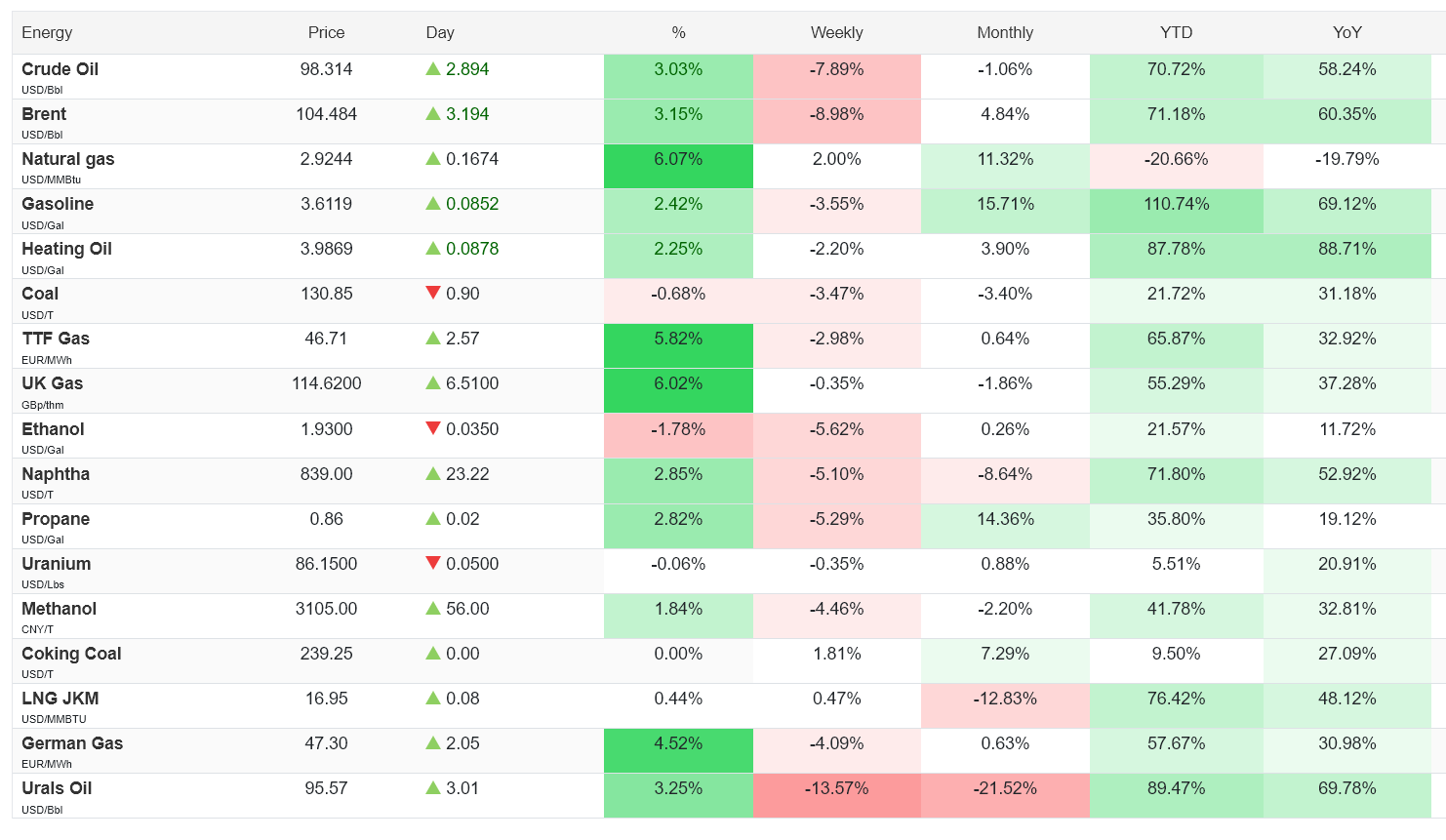
Brent crude trades near $100 per barrel after spiking above $116 during the conflict. Hormuz disruptions have also revived worries about fertilizer and food shortages across import-reliant economies.
At the same time, US headline inflation rose to 3.3% in March 2026. This is quite higher than 2.3% in February 2020, before the WHO officially characterized COVID-19 as a pandemic in March.

How BTC and Stocks Could Move If the Outbreak Worsens
Bitcoin and US equities have staged strong recoveries after sharp earlier declines. Bitcoin has gained roughly 22% since February 28. The S&P 500 rebounded from its March sell-off and closed at a fresh all-time high of 7,365 on Friday.
So far, the ongoing US-Iran conflict has largely acted as a tailwind for risk assets. However, a broader potential health crisis could challenge that momentum.
Markets still remember the reaction during the onset of COVID-19. The S&P 500 plunged 34% in just 35 days, falling from 3,386 in February 2020 to 2,237 by March 23.
Bitcoin also suffered a sharp sell-off. It lost more than 50% of its value within 2 days after the WHO declared COVID-19 a pandemic.
This time, markets are facing a far more complicated backdrop. As a result, any signs of a worsening outbreak could trigger a broad risk-off move across equities and cryptocurrencies.
Oil markets are also in focus. During the COVID-19 crash in 2020, collapsing demand sent US oil prices into negative territory for the first time in history. The current environment is very different.
Markets are already grappling with supply shortages linked to disruptions around Hormuz. If economic activity weakens because of a health scare, reduced demand could partially ease pressure on oil prices, though volatility would likely remain elevated.
Precious metals have also seen increased turbulence in 2026. Since the US-Israeli strikes on Iran, gold has declined more than 12%, while silver has lost over 9%.
During the COVID-19 shock in 2020, gold initially sold off alongside broader markets in March before rebounding and eventually reaching record highs. Silver also recovered sharply after its March collapse, climbing to a seven-year high by July 2020.
The same recovery pattern may not play out as easily this time. During the COVID-19 crisis, markets eventually rebounded on stimulus.
In 2026, however, policymakers have far less flexibility. If the outbreak were to worsen, the initial reaction across Bitcoin, stocks, and commodities could be far more volatile, driven by panic, liquidity concerns, and a flight away from risk assets.
Thus, while the Hantavirus cluster remains contained, the comparison with 2020 is sobering. Inflation, oil prices, and equity valuations all sit higher today, and policy room is thinner.
Any new health shock would meet a system already stretched, not one ready to absorb another stimulus wave.
Subscribe to our YouTube channel to watch leaders and journalists provide expert insights
The post How Will a Hantavirus Pandemic Scenario Impact Global Economies in 2026? appeared first on BeInCrypto.
Crypto World
Paybis Adds PayPal to US Checkout as Crypto Platforms Shift Focus Toward Mainstream Accessibility

Paybis has announced the integration of PayPal as a payment option for eligible customers in the United States, marking another step toward simplifying crypto onboarding for mainstream users. The Latvia-based crypto platform, which serves more than 6.9 million users globally, believes familiar payment methods may be one of the missing pieces preventing wider cryptocurrency adoption.
The new integration allows American users to purchase cryptocurrencies through PayPal directly on Paybis, using a payment brand already widely recognized across online commerce. According to the company, the move is designed to reduce friction during the checkout process, particularly for first-time buyers who may hesitate when asked to enter payment details into unfamiliar crypto platforms.
In an interview with Crypto Breaking News, Paybis co-founder and CEO Innokenty Isers explained why payment familiarity remains a critical issue for crypto adoption in the United States.
“The US has trained its consumers to pay through a handful of brands, such as PayPal, Venmo, and Apple Pay. People put their card details into those and not much else. Anything outside that list asks them to extend trust they haven’t given yet, and that hesitation is usually enough to lose the sale.”
According to Isers, the challenge becomes even greater in crypto because users are simultaneously evaluating both the asset and the platform itself.
“Crypto adds another layer to that decision. The buyer is judging the asset and the platform at the same time, and an unfamiliar payment method on top of that creates too many unknowns at once.”
Paybis argues that integrating PayPal can significantly reduce those concerns by allowing users to complete transactions inside an ecosystem they already trust. The company also highlighted PayPal’s global reach, with more than 439 million active accounts worldwide, alongside internal data showing that checkout conversion rates can increase by approximately 33% when PayPal is offered as a payment option.
Isers noted that for first-time crypto buyers, privacy and trust are often more important than trading tools or token selection.
“For a first-time crypto buyer, the biggest thing PayPal does is keep their card details out of a platform they’ve never used. They pay inside an account they already manage, and the crypto exchange only sees that the payment cleared.”
He also pointed out that banks frequently flag or reject first-time crypto card transactions due to fraud detection systems, creating additional friction for new users.
“With PayPal in the flow, the bank reviews a charge to a company it has been clearing for years, and the whole problem disappears.”
The broader strategy reflects a growing trend within the crypto industry, where companies are increasingly prioritizing user experience and accessibility over advanced trading functionality.
Asked whether the next wave of adoption will be driven more by user experience than trading features, Isers responded:
“In five years, most people who own crypto won’t think of themselves as crypto users. They’ll just have an app that holds some money for them, the same way they have an app that holds their movies or their music.”
He added that future crypto products will likely operate in the background without users even realizing blockchain infrastructure is involved.
“The next phase will be products where crypto is doing work the user can’t see. Think of a savings app where the yield comes from stablecoin lending, or a remittance app that settles on-chain in the background.”
The Paybis CEO also emphasized the growing importance of trusted consumer brands in driving mainstream conversion rates.
“Cash App, Robinhood, and PayPal have brought millions of Americans into crypto for the first time, even though their crypto features are basic compared to a real exchange. The trust those brands already had with users carried the conversion.”
According to the company, purchases through PayPal on Paybis can range from as little as $5 up to $1 million for eligible transactions, allowing both first-time buyers and larger investors to access the platform.
Looking ahead, Isers believes stablecoins and simplified fiat on-ramps will become the primary gateway for onboarding the next generation of crypto users.
“Stablecoins are the easiest part of crypto to understand. They behave like a dollar, don’t crash overnight, and can sit in a wallet without anyone watching the market.”
He added that major payment companies are already treating stablecoins as part of the future financial infrastructure.
“PayPal launched its own stablecoin in 2023, Stripe re-entered crypto last year specifically to support stablecoin payments, and Visa has been settling card transactions in USDC since 2021.”
The PayPal integration is now available for eligible US Paybis customers as the company continues expanding its global payment infrastructure and crypto onboarding services.

Key Highlights
- Major labor organizations caution that cryptocurrency legislation may jeopardize pension security.
- Upcoming Senate vote draws opposition from unions, financial institutions, and regulatory advocates.
- Retirement fund protection emerges as central issue in cryptocurrency policy debate.
- Stablecoin compensation provisions create additional controversy ahead of committee action.
- Labor coalition demands senators vote against legislation citing retirement account vulnerabilities.
A coalition of prominent labor organizations has launched a campaign against pending cryptocurrency legislation ahead of Thursday’s Senate Banking Committee decision. The unions contend that expanded digital currency regulations could leave worker retirement accounts vulnerable to cryptocurrency market instability. This opposition intensifies existing divisions among legislators already grappling with security questions, ethical considerations, and stablecoin governance.
Union Coalition Mobilizes Against Pending Legislation
Five major labor organizations—AFL-CIO, SEIU, AFT, NEA, and AFSCME—have called upon senators to reject the proposed legislation. Their primary focus involves protecting pension programs, public retirement systems, and savings vehicles that serve working Americans. The coalition insists on enhanced protective measures before lawmakers authorize broader cryptocurrency integration into mainstream finance.
These organizations contend the Crypto Bill would transfer market instability risks onto employees and pensioners. According to their analysis, cryptocurrency enterprises would gain expanded market entry while ordinary households shoulder potential financial damage. The groups emphasize that insufficient regulatory oversight could leave retirement portfolios increasingly exposed to volatile digital assets.
The Senate Banking Committee has scheduled its preliminary vote for Thursday following extended negotiations. Republican lawmakers have advocated for more defined market frameworks, whereas certain Democratic members continue pressing for enhanced safeguards. Yet the legislation’s final language remained unsettled as mounting pressure arrived from both labor and financial sector representatives.
Stablecoin Compensation Provisions Spark Additional Controversy
The proposed cryptocurrency legislation also encounters banking sector resistance regarding stablecoin reward mechanisms. Financial institutions contend that digital currency platforms could employ yield-similar incentives to attract deposits away from traditional banks. These institutions express concern that such provisions might erode deposit foundations and generate systemic stability risks.
Cryptocurrency industry representatives dispute these objections, noting that amended language would prohibit direct yield distributions. They maintain that activity-driven rewards differ fundamentally from conventional bank interest and advance payment system innovation. Nevertheless, this disagreement has positioned stablecoin governance among the legislation’s most contentious elements.
The proposed legislation seeks to establish more definitive frameworks for digital asset markets and payment tokens. Proponents argue that federal standardization could eliminate regulatory ambiguities and enable supervised industry development. Critics counter that Congress should not broaden cryptocurrency access without substantially stronger consumer and pension protections.
Retirement Security Takes Center Stage in Policy Debate
Labor organizations have reframed the cryptocurrency legislation as fundamentally a workplace and retirement security matter rather than purely market regulation. Their advocacy effort could sway Democratic legislators who depend on union backing during significant policy decisions. Additionally, it provides hesitant lawmakers additional justification to demand more rigorous amendments.
The AFL-CIO informed committee members that inadequate regulations could embed digital assets more deeply throughout the financial system. The federation further cautioned that platform operators and token issuers may gain disproportionate advantages over workers. This messaging reflects broader labor movement concerns regarding volatility, savings protection, and public pension fund exposure.
The cryptocurrency legislation now approaches Thursday’s committee vote facing intensifying pressure from multiple constituencies. Banking organizations seek strengthened restrictions, while labor unions demand clearer protections surrounding retirement accounts. Concurrently, cryptocurrency industry advocates maintain pressure on lawmakers to establish comprehensive federal regulation.
XRP exchange-traded funds (ETF) drummed up their biggest inflows since January amid a slew of developments at related company Ripple and favorable price action for the world’s fourth-largest token by market capitalization.
The five U.S.-listed spot XRP exchange-traded funds reported a combined $25.8 million in net inflows on Monday, the largest single-day haul since Jan. 5, when they drew $46 million in their first week of trading, according to SoSoValue data.
Franklin Templeton’s XRPZ led with $13.6 million, followed by Bitwise’s XRP at $7.6 million and Grayscale’s GXRP at $4.6 million. Canary’s XRPC and 21Shares’ TOXR reported no flows for the day.
Cumulative net inflows across all XRP spot ETFs now sit at $1.35 billion, with total net assets at $1.18 billion, representing about 1.3% of XRP’s market cap. Every XRP fund rose more than 4% on Monday alongside the underlying token, which climbed 1.2% over 24 hours to $1.47.
The flows come as Ripple announced the successful closing of a $200 million debt facility from funds managed by Neuberger Specialty Finance, the dedicated asset-based investment team within Neuberger, a global investment management firm.
The facility will support the continued growth of Ripple’s multi-asset prime brokerage platform, Ripple Prime, amid rising client demand for institutional-grade prime services and margin financing solutions.
Last week, Ripple said it completed a pilot tokenized U.S. Treasury settlement on the XRP Ledger with JPMorgan, Mastercard, and Ondo Finance, processing the redemption in under five seconds and bridging public blockchain rails with traditional interbank settlement infrastructure.
Separately, Ripple unveiled a four-phase plan to make the XRP Ledger quantum-resistant by 2028, positioning it for a potential “Q-day” when quantum computers can break current cryptography.
The roadmap included an emergency “Q-day readiness” phase that would force a migration to quantum-safe accounts and enable fund recovery using zero-knowledge proofs if quantum threats arrive sooner than expected.
Such institutional use cases may boost sentiment among ETF buyers, because they give XRP a function beyond speculative trading.
Meanwhile, spot bitcoin ETFs are on track for their seventh consecutive week of net inflows, with over $3.4 billion absorbed during the streak. The pattern of bitcoin leading, altcoin ETFs catching the spillover, and ether lagging behind has held through most of the year.
XRP remains down 39% over the past six months despite the ETF interest, with the token still well off its July 2025 all-time high near $3.65.


The developer of Claude has updated its terms of service, warning against the third-party sale or transfer of its private equity.

TLDR
- Pulse Biosciences (PLSE) shares climbed 16.8% Tuesday following a $13.3 million stock acquisition by two key executives.
- Co-Chairman Robert Duggan acquired 660,233 shares totaling approximately $13 million, while CEO Paul LaViolette purchased 15,000 shares for roughly $295,000.
- Both transactions occurred through the company’s at-the-market equity program during an approved trading period.
- The company specializes in nPulse nanosecond pulsed field ablation technology for atrial fibrillation treatment.
- Year-to-date performance shows PLSE shares climbing nearly 39%, with the company valued at $1.3 billion.
Shares of Pulse Biosciences (PLSE) rallied 16.8% Tuesday following the announcement that two top-level executives purchased a combined $13.3 million worth of company stock.
The transactions, executed by Co-Chairman Robert Duggan and CEO Paul LaViolette on May 11, 2026, took place during an authorized trading window established by the company.
At press time, shares were trading approximately 13% higher, pushing the year-to-date advance to around 39%.
Duggan dominated the buying activity, securing 660,233 shares for about $13 million. LaViolette contributed by acquiring 15,000 shares valued at approximately $295,350.
Collectively, the executives obtained 675,233 shares via Pulse Biosciences’ at-the-market offering program.
The ATM mechanism allows the company to issue shares directly into public markets. When executives use this avenue to purchase rather than the company to sell, it typically signals strong internal conviction about future prospects.
What Makes This Insider Activity Noteworthy
Insider acquisitions of this magnitude are uncommon. When two senior leaders collectively invest $13.3 million, markets typically pay attention — and respond accordingly.
The timing follows closely behind the company’s Q1 earnings release and new clinical data regarding its nPulse catheter technology.
Wall Street reactions to those developments were split. Some analysts highlighted encouraging clinical performance in European markets and accelerated U.S. pivotal trial schedules. Others pointed to negligible revenue generation, expanding losses, and significant cash consumption.
Despite generating limited commercial sales, Pulse Biosciences commands a $1.3 billion market capitalization.
Understanding PLSE’s Core Business
The company’s flagship technology leverages nanosecond pulsed field ablation — administering extremely brief electrical pulses to eliminate targeted cells while preserving adjacent tissue structures.
Its main therapeutic focus addresses atrial fibrillation, a widespread cardiac rhythm abnormality.
Management has prioritized expediting its U.S. regulatory pathway, with European feasibility trial results serving as an encouraging indicator according to industry analysts.
Daily trading volume for PLSE averages approximately 294,600 shares. Current technical analysis indicators signal a “Strong Buy” rating.
TipRanks’ AI model assigns PLSE a Neutral rating overall, noting that financial weaknesses are counterbalanced by a healthy balance sheet and promising clinical development pipeline.
With a year-to-date gain approaching 39%, the stock significantly outperforms broader market indices as 2026 reaches its midpoint.

Queen Camilla teams up with Kate Middleton’s brother to honour life-saving dogs

Jon Moulton backs biotech firm Infex Therapeutics tackling ‘critical global threat’ of antibiotic resistance
Ethereum (ETH) Sits in a ‘No-Trade Zone:’ Here’s What Will Define the Next Major Move

Manchester United reach agreement with Casemiro over contract clause amid transfer speculation

US brings back mandatory military draft registration

Steven Gerrard disagrees with Gary Neville over ‘shock’ Chelsea and Arsenal claim | Football


-
 Crypto World4 days ago
HarrisX Poll Found 52% of Registered Voters Support the CLARITY Act
-

 Fashion4 days ago
Weekend Open Thread: Marianne Dress
-

 Crypto World5 days ago
Upbit adds B3 Korean won pair as Base token gains Korea access
-
 NewsBeat5 days ago
NCP car park operator enters administration putting 340 UK sites at risk of closure
-

 Fashion22 hours ago
Coffee Break: Travel Steam Iron
-

 Fashion2 days ago
What to Know Before Buying a Curling Wand or Curling Iron
-

 Tech2 days ago
Auto Enthusiast Carves Functional Two-Stroke Engine from Solid Metal
-

 Politics17 hours ago
What to expect when you’re expecting a budget
-

 Politics3 days ago
Politics Home Article | Starmer Enters The Danger Zone
-
 Business3 days ago
Ignore market noise, India’s long-term story intact, say D-Street bulls Ramesh Damani and Sunil Singhania
-

 Tech1 day ago
GM Agrees To Pay $12.75 Million To Settle California Lawsuit Over Misuse Of Customers’ Driving Data
-

 Crypto World6 days ago
BlackRock CEO Larry Fink Discusses a New Asset Class
-

 Entertainment5 days ago
Sarah Paulson Called Out For Met Gala ‘Hypocrisy’
-
 Sports6 days ago
NBA playoff winners and losers: Austin Reaves is not loving Lakers vs. Thunder matchup, but Chet Holmgren is
-

 Entertainment6 days ago
Bold and Beautiful Early Spoilers May 11-15: Steffy Revolted & Liam Overjoyed!
-

 Entertainment5 days ago
General Hospital: Ric & Ava Bombshell – Ric’s Massive Secret Exposed!
-

 Crypto World5 days ago
Robinhood says Wall Street is building onchain
-

 Politics5 days ago
Simon Cowell Says He Was ‘Horrible’ To Susan Boyle During BGT Audition
-

 Sports5 days ago
UEFA Champions League final schedule, teams, venue, live time and streaming | Football News
-

 Tech7 days ago
Apple and Samsung are dominating smartphone sales so thoroughly that only one other company makes the top 10
You must be logged in to post a comment Login