

Crypto World
US Reaches $1 Billion Seized Iran Crypto to Date: Bessent’s Big Update



U.S. Treasury Secretary Scott Bessent announced today that America has now seized a cumulative total of approximately $1 billion in Iranian cryptocurrency assets under its escalating sanctions campaign.
Cumulative Total Hits $1 Billion
The figure represents the running total seized to date, not a single new action announced today.
It builds on earlier milestones, including a major April 2026 freeze of $344 million in USDT on the Tron blockchain.
Bessent had previously reported nearly $500 million in late April, with today’s update reflecting additional freezes accumulated since then.
Operation Economic Fury Accelerates
Launched in March 2025, Operation Economic Fury targets Iran’s sanctions-evasion networks. Iran has relied on stablecoins, particularly USDT on Tron, to move funds for oil sales and IRGC operations.
The U.S. works with issuers like Tether and blockchain analytics firms to identify and immobilize wallets.
Bessent noted Iran previously moved $400–500 million per month through crypto channels before intensified pressure.
Assets are held “on behalf of the Iranian people” and some face claims from terrorism victims.
Expect continued OFAC wallet designations and potential forfeitures in coming months. Iran’s economy already grapples with rial devaluation, banking strains, and reduced oil revenue.
This cumulative milestone marks a significant escalation in financial warfare, showing how traceable blockchain activity can be weaponized against sanctions evasion.
The post US Reaches $1 Billion Seized Iran Crypto to Date: Bessent’s Big Update appeared first on BeInCrypto.

Crypto World
Grayscale eyes $115m HYPE seed deal for Hyperliquid staking ETF, will HYPE go parabolic?
Grayscale is negotiating a $115 million HYPE-for-shares seed swap for its proposed Hyperliquid staking ETF, in a move that deepens Wall Street’s exposure to on chain derivatives.
Summary
- Grayscale in talks to seed Hyperliquid staking ETF with roughly $115 million in HYPE
- Product would list on Nasdaq under HYPG and stake the underlying tokens
- Deal follows 21Shares’ HYPE ETFs and intensifying competition for Hyperliquid exposure
Grayscale is negotiating with Hyper Holdings Global LP to seed its proposed Hyperliquid ETF with about 2 million HYPE tokens, worth roughly $115 million at current prices, in exchange for fund shares before listing, according to a report from FinanceFeeds.
ChainCatcher, citing the same report, said the asset manager plans to rename the product the “Grayscale Hyperliquid Staking ETF” and list it on Nasdaq under the ticker HYPG, with staking rewards built into the structure rather than offering only spot price exposure.
Grayscale pivots from plain spot HYPE exposure
Grayscale originally filed with the U.S. Securities and Exchange Commission in March for a spot ETF tied to Hyperliquid’s native token, describing a product “designed to track the price of HYPE” that would trade on Nasdaq under the ticker GHYP, with Coinbase Custody as the designated custodian.
At the time, Grayscale’s S 1 said the fund would not stake its HYPE holdings at launch, and instead included a conditional “staking provision” that could be activated later if the trust could still qualify as a grantor trust for U.S. federal tax purposes, language that reappears in the May amendment described.
The latest revision goes further by rebranding the vehicle as the Grayscale Hyperliquid Staking ETF and explicitly allowing the trust to capture protocol rewards from staked HYPE in addition to any price appreciation, provided the SEC signs off on the structure and associated tax treatment.
Grayscale’s negotiations with Hyper Holdings Global LP over the roughly $115 million seed stake would see the fund issue ETF shares to the Hyperliquid entity in exchange for about 2 million HYPE, using those tokens as initial capital before the product begins trading.
Hyperliquid’s ETF land grab and HYPE market backdrop
The proposed HYPG fund would join a fast crowd of Hyperliquid themed products, coming just weeks after 21Shares launched the first U.S. listed Hyperliquid ETFs, including the 21Shares Hyperliquid ETF under the ticker THYP and a leveraged product trading as TXXH, both tied to HYPE and designed to give investors regulated exposure to the derivatives focused network, according to a statement cited by crypto.news.
21Shares said THYP would “integrate staking rewards tied to its HYPE holdings,” committing to stake a substantial portion of the fund’s assets, a design that Grayscale now appears intent on mirroring by turning its own vehicle into a staking ETF rather than a plain spot tracker.
Hyperliquid’s native token has been one of the cycle’s standout performers, recently hitting an all time high of just over $62 and trading near the low $60s this month, with a market capitalization in the mid ten figure range, according to a May market update from Binance Square and live data on the HYPE price page.
In parallel, on chain activity has intensified around HYPE, with large holders including Galaxy Digital and Loracle repeatedly staking and unstaking eight figure dollar amounts of tokens in recent days, according to a series of network data snapshots, underscoring how ETF issuers are inserting themselves into an already crowded capital stack.
Grayscale’s move also lands in a market where Hyperliquid’s role in on chain derivatives markets has become a recurring theme; as one recent crypto.news analysis argued, the platform’s real story lies in its use of HYPE as staking collateral to spin up permissionless perpetual futures markets, with ETF bids arriving as a secondary layer of financialization on top of that core design.
For now, HYPG remains contingent on SEC approval of both the underlying spot HYPE ETF and its staking mechanics, keeping Grayscale in the same regulatory queue as other issuers pursuing Hyperliquid themed products,neven as the firm quietly lines up nine figure token inventory and tries to ensure it is not late to the one derivatives protocol Wall Street has decided to take seriously this cycle.
What does it mean for Hyperliquid price
Grayscale’s $115m HYPE seed talks put real buy pressure under an already rising token, with 24 hour data showing traders are treating the ETF pivot as a fresh upside catalyst.
Over the past 24 hours, Hyperliquid’s HYPE token is trading around $60.99, up roughly 1.05% on the day, with intraday moves between $56.43 and $61.13.
That means the roughly 2 million HYPE Grayscale is negotiating to receive as seed capital for its planned “Grayscale Hyperliquid Staking ETF” represents about $121.98 million at current spot levels and comes against the backdrop of roughly $1.01 billion in 24 hour trading volume, a non trivial chunk of visible liquidity.
Put differently, the seed deal would soak up the equivalent of more than 12% of one day’s trading volume at current prices, if it were executed on market, which helps explain why HYPE is printing positive daily returns while many majors are flat or slightly red.
In practice, most of that inventory will move over via over the counter arrangements between Hyper Holdings Global LP and Grayscale rather than straight through order books, but the economic effect is similar: a large pool of tokens becomes ETF collateral and, once inside the wrapper, is structurally less likely to hit the open market during normal conditions.
That supply overhang relief is landing at a time when HYPE is already sitting just a few dollars below its recent all time high near $64, leaving the token with a still bullish short term profile despite only a modest 24 hour percentage move.
If the SEC ultimately signs off on the HYPG structure and Grayscale completes the $115 million seed, traders will be looking for whether 24 hour volumes stay near the current $1 billion mark or grind higher, since sustained three comma liquidity tends to support higher equilibrium prices for assets that are still supply constrained.
On the flip side, if today’s 1.05% gain turns into a flat or negative 24 hour print while volumes remain elevated, that would be a sign that speculators are fading the ETF headline and using the bounce to derisk into Grayscale’s structural bid, a dynamic you will see first in the daily percentage change and only later in the longer term chart.


Wintermute is moving into prediction markets as institutional market makers race to dominate event contracts that already clear more than $20 billion a month.
Summary
- Wintermute begins two way market making on major prediction platforms
- Monthly prediction market volume above $20 billion as lifetime flows top $150 billion
- Move follows institutional push into Polymarket and Kalshi style event contracts
Wintermute, one of crypto’s largest quantitative market makers, has begun providing continuous two way liquidity on several “leading” prediction market platforms, extending its infrastructure into event contracts that straddle both digital assets and traditional macro themes, according to The Block.
The firm told The Block it has already been streaming bilateral buy and sell quotes across multiple venues, where aggregate monthly prediction market trading volume has climbed past $20 billion in 2026, even as liquidity remains “early stage” by institutional standards.
Wintermute itself executes more than $3.5 trillion in annual trading volume across spot, derivatives and DeFi markets, and the new business line is pitched as a way to extend that cross asset machinery into event contracts ranging from elections and macro data prints to crypto specific flows.
Wintermute’s thesis on event contracts
Jake Ostrovskis, Wintermute’s head of OTC trading, argued that the underlying demand in prediction markets already resembles traditional asset classes, with structurally similar flows but thinner books and wider spreads than blue chip futures or options.
“There is clear demand for these markets, but liquidity is still insufficient,” he told The Block, saying Wintermute’s goal is to post continuous bilateral quotes that tighten spreads, deepen books and make the implied probabilities more usable for traders and institutions.
Ostrovskis added that “tighter spreads and greater trading capacity” should improve the quality of probability signals coming out of venues like Polymarket and Kalshi, turning them into data sources that more closely resemble established derivatives markets rather than exotic side bets.
That narrative tracks with Wintermute Ventures’ broader view that “everything becomes tradeable” as crypto rails turn prediction markets into financial tooling rather than niche gambling, a theme the firm laid out in a 2026 outlook covered by Yahoo Finance.
Polymarket, Kalshi and institutional liquidity
Wintermute is not the first big trading shop to see an opening in event markets.
The Block reports that firms including Jump Trading and Galaxy Digital already provide liquidity to event contracts, as lifetime trading volume on Polymarket and Kalshi has now crossed $150 billion, based on data cited by CoinMarketCap from The Block’s prediction market trackers.
That $150 billion figure covers all historical trades on both platforms, while their combined monthly turnover has cooled slightly from a record run of growth, according to the same report.
On the crypto side, ultra short event contracts tied to bitcoin and ether already dominate flows on Polymarket and Kalshi, with five to 15 minute “up down” bets on BTC and ETH now accounting for more than half of their crypto volume, as previously reported by crypto.
Regulatory risk is mounting alongside that growth: Spain this month ordered ISP level blocks on both Polymarket and Kalshi over unlicensed gambling concerns, the fifth country to move against them in 2026, as detailed in a recent crypto investigation.
Wintermute’s move effectively treats those markets as another derivatives frontier, with stablecoin settlement, on chain clearing and automated risk management that look increasingly like the institutional DeFi stacks the firm is already building through products such as its new Armitage vault platform, reported earlier by Bitcoin.
If Armitage is Wintermute’s bet that DeFi lending should run on institutional style vaults, the push into prediction markets is its wager that event contracts will mature into a derivatives like infrastructure layer rather than remaining a regulatory gray zone casino.
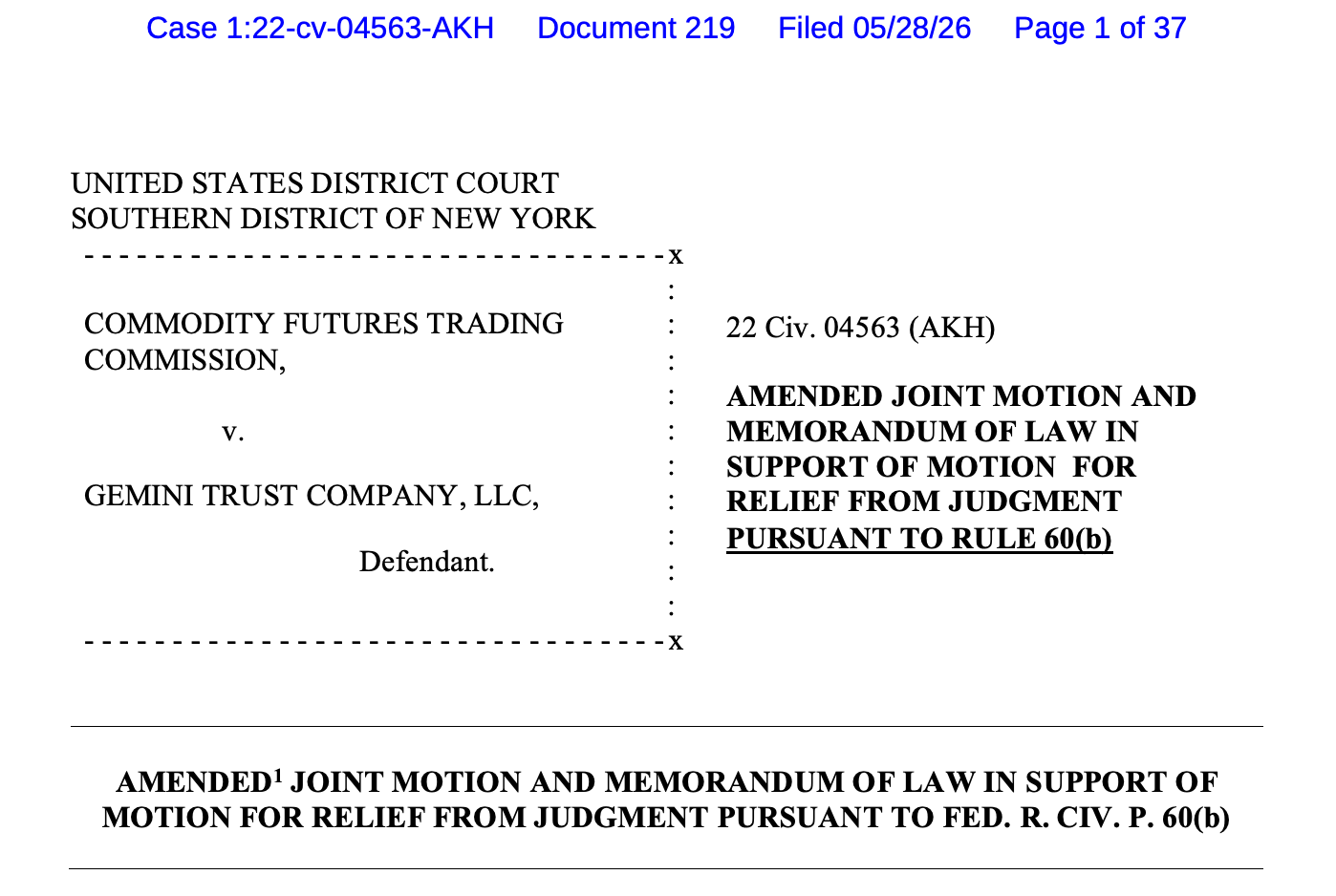
A former chairman of the US Commodity Futures Trading Commission (CFTC) responded to the agency’s move to vacate a $5 million settlement with cryptocurrency company Gemini.
In a Wednesday motion filed in the US District Court for the Southern District of New York, the CFTC joined the Gemini Trust Company in seeking relief from the judgment of a case initially filed in June 2022. The company reached a $5 million settlement with the CFTC in January 2025 while the agency was under former US President Joe Biden.
“[T]he CFTC’s action in reversing itself on a settled case is extraordinarily unusual,” Tim Massad, a former CFTC chair and research fellow at Harvard Kennedy School, told Cointelegraph. “The explanation seems to be that the staff got it wrong, not that the law was unclear.”
According to the CFTC’s motion, the agency sought relief based on claims that a whistleblower was found “not to be credible” and evidence was concealed by the commission’s previous leadership.
The motion alleged that the whistleblower, Gemini’s former chief operating officer, made false statements related to the company’s Bitcoin futures pre-certification review. The CFTC’s complaint against Gemini included allegations that the company reported inflated trading activity and volumes, misrepresenting user demand.
“Based on the CFTC’s comprehensive review, the CFTC concurs that there were significant deficiencies in [the Division of Enforcement’s] evidence and the Complaint should not have been filed,” said the filing.
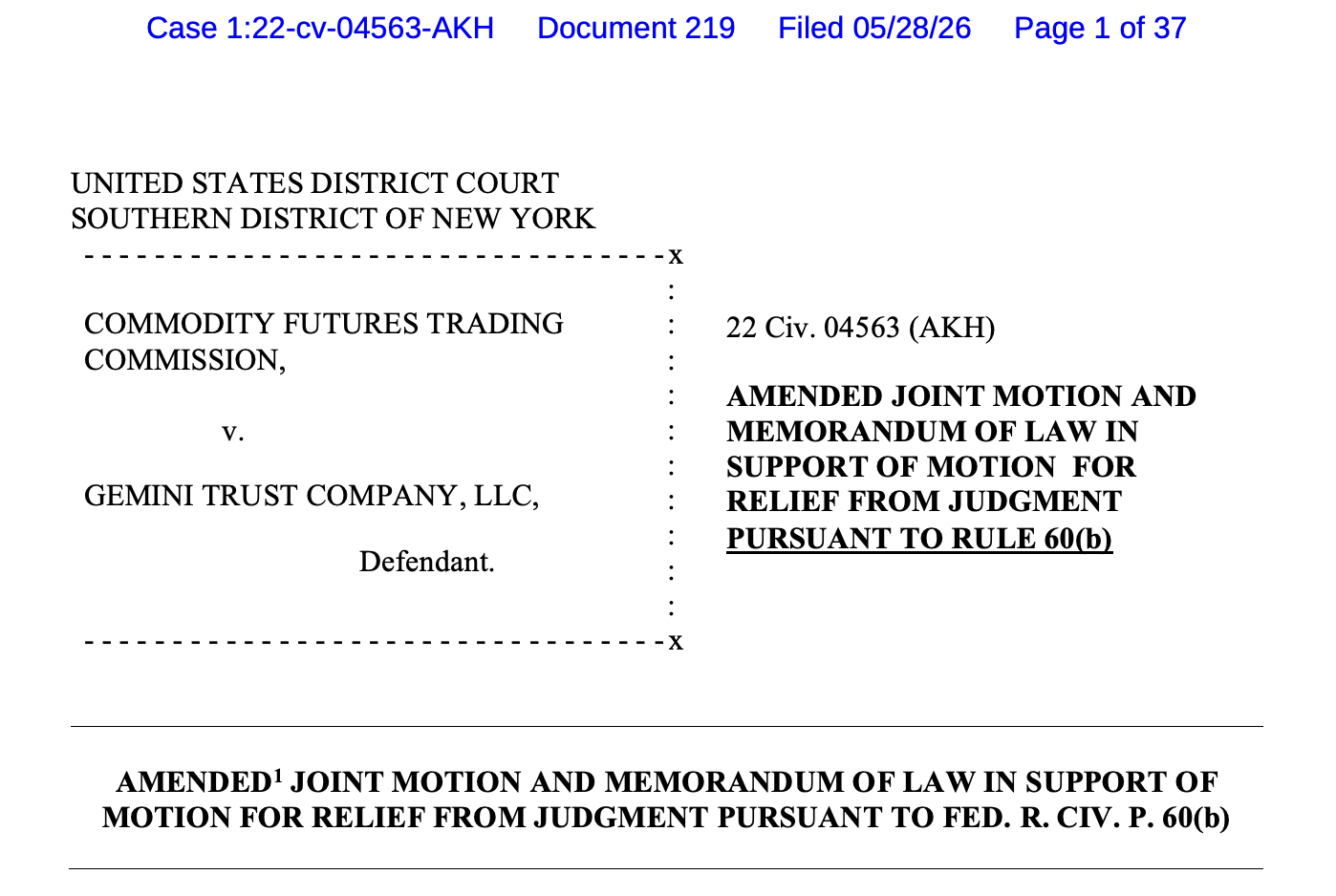
Amended motion by CFTC filed in SDNY on Thursday. Source: PACER
Related: Prediction markets legal battles heat up in Minnesota, Rhode Island
Although the CFTC and Securities and Exchange Commission (SEC) dropped several enforcement actions and investigations into crypto companies after Donald Trump assumed the office of the presidency, there had been no filings on the public docket in Gemini’s case since January 6, 2025.
Massad added:
“I know of nothing like this happening before, and I think the public deserves a better explanation.”
Gemini co-founders tied to the current administration
Tyler and Cameron Winklevoss, co-founders of Gemini, each donated $1 million to Trump’s 2024 election campaign. The two have also met with Trump and attended White House events, including the signing ceremony for the stablecoin-related GENIUS Act.
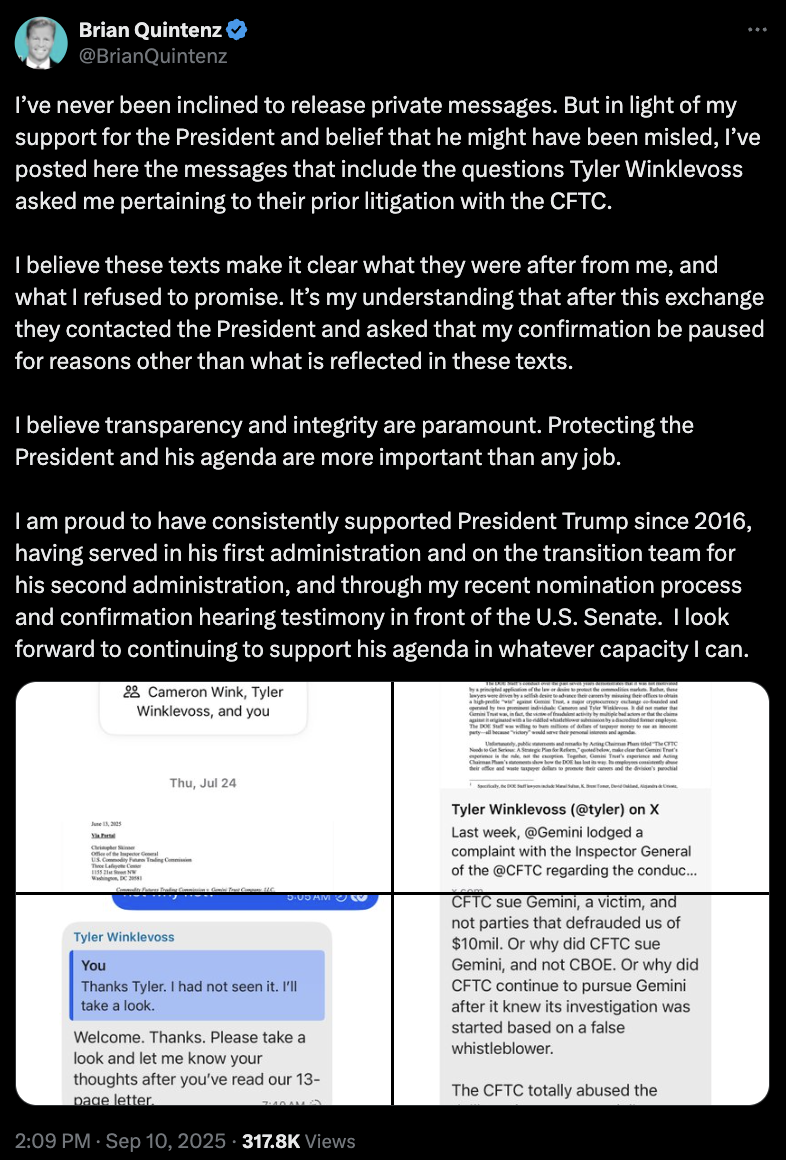
Source: Brian Quintenz
According to a text chain made public in September 2025 by former CFTC commissioner Brian Quintenz, Tyler Winklevoss raised the CFTC’s litigation as Quintenz was set to be considered for Trump’s nomination to head the agency. Trump later withdrew Quintenz’s nomination, leading to his pick, Michael Selig, being confirmed as chair and the agency’s current sole commissioner.
Notably, some of the language in the CFTC’s motion to vacate was similar to that in the Winklevoss text chain, including “abuse” of regulatory authority and “false whistleblower.” Cointelegraph reached out to Gemini for comment but did not receive an immediate response.
Magazine: HYPE chases $100 target, ETH could dump below $1800: Market Moves
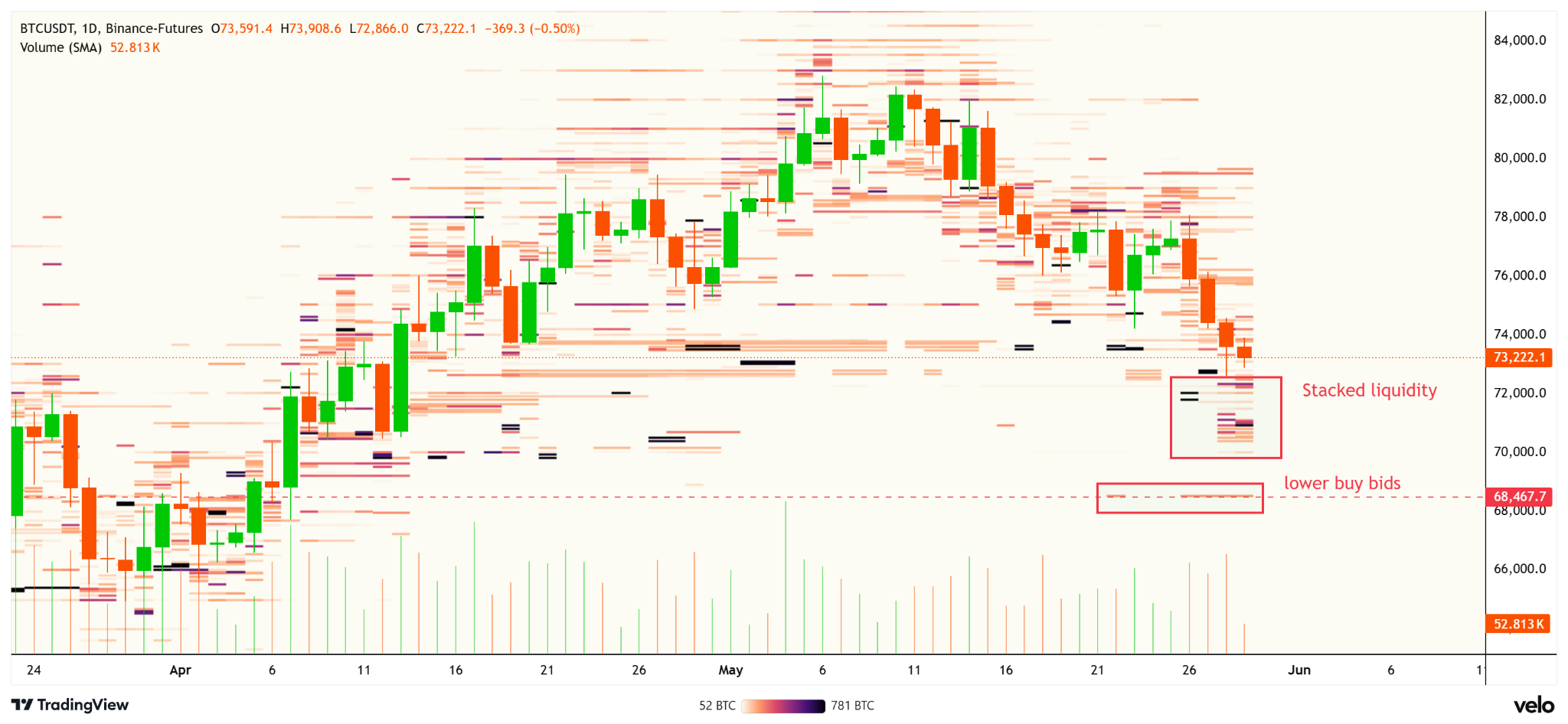
Bitcoin (BTC) traders have placed new buy orders near $70,000 as the price approaches a key liquidity zone. Order-book data shows more than $500 million in bid liquidity between $72,000 and $70,000, creating a demand zone that could shape BTC’s next move.
BTC buy bids form key support zone
Data from CoinGlass shows dip buyers have placed 6,235 BTC in bid liquidity between $72,000 and $70,000. At current prices, the buy orders are worth roughly $443 million.
The largest cluster sits directly above $70,000, where buyers are positioned to absorb the current selling pressure. Bid liquidity refers to limit buy orders waiting below the market price. When price trades into those orders, it can slow a decline and trigger a sharp rebound if demand absorbs available BTC supply.
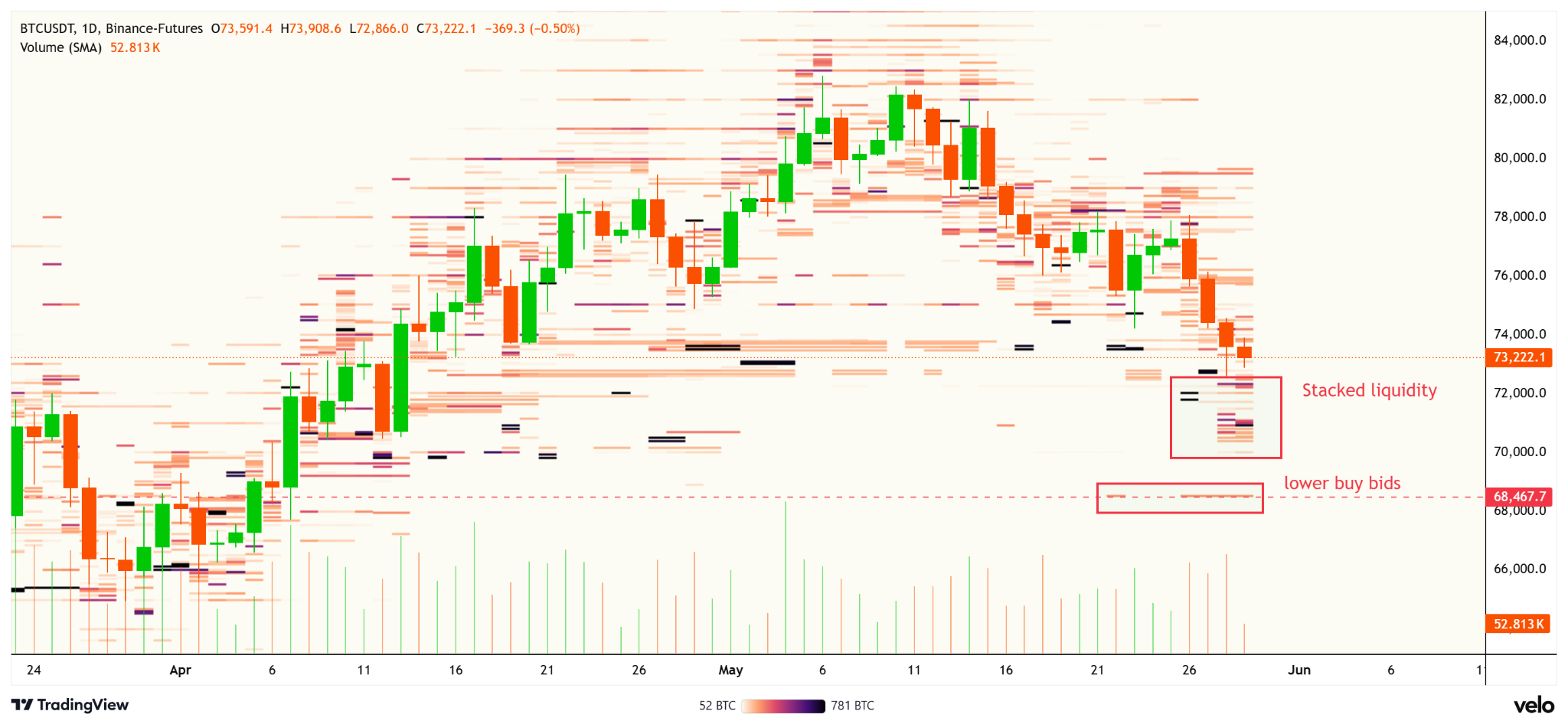
BTC/USD, one-day chart, buy liquidity analysis. Source: Velo chart
Below $70,000, the next notable pocket of demand sits at $68,505, where traders have placed another 1,012 BTC worth approximately $69 million. Outside that level, the order book thins considerably, with few visible bids below $68,500.
Meanwhile, liquidation heatmap data shows about $2 billion in cumulative long positions at risk near $70,000, compared to more than $5 billion in short positions around $78,000. Once BTC taps the bid cluster near $70,000, the larger liquidity pool may trigger a sharp rebound toward overhead liquidation zones.
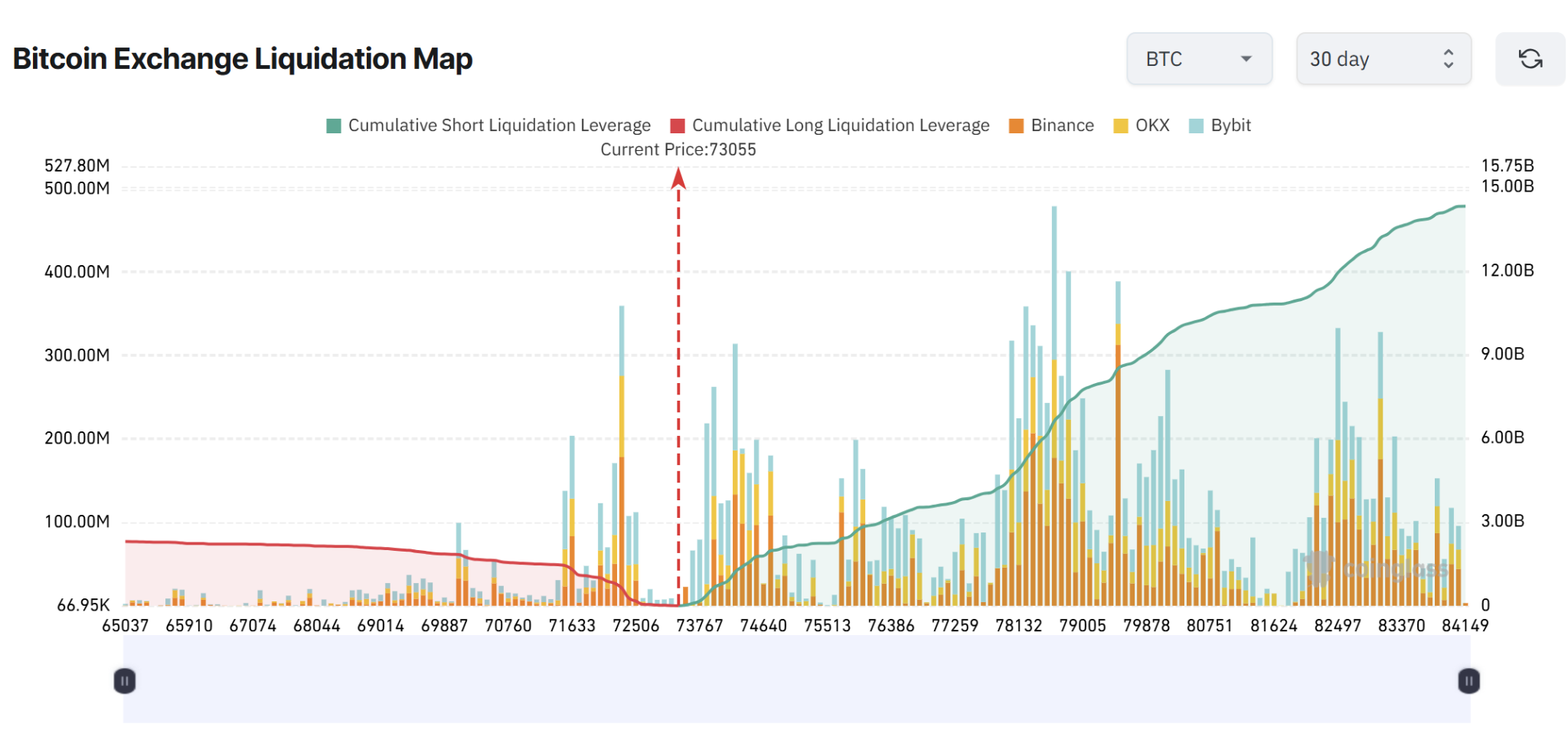
BTC liquidation map. Source: CoinGlass
Related: Bitcoin falls out of the global top 10 assets as market cap dips below $1.5T
RSI hits three-month low as daily BTC trend turns bearish
Bitcoin’s daily trend turned bearish after losing support at $74,800, confirming a pattern of lower highs and lower lows. The price is trading inside a descending channel and is currently testing support near the lower boundary around $72,000–$73,000.
The relative strength index (RSI) has fallen to roughly 33, its lowest level since Feb. 24. Momentum has stayed below the neutral 50 level throughout the recent decline, suggesting sellers still control the short-term price action.
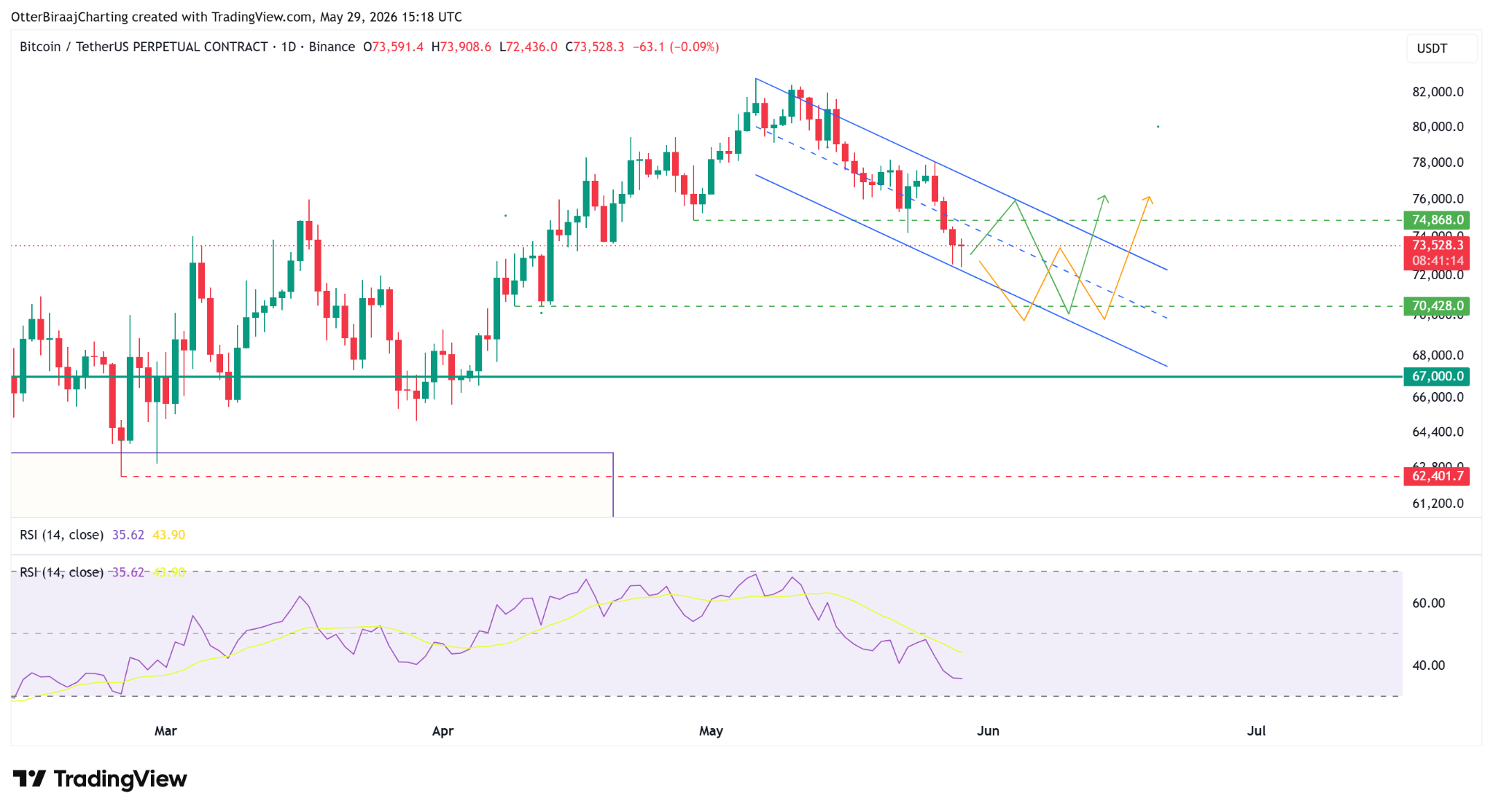
BTC/USD, one-day chart. Source: Cointelegraph/TradingView
Crypto trader Ardi outlined a similar view. The analyst said the $74,500–$75,500 region now acts as resistance across multiple time frames. A rejection from that area could keep focus on the $71,500 region, while a move through channel resistance near $76,000 may challenge the ongoing downtrend.
Options markets show investors have also been preparing for a move toward $70,000. According to Glassnode, traders spent nearly $10 million on put options with a $70,000 strike during the recent dip.
Put options rise in value when prices fall, making them a common hedge against downside risk. Recent flows show some easing in that protection demand as traders lock in profits, though the concentration of hedging activity highlights how closely the market is watching the $70,000 level.
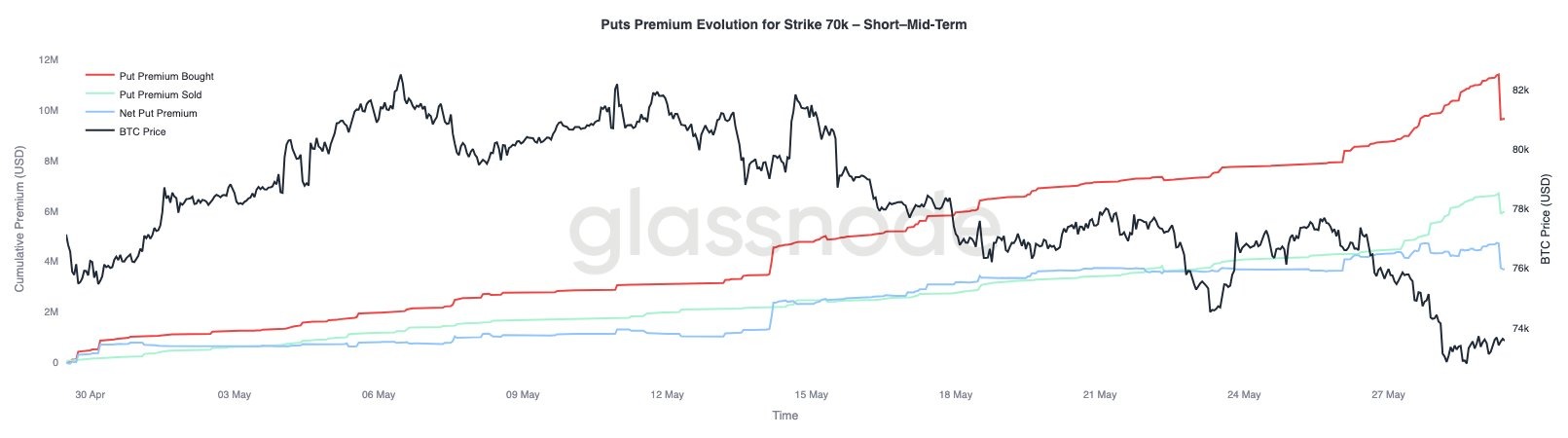
BTC options market analysis at $70,000. Source: Glassnode/X
Related: Bitcoin’s major holders halt buys as demand slows: CryptoQuant

The U.S. derivatives watchdog is edging crypto markets closer to a 24/7 trading model, signaling a more permissive posture toward crypto-based derivatives. The Commodity Futures Trading Commission (CFTC) issued an order granting Kalshi approval to list Bitcoin perpetual futures tied to the spot price, while also granting Coinbase a no-action position for similar BTC-based contracts. The moves come as the agency weighs how prediction markets and traditional futures frameworks can coexist with rapidly evolving digital assets.
The CFTC’s Friday notice confirms Kalshi’s BTCPERP perpetual futures contract, designed to track Bitcoin’s spot price and settle accordingly. The regulator emphasized that the approval rested on Kalshi’s representations about the contract’s terms, the underlying market, and compliance with the Commodity Exchange Act and the Commission’s core principles for designated contract markets. In parallel, Coinbase was granted a no-action stance for its own BTC perpetual futures, underscoring a willingness to explore crypto derivatives within a regulated framework.
Paul Grewal, Coinbase’s chief legal officer, described the decision as a “massive first for the industry” in a post on X, noting the broader trend toward more permissive access to crypto derivatives. Coinbase previously expanded into perpetual futures for non-U.S. traders in March, broadening the reach of crypto derivatives on mainstream trading venues.
The agency didn’t stop at Kalshi and Coinbase. In a separate notice, the CFTC contrasted the suitability of 24/7 trading for crypto-based derivatives with more traditional markets, like agriculture, where 24/7 activity may be less appropriate given regional customer bases and other market dynamics. The regulator highlighted that derivatives referencing crypto assets may be well-suited for around-the-clock trading due to their digital infrastructure and global reach. At the same time, it signaled a cautious stance on applying 24/7 models uniformly across all asset classes.
Industry echoes of that sentiment arrived from other corners of the market. CME Group has signaled intent to offer 24/7 crypto futures trading, subject to regulatory review, signaling that a broader ecosystem shift toward continuous trading could be on the horizon.
Key takeaways
- Kalshi wins approval for BTCPERP: The CFTC approved a Bitcoin perpetual futures contract on Kalshi’s prediction-market platform, marking a notable step toward exchange-like crypto derivatives on the regulatory map.
- Coinbase receives no-action relief: The exchange can explore BTC perpetual futures under the agency’s current stance, signaling growing U.S. legitimacy for retail crypto derivatives.
- 24/7 trading under scrutiny: The CFTC separately underscored that crypto derivatives may be better suited to around-the-clock trading than some traditional markets, while acknowledging not all asset classes share this feature.
- Regulatory and market dynamics: The developments occur amid ongoing regulatory repositioning and broader industry moves toward 24/7 crypto trading, including CME Group’s potential entry into the space.
- Political context: The evolving framework unfolds alongside political commentary on CFTC authority and jurisdiction over prediction markets, with nominations for commissioners still outstanding.
Kalshi’s BTCPERP: a milestone for prediction markets meeting crypto futures
The CFTC’s approval of BTCPERP places Kalshi at a unique crossroads between prediction markets and crypto derivatives. By tying a perpetual contract to Bitcoin’s spot price, Kalshi offers a mechanism for participants to speculate on crypto prices without owning the underlying asset. The regulator’s decision rested on Kalshi’s representations about contract terms, market structure, and compliance with applicable laws and core principles for designated contract markets. This move positions Kalshi as a platform that could operate with a more derivatives-exchange-like footprint within the U.S. regulatory framework.
As Kalshi moves forward, market participants will be watching how liquidity, margining, and settlement mechanics evolve in a framework that combines elements of prediction markets with perpetual futures dynamics. The BTCPERP contract promises to unlock new hedging and speculation avenues for both retail and institutional users who want continuous exposure to Bitcoin’s price movements.
Coinbase’s no-action stance: signaling incremental openness for U.S. crypto rails
Coinbase’s no-action relief, paired with Kalshi’s approval, signals a cautious but notable expansion of permissible crypto derivatives in the United States. The decision aligns with Coinbase’s broader strategy to offer perpetual futures products to diverse client bases while navigating the regulatory environment. Paul Grewal hailed the development as a turning point for the industry, underscoring the potential for regulated, 24/7 access to crypto derivatives on mainstream platforms. This follows Coinbase’s March rollout of stock perpetual futures for non-U.S. traders, illustrating a broader push into continuous, instrument-driven trading outside traditional stock markets.
24/7 trading: regulatory nuance, market implications
The CFTC’s second notice clarifies that the suitability of around-the-clock trading for derivatives is not universal. Crypto assets, with their digital infrastructure and global reach, may be well-suited to 24/7 trading, the agency contends. Traditional markets—such as agricultural commodities—pose distinct considerations tied to regional customer bases and physical delivery dynamics, which may complicate non-stop trading schemes. The nuanced stance suggests regulators are weighing the benefits of continuous liquidity and accessibility against the risks of around-the-clock activity in more service-heavy or regionally segmented markets.
Beyond Kalshi and Coinbase, the broader market is watching CME Group’s public statements about 24/7 crypto futures trading as an indicator of where the mainstream exchange ecosystem might converge. Pending regulatory review, the industry could see a broader rollout of continuous trading across multiple venues, potentially reshaping liquidity, risk management, and price discovery for crypto derivatives in the United States.
Regulatory context and political backdrop
The regulatory narrative surrounding crypto derivatives remains active. In parallel to these developments, U.S. President Donald Trump publicly supported the CFTC’s authority over prediction markets in a social media post, reflecting ongoing debates about jurisdiction and enforcement. The CFTC chair, Michael Selig, remains the sole commissioner in a five-member panel, with no announced nominations to fill the other seats as of Friday. The political and regulatory dynamics suggest continued scrutiny and potential shifts as more platforms seek to offer crypto-based derivatives under a U.S. regulatory umbrella.
As the year unfolds, observers will be monitoring how these approvals translate into real-world activity: Will Kalshi’s BTCPERP attract meaningful liquidity? How will Coinbase’s no-action status influence retail adoption and platform competition? And what further clarifications will regulators provide on the contours of 24/7 crypto trading versus traditional markets?
In the meantime, the market should brace for continued evolution in the U.S. framework for crypto derivatives, with investors and traders watching for further platform approvals, margin and settlement standards, and any forthcoming policy guidance that could redefine the boundaries of permissible crypto exposure on national exchanges.
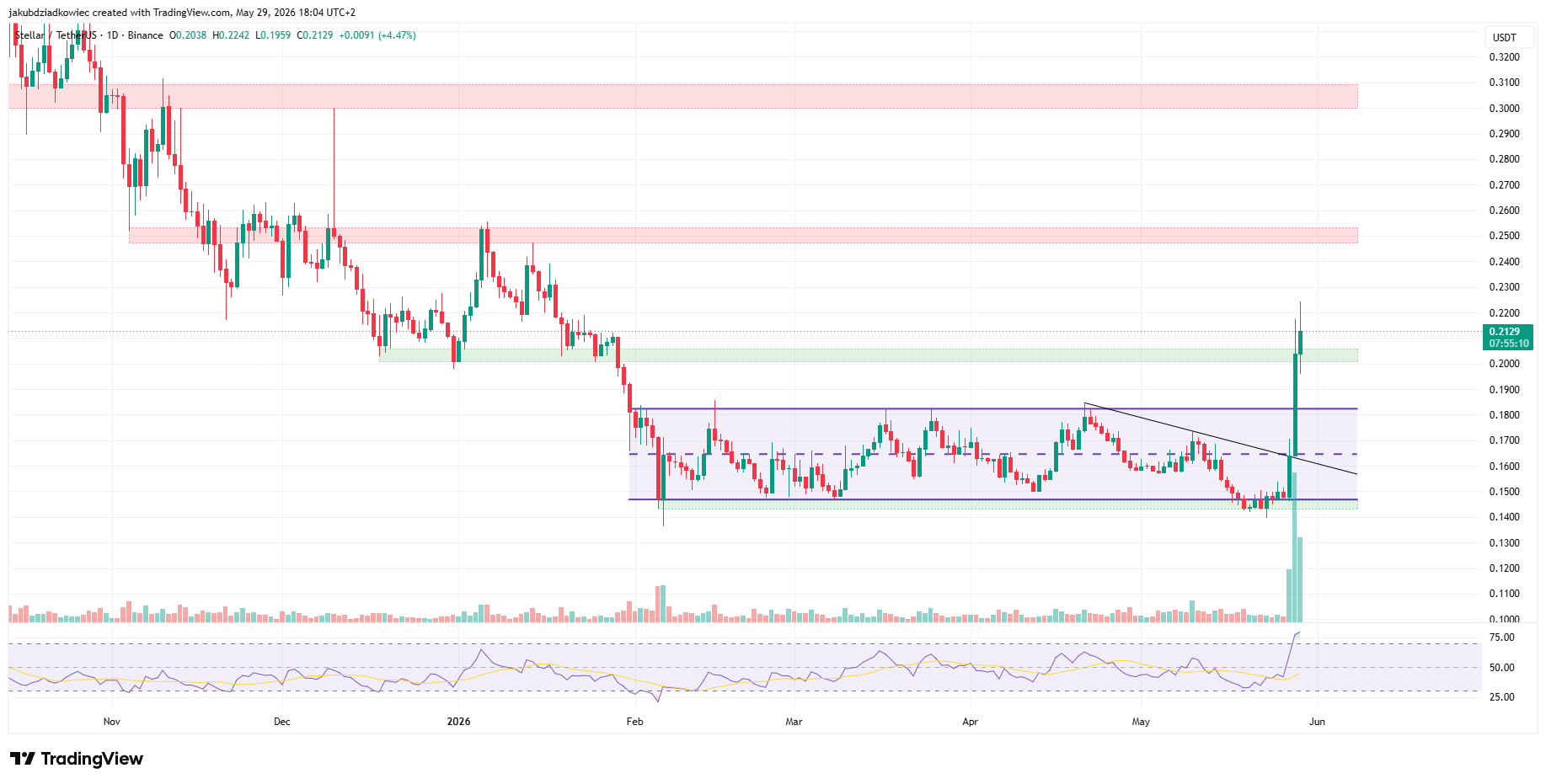
Three of the largest real-world asset (RWA) tokens are heading into June 2026 with completely different setups. Stellar (XLM) just confirmed a high-volume breakout. Chainlink (LINK) is bleeding on the chart while whales quietly absorb the float. Ondo (ONDO) ran hard in May and now looks like it gave large holders the exit they were waiting for.
Here is how each setup reads on the daily chart, and what to watch as the month begins.
Stellar (XLM): Breakout Confirmed, Shorts Fading the Move
XLM is the cleanest momentum setup in the group. Yesterday’s daily candle confirmed a breakout from a multi-week parallel accumulation channel on a major volume spike, with the daily RSI pushing up to 80.
The reclaim of $0.20 is the key technical event, a level that had capped the token through most of April and May, and is now expected to act as support. Above it, the path opens to $0.25, with $0.30 sitting beyond.

The funding rate tape adds an interesting layer. Through the entire consolidation window from late March through mid-May, perpetual funding oscillated around zero with frequent deep negative spikes, traders repeatedly tried to short the range lows and got nothing back.
The breakout finally pushed funding firmly positive as longs chased the move, but the latest 30-minute prints have flipped negative again even as price holds near the highs.

That is a bullish tell. Negative funding into a volume-confirmed breakout means shorts are fading a real move and paying longs to do so.
As long as $0.20 holds as support, the structure favors continuation toward $0.25 and $0.30.
The risk is purely tactical: RSI at 80 invites a cooldown, and losing $0.20 would turn this into a failed breakout.
Bias: bullish. Level to watch: $0.20.
Chainlink (LINK): Painful Chart, Cleanest On-Chain Picture in the Group
LINK is the inverse setup. The daily chart broke down from an ascending parallel channel on May 19 and is now grinding lower, with $7.38 as the measured downside target and secondary support near $8.
RSI sits around 40, not oversold, but firmly in the lower half. Volume is contracting, which typically signals compression rather than panic.
If LINK bounces, the resistance ladder runs from just below $10 to $12 (the 0.236 long-term Fibonacci retracement) and then $15 (the 0.382 Fib).
Reclaiming $10 would be the first technical signal that the May breakdown has run its course.

The bigger story sits underneath the price. Santiment data shows whale supply (excluding exchanges) has stair-stepped higher in two clear tranches, first in late January, then again in early March, adding roughly 175 million LINK to wallets that do not transact on venues.
Over the same window, exchange supply has fallen by more than 100 million tokens, with the steepest outflow coming in early April.

That is textbook accumulation: whales absorbing, exchange float shrinking, price refusing to reflect any of it yet.
The chart says LINK can still bleed into the $7s. The on-chain footprint says someone with size has been buying that bleed for months.
Bias: short-term bearish, structurally bullish. Levels to watch: $7.38 / $8 on the downside, $10 reclaim on the upside.
Ondo (ONDO): Strong Rally, Weaker Structure Underneath
ONDO had the most explosive move of the three in early May, breaking out hard from a months-long base. The follow-through has stalled.
The daily chart has printed a double-top at the 0.786 Fibonacci retracement near $0.47, and price has since broken below the 0.618 Fib.
ONDO is now trying to hold the 0.5 retracement at roughly $0.37. If that level fails, the chart opens up for a deeper retest of the previous accumulation zone around $0.30.
RSI is perfectly neutral at 50, and volume has tapered after the two-peak structure, both consistent with a market losing momentum rather than basing for another leg higher.

The on-chain backdrop is the real concern. Throughout the December-to-May window, ONDO’s supply on exchanges has trended steadily higher, tokens moving toward venues, not away from them.
Whale transaction count above $100,000 was muted through April, then erupted in early May almost exactly at the price peak.

That sequencing matters. Large holders activated during the rally, exchange balances kept building, and the rollover that followed has not been accompanied by any visible drop in venue supply.
Until exchange balances start to fall, the path of least resistance remains sideways to lower.
Bias: cautious. Levels to watch: $0.37 as the line in the sand, $0.30 as the realistic accumulation zone.
Top RWA Tokens to Watch in June
The three RWA majors offer three different trades for June 2026.
- XLM is the momentum play: A confirmed breakout with supportive funding and a clean upside ladder, provided $0.20 holds.
- LINK is the patience trade: Short-term bearish on the chart, but with the strongest accumulation profile in the group, which makes any flush toward $7.38 a potential gift to longer-term buyers.
- ONDO is the caution trade: The May rally was real, but the whale activity into rising exchange supply suggests the easy upside has already been taken until that venue balance trend reverses.
The RWA narrative still has the macro tailwind. Whether these three tokens lead the next leg or wait for it depends on which side of each setup resolves first.
The post Top 3 RWA Tokens for June 2026: One Breakout, One Accumulation, One Warning appeared first on BeInCrypto.


The U.S. Commodity Futures Trading Commission has approved Kalshi to launch the first federally regulated Bitcoin perpetual futures contract in the United States, opening a new path for crypto derivatives trading onshore.
Summary
- The CFTC approved Kalshi’s BTCPERP contract, clearing the way for the first federally regulated Bitcoin perpetual futures product in the U.S.
- The regulator also issued Coinbase a no-action letter allowing certain crypto perpetual futures products to use Bitcoin, Ether, and stablecoins as collateral.
- Kalshi’s approval comes as the company expands beyond prediction markets while challenging Minnesota’s proposed prediction market ban in federal court.
According to a CFTC announcement released Friday, Kalshi received approval to list and trade a Bitcoin-referenced perpetual futures contract under the ticker BTCPERP. The regulator said the approval requires the exchange to maintain the product in compliance with the Commodity Exchange Act and other applicable regulations.
The decision gives U.S. traders access to a type of crypto derivative that has largely been offered through offshore venues.
Unlike traditional futures contracts, perpetual futures do not expire, allowing traders to keep positions open indefinitely while speculating on the future price of an asset.
Kalshi chief executive Tarek Mansour said in a statement published on the company’s website that the launch represents the firm’s next step beyond prediction markets and into regulated derivatives trading. Mansour said federally regulated perpetual futures could improve risk management and capital allocation for U.S. businesses.
The approval comes as Kalshi continues to expand its role in financial markets while facing multiple regulatory and political battles linked to prediction markets.
The approval opens a regulated U.S. market for Bitcoin perpetual futures
For years, perpetual futures have become one of the most heavily traded products in global crypto markets, particularly on exchanges operating outside the United States. Their popularity stems from the ability to gain leveraged exposure to Bitcoin and other digital assets without dealing with contract expiration dates.
Alongside Kalshi’s approval, the CFTC issued a no-action letter to Coinbase on Friday covering certain perpetual futures products the exchange plans to offer through its Coinbase Financial Markets subsidiary.
According to the regulator, those contracts will be routed through Coinbase Bermuda and treated as foreign futures products. The no-action relief allows Coinbase Financial Markets to accept digital assets, including Bitcoin, Ether, and stablecoins, as margin collateral for eligible customers.
The CFTC’s twin announcements arrived days after President Donald Trump highlighted crypto perpetuals in a May 28 Truth Social post. Trump argued that previous regulators had pushed Bitcoin, crypto perpetuals, and innovation offshore before his administration reversed that trend.
“Gary Gensler and the “Anti-Crypto Army” nearly DESTROYED the American Crypto Industry by driving Bitcoin, Crypto Perpetuals, and INNOVATION offshore, but “TRUMP” SAVED IT.”
While perpetual futures can offer traders substantial gains from relatively small market moves, industry participants have long noted that leverage can also amplify losses during periods of volatility.
Kalshi expands beyond prediction markets amid regulatory disputes
The Bitcoin perpetuals approval lands during a period of rapid growth and heightened scrutiny for Kalshi’s business.
Earlier this month, the company filed a federal lawsuit against Minnesota seeking to block a state law that would prohibit prediction market platforms from operating in the state beginning Aug. 1.
Kalshi argued in its complaint that the Commodity Exchange Act grants the CFTC exclusive jurisdiction over event contracts and that Minnesota’s law improperly interferes with federally regulated exchanges.
The legal challenge followed a separate lawsuit filed by the CFTC against Minnesota. As previously reported by crypto.news, the regulator described the state’s legislation as one of the most aggressive attempts by a state government to restrict federally regulated prediction markets.
At the same time, Kalshi has increased its policy engagement efforts through Americans for Fair Markets, a newly launched advocacy group backed by the company. The organization, which counts former White House deputy chief of staff Taylor Budowich as a strategic advisor, said it plans to advocate for federal policies affecting prediction markets and regulated exchanges.
According to the group, its priorities include know-your-customer requirements, insider trading prohibitions, full CFTC funding, and restrictions on contracts related to war, death, terrorism, and assassination.


The U.S. Commodity Futures Trading Commission has greenlit the nation’s first bitcoin perpetual futures contract on a regulated exchange, marking a watershed moment for domestic crypto derivatives trading.
Summary
- CFTC approved first-ever bitcoin perpetual futures contract on regulated U.S. platform
- Chairman Mike Selig says move delivers on President Trump’s goal to make America “crypto capital of the world”
- Perpetual futures previously dominated offshore exchanges with over 70% of centralized trading volume
The CFTC announced Friday it had approved an unnamed regulated exchange to list and trade bitcoin perpetual futures contracts, ending the offshore monopoly on these high-volume derivatives instruments. The approval follows months of signals from CFTC leadership that the agency would move aggressively to onshore crypto perpetuals, which allow traders to speculate on Bitcoin (BTC) price movements indefinitely without expiration dates.
“Having true perpetual contracts in the United States is a major step forward in delivering on President Trump’s goal of cementing America as the crypto capital of the world,” CFTC Chairman Mike Selig wrote in an opinion piece published Friday at CoinDesk. Selig argued the contracts represent “a foundational risk management and price discovery tool in the global crypto asset markets”.
Regulatory Shift Under Trump Administration
The announcement comes days after President Donald Trump posted on social media that the previous administration “nearly DESTROYED the American Crypto Industry by driving Bitcoin, Crypto Perpetuals, and INNOVATION offshore, but ‘TRUMP’ SAVED IT”. Selig echoed this sentiment in March, stating he aimed to repair damage that “drove a lot of these firms and the liquidity offshore”.
Perpetual futures contracts differ from traditional futures by having no expiration date, allowing positions to remain open indefinitely through a funding rate mechanism that keeps contract prices aligned with spot prices. These instruments have dominated offshore crypto trading since 2016, with perpetuals accounting for over 70% of centralized exchange volume. In 2025, perpetual futures trading volume reached $61.7 trillion, up 29% from 2024.
Kalshi and Polymarket Race for Market Share
While the CFTC did not identify which exchange received approval, prediction market platform Kalshi had announced plans to launch cryptocurrency perpetual futures in April, with co-founder Luana Lopes Lara celebrating regulatory progress since December 2024. Kalshi secured a CFTC margin trading license and scheduled an April 27 launch event in New York City for its perpetual futures product, internally codenamed “Timeless”.
The platform planned to offer at least 10x leverage on Bitcoin and other assets, with U.S. dollar collateral at launch and Bitcoin trading to follow. Rival platform Polymarket also entered the perpetual futures market in April, intensifying competition for the lucrative derivatives sector.
Selig wrote Friday that the CFTC’s approach would “limit excessive leverage, volatility and systemic risk”. The announcement carries weight as agency guidance rather than formal rulemaking, meaning future CFTC leadership could reverse the policy without congressional action. The shift aligns with broader CFTC regulatory changes under the Trump administration, including joint SEC-CFTC coordination on crypto asset taxonomy and expanded tokenized collateral frameworks.
Arca chief investment officer Jeff Dorman says Strategy’s Bitcoin accumulation playbook has hit a breaking point, with roughly $15 billion in preferred stock and $1.5 billion in annual dividend obligations now colliding with a weakening cash buffer and softer Bitcoin (BTC) price.
The warning lands after Strategy used most of its cash reserve to buy back $1.5 billion of zero-coupon convertible notes due 2029, leaving $871 million on hand to meet recurring preferred dividend obligations.
The Preferred Stock Problem
MicroStrategy holds 843,738 BTC as of May 25, after building out a preferred stock structure totaling roughly $15.5 billion across STRC, STRK, STRF, and STRD series.
The STRC tranche alone pays a variable dividend the company recently raised to 11.5%.
Dorman argued the issuance was a wager that BTC was about to climb sharply, allowing future Bitcoin sales to fund those dividends.
Follow us on X to get the latest news as it happens
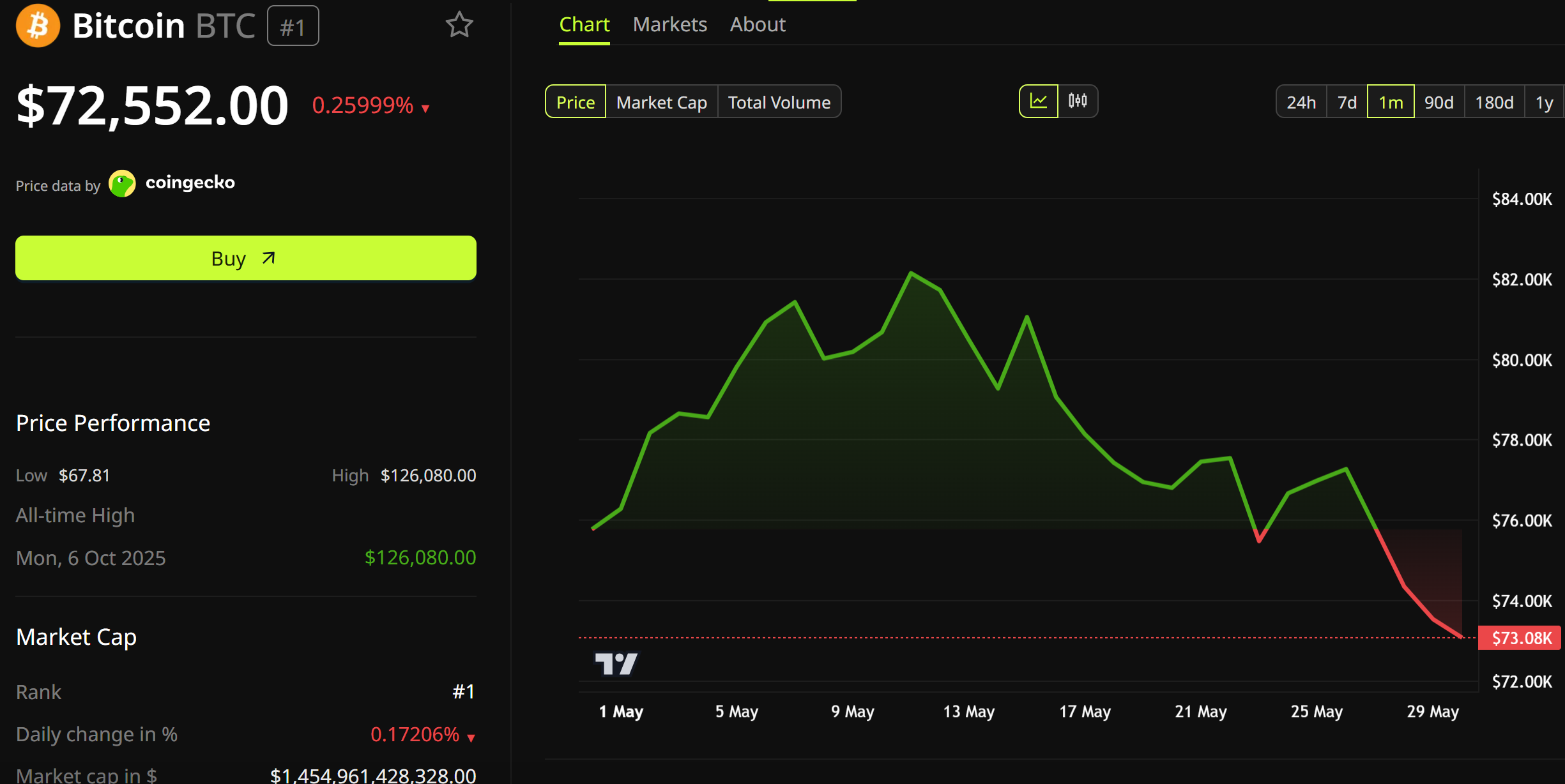
Bitcoin instead trades near $72,550, down almost 6% over the past week, weakening the implicit collateral behind that bet.

The Baffling Buyback
In May, Strategy repurchased $1.5 billion face value of its 2029 convertibles for about $1.38 billion in cash, locking in an 8% discount but burning through most of its depleted cash reserve.
The retired notes carried a zero coupon, making the timing of the buyback hard to square with rising dividend obligations.
“MSTR, BTC and Pref holders are really in bind. Someone is going to lose badly here, and it will happen in the next 4 months,” Dorman stated.
Three stakeholder groups now hold competing claims on the same balance sheet.
A potential Bitcoin sale to fund dividends would damage Saylor’s long-term thesis, while cutting payouts would punish preferred holders and raise comparisons to past STRC collapse risk debates.
MicroStrategy’s next capital move will signal which constituency comes first.
The post Institutional Crypto Exec Warns MicroStrategy’s Bitcoin Capital Loop Is Breaking appeared first on BeInCrypto.
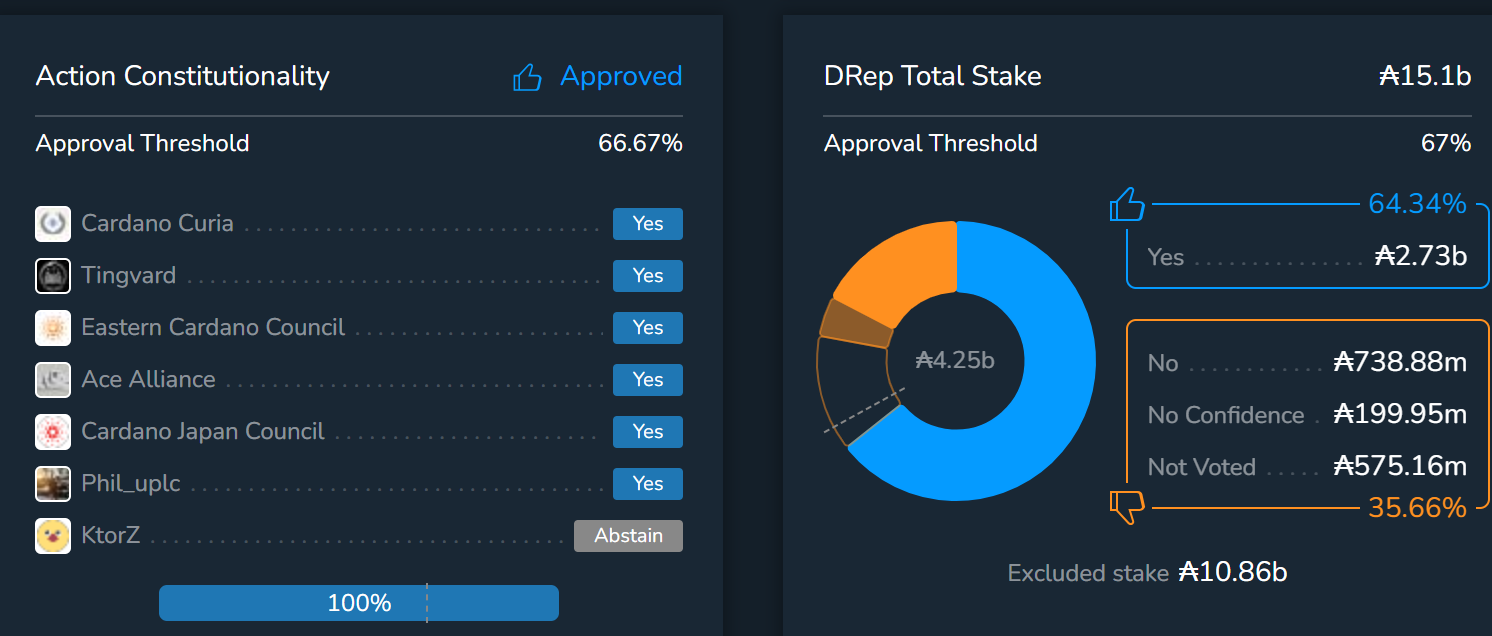
Cardano founder Charles Hoskinson and Cardano Foundation CEO Frederik Gregaard publicly backed the revised Cardano Summit 2026 proposal hours before voting closed on May 29, urging delegated representatives to approve a 7.8 million ADA treasury withdrawal for the Singapore event.
The on-chain vote requires roughly 66.67% support from active DRep stake. Recent snapshots showed yes votes near 65%, leaving the outcome dependent on unvoted stake as the May 29 deadline approached.

What the Revised Proposal Funds
The treasury request, equivalent to about $2 million at current ADA prices, would finance a two-day Cardano Summit on October 5 and 6 in Singapore.
The proposal lands as the community debates treasury allocations and stress-tests spending discipline.
“If you have not voted yet, I encourage you to vote yes today for the revised Cardano Summit proposal,” Hoskinson urged.
Follow us on X to get the latest news as it happens
Singapore Pivot and New Accountability Rules
The Foundation pitched Singapore as Cardano’s first major summit in Asia, citing access to regional builders, asset managers, and regulators.
The revised plan trimmed the original budget by 22%, dropped the TOKEN2049 sponsorship tie, and added milestone payments, independent audits, and a public spending dashboard.
Fund administration would run through a smart contract built by Sundae Labs, with provisions returning unused ADA to the growing on-chain treasury.
An oversight committee involving Intersect and DQuadrant would track milestones under the Cardano constitution framework.
A Test of On-Chain Governance
The vote functions as another stress test of Cardano’s shift to ADA governance under the Chang hard fork.
EMURGO CEO Phillip Pon publicly supported the alignment, while some DReps voted no, citing fiscal discipline and competing priorities given current market conditions.
Hoskinson has spent recent months signaling broader governance changes ahead for Cardano.
A failed vote would force a scaled-back or postponed Asia-Pacific debut, while approval would release funds under tight oversight.
The post Cardano Leaders Rally Last-Minute Support for $2 Million Singapore Summit Vote appeared first on BeInCrypto.
Grayscale eyes $115m HYPE seed deal for Hyperliquid staking ETF, will HYPE go parabolic?

All The Comics You Need To Read Before X-Men ‘97 Season 2

Fable Dodges GTA VI With Another Delay


-

 Business5 days ago
NYT Strands Answers May 24 2026 Revealed for Puzzle No. 812 Theme Summer Essentials
-

 Politics4 days ago
Bridgerton Season 5: Cast, Release Date And Everything We Know So Far
-

 Crypto World7 days ago
Robinhood crypto COO Tanya Denisova exits
-

 Tech4 days ago
Microsoft’s quiet Claude Code retreat and the real cost of enterprise AI
-
 Crypto World3 days ago
Micron Crosses $1 Trillion Market Cap as AI Demand Reshapes Memory Sector
-

 Business3 days ago
Selena Gomez Reportedly Upset Over Benny Blanco’s Comments on Her ‘Terrible’ Diet
-

 Business5 days ago
BTS Sells Out Four Las Vegas Shows at Allegiant Stadium for ARIRANG World Tour
-
Tech2 days ago
The Samsung pay deal is the moment Korean unions changed register
-

 NewsBeat2 days ago
Israel says it has killed new Hamas military leader in Gaza City airstrikes
-

 Tech4 days ago
Westone Audio and Etymotic Acquired by Fidelity Collective in Major IEM Market Move
-

 Tech3 days ago
Millions of AI agents imperiled by critical vulnerability in open source package
-

 Tech19 hours ago
Waymo dominates autonomous vehicle registrations as Tesla trails behind
-
 Crypto World5 days ago
Nvidia (NVDA) CEO Calls on Super Micro to Strengthen Export Controls Amid Smuggling Probe
-
 Tech4 days ago
China assigns ID codes to 28,000+ humanoid robots
-

 Tech3 days ago
NASA taps Blue Origin to deliver lunar rovers for Moon Base initiative
-
Crypto World3 days ago
SpaceX’s $2 Trillion IPO: Why Tech Giants Nvidia (NVDA), Apple (AAPL), and Microsoft (MSFT) May Face Pressure
-
Crypto World5 days ago
Brian Armstrong Outlines Crypto Vision for the Future Financial System
-
 Entertainment4 days ago
‘Breaking Bad’ Star’s Easy-to-Binge 6-Part Crime Series Spin-Off Is Finally Heading to Free Streaming
-

 Crypto World3 days ago
Spain blocks prediction markets Polymarket Kalshi
-

 Business4 days ago
Yatra Online, Inc. 2026 Q4 – Results – Earnings Call Presentation (NASDAQ:YTRA) 2026-05-25
You must be logged in to post a comment Login