

Crypto World
VALR, Africa’s Leading Digital Asset Infrastructure Provider, Eyes Kenya for Expansion

[PRESS RELEASE – Johannesburg, South Africa, May 18th, 2026]
VALR, Africa’s leading digital asset infrastructure provider, served as diamond sponsor of the Kenya Blockchain & Crypto Conference held in Nairobi on 14 and 15 May 2026.
Peter Mwangi, VALR’s newly appointed Country Manager for Kenya, delivered a keynote address in which he outlined his vision for Kenya as an up-and-coming digital asset hub on the African continent. He drew parallels between the country’s pioneering adoption and development of mobile money and the opportunities in payments, financial inclusion, and infrastructure on the digital asset front. Shelley Havemann, VALR’s Head of Payments, participated in a panel discussion on stablecoins, the future of payments, and VALR’s role in transforming finance.
VALR also hosted a meetup in the capital for business leaders in finance to explore partnership opportunities. These activities underscore VALR’s strategic focus on Kenya and its support for the country’s emerging digital asset ecosystem.
Kenya’s Digital Finance Leadership and Recent Regulatory Progress
Kenya is recognised for its early and pioneering adoption of mobile money, which has driven significant advances in financial inclusion, payments, and broader economic participation across the continent. Recent regulatory developments have strengthened this foundation. The Virtual Asset Service Providers (VASP) Act was enacted in October 2025 and came into force in November 2025. The finalisation of the supporting 2026 VASP Regulations under the Capital Markets Authority establishes a clear licensing and oversight framework. This framework aligns Kenya with international standards, promotes investor protection and responsible innovation, and creates a solid base for digital asset growth. These steps reinforce the vision outlined in Mwangi’s keynote and position Kenya as an increasingly important digital asset market in Africa.

(Peter Mwangi, VALR’s Country Manager for Kenya)
VALR Brings Scale, Infrastructure, and Innovation
Founded in Johannesburg in 2018, VALR quickly grew to become South Africa’s largest crypto exchange by trading volume. It has since developed into Africa’s leading digital asset infrastructure provider. VALR processes more than 15 billion US dollars in stablecoin volumes annually and consistently ranks among the top 10 global minters of USDC. The platform serves over 1.8 million registered users and more than 2,000 corporate and institutional clients, including companies listed on the JSE and Nasdaq.
VALR offers institutional-grade infrastructure, including API integration, multi-account management, governance controls, an OTC desk, staking, lending, borrowing, VALR Pay, and crypto-as-a-service solutions that power other institutions’ offerings. The company also recently launched its AI Service, which features an intuitive chat assistant for market analysis, account insights, and support, together with open API support for autonomous AI agents under the open Agent Skills Standard.
Through its conference participation and Nairobi meetup, VALR is bringing this proven expertise and infrastructure directly to Kenyan institutions and the wider African market. VALR welcomes discussions with Kenyan financial institutions and businesses interested in partnership opportunities.
About VALR
Founded in 2018, headquartered in Johannesburg, and backed by leading investors including Pantera Capital, Coinbase Ventures and Fidelity’s F-Prime Capital, VALR is a global crypto exchange, and the leading digital asset infrastructure provider on the African continent, offering a comprehensive suite of products, including Spot Trading, Spot Margin, Perpetual Futures, Staking, Lending, Borrowing, OTC services, VALR Invest, Crypto Bundles, and VALR Pay. Licensed by South Africa’s FSCA, with regulatory approval in Europe, VALR serves over 1.8 million registered users and 2,000 corporate and institutional clients worldwide. The exchange is dedicated to advancing a just financial future that upholds human dignity and the unity of mankind. For more information, visit valr.com.
The post VALR, Africa’s Leading Digital Asset Infrastructure Provider, Eyes Kenya for Expansion appeared first on CryptoPotato.


Early today, traders received Japan’s producer price index for June, which came in at 7.1%, the fastest annual increase since March 2023. The spike in wholesale inflation reinforced expectations for further Bank of Japan rate hikes. A former central bank official said Thursday that the BOJ may hike rates faster, potentially pushing them above 2%.
Note that the Japanese yen and Bitcoin have developed an unusually strong positive correlation, often moving in lockstep against the U.S. dollar. If that correlation holds, yen upswings may ultimately prove positive for bitcoin in general, even as BTC/JPY (and other crypto/JPY) pairs continue to lag in relative terms.
The GPIF Risk
The Government Pension Investment Fund (GPIF) of Japan manages roughly ¥277 trillion ($1.87 trillion) in assets, making it the world’s largest retirement fund. It invests heavily in global stocks and bonds.
Now the Japanese government wants the GPIF and other pension funds to invest more in local assets. Such a rotation could trigger volatility in global financial markets.
“The fund, one of the largest pension pools in the world, held 293.4 trillion yen, or roughly 1.81 trillion dollars, in assets at the end of December, maintaining roughly equal allocations across domestic equities, foreign equities, domestic bonds and foreign bonds,” analysts at InvestingLive said in a market update.

Zcash’s Ironwood network upgrade, the solution to an “infinity” bug discovered in May on the privacy-focused blockchain’s main private transaction pool, Orchard, is set to go live on July 28.
Announced in June, Ironwood closes the current Orchard pool, prevents new activity in it and sets up a new private pool. Funds leaving Orchard would have to pass through an accounting checkpoint before entering Ironwood, which could produce evidence about whether any counterfeit Zcash (ZEC) tokens were produced through the Orchard bug.
“Zcash’s Ironwood mainnet activation height has been set and tagged! All of the major organizations are committed to activation of NU6.3 at height 3428143, which is approximately July 28th at 8AM EST,” Zcash core developer Sean Bowe said on Thursday.
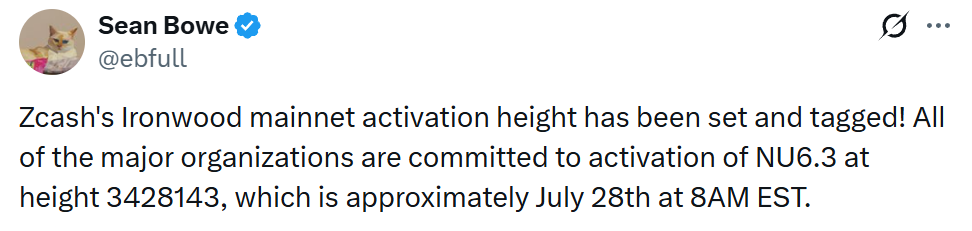
Source: Sean Bowe
Shielded Labs had floated delaying Zcash’s Ironwood upgrade, warning that ecosystem participants such as exchanges, mining pools and wallets would not have enough time to prepare their systems for a late-July mainnet activation. Bowe’s latest comment confirms the upgrade will go ahead one week later than its earlier target date of July 21.
Related: Anthropic’s Mythos AI finds no more ‘serious’ bugs in Zcash: Wilcox
In June, Shielded Labs said Ironwood may provide evidence about whether the Orchard vulnerability was ever exploited.
“As users migrate funds from the existing Orchard pool to the new pool, any hypothetical counterfeiter faces a choice: attempt to move counterfeit funds and risk exposing their existence, or leave them behind and risk being unable to move them in the future.”
ZEC plummeted 50% to $299.25 from $602.68 after the disclosure of the Orchard bug on June 3. The price of ZEC has made a partial recovery in the weeks following and is trading at $492.61 at the time of writing.
Zcash crossed a major monetary milestone this week, with more than 80% of its maximum 21 million ZEC supply now issued. A post from ruZCASH on Monday shows that there is now 16,806,723 ZEC in supply.
Magazine: Bitcoin’s quantum dilemma: Bigger blocks or STARK proofs?


“Once liquidations begin to drive price action, the market can move faster than real demand would justify,” said Shawn Young, chief analyst at MEXC Research, who is watching how bitcoin trades inside the $60,000 to $63,000 band now that the first recovery is in.
MSCI’s Asia Pacific equities gauge climbed 1.4% as investors moved back into semiconductor shares on renewed optimism over AI demand, cutting the week’s loss to under 1%.
South Korea’s Kospi, a bellwether for AI investment, jumped 4%. SK Hynix was among the winners after pricing $26.5 billion of American depositary shares, one of the largest share sales of the year.
Gains were further extended as yen strengthened 0.6% and long-dated Japanese government bond yields fell after Finance Minister Satsuki Katayama said the government wants pension funds to increase their holdings of domestic assets. Bloomberg’s dollar gauge declined and is heading for a second consecutive weekly drop.
Nothing crypto-native moved bitcoin this week. There was no ETF flow of any size, no protocol event and no exchange failure. Bitcoin absorbed an oil shock, a global bond selloff, a hawkish repricing of Fed expectations and two rounds of U.S. strikes on Iran, and finished up 4.2% because Korean memory chips are in demand and the dollar is losing ground.

A crypto wallet linked to a suspected romance-scam money launderer processed more than $122.5 million in 10 months, according to Interpol, as authorities expanded a global crackdown on online fraud.
Interpol said Thursday that Thai authorities arrested two suspects and uncovered a money-laundering network that funneled proceeds from romance scams into cryptocurrencies, using cross-chain token swaps to obscure the trail.
The Thai investigation was part of Operation First Light 2026, an Interpol-coordinated campaign targeting social engineering scams and the financial infrastructure used to launder their proceeds.
The operation involved authorities in 97 countries and territories, resulting in 5,811 arrests and the seizure of $293 million in illicit assets tied to fraud and money laundering.
Tomonobu Kaya, director of Interpol’s Financial Crime and Anti-Corruption Centre, said social engineering scams “continue to pose a significant threat to our society,” adding that no country can tackle the problem alone.
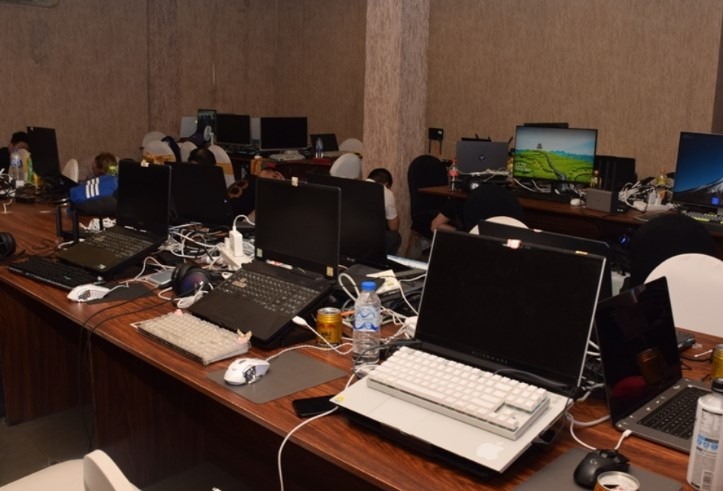
Authorities carried out raids on scam centers. Source: Interpol
Crypto romance scams draw global enforcement scrutiny
Interpol said participating authorities targeted bank accounts and crypto wallets used to move illicit funds. The operation analyzed 152,808 cases, blocked 31,014 bank accounts, solved 23,715 investigations and identified 15,606 suspects.
Authorities also used Interpol’s payment-freezing system, known as the Global Rapid Intervention of Payments, to help block illicit transfers involving fiat and virtual assets.
Authorities in Palau also deported 22 people allegedly involved in two hotel-based scam centers that used cryptocurrency and illegal gambling websites to target victims abroad.
Related: US seizes $61M in USDT linked to ‘pig butchering’ crypto fraud scheme
The case follows growing concern over the use of crypto in romance and investment scams. In April, the US Federal Bureau of Investigation (FBI) reported that Americans filed 181,565 crypto-related scam complaints totalling over $11 billion in losses in 2025.
Romance scams, also known as pig-butchering scams, often involve criminals building trust with victims through social media or online dating platforms before steering them toward fraudulent investment schemes.
Magazine: The 5 types of real world assets being tokenized fastest onchain
XRP continues to display signs of weakening market conditions, as key indicators suggest that sellers remain in control, according to the latest analysis from CryptoQuant.
The data show Open Interest has dropped to $350.6 million, one of its lowest levels in recent months, indicating that traders are closing futures positions and reducing leverage.
Bearish Signals
While lower Open Interest can sometimes ease selling pressure by flushing out leveraged positions, CryptoQuant said it is not the case this time because capital is also leaving the broader market.
The analytics firm also added that the trend is not limited to futures activity but also reflects a lack of meaningful new money entering the asset. The firm stated that traders are exiting positions without being replaced by fresh capital, leaving the market with weaker overall participation.
On-chain data also does not yet point to a stronger recovery. XRP’s NVT Ratio remains elevated at 162.86, suggesting that network activity has not increased enough to justify a higher market valuation.
According to the analysis, the combination of falling Open Interest and a persistently high NVT Ratio paints a consistent picture of weakening market conditions. CryptoQuant said investor risk appetite has declined significantly, and participants appear exhausted. This has left XRP’s price action tilted in favor of sellers.
On the institutional front, US-based spot XRP ETFs recorded $7.3 million in outflows on July 8th, although the funds have generally held up better than their Bitcoin and Ethereum counterparts.
Adoption and Visibility
Despite the weak market outlook, XRP continues to see strong real-world adoption in parts of Asia. Earlier this week, Japan’s SBI VC Trade said companies are increasingly adding XRP alongside Bitcoin to their treasury reserves and shareholder benefit programs. The crypto asset also remains one of the most actively traded cryptocurrencies in South Korea.
Ripple also expanded XRP’s visibility this week by securing the first crypto sponsorship of a major US college athletics program. Under the partnership, the University of Kansas Jayhawks will display the asset’s logo on game jerseys beginning this fall.
The post XRP’s On-Chain Data Flashes Warning While Sellers Continue to Dominate appeared first on CryptoPotato.

PayPal USD (PYUSD) has become natively available on Polygon through the Polygon Open Money Stack, giving businesses direct access to the regulated stablecoin across payment, compliance and fiat conversion services.
Summary
- PayPal USD is now issued natively on Polygon through the Open Money Stack, giving businesses direct access to regulated stablecoin payments and settlements.
- The integration combines wallets, fiat ramps and compliance tools into a single system to simplify cross border payments and local currency payouts.
- The launch extends PayPal’s PYUSD expansion after February’s PYUSDx platform and follows Mastercard’s decision to support PYUSD for stablecoin settlements across multiple blockchains.
According to a press release shared with crypto.news, Paxos-issued PYUSD is now issued natively on Polygon and integrated into the Polygon Open Money Stack, allowing businesses already processing payments on the network to access the stablecoin through the wallets, fiat ramps and compliance tools they already use.
Native PYUSD arrives on Polygon
According to Polygon Labs, the integration removes the need for businesses to connect separate providers for stablecoin issuance, fiat on and off ramps, compliance, and payment infrastructure. Instead, companies can accept payments from cards, bank accounts or exchange balances, settle in PYUSD across borders and convert funds back into local currencies through a single integration.
The company said the simplified setup reduces engineering work, lowers operating costs and speeds up settlement by combining regulated fiat access and compliance services within the same payments infrastructure.
Polygon Labs noted that its network has settled more than $2.6 trillion in stablecoin transactions to date and is already used by companies including Revolut and Stripe. Businesses already running payments on Polygon can now access PYUSD without changing their existing infrastructure, the company added.
Businesses target cross-border payments
According to Polygon Labs, businesses such as payroll providers, online marketplaces and remittance platforms could use PYUSD to pay contractors, settle with international sellers and move money into overseas markets without building their own banking and compliance systems. The company said end users could benefit from quicker payouts, fewer failed transactions and faster conversion into local currencies.
PYUSD is issued by Paxos under a national trust charter supervised by the Office of the Comptroller of the Currency, making it one of the largest U.S. dollar stablecoins issued by a federally regulated entity. Polygon Labs said pairing the regulated stablecoin with its licensed fiat ramps provides businesses with a compliant path between traditional financial systems and on-chain settlement.
“A stablecoin is only as useful as the places it can go and what it can do when it gets there,” Polygon Labs CEO Marc Boiron said, adding that bringing PYUSD into the Open Money Stack allows businesses to receive payments, move funds across borders and cash out through a single integration with compliance built in.
“PYUSD is issued under a national Trust charter supervised by the OCC, and bringing it natively to Polygon puts a federally regulated, dollar-backed stablecoin on one of the most active networks for stablecoin payments. Businesses running on the Open Money Stack can now settle in PYUSD with confidence in the compliance and regulatory oversight that serious money requires,” Peter Jonas, chief revenue officer at Paxos, added.
The rollout adds another expansion for PYUSD after PayPal and MoonPay introduced the PYUSDx platform in February, allowing developers to launch application-specific stablecoins backed by PYUSD without building payment infrastructure from scratch. At the time, the companies said growing stablecoin adoption had increased demand for faster deployment of custom digital currencies.
The launch also follows Mastercard’s June decision to add PYUSD alongside five other regulated dollar-backed stablecoins to its settlement network across multiple blockchains, including Polygon. Mastercard said the service would allow participating financial institutions to settle card transactions outside traditional banking hours while maintaining its existing security and compliance standards.

Charles Hoskinson has denied rumors that he is retiring from Cardano. He called the claims a complete fabrication in a video posted this week.
The Cardano founder blamed out-of-context clips and reaction videos for the story. He said they falsely claimed he called Cardano a failing project.
Hoskinson Pushes Back on the Rumor
Hoskinson said the story reached far. A London taxi driver told visiting Cardano supporters he had heard the founder was retiring.
He added that contacts at a partner firm relayed the same claim to their own chief executive.
“It is categorically untrue. It’s a complete lie. It’s a complete fabrication.”
Hoskinson asked supporters to share the video with anyone repeating the rumor. He said it proves he remains involved in the ecosystem.
A Rough Stretch for Cardano
The denial lands during a difficult period for Cardano. ADA’s price action has struggled near multi-year lows. The token trades around $0.16, roughly 94% below its 2021 all-time high of $3.09.

The network has also faced recent governance turmoil after EMURGO exited Cardano’s Pentad body following a wallet exploit. Investor Justin Bons separately made a call for Hoskinson’s exit, drawing heavy community backlash.
Not every signal has been negative. Cardano saw wallet growth this month even as ADA struggled to hold gains. Hoskinson has also floated a proposed governance overhaul aimed at restoring confidence.
The Broader Altcoin Backdrop
Cardano’s struggles mirror a wider altcoin market that has yet to break Bitcoin’s grip. Bitcoin dominance sits near 58%, testing support that has held since August 2025.
The Altcoin Season Index reads 45, still short of the 75 mark that defines a true rotation. The Crypto Fear and Greed Index remains in Extreme Fear territory.
Capital has stayed concentrated in Bitcoin and Ethereum through much of 2026. Analysts say a confirmed altcoin season likely needs Bitcoin dominance to break below 55.5%.
The post Charles Hoskinson Addresses Rumors He Is Quitting Cardano appeared first on BeInCrypto.
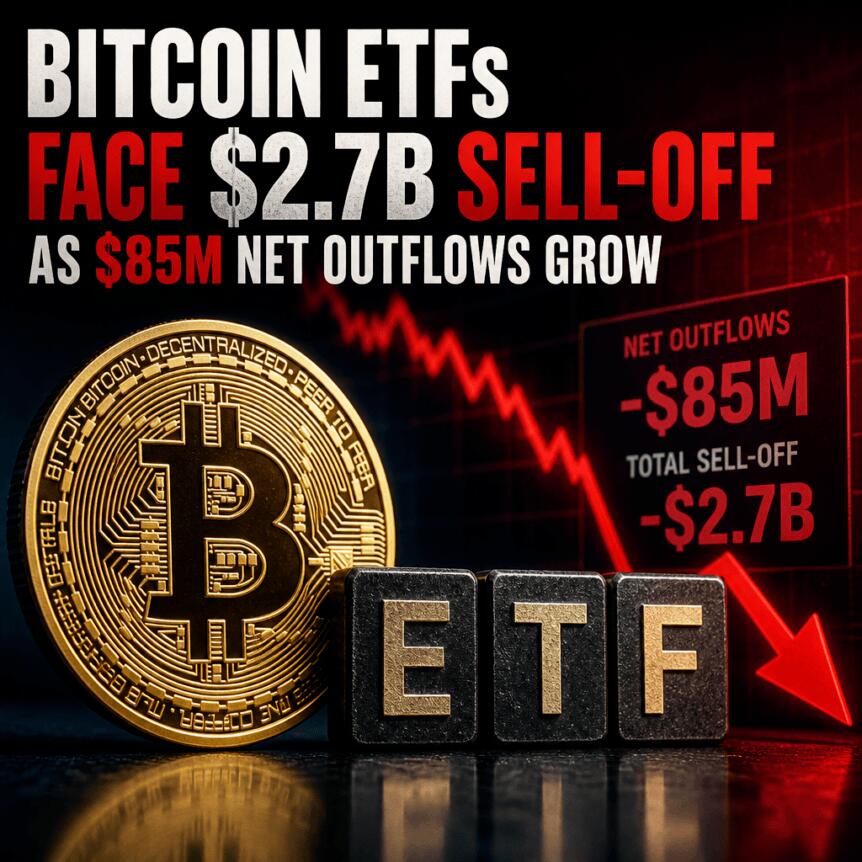
Bitcoin’s institutional story is turning, but not decisively—according to Swissblock, the most intense US spot Bitcoin ETF sell-off in the current bear market appears to be over, even as it cautions that institutional demand is still “not yet strong.”
While flows into US spot Bitcoin ETFs swung from ten straight days of outflows totaling $2.7 billion to a brief rebound, on-chain and derivatives-focused research continues to show a split: futures demand has improved faster than spot buying. That divergence matters because it often signals whether a recovery is durable or merely technical.
Key takeaways
- US spot Bitcoin ETFs reversed a ten-day outflow streak beginning June 17, after net outflows summed to $2.7 billion, per Farside Investors.
- Swissblock says the “most overwhelming” distribution wave has ended, but warns accumulation is still “positive, but not yet strong.”
- ETF flows show early stabilization—over $500 million net inflows across three trading days—yet remain fragile after a later net outflow.
- CryptoQuant analysis highlights a demand gap: derivatives demand moved toward neutral while spot demand stayed negative.
Swissblock: the ETF “storm” looks to have passed
In an X post on Thursday, Swissblock framed the recent ETF movement as the end of an unusually heavy sell-pressure phase. The firm described the episode as “the most overwhelming ETF distribution wave of this bear market,” adding, “The storm has passed.”
Swissblock also tied the change to improving risk conditions, stating that “Bitcoin Risk continues easing from Capitulation Risk” and that spot ETF flows have “turned slightly positive again.” The underlying flow numbers referenced in the article come from Farside Investors, a UK-based investment data provider that tracks ETF movement.
According to Farside Investors data, starting June 17 the US spot Bitcoin ETF complex recorded ten consecutive sessions of net outflows totaling $2.7 billion. After that stretch, the trend began to reverse, with more than $500 million in net inflows across three trading days—before the most recent session mentioned in the article closed with a net outflow of $84.9 million for Wednesday.
Swissblock characterized the rebound as a signal worth noting, but not one to overread. It called the development a “caveat” to the recovery narrative—an acknowledgement that ETF accumulation has improved, yet “institutional conviction is not returning with full force.”
“Has the storm passed? Or is Bitcoin simply in the eye of the storm?”
Why ETF flows matter—even when they turn
Spot Bitcoin ETFs have become a key channel for traditional and institutional access to BTC exposure. When flows consistently run negative for long stretches, it often reflects sustained risk-off positioning by allocators who use these vehicles as a regulated wrapper.
The shift from prolonged outflows to net inflows, even if modest or intermittent, can therefore represent more than a short-term trading reaction. It may indicate that some capital is returning after de-risking pressures eased.
Still, Swissblock’s framing is instructive for investors: “positive, but not yet strong” implies stabilization rather than a full recommitment of institutional capital. The specific pattern highlighted—three days of meaningful inflows followed by a smaller outflow—suggests demand may be improving unevenly rather than trending cleanly upward.
Spot versus futures: CryptoQuant sees a widening mismatch
Beyond ETF flow headlines, the broader picture of Bitcoin demand across market venues remains mixed. Earlier coverage referenced in the article pointed to demand as a recurring hurdle for a sustained bullish market recovery.
In fresh research shared this week through CryptoQuant, contributor IT Tech described conditions as partially improving while emphasizing a “clear divide between spot and derivatives markets.” In that view, total 30-day cumulative demand moved from close to -500K BTC to roughly -75K BTC.
More importantly, IT Tech said futures demand recovered faster than spot demand. Over the same period, futures demand shifted from -295,000 BTC to a “slightly positive” figure, while spot demand continued to register negative levels.
“This tells us something important. The latest bounce has been driven primarily by derivatives traders, while spot buyers are still relatively cautious,” IT Tech commented.
CryptoQuant’s framing aligns with a common market dynamic: derivatives can reflect expectations and hedging activity that change quickly, while spot buying—especially from longer-horizon participants—often requires stronger conviction. The article includes an additional historical observation attributed to IT Tech: the most reliable rallies tend to begin when both futures and spot demand rise together.
What to watch next: whether the spot bid returns
At this stage, the key uncertainty is whether the ETF improvement will translate into stronger, more persistent spot demand. The Swissblock takeaway—accumulation is improving but institutional conviction is not fully back—paired with CryptoQuant’s spot/derivatives divergence suggests investors should watch for confirmation across multiple indicators rather than relying on a single flow reversal.
In the coming sessions, readers should look for sustained net inflows in US spot Bitcoin ETFs beyond short bursts, alongside evidence that spot demand meaningfully turns positive rather than merely stabilizing while derivatives activity leads the rebound.


Robinhood Chain has recorded $500 million in daily Uniswap trading volume within just eight days of launch, lifting total value locked above $106 million and pushing the Arbitrum-powered network into the top ranks of decentralized finance activity.
Summary
- Robinhood Chain reached $500 million in daily Uniswap trading volume within eight days of launch.
- Ethena’s $50 million deposit helped push the network’s TVL above $106 million.
- Pump.fun integration, tokenized stocks, and gas fee waivers have accelerated early ecosystem growth.
DeFiLlama data shows the network’s total value locked climbed to more than $106 million after surging 159% in 24 hours, while cumulative addresses approached 200,000. The same data places Robinhood Chain behind only Ethereum mainnet in 24-hour Uniswap trading volume, an unusually rapid rise for a newly launched Layer 2 network.
Uniswap activity on the chain reached $500 million on July 8 after cumulative trading volume had already crossed $250 million during its first week.
Institutional liquidity has fueled the TVL jump
Most of the recent capital increase has come from institutional DeFi flows rather than retail participation.
According to DeFiLlama, nearly $90 million of Robinhood Chain’s locked value is held on the Morpho lending protocol, which powers the roughly 7% annual percentage yield available through Robinhood Earn on USDG deposits.
The largest catalyst came from Ethena, which deposited $50 million into a Steakhouse Financial-managed USDG vault on Morpho in a single transaction. That transfer accounted for much of the network’s sharp one-day TVL increase and highlighted how concentrated institutional liquidity can rapidly reshape early DeFi metrics.
Robinhood Chain also launched with full support for Uniswap’s v2, v3, v4 and UniswapX infrastructure from day one. Trading activity has centered on Wrapped Ether (WETH), memecoins and tokenized equity assets including NVDA, AAPL and GOOG, giving the network exposure to both crypto-native and tokenized real-world asset markets.
Ecosystem expansion has drawn fresh market attention
Robinhood chief executive Vlad Tenev has continued to position the network around tokenized real-world assets while acknowledging growing meme coin demand. In a July 8 post on X, Tenev wrote that as Robinhood develops Robinhood Chain into “the best chain for RWA,” it is “a great chain for memes, too.”
Support from Pump.fun arrived the same day, allowing users to trade Robinhood Chain tokens directly using SOL without bridging assets. The integration quickly boosted activity around the memecoin CASHCAT, adding another source of transaction volume shortly after the chain’s launch.
A separate filing with the U.S. Securities and Exchange Commission disclosed that Tenev sold 375,000 Class B HOOD shares under a prearranged Rule 10b5-1 trading plan.
According to the filing, the shares were sold between $112.22 and $118.13, generating roughly $43.6 million after HOOD stock had already gained more than 40% over the previous month, supported in part by enthusiasm surrounding Robinhood Chain.
Activity on the network has also lifted related crypto assets. UNI, Uniswap’s governance token, rose as much as 14% alongside the surge in trading volume. Robinhood Chain processes blocks every 100 milliseconds compared with Ethereum’s roughly 12-second block time, while Chainlink supplies oracle infrastructure for tokenized equities. Robinhood is also waiving gas fees for the network’s first 90 days, reducing transaction costs during its early growth phase.
Institutional interest in tokenized finance had already been building before the launch. Earlier this week, ARK Invest increased exposure to crypto-related stocks, adding to expectations that companies connected to tokenized assets could continue attracting investor attention.
At the same time, regulatory risks remain. SEC guidance published in January 2026 identified tokenized debt securities as an area for increased scrutiny, while Robinhood Chain’s current TVL remains heavily concentrated in Morpho, meaning large liquidity withdrawals could materially affect the network’s headline metrics.

Decentralized finance tokens have outperformed Bitcoin over the past month, a divergence Bitwise says may reflect a “quiet re-rating” of the sector rather than a short-lived bounce. In its latest crypto market review, the firm pointed to a steep change in relative performance during June: Bitcoin fell about 22%, while Bitwise’s index of tokens tracking major DeFi protocols declined roughly 4% over the same period.
Bitwise described the relative stability as unusual because DeFi tokens are typically among the first assets traders trim when risk appetite drops. The report argues that the sector’s volatility profile may be shifting as more traditional institutions use DeFi infrastructure—support that, in Bitwise’s view, has helped stabilize the broader ecosystem.
Key takeaways
- Bitwise’s DeFi token index fell about 4% in June versus Bitcoin’s ~22% drop, suggesting DeFi held up unusually well.
- Bitwise links the resilience to improving token economics and a narrowing gap between DeFi usage and token value.
- Institutional participation is cited as a stabilizing force as firms build on major DeFi names such as Morpho and Jupiter, with Aave highlighted for generating roughly $900 million in the past year.
- Despite token strength, total DeFi value locked has fallen—CryptoRank reported a decline to just over $70 billion from around $115 billion in January.
- Bitwise expects stablecoin-focused announcements to intensify before the GENIUS Act takes effect in January 2027, and it flags the CLARITY Act as a near-term volatility catalyst.
Why Bitwise thinks DeFi is being re-priced
Bitwise’s core observation is that DeFi’s traditional pattern—bigger swings than Bitcoin during downturns—has not played out in the most recent month. The firm said the relative performance difference is both “unusual” and largely absent from mainstream discussion, implying that market positioning may be lagging what token-level pricing is already signaling.
The report also frames this as more than a simple momentum story. Bitwise argues that DeFi token economics have been improving and that the historical disconnect between how much the platforms are used and how valuable their tokens become is narrowing. In that framing, outperformance is less about speculation and more about demand for DeFi services translating into token relevance.
Bitwise further points to real-world institutional usage as a stabilizer. It specifically names Morpho and Jupiter as examples of areas where institutions have started building, and it cites Aave’s activity—stating that Aave generated approximately $900 million in the past year—as evidence that core DeFi markets remain economically active even when the broader crypto market cools.
What’s inside Bitwise’s DeFi index
Bitwise’s DeFi index fund is market-cap weighted, and its current composition sheds light on why the basket has been resilient. The index allocates about 61% of weight to Hyperliquid’s native token (HYPE), which is tied to the perpetuals exchange ecosystem. Bitwise noted that HYPE has gained more than 160% so far this year.
The index also includes other prominent DeFi exposure, including Uniswap (UNI), Ondo (ONDO), and Aave (AAVE), among others. Despite being major constituents, these names have generally declined over the year-to-date period, with Bitwise stating that several of them are down double digits. That matters for investors because it suggests the overall index performance is being supported by a concentrated outlier (HYPE) while other widely followed protocols face their own drawdowns.
Value locked is down—resilience may not mean growth
Token performance does not automatically translate into increased capital deployment. While Bitwise’s index held up better than Bitcoin in June, CryptoRank reported that total value locked (TVL) in DeFi declined sharply throughout 2026.
According to CryptoRank data cited on June 24, DeFi TVL dropped nearly 40% so far this year, falling to just over $70 billion from roughly $115 billion in January. The data provider attributed much of the decline to a major correction in early October that followed a prior peak in the broader crypto market—when Bitcoin reached a high of more than $126,000.
CryptoRank also suggested the current drawdown is smaller than what occurred during the 2022 bear market, implying relative durability. Taken together, the token-vs-TVL split points to an important nuance for readers: DeFi can experience weaker liquidity and still see token pricing stabilize or improve—especially if parts of the ecosystem (like derivatives venues or specific liquidity markets) remain relatively favored by traders and institutions.
Policy catalysts: stablecoins and the CLARITY Act
Bitwise’s report extends beyond performance comparisons by highlighting regulatory and legislative developments it expects to influence market conditions. One major focus is stablecoins ahead of the GENIUS Act, a stablecoin-regulating bill that was made law in the US last year and is set to take effect in January 2027.
Bitwise said it expects “a steady run of large firms” to announce stablecoin projects ahead of GENIUS implementation. The firm also noted that stablecoin supply has remained supported through the recent downturn. In Bitwise’s view, continued supply growth should benefit major settlement rails such as Ethereum and Solana during the current quarter as regulators finalize rulemaking around the GENIUS Act.
On market structure, Bitwise said the next three months could be “make-or-break” for the CLARITY Act, currently under review and negotiation in the Senate. Bitwise said it believes the bill has an unlikely chance of passing before the November elections.
The report outlines a two-path scenario. If CLARITY passes, Bitwise argues it could signal the bottom of the current bear market. If it fails, Bitwise expects volatility at first, followed by a period of “clearing of uncertainty” as the industry continues building under a regulatory environment it characterizes as more pro-SEC and CFTC focused.
For investors, the practical takeaway is that the market may be balancing near-term uncertainty on structure policy with longer-term momentum from stablecoin-related deployment. With DeFi tokens holding up comparatively well against Bitcoin even as TVL falls, traders may increasingly look at whether liquidity breadth returns—or whether token strength continues to concentrate in specific segments.

1 Hour of the Gang Trying to Make That Money

Trouble on the streets of London and Paris after France knock Morocco out of the World Cup

China awards two village boys, one studied by lamplight to power a third of world’s EVs, the other cracked English in two months to give fighter jets x-ray vision


-

 Fashion6 days ago
Weekend Open Thread: High Hopes
-
 NewsBeat5 days ago
Taylor Swift and Travis Kelce wedding staffer hilariously struggles to keep her cool while checking in megastars
-

 Crypto World7 days ago
Standard Chartered Secures MiCA License as ESMA Adds 37 New Crypto Firms
-

 Fashion3 days ago
Open Thread: What Great Books Have You Read Recently?
-

 Politics7 days ago
The House | “Reframing the debate from a binary discussion of winners and losers”: Yuan Yang reviews ‘We Are Not Machines’
-

 Fashion18 hours ago
Loro Piana Fall 2026 Enters Houston’s Art Scene
-

 News Videos3 days ago
Whats Hidden Inside This Cash Register? #treasure #reselling #money
-
 Tech3 days ago
Anthropic’s new “J-lens” reveals a silent workspace inside Claude that mirrors a leading theory of consciousness
-
 Crypto World6 days ago
ESMA Expands Crypto Register by 37 Firms Following MiCA Transition Period
-

 Business3 days ago
AXT Shares Jump Nearly 14% as Semiconductor Materials Maker Rebounds on AI-Linked Indium Phosphide Demand
-

 Sports2 days ago
Joshua Pacio ‘more complete’ ahead of ONE rematch vs Malachiev
-

 Crypto World5 days ago
South Africa proposes crypto tax guidance under existing rules
-
Crypto World3 days ago
SK hynix (000660.KS) Stock Dips as $28B Nasdaq ADR Offering Drives AI Memory Expansion
-

 News Videos4 days ago
Best Time to Enter Small Caps Right Now? Another Bull Run? | Financially Free
-

 Tech5 days ago
Lenovo laptops are now shipping with YMTC SSDs, a sign of Chinese NAND entering the mainstream
-
Sports3 days ago
We have punished the disrespect
-

 News Videos4 days ago
Avoid entering in FOMO #bitcoin #cryptocurrency #trading #scalping
-

 Crypto World7 days ago
Alibaba bans Claude Code over alleged backdoor security concerns
-

 Tech5 days ago
Neuralink Threads Its Way Straight Through the Brain’s Armor
-

 Tech2 days ago
Anthropic brings Claude Cowork to mobile and web as usage data shows most users aren’t coding
You must be logged in to post a comment Login