
Entertainment
10 Forgotten ’80s Sitcoms That Have Aged Like Fine Wine


One of the greatest decades for sitcoms was the 1980s. From unconventional family comedies like Who’s the Boss, workplace classics like Cheers, and newfound stories about individuals who tend not to receive the spotlight like The Golden Girls, the ’80s set the blueprint for the type of comedies that audiences crave. Not every show aged well, like Bosom Buddies. But there are some shows that have aged like fine wine, which history seems to have forgotten.
While we fondly remember the hits of the decade, there are a handful of shows that deserve to be remembered for holding up well today. From sitcoms celebrating LGBTQ+ storylines to comedies that inspired a film franchise that we adore, these titles made their mark on the decade. Perhaps we forgot them because they aren’t accessible, or similar shows overshadowed them; this list is our chance to honor them once again.
‘Brothers’ (1984–1989)

The title is timeless in the sense that it’s been used multiple times since the 1984 sitcom, but the show is timeless because the story was well ahead of its time. Created by David Lloyd, the Showtime series Brothers followed three working-class brothers in Philadelphia, dealing with family life. Lou Waters (Brandon Margaret) is a gruff, comically clueless construction foreman. Joe Waters (Robert Walden) is a retired professional football player who runs a bar called The Point After. Cliff Waters (Paul Regina), the youngest brother, leaves his fiancée at the altar in the first episode to come out as gay. With Lloyd at the helm, Brothers was in capable hands for important storytelling. Having experience with The Mary Tyler Moore Show, Taxi, and Cheers, he knew how to craft a family-centric story. It thrived on the relatable, often comedic clash of traditional, working-class Philadelphia mentalities across three perspectives.
Brothers was quite the progressive series as it tackled taboo subjects of the 1980s, namely gay rights, homophobia, and HIV/AIDS. It balanced its comedic sitcom format with meaningful social commentary as Joe and Lou alternately struggled to accept Cliff’s sexuality, attempted to understand his lifestyle, and ultimately supported him. Cliff was not presented as a niche gimmick; he was treated with nuance as a fully realized character beyond mere punchlines. Cliff wasn’t the only gay character; he was joined by out-and-proud new friend Donald Maltby (Phillip Charles MacKenzie), a successful writer/magazine editor whom Cliff sought out for advice and support in the time leading up to his coming out. An ’80s show with multiple queer characters? Groundbreaking! And yes, they would venture to a gay bar, The Velvet Spike, throughout its run.
Brothers was a trailblazer, putting social issues at the forefront. It was the first original series produced entirely for premium cable. Seeing how premium cable has dominated the airwaves and helped usher in the streamer era, Brothers was ahead of the curve in that respect as well. At the end of the day, the show’s five seasons thrived because of its unprecedented, honest, and often hilarious examination of narratives that network television avoided. With its uncensored freedom to play, Brothers was a sitcom blueprint that no longer receives the praise it deserves due to limited accessibility.
‘Domestic Life’ (1984)

Not every sitcom is going to have a long-lasting, prosperous life. But sometimes, with every flop, it is an invaluable lesson that you can take with you to your next project. So, in that respect, a single-season run of Domestic Life helped co-creator Steve Martin learn to develop a multi-season legacy with Only Murders in the Building. Co-created by Martin, Martin Mull, Howard Gerwirtz, and Ian Praiser, the CBS series followed Martin Crane (Mull), a Seattle television commentator whose professional life offering advice on a TV segment often clashed with the hilarious chaos of his own family at home. Domestic Life centers on Martin as he navigates the ups and downs alongside his wife, Candy (Judith-Marie Bergan), teenage daughter, Didi (Megan Follows), and young son, Harold (Christian Brackett-Zika). If the name, career, and plot feel oddly similar to Frasier, well, call it deliberate, as one of the show’s writers, David Angell, co-created the hit NBC series.
The comedy stemmed from Martin’s smooth, confident on-air persona and his struggles as a real-life dad and husband. In turn, it gently poked fun at the traditional family tropes of the time. The parents were imperfect, and the children were brilliantly subverted, including a deadpan-delivering son working a small business out of his bedroom as he perused The Wall Street Journal. With a TV commentator at the helm, it proved to be a unique meta-humor that spoke directly to the camera, opening the door to the conceit of future sitcoms. The style brought a highly dry, self-aware brand of observational humor to a format that usually relied on cheesy punchlines. Perhaps ahead of its time, Domestic Life earned cult classic status for its gentle approach to parody, Mull as the lead, and its role as a prototype for live-action The Simpsons-esque antics. It wasn’t an anti-sitcom, but it was unlike anything else.
‘Jennifer Slept Here’ (1983–1984)

A sitcom about a benevolent ghost? Yes, there was one before the darling hit CBS comedy Ghosts. It was called Jennifer Slept Here. The one-season wonder was a fantasy concept created by Larry Rosen and Larry Tucker. The supernatural fantasy sitcom followed the ghost of glamorous Hollywood actress Jennifer Farrell (Ann Jillian), who haunts her former Beverly Hills mansion. She makes herself visible and acts as a mentor to Joey (John P. Navin Jr.), the teenage son of the wealthy Elliot family who recently moved into her home. An odd-couple, ghostly comedy, Jennifer Slept Here follows Jennifer as she attempts to help Joey navigate teenage life, high school, and growing up while simultaneously adjusting to her own afterlife. It may have been a high-concept sitcom, but such comedies in the 21st century, like The Good Place, have become what audiences seek.
A more adult take on Casper the Friendly Ghost, Jennifer Slept Here was truly a reexamination of the traditional guardian angel trope. The series was all about Jillian’s magnetic and charismatic take on the newly dead. The series even saw some stars drop by, including Debbie Reynolds as Jennifer’s equally ghostly, overbearing mother, Alice, and Zelda Rubinstein as Madame Wanda, an eccentric exorcistwho was a parody of her Poltergeist character, Tangina Barrons. Jennifer Slept Here relied on the full-on funny, as it was all about supernatural hijinks, leaning into classic ghost tropes like walking through walls and randomly appearing in front of Joey, causing him to look crazy in front of his family. With that, the series pushed back against traditional authority figures and leaned into the absurdity of the situation, even as his parents assumed he needed psychiatric help. If this entry has intrigued you to seek out the show, be ready for an earworm of a theme song.
‘Just the Ten of Us’ (1988–1990)

The ’80s were the pinnacle of family sitcoms that evolved the image of the typical American family. One of the most beloved shows of the time was Growing Pains. The show was such a success that it spawned its own spin-off based on a peripheral character, Coach Graham Lubbock, played by Bill Kirchenbauer. The character, who often interacted with Mike and Carol Seaver (Kirk Cameron and Tracey Gold), was such a fan-favorite that he earned his own show. And let’s just say, his big Catholic family of eight children was at the center. Just the Ten of Us tells the story of Graham and his wife, Elizabeth (Deborah Harmon), as they move from New York to Eureka, California. As time went by, the focus shifted heavily to the couple’s four eldest teenage daughters—Marie (Heather Langenkamp), Cindy (Jamie Luner), Wendy (Brooke Theiss), and Connie (JoAnn Willette)— who, by special arrangement, were allowed to attend St. Augustine’s, the boys’ school their father coached basketball. The girls often drove the story by sneaking around with boys, rebelling against their father’s strict rules, and navigating high school drama.
Just the Ten of Us relied on traditional family values, including subtle religious elements, representing a special cross-section of the American nuclear family. And yet, the show was notorious for subverting the teenage trope with the daughters in the spotlight. Graham was not necessarily the all-knowing, perfect TV dad. Instead, through his comedic timing, he was presented as the well-meaning, bumbling old-school disciplinarian. He was on a desperate crusade to protect his girls from boys and themselves, as they fought for teenage independence and freedom. They were portrayed as bright, funny, and incredibly loyal to one another. They worked so well as a quartet that they even formed a singing group, The Lubbock Babes. The show was an example of how a large-ensemble series could work without wearing itself thin. Even his 11-year-old son, J.R. (Matt Shakman), was given ample time to shine. The self-aware, slapstick comedy was at the heart of the show. Though traditional values were inherent in the family, Just the Ten of Us fought against being overtly sanitized, something audiences loathe today.
‘Kate & Allie’ (1984–1989)

Single women as central characters on sitcoms weren’t rare, but two divorced mothers? That was a novel idea. Luckily, it resulted in a beloved show, Kate and Allie. The six-season series created by Sherry Coben followed Kate McArdle (Susan Saint James) and Allie Lowell (Jane Curtin), two divorced childhood best friends who decide to live together in a New York City brownstone to pool their resources and raise their children as a supportive, modern family. Kate is a free-spirited, career-oriented woman who works as a travel agent. Allie is more traditional, conservative, and neurotic, and returns to college while balancing her life. Kate and Allie was celebrated for its smart, realistic portrayal of female friendship, independence, and the everyday, humorous chaos of raising a family in Greenwich Village, a nearly impossible feat today. The series was a risky yet profound take on the nuclear family that resonated well with audiences.
The dynamic between Curtin and Saint James was nothing but sublime comedy. They found the funny within the slice-of-life storytelling. What made the series triumph was how the women were portrayed. They were not struggling or desperate, instead resilient and capable. Kate and Allie celebrated the concept of a chosen family, proving that the setup is a powerful tool for survival and growth. Kate and Allie was a relaxed sitcom, especially known for its unique cold opens, featuring the women taking quiet walks and having amusing conversations around Greenwich Village. The concept has been borrowed from, including the Disney Channel sitcom Raven’s Home. What may have seemed progressive in the ’80s is anything but today. Oh, and if you want to know where future stars stopped by before their big break? It was Kate and Allie. The guest stars included Ben Stiller, William H. Macy, Ricki Lake, and many more.
‘Love, Sidney’ (1981–1983)

Perhaps one of the most endearing sitcoms of the decade was none other than Love, Sidney. Developed by Oliver Hailey as a series, Love, Sidney was based on a short story by Marilyn Cantor Baker, which was adapted as the TV movie Sidney Shorr: A Girl’s Best Friend. The series follows Sidney Shorr (Tony Randall), a middle-aged, closeted gay artist who shares his Manhattan apartment with a struggling single mother, Laurie Morgan (Swoosie Kurtz), and her young daughter, Patti (Kaleena Kiff), forming a unique, unconventional family of choice. Instead of focusing on romance or dating, the show heavily centered on the everyday humor of raising a child in the city, Sidney’s career as a commercial illustrator, and his interactions with quirky neighbors. A genuinely tender comedy, Love, Sidney was wholesome and historic.
Love, Sidney made television history by becoming the first American network prime-time series to feature a gay character in the lead role. Though the network downplayed this aspect of the character due to fears of sponsor backlash, the sheer act of having a gay man lead a prime-time sitcom in 1981 was pioneering. The dynamic of the trio was the heart and soul of Love, Sidney. Randall’s fussy, lovable comedic timing paired seamlessly with Kurtz’s charm and warmth, but it was Kiff who stole hearts. It may seem shocking by today’s standards, but for a show to focus on a non-traditional household centered around a gay man was necessary for sitcoms like Will & Grace and The New Normal to arise. A genuine celebration of found family, Love, Sidney broke ground thanks to Randall’s commitment to the part, one that was not a caricature but a complex, multifaceted individual.
‘Police Squad!’ (1982)

In 1982, David Zucker, Jim Abrahams, and Jerry Zucker created a show for ABC that was a spoof and send-up of police procedurals. It only lasted six episodes. And yet, its legacy carries through today because Police Squad led to the beloved comedy film series The Naked Gun. Police Squad may be that rare example of a cancellation actually benefiting from staying power. The original series follows Leslie Nielsen as Detective Frank Drebin, a seemingly competent but entirely clueless cop who solves absurd cases with a completely deadpan delivery and is surrounded by equally oblivious characters. Mocking 1950s and 60s hard-boiled police and detective dramas, Police Squad relied on rapid-fire visual gags, bizarre non-sequiturs, and literal-minded wordplay. And after two Airplane films, it’s what audiences adored.
Police Squad brilliantly subverted the sitcom style for a unique, rapid-fire, deadpan spoof that worked on screen. With the Airplane creative team tapping Nielsen, who had already established his brilliance in the style, Police Squad had the goods for greatness. Add in recurring gags like major celebrities, like William Shatner or Florence Henderson, billed as a guest star, only to be humorously killed off in the opening credits before the actual episode plot began, changing the episode title within the episode, and visual humor that brought laughs and groans, and Police Squad was perfect. The show was ahead of its time. Network executives felt the show was too demanding, as the sheer volume of jokes meant viewers had to pay constant attention rather than watch casually. And yet, that was Police Squad’s greatest asset. The series spawned a trilogy and a legacy film starring Liam Neeson. It inspired 21st-century comedies like Angie Tribeca. It may have been a flop by TV standards, but the truth is, it was anything but.
‘Small Wonder’ (1985–1991)

Back in the ‘80s, the synopsis of Small Wonder was so sci-fi that it seemed implausible. Today, Small Wonder seems like a story of the future that could soon be our reality. Created by Howard Leeds, the campy first-run syndicated series followed Ted Lawson (Dick Christie), a robotics engineer who secretly creates a highly advanced android, designed to look like a 10-year-old girl (Tiffany Brissette). The Lawson family— Ted’s wife, Joan (Marla Pennington), and mischievous son, Jamie (Jerry Supiran)—passes her off as their adopted daughter, V.I.C.I. (Voice Input Child Identicant), and tries to hide her robotic nature from their nosy neighbors, the Brindle family— Ted’s obnoxious boss, Brandon Brindle (William Bogert), and Brandon’s nosy daughter, Harriet (Emily Schulman), who has an obsessive crush on Jamie. The premise was ripe for comedy, and for four seasons, it prevailed.
Much of the humor came from the obvious— preventing Vicki from displaying superhuman feats, eating food, or malfunctioning in front of the neighbors and society at large. The heart of the story was watching how a family adopted a child as one of their own. The off-the-wall sci-fi premise was the hook, but its ability to play it as a genuine domestic comedy sustained its charm. The gimmicks catered to a younger demographic by using easy-to-follow stories and physical comedy. It had shades of Nickelodeon and Disney Channel shows of the early aughts. While Vicki provided the strange and unusual as well as the source of the secret, the supporting characters grounded the series in classic sitcom tropes. Small Wonder, though a low-stakes, laugh-heavy comfort viewing, has clearly allowed our imaginations to accept more grounded stories today at the intersection of AI, robotics, and domestic life. If Small Wonder were made today, it would be far from a comedy.
‘The Hogan Family’ (1986–1991)

The Hogan Family is a tale of two series. First, under the title Valerie, it was a classic family comedy starring Valerie Harper. Then, upon her departure, Sandy Duncan arrived, and it played under its official name. Originally, the story followed Valerie Hogan (Harper), a mother trying to raise her three sons, David (Jason Bateman), Willie (Danny Ponce), and Mark (Jeremy Licht), while her airline pilot husband, Michael (Josh Taylor), was constantly away. However, after a contract dispute with the producers following the second season, Harper was fired, and her character was written out and killed off. Enter Duncan as Aunt Sandy Hogan, who moved in to serve as the boys’ surrogate mother. Beyond lighthearted family comedy, the show also became well-known for tackling serious “very special episode” topics, including the death of a parent, drunken driving, teen sex, and AIDS.
No matter your age, The Hogan Family was relatable television. A shocking result in the second iteration of the show, The Hogan Family allowed a realistic storyline to present an authentic narrative that reflected the experiences of its viewers. With sharp writing and the ability to handle serious, real-world teenage issues with humor and heart, The Hogan Family was triumphant. There were many stars in the making during the ’80s. On The Hogan Family, it was Bateman. The show showcased distinct, dry delivery and sarcastic wit that eventually became his signature style. The Hogan Family had a solid ensemble, but let us not forget the iconic theme song by Roberta Flack, “Together Through the Years.” A comforting, nostalgic treat, it was the perfect song for a delightful, authentic series.
‘Too Close For Comfort’ (1980–1987)

If one thing is clear, the adoration and legacy of The Mary Tyler Moore Show carried on well after its end. Whether through spin-offs or the main cast continuing into new shows, the ensemble did quite well for themselves on sitcoms post-Mary Tyler Moore. Like Valerie Harper, Ted Knight had his own star vehicle in Too Close For Comfort. In the Knight-led series, Henry Rush (Knight) is an overprotective, conservative cartoonist, who lives upstairs from his two independent adult daughters, Jackie (Deborah Van Valkenburgh), the ambitious, street-smart older sister, and Sara (Lydia Cornell), the bubbly, naive younger sister, in San Francisco. Hoping to keep a watchful eye on them, he and his devoted wife, Muriel (Nancy Dussault), rent them the downstairs apartment, leading to constant comedic boundary-crossing and family drama. Through hilarious, multigenerational clashes, the series showcased Knight’s comedic prowess like no other show before.
Based on the British sitcom Keep It in the Family, the American iteration proved fruitful—a strategy that continues to work today. Too Close For Comfort tapped into the universal push-and-pull of the generation gap. Though the family was the central focus, one supporting character stole the show: the daughters’ incredibly naive and eccentric friend, Monroe Ficus (Jim J. Bullock). He was so beloved for his awkward but endearing dynamic with the grumpy Henry that he earned an upgrade to series regular. The series was anchored by a brilliant lineup on Tuesday nights, airing behind Happy Days, Laverne & Shirley, and Three’s Company, allowing it to become a comedy staple for six seasons. So why doesn’t it fall into that same conversation? The show faded into comedy obscurity following Knight’s death from cancer during its final season. It also suffered from constant cast changes and a name change to The Ted Knight in its final season. If you fell in love with Knight on The Mary Tyler Moore Show, Too Close For Comfort is something to seek out.

Too Close for Comfort
- Release Date
-
1980 – 1987-00-00
-

-
Nancy Dussault
Muriel Rush
-
Jim J. Bullock
Monroe Ficus
-
Deborah Van Valkenburgh
Jackie Rush

Continue Reading
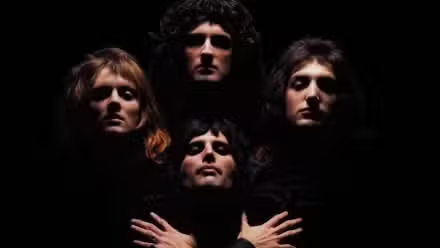
Winning a Grammy is one of music’s highest honors, but the Recording Academy is also famous for its history of controversial snubs. And classic rock hits are no exception. Unlike when The Beatles took home the coveted award at the 9th Annual Grammy Awards in 1967 for their hit song “Michelle” that was featured on their 1965 album Rubber Soul. However, over the years, so many legendary songs have lost Record of the Year to songs that have long since faded from the conversation while the “snubs” went on to give us some of the biggest and influential hit records of all time. Looking back, it’s hard to see how the Grammys made their choices.
From Beatles classic hits to arena-filled Queen anthems, these songs topped the Billboard Hot 100 and defined entire generations. They may have been overlooked on music’s biggest night, but their legacy has only grown bolder with time. Here are the 10 biggest classic rock hits that never won Record of the Year.
10
“The Boys Are Back in Town” by Thin Lizzy
Not many classic rock songs have the same melodic vibe as Thin Lizzy‘s “The Boys Are Back in Town.” The song was built around Brian Robertson and Scott Gorham’s unforgettable guitar skills, but the song was equally cinematic in its storytelling. The song does a perfect job of painting vivid pictures of old friends, past hometown bars and those magical nights you’ll always remember. Phil Lynott’s cool vocals give the song a personality unlike any other that makes it anything but a simple song.
The song peaked on the Billboard Hot 100 charts at No. 12 when the song was released in 1976. It was the lead single from Jailbreak. This became the Irish rock band’s signature hit song that introduced them to audiences around the world. But, despite its cultural impact, the song lost at the 1977 Grammy Awards to George Benson’s “This Masquerade.” However, almost 50 years later, “The Boys Are Back in Town” still blasts through stadium speakers, movie soundtracks and classic rock radio playlists with the same electrifying energy.
9
“Carry On Wayward Son” by Kansas
Progressive rock music has produced many songs but very few have crossed into the mainstream, like Kansas‘ “Carry On Wayward Son.” From the track’s instantly recognizable intro to its blaring guitar solos, the song packs an incredible amount of complexity into a song that makes it feel like it was meant to be a sing-along. Kerry Livgren’s lyrics about searching for meaning give the record an emotional weight that separates it from so many other classic rock songs from that era.
The song peaked on the Billboard Hot 100 at No. 11 in 1977. The song became Kansas’ breakout hit from Leftoverture, which helped establish the band as one of the most pivotal acts of 1970s rock. The song would go on to earn a nomination for the 1978 Grammy Awards but lost to Debby Boone‘s “You Light Up My Life.” Decades later, “Carry On Wayward Son” is still one of the most beloved songs in classic rock. For a band that never reached No.1 on the Billboard Hot 100, this song became a timeless classic that’s never gone out of style.
8
“Go Your Own Way” by Fleetwood Mac
The collapse of the relationship between Lindsey Buckingham and Stevie Nicks was not going to wallow in heartbreak when it was left up to Buckingham. Fleetwood Mac’s “Go Your Own Way” turned heartbreak into a bold rock anthem that was fueled by raw emotion and one of the most unforgettable choruses of the 1970s. Mick Fleetwood’s drumming pushes the song into this ultimate sense of controlled chaos that took personal turmoil and turned it into a grand performance.
“Go Your Own Way” peaked at No. 10 on the Billboard Hot 100 in 1977. It was released as the lead single from their iconic album Rumours, which helped turn the album into one of the biggest commercial successes in rock history. Just like Kansas’ “Carry on Wayward Son”, Fleetwood Mac lost to Debby Boone’s “You Light Up My Life” that year. However, you can’t listen to classic rock radio and not hear Fleetwood Mac’s iconic song. The song continues to live on in streaming playlists and live performances almost 50 years later after its release.
7
“Sweet Home Alabama” by Lynyrd Skynyrd
Some songs become hits and others become part of a place’s identity. “Sweet Home Alabama” by Lynyrd Skynyrd is clearly cemented in both. The hit song began as a response to Neil Young’s criticism of the American South, but it evolved into one of the most recognizable rock songs ever recorded. The opening guitar riff makes the song feel instantly familiar and there is a sense of warmth that washes over when the beginning chords, infused with blues, begin. The song feels infectious and that has made it impossible to ignore all of these years later.
The hit song peaked on the Billboard Hot 100 at No. 8 in 1974. The song gave Lynyrd Skynyrd their biggest hit, and it helped establish Southern rock as a force to reckon with. In 1975, the song earned the Record of the Year nomination but ultimately lost to Olivia Newton-John’s “I Honestly Love You.” While the Recording Academy chose a softer ballad as the winner, history has largely sided with Lynyrd Skynyrd. “Sweet Home Alabama” has become a cultural phenomenon of a song that even if you don’t listen to the genre as a preference, you definitely know this song.
6
“More Than a Feeling” by Boston
Boston’s “More Than a Feeling” is one of the most instantly captivating songs to ever be recorded. Tom Scholz spent years crafting the layered guitars, harmonies and spotless production that created a song that didn’t sound like anything else on rock radio in the mid 1970s. But at the core of the song, is the wistful reflection on memory and lost love the song provides. It’s as if the song transports you back into time.
In 1976, Boston’s “More Than a Feeling” peaked on the Billboard Hot 100 at No. 5. As the lead single from Boston’s self-titled album, “More Than a feeling” pushed the band into stardom and became one of the defining songs of the classic rock era. In 1977, the song received a nomination but lost to George Benson’s “This Masquerade.” Despite losing, Boston’s hit song has cast a longer shadow between the two. The influence of this song can be heard in generations of artists who followed. And nearly 50 years later, the song still stands as a how some songs have just become timeless.
5
“Bohemian Rhapsody” by Queen
It’s impossible to think of rock music without thinking of Queen’s legendary hit “Bohemian Rhapsody.” A six-minute epic song that doesn’t have a traditional chorus, with an opera-style middle section with one of Freddie Mercury’s greatest vocal performances of all time. The song broke almost every rule when it comes to the traditional layout of a song. On paper, there is no way this song should have worked. However, Queen decided to make one of the boldest statements in music, proving that audiences would like this type of record when backed by perfect songwriting and production.
“Bohemian Rhapsody” peaked on the Billboard Hot 100 at No.9 and spent a total of 19 weeks on the charts. What makes the Grammy’s treatment of this song so surprising isn’t that it lost Record of the Year. Because it never got the chance. Despite this iconic song becoming an international sensation and single-handedly redefining what a rock single could accomplish, the song wasn’t nominated for the award at all. It feels criminal and, looking back, the omission of the song makes it as shocking as the other losses on this list. “Bohemian Rhapsody” has since become one of the most celebrated songs ever. However, in 2004, the song was inducted into the Grammy Hall of Fame and has continuously topped “the greatest songs of all time lists.”
4
“Sweet Child O’ Mine” by Guns N’ Roses
If you ever find yourself thinking of iconic guitar riffs, Guns N’ Roses “Sweet Child O’ Mine” has to be at the top of that list. Not every rock song announces itself with a roaring power chord and ultimately gifts us one of the most famous guitar riffs ever written. The song unfolds into a love song that is unlike anything Guns N’ Roses had released before. The song was inspired by Axl Rose’s relationship with Erin Everly and displayed the band’s gritty attitude to love without sacrificing an ounce of their edge.
Luckily, the gamble paid off in a major way. “Sweet Child O’ Mine” peaked at No.1 on the Billboard Hot 100 in 1988. The song would go on to become the band’s only No.1 hit, but this introduced them to an even bigger audience and officially cemented the band as one of rock’s biggest acts. However, despite the massive success and lasting influence, the song lost the 1989 Grammy Award to Bobby McFerrin’s “Don’t Worry Be Happy.” Although McFerrin’s song is truly beloved as a moment in pop culture, “Sweet Child O’ Mine” has stretched far beyond that. Nearly four decades later, it’s still the song that defined Guns N’ Roses and one of the most recognizable tracks out there.
3
“American Pie” by Don McLean
From the beginning, this song had a lot of things working against it. Don McLean’s “American Pie” is more than eight minutes long, radio stations rarely embraced playing songs of that length, and its poetic and packed lyrics left audiences trying to interpret their meaning. However, this is exactly what made Don McLean’s song a masterpiece. Instead of just stating things plainly, McLean wanted to take listeners on a musical mystery ride when talking about nostalgia and cultural change with the loss of innocence. The track’s lyrics are still being dissected almost 50 years later, which proves how timeless the storytelling remains.
The risk paid off for this iconic song, released in 1971. “American Pie” climbed all the way to No.1 on the Billboard Hot 100 and stayed there for four weeks. It was nominated for the 1973 Grammy Award for Record of the Year but lost to Roberta Flack’s “The First Time Ever I Saw Your Face.” Flack’s classic earned its acclaim, but McLean’s song grew into one of those rare songs that feels less like a hit single and more like a shared piece of American culture. The song has been sung by generations that have disagreed on the actual meaning of the song, but that is part of what makes this song a masterpiece. This is many decades later and the song still holds such power and fascination, making the Grammy snub one of the most memorable.
2
“Hotel California” by Eagles
Ever had a song that left you with questions, and it kept pulling you back to find them? That’s the true magic of “Hotel California.” Since its release, fans have spent decades debating the song’s true meaning, which has varied between interpretations about fame, the music industry, the American dream and excess. Don Henley and Glenn Frey left much of the symbolism behind the lyrics open-ended, which allowed for listeners to find something different with those haunting lyrics. Bring in Don Felder’s unforgettable guitar work, and you have a song that becomes more fascinating after each listen.
“Hotel California” was released on the Eagles‘ legendary album of the same name in 1976. The song peaked at No. 1 on the Billboard Hot 100 for one week, while the album spent eight non-consecutive weeks at number one on the Billboard 200. The song earned a nomination for the 1978 Grammy Award but ultimately lost to Debby Boone’s “You Light Up My Life”, suffering the same fate as Fleetwood Mac and Kansas on this list. Despite only one song being able to take home the coveted award, no one can deny the impact “Hotel California” has had, especially with its closing solo, which is often called the greatest recording ever. “Hotel California” has only become more legendary with time.
1
“Hey Jude” by The Beatles
Some songs are instant hits that you know will become a classic. While others slowly earn that title over time, “Hey Jude” by The Beatles somehow managed to do both. The song was written by Paul McCartney for John Lennon’s son Julian, during his parents’ divorce and what started as a deeply personal message evolved into one of the most uplifting songs in rock history. The gentle encouragement, the skyrocketing melody and the unforgettable “na-na-na” finale took this simple ballad to new heights. This song is a great example of how joy brings people together by having them sing along, whether it’s in a stadium, around a campfire or through their own headphones.
“Hey Jude” became The Beatles’ biggest hit single when released in 1968. The song peaked at No.1 on the Billboard Hot 100 and broke records by spending 9 weeks at No. 1. The song would go on to sell 8 million copies worldwide and become The Beatles’ longest-running chart-topper in the United States. But despite this massive success, the song lost the 1969 Grammy Award for Record of the Year to Simon & Garfunkel’s “Mrs. Robinson.” This “snub” is often considered one of the biggest in Grammy history. The song remains one of the Beatles’ defining achievements, regularly appearing on lists of the greatest songs ever written. If there is a single song that proves Grammy victories don’t determine greatness, it’s “Hey Jude.”

Influencer Jen Hamilton has responded to fans hoping to see her star in a new season of The Bachelorette.
“They do not want me and this is why,” Jen, 35, began in a hilarious Instagram video shared on Sunday, August 2, that responded to a fan advocating for her to be featured in the reality TV dating series.
The social media star, who announced her split from her husband, Brian Hamilton, in June, continued with various vignettes that poked fun at her potential place in the show. “Don’t miss the most dramatic season of The Bachelorette ever. Featuring Jen Hamilton who we did not vet but got lots of comments about,” she said in a sarcastic voice-over before staging would-be meetings with suitors.
“Hi, my name is Jen, what do you like to do? Run? That’s what you can do, that way, thank you for coming,” she said. “A beach date? Did ya’ll … research me first? I’m built different than my predecessors. There’s no drawers that cover it alls.”

Influencer Jen Hamilton shared another emotional video after sparking speculation that her marriage to husband Brian is over. “OK, no crying,” she began in a TikTok posted on Monday, June 15, which she captioned, “The ‘statement.’” Hamilton continued in her video: “I’m feeling embarrassed and feeling exposed and feeling sad, feeling every single thing you […]
Fans took to the clip’s comments section to share praise for Jen’s tongue-on-cheek content, including former Bachelorette Katie Thurston who threw support behind what she saw. “Just say the word, and I’ll give you a direct number,” Thurston, 35, wrote, attracting more than 400 “likes.”
Another fan wrote, “I mean, I’d watch this season,” while another added, “Divorced Mom edition 😂the only season I want to watch.”
Four days prior, Jen shared a similarly hysterical Facebook video that attracted another call for her Bachelorette debut. “Something tells me when you’re ready to get back on the market, you will have a plethora of eligible suitors. Maybe Jen should be the next Bachelorette?” the fan wrote, attracting almost 7,000 thumbs up and heart responses.
Influencer Jen Hamilton shared details of her split from estranged husband Brian Hamilton. “While I was at the hospital, taking care of people, he found the time to have a whole other life. As someone who’s never even passionately kissed anyone else in my entire life, this has broken me beyond comprehension,” Jen, 37, said […]
Jen’s new Instagram video comes days after she seemingly shared a text exchange with her estranged husband. After telling Brian that she will “always love” him, he appeared to write, “Thank you for being you. Losing you is the dumbest thing I’ve ever done.”


Brian then appeared to continue, “I don’t want to leave you in rubble. I want all of you guys to be in my life.” (Jen and Brian share two sons, Ellis and Luke, though it is unclear who Brian was allegedly referring to in the text.)
Jen appeared to respond, “You already have.”
After the former couple confirmed their split via a joint Instagram statement, Jen has since accused her ex of leading a “double life” with a 56-year-old woman behind her back.
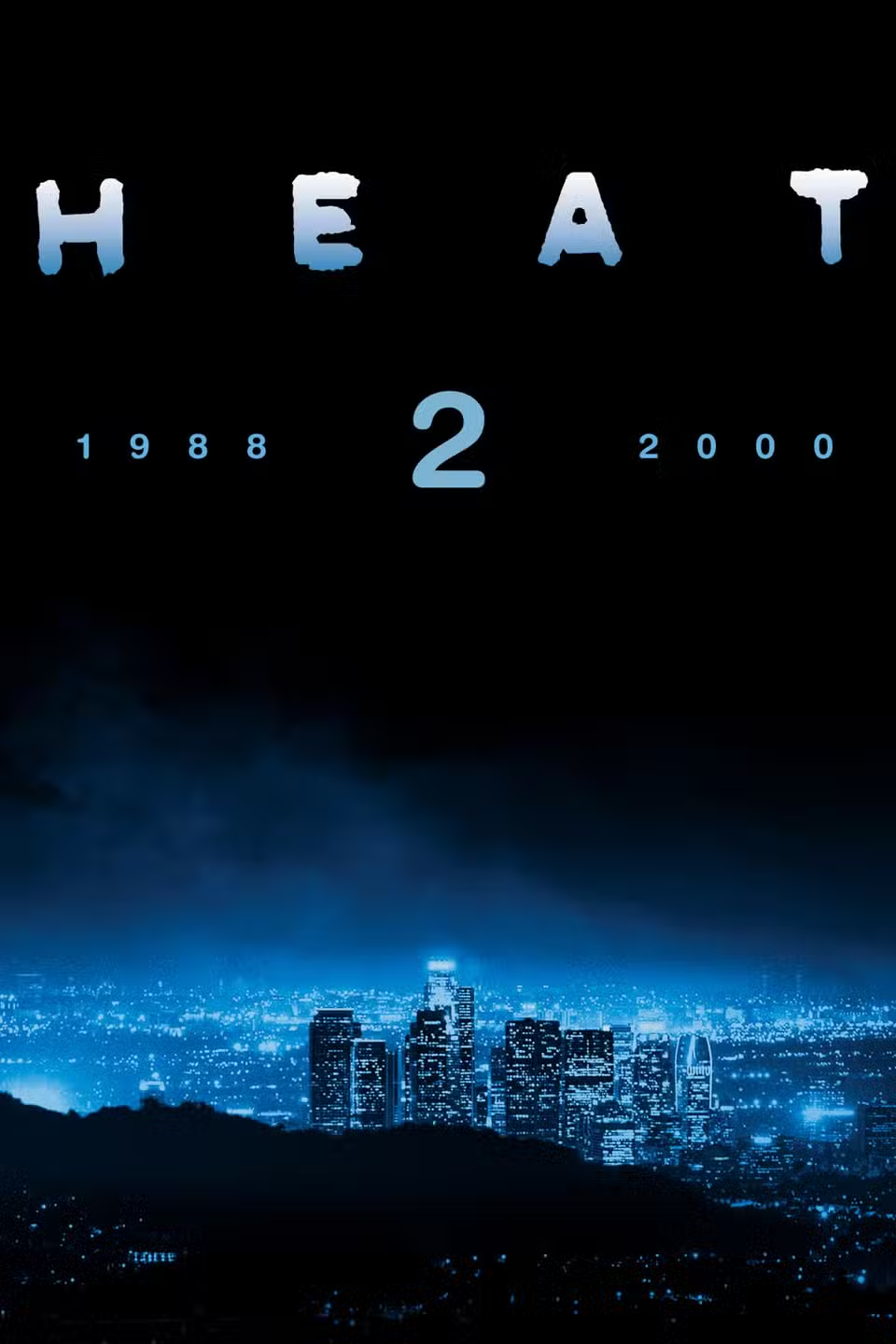
Michael Mann’s Heat 2 is among the highly anticipated movies that were announced in the last few years. The director follows up his 1995 crime thriller of the same name based on the best-selling novel he co-wrote with Meg Gardiner, which serves as both a prequel and sequel. The feature has changed many studios, going from Warner Bros. to Paramount, Sony, and finally Amazon MGM.
Heat 2 has roped in a stellar cast including Leonardo DiCaprio and Christian Bale. Their roles were revealed previously, with Bale set to fill Al Pacino‘s shoes and take the lead as detective Vincent Hanna, while DiCaprio will step into the shoes of the late great Val Kilmer‘s character, Chris Shiherlis, the lone survivor of Neil McCauley’s (Robert De Niro) crew. Further, Stephen Graham is set to take on Robert De Niro’s role, while long-rumored Adam Driver was reportedly in talks to embody Otis Wardell, the serial killer who has haunted Vincent since the 1980s.
However, with most top-line talents set in place, the feature has been in development hell for a while, given Mann wanted a bigger budget than Warner Bros.’ desired $125 million, per a new report. That became one of the main reasons for Heat 2 to change studios. Eventually, the project landed at Amazon Prime, which also took creative control of the James Bond franchise recently.
‘Heat 2’ Will Begin Production This Year
Now Heat 2 is ready to go on the floor, as the report confirms, “with production scheduled to begin in November and Bale and DiCaprio fully onboard, ‘Heat 2’ has reached its final form.” The feature will be backed by F1 producer Jerry Bruckheimer alongside Mann, United Artists’ Scott Stuber, and Nick Nesbitt. As for the scope of the movie, it hasn’t shrunk at all and “features action sequences that dwarf the first film.” And that’s saying something because Heat has a legendary heist/gunfight that was so realistic that law enforcement agencies use it in training exercises.
The makers are expecting Heat 2 to be a global hit: “’Heat 2’ could do for men of different ages what ‘Barbie’ did for women,” a source revealed. “It won’t reach the same box office, but it could easily approach more than $500 million which would make the film profitable theatrically and then a huge hit for Amazon on their platform.”
No release date has been confirmed for Heat 2. Stay tuned to Collider for more such updates.

- Director
-
Michael Mann
- Writers
-
Meg Gardiner, Michael Mann
- Producers
-
Jerry Bruckheimer, Art Linson, Michael Mann, Nick Nesbitt, Jan Pance, Scott Stuber
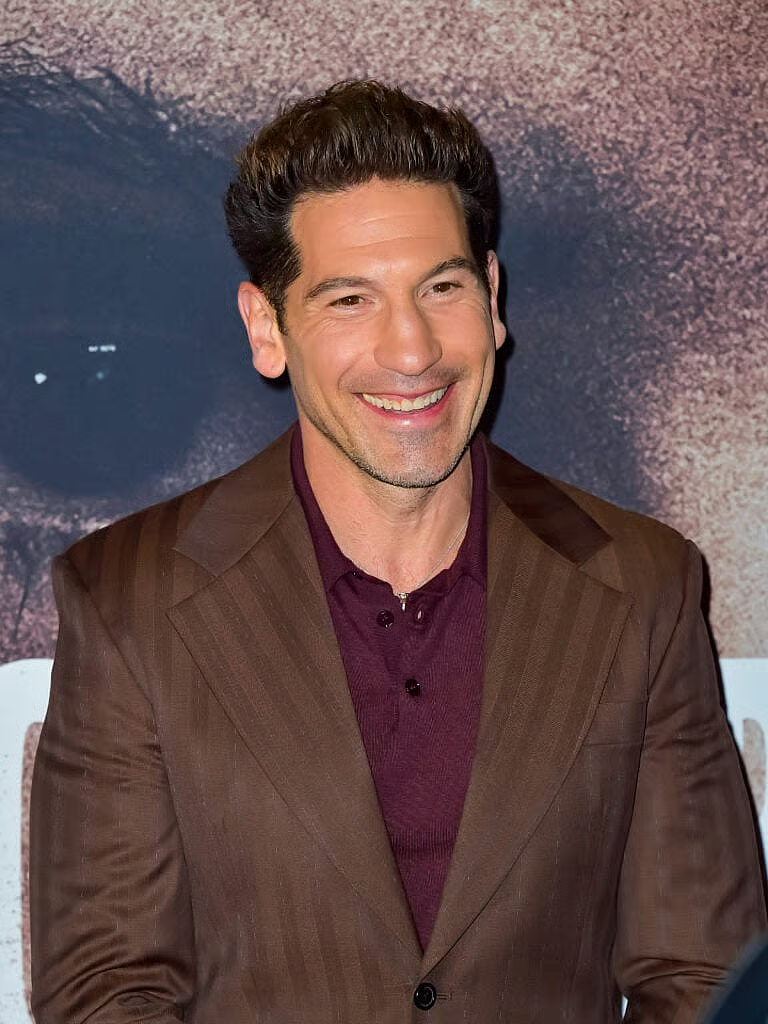
A clip from a 2017 interview with Jon Bernthal is making the rounds online, bringing renewed attention to the actor’s passionate defense of pit bulls. In the resurfaced footage, the “Punisher” star argues that fear of the breed is rooted in unfair stereotypes, even going so far as to describe it as “dog racism.” His past comments have reignited online discussion about the stigma surrounding the dog breed.
On August 1, “The Howard Stern Show” reuploaded a 2017 interview featuring actor Jon Bernthal, in which he defended pit bulls. The resurfaced clip quickly gained traction, with numerous media outlets and social media accounts highlighting his remarks, turning them into a trending topic online.
The conversation turned to pit bulls when Howard Stern asked the actor about a 2009 incident in Venice Beach. Bernthal was arrested following an altercation with a drunk individual who attempted to grab his pit bull. The actor punched the man, who ended up unconscious after hitting his head on the ground.
Stern asked why his pit bull didn’t attack, to which Bernthal answered, “My dogs are the greatest, and they’re unbelievably well trained.” He further added that the stereotype against pit bulls being aggressive is just “dog racism.”
“To be afraid of a breed of dog is completely ridiculous. It’s like being afraid of somebody for their race or their sexual orientation,” Bernthal told Stern.
The Actor Placed The Responsibility On Dog Owners
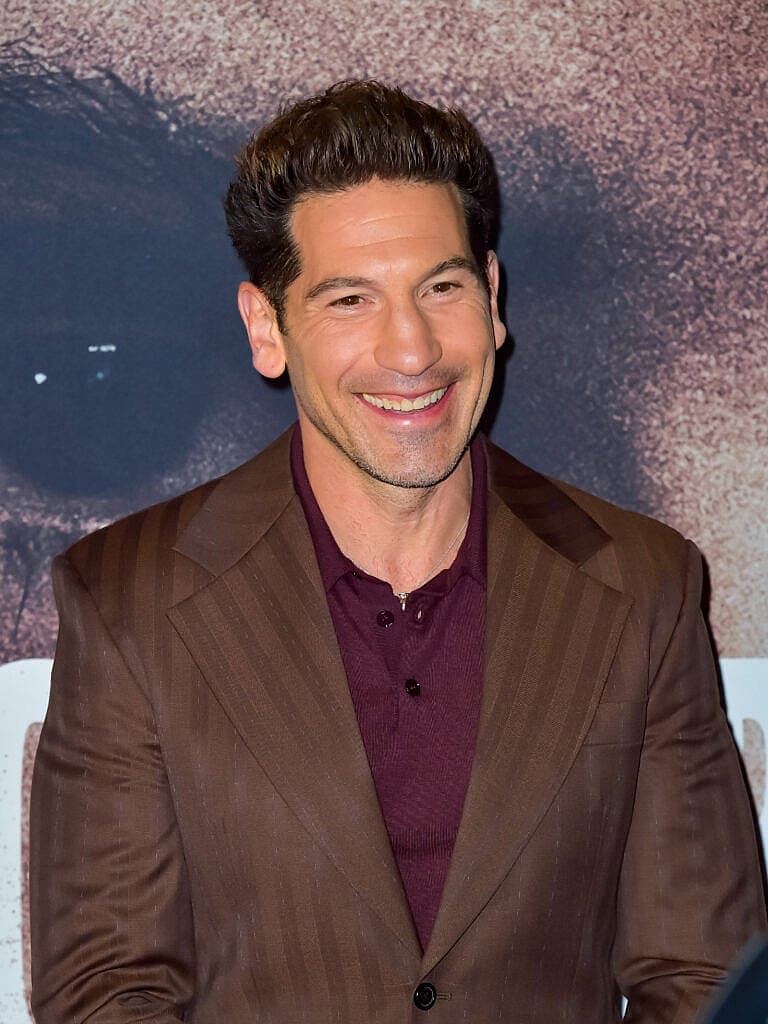
Bernthal admitted that it would “suck” to be bitten by a pit bull. However, he claimed that “they’re no more likely to bite you than a chihuahua or any other breed of dog.”
Moreover, the actor believes that a dog’s behavior depends largely on its owner and how it is raised and trained, regardless of the breed. “I think that a lot of knuckleheads, unfortunately, are attached to that breed of dog,” he added.
The resurfaced clip sparked an online debate. While many agreed with his view, others argued that genetics also play a role. One said mixed breeds are responsible for many attacks, but when it comes to specific breeds, “pit bulls are by far the most dangerous.” One person commented, “If you meet a pit bull who’s an a-shole it’s because an a-shole human taught them to be an a-shole.”
Jon Bernthal Is An Advocate For Pit Bulls
Bernthal has long been vocal about his love of pit bulls. In 2014, he shared that he often traveled by car to work instead of taking a plane, as he wanted to bring his pit bulls, Boss and Venice, with him.
“They’re beautiful. They’re sweethearts,” the actor said, adding that apart from them being his best friends, he wanted to change the public’s perception about the breed. “It’s pretty sick and twisted how people feel about them a lot of the time, and my dogs are total sweethearts,” he told Live Science.
In 2015, Bernthal, who starred in “The Walking Dead” for two seasons in 2010 to 2012, said there wasn’t a day when his dogs were not on set with him, and they were also his companions to meetings and auditions. “Our dogs are part of our family,” he said, per CBS News.
The Actor’s Father Served As Chair For The Humane Society
Bernthal isn’t the only one in his family advocating for pit bulls. His father, Eric, served as chair of the board of directors for the Humane Society of the United States (HSUS) until 2019.
In 2012, the Maryland Court of Appeals declared pit bulls and pit bull mixes “inherently dangerous” breeds. Through his leadership, Eric and the HSUS fought the decision and called out Maryland lawmakers for issuing a “death warrant” for thousands of dogs in shelters. The court ruling was overturned, and a new breed-neutral bill was enacted.
Bernthal credited his father for inspiring his passion for dogs, especially pit bulls, saying Eric “loved dogs to an insane level.”
Fatal Dog Attack Statistics
The role of breed in dog attacks remains a divisive issue, with pit bulls and Rottweilers at the center of discussion.
In 2025, there were 84 reported fatal dog attacks in the U.S. and Canada, with 64 involving dogs identified as pit bulls. Despite the statistics, several studies have shown that a dog’s breed does not correlate to its aggression.
Both the Centers for Disease Control and Prevention (CDC) and the American Veterinary Medical Association (AVMA) have previously warned against breed-specific fatality statistics, as they often rely on visual identification, which may be inaccurate.
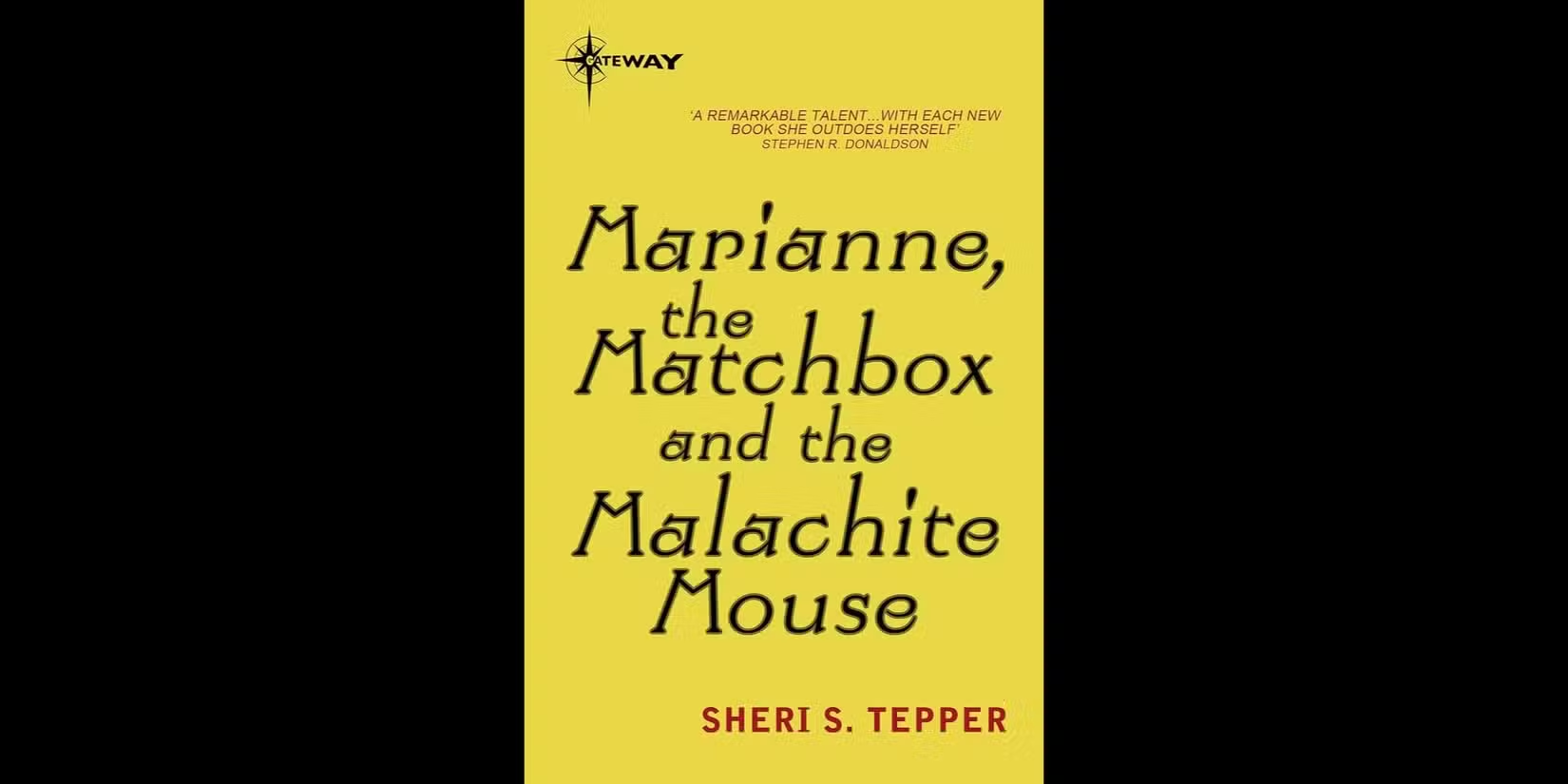
Many of history’s greatest fantasy books go on to receive exactly as much love and praise as they deserve. Inevitably, however, the years have seen many other exceptional works of fantasy literature which have been all but forgotten, even though they’ve only gotten better with age. Of course, saying that they’ve been “forgotten” is a bit of an exaggeration for dramatic effect, but there’s no denying that these great fantasy books haven’t been read by nearly as many people as they deserve.
These are, through and through, some of the greatest fantasy books of their time. Some of them are the work of huge names in fantasy literature like Ursula K. Le Guin and her Powers. Others are by considerably smaller names, like Katharine Kerr‘s The Silver Mage, the most tragically forgotten fantasy books of all time have all aged like the finest of wines. No matter their origin, these fantasy books are worthwhile and unworthy of their forgotten status.
‘Marianne, the Matchbox and the Malachite Mouse’ (1989)

The winner of several big awards and one of the most prolific authors of feminist speculative fiction of her generation, Sheri S. Tepper was nothing short of an absolute legend. Marianne, the Matchbox and the Malachite Mouse is one of her best works, the final installment in the Marianne trilogy, where the titular character’s magical past begins to feel like a distant dream while she struggles in the real world.
But even though it’s one of Tepper’s best works, it’s still one of the most underappreciated fantasy novels of the ’80s. It’s a really strong ending to the series, one that’s every bit as creative as it is emotionally satisfying. Tepper finds ways to introduce fresh new ideas to the world of Marianne even as it’s coming to an end, all through the wit and fast pacing that makes her voice as an author so unique.
‘Powers’ (2007)

Ursula K. Le Guin is one of the greatest and most important authors of speculative fiction of the 20th and 21st centuries, and over her illustrious career, she wrote several of the best fantasy books and book series the world has ever seen. One such series is the YA trilogy Annals of the Western Shore, whose conclusion is the exceptional Powers, following a young boy raised as a domestic slave who can see the future.
Thankfully for fantasy readers not looking to get into a full new series right now, each book in Annals of the Western Shore follows a different main character, making Power—the best of the bunch—easily understandable by itself. It’s one of those fantasy books better than most movies out there, a nuanced exploration of freedom and power that even those who don’t typically love YA fantasy should consider reading.
‘Myth Conceptions’ (1980)

Robert Asprin isn’t exactly a mainstream literary fantasy giant, which makes the discovery of his work all the more satisfying. He was arguably best known for his comedic work, his amusing Myth Adventures series in particular being one of the most enjoyable fantasy comedy book series of not just the 20th century, but perhaps of all time. Myth Conceptions, the second installment, where a court magician has to oppose the world’s mightiest army, is the best of the bunch.
Asprin’s writing style across the whole Myth Adventures series is delectably accessible and amusing, and Myth Conceptions in particular blends Asprin’s universally appealing sense of humor with some surprisingly deep worldbuilding and razor-sharp dialogue. It’s not high art, but anyone who loves their fantasy with a hearty side of puns and banter is pretty much guaranteed to love this underrated gem.
‘Sword-Dancer’ (1986)

Well-known for her work in both fantasy and historical fiction, Jennifer Roberson isn’t a particularly big name outside of niche fantasy fan circles, but she absolutely deserves to be. For reasons why, one needn’t look further than Sword-Dancer, the first chapter of the Tiger and Del series. In it, a legendary mercenary and a mysterious warrior team up on a dangerous rescue mission across the desert.
It’s one of the most near-perfect fantasy books nobody remembers, a really underappreciated book written by a really underappreciated fantasy author. Led by a pair of deeply compelling characters and told with a sense of adventure that fans of the genre can always appreciate, it’s a page-turner that should be perfectly able to get anyone instantly hooked on Tiger and Del.
‘The Silver Mage’ (2009)

Many fantasy book series run for several years and many installments, but Katharine Kerr’s Deverry Cycle, a sweeping narrative of Celtic fantasy spanning several centuries, is on a whole other level. A whopping 23 years after the publication of Daggerspell, the first novel in the series, came the fifteenth installment, The Silver Mage. It’s the highest-rated chapter in the series on Goodreads, and for good reason.
Of course, getting to this point in the Deverry Cycle already means that the reader has fallen in love with the world of Deverry deeply enough to read fifteen books’ worth of it. But even if one were to (for some reason) start here, The Silver Mage would still be an incredible novel in its own right. The writing is hugely accessible, different arcs and plot lines are brought to deeply satisfying conclusions, and the bits of Celtic folklore are the cherry on top.
‘Dragonsong’ (1986)

When a story blends elements of science fiction and fantasy, it’s referred to as science fantasy. It’s the genre that has given us some of the greatest sci-fi and fantasy novels of all time, including the awfully underrated Dragonsong by Anne McCaffrey. It’s the third installment in the 24-novel Dragonriders of Pern series, and it’s also one of the best fantasy books of the last 50 years.
Even older readers ought to consider adding it to their library, because it really is that good of a book.
As one of the best YA fantasy books of its time, Dragonsong is the perfect bridge for younger science fantasy readers to transition into more mature novels. And yet, even older readers ought to consider adding it to their library, because it really is that good of a book. With its richly detailed worldbuilding, heroic protagonist, and deeply emotional story, it’s a wonderful piece of uniquely ’80s-y fantasy literature.
‘The Dying Earth’ (1950)

It’s not just younger readers who deserve great fantasy books, but grown adults too; and as far as underappreciated fantasy books for adult readers go, it doesn’t get much more timeless than the 76-year-old book The Dying Earth. It’s the first (and best) chapter of the book series of the same name by Jack Vance, a collection of science fantasy short stories set in a distant future when humanity is disappearing, and civilization is decaying.
Part post-apocalyptic, part fatalistic adventure, and part sword-and-sorcery gem, The Dying Earth is easily one of the best fantasy books of the 1950s. It was considerably praised upon release and even went on to influence elements of Dungeons & Dragons, and yet, it has faded into relative obscurity over the years. Even still, it has aged like fine wine, blending science and magic in ways so delightfully creative that they’re also endlessly re-readable.
‘The High King’ (1968)

The fifth and final installment of Lloyd Alexander‘s The Chronicles of Prydain series, The High King is top-tier children’s fantasy from the mid-20th century. It is, indeed, one of the best books of the 1960s when it comes to fantasy for the smallest readers of the family, and it’s even hugely enjoyable for fans of the genre who are well into their adult years.
The book delivers powerful character arcs, sky-high and wonderfully emotional stakes, and a timeless message about heroism that you always expect from a Hero’s Journey tale like this one. Today, The High King remains a childhood classic for many readers even after almost six decades of its publication—but that’s still not nearly as big of an audience as it deserves.
‘Troy: Lord of the Silver Bow’ (2005)

David Gemmell was a master of heroic fantasy and has proven to have been massively influential over the years, yet his Troy trilogy still doesn’t deserve even a fraction of the love and praise it deserves. The series is historical fiction just as much as it is fantasy, and its opening installment, Troy: Lord of the Silver Bow, just so happens to be the best of the three.
It’s a fantastic introduction to Gemmell for those unfamiliar with him. Like the rest of the author’s work, Lord of the Silver Bow blends highly stylized depictions of violence and brutal combat with deeply layered character development and vivid worldbuilding. It’s a book that’s just as much of a must-read for fantasy fans as it is for history buffs.
‘Tigana’ (1990)

Canadian writer Guy Gavriel Kay is one of the most accomplished names in the modern history of fantasy literature. He revolutionized historical fantasy and helped Christopher Tolkien edit J. R. R. Tolkien‘s The Silmarillion, and yet there are those who’d argue that his biggest achievement is Tigana. This masterful high fantasy epic follows a band of rebels seeking to overthrow a pair of rival tyrants.
It’s one of the best fantasy books of the 1990s, hugely elevated by Kay’s lyrical, poetic, absolutely gorgeous prose. Within a single tightly-paced book, you get the thematic and emotional scale of an entire epic saga of fantasy novels. That’s just the kind of artist that Kay was. Complex, creative, and bittersweet, Tigana is a must-read for anyone who loves fantasy.
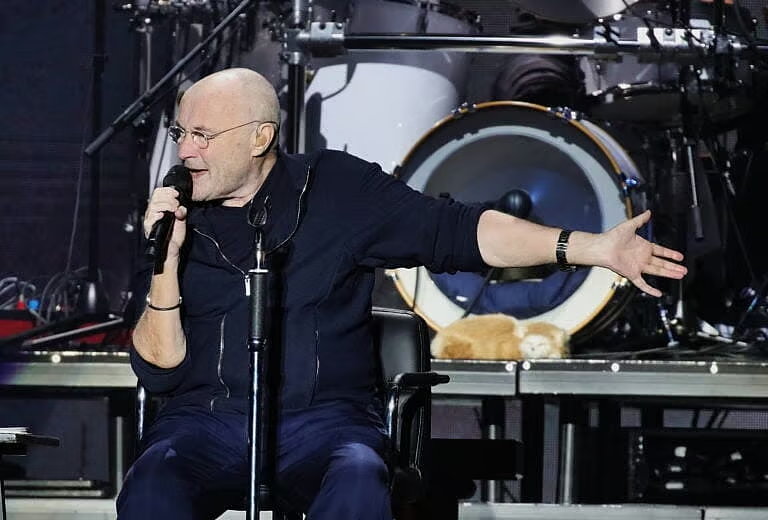
Phil Collins has enjoyed one of the most celebrated careers in music, first rising to fame as the drummer and later the lead singer of Genesis before launching a successful solo career. The musician concluded his final tour in 2022, and at 75 years old, he is reflecting on the frightening health scare he had in 2024 that left him believing he was nearing the end of his life.
Phil Collins has faced a number of health challenges over the past two decades that have significantly affected his ability to perform. Among them is a spinal injury that caused mobility issues and a few knee surgeries.
In 2023, the singer was more than a decade sober before he had a relapse that eventually sent him to the hospital in 2024 for alcohol addiction and organ failure. His health was in such dire condition that he was placed on life support, and his family and close friends were called to say goodbye.
“My kidneys were packing up, my organs were just seizing up. People were coming to say goodbye,” Collins told The Sunday Times. Admittedly, he said he was mostly unconscious at that time, but noted that those who were closest to him feared it was the end. “It could all have gone so terribly wrong,” he said.
All The Singer’s Five Children Were By His Bedside
Collins added that important decisions had to be made, such as whether to keep him on life support. All of the drummer’s children visited him to say their final goodbyes.
He has been married three times and is the father of five children. He shares Joely and Simon with his first wife, Andrea Bertorelli. He later welcomed daughter Lily Collins, best known for starring in “Emily in Paris,” with his second wife, Jill Tavelman. With his third wife, Orianne Cevey, he has two sons, Nicholas and Mathew.
Fortunately, he went on to recover. “I haven’t had a drink since,” he proudly shared. His recuperation wasn’t swift, though, as he spent seven months in a hospital in Switzerland.
Phil Collins Years For Companionship
Collins is currently based in Switzerland and has a live-in nurse who helps care for him following his health crisis. The singer admitted that he would like to find love again and misses certain parts of being in a relationship.
“I’d love to be in love again. I would love a relationship. Kissing somebody, for example. You know, pretty basic stuff,” the singer confessed.
Following his split from his third wife, he entered a relationship with news anchor Dana Tyler in 2007, which lasted until 2020.
At his age, however, Collins said love may no longer be in the cards for him. “I think it’s probably too late for that. I’m not a very social person. I don’t you know, I don’t go out,” he said.
Lily Collins Wrote An Open Letter To Her Father
Lily didn’t always have a close relationship with her father, which he detailed in her 2017 memoir “Unfiltered: No Shame, No Regrets, Just Me.” The actress said her bond with Collins deteriorated after her parents’ divorce.
Lily also penned an open letter to him in the chapter “A Letter to All Dads,” in which she later realized that many of her insecurities stemmed from “issues” with her father. “I forgive you for not always being there when I needed you and for not being the dad I expected. I forgive the mistakes you made,” she wrote.
The father and daughter have since mended their relationship, and Collins shared that he spent the New Year in London with family and Lily. “I have a wonderful relationship with Lily now. So everything has a happy ending, most of the time,” he said.
Phil Collins Is Not Closed Off To Performing Again
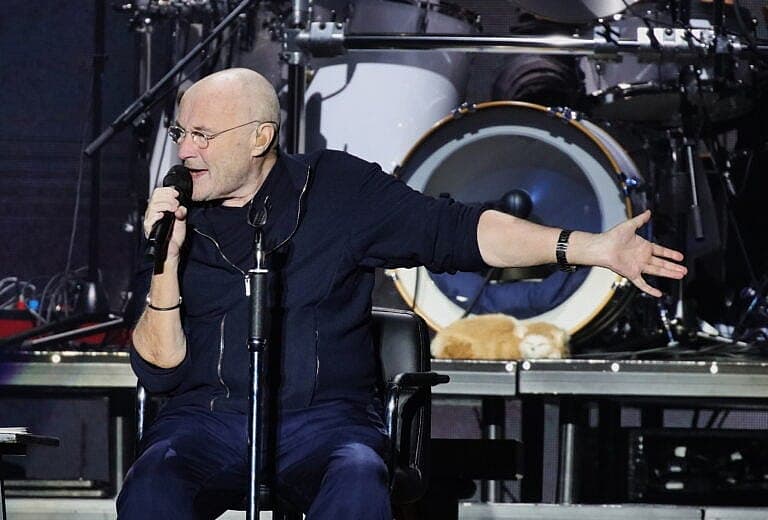
Collins last performed at “The Last Domino? Tour” in 2022 with Genesis. At that time, he announced his retirement due to multiple health issues.
In May, however, Collins shared a positive update on his health, revealing that he feels the healthiest he has in a long time. The musician has unfinished songs and ideas that he’s toying with, as well as a few finished works, and he isn’t opposed to the idea of returning to the stage. “I would contemplate… I’m constantly saying to myself, I better go back down to my studio at home,” he said.
Collins will be inducted at the Rock & Roll Hall of Fame for a second time in November, this time in recognition of his solo career.
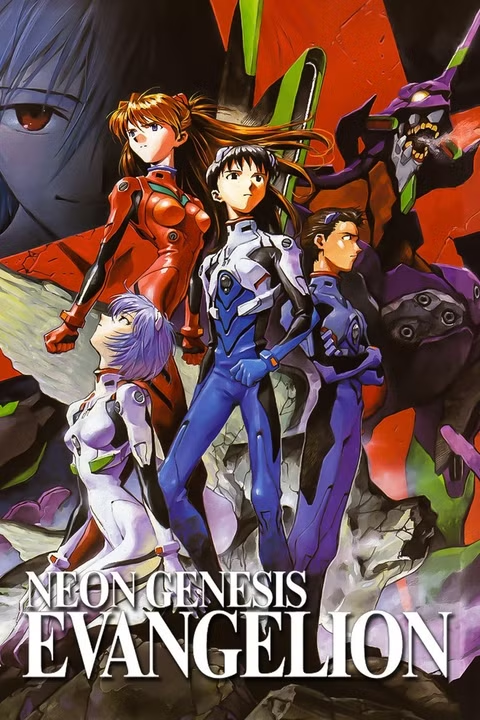
In the mid-1990s, a groundbreaking mecha series emerged from producers Gainax and Tatsunoko Production, forever changing the sci-fi genre. Set in the year 2015, 15 years after a devastating global catastrophe, the anime follows a reluctant teenage boy who is recruited by his estranged father to pilot a mysterious biomechanical weapon against monstrous creatures called Angels that threaten humanity.
Running for 26 episodes between October 4, 1995, and March 27, 1996, Neon Genesis Evangelion remains one of the greatest anime series ever made. It debuted to widespread critical acclaim and today holds a rare 100% Certified Fresh critics’ score on Rotten Tomatoes, alongside an 89% audience score. Over the past three decades, the series has profoundly influenced anime and sci-fi while remaining one of Japan’s most commercially successful multimedia franchises through television, films, merchandise, and home video releases.
Now, one of the most essential sci-fi anime ever made is heading to a new streaming home. According to Polygon, Neon Genesis Evangelion will arrive on The Criterion Channel on September 1, 2026, through a partnership with North American distributor GKIDS. The collection will include three entries from the franchise. First is the original 26-episode series, available in the Japanese dub and the original English dub, the latter streaming officially for the first time. Also included is Evangelion: Death (True)², the 1998 feature-length recap film, and The End of Evangelion, the acclaimed 1997 movie that serves as the alternate conclusion to the OG series.
The Legendary Mecha Series Has Aged Like Fine Wine
Directed by Hideaki Anno, Neon Genesis Evangelion concluded with two famously divisive episodes that many viewers found confusing. In response to the mixed reception, Gainax released The End of Evangelion, written and co-directed by Anno, which has since become one of the most celebrated anime films ever made.
Anno later revisited the franchise with the four-film Rebuild of Evangelion series, released between 2007 and 2021. Rather than serving as straightforward remakes, the films gradually branch off from the original story before delivering an entirely new conclusion. While the Rebuild films will not be part of Criterion Channel’s lineup, they are available on Prime Video until they leave the service in mid-August.
Neon Genesis Evangelion arrives on The Criterion Channel this September. Stay tuned to Collider for the latest entertainment news.

- Release Date
-
1995 – 1996
- Network
-
TV Tokyo
- Directors
-
Keiichi Sugiyama, Masahiko Otsuka, Tensai Okamura, Shoichi Masuo, Minoru Ohara, Seiji Mizushima, Tetsuya Watanabe, Ken Ando
- Writers
-
Akio Satsukawa, Yoji Enokido
-
Megumi Ogata
Shinji Ikari (voice)
-
Kotono Mitsuishi
Misato Katsuragi (voice)
Taking charge of a beloved franchise is no mean feat, but to try to turn around the fortunes of a sinking cinematic ship is much harder. This was the task Dan Trachtenberg had to undertake when he was given the keys to the Predator franchise, looking to bring back quality and refresh the IP for a new generation. Trachtenberg started impressively with Prey in 2022, which earned a pair of Critics’ Choice Awards. He then followed with the animated Predator: Killer of Killers last year, but his biggest task came later in that same year with Predator: Badlands.
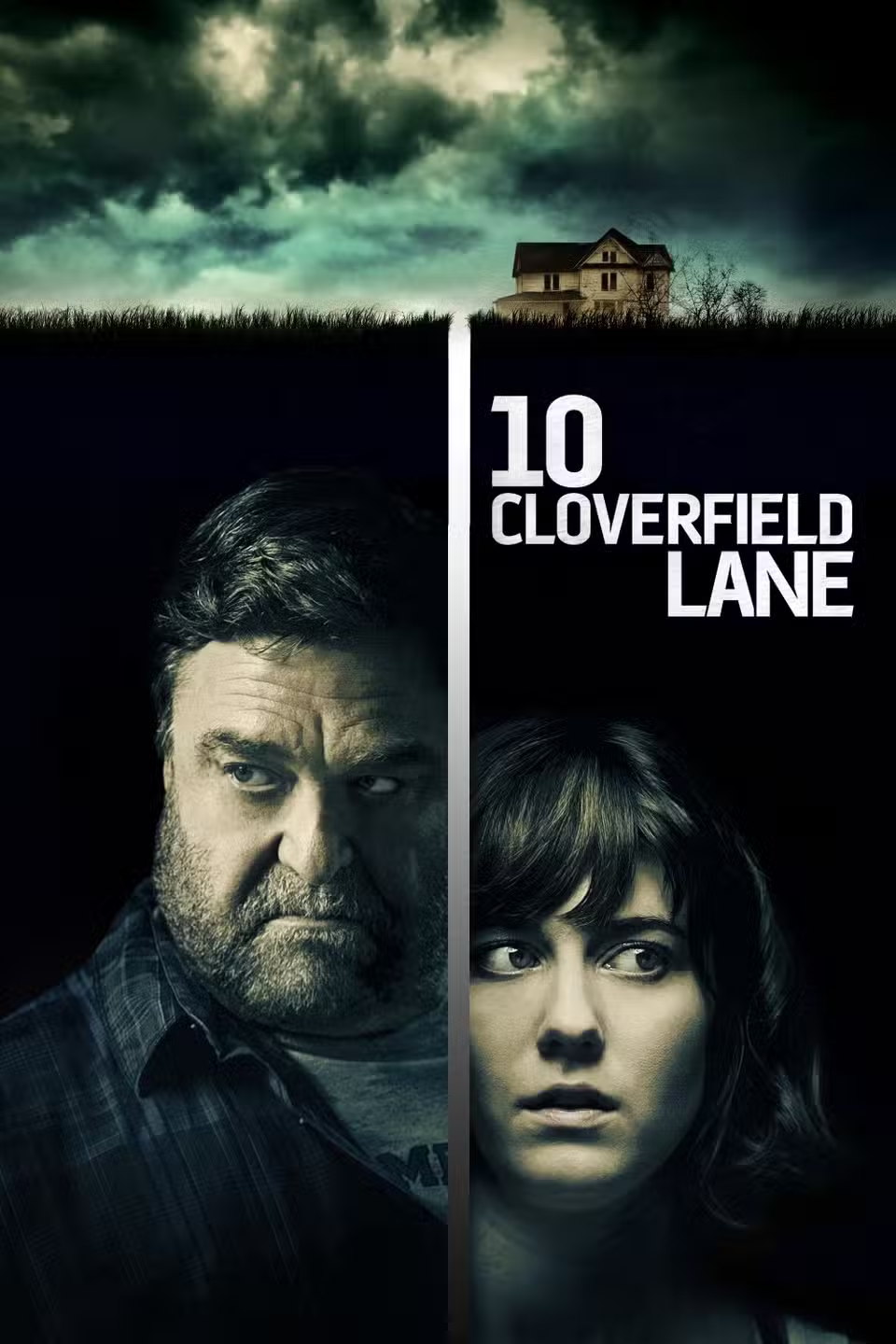
The film might’ve flopped at the box office, earning just $184.6 million against a $105 million budget, but the reaction from both critics and audiences was overwhelmingly positive, represented by an 86% critics’ score and 94% audience score on review aggregator Rotten Tomatoes. After three movies, it was clear that the future of the franchise was at least in creatively fresh and exciting hands with Trachtenberg, the sort of freshness that was obvious to anyone who enjoyed the director’s 2016 debut, 10 Cloverfield Lane.
Although in much less high-profile circumstances, 10 Cloverfield Lane saw Trachtenberg take charge of another franchise following the success of 2008’s Cloverfield. Unlike Predator: Badlands, 10 Cloverfield Lane was a notable box office triumph, turning a small $15 million production budget into $108 million worldwide. The film follows Michelle (Mary Elizabeth Winstead), who is kept in a bunker by Howard (John Goodman), a man who convinces her that the world outside has been ravaged by aliens. If you’re a fan of Trachtenberg’s work on Predator but haven’t seen his debut, then you’re in luck, as 10 Cloverfield Lane is available to stream on Paramount+ this month.
Dan Trachtenberg Directed an Episode of a Smash Hit Sci-Fi Series
Trachtenberg hasn’t just unleashed his sci-fi prowess on the big screen. In 2016, he directed the Season 3 episode of Black Mirror, “Playtest,” which follows an American traveler (Wyatt Russell) who signs up to test a revolutionary game to try and earn some cash. However, when the game starts to blur the line between reality and nightmare, the walls of his mind begin to crumble. A perfectly shocking, uncanny episode of Black Mirror, “Playtest” is a gem among the series’ vast catalog.
10 Cloverfield Lane is available to stream on Paramount+ this month. Make sure to stay tuned to Collider for the latest streaming stories.

- Release Date
-
March 10, 2016
- Runtime
-
103 Minutes
- Director
-
Dan Trachtenberg
Nothing in this world is perfect; at least, that is what everyone says. It is hard to argue with this, because even in a lot of people’s favorite medium, anime, there are dozens of fantastic but flawed works. Films such as Princess Mononoke and Paprika are legendary works, but they do have a handful of flaws that hold them back from being perfect.
However, that doesn’t mean it is impossible, because this list will highlight ten anime movies that don’t have any flaws in their own respect. Based on aspects such as consistency, pacing, animation, writing, directing, influence, critical acclaim, and overall quality, fans will have a tough time finding things to complain about in these films. These movies have genuinely become institutions of the medium, being perfect as long as they achieve what they set out for.

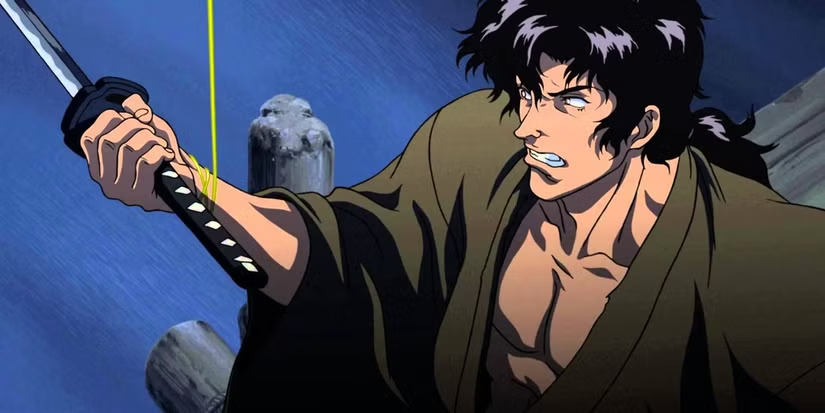
Kicking off this list is an underrated classic that fans either love or haven’t heard of: Ninja Scroll. Jubei is a swordsman for hire who wanders around the feudal country looking for work. After getting involved with a woman and her revenge story, he tries to clean his hands of it, but her enemies have different plans, thrusting him into a government conspiracy where he will meet an old friend.
Truth be told, Ninja Scroll doesn’t have the best story; it is rather predictable and bland. Some might view that as a flaw, but the simplicity gives way to what the movie really aims to accomplish: fight scenes galore! The animation and art are absolutely stunning, and this visual masterclass makes each fight scene just as striking, with plenty of thrills and riveting moments that make this simple but effective revenge tale one of the best action anime movies.
‘Redline’ (2009)

A lot of the movies on this list are narrative masterclasses, but films such as Redline are all about the animation and exhilaration. JP finally gets his chance to star in the titular race that he has always dreamed of, but the host planet was forcefully chosen, and they don’t want the race to expose their secret weapons, prompting them to try and stop all the racers before they cross the finish line.
Some movies are flawless because of a handful of aspects, but Redline is perfect because what it does, it does well. This movie is a high-octane experience from start to finish, and when it speeds up, it doesn’t slow down. Redline is a beloved anime film that fans enjoy simply because of the flawless animation and exhilaration that can make viewers overdose on hype-inducing moments.
‘Look Back’ (2024)

Tatsumi Fujimoto is an acclaimed manga author best known for his hit series, Chainsaw Man, but he has also delivered a handful of one-shots which have been turned into movies, including Look Back. Fujino was always passionate about art, but when one of her classmates was better than her, she dropped it completely. After the two would-be rivals meet each other, her passion reignites, beginning a lifelong friendship.
It may be shorter than most movies, but it is precisely because of that tight pacing that Look Back becomes a flawless anime film. The dynamic and relationship of the two characters is an absolute wonder, going through highs and lows of tragedy and redemption, ending in a bittersweet manner that proves why Fujimoto is one of the best modern mangaka.
‘The Night is Short, Walk on Girl’ (2017)

Some of the best avant-garde anime movies come from Masaaki Yuasa, including The Night is Short, Walk on Girl. An unnamed protagonist has a crush on one girl who only believes in fate, so to win her over, he tries to convince her that their love is fated. Trying to get her a childhood book, he works tirelessly to win her over as she continues her walk down the red string of fate, seeing what the world brings next.
This movie has a visual style unlike any other, proving to be a stunning display of style and art that hooks viewers with its vibrant colors and uniqueness. The Night is Short, Walk on Girl isn’t just a piece of eye candy, but it also has a profound message hidden beneath its fascinating love story. It may be a forgotten anime film, but it is still perfect and a must-watch.
‘Spirited Away’ (2001)

Studio Ghibli is the most acclaimed anime studio of all time, so it is only natural that their magnum opus, Spirited Away, earns a spot on this list. When a young girl and her family move to a new house, they find an amusement park behind it. When her parents are turned into pigs, she must travel into the supernatural hot springs resort in order to find the witch capable of reversing the curse.
As one of the most popular and renowned anime movies, there is no denying that Spirited Away is without flaws. Influence aside, it is a perfect display of hand-drawn animation that is so incredibly detailed it almost feels impossible. Plus, with a whimsical vibe, charming aesthetic, and a relatable coming-of-age story, Spirited Away is a family-friendly movie that anyone can, and will enjoy.
‘Ghost in the Shell’ (1995)
A new anime series came out remaking the iconic series, but the film of Ghost in the Shell is still the definitive version. Motoko Kusanagi is the leader of an elite squad that deals with cyber-terrorism events, and the latest case involves a mysterious killer that erases the memories of their victims. However, when the mystery gets personal, will Motoko keep her cool?
Like a lot of movies on this list, Ghost in the Shell is a visual spectacle that highlights its animation prowess through a hand-drawn style. Its original worldbuilding, philosophical themes, and thought-provoking discussion have made it a timeless story that only gets more relevant as time passes. As technology improves and society progresses, Ghost in the Shell proves to be timeless and ever-iconic.
‘A Silent Voice’ (2016)

Some of the best anime movies are high school dramas, and A Silent Voice is arguably the most flawless of the bunch. Years ago, Shouya used to bully a girl in school for being deaf, and years after she left, he still carried the guilt. However, when they are reunited again, he aims to right his past wrongs and redeem himself.
A Silent Voice displays one of the best examples of character development in anime, and to do that in a movie is even more impressive. This touching tale will have viewers bawling by the end of it, showcasing its emotional story, achieved through visual and thematic storytelling that further enhances the messages and themes. It all leads to a satisfying and uplifting ending, the ultimate cathartic conclusion.
‘Akira’ (1988)

When it comes to the most influential anime movie, it usually comes down to Spirited Away and Akira, with the latter also being a perfect film. Decades after a nuclear explosion destroyed the world, a rebuilt Neo-Tokyo is now a corrupt hellhole. When a biker gang gets involved in a government conspiracy, one of the members gains strange powers that could destroy the city again.
Akira was the film that put anime on the map in the West, also proving that it could be a serious and mature medium instead of simple entertainment for children. This technical masterpiece used 24 frames per second, which added a visceral weight to the movement and action. Akira is one of the best anime films of the past 50 years, and it didn’t earn that status by having any flaws.
‘Grave of the Fireflies’ (1988)

Akira wasn’t the only flawless anime movie to come out in 1988; It was paired with Studio Ghibli’s second film on this list, Grave of the Fireflies. After the bombing of Hiroshima, a boy and his little sister wander the wasteland in search of food, water, and anything else they will need to survive, but it may already be too late.
As opposed to other Studio Ghibli films, Grave of the Fireflies is a deeply tragic, depressing, and bleak movie that is a departure from the usual formula. It removes the suspense of wondering if they will survive and replaces it with a hollow feeling of knowing what will happen. Grave of the Fireflies is a grim depiction of the war and a defining anti-war experience that will haunt anyone who watches it.
‘Perfect Blue’ (1998)

Satoshi Kon was a legendary director who passed away too soon, but he left an untouchable legacy, including his best film, Perfect Blue. Pop idol Mima wants to break out into the acting industry, but after leaving her group, they begin to gain popularity. Not only that, but a stalker throws Mima into a spell of psychosis, unable to tell reality from fantasy anymore.
It may be confusing at times, but Perfect Blue‘s editing is entirely intentional, creating a disoriented feeling that puts viewers in the shoes of Mima, having them question what is real and what is fake. This brilliant tactic added to the thought-provoking nature and immersion of the story, creating a compelling anime movie that aged like fine wine. Perfect Blue has a tight pace and non-stop thrills that make it the best of the best.

Robert Irwin has suffered an injury to his face during a crocodile research trip in northern Australia.
The Dancing With the Stars: The Next Pro host, 22, shared a gruesome selfie that captured his injury via a Sunday, August 2, Instagram Story. “Tree: 1, Robert: 0,” Robert wrote over the photo which showed blood dripping down his nose and soaked through his khaki shirt.
The DWTS season 34 champion, who is currently traveling through the Steve Irwin Wildlife Reserve in Australia’s Far North Queensland, had previously shared via his Instagram Stories that he is camping in the remote Cape York Peninsula for one month while tackling his annual crocodile research expedition. (The reserve was established in 2007 to honor Robert’s late father, Steve Irwin, and his animal conservation efforts before he died at the age of 44 in 2006.)
As part of his trip, Robert built a crocodile trap, per footage shared via his Instagram Stories, and examined large crocodile footprints as well as spotting multiple crocodiles lurking in the water.
“We’re back on our annual crocodile research trip in remote northern Australia. First things first, it’s time to find signs of where crocs have been,” Robert captioned a Saturday, August 1, Instagram video of himself finding a muddy crocodile footprint. “It doesn’t get better than a footprint like this, what a whopper.”
Robert’s mom, Terri Irwin, took to the video’s comments section to provide context surrounding Robert’s annual adventure. “We are learning so much with our crocodile research. It’s the longest running telemetry study, helping us find out where they travel, nest, and go to escape extreme flooding events. We have discovered they can hold their breath more than eight hours, how their body temperature affects their movements, and that they can travel more than 60km per day,” Terri, 62, wrote. “It’s really exciting to be able to provide so much new data on these gorgeous animals!”

Robert Irwin Courtesy of Robert Irwin/Instagram
Just a few days prior, Robert shared behind-the-scenes footage of himself on the set of his DWTS spin-off reality series as the host continues to juggle U.S. showbiz pursuits with his animal conservation work in Australia, where he was born.
In January, he opened up to The West Australian about how he splits his time between the southern and northern hemisphere. “Being in L.A. for the last three months has been wonderful, but I am not a city kid,” Robert admitted at the time. “I live out in the bush and have grown up there, so it’s good to be back where there’s a bit of greenery.”
Last month, he shared a video of himself at the Irwin family’s Australia Zoo while holding a baby freshwater crocodile for the camera. “You can hear the vocalizations that he’s making, he’s only a young fella so at this size, he’s making those cute little frog noises,” he told fans in the July 22 clip alongside a caption that read, “How cute are those little squeaks?!”

Tech47 seconds ago
5 Harbor Freight U.S. General Toolboxes & Storage Products You Can Only Buy In-Store

News Videos1 minute ago
XRP AND ELON MUSK PARTNERSHIP??!! (XRP JUMP TO $680 SPECULATION?!)

NewsBeat5 minutes ago
Transfer news LIVE: Arsenal close in on Vinicius Jr deal, Man Utd target left-back, Guimaraes to have medical


-

 Business5 days ago
Why Trees Belong on the Risk Register
-

 Fashion3 days ago
Weekend Open Thread: Wit & Wisdom
-

 Politics3 days ago
Meta enters AI-training agreement with far-right ‘propaganda rag’ Newsmax
-
 Entertainment6 days ago
‘Stargate’ Creator’s New Sci-Fi Series Returns for Season 3 Tomorrow
-

 Crypto World2 days ago
MicroStrategy Post-Earnings CLARITY Act Push Could Add New Catalyst for Its Stock
-

 Politics6 days ago
The Part of the Electric Transition Nobody Wants to Discuss
-

 Business5 days ago
Major shareholder moves on Canyon
-

 Crypto World2 days ago
XRP Ledger v3.3.0 brings five institutional features
-

 News Videos4 days ago
Bitcoin Enters the 3rd Stage of the Bear Market
-

 Crypto World6 days ago
Kraken Enables Retail Access to Jersey Mike’s IPO via Tokenized Shares
-

 Tech6 days ago
New macOS Sequoia & Sonoma security updates for older Macs
-

 Politics4 days ago
Luke Littler’s dominance sparks GOAT debate
-

 News Videos6 days ago
Claude: Build Financial Dashboards in Minutes (2026)
-

 Business6 days ago
Johnson & Johnson agrees to $5.5B settlement over talc cancer claims
-

 Sports3 days ago
Seema Kaliramna Wins Discus Throw Bronze, Takes India’s CWG Medals Tally To 17
-

 Crypto World1 day ago
Crypto PAC spending tops $2M in Michigan House race
-

 Business3 days ago
Trump Announces Hamas Disarmament Agreement as Iran Strikes Kuwait Air Base and US Attacks Pause Overnight
-

 Tech5 days ago
Gemini can now summarize the messiest comment threads in Google Docs
-

 Tech1 day ago
ESET tracks rise in malicious AI skills and adaptable malware
-

 News Videos5 days ago
LIVE: XRP BULL RUN CONFIRMED! Donald Trump & Brad Garlinghouse Discuss Ripple
You must be logged in to post a comment Login