

Crypto World
Venga secures MiCA license as Europe’s crypto market faces regulatory reset



Disclosure: This article does not represent investment advice. The content and materials featured on this page are for educational purposes only.
Venga obtains a MiCA license from Spain’s CNMV, which lets the Barcelona crypto firm operate under the EU’s new regulatory framework.
Summary
- Venga secures MiCA authorization from Spain’s CNMV before Europe’s crypto transition period reaches its deadline.
- MiCA requires crypto providers to meet stronger standards for governance, security, reporting, and customer protection.
- Industry data cited shows only about 194 firms secured MiCA approval by May 2026 overall.
Venga has received authorization from Spain’s Comisión Nacional del Mercado de Valores to operate as a Crypto-Asset Service Provider under the European Union’s Markets in Crypto-Assets Regulation. The Barcelona-based company announced the approval on July 1, 2026. The Venga MiCA license allows the firm to provide regulated crypto-asset services under the EU’s new framework.
Venga MiCA license marks regulatory milestone
The authorization places Venga among a limited group of crypto firms approved under MiCA. The company, founded in Barcelona in 2023, said the approval follows nearly two years of work across its business.
“Obtaining the MiCA license is a major milestone for Venga and the result of nearly two years of work across every area of the business,” said Michael Stroev, co-founder and CEO of Venga. He said the process required investment in governance, compliance, security, reporting systems, and operational processes.
Spain’s CNMV granted the authorization as the European crypto market moves into a new phase of oversight. MiCA sets common rules for crypto-asset service providers. These rules cover governance, capital adequacy, operational resilience, cybersecurity, risk management, customer protection, and internal controls.
The license also gives Venga a route to passport its services across the European Union. The company can expand beyond Spain while operating under one regulatory framework.
MiCA authorization changes market standards
MiCA represents a broad regulatory reset for crypto assets in the European Union. The framework moves the sector away from earlier national registration systems. It requires companies to meet operating and supervision standards.
The transition period is ending on July 1. Crypto companies that relied on older national registrations must secure MiCA authorization or stop offering regulated crypto-asset services within the European Union. The change may force some providers to suspend activities, transfer clients, or leave certain European markets.
A report by crypto.news showed that more than 3,000 crypto firms were registered across the European Union before MiCA took effect. About 194 firms had secured MiCA authorization as of May 2026. That gap points to a smaller authorized market under the new rules.
The approval comes during consolidation in the European crypto sector. Firms that meet MiCA standards can operate under ongoing supervision. Firms that do not receive approval face limits on their ability to serve EU customers.
oversight expands for crypto-asset service providers
Authorized providers under MiCA face continuous regulatory duties. These include supervisory obligations, periodic reporting, annual audits, and oversight by national authorities. Those authorities apply standards coordinated by the European Securities and Markets Authority.
“For users, MiCA introduces a level of regulatory accountability that has not previously existed across much of the European crypto sector,” Stroev said. He added that authorization is not a one-time event and that licensed firms must continue to meet operational, financial, and customer protection requirements.
The new structure may change how users assess crypto platforms. Under MiCA, users can check whether a provider has authorization under the EU framework. That status shows whether the firm must follow the required safeguards and reporting rules.
Venga said the authorization confirms that it has built its business for the regulatory framework that will define the future of crypto services in Europe. The company aims to make digital assets accessible through a regulated platform available in Spanish, Catalan, and English.
Disclosure: This content is provided by a third party. Neither crypto.news nor the author of this article endorses any product mentioned on this page. Users should conduct their own research before taking any action related to the company.


The Erik Voorhees-founded Venice AI has achieved unicorn status after raising $65 million in Series A funding at a $1 billion valuation.
Led by Dragonfly and with backing from Coinbase Ventures, F-Prime, North Island Ventures, Morgan Creek and others, the funding round announced on Wednesday marks the company’s first external capital raise since launching in 2024.
The fundraising came in the same month Anthropic was forced to suddenly cut foreign access to two of its latest AI models, and comes just weeks after OpenAI was accused in a class-action lawsuit for sharing ChatGPT data with third parties, highlighting the potential appeal of privacy-focused AI platforms.
“This capital will be used to uphold the First and Fourth Amendments to the Constitution as they relate to mankind’s interaction with AI,” Voorhees said in an X post on Wednesday.
The First Amendment is part of the United States Constitution protecting five essential freedoms including the freedom of speech. The Fourth Amendment protects people from unreasonable searches and seizures by the government.
Venice AI courts privacy-focused users
Venice AI, which claims to have 3.5 million users, offers access to over 200 AI models but adds a proxy between the user and the models and allows users to choose the level of privacy they want.
For models from OpenAI, Anthropic, xAI and Google, the proxy obscures users’ IP address, account and session data. Other models offer higher levels of privacy.

Source: Erik Voorhees
“Control over intelligence is the defining fight of the coming decade,” Haseeb Qureshi, managing partner at Dragonfly, said on Wednesday.
“Whoever owns the AI delivery stack owns a direct window into your interior life. They log all your chats, train on them, and will hand them over when asked. And in the end, they decide the terms on which you’ll get to access the most powerful systems humankind has ever built.”
Voorhees said the capital will be used to further build out its own data center infrastructure, owning the GPUs that power its platform rather than being forced to rent them at higher costs.
The remaining capital will be used to grow its customer base, enter new markets, hire talent and acquire “additive businesses,” he added.
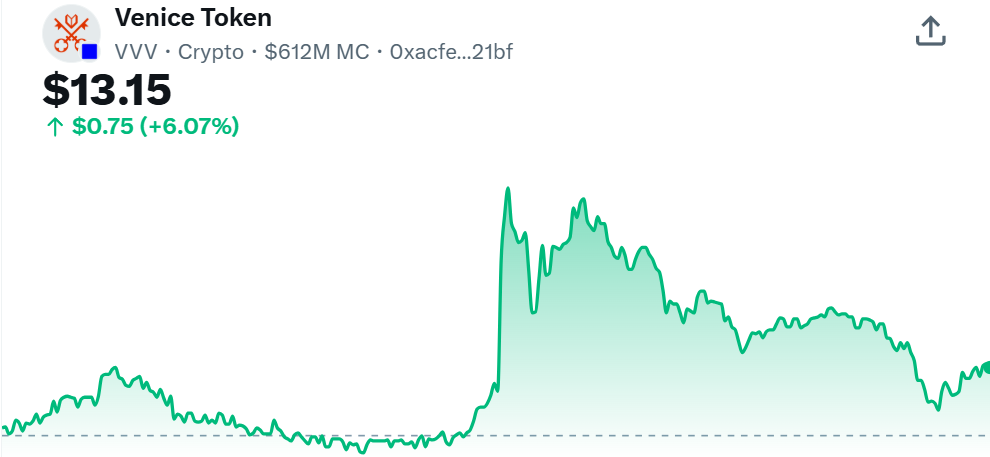
Venice Token rose 6% on Wednesday. Source: X
AI privacy concerns in spotlight
The capital raise comes amid mounting concerns over user privacy when using AI models.
Earlier this year, lawyers told Cointelegraph that a user consulting an AI for legal matters could have their chat logs used against them in court.
Related: AI’s power crunch turns Bitcoin miners’ grid access into an asset
In February, Ethereum Foundation AI lead Davide Crapis and Ethereum co-founder Vitalik Buterin proposed a way to use zero-knowledge proofs and other methods to ensure that a user’s interactions with large language models are private.
Conversations about privacy when using AI were stirred again in May, when a proposed class action was filed in California federal court accusing OpenAI of disclosing private ChatGPT user data to Google and Meta.
The complaint alleged that OpenAI embedded Meta Pixel and Google Analytics into the ChatGPT.com website, so that when a user sends a query, the website allegedly sends duplicate data to Meta and Google alongside advertising cookies and personally identifiable information, which is then used to target advertisements to the user.
Magazine: Bitcoin slides to $58K, XRP hits $1 but onchain data promising: Market Moves
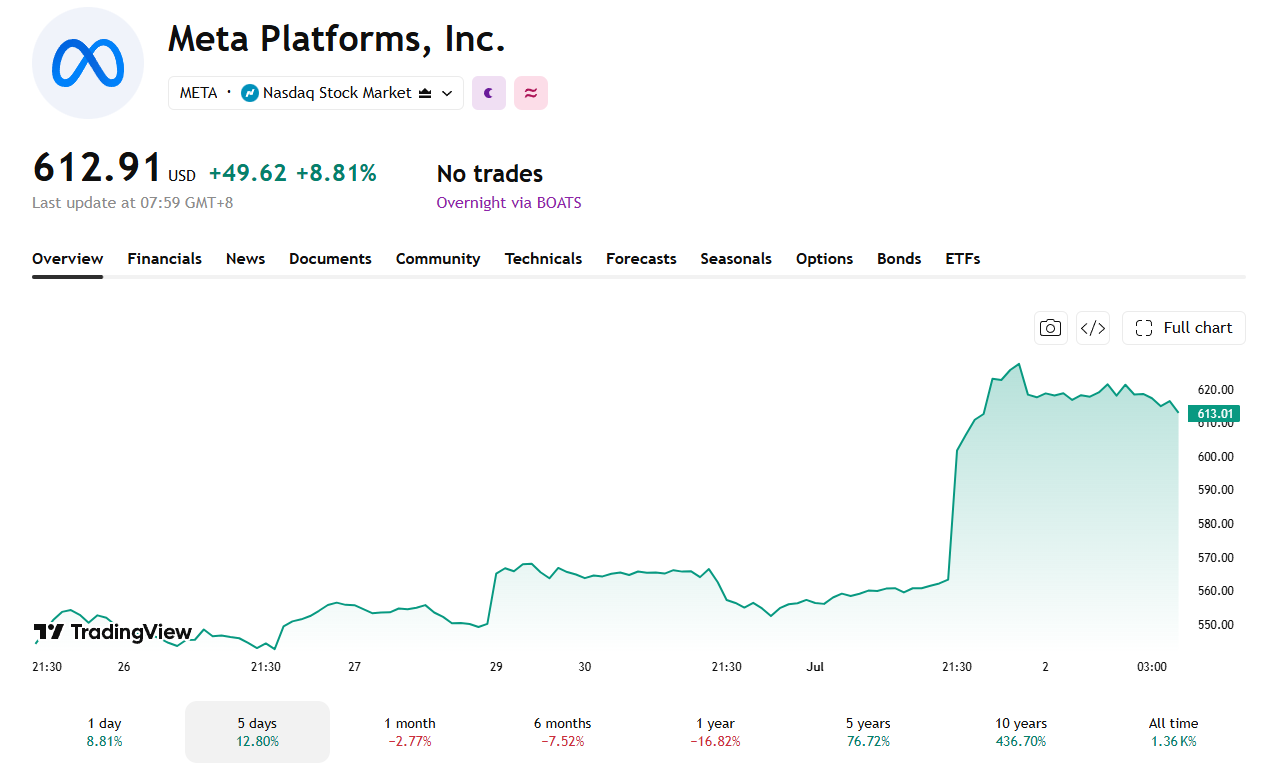
Meta’s plan to sell surplus computing power hit chip stocks hard on Wall Street. Meta’s own shares climbed nearly 9% on the news.
The announcement flipped years of assumed AI compute scarcity into a supply warning. It erased billions in semiconductor and neocloud value in a single session.
A Supply Signal Rattles Wall Street
Meta is building a business called Meta Compute. The unit will lease idle data center capacity to outside clients. The approach mirrors SpaceX’s model. SpaceX has rented spare capacity to firms including Anthropic.

For years, investors rewarded chip suppliers on one premise. They believed AI demand always outstripped supply. Meta’s admission of excess capacity broke that premise. Recent Nvidia institutional money flow data already show large investors pulling back.
Micron sank more than 10% on July 1. SanDisk, Intel and AMD each lost between 6.9% and 10.6%. Nvidia slipped just 1.25%, a modest decline that stood out against the broader rout.
Neoclouds and Big Tech Diverge
CoreWeave and Nebius rent GPU capacity to AI developers and saw their stocks fall 14% and 17% respectively on fears that Meta will undercut their pricing.
Meta has paid for similar cloud services before, but its shift into the same business now puts it in direct competition with its own vendors.
Other Magnificent 7 members gained ground. Apple, Microsoft, Amazon, Alphabet and Tesla all closed higher as some strategists link the split to AI spending cycle winners rotating away from pure hardware plays.
South Korea Feels the Spillover
The sell-off spread to Asia as Samsung and SK Hynix memory stocks fell more than 7% and 9% respectively in early trading and the KOSPI triggered another trading halt. The move extended a pattern from a prior Big Tech selloff spillover that hit Asian chipmakers earlier this year.
The post Meta Compute Launch Sends AI Compute Stocks Tumbling Globally appeared first on BeInCrypto.


Modern day crypto trading has become a deeply fragmented battleground that favors the institutional algorithms and punishes the retail trader. On one hand, there are high-frequency funds exploiting total visibility over public order books; on the other hand, ordinary market participants are forced into transparent matching pools where their pending stop-losses are openly hunted. Ouinex, a community-backed multi-asset platform, is trying to eliminate this structural asymmetry to shield retail orders from predatory manipulation.
Summary
- Ouinex says its Fair Execution Engine separates retail orders from institutional liquidity providers to reduce exposure to predatory trading strategies.
- The platform combines crypto markets with stock indices, commodities, forex, and equities through one interface with leverage of up to 500x.
- Ouinex says its OUIX token excludes venture capital allocations and uses trading based incentives instead of early institutional distribution.
For retail crypto traders, the core operational hurdles boil down to having to pit their personal portfolios against institutional-grade execution power, which creates a highly uncompetitive scenario where the everyday investor is structurally outmatched from the start. That’s the technological disparity Ouinex is trying to address.
“If I’m an institution that has 20 traders working around the clock with a trading infrastructure that is worth multi-million dollars with low latency, and I’m trading against the retail guy that’s sipping a coffee at Starbucks on his Wi-Fi, who do you think is going to win the battle? It’s a little bit like you’re swimming in a pool and you’re the little fish and there are sharks,” Ouinex CEO Ilies Larbi told crypto.news during an interview.
Professional trading venues typically rely on what is called a Central Limit Order Book, or CLOB. What this does is it matches bids and offers systematically to execute transactions.
On traditional platforms like Nasdaq or NYSE, retail investors are structurally insulated from the raw matching engine. Regular retail orders are typically routed through intermediary brokers or internalized by market wholesalers, meaning everyday retail capital rarely interacts directly with predatory institutional algorithms on the public book.
However, when this same methodology is transplanted across crypto trading venues, that protective buffer disappears. Most crypto platforms force everyday retail accounts and hyper-capitalized automated market makers onto the exact same matching engine, creating what Larbi calls an “absolutely unfair environment” for the retail trader.
This has been the core structural friction that has led Larbi and his team to come up with their proprietary Fair Execution Engine, which, simply said, drops the central limit order book for a more isolated, retail-protected matching model.
“We have built this Chinese wall between retail clients and institutions,” Larbi said, trying to explain the technology in layman’s terms.
What the Fair Execution Engine does is continuously scan and filter incoming institutional quotes in real time, thereby creating the hypothetical Chinese wall that keeps sensitive retail order details safely hidden on internal servers. As a result, the external trading algorithms cannot query a public order book to map out pending positions, and artificial liquidation hunts become mechanically impossible.
“Our retail users are fully protected because institutions cannot take liquidity on our platform, they’re only allowed to make markets, and that’s it. They don’t have access to things like stop losses or limit orders, because everything is sitting on our servers, and orders only get sent for execution once the market reaches that level.”
More than just crypto trading
Neutralizing predatory execution solves only half the equation for a modern brokerage, as sustaining active trader volume requires looking beyond a purely digital asset class. The modern day trader is always looking out for diverse financial instruments that can be accessed directly on a single platform without having to move capital in and out every time an opportunity arises outside the crypto arena.
We have already seen this structural integration materialise across several digital asset platforms that now offer traditional financial instruments like commodities, stock indices, and fiat pairs alongside native tokens.
Larbi agrees that “mixing” the two landscapes is the correct approach, especially with how recent geopolitical events have boosted traditional financial volumes while crypto activity has remained sidelined.
However, Ouinex is taking a different approach compared to what most crypto exchanges do when introducing traditional assets through a perpetual framework, which, according to Larbi, “doesn’t offer much liquidity” in most cases because they synthesize entirely new contracts rather than tapping into mature and established markets.
“What we’ve done is used traditional financial infrastructure to provide these instruments through a system that has existed for the last 50 years. On Ouinex, for example, when you trade TradFi, you’re basically trading at a cost that is about seven times cheaper than anything related to perpetuals, in a market that is approximately 20 times more liquid.”
Citing Hyperliquid as an example, Larbi noted that utilizing traditional financial plumbing makes trading the euro-dollar pair roughly seven times cheaper on Ouinex.
Furthermore, the executive pointed out that this infrastructure secures approximately $5 million in top-of-the-book liquidity, which represents a significantly deeper pool of available capital when compared to the mere $100,000 in depth of market on the competing venue.
As of publication time, besides the multiple crypto native instruments, Ouinex offers traditional instruments like stock indices, commodities, foreign exchange, and equities. Users can navigate all these asset classes through a unified interface that supports up to 500x leverage.
Eliminating predatory venture capital allocations
It’s not just market execution pipelines where Ouinex is taking a defensive posture to safeguard retail participants. Larbi also drew attention to token launch dynamics, flagging structural allocation manipulation as a serious issue fueling the “pump and dump schemes” that has been rampant throughout the ecosystem, especially during the years lacking clear crypto regulation.
“Exchange gets an allocation, VC gets an allocation, the founder spends money on marketing to hype the project, retail clients come in and buy, buy, buy, buy, buy. Once the market goes up, the exchange or the VC just dumps. They make millions. Retail people just lose money, right? That’s just the reality of 90% of what’s been happening in the crypto market.”
Addressing this structural misalignment required rewriting the tokenomics architecture for the platform’s native utility token, OUIX ($OUIX), from scratch. According to Larbi, Ouinex has completely excluded venture capital funds from the token’s distribution ledger, thereby preventing early-stage institutional dump pressure post-listing.
“We decided not to include any type of VCs in any of our token allocations, so no VC has a token allocation,” Larbi stated.
Additionally, operating a native trading ecosystem allows the firm to host its own token listing, bypassing the extortionate, unvested supply demands typically levied by third-party centralized exchanges. Retaining the asset entirely within its internal ecosystem forces the management team to assume full accountability for market stability, ensuring retail users are never treated as corporate exit liquidity.
“Because we are an exchange, we don’t need to actually go to another exchange to list the token… we make ourselves responsible fully for the performance of the token,” he added.
Instead of relying on traditional, one-off marketing promotions that attract temporary speculative hype, the exchange structures its token distribution through an active incentive model tied directly to network usage.
Participants can complete basic social tasks and accumulate NEX Points by engaging in either demo or live trading environments and then claim campaign payouts in OUIX or other supported cryptocurrencies at the end of each recurring campaign.
Targeting a lean ecosystem of dedicated traders
In his concluding remarks, Larbi said that Ouinex does not plan on competing against mass-market exchange giants that have already accumulated millions of casual, low-volume retail accounts. Instead, the platform wants to prioritize building a highly concentrated user base composed entirely of dedicated market participants.
“My goal is to go after 50,000 or 100,000 of the right users, people that are true traders that trade the market, and that’ll be enough for me to do right. So, if in two years we’re able to accomplish this, I’ll be absolutely happy. It’s a leaner operation, more quality traders, more revenue with less obviously operational cost, and that’s where you know we were trying to position, that’s how we’re trying to position Ouinex.”
According to company documents shared with crypto.news, Ouinex has raised over $9 million through a combination of community-equity financing and pre-sale rounds, establishing a base of over 5,000 retail and professional community investors with zero VC capital involved.
The platform is operated by an executive team averaging more than 25 years of experience in legacy financial systems and brokerage markets. It currently operates across multiple jurisdictions, with active compliance entities maintained in South Africa, Australia, Poland, and Saint Vincent and the Grenadines.
The architecture of the native OUIX ($OUIX) token introduces a deflationary mechanism sustained by trading fees generated across more than five asset classes. To safeguard the asset’s long-term market health, the tokenomics framework places over 50% of the pre-sold supply under a strict three-year cliff lockup schedule.


A record run of mega-listings is pulling hundreds of billions in fresh equity supply into the market. The fear is that the money to buy it comes partly out of crypto. The truth is more tangled than the timeline suggests.
Summary
- SpaceX completed the largest IPO in history in June 2026, and anticipated listings from OpenAI and Anthropic could bring the wave of new equity supply above $240 billion by year-end.
- The core worry is mechanical: an IPO does not create new money, so investors sell existing holdings to fund allocations, and crypto is among the easiest assets to liquidate quickly.
- The evidence for a drain is real: Bitcoin fell hard around the SpaceX listing, spot Bitcoin ETFs posted a record $4.5 billion of outflows in June, and higher-beta altcoins took the most damage.
- The evidence against a simple story is just as real: the same weeks brought a sharp equity selloff, geopolitical shocks, and a hawkish Fed, so macro, not the IPOs alone, drove much of Bitcoin’s drop.
- The likely answer is that the wave is a genuine short-term headwind that competes with macro forces, and whether it becomes a lasting drain depends on flows reversing once the deals are digested.
There is an obvious villain in crypto’s rough summer. SpaceX carried out the biggest IPO ever, OpenAI and Anthropic are lining up behind it, and Bitcoin fell through the same window. The story writes itself: the mega-IPO wave is a giant vacuum, sucking capital out of digital assets to fund the hottest listings in a generation. The mechanism is plausible, the timeline lines up, and the fear is widespread.
But correlation this clean often hides a messier truth, and the question deserves more than a chart with two lines pointing opposite directions. This piece lays out the scale of the wave, the mechanism behind the drain thesis, the evidence for it, the macro confound that complicates it, and what would tell us which force is really in control. It also looks at the strange counterpoint that the same IPO wave pulling liquidity from crypto is also pushing equity-like speculation onto crypto rails. The result is not a clean bullish or bearish answer, but a liquidity map.
The scale of the wave
Start with the numbers, because they are genuinely large. SpaceX went public around June 12, 2026, targeting roughly $75 billion at a valuation near $1.75 trillion, the largest listing in history, with reported demand exceeding $250 billion. Behind it sit two of the most anticipated technology debuts in years, OpenAI and Anthropic, whose listings and fundraising are expected to pull in tens of billions more. One estimate puts the combined new equity supply from this cluster above $240 billion by year-end.
That figure is what makes the drain thesis credible. Markets absorb new supply by finding buyers, and buyers need cash. When the supply arriving is measured in hundreds of billions and concentrated in a short window, the question of where the money comes from stops being academic. The wave is not one event but a sequence, which is why the concern is less about any single listing and more about the cumulative pull of several mega-deals stacking up across the same months.
For crypto readers, SpaceX’s Bitcoin position on public markets matters because it complicates the simple drain story. SpaceX did not only pull money from risk assets; it also brought 18,712 BTC onto the balance sheet of a public-market giant. That makes the listing both a competitor for crypto liquidity and a legitimizing event for Bitcoin as a corporate asset. The tension between those two effects is the core of the debate.
The mechanism: an IPO does not create new money
The heart of the drain argument is a simple truth that is easy to forget in a rally. An IPO does not print new money into the system. It transfers existing capital from investors into a newly public company and its early backers. To buy into a hot offering, investors free up cash, and they free up cash by selling something they already own.
Crypto is a prime candidate for that selling, because it trades around the clock and can be liquidated fast when someone needs capital in a hurry. The mechanism has several strands. Retail overlap is one: a large share of the SpaceX allocation targeted retail investors, a group that overlaps heavily with active crypto participants, so some of the money chasing shares comes straight out of crypto positions. Index-fund mechanics are another: once a giant company enters the indices, funds tracking those benchmarks are forced to buy billions of its shares, and because they hold little spare cash, they raise it by selling existing positions.
Institutional rebalancing is the third: funds holding Bitcoin through ETFs face a choice about trimming crypto to fund IPO allocations. Each strand points the same way, toward selling pressure on liquid risk assets, with crypto near the front of the line. That is why how ETF flows move the market matters in this context. When crypto ETF shares are sold to raise cash, the effect is not abstract; it removes a real bid from the market.
The evidence for a drain
The tape offers real support for the thesis. Around the SpaceX filing and listing, Bitcoin fell roughly 20% and slipped under $60,000, and the broader crypto market bled with it. The clearest institutional signal came from the funds: U.S. spot Bitcoin ETFs recorded about $4.5 billion of net outflows in June 2026, the worst month since the products launched, removing the steady bid that had cushioned earlier drops. Crypto ETFs had already seen billions in outflows the month before.
Analysts explicitly cited capital rotation and the SpaceX IPO among the drivers of the redemptions. The pattern extended beyond Bitcoin. Space and hard-tech stocks rallied in the same weeks that crypto slid, a visual rotation from digital assets into aerospace and AI exposure. And altcoins fared worse than Bitcoin, consistent with the idea that investors raising cash sell their highest-beta positions first.
Taken together, the outflows, the rotation into listing-adjacent equities, and the outsized altcoin damage form a coherent picture of capital leaving crypto as the IPO wave built. It does not prove the IPO wave caused all of the selloff, but it proves the drain thesis has more than vibes behind it. The timing, the flow data, and the asset-performance pattern all point in the same direction. The next question is whether they point only to the IPO wave or to a broader risk-off event that happened to arrive at the same time.
The evidence against a simple story
Here is where the clean narrative frays. The same weeks that saw Bitcoin fall also delivered a broad risk-off shock that had nothing to do with any IPO. Equity markets sold off sharply, with the Nasdaq posting one of its worst single days of the year and AI bellwethers dropping as bubble fears flared. Geopolitics piled on, with missile exchanges in the Middle East pushing oil higher and stoking the inflation fears that keep the Fed hawkish.
Under a hawkish Fed, with markets pricing a strong chance of a December rate hike as inflation drifts back up, risk assets were under pressure across the board. Bitcoin, which trades far more like a high-beta risk asset than like digital gold, did what every speculative position did in that environment: it got sold. When it recovered, it recovered on macro news, not on IPO mechanics. That sequence exposes the flaw in blaming the listings alone.
The IPO wave competed with genuine global risk-off conditions, and it is close to impossible to cleanly separate how much of Bitcoin’s drop came from capital rotating into SpaceX versus capital fleeing risk in general. Correlation with the IPO timeline is not proof of causation when a dozen other bearish forces arrived at once. That is why the Bitcoin market backdrop still matters more than any single listing. If macro remains hostile, even a completed IPO wave will not automatically restore crypto liquidity.
The rotation-back case
The drain thesis also has a time limit that its loudest versions ignore. An IPO is a one-time reallocation, not a permanent siphon. Once allocations are funded and the deals are digested, the selling pressure fades, and the capital that rotated out can rotate back. If the listings price well and risk sentiment improves, the same investors who sold crypto to fund IPO positions may redeploy into digital assets, turning a short-term headwind into a medium-term tailwind.
There is a structural sweetener too. SpaceX carried a multibillion-dollar Bitcoin position onto public markets, so every new shareholder gained indirect exposure to the asset, and a successful debut could encourage other pre-IPO companies to hold and disclose Bitcoin to court crypto-friendly investors. In that scenario, the IPO wave ends up expanding the base of Bitcoin holders rather than shrinking crypto’s capital. The drain, if it is one, may be the front end of a cycle that feeds back into the asset it briefly pulled from.
This is why the rotation-back case should not be dismissed, even if it is slower than the drain. Liquidity can leave quickly and return gradually. The first leg shows up as selling pressure, ETF outflows, and weaker altcoins. The second leg would show up later, through renewed ETF inflows, higher risk appetite, and capital moving back down the crypto risk curve once the IPO allocations have settled.
Why altcoins bear the brunt
If there is a drain, its incidence is uneven, and that unevenness is itself informative. Bitcoin is the deepest, most liquid crypto asset and the one institutions hold through ETFs, so it absorbs pressure but also attracts the first capital back. Altcoins are higher-beta and thinner, which means investors raising cash tend to liquidate them first and rebuild them last. That dynamic delays any altcoin season and concentrates the pain in the long tail of the market, even when Bitcoin itself is only mildly affected.
For readers trying to gauge the wave’s impact, the altcoin-versus-Bitcoin spread is a useful tell. If the drain is real and ongoing, altcoins keep underperforming as capital stays parked in equities. If the pressure is easing, the higher-beta names are where the recovery shows up first once risk appetite returns. The brunt falling on altcoins is both a symptom of the drain and an early indicator of its reversal.
The reason is behavioral as much as mechanical. In a cash-raising event, investors usually sell what is liquid, volatile, and easiest to replace later. That puts altcoins near the front of the liquidation queue. It also means a later altcoin rebound would be meaningful, because it would suggest the market has moved from forced cash-raising back into risk-taking.
What to watch
The debate does not resolve with a single number, but a few signals will show which force is winning. ETF flow direction is the clearest: a return to sustained net inflows would signal the drain is over and capital is coming back, while continued outflows would confirm the pressure persists. The timing of the OpenAI and Anthropic listings is the second: if they cluster into the same window, the cumulative supply shock intensifies, whereas spacing them out softens it. The third is whether post-deal capital actually rotates back after SpaceX is digested, the test of the rotation-back thesis.
The fourth is Bitcoin’s behavior around its support in the high $50,000s to $60,000 range, since holding there through the wave would suggest the selling is absorbable, while breaking down would suggest the drain is compounding other bearish forces. And the fifth is the macro backdrop, because as long as the Fed stays hawkish and risk-off conditions dominate, it will be hard to blame crypto weakness on the IPOs alone. Watched together, these signals separate a temporary reallocation from a structural outflow, which is the distinction that actually matters. One rough rule: if ETF flows turn positive while altcoins stop underperforming, the IPO drain is probably fading.
The harder signal is whether the IPO wave changes investor preference, not just investor positioning. A temporary drain means investors sold crypto to fund new listings and later returned. A structural drain would mean they now prefer listed AI and hard-tech exposure over crypto as their main risk-on trade. The first is a headwind; the second would be a deeper challenge.
The pre-IPO perps signal
One of the most revealing threads in this story has nothing to do with the drain itself and everything to do with where financial infrastructure is heading. Before SpaceX shares ever reached Wall Street, crypto exchanges rolled out pre-IPO perpetual futures tied to the expected listing, letting traders bet on the valuation through crypto rails. The activity was substantial, and the price action was wild: one pre-IPO SPCX perpetual fell sharply from its listing high as speculation swung, showing both the demand for the exposure and its volatility. Crypto venues, in other words, became the first place retail could trade SpaceX at all.
That detail reframes the whole liquidity question. The same infrastructure that the drain thesis says is losing capital to equities is simultaneously absorbing equity-style trading onto crypto rails. If pre-IPO perps on tokens and stocks become a durable product, then crypto exchanges are not just donors of liquidity to the IPO wave; they are also venues capturing a slice of the speculative interest the wave generates. The relationship between crypto and the mega-listings is more two-way than a one-directional siphon, which complicates the simple picture of capital flowing out and not coming back.
It also hints at a longer arc. As tokenized and pre-IPO markets mature, the line between trading a stock and trading a token blurs, and the platforms that started in crypto are positioned to sit in the middle of that convergence. The IPO wave may pull spot capital out of Bitcoin in the near term while pushing trading volume and relevance toward crypto-native infrastructure at the same time, a nuance the drain narrative misses entirely. For readers new to the product, the pre-IPO perps market sits inside the broader world of perpetual futures, where traders can take synthetic exposure without owning the underlying asset.
Lessons from past capital events
History offers a rough template for how these episodes resolve, even if no two are identical. Large capital events that pull attention and money toward a specific opportunity tend to produce a front-loaded effect: the pressure is heaviest in the run-up and immediate aftermath, when investors are raising cash and reallocating, and it eases once the event is digested and positions settle. The reallocation is a one-time transfer, not a permanent change in how much capital exists, so the assets that gave up liquidity often see some of it return once the opportunity is fully priced. The variable that decides whether the return happens quickly is the macro environment.
In a risk-on backdrop with ample liquidity, a big IPO gets absorbed with little lasting damage to other assets, because there is enough capital to fund the new supply without deep selling elsewhere. In a tight, risk-off backdrop like mid-2026, the same IPO bites harder, because investors are already defensive and more willing to sell liquid positions to raise cash. The current wave is landing in the harder version of that setup, which is part of why its effect on crypto feels sharp. The same deal that might have been absorbed cleanly in a looser market becomes a visible drain when liquidity is already scarce.
The practical lesson is to separate the temporary from the structural. A front-loaded drain that reverses once the deals clear is a headwind to trade around, not a reason to abandon the asset class. A structural shift, where capital permanently prefers listed innovation stocks over crypto, would be a bigger deal, but it requires evidence beyond a few months of correlated moves. So far, the pattern looks more like a large, concentrated reallocation arriving into an already-weak market than proof of a lasting migration, which is why the flows in the months after the listings matter more than the drawdown during them.
Who actually gets drained, and who does not
A subtlety the blunt drain thesis misses is that not all crypto capital is equally at risk of being pulled into an IPO. The money most likely to rotate out is the marginal, liquid, opportunistic kind: leveraged traders, short-term speculators, and investors who hold crypto as one line in a broader risk portfolio and will happily sell it to chase a hot listing. That is exactly the capital that flows through the venues showing the most stress, and its exit shows up fast in falling open interest and higher volatility.
The capital least likely to leave is the opposite: long-term holders, self-custody accumulators, and conviction buyers who treat Bitcoin as a multi-year position instead of a source of dry powder for equities. The exchange-outflow data discussed above suggests this cohort has been buying weakness even as the speculative money leaves, which means the drain is concentrated in the flighty end of the market and cushioned at the sticky end. That split matters for how deep and how lasting any drain can be, because a market losing its weak hands while its strong hands accumulate is behaving very differently from one where everyone is heading for the exits.
There is a geographic and structural layer too. The retail overlap that funds IPO allocations is heaviest in the markets and platforms where the same investors trade both stocks and crypto, so the drain is not uniform across the world or across venues. Institutions holding Bitcoin through ETFs face a cleaner rebalancing decision than a self-custody holder in a jurisdiction with limited access to the SpaceX offering, who may have no easy way to swap one for the other even if they wanted to. The result is that the drain is real but uneven, biting hardest where crypto and equity trading overlap and barely at all where they do not. For anyone trying to size the effect, the question is not whether capital is leaving, but which capital, and the answer, that it is mostly the liquid and opportunistic kind, is part of why the impact may prove more temporary than the headline drop suggests.
Frequently asked questions
How big is the IPO wave?
SpaceX completed the largest IPO in history in June 2026, targeting roughly $75 billion at a valuation near $1.75 trillion, with reported demand above $250 billion. Anticipated listings and fundraising from OpenAI and Anthropic could push the combined new equity supply from this cluster above $240 billion by year-end, concentrated into a relatively short window. That is why the drain thesis is being taken seriously: the scale is too large to ignore. The issue is whether the money comes mainly from crypto, from broader equities, or from cash and other liquid holdings.
Why would an IPO drain crypto liquidity?
Because an IPO does not create new money. Investors fund allocations by selling assets they already own, and crypto is easy to liquidate quickly. Retail buyers overlap with crypto holders, index funds are forced to buy the new shares by selling other positions, and institutions may trim Bitcoin ETF holdings to raise cash. Each channel points to selling pressure on liquid risk assets. Crypto sits near the front of that line because it trades 24/7, has deep venues, and is often held by investors who also chase high-growth tech listings. That does not mean every dollar funding the IPO wave comes from crypto. It means crypto is one obvious source of dry powder when investors need cash quickly.
Is there proof the drain is happening?
There is supporting evidence, not proof. Bitcoin fell around the SpaceX listing, spot Bitcoin ETFs saw a record $4.5 billion of outflows in June 2026, space stocks rallied as crypto slid, and altcoins underperformed. Analysts cited capital rotation and the IPO among the drivers. But the same period brought a broad risk-off shock, so the IPO cannot be cleanly isolated as the cause. The cleaner way to frame it is that the IPO wave was one headwind among several. It likely added pressure at the margin, especially through ETF outflows and altcoin selling. But macro conditions, Fed expectations, equity weakness, and geopolitical stress were also moving risk assets at the same time.
What else could explain Bitcoin’s drop?
Macro forces that arrived at the same time. Equity markets sold off sharply, AI stocks fell on bubble fears, geopolitical tension pushed oil higher, and a hawkish Fed pricing a likely December rate hike pressured risk assets broadly. Bitcoin trades like a high-beta risk asset, so it got sold in that environment regardless of the IPO wave. Macro and the listings are hard to separate. This matters because blaming only the IPO wave can lead to the wrong read. If the drop was mainly macro, then even after the listings clear, crypto can stay weak until risk appetite improves. If the drop was mainly IPO funding pressure, flows should recover once the deals are digested. The market’s next move depends on which force dominates.
Could the IPO wave actually help crypto later?
Yes, potentially. An IPO is a one-time reallocation, not a permanent siphon. Once deals are funded and digested, capital that rotated out can rotate back, especially if listings price well and risk sentiment improves. SpaceX also carried Bitcoin onto public markets, giving new shareholders indirect exposure and possibly encouraging other pre-IPO firms to hold and disclose Bitcoin. That is where the corporate-Bitcoin angle becomes relevant. If large public companies normalize holding BTC, the long-term adoption signal can offset some of the near-term liquidity drain. The question is whether that normalization is strong enough to matter for flows, not merely for narrative.
Why do altcoins get hit harder than Bitcoin?
Altcoins are higher-beta and less liquid, so investors raising cash tend to sell them first and rebuild them last. Bitcoin is deeper and held through ETFs, so it absorbs pressure but also draws capital back first. That dynamic concentrates the pain in altcoins and delays any altcoin season, which is why the altcoin-versus-Bitcoin spread is a useful gauge of the drain. If altcoins keep underperforming after the IPO allocations settle, the pressure is probably not over.
What signals show whether the drain is easing?
The clearest is ETF flow direction: a return to sustained inflows would signal capital coming back, while continued outflows would confirm ongoing pressure. Also watch the timing of the OpenAI and Anthropic listings, whether capital rotates back after SpaceX is digested, Bitcoin’s behavior around its support, and the macro backdrop, since a hawkish Fed keeps risk assets pressured independently. The altcoin-versus-Bitcoin spread is another useful tell. If higher-beta crypto starts recovering first, the forced cash-raising phase may be ending.
Does an IPO wave always pull money from crypto?
Not necessarily. The effect depends on overlap between IPO buyers and crypto holders, the size and timing of the deals, and the macro environment. In a risk-on market with ample liquidity, large IPOs can be absorbed without much crypto selling. In a tight, risk-off market like mid-2026, the overlap and the cash needs make crypto a more likely source of funding, amplifying the effect. The SpaceX, OpenAI, and Anthropic wave is unusual because the listings are large, concentrated, and aimed at the same risk-seeking investor base that often owns crypto. That makes the drain plausible. It still does not make it the only driver of crypto weakness.
Disclaimer: This article is for information purposes only and does not constitute financial, investment, or trading advice. Cryptocurrency prices are highly volatile, and market analysis is speculative and can change quickly. Nothing here is a recommendation to buy or sell any asset. Always do your own research and consider consulting a licensed professional before making financial decisions. Figures are accurate as of July 1, 2026, and will change.
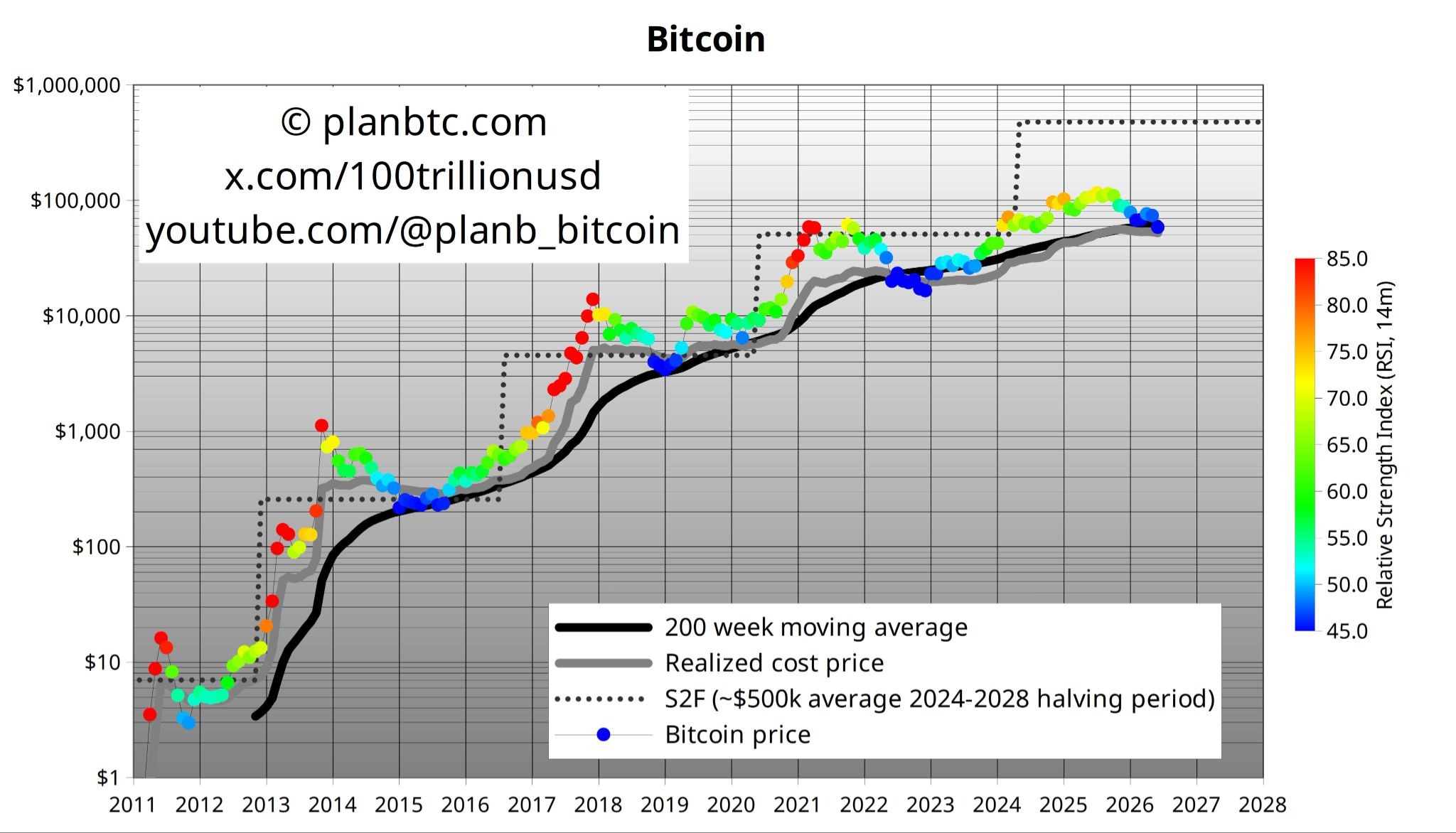
Bitcoin could face further downside pressure after ending June below its 200-week moving average but above its realized price, a combination that crypto analyst PlanB says suggests the market has yet to reach a bear market bottom.
Bitcoin fell 20.5% in June to close the month at $58,526 — its worst monthly performance since June 2022 — below its 200-week moving average of $62,000 but above its realized price of $52,000.
“ALL previous bear market bottoms were below realized price,” said PlanB, the creator of the stock-to-flow pricing model, on Wednesday, adding in a separate post that Bitcoin could drop to $52,000.
The price move would mean Bitcoin falling about 60% from its all-time high of $126,000 in October. The dip could be even deeper, as previous bear markets have seen Bitcoin fall even further, such as 83% in 2018 and 76% in 2022.
BTC is undervalued but can still go lower
“Right now, price is much lower than value and indeed might go lower from here (below realized),” PlanB said. “So, Bitcoin is undervalued but can still go lower.”
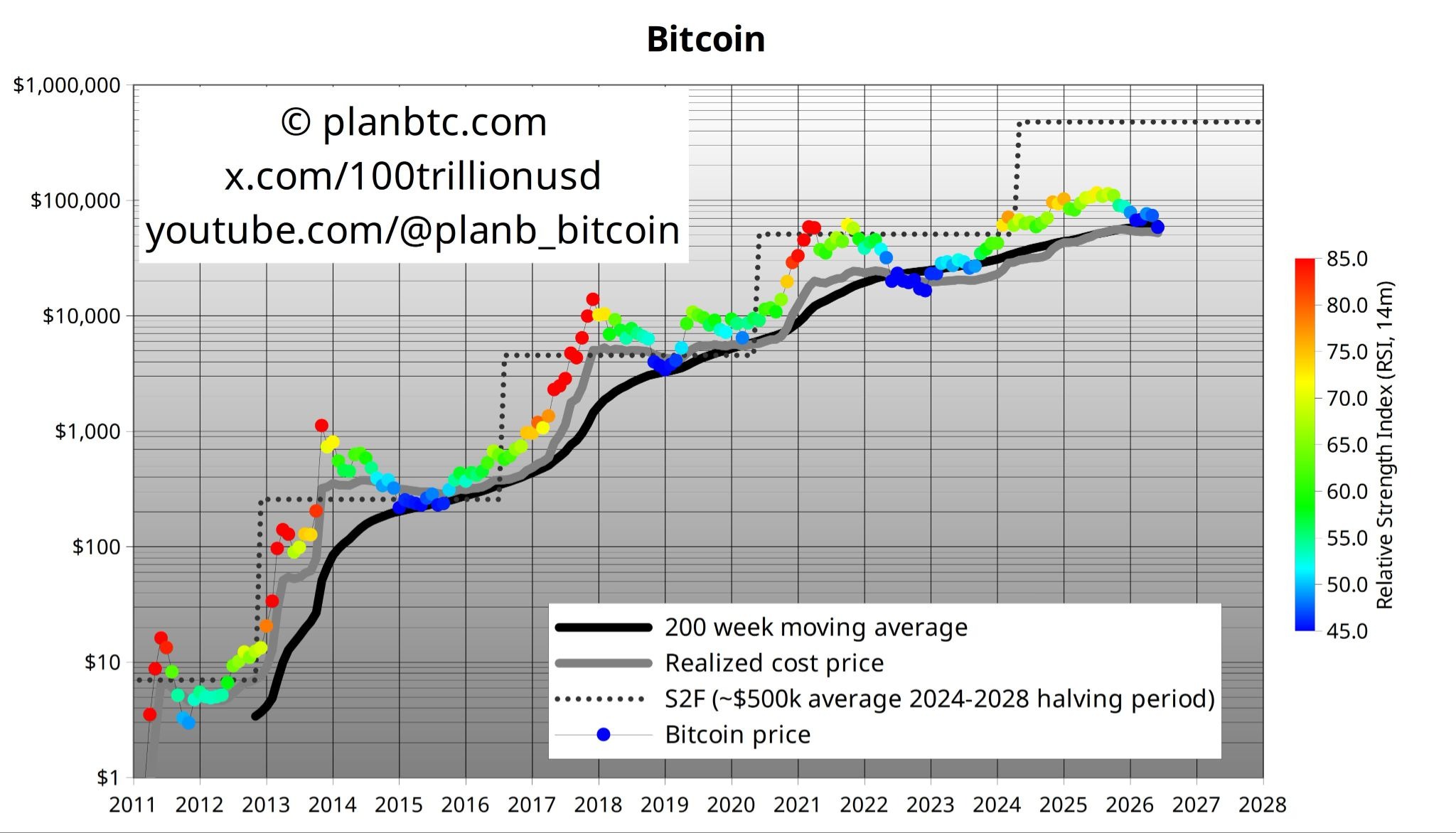
BTC is trading between the 200-week moving average and the realized price. Source: PlanB
Bitcoin’s realized price is the aggregate cost basis of all coins in circulation, calculated by valuing each unspent transaction output (UTXO) at the price when it last moved on-chain. It represents the average price at which holders acquired their coins, serving as a key onchain metric for support levels during bear markets.
Related: Bitcoin bounces off 21-month low, but leverage data signals caution: Was $57K the bottom?
Andri Fauzan Adziima, research lead at Bitrue Research Institute, told Cointelegraph that the June close above realized price but below the 200-week moving average “signals the bear bottom is still ahead per prior cycles.”
“I’m eyeing late-2026 capitulation there before the next leg up, though shallower this cycle due to institutions,” he said.
Lacie Zhang, research analyst at Bitget Wallet, told Cointelegraph that the current consolidation near $60,000 is “approaching a potential bottom zone, with strong historical and technical support likely forming around the $55,000 level if further downside occurs.”
Midterm year market bottom
ITC Crypto founder Benjamin Cowen also speculated there could be a cycle bottom for Bitcoin this year, given it is a US midterm election year. This has previously coincided with bear market bottoms in 2018 and 2022.
“The second half of midterm years usually marks the accumulation zone/market cycle bottom,” he said.
The US midterms are scheduled for Nov. 3, when all House of Representatives seats and about a third of Senate seats are up for election.
Magazine: Bitcoin slides to $58K, XRP hits $1 but onchain data promising: Market Moves
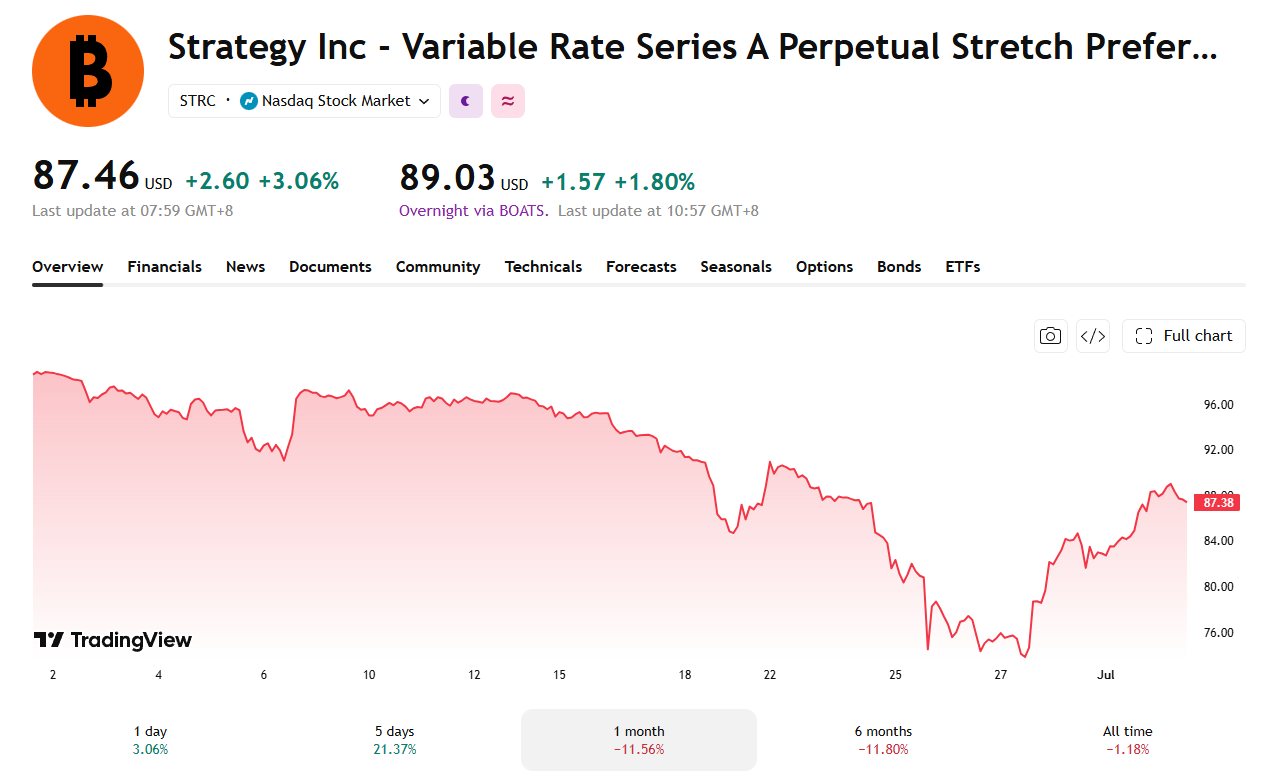
Michael Saylor reiterated on X that Strategy’s corporate objective remains for STRC to trade between $99 and $100, as the preferred stock attempts to climb back from its all-time low set on June 26.
The comment came as STRC rebounded from that record low of $71.25 to around $87.46 off the back of a new capital framework announcement. Even so, the gap to par remains wide with Bitcoin’s price also languishing.
STRC Still Trades Below Saylor’s Target
STRC, Strategy’s Variable Rate Series A Perpetual Stretch Preferred Stock, is not common stock. It is a preferred security designed to trade near a $100 face value. Strategy adjusts its dividend rate monthly to keep the price anchored, unlike common shares.
Bitcoin (BTC) had dropped below $60,000 in the same week STRC recorded its low, deepening a preferred stock crash that had already alarmed investors. STRC has since recovered but the stock is still about $13 short of the par value Saylor says remains the company’s goal.

On Monday, June 29, Strategy raised STRC’s dividend rate by 50 basis points to 12%. The increase takes effect for July record dates and is part of the capital management overhaul Strategy announced the same day.
Strategy reviews the rate using STRC’s trading level, Bitcoin’s price and volatility, and its own cash reserves. It will not raise the rate automatically just because the stock trades below par.
“As Strategy disclosed Monday: our corporate objective is for $STRC to trade over time at $99–$100.”
The tweet repeats language from Monday’s press release without adding new detail. Its timing during STRC’s rebound suggests Strategy wants the market to read the recovery as validation of its plan.
The reiteration follows weeks of criticism from Ripple (XRP) CEO Brad Garlinghouse. He called STRC’s slide a damning indictment of Strategy’s financing model. Rosen Law Firm has also opened a securities investigation into the company’s disclosures.
Whether STRC can climb back to par depends largely on Bitcoin’s trajectory. Bitcoin remains the primary driver of Strategy’s capital structure and dividend coverage.
The post Strategy’s Saylor Doubles Down on $100 STRC Target Despite Being $13 Off appeared first on BeInCrypto.

Tradeweb has carried out an onchain trade that pairs tokenized US Treasuries with tokenized cash, using Franklin Templeton as the seller of a tokenized Treasury security and Virtu Financial as the buyer. The execution reportedly took place over the Canton Network, with the companies saying settlement was completed in real time.
The deal is positioned as an industry milestone because it settles a tokenized Treasury against USDCx, a USDC-backed stablecoin issued on Canton. While the parties did not disclose the trade size, the firms framed the transaction as a practical step toward broader tokenized Treasury market infrastructure—particularly as major back-office plumbing, including DTCC’s planned tokenization services, moves closer to launch later this year.
Key takeaways
- Tradeweb executed a real-time onchain purchase-and-sale of a tokenized US Treasury settled against USDCx on the Canton Network.
- Franklin Templeton transferred the tokenized Treasury to Virtu Financial in exchange for tokenized cash, with Canton Network handling settlement synchronization.
- The trade is described as the first real-time purchase and sale of a tokenized US Treasury against USDCx, according to a Tradeweb spokesperson.
- The timing matters ahead of DTCC’s planned Tokenization Services rollout later this year.
- The transaction underscores how tokenized government bonds are moving from pilots toward production-style workflows.
A tokenized Treasury trade, settled in real time
According to the companies involved, Tradeweb served as the execution venue and source of price discovery for the transaction. Canton Network, meanwhile, coordinated settlement between the tokenized Treasury security and the tokenized cash leg of the trade.
Tradeweb and its counterparties said the trade settled in real time, though the exact notional amount was not released. Execution and settlement roles are often separated in traditional market structure; this type of workflow highlights how tokenization can compress those steps—at least within a controlled network environment—by linking asset and payment rails directly to the same settlement layer.
In a statement provided to Cointelegraph, a Tradeweb spokesperson said the transaction marked what they described as the industry’s first real-time purchase and sale of a tokenized US Treasury settled against USDCx, a USDC-backed stablecoin issued on Canton. Participants included Blockdaemon, Digital Asset, Societe Generale, Franklin Templeton, Tradeweb, and Virtu Financial.
Why the USDCx pairing is meaningful
The stablecoin used for settlement is not a minor detail. In tokenized Treasury markets, the “cash leg” is where many of the operational and compliance questions tend to concentrate: liquidity management, settlement finality, and how the payment instrument fits existing controls.
By explicitly citing settlement against USDCx on Canton, the firms are signaling that tokenized Treasuries can be paired with a stablecoin payment instrument on-chain—without requiring the buyer and seller to rely solely on separate off-chain cash processing. That matters for investors and trading desks because it can reduce settlement friction and shorten the path between trade execution and cash/asset finality, which are often decisive factors in institutional adoption.
At the same time, it remains important to watch how broadly these rails can scale beyond a limited set of participants. Real-time settlement claims are most meaningful when replicated across more counterparties, varied liquidity conditions, and larger volumes. The transaction size was not disclosed, leaving market participants to interpret the operational significance rather than the economic scale.
DTCC tokenization services as the next infrastructure milestone
The onchain trade also arrives ahead of a separate but related development: DTCC’s planned Tokenization Services later this year. DTCC has said the offering will enable participants to tokenize select stocks, exchange-traded funds (ETFs), and US Treasury securities while maintaining “the same investor protections and ownership rights as traditional assets,” according to DTCC’s published materials.
In practice, DTCC’s role is often associated with standardizing and simplifying settlement and custody workflows across the industry. If DTCC’s services deliver interoperable tokenization capabilities, they could help bridge the gap between isolated tokenization efforts and wider market participation. That makes Tradeweb and Canton’s transaction more than a standalone experiment—it can be read as preparation for a future where more participants can connect through shared tokenization infrastructure.
What remains uncertain is how DTCC’s approach will interact with existing tokenized Treasury ecosystems, including the specific stablecoin-based cash rails used for settlement. The Tradeweb/Canton transaction shows one functional pathway; the industry will likely be watching whether DTCC supports similar settlement models and whether cash and asset tokenization can be standardized across networks and venues.
Franklin Templeton’s wider tokenization push
This latest transaction fits into Franklin Templeton’s ongoing expansion of tokenized financial assets. Earlier this year, the asset manager partnered with Binance to let institutions use tokenized money market fund shares as trading collateral while keeping the underlying assets in regulated custody. Franklin Templeton has also partnered with Ondo Finance to bring tokenized ETFs onto blockchain networks, pointing to a broader strategy of onboarding institutional use cases through established market counterparties and custody frameworks.
The Treasury segment has been gaining attention alongside money markets and tokenized funds, in part because sovereign debt is often viewed as a foundational asset class for stable, yield-bearing tokenization strategies. While this does not automatically mean tokenized Treasuries will displace traditional Treasuries in size, each successful onchain settlement test reduces uncertainty about whether tokenized ownership can be operationally viable.
Governments and market data: tokenized sovereign debt keeps growing
Tokenized government bond efforts are not limited to the private sector. Several jurisdictions have launched blockchain-based initiatives to test issuance, settlement, and market infrastructure for sovereign debt.
Hong Kong was among the early movers, launching an inaugural digital green bond in 2023 and completing its third digital green bond issuance in November 2025, according to Hong Kong Monetary Authority announcements. Separately, the HKMA has said it will build a digital asset platform to support issuance and settlement of tokenized bonds, with plans to expand the infrastructure to other digital assets and connect with tokenization platforms across the region.
In the UK, the government appointed HSBC Orion to support its Digital Gilt Instrument pilot, designed to test blockchain-based issuance, settlement, and secondary trading of government bonds.
Meanwhile, on-chain Treasuries have reached significant scale in tokenized form. Data from RWA.xyz cited in the announcement places the tokenized US Treasury market at $14.6 billion, spanning 84 on-chain products and representing the largest segment within the tokenized real-world assets market.
Taken together, the picture that emerges is one of gradual maturation: policy pilots are exploring the mechanics of tokenized sovereign debt, while institutional market players are running increasingly production-like trades that validate execution and settlement workflows. The Tradeweb–Franklin Templeton–Virtu Financial transaction adds a concrete “cash + asset” settlement example—one that is particularly relevant for traders and custodians who need clarity on how stablecoin-based settlement can function alongside tokenized Treasuries.
Next, investors and market participants should watch for how DTCC’s forthcoming Tokenization Services change the connectivity and standardization of tokenized Treasuries settlement, and whether real-time USDCx-based settlement models prove replicable across more counterparties and larger volumes.
Zcash price has remained pinned below the $400 level after last month’s Orchard security scare, persistent overhead supply, and cautious derivatives positioning offset signs of improving buying pressure.
Summary
- Zcash price remains below $400 as sellers continue defending key resistance after June’s security-driven selloff.
- Technical charts show $410 as the breakout level, with $440 and $490 emerging as the next upside targets.
- Liquidation data and macro uncertainty keep downside risks alive unless buyers reclaim the descending trendline.
According to data from crypto.news, Zcash (ZEC) traded around $396 at the time of writing, little changed over the past week despite a relief bounce across several large-cap altcoins.
The privacy coin continues to recover from its violent early June collapse, when a critical flaw in the Orchard zero-knowledge proof circuit briefly raised double-spending concerns before developers deployed an emergency network upgrade. Although no funds were stolen, the event triggered a wave of liquidation and institutional selling that continues to weigh on price.
The fallout extended beyond the technical fix. Arthur Hayes exited his ZEC position during the panic, while the earlier 50% crash from roughly $624 to $309 left a large concentration of trapped holders at higher prices. That supply continues to emerge whenever ZEC approaches the $400-$420 region, limiting follow-through buying despite the stabilization seen during the past several sessions.
Descending trendline keeps Zcash trapped below key Fibonacci resistance
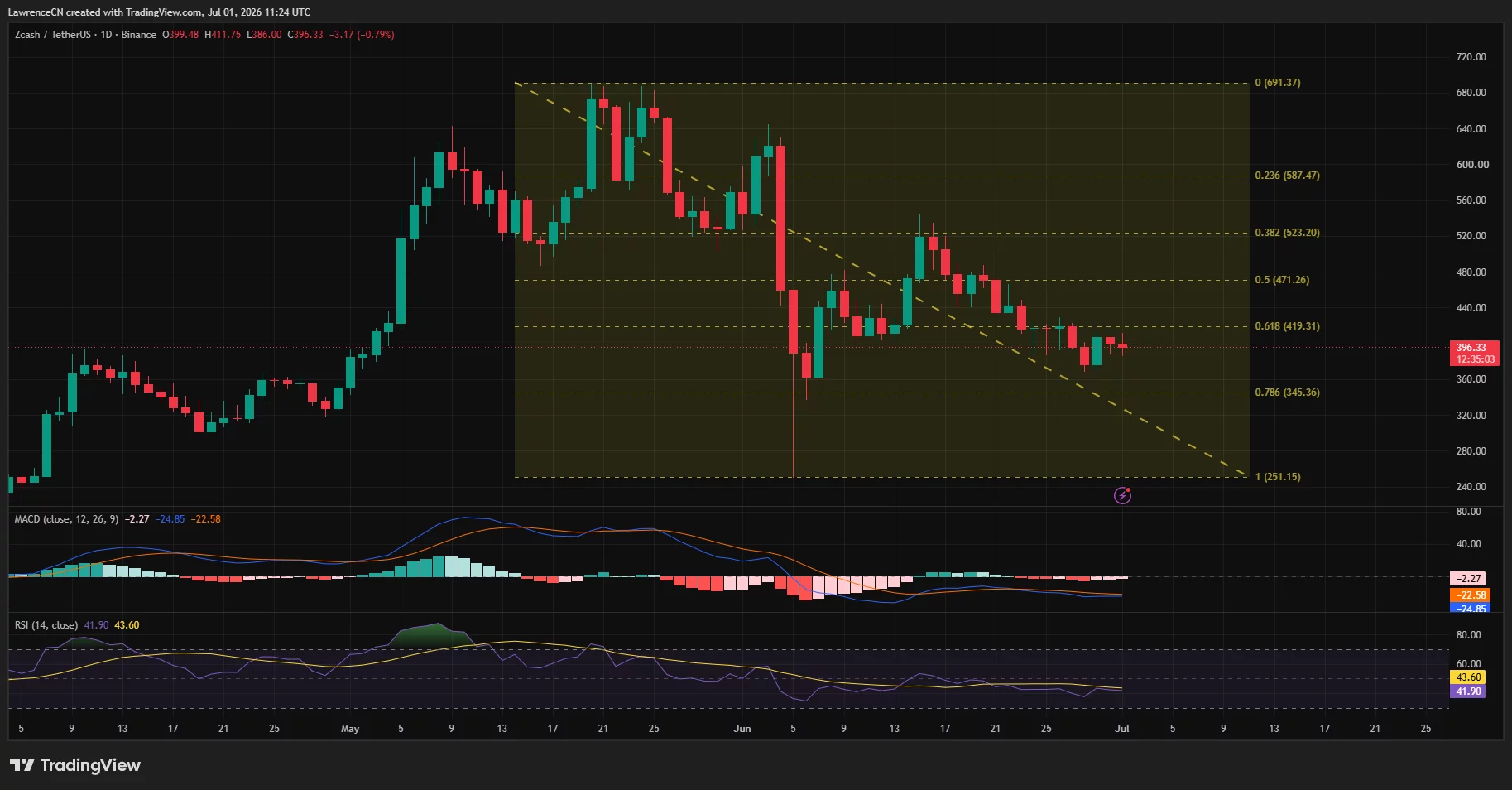
The daily chart shows ZEC trading just beneath the 61.8% Fibonacci retracement level near $419, a zone that rejected multiple recovery attempts following the June breakdown. Price also remains below a descending trendline that has defined the lower-high structure since the post-crash rebound peaked near $530 in mid-June.
Momentum indicators remain mixed. The daily RSI sits near 41, leaving room for another recovery attempt without entering overbought territory, while the MACD remains below its signal line despite the bearish histogram steadily shrinking. Together, the indicators suggest selling pressure has eased but buyers have yet to regain control of the longer-term trend.
The 4-hour chart presents a slightly more constructive picture. ZEC has begun testing the descending resistance line that has capped every rally over the past two weeks, while the Chaikin Money Flow has climbed back above zero, suggesting fresh capital has started entering the market. Even so, the Aroon indicator continues to favor the prevailing downtrend, showing that bullish momentum has not yet replaced the existing market structure.
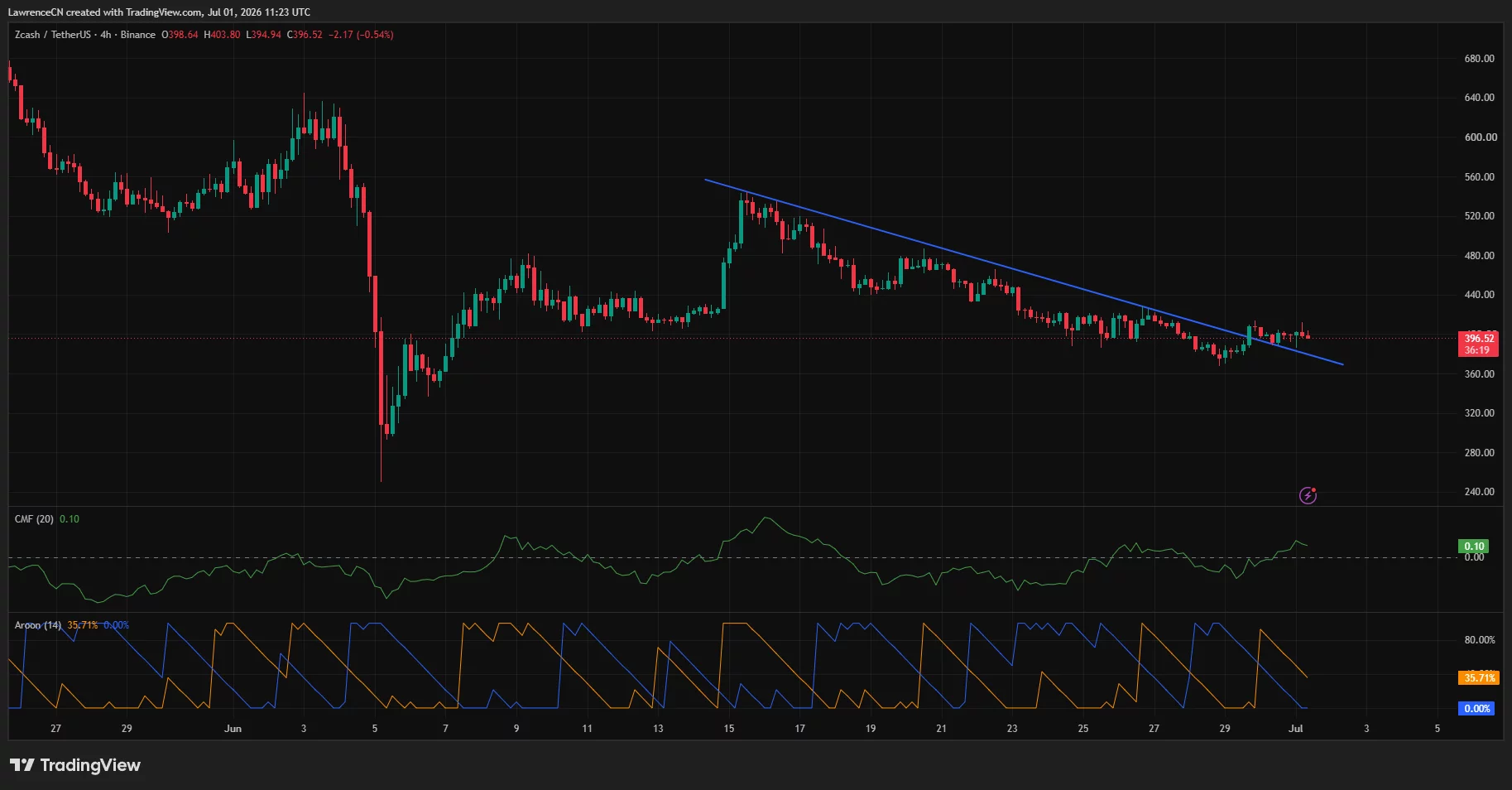
According to analyst Team LAMBO, a decisive move through the immediate ceiling could change the short-term outlook. “ZEC can breakout above 410 to target 440 and 490 again,” the analyst wrote in a recent market update, identifying $410 as the trigger level that could expose the next resistance areas near $440 and $490.
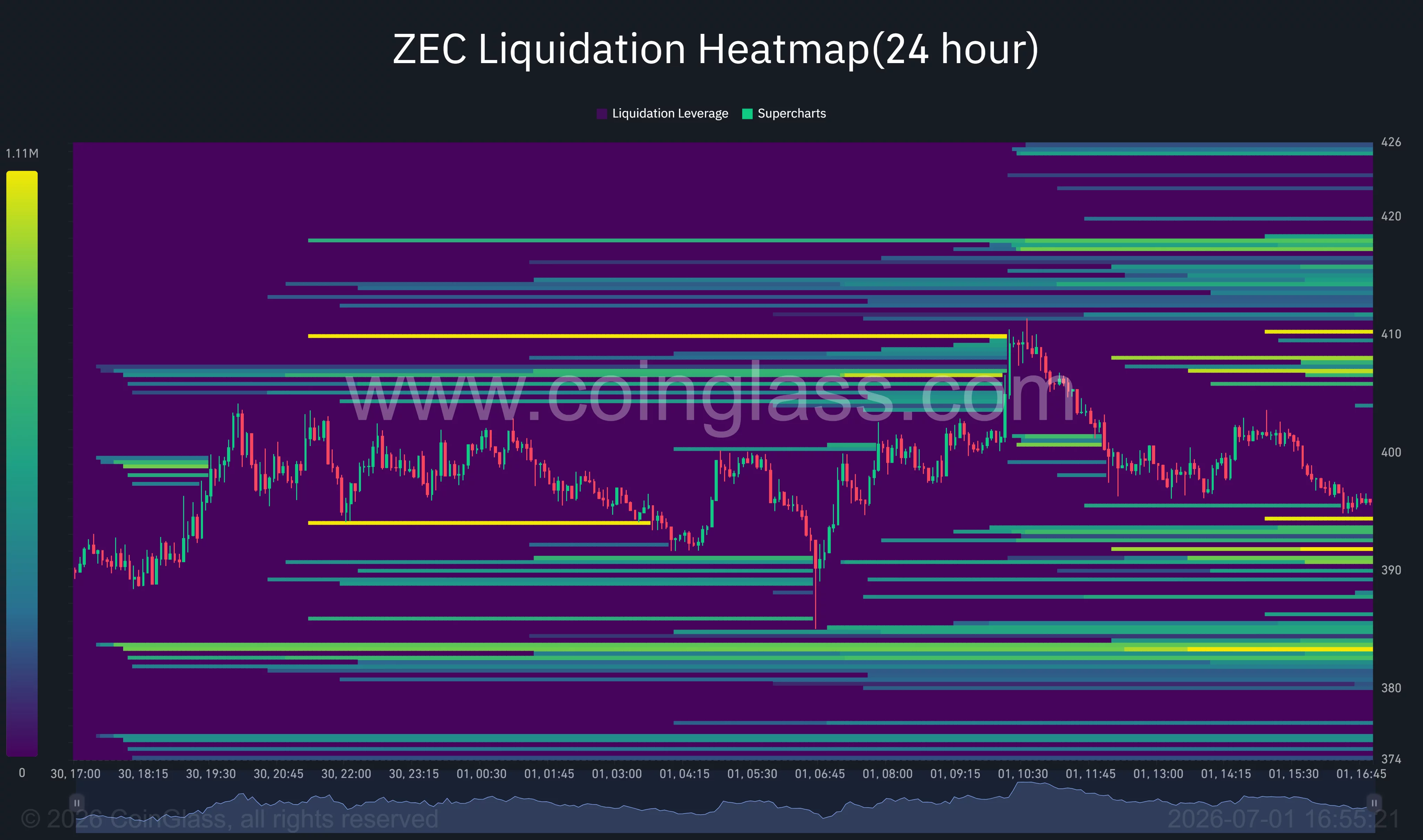
Derivatives positioning also shows why the current range remains difficult to escape. CoinGlass liquidation heatmaps reveal dense clusters of leveraged short positions concentrated around $405-$410 and again near $418-$420. A sustained break through those zones could force short liquidations and accelerate upside momentum. On the downside, another significant concentration of long liquidations sits between roughly $392 and $385, creating an area where volatility could increase if sellers regain control.
Macro risks continue to challenge the recovery thesis
Several external risks continue to limit appetite for privacy-focused cryptocurrencies despite improving technical conditions. Crypto market sentiment remains fragile after weeks of elevated volatility, while investors continue to monitor U.S. inflation data, interest-rate expectations, and geopolitical tensions that have reduced demand for higher-risk digital assets.
Regulatory uncertainty also remains a headwind unique to the privacy coin sector. European compliance initiatives and tighter scrutiny of anonymous digital assets continue to discourage institutional participation, reducing the amount of fresh capital available to absorb the overhead supply left behind by June’s selloff.
The bullish setup would weaken if ZEC fails to hold support around $390, with a break below that level exposing the stronger demand zone near $380 and potentially the 78.6% Fibonacci retracement around $345.
A confirmed close above $410, however, would invalidate the current lower-high sequence and increase the probability of a move toward the $440 resistance area, with $490 becoming the next upside objective if buying momentum accelerates.
Disclosure: This article does not represent investment advice. The content and materials featured on this page are for educational purposes only.


Solana perpetuals exchange Drift Protocol has rebranded to Velocity DEX, the protocol's official X account announced on Wednesday. Solana's own account confirmed the switch shortly after, posting "FYI: @driftprotocol is now @VelocityDEX." Velocity DEX said the new name reflects "a cleaner… Read the full story at The Defiant
Jupiter has surged more than 15% after a sharp rebound in June protocol revenue revived bullish sentiment despite persistent risk-off conditions across the crypto market.
Summary
- Jupiter jumped more than 15% after June protocol revenue climbed to a three-month high.
- Technical indicators show JUP has reclaimed its 200-day EMA as open interest and funding rates strengthened.
- Bulls now target the $0.24-$0.26 range, while losing $0.218 support could revive selling pressure.
According to data from crypto.news, Jupiter (JUP) traded around $0.233 at the time of writing after briefly touching an intraday high near $0.238, extending its weekly gain to almost 30%.
The token’s rally followed a sharp improvement in protocol activity during June. Data from DeFiLlama showed Jupiter generated 261,909 SOL in user fees and 76,257 SOL in protocol revenue during the month, reversing three consecutive months of weakening network activity.
Because a portion of protocol revenue feeds Jupiter’s staking and governance model, the jump in cash flow quickly translated into renewed demand for the token.
The move also arrived while risk appetite across digital assets remained subdued. The Crypto Fear & Greed Index has continued to hover in Extreme Fear territory near 11 as macro uncertainty and tighter liquidity conditions keep investors selective toward altcoins. Jupiter nevertheless outperformed most large-cap tokens, suggesting traders have prioritized protocol-specific fundamentals over macro headwinds.
Derivatives traders joined the advance rather than fading it. Open interest climbed roughly 11% to $58.7 million, while funding rates stayed positive near 0.0021%, showing leveraged traders have continued paying a premium to maintain long exposure instead of aggressively hedging the rally. That combination generally supports sustained momentum as long as fresh buying continues to absorb profit-taking.
Bulls have reclaimed the long-term trend while momentum targets higher resistance
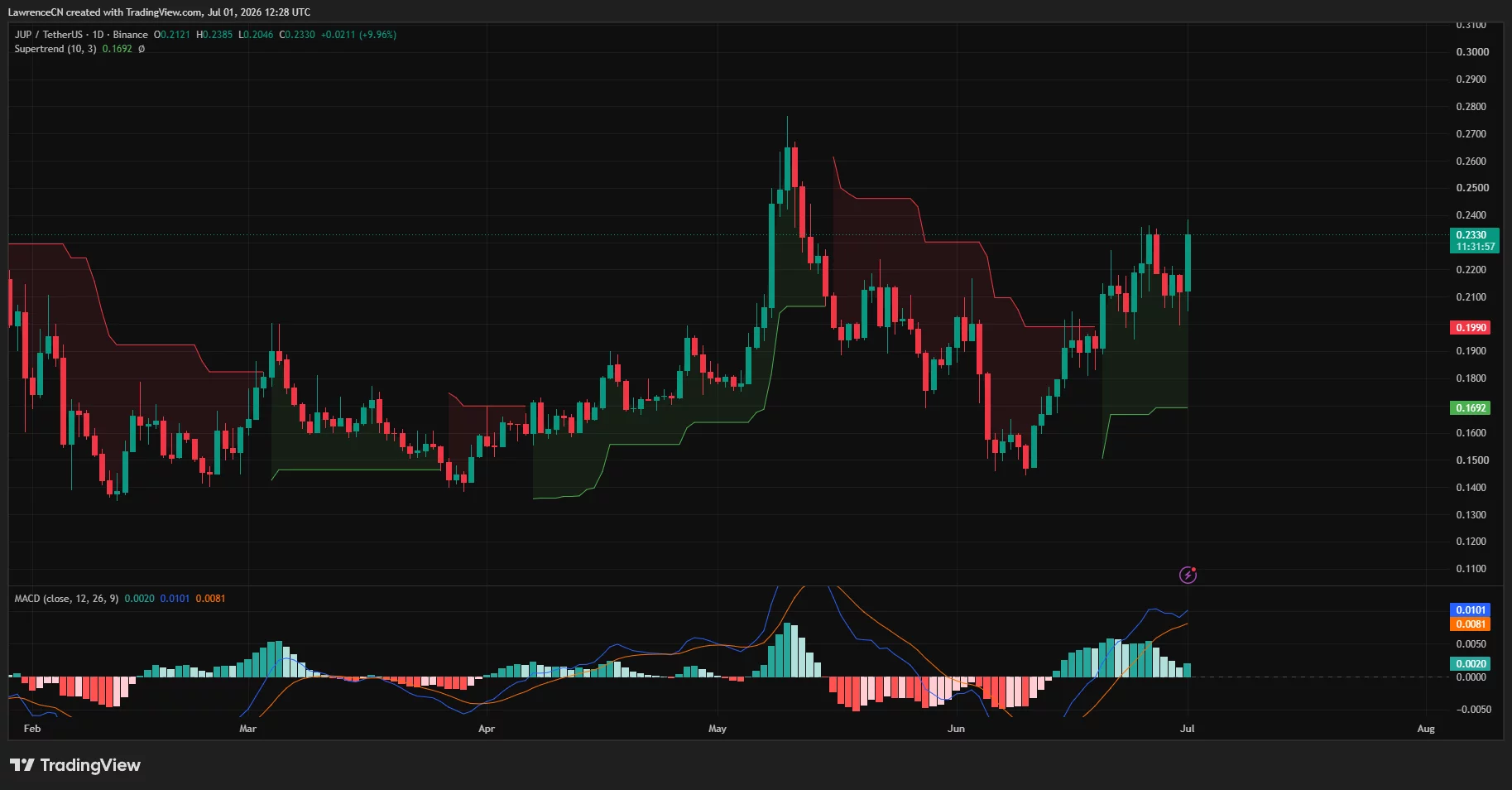
The daily chart shows JUP has reclaimed its 200-day exponential moving average around $0.219, a level that repeatedly rejected advances during the previous decline. Price has also remained comfortably above the daily Supertrend indicator near $0.169, preserving the bullish structure established after June’s recovery.
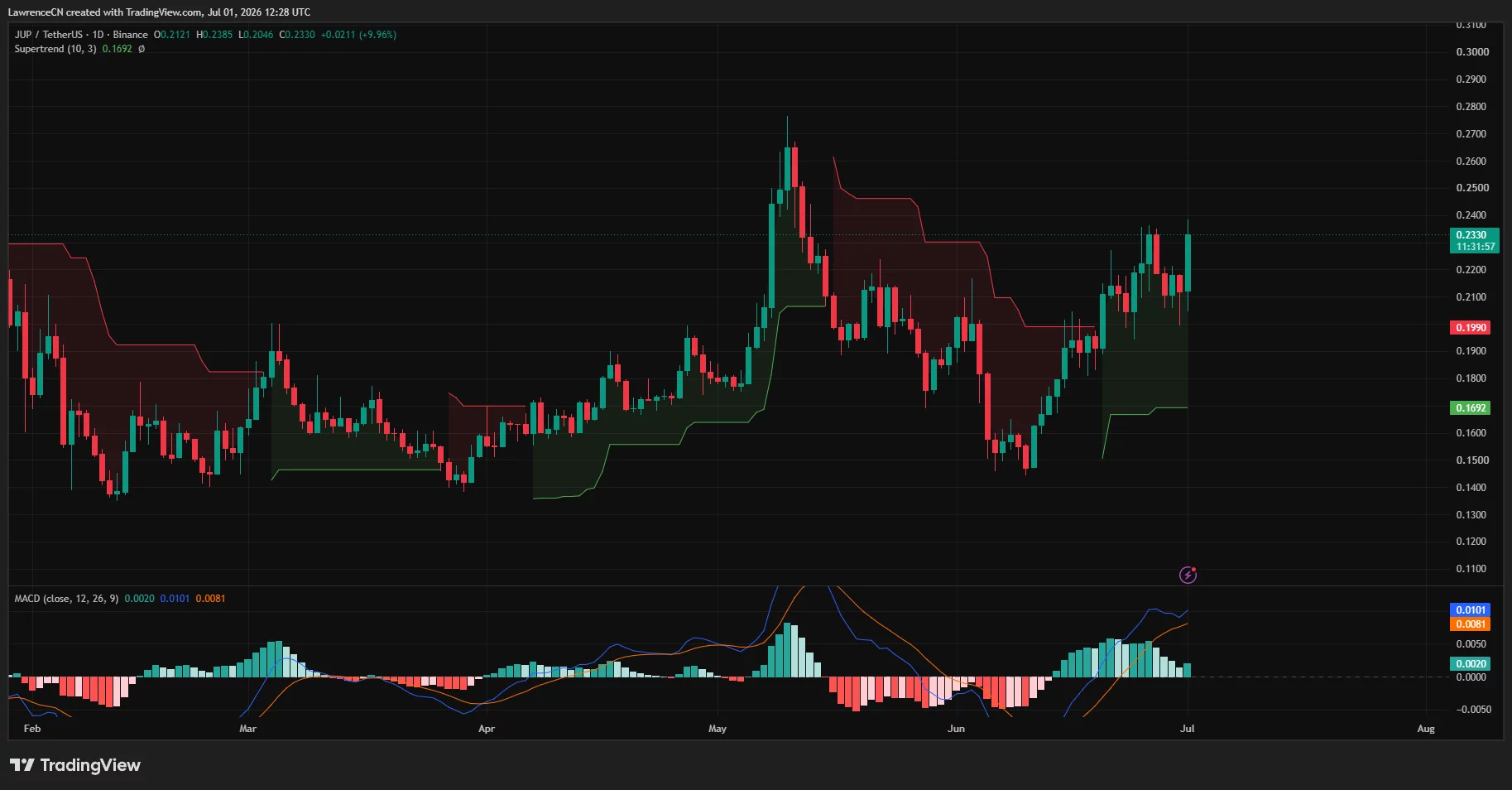
Momentum indicators continue to favor buyers. The daily MACD remains above its signal line despite a modest slowdown in histogram expansion, suggesting upside momentum has eased but has not reversed. On the four-hour chart, RSI has climbed to about 63 without entering overbought territory, while the MACD has completed another bullish crossover as price pushes back toward the recent swing high.
The 4-hour structure also shows JUP trading above an ascending trendline that has supported higher lows since early June. Fibonacci retracement levels place immediate resistance near $0.238, followed by the psychological $0.24 region. A decisive close above that zone could expose the May peak around $0.26, while the 0.786 Fibonacci level near $0.218 now serves as the first important support during any pullback.
CoinGlass liquidation data reinforces those technical levels. The largest concentration of short liquidations sits between roughly $0.238 and $0.245, creating a potential liquidity pocket if buyers force another breakout. Below the market, notable long liquidation clusters have formed around $0.22 and $0.21, areas that could attract buyers if price retraces before attempting another advance.
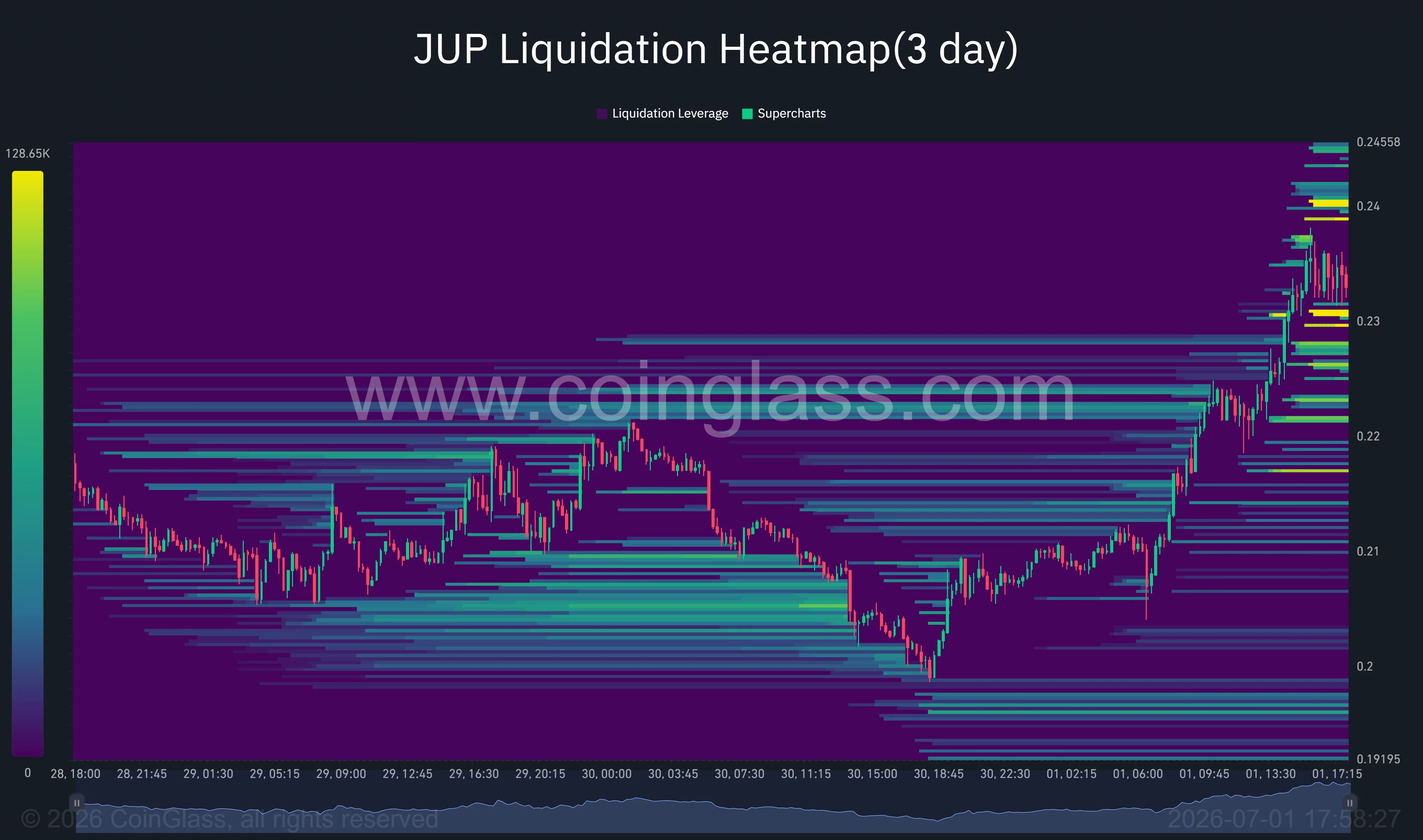
Failure to hold support could revive the previous bearish trend
The bullish outlook would weaken if JUP loses the ascending trendline and falls back below the former breakout zone around $0.218. Such a move would place the 200-day EMA under pressure again and increase the probability of a decline toward the $0.20-$0.19 region, where the 0.5 Fibonacci retracement aligns with previous consolidation.
Macro risks also remain in place despite Jupiter’s strong fundamentals. Persistent risk-off sentiment, reduced liquidity across crypto markets, or renewed weakness in Solana ecosystem tokens could limit follow-through buying. Without continued growth in protocol revenue and sustained derivatives participation, the latest breakout could lose momentum before challenging the next major resistance zone above $0.24.
Disclosure: This article does not represent investment advice. The content and materials featured on this page are for educational purposes only.
Frankie Muniz announces divorce from wife Paige Price after 7 years of marriage

Belfast councillor renews call for drug consumption room as city centre ‘deteriorating’

Positive Breakout: These 9 stocks cross above their 200 DMAs – Upside Ahead?


-

 Fashion5 days ago
Weekend Open Thread: Staud – Corporette.com
-

 Politics6 days ago
The House | Manchesterism won’t survive the painful trade-offs unless it gets citizens on board
-

 Crypto World2 days ago
Strategy authorizes up to $1.25B in Bitcoin sales under new capital plan
-

 Politics6 days ago
Potential 2028er World Cup attendee leaderboard
-

 Business6 days ago
Asia stock markets slide as tech shares slump
-

 News Videos3 days ago
MAJOR BITCOIN & MARKET UPDATE!!!! (MUST WATCH ASAP!!!)
-

 Tech6 days ago
A Look At A Gaggle Of Transputer Boards
-
 Crypto World6 days ago
Dell (DELL) Shares Tumble Over 5% Following Analyst Downgrade to Hold
-

 Crypto World5 days ago
Coinbase, Circle Deepen Crypto Stock Losses Despite Resilient S&P 500
-

 Business2 days ago
Australia treasurer says alleged access of prime minister’s bank data ’incredibly concerning’
-

 Crypto World5 days ago
Kraken's xStocks Opens Bending Spoons IPO Registration to EEA Retail
-

 Sports5 days ago
FIH Pro League: India defeat Pakistan 7-1, register biggest win of campaign | Other Sports News
-

 Crypto World6 days ago
Bitcoin Sparks $600M Hourly Liquidations With $65,000 Set To Become Resistance
-

 Tech4 days ago
Bluekit phishing kit adopts browser-in-the-middle for login theft
-

 Tech5 days ago
Russian hackers now target Signal backup recovery keys
-

 Tech2 days ago
Anonymous researcher drops 0-day ‘exploitarium’ repo
-
 Crypto World6 days ago
Hyperliquid Named on Singapore MAS Investor Alert Register
-

 Crypto World5 days ago
RTX holders must register wallets before token distribution begins
-

 Crypto World7 days ago
Ripple and SBI launch RLUSD in Japan after JFSA approval
-

 Sports15 hours ago
Broncos roster: OL Ben Powers (No. 74) entering final year of contract
You must be logged in to post a comment Login