

Crypto World
Vitalik Buterin outlines Ethereum’s privacy measures. Here is what it actually means



Ethereum co-founder Vitalik Buterin on Wednesday outlined near-term steps the network is taking to bring privacy onchain, a feature institutions highlighted at Consensus Hong Kong as necessary for widespread institutional adoption of the blockchain technology.
Buterin’s X post was technically dense but pointed to a simple fact: the world’s largest smart contract blockchain is moving to make private transactions a feature of the network, not a workaround provided by third-party tools.
The post comes as the Ethereum Foundation, the non-profit organization that supports the blockchain’s network and ecosystem, faces a wave of high-profile departures amid an internal transition tied to a new organizational mandate to redefine its role within Ethereum.
The three new short-term initiatives are: Account abstraction (AA) and FOCIL, Keyed nonces and access layer work. Each of the three adds a different layer of privacy to Ethereum.
Here is what each one actually does:
Uncensorable private transactions
As of now, if a user sends a private transaction on Ethereum via crypto mixers such as Tornado Cash, it first goes into the public memory pool (mempool), a sort of waiting area visible to everyone on the network. Imagine dropping a letter into a post office where every worker can read the address before finalizing which one to move for delivery.
Similarly, Ethereum entities that decide which transactions make it into each block can see those transactions and exclude them, which amounts to censorship.
FOCIL, or fork-choice enforced inclusion lists, makes censorship harder by allowing a committee of validators to propose a list of transactions that block builders are expected to include. Ignoring these transactions can lead to the block being rejected by the network. This way, it becomes difficult to censor transactions.
Meanwhile, account abstraction upgrades how Ethereum accounts work. Today, most Ethereum users rely on externally owned accounts (EOAs) via apps like a basic MetaMask, Trust Wallet, or Coinbase Wallet, each controlled by a single private key. If a user loses that key, they lose access to their funds.
Account abstraction enables all accounts to behave like programmable smart contracts, providing features such as multi-signature approvals and social recovery. It also lets apps or friends pay a user’s transaction fees.
Keyed ‘nonces’
Every Ethereum account has a nonce, a number used once. It acts as a running tally of all proposed transactions, increasing by 1 with each new transaction sent. This setup helps prevent the same transaction from being repeated on the network.
It’s like getting a sequentially numbered ticket at a food counter. But it comes with a problem. Even if an order is private, anyone watching can see that ticket #5 and ticket #6 came from the same person. On Ethereum, this sequential nonce allows observers to link transactions to the same account, even if the transactions are private and their contents are hidden.
The fix for that is keyed nonces. This replaces the single counter with a structure that comprises a nonce key and a nonce sequence, giving each account multiple separate ticket counters for different types of activities. This makes it harder to track the transaction trail and correlate them onchain.
“This replaces the single sender nonce with (nonce_key, nonce_seq), giving frame transactions independent replay domains,” pseudonymous researcher soispoke.eth said.
Access-layer work: private reads and Kohaku
The third proposed measure addresses the issue that even if transactions are private, users’ browsing behavior on the network is not. Imagine making a private phone call. Nobody heard the conversation, but the telecommunications firm knows who made the call and to whom.
Similarly, every time a user queries the blockchain to check a balance or read a smart contract, their wallet relies on third-party RPC node providers, exposing their IP address, physical location, and complete wallet identity to corporate servers that log this data.
Central to this effort is Kohaku, an open-source privacy toolkit introduced in 2025. Rather than eliminating reliance on RPC node providers entirely, Kohaku gives wallet developers tools to query blockchain data privately, using techniques such as private information retrieval, so nodes can answer queries without learning which specific data the user requested.
‘ETH’s utility value’
Ethereum has long had privacy as a goal, but it has not been a native feature. The new initiatives, if they go live, could serve as a positive catalyst for ether (ETH), the native token of Ethereum.
The plan for the new privacy initiatives isn’t just a narrative; the market is validating it too.
Valuations of established privacy-focused projects have surged, reflecting genuine demand. For example, Zcash (ZEC) has rallied more than 800% since early last year, pushing its market capitalization to roughly $9.85 billion. Meanwhile, Monero (XMR), despite frequent criticism for its use by bad actors on darknet markets and for terror funding, has also rallied by more than 100% in the same timeframe.
Bitcoin , the market leader, has declined by more than 5% over the same period.
One X user explained Ethereum’s need for privacy best: “Ethereum’s missing component at this point is some form of native privacy. ETH’s utility value would literally jump overnight. Privacy is the type of feature that can give an asset true moneyness qualities. L1 privacy could also drive a surge in mainnet fees.”
None of these changes is live yet, but Tuesday’s post is a meaningful signal about where things are headed next.

Key takeaways:
- $2 billion in spot Bitcoin ETF outflows spark downside fears, but this metric is typically backward-looking.
- A sustained discount on stablecoins in China signals broad capital flight from cryptocurrency markets.
Bitcoin (BTC) reclaimed $77,000 on Wednesday as broader risk markets saw modest relief after Brent crude prices retreated below $108. However, large outflows from spot Bitcoin exchange-traded funds (ETFs) have forced traders to reassess the odds of further downside risk, especially amid lingering fears of a global economic downturn.
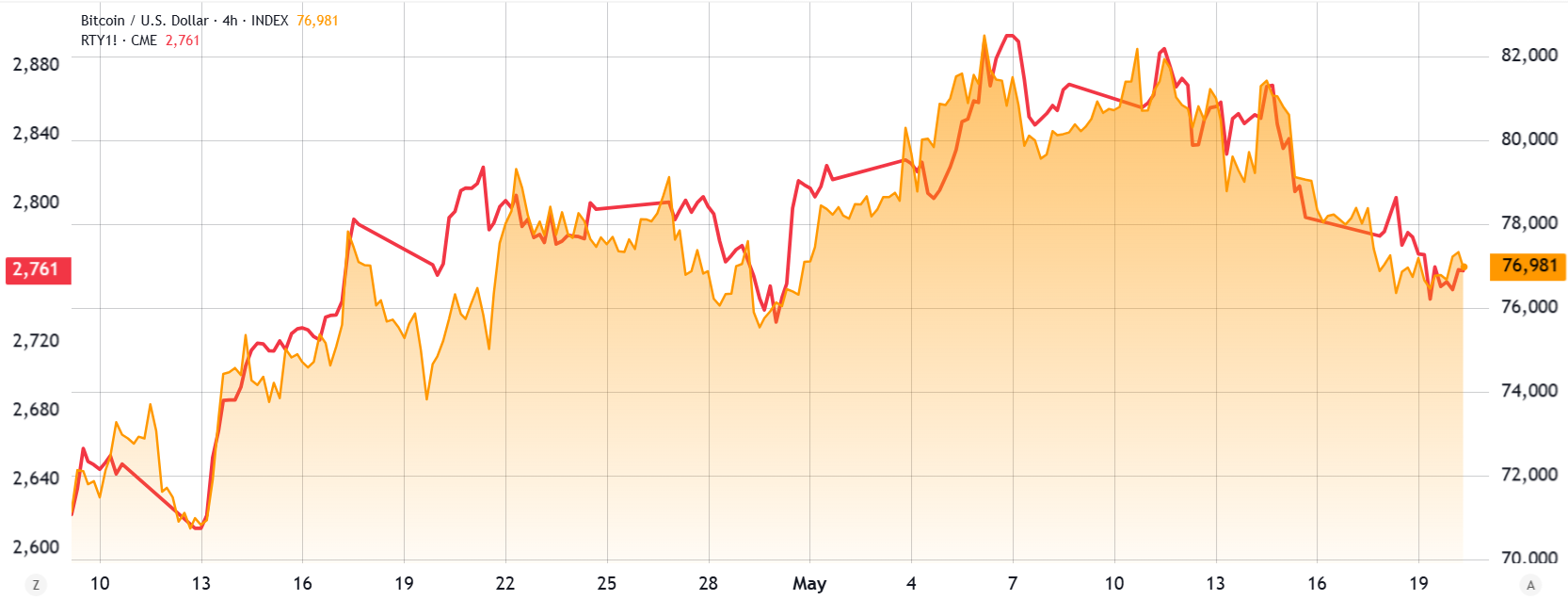
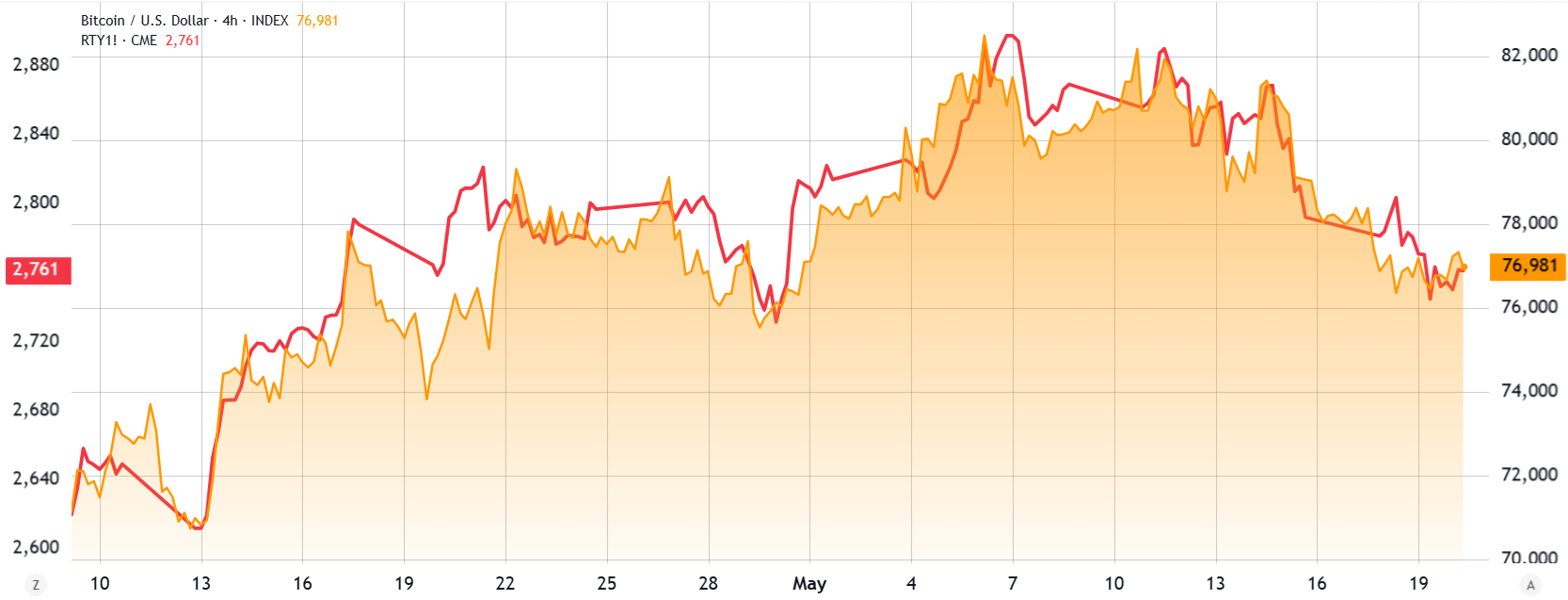
Russell 2000 Index futures (left) vs Bitcoin/USD (right). Source: TradingView
Bitcoin’s price action closely tracked the US small-cap stock index, hinting that macroeconomic factors are currently driving the move. The Russell 2000 Index excludes the 1,000 largest companies, shielding it from the heavy concentration of tech stocks.
Outflows from US-listed spot Bitcoin ETFs totaled $2 billion in the seven days leading up to Tuesday, sparking fears of a deeper price correction below $75,000.
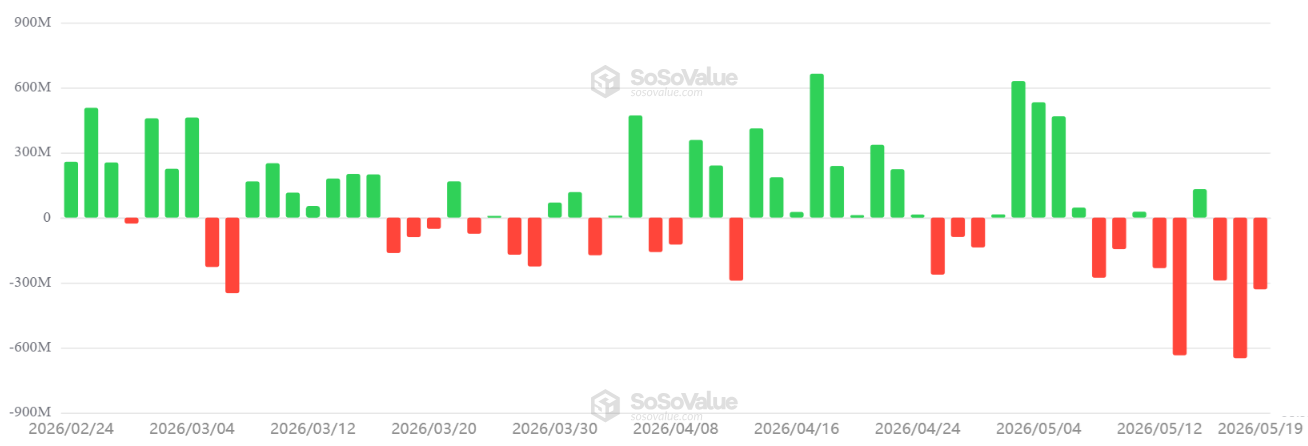
US-listed spot Bitcoin ETF daily net flows, USD. Source: SoSoValue
Traders are now turning their attention to the artificial intelligence sector, with Nvidia (NVDA US) scheduled to drop its quarterly results after the US market close. According to Yahoo Finance, investors fear that competition from AMD (AMD US), Amazon (AMZN US) Google (GOOG US) are closing in.
Stablecoin flows in China reveal weak demand for crypto
Regardless of Wednesday’s Nvidia earnings, stablecoin flows in China reveal a distinct lack of investor appetite for cryptocurrencies.
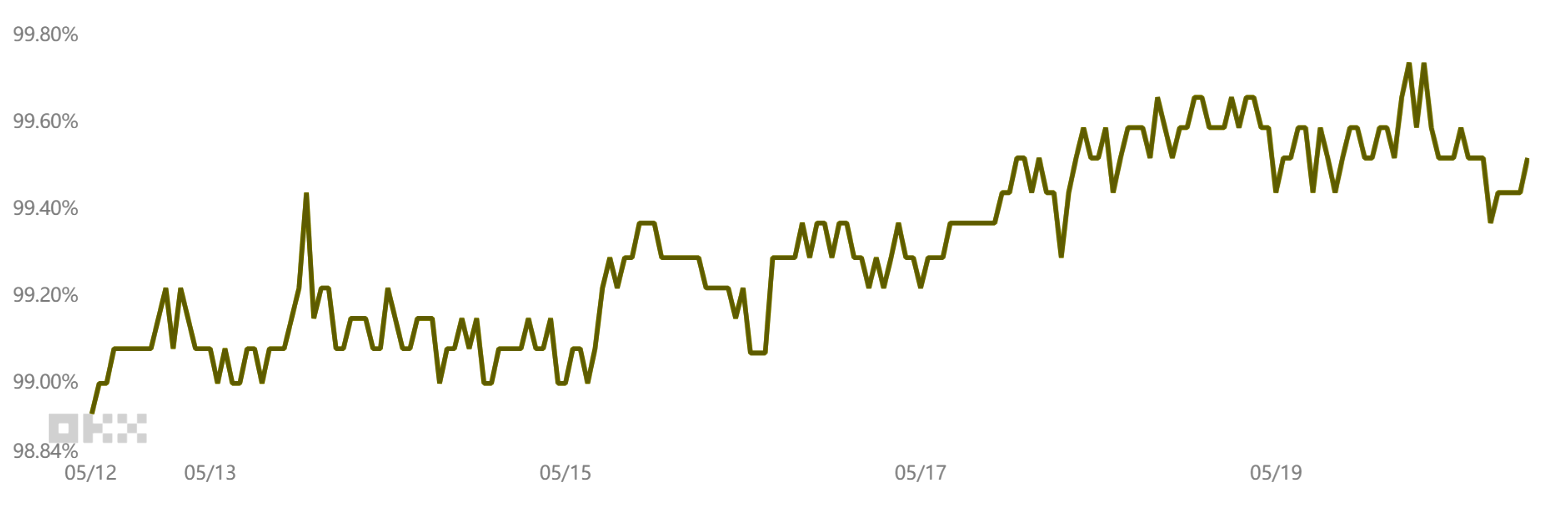
USD stablecoin premium/discount relative to USD/CNY rate. Source: OKX
Stablecoins traded at a 0.4% discount against the official Chinese yuan-US dollar foreign exchange rate, signaling heightened demand to exit crypto markets. Under neutral conditions, the metric typically sustains a 0.3% to 0.8% premium due to strict Chinese capital controls and the regulatory risks faced during arbitrage trades.
Part of this market-wide risk aversion can be pinned to stubborn oil prices and surging US Treasury yields. Selling pressure on government bonds indicates growing concern over the Federal Reserve’s ability to head off an economic recession without triggering major currency dilution.
Related: Bitcoin lost its hold on $80K, but three events may send it back sooner than markets expect
Elevated energy costs are driving resilient inflationary pressures, ultimately limiting the central bank’s ability to deploy expansionary monetary measures.
Demand for downside Bitcoin price protection signal lack of confidence
Strength in tech stocks masks broader economic risks. Meta (META US) announced a 10% global workforce reduction, while Cloudflare (NET US) is eliminating 20% of its staff. On Wednesday, Intuit’s (INTU US) CEO confirmed the company is laying off 17% of its employees.
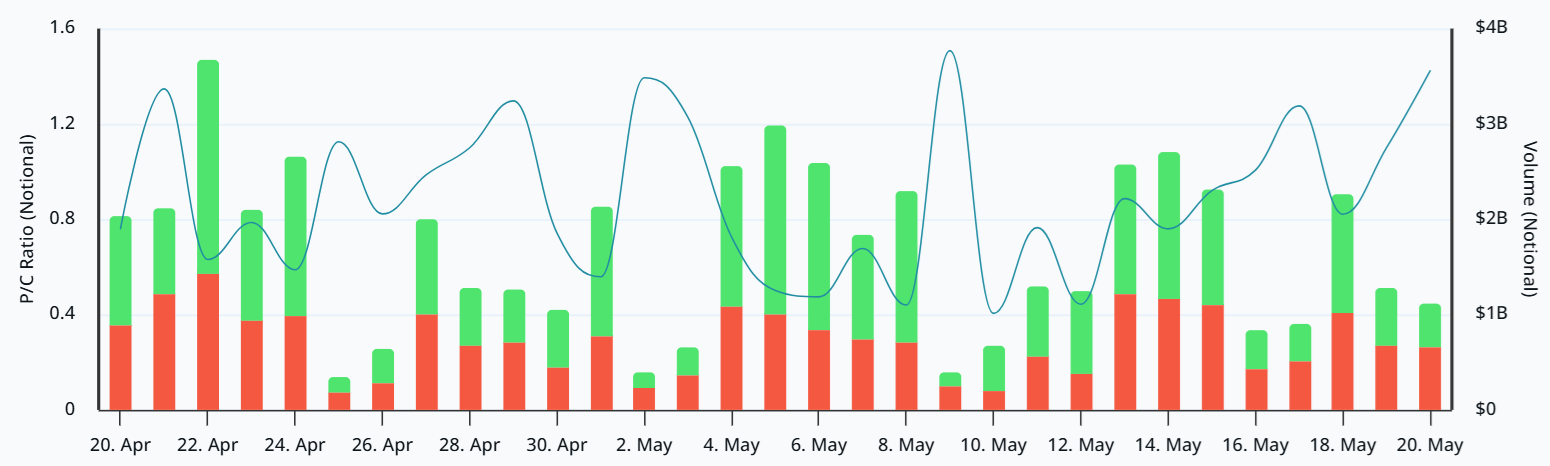
Bitcoin options put-to-call volume ratio at Deribit. Source: Laevitas
The volume of Bitcoin put (sell) options traded on Deribit outpaced equivalent call (buy) instruments by 42% on Tuesday as traders sought downside protection. This metric has completely retraced from the previous week’s 56% call option advantage, seen when Bitcoin flirted with $82,000. In essence, traders are reacting to recent price movements rather than anticipating them.
Macroeconomic trends and high-stakes AI earnings forecasts continue to dominate the news flow, making it difficult for Bitcoin to regain sustained bullish momentum. If Nvidia’s results fail to meet investor expectations, Bitcoin could retest the $75,000 level. Still, the mere $2 billion spot Bitcoin ETF outflows are backward-looking and unlikely to indicate structural bearish expectations.


On-chain investigator ZachXBT says at least about $25 million in presale funds tied to BlockDAG Network and ZKP appear to have been mixed together and routed toward influencer promotions and gambling-related marketing linked to Gurhan Kiziloz.
Summary
- ZachXBT alleges BlockDAG and ZKP presale money was used interchangeably rather than ring-fenced by project.
- He says roughly $25 million flowed through pooled wallets, cross-chain bridges and exchanges before reaching addresses used for KOL and streamer payments.
- The warning explicitly tells investors to avoid BlockDAG, ZKP and Spartans, a gambling platform ZachXBT has repeatedly linked to Gurhan Kiziloz.
ZachXBT has accused the operators behind BlockDAG Network and ZKP of pooling presale funds and redirecting part of that money into promotional payments for influencers, streamers and gambling-related marketing instead of limiting it to the purposes investors were led to expect.
In his post, he says on-chain tracing shows signs that at least about $25 million from the two presales was used interchangeably across multiple wallets before being bridged, sent to exchanges and then routed onward to addresses associated with promotional payouts for Spartans and related entities tied to Gurhan Kiziloz.
The allegation matters because the core claim is not merely sloppy treasury management but undisclosed reuse of investor money across separate ventures. According to RootData, ZachXBT had already alleged that Kiziloz was the real force behind BlockDAG and that the project’s public-facing leadership functioned more as nominal cover than actual control.
Fund flows under scrutiny
The new claim builds on months of scrutiny around BlockDAG’s unusually long-running presale and opaque cash movements. In an earlier public warning on X, ZachXBT said the token sale had run for more than two years while presale funds were being off-ramped through Middle Eastern OTC desks as Kiziloz spent heavily elsewhere.
Other outlets have echoed parts of that broader picture. CryptoRank reported in October 2025 that ZachXBT alleged Gurhan Kiziloz was the real co-founder behind BlockDAG and that millions in presale money were funneled through OTC brokers, while CryptoPotato later summarized allegations that BlockDAG had taken in more than $300 million from retail investors using aggressive promotional tactics and unrealistic return claims.
What is newly significant here is the allegation that ZKP was not separate in financial practice even if it was separate in fundraising language. ZachXBT says the presale materials for both BlockDAG and ZKP did not disclose that the funds could be used to support other businesses, and he argues the wallet behavior suggests exactly that.
Spartans and investor warnings
ZachXBT also identified specific addresses, including what he describes as the Spartans KOL payment wallet and the BlockDAG / ZKP presale wallet cluster, as part of the flow of funds he traced through the system. His conclusion is blunt: investors should stay away from BlockDAG, ZKP and Spartans.
That warning fits a broader pattern in his prior reporting. Binance Square summarized earlier allegations that Kiziloz was behind both Spartans and BlockDAG and that more than $300 million had been raised from retail investors through social-media-heavy promotion and misleading partnership claims.
Retail frustration is also not theoretical. Complaints in public communities such as Reddit and Facebook groups have continued to focus on withdrawal delays, unclear fund use and skepticism over whether the money raised was ever segregated in the first place.
The central problem is obvious enough: if separate presales were marketed as distinct opportunities but the cash was pooled and then used to pay external promoters for a gambling ecosystem, that is not clever treasury management. It is the kind of conduct that makes every “community-driven” presale look like a transfer mechanism from retail wallets into a private marketing machine.


Raoul Pal says AI and crypto could add $100T to global GDP within a decade.
Summary
- Real Vision CEO Raoul Pal forecasts crypto will grow from roughly $2.7 trillion today to $100 trillion within a decade, driven by AI convergence.
- Pal argues AI adoption is accelerating faster than the internet era, describing the current moment as equivalent to “Metcalfe’s law squared.”
- He calls crypto the ownership layer for the AI economy, saying individuals can “front-run Wall Street” by owning blockchain infrastructure now.
Real Vision CEO Raoul Pal argued that AI and blockchain are converging into a single new infrastructure layer for the global economy. He forecast the crypto market could grow from roughly $2.7 trillion today to $100 trillion within a decade. “We can own the infrastructure layer for the first time in history,” Pal said.
Pal framed the current moment as a historic acceleration point, comparing AI adoption to “Metcalfe’s law squared” and citing data showing AI now produces more words annually than humans. He said humanity is approaching a point where AI systems become “apex intelligence,” fundamentally reshaping labour, finance and daily life.
Why Pal says this moment is structurally different from past cycles
Pal’s $100 trillion thesis has sharpened around AI convergence. In earlier analysis, crypto.news tracked Pal’s argument that a debt-driven liquidity cycle would push crypto higher through 2026. His newer position adds AI as a structural demand driver on top of that macro thesis.
He described crypto as a permissionless equity system, allowing anyone with a phone to own exposure to blockchain infrastructure without KYC restrictions. Pal has also recently argued that all banks will eventually run on Ethereum, treating the network as long-term financial infrastructure.
What Pal says could derail crypto
Asked in the interview what could stop crypto adoption, Pal replied: “Nothing stops this train.” The response reflects his view that AI agent demand for on-chain rails is now structural, not cyclical. AI agents require instant settlement, fractional payments and permissionless access, none of which traditional payment systems support at scale.
Pal recommends holding Bitcoin for pure store of value and a basket of major layer-1 networks for the coordination layer. He has previously noted that moves between assets reflect capital rotation rather than structural trend changes, underscoring his preference for core positions over speculative bets.

Bitcoin is showing tentative signs of stabilization as demand signals around Coinbase suggest resilient appetite even after a wave of profit-taking. While traders booked profits into early May, market data indicates steady buyer interest that could support a renewed push higher in the weeks ahead.
According to CryptoQuant, BTC traded up to about $82,000 on May 4, with holders realizing roughly $1.14 billion in daily profits as the move paused. That period also saw unrealized profit margins climb to 17.7% on May 5 — the highest level since June 2025 — underscoring a market still flush with capital even as prices retraced.
In the meantime, the Coinbase Premium Index slipped to -0.087 on May 19, the weakest reading since March 31, signaling Bitcoin traded at a discount on Coinbase relative to Binance and suggesting softer demand from U.S.-based buyers. Yet the 14-day simple moving average of the premium has remained in an uptrend, staying above February lows and hinting at steadier underlying demand rather than a wholesale exodus from spot markets.
Analysts also highlight that activity within the Coinbase-linked ecosystem has held up during the pullback. The Base blockchain revenue rose to nearly $972,000 on May 19, a level that exceeded late-March readings even as the Coinbase Premium Gap remained negative. The divergence points to robust on-chain participation within Coinbase’s broader ecosystem while spot demand gradually rebuilds.
The immediate price setup remains constructive on the daily chart. BTC has stayed above the 100-day exponential moving average near $76,800, which continues to act as a key dynamic support. After a test of higher levels, the market has moved within a $76,000–$77,000 fair-value zone that has historically drawn accumulation. A sustained bounce from this area could reopen a path toward $80,000–$82,000, yet the next larger supply ceiling sits higher, near $86,000–$90,000.
A close below $74,800 would threaten the current higher-low pattern and redirect focus to the psychological $70,000 level. Meanwhile, futures data depict a market resilient to selling pressure. CryptoOnChain noted that Bitcoin’s 30-day moving-average net taker volume declined to about $58 million on May 18 from $243 million in April, but remained positive during the recent pullback, implying that futures buyers continued to absorb selling pressure near the prevailing price.
For investors watching the macro mosaic, the dialogue between on-chain participation and exchange-based demand remains essential. On the one hand, negative Coinbase premium readings signal a potential friction point for U.S.-based buyers; on the other, rising on-chain activity and a sustained price above key thresholds point to underlying demand that could support a renewed rally if broader conditions stay constructive. Related analyses in the space have contemplated scenarios that include conservative price-paths to the year-end, underscoring how quickly sentiment can shift as new catalysts emerge. Cointelegraph coverage notes a conservative $255K year-end target in one model.
Key takeaways
- The Coinbase Premium Index fell to -0.087 on May 19, the weakest since March 31, indicating a price gap where BTC costs less on Coinbase than on Binance.
- The 14-day SMA of the premium remains in an uptrend, suggesting underlying demand resilience despite negative readings.
- BTC held above the 100-day EMA near $76,800, with a potential move back toward $80,000–$82,000 if demand strengthens from the current range.
- On-chain activity within Coinbase’s ecosystem remained elevated even as prices retraced; Base network revenue reached nearly $972,000 on May 19.
- Futures activity shows resilience: 30-day net taker volume dipped but stayed positive, indicating continued absorption of selling pressure by futures buyers.
Coinbase Premium Signals: Demand versus Profit-Taking
Despite a negative premium reading, the 14-day trend in the Coinbase Premium Index points to a quieter but persistent demand backdrop. Market observers caution that the negative reading reflects price dispersion across exchanges rather than a wholesale collapse in appetite. With traders realizing a sizable portion of gains in early May, the question remains whether renewed spot demand will catch up to the underlying on-chain participation seen in subsequent weeks.
CryptoQuant data also highlighted a breathing space between on-chain activity and exchange prices. While profit-taking accelerated as BTC rallied toward $82,000, the network activity associated with Coinbase’s ecosystem did not simply evaporate. The recovery in Base revenue alongside a still-positive futures backdrop paints a picture of a market that could rebound if price action consolidates above critical levels.
Technical Outlook: Key Levels and Scenarios
From a risk management perspective, price action continues to respect a framework of support near $76,800 and a broader band that has held through recent swing lows. The gap between $76,000 and $77,000 is considered a fair-value zone that historically invites accumulation during pullbacks, potentially enabling BTC to retest resistance near $80,000–$82,000.
Above that, the next major hurdle sits in the $86,000–$90,000 region, where supply dynamics have previously intensified. Conversely, a daily close below $74,800 would likely signal a breakdown of the current higher-low pattern and could shift attention toward the psychological support around $70,000. In the near term, the price path remains tethered to the balance between demand signals on exchanges like Coinbase and the placement of on-chain activity within the broader ecosystem.
On-Chain Activity and Derivatives Context
The discrepancy between negative exchange premiums and elevated on-chain activity raises important questions about where demand is accruing. Base network revenue near $972,000 on May 19 indicates ongoing utilization of Coinbase-affiliated layers, even as price-based demand fluctuates. Meanwhile, the futures picture shows that buyers have continued to step in at or near current levels, absorbing selling pressure despite thinning momentum in some metrics.
As investors weigh the next move, the interplay between exchange pricing, on-chain activity, and derivatives flows will be pivotal. A sustained uptick in Coinbase premium and a firm break above the $77,000–$78,000 zone could attract renewed spot interest and push BTC toward the upper end of the short-term range. Conversely, further pressure on the premium and a breach of key support could reframe risk expectations for the coming weeks.
What remains most uncertain is how the macro environment and broader risk sentiment will interact with these micro signals. Watch for a potential reacceleration in on-chain activity alongside a normalization of the Coinbase premium, which would collectively bolster the case for a constructive mid-to-late-year trajectory for Bitcoin. The story continues to unfold as market participants digest upcoming catalysts and reassess their positions in response to evolving data.
Readers should monitor the evolving relationship between exchange pricing, on-chain participation, and derivatives behavior, as these elements together will likely shape Bitcoin’s trajectory in the near term.
For ongoing coverage of Bitcoin price dynamics and related market signals, see the broader discourse on price-model scenarios and year-end targets that frequently surface in industry analyses. Related analysis on potential year-end targets.
Coinbase launched USDF with Flipcash, a Solana-based stablecoin backed 1:1 by Circle’s USD Coin, as the crypto exchange expands its infrastructure business for companies issuing branded digital currencies.
According to Wednesday’s announcement, USDF is designed to serve as the settlement asset for currencies created on Flipcash, a platform where users can launch fixed-supply digital currencies priced and transacted in the stablecoin. Flipcash said the token is intended to function as the primary dollar asset within its app.
In December, Coinbase launched its white-label stablecoin issuance service for companies seeking branded digital dollar products without managing their own reserve, custody or settlement infrastructure. The platform includes fiat onramps, wallet services and USDC (USDC) reserve backing. It previously identified Solflare, R2 and Flipcash among companies exploring launches using the system.
Flipcash said it selected Coinbase’s platform because it provided USDC-backed reserves, onchain settlement infrastructure and integrated fiat access through a single service.
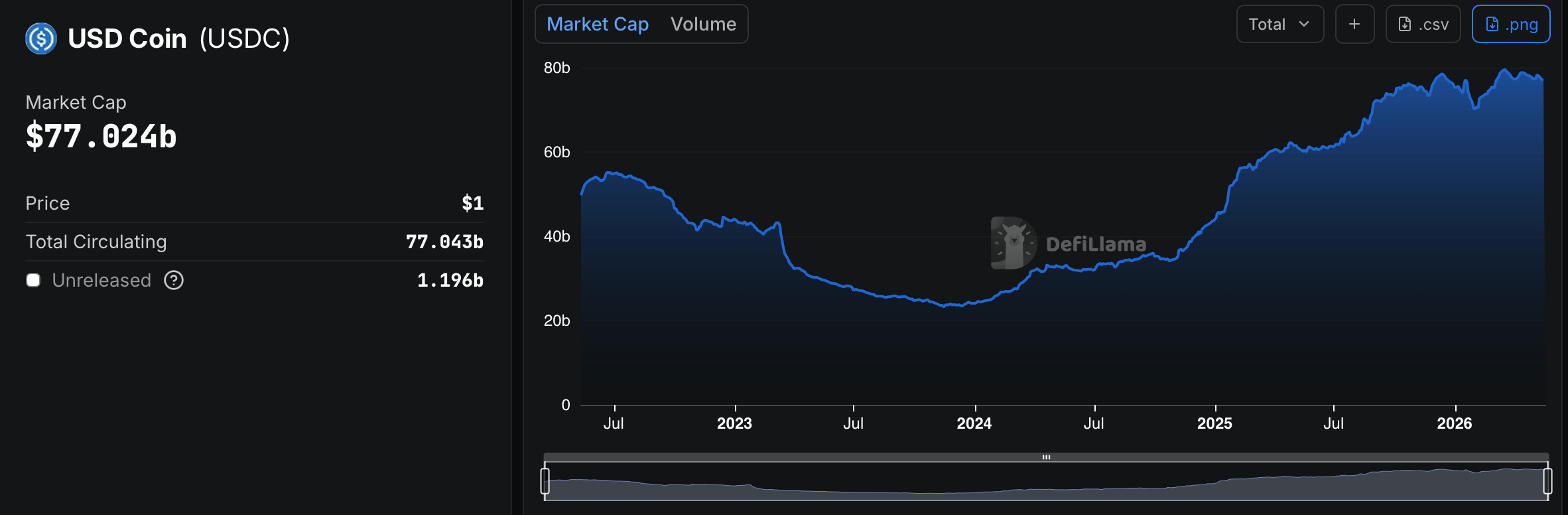
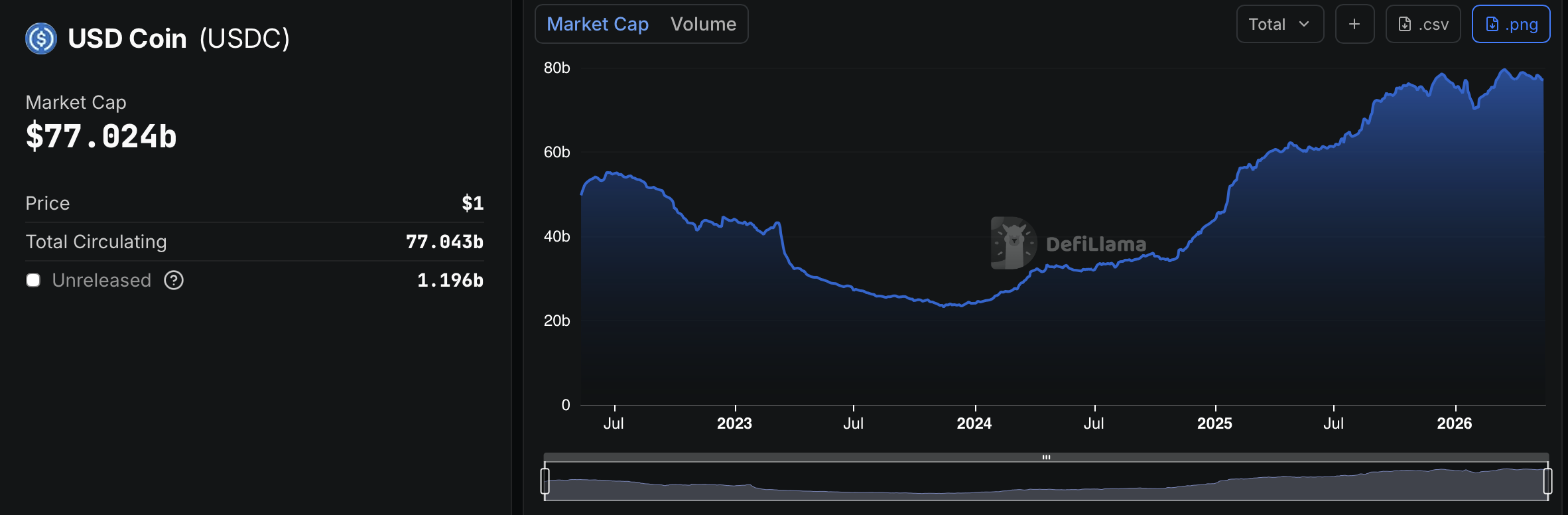
According to DefiLlama data, USDC is the world’s second-largest stablecoin by market capitalization, with roughly $77 billion in circulation.
Source: DefiLlama
Related: Trump filing discloses Coinbase, Strategy crypto-linked exposure in Q1
Stablecoin infrastructure providers expand white-label issuance services
The launch comes as stablecoin issuers and crypto infrastructure providers increasingly offer white-label services that allow businesses to launch branded digital dollar products without managing their own blockchain infrastructure or reserves.
In September 2025, Stripe launched Open Issuance, a platform that allows businesses to create and manage their own stablecoins through its Bridge unit. Stripe said the system allows companies to control minting, branding and reserve economics while connecting to shared liquidity infrastructure.
In May, Western Union launched its Solana-based USDPT stablecoin, with issuance handled by Anchorage Digital and wallet and settlement infrastructure provided by Fireblocks. The company said the token would support blockchain-based settlement and cross-border payment services across parts of its remittance network.
Earlier examples include Binance’s BUSD stablecoin, launched in 2019, and PayPal USD, launched in 2023, both of which were issued by Paxos.
Crypto infrastructure companies have also expanded into stablecoin issuance, payments and settlement infrastructure in recent months. Earlier this month, Bakkt completed its acquisition of stablecoin infrastructure firm Distributed Technologies Research as part of its push to build a 24/7 digital settlement layer powered by stablecoin and AI payment technology.
The stablecoin market capitalization has climbed to roughly $323 billion from about $244 billion a year ago, an increase of nearly 32%, according to DefiLlama data.
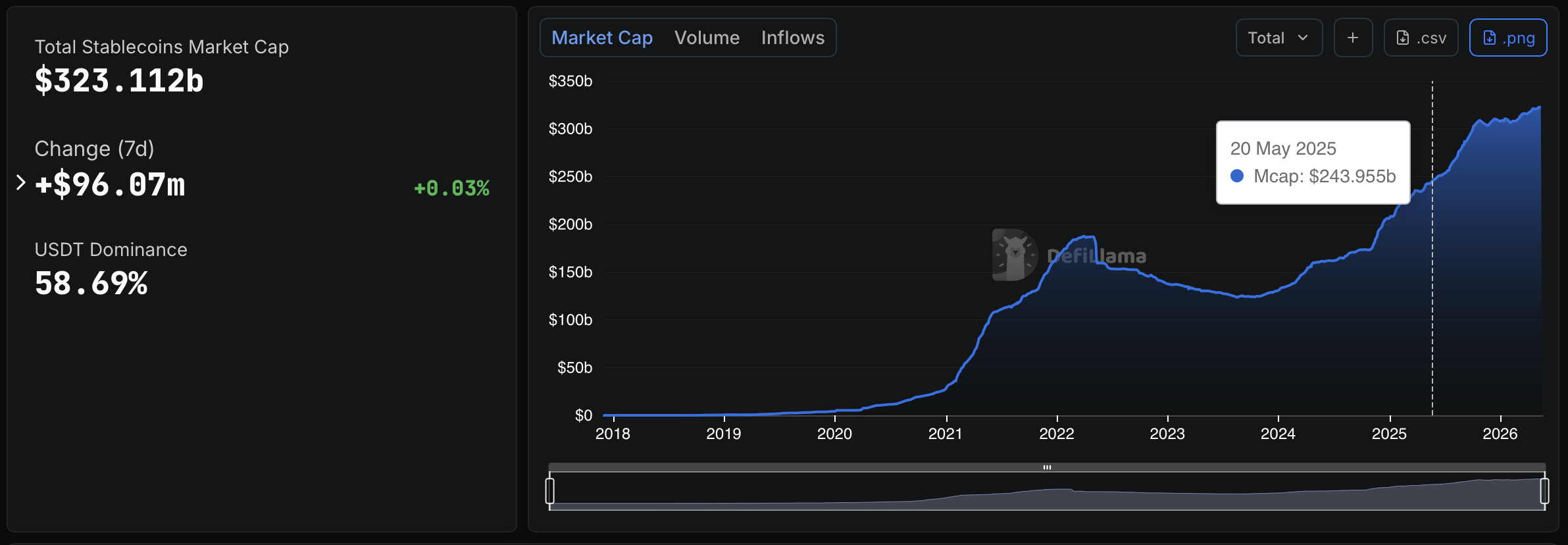
Source: DefiLlama
Magazine: eToro founder timed Bitcoin top perfectly due to belief in 4 year cycles
Crypto World
XRP Exchange Flow Shifts as Bybit Deposit Wave Ends, Binance and Coinbase Turn Negative

TLDR:
- Bybit’s XRP transaction delta returned close to zero around May 16, ending a month-long deposit trend.
- Sustained deposit activity on Bybit from mid-April to mid-May signaled potential sell-side pressure.
- Binance and Coinbase have shifted back to negative delta, meaning withdrawals now outpace deposits.
- The metric tracks transaction count, not token volume, offering a directional but partial market view.
XRP exchange-flow behavior is showing a notable shift across major trading venues. After weeks of persistent deposit activity on Bybit, the platform’s transaction delta returned close to zero around May 16.
Meanwhile, Binance and Coinbase have moved back into negative territory. This change reflects a clear rotation in exchange behavior, suggesting that the broad selling pressure seen during the mid-April to mid-May period has cooled considerably.
Bybit’s Month-Long Deposit Trend Comes to a Halt
XRP deposit activity on Bybit remained consistently elevated from mid-April through mid-May. During that stretch, the exchange recorded strong and persistent positive readings in its transaction delta.
Sustained deposit-side activity is often associated with potential sell-side pressure in crypto markets. Coins moving into exchanges are typically more available for trading or liquidation.
The shift became apparent around May 16, when Bybit’s delta returned near zero. That move marked a clear break from the previous pattern of heavy deposit imbalance.
On a transaction-count basis, the deposit pressure that defined the prior period has now faded. This change removes one of the more visible sources of supply-side activity in recent weeks.
Crypto analyst Amr Taha shared the observation based on the XRP Multi-Exchange Daily Depositing/Withdrawing Transactions Delta. The data tracks transaction counts rather than total token volume.
So it does not confirm exact amounts of XRP moved in or out. However, the directional shift across multiple venues remains a notable development.
The end of Bybit’s deposit wave does not guarantee a price move in either direction. Rather, it removes a layer of exchange-side pressure that was present for roughly a month.
Traders watching supply dynamics will likely monitor whether this neutral reading holds or reverses in the coming sessions.
Binance and Coinbase Withdrawal Activity Points to a Different Flow Structure
As Bybit’s deposit activity cooled, Binance and Coinbase moved back into negative delta territory. Negative readings indicate that withdrawal transactions are now outweighing deposit transactions on those platforms.
This is a different flow structure compared to what was seen during the Bybit-led deposit phase. The shift suggests coins are moving away from those exchanges rather than toward them.
Withdrawal-side behavior on major exchanges like Binance and Coinbase can reflect reduced near-term selling intent. When more tokens leave an exchange than enter, available supply on that platform tends to tighten.
That dynamic, when sustained, can shift the balance between buyers and sellers over time. However, short-term readings should be interpreted carefully without additional context.
The combination of Bybit cooling and Binance and Coinbase turning negative creates a different setup for XRP. The market is no longer showing the same broad exchange-deposit pressure from the prior period.
Instead, a rotation in flow behavior is now visible across major venues. This metric tracks transaction direction, making it a useful but partial view of overall market activity.

TLDR:
- Binance recorded a $1.2 billion stablecoin outflow, with $1 billion of that total consisting solely of USDT.
- The withdrawal follows a recent Bitcoin sell-off, pointing to either short capitulation or spot profit realization.
- Weekend low-liquidity conditions raise the risk of stop-hunts and leveraged liquidations around the $77,600 zone.
- Reduced stablecoin reserves on Binance limit near-term buying pressure, making sustained upward momentum unlikely soon.
Bitcoin is trading around the $77,600 level as a $1.2 billion stablecoin outflow exits Binance. Of that total, $1 billion consists of USDT alone.
The movement follows a recent downward price wave. Stablecoin flows on derivative-heavy exchanges like Binance are closely watched by traders. They often signal what major market participants are planning next.
What the $1 Billion USDT Withdrawal Reveals About Market Sentiment
Stablecoin flows on exchanges act as leading indicators for price movement. When stablecoins leave exchanges, it often means traders are pulling capital rather than preparing to deploy it.
That shift in behavior tells a story about current market confidence. The timing here, coming after a sell-off, makes it worth examining closely.
Two scenarios stand out as the most probable explanations for this outflow. The first is short capitulation, where bearish derivative traders close profitable positions and withdraw proceeds.
The second is spot profit realization, where investors who recently sold Bitcoin are moving their USDT to cold storage or external wallets. Both scenarios point toward reduced near-term buying pressure on Binance.
Analyst BorisD flagged the move noting that stablecoin inflows near resistance zones typically prepare the ground for short positions or profit-taking.
Meanwhile, inflows near market bottoms tend to support upward price action. The current outflow does not fit either of those setups cleanly, which adds to the uncertainty.
This ambiguity is what makes the $1 billion USDT exit particularly notable. Rather than a clear directional bet, it reads more as a withdrawal of capital from the field entirely. That kind of behavior tends to precede consolidation phases rather than sharp moves in either direction.
Weekend Price Action Could Bring Liquidity Sweeps on Both Sides
With the weekend approaching, lower liquidity conditions are expected across crypto markets. Thinner order books make it easier for large players to push price through key levels temporarily.
That environment often produces stop-hunts on both long and short positions. Traders holding leveraged exposure should factor this in.
Consolidation around the $77,600 zone is the most likely short-term outcome. The market needs time to rebuild liquidity pools after the recent wave of selling.
Sideways price action, punctuated by sharp spikes in either direction, fits this pattern well. Neither bulls nor bears currently hold a decisive edge at this level.
Leveraged traders face the highest risk during this kind of environment. A brief wick above or below a key level can trigger cascading liquidations before price returns to range.
Managing position size and stop placement becomes more important than direction calls during consolidation. The data from Binance supports a cautious stance for now.
As Bitcoin holds at $77,600, the market appears to be in a wait-and-see mode. The $1.2 billion stablecoin outflow has removed a layer of potential buying fuel from Binance.
Until fresh capital re-enters the exchange, sustained directional momentum remains unlikely. Traders are advised to monitor stablecoin flow data closely over the coming sessions.


Ripple CLO Stuart Alderoty says the Clarity Act could unlock a multi-trillion dollar US crypto market.
Summary
- The Senate Banking Committee advanced the Clarity Act 15-9 on May 14, with two Senate Democrats voting yes despite Elizabeth Warren’s opposition.
- Ripple CLO Stuart Alderoty called it a “monumental outcome” and cited 67 million American crypto holders as the constituency the bill protects.
- The bill still needs 60 Senate floor votes, two committee reconciliations and Trump’s signature before it becomes law.
The Senate Banking Committee advanced the Clarity Act 15-9 on May 14, a bipartisan result that lifts the Digital Asset Market Clarity Act toward a full Senate floor vote.
“The Clarity Act isn’t about protecting an industry. It’s about protecting everyday Americans who deserve clear rules when they participate in the multi-trillion dollar crypto economy. 67 million Americans already hold crypto. The data is in. It’s time,” Ripple CLO Stuart Alderoty said in a post.
What the Clarity Act would actually do
The bill would establish which regulator — the SEC or the CFTC — has jurisdiction over specific digital assets, ending the enforcement-by-ambiguity approach that has defined US crypto oversight since 2017. Crypto.news explored why the legislation matters more to XRP than to almost any other asset.
The Clarity Act would formally classify named tokens including XRP as digital commodities, removing legal uncertainty that has kept institutional capital on the sidelines. Analysts at Standard Chartered estimate the bill could unlock $4 to $8 billion in additional XRP ETF inflows alone.
Why this bipartisan vote matters
The 15-9 result marks the first time a comprehensive crypto market structure bill has cleared the Senate Banking Committee with cross-party support. Every Republican voted yes, alongside two Senate Democrats despite opposition from Elizabeth Warren.
Despite the momentum, the bill still needs 60 floor votes to clear a filibuster. It then faces reconciliation between the Banking and Agriculture Committee versions before alignment with the House text from July 2025.
What still has to happen before it becomes law
Crypto.news has tracked Ripple CEO Brad Garlinghouse warning the bill’s chances drop sharply if lawmakers fail to act before campaign season. Senators Lummis and Moreno have both warned that failure in 2026 means the next window is 2030.
The XRP price page tracks market reaction against that legislative backdrop in real time.
Bitcoin has now declined for five consecutive trading days between May 15 and May 19, marking its second longest losing streak of the year and trying to put in its first daily green candle in six days.
The latest pullback has seen bitcoin slide from above $80,000 to roughly $76,000 in light of broader market weakness.
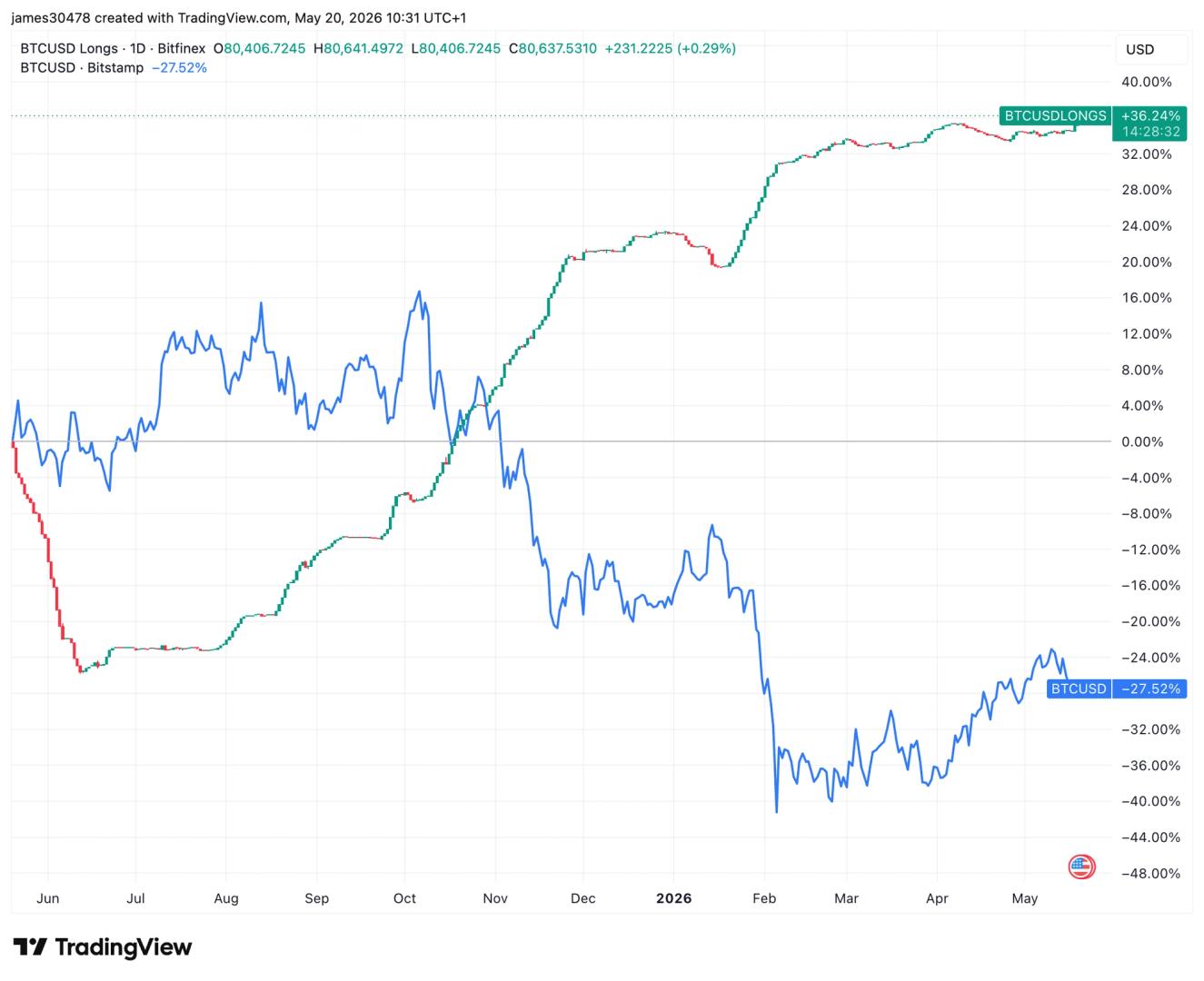
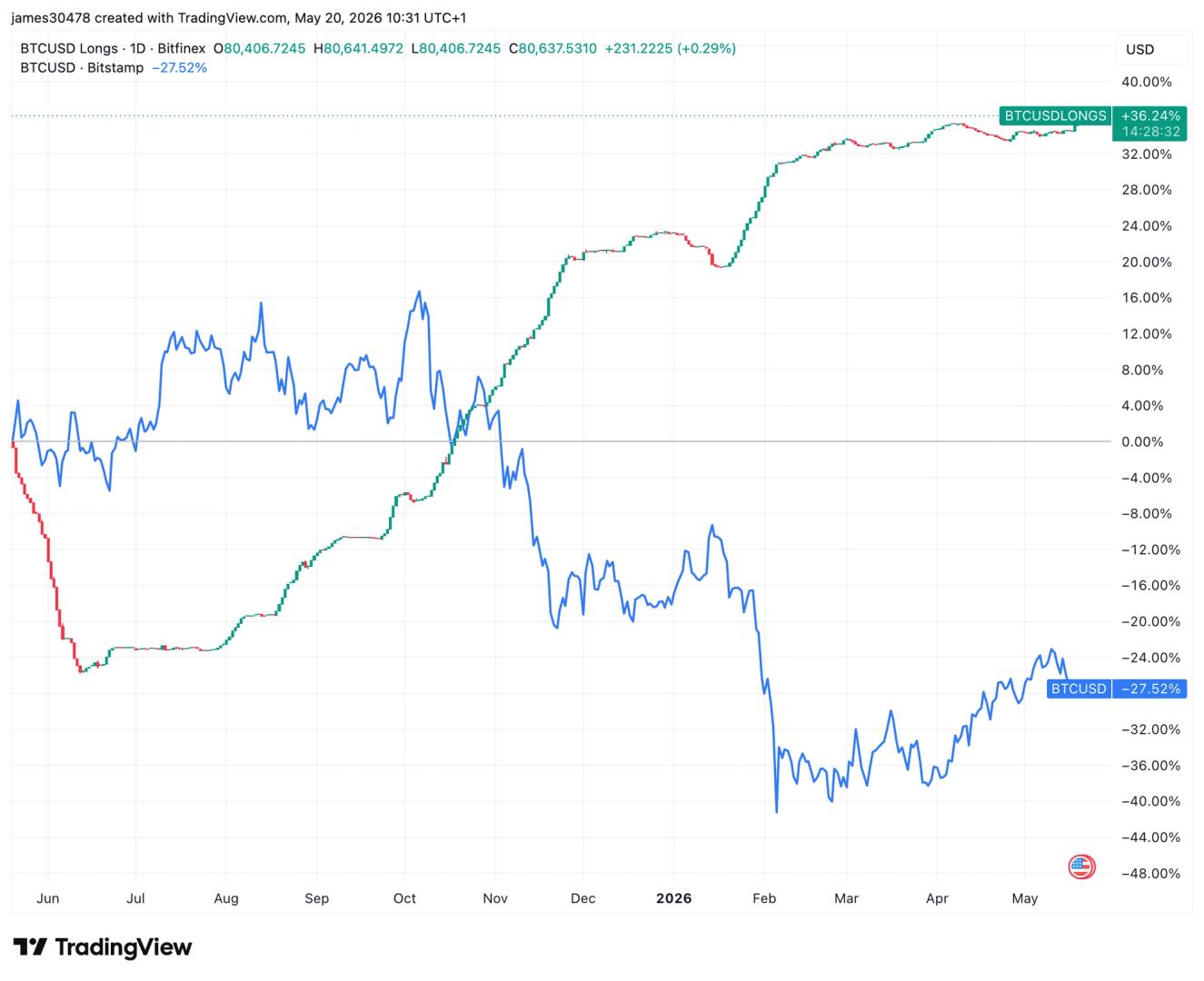
During the downturn, leveraged traders on Bitfinex continue to add exposure. Data from the TradingView shows bitcoin margin longs, positions opened using borrowed funds, have risen to 80,636 BTC, up roughly 1.5% over the past several days and now sitting at their highest level in two and a half years. The last time longs were this elevated was in December 2023, when bitcoin traded near $43,000.
According to TradingView data, Bitfinex margin longs have climbed around 10% since the start of the year, even as bitcoin itself has fallen 13%. The divergence underscores continued accumulation from large traders despite BTC remaining nearly 35% below its October all-time high of $126,000.
Historically, the so-called “Bitfinex whale” has often acted as a contrarian signal. Over the past five years, large leveraged long positions on the exchange have frequently expanded during periods of market weakness and capitulation, while being reduced closer to local market tops and trend reversals.
Bitcoin is now approaching a key technical zone. The asset is currently testing both the True Market Mean, an onchain valuation metric representing the market’s aggregate cost basis, and the short-term holder realized price, which tracks the average acquisition price of recent buyers over the past 155 days, near $78,000, just above the current spot price. Above that, the 200-day moving average sits just over $81,000, representing another major resistance level for bulls to reclaim.
Crypto World
BTC price tops $77,000. Analysts weigh in on whether the bounce has legs.: Crypto Daily
This is an excerpt from CoinDesk newsletter ‘Daybook.’ Sign up here, if you haven’t already.
Bitcoin has bounced to over $77,000, triggering a broader market recovery that has lifted both the CoinDesk 20 (CD20) and CoinDesk 80 (CD80) indexes by more than 1% since midnight UTC. Some coins, such as privacy-focused Dash and XDC Network’s XDC token, have gained 10% over the past 24 hours.
Some analysts continue to maintain a cautious stance, saying the market is caught between positive regulatory tailwinds and macro headwinds.
“Short-term action is pressured by [ETF] outflows and macro caution, while long-term positioning is supported by regulation, institutional access and reserve-asset narratives,” Naeem Aslam, a former hedge fund trader and the chief investment officer at Zaye Capital Markets, told CoinDesk in an email.
Aslam hailed President Donald Trump’s directive to the government and the Federal Reserve to review payment-system access for fintech and crypto firms as supportive of digital assets.
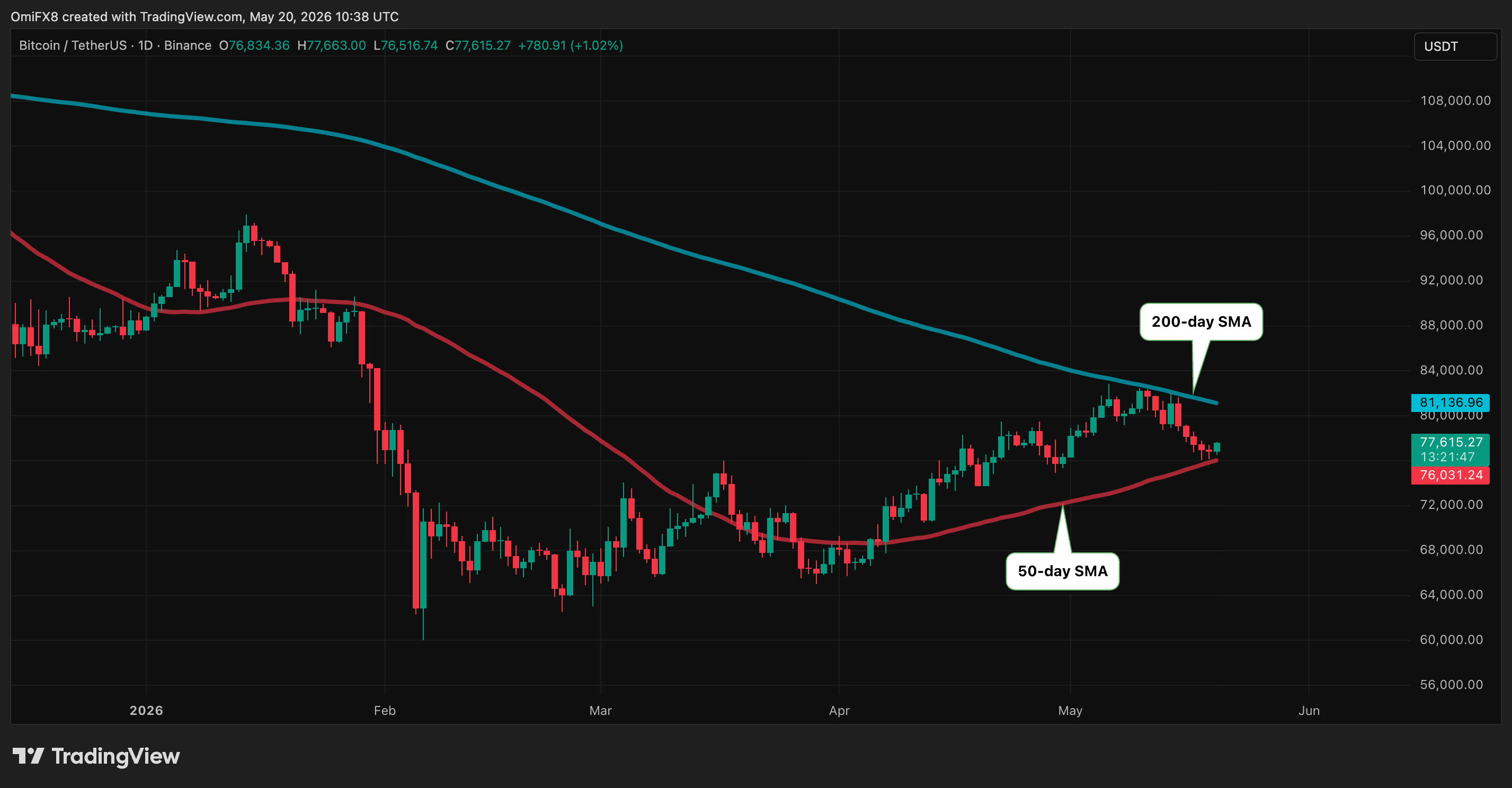
Alex Kuptsikevich, the chief market analyst at FxPro, said bitcoin’s latest bounce from the 50-day simple moving average is setting the stage for a decisive move in the next couple of days.
“Bitcoin, as of the end of last month, found support on dips to the $76K region,” Kuptsikevich said in an email. “Over the last couple of days, this support has been reinforced by the 50-day MA, as has the market. On the other hand, resistance at the 200-day MA continues to decline, bringing the bulls’ and bears’ red lines closer together and marking the moment when the market will choose its trend for the coming months.”
A market update from the financial technology and digital asset platform 1Konto placed the onus for sustained recovery on ETF inflows.
“ETF flows have become one of the cleanest transmission channels between traditional portfolios and Bitcoin spot demand. If those flows turn negative at the same time the long end sells off, Bitcoin trades more like macro collateral than a standalone scarcity asset,” the firm said in its daily market update.
We think Bitcoin can still stabilize before broader risk assets, but the next durable move higher likely needs either a calmer Treasury market or clear evidence that ETF demand is rebuilding,” the firm said in its daily market update,” it added.
In traditional markets, futures tied to the Nasdaq 100 index rose 0.8%, and oil dropped as the Senate moved to curb Trump’s ability to wage war against Iran. Investors are also looking to Nvidia’s earnings later Wednesday. Stay alert.
Read more: For analysis of today’s activity in altcoins and derivatives, see Crypto Markets Today . For a comprehensive list of events this week, see CoinDesk’s “Crypto Week Ahead.”
What’s trending
Today’s signal

Bitcoin’s five-day losing streak has run out of steam with prices nearly testing the 50-day simple moving average (SMA) late Tuesday.
Since then, BTC has bounced back above $77,000. The setup is pretty simple: Prices are stuck between the 50-day SMA support and the 200-day SMA resistance.
The two averages are converging, with the 200-day SMA declining and the 50-day measure rising, narrowing the range and building pressure for a decisive move in either direction in the days ahead.
A break below the 50-day SMA near $76,000 would likely signal that the bounce has failed and open the door to a retest of the February lows near $73,000. On the other hand, a sustained close above the 200-day SMA near $82,500 would be a meaningful technical development, potentially drawing in sidelined buyers and shifting the broader trend from bearish to neutral at minimum.

Firefighters attend an incident on Bromwich Street, Bolton
Immunovant director Atul Pande sells $192,000 in shares

Bitcoin Rallies Back Into Range Even As Investors Spot Risks


-

 Crypto World5 days ago
BloFin War of Whales 2026 Grand Prix opens registration for $5M trading championship
-

 Fashion5 days ago
Weekend Open Thread: Theory – Corporette.com
-

 Crypto World5 days ago
E-Estate Announces 1 Year Live: Washington DC Summit as Real Estate Tokenization Enters Its Next Phase
-

 Tech6 days ago
Tech Moves: Microsoft AI leader jumps to OpenAI; former AI2 exec joins Meta; and more
-

 Tech5 days ago
Google reimburses Register sources who were victims of API fraud
-
 Crypto World6 days ago
Google’s Gemini AI Predicts Incredible Solana Price by the End of 2026
-

 Business5 days ago
H&R Real Estate Investment Trust (HR.UN:CA) Q1 2026 Earnings Call Transcript
-
 Entertainment6 days ago
Zara Larsson Has Blunt Response To Chris Brown Diss
-

 Sports5 days ago
Napoleonic enters 2026 Doomben 10,000 field via Abounding withdrawal
-

 Crypto World5 days ago
BeInCrypto 100 Institutional Awards Nomination: KAST for Best Digital Assets Neobank and Best Digital Assets Fintech
-

 Fashion4 days ago
On the Scene at Gucci’s Cruise Show in New York City: Mariah Carey, Kim Kardashian, Lindsay Lohan, Iman, and More!
-
 Crypto World5 days ago
Bitcoin Battles US Bond Nerves With BTC Price Dip Toward New May Lows
-
 Crypto World5 days ago
Wall Street’s Boldest Gold Prediction Has Russians Rushing to Buy
-

 Crypto World5 days ago
ICE and CME urge US regulators to curb Hyperliquid energy trading
-

 Politics6 days ago
DWP PIP Timms review continues to be an absolute farce
-

 Fashion5 days ago
Trending Western Style Vests Perfect for Summer
-

 Entertainment5 days ago
David Letterman Returns to Late Show, Blasts Cancellation
-

 Crypto World5 days ago
IREN closes $3 billion convertible notes deal amid AI infrastructure expansion
-
Crypto World6 days ago
Lido Finance Selects Chainlink CCIP as the Official Cross-Chain Infrastructure for wstETH Security
-

 Fashion4 days ago
Amazon Sundays: Memorial Day Hosting
You must be logged in to post a comment Login