
Crypto World
Wall Street Meets XRPL: Why Ripple’s Latest DTCC Integration ‘Seems Important’

In a key move connecting traditional and digital finance, the Depository Trust and Clearing Corporation (DTCC) added Hidden Road Partners CIV US LLC to its NSCC Market Participant Identifiers directory.
Effective March 2, 2026, the NSCC update allows Ripple Prime to route institutional post-trade volumes directly onto the XRP Ledger (XRPL). Notably, the move bridges traditional market infrastructure with blockchain settlement.
XRPL Moves Deeper Into Wall Street Infrastructure
According to the DTCC notice dated February 27, 2026, the update is part of broader changes to participant lists for insurance processing. It also reflects NSCC updates across OTC, corporate, municipal, and UIT products.
As a result, Hidden Road appears under clearing broker code 0443 with executing broker alpha “HRFI,” approved specifically for OTC trades. The inclusion sets the stage for Ripple Prime to integrate traditional clearing infrastructure with blockchain settlement.
The integration enables Ripple Prime to combine NSCC’s centralized clearing, risk management, and settlement services with the XRPL’s speed and low transaction costs. Also, the arrangement could compress settlement times and improve capital efficiency across a system handling over $2 quadrillion annually.
In line with its growth strategy, Ripple acquired Hidden Road in April 2025 for $1.25 billion, marking one of the largest deals in digital assets history. Rebranded as Ripple Prime in October 2025, the platform now offers multi-asset prime brokerage. It provides clearing, financing, and OTC spot trading for XRP and RLUSD stablecoins.
Before the acquisition, Hidden Road cleared $3 trillion yearly for more than 300 institutional clients across FX, derivatives, and digital assets. Ripple plans to migrate post-trade activities to the XRPL, using RLUSD as collateral to streamline cross-margining between traditional and crypto markets.
An Important Development?
Ripple CTO Emeritus David Schwartz described the development as one that “seems important” on social media, noting its potential impact on XRPL adoption. Industry experts suggest the integration may boost settlement speed and institutional access while embedding blockchain deeper in U.S. financial infrastructure.
Beyond Ripple Prime, the DTCC notice also highlighted other updates. These include Summit Wealth Group joining insurance processing on March 9, 2026, and U.S. Securities International Corp. changing its clearing broker from NFSC to SWST.
Meanwhile, firms including Azzad Funds and Bain Capital Private Credit retired, with reassignments ensuring continuity of clearing and settlement operations.
The post Wall Street Meets XRPL: Why Ripple’s Latest DTCC Integration ‘Seems Important’ appeared first on CryptoPotato.

Crypto World
Senator Tillis eyes “crypto-palooza” to break stalemate over stablecoin yield regulations
A bipartisan effort to bridge the divide between Wall Street and the digital asset industry could see a breakthrough as early as this week.
Summary
- Senator Thom Tillis plans to release a draft agreement this week aimed at resolving the dispute between banks and crypto firms over stablecoin interest payments.
- The proposed language for the Clarity Act seeks to settle whether digital asset companies can offer rewards on idle balances after banks voiced concerns regarding deposit drains.
Politico reports that Senator Thom Tillis (R-N.C.) is preparing to unveil a draft agreement aimed at settling the fierce debate over stablecoin yields.
Working alongside Senator Angela Alsobrooks (D-Md.), Tillis has been refining language for the Clarity Act, a piece of legislation intended to set a regulatory framework for the crypto sector.
The primary sticking point remains whether digital asset firms should be permitted to pay interest on idle stablecoin balances, a practice banks claim threatens their deposit base.
“I think the language has come together well,” Tillis stated on Monday, noting that a public release depends on the continued success of ongoing discussions.
Banking representatives have already expressed concerns regarding the latest proposal from the two senators. Traditional lenders argue that high-yield stablecoin products could pull liquidity out of the banking system, creating instability.
Conversely, crypto platforms like Coinbase argue that a ban on rewards would hinder growth and ignore the potential for banks to participate in these new markets.
While the GENIUS Act, passed last year, prohibited stablecoin issuers from paying interest directly, it left a loophole for third-party exchanges to offer yields, which the Clarity Act now seeks to address.
The White House has attempted to mediate the standoff through several private meetings since January, yet both sides have remained firm in their views.
Senator Tillis has suggested hosting a “crypto-palooza” on Capitol Hill, bringing both factions together in a public forum to force a resolution.
Even if a compromise is reached, the bill faces a steep climb through the Senate Banking and Agriculture Committees before it can reach the floor for a final vote.
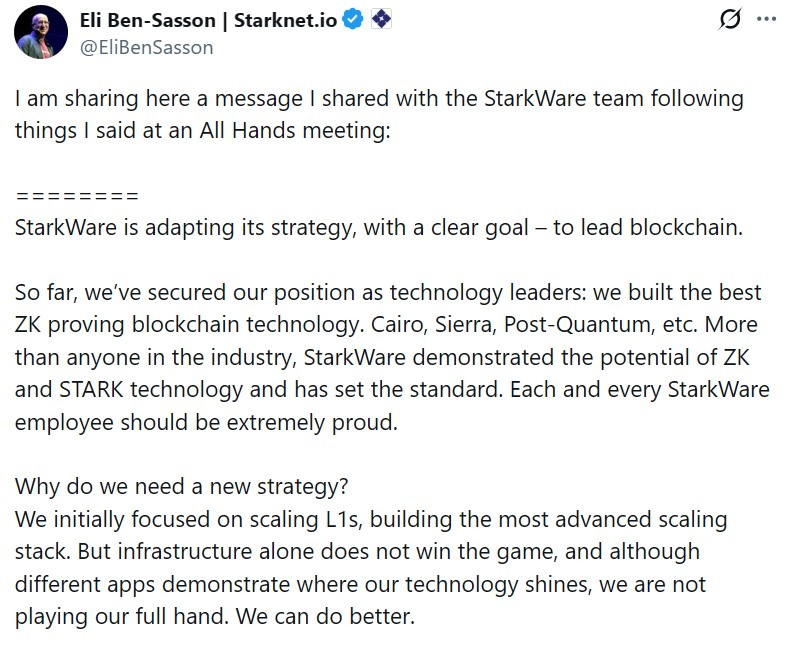
Zero-knowledge scaling company StarkWare is cutting jobs and restructuring its operations as it shifts from infrastructure development toward revenue-generating products.
CEO Eli Ben-Sasson said in internal remarks that the firm will split into two business units and cut headcount to move faster and operate more efficiently, with one unit focused on applications and the other on Starknet development.
Ben-Sasson said the company would adopt a “startup mode” mindset, prioritizing fewer initiatives with higher revenue potential, while warning that downsizing would affect employees across the organization. StarkWare did not disclose how many employees would be affected by the cuts.
The move reflects a wider retrenchment across crypto firms, which have been trimming headcount and narrowing priorities as they chase clearer product-market fit, stronger monetization and leaner operations. Messari, Algorand Foundation and Crypto.com all announced cuts in March.

StarkWare says technical edge must translate into revenue
Ben-Sasson said StarkWare’s next phase would center on turning its technology into “meaningful revenue” and “meaningful usage,” arguing that the company could no longer rely mainly on external blockchains or third-party teams to prove the value of its stack.
Ben-Sasson said the company would focus on “fewer things excellently” and prioritize products with revenue potential that can be built only on its technological stack.
Related: Decentralized email platform Dmail to cease services on May 15
“We’re going to achieve this by innovating across not just infrastructure, as we’ve done so far, but across the whole stack of infrastructure and product,” he said.
Crypto layoffs continue as firms tighten strategy
StarkWare’s cuts follow other recent layoffs across the crypto sector as firms narrow priorities and reshape operations. On March 17, Messari announced layoffs alongside a leadership change as the company moved deeper into artificial intelligence-powered research and data tools for institutions.
On March 19, the Algorand Foundation said it would cut 25% of its employees, citing macro uncertainty and the broader crypto downturn. The organization said the move was aimed at better aligning resources with its long-term business, technology and ecosystem priorities.
On the same day, Crypto.com also announced a 12% reduction of its workforce as part of a broader push into AI. The exchange said the layoffs were tied to company-wide AI integration and a decision to prioritize resources around key growth areas.
Magazine: Asia Express: Phantom Bitcoin checks, China tracks tax on blockchain

The U.S. Department of Justice has opened a compensation process for victims of the OneCoin crypto Ponzi scheme, drawing from forfeited assets seized from the operation’s principals. The department announced that more than $40 million in recovered assets is available to reimburse individuals who bought OneCoin between 2014 and 2019 and recorded a net loss.
US Attorney for Manhattan Jay Clayton called the program “an important step toward returning funds to those harmed.” The case highlights how large-scale crypto fraud can unfold and how authorities are attempting to recoup proceeds for victims, even years after a scheme collapses.
OneCoin, launched in 2014 with the ambition of rivaling Bitcoin, rapidly gained attention before revelations of its lack of real utility led to a global crackdown. The project rose to prominence in the crypto market, only to fall as authorities worldwide launched investigations into its operations.
“Between 2014 and 2019, OneCoin’s founders sold a lie disguised as cryptocurrency, costing victims more than $4 billion worldwide,” Clayton said. “While no recovery can fully undo the damage, our Office will continue working to seize criminal proceeds and prioritize getting money back into the hands of victims.”
Key takeaways
- The Department of Justice has established a compensation process for OneCoin victims, drawing on more than $40 million in forfeited assets.
- Eligible claimants are individuals who purchased OneCoin between 2014 and 2019 and sustained a net loss.
- OneCoin’s co-founders were Ruja Ignatova and Karl Sebastian Greenwood; Greenwood has since been sentenced to 20 years in prison, while Ignatova remains at large despite ongoing efforts to locate her.
- Authorities estimate that the scheme stole more than $4 billion from about 3.5 million victims between 2014 and 2016, with some broader estimates suggesting global losses could reach as high as $19 billion.
- Before its collapse, several central banks warned investors about OneCoin, and Bulgarian police later raided the company’s headquarters in 2018, resulting in Greenwood’s arrest.
The OneCoin arc: from promise to collapse
OneCoin launched in Bulgaria in 2014, spearheaded by Ruja Ignatova and Karl Greenwood, and quickly spread to the United States around 2015. The DOJ notes that the operation quickly attracted millions of participants, convincing many that they were investing in a legitimate alternative to established cryptocurrencies.
Despite its spectacular rise, investigators uncovered that the coin did not possess real value or functional utility beyond the marketing and pyramid-like incentives that fueled its expansion. By the time authorities moved in, the scheme had already exhausted substantial sums from a wide global base of investors.
According to the DOJ, between 2014 and the end of 2016, the scheme stole more than $4 billion from roughly 3.5 million victims. Some external estimates have placed global losses significantly higher, underscoring the scale and reach of the fraud as it unfolded across borders.
Prior to its collapse, several national central banks publicly warned investors about OneCoin, labeling it as a potential Ponzi scheme. The investigation culminated in Bulgarian police raids on the company’s headquarters in 2018, and Greenwood was subsequently arrested.
Greenwood’s prosecution culminated in a 20-year prison sentence handed down in September 2023 for his role in the scheme. Ignatova’s whereabouts remain unknown since 2017 when she was last seen boarding a flight to Athens. The FBI lists Ignatova on its Ten Most Wanted Fugitives list, and authorities have offered a $5 million reward for information leading to her capture and conviction.
The OneCoin case remains a stark reminder of how quickly crypto investment narratives can diverge from real utility, and how enforcement authorities pursue asset recovery even after schemes collapse.
Implications for victims and the broader crypto landscape
The new compensation process represents a tangible step by the U.S. government to translate enforcement outcomes into restitution for ordinary investors who were harmed by a high-profile crypto fraud. While the $40 million pool cannot fully compensate billions in alleged losses, it signals a channel for victims to recover at least a portion of their losses, funded from confiscated assets rather than taxpayer money.
For investors and practitioners, the OneCoin episode underscores several enduring lessons about risk in crypto markets. First, the presence of rapid wealth narratives around “cryptocurrency” does not guarantee legitimate value creation. Second, cross-border enforcement can eventually converge on asset recovery, even when the underlying assets prove illiquid or non-existent in utility terms. Finally, the case adds to the growing jurisprudence around what constitutes a legitimate crypto asset and how regulators differentiate between genuine innovation and deceptive schemes.
As authorities continue to unwind the remaining legal and financial tail of OneCoin, observers will be looking for updates on additional forfeitures, the effectiveness of the compensation framework, and how such processes could influence future cases involving mass-market crypto schemes.
For readers tracking this story, the next milestones to watch include the administration of the compensation process, any further asset seizures tied to the case, and ongoing efforts to locate Ignatova or recover further proceeds linked to the scheme.
Crypto World
Former CFTC Chair Chris Giancarlo leaves Willkie Farr to focus on digital asset advisory
Former CFTC Chairman Chris Giancarlo is leaving the legal profession to commit himself fully to the digital asset space as a strategic adviser for fintech and cryptocurrency startups.
Summary
- Chris Giancarlo is retiring from legal practice at Willkie Farr & Gallagher to focus exclusively on advising cryptocurrency founders and fintech boards.
- The former regulator earned the nickname Crypto Dad during his time leading the CFTC for his early support of digital assets and his role in launching the first Bitcoin futures.
The announcement came via a social media post on Sunday, where Giancarlo confirmed his departure from the law firm Willkie Farr & Gallagher and his official retirement from legal practice.
By moving into a full-time advisory role, he plans to provide guidance to executives and boards navigating the evolving digital economy.
“From here on, I’ll devote my time to advising founders & builders of FinTech & Digital Assets and their CEOs and boards, research & writing on public policy issues, and continuing work with non-profit programs,” Giancarlo stated.
Known throughout the industry as “Crypto Dad,” Giancarlo earned his reputation during his tenure at the Commodity Futures Trading Commission.
He joined the agency as a commissioner in 2014 under the Obama administration and later served as chairman from 2017 to 2018 following a nomination by Donald Trump.
His leadership was defined by the pivotal decision to greenlight the first Bitcoin futures markets in the United States, a move that helped bridge the gap between traditional finance and nascent digital markets.
Giancarlo has remained a prominent figure in regulatory circles since leaving public office, recently working with the crypto-focused bank Sygnum on global strategy and compliance.
During a recent appearance on “The Wolf of All Streets” podcast, he addressed the slow pace of legislative efforts like the CLARITY Act.
He suggested that even without immediate action from Congress, the CFTC and the SEC possess the necessary tools to establish a functional framework for the industry.
Modernizing the financial system remains a priority for the former regulator. He warned that while regulatory uncertainty might cause traditional banks to hesitate, the underlying tech is too important to ignore.
“I think there’s a recognition that this is the new architecture of finance and America, our financial institutions are the world’s dominant financial institutions. We need to modernize that. We need to adopt this technology,” he said.
The transition follows a similar path taken by other high-ranking regulators. Caroline Pham, who previously served as the acting chair of the CFTC, moved into the private sector last December to take on the role of chief legal officer at MoonPay.


Citadel Securities believes the worst-case tail risk from the Iran conflict has been “substantially truncated,” positioning both stocks and bonds for a rally.
The view, outlined by Nohshad Shah, reflects easing extreme-scenario risks as geopolitical incentives increasingly favor de-escalation.
Rally in Stocks and Bonds Is Coming as War Tail Risks Shrink
Shah wrote in a note that Iran’s leadership is primarily focused on regime survival. At the same time, China has strong incentives to push for de-escalation. Together, these dynamics suggest the likelihood of further military escalation is fading.
“The contours of what follows will become clearer in the coming weeks, but for markets, the most relevant point is that we appear to have substantially truncated the tail of the worst-case scenario,” he said.
Despite the US-led Hormuz blockade, Shah maintains his view that a resolution is taking shape. He suggested the conflict’s “end game” is approaching as both Washington and Tehran face rising costs from prolonged hostilities.
Follow us on X to get the latest news as it happens
US equity markets appeared to agree with that assessment. Google Finance data showed that the S&P 500 climbed 1.02% on Monday, rising to 6,886. The index has erased nearly all its losses since the Iran war began in late February.
The Nasdaq Composite gained 1.23%, the Russell 2000 Index rose 1.5%, and the Dow Jones Industrial Average added 0.6%. The rally extended gains from last week, when the S&P 500 recorded its longest winning streak since October 2025.
Previously, BitMine’s chairman, Tom Lee, also projected that the stock market had bottomed and the index could hit record highs this year.
Subscribe to our YouTube channel to watch leaders and journalists provide expert insights
The post Citadel Securities Expects Stocks and Bonds to Rally: Here’s Why appeared first on BeInCrypto.


X Head of Product Nikita Bier suggested the platform could launch a crypto-focused product, posting that “crypto has had a rough year” and that X should “launch something to fix it.”
While nothing has been officially confirmed, the post quickly drew responses from prominent community members pitching specific integration ideas. Fred Krueger responded to Bier’s post, calling for native Bitcoin (BTC) support on X.
Another user argued that paying creators in USDC stablecoin would improve the experience for both content producers and the platform.
These responses reflect a growing appetite among X’s crypto-native user base for deeper digital asset functionality.
Smart Cashtags and Trading Infrastructure
X has already taken concrete steps toward crypto-adjacent features. On February 14, Bier announced Smart Cashtags. This tool would let users trade stocks and crypto directly from the X timeline. The feature builds on X’s existing cashtag indexing system.
Previously, there was growing speculation that crypto functionality could be integrated into the X Money service, but the platform has not yet confirmed any such plans.
Furthermore, X appointed Benji Taylor as its new Design Lead in March. Taylor previously served as Chief Product Officer at Aave Labs and as the lead designer at Coinbase’s Base network.
His blockchain-heavy background has been widely interpreted as a signal that X is preparing to integrate crypto more deeply into its product stack.
Whether Bier’s post was a genuine product tease or simply community engagement, the convergence of Smart Cashtags, Taylor’s hire, and X Money’s development suggests the platform’s crypto ambitions may be advancing on multiple fronts.
The post X Head of Product Teases New Launch to Address Crypto’s Rough Year appeared first on BeInCrypto.
Key Takeaways
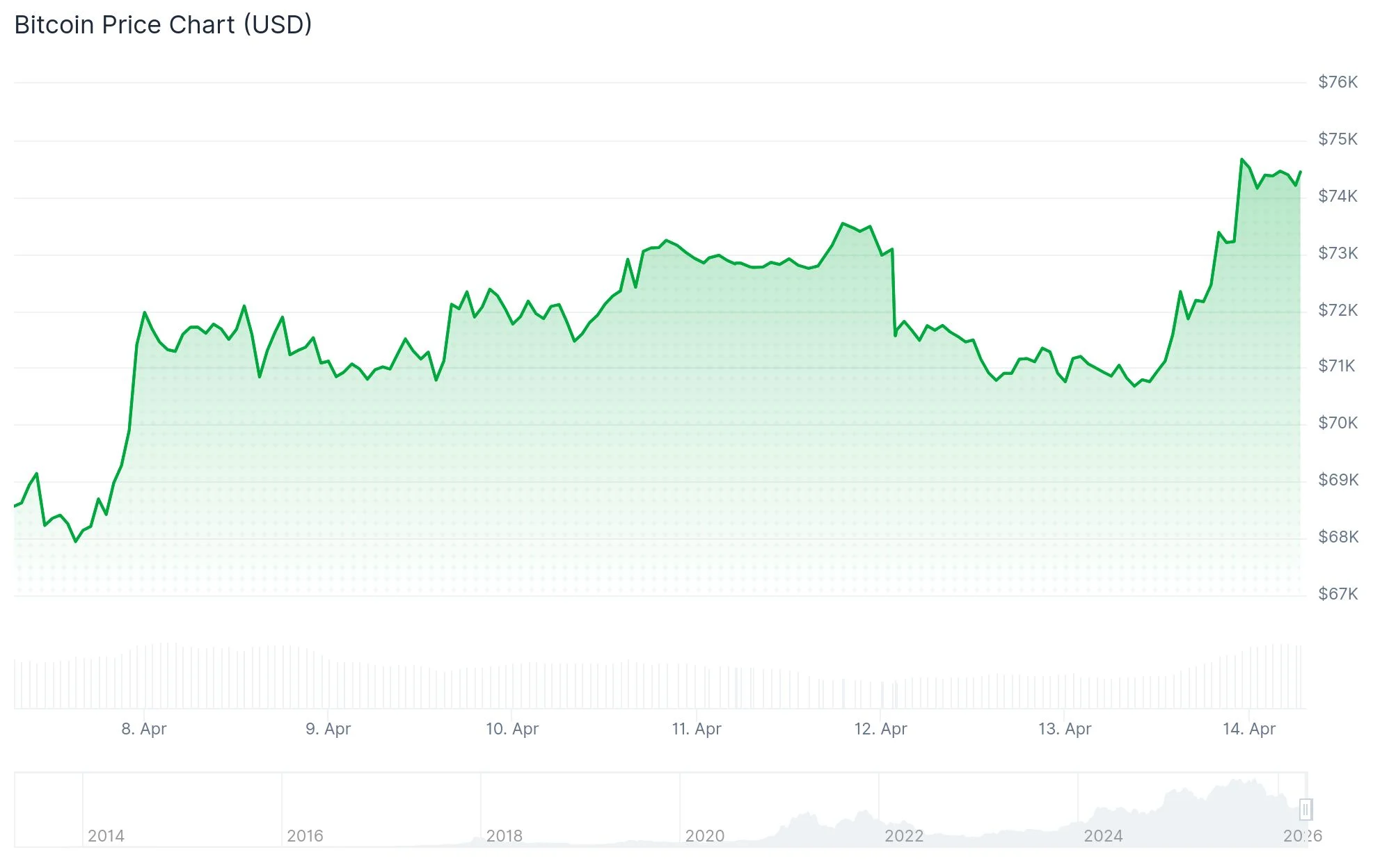
- BTC reached a four-week peak approaching $75,000 before settling around $74,290
- Approximately $530 million in cryptocurrency liquidations occurred, predominantly affecting short sellers at 80%
- Optimism surrounding potential US-Iran diplomatic progress is viewed as the primary catalyst
- Spot Bitcoin ETFs recorded $833 million in net capital inflows over the previous week
- Large wallet addresses accumulated 30,000 BTC throughout March, representing approximately $2.1 billion
Bitcoin successfully breached the $73,000 threshold on Monday after three previous rejection attempts over the preceding eight days, climbing to $74,484 — marking its strongest performance since the Iran tensions escalated in late February.
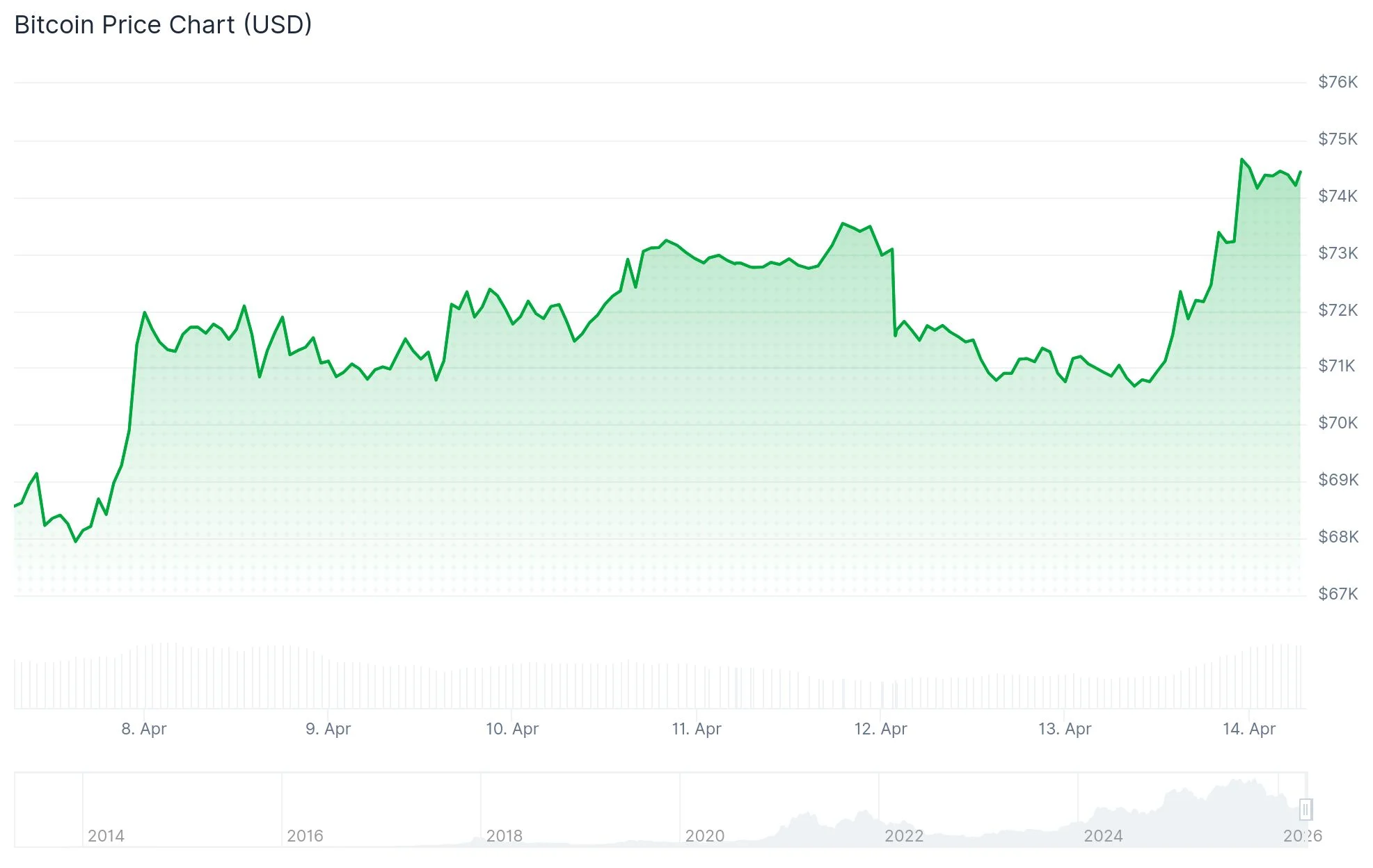
This price movement resulted in $534 million worth of forced liquidations affecting approximately 180,000 market participants. Short positions accounted for $430 million of these liquidations, representing the second substantial short squeeze within a six-day period.

Ethereum demonstrated stronger performance than Bitcoin, climbing 7.7% to $2,366 — reaching levels not seen in approximately ten weeks. Solana advanced 4.6%, while BNB increased 3.3%. All top-10 cryptocurrency assets by market capitalization recorded positive movements across both 24-hour and seven-day timeframes.
The most significant individual liquidation involved a $12.4 million BTC-USDT short position on the Aster exchange. Bitcoin represented $229 million in aggregate liquidations, with Ethereum following at $136 million.
Market participants are attributing the upward movement to indications from President Trump suggesting potential willingness to re-engage in diplomatic discussions with Iran. Despite a US military blockade of the Strait of Hormuz commencing Monday, financial markets appear to interpret this as a negotiating tactic rather than military escalation.
Jeff Mei, COO at BTSE, shared with Cointelegraph: “Market participants believe the US and Iran are progressing toward an agreement. Iran is urgently seeking to negotiate a settlement, and equity and cryptocurrency markets are responding positively.”
The S&P 500 has completely recovered all declines stemming from the Iran conflict, while the MSCI All Country World Index extended its winning streak to eight consecutive sessions.
Institutional Investment and Large Holder Behavior
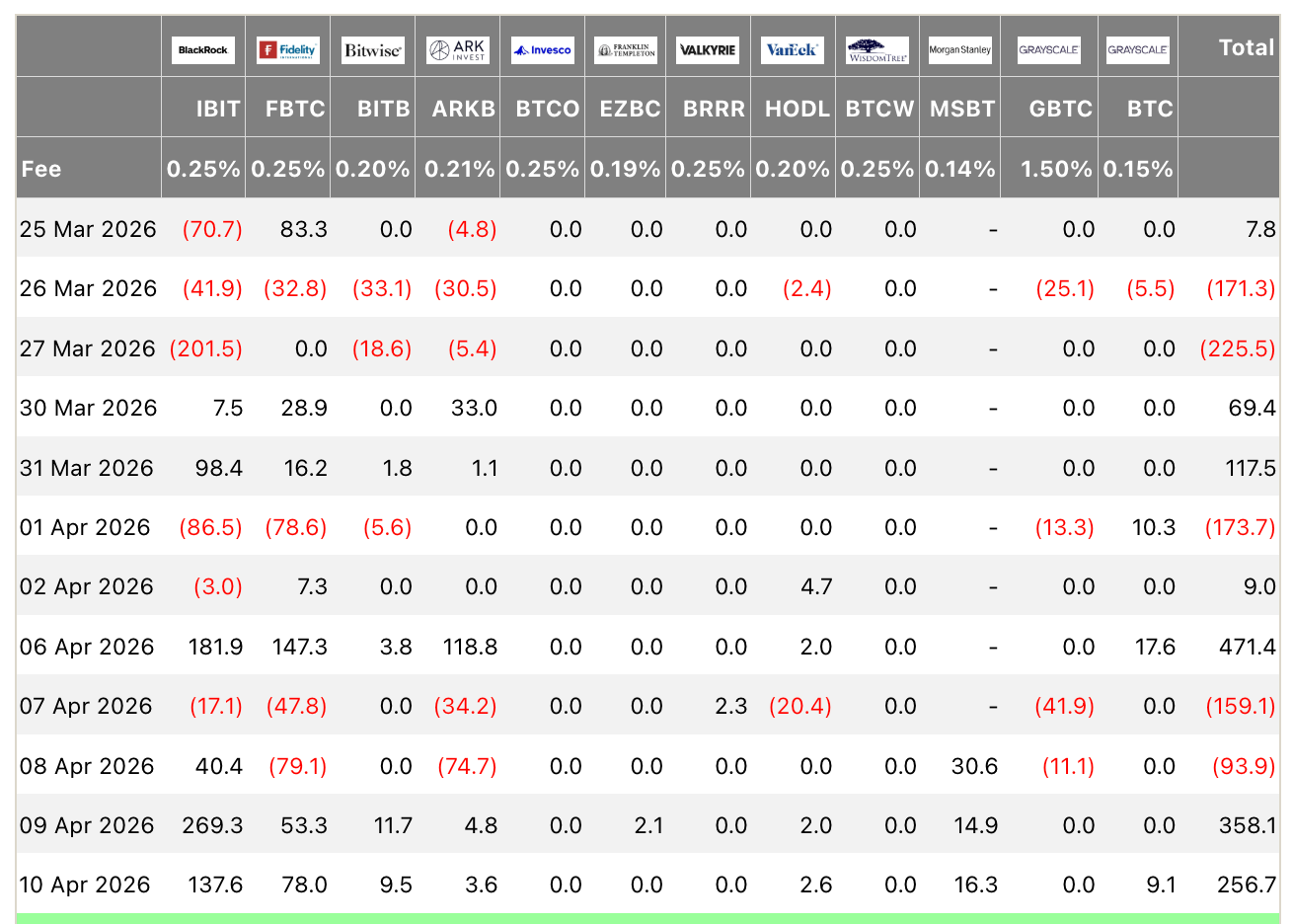
Bitcoin ETFs captured $833 million in net positive flows throughout the past week. James Butterfill from CoinShares indicated this “demonstrates renewed risk appetite following preliminary ceasefire progress regarding Iran, combined with support from weaker-than-anticipated US consumer spending and inflation figures.”
Blockchain analytics from Santiment reveal that addresses containing between 1,000 and 10,000 BTC increased their holdings by 30,000 tokens during March — valued at roughly $2.1 billion. Approximately 20,000 BTC of this accumulation occurred within a 24-hour window.
The Santiment analytics account highlighted on X that these large holders now possess over 4.25 million BTC, representing 21.3% of circulating supply — their highest concentration since mid-February.
Technical Outlook and Key Levels
Trading organization Valerius Labs observed: “This movement doesn’t constitute a genuine breakout. It’s a short squeeze encountering resistance zones. Authentic demand emerges above the 200-period simple moving average, not 15% beneath it.”
CryptoQuant has identified critical resistance approaching $79,000 — corresponding to the Traders’ Realized Price, where recent participants who entered during the downturn reach their cost basis and may consider profit-taking.
The 4-hour Relative Strength Index has advanced to 62, surpassing its 14-period moving average, which technical analysts interpret as strengthening bullish momentum. The current ceasefire arrangement between the US and Iran is scheduled to conclude next week, with additional diplomatic sessions under consideration.

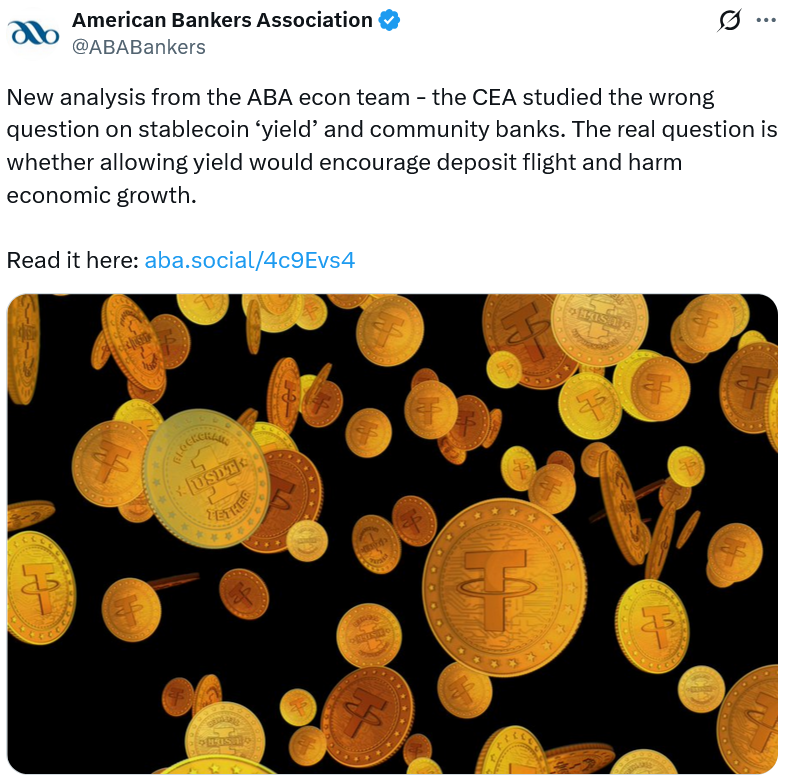
The American Bankers Association (ABA) has criticized a White House report that claimed banning stablecoin yields would only have a negligible impact on banks, arguing that the conclusion was reached by asking the “wrong question.”
The White House’s Council of Economic Advisers claimed in a research paper on Wednesday, on the “Effects of Stablecoin Yield Prohibition on Bank Lending,” that under a baseline scenario, banning stablecoin yield may only increase bank lending by $2.1 billion, representing a marginal net increase of about 0.02%.
ABA chief economist Sayee Srinivasan and vice president for banking and economic research Yikai Wang said in a statement on Monday that the “live policy concern” is not whether prohibiting yield on stablecoins would impact bank lending but whether allowing yield on stablecoins would encourage deposit outflows, particularly from community banks.
Srinivasan and Wang said that even if total deposits in the banking system remain unchanged, more funds would likely move from smaller banks to large institutions, which would raise the funding costs of community banks and reduce local lending.
Some of these smaller banks may not have enough balance sheet flexibility to absorb these outflows without resorting to higher-cost wholesale borrowing, the pair said.

Members of the crypto and banking industries have met to negotiate provisions in a Senate bill that will outline how crypto is policed ahead of a potential markup this month, with a key sticking point being language around banning stablecoin yield payments.
Related: CFTC chair says agency is ready to oversee entire crypto market
The ABA’s concerns reflect a Treasury paper in April 2025 that estimated widespread stablecoin adoption could lead to $6.6 trillion worth of deposit outflows from the US banking system.
ABA admits stablecoin rewards are more attractive
Despite the fears, the ABA economic researchers acknowledged that households and businesses would be financially incentivized to move funds out of banks in pursuit of higher-paying stablecoins.
Coinbase CEO Brian Armstrong is among the crypto industry leaders who have criticized banks for paying near-zero interest on deposits for decades, arguing that stablecoin yield would force banks to compete on a more level playing field.
The ABA represents some of the banking industry’s biggest names, including JPMorgan Chase, Goldman Sachs and Citigroup.
Magazine: Would Bitcoin really be at $200K if not for Jane Street? Trade Secrets

Cineflicks, an upcoming digital entertainment platform, has launched its first presale round as it continues development of a streaming platform focused on user participation and content engagement.
The Cineflicks platform is designed to offer users access to movies, shows, and digital content while introducing a structured engagement system within the platform. The model focuses on integrating content consumption with user participation, aiming to create a more interactive entertainment experience.
According to the team, Cineflicks is currently in the beta stage of development. Core features under development include a streaming interface, user profiles, content discovery systems, and reward tracking mechanisms. The platform also includes Web3 wallet integration to support digital asset management and transparent tracking of user activity within the ecosystem.
The announcement comes at a time when global streaming consumption continues to grow, with audiences spending increasing amounts of time on digital entertainment platforms. While streaming services have expanded significantly over the past decade, most platforms continue to operate on a passive consumption model where users access content without participating in the broader platform ecosystem.
Cineflicks is positioning its platform around a model that introduces participation-based engagement, where user activity is integrated into the overall platform experience. The company states that this approach is intended to align user engagement with platform growth while maintaining a familiar streaming interface.
The first presale round marks an early phase of ecosystem participation, with additional stages expected as the platform progresses toward its public rollout. The presale is structured in multiple phases, supporting the gradual expansion of the Cineflicks ecosystem.
The company plans to continue development of the platform alongside expanding its content library, partnerships, and user base in the coming months.
About Cineflicks
Cineflicks is an upcoming digital entertainment platform focused on streaming movies, shows, and web-based content. The platform is being developed to combine content access with user participation, supported by a structured digital ecosystem.
Media Contact
Email: marketing@cineflicks.io
Website: https://cineflicks.io
Twitter: https://x.com/cineflicksott
Instagram: https://instagram.com/cineflicksott
Disclaimer: This is a Press Release provided by a third party who is responsible for the content. Please conduct your own research before taking any action based on the content.
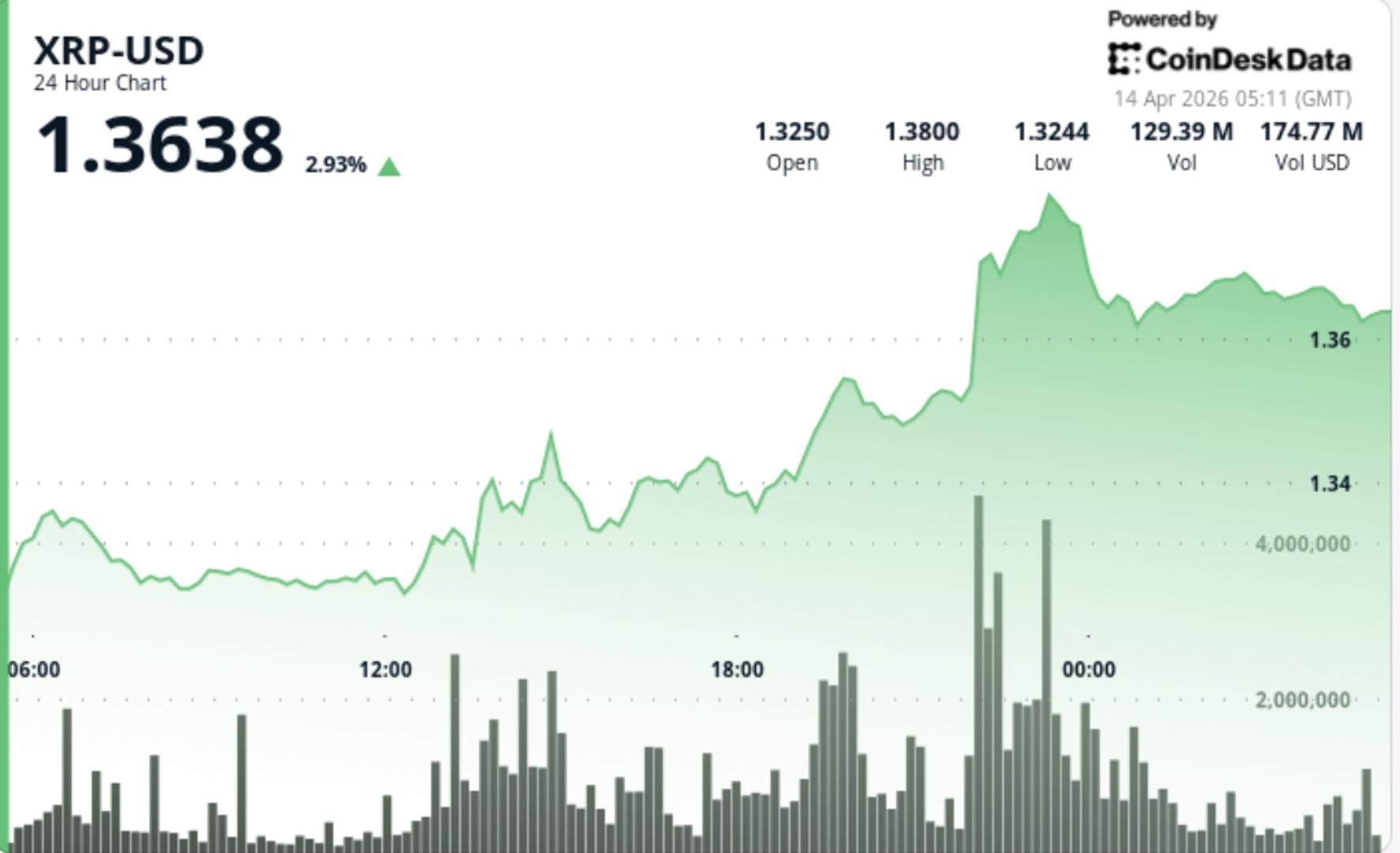
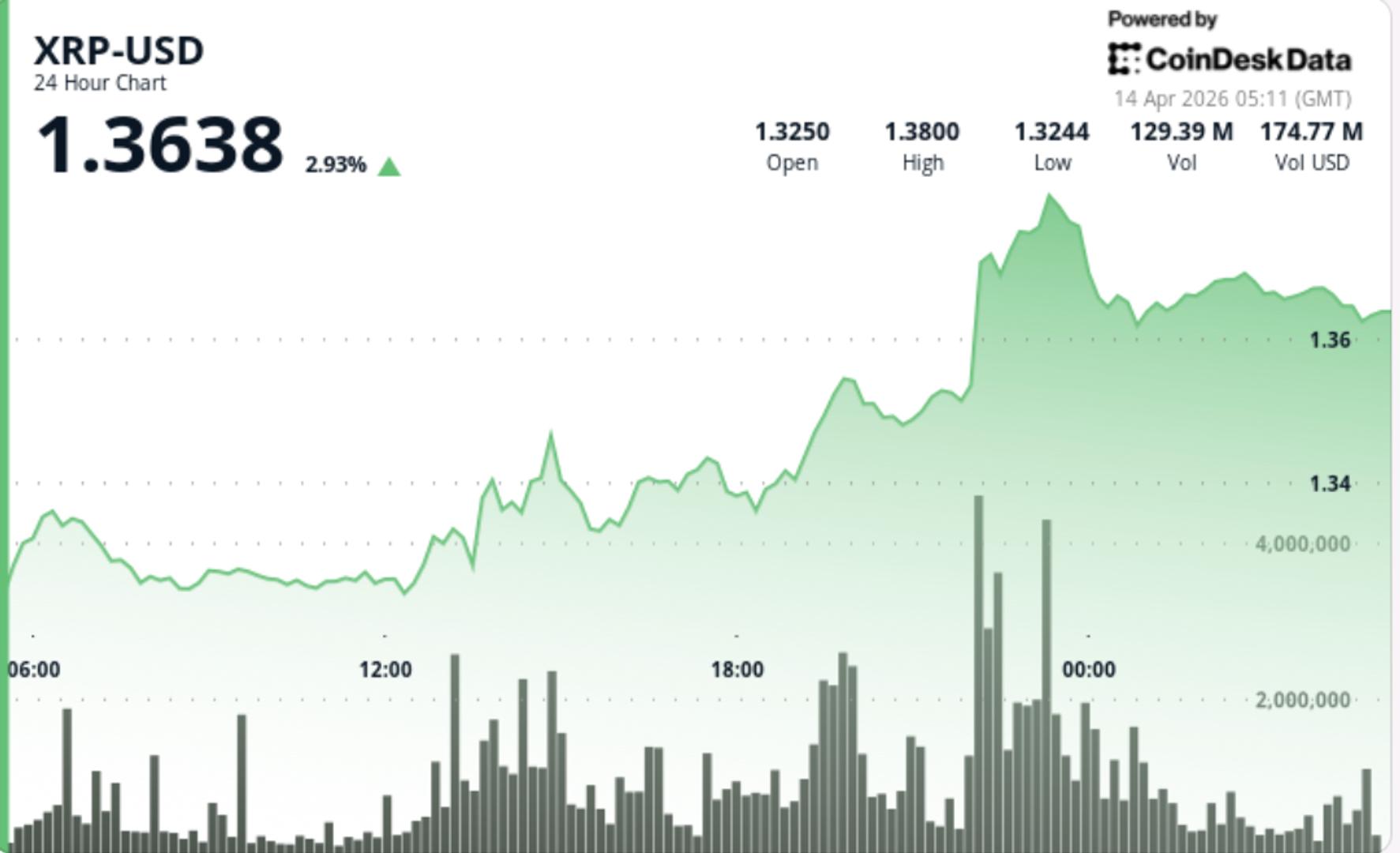
XRP is pushing higher again, but the real story is the setup building underneath. Price is grinding up on strong volume even as sentiment remains extremely negative, a mix that has historically preceded sharper moves.
News Background
• Social sentiment has dropped to one of its most bearish levels in two years, a setup that has previously preceded strong rallies.
• The broader structure remains defined by long-term consolidation, with XRP approaching a multi-year breakout decision zone.
Price Action Summary
• XRP moved from $1.32 to $1.37, continuing a sequence of higher lows that signals steady accumulation.
• The breakout above $1.35 came on strong volume, with follow-through buying pushing price toward $1.38.
• Price is now consolidating just below recent highs, holding gains rather than immediately reversing.
Technical Analysis
• The key signal is the combination of rising price and strong volume, pointing to accumulation rather than short-term speculation.
• At the same time, extremely bearish sentiment suggests retail positioning is still skewed to the downside, creating a contrarian setup.
• XRP remains below major resistance, meaning the broader trend has not yet flipped despite improving short-term structure.
• Compression across timeframes indicates the market is approaching a decision point, with pressure building for a larger move.
What traders should watch
• $1.35 is now the immediate support, with price needing to hold above it to maintain momentum.
• $1.42-$1.45 is the key breakout zone that needs to clear for a stronger trend shift.
• Failure to hold $1.33-$1.30 would weaken the structure and bring downside back into focus.

Powerful new play heading to Shotts theatre

Cottesloe strata offices sold for $10m

Senator Tillis eyes “crypto-palooza” to break stalemate over stablecoin yield regulations


-

 Politics4 days ago
US brings back mandatory military draft registration
-
 Sports4 days ago
Man United discover Nico Schlotterbeck transfer fee as defender reaches Dortmund agreement
-

 Fashion4 days ago
Weekend Open Thread: Veronica Beard
-

 Tech6 days ago
How Long Can You Drive With Expired Registration? What Florida Law Says
-

 Politics2 days ago
World Cup exit makes Italy enter crisis mode
-

 Politics4 days ago
Malcolm In The Middle OG Turned Down ‘Buckets Of Money’ To Appear In Reboot
-

 Crypto World5 days ago
Canary Capital Files SEC Registration for PEPE ETF
-

 Business3 days ago
Tesla Model Y Tops China Auto Sales in March 2026 With 39,827 Registrations, Beating Cheaper EVs and Gas Cars
-

 Fashion7 days ago
Let’s Discuss: DEI in 2026
-

 Crypto World6 days ago
Bitcoin recovers as US and Iran Agree a Ceasefire Deal
-

 Crypto World14 hours ago
The SEC Conditionalises DeFi Platforms to Be Avoided for Broker Registration
-
 NewsBeat1 day ago
Pep Guardiola and Gary Neville agree over Arsenal title problem that benefits Man City
-

 Business4 days ago
OpenAI Halts Stargate UK Data Centre Project Over Energy Costs and Copyright Row
-

 Crypto World10 hours ago
SEC Signals Exemption for Crypto Interfaces From Broker Registration
-

 Business3 days ago
Ireland Fuel Protests Enter Day 5 as Blockades Spark Shortages and Government Prepares Support Package
-

 Politics4 days ago
LBC Presenter Mocks Trump Over Iran War Failures
-

 Crypto World3 days ago
Federal judge blocks Arizona from bringing criminal charges against Kalshi
-

 Tech4 days ago
A version of Windows 10 released a decade ago is now eligible for additional security patches
-
 NewsBeat2 days ago
JD Vance announces ‘no agreement’ with Iran over nuclear weapons fear
-

 Business3 days ago
IMF retains floor for precautionary balances at SDR 20 billion
You must be logged in to post a comment Login