

Crypto World
What approval would actually change for crypto



The Digital Asset Market Clarity Act just cleared its hardest committee test. If it becomes law, it ends the single most damaging fact of life for American crypto: not knowing who is in charge. But the version that reaches President Trump’s desk will be shaped by three fights still being waged in the Senate, and the outcome of those fights decides who wins and who loses.
Summary
- The Senate Banking Committee advanced the CLARITY Act in a 15 to 9 vote, moving the crypto market structure bill closer to a full Senate vote.
- The proposal would divide digital assets into categories overseen by the SEC and CFTC, while also creating a separate framework for payment stablecoins.
- Ethics rules tied to President Donald Trump’s crypto connections, stablecoin yield limits, and anti-money laundering provisions remain among the biggest unresolved issues before the bill can reach the White House.
The restaurant with two inspectors
Imagine running a restaurant where the health inspector and the fire marshal both insist your kitchen is theirs to police. Neither will put their rules in writing. And if you guess wrong about whose instructions to follow, the penalty is that they shut you down and sue you.
That, more or less, has been the experience of building a crypto company in the United States since around 2017. The Securities and Exchange Commission and the Commodity Futures Trading Commission have spent the better part of a decade in an unresolved turf war over digital assets, and the industry has lived in the gap between them. Tens of billions of dollars in fines have been paid. Founders have spent years in litigation just to extract an answer that regulators could have written down in advance. Most builders simply gave up and left, for Dubai, Singapore, Switzerland, anywhere a straight answer arrived in less than three years.
The Digital Asset Market Clarity Act, universally shortened to the CLARITY Act, is Washington’s most serious attempt to end that era. And after months of stalemate, it just took its biggest step forward yet. On May 14, 2026, the Senate Banking Committee voted 15-9 to advance the bill to the Senate floor, with two Democrats crossing party lines to join every Republican on the panel.
That vote was not the finish line. It was the moment the bill stopped being a wishlist and became real legislation with a credible path to law. For anyone who trades, builds, invests in, or simply holds digital assets, the question is no longer whether to pay attention. It’s what, concretely, changes if this thing passes, and what the unresolved fights still being waged in the Senate will mean for the version that actually becomes law.
This is a long answer to that question.
What the bill actually does: three boxes, two regulators
Strip away the acronyms and the 270-plus pages, and the CLARITY Act does one structurally simple thing. It sorts every digital asset into one of three categories and assigns each category to a regulator.
Digital commodities. A token whose value comes from a functioning, sufficiently decentralized blockchain, where the network does something real and the token is the fuel that powers it. Bitcoin and Ether are the obvious cases, and both are widely expected to land here, formalizing what has been their de facto treatment for years. Digital commodities fall under the CFTC.
Investment contract assets. A token is sold the way startup equity is sold, where a centralized team raises money from the public and promises to build something with it. These stay with the SEC, which is where that agency has always had its firmest legal footing.
Permitted payment stablecoins. Dollar-pegged tokens designed to actually move money. These get a separate category with joint SEC and CFTC oversight, building on the GENIUS Act stablecoin framework that passed earlier.
Three boxes. Two regulators. The biggest reduction in legal fog the American crypto industry has ever been offered.
The mechanics behind that simple structure are what make the bill consequential. The CLARITY Act gives the CFTC exclusive jurisdiction over the spot and cash markets for digital commodities, which is a dramatic expansion for an agency that has historically referred to derivatives rather than the underlying assets themselves. Exchanges, brokers, and dealers handling digital commodities would register with the CFTC through a new, purpose-built pathway, instead of trying to force themselves into securities rules written in 1933 and 1934 for a very different kind of asset.
The SEC, in turn, keeps authority over genuine securities offerings. The bill draws a line, in federal statute, between the moment a token is being sold as a fundraising instrument by a centralized team and the moment the underlying network has matured enough that the token trades as a commodity. That maturation test, the question of when a project becomes “decentralized” enough to graduate from SEC to CFTC oversight, is one of the most legally intricate parts of the bill, and one of the most important.
For developers, there’s a provision that may matter more than the jurisdictional sorting itself: protection for people who write open-source code but never have custody of user funds. Under the CLARITY Act, publishing a smart contract would stop being treated as the legal equivalent of running an unlicensed money-transmitting business. For a corner of the industry that has watched developers face personal legal exposure simply for shipping code, this is foundational.
What approval would mean, by who you are
A regulatory framework is not an abstraction. It lands differently depending on where you sit in the ecosystem. Here is the concrete picture.
If you are a developer or founder
The immediate change is the disappearance of a specific, paralyzing fear: that building in the open is itself a legal risk. A clear registration pathway means a US-based project can launch knowing which agency it answers to and what compliance looks like, rather than discovering the answer through an enforcement action two years later.
The decentralization maturity test gives projects something they have never had, which is a roadmap. A token can begin its life under SEC oversight as an investment contract asset and, as its network decentralizes, move into the digital commodity category. That transition used to be a matter of speeches, blog posts, and hope. Putting it into statute means a founder can plan around it.
The likely practical effect is repatriation. A meaningful share of the talent and capital that decamped to friendlier jurisdictions did so for one reason: those places offered a straight answer. Remove that disadvantage, and the math on building in the US changes.
If you are an exchange, broker, or custodian
For the largest US platforms, the bill turns an existential ambiguity into an operational task. Instead of litigating whether the assets they list are securities, exchanges would register with the CFTC and operate under a defined rulebook. The bill includes an expedited registration process and provisional status, so platforms are not frozen out while the CFTC builds its full framework.
This is a double-edged outcome. Clarity is not the same as leniency. A registered exchange will face real, enumerated obligations: custody standards, disclosure requirements, conduct rules, and capital expectations. The era of regulatory vapor ends, but so does the era of regulatory absence. Compliance will have a cost. The industry’s bet is that a known, payable cost beats an unknowable, unbounded legal risk. For most serious operators, that bet is obviously correct.
If you are a retail investor or token holder
The benefits here are real but slower and less glamorous. Defined disclosure requirements for token issuers mean better information before you buy. Custody and conduct rules for registered intermediaries mean more protection for assets you hold on a platform. The legal status of the assets in your wallet becomes a settled question rather than an open one.
There’s also a subtler consequence. A credible US framework is the precondition for the next wave of institutional products, and for traditional financial institutions to offer crypto services to ordinary customers without regulatory peril. Approval doesn’t put crypto in your bank tomorrow. It removes the biggest single obstacle standing between today and that future.
If you hold or use stablecoins
This is where the bill’s politics get sharp, and the detail matters. The compromise negotiated by Senators Thom Tillis and Angela Alsobrooks draws a careful line. Intermediaries, exchanges, for instance, would be prohibited from paying yield on a customer’s idle, passive stablecoin holdings. The intent is explicit: a passive stablecoin balance must not be allowed to function like an interest-bearing bank deposit. But the same provision permits rewards tied to activity, meaning incentives connected to actually spending or using a stablecoin, as long as they don’t resemble passive interest.
If that distinction sounds narrow, it is. It’s also the fault line over which this entire bill nearly collapsed, and it explains a fight covered in the next section.
The three fights that will shape the final bill
The version of the CLARITY Act that passed committee is not the version that will become law. Three contested issues remain open, and each one will shape who benefits and by how much. Anyone trying to understand what approval “means” has to watch these, because the answer is still being written.
Fight one: ethics, and the shadow of the Trump family
This is the single biggest political wedge between the bill and final passage. Many Senate Democrats are demanding an ethics provision barring senior government officials from holding business ties to the crypto industry, a demand driven, unambiguously, by President Trump’s family’s extensive crypto ventures, including the World Liberty Financial project.
Republicans on the Banking Committee declined to include such language in the committee bill, arguing that ethics sits outside the committee’s remit and can be added later by floor amendment. The committee specifically voted down a Democratic ethics amendment. That rejection is the most direct explanation for why most Democrats voted no.
The arithmetic makes this unavoidable. On the Senate floor, the bill needs 60 votes. Assuming every Republican supports it, that means roughly seven Democrats have to come along. Crypto-friendly Democrats, including Senators Kirsten Gillibrand and Ruben Gallego, have stated plainly that they won’t provide those votes without an ethics provision. Industry advocates now describe some form of ethics language as “almost all but guaranteed” to be added before a floor vote.
But there’s a counter-pressure pulling the other way. Senator Cynthia Lummis, a key negotiator, warned that the President himself has to sign off, and that if the bill becomes, in her words, a cudgel aimed specifically at him, he’ll veto it without hesitation. The realistic landing zone is therefore an ethics provision strong enough to win seven Democratic votes but weak enough to survive a presidential signature. That’s a narrow target, and where exactly the language lands will tell you a great deal about how seriously the final law treats conflicts of interest.
Fight two: illicit finance and law enforcement
A coalition of law enforcement groups argues the bill doesn’t do enough to stop digital assets from being used in financial crime, and would make catching bad actors harder. The concern gained urgency from a Treasury FinCEN advisory flagging crypto platforms and stablecoins as a channel for sanctioned actors to launder illicit proceeds.
Senators have filed amendments to strengthen anti-money-laundering and sanctions provisions. Backers of the bill counter that it actually strengthens AML and sanctions rules and gives law enforcement better tools. How this gets resolved affects the compliance burden on every registered intermediary, and the bill’s credibility with the national-security-minded senators whose votes are in play.
Fight three: the banks
America’s banking industry is the bill’s most powerful organized opponent, and its objection is
fundamentally about deposits. If stablecoins can pay anything resembling yield, banks fear money will drain out of deposit accounts, the same deposits that fund lending. In the days before the committee vote, bank trade groups reportedly sent more than 8,000 letters to senators demanding revisions. Even after the Tillis-Alsobrooks compromise, banking groups complain the activity-rewards language leaves room for workarounds.
This is not a sideshow. It’s a genuine clash between two financial industries over the future shape of money, and the banks have decades of lobbying infrastructure behind them. The final stablecoin language will be one of the most negotiated paragraphs in the entire bill.
The road from here
Even on an optimistic reading, the CLARITY Act has several gates left to clear.
First, the Senate Banking Committee bill has to be merged with a parallel version produced by the Senate Agriculture Committee, since the two panels share jurisdiction over digital assets, into a single unified text. Industry insiders expect intense negotiation over the next several weeks, and this is the most likely vehicle for inserting the ethics compromise.
Second, the merged bill faces a full Senate floor vote requiring 60 senators.
Third, because the House passed its own version of the CLARITY Act back in July 2025, any Senate- passed bill containing new components, such as the stablecoin yield language, the DeFi provisions, or ethics rules, has to be reconciled with, or accepted by, the House before it can go to the President.
The timeline is genuinely tight. White House officials have floated a target of a signing on or around July 4, 2026. Industry advocates describe an effective “drop-dead deadline” before the August recess, after which the midterm elections and a potentially less crypto-friendly Congress raise the degree of difficulty considerably. Prediction markets have put the odds of passage in 2026 in the rough vicinity of two-in- three, while at least one Wall Street analyst has been more cautious, calling a successful floor vote “in play but not the expected outcome.”
In other words: reachable, not guaranteed.
What it means, in the end
It’s worth being precise about the nature of what is on offer here, because both boosters and skeptics tend to overstate it.
The CLARITY Act is not a gift to the crypto industry. It’s a rulebook. It hands the industry the thing it has asked for over and over, a definitive answer to “who regulates this?”, and the price of that answer is a genuine, enforceable obligation. Exchanges will register. Issuers will disclose. Intermediaries will be examined. For an industry that has at times romanticized its own lawlessness, the deepest meaning of approval is that the era of operating in the absence of rules ends, and the era of operating under them begins.
For the United States as a whole, the bill is a bet that a clear domestic framework will pull
Builders, capital, and talent back home, and that the alternative, ceding the next decade of financial infrastructure to other jurisdictions, is the worst outcome.
And for the ordinary participant, the developer shipping code, the trader on an exchange, the person holding a stablecoin, the change is less a single dramatic event than the removal of a decade-long background hum of uncertainty. The legal status of the asset in your wallet becomes a settled fact. The platform you use answers to a named regulator. The developer who wrote the protocol is not a criminal for having written it.
That’s what crypto purgatory ending actually looks like. Not paradise. Just, finally, a map.
The committee’s vote on May 14 was the moment the map stopped being a rumor. The next two months, the merged text, the ethics deal, the floor math, and the House vote will decide what the map actually says. Watch the floor math. Watch the ethics negotiations. And when the merged text lands, read it. The details are the story now.
This article is for informational purposes and does not constitute legal, financial, or investment advice. Legislative situations evolve quickly; the status described reflects developments as of mid-May 2026.

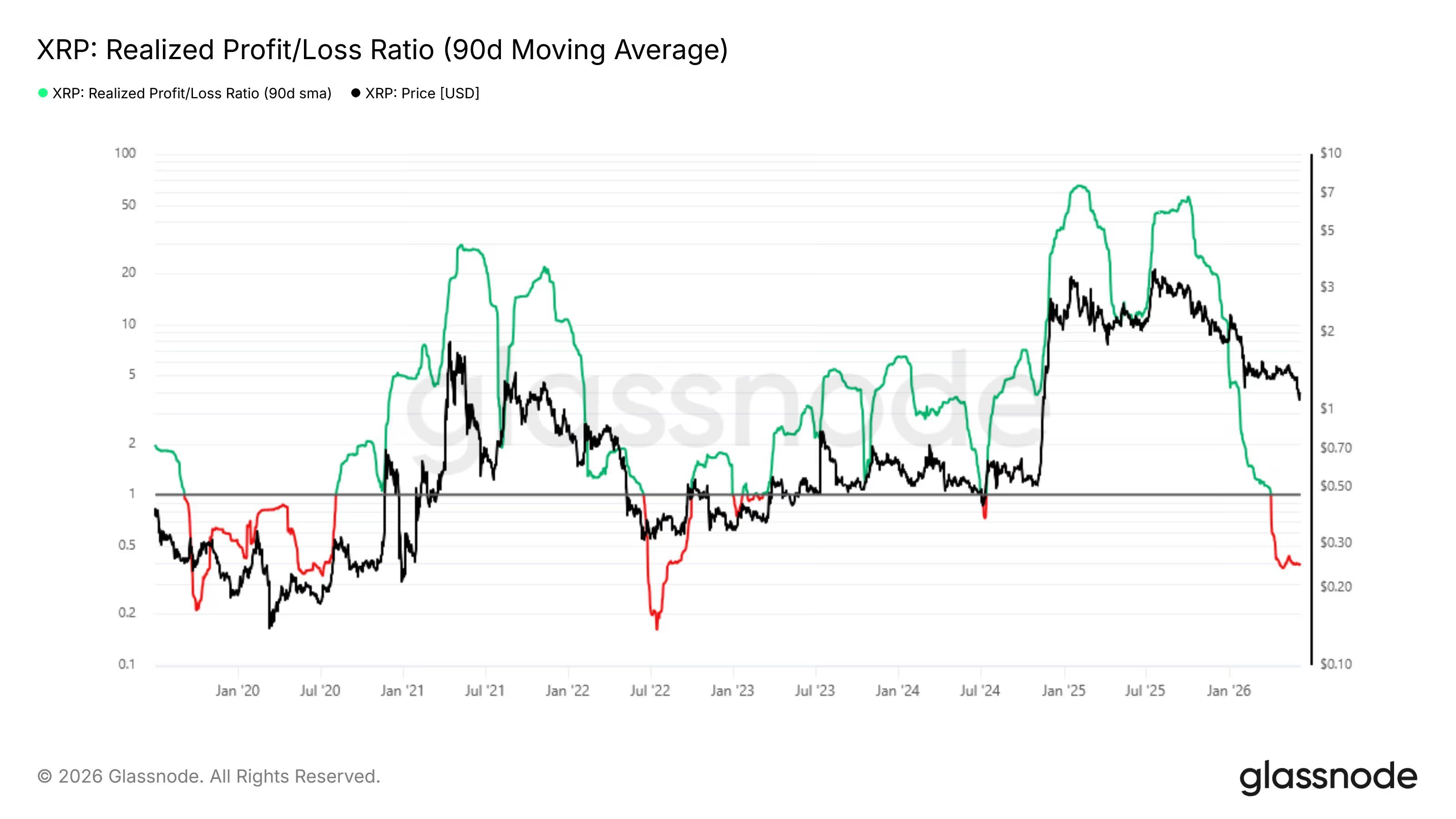
XRP holders are increasingly selling at a loss in a textbook sign of market capitulation.
The 90-day moving average of XRP’s realized profit-to-loss ratio has plunged to 0.38, according to data tracked by Glassnode.
That means for every $1 of losses investors are realizing right now, they are taking in just 38 cents in profit. Essentially, most of the coins trading on the blockchain are underwater.
The situation marks a reversal from the 2025 peak, when the ratio hit 50. At that time, profit-takers were overwhelming loss-sellers by a staggering 50-to-1.

A ratio this far below 1 is widely viewed as a hallmark of capitulation, a market phase where exhausted holders finally throw in the towel and sell, often after bearing the prolonged pain of holding coins in loss. It reflects intense fear or forced selling in the market.
While capitulation doesn’t always mark the exact bottom, it frequently appears near exhaustion points in downtrends. For XRP traders, this could mean that the bear market is in its final stages.
The payments-focused cryptocurrency traded at around $1.11 at press time, down nearly 40% for the year, according to CoinDesk data. Prices peaked above $3.60 last July.
Meta’s revenue rose by 33% year-on-year in the first quarter of 2026, reaching $56.3 billion. Adjusted earnings per share came in at $7.31, comfortably ahead of the consensus forecast of $6.67. However, the positive earnings results were overshadowed by other developments.
Alongside the report, the company raised its 2026 capital expenditure forecast to between $125 billion and $145 billion, which the market interpreted as a signal of potential pressure on free cash flow. Additional pressure on the share price emerged in early June following reports that Meta was considering raising tens of billions of dollars through a new share offering to finance AI infrastructure projects. The company itself dismissed these reports as “pure speculation”.
Technical Picture
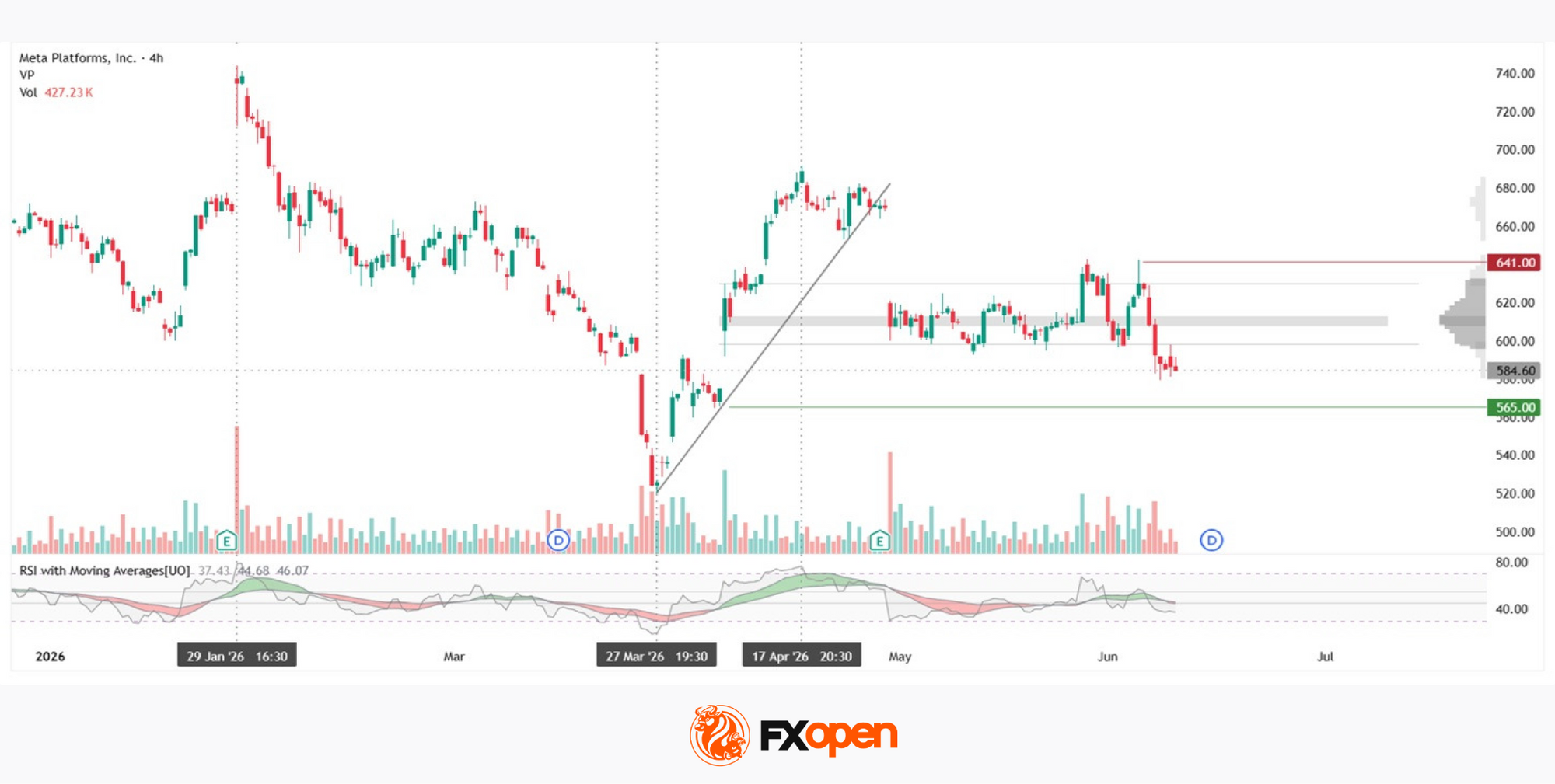
Since the beginning of April, Meta shares had been trading within an ascending trend structure that originated from the March low. Towards the end of April, however, a gap formed on the chart, followed by a break of the trendline. Since then, the stock has entered a sideways phase, losing its previous upward momentum.
The share price is currently trading below the lower boundary of the volume profile at 598 and below the point of control (POC) located in the 610–611 area — levels that could once again attract market attention should buying interest return.
The green support level near 565 may serve as a downside target if selling pressure continues. Meanwhile, the resistance zone around 641 remains the next major upside reference point in the event of a reversal and a break above the upper boundary of the profile.
The RSI and its moving averages currently stand at 37, 44 and 46. The oscillator has moved below the neutral zone, while the moving averages continue to confirm the prevailing bearish direction.
Key Takeaways
Following the break of the ascending trendline and the formation of the April gap, Meta shares entered a consolidation phase and are currently testing its lower boundary. Future price action will largely depend on how transparent management proves to be regarding the financing of its AI initiatives and whether the company can demonstrate that its substantial capital investments translate into tangible operational results.
Buy and sell stocks of the world’s biggest publicly-listed companies with CFDs on FXOpen’s trading platform. Open your FXOpen account now or learn more about trading share CFDs with FXOpen.
This article represents the opinion of the Companies operating under the FXOpen brand only. It is not to be construed as an offer, solicitation, or recommendation with respect to products and services provided by the Companies operating under the FXOpen brand, nor is it to be considered financial advice.

Key Takeaways
- A security breach involving an employee’s laptop led to the exposure of private keys controlling Humanity Protocol’s bridge infrastructure.
- The attackers gained control of three out of six multisig keys, enabling them to manipulate token bridges on both Ethereum and BNB Chain.
- Approximately 141 million H tokens were extracted from Ethereum, while 200 million tokens were illegally minted on BNB Chain.
- H token’s value plummeted more than 85%, declining from approximately $0.67 to bottoming out at $0.05.
- On-chain analysts detected suspicious wallet movements before the attack occurred, though no conclusive evidence of insider involvement has emerged.
Humanity Protocol revealed this Tuesday that cybercriminals successfully extracted more than $36 million in its H token following unauthorized access to private keys housed on a compromised employee computer.
The platform operates cross-chain bridges facilitating H token transfers between Ethereum and BNB Chain networks. These bridges were safeguarded using multisignature wallet technology—a security mechanism demanding multiple key approvals before executing transactions or modifying smart contracts.
According to founder Terence Kwok, the key distribution followed proper protocol across four separate individuals. However, a critical error occurred during the initial configuration phase when several keys were inadvertently stored on one device that subsequently fell victim to compromise.
“Some of the keys were accidentally backed up to a compromised device during setup,” Kwok said.
Breaking Down the Exploit
On Ethereum, the perpetrators secured three of the six keys associated with the bridge’s administrative account. This threshold gave them complete authority over the system. They swapped the authentic bridge smart contract with a fraudulent replacement and extracted approximately 141.2 million H tokens through one massive transaction.
On BNB Chain, the attackers compromised three of five keys. They injected an unlimited minting capability into the bridge contract and exploited it to create 200 million fresh H tokens, transferring them straight into their controlled wallet.
The development team immediately suspended all deposit and withdrawal operations on both compromised bridges upon detecting the security breach.
Market Reaction and Price Collapse
The H token had experienced strong upward momentum during the weeks preceding the breach, surging from approximately $0.20 to $0.70. Following public disclosure of the exploit, the token’s value crashed to around $0.05—representing a catastrophic decline exceeding 85%.
While the token eventually rebounded toward the $0.20 level, significant damage had already occurred. In the aftermath, Humanity Protocol’s team information page was also taken down from their official website.
Investigating the Attack’s Source
On-chain investigator ZachXBT initially raised concerns about potential connections between irregular market-making operations and over-the-counter H token transactions and the security breach. He subsequently clarified that these activities appeared unrelated to the key compromise incident.
Security researcher Elton Shehdula from Allium Labs suggested the blockchain evidence indicated a carefully orchestrated operation. He observed that wallets participating in the attack received funding from both an exchange and a mixing service several weeks beforehand. The attacker also seemingly tested minting permissions days before launching the full-scale exploit, with the drainage occurring simultaneously across both blockchain networks.
Shehdula indicated that such meticulous preparation suggests either an internal threat actor or an external adversary who had maintained covert possession of the compromised key for an extended period.
Cyvers security director Hakan Unal noted that the blockchain evidence presents an ambiguous picture. He explained that authentic external attacks typically display hasty characteristics—rapid fund transfers to newly created wallets, disadvantageous swap rates, and immediate mixer usage. Conversely, orchestrated events may exhibit more controlled timing patterns, particularly coinciding with token unlock schedules or vesting milestones.
Currently, Humanity Protocol states it is collaborating with cryptocurrency exchanges and additional stakeholders to explore potential recovery strategies. The specific circumstances surrounding the initial laptop compromise remain undisclosed to the public.

The latest Wintermute crypto prediction says capital has not returned, and no bottom is confirmed. BeInCrypto analysts tested every checkable claim against on-chain data. The short answer is that the call holds, except for the one thing it dismisses.
Bitcoin trades near $62,000 after a 14% weekly drop, back to levels last seen in September 2024, while the Nasdaq fell 4.7% amid AI exhaustion.
What the Wintermute Crypto Prediction Actually Says
The market maker’s June 8 note argues the decline came from US institutional selling and Bitcoin ETF outflows, not from Strategy’s sale of 32 BTC.
That sale, the firm’s first since 2022, was immaterial in size and symbolic in signal, in Wintermute’s words. Disclosures this week even showed Strategy back on the bid with a 1,550 BTC purchase.
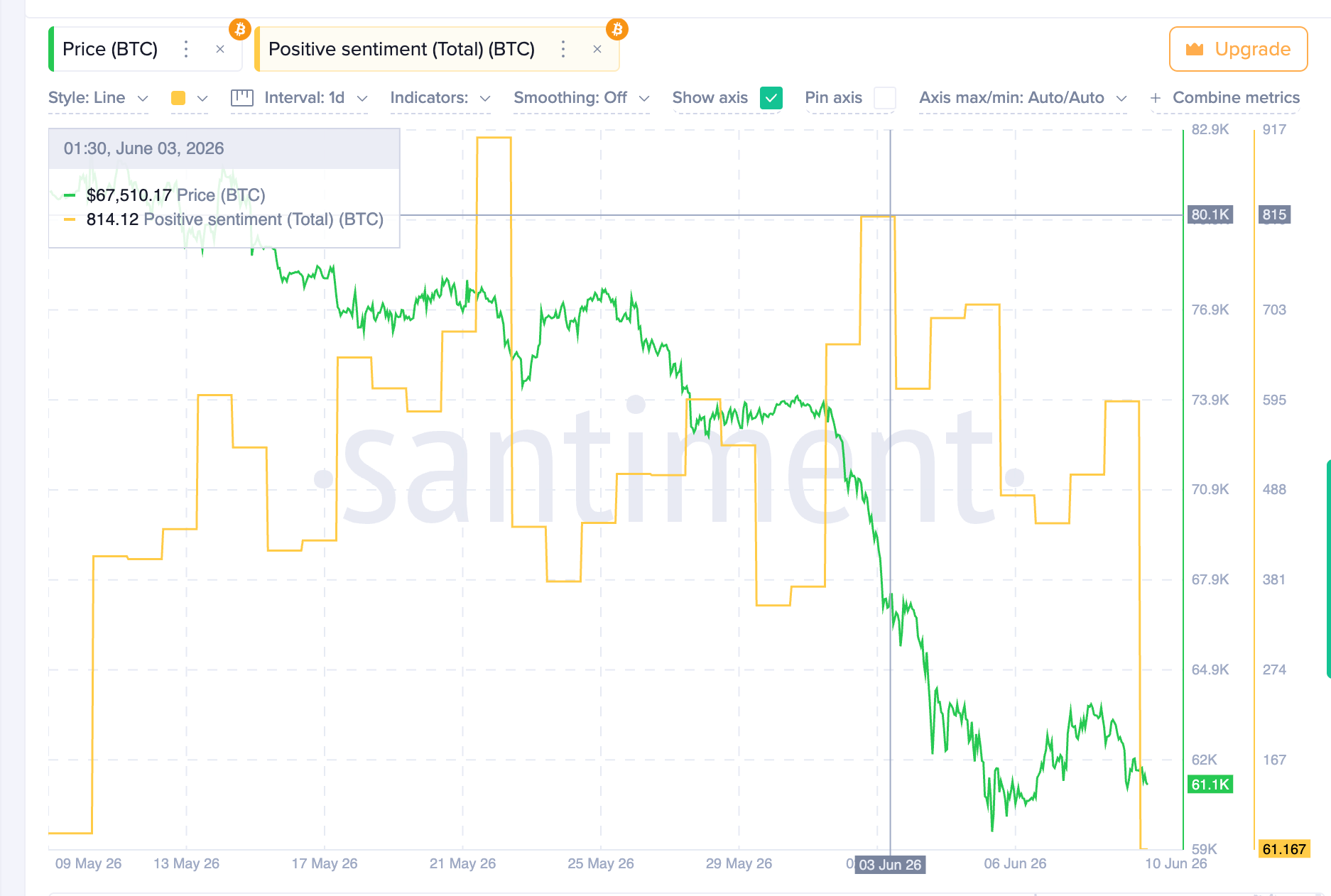
Here, the desk pushes back on one point. The coins never hit order books, yet sentiment data reviewed by BeInCrypto shows Bitcoin’s positive sentiment score collapsing from 814 on June 3 to 61 now, a fall of more than 92%.
The crash brackets the sale’s circulation, suggesting the damage ran through psychology even if it skipped the tape.

The macro half of the Wintermute crypto prediction reads good news as bad news. May payrolls printed 172,000 jobs against roughly 80,000 expected, services prices hit their hottest since August 2022, and the 10-year yield rose to 4.55% on Friday.
Consequently, the easing case faded, and some analyst commentary now frames oil-driven inflation as a potential trigger for a rate hike.
Wintermute adds one structural worry. Bitcoin never spent meaningful time between $50,000 and $59,000 in 2024, so few shelves exist underneath, leaving capital flows to set direction.
So BeInCrypto analysts checked the flows first.
The Money Has Not Come Back, and the Reserves Prove It
The cleanest gauge is stablecoin exchange reserves, the pool of dollar-pegged tokens sitting on exchange wallets as ready-to-deploy buying power.
CryptoQuant data reviewed by BeInCrypto shows that the pool peaked at $75.12 billion on November 12, 2025. Roughly a month after BTC’s all-time high.

It has since drained to $62.81 billion as of June 10, 2026, a fall of roughly 16%. That round-trips the entire fourth-quarter build and returns reserves to a level even lower than last seen in late September 2025, before the price peak even formed.

The broader stablecoin market cap tells the same story from another angle. DefiLlama shows the total float at $315.97 billion, down $3.25 billion in the past week after topping near $323 billion.
Dry powder is draining while the total money on crypto’s rails leaks at the same time.

On its core claim, the Wintermute crypto prediction verifies in full. Capital has not returned, by either measure. The ETF ledger then shows how unusual this drought already is.
An Outflow Streak With No Precedent
SoSoValue monthly data frames the whole cycle. Inflows of $6.02 billion in July 2025 began the setup, and September and October added $3.53 billion and $3.42 billion as prices peaked at $126,210.
Then the funds flipped. November through February printed four straight red months, the longest monthly outflow streak since the products launched, against a single two-month streak in February and March 2025. November alone bled a record $3.48 billion.

May reopened the wound with $2.43 billion out, the worst month of 2026, and June has already shed $1.89 billion in just 10 days, nearly 80% of May’s total.
During the outflow era, fund assets nearly halved from $147.73 billion to $77.58 billion, while prices halved from the record high to $62,000.
The dates further strengthen the Wintermute crypto prediction.
Rekt Capital called the October 2025 top in June 2024 using halving-cycle timing, and October proved to be the final month of meaningful inflows. His late-November macro triangle breakdown landed on the streak’s worst month.
His forward math is where the scenario sharpens.
The Verdict on the Wintermute Crypto Prediction
In an interview with BeInCrypto, the analyst capped this year’s upside at the falling macro downtrend, the series of lower highs running since October.
“The mid-80s would probably be the top for this year, provided we don’t break the macro downtrend,” said Rekt Capital.
The pivot that changes everything is a sustained break above $82,500.
His floor runs deeper than current prices.
“This bear market should see a retracement of some 60% to 70%, which would mean we go sub-50 into the 40s, and that should be taking place in Q4 of this year,” he told BeInCrypto.
BeInCrypto’s projection highlights similar levels. Keeping the mid-January to early-May swing in play, a potential bottom for BTC comes at $44,627. That would be a 64% retracement from BTC’s peak.
The peak to breaking the bearish pattern lies around $82,824, aligning perfectly with Rekt Capital’s $82,500 pivot.

So, how true is Wintermute’s crypto prediction? The answer lands in three parts.
The flow claims verify in full, from the record streak to the drained reserves. The dismissal of the Strategy sale underplays a 92% collapse in Bitcoin sentiment that the desk can document.
And the one bullish crack is real, since long-term holder wallets keep absorbing coins even as their pace thins considerably.
However, weakening accumulation is what keeps Wintermute’s bearish case alive.

Wintermute named its own test in the SpaceX listing on June 12, and Rekt Capital named its at $82,500. Either one of those triggers breaks the pattern, or the flow math and the cycle math keep pointing at the same sub-$50,000 zone.
His ceiling stretches further out. Every cycle forms a three-year resistance that breaks only in the halving year, and this cycle’s level is $93,000. That makes $93,000 his absolute maximum for 2027, with new record highs unlikely before 2028.
The post Wintermute Suggests a Scary Crypto Market Scenario: How True Is It? appeared first on BeInCrypto.


The European Commission has proposed sanctions on 20 non-EU entities, including crypto platforms, as part of a new package that could introduce the bloc’s first country-level ban on foreign crypto services linked to Russian sanctions evasion.
Summary
- The European Commission has proposed sanctions on 20 non-EU entities, including crypto platforms accused of helping Russia bypass existing restrictions.
- New measures could introduce the EU’s first country-level ban on crypto services from jurisdictions hosting platforms linked to sanctions evasion.
- Chainalysis reported $93.3 billion in transaction volume tied to the ruble-backed stablecoin A7A5, a network cited in growing scrutiny of Russia-linked crypto activity.
According to the European Commission, the proposed 21st sanctions package targets banks, oil traders, and cryptocurrency platforms that have allegedly provided services to sanctioned Russian individuals and entities.
European Commission President Ursula von der Leyen said the measures are designed to close remaining channels used to bypass existing restrictions.
Under the proposal, transaction bans would be extended to the listed non-EU entities. In addition, the commission is seeking authority to prohibit crypto services originating from entire non-EU jurisdictions if those countries host platforms that help sanctioned Russian actors continue operating.
“It will act as a strong deterrent for the countries hosting platforms that help Russia evade our sanctions,” von der Leyen said.
Crypto platforms face growing sanctions scrutiny
The proposal arrives as regulators on both sides of the Atlantic increase pressure on crypto infrastructure they believe supports sanctioned states and illicit financial networks.
Chainalysis reported that illicit cryptocurrency addresses received $154 billion in 2025. The blockchain analytics firm also identified substantial activity linked to Russia, citing approximately $93.3 billion in transaction volume involving the ruble-backed stablecoin A7A5, which it said represented a significant portion of state-linked crypto activity.
Earlier this year, blockchain research firm Elliptic identified five crypto exchanges that it said provided financial pathways used to bypass sanctions while operating outside traditional banking oversight.
Recent enforcement actions have already targeted several crypto businesses accused of supporting sanctioned networks. In May, the United Kingdom sanctioned Huobi Global S.A., which authorities linked to HTX, over allegations that it provided services to the Russia-connected A7 network. The UK government imposed asset freezes, payment restrictions, internet service sanctions, and other measures against the company.
Elliptic said the UK action represented the first use of Regulation 17A against a cryptoasset exchange, extending restrictions on correspondent banking relationships and payment processing involving designated entities.
Across the globe, the U.S. Treasury in June designated four Iranian cryptocurrency exchanges, Nobitex, Wallex, Bitpin, and Ramzinex, alleging they helped sanctioned entities access the digital asset ecosystem. Treasury officials said cryptocurrency services had become part of Iran’s efforts to move funds outside traditional financial channels.
Russia prepares domestic crypto framework
While European authorities move toward tighter restrictions, Russia is preparing a comprehensive cryptocurrency regulatory framework expected to be introduced in July.
The planned rules would establish licensed domestic trading platforms, creating a regulated structure for local crypto activity as international scrutiny of Russia-linked digital asset flows continues to increase.
Outside the crypto sector, the European Commission’s latest package also seeks to tighten pressure on Russia’s energy and trade sectors. Proposed measures include additional restrictions on oil vessels and the first sanctions targeting Russian fisheries.
“Our sanctions keep biting hard and cutting deep; they are weakening the economic foundations of Russia’s war effort,” von der Leyen added.
Key Points
- Kraken secured the position of Official Crypto Exchange Supporter for FIFA World Cup 2026
- The agreement encompasses digital asset education, supporter engagement initiatives, and platform awareness throughout North America and European markets
- The tournament will showcase an unprecedented 48 national teams competing in 104 fixtures across 16 metropolitan areas in three nations
- Tournament organizers project a combined audience exceeding six billion spectators worldwide
- Initial fan engagement launches with the FIFA World Cup 2026 Countdown Concert scheduled for June 10
The cryptocurrency exchange Kraken has secured official supporter status for the FIFA World Cup 2026 tournament. This arrangement spans North American and European territories, emphasizing supporter interaction, cryptocurrency literacy programs, and platform exposure surrounding the global football event.
Romy Gai, FIFA’s Chief Business Officer, indicated the collaboration aligns with the federation’s objectives for enhancing supporter experiences. Arjun Sethi, co-CEO of Kraken, emphasized that football transcends geographical and linguistic barriers, suggesting financial systems should operate similarly.
The 2026 tournament unfolds over seven weeks spanning the United States, Canada, and Mexico. This marks the inaugural expanded format featuring 48 participating nations and 104 total matches. FIFA anticipates cumulative viewership surpassing six billion people globally.
Kraken’s Tournament Engagement Strategy
Kraken plans to leverage the World Cup’s massive platform for introducing football enthusiasts to cryptocurrency technology. The strategy prioritizes educational content, brand recognition, and seamless platform accessibility.
Supporter engagement activities are scheduled throughout the pre-tournament and competition periods. These initiatives will integrate with match broadcasts, football supporter networks, and tournament-related events across both continental regions.
The inaugural public engagement coincides with the FIFA World Cup 2026 Countdown Concert happening June 10. This multi-city concert series represents part of the broader pre-tournament promotional campaign.
The financial details of the FIFA partnership agreement remain undisclosed by Kraken.
Existing Sponsorship Portfolio
Kraken maintains current partnerships with prominent football clubs including Tottenham Hotspur, Atlético de Madrid, and RB Leipzig. The platform additionally sponsors Atlassian Williams Racing in the Formula 1 championship.
These existing agreements positioned Kraken before substantial football and motorsport audiences prior to finalizing the World Cup arrangement. The FIFA deal significantly amplifies that exposure to a worldwide tournament audience.
With more than ten years of operational history, Kraken maintains service across over 190 nations. This established framework will support the company’s World Cup-related programming initiatives.
Cryptocurrency platforms have progressively utilized sports partnerships for reaching audiences beyond traditional trading demographics. Kraken’s strategy emphasizes educational outreach and brand awareness rather than direct trading solicitation.
The 2026 World Cup represents FIFA’s most expansive tournament regarding participating teams and total matches. Spanning three nations and 16 host metropolitan areas, the arrangement provides Kraken extensive geographical reach for its engagement initiatives.
Sethi characterized the tournament as a worldwide platform where football culture and digital finance converge. Both FIFA and Kraken emphasized supporter engagement as the partnership’s fundamental objective.
The June 10 countdown concert launches Kraken’s public-facing World Cup programming. Engagement activities throughout North America and Europe will continue through the tournament’s conclusion.
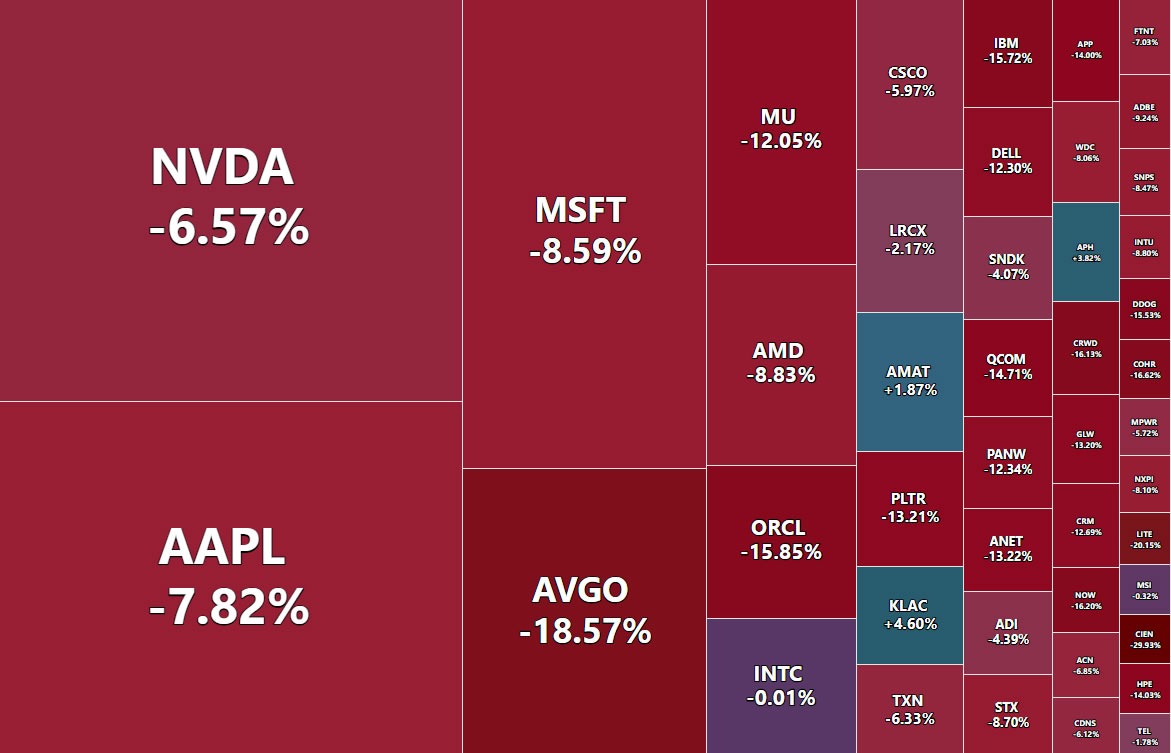
The initial public offering of Elon Musk’s SpaceX has reportedly seen an oversubscription rate running at almost four times the planned offering size, with some analysts suggesting it could be squeezing liquidity from the market.
SpaceX’s IPO (SPCX) has attracted over $250 billion in investor demand, far exceeding the $75 billion it is seeking to raise in what would be the largest public offering ever, with the firm valued at $1.8 trillion, Reuters reported.
Bankers and investors say it is the latest sign that demand is strong, as long-only funds have put in “sizable orders,” according to the sources.
Pricing is expected on Thursday, though demand figures can still shift before then, as some large institutional investors tend to submit orders late in the process.
Tech stocks tumble in IPO hype rotation
The IPO comes at a time of extreme volatility in markets, with US tech stocks tumbling and crypto markets shedding more than $180 billion over the past week.
Some analysts have speculated that the market retreat could be partially driven by selling to raise funds for the SpaceX IPO.
“I’m seeing this exactly as the classic pre-mega-IPO liquidity squeeze playing out in real time,” Bitrue Research Institute research lead Andri Fauzan Adziima told Cointelegraph.
“The tanking in crypto and tech stocks right now isn’t random, it’s the direct ‘IPO tax’ from SpaceX’s record-breaking deal, with pricing tomorrow and trading Friday at $135 for a $1.8 trillion valuation,” he said.
“Oversubscription with massive orders confirms the hype, but that excitement is sucking liquidity out of correlated risk assets today, hitting crypto hardest because it’s the most retail-driven and sentiment-tied to growth/tech narratives.”
This isn’t the start of a broader bear market, it’s a “temporary rotation,” he said.
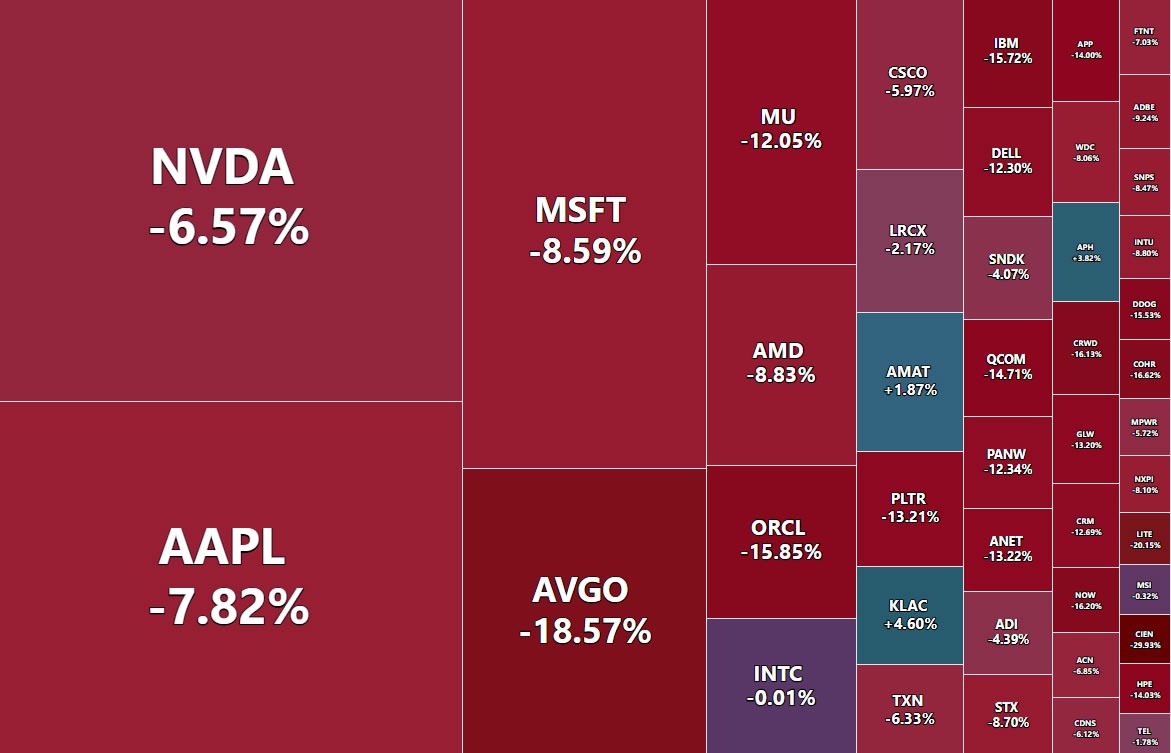
Tech stocks take a hit (five-day) ahead of SpaceX IPO. Source: Barchart
Crypto exchanges rush to offer pre-IPO perps
SpaceX’s growth story is largely tied to its satellite internet business, Starlink, which has become a major source of revenue and profitability. The firm has also touted a $23 trillion market opportunity it claims is ahead for its artificial intelligence offerings.
Related: SpaceX IPO: ‘Bad news’ for tech stocks but what about Bitcoin?
Crypto exchanges have been quick to capitalize on the IPO hype, with Binance, Coinbase, Kraken and Bybit launching pre‑IPO perpetual futures for SPCX this month.
Shunyet Jan, head of spot and derivatives at Binance, told Cointelegraph that the strong early traction for Binance’s pre-IPO perpetual futures “reflects growing user interest in gaining regulated-style market exposure to high-profile private companies through this native product.”
Since launch, the products have generated $2.1 billion in cumulative trading volume in just 18 days on Binance, with participation spanning more than 130 countries.
Meanwhile, decentralized exchange Hyperliquid has seen $70 million in trading volume over the past 24 hours, with the current price for its synthetic SpaceX pre-IPO perps at $157, down from $210 when the derivatives launched, according to Hyperdash.
This indicates strong demand with open interest (OI) exceeding $115 million on Hyperliquid alone, and a current prediction of a $1.97 trillion SpaceX valuation.
Magazine: Vietnam preps crypto pilot, HK pushes tokenization: Asia Express


XRP perpetual futures have started trading on Kalshi, giving U.S. users access to leveraged XRP price exposure.
Summary
- Kalshi now offers XRP perpetual futures to U.S. traders through its CFTC-regulated derivatives exchange platform.
- The cash-settled contract uses CF Benchmarks pricing and remains open without a fixed expiration date.
- Kalshi’s crypto perpetual volume passed $1 billion within one week, showing strong early trader demand.
The cash-settled contract trades under the XRPPERP ticker and has no fixed expiration date.
The launch expands Kalshi’s crypto derivatives offering beyond Bitcoin and Ethereum. It also moves XRP into a regulated market long dominated by offshore exchanges.
XRP contract tracks a regulated price benchmark
Kalshi’s support page lists XRP among 13 crypto assets available through its perpetual futures service. One full XRPPERP contract represents 10,000 XRP, while the minimum order equals one XRP.
The product uses the CME CF XRP-Dollar Real Time Index. Kalshi uses that reference rate for funding and settlement.
Perpetual futures stay open without a maturity date. Regular funding payments help keep the contract price close to the underlying XRP spot market.
Kalshi used the CFTC self-certification route
Kalshi filed the XRP contract with the Commodity Futures Trading Commission on June 1 under Regulation 40.2(a). The filing self-certified XRPPERP for listing after the close of business that day.
That process differs from the formal review route used for Kalshi’s Bitcoin perpetual contract. Kalshi remains a CFTC-registered designated contract market, and XRPPERP trades within that regulated exchange structure.
The filing says the market includes customer identity checks, trade monitoring, risk-based margin and central clearing. Kalshi can also apply price bands, order limits and position controls.
Early demand supports Kalshi’s crypto expansion
Kalshi’s broader perpetual futures rollout recorded more than $100 million in volume during its first 24 hours. Reported cumulative volume later passed $1 billion within the opening week.
The XRP launch follows Bitcoin and Ethereum products introduced earlier in June. As crypto.news reported on June 4, XRP and several other altcoin contracts were still awaiting clearance. Kalshi’s updated product pages now show XRP, Solana, Dogecoin and other assets as available.
Kalshi has also filed for a perpetual contract tied to Hyperliquid’s HYPE token. The expansion places it in competition with Coinbase, Kraken and offshore derivatives exchanges.
Perpetual futures widen access but add risk
XRP perpetual futures let traders take long or short positions without owning the token. They can also hold positions without repeatedly moving into new dated contracts.
However, leverage can increase both gains and losses. Funding payments may raise the cost of keeping a position open, while sudden price moves can trigger forced liquidation.
CME Group chief Terry Duffy has warned that U.S. crypto perpetuals may expose retail traders to risks they do not fully understand. Kalshi states that leverage limits can vary by asset and advises users to check each market before trading.

The leading meme coin was not spared from the market-wide calamity at the end of the previous business week, and its subsequent recovery is yet to impress.
However, this has allowed large investors to accumulate at lower prices. Santiment data shared by popular analyst Ali Martinez shows that the so-called whales have acquired over 200 million tokens in the past week alone.
The graph below demonstrates that their DOGE holdings kept increasing in the past several days, hitting 18.84 billion coins.
Over the past week alone, whales have accumulated more than 200 million Dogecoin $DOGE. https://t.co/PZF6Vdi85j pic.twitter.com/FW7XZig7YG
— Ali Charts (@alicharts) June 10, 2026
As mentioned above, DOGE was swept last week, especially on Friday, dipping below $0.08 for the first time since February 2025. Despite recovering slightly to $0.084 as of press time, the OG meme coin remains highly depressed, at 89% away from its May 2021 all-time high.
Martinez also warned recently that DOGE could be on the verge of a more profound decline if certain metrics align. As reported, he noted that the meme coin’s price action has followed multi-year consolidation channels, where it has repeatedly moved through extended ranges that compress volatility and redistribute supply before larger cycles begin.
Citing several on-chain metrics, he explained that DOGE could drop to $0.058 if the $0.081 floor gives in.
Meanwhile, data from SoSoValue clearly shows that ETF investors have not expressed any interest in the largest meme coin. More specifically, there has been only one day of actual inflows since May 19: all the rest have seen no reportable action.
The three funds tracking the asset’s performance have attracted a very modest $12.44 million since their inception in late November 2025.
The post Dogecoin Whales Buy the Dip as DOGE Hit 14-Month Low appeared first on CryptoPotato.

Taylor Hornby, a security researcher who works with Shielded Labs, discovered a bug on May 29, 2026 – just one day after Anthropic released Opus 4.8- that resulted in billions of dollars removed from the project’s market capitalization.
The flaw affected a shielded pool within the protocol’s design that powered private Zcash transactions, and was serious enough to trigger an emergency response across the entire ecosystem. It resulted in a sudden sell-off that saw ZEC’s price crash by roughly 60%, thereby erasing more than $4 billion in market cap.
The short version of the story is relatively simple: a missing constraint in Zcash’s Orchard circuit could have allowed a malicious prover to spend the same shielded note many times over while producing different nullifiers. In practice, this means an attacker could have inflated ZEC within the Orchard pool without leaving an on-chain fingerprint.
The scary part is that this bug has existed since Orchard went live, and this happened in May 2022. Therefore, the total exposure window lasted for around four years, before it was ultimately patched shortly after Hornby discovered it.
AI Helped Find The Critical Vulnerability
This story isn’t just about the flaw, but the way it was found.
Hornby said he used a custom “zcash-full-stack-auditor” agent framework with Claude Opus 4.8. It was designed to work at maximum effort and was pointed at the halo2 implementation, including the Orchard circuit. The AI was searching for soundness and zero-knowledge security issues.
The researcher reported that around 6 p.m. on May 29, one of the audit agents flagged a vulnerability that it believed could be used to double-spend Orchard notes. Hornby then used Claude to help write proof-of-concept code against a similar circuit, before testing the issue against the real Orchard circuit.
Testing the Exploit with Claude
Hornby later built a full test in Zcash’s local regtest mode, where the exploit doubled the value of an Orchard note until the test wallet balance exceeded 10 million ZEC. These transactions were never broadcast to mainnet or testnet, of course, but the test itself was significant because regtest applies the exact same validation rules, meaning that it could have been done on mainnet with the same degree of success.
Per the official disclosure, the full PoC took roughly six hours to develop using Claude Code’s help. Hornby said the model needed relatively little guidance beyond a few hints.
Of course, it’s important to understand that this doesn’t mean that AI independently “hacked Zcash.”
Taylor Hornby is a renowned specialist security researcher. That audit was targeted, and the tools were custom-built.
Still, the case shows how some frontier AI models are beginning to significantly reduce the time required to investigate highly complex, technical systems.
The post How One Guy Used Claude Code to Discover a Billion-Dollar Bug appeared first on CryptoPotato.
She has scored a lot of runs there

Samsung Galaxy Watch 8 Gives Android Wearers Fresh Tools to Track What Matters Most

Disappearance of alleged Israeli spy puts Lebanese state in a tough spot



-

 Fashion5 days ago
Weekend Open Thread: Evereve – Corporette.com
-
 Crypto World5 days ago
Jensen Huang Approves Samsung, SK Hynix, and Micron for NVIDIA (NVDA) HBM4 Memory Supply
-

 Crypto World2 days ago
Anatomy of the June crypto crash: Fed, Iran, Saylor
-
 Entertainment3 days ago
The Best Mystery Series of All Time Is Surging on Streaming 30 Years After It Ended
-

 NewsBeat2 days ago
Alexander Zverev wins the French Open to finally earn a 1st Grand Slam title
-

 Tech4 days ago
Suspicious Polyfill login prompts pop up on Toshiba, Muji websites
-
Crypto World4 days ago
Senator Cynthia Lummis Calls CLARITY Act the Most Consequential Financial Legislation of This Generation
-

 Tech3 days ago
Microsoft unveils seven homegrown AI models in new bid for ‘long term self-sufficiency’
-

 Tech5 days ago
Microsoft launches MXC, an OS-level sandbox for AI agents, with OpenAI and Nvidia already on board
-

 Business5 days ago
(VIDEO) Justin Bieber Delivers Surprise Happy Birthday Serenade to Diners at Los Angeles Mexican Restaurant
-
 Business3 days ago
The Pain Points Taking a Fragile Tech Rally Down a Notch
-
Crypto World5 days ago
LBank Surpasses 25 Million Users Worldwide as AFA Partnership Continues to Drive Global Growth
-

 Crypto World3 days ago
Trump’s AI Ownership Plan Could Benefit Anthropic at OpenAI’s Expense
-

 Tech5 days ago
Meta steals a tactic from Tesla and builds data centers in tents
-

 Tech4 days ago
Von der Leyen’s AI envoy pick draws conflict-of-interest fire
-
 Sports17 hours ago
Bangladesh beat Australia after 20 years in ODIs, register only their second win over six-time world champions | Cricket News
-
 Crypto World2 days ago
Eli Lilly (LLY) Stock Surges 4% Following Breakthrough Sleep Apnea Trial Results
-

 Business2 days ago
High Stakes for Wembanyama as New York Pushes for 3-0 Lead
-

 Tech4 days ago
Hackers now exploit SolarWinds Serv-U flaw to crash servers
-

 Tech5 days ago
RCS Messages Between iPhone and Android Get End-to-End Encryption With iOS 26.5
You must be logged in to post a comment Login