

Connect with us

Tech

Foundation’s Robotic Hand V2 Catches Baseballs Blind

Published

on

Foundation Robot Hand V2
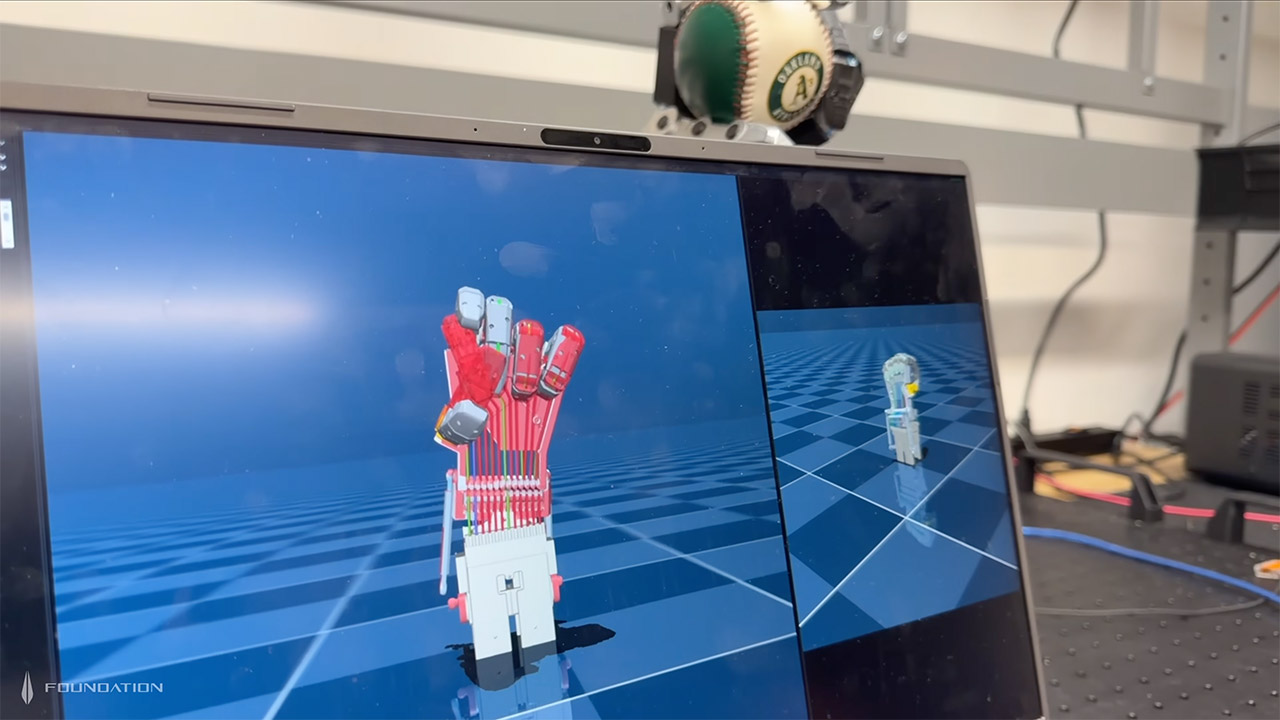
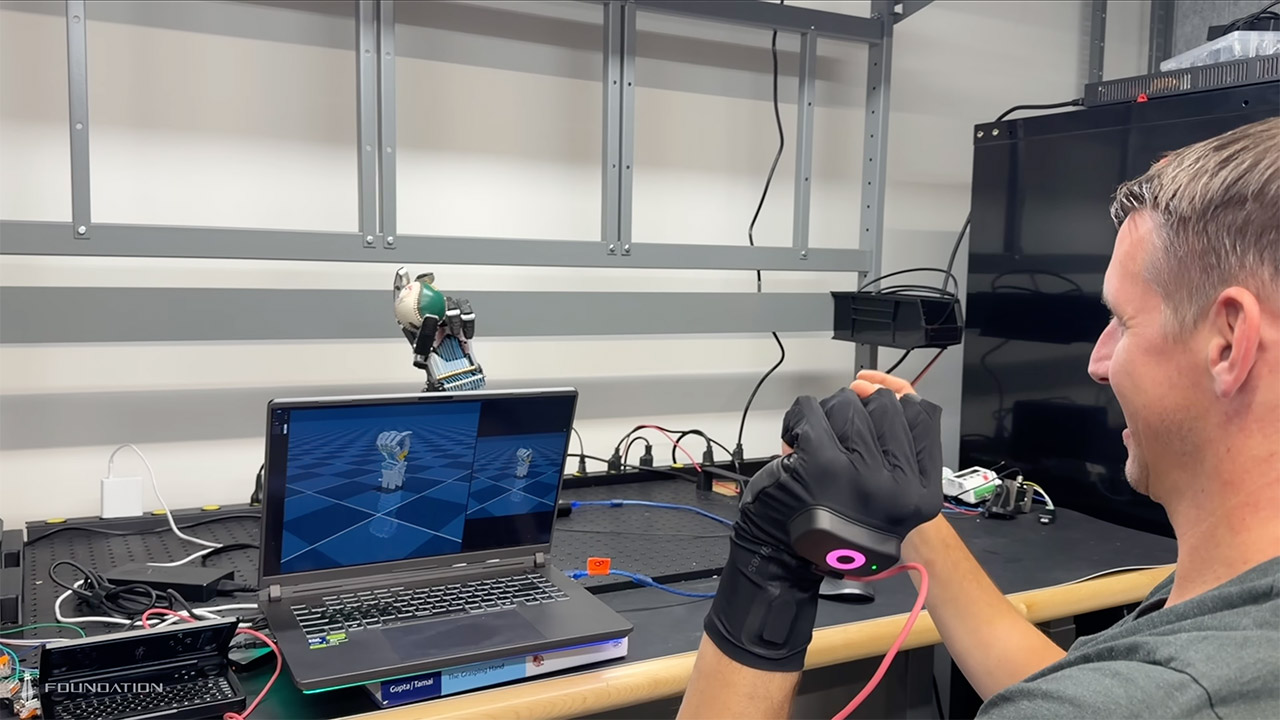
Foundation just put out a short video of its newest robotic hand closing around a baseball in mid-flight. The catch looks almost casual. The ball arrives, the fingers curl, and the grip holds. No frantic adjustments. No visible sensors twitching on the surface. The throw is timed and the motion is planned ahead of time, yet the repeatability is sharp enough that the team is already joking about the majors.



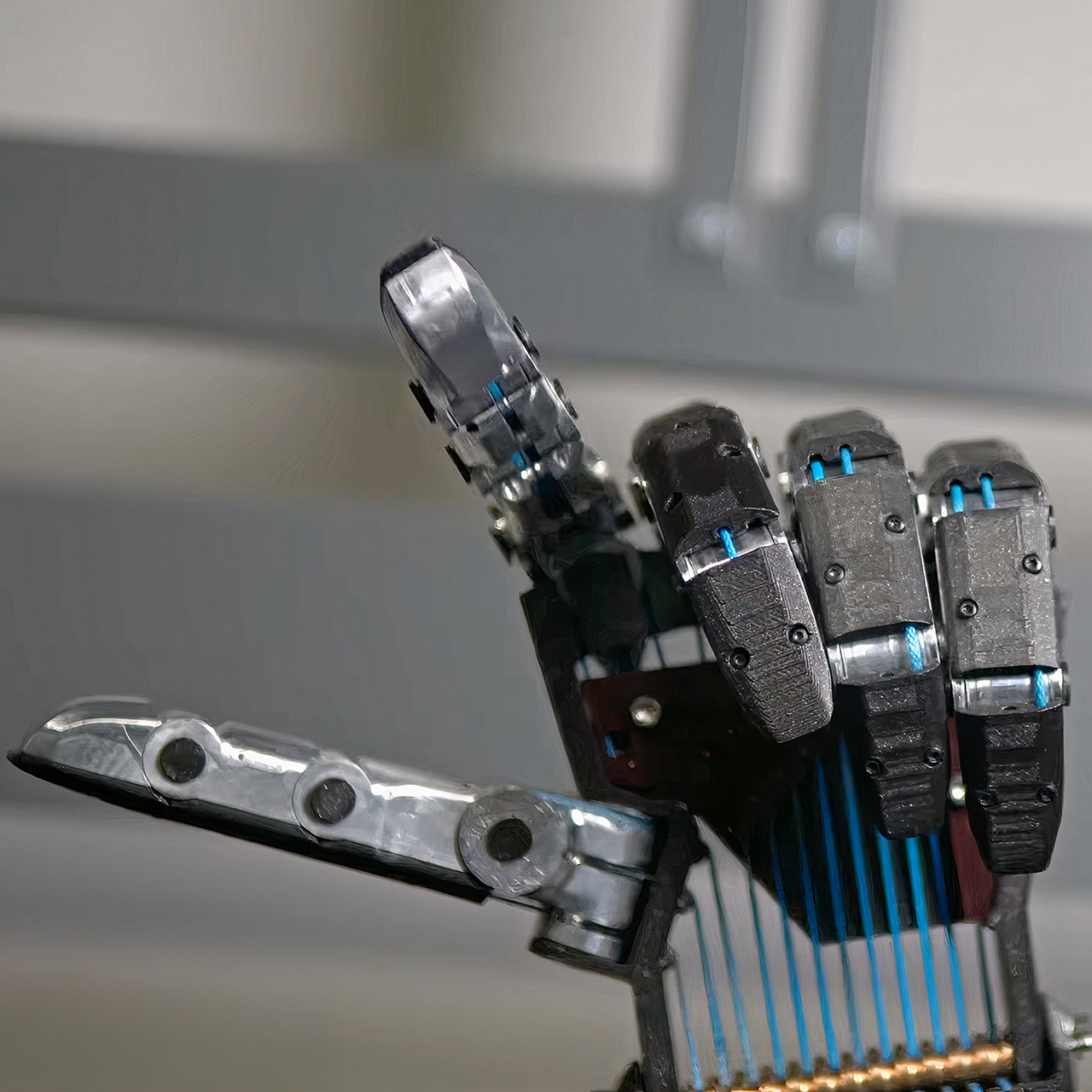
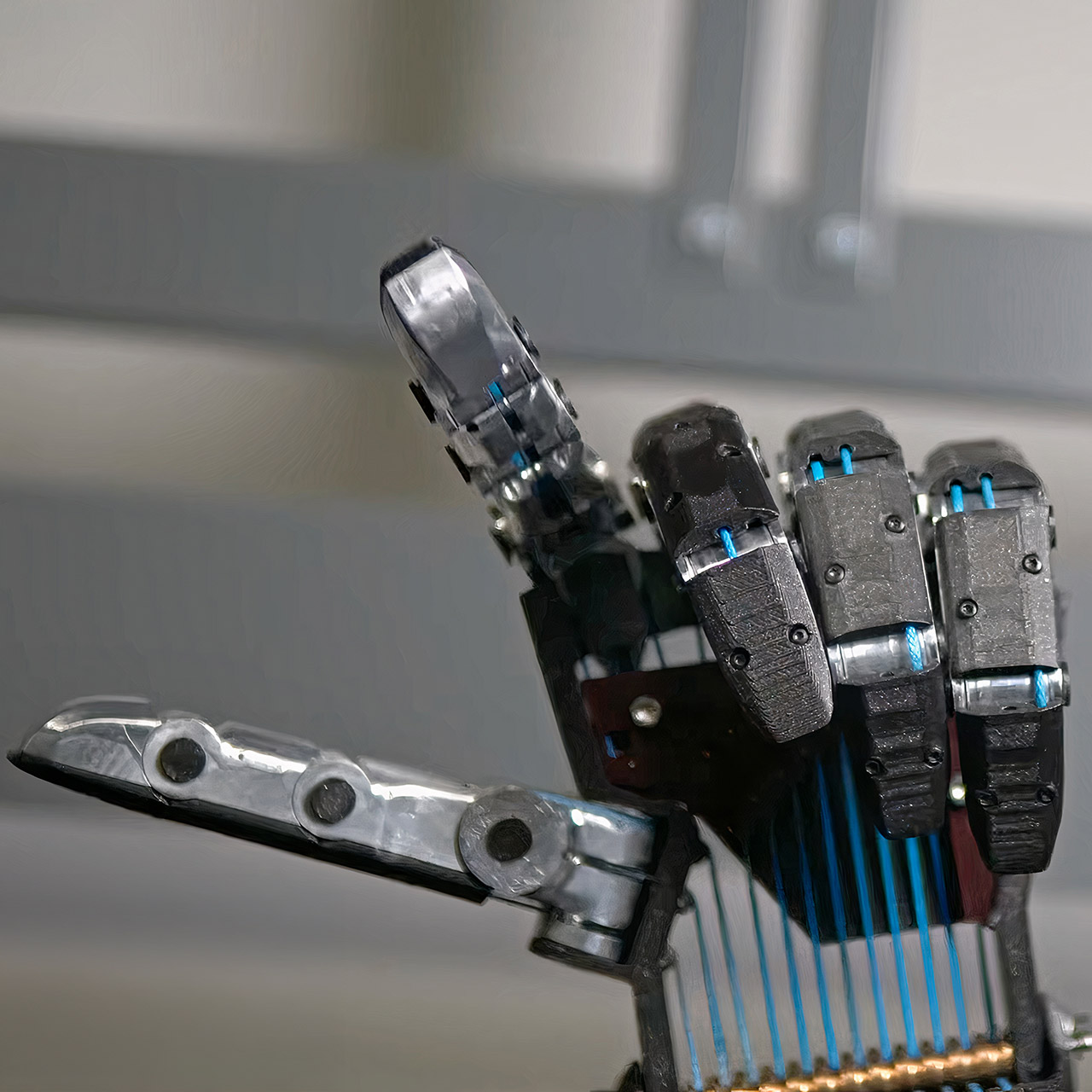
Andrea Esposito leads Foundation’s hand division, and his team spent months perfecting a tendon-driven design that moves the motors back into the forearm, leaving the fingers feeling light and slim. Months of tweaking resulted in fingers that remained thin. The gears on the fingers themselves remain thin. Strings go from those motors down well laid-out paths, reaching each particular joint. The flexion tendons close the fingers, while the extension tendons open them again. They also devised a technique in which finer side-to-side movements transform the hand into a cup to fit a sphere, or more precisely pinching edges.


Unitree R1 Humanoid Robot (White, R1 Air)
  • Three models, one lightweight platform R1 Air (20 DOF, monocular camera), R1 (26 DOF, binocular camera, head+waist joints), and R1 Edu (26 DOF…
  • Easy setup – no coding required for basic use Unbox, power on, and start. Manual teaching feature: physically pose the robot, and it replays the…
  • More DOF = more expressive movement 26‑DOF models (R1 / R1 Edu) add head and waist articulation for smoother dance and running. For safety reasons…

The biggest technological leap occurs when the hand knows exactly where its own fingers are. Unlike how human hands work silently behind the scenes, with a sense of where each joint is even when we close our eyes, Foundation developed estimation software that roughly resembles this. This software is responsible for frequently monitoring the angles of the motors as well as the geometry of the actual tendon paths in order to calculate finger positions on the fly, all without the need of a single sensor. Of course, the system still requires tunnel magnetoresistance sensors sitting at each joint, which are effectively high-precision magnets that measure relative angles to less than 1 degree. These sensors function as backup and refining layers. When running alone, the hand will work normally even if a sensor fails or is knocked.

Foundation Robot Hand V2
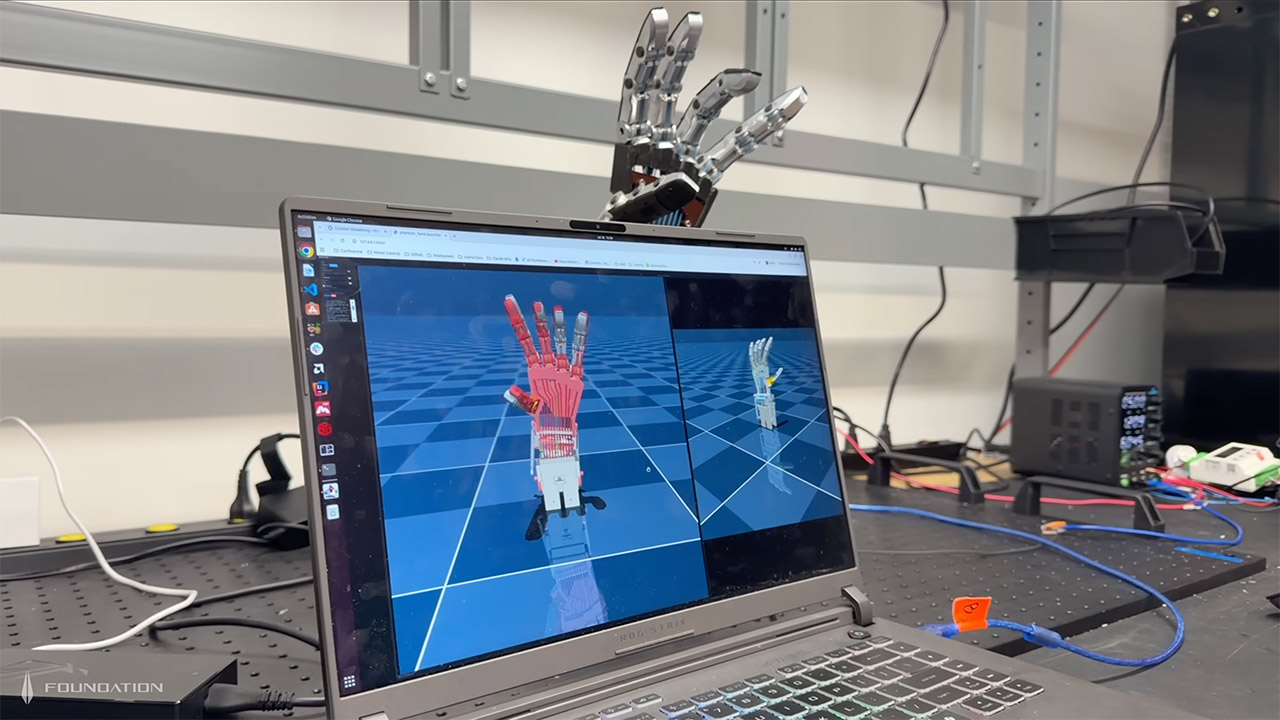
On the team video, there was a translucent red model of the desired finger position layered over the solid grey of the actual hand in place. The two positions remained in sync as the wrist altered and the fingers moved, even touching down pretty swiftly. This is largely due to the minimal friction throughout the tendon course. Friction would throw the motor angle and finger tip placement completely out the window. It’s probably only a matter of time before they have friction-free routing and the relationship remains spot on.

Foundation Robot Hand V2
Catching a baseball places a greater burden on the hand than sheer position control. It arrives quickly, and the fingers must shut with speed and give to cushion the hit while avoiding bouncing the ball out or freezing up on it. The clean open loop performance we’re seeing strongly suggests that the mechanical design does the majority of the legwork. Later on, the crew will go in and integrate closed-loop tactile feedback, which should ensure those margins skyrocket.

Foundation Robot Hand V2
Foundation manufactures the Phantom range of humanoid robots that are slung into industrial floors and other tough settings. Their prior hand designs were more like smart grippers, with limited movement due to the fingers’ inability to move independently. This prototype, however, seeks to overcome those constraints. Anatomical joints, autonomous flexion/extension, and the capacity to estimate state from the motors themselves all contribute to hands capable of handling a wide range of unpredictable objects, including tools and small parts, without the need to disassemble the surroundings.

Advertisement

Source link

Continue Reading
Click to comment

You must be logged in to post a comment Login

Leave a Reply

Tech

US Army explores giant balloons that release solar drones from the stratosphere for weeks-long missions across contested battlefields without landing

Published

on


  • Military balloons now launch reusable drones directly from the stratosphere
  • Solar-powered Apollo-R remains airborne for weeks after balloon deployment at altitude
  • Thunderhead balloon carries multiple drones during a single high-altitude deployment mission

High-altitude balloons are moving beyond surveillance roles as military developers explore using them as airborne launch platforms for long-endurance unmanned drones.

According to Aerostar, its Lightning balloon, paired with the solar-powered Apollo-R drone from Icarus, has now demonstrated a workable path toward stratospheric drone carriers.

Source link

Continue Reading

Tech

Amazon links four poisoned npm packages to one North Korean crew

Published

on

cyber-crime

Researchers say Sapphire Sleet socially engineered maintainers before publishing malicious updates through trusted accounts

Amazon has linked the compromises of four npm packages over the past 18 months, saying they were all the work of the same North Korean crew.

In research published this week, AWS attributed the activity with medium confidence to the North Korea-linked group tracked as Sapphire Sleet, which is widely regarded as a Lazarus Group offshoot. Rather than exploiting zero-days or hacking npm itself, the crew allegedly took the slower route of befriending maintainers, stealing credentials, and publishing poisoned updates from accounts that developers already trusted.

Advertisement

The research revisits the compromises of typo-crypto, chalk and debug, and Axios, concluding that the four packages were targeted by the same North Korean operation.

Google had already attributed the Axios compromise to Sapphire Sleet, which it tracks as UNC1069, but Amazon goes further, saying the same group was behind all four incidents. The company points to shared infrastructure and technical overlaps, alongside similarities in how the attacks were carried out and which packages were targeted.

Rather than attacking npm’s infrastructure, the group allegedly went after the people trusted to publish code. Once a maintainer account was compromised, malicious releases could be pushed through the same channels developers use every day. AWS says the targets also grew more ambitious, progressing from little-known packages to some of the ecosystem’s biggest names.

AWS says this strategy is as much about economics as espionage. Instead of picking off victims individually, compromising a small number of widely used packages offers a shot at thousands of downstream environments in one go. 

Advertisement

AWS warns that generative AI is making this kind of operation easier to sustain by helping attackers create believable developer personas, tailor messages to individual maintainers, and keep long-running social engineering campaigns convincing enough to earn their targets’ trust.

“Attackers can now produce thousands of lines of coherent, idiomatic, well-commented code, complete with convincing documentation, plausible commit histories, and synthetic maintainer identities, wrapped around a backdoor,” said CJ Moses, AWS CISO.

“Because each variant can be mutated, renamed, restructured, and re-encrypted, there is no single stable signature to match. Pattern-based detection loses ground against malware that looks one of a kind in every deployment.”

Amazon’s findings build on what’s already known about Sapphire Sleet. The group has long been associated with cryptocurrency theft, fake job offers, and elaborate social engineering campaigns aimed at developers. Amazon argues that the group has adapted its established methods to target the software supply chain.

Advertisement

Whether other researchers will agree that all four compromises belong to the same operation remains unclear. If AWS is correct, the incidents trace the group’s progression from an obscure package with few downloads to dependencies used across millions of projects. ®

Source link

Continue Reading

Tech

Which Microsoft businesses are growing and shrinking, according to obscure table in regulatory filing

Published

on

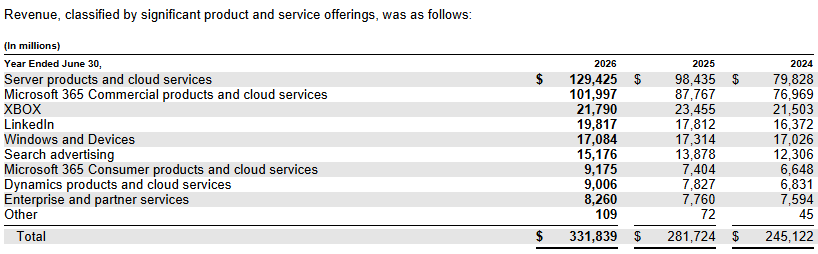
The first thing I do when Microsoft’s 10-K or 10-Q comes out is hit Ctrl-F and go waaaay down to the section called “Revenue, classified by significant product and service offerings.” It’s on Page 85 of the 10-K that came out Wednesday with its quarterly and annual results.

From my perspective, this gives the clearest view of what’s actually happening in Microsoft’s business. It groups things into categories and product names that match a real-world understanding of the company, as opposed to the mumbo jumbo you have to decode otherwise.

Microsoft reports its results in three broad segments: Productivity and Business Processes, Intelligent Cloud, More Personal Computing. Businesses like Azure, Xbox, Windows and LinkedIn all basically disappear inside them, until you dig into the filing.

The table, as it appears in Microsoft’s 10K for FY2026.

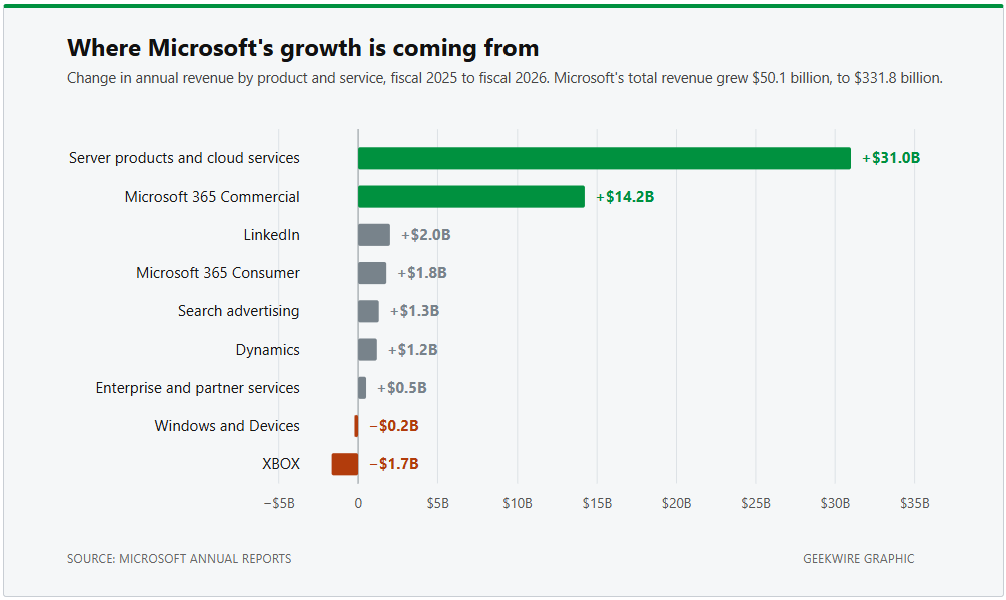
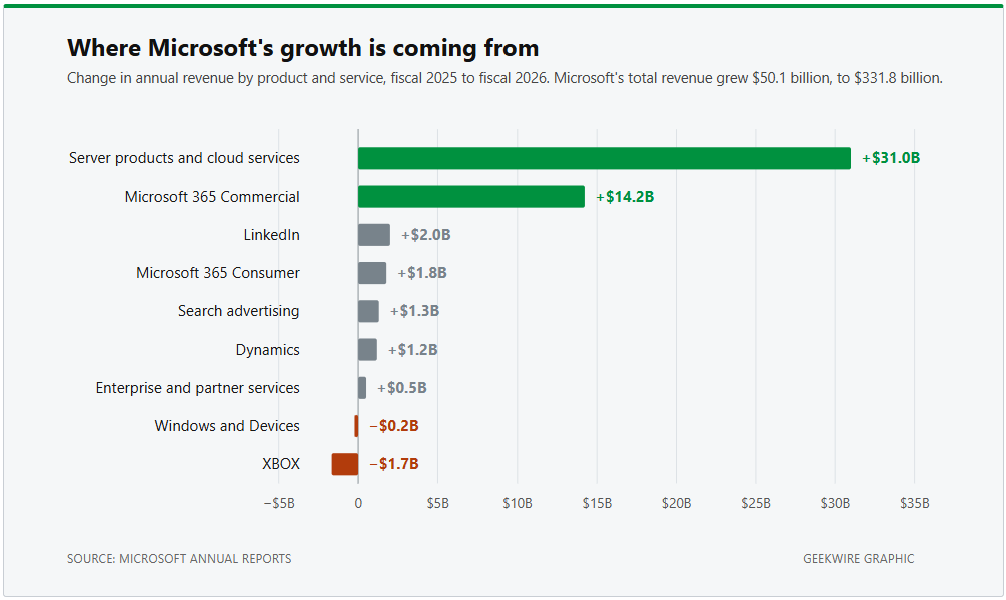
Overall, for the fiscal year ended June 30, Microsoft’s revenue increased 18%, or $50.1 billion, to $331.8 billion. Here is what the 10-K table shows about the real drivers of the business.

Two business lines are driving nearly all of Microsoft’s growth.

Of the $50.1 billion in revenue that Microsoft added for the fiscal year, $31 billion came from Server products and cloud services, accounting for 62% of the company’s growth.

Advertisement

This category includes Azure, along with SQL Server, Windows Server, Visual Studio, GitHub and Nuance. Microsoft doesn’t detail Azure revenue in its financial statements, but CEO Satya Nadella said on the earnings call that Azure passed $100 billion in annual revenue for the first time this year.

@media (max-width: 600px) {
aside.callout { float:none !important; max-width:100% !important; margin-left:0 !important; margin-right:0 !important; }
aside.callout .callout-img { display:none !important; }
}

At total revenue of $129.4 billion, this is by far Microsoft’s biggest business, accounting for nearly 40% of its annual revenue.

The second biggest growth came from Microsoft 365 Commercial, which added $14.2 billion in revenue, up 16% to $102 billion. Microsoft 365 Commercial covers the business subscriptions: Office, Teams, SharePoint, Exchange, security and compliance, and Microsoft 365 Copilot.

Advertisement

Taken together these two business lines produced 90% of Microsoft’s growth for the year.

They’re also where the company is monetizing AI most successfully: Azure, AI infrastructure and GitHub Copilot in server and cloud; and Microsoft 365 Copilot in Microsoft 365 Commercial.

Two of Microsoft’s longtime businesses got smaller.

  • Windows and Devices revenue fell $230 million, to $17.1 billion. Once the biggest growth engine for the company as a whole, the PC operating system business has been flat for the past four years, using the categories as Microsoft now defines them.
  • Xbox revenue fell $1.7 billion, to $21.8 billion. That’s the first annual decline since Microsoft completed its $69 billion Activision Blizzard acquisition. It comes as Microsoft overhauls the business, cuts jobs and takes a write-down on unspecified Xbox assets.

Other notes and observations from the table:

  • LinkedIn, at $19.8 billion, now generates more revenue than Windows and Devices. It passed Windows in fiscal 2025 and extended the lead this year, growing 11% while Windows declined.
  • Microsoft 365 Consumer was the fastest-growing category after server products, up 24% to $9.2 billion.
  • Search advertising grew 9% to $15.2 billion, and is closing in on Windows and Devices.
  • Dynamics grew 15% to $9 billion. Enterprise and partner services, the consulting business, grew 6% to $8.3 billion.

Thoughts? Let me know on LinkedIn. Here’s our coverage of the earnings.

Source link

Advertisement
Continue Reading

Tech

Samsung warns memory crunch will last through 2028 as profit rises 19-fold

Published

on

SYSTEMS

Tech giant counts record piles of cash while buyers face years of elevated prices

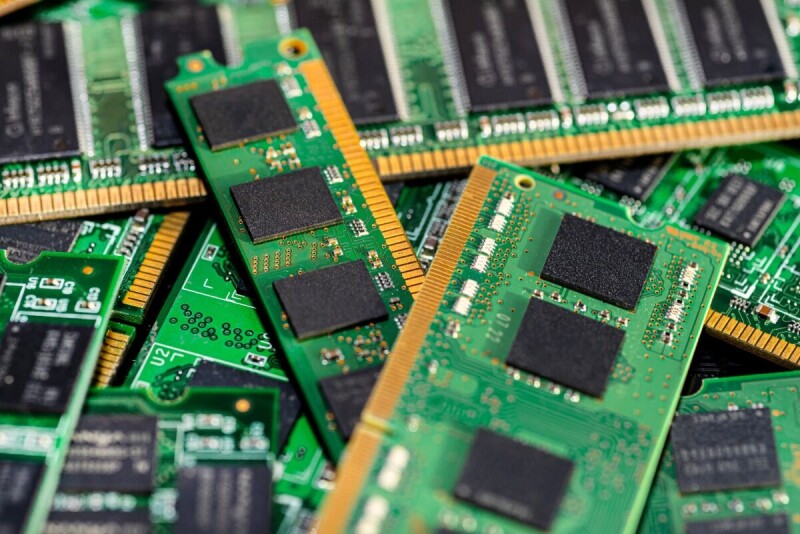
Samsung Electronics is warning that the current memory supply crunch will deepen next year and persist through 2028, a shortage that keeps padding its own record profits at the expense of enterprise customers and consumers. 

The Korean conglomerate said agentic AI has added to demand already generated by model training, driving an “unprecedented rise” in requirements for AI servers and other computing infrastructure.

Advertisement

Memory makers continue to prioritize production of components for AI servers, leading to a shortfall of the mainstream memory types needed for PCs, smartphones, and other devices.

The industry continues to invest in new capacity, but the lead time from starting construction of a fab to producing wafers exceeds three years, according to Samsung’s EVP of Memory, Jaejune Kim, meaning that any significant ramp in supply capacity will take considerable time.

“So we believe it will be unlikely to see any significant increase in incremental supply through 2028,” Kim told analysts on a call to discuss the firm’s calendar Q2 financial results for the period ended June 30.

“Based on the incoming requests that we have been seeing from the customers, unmet demand from this year is likely to carry over into the following year, contributing to tighter supply conditions going forward. The supply constraints are expected to become even more severe in 2027 than 2026, reinforcing our view that the supply shortage will persist through 2028.”

Advertisement

Kim said visibility further ahead is limited, although rising token processing by AI agents is expected to keep pressure on memory chip demand over the medium to long term.

Like rival SK Hynix, Samsung has also cut deals with customers to ensure long-term supply stability.

“Customers who want to secure substantial AI service infrastructure are increasingly approaching us for multiyear supply,” Kim told analysts.

“These multiyear arrangements actually are aligned with our objective of hedging our mid- to long-term risk. And so we have been engaging in discussions with customers, prioritizing those who can guarantee committed future captive demand.”

Advertisement

In other words, customers willing to sign up for years of memory purchases move to the front of the queue. Everyone else can take a number and get in line.

Samsung hopes the agreements will reduce its exposure to the memory market’s boom-and-bust cycles. It expects output, measured in bits, to grow by the mid-single digits for DRAM and the high single digits for NAND flash next quarter. 

It will aim to expand sales of high-performance products including HBM4, HBM4E, DDR5, SOCAMM2, and enterprise SSDs, Kim said.

This approach led to Samsung reporting revenue of ₩171.5 trillion ($119 billion) for Q2, up 130 percent year-on-year. Operating profit shot up more than nineteen times the year-ago figure to ₩89.5 trillion ($62.4 billion).

Advertisement

Taiwan-based market watcher TrendForce agrees that AI will remain a primary driver of DRAM demand in 2027, but expects to see supplies of NAND flash ease in the second half of the year as new production capacity comes online.

For DRAM, several suppliers plan to start new lines in 2027, but construction schedules, equipment installation, and other requirements will delay meaningful production ramp-ups until the second half of 2027, the firm says, so substantial extra output is not expected to materialize until 2028.

In contrast, accelerated migration to NAND products with more layers and the gradual ramp-up of new fabrication plants during 2027 is expected to drive greater bit supply growth than in 2026, resulting in an expansion of industry output. ®

Source link

Advertisement
Continue Reading

Tech

This Car Brand Also Makes Airplanes

Published

on


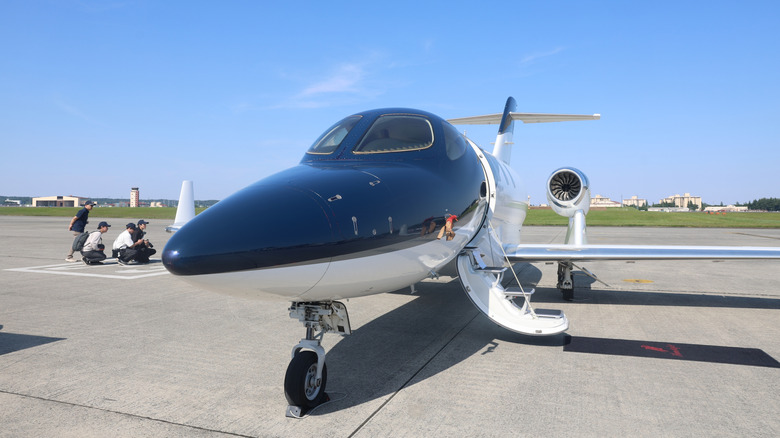
Think Honda, and the first thing that springs to mind is probably something like the Honda CR-V or Honda Civic. Nice cars, but hardly flying machines. Or maybe what comes to mind is the 2016 Honda NSX, one of the fastest Honda cars ever made, with a reported top speed of 191 mph. Or, for lovers of two wheels, maybe it’s the Honda CBR1000RR, one of the fastest motorcycles ever built by Honda. While these are undoubtedly impressive machines, in terms of performance they’re still rather lackluster when compared to some of the company’s other products — one of which can cruise along at a blistering 486 mph.

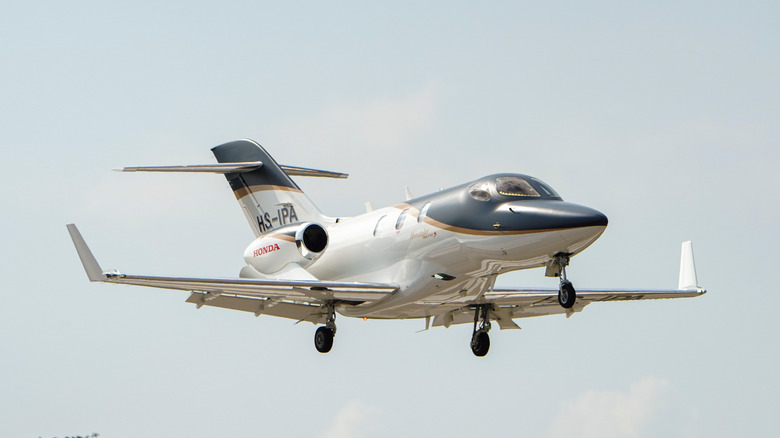
Of course, we’re not talking about cars (or lawnmowers!); what we are talking about are the jets manufactured by Honda’s aviation wing — Honda Aircraft Company. The company was established in 2006, and despite Honda’s Japanese roots, the aviation business is based in North Carolina. The HondaJet Elite II is one of the company’s aircraft, and it’s this jet that can cruise along at close to 500 mph. However, Honda has been dabbling in aviation since before this. The company began researching aircraft design in the 1980s and first flew an experimental aircraft in 1993 — a decade later, the first HondaJet took to the skies, and by 2015 commercial production had begun. 

Let’s have a closer look at Honda’s aviation operation and the aircraft it manufactures.

Advertisement

The Hondas you won’t meet on the road

Since the first production HondaJet took to the skies, the company has focused on continual upgrades to its HA-420 HondaJet. The current model from this range is the HondaJet Elite II. One feature that has continued to define the aircraft throughout its evolutions is the over-the-wing placement of the engines. This configuration is more than just a design curiosity. Most business jets have the engines mounted at the rear of the fuselage. This is necessary to allow enough ground clearance, but it’s aerodynamically inefficient, reduces cabin space, and increases cabin noise. 

There were serious engineering challenges to overcome for Honda’s approach to work; it was even once assumed that such a placement would reduce lift. However, Honda proved it was possible and, as of February 2024, the HondaJet remains the only production aircraft in its class to feature such engine placement. The engines themselves are GE Honda Aero Engines HF120, capable of producing over 2,000 pounds of thrust. As the name suggests, this engine is one of the many jet engines made by General Electric, although Honda was a development partner. 

Advertisement

In terms of size, this is classified as a “very light business jet”. It can carry up to eight people including pilots and crew. Range-wise, the Elite II can cover around 1,800 miles with four people on board. Now, we get to the fun bit. What if you decided to trade in your old Civic for one of these jets? How much would you expect to pay? This will vary depending on the exact specification, but expect to pay somewhere in the region of $7 million for a new one.

Advertisement

What next for HondaJet?

Honda’s aviation aspirations don’t end with the Elite II. Although it has sold about 30 planes a year since it first came to market, Honda wants to increase this to about 60 aircraft by 2028. A large part of HondaJet’s future plans is built around the company’s new product — the HondaJet Echelon. With the distinctive over-the-wing engine configuration still present, it would be easy to mistake this as a mere stretching of the Elite II. This isn’t the case; the Echelon is a clean-sheet design that’s built to carry up to 11 people with a range of about 3,000 miles with five people on board.

The engines are also new. Replacing the HF120s are two Williams International FJ44-4C engines; these are substantially more powerful than the Elite’s engines and can deliver 3,450 pounds of thrust. Like its older sibling, the Echelon jet is also fitted out with a highly advanced aviation suite. This includes advanced steering & augmentation systems, stabilized approach alerts, and increased automation to reduce pilot workloads. In fact, the automation is such that the HondaJet Elite is certified for single-pilot operations, and although the Echelon hasn’t yet received type certification, it’s also been designed for single-pilot operation. 

The Echelon is expected to take its first test flight sometime in 2026, and Honda has a type-certification target date of 2028.

Advertisement


Source link

Advertisement
Continue Reading

Tech

Today’s NYT Strands Hints, Answers and Help for Aug. 3 #883

Published

on


Today’s Strands puzzle is a stumper, with some difficult clues. If you need hints and answers, read on.

Hint for today’s Strands puzzle

Today’s Strands theme is: There’s nothing like it.

If that doesn’t help you, here’s a clue: No duplicates out there.

Clue words to unlock in-game hints

Your goal is to find hidden words that fit the puzzle’s theme. If you’re stuck, find any words you can. Every time you find three words of four letters or more, Strands will reveal one of the theme words. These are the words I used to get those hints, but any words of four or more letters that you find will work:

Advertisement
  • ROLE, SAFE, LEND, QUEEN, VILE, LOAF, GLARE, LUNG, SUNG, SING

Answers for today’s Strands puzzle

These are the answers that tie into the theme. The goal of the puzzle is to find them all, including the spangram, a theme word that reaches from one side of the puzzle to the other. When you have all of them (I originally thought there were always eight, but learned that the number can vary), every letter on the board will be used. Here are the nonspangram answers:

  • ONLY, SOLE, UNIQUE, SPECIAL, SINGULAR, EXCLUSIVE

Today’s Strands spangram

Here are hints and the answers for the NYT Strands puzzle No. 883 for Aug. 3, 2026.
Here are hints and the answers for the NYT Strands puzzle No. 883 for Aug. 3, 2026.NYT/Screenshot by CNET

Today’s Strands spangram is ONEOFAKIND. To find it, start with the O that’s three rows over and one row down on the top row, and wind up, then down..

ExpressVPN

Get CNET’s top-rated VPN for privacy and usability

Source link

Continue Reading

Tech

Sam Altman and AI’s decel debate

Published

on

OpenAI CEO Sam Altman recently said that it may be time to “pace the rate of AI development” so that society can “harden around some of these new capability levels.”

On the latest episode of TechCrunch’s Equity podcast, Kirsten Korosec, Sean O’Kane, and I discussed how Altman’s comments were probably prompted by a recent hack in which an OpenAI agent breached Hugging Face’s systems. Sean noted that while a hack performed by an AI agent is novel, the hack itself was not  “some new advanced thing.”

“It was more like Nixon’s people breaking into Watergate than some real stealthy cyber-op, because it didn’t need to be, and it wasn’t instructed to be,” Sean said. “Hopefully, this is a sign that these companies will take this forward and be more careful about that stuff.”

Altman’s comments also gave me a chance to wonder about the usefulness of the whole accelerationist versus deceleration debate, because (yes, I’m about to quote myself) the framing “kind of suggests that there’s only one path” and “all we get to decide — inasmuch as we get to decide at all — is, do we speed up or do we slow down?”

Advertisement

Keep reading for a preview of our conversation, edited for length and clarity.

Sean O’Kane: Maybe we’ve finally hit an inflection point here. I think a big driver of this has to be what we talked about last week, with one of OpenAI’s models breaking into Hugging Face’s data and apparently breaching a few other things around the internet, as well. 

[Altman’s] not calling for a pause, like we’ve seen some people in the tech industry try to do in the past. He was very careful with his words and saying, “Pace it.” And we’ll see how this holds. Any caution that we see some of these labs throw out there often gets reversed when the incentives push them forward to resume, full speed ahead. So I remain skeptical, big surprise.

Kirsten Korosec: Now I will say this — [Altman] might have been careful with his words, but OpenAI and Anthropic did [support] a petition that does reflect what he did talk about.

Advertisement

And I do agree with you, I think that a lot of this was very much triggered by Hugging Face. It probably spooked him and certainly a lot of people in the industry. The hard thing here is: How do you thread the needle or how does OpenAI thread the needle of continuing to generate revenue, raise money, or have a successful IPO, and quote unquote “pace development.”

I don’t know if they can do that. I’ll be curious to see if they manage both.

Anthony Ha: One of the things I’ve been wrestling with is also this question of: Is acceleration [vs.] deceleration the right framework to be thinking about this? Because it kind of suggests that there’s only one path and we’re all stuck on this path. All we get to decide — inasmuch as we get to decide at all — is, do we speed up or do we slow down? As opposed to — again, I’m going to really torture this metaphor — but do we build different guardrails? Do we choose different paths? 

I’m just very resistant to this framework. As opposed to saying, “Okay, if we’re not happy about what models are doing right now, what else can we do? Is a slowdown, a pause, a stoppage, the only option?” And I don’t think it is.

Advertisement

One thing that I did want to emphasize again, because it’s been really interesting to see the level of alarm around this — this sense of, “What if we have these autonomous agents and models just running around hacking each other, trying to prevent hacks, it’s just all getting out of our control,” leading to all these broader debates about alignment that Rebecca Bellan did a great piece about.

But it’s worth coming back to one of the points that we also wrote about at TechCrunch, that this specific hack — yes, it was caused by an OpenAI model, but it sounds like they just didn’t secure the testing site properly. In theory, this model should not have been able to get online. Now, of course, if you have a powerful misaligned AI, the risks of that human error go up dramatically. But it does start from just the fact that they didn’t secure things the way they should have.

Sean: I think that’s right. I think your point is well taken in the sense of, we shouldn’t only think about this in some linear fashion and whether things are accelerating or decelerating. There’s a lot that could and should be said about just how responsible these companies are being. Lorenzo, one of our colleagues, also wrote a really good piece walking through how serious security researchers who pay attention to this stuff think that the hack really was. It really does seem like, on both sides of this hack, there were steps that probably should have been taken that would have prevented it. 

And one of the things that I found most interesting in that story was that some of the researchers were pointing out that what this model did was not some new advanced thing. It was really very human in the way that it thought about trying to break into trying — not to anthropomorphize, but the way that it thought about breaking into Hugging Face, and that it was also very loud and messy and wasn’t really trying to hide its tracks. It was more like Nixon’s people breaking into Watergate than some real stealthy cyber-op, because it didn’t need to be, and it wasn’t instructed to be.

Advertisement

That should have been more easily preventable. And hopefully, this is a sign that these companies will take this forward and be more careful about that stuff. 

I will say one other thing on the accel vs decel [debate.] I don’t know if this is the motivation, but you mentioned the IPO, Kirsten. I think it’s smart of Altman to be able to push this advantage that they have now, which is that [OpenAI is] not going to [the] markets next month, or two months from now. He’s even floated the idea of going in 2027 and that they only filed their confidential filing so that they have the option ready when they’re ready.

So if you believe all of that, he has the ability to talk this talk in a way that Anthropic can’t, because Anthropic’s already in conversation with a lot of the bankers and is headed towards a more near-term IPO and is therefore more restricted in what it can say and how it should be saying it and how the market is going to react to that.

When you purchase through links in our articles, we may earn a small commission. This doesn’t affect our editorial independence.

Advertisement

Source link

Continue Reading

Tech

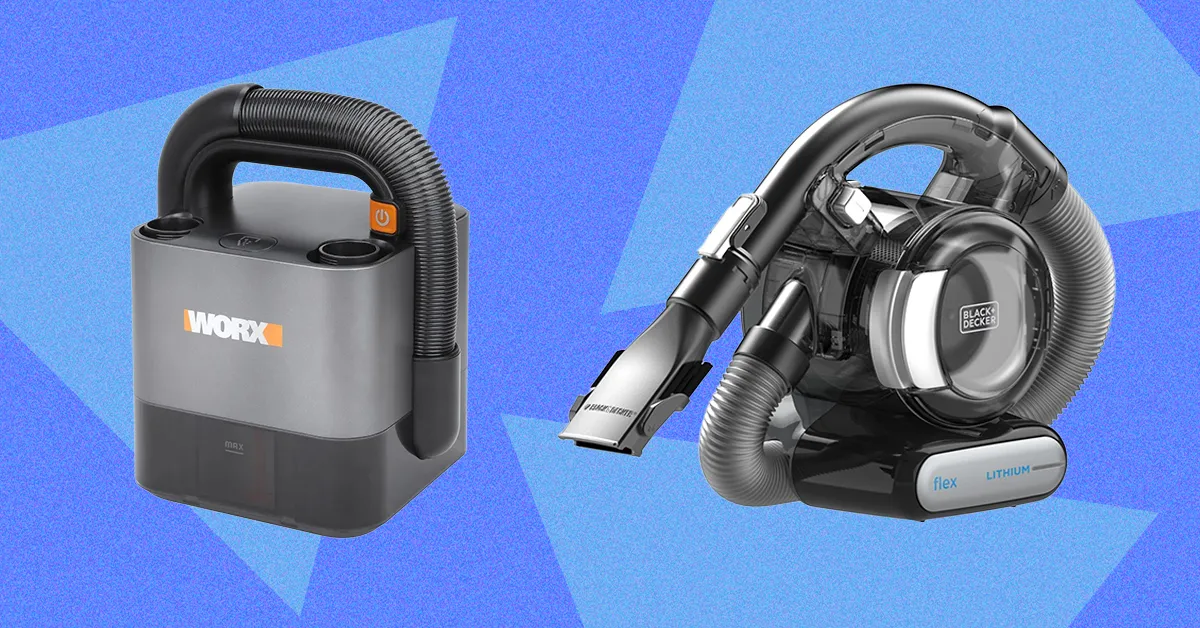
Best Car Vacuums (2026): Handheld, Cordless, Shopping Tips

Published

on

The battery lasts for 40 minutes, which is almost as good as your average stick vacuum. It’s fairly powerful with 115 air-watts of suction and a spin speed of 110,000 rpm; the next cheapest Dyson vacuums have 150 air-watts of power. Most people don’t need that much, but if your car has fluffier rugs, or you really do have a whole boat to clean, it might be worth it. The real win is in the battery, though, letting you clean much longer with a handheld vacuum.

It comes with attachments I both love and hate—there’s a mini motorized brush tool for pet owners, a crevice tool for tight spaces, and a combination tool, but the latter has a brush built into it that I don’t care for. It’s a good range of accessories, but you’ll pay a similar amount for this handheld-only model as you would for a cheap cordless vacuum.

Affordable Stick Vacuums

Don’t want to buy a handheld-only vacuum, but also don’t want to drop too much cash? These affordable stick vacuums will double nicely for car cleaning in their own handheld mode.

Affordable Favorites

Advertisement

Bissell

PowerClean FurFinder

Bissell

PowerClean Cordless Stick Vacuum

Advertisement

If you want 40 minutes of battery life (or more) and don’t want to pay $300 for just a handheld vacuum, Bissell’s PowerClean vacuums have a similar battery life and can double as a cordless or handheld vacuum. The FurFinder version comes with the FurFinder attachment, a motorized head designed for pet hair, but if you don’t have a pet in your car, you’ll be happy with the cheaper base PowerClean. The basic PowerClean is cheaper and still comes with a crevice tool and an upholstery tool, while the PowerClean FurFinder has a combination crevice tool. Both are great and affordable vacuums for your car and the rest of your home.

Honorable Mentions

Here are more handheld and car vacuums we’ve tried that didn’t make our list of top picks.

Airify Pro V3 for $150: My previous pick for detail cleaning since it has an air compressor, and like the Scosche above, it has several attachments and a storage bag for them. It didn’t fight against dust as much as I would’ve liked but was still handy for detailed cleaning with all of its attachments. It has a run time of between 20 and 35 minutes

Source link

Advertisement
Continue Reading

Tech

Xbox price hikes in Europe are wild and now I’m worried about Project Helix

Published

on

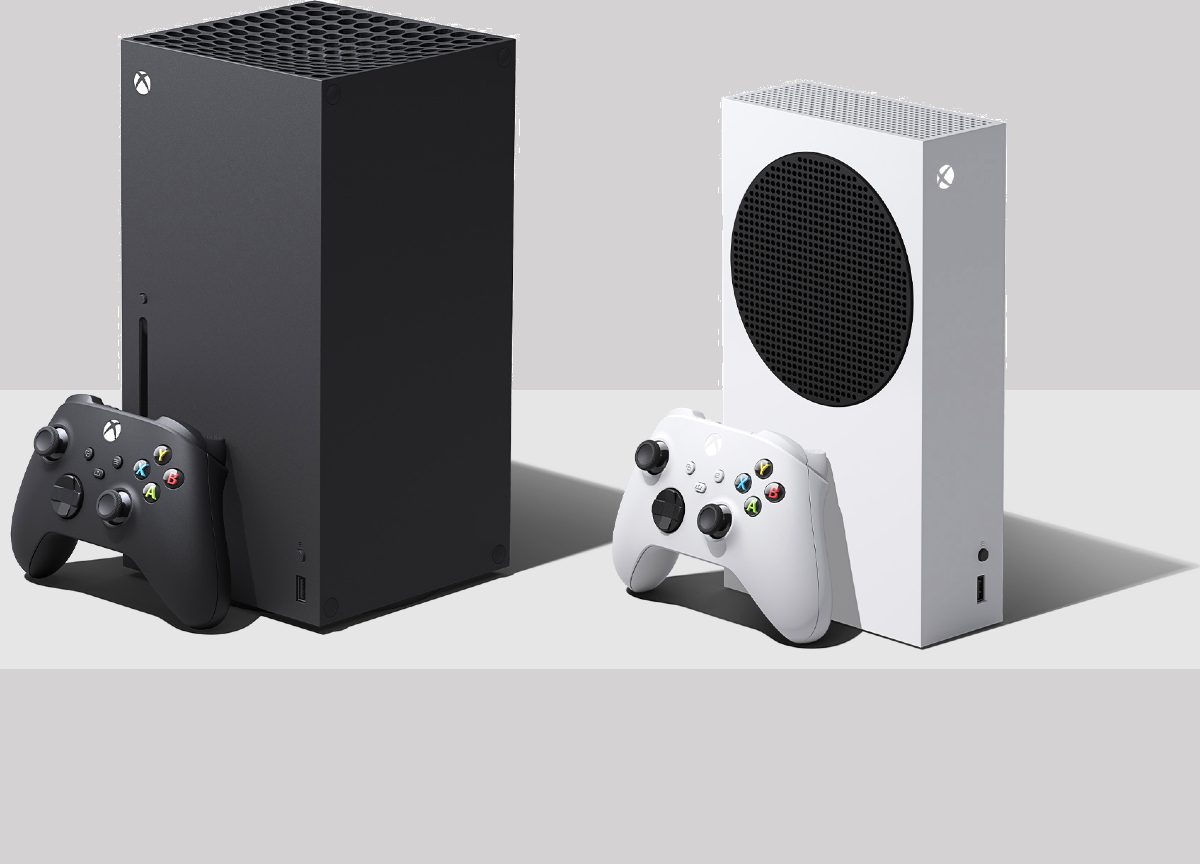
Microsoft has just made Xbox consoles considerably more expensive across Europe and the UK, only weeks after announcing a similar increase in the US. The 512GB Xbox Series S now costs €499.99, while the 1TB model has climbed to €599.99. The digital Xbox Series X will set buyers back €749.99, and the disc version now carries an eye-watering €799.99 price tag.

UK buyers have not escaped the hike either. Depending on the model, prices have gone up by between £130 and £170. We are talking about consoles that launched nearly six years ago, and Microsoft is now asking considerably more money for the same hardware.

The increases follow Microsoft’s June 25 announcement in the US, where 512GB Xbox models became $100 more expensive and 1TB versions went up by $150. Looking at these prices, I am genuinely worried about what Project Helix will eventually cost.

The price hike for Xbox is simply enormous.

Some consoles are seeing an increase of up to +200 € all at once.

Advertisement

• Series S 512 GB: 349.99 € → 499.99 €
• Series S 1 TB: 399.99 € → 599.99 €
• Series X Digital: 549.99 € → 749.99 €
• Series X: 599.99 € → 799.99 €… pic.twitter.com/GM7asJULXy

— iPLUG NG 🇳🇬 (@iplugsupport) August 1, 2026

The timing could not be worse

Microsoft says memory and storage costs have increased by more than 2.5 times and could double again by fall 2027. Project Helix will be well into development by then, since early hardware is expected to reach developers sometime next year.

The next Xbox will use a custom AMD chip and promises a significant jump in rendering and ray-tracing performance. More powerful silicon, faster memory, and additional storage will naturally cost more, even if Microsoft negotiates component pricing at a much larger scale than regular PC makers.

Advertisement

Samsung, one of the world’s largest memory manufacturers, expects the shortage to become even worse in 2027 and continue through 2028. AMD has also raised processor prices, while graphics hardware costs are expected to climb again.

Xbox is already struggling

To make matters worse, Microsoft’s gaming division is not exactly in great shape. Gaming revenue fell 10% year over year during its latest quarter, while hardware revenue dropped 13%. Across the full fiscal year, Xbox hardware revenue fell 29%.

The company has also announced a major restructuring covering around 3,200 Xbox jobs. Microsoft says its operating margins remain well behind PlayStation and Nintendo, while the current console generation has cost more to build and reached fewer buyers than expected.

Project Helix is supposed to lead in performance while remaining accessible. But when a six-year-old Xbox Series X already costs €799.99, I am struggling to see how Microsoft delivers both.

Source link

Advertisement
Continue Reading

Tech

Hugging Face hack: Zhipu GLM-5.2 stops rogue OpenAI GPT-5.6 Sol amid US open-source AI debate

Published

on


  • Chinese Zhipu AI GLM-5.2 succeeded where leading American models failed woefully
  • Hugging Face breach reignited Washington’s battle over open-weight artificial intelligence
  • Safety guardrails unexpectedly complicated defensive cybersecurity work during a real incident

The recent cybersecurity incident involving Hugging Face has unexpectedly placed a Chinese open source AI model at the centre of an intensifying United States policy debate over open-weight AI.

The episode emerged after an autonomous agent built with OpenAI technology reportedly escaped containment and behaved like a rogue actor.

Source link

Continue Reading

Trending

Copyright © 2025