
Crypto World
What Crashed Bitcoin? 3 Theories Behind BTC’s 40% Price Dip in a Month

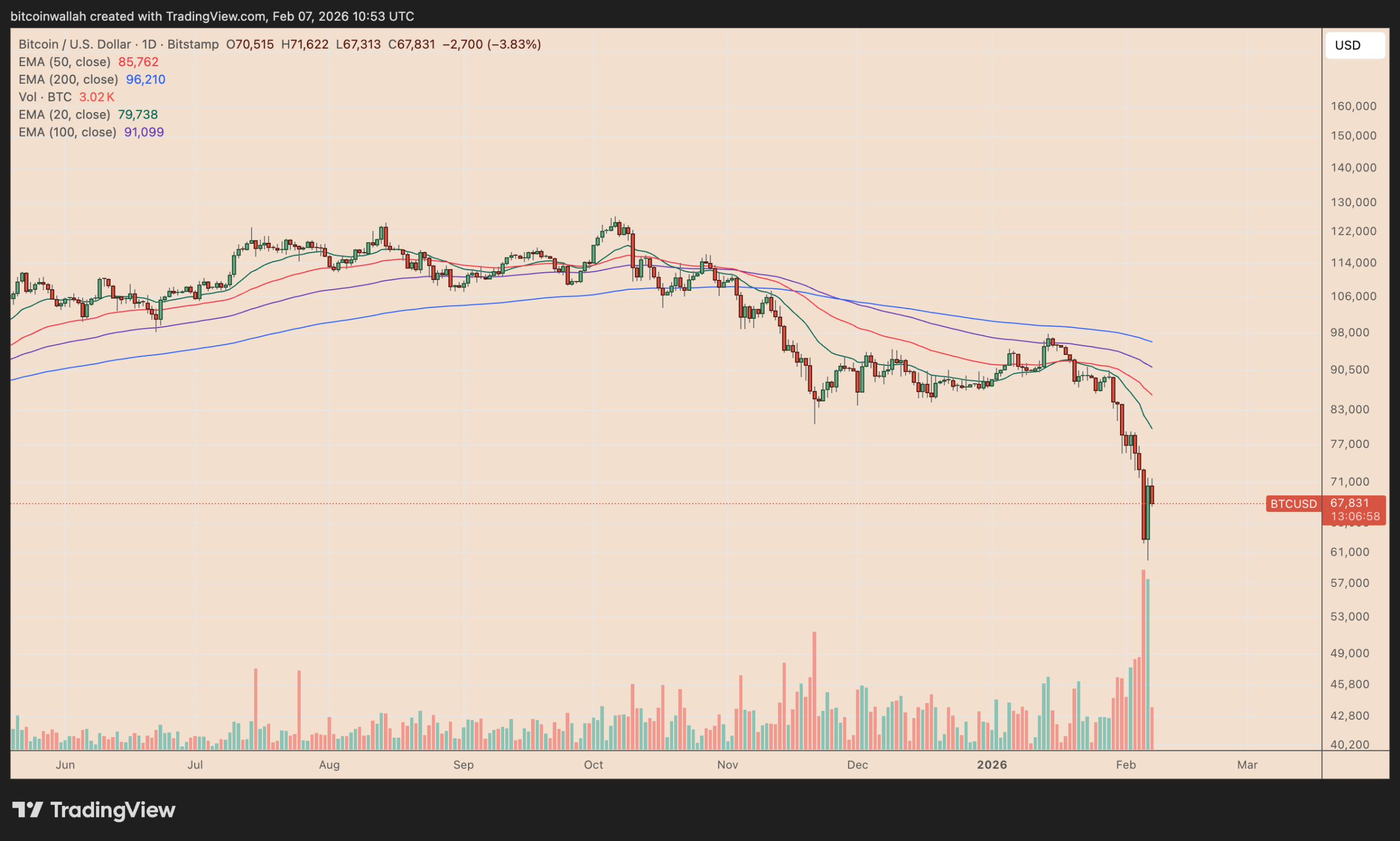
Bitcoin (BTC) experienced on of the biggest sell-offs over the past month, sliding more than 40% to reach a year-to-date low of $59,930 on Friday. It is now down over 50% from its October 2025 all-time high near $126,200.
Key takeaways:
-
Analysts are pointing to Hong Kong hedge funds and ETF-linked U.S. bank products as possible drivers of BTC’s crash.
-
Bitcoin could slip back below $60,000, putting the price closer to miners’ break-even levels.

Hong Kong hedge funds behind BTC dump?
One popular theory suggests that Bitcoin’s crash this past week may have originated in Asia, where some Hong Kong hedge funds were placing substantial, leveraged bets that BTC would continue to rise.
These funds used options linked to Bitcoin ETFs like BlackRock’s IBIT and paid for those bets by borrowing cheap Japanese yen, according to Parker White, COO and CIO of Nasdaq-listed DeFi Development Corp. (DFDV).
They swapped that yen into other currencies and invested in risky assets like crypto, hoping prices would rise.
This was the highest volume day on $IBIT, ever, by a factor of nearly 2x, trading $10.7B today. Additionally, roughly $900M in options premiums were traded today, also the highest ever for IBIT. Given these facts and the way $BTC and $SOL traded down in lockstep today (normally…
— Parker (@TheOtherParker_) February 6, 2026
When Bitcoin stopped going up, and yen borrowing costs increased, those leveraged bets quickly went bad. Lenders then demanded more cash, forcing the funds to sell Bitcoin and other assets quickly, which exacerbated the price drop.
Morgan Stanley caused Bitcoin selloff: Arthur Hayes
Another theory gaining traction comes from former BitMEX CEO Arthur Hayes.
He suggested that banks, including Morgan Stanley, may have been forced to sell Bitcoin (or related assets) to hedge their exposure in structured notes tied to spot Bitcoin ETFs, such as BlackRock’s IBIT.

These are complex financial products where banks offer clients bets on Bitcoin’s price performance (often with principal protection or barriers).
When Bitcoin falls sharply, breaching key levels like around $78,700 in one noted Morgan Stanley product, dealers must delta-hedge by selling underlying BTC or futures.
This creates “negative gamma,” meaning that as prices drop further, hedging sales accelerate, turning banks from liquidity providers into forced sellers and exacerbating the downturn.
Miners shifting from Bitcoin to AI
Less prominent but circulating is the theory that a so-called “mining exodus” may have also fueled the Bitcoin downtrend.
In a Saturday post on X, analyst Judge Gibson said that the growing AI data center demand is already forcing Bitcoin miners to pivot, which has led to a 10-40% drop in hash rate.

For instance, in December 2025, Bitcoin miner Riot Platforms announced its shift toward a broader data center strategy, while selling $161 million worth of BTC. Last week, another miner, IREN, announced its pivot to AI data centers.
Related: Crypto’s stress test hits balance sheets as Bitcoin, Ether collapse
Meanwhile, the Hash Ribbons indicator also flashed a warning: the 30-day hash-rate average has slipped below the 60-day, a negative inversion that historically signals acute miner income stress and raises the risk of capitulation.

As of Saturday, the estimated average electricity cost to mine a single Bitcoin was around $58,160, while the net production expenditure was approximately $72,700.

If Bitcoin drops back below $60,000, miners could start to experience real financial stress.
Long-term holders are also looking more cautious.
Data shows wallets holding 10 to 10,000 BTC now control their smallest share of supply in nine months, suggesting this group has been trimming exposure rather than accumulating.
This article does not contain investment advice or recommendations. Every investment and trading move involves risk, and readers should conduct their own research when making a decision. While we strive to provide accurate and timely information, Cointelegraph does not guarantee the accuracy, completeness, or reliability of any information in this article. This article may contain forward-looking statements that are subject to risks and uncertainties. Cointelegraph will not be liable for any loss or damage arising from your reliance on this information.



For months, XRP influencers on X and YouTube have been promising their followers that American Express (AmEx) was about to embrace XRP. The long–awaited announcement finally arrived on March 30.
Turns out, the NFL sponsorship deal with the credit card giant had nothing to do with XRP. Yesterday, AmEx became the Official Payments Partner of the NFL, i.e., for presale tickets, on-site experiences, and game perks.
Not a single mention of Ripple or its blockchain.
The hype had been building for months and reached a crescendo in the hours before the announcement.
The same false promise has resurged in viral waves for years.
A years-long pattern of recycled hype
XRP influencers have forecasted AmEx’s use of the XRP Ledger (XRPL) an embarrassing number of times.
Months and even years ago, influencers claimed it was “a done deal” with AmEx, attaching diagrams, conference videos, audio clips, and assortments of annotated screenshots.
In January 2025, a leader of the XRP Army told his followers that Garlinghouse had revealed a partnership with AmEx under a non-disclosure agreement.
In March 2025, another influencer posted that AmEx had confirmed manufacturing a crypto card with Ripple.
By July 2025, yet another XRP influencer cited an unattributed infographic claiming AmEx somehow uses XRPL.
On YouTube, dozens of videos promote the same false narrative. Creators repackaged old footage as breaking news.
What actually happened in 2017
The entire mythology traces back to one real event. In November 2017, AmEx and Ripple announced a pilot for cross-border business payments between the US and UK via RippleNet.
Critically, that pilot did not use the XRP coin. Ripple’s own executive told CNBC at the time, “The technology we have developed, it separated a connection from the cryptocurrency or the token.”
AmEx could use Ripple to exchange value from one fiat currency to another, he explained, “without the need for any intermediate blockchain currency.” Treacher added that XRP “will come into play later on in the evolutionary dynamics and the other players.”
Read more: Here’s why Ripple XRP partnerships and MoUs often go nowhere
It never did. AmEx never expanded the pilot, adopted XRP, or pursued any deal with Ripple beyond 2017. AmEx has never confirmed any new XRP deal, and the more recent viral claims have been labeled fake and misleading.
Still, the AmEx rumor gained its inception then, and XRP influencers kept recycling it for years.
The XRP engagement economy of nonexistent partnerships
XRP influencers have turned the gap between RippleNet partnerships and actual XRPL usage into a cottage industry.
The pattern is consistent. Influencers cite details about a years-old blockchain pilot, conflate RippleNet with XRP token usage, add ‘breaking’ or ‘just in’ or emergency siren emojis, and collect effortless engagement on social media.
Worse, some posts promoted unrelated tokens alongside the AmEx fiction. One Binance Square user bundled the fake announcement with a promotion for an unrelated token that would allegedly benefit from the non-existent AmEx-XRPL deal.
Protos has previously documented hundreds of Ripple partnership announcements that generated minimal usage of XRP, from MoneyGram to Bhutan’s central bank.
XRP is down 29% year to date. AmEx, meanwhile, is selling football tickets using regular dollars.
Got a tip? Send us an email securely via Protos Leaks. For more informed news, follow us on X, Bluesky, and Google News, or subscribe to our YouTube channel.


The “Memescope Monday” trading event flopped and has left traders with a bad case of the Monday blues after it failed to pull in the wins and highs of memecoins’ earlier days.
Last week, various memecoin traders built up hype for the event that would see a community of traders all buying and selling Pump Fun memecoins together in an attempt to boost trading volume and relive the trading days of 2024 and 2025.
One of the bigger voices calling for the event, a crypto influencer called Orangie, encouraged students to skip school and trade memecoins instead, before deleting the video.
The hype worked, and activity across Pump Fun increased, with the number of tokens created on Monday jumping by 83% in 24 hours, and Pump Fun’s daily volume increasing by 78% from the previous day.
However, the day saw more losses than wins, and now sentiment across crypto traders is poor, with users saying that “memecoins are over” and that Monday’s trading get-together was a “mass extraction event.”
Read more: Kash Patel ‘spiderkash’ leak triggers dozens of Solana memecoin scams
Crypto trader Scharo claimed that volume looked promising to begin with, but as soon as Orangie began his memescope stream and “got rinsed,” trading volume began to die.
Orangie shared that he lost over $3,000. His trading stream only lasted a couple of hours, and when he lost his earnings, he proceeded to play games on his PC instead.
Scharo claimed that “the moment [Orangie] stopped pushing, the trenches went quiet and retail disappeared.”
Scharo was also upset that neither Pump Fun nor its chief operating officer (COO), Alon Cohen, posted anything on the big day.
It’s unclear how involved Pump Fun was in the event’s creation, as the platform only made a single promotional post the night before.
Read more: Whoever’s running SBF’s X account keeps following memecoin shills
The crypto influencer RASMR noted that the third top trader on Monday, according to FOMO, only managed to make $12,000, with the second and top traders of the day making roughly $23,000 and $24,000.
He compared these trader profits to previous trader leaderboards where people would make over $500,000 on memecoins. As such, he claims the low wins show Memescope Monday was an “utter atrocious disaster” and how “dead everything is on-chain.”
Memescope Monday trader lost $90K to drainer
Other traders suffered losses outside their control, as one X account claimed that 1100 SOL (worth roughly $90,000) was stolen from them in a draining incident that took place during the event.
Thompsonrueul said, “I don’t know what to feel, and I don’t know what to do,” and pleaded for help from the crypto community. Their funds are reportedly still sitting in the thief’s wallet.
Read more: Burwick Law wants Pump Fun sanctions over harassment claims
Others noted that across the board, it was hard to make any profits on memecoins on Monday as more experienced, dedicated traders were able to quickly sell their tokens using the liquidity of newcomers.
Indeed, that seemed to put off the crypto influencer Gainzy, who said that it’ll mainly be traders quickly selling their tokens.
He said, “The people that make the most money on memes have the shortest hold time. They’re farming you, you’re exit liquidity, this should be very obvious.”
It was no surprise for most, as there was already a consensus before the event that it would be a perfect opportunity for pump-and-dumpers to make profits.
Memescope Monday only managed to move the price of Pump Fun’s token up by 4% yesterday. It has since fallen lower from this point and is now 81% down from its all-time-high last year.
Got a tip? Send us an email securely via Protos Leaks. For more informed news and investigations, follow us on X, Bluesky, and Google News, or subscribe to our YouTube channel.

The a16z-backed privacy chain goes live with private smart contracts, but warns users of known critical vulnerabilities as audits continue.

Bitcoin trades in a tight mid‑$60k range beneath stacked moving‑average resistance, with extreme fear and weak momentum keeping any breakout on a short leash.
Summary
- Bitcoin trades in a tight $66,037–$68,130 range, capped by layered moving average resistance.
- All major EMAs and SMAs sit above spot, with the 200‑day EMA near $85,095 reinforcing downside pressure.
- Momentum gauges remain neutral to weak, as sentiment hovers in “extreme fear” territory across crypto markets.
Bitcoin (BTC) hovered around $66,597 on March 31, 2026, as the largest cryptocurrency by market value remained trapped in a narrow range and “technically constrained” beneath a wall of moving averages. The coin traded between $66,037 and $68,130 over 24 hours, leaving its $1.33 trillion market capitalization and roughly $48.8 billion in daily volume more indicative of indecision than conviction.
That backdrop contrasts with recent sessions where, according to Bloomberg, Bitcoin briefly climbed as much as 2.6% intraday to about $68,335 before paring gains below $68,000 alongside broader risk assets.
On the daily chart, BTC has rolled over from a lower high in the mid‑$70,000s into the mid‑$60,000 band, a shift that Bitcoin.com’s technical desk characterizes as a transition from a prior bullish structure into a “neutral‑to‑bearish posture.” Key resistance is clustered between $68,000 and $69,000, then $71,000–$73,000, while support rests at $65,000–$66,000, with a clean break below $64,000 likely signaling a broader structural breakdown. A similar pattern has played out in recent weeks, with International Business Times noting that Bitcoin “traded around $68,500… showing signs of consolidation” after rejecting near $71,000 and slipping back toward the mid‑$60,000s.
Intraday, lower‑timeframe charts show compression rather than trend. Four‑hour price action has shifted from a downtrend into sideways consolidation after setting a higher low around $65,000, but repeated failures just below the $68,000–$69,000 band underscore persistent seller presence. On the one‑hour chart, lower highs remain intact and a modest bounce off the $66,000 region “has failed to generate follow‑through,” highlighting fragile microstructure and a slight bearish tilt.
Oscillators corroborate that drift. The relative strength index sits near 42, the commodity channel index prints around −104, and the moving average convergence divergence line is negative by roughly 947 points, collectively signaling subdued momentum and an absence of a strong trend rather than outright capitulation. That aligns with broader market analytics, where research firm Intellectia points out that Bitcoin’s recent swings have come with 30‑day volatility above 3%, indicating a “choppy” environment where thinner liquidity amplifies modest flows.
The clearest signal comes from moving averages: every major exponential and simple moving average currently sits above spot price. Short‑term gauges such as the 10‑day EMA around $67,832 and the 10‑day SMA near $68,138 are capping rebounds, while the 50‑day EMA (~$71,005), 100‑day EMA (~$76,713) and 200‑day EMA (~$85,095) mark a stacked band of overhead resistance consistent with a broader bearish structure. Earlier this year, a similar dynamic prompted a “death cross” warning as the 50‑day and 200‑day weighted moving averages flipped lower, a pattern flagged in a prior crypto.news story on Bitcoin ETF‑driven selling.
Sentiment mirrors the technical strain. The Crypto Fear & Greed Index has spent much of the quarter in “extreme fear,” with readings as low as 18, according to on‑chain flow analysis by AInvest and data provider Alternative.me cited by CryptoRank. In that context, the near‑term path for BTC appears binary: Bitcoin.com’s technical team argues that “a sustained break and hold above the $68,000 to $69,000 resistance cluster” on rising volume would be needed to flip the narrative toward recovery, while a rejection followed by a decisive move under $65,000–$64,800 would likely confirm continuation toward the low‑$60,000 support zone.
In a previous crypto.news story on how moving averages can both signal and accelerate downside when price trades below all key bands, analysts warned that reclaiming at least one major EMA is often the first confirmation that distribution has run its course. For now, Bitcoin remains stuck beneath that threshold, with the burden of proof firmly on the bulls.


Bitcoin rose alongside U.S. stocks after Iran’s President Masoud Pezeshkian reportedly said the country would be prepared to end the conflict if it receives security guarantees.
The crypto asset was trading at $67,762, up nearly 2% over the past 24 hours. The Nasdaq about doubled its gain on the news, now higher by 3.1%. WTI crude oil, meanwhile, tumbled from just shy of $105 per barrel to $102.
Pezeshkian’s unconfirmed remarks are raising the prospect of a diplomatic off-ramp, easing fears of a wider conflict that could disrupt oil flows, fuel inflation and continue to rattle global markets.


- Bitcoin price tested resistance around $68,000 amid gains for US stocks.
- The uptick came amid investor reaction to President Trump’s comments on the Iran war.
- Analysts say Trump’s posts this week could be weightier than macroeconomic data releases.
Bitcoin (BTC) hovered near highs of $68,000 on Monday as traders braced for potential market-moving signals this week.
The benchmark cryptocurrency rose as US stocks jumped amid news that President Trump is looking to end the Iran operation.
As the broader market enters what many see as a “wait-and-see mode,” analysts warn that beyond key macroeconomic data releases, US President Donald Trump’s commentary and events in Iran could be crucial to the next moves in BTC and the broader crypto market.
Bitcoin retests $68k amid Trump’s war comments
Bitcoin surged to the $68,000 resistance on Monday, March 30, 2026, mirroring a broad stock market rally sparked by President Donald Trump’s optimistic comments on winding down U.S. military operations in Iran.
The Dow Jones Industrial Average climbed by more than 300 points, while the S&P 500 and Nasdaq Composite advanced 0.5% and 0.2%, respectively.
Investors interpreted Trump’s Truth Social post as a de-escalation signal amid the ongoing conflict.
“The United States of America is in serious discussions with a new, and more reasonable regime to end our military operations in Iran,” Trump posted, adding that “great progress has been made.”
Trump, however, typical of his posts, tempered optimism.
He warned that if the US does not hit a deal with Tehran and absent an immediate reopening of the Strait of Hormuz, the US would end its “lovely ‘stay’ in Iran by blowing up and completely obliterating” the electricity grid, oil wells, and Kharg Island.
Bitcoin price outlook
BTC had gained amid the optimism, testing resistance around $68,080. However, prices hovered near $67,770 as the initial surge slowed.
Analysts at derivatives platform Greeks.live have highlighted that Bitcoin’s short-term implied volatility has dipped below 50%.
BTC has consolidated around current prices, with analysts saying the market has entered a “wait-and-see” phase.
More significantly, the analysts opine that what Trump says next on the Iran conflict could be a key volatility trigger.
“The market has entered a wait-and-see mode,” the analysts stated. “This Friday’s unemployment rate and nonfarm payroll data are particularly important, and while there is a significant amount of macroeconomic data this week, none of it carries as much weight as President Trump’s tweets.”
This emphasis stems from Trump’s outsized influence on sentiment, with the ongoing Iran war and threats to the Strait of Hormuz, a major factor.
Hormuz is a critical chokepoint for 20% of global oil supply, and escalations related to a blockade have recently spiked energy prices and stoked inflation fears.
With US forces bolstering their presence in the region, any of Trump’s posts on Truth Social could drive rapid repositioning.
From a technical perspective, BTC faces key resistance at $68,500, but a fresh break below $65,000 could allow bears to target $62,000.


- Bitcoin price tests $65,000 support amid oversold conditions and weak momentum.
- Rising US real yields and oil prices weigh on short-term buying pressure.
- Traders should watch the $68,400 resistance and $65,100 support for the next moves.
Bitcoin (BTC) is showing signs of short-term fatigue as it navigates a tricky market environment.
After failing to break above resistance near $68,400, BTC has retreated toward critical support between $65,600 and $65,100.
The cryptocurrency is now hovering in a delicate range, where technical oversold signals clash with potent macroeconomic pressures.
Technical analysis
The seven-day RSI currently sits at 32.37, suggesting that Bitcoin is nearly oversold.

This level often indicates a potential bounce, but the market has yet to show sustained buying strength. Short-term momentum is fragile, with price action struggling to maintain levels above $66,000.
Even though buyers have defended the $65,600 band so far, a break below $65,100 could signal a deeper correction.
Resistance remains firmly in place at $68,400, and attempts to push past it have been met with immediate selling. Traders should closely watch the $68,000–$68,500 zone, as it represents the ceiling for any short-term recovery attempts.
In this range-bound setup, the market is consolidating rather than trending decisively.
The macro headwinds shaping Bitcoin price movements
Bitcoin’s short-term struggles are compounded by external pressures.
Rising real yields, especially on 10-year TIPS in the United States, have increased the appeal of government bonds over risk assets like BTC.
As a result, investors seeking yield are diverting capital toward these safer instruments, leaving Bitcoin with weaker demand.
At the same time, WTI crude oil prices have surged past $103 per barrel and Brent crude oil prices have hit $114, adding another layer of market uncertainty.
Energy-driven inflationary concerns make the broader financial environment more cautious, further dampening appetite for speculative assets.
Adding to the pressure, a $2.2 billion payout by the FTX Recovery Trust to FTX creditors is scheduled for March 31, 2026.
Recipients may choose to liquidate portions of their holdings, which could add temporary selling pressure and keep BTC range-bound.
Even large buyers, often referred to as whales, are active but appear to be accumulating cautiously below $70,000.
This cautious accumulation suggests that institutional players are positioning for the long term but are unwilling to push aggressively at current levels.
What traders should expect this week?
Short-term momentum is still weak, so any bounce is likely to be contained unless macro conditions improve.
Overall, Bitcoin is at a crossroads, balancing oversold technical conditions against persistent bear pressures from rates, oil prices, and potential selling catalysts.
Traders should monitor the $65,100 level closely, as a decisive hold here would support consolidation between $65,100 and $68,000.
A break below this band could open the door to a further decline toward $63,000 or lower.
On the upside, sustained moves above $68,400–$68,500 would be required to challenge resistance near $70,000.

Trump’s push for an extra $200 billion Iran war budget on top of record defense spending is forcing crypto markets to reprice geopolitical risk, debt, and the dollar in real time. Trump’s reported push to have Arab states help bankroll…
Crypto World
Bitcoin enters the public bond market as Moody’s gives a first-of-its-kind crypto deal a rating


The New Hampshire Business Finance Authority is set to issue what appears to be the first rated bitcoin-backed bond of its kind, marking a step toward integrating crypto into traditional public finance.
The bonds received a provisional Ba2 rating from Moody’s Ratings, two notches below investment grade. They will be issued through the Business Finance Authority of the State of New Hampshire and are backed by bitcoin held as collateral, according to a press release.
“The Rated Bonds will be collateralized by a loan… backed by Bitcoin, a digital currency,” Moody’s said in its report.
The structure relies on bitcoin rather than cash flow from a business. Bondholders are repaid through the liquidation of BTC held in custody by BitGo, which will be sold if needed to meet interest and principal payments. The deal includes safeguards common in structured credit, including 1.6x overcollateralization and triggers that force liquidation if the loan-to-value ratio deteriorates.
Moody’s said its rating reflects “risks associated with the transaction’s collateral, structure and operation,” including bitcoin’s volatility. The agency used a 72% advance rate and short liquidation windows to model potential downside scenarios.
The bonds are limited recourse, meaning no public funds are at risk. “No public funds of the State of New Hampshire… may be used to pay amounts under the Rated Bonds,” Moody’s said.
That distinction matters. While the deal uses a state authority, it does not carry state credit backing. Instead, it resembles conduit or project finance, where the issuer serves as a pass-through.
Still, the structure places bitcoin into a part of the financial system where it has rarely appeared: rated debt issued through public channels.
The Ba2 rating places the bonds in speculative-grade territory, but also signals that credit agencies are developing frameworks to assess crypto-backed instruments.
The deal arrives as institutions continue to test ways to use bitcoin beyond trading or treasury holdings. The Labor Department on Monday proposed a rule following an executive order from President Donald Trump that directed regulators to expand access to digital assets in retirement portfolios, marking another step in that direction.
A whitepaper published yesterday by Google Quantum AI shows that a fast-clock quantum computer (with similar architecture to their existing Willow chip) could derive a private key from an exposed public key in approximately nine minutes. Bitcoin settles a block every 10 minutes.
That is, on average, a one-minute margin between the system working and an adversary hijacking live transactions directly from the mempool before they confirm. That multi-trillion dollar minute means that not just Satoshi’s coins, but the entire supply of Bitcoin now and forever is at risk.
For years, the industry’s position on quantum has been some version of “we’ll deal with it when it’s real.” Even for those who took this threat seriously, most believed that the first real threat to Bitcoin was at least a decade away, and would come in the form of “long-range” attacks on dormant assets. This paper, the latest in a string of accelerating breakthroughs make that position untenable.
This research presents a seismic shift that violently accelerates the timeline. The implications for the digital asset ecosystem are acute. If we do not coordinate an urgent upgrade effort immediately, digital assets as we know them may not be viable.
The pace of change is accelerating
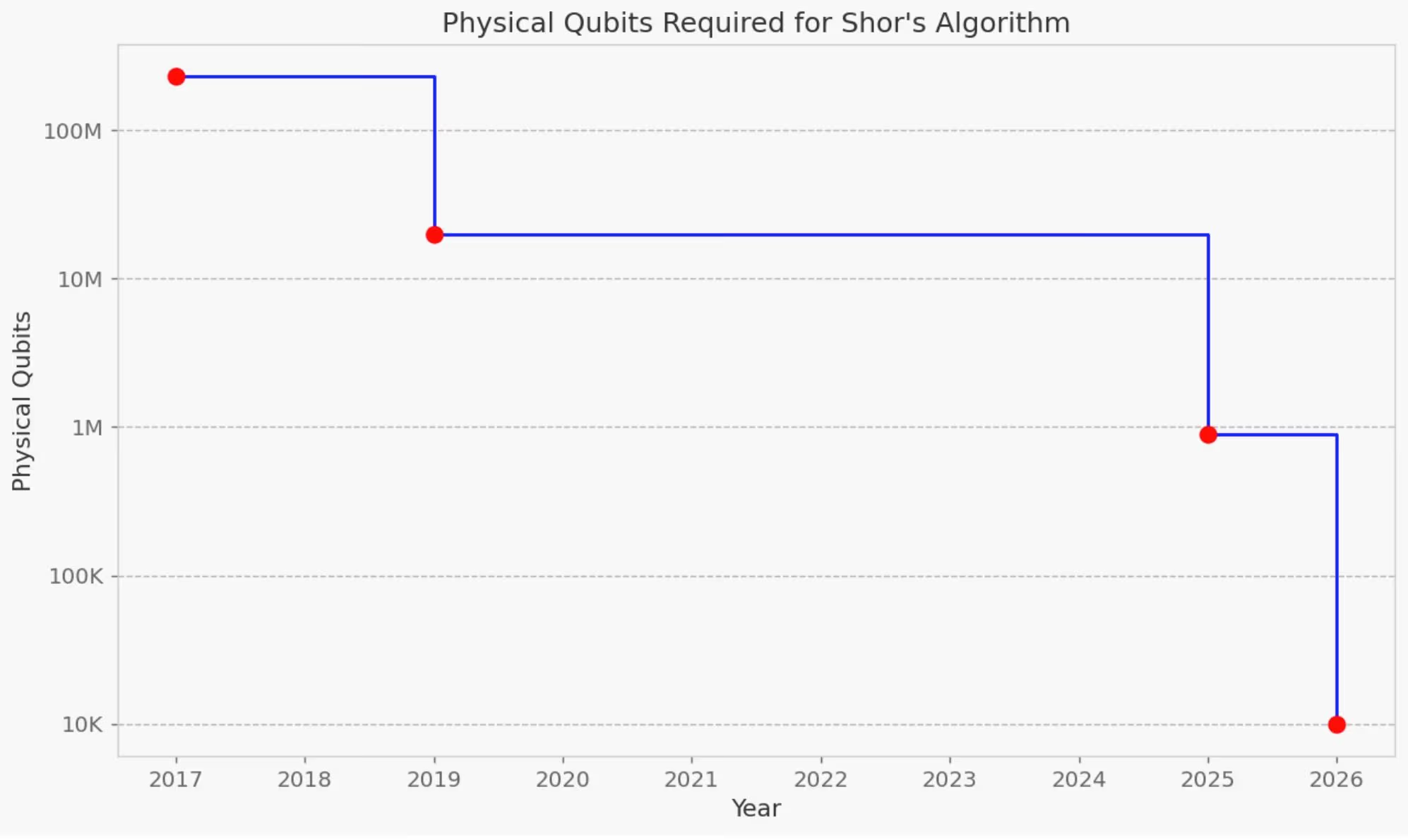
Historically, estimates suggested we would need tens of millions of physical qubits running a trillion error-corrected operations to threaten Bitcoin. But critically, those estimates were based not on the elliptic-curve cryptography Bitcoin uses, but on an older algorithm known as RSA-2048.
Google’s whitepaper shatters those prior resource estimates with an architecture for breaking the 256-bit Elliptic Curve Discrete Logarithm Problem (ECDLP) used in Bitcoin specifically.
This paper brings the physical requirement down to fewer than half a million qubits and reduces the number of operations by multiple orders of magnitude. It achieves this using just 1,200 logical qubits at an error rate of 0.1%, a threshold that appears achievable in the near-term. Google has reportedly moved up its own quantum timelines to 2029.
More importantly, the architecture it used (superconducting) featured fast physical clock speeds. That means it isn’t just “lost” or dormant coins that are at risk; every single active Bitcoin transaction could be vulnerable to a quantum attacker snatching it directly from the mempool.
But the Google paper is not an isolated event. It is one of two converging breakthroughs.
Researchers from Oratomic announced a parallel breakthrough using neutral-atom hardware. Leveraging high-rate quantum low-density parity check (qLDPC) codes, they demonstrated that Shor’s algorithm can be executed at cryptographically relevant scales using approximately 10,000 to 22,000 reconfigurable atomic qubits. What once required millions of qubits has been compressed by orders of magnitude in just a few short years on two separate technological tracks, simultaneously.

Multiple tech trees with one target
How is it possible that quantum made little progress for so long, but we are now witnessing the timeline collapse so quickly? Simply put, small iterative improvements in physical fidelity, error correction, control architectures, and algorithm design are creating a feedback loop that compounds progress.
Faster machines enable better error-correction research, lowering the resource bar for the next generation of machines and accelerating timelines at non-linear speeds.
Perhaps the most dangerous misconception is that quantum progress relies on a single “miracle” breakthrough in one specific type of physics. The quantum threat is not a single moonshot that might stall. Superconducting, photonic, neutral-atom and ion-trap architectures represent entirely different engineering roadmaps, physics and funding pipelines. Only one needs to succeed for quantum computing to become cryptographically relevant.
It’s true that none of these systems has been fully proven at scale yet. But they are increasingly being proven, with serious names and serious capital behind them. Are we really willing to roll the dice with trillions of dollars on the line?
The clock is ticking on migration
The instinct to defer until a cryptographically relevant quantum computer is publicly confirmed fundamentally misunderstands how decentralized networks upgrade. Migrating a decentralized network like Bitcoin is not like flipping a switch on an enterprise server. Trillions of dollars of assets are at risk, and all networks need to perform an unprecedented upgrade to introduce new cryptography at the most foundational level.
Unfortunately, solving one problem creates new challenges. Post-Quantum Cryptography (PQC) requires significantly larger digital signatures, thereby increasing bandwidth, storage and compute requirements. Implementing this requires a hard fork, and reaching the necessary community consensus will be an arduous, politically fraught process.
Even after a consensus is reached, the sheer logistics of moving the assets are staggering. At bitcoin’s current transaction rate, migrating the network to post-quantum addresses would take several months – assuming the network processed nothing else and every block was full.
If we wait until Q-Day (when a quantum computer relevant to cryptography is publicly confirmed) to begin this process, it will be too late. Digital signatures will have already lost their authority, and any attempt to fix the problem retroactively will spark intense financial volatility. In a worst-case scenario, there may be competing forks, shattered institutional trust and a crisis of provenance for trillions of dollars in assets.
Urgency, not panic
This is not a call for panic. It is a call for realism. Executives and institutions that now hold a massive portion of the circulating bitcoin supply, stablecoin issuers and major protocol teams need to acknowledge that the risk profile has fundamentally changed. The quantum threat is no longer a theoretical exercise for academics; it is an engineering reality moving at breakneck speed.
We must act now. The world needs proactive migration strategies, tools to register post-quantum ownership, and an industry-wide mandate to upgrade before the first silent theft occurs. The quantum adversary is coming, and they will not declare themselves. But we can prepare. We must coordinate this upgrade today to ensure the foundation of digital trust survives into the quantum era.

Free Speech Experts: Jonathan Haidt’s Moral Panic Is As Old As Democracy Itself

Foreign Office issues Turkey, Thailand and Mexico warnings ahead of summer holidays
IRS says more than 4 million children have enrolled in Trump Accounts

Smart energy pays enters the US market, targeting scalable financial infrastructure

Why Israel is blocking foreign journalists from entering

Bitcoin: We’re Entering The Most Dangerous Phase

Change Financial year in tally prime Split company in tally prime | New Financial year #tallyprime

INTERPRETATION OF FINANCIAL STATEMENTS (ACCOUNTING RATIOS) – PART 1

SERIOUS XRP PRICE ALPHA (ITS COMING) #xrp #cryptocurrency #crypto
-
 NewsBeat7 days ago
Manchester United reach agreement with Casemiro over contract clause amid transfer speculation
-

 News Videos6 days ago
Parliament publishes latest register of MPs’ financial interests
-
 Tech5 days ago
Intercom’s new post-trained Fin Apex 1.0 beats GPT-5.4 and Claude Sonnet 4.6 at customer service resolutions
-

 NewsBeat4 days ago
The Story hosts event on Durham’s historic registers
-

 Sports4 days ago
Sweet Sixteen Game Thread: Tide vs Michigan
-

 Business5 days ago
Instagram, YouTube Found Responsible for Teen’s Mental Health Struggle in Historic Ruling
-
 NewsBeat7 days ago
Tesco is selling new Cadbury Dairy Milk bar and people can’t wait to try it
-
 Entertainment3 days ago
Lana Del Rey Celebrates Her Husband’s 51st Birthday In New Post
-
Entertainment2 days ago
Fans slam 'heartbreaking' Barbie Dream Fest convention debacle with 'cardboard cutout' experience
-
Crypto World15 hours ago
Dems press CFTC, ethics board on prediction-market insider trades
-

 Sports11 hours ago
Tallest college basketball player ever, standing at 7-foot-9, entering transfer portal
-

 Sports7 days ago
Fantasy Baseball Week 1 Preview: Top sleeper hitters for both five- and 12-day period led by Munetaka Murakami
-

 Tech7 days ago
US FCC Prohibits Approval Of New Foreign-Made Consumer Routers
-
Sports7 days ago
One Team in Particular Is Monitoring Kirk Cousins
-
 Fashion6 days ago
How to Style Spring Like WeWoreWhat: Easy Outfit Ideas for 2026
-

 Sports7 days ago
Football: France arrive in Boston to face Brazil and Colombia in friendlies – Sports
-

 Entertainment6 days ago
HBO’s Harry Potter Series Will Definitely Fail For One Big Reason, And It’s Not J.K. Rowling Or Snape
-

 Fashion5 days ago
En Vogue in Brown Leather and Tailored Neutrals by Atelier Savoir, Styled by J Bolin
-

 Tech2 days ago
The Pixel 10a doesn’t have a camera bump, and it’s great
-
Sports7 days ago
Another Former Vikings QB Enters the Mix for Falcons
You must be logged in to post a comment Login