

Crypto World
What we’ve learned from Terraform Labs’ unredacted Jane Street lawsuit

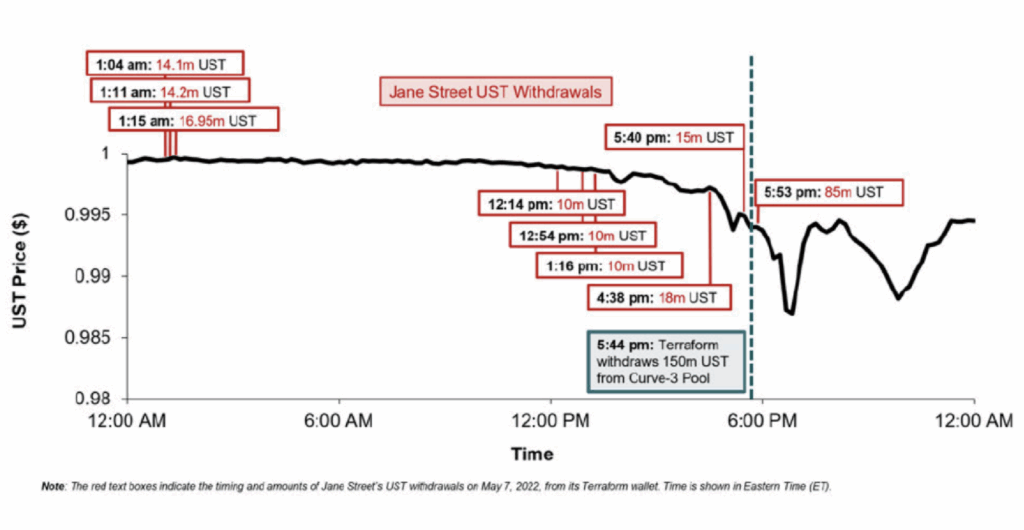
Liquidators overseeing Terraform Labs’ bankruptcy have unredacted the Jane Street Group lawsuit that accuses the firm of using a secret Telegram chat to profit from Terra’s $40 billion collapse.
Appointed administrator, Todd Snyder, filed the lawsuit last February in a Manhattan court.
It accuses Jane Street, its co-founder Robert Granieri, and employees Bryce Pratt and Michael Huang of using insider information to front-run transactions and profit from Terraform Labs’ fallout.
Allegedly key to this was a Telegram group chat called “Bryce’s secret” set up by Pratt. The suit claims he used the group to relay information from various Terraform employees back to Jane Street.
At the time of filing, Jane Street claimed the suit was full of “baseless, opportunistic claims.”
Read more: Do Kwon sentenced to 15 years for Terra/Luna fraud
It said, “This desperate suit is a transparent attempt to extract money when it’s well-established that the losses suffered by Terra (UST) and Luna (LUNA) holders were the result of a multibillion-dollar fraud perpetrated by the management of Terraform Labs.”
The lawsuit was mostly redacted but now, many of these redactions have been removed. Protos has compared the documents to reveal what’s new.
The unredacted claims in Terraform Labs lawsuit
The first set of unredacted lines introduces the group chat “Bryce’s secret,” and notes that it was a secret message chain named after a former Terraform intern and then-current Jane Street systems developer.
It claims that the insider information allowed Jane Street to unwind hundreds of millions of dollars in potential exposure, “and then to short sell Terraform tokens to reap even more illicit profits.”
Unredacted lines claim Jane Street “made a killing.” The suit then claims that Jane Street, knowing it had used insider information, went on to delete all traces of the crypto wallet linking it to these trades.
Jane Street was allegedly ‘hungry for defi info’
We’re also now able to see the claim that Jane Street was “very hungry for…defi info,” and that it sold the entirety of its UST holdings. It then allegedly “took short positions in UST and Luna to profit from the crash it helped catalyze.”
Previously-redacted details about Pratt, Granieri, and Huang are then revealed. These note Granieri’s role in authorizing the alleged suspicious UST trades, and claim that he discussed the rescue of the Terraform ecosystem while learning material non-public information.
Pratt was allegedly involved in “acquiring and confirming information from Terraform and providing it to others at Jane Street.”
The suit also claims that Huang discussed decommissioning Jane Street’s wallet, was primarily responsible for executing relevant trades during UST’s 2022 depeg, and frequently received Pratt’s insider information.
Later unredacted lines claim that Pratt was encouraged by others at the firm to leverage his connections at Terraform.
Lawsuit says Pratt was allegedly ‘adding colour’
The newly-unredacted suit also claims that Jane Street staff discussed investing in Terraform and Luna Foundation Guard (LFG), and mulled over LFG’s $1 billion capital raise through an over-the-counter sale of LUNA.
Employees — who remain redacted — asked how this was achieved, and if the deal had “a four-year lock and 24 participants, with an average price of $51/luna?”
The suit claims Huang was skeptical of the $51 price, and added Pratt to the discussion to “add some colour.” The suit also alleges that Pratt said, “Pricing around $51 sounds right according to my sources.”
It adds that Pratt heard the raise was supposed to be $2 billion originally, and that the deal was supposed to be at a 40% discount before LUNA fell and various investors backed out.
Bryce’s secret is allegedly born
From here, unredacted lines claim that “Bryce’s secret” was made on February 22 with Pratt, Terraform Labs’ head of business development, and another unnamed Terraform employee.
In one discussion, the employee and Pratt allegedly discussed a potential investor in Terraform Labs with the firm’s head of business development.
The suit details that the two were initially coy about the investor, but eventually the unnamed employee revealed to the head of business development that it was “Jane Streeeeeeeet.”
This allegedly piqued the Terraform business head’s interest. The suit notes they asked Pratt “what are you guys looking to do, besides otc,” and “can u market make ust?”
Pratt then replies, “everything. Probably ya. If jump can legally do smtg we probs can too,” according to the suit.
The lawsuit claims these discussions were “the beginning of near-constant communications between Jane Street and Terraform between February and May 2022 that revealed material non-public information.”
In another instance, the lawsuit notes that, as Jane Street and Terraform negotiated a LUNA purchase deal, Pratt was tasked with drafting a “terra explainer” for Jane Street that would summarise its operations.
If Pratt was ever unsure about details, he would allegedly “ask [his] friends,” aka former Terraform Labs employees.
The suit also notes Pratt’s alleged insider knowledge was relied upon in March 2022 discussions about staking on Anchor. When the discussion shifts to shorting LUNA, Huang allegedly halts the discussion so Pratt can share his input, where he then appears to obtain more non-public information.
In March again, the lawsuit claims Pratt told Huang that crypto firm Celsius wanted to invest between $1-2 billion into LFG, but “Terra is probably going to say no.”
Pratt goes on to say that he doesn’t really know what Celsius does, and that “terra is super confused too.”
Pratt allegedly sought insider info at wedding
The lawsuit notes that on April 1, Pratt told Huang and a redacted individual that “if we can still get in on [Luna Foundation Guard]… it’s looking better and better.”
He added, “I am hopefully going to a wedding later this month which basically every Terra exec will be at, including obviously Do. Maybe I can talk to them there and see if we can do something :).”
Pratt also allegedly helped Jane Street understand non-public numbers surrounding the UST/LUNA mint-burn.
Read more: The high-profile LUNA investors — from prime ministers to beauty queens
This allegedly involved Pratt leveraging his relationship with Terraform Labs’ head of research to confirm outdated sources.
Huang allegedly told Pratt, “I’m like kind of mad this isn’t just in their docs,” to which Pratt allegedly responded, “On the other hand shouldn’t you be slightly pleased that you have an informational advantage :’).”
Pratt also apparently shared with Huang in that same chat that, based on the info provided by the research head, “Jump makes an absolute killing off of MEV in Terra and that MEV in general should be very high priority for us.”
Lawsuit says Jane Street explored hirings to learn more about Terra
The lawsuit says Terraform’s head of research “was both providing and seeking information” and by March 2022, wanted Jane Street to hire him. One Jane Street employee allegedly wanted to hire him to learn more about Terraform Labs’ inner workings.
Further unredacted lines note that Pratt tried to quash concerns that the firm’s wallet, positioned as the sixth largest, was a “red flag.”
The suit alleges he said, “estimates I’ve heard from trusted sources put [hedge fund] Alameda’s Anchor deposits somewhere north of $1B.”
He then supposedly added, “Despite us being the 6th largest wallet, I think it’s very unlikely that we’re the 6th largest depositor.”
Jane Street allegedly made suspiciously timely UST sales
The next batch of unredacted lines detail Jane Street’s purchases of UST.
According to the suit, Jane Street bought 10,000 UST on February 11, then one month later, another 10 million UST on Binance.
Afterwards, between April 1 and April 11, Jane Street is noted to have bought over 190 million UST on Binance. Altogether, the lawsuit says it owned ~$200 million worth of UST.
The suit then claims that it staked its UST with Anchor and began to earn 20% interest.
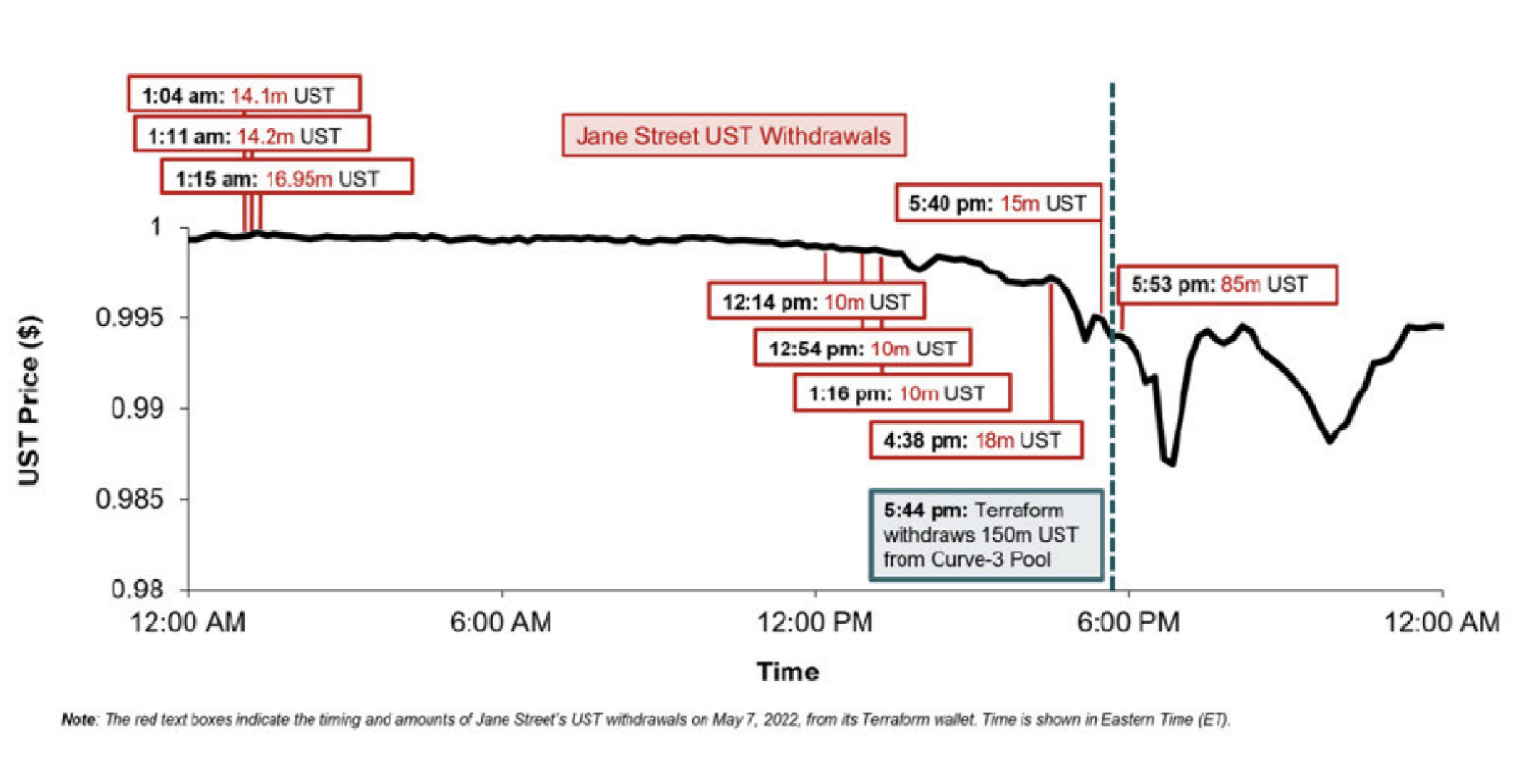
From here, unredacted sections detail the run-up to Terraform’s UST depeg and Jane Street’s unstaking and selling of UST. The suit reveals how Jane Street carried out a test sale of $8 million worth of UST to test the peg’s stability in late April.
It then held onto the rest of its UST until May 7, the day Terraform withdrew 150 million UST from the Curve3 liquidity pool without public disclosure.
Jane Street exited its entire $192 million UST position that day.
Read more: How Jump Trading allegedly manipulated UST into collapse
The unredacted suit claims, “Jane Street leveraged its material nonpublic information about Terraform’s ecosystem to sell its UST at the most opportune moment.”
“By selling all of its UST in one day, all effectively at its peg value of $1, Jane Street avoided the catastrophic losses that other investors, including the individual victims, suffered when UST collapsed to virtually $0 just days later.”
Lawsuit says Jane Street traders were nervous
The unredacted sections then go on to explain how Jane Street began to short UST and LUNA based on non-public information.
Pratt allegedly learnt through Terraform’s head of research that Jump Trading would help Terraform Labs restore its UST peg, which was, by May 9, trading below $0.80.
He allegedly learned this by asking, “Y jump not doing their shit.”
On May 9, Jane Street co-founder, Granieri, allegedly forwarded on non-public information to fellow Jane Street traders that he learned from Jump Trading’s founder Bill DiSomma and CIO Dave Olsen.
This included efforts from Jump Trading to help Terraform Labs, and Jump’s request to Jane Street to also help bail Terraform Labs out and restore its peg.
Read more: How did so many Jane Street traders wind up at FTX?
He supposedly learned that Jump Trading would only invest $100-200 million to help Terraform Labs, and alleged that it would need at least $2 billion, or $5 billion to be saved.
According to the lawsuit, Granieri said Jane Street would think about Jump’s request. Across that same day, and the next, the lawsuit claims Jane Street began shorting UST and LUNA for millions.
Also alleged in the suit is that some Jane Street traders were concerned about trading on insider information. It added that one supposedly said he “understood that [material non-public information] didn’t really exist in crypto.”
According to one unredacted line, “Jane Street unwound its short positions, pocketing over $19 million of profits on the UST short positions and over $115 million of profits on the Luna short positions.”
It had also allegedly placed another cheap option bet on LUNA that, if the UST depeg was ever restored, it would make Jane Street up to $180 billion by Huang’s estimates.
The suit then details that Terraform Labs’ head of research was eventually offered a role after the collapse of UST. It notes that he joined, but Jane Street staff were “unclear… whether he was also still working at Terraform at the time.”
Jane Street allegedly wanted to keep its ‘killer’ trades quiet
Redacted sections also show that Jane Street was praised by a group of skilled on-chain analytics experts in the weeks that followed for the “killing” it made on its trades.
Rather than revel in the praise, the lawsuit claims that Huang “expressed anxiety at having been caught.” He allegedly guessed that the firm’s admirers were “friends with exchanges and someone leaked them our wallets at some point.”
One unredacted section details how news of a wallet involved in the depeg began to spook Huang, and that he discussed “affirmatively stripping information that would connect them to this wallet.”
This was despite Jane Street’s name not being publicly linked yet.
Read more: Researcher ties Jane Street to notorious ‘Wallet A’ that helped depeg UST
The unredacted document goes on to claim, “While it never publicly touted its involvement in the scheme, Jane Street has also never denied that it reaped massive profits from the collapse of UST due to its sales based on insider information.”
Other previously-redacted sections of the document recount specific details around unjust enrichment, market manipulation, insider trading, and other securities violations.
Got a tip? Send us an email securely via Protos Leaks. For more informed news and investigations, follow us on X, Bluesky, and Google News, or subscribe to our YouTube channel.

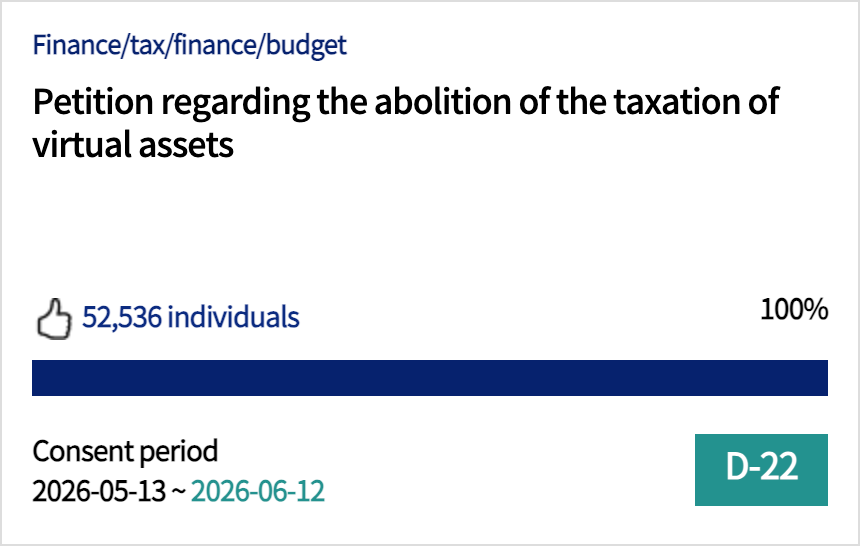
A petition to scrap a 22% tax on crypto investment gains in South Korea reached the 50,000-signature threshold required for the country’s Finance and Economic Planning Committee to review objections to the new tax regime.
The 22% tax, set to take effect in January 2027, imposes financial and reporting “burdens” on investors, while also limiting upward mobility for younger individuals, who are locked out of housing markets due to skyrocketing real estate prices, according to the petition.
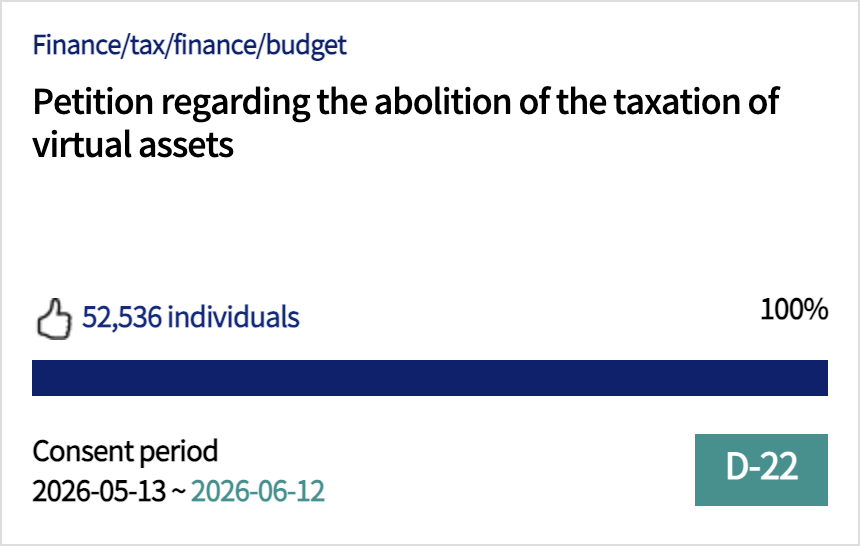
The petition now has more than 52,000 signatures. Source: South Korea Assembly
The petition also said that taxing crypto gains at 22%, while giving other asset classes preferential tax treatment, undermines South Korea’s share of the crypto market. In a translated statement, the authors of the petition wrote:
“If taxation is enforced in order to secure short-term tax revenues, it is likely to lead to greater losses in the long term, namely, a contraction of industry and an outflow of capital and talent abroad.”
South Korea is a key crypto hub in the Asia-Pacific region, and in March 2025, about 32% of the country’s population owned cryptocurrencies, according to local news agency Yonhap. However, ownership has declined so far this year as crypto prices remain under pressure.
Related: South Korea plans July rules for tokenized securities
South Korea’s crypto market contracts as tighter controls are proposed
The total value of crypto held by South Koreans declined from about 121.8 trillion won ($83.3 billion) in January 2025 to about 60.6 trillion won ($41.4 billion) in February 2026, according to industry data.
Daily trading volumes on the five largest crypto exchanges in the country, which include Upbit, Bithumb, Coinone, Korbit and Gopax, also fell from $11.6 billion in December 2024 to just $3 billion in February.
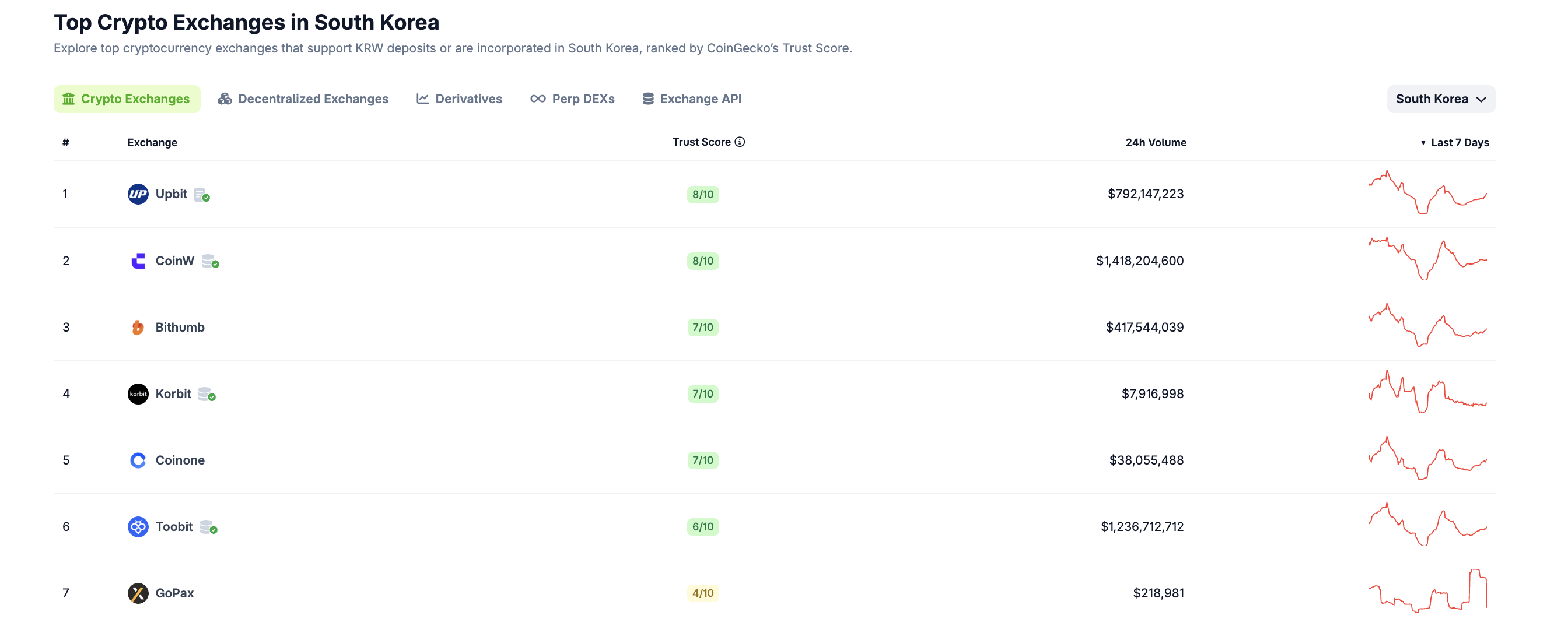
Daily trading volume for South Korea’s largest crypto exchanges. Source: CoinGecko
Tighter Anti-Money Laundering (AML) regulations and Know Your Customer controls in South Korea are also driving investors away from the sector, critics of the policies say.
In March, South Korea’s Financial Services Commission (FSC) and the Financial Intelligence Unit (FIU) proposed that all crypto transactions above 10 million won ($6,630) sent to or from foreign crypto wallets should be automatically flagged as suspicious.
Crypto industry advocacy organizations in the country have pushed back against the new rules, arguing that the reporting requirements would create an operational burden for exchanges.
Magazine: South Korea gets rich from crypto… North Korea gets weapons

TLDR
- Michael Saylor said Bitcoin will outperform the S&P 500 over time.
- He made the statement during a Thursday appearance on CNBC’s Squawk Box.
- Saylor said Strategy expects Bitcoin to deliver about 30% annual returns.
- He linked that forecast to his $13 million Bitcoin price target for 2045.
- Saylor said institutional adoption and fixed supply support his long-term Bitcoin thesis.
Michael Saylor said Bitcoin will outperform the S&P 500 over time during a Thursday appearance on CNBC’s Squawk Box. He said Strategy expects Bitcoin to deliver annual returns of about 30%, above the index’s long-term average. Saylor also repeated his $13 million Bitcoin price target for 2045 and said $60,000 marked the asset’s bottom.
Bitcoin Outlook Tops Michael Saylor’s Market Case
Saylor told CNBC that Bitcoin will “go up” more than the S&P 500 over time. He said Strategy expects annual returns near 30%.
He compared that view with the S&P 500’s long-term annualized return of about 10%. The index tracks 500 large public companies in the United States.
So far this year, the S&P 500 has gained 8%, based on Google Finance data. Bitcoin has fallen 12% over the same period.
Saylor said Strategy’s forecast supports his long-term Bitcoin thesis. He said the company expects the asset to outperform traditional benchmarks over time.
He also linked that outlook to his $13 million price target for 2045. Saylor said Bitcoin could average about 29% annual returns over the next 19 years.
According to Saylor, institutional adoption supports that case. He also pointed to government treasury strategies and Bitcoin’s fixed supply.
Saylor has repeated this view before. Earlier this year, he said Bitcoin could double or triple the S&P 500’s performance over four to eight years.
Regulation and Market Support Stay in Focus
During the same interview, Saylor said Bitcoin would rally from current levels. He said $60,000 served as the asset’s bottom.
He described the market as entering a “spring phase.” He said Bitcoin had support near current levels and a favorable macro backdrop.
Saylor also pointed to regulatory developments in the United States. He said progress on the CLARITY Act could help the crypto sector.
He referred to the bill’s passage through the Senate Banking Committee last week. He said the measure advanced with bipartisan support after months of delays.
Saylor also mentioned expected guidance from the US Securities and Exchange Commission. He said the agency could introduce innovation exemptions for tokenized securities.
He said those exemptions could support securities tokenization on crypto networks. That process could expand blockchain activity across financial markets.
The latest update from Saylor’s remarks was his view on support levels. He said Bitcoin’s floor stood at $60,000 during Thursday’s CNBC interview.

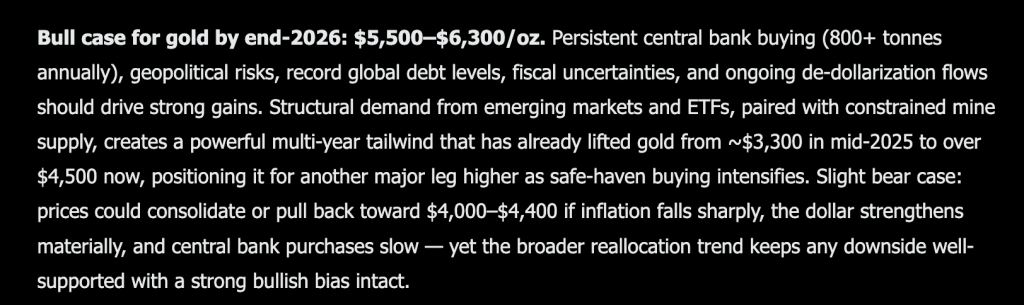
Gold price just ran from $3,300 to $5,400 in under a year and most people still think of it as the boring safe haven asset. Grok AI looked at that chart and predicts the move is not finished. Not even close.
$5,500 to $6,300 per ounce by end-2026. Another major leg higher from a price that has already broken every historical record.
Grok’s bull case is not built on fear alone. It is built on a structural demand shift that central banks have been executing quietly for years.
Over 800 tonnes of gold are being purchased annually by central banks, a pace that has not slowed despite prices hitting all-time highs repeatedly.
That is not speculative buying. That is sovereign wealth allocation at scale, driven by de-dollarization flows that show no signs of reversing.
Layer geopolitical risks, record global debt levels, and fiscal uncertainties on top of that institutional bid and you have a demand profile that is compounding rather than plateauing. Emerging market ETF inflows are adding retail and institutional demand from economies that historically underowned gold.
And constrained mine supply means the production side cannot respond to higher prices the way it normally would, which tightens the float further as demand accelerates.
Grok’s framing is precise: gold has already made the move from $3,300 to $4,500 on these same tailwinds, and the second leg toward $6,300 is the continuation of a multi-year trend rather than a new prediction.
The bear case requires 3 things to go wrong simultaneously. Inflation falling sharply removes the safe-haven urgency. The dollar strengthening materially redirects global capital flows.
And central bank purchases slowing breaks the institutional demand floor. Grok acknowledges those risks but is direct: even in that scenario the broader reallocation trend keeps downside well-supported and the bullish bias intact. The bear case is consolidation toward $4,000 to $4,400, not a trend reversal.

Discover: The best crypto to diversify your portfolio with
Gold Ran 65% in 12 Months and Is Now Pulling Back, Grok AI Predicts This Is a Reset Before the Next Leg, Not the Top
Gold spot price is trading at $4,510 on the daily, and the chart is one of the most impressive trend structures in any asset class over the past 14 months.
Price ground sideways between $3,000 and $3,400 for most of 2024 and early 2025, then broke out in September 2025 in a near-vertical move that took it all the way to $5,600 by February 2026. That was a 65% move in 5 months driven by exactly the forces Grok identified in its prediction.
The current pullback from $5,600 to $4,510 is the first meaningful correction since that breakout began, and the chart is now testing a critical support zone.
The $4,400 to $4,600 range is where the late 2025 consolidation occurred before the final push to $5,600, which means it is the most logical area for buyers to step in and defend the trend.
Grok’s bear case floor of $4,000 to $4,400 sits just below that zone, and whether that support holds or breaks determines whether this is a bull flag reset or a more serious correction.
Resistance above is $4,800 to $4,900, the range where multiple rejections clustered during the March and April consolidation phase.
Above that $5,200 is the next reference and $5,600 is the February peak that needs to be cleared before Grok’s $5,500 to $6,300 target zone becomes the chart reality rather than just the prediction.
Grok sees $6,300 by year-end. The chart needs $4,400 to hold first.
Discover: The best pre-launch token sales
The post Elon Musk Grok AI Predicts GOLD Price by End of 2026 appeared first on Cryptonews.

[PRESS RELEASE – Kingstown, Saint Vincent and the Grenadines, May 21st, 2026]
NOW Wallet, a non-custodial crypto wallet focused on security, multi-chain access, and seamless DeFi experience, now has direct access to perpetual futures and prediction markets built into the app. That means platforms like Hyperliquid, Aster, Lighter, GMX, and dYdX for perps trading, and Polymarket and PancakeSwap for prediction markets — all accessible without leaving the wallet.
Perps and prediction markets
Perpetual futures (“perps”) allow users to take positions on cryptocurrency price movements without holding the underlying asset. These instruments support features such as leverage, short positioning, and continuous trading, which have contributed to their widespread use in digital asset markets.
Prediction markets operate on a different model. Rather than tracking asset prices, they reflect the perceived likelihood of specific outcomes. Participants take positions on whether an event will occur, such as a cryptocurrency reaching a certain price level, a macroeconomic development, or other predefined scenarios. Market prices adjust as expectations change, and positions are resolved once the outcome is determined.
Both segments have expanded within decentralized finance (DeFi) in recent years.
Bring this into the wallet
Until now, accessing advanced DeFi trading tools meant a fragmented workflow — separate accounts on separate platforms, funds split across multiple places, constant switching between apps and browser tabs. It worked, but it wasn’t clean.
This update brings that access into one place. Users can connect to supported protocols directly through their wallet, fund trading balances, sign transactions, and manage positions — all while keeping self-custody of their assets. No centralised exchange accounts required.
The aim is straightforward: make on-chain trading more direct, less fragmented, and actually usable on mobile.
Part of a broader shift in crypto UX
Wallets started as storage tools. That’s changing. As more users engage with swaps, staking, trading, and prediction markets at the same time, the expectation has shifted — a wallet should be the access layer for all of it, not just a place to park funds between sessions.
Adding perps and prediction markets is part of that direction for NOW Wallet.
About NOW Wallet
NOW Wallet is a non-custodial multi-chain crypto wallet supporting storage, swaps, staking, fiat purchases, and dApp access across 70+ blockchain networks.
The feature is available now in the latest version of NOW Wallet.
Users can download NOW Wallet: https://walletnow.app/
The post Perps and Prediction Markets Are Now Available in NOW Wallet appeared first on CryptoPotato.
The Trump administration’s push to choke off Iran’s crypto use is intensifying. The US Treasury has frozen nearly $500 million in regime-linked digital assets under Operation Economic Fury.
Treasury Secretary Scott Bessent disclosed the figure last week, including a $344 million seizure in the prior month. Estimates place Iran’s total digital asset holdings near $7.7 billion as Middle East tensions climb.
Inside Operation Economic Fury
Treasury officials say the campaign targets Iran’s military and the Islamic Revolutionary Guard Corps (IRGC). It also goes after regional proxies and shadow banking networks that move oil revenue.
Bessent has framed the strategy as pushing the regime into a financial crisis.
The largest single action so far was the $344 million USDT freeze on the Tron network, coordinated with Tether.
That move followed earlier US measures against Iran-linked UK exchanges accused of routing IRGC funds.
Tehran is now estimated to hold roughly $7.7 billion in digital assets, a figure cited by Fox Business reporter Darren Botelho, drawing on threat-detection data.
That total ranks Iran among the largest sovereign crypto holders tracked by blockchain analytics firms.
Bitcoin as the New Banking Workaround
The regime is leaning harder on Bitcoin (BTC) to move money outside the traditional banking system. Tehran recently rolled out a state-backed maritime insurance platform called Hormuz Safe.
The platform settles cargo ship policies entirely in BTC for vessels transiting the Strait of Hormuz.
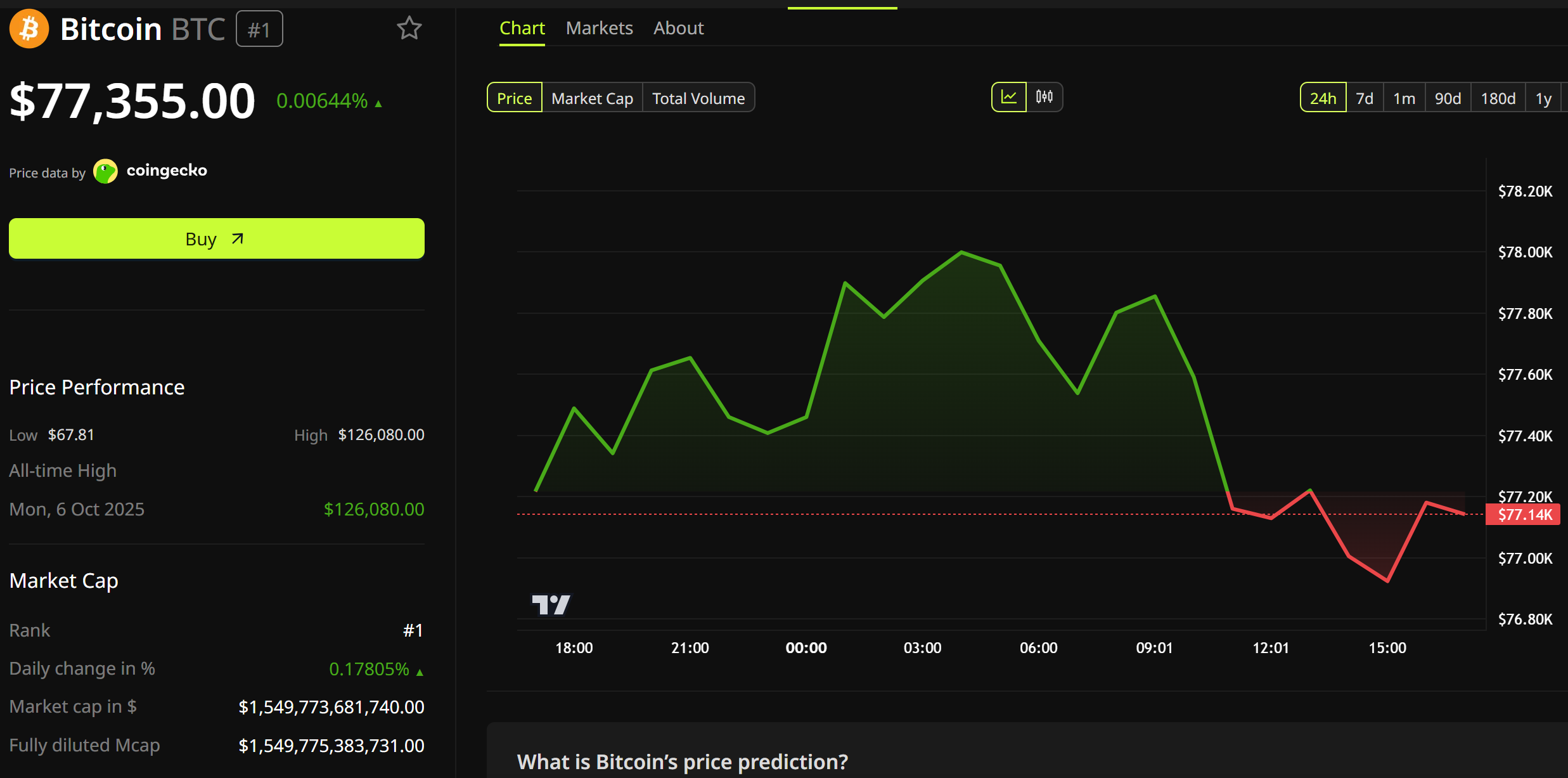
BTC traded near $77,355 at press time, up by a modest 0.006% over 24 hours, with the pioneer crypto’s role in Iran’s wartime economy adding geopolitical weight to its short-term action.

Why the Trail Favors Investigators
Despite crypto’s reputation as a sanctions workaround, US officials argue the opposite holds in practice. On-chain transactions leave permanent records that let forensics firms map wallets connected to the IRGC and Iran’s Central Bank.
“We found over and over again that they’re actually a much better asset for U.S. law enforcement and other agencies to track because you leave a lot of breadcrumbs,” Fox Business reported, citing Chris Perkins, CEO of 250 Digital Asset Management.
Traceability now favors enforcement. Industry insiders also told the network that Washington may threaten to cut crypto exchanges off from US banking.
Such a step would target firms still processing Iran-linked flows. The coming weeks should show whether the Treasury escalates to exchange operators.
How Tehran adjusts its Bitcoin-based workarounds will also come into focus.
The post US Intensifies Operation Economic Fury Targeting Iran’s $7.7 Billion Crypto Network appeared first on BeInCrypto.

World Liberty Financial’s WLFI token recently hit a huge milestone after it recorded its highest-ever realized profit event.
According to on-chain analytics firm Santiment, 1.8 billion of the Trump-linked tokens were sold at a profit on May 18, with the spike coming only weeks after WLFI hit an all-time low.
WLFI Holders Cash Out After Binance-Linked Catalyst
Alongside the record realized profit, Santiment noted that a metric that tracks tokens moving on-chain multiplied by their level of dormancy, known as “age consumed,” had also hit an all-time high of 17.4 trillion, indicating unprecedented movement of long-dormant supply.
It tied the activity to Binance launching a USD1/BTC trading pair that allowed traders to use WLFI’s USD1 stablecoin as collateral for Bitcoin futures for the first time. The analytics firm said the listing created a rare exit opportunity for long-term holders after WLFI spent months sliding lower.
“This was a major, well-publicized event that gave long-time holders a high-profile moment to finally cash out,” it wrote.
Even after the recent bounce, the token is still down more than 80% from its September 2025 all-time high near $0.33, with the situation having been made worse late last month after WLFI crashed to an all-time low near $0.05.
Per Santiment, that drop was caused by “governance drama, a controversial token unlock proposal involving 62 billion tokens, and several reports about secret token sales benefiting insiders.”
The unlock proposal in particular drew intense scrutiny from holders and even led to a public dispute with Tron’s Justin Sun, one of the biggest investors in World Liberty, who called it “one of the most absurd governance scams” he had ever seen.
He then filed a lawsuit against the project in a California federal court, which WLFI countered with a suit of its own, accusing Sun of running “a coordinated media smear campaign.”
Where WLFI Stands Now
Apart from unlocking dormant selling, the Binance listing event appears to have also coincided with a wave of other on-chain activity, including several huge USD1 burn transactions linked to World Liberty, flagged by crypto analyst CryptoNotaz.
Meanwhile, at the time of writing, WLFI was trading around $0.061, which is a nearly 12% dip over the past seven days and 22% in the last month.
Its market cap is sitting at about $1.9 billion against a fully diluted valuation near $6.1 billion, with only around 31.8 billion of the 100 billion total supply currently in circulation.
Looking at open interest, WLFI futures stand at $181.7 million according to CoinGlass. About $226,000 worth was liquidated over the past 24 hours, with slightly over $133,000 of that being long positions.
The post WLFI Holders Dump 1.8B Tokens in Record Profit Event appeared first on CryptoPotato.
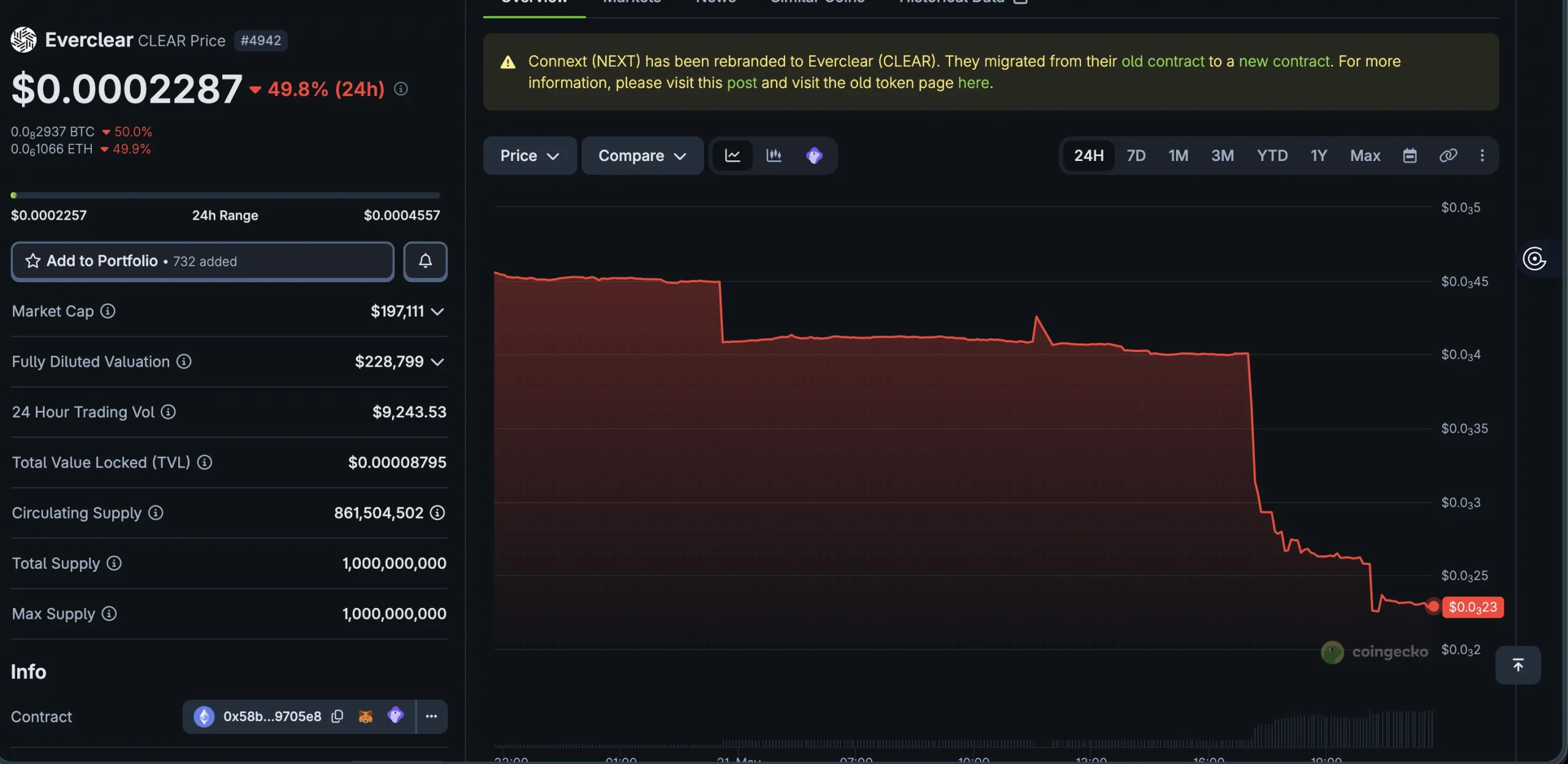
Everclear’s announcement of a full operational wind-down sent CLEAR sharply lower in the latest session.
Summary
- As of May 21, CLEAR declined to $0.0002332, down over 48% in 24 hours
- Everclear confirmed full shutdown of protocol and operations
- Project previously processed $500 million in monthly volume
- Team cites lack of sustainable revenue despite partnerships
Everclear, the cross chain clearing and settlement network backed by firms including Pantera Capital and Polychain, said it is winding down all operations after failing to build a sustainable business model.
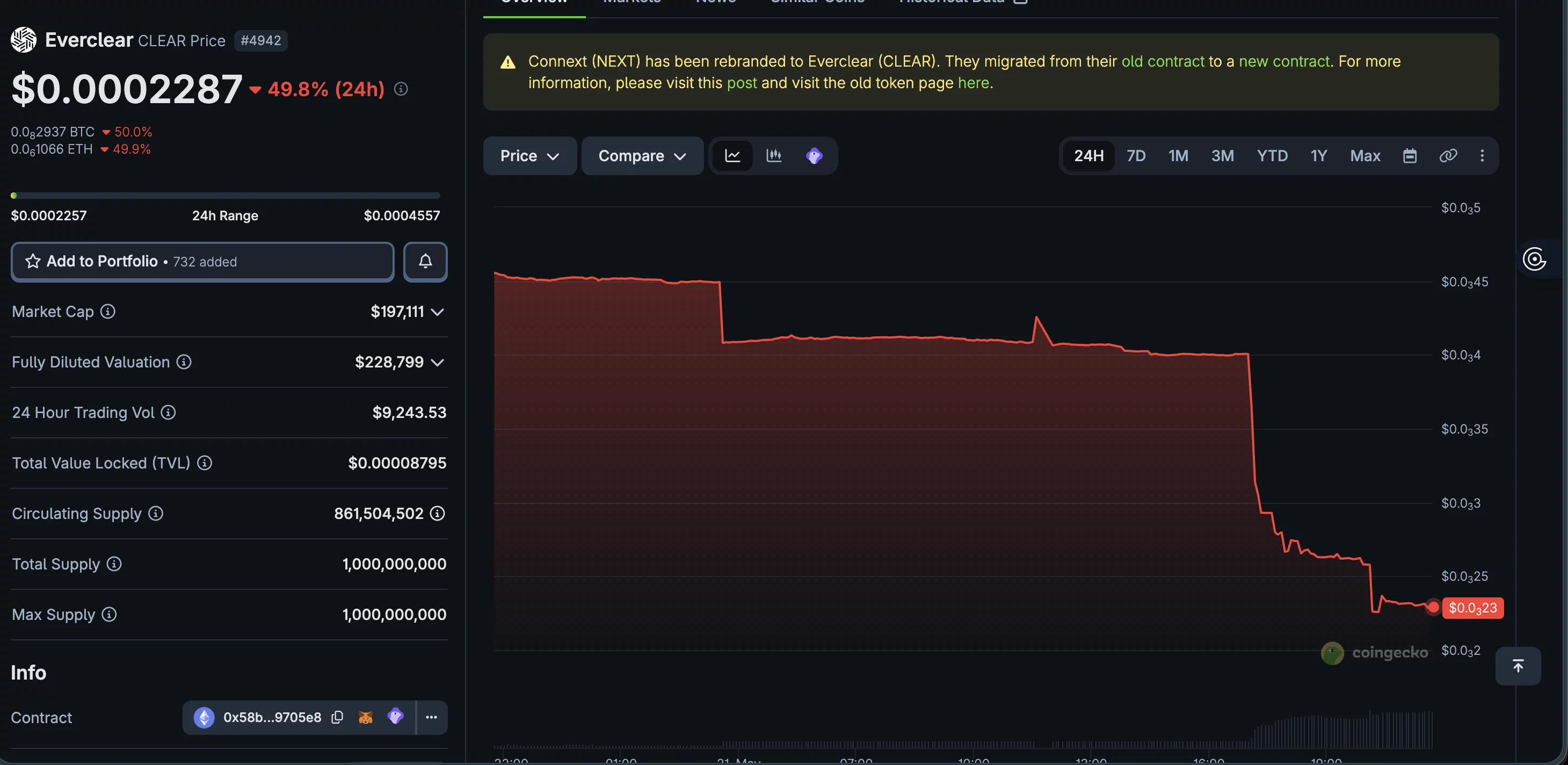
In a stunning announcement posted to X, the team confirmed that the protocol has already been sunsetted and no funds remain locked.
The token is currently trading at $0.0002332, down over 48% in 24 hours.
Why did Everclear shut down its protocol?
“The protocol has been sunsetted,” Everclear stated. “To our knowledge, no funds are stuck any remaining TVL was withdrawn by users and partners.”
The project, originally launched in 2017 as Connext with early support from the Ethereum Foundation, aimed to solve liquidity fragmentation across blockchains. It later rebranded to Everclear and launched its mainnet in April 2025, positioning itself as infrastructure for cross chain settlement.
Despite technical execution, the team acknowledged that demand did not translate into revenue. “Despite reaching $500M in monthly volume, the cross chain solvers segment never developed the commercial depth we needed,” the team wrote. Users, it said, were highly price sensitive, limiting monetization.
The shutdown affects not only the protocol but also the Everclear Foundation and its research arm, effectively ending all development efforts tied to the ecosystem.
What happens to CLEAR token and remaining funds?
The immediate market reaction was severe. CLEAR dropped more than 48% to $0.0002332, according to CoinGecko data, wiping out most of its remaining market value in a single session.
Everclear said it plans to use remaining treasury funds to settle liabilities. The team also floated a potential token buyback, though it emphasized uncertainty around execution. The estimated size of any buyback ranges between $50000 and $200000, a relatively small figure compared to historical funding rounds.
The project had raised capital from major crypto investors and built integrations with industry partners. However, Everclear admitted it misjudged timelines for those partnerships to go live, which ultimately strained its financial runway.
“Several significant names signed on, but we underestimated how long it would take those partners to go live and our runway ran out before they did,” the team said.
There remains a possibility, however, that the technology could survive in another form. Everclear is exploring open sourcing its codebase, according to those familiar with the matter, allowing its DAO or external developers to continue development under new leadership. The intellectual property is currently held by the Everclear Foundation.
The collapse adds to a growing list of infrastructure projects struggling to convert usage into revenue, even as networks like Ethereum (ETH) continue to dominate settlement activity. It also highlights ongoing challenges in cross chain design, an area often positioned as critical to the broader crypto ecosystem alongside assets like Bitcoin (BTC) and scaling discussions tied to Layer 2 ecosystem growth.
The crypto market showed signs of a cautious recovery on Thursday, with bitcoin trading at $77,900, up from Tuesday’s low of $76,100, and ether (ETH) at $2,130 after adding just 0.1% since midnight UTC.
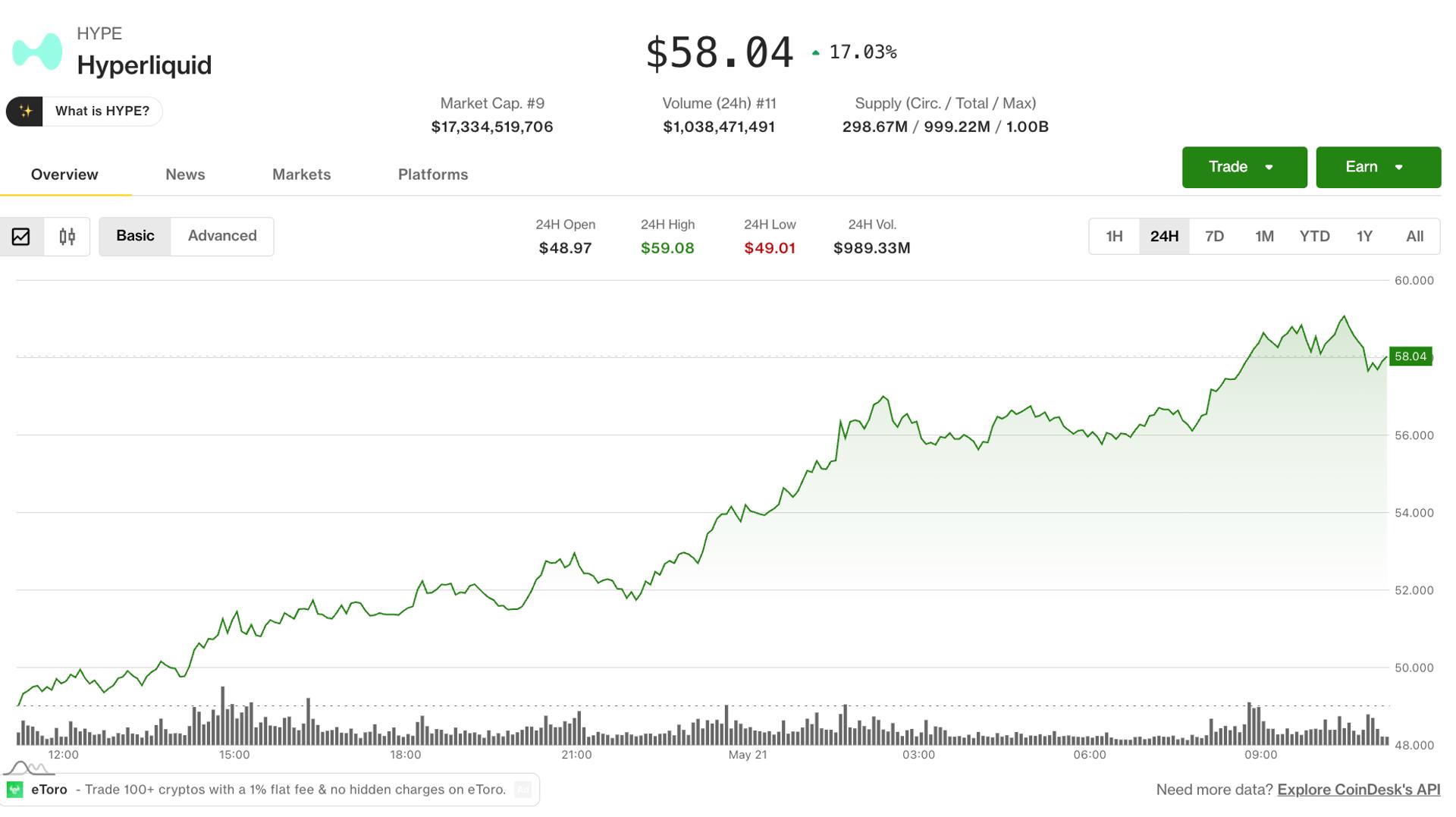
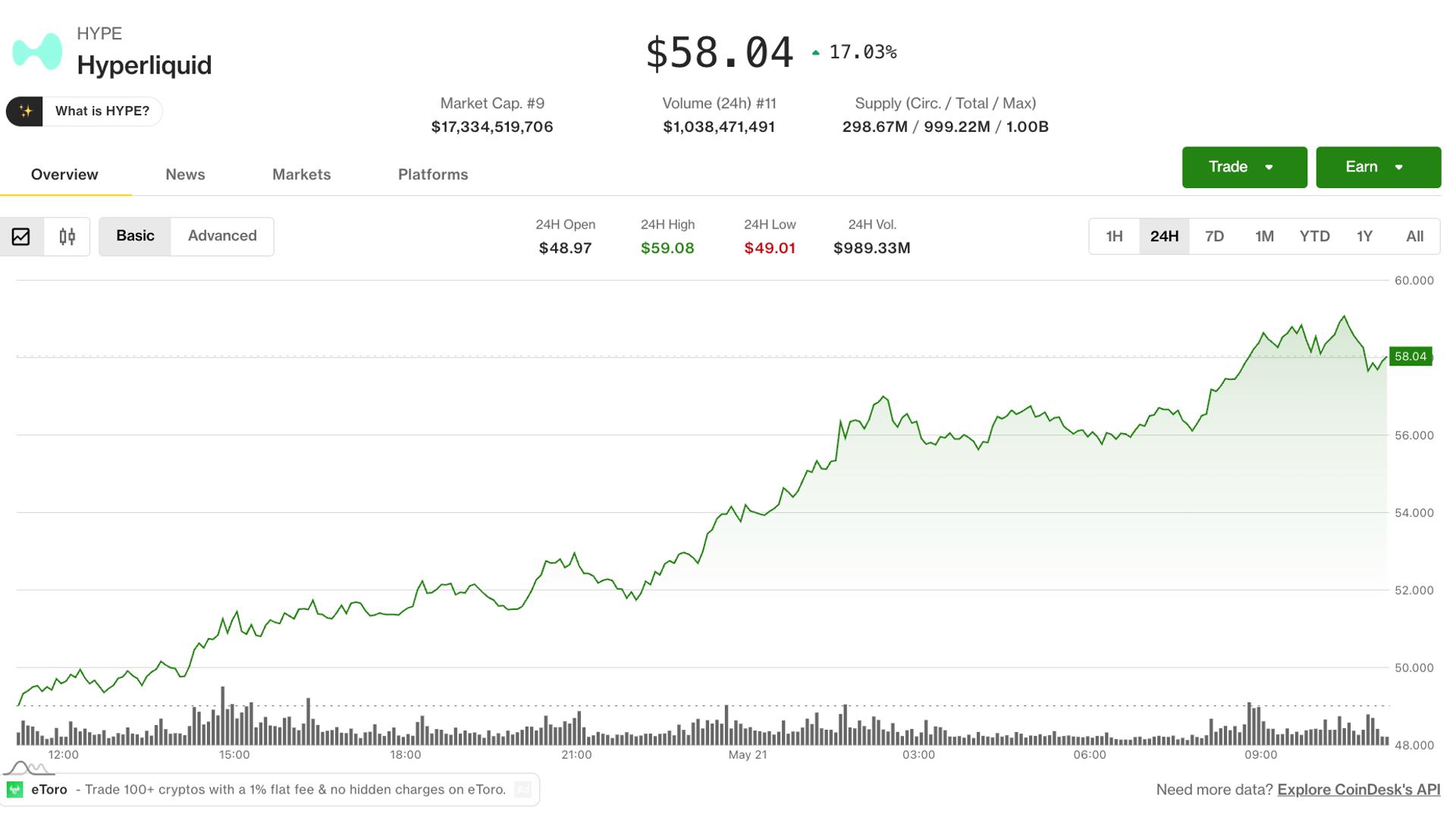
The altcoin sector remains mixed. While Hyperliquid (HYPE) rose for a fifth straight day, adding 6.5% to notch a 53% gain over the past week, privacy coins gave back a portion of Wednesday’s gains.
U.S. equities snapped a three-day losing streak on Wednesday, with the S&P 500 index 1.5% higher as investors anticipated a strong earnings report from Nvidia (NVDA), which beat forecasts with record quarterly revenues of $81.62 billion.
Oil prices dipped as U.S. President Donald Trump said a peace deal with Iran was in its “final stages,” providing a boost to risk assets.
Derivatives positioning
- Crypto futures volume increased 15% to $165.7 billion, open interest rose nearly 1% to $128 billion and liquidations jumped 72% to $266 million, ending a two-day streak of declining activity.
- Hyperliquid’s HYPE token led the top 100 coins with open interest reaching the highest level since Feb. 19. Coupled with positive cumulative volume delta (CVD) and slightly positive funding, the increase suggests aggressive market-order buyers, not passive limit order buyers, are in control without yet showing signs of overheating.
- A similar bullish trend was evident in privacy coin zcash (ZEC), which has dominated daily open interest rankings throughout the week.
- DASH futures are also heating up. Open interest jumped 38% to 1.98 million tokens, but the “boom-bust” price rejection at $54, alongside negative CVD, suggests sellers are aggressively fading rallies with market orders.
- Negative CVDs in other assets like XMR, SUI, TON, HBAR, M, BNB and CC further indicate that sellers are being aggressive with market orders rather than trading passively via limit orders.
- Bitcoin’s futures market remains stagnant with open interest trapped in the 720K-750K BTC range for a seventh day. The lack of momentum is mirrored in the ether (ETH) market.
- Ether’s 30-day implied volatility dropped to a 2026 low of 53%, breaking through floor levels established in late 2024, while bitcoin’s BVIV held steady near 40%, suggesting broad calm amid macro risks.
- In the options market, a large block trade involved the sale of an XRP short straddle, representing a high-conviction bet on the token’s spot price remaining range-bound around $1.40 through late June.
- For both BTC and ETH, the strangle has emerged as the most favored options strategy on Deribit over the past 24 hours, suggesting traders are positioning for a breakout from the current low-volatility regime.
Token talk
- HYPE is justifiably receiving plaudits this week, with a gain of more than than 20% in the past 24 hours as daily trading volume has jumped 135% to $1.3 billion.
- The CoinDesk Memecoin Select Index (CDMEME) fell 0.2% on Thursday and 0.9% over 24 hours. All the other CoinDesk benchmarks are higher over a 24-hour period, while the CoinDesk Computing Select Index (CPUS) outperformed its peers.
- A crypto analyst pseudonamed “skew” described the altcoin market as being in a “make or break” position this week, alluding to the total crypto market cap excluding bitcoin, which has posted a series of higher highs and higher lows since February.
- Speculation is ramping up again across several altcoin trading pairs, including doublezero (2Z), which has seen trading volume surge by more than 410%, leading to a 17% rise in the token over the past 24 hours.


Increasing numbers of crypto investors and execs are employing personal security as physical attacks aimed at gaining access to their or their firm’s tokens show no signs of stopping.
Indeed, the numbers of so-called “wrench attacks” have jumped in recent months, particularly in France where reports claim that there’s been one violent crypto-related robbery attempt every five days on average this year.
Prominent individuals, including Ledger’s David Balland, have been kidnapped and extorted, while in cases like the kidnapping of Nancy Guthrie, the mother of Today host Savannah Guthrie, the kidnappers appeared to request a ransom in bitcoin.
Luckily, for many at-risk execs, the firms they lead have been willing to step into the breach and swallow some of the costs incurred by keeping them safe.
Protos reviewed SEC filings to build a picture of just how much some of these companies are spending.
Coinbase spends big on Armstrong and small on Choi
Coinbase’s Schedule 14A, filed with the SEC, notes that Brian Armstrong, Coinbase’s CEO and chairman of the board, receives security paid for by Coinbase as part of his compensation.
Specifically, the form claims that in 2025, Coinbase paid $7,634,834 “in costs related to personal security measures for Mr. Armstrong.”
This is approximately $20,900 per day and a more-than-20% increase on the $6.2 million that the exchange paid to keep Armstrong safe in 2024.
Read more: Crypto execs hiring private security after high-profile kidnappings, report
Additionally, Emilie Choi, the company’s president and COO, also receives personal security.
However, this part of her compensation totals just $43,567, approximately 0.6% or a little over two days worth of Armstrong’s costs.
In 2024, approximately $78,000 was spent on Choi’s security.
Gemini defends its eponymous twins
Gemini currently pays for security for the Winklevoss twins.
Its Schedule 14A details how it pays a “$2,490,844 cost per individual for the provision of personal security services” for Cameron Winklevoss, the firm’s president, and Tyler Winklevoss, its CEO.
Each of their security costs is approximately 33% as much as Armstrong’s.
Strategy protects Saylor, but not the C-suite
Strategy’s Schedule 14A reveals that it pays for security services as part of its executive compensation.
For Michael Saylor, the chairman of the board and executive chairman, it pays $272,113 per year.
This is approximately 3.6% as much as Armstrong’s security costs, or approximately 13 days worth.
Strategy’s disclosure doesn’t seem to include security for any of its apparently far more expendable C-suite.
Read more: Doordash crypto wrench attack suspects charged, report
Circle spends a lot for Allaire and some for other executives
Circle, the firm behind stablecoin USDC, reveals in its Schedule 14A that it does pay for security.
Specifically, it reveals that it forked out $4,096,862 “for personal travel and home security enhancement” for its Chairman and CEO, Jeremy Allaire.
Outside of Allaire, it also has paid for “home security enhancements” for other executives.
Specifically, it paid:
- $106,100 for CFO Jeremy Fox-Geen
- $48,770 for COO Kash Razzaghi
- $91,372 for President Heath Tarbert
- $108,414 for Chief Product and Technology Officer Nikhil Chandhok
Crypto firms that don’t mention security for execs
Bullish’s Form 20-F doesn’t include any pay for security.
Meanwhile, none of Galaxy Digital, crypto mining firm Riot, or Trump-affiliated Hut 8 mention security in their Schedule 14A.
Nigel Farage and Christopher Harborne
Recently, British politician Nigel Farage of the Reform Party received a £5 million ($6.7 million) “gift” from Christopher Harborne, a Tether shareholder.
Farage has claimed that this gift was “a reward for campaigning for Brexit for 27 years.”
However, before he made that claim, he also explained that he was given the money so that he “would be safe and secure for the rest” of his life and further claimed that Harborne “is deeply concerned for his safety.”
Farage has become a vocal supporter of cryptocurrency, something critics have attributed to his “friendship” with Harborne.
Got a tip? Send us an email securely via Protos Leaks. For more informed news and investigations, follow us on X, Bluesky, and Google News, or subscribe to our YouTube channel.
TLDR
- Flare CEO Hugo Philion said the FAssets v1.3 upgrade makes FXRP minting simpler for XRP users.
- The new mint-to-tag model lets users mint FXRP through a single XRP Ledger transaction.
- Philion said the process uses native XRP Ledger features and does not require direct exchange integrations.
- He said Flare designed the system with minting caps, escrow protections, and emergency custody measures.
- Philion said the XRP Ledger can serve as the issuance and settlement layer while Flare provides the compute layer.
Flare CEO Hugo Philion said the network is upgrading its FAssets system to make XRP more usable in DeFi. He said FAssets v1.3 lets users mint FXRP through a simpler “mint-to-tag” process on the XRP Ledger. Philion also said Flare is building confidential compute tools for privacy-focused, institutional blockchain applications.
Flare, XRP and the FAssets v1.3 Upgrade
Philion discussed the update in an interview with XRP-focused YouTuber Crypto Sensei. He said the goal is to simplify how users convert XRP into FXRP.
Under FAssets v1.2, users had to reserve collateral and work with agents. Philion said v1.3 reduces that flow to a single XRP transaction.
He said users can send XRP to a designated address with structured memo data. That process uses native XRP Ledger features, including destination tags.
Philion said the design removes the need for direct exchange approvals or integrations. He said any exchange supporting XRP destination tags could support the process in theory.
He also said Flare built the system to limit bridge-related risks. According to Philion, the protocol uses minting caps, overcollateralized redemptions, escrow protections, and emergency custody arrangements.
Philion said Flare’s Core Vault can route funds to a regulated custodian tied to Ripple. He said that option would apply during severe protocol failures or attacks.
The interview framed the XRP Ledger as the issuance and settlement layer. Philion said Flare serves as the programmable compute layer for DeFi applications.
Flare Expands XRP DeFi and Confidential Compute Plans
Philion said Flare is also working with exchanges including Uphold on one-click XRP products. He listed staking, lending, borrowing, and loan origination among those services.
He said lending markets remain one of the largest missing pieces in XRP’s ecosystem. He pointed to Firelight and Morpho as examples of protocols built around XRP liquidity.
Philion described confidential compute as the most ambitious part of Flare’s roadmap. He said Flare 2.0 combines blockchain settlement with trusted execution environments.
Under that model, applications could process transactions privately and still prove execution on-chain. Philion said that setup could support institutional-grade DeFi use cases.
He said tokenized real-world assets issued on the XRP Ledger could move into Flare’s private environments. There, institutions could trade, borrow, or access compliant decentralized exchanges.
Philion said the structure creates a partnership model between the two networks. In his description, XRP Ledger handles issuance and final settlement, while Flare provides compute and utility.
After the interview, XRP community figure Eri reacted on social media. She said the model could help “Ripple win business” in sectors requiring confidential computing.

Bungie Will End Active Development Of Destiny 2 On June 9

DWP announce new pension rules that could boost savings for millions of people

Vista Group International Limited (VGLIF) Shareholder/Analyst Call Transcript


-

 Crypto World6 days ago
BloFin War of Whales 2026 Grand Prix opens registration for $5M trading championship
-

 Fashion6 days ago
Weekend Open Thread: Theory – Corporette.com
-

 Crypto World6 days ago
E-Estate Announces 1 Year Live: Washington DC Summit as Real Estate Tokenization Enters Its Next Phase
-

 Tech7 days ago
Tech Moves: Microsoft AI leader jumps to OpenAI; former AI2 exec joins Meta; and more
-

 Tech6 days ago
Google reimburses Register sources who were victims of API fraud
-
 Business6 days ago
H&R Real Estate Investment Trust (HR.UN:CA) Q1 2026 Earnings Call Transcript
-

 Sports6 days ago
Napoleonic enters 2026 Doomben 10,000 field via Abounding withdrawal
-
 Crypto World6 days ago
BeInCrypto 100 Institutional Awards Nomination: KAST for Best Digital Assets Neobank and Best Digital Assets Fintech
-
 Crypto World6 days ago
Bitcoin Battles US Bond Nerves With BTC Price Dip Toward New May Lows
-

 Crypto World6 days ago
ICE and CME urge US regulators to curb Hyperliquid energy trading
-
 Crypto World6 days ago
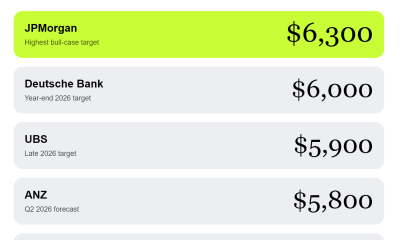
Wall Street’s Boldest Gold Prediction Has Russians Rushing to Buy
-

 Fashion5 days ago
On the Scene at Gucci’s Cruise Show in New York City: Mariah Carey, Kim Kardashian, Lindsay Lohan, Iman, and More!
-

 Entertainment6 days ago
David Letterman Returns to Late Show, Blasts Cancellation
-

 Crypto World6 days ago
IREN closes $3 billion convertible notes deal amid AI infrastructure expansion
-

 Politics7 days ago
DWP PIP Timms review continues to be an absolute farce
-

 Fashion5 days ago
Trending Western Style Vests Perfect for Summer
-

 Politics5 days ago
Watch: far-right flag-fanatics run over victim, attack locals – Setup By the Left wing for your entertainment
-
Crypto World7 days ago
Lido Finance Selects Chainlink CCIP as the Official Cross-Chain Infrastructure for wstETH Security
-

 Fashion6 days ago
Creative Ideas for Custom T-Shirts
-

 Fashion5 days ago
Amazon Sundays: Memorial Day Hosting
You must be logged in to post a comment Login