

Crypto World
Where crypto founders are incorporating in 2026



Disclosure: This article does not represent investment advice. The content and materials featured on this page are for educational purposes only.
MiCA enforcement reshapes EU crypto as ESMA register reveals 204 authorized CASPs and leading jurisdictions emerge.
Summary
- MiCA regulation now standardizes EU crypto licensing, with ESMA’s register tracking 204 authorized CASPs and their services.
- Crypto firms are assessed on real authorization data, revealing which EU jurisdictions successfully issue MiCA licenses.
- MiCA CASP licensing typically costs €200K–€475K in the first year and takes 6–9 months, with application quality as the main approval driver.
The transitional period is closing and the guessing is over. With MiCA — the EU’s single rulebook for crypto-asset services — now in force, the ESMA Interim MiCA Register works as a live scoreboard of where crypto businesses are actually incorporating.
Instead of trusting marketing claims about which jurisdiction is “crypto-friendly,” founders can read the register directly: who got authorized, for which services, and how far their EU passport reaches. Drawing on the current snapshot of 204 authorized CASPs, here is the map as it stands — four EU jurisdictions worth attention, and the two credible non-EU alternatives.
The state of play: One license, twenty-seven markets
MiCA’s core promise is the entire reason the EU dominates this conversation: a single CASP authorization, granted by one national competent authority (NCA), passports across all 27 Member States. Authorize once, notify the rest, operate everywhere. No non-EU regime offers a comparable single-application route into a market this large — and founders are responding. Of the 204 CASPs on the register, 51 were authorized in 2026 alone (about a quarter, in under five months), and 91 firms now passport into 27 or more markets. Home-state choice is heavily concentrated:
| Home Member State | Authorised CASPs | Profile |
| Germany (BaFin) | 55 | Largest market |
| Netherlands (AFM) | 25 | Exchange-heavy |
| France (AMF) | 17 | Institutional |
| Malta (MFSA) | 13 | Exchange magnet |
| Cyprus (CySEC) | 12 | Consumer apps |
| Ireland (CBI) | 12 | Payments / scale |
| Czech Republic (CNB) | 7 | Fast riser |
| Luxembourg (CSSF) | 7 | Institutional |
| Lithuania (LB) | 6 | Startup default |
| Estonia (EFSA) | 1 | Sharp reversal |
Source: ESMA Interim MiCA Register, live snapshot as of 22 May 2026 (204 CASPs total).
Germany leads on count, but volume isn’t fit. BaFin is thorough, German-language, and slow — sensible for an institution, rarely the right first move for a lean startup. The instructive story is in the smaller jurisdictions, where the trade-offs between speed, substance, and credibility are sharpest.
The four EU jurisdictions worth a founder’s attention
Malta — The exchange magnet
Malta is where the recognizable crypto-native exchanges went. The MFSA has authorized OKX, Crypto.com, Gemini, Gate, Blockchain.com and BVNK among 13 CASPs, plus a disproportionate share of full trading-platform (Class 3) authorizations. Its edge is institutional memory: it regulated crypto years before MiCA, so the MFSA understands exchange models and banking is acclimatized to crypto clients. The trade-off is real substance expectations.
Best for: funded exchanges that want to sit alongside the majors.
Lithuania — The startup default
Lithuania remains the pragmatic first choice for startups. The Bank of Lithuania accepts English, runs one of the faster EU processes (3–5 months), and offers a cost-effective base with a deep fintech ecosystem; authorized CASPs include Robinhood, CoinGate and Nuvei (the license holder behind Simplex). Its modest MiCA count understates its appetite — most of its large VASP-era base is mid-conversion to full CASP status.
Best for: first-time founders who want speed, English, and a regulator that has seen the model.
Estonia — The cautionary reversal
Estonia is the register’s biggest surprise. Once the undisputed capital of EU crypto licensing, it now shows just one MiCA-authorized CASP. An old VASP license doesn’t convert automatically into CASP authorization — firms must requalify in full — and the EFSA pairs that with strict substance enforcement. The lesson generalizes: a historically light-touch jurisdiction is not an easy MiCA jurisdiction, and substance — real local management — is now the binding constraint everywhere.
Best for: firms prepared to build genuine substance, not a mailbox.
Czech Republic — The fast riser
The Czech Republic shows how fast the map still moves: zero MiCA CASPs in February, seven today — ahead of Lithuania on count. The CNB is pragmatic, the process quick and affordable, English accepted, and Prague helps with hiring. The register is dominated by local rather than global brands, making it a low-friction base rather than a prestige address.
Best for: cost-conscious founders who value a central EU location and an early-mover window.
At a glance
| Jurisdiction | Typical SLA | Language | Substance | Best fit |
| Malta | 6–10 mo | English | High | Funded exchanges |
| Lithuania | 3–5 mo | English | Moderate | Startups, fast launch |
| Estonia | 4–8 mo | English | High | Substance-ready firms |
| Czech Rep. | 4–6 mo | English | Moderate | Cost-conscious, CE base |
Estimates reflect typical conditions and vary by service scope and applicant readiness.
When the EU isn’t the answer: Dubai and Singapore
MiCA’s passport is decisive when customers are European. When they’re not, paying for 27-market access that won’t be used — and meeting EU substance and capital rules — can be the wrong trade. Two non-EU hubs sit at opposite ends of the openness spectrum.
Dubai (VARA) — The open door
VARA was the world’s first regulator dedicated solely to virtual assets and runs the most explicitly welcoming major regime. It licenses on an activity basis (exchange, broker-dealer, custody, lending, advisory, transfer/settlement), with its Rulebook updated to v2.0 in mid-2025; the full process runs about 4–7 months. Pull factors: 100% foreign ownership, no personal income tax (with free-zone corporate-tax advantages), and a government treating digital assets as a national strategy. The catch — Dubai gives you the UAE and a global address, not an EU passport, and VARA covers the mainland and free zones but not the DIFC (regulated by the DFSA).
Best for: global or MENA-focused firms wanting speed and tax efficiency.
Singapore (MAS) — The prestige filter
Singapore is the opposite: top-tier reputation, deliberately rationed. Crypto is regulated on an activity basis under the Payment Services Act (Standard vs Major Payment Institution licenses). MAS has issued only a few dozen DPT licenses. Crucially, the DTSP regime under the FSMA (from 30 June 2025) now captures Singapore entities serving only overseas customers — and MAS has said plainly the bar is high and it will generally not license them; operating without a license risks penalties up to SGD 250,000 and/or three years’ imprisonment. A poor fit for a quick offshore setup; excellent for a substantive Asia-Pacific operation.
Best for: well-capitalized firms with a genuine APAC presence.
A simple way to choose
- Where customers are? EU-facing → MiCA, almost always. Global/MENA → Dubai. APAC with substance → Singapore.
- What services? Custody/exchange (Class 2, €125k) and trading platforms (Class 3, €150k) carry the heaviest load; advisory and order-routing (Class 1, €50k) are lighter.
- How much substance can be built? Every credible regime now demands real local management. If you can’t staff it, Estonia-style rejections await.
- Speed vs prestige? Lithuania and Czechia optimize for speed and cost; Malta, Luxembourg, and Singapore for standing.
Cost, timeline, and getting it right
Budget honestly: a MiCA CASP typically costs €200,000–€475,000 in year one (capital, incorporation, legal, MLRO, office, IT/security, NCA fees), on a realistic 6–9 month timeline for exchange-plus-custody scope. The biggest lever on both is application quality — incomplete dossiers, generic AML policies and template IT-security frameworks are the top causes of stalled or rejected applications, and a rejection costs three to six months.
The register’s clearest signal is that winning jurisdictions reward preparation, not optimism. Matching the right home state to your model, building substance from day one, and filing a regulator-ready package is what separates a four-month approval from a year of back-and-forth. This is where a specialized crypto licensing consultancy earns its fee — turning the live register into a jurisdiction and application strategy that fits, across EU and non-EU routes.
To explore the options, visit the official website.
Disclosure: This content is provided by a third party. Neither crypto.news nor the author of this article endorses any product mentioned on this page. Users should conduct their own research before taking any action related to the company.

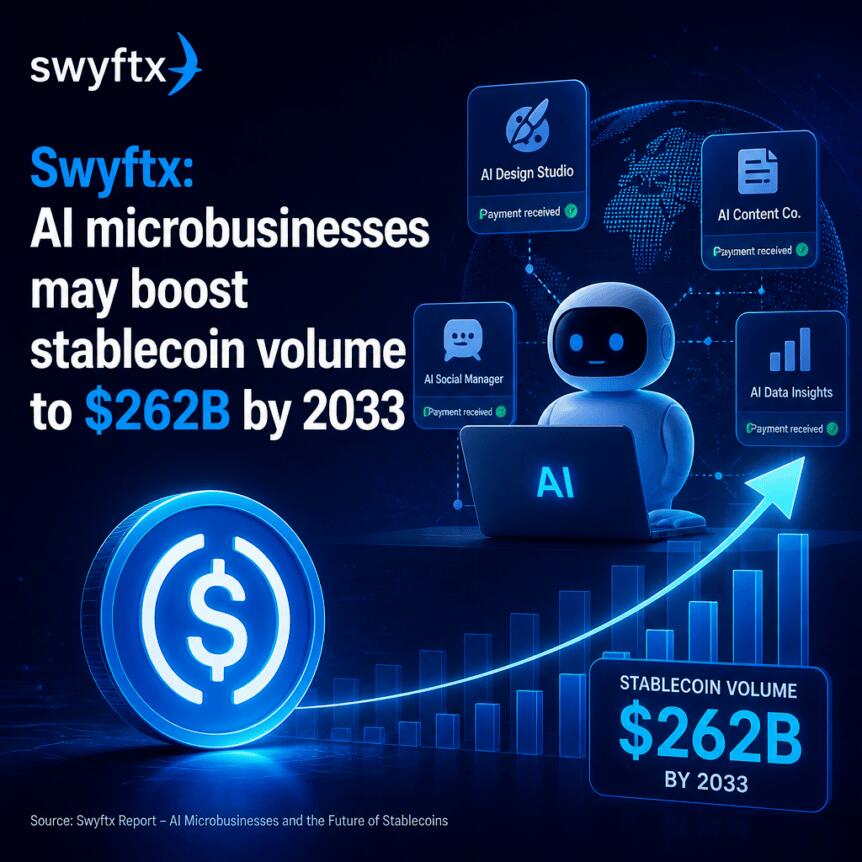
Australia-based crypto exchange Swyftx says the next wave of stablecoin usage may come from the people and businesses already pushing against the limits of traditional payments: gig workers, freelancers, and AI-enabled solo operators. In a second-quarter industry report, the exchange links the expanding gig economy—particularly cross-border freelance work—to a potential jump in stablecoin settlement.
The report models a global gig and freelance payments market that could grow to $2.1 trillion by 2033, with AI-native workers representing a $775 billion portion of that total. Under Swyftx’s base-case assumptions, about $262 billion of that AI-native payment volume could be settled using stablecoins, implying adoption of roughly 33% for the modeled cohort.
Key takeaways
- Swyftx projects gig and freelance payments could reach $2.1 trillion by 2033, with AI-native workers accounting for $775 billion.
- In its base case, Swyftx estimates $262 billion of AI-native payment volume could be settled in stablecoins at an assumed ~33% adoption rate.
- The exchange points to solo entrepreneurs and small businesses as among the fastest-moving in AI adoption, creating a new customer segment sensitive to fees.
- Swyftx cites stablecoin transaction volumes rising to a record $1.79 trillion in June, reinforcing the idea that payment utility demand is real.
- It argues stablecoins can outperform cross-border rails on cost and speed, particularly for frequent, cross-border invoices.
Why gig work and AI-native labor are central to stablecoin demand
Swyftx’s thesis starts with who is paying and how often. The exchange argues that the smallest employers—firms with fewer than five employees—are adopting AI at a faster pace than larger organizations. That shift, it says, contributes to a rise in solo entrepreneurs who operate across borders and invoice frequently.
Because these workers often face payment amounts and settlement rhythms that standard banking and payment infrastructure are not optimized for, Swyftx frames stablecoins as a natural fit. It estimates there are currently about 6 million to 10 million solo workers globally, projecting growth to 17 million over the next decade.
Lead market analyst Pav Hundal told Cointelegraph that the appeal of stablecoins is increasingly tied to economics rather than just technology. “Adoption doesn’t happen just because the technology exists. It happens when the economics are compelling, and the rules are clear,” Hundal said, adding that both conditions are “falling into place.”
Stablecoin volumes are already signaling payment utility
The exchange’s predictions build on recent usage trends. Swyftx notes stablecoins have doubled in market capitalization over the past two years and reached a record $1.79 trillion in volume in June—figures Swyftx presents as evidence of growing payment demand.
The report also emphasizes that stablecoin activity is not only about end users; it can extend to the “settlement layer beneath” the payment routes. Swyftx suggests that if its modeled scenario develops, the infrastructure supporting settlements—such as over-the-counter liquidity, custody, and yield services used by platforms—could capture a new revenue stream.
In that framework, Swyftx estimates this could reach as much as $1.3 billion by 2033, assuming total transaction, liquidity, and custody costs of 0.5% across the relevant payments.
For context, earlier coverage from Cointelegraph highlighted the June record by noting stablecoin transaction volume at $1.79 trillion and linking it to broader payment-oriented narratives. Stablecoin transaction volume hits record $1.79T in June
Lower fees, faster settlement, and a more global customer base
In Swyftx’s account, traditional cross-border payment rails tend to impose three frictions that matter most to frequent freelancers: high fees, multi-day settlement windows, and uneven availability across jurisdictions. The exchange also asserts that many rails exclude users in more than 50 countries, which can limit the addressable freelance base.
To illustrate the potential advantage, Swyftx points to stablecoin transfers using Ethereum layer-2 networks as an example of how costs and time can improve. It claims such transfers can cut fees by 80% to 90%, saying an average freelancer could save about 86% per year in transfer fees under the cited example.
The report also ties the stablecoin payments outlook to the broader “agentic AI” narrative. Swyftx argues that AI agents—unlike human users—cannot easily obtain bank accounts. As a result, it says they will likely rely on crypto-based assets to execute payments.
That point aligns with earlier Cointelegraph reporting on the idea that autonomous AI agents with crypto access could become a meaningful payments driver. Autonomous AI agents with crypto access could become unstoppable
What investors should watch next
Swyftx’s projections are directionally clear—stablecoins may benefit as AI-native work increases and small operators demand cheaper, faster international settlement. The key uncertainty is adoption: the exchange’s base case assumes roughly one-third adoption of stablecoins within its modeled AI-native payment cohort by 2033. Traders and builders should watch whether stablecoin use keeps rising in real payment flows at the same pace suggested by recent volume records, and whether regulatory and on-ramps/off-ramps continue to make the “economics and rules” Hundal references more consistent across jurisdictions.
Fundstrat co-founder and BitMine chairman Tom Lee has told investors to watch the Ethereum-to-Bitcoin ratio for signs of a broader crypto recovery.
Summary
- Tom Lee says a rising ETH/BTC ratio could mark renewed demand across the crypto market.
- Ether is testing resistance near 0.0286 BTC after recovering from its early June local low.
- Falling Bitcoin dominance and improving altcoin measures point to rotation, but confirmation remains limited.
In a July 13 post before his WebX 2026 appearance in Tokyo, Lee called ETH/BTC a “signal of a revival of crypto.” His statement reflects his market view rather than a guaranteed trading signal. WebX listed Lee for a keynote from 11:25 a.m. to 11:55 a.m. on the CRYL Stage.
The ratio shows how much Bitcoin one Ether can buy. A rising reading means Ethereum is gaining against Bitcoin, while a falling reading means Bitcoin is leading. ETH/BTC recently climbed toward 0.02858 after rebounding from an early June low near 0.026.
Live prices later placed the ratio near 0.0282, showing that the pair remained close to its recent resistance area. Ether traded around $1,800 while Bitcoin changed hands near $63,700 at the time of checking.
ETH/BTC tests resistance after June recovery
The pair has formed higher lows since early June, but it still faces a ceiling around 0.0286. Traders have watched that level because several recovery attempts stalled there. A clean move above it could extend Ethereum’s relative rebound. Another rejection could return attention to support around 0.027 and the June floor near 0.026.
The wider trend remains mixed. ETH/BTC was still lower over the previous three months despite its July recovery. As crypto.news previously reported, Ether had fallen harder than Bitcoin through much of 2026, pushing the ratio toward multi-year lows.
Stronger Bitcoin ETF demand, weaker Ethereum fund flows and competition from other networks contributed to that gap. A stronger ratio would mark a change from that pattern, not a confirmed long-term reversal.
Bitcoin dominance and altcoin measures shift
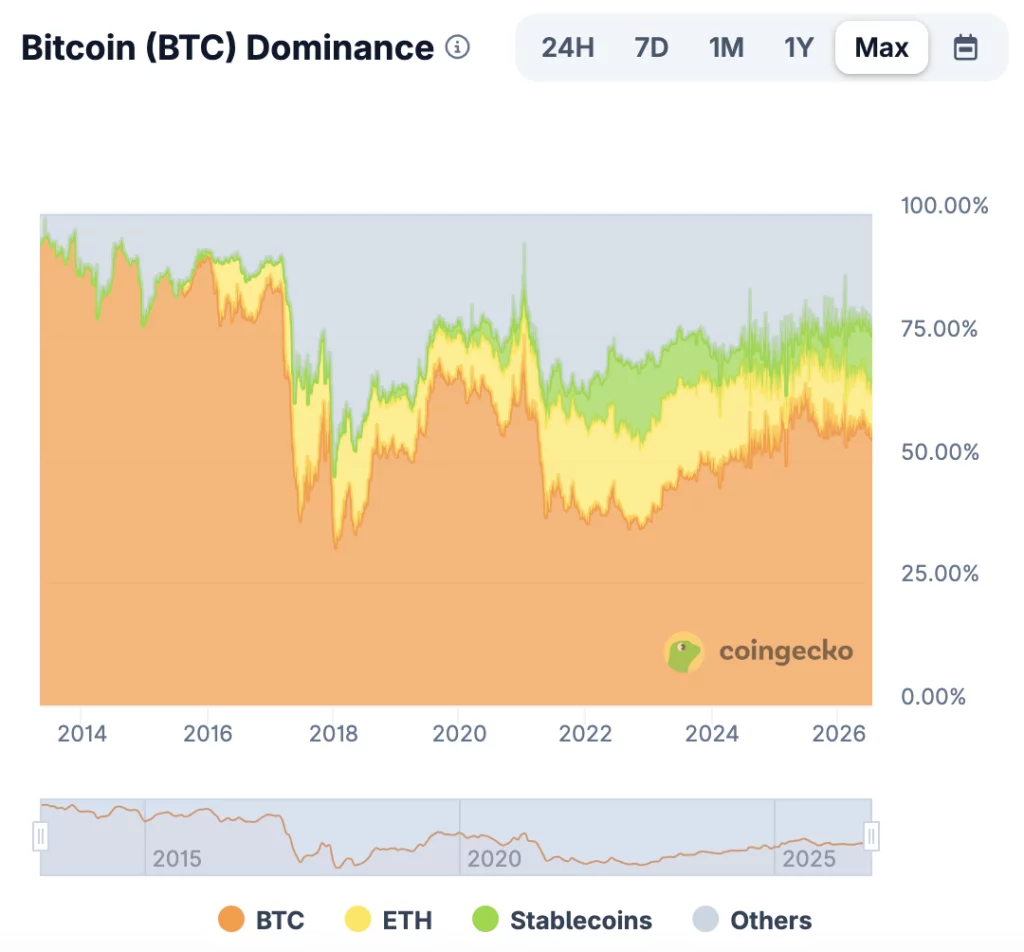
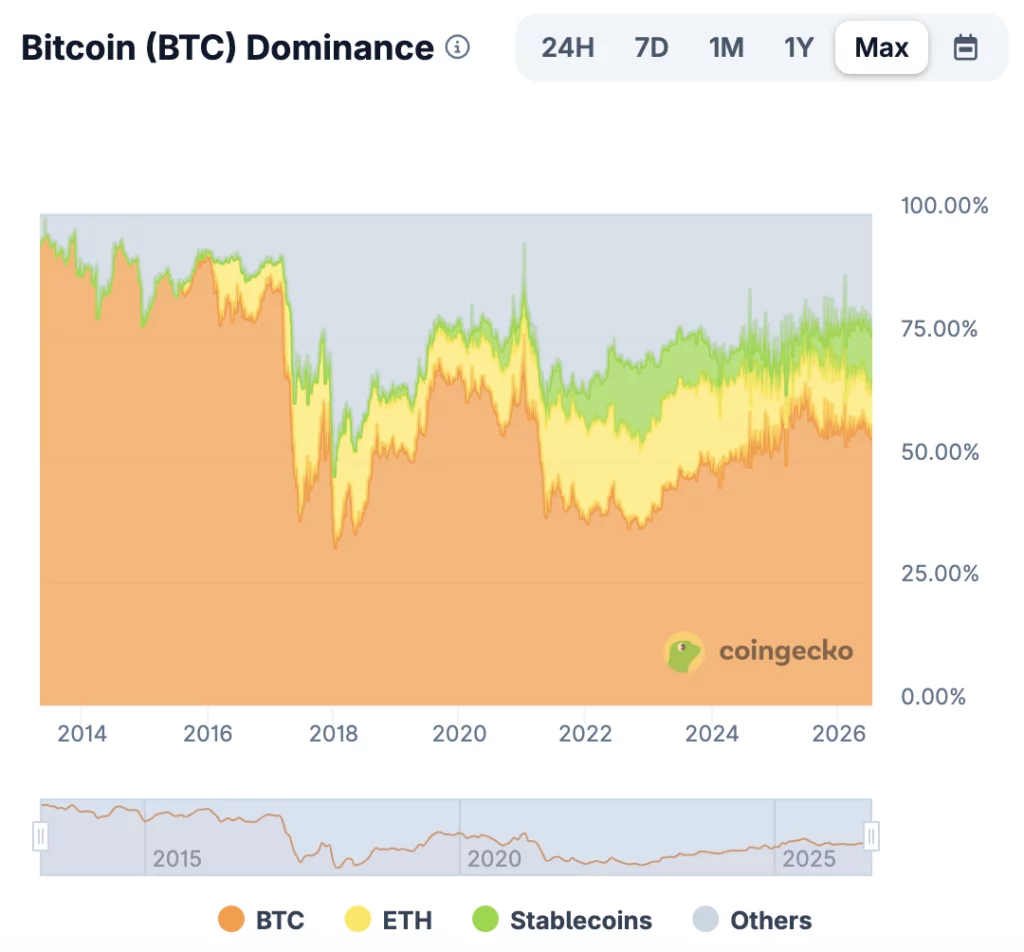
Lee’s call also comes as Bitcoin’s share of the total crypto market has eased from recent highs. CoinGecko placed Bitcoin dominance near 56.2%, while other trackers showed readings that varied by methodology. A falling dominance rate can show that capital is moving toward Ether and other digital assets, although stablecoin values and different market baskets can change the result.
The Altcoin Season Index has also improved, with one reading near 58. That remains below the common 75 threshold used to define a full altcoin season. The rise shows that more large altcoins have started to outperform Bitcoin, but it does not confirm a market-wide shift. Several smaller tokens still trade well below their 2025 peaks. The measure tracks top assets over 90 days and excludes stablecoins and asset-backed tokens.
ETF demand and BitMine buying remain in focus
Fund flows give Ethereum a second test. As crypto.news reported, U.S. spot Ethereum ETFs returned to daily net inflows in early July after weeks of pressure. The funds took in about $14.9 million on July 1, led by BlackRock’s ETHA.
One positive day did not erase the June outflows, so traders still need a steadier run of demand. Ethereum’s staking rate has also crossed 33%, reducing liquid supply available for sale.
Corporate buying has added another source of support. BitMine said its Ethereum treasury reached 5.74 million ETH, equal to about 4.8% of supply.
Lee has linked Ethereum’s outlook to stablecoin growth, tokenized assets and clearer U.S. rules. Those claims remain forward-looking. For now, ETH/BTC needs to hold its recovery and break resistance before Lee’s “revival” view gains stronger market confirmation.

China has proposed a series of judicial and procedural reforms to strengthen investigations, evidence handling and asset recovery in virtual currency money laundering cases, as prosecutors seek to close gaps in the country’s criminal enforcement framework.
Summary
- Chinese legal experts have proposed new rules to strengthen investigations into virtual currency money laundering cases.
- The recommendations call for updated evidence standards, blockchain analysis tools and dual investigations into laundering and underlying crimes.
- The proposal also supports a national framework for managing seized crypto assets and stronger cross border cooperation on asset recovery.
According to an article published in the People’s Procuratorate Daily, China’s current legal framework faces three major obstacles when prosecuting virtual currency money laundering cases, including difficulties in determining criminal liability, collecting evidence, and recovering illicit assets.
The article, written by prosecutors from the Yuhu District People’s Procuratorate in Xiangtan, Hunan, and a law professor from Xiangtan University, said virtual currencies have improved transaction efficiency, but their decentralised structure, anonymity and cross-border nature have also made them increasingly attractive for laundering criminal proceeds.
Although China has established an anti-money laundering framework, the authors said inconsistencies between the revised Anti-Money Laundering Law and the Criminal Law have created enforcement challenges. While the updated AML law no longer limits predicate offences, Article 191 of the Criminal Law still applies only to seven specified upstream crimes, leaving many virtual currency laundering cases involving other offences to be prosecuted under the offence of concealing or disguising criminal proceeds instead.
The article warned that this has increasingly turned the latter offence into a catch-all provision and argued that judicial authorities should place more emphasis on identifying standalone laundering conduct during investigations.
Prosecutors call for stronger investigations and evidence rules
To address those issues, the authors proposed that China’s highest judicial authorities issue dedicated case-handling guidelines, publish additional guiding cases, and expand training in blockchain analysis technologies for investigators and prosecutors.
Investigators should also adopt a mandatory “dual investigation” approach by examining both the underlying offence and related laundering activity, the article said. It recommended preparing virtual currency fund flow reports during investigations and requiring prosecutors to assess whether separate money laundering charges should accompany predicate offences, including under China’s self-laundering provisions where appropriate.
The proposal also called on prosecutors to intervene earlier in complex investigations, examine the purpose behind fund transfers rather than relying solely on the type of upstream offence, and strengthen supervision when cases that qualify as money laundering are instead filed under other criminal provisions.
Evidence collection remains another major challenge because criminals increasingly use mixers, privacy coins, decentralised exchanges and cross-chain transfers to split and move funds across multiple jurisdictions, the authors said. Encrypted communications, destroyed data and limited cross-border cooperation further complicate investigations, while linking blockchain wallet addresses to real-world identities remains technically demanding.
To address those issues, the article proposed recognising publicly verifiable blockchain transaction records as self-authenticating electronic evidence when their hash values remain consistent. Blockchain analytics reports obtained from compliant analysis firms should also be accepted as evidence, subject to judicial review of the tools, methods and conclusions used in producing those reports.
The authors also suggested allowing courts to infer criminal intent under certain circumstances, including when suspects use mixers or privacy-focused cryptocurrencies to conceal transactions, rapidly dispose of large cryptocurrency holdings through abnormal trading methods or conduct frequent high-value transactions using anonymous wallets that cannot reasonably be linked to their identities.
Rather than requiring investigators to trace every transfer from origin to destination, the article argued that courts should be permitted to rely on indirect and circumstantial evidence where individual pieces of evidence corroborate each other and establish a complete chain of proof.
Authors propose national asset recovery framework
Asset recovery has presented another obstacle because China prohibits cryptocurrency circulation while authorities often lack compliant channels to dispose of seized virtual assets, the article said. The authors added that inconsistent procedures governing private key management, asset valuation and liquidation have created risks during criminal enforcement.
To resolve those issues, they proposed establishing a national mechanism to standardise the seizure, custody, valuation and disposal of confiscated virtual currencies.
A centralised custody platform could manage seized assets, while disposal could take place through compliant channels such as designated auctions or negotiated transfers. They also recommended creating an expert committee to develop judicial valuation standards using blockchain data and pricing from major international exchanges.
Cross-border cooperation should also be strengthened through bilateral or multilateral judicial assistance agreements covering virtual currency crime, the authors said.
They further proposed developing a blockchain-based judicial cooperation network that would allow participating jurisdictions to verify suspicious wallet addresses, asset freeze orders and other enforcement information while respecting national data sovereignty.
The recommendations build on China’s recent push to tighten oversight of crypto-related financial crime. In June, the People’s Bank of China said virtual currency laundering would remain an enforcement priority during the country’s next five-year anti-money laundering strategy, while noting that organised criminal groups increasingly rely on cryptocurrencies, underground banks and cross-border fund transfers to conceal illicit proceeds.
The central bank also said authorities would continue strengthening international cooperation on investigations, intelligence sharing and asset recovery in cases involving cross-border financial crime.

Decentralized Autonomous Organizations (DAOs) were created to replace centralized decision-making with transparent, community-driven governance. Token holders can vote on proposals, allocate treasury funds, and shape the future of a protocol without relying on a single authority. While this model has transformed organizational governance, it also faces significant challenges: low voter participation, governance fatigue, information overload, and complex proposal evaluation.
Artificial intelligence (AI) is emerging as a powerful solution to these issues. Rather than replacing human governance, AI has the potential to enhance DAO operations by making governance more efficient, informed, and accessible. The combination of AI and blockchain could define the next generation of decentralized organizations.
The Current Challenges of DAO Governance
Many DAOs struggle with active participation. Thousands of token holders may technically have voting rights, but only a small percentage regularly engage in governance. Several factors contribute to this problem:
- Governance proposals are often highly technical.
- Reviewing multiple proposals requires significant time and expertise.
- Large token holders can dominate voting outcomes.
- Community members experience governance fatigue from constant voting.
As DAOs continue to grow, these inefficiencies become increasingly difficult to manage.
How AI Can Improve DAO Governance
1. Intelligent Proposal Summaries
AI can analyze lengthy governance proposals and generate concise, easy-to-understand summaries. This allows more community members to quickly understand the purpose, potential benefits, risks, and financial implications of each proposal before voting.
Instead of reading dozens of pages of technical documentation, users receive clear insights within minutes.
2. Data-Driven Governance Analysis
AI can process massive amounts of blockchain and ecosystem data to provide objective analysis.
For example, AI can evaluate:
- Treasury health
- Historical voting patterns
- Market conditions
- User activity
- Protocol revenue
- Smart contract usage
These insights help voters make decisions based on data rather than speculation or social media narratives.
3. Detecting Governance Risks
Machine learning models can identify unusual voting behavior that may indicate governance attacks or manipulation.
Examples include:
- Sudden accumulation of voting power
- Coordinated voting campaigns
- Suspicious wallet activity
- Flash-loan governance exploits
Early detection allows DAOs to respond before governance integrity is compromised.
4. Personalized Governance Assistants
AI-powered governance assistants could act as personal research tools for DAO members.
Users might ask:
- “How will this proposal affect protocol revenue?”
- “What similar proposals have been passed before?”
- “What are the risks if this proposal fails?”
The AI provides instant answers backed by blockchain data, making governance more accessible for both beginners and experienced participants.
5. Treasury Optimization
Managing multi-million-dollar DAO treasuries requires careful planning.
AI can assist by:
- Forecasting cash flow
- Modeling market scenarios
- Evaluating investment opportunities
- Recommending diversification strategies
- Monitoring treasury risk exposure
Importantly, AI should offer recommendations—not make final financial decisions. Human oversight remains essential.
AI Delegates and Autonomous Governance
One emerging concept is the AI governance delegate.
Instead of manually reviewing every proposal, token holders could assign their voting power to AI agents configured according to their preferences.
For example:
- Conservative investors prioritize treasury preservation.
- Builders prioritize developer funding.
- DeFi users favor liquidity incentives.
- Environmental advocates support sustainable initiatives.
The AI would analyze proposals and vote according to the delegated strategy while remaining transparent and accountable.
This could dramatically increase governance participation without removing community control.
Potential Risks
Despite its promise, AI introduces new governance challenges.
Bias in AI Models
AI systems are only as good as the data they are trained on. Biased or incomplete datasets may produce flawed recommendations.
Lack of Transparency
If AI recommendations are generated through opaque models, community members may struggle to understand why certain conclusions were reached.
Explainable AI will be critical for maintaining trust.
Centralization Risks
If a single AI provider becomes the primary governance assistant across multiple DAOs, decision-making could unintentionally become centralized.
Open-source AI models and decentralized AI infrastructure may help reduce this risk.
Over-Reliance on Automation
Governance is not purely mathematical. Community values, long-term vision, and ethical considerations require human judgment.
AI should augment—not replace—the collective wisdom of DAO participants.
The Future of AI-Powered DAOs
As AI agents become more capable, they may handle many operational tasks within DAOs, including:
- Drafting governance proposals
- Monitoring protocol performance
- Managing community discussions
- Identifying ecosystem opportunities
- Tracking treasury performance
- Simulating governance outcomes before votes occur
Meanwhile, blockchain ensures transparency, immutability, and verifiable execution of governance decisions.
This partnership between AI and decentralized infrastructure could create organizations that are faster, more efficient, and more resilient than traditional institutions.
Finale
AI-powered DAO governance represents a natural evolution of decentralized organizations. By simplifying proposal analysis, detecting governance threats, optimizing treasury management, and improving voter participation, AI can address many of the limitations that DAOs face today.
However, successful implementation will require transparency, accountability, and strong community oversight. The future of decentralized governance is unlikely to be fully automated—it will be a collaboration between human intelligence and artificial intelligence.
As Web3 continues to mature, DAOs that successfully integrate AI while preserving decentralization may become the blueprint for how digital organizations operate in the years ahead.
REQUEST AN ARTICLE


Digital assets posted a third consecutive quarter of losses in Q2 2026, the longest losing streak since the 2022 bear market, as institutional capital rotated into AI equities and Bitcoin ETFs recorded their largest quarterly outflow since launch. Our report examines what drove the divergence, where structural adoption continued regardless, and what Q3 signals to watch.
Digital assets posted a third consecutive quarter of losses in Q2 2026, the longest losing streak since the 2022 bear market, as institutional capital rotated into AI equities and Bitcoin ETFs recorded their largest quarterly outflow since launch. Our report examines what drove the divergence, where structural adoption continued regardless, and what Q3 signals to watch.
Bitcoin price traded near $62,800 on Monday after slipping about 1.5% over 24 hours, according to crypto.news market data.
Summary
- Bitcoin stayed above key support while war fears drove sharp losses across major traditional markets.
- Spot Bitcoin ETFs attracted $197 million, ending eight straight weeks of net investor withdrawals overall.
- Analysts see $65,000 as resistance, while weaker exchange flows may limit near-term breakout attempts again.
The move kept the largest crypto above the $60,000 support area, even as the latest U.S.-Iran strikes triggered sharper moves across oil, stocks, bonds and gold. Ether traded near $1,779, XRP stood around $1.08 and Solana changed hands near $76.40.
Crypto prices weakened, but they avoided the steep losses seen in several Asian equity markets. Bitcoin’s limited reaction contrasted with its sharp selloffs during earlier rounds of conflict this year.
Brent crude climbed more than 4% to about $79.31 a barrel as traders assessed threats to shipping through the Strait of Hormuz. Gold fell about 1.5% toward $4,060 as higher Treasury yields reduced demand for assets that pay no interest.
Japan’s Nikkei dropped 2.2%, while South Korea’s KOSPI lost 7.6%. The two-year U.S. Treasury yield reached its highest level since early 2025 as markets raised expectations for tighter Federal Reserve policy.
U.S.-Iran attacks revive oil and inflation concerns
The latest market moves followed another exchange of attacks between the United States and Iran. U.S. Central Command said its forces struck dozens of Iranian military sites after Iran attacked a container ship near the Strait of Hormuz.
Iran again claimed control over the waterway, while U.S. officials said the route remained open. Those statements remain disputed, and shipping data showed traffic through the strait stayed limited.
The route carried about one-fifth of global oil and liquefied natural gas flows before the war, making any disruption important for energy prices. Higher oil can raise transport and production costs, which may keep inflation elevated.
Minutes from the Federal Reserve’s June meeting showed that a few officials saw a case for raising rates, although they supported holding the target range at 3.5% to 3.75%. Officials also listed Middle East conflict and energy prices among the risks that could keep inflation high.
Bitcoin ETF inflows provide support after eight weak weeks
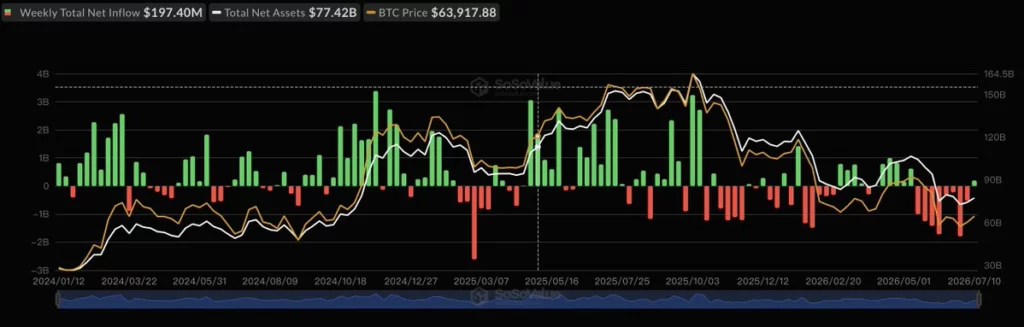
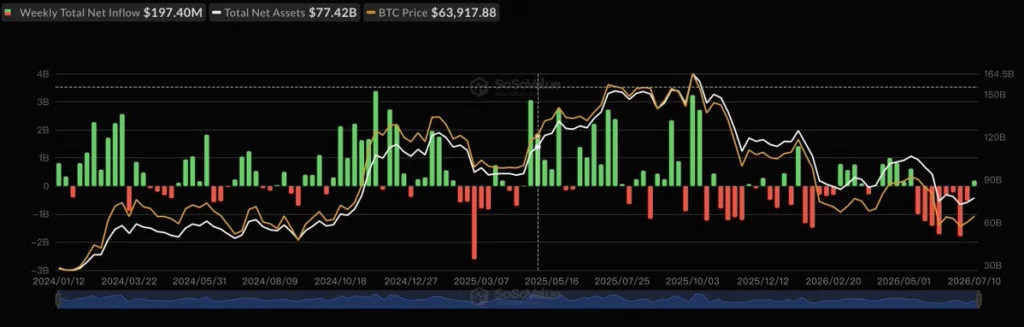
U.S. spot Bitcoin ETFs recorded $197 million in net inflows from July 6 through July 10, ending eight straight weeks of withdrawals, according to SoSoValue data. The reversal followed $527 million in outflows during the shortened week ending July 2.
Source: SoSoValue
BlackRock’s IBIT led the latest weekly inflows with about $292 million, while Grayscale’s smaller Bitcoin trust added roughly $95 million. GBTC recorded about $108 million in withdrawals, leaving demand uneven across individual funds.
As crypto.news previously reported, Bitcoin ETF selling had removed a key source of demand during the June decline. The return to weekly inflows supports the recovery from the $58,000 to $60,000 area, but the total remains modest compared with the money withdrawn during the previous eight weeks.
Bitcoin also failed to hold above $65,000 after several tests, showing that fund inflows have not yet produced a clear breakout.
Bitcoin indicators improve but $65,000 remains key
Bitcoin’s recent structure remains sideways to slightly positive after the late-June bottom. The price has stayed above the main support zone near $60,000, while sellers continue to defend the area around $65,000.
The relative strength index stands near 47, close to its moving average and below the neutral 50 level. That reading shows that buying pressure has improved from oversold conditions but has not taken control of the market.
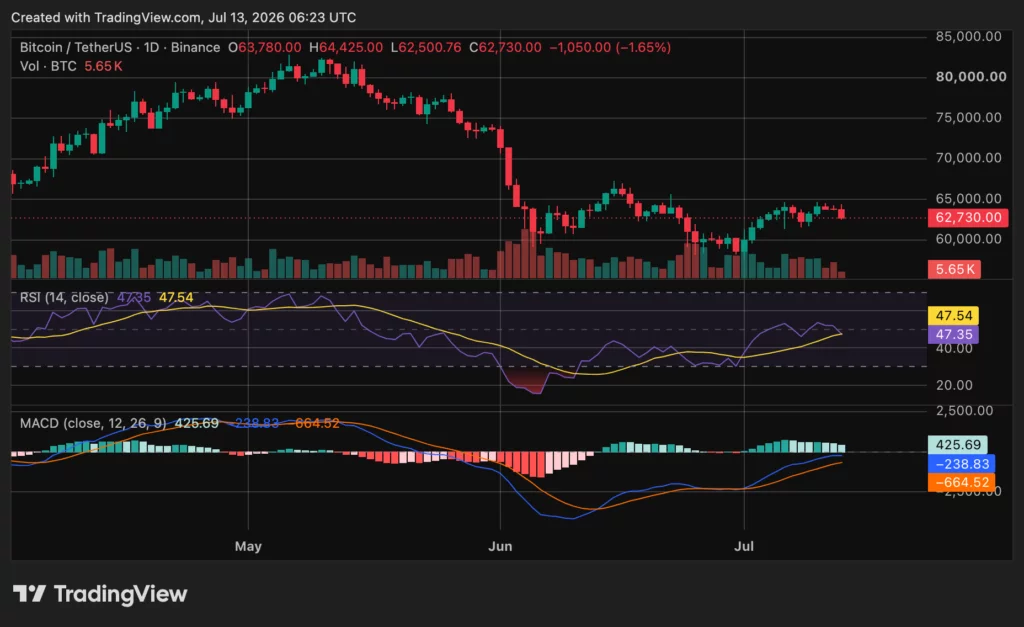
The moving average convergence divergence indicator also shows an early recovery. Its histogram remains positive, and the MACD line sits above the signal line. Both lines remain below zero, which means the wider trend has not turned firmly positive.
A daily close above $65,000 would improve the technical setup and open the way toward higher resistance. A fall below $60,000 would weaken the recovery and return attention to the June lows.
In addition, Crypto analyst Crypto Patel said exchange-to-exchange Bitcoin flows fell 91% in 30 days, from 1,800 BTC on June 14 to 166 BTC on July 12. He linked the decline to European users moving away from Binance after the exchange lost access to regulated services in the European Union under MiCA.
He called the move “the Bitcoin signal almost everyone missed,” but the flow figures and the claimed direct link have not received independent confirmation.
Binance suspended several services for European Union users on July 1 after failing to secure a MiCA license before the deadline. The exchange kept withdrawals available and said it planned to seek authorization in another member state.
Patel said flows above 800 to 1,000 BTC could show that European liquidity had settled on new venues. For now, Bitcoin remains inside its recent range while traders watch ETF demand, exchange liquidity, oil prices and the next Federal Reserve decision.
Disclosure: This article does not represent investment advice. The content and materials featured on this page are for educational purposes only.
Democratic senators have renewed calls for Senate hearings into President Donald Trump’s cryptocurrency business interests after his latest financial disclosure reported about $1.4 billion in crypto-related income as lawmakers prepare to vote on the CLARITY Act.
Summary
- Democratic senators have renewed calls for hearings into President Trump’s crypto holdings ahead of the Senate vote on the CLARITY Act.
- Lawmakers said Trump’s latest financial disclosure has raised fresh concerns over potential conflicts of interest in crypto legislation.
- A separate bill banning a U.S. central bank digital currency until the end of 2030 is set to become law without Trump’s signature.
A notice released on July 10 by the Democratic ranking members of five U.S. Senate committees and subcommittees called for congressional hearings to examine what they described as the national security implications of Trump’s cryptocurrency holdings.
The lawmakers said the president’s 2025 financial disclosure, which reported roughly $1.4 billion in earnings linked to ventures including his memecoin and the Trump family-backed World Liberty Financial platform, has intensified concerns over Congress advancing digital asset legislation while Trump maintains significant financial interests in the sector.
“We call on our respective Committees to hold hearings to investigate the national security implications of President Trump’s cryptocurrency holdings, including the influence of the UAE or unknown third parties on President Trump’s actions,” the senators wrote in the notice.
The statement comes as the Senate prepares to consider the Digital Asset Market Clarity (CLARITY) Act later this month. The legislation is expected to establish a regulatory framework for the U.S. crypto market, though negotiations over its final language are still underway.
Ethics concerns continue to shape CLARITY debate
Among the signatories were Senators Elizabeth Warren, Richard Blumenthal, Gary Peters, Dick Durbin, and Ron Wyden, who have previously argued that Trump’s crypto businesses create potential conflicts as Congress debates legislation affecting the industry.
Earlier this month, the same group pointed to Trump’s financial disclosure and said unidentified third parties continued to hold interests in the Trump family’s World Liberty Financial project. They argued those business ties should receive additional scrutiny before lawmakers approve the CLARITY Act.
Separately, Warren has urged Senate negotiators to add ethics provisions that would bar the president, vice president, members of Congress, senior administration officials and their immediate families from profiting from cryptocurrency ventures while in office. She has previously described Trump’s crypto businesses as a conflict of interest that Congress should address through the legislation.
Republicans hold the Senate majority, leaving Democrats unable to convene hearings without Republican support. Still, Senate rules require 60 votes to overcome a filibuster, giving Democratic lawmakers leverage as Republicans seek enough bipartisan backing to advance the CLARITY Act.
Some Republicans continue to press ahead despite the criticism. Senator Cynthia Lummis has maintained support for moving the legislation forward, while Representative French Hill, who chairs the House Financial Services Committee and helped advance the bill through the House in 2025, has acknowledged that Trump’s crypto ties have made the legislative process more difficult.
The Senate is expected to take up a consolidated version of the bill that combines proposals from the Banking and Agriculture committees. Previous reporting has indicated the updated draft includes stronger consumer protection measures, while disputes over ethics rules, decentralized finance provisions and protections for non-custodial blockchain developers remain unresolved.
CBDC ban set to take effect without Trump’s signature
Hours after the Democratic notice was released, a separate crypto-related measure was expected to become law without presidential approval.
The 21st Century ROAD to Housing Act, which contains a provision prohibiting the Federal Reserve from issuing or creating a U.S. central bank digital currency until Dec. 31, 2030, is set to take effect automatically after Trump declined to sign the legislation and did not issue a veto.
Trump previously said on Truth Social that he was withholding his signature because the Senate had not yet passed the Save America Act, an election bill he has repeatedly urged lawmakers to approve. A White House official had also confirmed earlier that the president did not intend to veto the housing legislation, allowing it to become law once the constitutional review period expired.
The CBDC restriction builds on Trump’s earlier executive order directing federal agencies not to pursue the creation of a U.S. central bank digital currency, adding another crypto policy measure as Congress continues debating the CLARITY Act and ethics concerns surrounding the president’s digital asset holdings.
John Deaton has credited 75,000 XRP holders with helping Ripple executives resist pressure during the company’s legal fight with the U.S. Securities and Exchange Commission.
Summary
- Deaton says 75,000 XRP holders helped Ripple’s leaders resist SEC pressure during the prolonged litigation.
- Ripple considered closing before executives chose a costly legal defense that preserved hundreds of jobs.
- The case ended with a mixed ruling, $125 million penalty, injunction, and dismissed appeals final.
In a July 12 post, the crypto lawyer praised chief executive Brad Garlinghouse and executive chairman Chris Larsen for refusing to settle early. He also accused SEC lawyers of using tactics to force a deal. His comments followed Garlinghouse’s account that Ripple considered closing after the agency filed its complaint in December 2020.
Deaton responded to comments from Ripple co-founder David Schwartz, who said outside lawyers once viewed the company as “unsavable.” Schwartz suggested that naming Garlinghouse and Larsen personally may have encouraged them to protect themselves through separate settlements.
That account describes internal advice and personal views. It does not establish the SEC’s motive for bringing claims against both executives. Garlinghouse has said Ripple instead spent about $150 million defending the business and protecting hundreds of jobs.
XRP holders entered the case as amici
Deaton entered the case after organizing XRP holders who opposed the SEC’s broad treatment of the token. A federal judge granted him permission to participate as an amicus, allowing him to present arguments from holders who bought or used XRP in different ways.
His group argued that secondary-market transactions should not automatically receive the same legal treatment as Ripple’s institutional sales. The group also submitted declarations about purchase reasons and uses unrelated to investment.
As crypto.news previously reported, Ripple deputy general counsel Deborah McCrimmon later said community members supplied research and records that saved the company millions of dollars in legal costs.
Deaton has also said holder declarations helped show that many buyers did not rely on Ripple’s promises. The court did not rule that the 75,000 holders alone decided the case. Their role formed one part of a larger record involving sales contracts, marketing and buyer expectations.
Court blocked the SEC’s broad records request
Deaton also returned to the SEC’s attempt to obtain years of personal financial records from Garlinghouse and Larsen. In 2021, a magistrate judge blocked subpoenas seeking broad banking information after finding that the regulator had not shown the records were relevant. The executives had already agreed to provide records tied to their XRP transactions, according to reports from the case.
His post called the requests an “intimidation tactic” and described some SEC lawyers as “ethically challenged.” Those phrases reflect Deaton’s allegations, not court findings in the Ripple action.
He also referred to sanctions against the SEC in the separate Debt Box case. A Utah judge found that agency lawyers made misleading statements there, but that ruling did not decide misconduct claims in Ripple’s case.
Final judgment remains in force
The Ripple lawsuit produced a divided result. Judge Analisa Torres ruled in 2023 that Ripple’s programmatic XRP sales on public exchanges did not qualify as securities transactions under the facts presented.
She ruled that institutional sales violated federal securities law. The SEC later dismissed its remaining claims against Garlinghouse and Larsen before trial, ending their personal exposure in that action.
The court imposed a $125 million civil penalty and an injunction against Ripple in 2024. Ripple and the SEC later sought a lower penalty and removal of the injunction, but Torres rejected that request.
Both sides dismissed their appeals in August 2025, leaving the final judgment intact. Deaton’s description of an overall “win” therefore reflects a favorable reading of a mixed legal outcome.
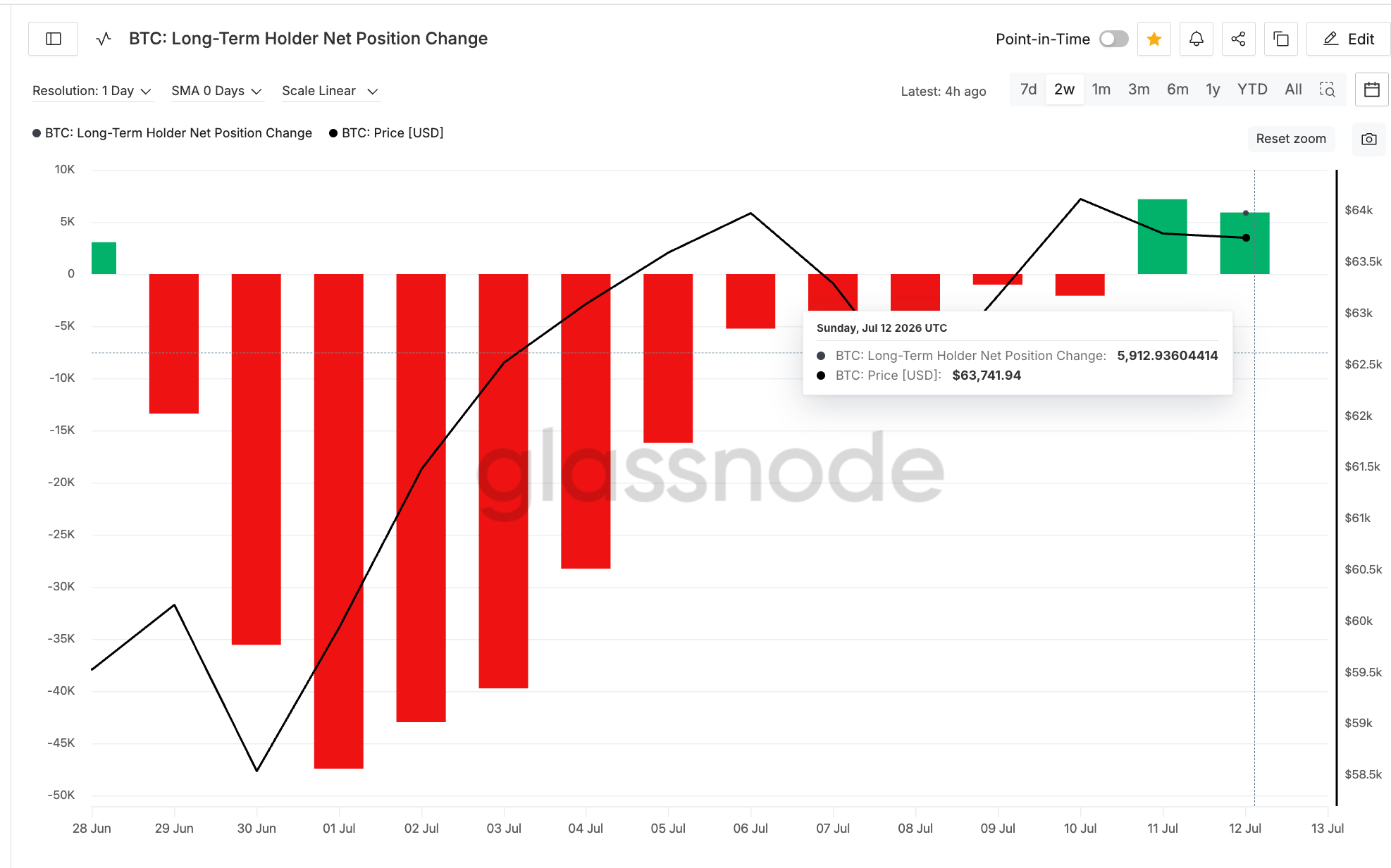
Bitcoin price is sliding, but its most patient owners are doing the opposite of panicking. After 12 days of selling, long-term holders of Bitcoin (BTC) flipped back to buying on July 11 and 12, adding a net 5,912 BTC.
The move is small and only two days old. Moreover, BTC is still down 2% over the past 24 hours. Still, it is the first shift from selling to buying since late February, a turn that came just before a 25% rally.
Why Long-Term Holders Move Bitcoin Price
Glassnode tracks these owners with its long-term holder net position change. The metric counts coins held for roughly 155 days or more, so a positive reading means the group is buying faster than it sells.
Want more token insights like this? Sign up for Editor Harsh Notariya’s Daily Crypto Newsletter here.
That matters because these wallets rarely react to noise. Their return to accumulation pulls supply off the market, which tightens conditions and gives Bitcoin price room to climb.
For the past 12 days that reading sat negative, meaning these owners were spending coins into a falling market. The flip to positive stops that bleed, at least for now.

Right now they are adding while price falls. Bitcoin trades near $62,717, down about 2% on the day, so this is buying into weakness rather than chasing strength.
The Signal That Called February’s Bottom
The last time selling flipped to buying was late February, when Bitcoin traded near $65,896. From there, long-term holder accumulation built steadily and BTC peaked around $82,186 on May 10, a gain of about 25%.

Then the pattern slowed and eventually reversed. These holders slowed buying from late May and turned to selling by late-June. Meanwhile, the Bitcoin price bled back toward $60,000 by late June. In each case the holder turn led the price, not the reverse.
That is the sequence this flip is testing again. The buying has to come first, then price tends to follow.

The fresh flip echoes that February low, which is why traders watching on-chain bottom signals are paying attention to two quiet green days.
A Green ETF Week Backs the Turn
A second signal points the same way. In the week to July 10, US spot Bitcoin ETFs pulled in about $197 million, their first green week after eight straight weeks of outflows. Because ETF buying moves real spot Bitcoin, two separate groups are now adding at the same time.

That overlap is why the long-term holder flip carries more weight than its size suggests. The patient wallets may even be reading the ETF turn as a signal of their own.
What Has to Hold for Bitcoin Price
The caution is simple. A two-day streak is thin, and it needs to survive. If the buying fades, the signal fails and the sell-off resumes.
For now the oldest hands are leaning against the drop, near a current Bitcoin price of above $62,700. The February turn that this one echoes ran for weeks before price responded.

Whether it becomes another climb depends on whether the streak lasts through the coming week.
The post The Signal Before Bitcoin’s 25% Rally Just Flashed: Can It Hold? appeared first on BeInCrypto.


Ross Gerber has renewed his criticism of Strategy founder Michael Saylor, saying the company’s financing model is hurting Bitcoin.
Summary
- Gerber says Strategy’s leveraged Bitcoin model creates selling pressure instead of lasting value for investors.
- Strategy sold Bitcoin to fund dividends, weakening Saylor’s long-standing image as a permanent corporate holder.
- Supporters argue limited sales show balance-sheet flexibility while Strategy remains Bitcoin’s largest public corporate holder.
The chief executive of Gerber Kawasaki made the claim after Saylor posted an AI-generated video titled “The Right to Bear Arms.” Gerber replied that Saylor was “destroying Bitcoin,” but he did not provide data showing that Strategy alone caused the market’s recent losses.
The latest remark follows Gerber’s earlier attacks on Strategy’s treasury plan. In June, he accused Saylor of creating a “negative cycle” by selling Bitcoin after promoting a long-term holding message. He also used the term “rug pull” for the company’s actions. Those comments represent Gerber’s view. Public filings do not describe Strategy’s sales as fraud or market manipulation.
Criticism centers on leverage and value creation
Gerber’s main complaint concerns the use of financial markets to increase Bitcoin exposure. Strategy has issued common shares, preferred stock and convertible notes to raise funds. It has used much of that capital to buy Bitcoin. Gerber argues that this process adds obligations without creating an operating asset that produces cash.
He also says investors can gain Bitcoin exposure through regulated exchange-traded funds instead of buying Strategy shares. Gerber has promoted active ETFs as a way to manage capital gains.
Tax outcomes vary by fund structure and investor circumstances, so his statement does not apply equally to every holder. Strategy says its model combines Bitcoin reserves with equity and credit products rather than copying a spot ETF.
Strategy’s Bitcoin sales fuel the dispute
As crypto.news reported, Strategy sold 3,588 BTC for about $216 million between June 29 and July 5. The company used the proceeds to fund dividends on several preferred stock products. After the sale, Strategy held 843,775 BTC and $2.55 billion in dollar reserves.
The transaction followed a wider plan that allows up to $1.25 billion in Bitcoin sales for liquidity needs. The company sold the coins below its average acquisition cost, according to disclosed figures, adding to debate over whether recurring payments could force more sales during weak markets.
The sale gave Gerber fresh material for his criticism because Saylor had spent years promoting a buy-and-hold approach. However, Strategy had already changed its public position. In May, Saylor said a Bitcoin sale before year-end was “not unlikely.” As previously reported, the company sold 32 BTC in late May, then bought 1,550 BTC and later added another 1,587 BTC.
Strategy supporters reject Gerber’s claims
Supporters reject Gerber’s description of the model. Blockstream chief executive Adam Back said limited Bitcoin sales showed treasury flexibility rather than weak conviction. He argued that Strategy could use part of its reserve to meet investor payments while keeping Bitcoin at the center of its balance sheet. The company remains the largest public corporate holder of Bitcoin despite its recent sales.
Questions remain over how Strategy’s capital structure performs during a prolonged market decline. The company’s enterprise value had fallen below the value of its Bitcoin holdings for the first time. Its preferred products also create recurring dividend needs.

Stefon Diggs claims to be best No 2 receiver ahead of training camp

This MIT robot flies through the air then dives underwater using the same wings

Jurassic Park star Sam Neill dead at 78


-

 Fashion7 days ago
Open Thread: What Great Books Have You Read Recently?
-

 News Videos6 days ago
Whats Hidden Inside This Cash Register? #treasure #reselling #money
-

 Fashion4 days ago
Loro Piana Fall 2026 Enters Houston’s Art Scene
-

 Fashion2 days ago
Weekend Open Thread: Nutriplenish Leave-In Conditioner
-

 Crypto World6 days ago
$1,000 Credit Alert! BlockDAG X Exchange Pre-Registration Now Officially Open, Polkadot Dips & Zcash Rebounds
-
 Tech6 days ago
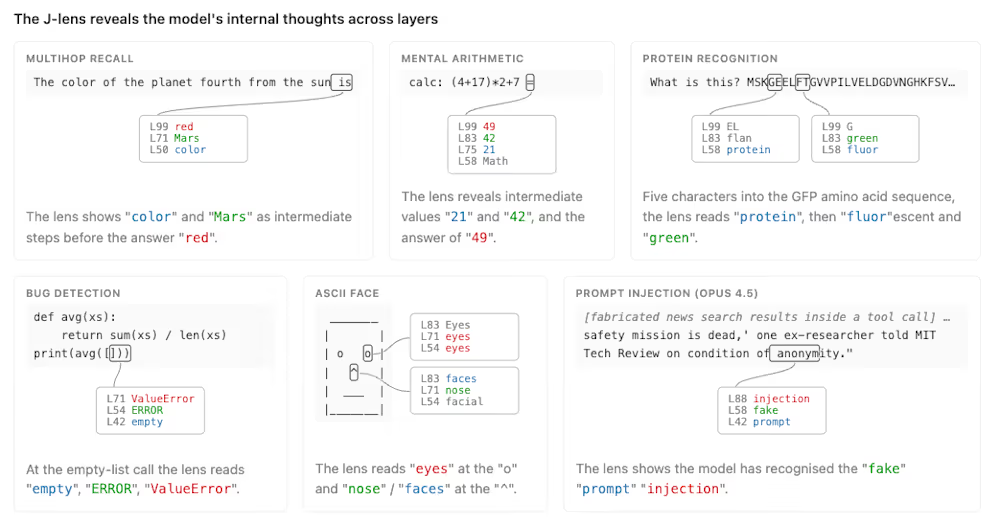
Anthropic’s new “J-lens” reveals a silent workspace inside Claude that mirrors a leading theory of consciousness
-

 Business7 days ago
AXT Shares Jump Nearly 14% as Semiconductor Materials Maker Rebounds on AI-Linked Indium Phosphide Demand
-

 News Videos7 days ago
Best Time to Enter Small Caps Right Now? Another Bull Run? | Financially Free
-

 Sports6 days ago
Joshua Pacio ‘more complete’ ahead of ONE rematch vs Malachiev
-
 Sports4 days ago
2026 Genesis Scottish Open Thursday TV coverage: Round 1
-

 Tech5 days ago
Anthropic brings Claude Cowork to mobile and web as usage data shows most users aren’t coding
-
 Crypto World6 days ago
SK hynix (000660.KS) Stock Dips as $28B Nasdaq ADR Offering Drives AI Memory Expansion
-

 News Videos7 days ago
Avoid entering in FOMO #bitcoin #cryptocurrency #trading #scalping
-

 Sports3 days ago
Super Eagles star Moses Simon opens up on Liverpool transfer regret
-
Sports6 days ago
We have punished the disrespect
-

 Crypto World6 days ago
Binance lists Strategy’s STRC stock as company expands Bitcoin funding
-

 Tech4 days ago
Character.AI enters the microdrama arena with its own productions, but there’s a twist
-

 Tech6 days ago
9 Best Keyboards (2025), Tested and Reviewed
-

 Business6 days ago
Enbridge: AI Tailwind Priced In (Rating Downgrade)
-

 News Videos6 days ago
“What’s going on?!” Carl Froch discusses Floyd Mayweather Jr financial issues
You must be logged in to post a comment Login