

Crypto World
China industrial profits jump 24.7% in April, fastest gain in over two years despite headwinds


BEIJING — China’s industrial profits in April surged by 24.7% from a year earlier, according to official data released Wednesday, marking the fastest growth since November 2023.
The increase accelerated from a 15.8% rise in March, according to China’s biggest financial data provider Wind Information.
For the first four months of the year, enterprise profits rose 18.2%, up from 15.5% growth in the first quarter.
China reported slower economic growth in April, with a 4.1% increase in industrial output and a 0.2% rise in retail sales from a year ago. Fixed asset investment fell for the first four months of the year as the real estate drag steepened.
Exports remained strong, climbing 14.1% in April from a year ago in U.S. dollar terms. Imports surged by 25.3%, data released earlier in May showed.
The producer price index in April jumped 2.8% from a year ago, the most since July 2022.


TLDR:
- OpenAI’s 2025 net loss hit $38.5 billion despite revenue tripling to $13.07 billion overall.
- Uber, Amazon and JPMorgan now restrict employee AI usage after costs spiraled unexpectedly.
- Anthropic and OpenAI filed confidentially for IPOs, both targeting valuations near $850 billion.
- Chinese models DeepSeek and Kimi undercut Anthropic and OpenAI pricing in benchmark cost tests.
Anthropic and OpenAI are pushing toward public markets while facing mounting questions about AI spending sustainability.
OpenAI posted a $38.5 billion net loss in 2025, even as revenue tripled to $13.07 billion. Rising pay-per-token costs have prompted major employers to limit staff usage, raising doubts about near-term profitability for both companies.
Enterprise Costs Spark Internal Crackdowns
Several large corporations have begun restricting employee access to AI tools after expenses climbed sharply. Uber reportedly exhausted its 2026 AI budget by April and now caps spending at $1,500 per employee monthly.
Amazon told staff to avoid using AI tools without clear purpose, following reports that engineers ran automated agents to climb internal usage leaderboards.
JPMorgan circulated an internal memo this month addressing excessive AI spending across departments. Some employees reportedly generated AI bills exceeding their own monthly salaries.
These examples reflect a broader pattern among companies that adopted AI tools aggressively over the past two years.
One pricing shift illustrates the scale of the problem. Workato saw its Anthropic bill increase 700% in a single day after the company moved from flat-rate to pay-per-token pricing in May.
Workato’s chief information officer said earlier subsidized pricing had encouraged widespread adoption before actual costs became visible.
IPO Timing Collides With Spending Concerns
Anthropic and OpenAI filed confidentially for public offerings this month, both reportedly targeting valuations near $850 billion.
Neither company has reached profitability, and OpenAI’s losses nearly tripled year over year. In 2024, the company lost $5.09 billion, a figure that grew to $38.5 billion in 2025.
This timing creates friction for both firms as they court investor confidence. Public offerings typically require evidence of sustainable revenue growth, yet enterprise clients are simultaneously scaling back usage. The same trend driving corporate cost-cutting threatens the growth narrative needed for successful IPO valuations.
OpenAI is reportedly considering token price reductions to retain customers shifting toward Anthropic’s offerings. According to the Wall Street Journal, Anthropic’s Claude Code product helped push annualized revenue from $9 billion to $47 billion within five months. That growth has intensified competitive pressure between the two firms.
Competitive Pricing Pressure Intensifies From Chinese Models
Artificial Analysis tested major AI models on identical benchmark tasks, comparing total operational costs. Anthropic’s flagship model cost $4,811 to complete the test suite, while OpenAI’s model cost $3,357 for the same workload.
Chinese alternatives showed substantially lower costs in the same testing. DeepSeek completed the benchmark for $1,071, while Kimi finished for $948.
These figures suggest Chinese developers prioritize cost efficiency over matching premium-tier performance metrics.
Bain surveyed nearly 1,000 companies regarding AI return on investment, finding that 40% reported actual cost savings below 10%.
One investor told Axios that a corporate finance officer spent $500 million on Claude access in a single month before anyone noticed.
As Anthropic and OpenAI prepare investor pitches, enterprise customers are demonstrating measurable resistance to current pricing structures.

Crypto World
Michael Saylor Touts $48 Billion Bitcoin Turnaround, But Can MicroStrategy’s STRC Survive 2026?
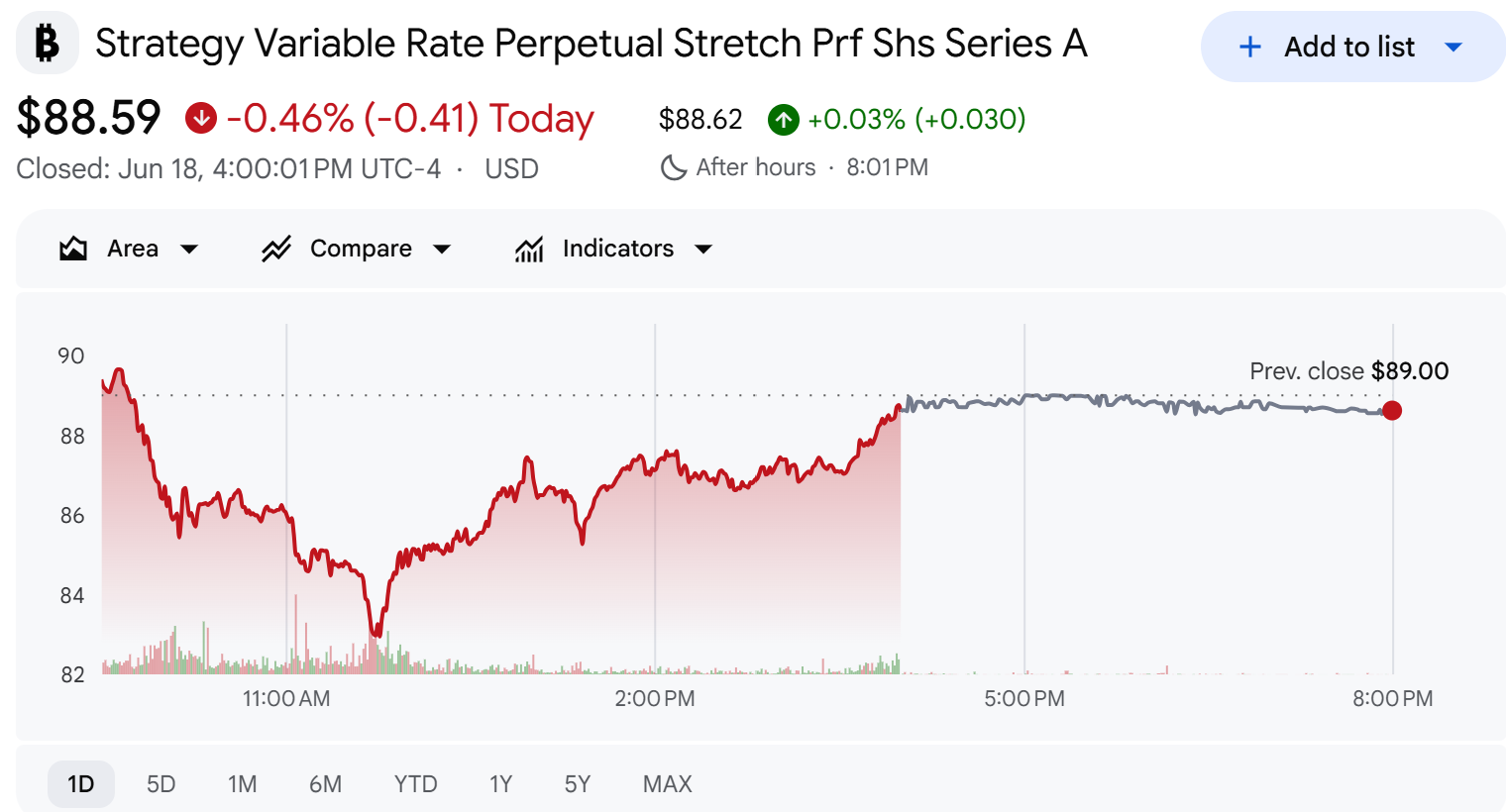
Michael Saylor marked Strategy’s turnaround from its 2022 lows, saying the firm’s Bitcoin (BTC) and cash reserves now top its debt by roughly $48 billion. His remarks land as MicroStrategy’s STRC preferred stock trades well below its $100 target.
Saylor is celebrating a multi-year win, yet traders question whether his newest Bitcoin funding tool can hold steady.

How Strategy Climbed Back From Its 2022 Lows
In October 2022, the company then called MicroStrategy (MSTR) held about 130,000 BTC. Weeks later, as the FTX collapse drove Bitcoin below $16,000, Saylor says its debt briefly topped its Bitcoin and cash by about $300 million.
Adjusted for a 10-for-1 split in 2024, the stock traded near $13. Michael Saylor says the picture has since transformed.
MicroStrategy has raised more than $60 billion, and it now holds about 843,700 BTC, more than any other public company. He casts the rebound as proof that conviction paid off.

“When I gave this speech in October 2022, Bitcoin traded near $20,000… Today, our BTC and USD reserves exceed debt by ~$48 billion. Thank you to everyone who believed, endured, and took the long view,” Saylor wrote in a post.
Follow us on X to get the latest news as it happens
Why STRC Slipped Below Its $100 Target
STRC, formally the Variable Rate Series A Perpetual Stretch Preferred Stock, was built to trade near $100, and Strategy resets the dividend monthly to defend that level. The company has lifted the rate repeatedly, now to 11.5%.
Strategy’s own filings note STRC is not collateralized by its Bitcoin and carries only a preferred claim on residual assets. That makes it a credit product, not a Bitcoin proxy.
The stock has not cooperated. It recently changed hands in the high $80s, having fallen below its $100 floor during the sell-off.

With Bitcoin near $63,700, leverage unwinds and paused issuance drove the slide. MicroStrategy can sell new STRC only at or above par, so a deep discount stalls its Bitcoin-buying machine.
Conviction Meets a Real Stress Test
Supporters remain calm. Michaël van de Poppe, founder of MN Capital, argued that STRC cannot break this cycle unless Bitcoin crashes toward $10,000, and he expects it to move back near par within a week.
Others see a messaging problem rather than a structural one.
Crypto analyst James Van Straten said the panic misreads what STRC is, noting that retail investors hold most of the stock, around 80% by one count.
“$STRC is not a stablecoin, it does not ‘de-peg.’ … The issue has been with [Saylor’s] messaging. You can’t expect ‘one penny of volatility’ when the underlying asset is a 40-50 vol asset and the majority of holders are retail,” the analyst stated.
The selling fears are not new. Strategy made its first-ever Bitcoin sale in that same 2022 window, selling 704 BTC for a tax benefit before rebuying days later.
It again sold 32 BTC this year to help cover dividends, and economist Peter Schiff has branded the structure a house of cards as STRC, MSTR, and Bitcoin fell together.
The timing sharpens the test. Shareholders approved a move to semi-monthly STRC dividends that takes effect at the end of June.
The post Michael Saylor Touts $48 Billion Bitcoin Turnaround, But Can MicroStrategy’s STRC Survive 2026? appeared first on BeInCrypto.
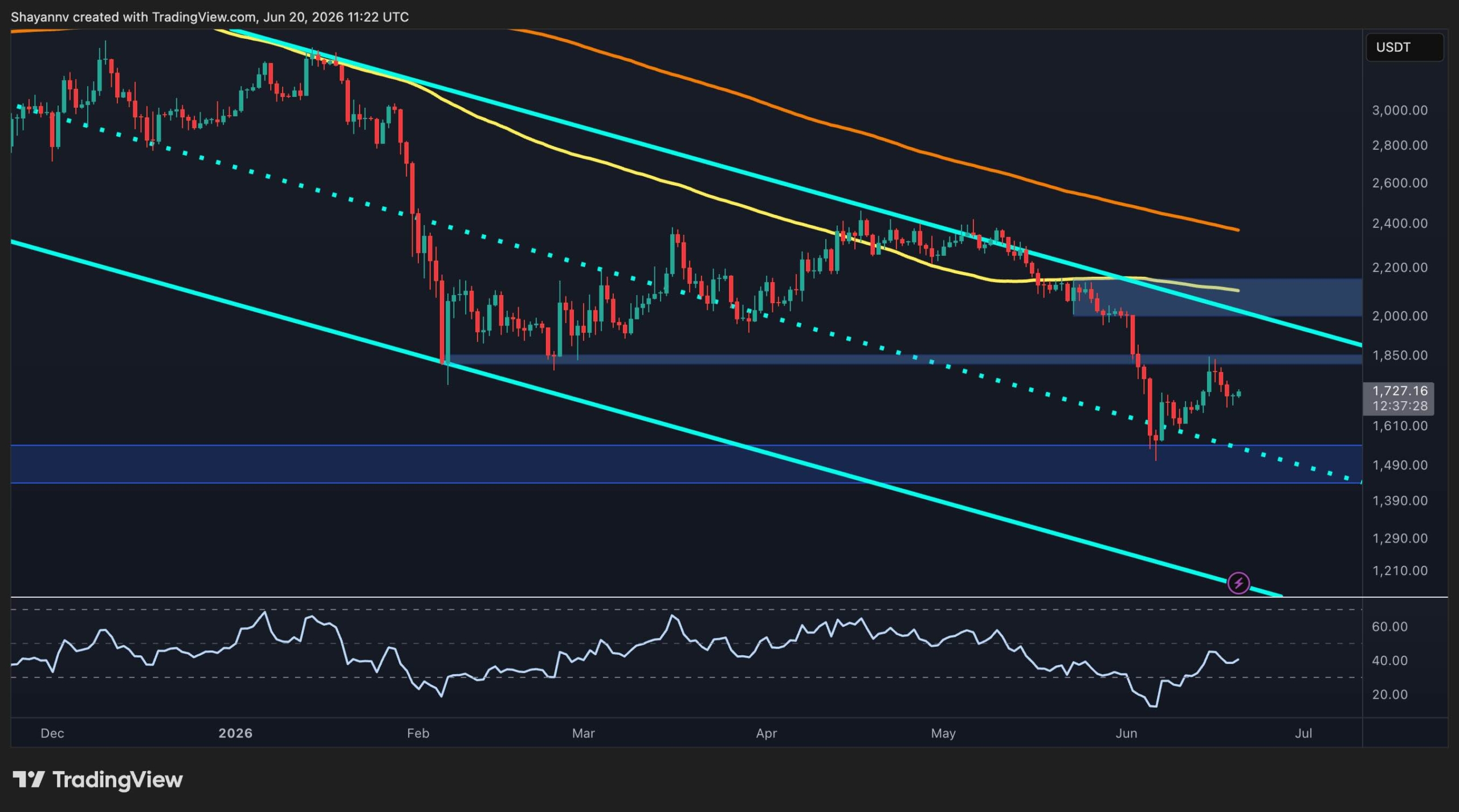
After finding support around $1.5K earlier this month, Ethereum has managed to stage a modest recovery. However, the asset remains positioned below critical technical barriers, and sentiment metrics indicate that buyers have not yet regained control of the market. The latter specifically shows a lack of strong institutional demand, suggesting that recovery attempts could face considerable headwinds.
Ethereum Price Analysis: The Daily Chart
On the daily timeframe, ETH remains firmly inside the large descending channel that has guided price action lower for several months. The asset recently broke below the important $1.85K support area, which has now flipped into resistance. The breakdown accelerated selling pressure toward the major demand zone at roughly $1.5K. This area, coinciding with the mid-line of the channel, has successfully halted the decline so far, producing a relief bounce back toward the $1.8K region.
However, the asset was rejected from the $1.8k zone, and the broader structure remains bearish as ETH continues to trade below both the 100-day and 200-day moving averages, which are sloping downward in the $2.1K-$2.4K range.
The former support zone around $2K now represents the most significant resistance cluster overhead. A recovery into that area would likely attract fresh selling interest unless accompanied by a decisive breakout above the descending channel.
Yet, as long as ETH remains below $1.85K and beneath the channel resistance, the prevailing trend favors sellers. A decline from current levels could expose the $1.5K support region once again, while a breakdown below that demand zone would open the door for a deeper drop toward the lower boundary of the channel below the $1.2K mark.
ETH/USDT 4-Hour Chart
The 4-hour timeframe shows a clearer picture. Following the sharp selloff into the $1.5K support area, ETH formed a rising channel and began carving out higher lows. This recovery structure allowed price to rebound toward the $1.8K resistance zone, where sellers quickly regained control and pushed the asset back lower.
The rejection from that resistance area confirms its importance in the near term. Since then, ETH has broken below the ascending channel and is consolidating around $1.7K. The RSI also currently hovers around neutral territory, indicating that bearish momentum has eased but has not yet shifted decisively in favor of buyers.
Immediate support remains at $1.5K, which served as the origin of the recent bounce. Yet, if the measured move of the broken ascending channel plays out, the market could drop well below this zone. On the upside, buyers must still reclaim the $1.8K resistance region to generate stronger recovery momentum. Yet, as things stand, the overall bearish sentiment is still dominant.

Sentiment Analysis
The Coinbase Premium Index continues to provide a bearish signal for Ethereum. This metric measures the price difference between ETH traded on Coinbase and other major exchanges, often serving as a proxy for U.S. institutional and spot demand. Positive readings generally indicate stronger buying activity from Coinbase participants, while negative readings suggest weaker demand and increased selling pressure.
The latest data shows the Coinbase Premium Index remaining predominantly below zero, with recent readings approaching -0.1. This marks one of the weakest periods of Coinbase demand seen since the beginning of last year. Notably, the deterioration in the premium has occurred alongside ETH’s price decline, which reinforces the view that U.S.-based investors have not yet returned aggressively to the market.
Historically, sustained recoveries in Ethereum have often been accompanied by persistent positive premium readings. Until the metric can reclaim and hold above the neutral line, order flow suggests that rallies may continue to face selling pressure rather than broad-based accumulation.

The post Ethereum Price Prediction: Can ETH Reclaim $2K Before Month-End? appeared first on CryptoPotato.

The European Commission has opened a public consultation on proposed updates to the EU’s Markets in Crypto-Assets (MiCA) framework, signaling that Brussels plans to refine how its landmark crypto rules address newer parts of the market. The consultation—initiated in May—comes as full application and enforcement of MiCA began on December 30, 2024, with the first licensing steps rolling out in the early months of 2025.
Some in the industry have already started calling the expected revision “MiCA 2.0,” with regulators aiming to tackle gaps left by the initial law. According to Katie Harries, director and head of policy for Europe at Coinbase, refinements could help keep the EU’s framework “competitive” as digital-asset regulation moves into a second phase—particularly for decentralized finance (DeFi), stablecoins, and tokenization-related activity.
Key takeaways
- Brussels’ consultation is structured to adjust MiCA’s scope and definitions, tighten rules for certain token categories, and broaden coverage to topics not addressed in MiCA 1.0.
- Stablecoin policy is expected to be highly political because the rules could change depending on whether stablecoins are treated like trading instruments or payment infrastructure.
- For DeFi, regulators are looking for practical ways to evaluate “how decentralized” a crypto-asset service provider (CASP) is, rather than treating decentralization as a simple yes-or-no concept.
- EU lawmakers are also seeking input on prediction markets, including whether existing EU regimes would apply and where potential conflicts between frameworks might arise.
- The consultation runs until Aug. 31, but industry observers expect the legislative process to take years, with concrete proposals unlikely before 2028.
MiCA set the baseline—now the EU wants to recalibrate
MiCA’s rollout marked the EU’s attempt to establish a unified approach across member states, replacing fragmented national rules. Harries told Cointelegraph that MiCA “helped set an early global benchmark for digital asset regulation” and gave the EU a “first-mover advantage” by delivering a single, harmonised rulebook for crypto.
In practical terms, Harries said the law is meant to give consumers more transparency and protection, while giving businesses enough regulatory clarity to plan investment and expansion across the bloc. For Coinbase, she added, MiCA has also served as a foundation to scale operations in Europe into the next stage of adoption for both retail and institutional users.
Even so, Brussels is now preparing changes ahead of revisions and additions to the framework. The Commission’s consultation is divided into four parts: updating regulatory scope and definitions for crypto assets other than asset-referenced tokens (ARTs) and e-money tokens (EMTs); setting requirements for EMTs, ARTs and their issuers; defining a legal framework for crypto-asset service providers (CASPs); and addressing areas that MiCA 1.0 did not cover—such as DeFi and prediction markets.
Stablecoins: the use-case determines the regulatory priority
One section of the consultation stands out for its potential downstream effects: stablecoins and related requirements. Catarina Veloso, director of regulatory and compliance at Notabene, described the stablecoin-focused part as the “longest and arguably the most politically charged” segment of the process.
Veloso noted that the way stablecoins are used—whether as a mainstream retail payment tool, a wholesale settlement rail, or as a supplement to existing cross-border payment methods—could heavily influence what rules the EU ultimately prioritizes.
In her view, if stablecoins are treated mainly as crypto trading instruments, regulators may concentrate on investor protection and market integrity. If they are treated more like payment infrastructure, the regulatory center of gravity shifts toward redemption mechanics, liquidity requirements, reserve management, operational resilience, and supervisory reporting.
That shift matters because the risk profile of stablecoins can vary depending on scale, who uses them, and where they sit inside the broader financial system. “What risks they carry,” Veloso said, “depend heavily on how they are used, at what scale, by whom, and in connection with which parts of the financial system.”
Coinbase’s policy priorities focus on making euro stablecoins more competitive within the EU rule set. Harries said Coinbase would like MiCA 2.0 to recalibrate elements including reserve rules, stablecoin rewards, and the multi-issuance model. She argued that allowing a larger share of reserves to be held in “high-quality sovereign assets” could reduce risk without undermining safety.
Another issue is rewards. Veloso pointed out that EMT issuers are currently prohibited from offering interest, which she said can weaken the competitiveness of euro-denominated stablecoins. In practice, that could push users either toward foreign-currency stablecoins or toward yield strategies that sit outside the regulated perimeter.
Harries said Coinbase wants MiCA to permit non-interest incentives—such as cashback and loyalty programmes—stating that these are common features in payments and may support consumer choice and competition.
DeFi under MiCA: regulators want measurable decentralization
A core limitation of MiCA 1.0 is that it does not cover CASPs that are “fully decentralized” and operate without intermediaries. But Veloso cautioned that decentralization is rarely binary in reality.
To build a workable policy, regulators need a way to assess the degree of decentralization and decide which indicators should matter. That includes whether the protocol is under particular control, who holds governance rights, the status of administrative keys, whether the front-end is controlled by a central party, who captures revenue, how upgrades are handled, and whether identifiable persons can materially influence outcomes.
Veloso also said regulators are looking for practical rules to determine when the EU should treat access to DeFi platforms as a regulated service. She explained that, even if platforms themselves are exempt because they are decentralized, the broader question is whether firms that connect users to those platforms should still conduct due diligence obligations vis-à-vis their clients.
Legal practitioners highlighted that this is already a live compliance question. Miroslav Đurić, a senior associate at Taylor Wessing, said many CASPs already connect clients with DeFi platforms, and because those platforms are exempt, regulators are now asking whether CASPs should meet fiduciary duty expectations through due diligence.
Đurić also noted that the Commission may consider different approaches, potentially including options that restrict client connections to DeFi platforms only if they are certified under a future certification regime.
Prediction markets: fitting them into EU frameworks may be tricky
Prediction markets are another area where MiCA’s initial scope is not fully settled. The EU currently lacks a unified regulatory structure for these markets, and they are banned in some member states.
The consultation seeks views on whether prediction markets provide economic benefits for consumers, and whether they should fall under MiCA or the Markets in Financial Instruments Directive (MiFID). Đurić said the answer depends on the specific contracts offered by each platform.
Because event contracts can have different characteristics, a platform operator could find itself subject to multiple, sometimes conflicting regimes—ranging from MiFID II rules to gambling-related regulation or potentially MiCA requirements—depending on contract structure.
Deadlines—and the long timeline ahead
Crypto industry observers say they plan to remain engaged with Brussels during the consultation process. Harries said an effective MiCA 2.0 will require ongoing “dialogue between industry, policymakers and regulators,” including learning from how the existing framework works in practice and refining parts where additional clarity or flexibility could support the next phase of growth.
While the comment period ends on Aug. 31, Đurić suggested the broader legislative process could take years. He said it is unlikely that concrete legislative proposals will be adopted before 2028, given both the complexity of the topics and the usual pace of EU lawmaking.
For market participants, the key next step is watching how regulators decide to translate stablecoin and DeFi policy questions into enforceable definitions—especially around how decentralization is assessed and how payment-versus-trading use cases shape the rules. Those choices will likely determine how quickly the EU’s second-phase framework can become operational for issuers, platforms, and intermediaries.
XRP remains under pressure across both its USD and Bitcoin pairs, with the asset continuing to trade within a well-defined bearish structure. While buyers have managed to defend key support levels in recent weeks, the broader trend has yet to show convincing signs of a reversal, as the token remains below major moving averages and the descending trendline resistance.
Ripple Price Analysis: The USDT Pair
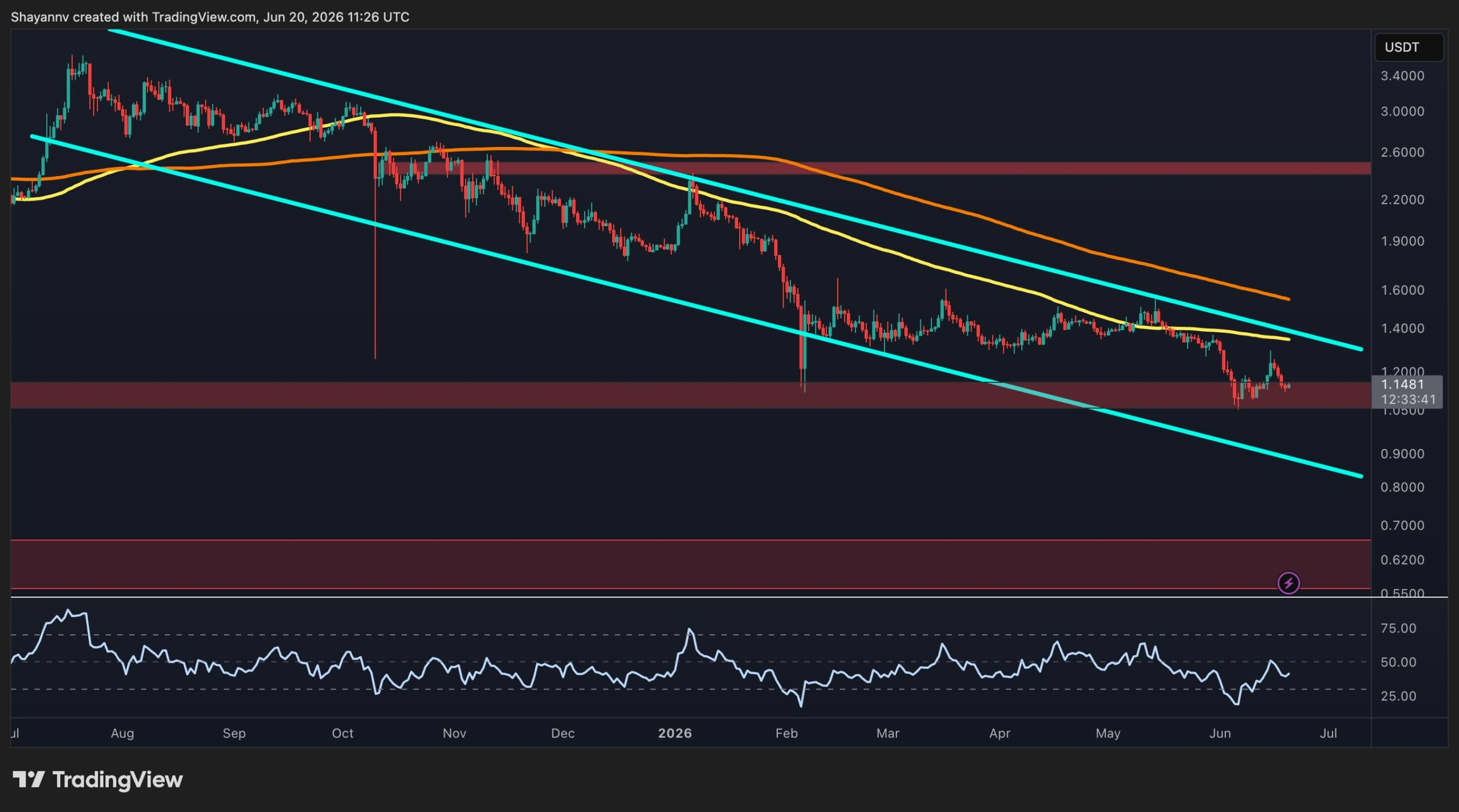
On the USDT pair, XRP continues to trade inside a large descending channel that has governed the price action since the second half of 2025. The recent decline pushed the asset back into the critical support zone around $1.1, where buyers have once again stepped in to prevent a deeper breakdown.
This area has acted as a major demand region throughout the current correction and remains the most important support level on the chart. A decisive loss of this zone could expose the next major downside target around the $0.60 region, which marks the next visible demand area on the higher timeframe.
On the upside, XRP is capped by several layers of resistance. The descending channel’s upper boundary currently coincides with the 100-day moving average near the $1.35 area, while the 200-day moving average is positioned higher around $1.75. Beyond that, the major supply zone at $2.5 remains the key level that buyers would need to reclaim to shift the long-term structure back in their favor.
Meanwhile, overall momentum remains weak. Although the RSI has stabilized above the oversold territory, it has yet to generate the type of bullish divergence or strength typically associated with a sustainable trend reversal.
As long as XRP remains below the descending channel resistance and the major moving averages, the broader market structure continues to favor sellers despite the recent stabilization.
The BTC Pair
The BTC pair paints a similarly cautious picture and highlights XRP’s ongoing relative weakness against Bitcoin. After a prolonged decline within a descending channel, XRP/BTC has recently entered a consolidation phase above the key support area around 1,720 SATs. This level has been tested multiple times since May and continues to attract demand, forming the base of the current range.
However, despite holding support, buyers have repeatedly failed to establish a sustained breakout above the nearby resistance zone around 1,850 SATs. This area coincides with the 100-day moving average and has acted as a ceiling throughout June.
If XRP/BTC loses the 1,720 SATs support floor, the next major demand area sits considerably lower around 1,500 SATs. Conversely, a successful breakout above the 1,850 SATs level could open the door for a move toward the next resistance region near 2,000 SATs, where additional supply is likely to emerge.
Still, the BTC pair suggests that XRP has yet to establish meaningful relative strength, reinforcing the cautious outlook visible on the USDT chart. Until buyers reclaim the nearby resistance levels and break the broader descending structure, rallies are likely to be viewed as corrective rather than the start of a new bullish trend.

The post Ripple Price Analysis: Where XRP Could Go Next After Its Weekly Rejection appeared first on CryptoPotato.
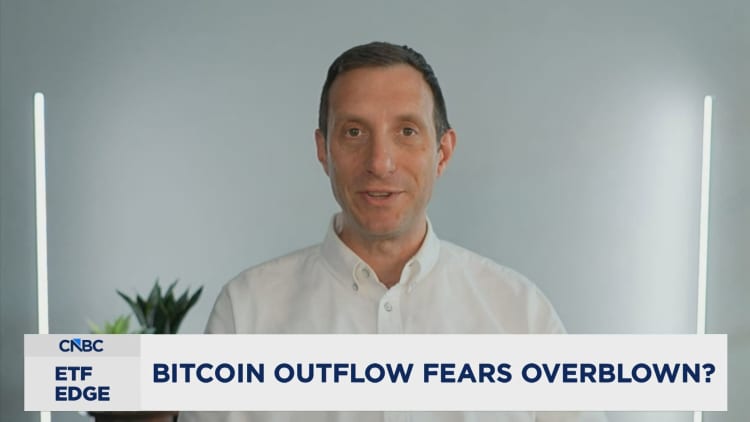

CoinDesk’s president of indices and data has a message for investors: Don’t count out bitcoin.
“When I got my first smartphone, which is a great example of a disruptive technology that has been incorporated into my life, I didn’t get the smartphone and say, ‘This thing is garbage because I can’t get a taxi in front of my home whenever I want it.’ I was very excited that I didn’t have to carry an MP3 player and my cellphone at the same time,” David LaValle told CNBC’s “ETF Edge” on Monday.
LaValle’s call comes during a rough time for bitcoin. The cryptocurrency is off almost 2% over the shortened holiday week. Plus, bitcoin is down almost 50% since its all-time high of $126,279 hit on Oct. 6, 2025, as of Thursday’s close.
Bitcoin crossed over the key level of $65,000 on Monday, but by Thursday it dipped back into the $63,000 range.

Bitcoin performance
Despite the losses, LaValle thinks the downturn, which is often referred to as a “crypto winter,” won’t permanently discourage institutional and retail investors from boosting exposure to the asset.
“As it pertains to the future of the digital asset, a lot has transpired, and there have been downdrafts over the past eight years,” he said. “Unlike previous crypto winters, this is like, ‘Hey, when do I get back in as opposed to whether or not there’s a future.’ We look at this as a point of credibility.”
TMX VettaFi’s head of research and editorial, Todd Rosenbluth, sees a promising trend among bitcoin ETF investors. He finds they’re largely holding onto them despite the ongoing market uncertainty, which is a sign of optimism.
The iShares Bitcoin Trust ETF (IBIT) “actually just crossed into the net outflows, despite bitcoin itself having been down for much of the year,” Rosenbluth said in the same interview. “So, people were still holding on, and in fact buying IBIT through the initial downdraft. That’s encouraging to me that people were holding on.”
He pointed to a VettaFi survey of 104 financial advisors in early May. According to Rosenbluth, it revealed where the firm’s clients stand on digital assets. It showed almost half of them were watching the stock from the sidelines while just 22% were actively investing or building.
“A [crypto] pullback has created a buying opportunity for some people. Others, it might reinforce that they don’t want to be near it when something sells off too strongly,” Rosenbluth said. “But I do think we’re going to see continued evolution of the demand.”
Meanwhile, the losses have been impacting some of the largest bitcoin ETFs, which includes the iShares Bitcoin Trust ETF and Grayscale Bitcoin Trust ETF (GBTC). They’ve fallen 40% over the past 52 weeks.


In May, the European Commission opened a comment period, seeking feedback on regulations for the cryptocurrency and blockchain industries.
The comment period will precede eventual revisions and additions to the Markets in Crypto Assets (MiCA) legislative framework. Some have already dubbed the expected new framework “MiCA 2.0.”
Katie Harries, director and head of policy for Europe at Coinbase, told Cointelegraph that there are several key areas where “refinements could help ensure the framework remains competitive in the next phase of digital asset regulation.”
With an updated version of EU crypto law, the crypto industry is looking for more regulatory clarity in DeFi, stablecoins and tokenization.
MiCA was just the first step
Full application and enforcement of MiCA rules began on December 30, 2024, with the first licenses issued in the first months of 2025.
While the legislative process was long and complex, the EU still managed to create a regulatory framework for crypto ahead of the United States. Per Harries, “MiCA helped set an early global benchmark for digital asset regulation and gave the EU a first-mover advantage.”
It represented an “important first move” for the EU which created a “a single, harmonised rulebook for crypto” among its member states. “It gave consumers greater protection and transparency, while providing businesses with the regulatory clarity needed to build, invest and grow across the bloc.”
Harries said that, for Coinbase, MiCA provided a foundation on which it can expand its business in Europe into “the next phase of adoption across both retail and institutional markets.”
Now, Brussels is looking to recalibrate its landmark legislation. The consultation is split into four parts:
- Regulatory scope and definitions for crypto assets other than asset-referenced tokens (ARTs) and e-money tokens (EMTs)
- Requirements for EMTs, ARTs and their issuers
- Defining legal framework for crypto-asset service providers (CASPs)
- Topics that MiCA 1.0 didn’t cover e.g., DeFi and prediction markets
Stablecoin discussion has regulatory consequences
Per Catarina Veloso, director of regulatory and compliance at Notabene, part 2, which would affect stablecoins, is “longest and arguably the most politically charged section of the consultation.”
How stablecoins are used, be it as a mainstream retail payment instrument, a wholesale settlement rail, or a “complement to existing payment methods for cross-border payments,” could have a significant effect on how stablecoin policy is made.
“If stablecoins are treated mainly as crypto trading instruments, the focus is likely to remain on investor protection and market integrity. If they are treated as payment infrastructure, then redemption, liquidity, reserve management, operational resilience and supervisory reporting become much more central.”
What risks they carry “depend heavily on how they are used, at what scale, by whom, and in connection with which parts of the financial system.”
Harries said that Coinbase would like to see MiCA 2.0 “make euro stablecoins more competitive by recalibrating rules around reserves, rewards and the multi-issuance model.” Allowing a greater share of stablecoin reserves to be held in “high-quality sovereign assets could reduce risk without compromising safety.”
Another aspect is stablecoin rewards. Currently, EMT issuers are prohibited from offering interest. But, per Veloso, “this can weaken the competitiveness of euro-denominated stablecoins and push users either toward foreign-currency stablecoins or toward yield structures outside the regulated perimeter.”
Harries said that “MiCA should allow non-interest incentives such as cashback and loyalty programmes, which are standard features across payments and help drive competition and consumer choice.”
Bringing DeFi and prediction markets into the fold
Presently, MiCA does not cover CASPs that are fully decentralized and operate without any kind of intermediary. Veloso noted that, while it sounds simple, “decentralisation is rarely binary.”
To form an informed policy around DeFi, EU regulators must know how to assess whether a CASP is fully decentralized and “what indicators should matter: control over the protocol, governance rights, admin keys, front-end control, revenue capture, upgradeability, or the ability of identifiable persons to influence outcomes.”
According to Miroslav Đurić, a senior associate at Taylor Wessing, many CAPSs already connect their clients with DeFi platforms. But since these platforms are exempt from MiCA, regulators are now asking “whether CASPs should meet their fiduciary duty vis-à-vis clients by conducting due diligence over DeFi platforms that they make accessible to their clients.”
“The Commission appears to be ready to explore different approaches incl. some that might only permit CASPs to connect their clients with DeFi platforms that are certified (under some new certification regime).”
Prediction markets are also a hot topic currently considered in the EU. Currently there is no unified regulatory structure, and prediction markets are banned in some countries.
The Commission is seeking comments on whether these offer any economic benefit for consumers, and whether they fall under MiCA or Markets in Financial Instruments Directive (MiFD).
Đurić said this will depend on the nature of the contracts themselves. “Depending on the event contracts available on the platform […] a platform operator can easily become subject to requirements stipulated under different, sometimes conflicting regulatory frameworks: ranging from MiFID II over gambling to MiCA regulatory framework.”
What’s next?
Crypto industry observers say they intend to remain in dialogue with Brussels throughout the process. Harries said that a new, effective MiCA will require “dialogue between industry, policymakers and regulators, learning from how the framework is working in practice and refining areas where greater clarity or flexibility can help support the next phase of growth across the region.”
The period for comment ends on Aug. 31, but according to Đurić, the total process could take years.
“Given the level of complexity of the points raised in the consultation as well as the usual pace at which the EU legislative process moves […] it is hardly expectable that any concrete legislative proposals will be adopted before 2028.”


Urbelis said he believes AI could eventually reshape the standard of care around smart contract development. Historically, teams could point to the cost and complexity of audits as a reason certain reviews were not performed. That argument becomes more difficult when sophisticated security analysis is available on demand.
“A clean AI report will be seen as no defense,” he said. “A plaintiff may well argue it the other way: the tool existed, it was cheap, and you should have caught it.”
The prospect raises broader questions for the industry: if AI-powered security reviews become ubiquitous, will investors expect them before funding projects, and could failing to run AI-assisted audits eventually be viewed as negligence?
Despite the technology’s promise, neither researcher said he believes AI is poised to replace human auditors.
While machines excel at identifying coding flaws, Urbelis said they remain weaker at spotting the economic and incentive-based vulnerabilities that have contributed to some of crypto’s largest losses. “The bugs that drain treasuries often turn on intent and adversarial incentives,” he said. “Those still need an experienced human in the room.”
Schwed offered a similar warning. “‘Claude, audit my smart contract, make no mistakes’ is not a security program,” he said. “If the person running the tool can’t evaluate what comes back, you haven’t bought security, you’ve bought a false sense of it.”

Bitcoin’s next major leg down might not come from miners, ETF exodus, macro data, unknown large whales, or even wars and worsening economic conditions. Instead, it could be from the market’s largest and most famous corporate BTC buyer if it indeed turns into a recurring seller, as many critics and experts fear.
As such, we decided to ask ChatGPT about its take on the matter: how viable is the threat, and how low can BTC go if Strategy indeed begins disposing of some of its crypto holdings to pay off dividends or other expenses?
Is Strategy a Threat to BTC’s Price?
Consistent crypto critic Peter Schiff is not the only person who has sounded the alarm on Strategy’s strategy (no pun intended) to raise funds through its STRC to accumulate more bitcoin. Just earlier, we reported that a popular crypto analyst, Kaleo, warned that the company would need to sell at least 50,000 bitcoin in the next couple of years to fund dividend payments and other expenses.
ChatGPT warned that if the largest corporate holder of BTC indeed starts offloading more significant portions, not just the 32 units it sold several weeks ago, the initial market shock could send the asset tumbling toward multi-year lows at $52,000. That would be just the base-case scenario and first reaction, before a more profound correction driven by a deeper loss of confidence in Strategy’s capital structure could tumble bitcoin toward $45,000.
The popular AI solution noted that it’s highly unlikely that Strategy will offload “hundreds of thousands of coins,” but the real danger for the asset’s price will stem from the narrative shift.
“For years, Strategy was the market’s most reliable corporate buyer of bitcoin. When BTC dipped, investors expected Michael Saylor’s company to raise capital and buy more. That created a psychological floor. If the same market starts believing Strategy must sell BTC to service its own financial instruments, that floor can quickly turn into resistance.”
Why STRC Matters
Also referred to as Stretch, STRC is the company’s variable-rate perpetual preferred stock. Simply put, investors buy STRC for cash yield, while Strategy uses the capital raised through the instrument to support its bitcoin-focused balance sheet. It’s designed around a $100 stated amount.
The company can adjust the dividend rate to keep STRC trading close to that level. When the shares trade near or above $100, the model operates as designed: the company can issue more preferred shares through at-the-market programs, raise cash, buy more BTC, and keep the machine working.
When that $100 par breaks, the structure is in danger. At current prices of under $90, STRC is no longer behaving like a stable high-yield instrument. Instead, it trades at a meaningful discount relative to the level the firm wants to hold, creating several issues.
Strategy’s ability to issue more STRC becomes weaker as selling new shares below the intended $100 zone would violate the product’s design or signal that investors are demanding a much larger discount.
Additionally, the dividend rate may need to rise to attract buyers back. Lastly, instead of using STRC proceeds to buy more BTC, Strategy may have to utilize its cash reserves, common-stock sales, or, as threatened above, BTC sales, to keep dividends current.
The post What Happens to Bitcoin’s Price if the Biggest Corporate Buyer Becomes a Seller? appeared first on CryptoPotato.


Iran’s Khatam al-Anbiya Central Headquarters announced on June 20, 2026, that the Strait of Hormuz is closed to vessel traffic. The command cited alleged violations of the Islamabad Memorandum of Understanding by the United States and Israel.
This declaration directly challenges the recent de-escalation framework and reintroduces risks to global oil transit at a moment when markets had priced in relief.
The Official Declaration
Iran’s Khatam al-Anbiya Central Headquarters, which coordinates the Islamic Revolutionary Guard Corps and regular armed forces, issued the statement through state media.
It described the closure as the “first step” in response to breaches of the ceasefire agreement. The command warned that further measures would follow if aggression continues.
Iranian outlets including Mehr News carried the announcement.
Follow us on X to get the latest news as it happens
The Strait of Hormuz serves as a critical chokepoint. Approximately 20 million barrels of oil pass through it daily.
This volume accounts for roughly 20-25% of global seaborne oil trade. Significant liquefied natural gas exports from Qatar and the UAE also transit the waterway.
Historical disruptions in the region have driven sharp spikes in energy prices and shipping costs worldwide.
The post Iran Closes Strait of Hormuz, Shattering Fragile Ceasefire appeared first on BeInCrypto.

Jelly Roll Trolls Haters With Shocking Divorce ‘Plot Twist’

FRM Unit-4 Problematic Full Revision | Financial Risk Management | OU MBA Semester-4 | 100% Pass

(VIDEO) Benny Blanco’s Half-Shaved Haircut Sparks Viral Reactions, Fans Say They Feel for Selena Gomez

Blockchain.com files with SEC for U.S. IPO

No Jackpot Winner as $257 Million Prize Rolls Over to $269 Million Monday Draw

Israel says it has killed new Hamas military leader in Gaza City airstrikes
FRM Unit-4 Problematic Full Revision | Financial Risk Management | OU MBA Semester-4 | 100% Pass

Ripple ENTERS SWIFT BACKDOOR, XRP AUTO-Bridging is KEY, DTCC Unveils PROCESS to Quadrillions

You need to believe in #business and financial education. That change in mindset will make you great
-
 Business6 days ago
No Jackpot Winner as $257 Million Prize Rolls Over to $269 Million Monday Draw
-

 Fashion23 hours ago
Weekend Open Thread: Miami – Corporette.com
-
Crypto World6 days ago
Zimbabwe Requires Crypto Businesses to Register Annually Under New FIU Regulations
-
 Entertainment6 days ago
Matt Damon’s Viral Sci-Fi Thriller Has Taken Over HBO Max
-

 Tech6 days ago
As AI companies race to go public, who else is along for the ride?
-

 Business6 days ago
Anthropic staff to meet White House officials next week, Axios reports
-
 NewsBeat6 days ago
what doctors are seeing in ebike crashes
-
 Crypto World6 days ago
Bitcoin could crash to $48,000, if this historical pattern is triggered
-

 Entertainment7 days ago
Deion Sanders Shares Powerful Post After Viral Advice To Deiondra
-
 NewsBeat6 days ago
Warning of disruption as Cardiff Crossrail works to start
-
 NewsBeat6 days ago
Tributes to former deputy head teacher at Cambridge school among death and funeral notices
-

 Politics6 days ago
“Israel’s” ban on ICRC visits ruled illegal, but Knesset moves to stop them permanently
-

 News Videos6 days ago
Financial Accounting | Last Day Revision Strategy and Booster | CMA Inter – June 2026
-
 Entertainment6 days ago
Kate Middleton Glare Goes Viral After Kids Booed At Royal Event
-

 Tech6 days ago
Over 400 Arch Linux packages compromised to push rootkit, infostealer
-

 Crypto World6 days ago
XRP ETFs Outperform As Bitcoin And Ethereum Funds Extend Outflow Trend
-

 Business6 days ago
Invesco Quality Income Fund Q1 2026 Commentary
-

 NewsBeat6 days ago
Singer Oliver Tree dies aged 32 in helicopter crash in Brazil
-
 Crypto World6 days ago
Market Preview: SpaceX (SPCX) IPO Record, Federal Reserve Meeting, and Iran Nuclear Agreement
-

 Sports6 days ago
Dick Advocaat’s Curacao scores first-ever World Cup goal against Germany
You must be logged in to post a comment Login