
Crypto World
Why Bitcoin-backed loans need qualified custody and no rehypothecation, according to Arch Lending CTO



Arch Lending co-founder Himanshu Sahay has identified qualified custody, zero rehypothecation, and clear collateral rules as three safeguards needed to reduce risks in Bitcoin-backed lending.
Summary
- Bitcoin-backed loans give long-term holders access to cash without requiring an immediate sale.
- Sahay said independent custody and zero rehypothecation can limit operational and counterparty risks.
- Borrowers still face interest charges, margin calls and liquidation when Bitcoin’s price falls.
- Celsius, BlockFi, and Genesis showed how opaque lending structures can leave customers exposed.
Himanshu Sahay, co-founder and chief technology officer of Bitcoin-backed lending platform Arch Lending, told crypto.news that wealthy Bitcoin holders are increasingly using loans to meet cash needs while keeping their exposure to the asset.
“For long-term Bitcoin holders, borrowing can provide liquidity without requiring them to sell their position,” Sahay said.
Individuals may use the proceeds for another investment or personal expenses, while family offices and businesses can borrow for working capital, according to Sahay. The arrangement allows the borrower to retain ownership of their Bitcoin unless the loan terms trigger a collateral sale.
A recent report on lending found that demand for Bitcoin-backed credit has recovered as investors look for liquidity without selling their holdings. The report said lending platforms have responded to the failures of 2022 by adopting clearer custody arrangements, plainer disclosures and more conservative risk controls.
Bitcoin-backed loans provide cash without an immediate sale
For US investors, selling appreciated Bitcoin generally requires the holder to calculate a capital gain or loss. The Internal Revenue Service treats digital assets held for investment as capital assets and requires taxpayers to report gains or losses when they sell or otherwise dispose of them.
Using Bitcoin as loan collateral does not involve the same immediate sale. Tax treatment can change, however, if the lender liquidates some or all of the collateral, while individual circumstances may create other reporting issues. The IRS advises digital-asset investors to consult a qualified tax professional when determining how a transaction should be reported.
Sahay did not present borrowing as a way to remove financial risk. Interest costs increase the amount that must be repaid, while a drop in Bitcoin’s price can raise the loan-to-value ratio, or LTV, until the borrower faces a margin call.
“Borrowing is not risk-free. It comes with interest costs, margin-call risk, and potential liquidation if the value of the collateral falls.”
Under a typical Bitcoin-backed loan, the LTV compares the outstanding debt with the current value of the pledged Bitcoin. If the asset declines enough, the borrower may need to add collateral or repay part of the loan. Failure to meet the lender’s requirements can lead to the sale of some or all of the Bitcoin.
Artem Ponomarev, founder and CEO of XPlace, made a similar case in an Aug. 18 interview, calling for safer borrowing tools built around conservative LTV limits, continuous collateral monitoring and clear liquidation terms. Ponomarev said borrowers should understand what will happen if their collateral loses value before taking out a loan.
Qualified custody separates collateral from the lender
Sahay described custody as the foundation of a properly structured Bitcoin-backed loan because it determines who controls the private keys and what can happen to the collateral during the loan term.
“At Arch Lending, collateral is held with Anchorage Digital Bank, a federally chartered U.S. bank and qualified custodian,” Sahay said. “Arch Lending does not hold the private keys, and borrower collateral is not rehypothecated.”
The Office of the Comptroller of the Currency granted Anchorage Digital Bank a national trust bank charter in January 2021. According to the OCC, Anchorage received approval to perform fiduciary, agency, and custodial activities after agreeing to capital, liquidity, and risk-management requirements under an operating agreement.
Federal oversight has not placed Anchorage beyond regulatory action. In April 2022, the OCC issued a consent order after finding that the bank had failed to adopt and implement a compliance program that met Bank Secrecy Act and anti-money-laundering requirements. The regulator required Anchorage to appoint a compliance committee and improve its customer due diligence, suspicious-activity monitoring, and independent testing.
Qualified custody is intended to place the assets with an institution that operates under defined regulatory and control requirements. Sahay said the arrangement can reduce operational risks involving private-key management, unauthorized transfers, and the separation of borrower assets.
Custody does not protect a borrower from a falling Bitcoin price, according to Sahay. It also does not prevent a liquidation carried out under the loan agreement after the collateral crosses a specified LTV level.
According to Arch’s website, Anchorage holds collateral in individually segregated wallets, while Arch does not lend, stake, or trade the pledged assets. The company also advertises up to $100 million in insurance coverage through Anchorage, although such insurance applies to specified custody and operational events rather than losses caused by Bitcoin price declines or contractually permitted liquidations.
Arch’s website lists initial Bitcoin LTV ratios of up to 60%. It says borrowers receive warnings and margin calls as the ratio rises, with partial liquidation available to restore the loan to its required level. Exact thresholds and terms can vary by product and loan agreement.
No rehypothecation limits connected lending risks
Rehypothecation occurs when a lender or custodian reuses pledged collateral in another loan, trade or investment. Sahay said a no-rehypothecation policy prevents a borrower’s Bitcoin from being deployed elsewhere while it secures the original loan.
“No rehypothecation protects against a different risk: the collateral being lent out or deployed elsewhere,” he said.
Reusing collateral can expose a borrower to additional counterparties because the lender may depend on another institution to return the assets. If the receiving institution defaults or freezes withdrawals, the original lender may be unable to return the Bitcoin even when the borrower meets the loan obligations.
An October 2025 report on a multi-signature Bitcoin platform described another structure intended to prevent rehypothecation. The Sygnum and Debifi product placed collateral in a wallet requiring approval from three of five signatories, including the borrower, the bank, and independent parties, before the Bitcoin could move.
Sahay said borrowers should examine several parts of a lending agreement rather than rely on one safeguard. Relevant questions include who holds the Bitcoin, whether collateral can be reused, how the lender funds the loan, which LTV thresholds apply, and what happens if either party encounters financial trouble.
Independent custody and no rehypothecation address different risks. Custody controls who can authorize a transfer, while the loan contract determines whether the lender has permission to deploy the collateral. Asset segregation and bankruptcy remoteness involve separate legal questions about whether creditors could claim the Bitcoin if the lending company failed.
The 2022 failures exposed opaque lending structures
According to Sahay, the collapse of Celsius, BlockFi, and Genesis showed why custody, lending, and asset deployment should not be combined without clear disclosures.
“Many of the failed lenders combined custody, lending and asset deployment in ways that made it difficult for customers to understand where their collateral was or how much risk was being taken with it.”
The Federal Trade Commission alleged in July 2023 that Celsius took title to more than $4 billion in customer crypto deposits. According to the agency, Celsius used customer assets to fund its operations, pay rewards, borrow from other institutions, and make risky investments despite telling users that deposits were safe and available.
BlockFi’s problems also extended beyond custody. In February 2022, the Securities and Exchange Commission charged the lender with failing to register its retail interest accounts and making false and misleading statements about the collateral backing institutional loans. BlockFi agreed to pay $100 million to the SEC and 32 US states before filing for bankruptcy in November 2022 following its exposure to FTX.
Genesis Global Capital suspended withdrawals that same month and filed for Chapter 11 protection in January 2023. In May 2024, the New York attorney general secured a $2 billion settlement intended to support recoveries for affected investors and barred Genesis from operating in the state. The attorney general said at least 29,000 New Yorkers had placed more than $1.1 billion into the Gemini Earn program connected to Genesis.


It isn’t clear if an increase in cannabis use, for example, is driving some of the decline. “We don’t know if it’s a substitution, but that’s a question we need to answer,” Toomey says.
Saad, of Gallup, says there could be political factors at play too. According to the new Gallup poll, alcohol use has declined significantly among Republicans and Independents, while Democrats’ alcohol consumption has remained virtually unchanged since 2023.
“It could be worth looking into what kind of political messaging is going on, and if it’s more effective among Republicans and Independents than Democrats,” Saad says.
She notes, however, that “we haven’t seen strong anti-alcohol messages out of the [Trump] Administration.” In January, the administration released updated dietary guidelines that no longer specified a daily limit for alcohol consumption.
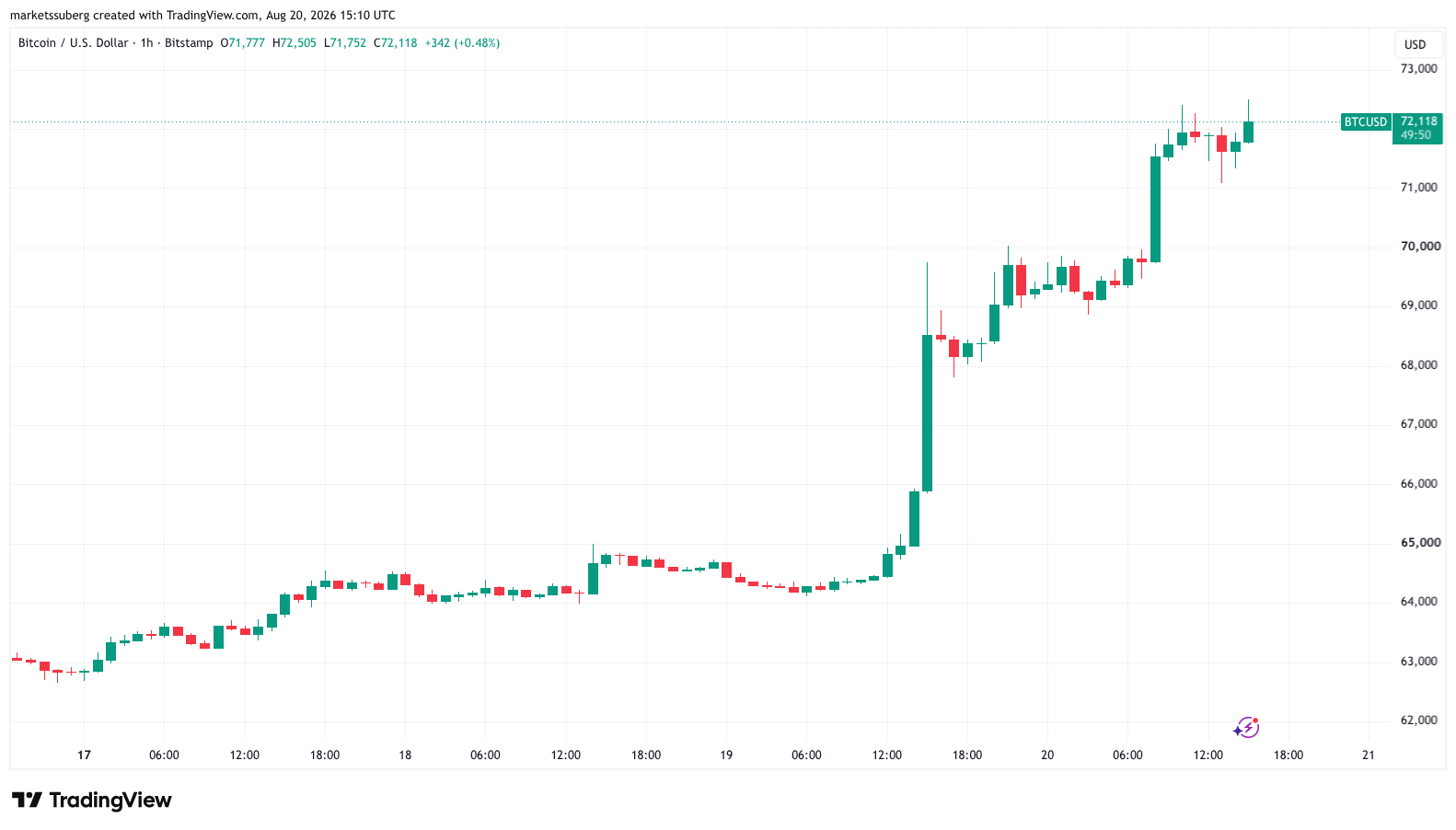
Bitcoin (BTC) saw multimonth highs after Thursday’s Wall Street open while stocks dipped and bond yields rebounded on US-Iran war nerves.
Key points:
- Bitcoin builds on its highest levels in 11 weeks to hit $72,500 on Bitstamp.
- US bond yields see volatility after president Donald Trump threatens “economic warfare” with Iran.
- Bitcoin market participants question whether the rally has staying power.
US bond yields reverse higher after Trump pledges “economic warfare” with Iran
Data from TradingView showed BTC/USD retesting $71,000 before hitting new 11-week high of $72,505 on Bitstamp, up by more than 4% on the day.
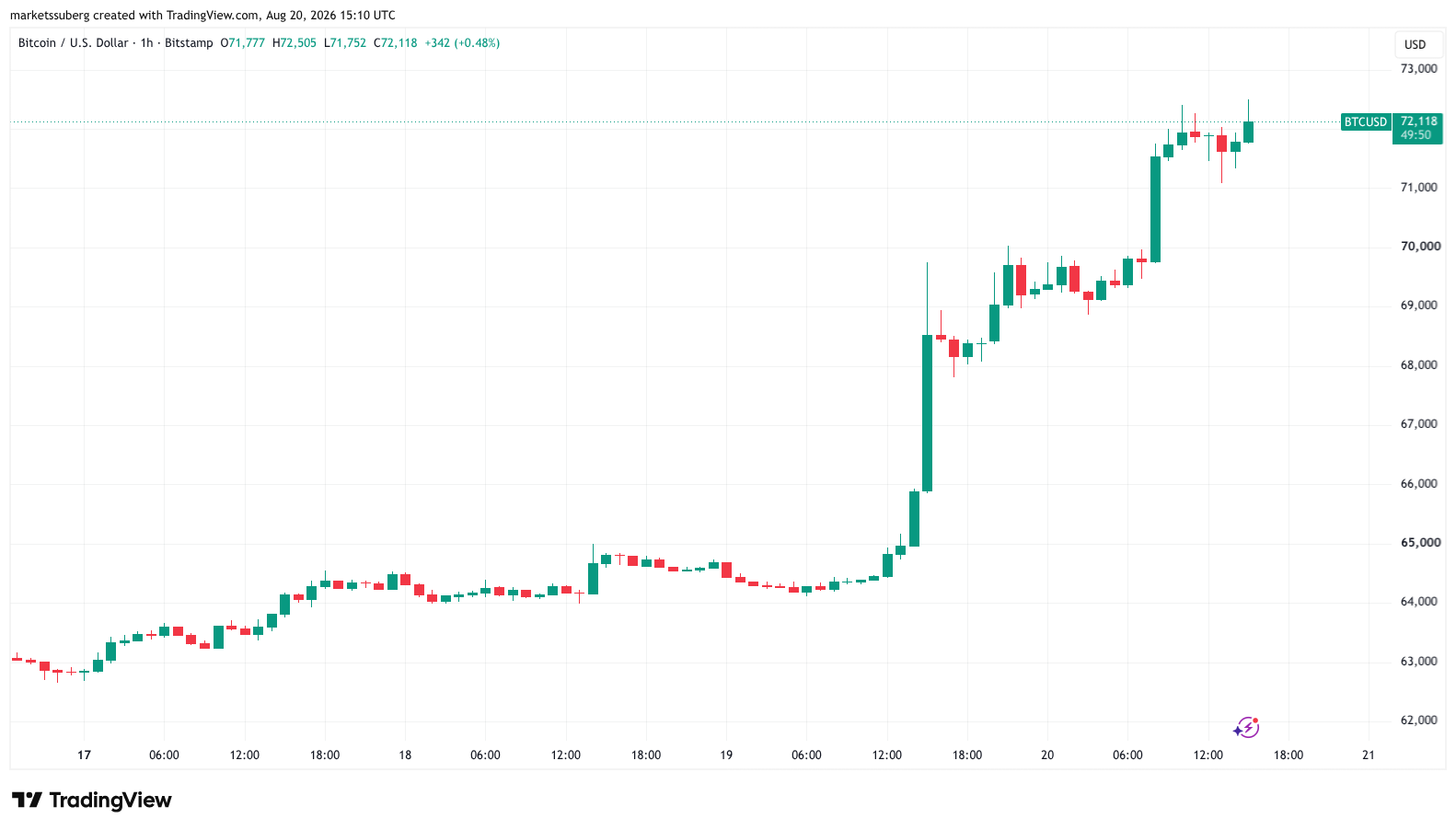
BTC/USD one-day chart. Source: Cointelegraph/TradingView
US equities opened lower after US president Donald Trump threatened Iran with the “most crushing economic operation ever taken against any country,” calling it “Economic D-Day.”
“This will be economic warfare and isolation on an unprecedented scale,” he wrote in a post on Truth Social amid frustration over the lack of a deal with the US on the Strait of Hormuz oil route.
WTI crude oil reached $87.69 per barrel on the day, its highest since July 24.
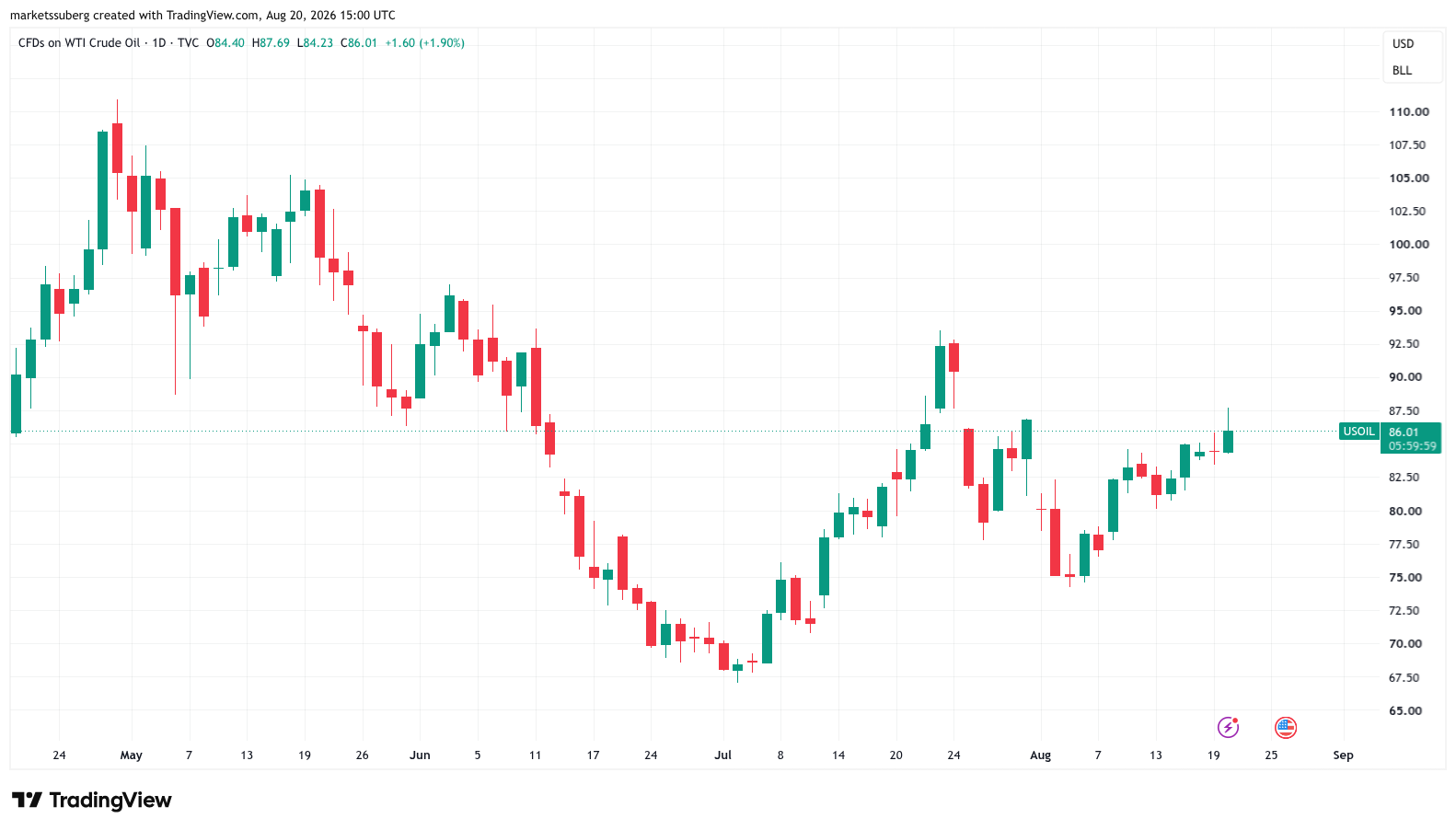
CFDs on WTI crude oil one-day chart. Source: Cointelegraph/TradingView
The comments further appeared to cause a rebound in US government bond yields, which had fallen sharply the day prior after the US Treasury announced that it would at least double the size of its bond-market liquidity interventions from September.
The 30-year yield traded as low as 5.179% on the day before rebounding to 5.266% — an increase of 9 bps, which nearly erased the previous downside. The 10-year bond yield also reversed the previous day’s drop.
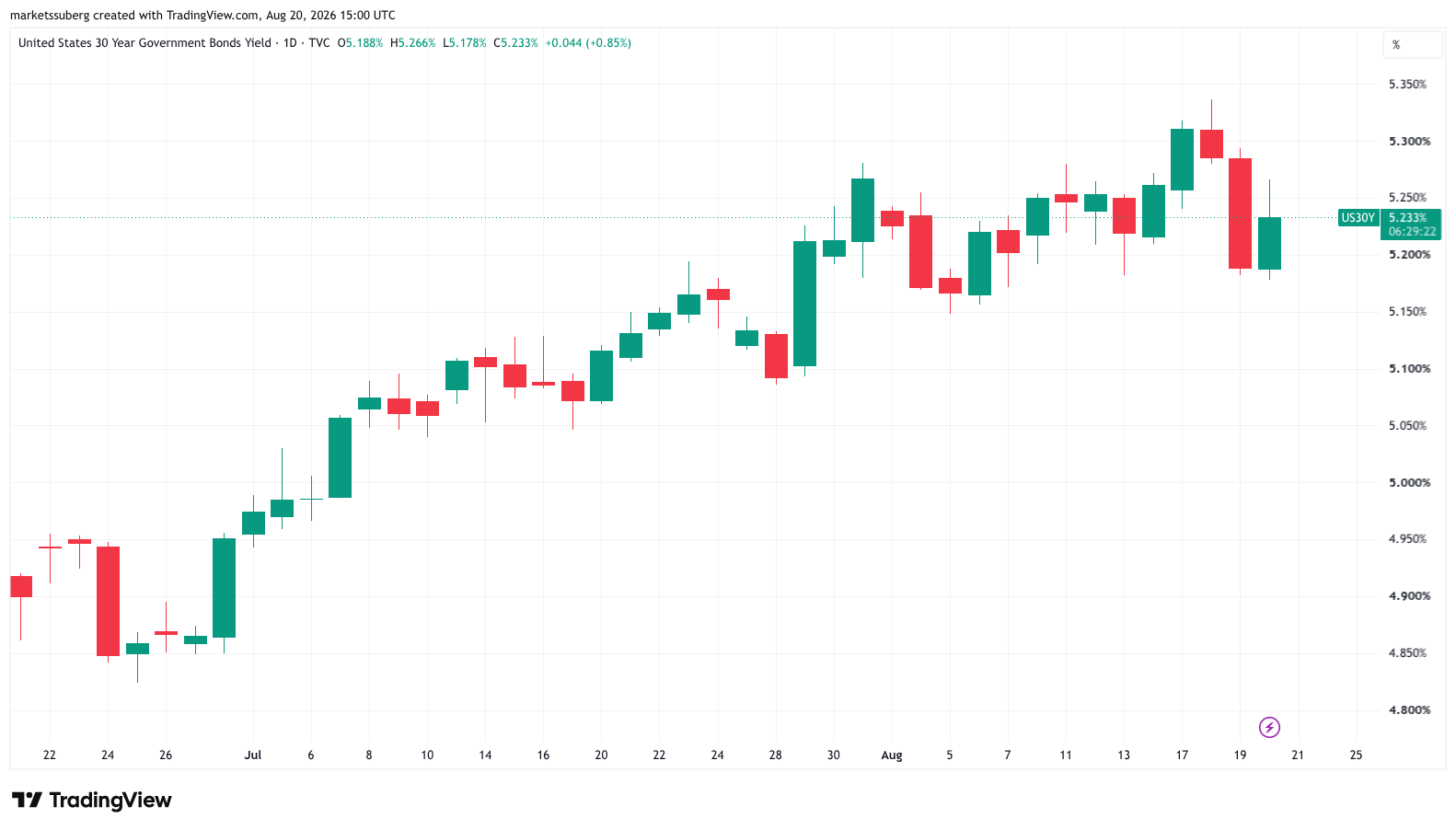
US 30-year bond yields one-day chart. Source: Cointelegraph/TradingView
The Kobeissi Letter cast doubt on whether the intervention would be sufficient to calm markets.
“It’s going to take a lot more intervention to tame this beast,” it wrote in a post on X. The Treasury confirmed in its announcement that it would revisit the size of debt buyback operations on Nov. 4.
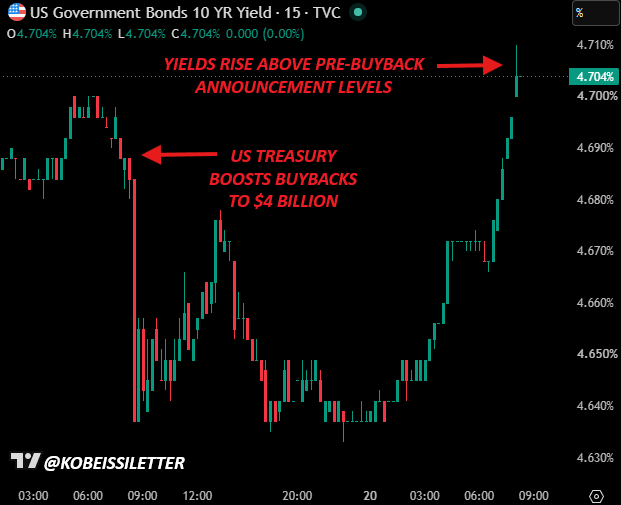
US 10-year bond yields chart. Source: The Kobeissi Letter on X.com
Analysis: Too early to call Bitcoin bull-market comeback
After gaining nearly $10,000 over four days, Bitcoin left market participants skeptical about the durability of its newfound strength.
Related: Bitcoin has ‘largely purged’ froth that preceded 50% drop from $126K: BlackRock
In ongoing X coverage, trader and analyst Rekt Capital argued that BTC/USD would need to sustain its gains to challenge the grip of the bear market.
“Bitcoin will need to rally a lot more than what it has produced thus far if price is to invalidate the ‘weakening support’ idea. At the moment, technicals are pointing to $60k as a weakening macro support,” he wrote on Thursday.
A further post noted that four-year BTC price cycle patterns would allow for a new macro BTC price low until the end of 2026.
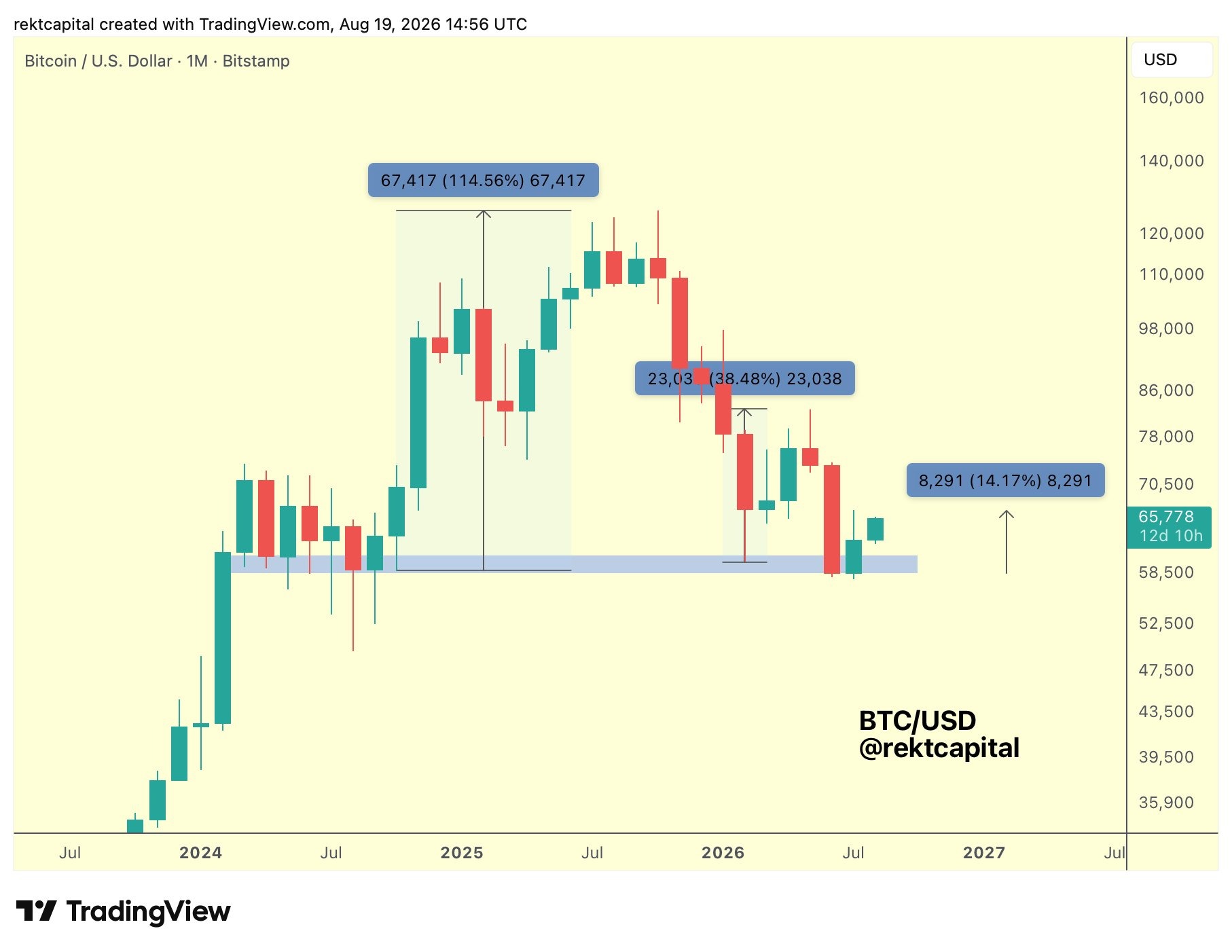
BTC/USD one-month chart. Source: Rekt Capital on X.com
Continuing, Ki Young Ju, CEO of onchain analytics platform CryptoQuant, flagged the return of positive demand for Bitcoin on both spot and derivatives markets — a phenomenon not seen since October 2025, when BTC/USD saw its most recent all-time high of $126,200.
“The scale remains modest, but if this holds for another month, it would be reasonable to conclude that the bear market is over and a new bull cycle has begun,” he told X followers.
Previously, Cointelegraph reported on the lack of spot demand as a key missing catalyst for a sustainable crypto market reversal.
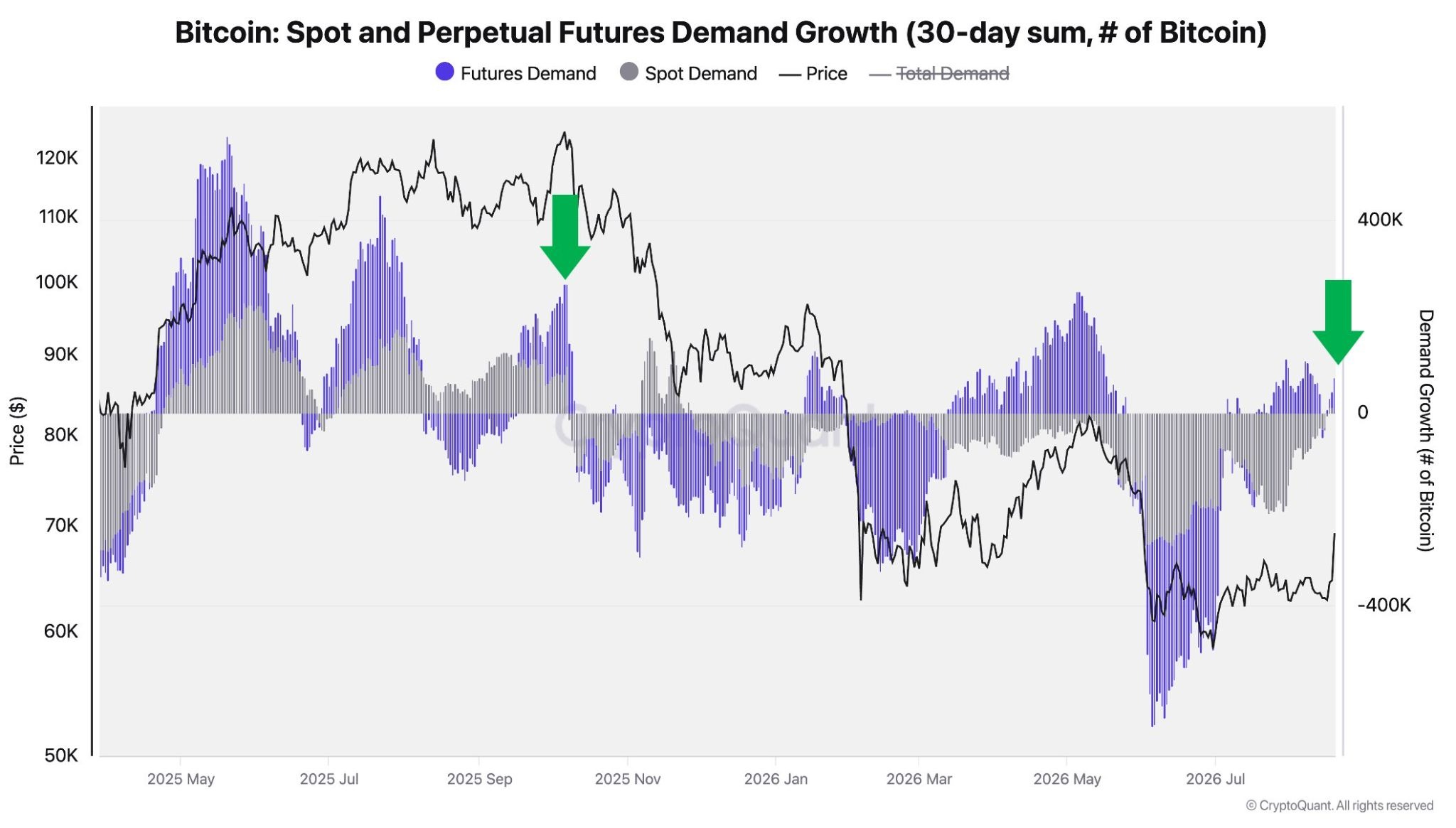
Bitcoin demand growth data. Source: Ki Young Ju on X.com

U.S. financial literacy scores are falling and researchers think they’ve pinpointed an overlooked factor in the plunge — the “smartphone penalty.” Research suggests smartphones lead to less engaged survey participants, and are therefore partly to blame for declining financial literacy scores on surveys conducted over the past 15 years. “We found that using a smartphone to answer survey questions leads…
Copyright ©2026 Investor’s Business Daily, LLC. All rights reserved. 87990cbe856818d5eddac44c7b1cdeb8


Commodity Futures Trading Commission Chairman Mike Selig told the inaugural gathering of the Innovation Advisory Committee that his agency won’t sit idle.


Coldcard has released firmware versions 5.6.1 and 1.5.1Q after a three-week security review, while warning that users with affected seed phrases must create new wallets and move their Bitcoin.
Summary
- Firmware 5.6.1 covers Coldcard Mk4 and Mk5, while version 1.5.1Q applies to Q devices.
- New seed creation now requires key presses, dice rolls, or coin flips supplied by the user.
- Installing the firmware does not repair seed phrases created under affected versions.
- Coldcard advised users to verify the signed update before generating a replacement wallet.
Coldcard firmware adds mandatory user entropy
Coldcard said in an Aug. 20 post that the latest release followed three weeks of review after its July 31 emergency fix, which addressed a flaw in how some versions of its firmware generated wallet seed phrases.
The Bitcoin hardware wallet maker released version 5.6.1 for its Mk4 and Mk5 devices and version 1.5.1Q for Coldcard Q. According to the company, the review covered the earlier seed-generation failure and several areas involved in transaction signing, device connections, firmware installation, and random-number checks.
Under the updated process, every new seed phrase must receive at least one source of randomness directly from the device owner. Users can provide it through at least 65 key presses with unpredictable timing, 50 private rolls of a physical six-sided die, or 128 physical coin flips.
Coldcard said the device combines that user input with fresh data from the STM32 true random-number generator and its two secure elements, known as SE1 and SE2. Requiring input from separate sources reduces reliance on any single component during seed creation, according to the company.
“Every newly generated seed now requires one source of user entropy,” Coldcard said.
Users must keep their key presses, dice results, or coin tosses private because anyone who records the inputs may gain information that could help reconstruct the resulting wallet. The company’s instructions treat its standard seed process separately from its advanced dice-only method, which has its own minimum requirements.
Existing Coldcard seeds cannot be repaired by updating
Installing the latest release only changes how Coldcard creates seeds after the update. The company warned that firmware cannot add missing randomness to a seed phrase that was generated previously.
Affected users must update their device first, create and verify an entirely new seed, and transfer their Bitcoin to addresses controlled by the replacement wallet. Importing the old words into updated Coldcard firmware, a different hardware wallet, or a software wallet preserves the same weakness because the underlying seed remains unchanged.
Coldcard advised users to record the replacement seed offline, confirm the wallet’s receiving address on the device screen, and complete a small test transfer before moving the full balance. Owners should keep the old backup until they have checked that the migration succeeded, but they should not continue using it to receive funds.
As reported on Aug. 2 by crypto.news, the official warning applies to seeds created on specific firmware versions rather than every seed ever produced by a Coinkite device. Mk2 and Mk3 seeds generated on versions 4.0.1 through 4.1.9 fall within the affected range.
For Mk4 and Mk5 devices, the advisory covers seeds generated before standard firmware 5.6.0 or Edge firmware 6.6.0X. Coldcard Q users are covered when their seeds were created before standard version 1.5.0Q or Edge version 6.6.0QX.
Mk1 devices are outside the firmware regression identified by researchers, while Coinkite products, including TAPSIGNER, OPENDIME, and SATSCARD, use different software and are not covered by the same disclosure.
Coldcard previously identified an exception for wallets whose owners added at least 50 fair, independent, and private dice rolls before their final seed words were produced. According to the company, the rolls supplied at least 128 bits of independent randomness. Users who cannot remember how many rolls they entered, used fewer than 50, or exposed the sequence were advised to migrate.
A BIP-39 passphrase can create another barrier between an attacker and a wallet, but Coldcard said a passphrase does not repair the seed itself. Owners of affected seeds were therefore told to replace the underlying recovery phrase even if they had added a strong passphrase.
Firmware 5.6.1 tightens signing and device boundaries
Beyond seed creation, the release adds staged verification of partially signed Bitcoin transactions immediately before signing. A partially signed Bitcoin transaction, commonly called a PSBT, lets a wallet review and approve transaction data without exposing its private keys to an online computer.
Coldcard said the new check divides PSBT verification into stages before the device produces a signature. The company also changed its default SIGHASH handling, which determines which parts of a Bitcoin transaction a signature covers.
Additional changes strengthen the boundaries around USB connections and firmware updates. The release also improves Delta Mode isolation, fixes backups involving the active wallet, and adds checks around random-number generator initialization and possible faults.
Users downloading the update were told to verify its digital signature before installation. Firmware signatures allow an owner to check whether a file came from Coldcard and whether it was altered after publication.
The release follows a seed-generation flaw introduced during a firmware change in March 2021. Block’s Bitcoin engineering and security team said affected software called a deterministic MicroPython fallback when creating wallet seeds instead of using the intended STM32 hardware random-number generator.
According to Block’s review, older Mk2 and Mk3 devices could produce seeds with about 40 bits of effective randomness, while vulnerable Mk4, Mk5, and Q devices received some input from a secure element but reached only about 72 bits. Both figures were below the intended 128-bit level, making some seeds practical to search offline.
An attacker who generated possible seeds could derive their Bitcoin addresses and compare them with public blockchain records. Finding a match would provide the private keys needed to transfer the funds without obtaining the physical device, learning its PIN, or attacking the Bitcoin network.
A subsequent analysis of the flaw detailed four suspected attack waves that removed an estimated 1,816 BTC from more than 5,200 addresses. Loss estimates have varied as researchers separated confirmed victim reports from addresses identified through transaction patterns.
Coldcard attack changed custody choices for US holders
The incident also affected how some Bitcoin owners approached custody. An Aug. 4 report on exchange inflows cited OKX Chief Compliance Officer Jonathan Brockmeier as saying the exchange recorded unusually high deposits after the Coldcard attacks.
“We’re seeing record levels of inflows now to centralized exchanges post-Coldcard,” Brockmeier said.
Moving Bitcoin to an exchange removes the owner’s direct responsibility for seed generation and storage, but it places control of the assets with a third-party custodian. US investors who only want exposure to Bitcoin’s price can also use spot Bitcoin exchange-traded funds, whose shares trade through regulated brokerage accounts while institutional custodians hold the underlying Bitcoin.
Galaxy Research said it shared suspected attacker addresses with exchanges, blockchain investigators, and US federal law enforcement agencies. The research firm also reported in early August that about 90% of the Bitcoin taken during the confirmed attack waves had not moved from the identified destination wallets.

It continued: “According to the allegations raised, upon the ambulance’s arrival at the scene of the incident, a shell was fired toward it, resulting in the deaths of the two paramedics travelling in it. Several days later, the bodies of the seven members of the Hamada family, including the bodies of Hind and Layan, were recovered from the vehicle. In addition, the bodies of the two paramedics were recovered from the ambulance.”
In a statement on Thursday, Hind Rajab’s mother, Wesam Hamada, said, “I do not want a closed military investigation. I want an independent, transparent investigation and genuine accountability for everyone responsible.”
What happened to Hind Rajab
The Hamada family was traveling through Gaza City on Jan. 29, 2024, after Israeli evacuation orders prompted them to leave the city’s Tel al-Hawa neighborhood, when their vehicle came under fire.
The girls contacted rescue authorities for help. Recordings released by the PRCS in February 2024 captured Layan speaking with an emergency dispatcher before gunfire was heard and the call ended.
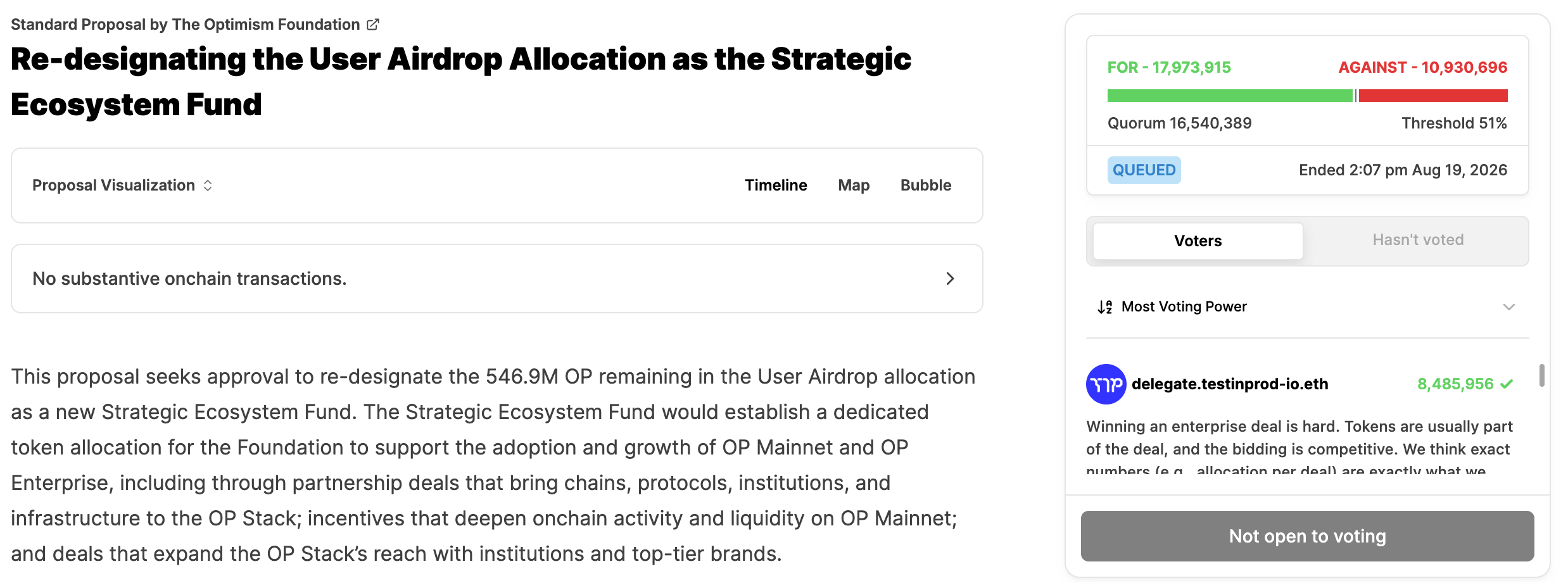
Blockchain Optimism’s governance has approved a proposal to repurpose 546.9 million OP tokens previously reserved for user airdrops to support ecosystem growth and institutional adoption.
OP currently has a market cap of roughly $214 million, with a circulating supply of about 2.29 billion tokens, according to CoinGecko data.
The new Strategic Ecosystem Fund will support partnerships with chains, protocols and institutions, as well as incentives to increase activity and liquidity on OP Mainnet and grow OP Enterprise.
The decision drew pushback from some delegates who argued the tokens had been promised to users and questioned how the foundation would measure returns from the fund. Supporters said the allocation would be better used to compete for enterprise deals and drive growth.
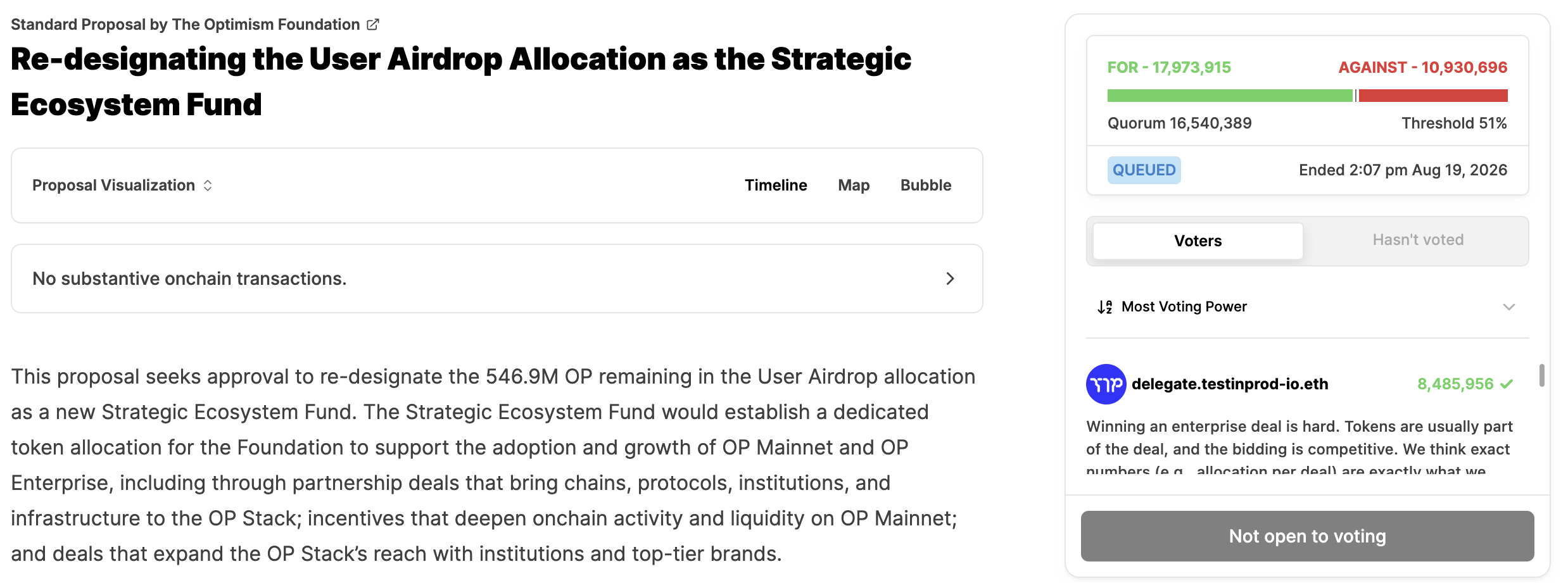
Optimism vote to repurpose 546.9M OP. Source: Optimism
Optimism said it has no additional airdrops planned after distributing 269.1 million OP across five rounds, contending that airdrops were better suited to an earlier phase focused on broad user acquisition than its current institutional push.
Optimism is an Ethereum (ETH) scaling project behind OP Mainnet and the OP Stack, the blockchain framework used by networks including Base, Unichain, Kraken’s Ink and Sony’s Soneium. More than 30 OP Stack chains currently contribute revenue to Optimism, according to the project.
OP rebounds 11% but remains 93% below record high
OP traded around $0.09 on Thursday, up roughly 11% over the past 24 hours amid a broader crypto market rally. Despite the rebound, the token remains more than 93% below its all-time high.
At OP’s current price, the 546.9 million-token allocation is worth around $50 million, equivalent to nearly a quarter of the token’s roughly $211 million market capitalization.
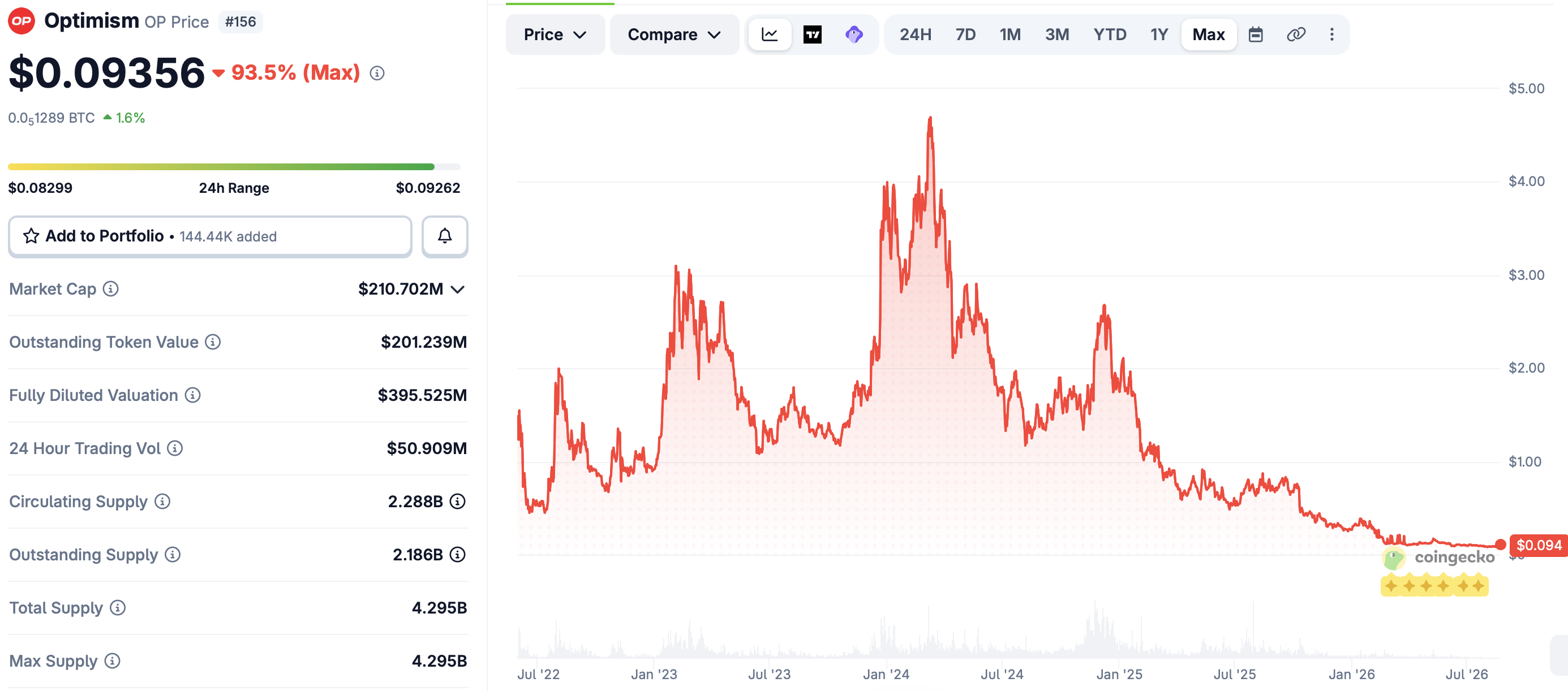
Source: CoinGecko
In July, Cointelegraph reported that the blockchain had signed a a memorandum of understanding with Viva Republica, the operator of South Korea-based mobile money transfer app Toss, to on a three-month proof-of-concept to test a Korean won-based stablecoin infrastructure for institutional payments.
Magazine: MiCA cracks down on USDT in Europe… but no one else cares
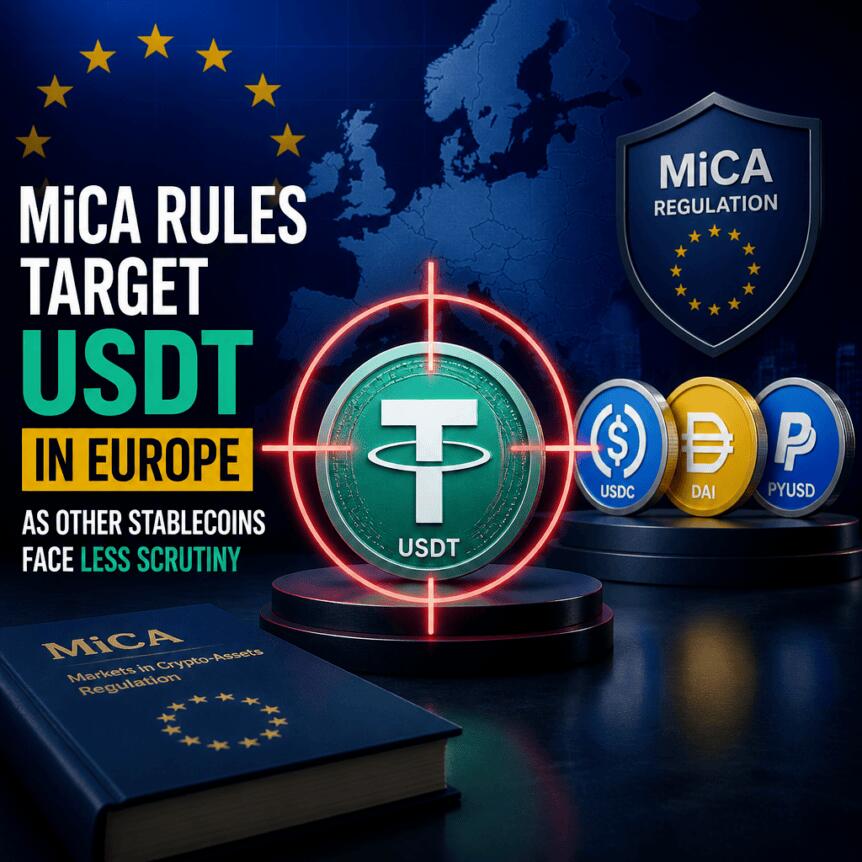
Europe’s regulatory squeeze on Tether’s USDT is moving beyond announcements and into platform-level implementation, but early data suggests it hasn’t upended global USDT usage.
When Revolut told European users it would delist USDT after Aug. 31, it reinforced a broader pattern: financial platforms are adjusting access to the world’s largest stablecoin as the EU’s Markets in Crypto-Assets (MiCA) stablecoin framework tightens. MiCA’s stablecoin rules have been phased in since 2024, and the EU-wide transition period ended on July 1, increasing pressure for platforms to remove offerings that don’t comply.
Key takeaways
- MiCA appears to be changing where regulated platforms can list USDT, but Artemis Analytics says it has not triggered a clear migration to other venues or chains.
- Artemis research quoted in the report indicates no noticeable shift in USDT supply or demand directly tied to MiCA coming into effect in Europe.
- Dollar stablecoin demand is increasingly tied to payments and cross-border transfers, not only trading or savings—making it less dependent on which exchanges list a particular token.
- Emerging-market stablecoin activity continues to expand, with chain usage on networks such as Binance Smart Chain and Tron rising in the period covered by Artemis data.
- For European users, the practical question shifts toward alternatives—potentially euro-denominated stablecoins—though the dollar still remains central to crypto’s benchmark.
MiCA pressure, but no obvious “migration” in USDT activity
MiCA’s stablecoin rules are designed to standardize and regulate issuers and offerings within the EU. As these requirements phase in—and deadlines pass—regulated gateways have been forced to reassess which stablecoins they can support legally.
However, a central point in the reporting is what hasn’t happened. According to Artemis Analytics, the restriction of USDT on a major European front hasn’t produced a measurable shock in broader USDT behavior.
“The data does not indicate any noticeable change in USDT supply or demand attributable directly to MiCA coming into effect in Europe… MiCA didn’t trigger a major venue or chain migration.”
In other words, while compliance has real consequences for retail access in Europe, USDT’s global utility may be resilient enough to absorb those changes without a dramatic reallocation of liquidity across major networks.
Why USDT demand is holding up: stablecoins as infrastructure
A key explanation offered in the piece is that USDT is being used for more than parking value or executing trades. In this framing, dollar stablecoins increasingly function as financial infrastructure—embedded in everyday movement of money, payments, and cross-border settlement.
The report points to Argentina as an illustrative case. Even as conditions around access to physical dollars have changed, stablecoin activity reportedly kept expanding. Lemon, an Argentine crypto and financial services platform, processed $9.3 billion in total volume in 2025—up 60% year-on-year. Transactional users reportedly rose 70% to nearly 1.8 million, and stablecoin volume grew 45% year-on-year.
Those figures are used to support a broader behavioral shift: stablecoins are increasingly treated as part of the payment rails rather than a purely defensive storage tool.
“The role of USDT and other dollar stablecoins is evolving. What we’re seeing is a shift from stablecoins as a store of value to stablecoins as financial infrastructure.”
The report attributes additional detail to Lemon’s business and planning manager, describing use cases that include payments, cross-border transfers, and connecting local users to international balances. The article describes a flow where Argentine users can pay in Brazil using PIX in pesos, receive dollars or euros from overseas credited as USDC, and also move between bank dollars and digital dollar balances. The point for readers: if stablecoins are operating across multiple payment paths and rails, their demand is harder to track solely through which tokens are available on regulated European platforms.
MiCA’s European “gateway” effect vs. global chain usage
Artemis data cited in the report also challenges the idea that MiCA would immediately restructure stablecoin usage on major chains. The article says Artemis observed daily users increasing on networks favored for low fees and day-to-day stablecoin use.
Specifically, the report states that daily users on Binance Smart Chain rose from about 318,000 in June 2024 to 1.56 million by July 2026. It also says daily users on Tron increased by 44% to around 908,000.
“That looks like expanding global and emerging market usage rather than a Europe-specific migration, and there’s no clear MiCA-timed break in the chain data.”
This distinction matters: it suggests MiCA is primarily changing how users in Europe access certain dollar stablecoins through regulated channels, not erasing the underlying demand for stablecoin settlement itself.
In the reporting, WeFi’s chief executive and co-founder Maksym Sakharov ties the behavior directly to utility. Users, the report argues, tend not to pick a stablecoin simply because it appears on a particular regulated platform. Instead, stablecoin choice is described as being driven by counterparty use, liquidity depth, and the ability to operate across markets.
“Users do not choose a stablecoin only because it is available on one regulated platform. They choose it because counterparties use it, liquidity is deep, and it works across many markets.”
The article also includes a perspective from OKX Europe’s chief executive, Erald Ghoos, saying OKX Europe has not offered USDT to European users for around two years. In that sense, the report frames the latest deadline as less of a fresh disruption for some platforms than for others that still maintained access later into the compliance cycle.
Europe’s alternatives and the dollar challenge
If USDT access on regulated EU gateways shrinks for some users and platforms, the next question becomes what those users switch to—and whether the alternatives can offer comparable liquidity and usability.
The report underscores a structural advantage the dollar has historically enjoyed in crypto: the US dollar remains the dominant benchmark across markets. Even though euro-denominated stablecoins may reduce friction for European end users by lowering the need for conversion, liquidity and network effects are unlikely to change overnight.
Still, the piece points to an emerging institutional interest in euro stablecoins. OKX Europe’s Erald Ghoos is quoted saying institutional players are showing increasing interest in creating more EUR-denominated stablecoins:
“What we are seeing from institutional players is interest in creating more EUR-denominated stablecoins, which is worth watching as it develops.”
MiCA determines which stablecoin products can be offered through regulated European platforms, but it cannot rewrite global crypto’s reference currency by itself. The report’s overall framing is that regulation may reshape the EU’s “front door,” while stablecoin demand—especially where it’s tied to cross-border flows—continues to follow deeper market utility and network adoption.
For investors and builders, the next thing to watch is whether USDT restrictions inside regulated EU channels lead to measurable changes in Europe-specific liquidity patterns over time—or whether usage simply routes through other networks and jurisdictions while stablecoin demand continues to grow globally. MiCA may be altering access, but the report suggests the larger stablecoin engine is still running on fundamentals tied to payments and interoperability.

Optimism governance has approved a proposal to redirect 546.9 million OP tokens—previously set aside for user airdrops—into a new initiative aimed at accelerating ecosystem development and institutional engagement.
On-chain approval also follows Optimism’s statement that it does not plan additional airdrops after distributing 269.1 million OP across five rounds. The decision is now a central point of debate among delegates over whether the foundation is moving from broad user acquisition to enterprise-focused growth early enough—and how success will be measured.
Key takeaways
- 546.9 million OP tokens earmarked for future airdrops will be repurposed to fund Optimism’s new Strategic Ecosystem Fund.
- Optimism says it has already completed its airdrop program, distributing 269.1 million OP in five rounds, and views airdrops as more suited to an earlier growth phase.
- The fund is designed to support partnerships and incentives intended to grow activity and liquidity on OP Mainnet and OP Enterprise.
- Some delegates raised concerns about broken promises to users and questioned how returns on the fund will be evaluated.
- At current levels, the repurposed allocation is roughly $50 million, depending on OP’s market price, according to CoinGecko.
Airdrop funds redirected into a strategic ecosystem budget
The governance vote approved the transfer of 546.9 million OP tokens into what Optimism describes as a new Strategic Ecosystem Fund. The intent is to shift resources toward ecosystem growth efforts that—according to the project—are better aligned with its current priorities around institutional adoption.
The proposal also signals a change in how Optimism is trying to compete. Rather than focusing on distributing tokens broadly to users, supporters argued the allocation could be used to strengthen relationships with chains, protocols, and institutions, and to offer incentives aimed at increasing on-chain activity and market depth.
However, the decision was not universally welcomed. Some delegates pushed back, arguing the tokens had been promised to users and raising questions about accountability. In particular, they wanted clarity on how the foundation would measure whether the fund delivers measurable outcomes rather than simply reallocating value.
The vote is recorded on Optimism’s governance platform: Optimism proposal.
Optimism says additional airdrops aren’t planned
Optimism stated that it has no additional airdrops planned after completing token distribution of 269.1 million OP across five rounds. The project framed this as a lifecycle transition: airdrops, it argued, are most useful during an earlier phase built around wide user onboarding, while its current stage emphasizes institutional and enterprise readiness.
That framing matters because it underpins the justification for repurposing the remaining allocation. If the airdrop program is considered complete, governance can treat the unused reserve as discretionary—while critics view the same reserve as a commitment that should be fulfilled later rather than redirected to new objectives.
Where the OP Stack revenue comes in
Optimism operates as an Ethereum scaling effort, including OP Mainnet and the OP Stack, a framework used by multiple networks. The article’s data points also highlight that Optimism’s broader economic model is not purely dependent on token incentives: the project says more than 30 OP Stack chains contribute revenue to Optimism. This revenue-linked ecosystem context is relevant to the fund debate because it suggests the foundation is trying to balance token-driven growth with platform-level earnings from chains built on its stack.
Optimism references its OP Stack ecosystem here: OP Stack.
Still, delegates’ concerns about measurable outcomes remain important regardless of revenue streams. A strategic fund can strengthen partnerships, but it also creates an additional channel where governance stakeholders will want evidence of effectiveness.
Token impact and broader market signals
Following the vote, OP reportedly traded around $0.09 on Thursday, up roughly 11% over 24 hours amid a broader crypto market rally. Even with the rebound, OP remains far below its peak—more than 93% under its all-time high, based on market tracking data.
CoinGecko data also places OP’s market cap at roughly $214 million with a circulating supply of about 2.29 billion OP. The same dataset implies the governance allocation—546.9 million tokens—is worth in the neighborhood of $50 million at current prices, or close to a quarter of the token’s reported market capitalization.
CoinGecko: OP on CoinGecko.
This matters for investors because token allocation votes can affect expectations about how the ecosystem will be funded and how quickly it can convert into growth. While a funding shift does not guarantee price movement, it can influence sentiment around whether a network is focused on sustainable activity and institutional adoption—or whether it is sacrificing user-facing promises for faster enterprise positioning.
Enterprise narrative under development
Optimism’s decision lands alongside ongoing enterprise-leaning activity. Earlier coverage from Cointelegraph noted that Optimism signed a memorandum of understanding with Viva Republica, the operator of South Korea’s mobile money app Toss, to test a Korean won-based stablecoin infrastructure for institutional payments over a three-month proof-of-concept period.
This is the kind of partnership angle the governance supporters are effectively betting on with the Strategic Ecosystem Fund: using OP resources to accelerate collaborations that can translate into real-world payment rails and institutional workflows.
Earlier coverage: Cointelegraph report.
Still, the governance pushback underscores the tension investors and users should watch: the network is trying to move toward enterprise growth, but delegates also want assurance that token commitments to users and the promise of earlier allocations are handled transparently.
Going forward, market participants will likely track whether Optimism provides clear reporting on how the Strategic Ecosystem Fund is deployed and what measurable milestones it targets—especially given the vote’s stated goal of growing activity and liquidity on OP Mainnet and OP Enterprise.
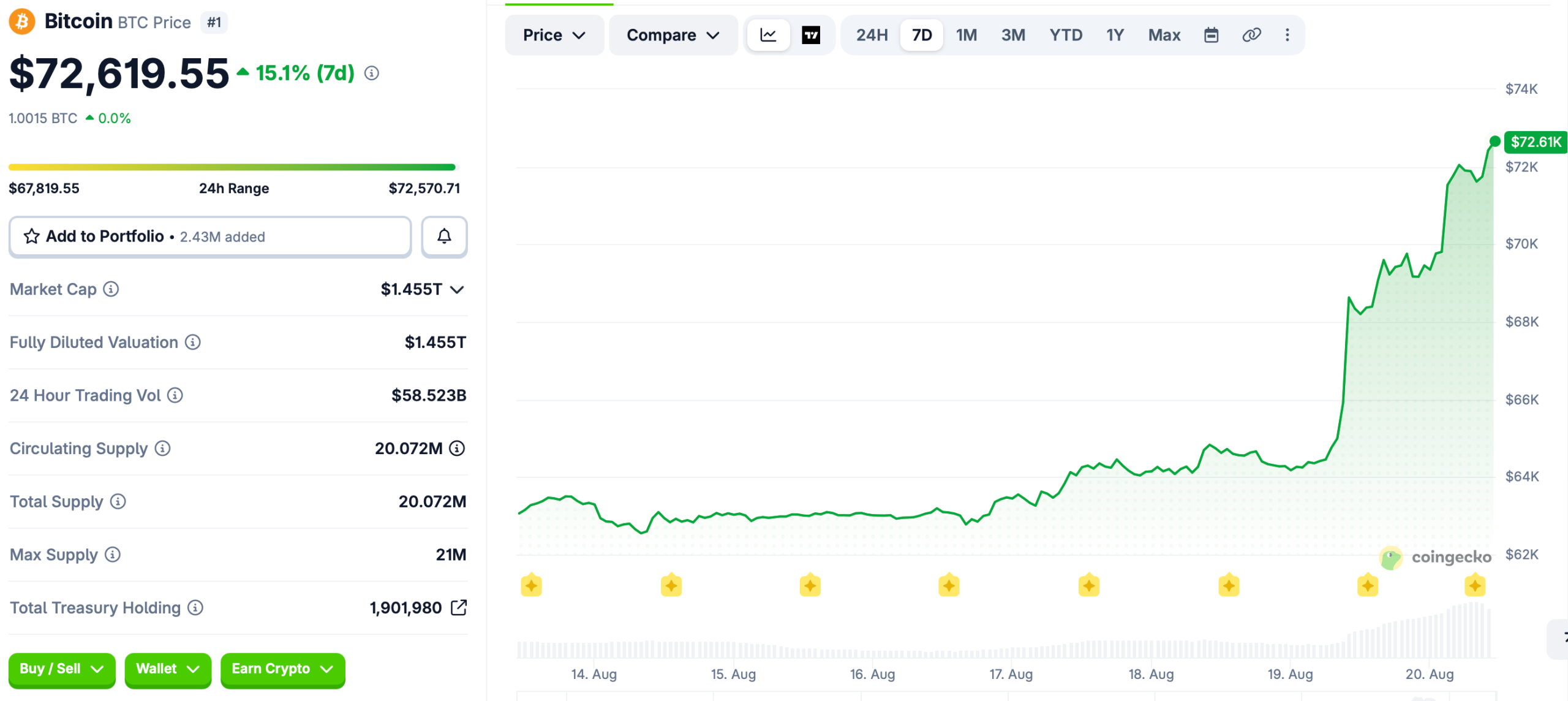
As US federal debt tops $40 trillion for the first time, there is renewed debate over whether mounting government borrowing could strengthen Bitcoin’s case as a scarce, non-sovereign asset.
Interest costs have also climbed, surpassing Medicare to become the federal government’s second-largest budget expense behind Social Security in the first 10 months of fiscal 2026, according to Reuters.
The debt milestone coincided with a Treasury move to calm a bond selloff that’s pushed long-term yields to their highest levels since 2007. Treasury Secretary Scott Bessent said Wednesday the department would double buybacks of 10- to 30-year debt to at least $4 billion per operation, initially pushing yields and the US dollar lower as Bitcoin (BTC) and gold rallied.
Bitcoin is continuing to surge, trading around $72,600 on Thursday morning, up roughly 6% over the past 24 hours and 15% over the past week, according to CoinGecko data.
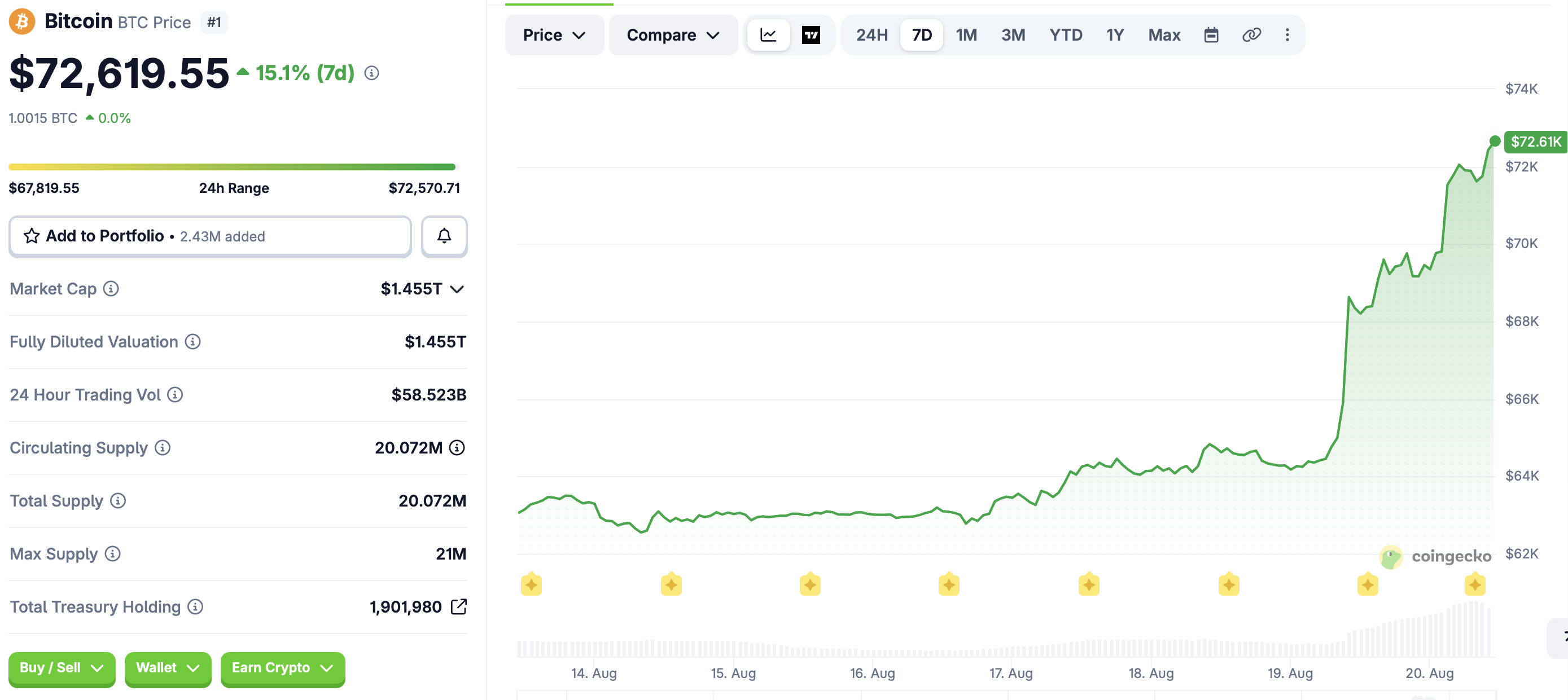
Source: Yahoo Finance
Related: Bitcoin ETFs add $189M as August net inflows approach $1B
Treasury buybacks add another potential Bitcoin catalyst
While Bloomberg and others attributed elements of Bitcoin’s rally to optimism over friendlier US crypto policy following President Donald Trump’s meeting with industry executives at the White House on Wednesday, market analysts pointed to the Treasury and broader fiscal conditions as additional factors.
TrendLabs founder and chartered market technician JC Parets pointed to the Treasury’s move to increase purchases of longer-term government bonds, which he said bond-market participants viewed as an effort to push back against rising long-term rates. Parets said:
If the market believes the government is going to push back against rapidly rising long-term rates, that can change the math for everything else investors own. Including Bitcoin.
Bitunix analyst Dean Chen offered another view, saying that the debt milestone is not inherently bullish for Bitcoin. While Treasury buybacks temporarily lowered long-term yields and weakened the dollar, persistent deficits and growing financing needs could eventually push borrowing costs higher again.
Chen said Bitcoin’s near-term direction will depend more on broader financial conditions, pointing to US dollar strength, long-term Treasury yields and inflation expectations as key variables to watch.
Analysts at DeFi protocol Yield Basis took a longer-term view, telling Cointelegraph that continued growth in US debt could strengthen demand for Bitcoin as a hedge against currency debasement because of its fixed supply and lack of a sovereign issuer. They said:
Whether it will actually become a new reserve asset remains to be seen, but as concerns around fiat currency debasement grow, it will definitely stand out more as a straightforward protective instrument (alongside more traditional assets like gold).
Magazine: MiCA cracks down on USDT in Europe… but no one else cares

Americans Are (Still) Drinking Less than Ever Before

General Hospital: Anna Plots a Brutal Trap Targeting Britt?!

Details on the free skate lessons happening in Co Antrim over next two years




![You’ll Make Much More Money If You Just Trade This! [Easy Switch]](https://wordupnews.com/wp-content/uploads/2026/08/1787253393_maxresdefault-80x80.jpg)

-

 Fashion6 days ago
Weekend Open Thread: Ann Taylor
-
 Sports7 days ago
This U.S. Amateur is a glimpse into golf’s future in more ways than you think
-
 Tech6 days ago
11 Ways to Rank Your Videos
-
 NewsBeat6 days ago
Myanmar says over 300,000 Rohingya refugees verified for repatriation as exodus enters ninth year
-

 Sports6 days ago
Birmingham 2026: Day 6 Timetable for Irish Athletes
-

 Politics5 days ago
SEQ Code: The Three Letter Boarding Pass Code That Could Give You The Worst Seat
-

 Tech3 days ago
Qwen3.8-27B runs frontier-class coding agents and reasoning locally, no cloud API required
-

 Business2 days ago
SMA Solar Technology AG (SMTGY) Q2 2026 Earnings Call Transcript
-

 Crypto World6 days ago
Pi Network Protocol 27 endgame: last upgrade before what?
-

 Crypto World3 days ago
OCC Greenlights Trump Family Crypto Firm for Trust Charter
-
 Tech5 days ago
Every fusion startup that has raised over $100M
-

 Business7 days ago
15 Ways to Make Money From Your Phone (2026 Guide)
-
 Entertainment6 days ago
10 Netflix Shows That Quietly Became Modern Classics
-

 Fashion6 days ago
Weekly News Update, 8.14.26 – Corporette.com
-
 Entertainment5 days ago
Marvel Studios Reveals New X-Men Cast Including Adam Driver and Sadie Sink
-

 News Videos15 hours ago
Don’t Leave Your Financial Future To Chance | August 19, 2026
-

 Crypto World7 days ago
Robinhood Chain Approaches $1B TVL as Uniswap Integration Boosts Liquidity
-

 Business6 days ago
Facebook Down Now? Users Report Login And Loading Problems As Outage Trackers Monitor Ongoing Issues
-

 Fashion6 days ago
Silver bangles for women – Newbridge Silverware
-
 Business5 days ago
Monarch Mutual Fund set to enter MF space with maiden overnight fund; files draft with Sebi
You must be logged in to post a comment Login