
Crypto World
why connectivity will define the next era



In today’s newsletter, Paul Frost-Smith, CEO of Komainu, covers how institutional crypto is converging with traditional finance, but speed can introduce risk if legal and compliance layers aren’t aligned.
Then, in “Ask an Expert,” Sam Boboev, from the “Fintech Wrap Up,” details the key coordination risks institutions must solve for.
Beyond custody: why connectivity will define the next era.
Institutional crypto markets
Institutional adoption of crypto has matured rapidly. The challenge is no longer simply securing assets, but moving and managing them efficiently across a fragmented ecosystem of custodians, exchanges and counterparties. With assets under professional custody now exceeding $200 billion, the inefficiencies of siloed infrastructure have an increasingly material impact on trading, hedging and liquidity management.
Treasury teams often find assets stranded across multiple platforms, creating operational friction that slows trades, constrains intraday liquidity and increases risk exposure. Idle assets tie up capital, amplify counterparty risk and raise the cost and complexity of managing institutional portfolios. In a 24/7 market where speed, execution and real-time visibility matter, the ability to mobilise capital across platforms is no longer optional, it is a prerequisite for scale, efficiency and resilience.
The next phase of market evolution will be defined by connectivity. Platforms that link custody, liquidity and collateral in real time are no longer “nice to have,” they are critical infrastructure. Networked systems enable assets to move faster, collateral to be rehypothecated safely and positions to be adjusted instantly without the delays inherent in siloed setups. Institutions that can leverage integrated infrastructure gain a direct advantage in capital efficiency, risk management and operational agility.
Technologies such as Bitcoin’s Liquid Network illustrate the potential. By combining security, transparency, and near-instant settlement, these networks provide a model for institutions to operate efficiently while mitigating counterparty and operational risk. Assets that are digital-native and programmable can be pledged, transferred and released automatically according to predefined rules, bringing crypto markets closer to the operational standards expected in traditional finance.
The implications are clear. The efficiency and integration of underlying infrastructure directly affect portfolio outcomes. A digital asset’s value is no longer defined solely by its market price; mobility and utility are just as important. Firms that can connect these “pipes” of digital finance gain better liquidity, faster execution and strategic flexibility at scale, enabling them to deploy capital more effectively across trading, hedging and yield-generating activities.
This shift also signals a broader trend, with custody evolving beyond its traditional role. Once synonymous with storage, it now functions as a dynamic, active layer that validates, transfers, and interacts with assets programmatically. Institutional investors evaluating service providers should look beyond security and regulatory compliance to consider the ability to support fast, interconnected and reliable market activity.
Looking ahead, interoperability and network connectivity, not just regulatory clarity, will define which institutions can scale efficiently in crypto markets. Those that build their strategies around connected, integrated infrastructure will be positioned to capitalise on opportunities that siloed competitors cannot.
As institutional participation deepens, the competitive edge in crypto markets will increasingly come from how effectively firms can deploy and mobilise capital. Connectivity, interoperability and real-time collateral mobility will define the infrastructure institutions rely on to trade, hedge and manage risk at scale. Those that prioritise integrated systems today will be better positioned to navigate a market that is becoming faster, more interconnected and more operationally demanding.
– Paul Frost-Smith, CEO, Komainu
Ask an Expert
Q1: What defines the next phase of institutional crypto market structure?
The next phase is defined by convergence with traditional financial infrastructure. Crypto is no longer operating as a parallel system; it is being absorbed into existing institutional frameworks. This shows up in three areas: regulated custody, tokenized financial instruments and stablecoins as settlement rails. Institutions are not adopting crypto for speculation, but for balance sheet efficiency, faster settlement and programmable financial flows. The market structure is shifting from exchange-led liquidity to infrastructure-led integration.
Q2: Where is the real value being created right now?
The value is moving down the stack into infrastructure. Custody, tokenization platforms and stablecoin issuance are becoming the core control points. These layers determine how assets are issued, transferred and settled. Distribution still matters, but control over settlement and asset representation is where defensibility is forming. This is why we are seeing traditional players focus on tokenized money market funds, on-chain repo and institutional-grade stablecoins.
Q3: What are the key risks institutions need to solve for?
The primary risk is not volatility, but coordination across legal, technical and operational layers. Tokenized assets can settle instantly, but ownership rights, compliance rules and jurisdictional enforcement still operate off-chain. This creates a structural mismatch. Institutions need systems where the ledger, compliance logic and legal frameworks are aligned. Without that, speed introduces risk rather than efficiency.
– Sam Boboev, founder, Fintech Wrap Up
Keep Reading
- Bitcoin enters the public bond market as Moody’s gives a first-of-its-kind crypto deal a rating.
- Franklin Templeton is launching a dedicated cryptocurrency division, Franklin Crypto, anchored by its planned acquisition of crypto investment firm 250 Digital.
- Australia has passed its first comprehensive crypto law, requiring exchanges and custody platforms to obtain financial services licenses within six months.


TLDR
- Ethereum derivatives recorded more than $1 billion in sell volume within one hour after Trump’s speech on Iran.
- Ethereum’s price fell over 4% as traders increased short positions in the derivatives market.
- Binance accounted for nearly $968 million of the total Ethereum derivatives sell activity.
- The S&P 500 lost about $500 billion in market value shortly after the remarks.
- Spot Ethereum ETFs reported more than $7 million in net outflows on April 1.
Global financial markets reacted sharply after President Donald Trump outlined potential military action against Iran within weeks. Ethereum followed the broader risk-off move as traders rushed to exit positions. Data from CryptoQuant showed heavy selling in derivatives within a single hour.
Ethereum Derivatives Record $1B in Rapid Sell Orders
Crypto markets shifted quickly after Trump addressed the nation and detailed plans for continued strikes on Iran. He said Operation Epic Fury had weakened Iran’s military and reduced missile capabilities. He also warned that stronger attacks would continue over the next two to three weeks.
As a result, traders moved rapidly across risk assets and pushed US Treasury prices higher. At the same time, the S&P 500 erased about $500 billion in market value within minutes. Ethereum derivatives then recorded more than $1 billion in sell volume within one hour, according to CryptoQuant.
CryptoQuant reported that about $968 million of that sell volume occurred on Binance. Binance currently handles the largest share of global crypto trading activity. The surge in orders increased short-term bearish pressure across futures markets.
Consequently, Ethereum’s price fell more than 4% during the same period. The sharp movement reflected aggressive positioning in leveraged products. CryptoQuant stated that markets now face “a period of extreme uncertainty and volatility.”
The firm added that price action has become “increasingly erratic and unstable.” Traders reacted directly to geopolitical developments and shifting liquidity conditions. The derivatives spike marked one of the largest hourly sell waves this month.
ETF Outflows Add Pressure on Ethereum
Institutional flows also reflected weaker sentiment toward Ethereum products. Spot Ethereum ETFs posted eight consecutive days of net outflows before briefly reversing direction. During the following two sessions, these funds recorded short-lived inflows.
However, the rebound did not hold as outflows returned. On April 1, spot Ethereum ETFs registered more than $7 million in net withdrawals. The renewed selling aligned with rising geopolitical tension and reduced risk appetite.
Bitunix analysts described the current environment as a shift in market structure. They stated, “The market has entered a new phase dominated by ‘supply chain destruction.’” They added that energy, metals, and geopolitics now push inflation expectations higher without supporting growth.
The analysts said this dynamic creates a mismatch between risk pricing and economic support. They explained that asset prices now respond mainly to liquidity conditions. They also stated that markets lack a clear policy anchor or exit path from conflict.
Ethereum’s derivatives data and ETF flows both reflected mounting strain across trading venues. Traders reduced exposure as headlines intensified across global markets. The latest ETF outflow data on April 1 marked the most recent confirmed movement in institutional positioning.

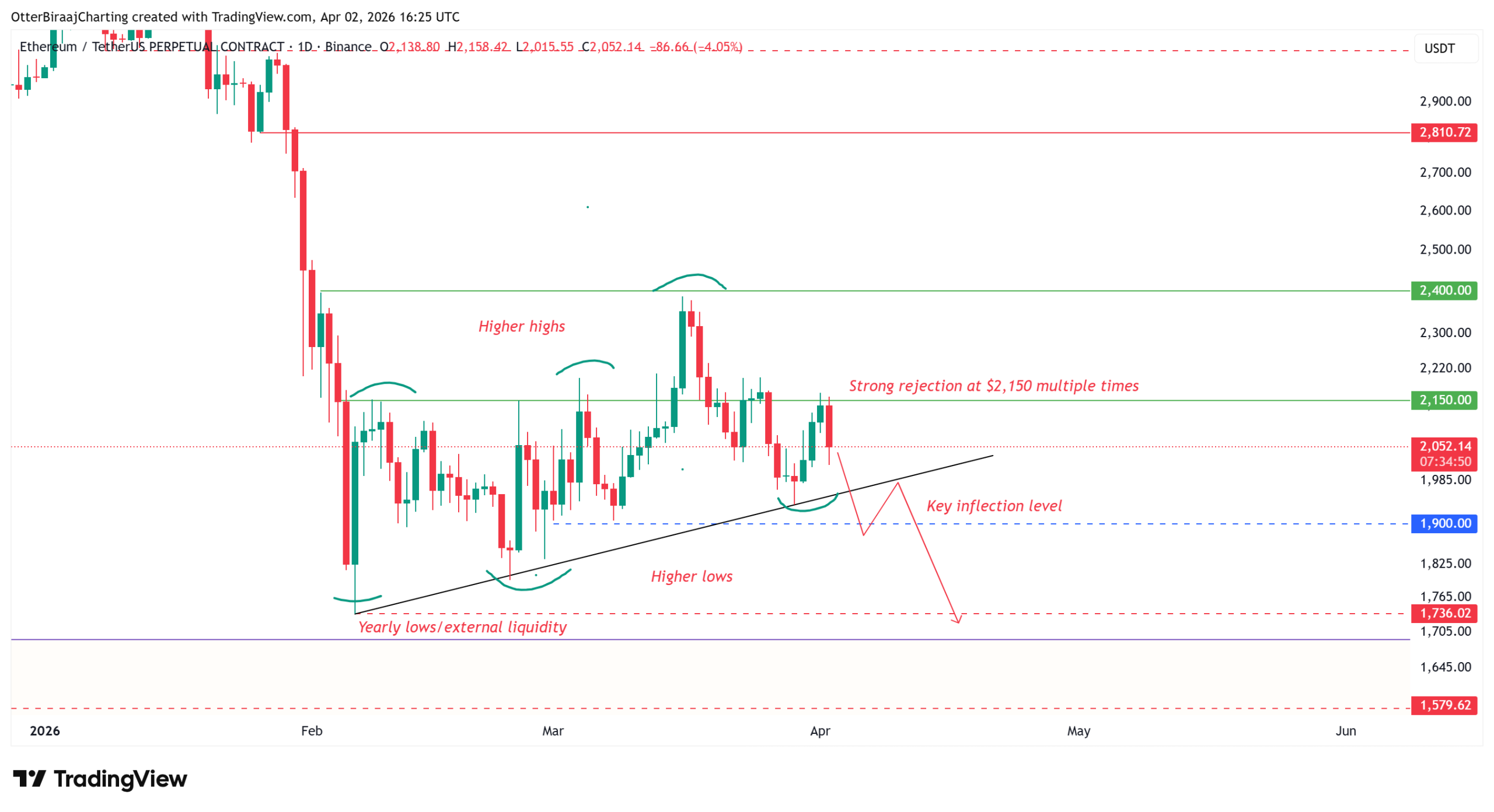
Ether (ETH) price may be at risk of a correction to new year-to-date lows, especially if the bulls fail to secure daily candle closes above the $2,150 to $2,400 range.
Ether’s price action continues to be driven by US and global macroeconomic events, along with investors’ appetite for risk assets during the US and Israel-Iran war. As data shows more than $1 billion in futures-driven sell pressure, the chance of Ether falling below $1,800 rises.
Ether’s main challenge sits at $2,400
Repeat rejections near $2,150 continue to cap Ether rallies, and the level has acted as a strong resistance seven times over the past two months. The trend and its resistance dominate the price action, despite the pattern of higher-high and higher-low candles, which can be seen on the daily chart.

A break below the ascending trendline may shift traders’ focus to $1,900, where liquidity sits near the equal lows formed during the first week of March. Losing that level introduces a bearish break of structure, exposing the external liquidity pockets to Ether’s yearly low at $1,736.
The short positioning has not increased significantly despite the recent decline. The liquidation heatmap shows an imbalance within a 10% range ($1,845–$2,255) from the current price, with approximately $2.4 billion in long liquidations clustered near the lower bound ($1,845) and $1.7 billion in short liquidations near the upper bound ($2,255).

This skew indicates that downside liquidity is larger, but the short positioning still isn’t overcrowded, even as the price continues to weaken.
The absence of large short buildup points to a passive positioning stance rather than conviction-driven selling. The price continues to compress under resistance, with buyers unable to reclaim control above the key threshold of $2,150.
Related: Ethereum bulls must hold $2K: Volatility metric hints at ‘strong’ move next
ETH derivatives spike after continued macro volatility
A surge in ETH futures selling followed comments by US President Donald Trump, which escalated tensions with Iran rather than calming markets. Trump signaled that military action will continue until late April and warned of potential strikes on Iran’s power plants.
Following the development, crypto analyst Darkfost noted that Ether futures sell volume on Binance increased by $1 billion within an hour.

Despite the surge in selling, ETH continues to trade just below the $2,150 resistance level. A sustained move above $2,150 would open the way toward $2,400, where resistance is relatively thin.
If the price clears $2,400, the next expansion zone sits near $2,800, where little trading activity has occurred over the past six months.

For now, ETH remains range-bound, capped by repeated resistance near $2,150, with $1,900 acting as the nearest liquidity pivot, which may extend the bearish breakdown.
Related: Ethereum’s EEZ and the attempt to rebuild one Ethereum
This article is produced in accordance with Cointelegraph’s Editorial Policy and is intended for informational purposes only. It does not constitute investment advice or recommendations. All investments and trades carry risk; readers are encouraged to conduct independent research before making any decisions. Cointelegraph makes no guarantees regarding the accuracy or completeness of the information presented, including forward-looking statements, and will not be liable for any loss or damage arising from reliance on this content.
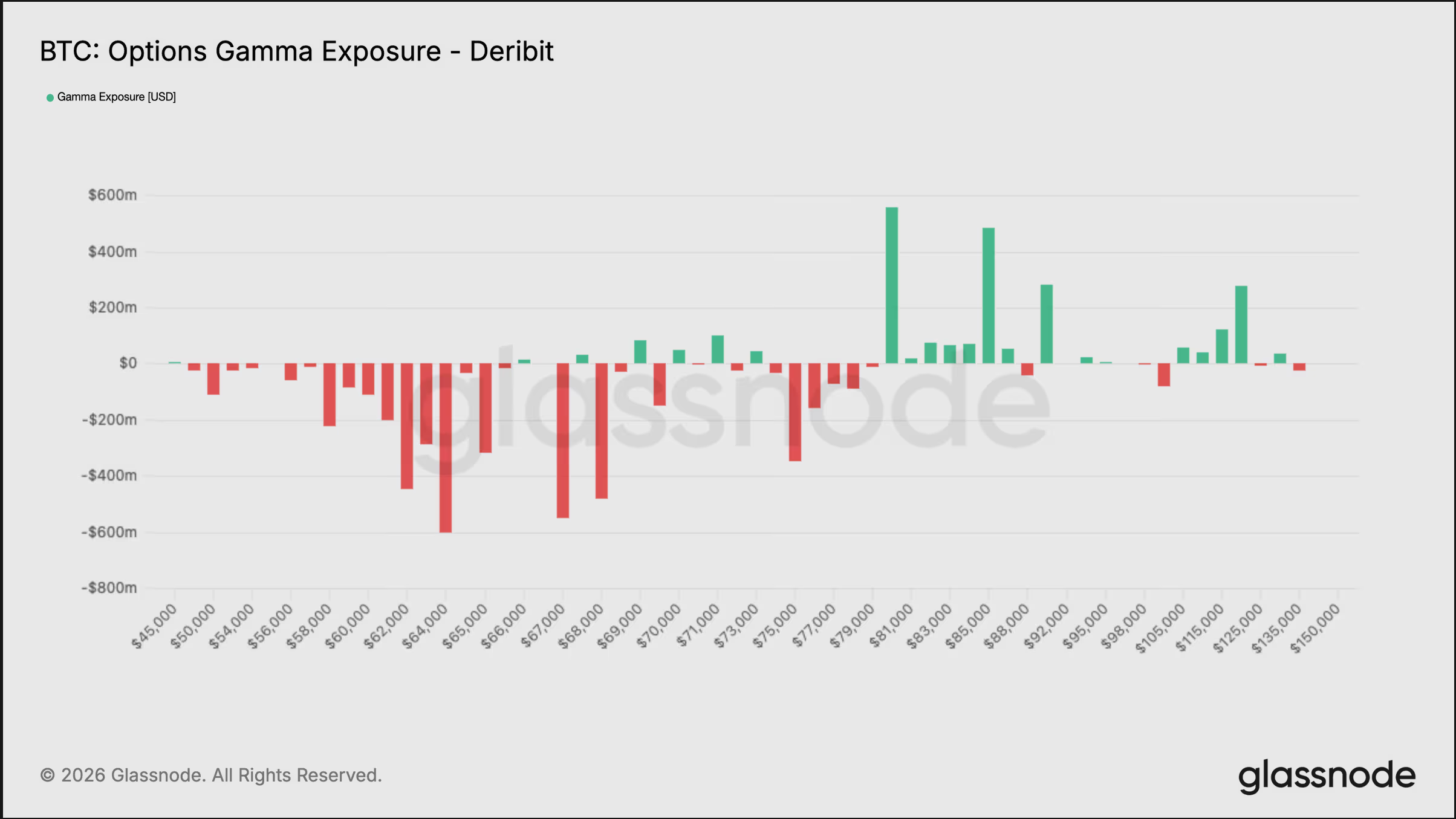
President Donald Trump’s renewed aggressive posturing toward Iran has pushed bitcoin lower by roughly 2% over the past 24 hours to $67,000. While this price action is consistent with routine volatility, beneath the surface, market structure looks fragile.
This is mainly due to flows in the Deribit-listed options market, specifically, a build-up of defensive positioning just below current prices that could result in a slide all the way down to $50,000.
A fragile setup below $68,000
In recent weeks, traders have been loading up on put options offering downside protection. These defensive flows have been concentrated in put options at strike levels $68,000 and lower, all the way down to mid-$55,000s. This is understandable, given the macroeconomic risks from the Iran war, quantum threats and the brutal bear market that began late last year.
However, when this kind of positioning builds, it creates what savvy traders call a “negative gamma” zone – a setup where market makers or dealers who add liquidity to an exchange’s order book are forced to react to price moves in ways that end up accelerating the prevailing trend, which is bearish in this case.
These kinds of dynamics have amplified both bullish and bearish trends in the past.

The Glassnode chart shows that dealer gamma exposure is mostly negative from $68,000 to $50,000. This is the result of being on the opposite end of traders’ long put positions.
In other words, dealers are holding short put positions. So, as the market drops below $68,000, they face losses and are likely to short BTC to hedge their exposure.
This hedging can push prices even lower, creating a feedback loop, which can accelerate quickly.
That’s why the latest drop below the $68,000 level becomes critical. The break below that threshold doesn’t just signal technical weakness — it opens the door to a zone where forced selling could intensify.
“Negative gamma is now building just below current price levels, from $68K all the way down to the high 50s,” Glassnode said in its weekly report.
“A move into this zone could trigger accelerated selling as hedging flows reinforce downside momentum, turning what would otherwise be a gradual move into a sharper repricing, with a potential revisit of the $60k level, the bottom of the February 5 selloff,” the firm added.
With liquidity still relatively thin following the March 27 options expiry, and likely to remain thin over the Easter holidays, there may not be enough buyers to absorb that pressure.
So, if the feedback loop fully kicks in, the decline could extend well below $60,000.
This setup shows that while bitcoin is currently reacting to war headlines, the market’s inner workings can also shape its trajectory.
If prices hold above $68,000, the current setup may unwind without much damage. But a sustained break below that level could flip the market into a regime where selling feeds on itself, turning a routine dip into a much deeper move.


Summary
- Whale positions on Hyperliquid total $3.4 billion, with $1.737 billion in longs (51.08%) and $1.663 billion in shorts (48.92%), putting the long–short ratio at 1.04.
- Aggregate P&L shows longs down $153 million while shorts are up $161 million, indicating whales are currently being paid for being net short into recent moves.
- A key whale address, 0xa5b0..41, is running a 15x leveraged long on ETH at $2,148.7, sitting on about $8.60 million in unrealized losses.
According to real-time data from analytics platform Coinglass, large traders on perpetual DEX Hyperliquid currently hold a combined $3.4 billion in notional positions across the venue. Of that, $1.737 billion is in long positions, accounting for 51.08% of whale exposure, while $1.663 billion is in shorts, or 48.92%, leaving the long–short ratio effectively balanced at 1.04.
Despite the slight tilt toward longs, whales are in the red on bullish bets and green on bearish ones. Coinglass snapshots cited by market outlets show unrealized P&L on long positions at roughly -$153 million, while shorts are ahead by about $161 million, suggesting recent price action has punished leveraged dip‑buyers more than it has squeezed short sellers.
Within the aggregate figures, one address — 0xa5b0..41 — stands out for its aggressive positioning on Ether. Data from Hyperliquid whale trackers show the address holding a 15x leveraged long on ETH opened around $2,148.7, effectively a full‑size bet at that entry level.
As of the latest reading, that ETH position is running an unrealized loss of roughly $8.5965 million, reflecting how even a modest spot move against a 15x leveraged trade can translate into multi‑million‑dollar drawdowns for whales. Prior Coinglass‑based reports have flagged the same address multiple times as it shifted from being in profit to deeply negative as ETH whipsawed around the low‑$2,000s.
The current $3.4 billion whale footprint comes after weeks of scrutiny on perpetual DEX data quality, with Coinglass previously comparing volume, open interest and liquidations across Hyperliquid, Aster and Lighter. In that analysis, Hyperliquid showed higher liquidations relative to volume, indicating more genuine leverage and risk transfer versus pure incentive‑driven wash activity, though critics argued one‑day snapshots can be misleading.
For now, the slightly long‑biased but loss‑making whale book on Hyperliquid suggests big accounts are still willing to lean long across assets, but have mistimed entries into recent volatility. With shorts currently in aggregate profit, funding, liquidation maps and open interest shifts in coming sessions will show whether these whales add to risk, cut exposure, or flip more decisively to the short side.
The partnership brings leveraged derivatives to one of crypto’s largest consumer distribution channels, targeting emerging-market users priced out of traditional brokerages.
Wallet in Telegram has launched perpetual futures trading through a new integration with Lighter, the Ethereum-based decentralized exchange (DEX), the teams announced Thursday.
The feature enables users to open long and short positions on more than 50 assets — spanning crypto, metals, equities, oil, and ETFs — with up to 50x leverage and a minimum position size of $1, all without leaving the Telegram app.
The Open Platform (TOP), the entity that develops Wallet in Telegram, told Forbes that it evaluated multiple decentralized perpetual exchanges before selecting Lighter, with the decision driven by cost structure, incentive design, and alignment with a retail-heavy audience. Lighter’s zero-fee model for standard accounts was a key factor.
Rather than competing for power users on standalone exchanges, Wallet is targeting a broader audience that may not have previously used derivatives platforms. The wallet has more than 150 million registered users, many of whom were onboarded through earlier gamified mini-app features on Telegram.
Users in the United States and the United Kingdom are excluded from the rollout. The initial focus is on emerging markets where traditional brokerage infrastructure is more limited.
Lighter Struggles Post-TGE
The deal represents a significant distribution channel for Lighter, which has become one of the top perp DEXs by volume since launching its public mainnet in late 2025.
Lighter processed $59 billion in perpetual volume in March 2026, ranking fourth among perp DEXs, according to DefiLlama. That’s down nearly 80% from its peak of $292 billion in November.
The platform runs on a custom zero-knowledge rollup on Ethereum, where every order match and liquidation is cryptographically verified onchain. It raised $68 million in November 2025 from Founders Fund, Ribbit Capital, Haun Ventures, and Robinhood. Since then, Lighter has expanded into spot trading, launched its LIT token, and introduced equity perpetuals.
Still, the exchange trails category leader Hyperliquid, which processed nearly $210 billion in March, by a wide margin.
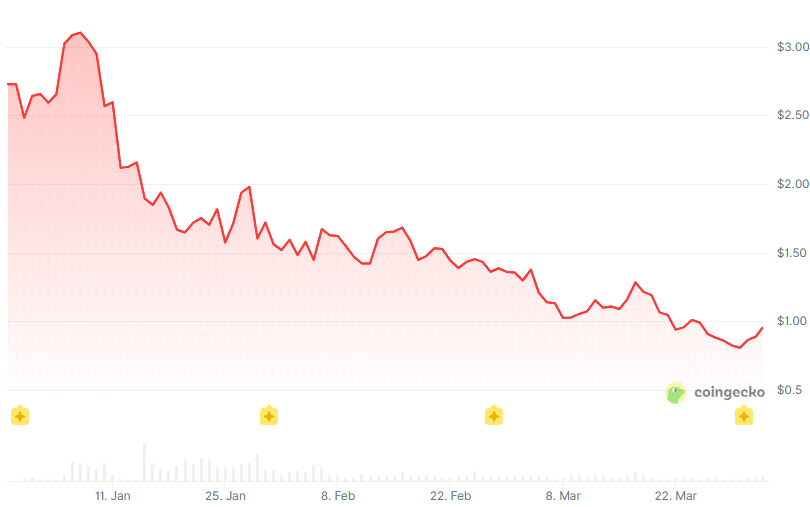
The platform’s LIT token rallied 5% on the news, but has struggled since its December launch, losing more than two-thirds of its value since January 1.

Lighter also announced that its Partner Attribution program is now open, allowing developers to integrate the exchange’s perpetuals and spot infrastructure into their own applications.
TLDR
- Arthur Hayes questioned whether native multisig wallets on Solana could have prevented the Drift Protocol hack.
- Early investigations showed that attackers compromised administrative access rather than exploiting smart contract code.
- Solana leaders stated that human weaknesses and operational security gaps enabled the breach.
- Drift Protocol froze all functions and removed the compromised wallet from its multisig setup.
- The DRIFT token fell to $0.038 before recovering to around $0.052 within 24 hours.
A $280 million exploit at Drift Protocol triggered debate across the crypto sector and pressured token prices. Arthur Hayes questioned wallet infrastructure, while Solana leaders blamed operational failures. Early findings indicate attackers compromised administrative access rather than smart contracts.
Arthur Hayes Raises Wallet Security Concerns After DRIFT Exploit
Arthur Hayes challenged crypto wallet design after hackers drained about $280 million from Drift Protocol. He asked on X, “If Solana had native multi sig addresses, would the Drift hack even have been possible?” His remarks focused attention on wallet controls and multisignature structures.
Meanwhile, executives across the Solana ecosystem addressed the breach and clarified its scope. They said the attack did not stem from faulty smart contracts. Instead, they pointed to compromised administrative permissions and weak operational security.
Jacob Creech, Solana’s vice president of technology, urged protocols to review their configurations. He wrote, “Every protocol should evaluate their setup and understand if it fits your security requirements.”
He added that stronger multisig thresholds and timelocks can restrict unauthorized actions.
Drift Protocol responded by freezing all protocol functions after detecting the exploit. The team removed the compromised wallet from its multisig setup. It also said it is working with exchanges, bridges, and law enforcement to trace funds.
The DRIFT token fell sharply after news of the breach spread. It dropped to a record low of $0.038 before recovering part of the losses. At the time of reporting, DRIFT traded near $0.052, down 27% in 24 hours.
Retail sentiment on Stocktwits shifted during the volatility. Sentiment moved to “bullish” from “neutral” within a day. Chatter levels increased to “extremely high” from “high,” reflecting intense discussion.
Solana Leaders Say Human Weaknesses, Not Code, Enabled Attack
Solana leaders stated that the breach exposed weaknesses in permission management practices. Lily Liu, president of the Solana Foundation, said the incident “hits hard” for the ecosystem. She added that the smart contracts themselves remained intact.
Liu wrote on X, “The real targets now are humans: social engineering and opsec weaknesses more than code exploits.”
She emphasized the need to improve operational safeguards. She said the ecosystem must strengthen processes around access controls.
Creech echoed that view and encouraged internal reviews across protocols. He highlighted the importance of aligning security setups with risk exposure. He said better controls can limit damage when credentials become compromised.
TLDR
- The IMF states that tokenization replaces core financial architecture rather than improving existing systems.
- The report identifies stablecoins as the weakest link within the tokenized financial structure.
- Stablecoin transaction volume reached $1.8 trillion per month by early 2026.
- The IMF says 97% of stablecoins are denominated in U.S. dollars.
- The report warns that stablecoins can lose their peg during periods of market stress.
The International Monetary Fund (IMF) released a policy paper in April 2026 on tokenized finance. Tobias Adrian authored the report in his role as Financial Counsellor. The document argues that tokenization replaces core financial architecture rather than improving existing systems.
IMF Flags Stablecoins and Tokenization Settlement Risks
The IMF states that tokenization shifts trust, settlement, and risk management into shared digital infrastructure. It explains that programmable tokens embed ownership and compliance directly on ledgers. As a result, risk moves from institutions to code and system design.
The report separates tokenized money into deposits, regulated stablecoins, and wholesale CBDCs. It states that each form allocates risk differently within the system. However, it identifies stablecoins as the weakest structural point in tokenization.
The Fund reports that stablecoin transaction volume reached $1.8 trillion per month by early 2026. It notes that volumes were minimal in 2018 and rose sharply through 2024 and 2025. The paper describes this growth as rapid settlement expansion within crypto markets.
The report states that 97% of stablecoins are denominated in U.S. dollars. It adds that these tokens now influence money markets and payment systems. As a result, dollar-based stablecoins extend dollar usage into tokenized markets.
Adrian writes that stablecoins resemble money market funds more than central bank money. He states that a fully backed stablecoin can still lose its peg. He links that risk to liquidity stress during redemption surges.
Rapid Settlement and Sovereignty Risks Highlighted
The IMF explains that traditional finance uses settlement lags to manage stress. It states that two-day settlement windows allow regulators to intervene. However, tokenization enables atomic settlement that removes that delay.
The report warns that automated liquidations can trigger rapid asset sales. It states that coding errors or faulty price feeds can spread losses quickly. As a result, stress events unfold faster than in traditional markets.
The paper adds that central bank backstops operate on business-day cycles. It explains that tokenized systems function continuously, including weekends and holidays. Therefore, stablecoins operating as settlement layers face immediate testing during stress.
The IMF states that stablecoins connect every component of tokenized markets. It explains that smart contracts, collateral positions, and liquidity pools settle in them. Consequently, a broken peg would affect all linked transactions simultaneously.
The report also highlights cross-border risks for emerging economies. It states that dollar stablecoins can move capital outside banking channels. As a result, central banks may lose response time during currency pressure.
The IMF notes fragmentation across multiple token platforms. It states that liquidity splits across separate ledgers and bridges. The report concludes that fragmentation can increase systemic strain within tokenized finance.
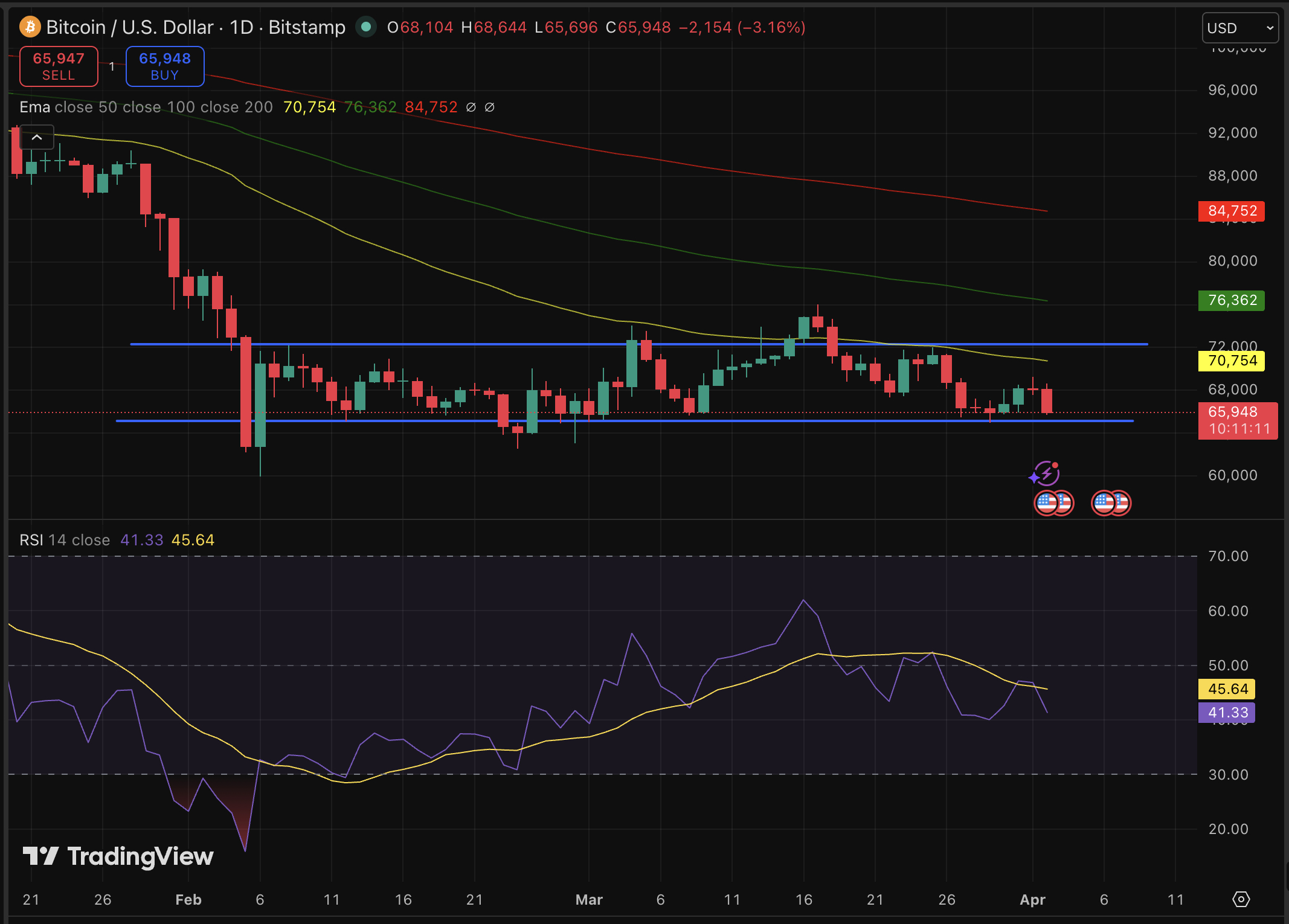
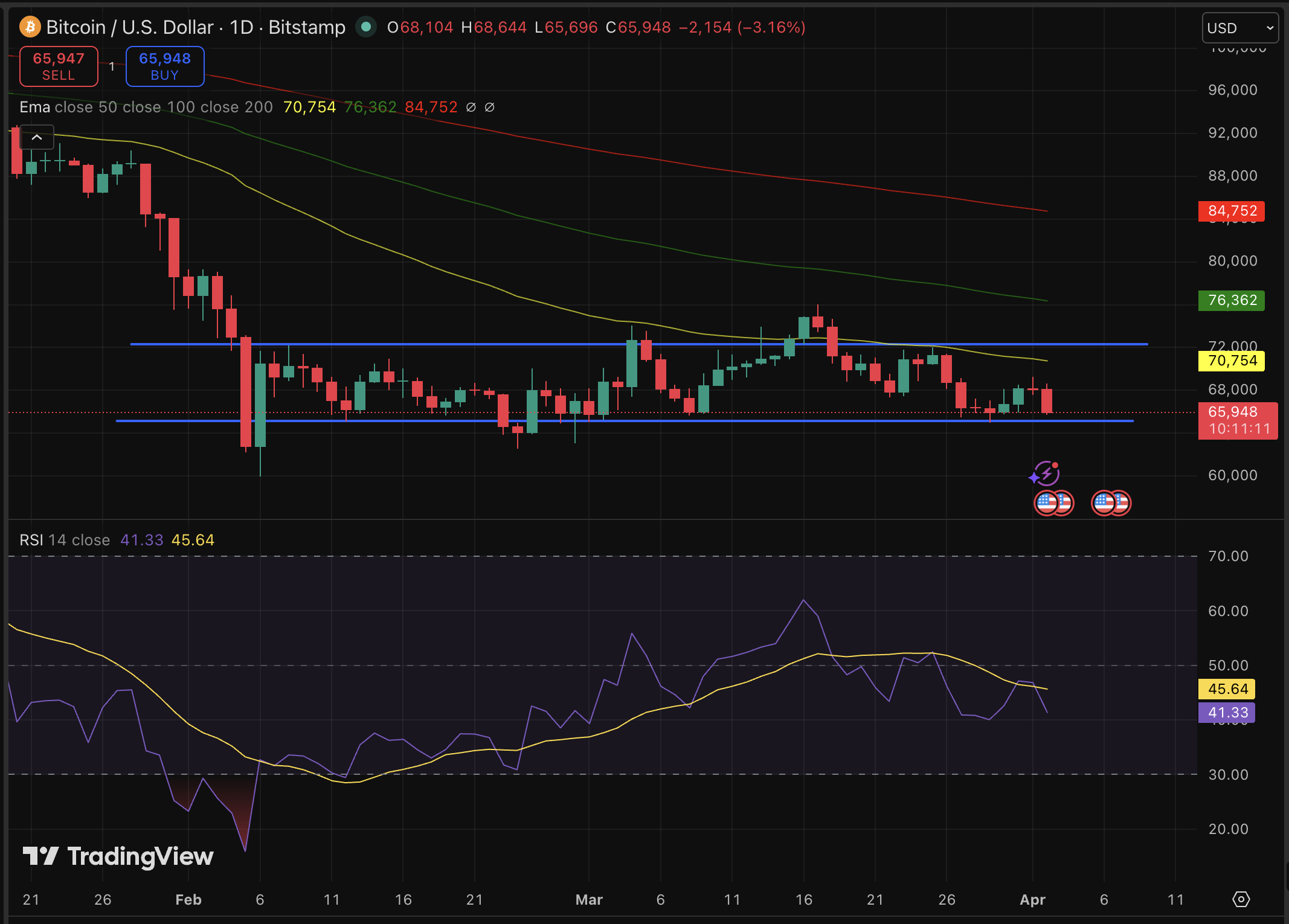
Bitcoin is under pressure, and the macro forces closing in aren’t easing. BTC USD price just fell to the $66,000 zone, down -3.5% in the last 24 hours, with bears eyeing a drop toward the $64,000 critical level if current levels fail to hold.
Risk assets across the board got hit after U.S. President Donald Trump’s address to the nation left markets rattled rather than reassured. Trump’s tone on the Iran conflict, referencing power plants, a 2–3 week war timeline, and NATO criticism, failed to deliver the de-escalation traders were pricing in.
“Between threatening Iran’s power plants, saying the Iran War would last 2-3 more weeks, and calling out NATO, there was nothing new,” trading resource The Kobeissi Letter noted.
BTC logged intraday lows near $65,000 on the news, recording roughly 4% daily losses before recovering by a small margin. Gold and equities fell in tandem, too, in classic risk-off rotation.
The U.S. dollar is now eyeing a breakout to yearly highs, and oil is strengthening on the same geopolitical cues. That combination has historically been a headwind for Bitcoin. The correlation between BTC and macro risk appetite is tightening at exactly the wrong moment.
Discover: The best crypto to diversify your portfolio with
Can BTC USD Price Hold $66,000 or Are New Lows Incoming?
The technical picture is deteriorating. RSI sits at 45, which is neutral on the surface, but declining, while the 50-day SMA has compressed to $7,0,700, and the 200-day SMA is at $84,700. It’s okay, but the daily chart has shifted to a strong sell configuration even as RSI avoids outright oversold territory.
Immediate resistance at the aftermath sits in the $67,000–$69,000 zone, a range that has capped multiple recovery attempts. BTC has now rejected $69,000 at least once this week. Below current levels, the immediate target is $64,000 as the 1-week forecast low. A longer-term trendline dating back to 2017 sits beneath that, which could act as a final support before any structural breakdown.
One trader on TradingView captured the mood bluntly: “A lot of people are turning very bearish on Bitcoin, but I don’t think it’s time to be bearish.” Conviction on either side is thin right now. The oil-BTC relationship is the wildcard that could force the issue.
Discover: The best pre-launch token sales
Early-Mover With Upside Potential as BTC Tests Supports
Spot BTC may be grinding lower, but the infrastructure layer being built on top of Bitcoin is attracting capital that doesn’t care about short-term price action. If Bitcoin’s base layer is the store of value, the race is now on to build the execution layer.
Bitcoin Hyper ($HYPER) is positioning itself at that intersection. Billed as the first-ever Bitcoin Layer 2 with Solana Virtual Machine (SVM) integration, the project delivers faster throughput than Solana, while inheriting Bitcoin’s security model.
The presale has raised more than $32 million at a current price of $0.0136, with staking bonus available at a high 36% APY. Key infrastructure includes a Decentralized Canonical Bridge for BTC transfers and ultra-low-latency smart contract execution that is targeting Bitcoin’s core limitations: slow finality, high fees, and zero programmability.
As macro volatility compresses large-cap returns, early-stage infrastructure plays with genuine technical differentiation are drawing attention.
For traders who want to explore the project further: Research Bitcoin Hyper here.
This article is not financial advice. Crypto assets are highly volatile. Always conduct your own research before investing.
The post BTC USD Price Could Break New Lows: U.S. Dollar and Oil Getting Stronger appeared first on Cryptonews.
Arizona is moving to make XRP a state treasury asset. XRP price itself trades at $1.28, down by 4.5% in today, with crypto sentiment at extreme fear and a single bearish prediction hitting the market. The bill that could change everything is closer to a full House vote than most traders realize.
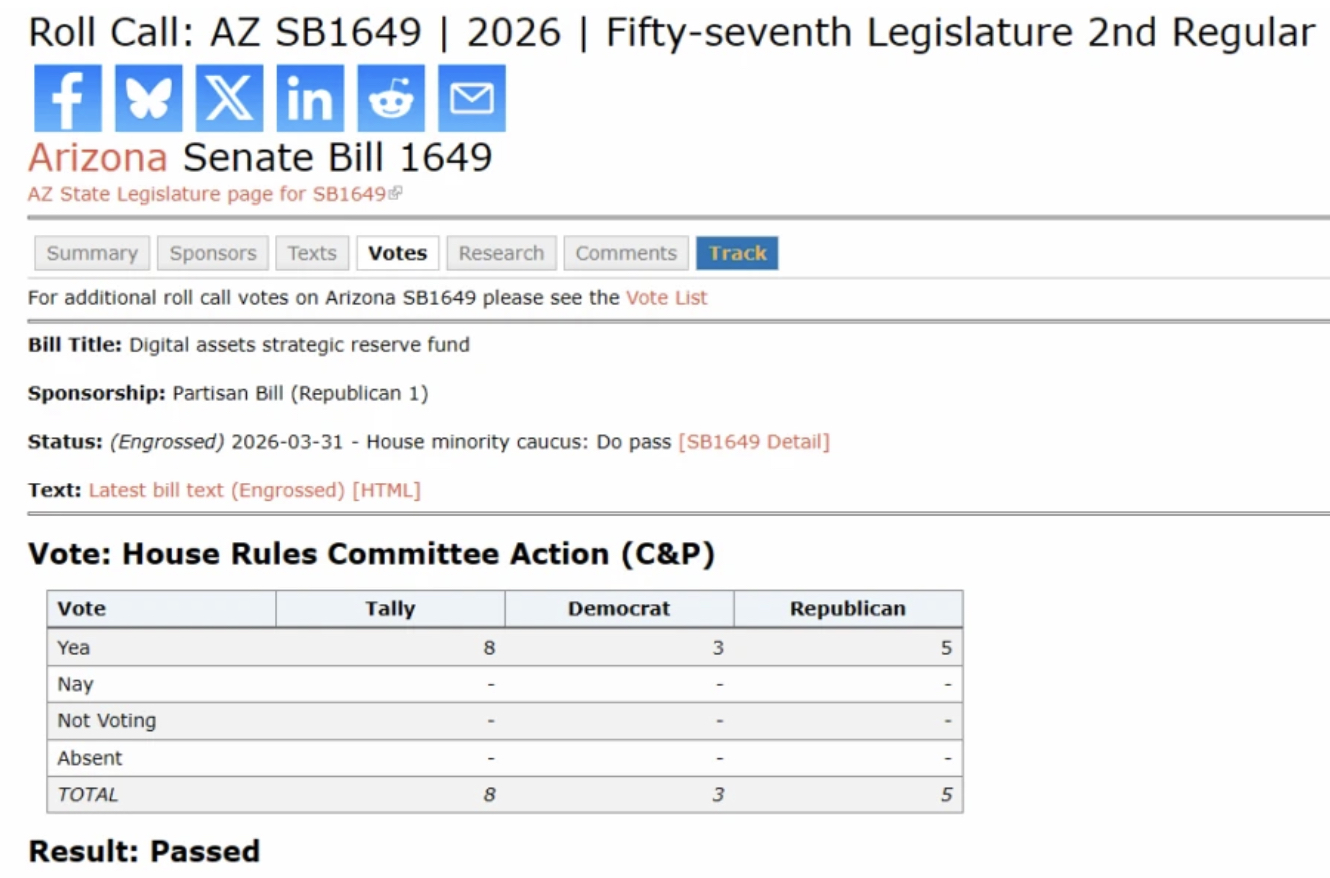
Arizona’s SB1649 would create a Digital Assets Strategic Reserve Fund, placing confiscated, surrendered, or state-held digital assets under the state treasurer’s direct control. XRP is explicitly named alongside Bitcoin, stablecoins, and a handful of altcoins.
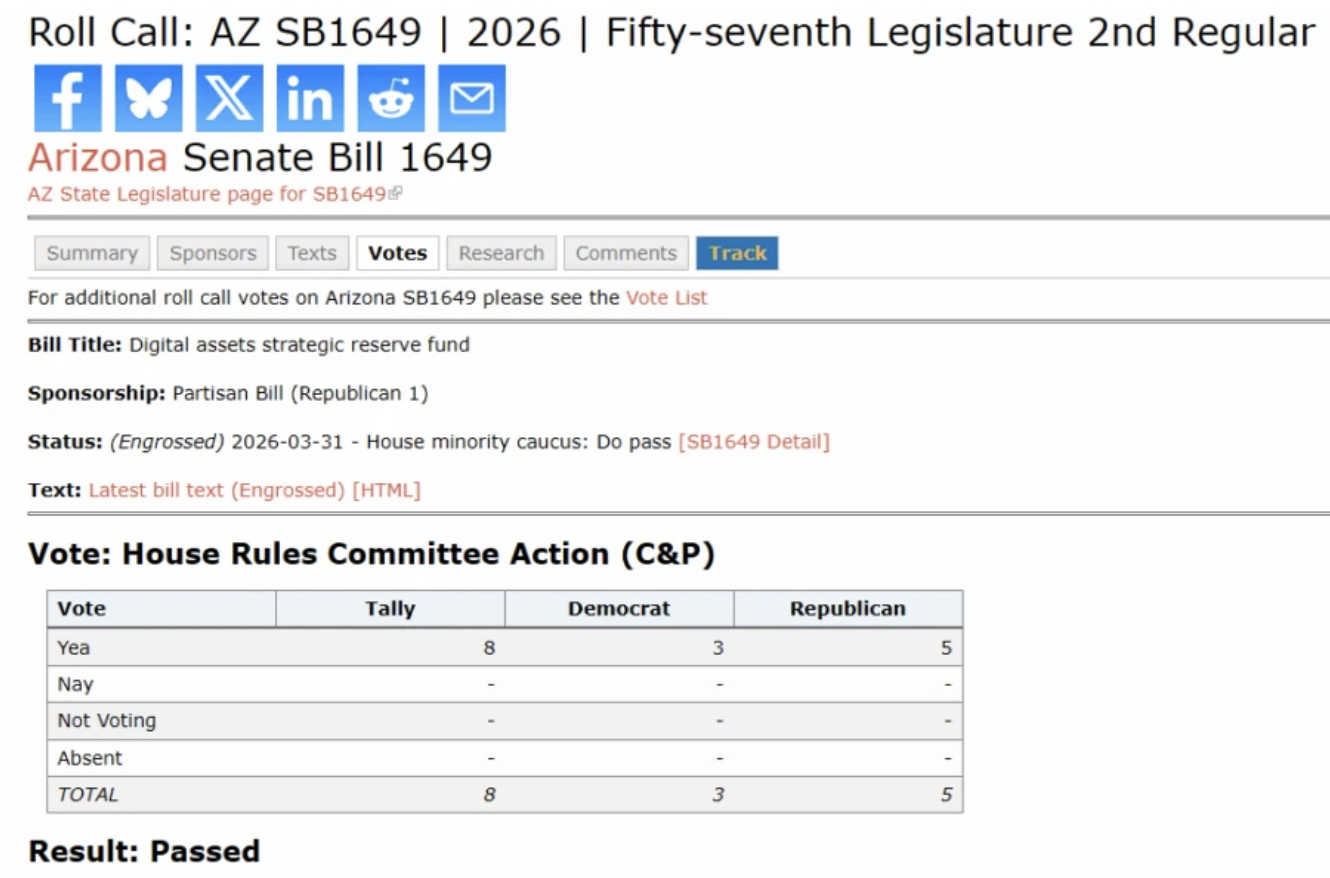
The measure cleared the House Rules Committee 8-0 on March 30, moving it to a full chamber vote. Critically, the bill allows the treasurer to earn additional returns through staking, airdrops, or limited lending, meaning XRP’s utility as a yield-bearing reserve asset is already baked into the legislative language.
The macro backdrop is ugly right now, but Ripple’s accelerating institutional legitimacy keeps long-term bulls engaged. Whether this bill passes or not, the precedent it sets for state-level crypto adoption is hard to ignore.
Discover: The best crypto to diversify your portfolio with
XRP Price Prediction: $2 Before Arizona’s House Vote?
XRP is consolidating under pressure. At under $1.30, the asset is trading below its 50-day SMA of $1.44, with RSI sitting at a neutral-to-bearish 43, not yet oversold, but lacking momentum. For holders, these are the key levels to watch. Support is at $1.25, and the strongest is at $1.23. Resistance sits at $1.33–$1.34, with $1.40 the line that needs to break for any meaningful recovery.
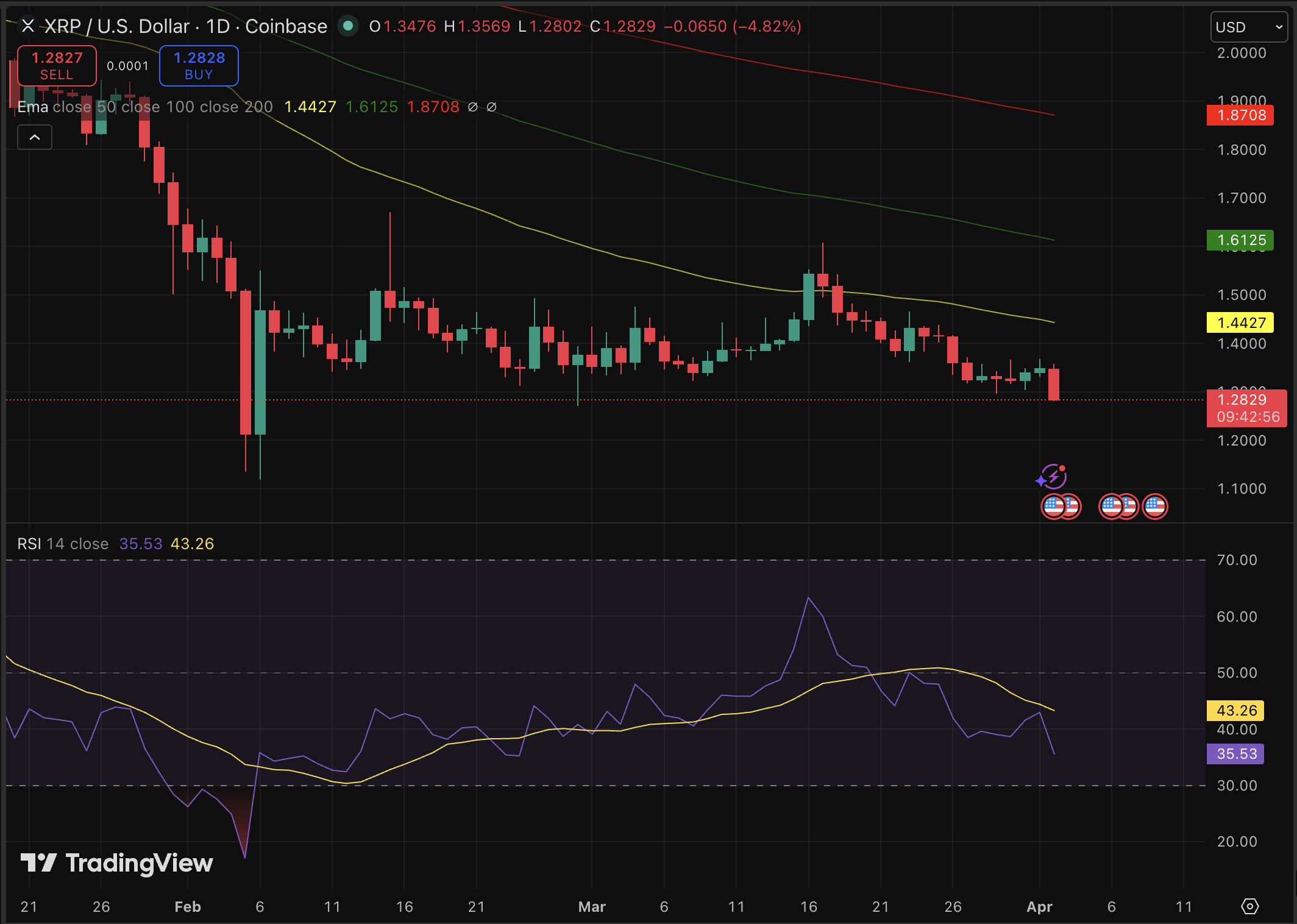
In a good scenario, the Arizona House passes SB1649, ETF approval odds crystallize into a confirmed timeline, and XRP reclaims $1.42, opening a path toward the $2.10 upper bound analysts cite for 2026.
But if $1.25 fails, macro pressure deepens, and XRP retests sub-$1.20 territory. One TradingView analyst has identified a forming bull flag, parabolic if confirmed, painful if it resolves downward.
Discover: The best pre-launch token sales
Maxi Doge Eyes Early-Mover Upside as XRP Tests Key Support
XRP’s 6% weekly decline is a reminder that even fundamentally strong assets bleed in risk-off environments. For traders unwilling to wait out a potentially extended consolidation at this market cap, early-stage presales offer a different risk profile, higher volatility, but asymmetric upside that a $80B asset simply can’t replicate.
Maxi Doge ($MAXI) is an ERC-20 meme token built around a 240-lb canine mascot and a unapologetically aggressive trading culture. The presale has raised $4,7 million at a current price of $0.0002811, with staking at 66% APY in rewards for early holders.
Features include holder-only trading competitions with leaderboard rewards, a Maxi Fund treasury for liquidity and partnerships, and meme-first marketing built for viral distribution. The risk-off market environment is actively pushing attention toward presale-stage projects like this one.
Research Maxi Doge before the presale window closes.
This article is for informational purposes only and does not constitute financial advice. Crypto assets are highly volatile. Always do your own research before investing.
The post XRP Price Prediction: XRP Could Soon Become a State Treasury Asset appeared first on Cryptonews.

Murad Mahmudov, the crypto trader widely known online as the “Memecoin Messiah,” has endured a brutal nine-month stretch, wiping almost $60 million from his bets. Yet he remains bullish on SPX6900, a memecoin that aspires to outpace the S&P 500 and redefine memecoin economics.
Key takeaways:
- Mahmudov argues SPX6900 could grow the market cap of the token to $1 trillion—from roughly $250 million today—an extraordinary, 400,000% rise.
- On the technical front, SPX6900’s three-day chart points to a potential further decline of about 20% in the coming weeks.
- Public portfolio data shows a heavy concentration in SPX6900, with the Muststopmurad wallet holding about 29.964 million SPX (roughly $7.8 million), about 96% of the publicly tracked portfolio value.
- Despite steep losses, there have been no meaningful sales of SPX6900 or other major positions, according to DropsTab, suggesting the trader has not yet realized losses beyond the unrealized figure.
- The broader memecoin sector remains battered, with a large share of projects inactive and exit liquidity in some names showing limited real trading activity.
SPX6900 on a bold trajectory, or a fragile setup?
In a post circulated on X, Mahmudov asserted that SPX6900, a memecoin’s bid to overtake the S&P 500 in market presence, could surge to a $1 trillion market capitalization from its current roughly $250 million valuation—a jump of about 400,000%. The claim frames SPX6900 as a long-term bet on a narrative shift within the memecoin space, one that hinges on mass adoption and liquidity enhancements to propel a token past a traditional stock index in perceived value.
By contrast, the marketplace for memecoins has faced a brutal environment. SPX and other memecoins have tracked a broader retreat in the sector, with prices and on-chain liquidity deteriorating as traders reassess risk capital. Bitcoin remains the sole cryptocurrency to have reached a $1 trillion market cap in historical precedent, underscoring how extraordinary such a SPX6900 thesis would be in ordinary market conditions.
Concentration risk and unrealized losses
Public wallet analytics place Mahmudov’s SPX6900 exposure at the core of his tracked holdings. Arkham Intelligence flags the trader’s wallets under the entity “Muststopmurad,” and current data show approximately 29.964 million SPX held—valued at about $7.79 million. This single line item accounts for roughly 96% of the total tracked portfolio, estimated near $8.1 million.
The magnitude of the drawdown is stark. At a peak in July of the previous year, the same holdings carried an implied value of around $67 million. The ensuing correction has produced an unrealized loss near $60 million as the memecoin sector retraced more than 80% from its highs. The heavy tilt toward SPX6900 illustrates a classic high-conviction, high-risk position where outsized gains are possible but gains can evaporate rapidly in a sentiment-driven market.
Despite the paper losses, Mahmudov’s on-chain footprint shows no clear exit from these bets. DropsTab, a portfolio-tracking service that aggregates public wallets, indicates no material sales of SPX6900 or his other major positions. The platform records realized profits and losses on the tracked holdings as zero, suggesting the decline has come largely from price moves rather than realized dispositions. The portfolio, by this accounting, still shows more than $6.22 million in unrealized gains across its positions, indicating a complex mix of upside exposure that the trader has not yet cashed in—or chosen not to crystallize.
Exit liquidity and the broader memecoin backdrop
The memory-heavy, supply-sensitive dynamics of memecoins are also reflected in on-chain liquidity metrics. Market data show that several memecoin names—such as RETARDMAXX, HONK, and CHAD—struggle to attract meaningful liquidity. On Solana-based pairs, RETARDMAXX displayed around $44,000 in liquidity with only six transactions and modest daily volume, while CHAD showed roughly $842 in liquidity with no trades or new makers recorded in the same window. HONK’s pair registered just $1 in liquidity and no activity, underscoring the fragility of exit liquidity for some of these tokens in stressed markets.
Such liquidity gaps matter for holders who may wish to monetize losses or trim risk, particularly when a narrative previously supported by hype but now confronted with waning enthusiasm. In a market where a majority of new tokens fail to find steady demand, the ability to realize gains—or even limit losses—depends on the existence of durable liquidity pools and active buyers. CoinGecko’s January tracking highlighted the fragility of the broader memecoin set, reporting that 53.2% of all cryptocurrencies tracked since 2021 were inactive, with 11.6 million token failures recorded in 2025 alone that disproportionately affected memecoins. This backdrop helps explain why even sizable unrealized gains on a single position may struggle to translate into liquidity if the market lacks buyers willing to step in at meaningful levels.
Technical setup: a potential continuation of downside in SPX6900
From a chart perspective, the SPX6900 price action on a three-day horizon appears to be breaking down from a rising wedge pattern. A breakdown beneath support near the $0.26 level has already been triggered, with the price trading below the 20-, 50-, and 100-period exponential moving averages, a configuration that often signals a continuation of the downtrend in the near term. If the pattern plays out as the setup suggests, a measured move could take SPX6900 toward the $0.205 area—roughly 20% below current levels. Such a move would have implications for Mahmudov’s portfolio, potentially shaving another $1.5 million or more from the SPX stake, depending on the token’s price action and any accompanying shifts in liquidity.
Beyond the mechanics of the chart, the risk for concentrated memecoin bets remains structural. The memecoin sector’s volatility has historically outpaced broader crypto markets, with narrative-coupled demand driving extreme swings in both directions. For Mahmudov, the question is whether the SPX6900 thesis can withstand a test of time and liquidity, or if the current trend portends further writedowns before a credible inflection—if one ever arrives—materializes.
As of now, Mahmudov’s public posture suggests a patience-based stance rather than a willingness to harvest losses. The combination of a grandiose market-cap target, a highly concentrated position, and a market environment that has punished many memecoins for thin liquidity presents a case study in risk management rather than conventional investing wisdom. For observers, the ongoing question is whether SPX6900 can deliver on its promised scale or if the token’s path will remain a cautionary tale about the limits of meme-driven valuation in a crowded, unforgiving market.
What to watch next: productizing a memecoin’s ascent into mainstream liquidity remains the central hurdle. If SPX6900 can attract meaningful exchange listings, deeper liquidity, and broader investor interest, the thesis could gain traction. If not, the focus will shift to risk controls around highly concentrated portfolios and the practicalities of exiting positions in a market where exit liquidity is uneven at best.

JLR sees sales recover after cyber attack
$1B Ethereum Derivatives Sell-Off Follows Trump Remarks

Why the Islamic Republic must fall


-

 Business7 days ago
Instagram, YouTube Found Responsible for Teen’s Mental Health Struggle in Historic Ruling
-

 NewsBeat6 days ago
The Story hosts event on Durham’s historic registers
-

 Sports6 days ago
Sweet Sixteen Game Thread: Tide vs Michigan
-
Entertainment3 days ago
Fans slam 'heartbreaking' Barbie Dream Fest convention debacle with 'cardboard cutout' experience
-
 Entertainment5 days ago
Lana Del Rey Celebrates Her Husband’s 51st Birthday In New Post
-
Crypto World2 days ago
Dems press CFTC, ethics board on prediction-market insider trades
-

 Crypto World22 hours ago
Gold Price Prediction: Worst Month in 17 Years fo Save Haven Rock
-

 Tech4 days ago
The Pixel 10a doesn’t have a camera bump, and it’s great
-

 Sports2 days ago
Tallest college basketball player ever, standing at 7-foot-9, entering transfer portal
-

 Tech2 days ago
EE TV is using AI to help you find something to watch
-

 Fashion5 days ago
Amazon Sundays: Soft Spring Layers
-

 Tech3 days ago
Apple will hide your email address from apps and websites, but not cops
-

 Tech2 days ago
How to back up your iPhone & iPad to your Mac before something goes wrong
-

 Politics3 days ago
Should Trump Be Scared Strait?
-

 Tech3 days ago
Flipsnack and the shift toward motion-first business content with living visuals
-

 Crypto World3 days ago
U.S. rule change may open trillions in 401(k) funds to crypto
-

 Business7 days ago
Chinese universities with military links bought Super Micro servers with restricted AI chips
-

 Fashion6 days ago
Weekly News Update, 3.27.26 – Corporette.com
-

 Tech4 days ago
Elon Musk’s last co-founder reportedly leaves xAI
-
Crypto World4 days ago
Bitcoin’s Six-Month Losing Streak: What On-Chain Data Says About the Market’s Next Move
You must be logged in to post a comment Login