
Crypto World
Why North Korea hacks crypto instead of evading sanctions like Russia and Iran



North Korea’s six-month infiltration campaign at Drift rattled a crypto industry already reeling from billion-dollar exploits.
But as the news settled, a bigger question came into focus: why does North Korea keep coming back to crypto in the first place, and why does its approach look so different from every other state-backed hacking operation on the planet?
The short answer, according to security experts, is that crypto helps give the regime a revenue stream and keep them afloat.
“North Korea doesn’t have the luxury of patience,” said Dave Schwed, chief operating officer at SVRN and the founder of the cybersecurity masters program at Yeshiva University. “They’re under comprehensive international sanctions and they need hard currency to fund weapons programs. The UN and multiple intelligence agencies have confirmed that crypto theft is a primary funding mechanism for their nuclear and ballistic missile development.”
That urgency explains a dynamic that has long puzzled investigators: why North Korean hackers carry out large-scale, traceable heists on public blockchains instead of quietly using crypto to evade sanctions the way other state actors do.
The answer, Schwed argues, is structural. Russia still has an economy: oil, gas, commodity exports, and trading partners willing to use workarounds. It needs crypto as a payment rail, but not for much else. Iran, too, has goods to move — sanctioned oil, proxy financing networks, willing intermediaries across the Middle East. North Korea has almost nothing left to sell.
“Their exports are almost entirely sanctioned. They don’t have a functioning economy that needs a payment rail. They need direct revenue,” Schwed said. “Crypto theft gives them immediate access to liquid value, globally, without needing a counterparty willing to do business with them.”
That distinction — crypto as infrastructure versus crypto as a target — is what separates North Korea not just from Russia, but from Iran as well. While Russia routes money through crypto to work around sanctions, and Iran uses it to fund proxy networks across the Middle East, North Korea is running something closer to a state-sponsored heist operation.
“Their targets are exchanges, wallet providers, DeFi protocols and the individual engineers and founders who have signing authority or infrastructure access,” said Alexander Urbelis, chief information security officer at ENS Labs and a professor of cybersecurity at King’s College London. “The victim is whoever holds the keys or access to the infrastructure that holds the keys.”
Russia and Iran, by comparison, treat crypto as incidental, a means to broader geopolitical ends.
“Russia targets elections, energy infrastructure and government systems. Iran goes after dissidents and regional adversaries,” Urbelis said. “When either of them touches crypto, it’s to move money, not to steal it from the ecosystem.”
That singular focus has pushed North Korean operatives to adopt tactics more commonly associated with intelligence agencies than criminal hackers: months-long relationship building, fabricated identities and supply chain infiltration.
The Drift campaign is only the most recent example.
“You’re not defending against a phishing email from a random scammer,” Urbelis said. “You’re defending against someone who spent six months building a relationship specifically to compromise one person who has the access you need to protect.”
Crypto’s own architecture makes it a uniquely attractive hunting ground. In traditional finance, even successful hacks run into friction in the form of compliance checks, correspondent bank checks, settlement delays and the possibility of reversing fraudulent transfers. When North Korea’s hackers pulled off the Bangladesh Bank robbery in 2016, the heist took days to process and most of the funds were eventually recovered or blocked. In crypto, none of those safeguards exist at the protocol level.
“Once a transaction is signed and confirmed, it’s final,” Urbelis said. The Bybit exploit earlier last year moved $1.5 billion in roughly 30 minutes, a pace and scale that would be nearly impossible in the traditional banking system.
That finality fundamentally changes the security calculus. In banking, a reasonable defense can be built across prevention, detection and response, because there’s always a window to freeze funds or reverse a wire. In crypto, that window barely exists, which means stopping an attack before it happens isn’t just preferable — it’s essentially the only option.
And while banks operate under decades of regulatory guidance and audit requirements, many crypto projects are still improvising — often prioritizing speed and innovation over governance and controls.
That gap creates an environment where even sophisticated teams can be vulnerable, particularly to the kind of long-term infiltration tactics North Korea has been refining.
“This is the hardest operational security problem in crypto right now,” Urbelis said of the challenge of vetting against sophisticated fake identities and third-party intermediaries. “I don’t think the industry has solved it.”
Read more: How North Korea’s 6-month long secret espionage program has crypto community rethinking security


TLDR:
- Bitcoin’s OTC share reached 82.26%, placing settlement activity firmly inside the Institutional Alert Zone.
- Coinbase captured 58.21% of CEX flows, reflecting its custody role for eight U.S. Bitcoin ETFs.
- Long-term holders deposited just 94.68 BTC to exchanges against 706,000 BTC moved on-chain in 24 hours.
- Analysts warn futures traders against short positions as public sell-side liquidity hits critical lows.
Bitcoin institutional dominance hit a macro alert level in the past 24 hours. On-chain analyst GugaOnChain reported OTC trading captured 82.26% of total BTC settlement volume.
Coinbase led centralized exchange flows at 58.21% of residual CEX activity. With BTC at $73,337, up 9.02% over seven days, settlement reached 706,000 BTC, worth $51.5 billion. These figures point to coordinated institutional accumulation on a large scale.
OTC Markets Signal Structural Accumulation
Bitcoin’s OTC share crossing 80% places it inside what analysts call the Institutional Alert Zone. This range, between 80% and 90%, marks periods when public liquidity contracts sharply.
As a result, only 17.14% of total settlement activity reached centralized exchanges in this window. Open order books were, therefore, left with minimal sell-side depth.
When OTC activity reaches this level, smart money moves large BTC volumes off-exchange. GugaOnChain noted this pattern has been intensifying over recent weeks.
Institutional buyers are consistently opting for private transactions over exchange-based order flow. This behavior gradually removes available supply from retail-accessible trading venues.
GugaOnChain posted a direct warning to futures traders on social media. The analyst wrote that 82% off-exchange settlement leaves the spot market sell side near empty.
Any demand spike, the post stated, would trigger a supply shock. Violent upward repricing of Bitcoin, the analyst warned, would follow closely.
The broader takeaway for active traders centers on managing directional risk. GugaOnChain explicitly cautioned against short positions in the current market environment.
With minimal sell-side liquidity in public markets, any demand spike faces no resistance. This structural setup makes short positions particularly vulnerable to sudden, sharp reversals.
Coinbase Leads CEX Flows While Long-Term Holders Stay Inactive
Within the 17.14% of flow transacted on centralized exchanges, capital concentration was notable. Coinbase dominated at 58.21%, reflecting its role as custodian for eight of eleven U.S. Bitcoin ETFs.
Binance followed at 22.13%, functioning primarily as a retail entry point rather than an institutional hub. Kraken accounted for 6.44%, drawing compliance-focused institutional capital.
To confirm the accumulation thesis, GugaOnChain cross-referenced OTC data with exchange inflow metrics. The analyst applied the “Bitcoin: Exchange Inflow – Spent Output Age Bands” indicator across all major exchanges.
Coins older than six months deposited to exchanges totaled just 94.68 BTC in 24 hours. Against 706,000 BTC moved on-chain that day, this confirms near-total dormancy among long-term holders.
This data shows veteran holders are not distributing into the current price rise. Old coins stay locked away while fresh institutional accumulation continues off-exchange.
Low long-term holder selling combined with high OTC absorption tightens the available supply structure. These converging factors build a case for continued upward price movement in Bitcoin.
The supply picture, taken together, favors sustained buying pressure. Liquidity drains privately while public order books remain thin and underpopulated.
Any fresh wave of spot demand will encounter very little sell-side resistance. The data consistently supports the setup for a continued Bitcoin price advance.



World Liberty Financial has challenged its largest private investor to a legal fight after he publicly accused the project of embedding a hidden freeze function in its token contract.
The dispute marks a sharp turn in a relationship that began with a $30 million investment in November 2024.
World Liberty Financial Turns on Its Biggest Backer: See You in Court
The investor, Tron founder Justin Sun, poured over $75 million into the platform and describes himself as the first and single largest victim of the project’s blacklisting practice.
In December 2024, the World Liberty Financial cleared its cbBTC portfolio of 102.9 tokens worth $10.4 million to acquire 103.15 WBTC.
The following day, Sun was named an advisor to WLFI, highlighting his growing interest in the DeFi project and the growing relationship between WLFI and WBTC.
Sun’s allegations center on a smart contract function he says was never disclosed to investors. He claims the mechanism grants WLFI unilateral power to freeze or restrict any token holder’s assets without notice or recourse.
“Does anyone still believe Justin Sun? Justin’s favorite move is playing the victim while making baseless allegations to cover up his own misconduct. Same playbook, different target. WLFI isn’t the first. We have the contracts. We have the evidence. We have the truth. See you in court pal,” wrote WLFI.
His wallet was blacklisted in September 2025 after on-chain data showed outbound token transfers, including one worth $9 million.
Sun’s frozen holdings have since lost roughly $60 million in value as the WLFI token price collapsed, leaving him unable to sell, hedge, or rebalance his exposure. WLFI has maintained the freeze was a security measure, not a targeted action.
The dispute has drawn attention to a separate but related concern. A DeFi analyst flagged that Dolomite, a lending protocol, is allowing $292 million to be borrowed against $400 million in WLFI collateral, with $158 million in USD1 already drawn.
The analyst noted that Dolomite’s founder is also WLFI’s CTO, raising direct conflict-of-interest questions.
WLFI tokens hit a record low of $0.077 on April 11 and traded at $0.079 at press time, down roughly 76% from their all-time high of $0.30 set last September.
The post World Liberty Financial Dares One Of Its Biggest Backers to Court appeared first on BeInCrypto.
TLDR:
- JD Vance confirmed US-Iran nuclear talks failed, triggering a 3% Bitcoin price drop overnight.
- Bitcoin’s decline extended its drawdown to nearly 42% from its most recent all-time peak price.
- Nearly $1 billion in sell volume hit Binance derivatives within one hour of the failed talk news.
- Binance funding rates fell to -0.0065%, confirming short positions now dominate the derivatives market.
Bitcoin faced sharp selling pressure after US-Iran nuclear talks collapsed over the weekend. JD Vance confirmed no agreement was reached, sending BTC down 3% and back toward the $70,000 range.
Bitcoin Slides 3% After Diplomatic Breakdown
Bitcoin entered the weekend with cautious optimism, supported by improving geopolitical signals from the prior week. Traders had been watching the US-Iran negotiations closely for any sign of progress.
Instead, JD Vance announced overnight that talks had failed entirely. Disagreements over nuclear issues were cited as the main barrier to any deal.
The price quickly reflected the news, with Bitcoin dropping around 3%. That decline brought BTC back to the $70,000 area, a zone that had acted as support in recent sessions.
The move also extended Bitcoin’s drawdown to nearly 42% from its most recent peak. Despite the sustained decline, market participants continued to lean short.
Geopolitical tension has often added uncertainty to crypto markets, and this case was no different. The breakdown removed a layer of optimism that had been building throughout the week.
When that support gave way, the sell-off followed quickly and without hesitation. Bearish momentum took hold almost immediately after the announcement.
Trading volumes responded sharply as the news circulated. BTC price action was decisive, with sellers taking control during the session.
The broader crypto market also reflected the risk-off shift. Bitcoin, as the market’s lead asset, absorbed the brunt of the pressure.
Short Sellers Take Control of Binance Derivatives
Within one hour of the news breaking, nearly $1 billion in sell volume flooded Binance derivatives. Crypto analyst Darkfost noted in a post that this level of activity in such a short window pointed to heavy, coordinated short positioning.
The volume surge reinforced the already declining price trajectory. It was a clear signal that traders were reacting swiftly to the geopolitical news.
Funding rates on Binance moved further into negative territory, settling around -0.0065%. Binance incorporates an implicit interest rate of 0.01% into its funding rate calculations.
When the rate falls below that level, it confirms that short positions are already dominating. That threshold has now been crossed, placing control firmly with the bears.
This kind of short-side consensus has historically preceded counter-moves in the market. When most participants align on one side, price often moves in the opposite direction.
However, this dynamic tends to carry less force during bear market conditions. Any potential reaction is likely to remain limited in both scale and duration.
Traders watching this setup should remain measured in their expectations. The broader trend continues to favor the downside, even with crowded short positioning.
A reactive bounce is possible but not guaranteed under current conditions. BTC’s next move will likely depend on any fresh geopolitical or macro developments.
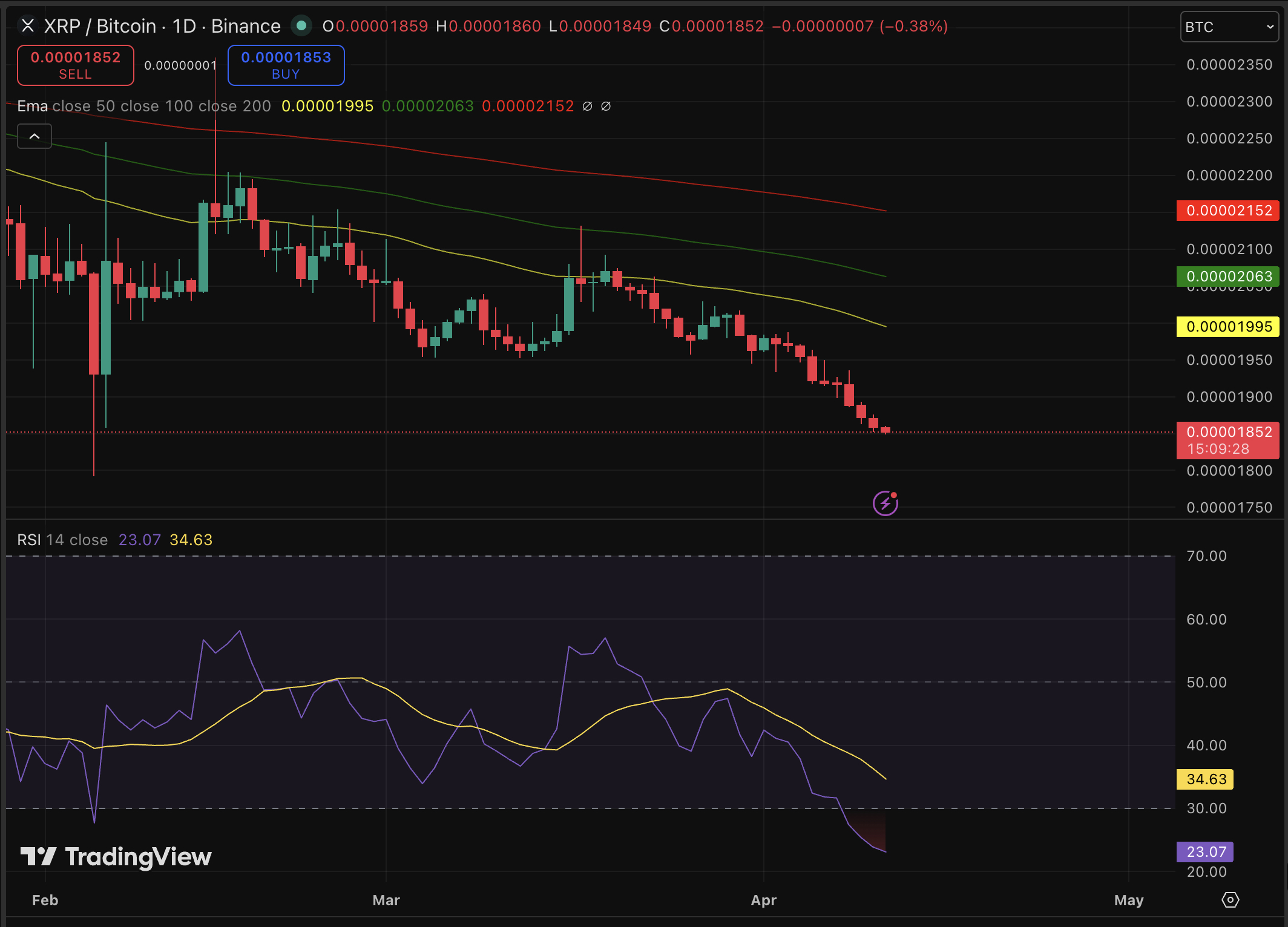
XRP price is trading at a whisper of green in an otherwise grim eight-month downtrend and continuation of bearish prediction. Volume remains elevated at the $2B range, showing that conviction hasn’t fully left the building. Are the indicators finally telling us something, or is this another false dawn before a deeper flush?
Technical data shows the RSI on the XRP/BTC ratio has collapsed to 23, the most oversold reading since October 2025. Historically, RSI prints at this level on the XRP/BTC pair have preceded breakouts of 65% to 345% against Bitcoin.
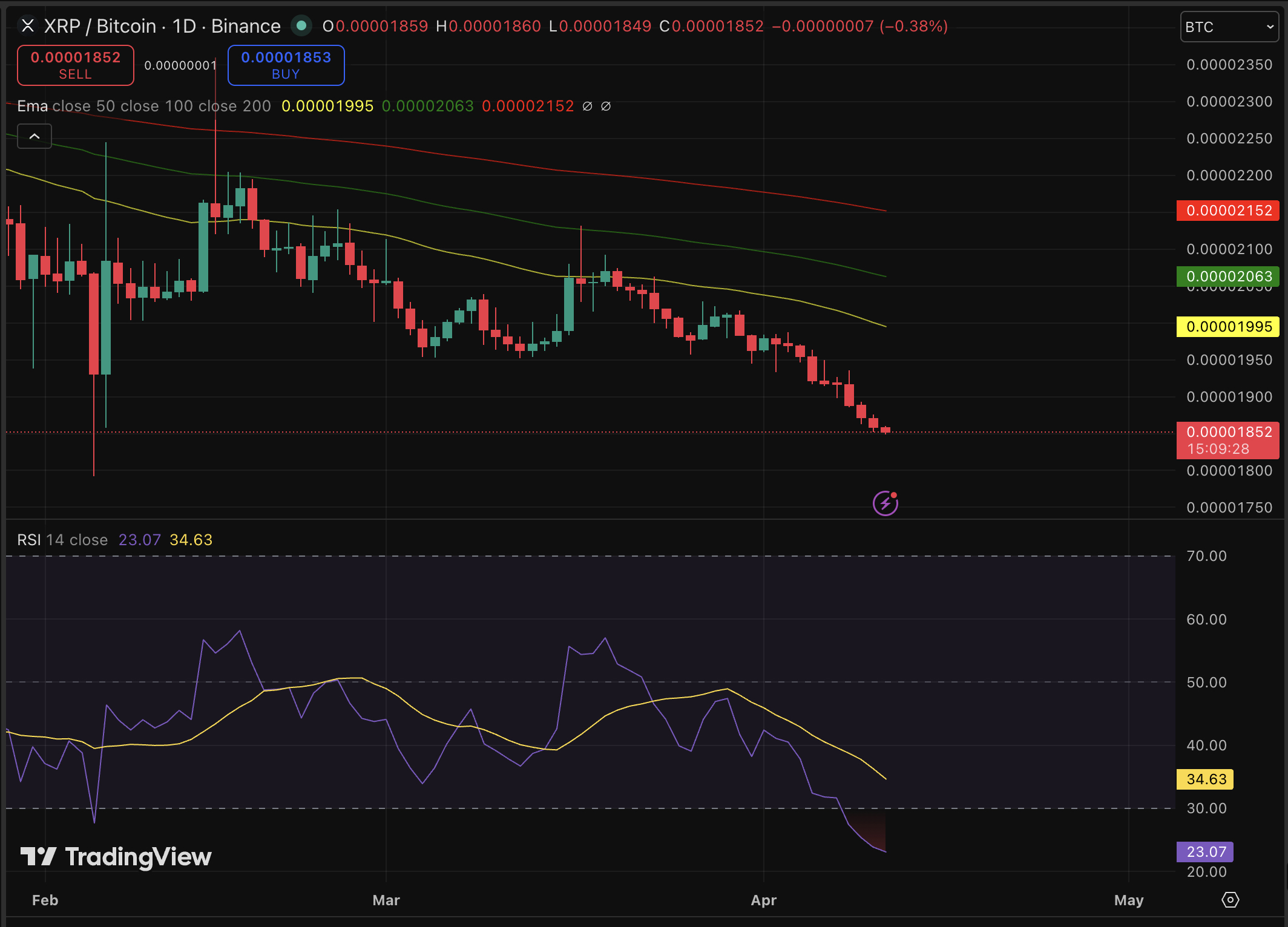
The XRP MVRV Z-score is simultaneously hovering near zero, a level that has aligned with accumulation zones in 2021, 2022, and 2024 before each subsequent major rally. The last comparable setup, June 2025, launched a 61% XRP/BTC ratio surge and a 92% price run to $3.66.
The Fear & Greed Index sits at an extreme 16, with 26 of 29 technical indicators currently bearish. Macro caution is real. But macro caution and structural bottoms have a long history of coexisting.
Discover: The best crypto to diversify your portfolio with
XRP Price Prediction: Reclaim $1.41 Resistance, or a Retest of $1.28 Support?
Price is consolidating in a tight band with clear technical boundaries. Resistance sits at $1.37, $1.39, and $1.41; the 50-day SMA looms overhead at $1.40, keeping bulls honest. Support clusters at $1.33, $1.32, and $1.31, with the strongest floor at the $1.28–$1.30 classical pivot zone.
The RSI on the daily timeframe has neutralized around 46.48, not oversold, but also not showing momentum in either direction.
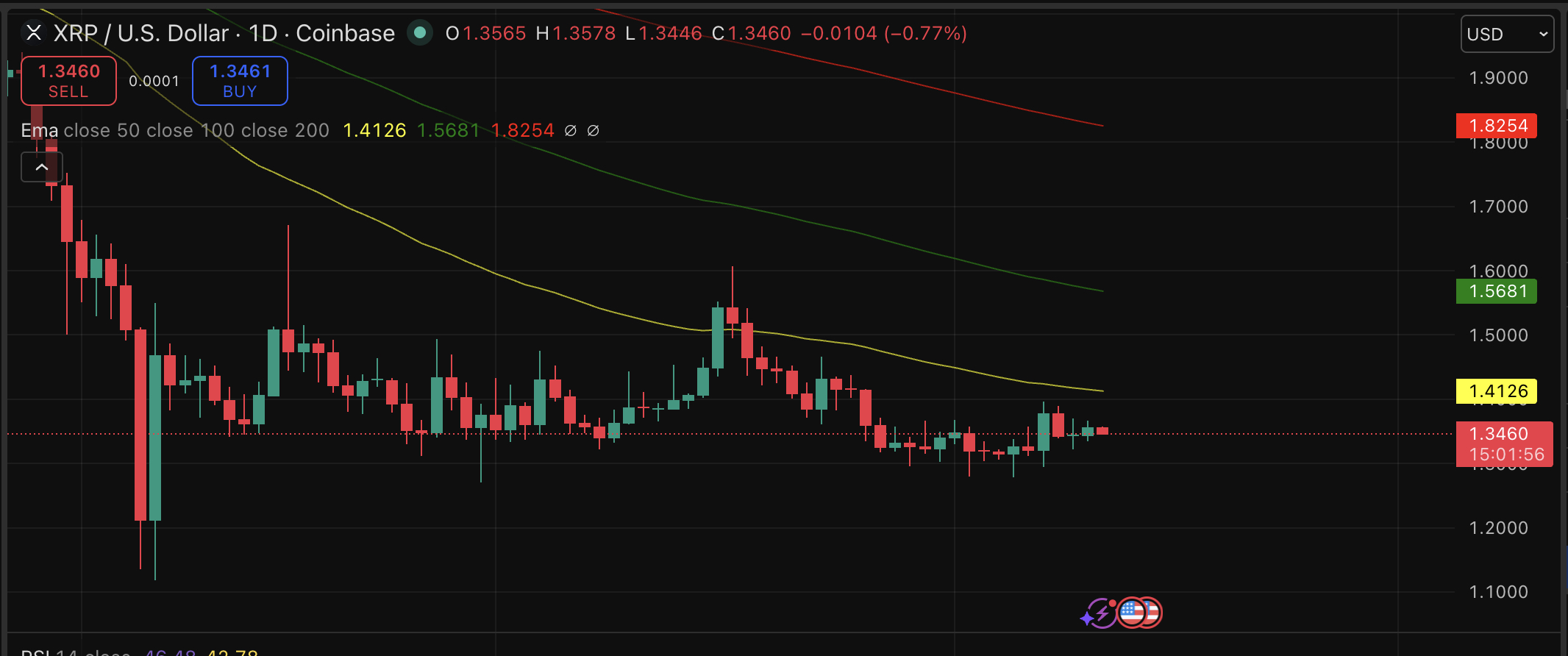
Short-term forecasts lean cautiously. April’s projected range is $1.30–$1.51, suggesting limited explosive upside in the near term even under optimistic conditions.
XRP’s recent price action has drawn comparisons to prior false recoveries, though the MVRV data distinguishes this moment from typical dead-cat setups. The XRP/BTC pair is also sitting inside a long consolidation range that has historically acted as a macro launch zone, which is either very reassuring or very easy to say in hindsight.
Discover: The best pre-launch token sales
LiquidChain Targets Early Mover Upside as XRP Tests Key Levels
XRP’s structural indicators may be pointing toward a bottom, but even a clean reversal to $1.5 only represents modest upside for capital already deployed at current prices. Institutional inflows into XRP ETPs have been notable, yet the price remains range-bound. Traders watching for asymmetric entries are increasingly scanning earlier in the capital stack.
LiquidChain ($LIQUID) is a Layer 3 infrastructure project built around a single thesis: that fragmented liquidity across Bitcoin, Ethereum, and Solana is the core unsolved problem in DeFi. Its Unified Liquidity Layer fuses BTC, ETH, and SOL liquidity into one execution environment, developers deploy once and access all three ecosystems simultaneously via Single-Step Execution and Verifiable Settlement.
A new layer emerges. Only a few see it first.
The future is LiquidChain⟁https://t.co/vqvBcdSj94 pic.twitter.com/R7ZeZ0NPGl
— LiquidChain (@getliquidchain) March 24, 2026
The presale is currently priced at $0.01448, with $650K raised to date and the project approaching its $1M milestone. It also offers 1600% APY Staking bonus for early participants.
For traders looking beyond near-term range-trading, research LiquidChain and check what it has to offer.
The post XRP Price Prediction: Bottom Signals Flashing, Good Time to Scoop? appeared first on Cryptonews.
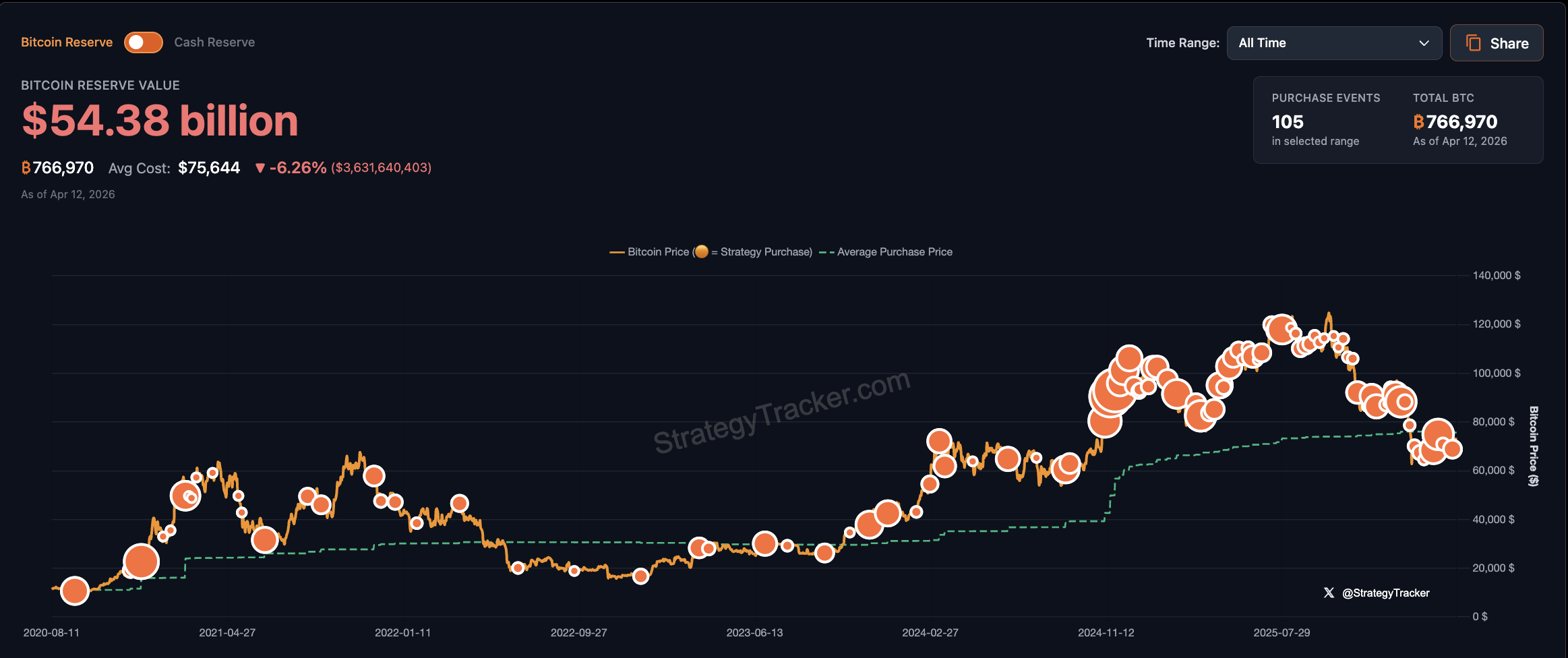
Michael Saylor, the co-founder of Bitcoin (BTC) treasury company Strategy, signaled that the company is acquiring more BTC, as the price retreated from the local high of over $73,000 reached this week.
“Think bigger,” Saylor said on Sunday, while sharing the chart of Strategy’s BTC purchase history that has become synonymous with imminent BTC acquisitions.
Strategy’s most recent BTC purchase was April 6, when it bought 4,871 coins for more than $329.8 million, bringing its total holdings to 766,970 BTC, valued at about $54.5 billion using market prices at the time of publication, according to the company.
The Tysons Corners, Virginia-based company continues accumulating BTC, even amid a bear market that pushed Bitcoin’s price down to two-year lows, putting Strategy’s BTC treasury underwater.

Related: Strategy set to resume buying Bitcoin via STRC: Will BTC price hit $80K?
Strategy is sitting on nearly $14.5 billion in unrealized losses
Strategy’s average cost of acquisition per BTC is $75,644, nearly $5,000 less than the market price at the time of this writing.
The company reported a loss of nearly $14.5 billion on its BTC holdings for the first quarter of 2026, according to a filing with the US Securities and Exchange Commission (SEC).
Despite the unrealized losses, Strategy continues to accumulate BTC at a faster rate than miners can produce new coins, leading some analysts to forecast a potential BTC supply squeeze.
Miners produced about 16,200 BTC in March, while Strategy accumulated 46,233 BTC during that same period, nearly three times the newly mined supply.

“The global consensus is that BTC is digital capital. The four-year cycle is dead. Price is now driven by capital flows. Bank and digital credit will determine Bitcoin’s growth trajectory,” Saylor said in April.
Strategy’s 766,970 BTC reserve makes it the biggest BTC treasury company by holdings, according to BitcoinTreasuries. The next largest is held by Twenty One Capital, which holds 43,514 BTC.
Strategy has bucked the trend during the ongoing bear market by continuing accumulation as other BTC treasury companies show signs of capitulation amid a challenging business environment. MARA Holdings sold 15,133 Bitcoin in March for roughly $1.1 billion to buy back $1 billion of zero-coupon convertible notes at a discount.
Chairman and CEO Fred Thiel commented that the transaction enhanced the company’s “financial flexibility” and increased its “strategic optionality” as MARA expands “beyond pure-play Bitcoin mining into digital energy and AI/HPC infrastructure.”
Magazine: Scottie Pippen says Michael Saylor warned him about Satoshi chatter


BNB Chain has told node operators to complete a required software update before the Osaka/Mendel hard fork reaches mainnet on April 28.
Summary
- BNB Chain told node operators to install BSC v1.7.2 before the Osaka/Mendel hard fork launches.
- The April 28 mainnet upgrade follows testnet activation and adds stability, gas limits, and finality.
- BNB Chain said outdated settings and poor binary replacement could cause nodes to lose sync.
The network said operators should move to BSC v1.7.2 and remove outdated settings to keep nodes running normally.
BNB Chain developers said node operators must complete the update before the Osaka/Mendel hard fork goes live on BSC mainnet. The network scheduled the upgrade for April 28 at 2:30 a.m. UTC.
The notice said operators need to replace binaries correctly and clean up old configuration fields. The team said those steps are needed to stop nodes from “losing sync” during the upgrade.
The message places the focus on infrastructure readiness before the hard fork date. It also shows that the update is not optional for operators who want their nodes to stay aligned with the chain.
The deadline comes as BNB Chain moves from testnet preparation to a full mainnet rollout. That shift usually puts more attention on validator and node performance across the network.
The Mendel upgrade adds BEP-652, which brings EIP-7825 into BNB Chain through a protocol-level gas cap for each transaction. The cap is set at 16,777,216 gas.
That change means all nodes will reject transactions above the limit in the same way. BNB Chain said this method is more reliable than the earlier soft cap model that operators could treat differently.
The broader network upgrade includes nine BEPs in total. BNB Chain also said it adopted seven of the 13 Ethereum proposals linked to Fusaka, including six that required a hard fork and one client-side RPC change.
The network did not adopt the other six proposals because of architecture differences. It also added two BNB Chain-specific updates through BEP-657 and BEP-648.
Testnet rollout came before mainnet launch
BNB Chain activated the Osaka/Mendel hard fork on the BSC testnet on March 24 at block 88,379,325. Developers said the test phase improved block construction, transaction handling at scale, network stability, and execution accuracy.
BEP-657 limits when blob transactions can be included based on block number. BEP-648 aims to reduce latency and speed up finality on the network.
The mainnet launch now depends on operators completing the required update on time. The latest alert shows BNB Chain wants nodes fully prepared before the April 28 hard fork begins.
The TRON founder accused the Trump-linked DeFi project of hiding a ‘trap door’ in its token contract.
The long-simmering conflict between TRON founder Justin Sun and World Liberty Financial (WLFI) erupted into an all-out public war on Sunday, with both sides hurling accusations on X.
Sun, who invested $75 million in the DeFi venture affiliated with the Trump family, published a lengthy statement accusing WLFI of embedding a hidden blacklisting function in the WLFI token smart contract, a mechanism he said gives the project “unilateral power to freeze, restrict, and effectively confiscate the property rights of any token holder, without notice, without cause, and without recourse.”
“This is a trap door marketed as an open door,” Sun wrote.
The dispute dates back to September 2025, when WLFI blacklisted a wallet containing more than 500 million of Sun’s WLFI tokens after on-chain analysts flagged transfers routed through HTX, Sun’s crypto exchange.
WLFI responded within hours, dismissing Sun’s allegations and threatening legal action.
“Justin’s favorite move is playing the victim while making baseless allegations to cover up his own misconduct,” the project’s official account posted. “We have the contracts. We have the evidence. We have the truth. See you in court pal.”
Sun fired back minutes later, demanding that whoever was operating the account identify themselves. “As the largest investor in this project, I demand that those responsible come forward by name, instead of hiding in the shadows.”
The feud follows days of scrutiny over WLFI’s treasury operations.
Sun went on to allege that governance votes cited to justify the project’s actions “were not conducted through a fair or transparent process” and that “the outcomes were predetermined.”
He accused the team of extracting fees, implanting backdoor controls, and “treating the crypto community as a personal ATM.”
Sun was careful to separate the WLFI operators from President Trump himself, opening his statement by reaffirming support for Trump and directing criticism at “the bad actors at WLFI.”
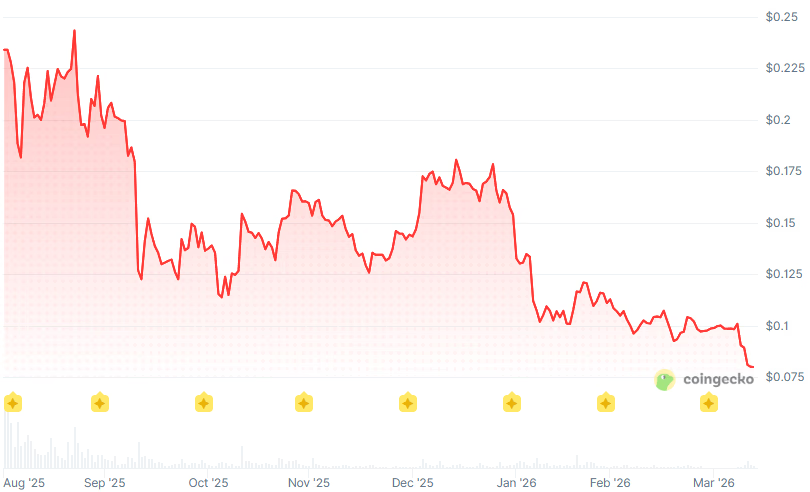
Since the September 2025 blacklist, WLFI has fallen roughly 76% from its all-time high of $0.30 to around $0.079, per CoinGecko, hitting an all-time low just yesterday. The token tanked 18% on its first day of trading and has barely recovered since.

TLDR:
- BlackRock’s combined BTC and ETH holdings dropped from $78.36B to $57.89B in Q1 2026.
- Bitcoin holdings rose by 14,950 BTC despite a $16.24B fall in dollar value over the quarter.
- Ethereum holdings fell 410,750 ETH, reflecting both price weakness and active net distribution.
- Q1 2026 losses of $20.47B were $5.97B lower than the $26.44B decline recorded in Q4 2025.
BlackRock’s crypto portfolio recorded a sharp $20.47 billion decline in Q1 2026, as falling Bitcoin and Ethereum prices weighed heavily on the asset manager’s holdings.
Data from blockchain analytics platform Arkham shows combined BTC and ETH holdings dropped from $78.36 billion to $57.89 billion between January 1 and March 31.
While Bitcoin saw continued accumulation despite the price slump, Ethereum experienced both price-driven losses and reduced holdings, marking a clear shift in institutional positioning as market conditions remained under pressure throughout the quarter.
Bitcoin Accumulated as Ethereum Holdings Contracted
Bitcoin remained the largest component of BlackRock’s crypto allocation throughout Q1 2026. BTC prices fell from $88,341 to $65,982, a 25.31% decline, pushing the dollar value of holdings down by $16.24 billion.
The value dropped from $68.05 billion to $51.81 billion over the quarter. Despite the price weakness, BlackRock continued buying Bitcoin.
Holdings grew from approximately 770,290 BTC to 785,240 BTC, adding 14,950 BTC, or 1.94% growth. This pattern points to opportunistic accumulation rather than retreat from the asset class.
Ethereum told a different story. ETH prices fell 33.12%, from $2,966 to $1,983, while ETH holdings also dropped from 3.47 million to 3.06 million.
That 410,750 ETH reduction pushed Ethereum exposure down from $10.31 billion to $6.08 billion, a $4.23 billion decrease. Unlike Bitcoin, Ethereum saw both price pressure and net distribution during the period.
Q1 2026 Losses Remain Below Q4 2025 Levels
The Q1 2026 decline, though steep, was smaller than the previous quarter’s drawdown. In Q4 2025, BlackRock’s crypto portfolio fell by $26.44 billion, with Bitcoin dropping $20.74 billion and Ethereum falling $5.71 billion.
Quarter-over-quarter, the pace of losses eased by approximately $5.97 billion. The comparison to Q1 2025 shows how much conditions have shifted.
A year earlier, the portfolio declined by only $4.95 billion, with both assets still in accumulation phases. Bitcoin rose by 23,300 BTC, and Ethereum increased by 120,350 ETH during that earlier period.
By Q1 2026, Ethereum had clearly shifted from accumulation to net outflows. Bitcoin accumulation persisted, but falling prices kept overall portfolio value under pressure.
The holdings tracked here reflect client capital flowing through BlackRock’s iShares Bitcoin Trust and iShares Ethereum Trust, not proprietary positions held by the firm.
President Donald Trump said the United States will begin naval action at the Strait of Hormuz, according to a Truth Social post shared Sunday.
Summary
- Trump said the US Navy will begin blockading ships entering or leaving the Strait immediately.
- The post said US forces may interdict vessels accused of paying tolls to Iran.
- Trump linked the planned blockade to Iran tensions and the unresolved dispute over nuclear issues.
The statement said the move followed talks in which “NUCLEAR” remained the main unresolved issue.
Meanwhile, Trump said the United States Navy would start the process of blockading ships trying to enter or leave the Strait of Hormuz. He described the move as an immediate response and said the goal was to stop what he called ”WORLD EXTORTION.”
The post also said the United States would move toward an ”ALL BEING ALLOWED TO GO IN, ALL BEING ALLOWED TO GO OUT” basis at a later stage. Trump said Iran had blocked that outcome by raising fears about mines in the waterway.
Trump said the Navy had been instructed to seek and interdict vessels in international waters that had paid what he called an illegal toll to Iran. He added that any ship paying such a toll would not receive safe passage on the high seas.
The post also said US forces would begin destroying mines that Iran allegedly placed in the strait. Trump presented the planned action as part of a broader effort to stop Iran from using the waterway for pressure during the current crisis.
In addition, Trump used sharp language throughout the post and said any Iranian forces that fired at US or commercial vessels would face direct retaliation. He also wrote that the blockade would begin shortly and said other countries would join the effort.
The statement further claimed Iran’s naval and air capabilities had been degraded and repeated the administration’s view that Tehran’s nuclear program remained the central issue. Trump said Iran wanted money and, more importantly, ”Nuclear.”
Strait of Hormuz remains a key route
The Strait of Hormuz remains one of the world’s most important shipping routes for oil and gas flows. Any military move involving that passage is watched by energy markets, shipping operators, and governments across several regions.
Trump’s post did not include operational details, a timeline for enforcement, or the names of any partner countries expected to join. The statement nevertheless set out a clear position that the United States was prepared to take direct action in and around the strait.


A fake Ledger app on Apple’s Mac App Store cost musician G. Love nearly 6 BTC after he entered his recovery phrase into the malicious software. The stolen Bitcoin was worth more than $424,000.
In an April 11 X post, Garrett Dutton, the singer known as G. Love, explained the loss while he was moving his Ledger setup to a new Apple computer.
Bitcoin Theft Highlights Risks of Fake Wallet Apps
He explained that the incident occurred after he searched the App Store for Ledger Live, downloaded an app that looked authentic, and followed its prompts. The app then asked for his 24-word seed phrase. As soon as he entered it, the attackers drained the Bitcoin.
Dutton said the stolen funds were part of his retirement savings.
“I lost 5.9 BTC all I had for ten years I worked on this f#ck be careful out there,” he stated.
On-chain investigator ZachXBT said the stolen 5.92 BTC were routed through addresses identified as KuCoin deposit addresses.
When asked whether the funds could be recovered, ZachXBT said he did not expect KuCoin to intervene.
Instead, the on-chain investigator accused KuCoin of presenting itself as compliant only when it suited its interests. He also pointed to KuCoin’s loss of its MiCA license in February 2026, just three months after obtaining it, as evidence of deeper compliance problems.
ZachXBT continued, noting that illicit services continue to exploit broker and personal accounts on the platform, with little visible regulatory resistance. He added that the large number of deposit addresses suggested the thieves may have routed the funds through an instant exchange.
Meanwhile, Beau, head of security at Pudgy Penguins, warned crypto users never to enter a hardware wallet seed phrase on an internet-connected device such as a laptop or phone.
He said scammers often distribute fake wallet apps through email, deceptive advertisements, and even physical mail. The security expert added that users should treat any message urging them to download or update wallet software as a scam until they independently verify it.
The post Fake Ledger App on Apple App Store Drains Over $400,000 in Bitcoin appeared first on BeInCrypto.

(VIDEO) Frustrated Sergio Garcia Breaks Driver on Masters No. 2 Tee Box
Bitcoin Institutional Dominance Hits 82% Amid Surging OTC Activity
a Trade with the Bears, Summer QB Competition, Cam Skattebo


-

 Business7 days ago
Three Gulf funds agree to back Paramount’s $81 billion takeover of Warner, WSJ reports
-

 Politics2 days ago
US brings back mandatory military draft registration
-

 Fashion2 days ago
Weekend Open Thread: Veronica Beard
-

 Tech5 days ago
How Long Can You Drive With Expired Registration? What Florida Law Says
-

 Politics3 hours ago
World Cup exit makes Italy enter crisis mode
-

 Fashion6 days ago
Massimo Dutti Offers Inspiration for Your Summer Mood Board
-
 Sports2 days ago
Man United discover Nico Schlotterbeck transfer fee as defender reaches Dortmund agreement
-

 Crypto World3 days ago
Canary Capital Files SEC Registration for PEPE ETF
-

 Fashion5 days ago
Let’s Discuss: DEI in 2026
-

 Business2 days ago
Tesla Model Y Tops China Auto Sales in March 2026 With 39,827 Registrations, Beating Cheaper EVs and Gas Cars
-

 Crypto World4 days ago
Bitcoin recovers as US and Iran Agree a Ceasefire Deal
-

 Politics2 days ago
Malcolm In The Middle OG Turned Down ‘Buckets Of Money’ To Appear In Reboot
-

 Business2 days ago
OpenAI Halts Stargate UK Data Centre Project Over Energy Costs and Copyright Row
-

 Business1 day ago
Ireland Fuel Protests Enter Day 5 as Blockades Spark Shortages and Government Prepares Support Package
-

 Tech6 days ago
Italian court says Netflix must refund customers up to $576 over price hikes
-

 Tech6 days ago
Gamer Restores the Original PlayStation Portal From Two Decades Ago
-

 Tech6 days ago
Haier is betting big that your next TV purchase will be one of these
-

 Tech6 days ago
The Xiaomi 17 Ultra has some impressive add-ons that make snapping photos really fun
-

 Tech6 days ago
Samsung just gave up on its own Messages app
-

 Tech6 days ago
Save $130 on the Samsung Galaxy Watch 8 Classic: rotating bezel, sleep coaching, and running coach for $369
You must be logged in to post a comment Login