

Crypto World
Will Crypto Markets Move When $1.2B Bitcoin Options Expire Today?


Around 19,500 Bitcoin options contracts will expire on Friday, July 17, with a notional value of roughly $1.23 billion. This expiry is much smaller than usual events, so it is unlikely to have any impact on spot markets.
Crypto markets have gained later in the week following cooler-than-expected US inflation data, but have lost those gains by Friday.
Bitcoin Options Expiry
This week’s batch of Bitcoin options contracts has a put/call ratio of 0.87, meaning that sellers of long (call) contracts and short (put) contracts are almost evenly matched. Max pain is around $62,500, which is lower than current spot prices, so some will be out of the money on expiry.
Open interest (OI), or the value or number of Bitcoin options contracts yet to expire, remains highest at the $70,000 strike price on Deribit, with $1.6 billion, but short sellers still have $1.1 billion in OI at $60,000. Total BTC options OI across all exchanges has ticked up a little to $30 billion, according to Coinglass.
“Puts continue to trade at a premium to calls across all major tenors, although the magnitude of that premium has become increasingly uniform,” said crypto derivatives provider Greeks Live this week.
This suggests that overall, the market is less panicked about an immediate crash than before, though people still pay a bit more for “drop protection” than for “rise bets” — just not as extremely as they did recently.
“The proportion of large-scale bullish trades continued to increase this week, primarily consisting of short-term bull spreads.”
Meanwhile, Deribit said, “This floods the market with liquidity and volatility, creating prime conditions for trading short-dated options on Deribit.”
At 08:00 UTC tomorrow, ~$1.45B in BTC and ETH options are set to expire on Deribit.$BTC : ~$1.23B notional | P/C: 0.86| Max Pain: $62.5K$ETH : ~$218M notional | P/C: 1.54| Max Pain: $1.75K
This floods the market with liquidity and volatility, creating prime conditions for… pic.twitter.com/OlYg6LQsls
— Deribit (@DeribitOfficial) July 16, 2026
In addition to today’s tiny batch of Bitcoin options, around 131,000 Ethereum contracts are expiring, with a notional value of $242 million, a max pain of $1,750, and a put/call ratio of 1.5.
Total ETH options OI across all exchanges is low at around $4.8 billion. This brings the total notional value of crypto options expirations to around $1.4 billion, a very small event.
Spot Market Outlook
Crypto markets bounced to a mid-week high of $2.3 trillion, but those gains had started to erode by the end of the week.
Bitcoin has fallen around 2% from its intraday high of $64,800 to $63,300 during the Friday morning Asian trading session. It appears to be heading for the weekly resistance area, which is around $62,000.
Ether has also broken down from its six-week high in an almost 4% decline to around $1,850 at the time of writing.
The post Will Crypto Markets Move When $1.2B Bitcoin Options Expire Today? appeared first on CryptoPotato.

South Korea’s Financial Supervisory Service (FSS) has reportedly begun a formal sanctions process related to the November 2025 $36 million exploit on Upbit, the country’s major crypto exchange operated by Dunamu. According to Yonhap News, the regulator has sent Dunamu an inspection opinion letter following a review of the incident.
The letter effectively opens the next stage of enforcement. It also gives Dunamu an opportunity to respond to the inspection findings before the FSS moves to notify the company of any proposed sanctions.
Key takeaways
- The FSS has reportedly issued an inspection opinion letter to Dunamu, kicking off a sanctions procedure after Upbit’s November 2025 $36 million hack.
- Yonhap reported that regulators are assessing whether Upbit violated the Virtual Asset User Protection Act, even though the law reportedly lacks direct penalties for cyberattacks and computer hacks.
- Upbit previously said it reimbursed affected customers using its own balance sheet funds and froze certain assets after the breach.
- Authorities are also weighing changes to South Korea’s Digital Asset Basic Act to add sanctions and compensation provisions for hacking and system failures.
- Upbit said it upgraded its wallet infrastructure after the incident and later introduced an automatic onchain tracing service intended to support recovery efforts.
FSS inspection letter launches enforcement step
Yonhap News reported Sunday that the FSS recently sent Dunamu an inspection opinion letter connected to the $36 million exploit that affected Upbit in late November 2025. The report frames the letter as the formal start of a sanctions process, with Dunamu able to respond to the findings before the regulator issues details of any proposed penalties.
The FSS is assessing whether the exchange breached the Virtual Asset User Protection Act. However, Yonhap noted that the statute does not provide direct sanctions provisions specifically for cyberattacks or computer hacking incidents.
This creates a compliance pressure point for exchanges and operators in South Korea: even when losses originate from security failures outside traditional financial market conduct, regulators are still attempting to map the incident to existing consumer protection obligations.
Criticism focused on delayed disclosure
Yonhap said Upbit faced criticism for delaying its announcement of the $36 million hack. The breach reportedly lasted about 54 minutes, beginning at 4:42 a.m. KST on November 27, but Upbit did not publicly disclose the incident until the end of the day.
The timing of the public disclosure, according to Yonhap, coincided with a merger-related event involving Naver Financial, after which the exchange finally announced the exploit. The regulatory review described in the report suggests that disclosure timing—along with incident handling—may be a key part of the FSS’s evaluation under the user protection framework.
Cointelegraph said it approached Dunamu for comment on the matter. No further response is included in the provided text.
Regulatory gap and proposed legislative changes
Yonhap also reported that South Korean authorities are considering how to address the current legal gap. The outlet said officials plan to add sanctions and compensation provisions for hacking and computer system failures into the second phase of the Digital Asset Basic Act.
For market participants, the significance is practical: a clearer statutory basis could shift enforcement from interpretive reviews—such as whether a hack violates broader user-protection obligations—to direct, incident-specific penalties and compensation duties. In other words, the likely focus may expand from “did the operator comply with existing rules?” to “did the operator meet explicit standards designed for cyber incidents?”
Until those amendments take effect, operators may remain exposed to enforcement theories rooted in consumer protection and operational responsibility, even where the law lacks cyberattack-specific sanction language.
Upbit’s response: reimbursements, wallet overhaul, and tracing
Upbit’s public response to the November 2025 exploit emphasized customer reimbursement and infrastructure changes. In a statement released after the incident, the exchange said it froze roughly 2.3 billion won (about $1.5 million) worth of funds. Upbit also said it would fully reimburse affected customers using its own balance sheet assets.
Separately, Upbit said it initiated an overhaul of its crypto wallet architecture after the exploit and migrated all assets from the wallets implicated in the incident. The exchange’s stated objective was to reduce exposure to potential vulnerabilities that could allow similar attacks to succeed.
In December 2025, Upbit said it developed an automatic onchain tracking service called the Onchain AI Tracer System, intended to trace the path of stolen funds and support recovery efforts.
These operational updates matter in the regulator’s context because they may influence how authorities assess whether Upbit took adequate steps both immediately after the breach and in the subsequent months. Even when reimbursement addresses direct user losses, regulators may still consider whether changes demonstrate robust incident prevention, transparent communication, and effective post-incident controls.
Upbit also ranks among the larger spot crypto exchanges in South Korea and globally, according to CoinMarketCap’s exchange rankings, which use scoring that includes traffic, liquidity, and trading volume.
Going forward, the key development to watch is Dunamu’s response to the FSS inspection opinion letter, since it will shape what sanctions—if any—are ultimately proposed. At the same time, traders and users should monitor the legislative process around the Digital Asset Basic Act’s next phase, because any move toward explicit hacking-related sanctions and compensation could materially alter how compliance is judged after major security incidents.

With the latest Consumer Price Index data for June already out, all economic eyes have now turned to the United States Federal Reserve and the upcoming FOMC meeting scheduled for the end of July.
Although inflation has cooled, there are still those pushing for an interest rate hike during the next meeting. The question is: what could happen to BTC and its price stagnation if that’s the case?
Big Macro Test Ahead?
The odds declined over the past week or so after the June inflation data showed a substantial drop to 3.5%. While that might be more misleading than it sounds, given the fact that oil prices are up in July due to the ceasefire breakdown, data from CME FedWatch show that experts believe there’s an 85% probability that policymakers will leave rates unchanged. In contrast, the odds of a 25-basis-point increase stand at a more modest 15%.
Those odds shifted after the CPI announcement on Tuesday given the softer-than-expected reading, which reinforces the market’s expectation that the Fed will not pivot on its current strategy. Nevertheless, there are some who continue to sound increasingly hawkish, including new Fed Chair Kevin Warsh and Dallas Fed President Lorie Logan.
Higher interest rates have been seen as a roadblock for BTC and other risk-on assets, as investors tend to become more defensive. Higher borrowing costs strengthen the appeal of lower-risk investments such as Treasury securities, while reducing liquidity throughout financial markets.
The latest major example of bitcoin plunging following the Fed’s aggressive tightening cycle was in 2022/2023. However, today’s market differs from previous cycles.
Will BTC Indeed Crash?
A large portion of the market reaction would likely depend on whether a rate hike catches investors completely off guard. Markets overwhelmingly expect rates to remain unchanged; an unexpected 25- or, more threateningly, 50-basis-point hike could trigger a sharp sell-off across equities, cryptocurrencies, and other risk assets.
However, the longer-term picture offers a different perspective. If the central bank raised rates because the local economy was still resilient and inflation proved harder to beat, stronger economic activity could continue to support corporate earnings and institutional investment appetite. BTC has proven in the past that it can recover quickly from macro-driven shocks, particularly when long-term demand stays intact.
For now, the landscape appears quite fragile, even as markets anticipate no rate changes. However, inflation is still above the Fed’s target, and several policymakers have doubled down on more hawkish stances, which could lead to some wild price moves if the central bank surprises investors with a July hike.
The post What Happens to Bitcoin if the Fed Raises Rates in July? appeared first on CryptoPotato.
A severe Cyclospora parasite outbreak tied to supplier Taylor Farms hit Walmart and Taco Bell this week. Both companies moved fast, with Walmart issuing recalls and Taco Bell cutting menu items on Friday.
US health officials confirmed the contamination link late Thursday, tracing cases to shredded iceberg lettuce grown in central Mexico. Both stocks closed lower on Friday as the fallout spread across the food supply chain.
What Caused the Parasite Outbreak
Cyclospora is a microscopic parasite that causes cyclosporiasis, an intestinal illness known for prolonged watery diarrhea and fatigue.
The Centers for Disease Control and Prevention (CDC) traced the outbreak to shredded iceberg lettuce grown in central Mexico. Taylor Farms, one of the largest salad producers in the country, supplied the contaminated batches.
Investigators traced illnesses to Taco Bell locations across five states. Taylor Farms then said Friday it would remove all iceberg lettuce sourced from the region. Historically, food-safety scares fade within weeks; this one moved unusually fast.
The CDC has confirmed more than 1,600 cases nationwide, with thousands more reports under review. However, broader stock market sentiment across equities had already turned cautious after a string of earnings surprises this month.
How Walmart and Taco Bell Responded
Walmart (WMT) pulled four bagged salad products from shelves as a precaution. The retailer, however, reported no confirmed illnesses linked to its own products. Taco Bell removed the supplier’s lettuce entirely and cut several menu items while it verifies new sourcing.
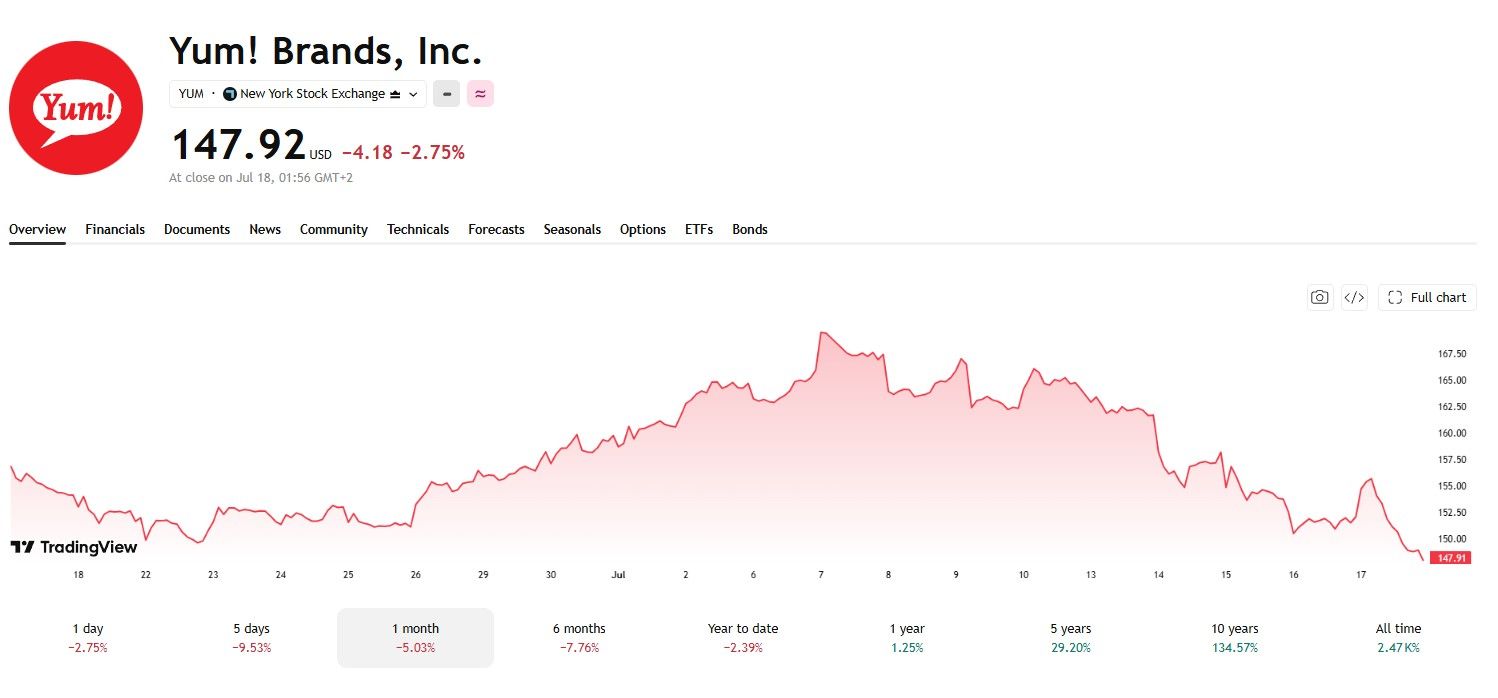
Yum Brands (YUM) shares fell 2.75% Friday to close at $147.92, and Walmart slipped 0.62% to $114.24. The reaction mirrors other sharp, single-stock swings this earnings season. Netflix shares sank after a third-quarter revenue guidance miss.
Meanwhile, Alphabet slid on a Gemini AI delay and a fresh EU order. In each case, one company-specific shock outweighed broader index calm.

Why Sweetgreen’s Rally Stands Out
Sweetgreen (SG) shares jumped 13.83% to close at $7.08. Regulators confirmed the chain does not use iceberg lettuce and was never part of the contaminated supply chain.
In contrast, Walmart and Yum Brands remain squarely inside the investigation’s scope. The stock had shed nearly 26% over the prior week as investors priced in guilt by association. That fear eased once a clearer picture emerged.

The swing recalls other abrupt reversals this year. SpaceX, for instance, saw a volatile Nasdaq-100 debut. Equity investors more broadly shifted toward record equity market exposure, even as bitcoin sat out the rally.
Sweetgreen’s next earnings report, due August 6, will show whether the relief rally reflects lasting confidence or a temporary reprieve.
Therefore, whether the sector’s swings prove temporary may depend on how quickly the Food and Drug Administration (FDA) closes its investigation. Meanwhile, investors will also watch whether other suppliers face scrutiny in the coming weeks.
The post Cyclospora Parasite Outbreak: Salad Recalls Trigger Sharp Stock Volatility appeared first on BeInCrypto.
South Korea’s Financial Supervisory Service (FSS) has reportedly moved to formally examine whether crypto exchange operator Dunamu, the parent company behind Upbit, breached local rules after a $36 million hack last November. Yonhap News reported Sunday that the regulator recently sent Dunamu an inspection opinion letter—an early step that starts a sanctions process and gives the company a chance to respond to the FSS’s findings before any penalties are proposed.
At the center of the inquiry is a regulatory question about how existing South Korean law applies to cyber incidents. According to the same report, authorities are also looking at a potential legislative fix that would add clearer sanctions and compensation provisions for hacking and computer system failures.
Key takeaways
- The FSS has sent an inspection opinion letter to Dunamu, the operator of Upbit, marking the start of a formal sanctions procedure, per Yonhap News.
- Dunamu is expected to respond to the regulator’s inspection findings before any proposed sanctions are issued.
- The probe is tied to a $36 million exploit reported by Upbit in connection with a breach that lasted about 54 minutes on November 27, 2025, though the announcement came later that day.
- South Korean authorities are reviewing whether the incident violated the Virtual Asset User Protection Act, which currently lacks direct provisions for cyberattacks or computer hacks.
- The report indicates plans to address that legal gap in a second phase of the Digital Asset Basic Act by adding sanctions and compensation related to system failures.
Regulator signals sanctions after the November Upbit exploit
Yonhap News said the FSS recently sent Dunamu an inspection opinion letter following the November 2025 hack tied to Upbit. The letter effectively initiates the regulator’s step-by-step sanctions process, starting with a formal assessment and allowing the exchange operator to reply before the FSS notifies the company of any proposed penalties.
The development matters for market participants because it frames the incident not just as a security lapse, but as a compliance issue under South Korea’s financial oversight. When regulators move from incident response to sanctions procedures, it typically signals heightened scrutiny over both operational controls and communications practices around material events.
Timing of Upbit’s disclosure comes under scrutiny
Yonhap also highlighted criticism directed at Upbit regarding the timing of its public disclosure about the $36 million exploit. The report states that the breach began at 4:42 a.m. KST on November 27, 2025 and lasted roughly 54 minutes. However, Upbit did not announce the hack until the end of the day.
Yonhap attributed the delayed announcement to the conclusion of a merger-related event involving Naver Financial. That detail underscores the potential tension between corporate event calendars and the expectations regulators and users may have for timely disclosure after a major security incident.
Legal gap: current law lacks direct cyberattack sanctions
According to Yonhap, the FSS is reviewing whether the exchange violated the Virtual Asset User Protection Act. The report specifically notes that the act does not contain direct sanction provisions for cyberattacks or computer hacks.
This is a significant point for investors and compliance teams: if the law does not clearly address hacking events, regulators may have to rely on broader consumer protection obligations or other compliance standards to justify penalties. That can lead to uncertainty about outcomes—especially while case-specific interpretations develop.
Yonhap added that South Korean authorities intend to reduce this ambiguity by proposing additions for sanctions and compensation related to hacking and computer system failures in the second phase of the Digital Asset Basic Act. In practical terms, that suggests policymakers want future regulatory enforcement to be more direct and standardized when similar incidents occur.
Upbit’s response after the breach: reimbursement and wallet changes
Following the November exploit, Upbit said it froze approximately 2.3 billion won (about $1.5 million) worth of funds and would fully reimburse affected customers using its own balance sheet, according to a statement published on the exchange’s website. Upbit said it would reimburse impacted users rather than leaving them to absorb losses.
In addition to reimbursement, Upbit said it initiated an overhaul of its crypto wallet architecture to address potential vulnerabilities identified in the aftermath of the incident. The exchange also stated that it migrated all assets from wallets considered affected.
The operator’s efforts extended into onchain monitoring as well. In December 2025, Upbit said it developed an automatic onchain tracking service called Onchain AI Tracer System. The stated purpose was to follow the path of stolen funds and support potential recovery efforts.
For traders and users, these actions are relevant because they indicate how Upbit has approached both immediate risk containment and longer-term incident response. Yet regulators may still evaluate whether controls were sufficient before the breach, how the incident was managed during the window of compromise, and how promptly users were informed.
Separately, Upbit is described as ranking third in CoinMarketCap’s spot exchange rankings, based on a scoring system that includes factors such as traffic, liquidity, and trading volumes, according to CoinMarketCap’s exchange rankings page.
What to watch as the inspection and sanctions process unfolds
With the FSS inspection opinion letter now in place, the next key development will be how Dunamu responds to the regulator’s findings and what compliance arguments it presents around disclosure timing, incident handling, and the applicability of existing law. Observers should also watch the legislative track Yonhap described—if the second phase of the Digital Asset Basic Act adds cyber-focused sanctions and compensation provisions, it could materially change how future security incidents are regulated in South Korea.
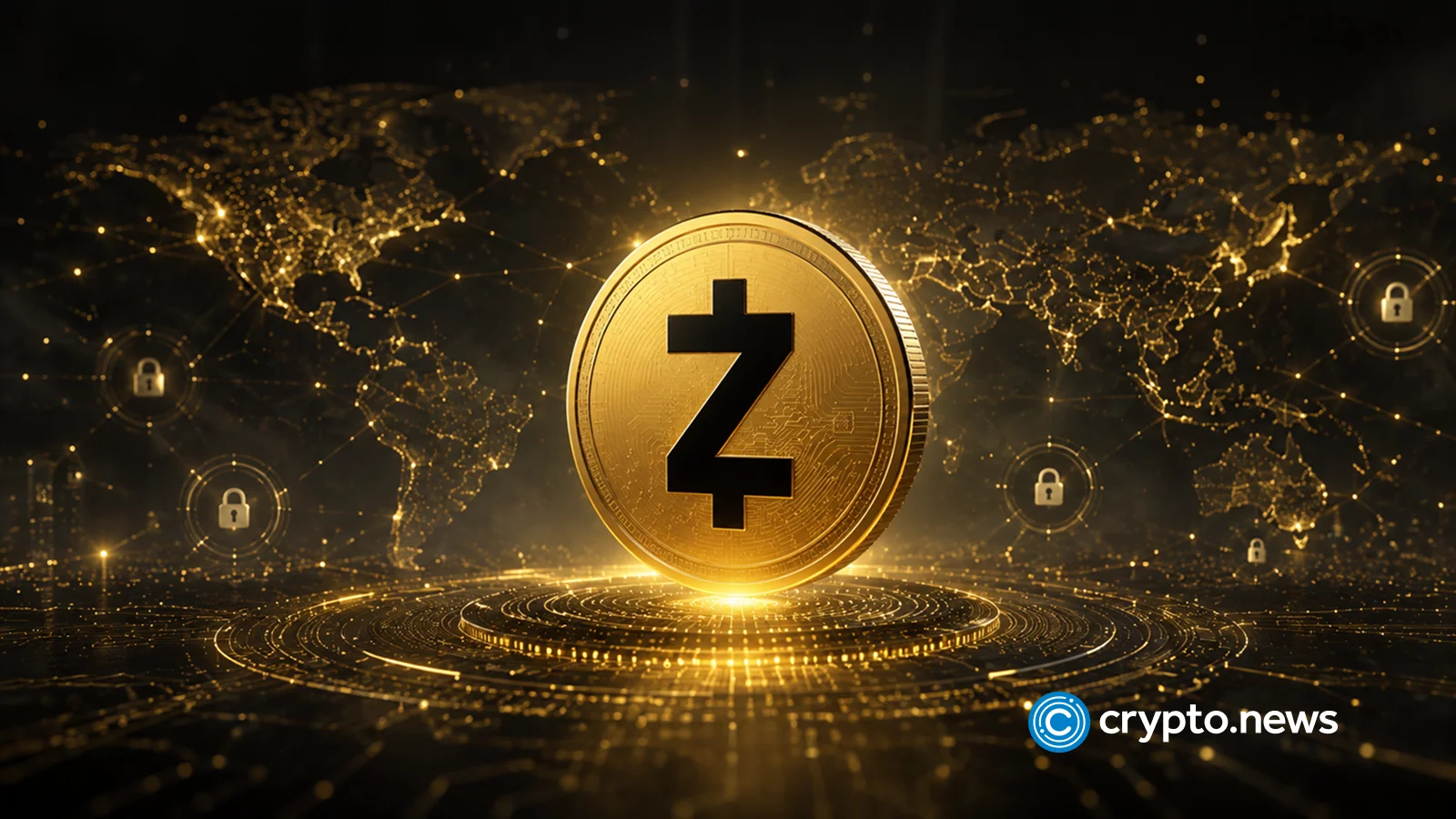
Zcash founder Zooko Wilcox has explained how the network’s July 28 Ironwood hard fork will address uncertainty around a critical flaw in the Orchard shielded pool.
Summary
- Zcash will seal the old Orchard pool, limiting how much ZEC can leave after Ironwood.
- Ironwood cannot identify fake coins individually but can stop excess hidden supply from escaping Orchard.
- Temporary exchange and wallet disruptions may occur as providers prepare for Zcash’s July 28 upgrade.
The upgrade will not identify or freeze individual counterfeit coins. Instead, it will seal the old pool and limit how much ZEC can leave.
In a July 19 post on X, Wilcox explained how the planned upgrade would deal with any hidden excess supply if the flaw was exploited before developers patched it. Because Orchard hides transaction details, the network cannot prove that counterfeit ZEC was never created.
Ironwood will seal the vulnerable Orchard pool
Ironwood, also known as NU6.3, is scheduled to activate at block 3,428,143 on July 28. The upgrade will retire the current Orchard pool and introduce a new shielded pool based on the corrected circuit.
According to Zcash’s official Ironwood user update, users will no longer be able to send or receive ZEC inside the old Orchard pool after activation. Funds can leave only through the turnstile, which prevents more ZEC from exiting than legitimately entered.
The Zcash team said it believes the flaw was “unlikely to have been exploited,” but users cannot independently prove no counterfeit ZEC was created. Ironwood aims to trap any excess value inside the old pool rather than allow it to enter wider circulation.
Orchard bug left a supply question Zcash could not prove away
Security researcher Taylor Hornby discovered the Orchard flaw on May 29 while auditing the shielded system. The bug could have allowed an attacker to create counterfeit ZEC inside Orchard without leaving an obvious public record.
As reported by crypto.news, developers first disabled Orchard activity and then restored it through the NU6.2 hard fork with corrected cryptography. No evidence of unauthorized value creation was found, but Orchard’s privacy means past exploitation cannot be ruled out with complete certainty.
Crypto.news later reported that Ironwood would create a fresh shielded pool and use the turnstile to control value leaving the old one. Node operators can then verify that circulating ZEC does not exceed the amount permitted by the network’s monetary rules.
Wallets and exchanges may temporarily pause services
Zcash users do not need to take immediate action before the hard fork. However, wallets, exchanges and other providers may temporarily suspend deposits, withdrawals or related services while completing software upgrades.
The official network guidance says Orchard users will eventually need wallet support to move funds into the new pool. Funds may remain temporarily unavailable in wallets that have not added the required migration tools.
The July 28 activation also follows Zcash’s move away from the legacy zcashd client. Providers still completing that migration may need more time before fully supporting Ironwood.
Zcash adds more security checks after the flaw
The Orchard incident led to wider security work across the Zcash ecosystem. As reported by crypto.news, an AI-assisted review using Anthropic’s Mythos system found no additional serious vulnerabilities after the original flaw was disclosed.
Developers are also pursuing independent audits and formal verification for the updated cryptographic system. The work aims to reduce the risk of another hidden counterfeiting flaw and give users stronger ways to verify Zcash’s supply rules.
Ironwood addresses the unresolved supply question rather than the already-fixed bug itself. By sealing Orchard and controlling withdrawals through the turnstile, the hard fork aims to prevent any hypothetical counterfeit ZEC from entering circulation.
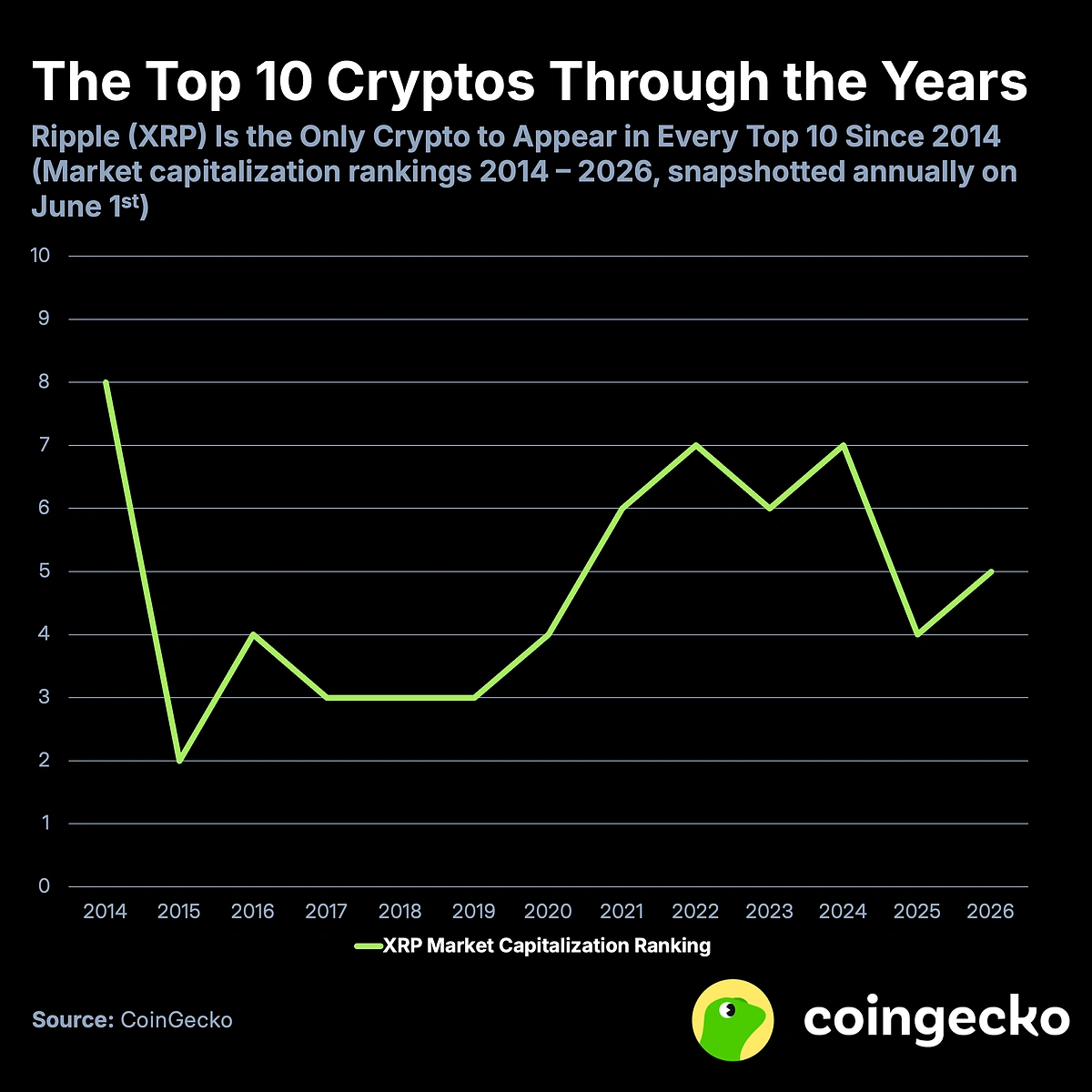
XRP just secured a record no other altcoin can claim, staying inside crypto’s top 10 by market cap every single year since 2014.
The streak spans more than a decade, from bull runs to brutal bear markets to a landmark legal battle against regulators.

The Only Altcoin Besides Bitcoin in the Top 10
A top 10 ranking measures the ten largest cryptocurrencies by market cap, the total value of all coins in circulation. XRP is the only asset besides Bitcoin to hold that position continuously since 2014.
The CoinGecko study, which excluded 2013 due to sparse data, frames the achievement in stark terms. Back in 2014, XRP ranked eighth, with a market cap of nearly $32 million, just 0.3% of the top 10’s combined market cap.
The token reached second place in 2015, right behind Bitcoin. It later held third across 2017, 2018, and 2019 before stablecoins and Layer-1 tokens reshaped the ranking.
The list of casualties makes the run even more impressive. Early giants like Litecoin, Dash, NEM, Namecoin, and Peercoin once filled the top 10 but eventually faded from view.
Follow us on X to get the latest news as it happens.

XRP, by contrast, refused to disappear entirely. It weathered every rotation of capital, narrative, and technology that pushed rivals out of the elite tier and into obscurity.
Ethereum offers a useful perspective on the feat. It has spent years in the top 10, yet its token only launched in 2015, leaving XRP alone alongside Bitcoin as a genuine 2014 survivor.
Why Does XRP’s Longevity Actually Matter
The resilience faced its harshest test between 2020 and 2023. The US Securities and Exchange Commission sued Ripple, the payments firm tied to XRP, triggering delistings across several major exchanges.
Even then, the token retained enough value to stay among the industry’s largest names. CoinGecko attributed that endurance to sustained institutional and cross-border payment demand across every market cycle.
The numbers show how far it has traveled since those early days. By 2025, XRP had reached fourth place with a market cap of nearly $127.9 billion, roughly 4.3% of the top tier.
Its trajectory mirrors both the explosive growth of crypto and its own ability to stay relevant as the industry matured around it year after year.

Legal commentator, Bill Morgan, called the record both a fact and an inconvenient truth for skeptics who still question XRP’s long-term relevance.
The achievement carries weight beyond bragging rights. Longevity signals durable demand, a quality that increasingly matters as institutions weigh which assets belong inside regulated financial products and long-term portfolios.
XRP currently trades near $1.10, holding its top-10 spot despite recent market volatility that briefly dragged the price to $1.05 before recovering.
Subscribe to our YouTube channel to watch leaders and journalists provide expert insights.
The post XRP Achieves a Milestone No Other Altcoin Has Ever Reached in Crypto History appeared first on BeInCrypto.
Circle President Heath Tarbert has defended the company’s long-term strategy after Circle shares fell sharply from their post-IPO peak.
Summary
- Circle says USDC’s scale and network effects remain difficult for new stablecoin competitors to replicate.
- Open USD adds pressure as Circle shares trade far below their post-IPO peak near $260.
- Circle keeps expanding regulated infrastructure while investors question competition, margins, and future stablecoin revenue sharing.
Speaking in a July 14 interview with FOX Business, Tarbert said management remains focused on building financial infrastructure rather than reacting to short-term moves in the stock.
The interview came as Circle faced growing investor concern over competition in the stablecoin market. CRCL had traded near $260 after its public debut before falling toward the low $60 range. Tarbert said Circle is “playing the long game” and argued that successful execution would eventually support shareholder value.
Tarbert points to USDC network effects
Tarbert said Circle’s main focus remains building a full-stack internet financial platform around USDC and related infrastructure. He argued that the company’s position cannot be measured only through daily stock movements and said the stock should “take care of itself” if Circle delivers on its wider mission.
He also defended USDC against new competitors. Tarbert pointed to roughly $73 billion in circulation and native support across 34 blockchains, saying those network effects would be “incredibly hard to replicate.” Circle describes USDC as a regulated digital dollar used across trading, payments and settlement.
Open USD adds new pressure to Circle
The comments came after Open Standard launched Open USD, a planned stablecoin backed by more than 140 participating businesses. The group includes Visa, Mastercard, Stripe, BlackRock, BNY and Coinbase. Open Standard says partners can mint and redeem Open USD without fees and receive reserve earnings after a management charge.
As reported by crypto.news, Circle shares fell 17.5% to $62.63 after Open USD entered the market and CRCL left several Russell Growth indexes. The decline added to concerns about whether new stablecoin models could pressure Circle’s economics.
Wall Street has also raised questions about that competition. Crypto.news reported that Mizuho cut its Circle price target to $50, arguing that Open USD’s revenue-sharing structure could pressure margins and raise distribution costs.
Circle faces pressure over USDC economics
Circle’s challenge extends beyond new stablecoin issuers.JPMorgan lowered earnings forecasts for Circle and Coinbase after a new revenue-sharing agreement tied to USDC balances on Hyperliquid. The bank said stronger adoption could come with lower reserve income retained by the companies.
Tarbert pushed back on the idea that competitors can quickly reproduce USDC’s reach. He also described USDC as the largest regulated stablecoin and said it leads in actual transaction volume, presenting scale and existing distribution as key parts of Circle’s competitive position.
Circle keeps expanding regulated infrastructure
Circle has continued adding regulated infrastructure despite the stock decline. On July 10, the company received final OCC approval to establish Circle National Trust. The trust bank will initially provide digital asset custody, with USDC reserve management planned as a possible future service.
As reported by crypto.news, the approval places the new entity under direct federal supervision. Circle says the structure could support wider institutional use of its digital asset infrastructure.
Tarbert’s comments frame the stock decline against a wider contest for stablecoin distribution and reserve income. Open USD brings a large group of payment and financial companies into the market, while Circle continues betting that USDC’s existing network and regulated infrastructure will support its long-term position.
XRP price prediction remains in focus as it trades between $1.08 and $1.10. The chart still gives bulls little to celebrate. Price remains below the 50, 100, and 200-day EMAs between $1.15 and $1.16, $1.24 and $1.25, and $1.45 and $1.46. That leaves the $1.00 to $1.02 zone as the key support that traders keep watching.
The latest inflation data briefly lifted risk appetite across financial markets. However, XRP barely flinched. While stocks welcomed the softer backdrop, XRP continued to drift as traders stayed on the sidelines. Sometimes the market hears good news and simply shrugs.
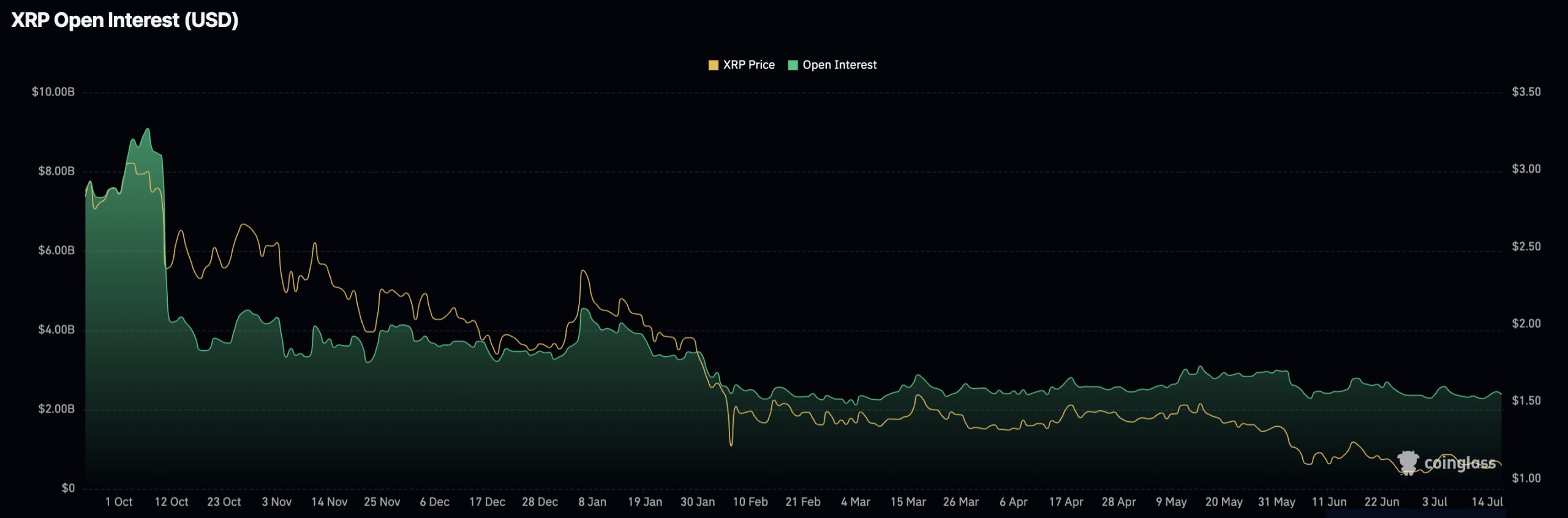
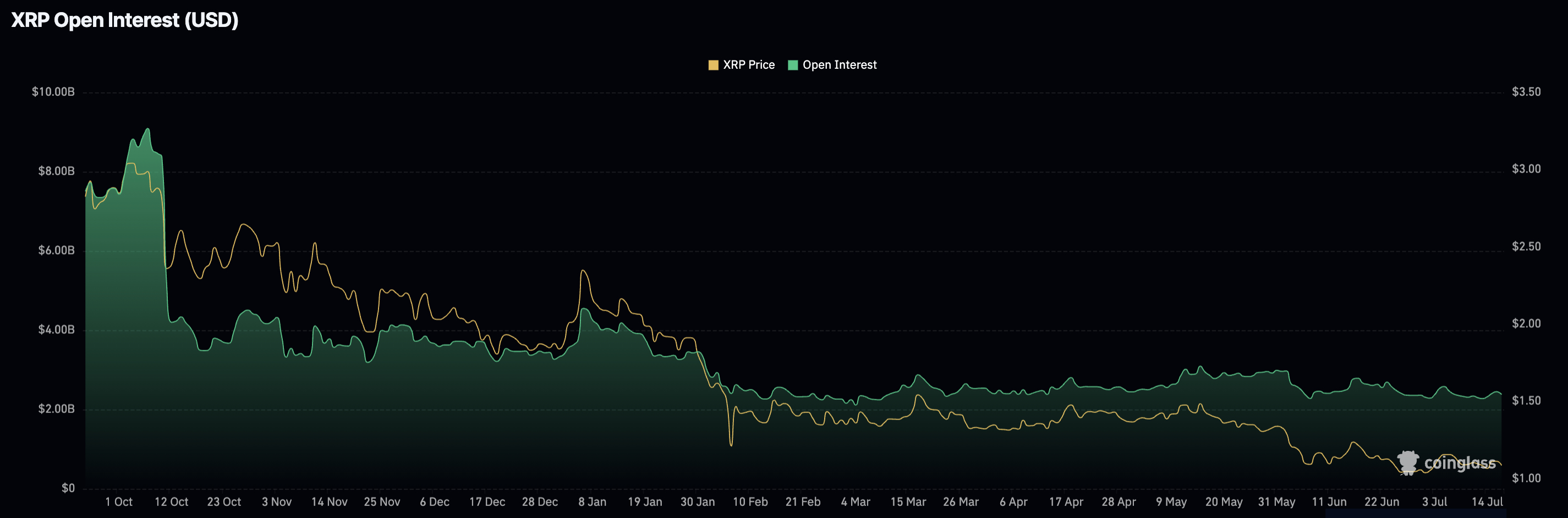
Open interest in perpetual futures has continued to fade, reflecting weaker speculative demand. ETF inflows have also slowed, while assets under management remain below $900 million to $1 billion. Retail participation has yet to return in meaningful numbers, leaving momentum without much fuel.
Even so, momentum remains neutral rather than outright bearish. The daily RSI sits between 44 and 46, suggesting neither buyers nor sellers have full control. That shifts the focus away from breakout dreams. Instead, traders are asking whether XRP can defend the psychologically important $1.00 to $1.02 area before sellers push for another leg lower.
Now, can XRP push higher next week?
Trade ADA on Bybit and Get a Chance to Win Our $1,000 USDT Airdrop
XRP Price Prediction: Hold $1.00 Support This Week?
XRP is trading between $1.08 and $1.10, while 24-hour volume sits between $1.0 billion and $1.1 billion. Activity remains healthy, but volume still lacks the punch that usually confirms a trend. Meanwhile, the failed defense of the $1.10 to $1.11 zone remains the technical headline. That area briefly acted as support, but losing it puts buyers back on the spot.
The EMA stack still leans against a quick recovery. The 20, 50, and 200-day EMAs continue capping upside attempts. As a result, every bounce runs into overhead supply almost immediately. Sellers are not running away with the market, but they are still calling the tune.

The bullish path remains straightforward. Buyers need to defend the $1.08 to $1.10 range and reclaim $1.15 to $1.17 with convincing volume. Fresh optimism around regulation could also help, although the price still needs to prove it. Hope is cheap, but breakouts usually demand cash.
The base case is still a sideways grind between $1.08 and $1.16. However, if $1.10 to $1.11 turns into firm resistance again, attention shifts toward $1.02 to $1.04. A break there would put the $0.99 to $1.00 area back in focus, where traders often become far more emotional than technical.
The RSI around 51 to 53 reflects neutral momentum rather than a decisive edge for either side. In that environment, patience often beats prediction. Longer-term models still lean constructive, yet short-term traders are likely watching whether the $1.00 mark survives before dreaming about the next rally.
Discover: The Best Token Presales
Bitcoin Hyper Targets Early Mover Upside as XRP Tests Key Levels
When a large-cap asset like XRP is grinding below every meaningful moving average with weakening institutional flows, the risk-adjusted case for holding it starts to compete with the opportunity cost of sitting in something earlier in its curve. That’s the rotation trade some active traders are running right now. They are not abandoning crypto, but moving capital where asymmetry is higher.
Bitcoin Hyper ($HYPER) is currently in presale at $0.0136832, having raised $32.9 million to date. The project’s core pitch is infrastructure, not hype: it’s positioning as the first Bitcoin Layer 2 with Solana Virtual Machine (SVM) integration, with sub-Solana latency on a chain secured by Bitcoin’s trust model.
The presale includes staking with a high APY, and the feature set covers a decentralized canonical bridge for BTC transfers alongside low-cost smart contract execution.
Research Bitcoin Hyper at the presale page before the current pricing stage closes.
Discover: The Best Crypto to Diversify Your Portfolio
The post XRP Price Prediction: Can XRP Hold $1 Next Week? appeared first on Cryptonews.

The Electronic Transactions Association (ETA) is signaling that Bitcoin may become a more visible part of mainstream payments conversations—at least within the group’s broader push to engage with emerging transaction technologies. ETA CEO Jason Oxman told CoinDesk that the organization is not lobbying for or against Bitcoin, but he suggested that ETA members are beginning to recognize its potential disruption in the payments stack.
The message comes as the ETA expands its membership base to include BitPay. On August 6, the trade group announced that BitPay—the Bitcoin payments provider—had become the first virtual currency company to join the ETA, framing the move as part of the industry’s ongoing innovation agenda.
Key takeaways
- The ETA’s Jason Oxman said the group does not take an official pro- or anti-Bitcoin stance and supports electronic transactions broadly, including non-Bitcoin technologies.
- BitPay’s entry as the ETA’s first virtual currency member is being presented by Oxman as evidence the trade group “won’t turn a blind eye to innovation.”
- Oxman pointed to education efforts around Bitcoin—specifically referencing the role of the Bitcoin Foundation—in shaping ETA members’ attitudes.
- On New York’s BitLicense proposal, Oxman argued regulators should avoid applying “reflexive” rules to new technology and instead conduct a deeper technical review of how Bitcoin systems and consumer protections work.
- New York’s financial regulator extended the public comment period for the BitLicense proposal by 45 days, pushing the deadline to October 21.
Why BitPay’s ETA membership matters
ETA represents major players in electronic payments, including companies such as Visa, MasterCard, Amazon, and PayPal. When Oxman discussed the ETA’s posture toward Bitcoin, he did not describe the trade group as endorsing a single technology. Instead, he framed the ETA’s mission around enabling electronic transactions in whatever form merchants and customers choose.
In that context, Oxman cited the ETA’s partnership with Atlanta-based Bitcoin payment solutions provider BitPay as a practical sign of openness. He suggested the organization is trying to position itself as a partner for emerging technology startups, with engagement driven largely by whether market participants show demand for those tools.
Oxman’s core argument was that transaction rails evolve according to user and merchant preferences. As he put it in his remarks, electronic transactions will take “whatever the customer or merchant of choice agrees is going to be the form of their electronic transaction.”
From education to partnerships
Oxman also linked the ETA’s shifting view to earlier learning efforts about Bitcoin. He said the Bitcoin Foundation played a significant role in educating ETA members about Bitcoin’s benefits and emphasized the value of business-oriented introductions between Bitcoin startups and established payment companies.
Specifically, Oxman referenced an ETA event in 2013 where Bitcoin Foundation general counsel Patrick Murck spoke. In Oxman’s recollection, Murck helped frame Bitcoin in business terms, after which Oxman said at least one ETA member decided to pursue a deal with a Bitcoin processor.
This detail matters because it suggests the ETA’s openness is not only policy-driven, but also influenced by how Bitcoin is presented—less as a speculative innovation and more as a payments system that can be integrated into existing commercial workflows.
What Oxman says about BitLicense and consumer protection
The ETA CEO’s comments also touched New York’s BitLicense framework, which has been at the center of ongoing debate about how cryptocurrency businesses should be regulated. Oxman said the ETA’s historical experience with regulatory change has involved adjusting to new payment options such as PayPal, noting that it previously spent significant effort encouraging regulators not to constrict innovation.
However, he acknowledged why regulators may be cautious with new payment technologies. His reasoning was that regulators tend to focus on consumer protection. According to Oxman, the less established the alternative system is—meaning the fewer protections are clearly available—the more regulators feel compelled to intervene.
Still, Oxman said the NY Department of Financial Services (NYDFS) should do more than react quickly to novelty. He argued regulators should not rely on “reflexive rules” simply because a technology is new, and instead conduct a real in-depth look at Bitcoin’s underlying systems.
In his view, the key is understanding how Bitcoin’s system operates, including how the blockchain works, and how Bitcoin providers—such as payment processors—can implement additional safeguards for consumers and merchants. The implication is that compliance standards should reflect the actual operating model and control points of Bitcoin-related businesses, rather than generic assumptions that could overreach.
Regulatory timeline shifts in New York
While ETA’s stance is aimed at engagement rather than advocacy, New York’s regulatory process is still unfolding. Earlier this week, NYDFS superintendent Benjamin Lawsky extended the public comment period on the BitLicense proposal by 45 days, pushing the deadline to October 21. This extension followed a joint letter addressed to Lawsky from BTC China, Huobi, and OkCoin, where the “Big three” exchanges outlined concerns about the proposal.
For industry participants, the practical takeaway is that the BitLicense debate remains active and that the regulatory outcome may depend on the arguments that emerge during the revised comment window. For Bitcoin-focused payments firms, that matters directly: the availability of licensing pathways and the scope of compliance requirements can influence whether and how businesses expand within New York.
As the ETA continues to bring Bitcoin payments into its orbit through members like BitPay and as New York works through its BitLicense process, readers should watch two things: whether regulators adopt a more technical, systems-level approach to consumer safeguards, and whether established payments networks deepen partnerships with Bitcoin-related processors as demand from merchants and customers becomes more visible.


South Korea’s Financial Supervisory Service has begun a formal sanctions process against Dunamu, the operator of crypto exchange Upbit, over the major wallet breach reported in November 2025.
Summary
- South Korea’s FSS opened sanctions proceedings against Dunamu over Upbit’s November 2025 wallet breach case.
- Current law lacks direct hacking penalties, leaving regulators uncertain about how severe sanctions can be.
- Upbit reimbursed affected users and rebuilt wallet systems while regulators continued examining the incident closely.
The action follows a months-long inspection into whether the exchange met its duties under the country’s Virtual Asset User Protection Act.
According to an SBS report citing financial authorities, the FSS recently sent Dunamu an inspection opinion letter. The document gives the company a chance to respond before regulators decide what penalties, if any, should follow. The process then moves through several formal regulatory review stages.
FSS reviews Upbit’s response to the 2025 breach
The November 27 attack affected Solana-based assets held by Upbit. Early estimates varied, with crypto.news reporting losses of about $36 million based on figures available at the time. South Korean reports now place the affected amount at 44.5 billion won, worth about $32 million at current exchange rates.
Upbit said it moved assets to cold wallets, halted deposits and withdrawals, and began tracing the stolen funds after detecting abnormal transfers. In its official customer notice, the exchange said customer losses would be covered with company funds. Authorities later examined both the security failure and the timing of Upbit’s public disclosure.
Legal gap makes the possible sanctions unclear
The current Virtual Asset User Protection Act gives regulators powers over custody, unfair trading and customer protection, but it does not set direct penalties specifically for hacking or computer system failures. That leaves uncertainty around how far the FSS can go in this case.
The regulator will consider Dunamu’s response before issuing advance notice of any proposed action. Final measures would require further review by the sanctions review committee, the Securities and Futures Commission and the Financial Services Commission. South Korean authorities are also considering stronger rules for hacking and technology failures in the next phase of digital asset legislation.
Upbit has faced wider regulatory pressure
The hack arrived during a period of close regulatory attention on Dunamu. As reported by crypto.news, South Korea’s Financial Intelligence Unit previously imposed a 35.2 billion won fine on the company over anti-money laundering and customer verification failures.
That earlier enforcement action later faced court scrutiny. Crypto.news reported that a court canceled a three-month partial suspension against Dunamu after finding gaps in the legal basis used for the sanction. The latest hacking case could create another test of how existing laws apply to crypto exchange operations.
Dunamu’s Naver deal remains under review
The sanctions process also comes while Dunamu works through a planned share swap with Naver Financial. the companies recently delayed completion of the transaction to December 31 because several regulatory approvals remain outstanding.
The current inspection does not automatically block that deal. However, Dunamu remains under several layers of regulatory review while South Korea prepares broader digital asset rules. The FSS has not yet announced a proposed sanction level in the hacking case, and Dunamu still has an opportunity to challenge the inspection findings before any final decision.

Crypto in Pakistan: Halal or Haram? New Debate Erupts After Fatwa

Joe Hart backs surprise result in Spain vs Argentina World Cup final | Football

Top 10 Must-Visit Vietnam Destinations for 2026, From Bustling Hanoi’s Old Quarter to Phu Quoc Island


-
 NewsBeat3 days ago
London Mayor Sadiq Khan handed a peerage by Keir Starmer alongside 15 other Labour figures… just days before the PM leaves No10
-

 Fashion2 days ago
Weekend Open Thread – Corporette.com
-

 Politics1 day ago
The House | The City of London can help the new chancellor deliver growth in every postcode
-

 Politics4 days ago
Young campaigners urge incoming PM to act on outdoor junk food ads
-

 Crypto World3 days ago
CFTC blocks Kalshi from unwinding Michigan trades after court order
-

 Business3 days ago
Nvidia Stock Slips After Big Tuesday Rally as Huang Confirms Vera Rubin Chip Is Now in Production Today
-

 Crypto World1 day ago
Ripple Payments Joins MiCA With 14 Firms, Does It Mean Anything For XRP?
-
 Entertainment4 days ago
Disney’s Most Ambitious Failed Star Wars Attraction Is Coming to SDCC
-

 Crypto World2 days ago
Ripple wins EU-wide access as ESMA adds it to MiCA register
-

 Business3 days ago
Palantir Shares Rise After Expanded Nvidia Partnership and Fresh Analyst Upgrades Ahead of Earnings Day
-

 Crypto World3 days ago
Injective Submits SEC Transfer-Agent Registration to Onchain Ownership Records
-

 NewsBeat2 days ago
Registration is now open for March for Men with Kev 2026
-

 Tech5 days ago
Get Your ESP32 Sunny Side Up With This Solar Dev Board
-

 News Videos5 days ago
XRP BOMBSHELL… XRP OMBOARDED FOR TRANSACTIONS!!!
-

 Tech5 days ago
Dark Secrets Emerge When Jailbreaking LLMs
-
 Crypto World2 days ago
Two July Windows Left: The CLARITY Act’s Senate Fight and What Failure Means
-
 Sports4 days ago
New Cornerback Enters Vikings Trade Rumor Mill
-

 News Videos2 days ago
Money | Class 12 Economics | CBSE Board Exam 2026-27
-

 Business2 days ago
Banco Bilbao Vizcaya Argentaria, S.A. (BBVA) Discusses Global Macro Environment and Economic Outlook for Core Markets Transcript
-

 Crypto World3 days ago
Claude Fable 5 Slips to Second in AI Coding Leaderboard
You must be logged in to post a comment Login