

Crypto World
WISeKey (WKEY) Shares Drop as WISeSat Progresses Toward Nasdaq Launch Under WSAT Symbol


Key Takeaways
-
WISeKey shares retreat as WISeSat subsidiary progresses with Nasdaq listing under WSAT symbol.
-
Satellite subsidiary submits updated confidential SEC registration for anticipated public market debut.
-
Stock faces downward pressure following disclosure of SPAC transaction advancement.
-
WISeSat pursues independent Nasdaq presence through WSAT ticker while parent company shares decline.
-
Parent company experiences continued selloff as satellite unit completes regulatory filing milestone.
Shares of WISeKey International Holding (WKEY) declined following disclosure of a regulatory filing advancement for its satellite subsidiary WISeSat’s forthcoming Nasdaq debut. The stock settled at $8.25, representing a 6.99% decrease, and continued sliding to $8.17 during pre-market activity. The decline reflected investor concerns surrounding the proposed space technology merger transaction.
WISeKey International Holding AG, WKEY
Satellite Subsidiary Progresses With Public Market Plans
According to WISeKey’s announcement, WISeSat.Space Holdings Corp. filed an updated confidential Form F-4 registration draft with the Securities and Exchange Commission on May 29, 2026. This submission advances the satellite company’s merger with Columbus Acquisition Corp. Upon deal completion, the merged entity anticipates commencing Nasdaq trading operations under the WSAT ticker symbol.
The transaction stems from a Business Combination Agreement executed November 9, 2025, involving WISeSat, CAC, Pubco, WISeKey, and WISeSat Merger Sub Corp. Following consummation, both WISeSat and CAC will operate as Pubco subsidiaries. The arrangement remains contingent upon SEC clearance, Columbus Acquisition shareholder consent, and Nasdaq listing authorization.
The satellite division operates via WISeSat.Space AG, concentrating on protected orbital infrastructure solutions. Its mission encompasses secure communications channels, digital authentication systems, encrypted data transmission, and defense-oriented space technologies. The enterprise leverages WISeKey’s established expertise in cybersecurity protocols, identity verification, and semiconductor engineering.
Parent Company Shares Decline Despite Regulatory Milestone
Trading activity for WKEY remained bearish following the filing disclosure. Shares concluded regular trading at $8.25 following the 6.99% drop, then extended losses by 0.96% before market open. This movement brought the pre-market price to $8.17, demonstrating persistent selling pressure.
The negative market response accompanied the transaction’s progression into additional regulatory stages. While a confidential amended registration draft represents forward movement, it doesn’t finalize the combination. Furthermore, the public Form F-4 remains pending effectiveness with the SEC.
WISeKey disclosed the advisory team supporting the merger. Maxim Group LLC serves as sole financial advisor to WISeKey. Legal counsel includes Ellenoff Grossman & Schole representing WISeSat and Pubco, alongside Loeb & Loeb advising CAC.
Company Overview and Strategic Direction
WISeKey’s core operations span cybersecurity solutions, digital identity platforms, and internet-connected device security. The company maintains dual listings under WIHN on Switzerland’s SIX Exchange and WKEY on Nasdaq. Its WISeSat division represents expansion into orbital secure connectivity infrastructure.
The satellite subsidiary focuses on quantum-resistant communication networks delivered through protected space-based systems. WISeSat intends to integrate orbital services with verification technologies, digital identity frameworks, and protected information exchange protocols. Target markets include government agencies, corporate entities, and industries requiring encrypted communications.
The planned WSAT listing would establish WISeSat as an independent publicly-traded entity. Nevertheless, the arrangement awaits final documentation and shareholder authorization. During this interim period, WKEY shares remain under selling pressure as investors evaluate transaction completion risks.


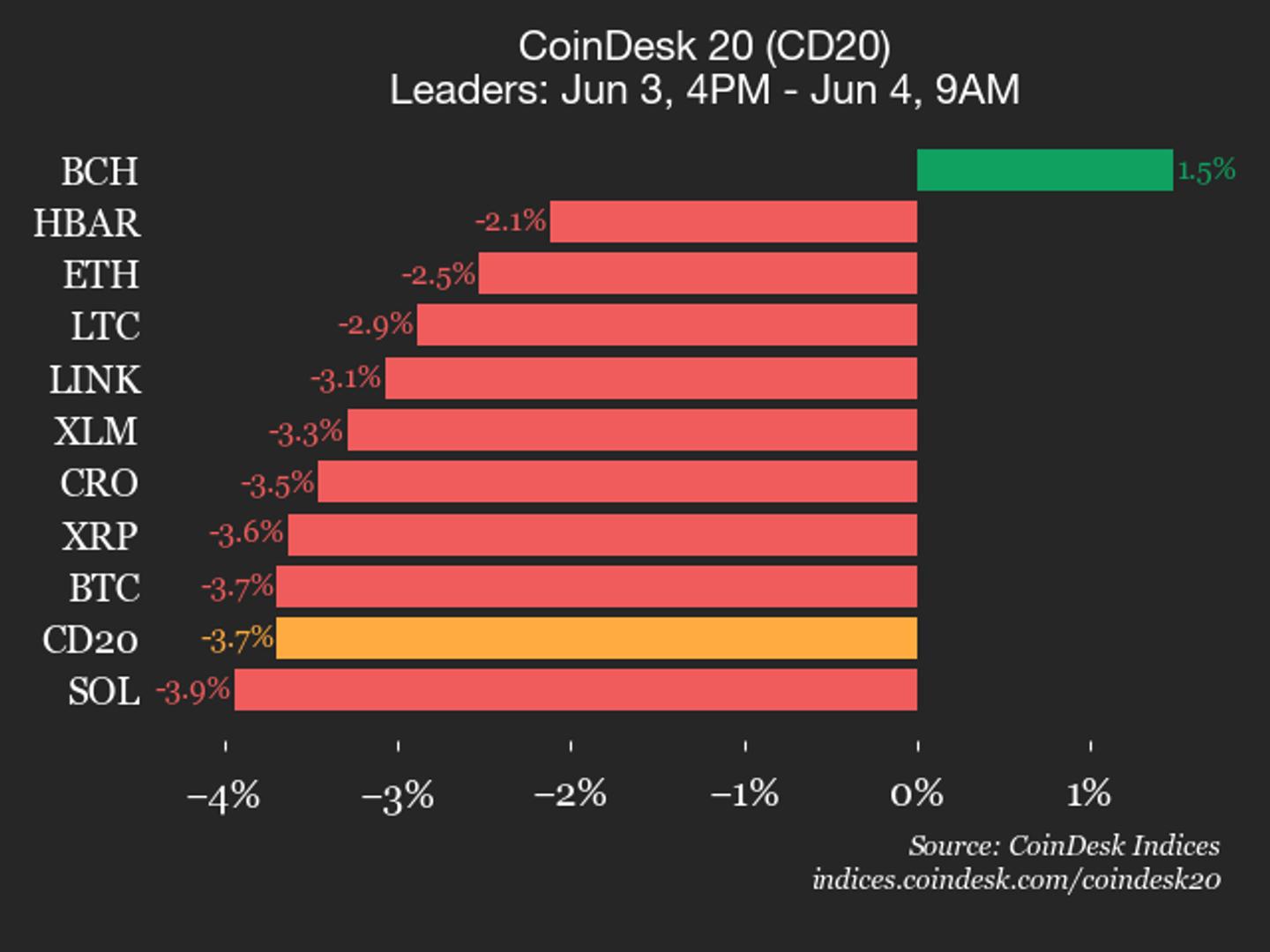
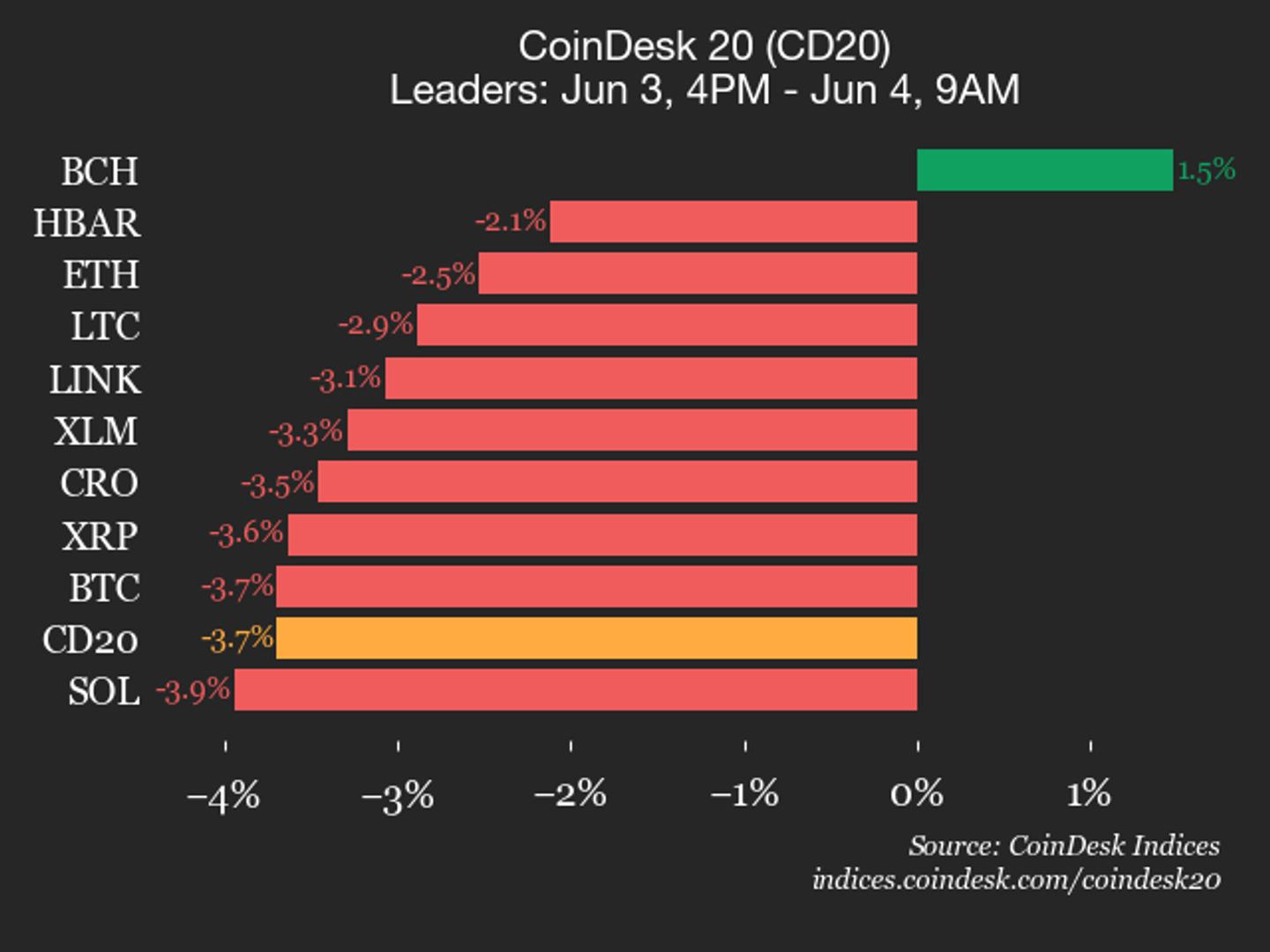
NEAR Protocol (NEAR) declined 15.2% and Internet Computer (ICP) dropped 13.1%, leading the index lower.


Bitcoin has tanked over 14% in one week and 22.7% in four weeks. Strategy Chairman Michael Saylor has a simple explanation for the decline: It’s capital rotation, not impairment.
In a post on X, Saylor pointed to the historic pace of AI infrastructure funding to the tune of approximately $400 billion deployed over the past six months while noting the $4 billion in outflows from the U.S.-listed spot ETFs since mid-May.
In essence, he argued that institutions are pulling money out of bitcoin and deploying into AI, leading to weakness in the top cryptocurrency. This matters because rotation implies temporary weakness, driven by capital chasing a hot theme before it eventually finds its way back.
“Volatility creates opportunity,” Saylor said, a characteristically bullish framing from the most prominent corporate bitcoin holder on the planet.
Saylor’s Strategy recently sold 32 BTC, a move, analysts say, added to the bearish sentiment in the market, deepening the price selloff. The publicly listed firm still holds 843,706 BTC.
While some analysts have flagged the AI boom as a headwind for bitcoin, most bears have drawn a darker conclusion from the recent selloff: that crypto is simply broken.
“Bitcoin just looks broken at this point Even Saylor is selling now,” pseudonymous trader QE Infinity said on X.
Their case probably rests on a confluence of concerning signals: Saylor’s surprise sale of 32 BTC, weeks of heavy ETF outflows, and the striking fact that almost every major asset class, from equities to commodities, is trading at or near record highs while bitcoin languishes.
Large Deleveraging and ETF Outflows Shake Crypto Markets
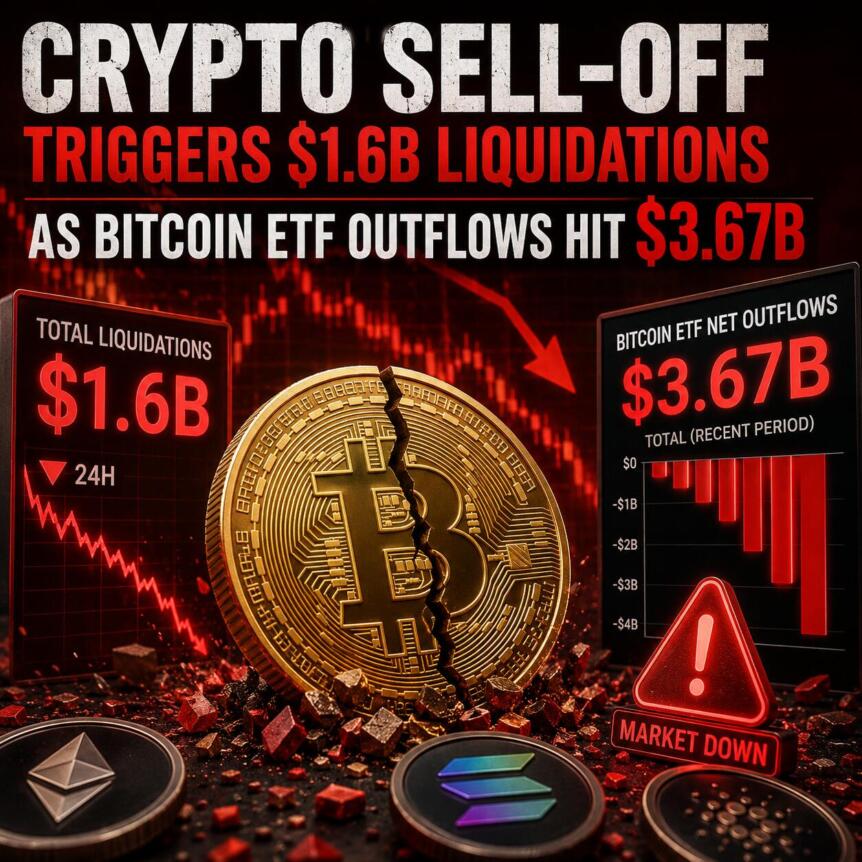
Cryptocurrency markets experienced a sudden bout of selling that produced about $1.6 billion in liquidations within 24 hours, marking the largest deleveraging event since February, according to market analysis from trading platform eToro. Over the same period, spot bitcoin exchange-traded funds recorded roughly $3.67 billion in outflows across the prior two weeks, a sign of diminishing spot demand as some investors reallocate capital to equities and artificial intelligence-related investments.
What the Numbers Show
The headline liquidation figure highlights pressure among leveraged participants and recent entrants to the market. eToro market analyst Javier Molina notes that while the short-term numbers are sharp, the composition of selling matters for understanding the likely trajectory of prices. “The $1.6 billion in liquidations recorded over the past 24 hours marks the largest deleveraging event in the crypto market since February. However, the more important signal lies beneath the headline,” Molina said.
ETF flows add another dimension. The approximately $3.67 billion in outflows from spot bitcoin ETFs over two weeks points to weaker spot demand, but proximate drivers are not obvious from gross flows alone. eToro highlights that ETF withdrawals are not necessarily equivalent to institutional capitulation: a substantial portion of ETF ownership can reside with retail investors and may reflect short-term portfolio rotation rather than wholesale abandonment by long-term holders.
Why the Sell-Off May Be Concentrated
According to eToro, the recent correction appears to have been led predominantly by retail traders, newer market participants and those using leverage, rather than by entrenched, long-term holders. That distinction is important from a market-structure perspective: when selling is concentrated among leveraged positions, it can create acute but transient downward pressure. If long-term holders begin to sell, that can signal a deeper shift in market sentiment and liquidity.
Molina cautioned that ETF outflows should not be interpreted automatically as institutional liquidations. “ETF outflows should not automatically be interpreted as institutional selling, as a significant portion of ETF exposure is ultimately held by retail investors,” he said.
Realised Price and Market Resilience
One measure eToro points to is bitcoin’s realised price, an estimate of the market’s aggregate cost basis. Bitcoin trading above its realised price suggests that, in aggregate, holders remain in profit and that the market may be undergoing a repositioning rather than broad-based capitulation. That distinction is consistent with a corrective reset in positioning and sentiment following an extended run of optimism in crypto markets.
“Despite the recent correction, bitcoin continues to trade above its realised price, the market’s aggregate cost basis, suggesting this remains a reset in positioning and sentiment rather than the kind of broad capitulation typically associated with deeper bear markets,” Molina said. The crucial question for traders and institutional observers alike is whether selling remains limited to recent buyers and highly leveraged accounts or whether it broadens to include longer-term holders.
Broader Context: Rotation to Equities and AI
The wave of ETF outflows comes amid an observable rotation by some investors into equities, and specifically into AI-related investments, according to eToro’s commentary. That dynamic reflects cross-asset decisions rather than factors unique to bitcoin or crypto; when macro or sector-specific narratives gain traction, capital can flow out of risk assets perceived as more speculative into areas that investors currently view as offering better near-term prospects.
This cross-asset flow can amplify short-term volatility in crypto markets, particularly when combined with concentrated leverage. For participants seeking to interpret price action, distinguishing rotational flows from structural selling is essential for assessing downside risk and potential entry points.
Implications for Traders and Institutions
For traders, the immediate implication is heightened caution around leveraged positions and an increased focus on liquidity metrics. Rapid deleveraging episodes can cascade and push prices through technical levels quickly, creating additional liquidations and volatility.
For institutional participants and allocators, the episode underlines the importance of parsing ETF flows and on-chain metrics rather than relying on headline outflow figures alone. Understanding who is selling — retail ETF holders, algorithmic funds, or long-term institutional allocators — is critical to assessing whether outflows presage sustained demand erosion or a temporary reallocation of risk budgets.
What to Watch Next
Market participants will be monitoring several indicators to judge whether the recent correction is transitory: the persistence of ETF outflows, on-chain measures of long-term holder behavior, the pace of open interest reductions on derivatives platforms, and whether realised price dynamics shift materially lower. If selling remains concentrated among short-term and leveraged participants, the market could stabilise as those positions wash out. If long-term holders begin to reduce exposure, it could herald a more significant change in market structure and sentiment.
For now, eToro’s read is that the episode looks like a repositioning driven by shorter-term sellers amid a broader rotation into equities and AI, rather than an across-the-board institutional retreat. Traders and allocators should continue to treat risk management as paramount while assessing the evolving mix of flows and holder behaviour.
Disclosure: This article summarises market commentary from eToro. It is not investment advice. Crypto markets are volatile and carry a risk of capital loss.
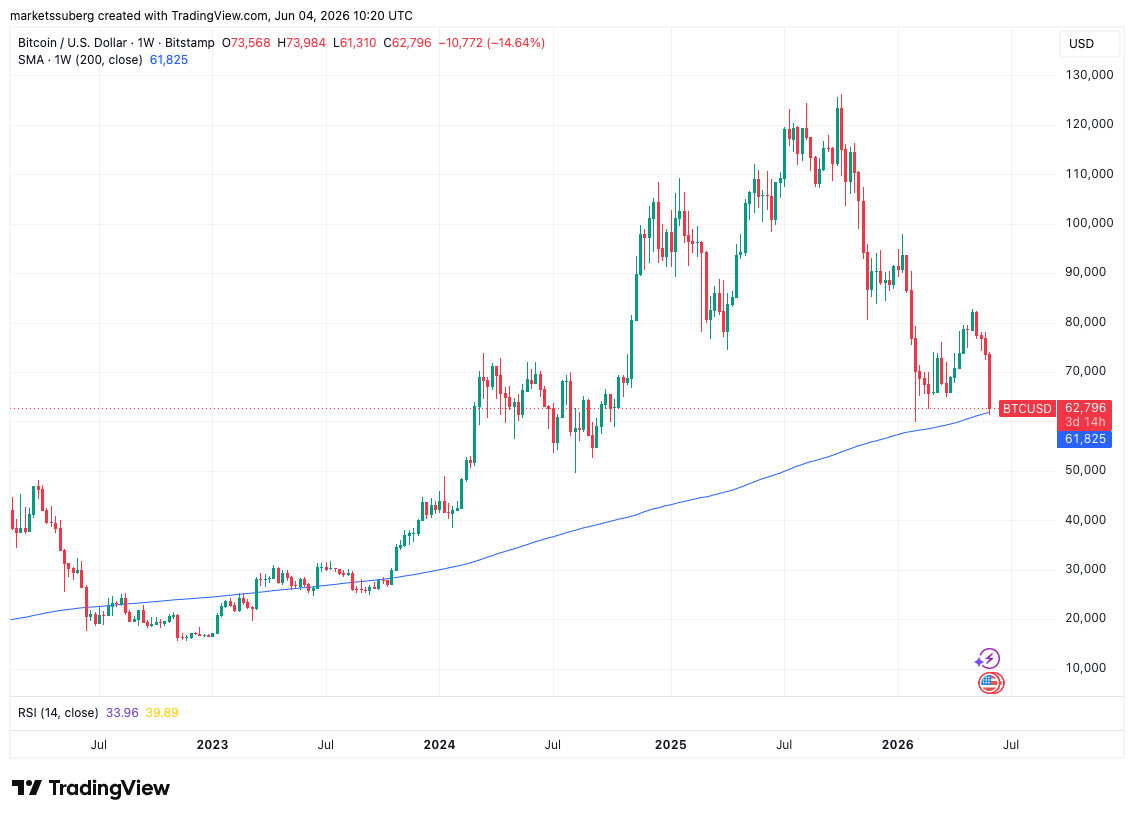
Bitcoin (BTC) has tagged a key bear-market trend line with its drop to four-month lows, with a “decent chance” of a rebound next.
Key points:
- Bitcoin revisits its 200-week simple moving average after trading above it since October 2023.
- The trend line functioned as resistance throughout the 2022 bear-market bottom and rebound.
- Bitcoin’s daily RSI approaches its most oversold since 2020.
Bitcoin bear-market trend line returns after nearly three years
Data from TradingView shows that for the first time since 2023, BTC/USD is back at its 200-week simple moving average (SMA).
The 200-week SMA is a key yardstick during Bitcoin bear markets. The trend line, which has only ever increased with time, currently sits at $61,626.
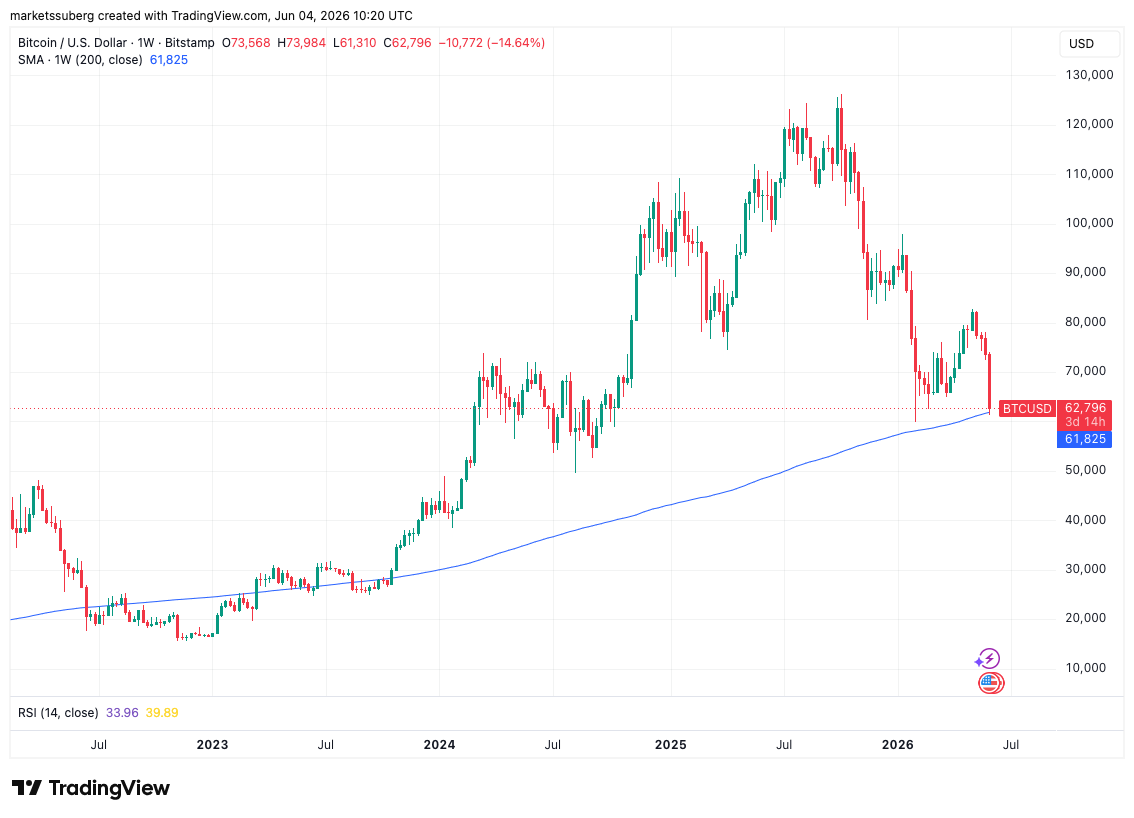
BTC/USD one-week chart with 200SMA. Source: Cointelegraph/TradingView
The last time price interacted with it was in October 2023, but during the 2022 bear market, it functioned as resistance until bulls fully regained control.
Commenting, CollinTalksCrypto, creator of the social media channel of the same name, described the return of the 200-week SMA as a “key milestone.”
“Does it bounce here or keep dropping?” he queried in a post on X.
“My guess is BTC has a decent chance of bouncing soon as it’s been dropping pretty steeply. But honestly it’s anyone’s guess in the short term.”
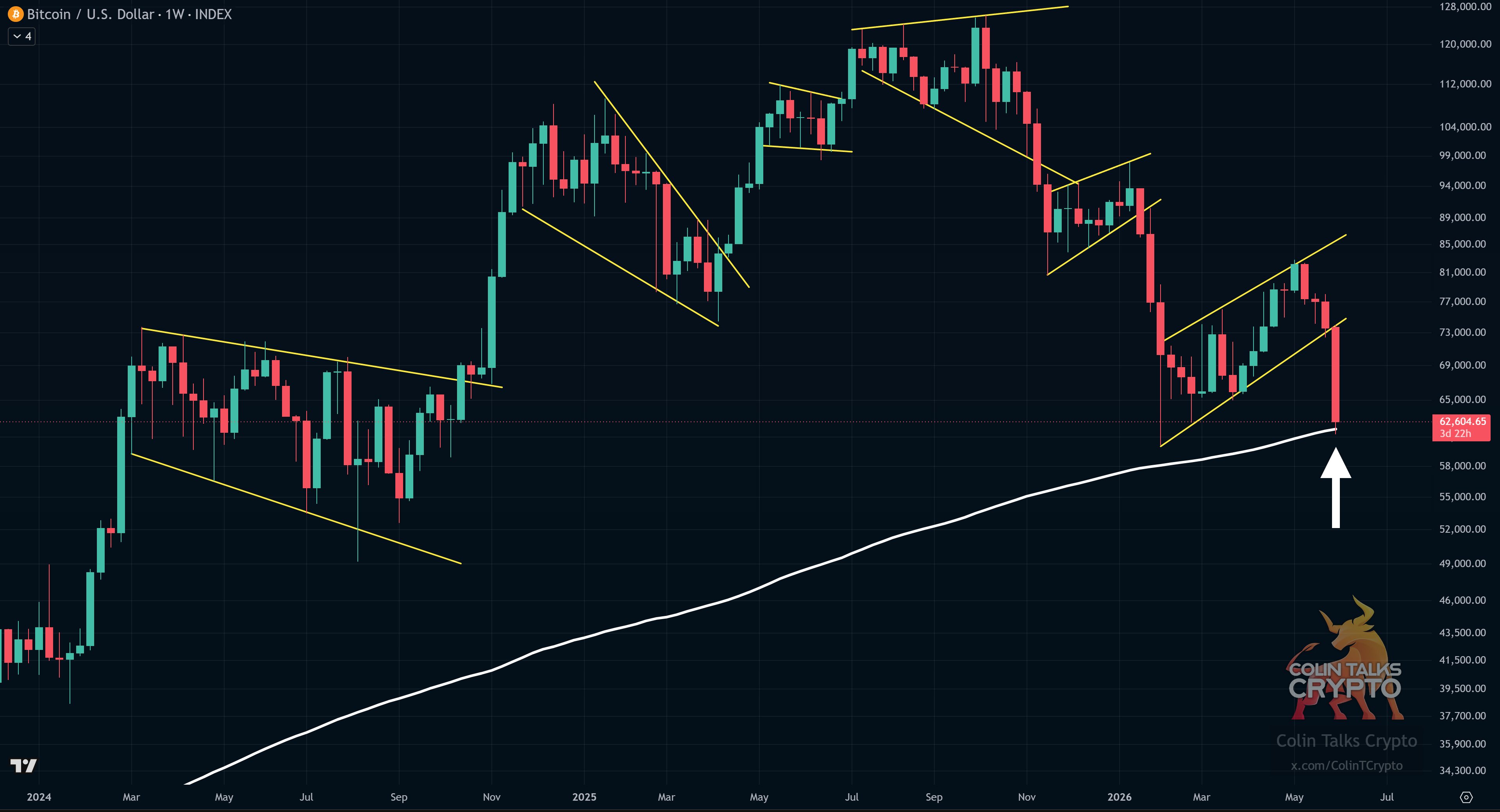
BTC/USD one-week chart with 200SMA. Source: ColinTalksCrypto/X
ColinTalksCrypto included a chart showing various bull and bear flags over the past several years. As Cointelegraph reported, BTC/USD has now copied its bear-flag breakdown from the start of 2026.
He added that the “best bear market entries happen *below* the 200-week MA.”
BTC price sparks more record “oversold” talk
Some optimistic market takes focused on the “oversold” nature of Bitcoin at its latest local lows.
Related: Bitcoin copying 2022 ‘almost perfectly’ as trader sees key support failing
On daily time frames, the relative strength index (RSI) dropped to 17.35, marking its lowest levels since 2020 along with the February drop.
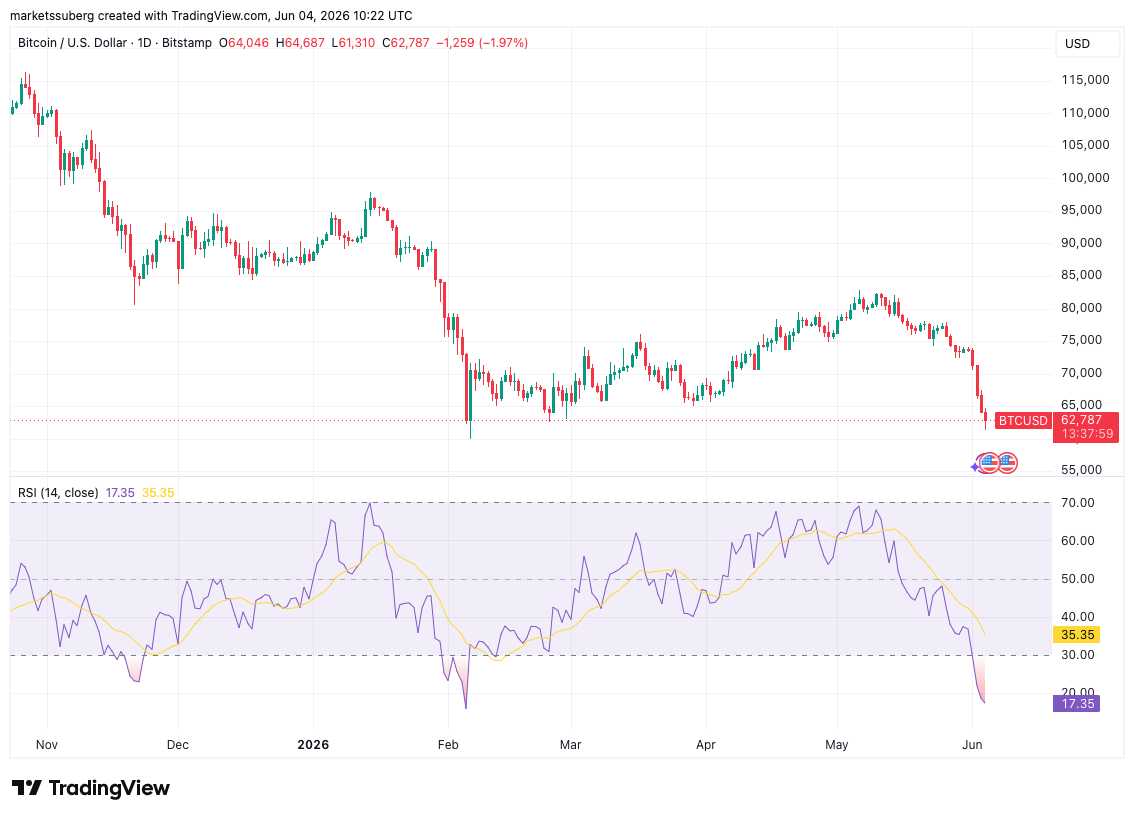
BTC/USD one-day chart with RSI data. Source: Cointelegraph/TradingView
Responding, the X analytics account named after famous economist Frank A. Fetter stressed that BTC/USD was “pretty much the most oversold ever.”
“It’s the area to accumulate your positions, if you have a strong thesis on Bitcoin from here,” crypto trader and analyst Michaël van de Poppe added on the back of both RSI data and the revisit of the 200-week SMA.
Van de Poppe put ongoing questions over Strategy’s corporate debt at the center of short-term price trajectory.
“Aside from that perspective, it’s all about STRC and the depeg; if that flips back upwards, it’s very likely time for Bitcoin to bounce back too,” he added.
“If there’s a constant, continuous downward trend here, we’ll most likely see sub-$60,000 in the markets.”
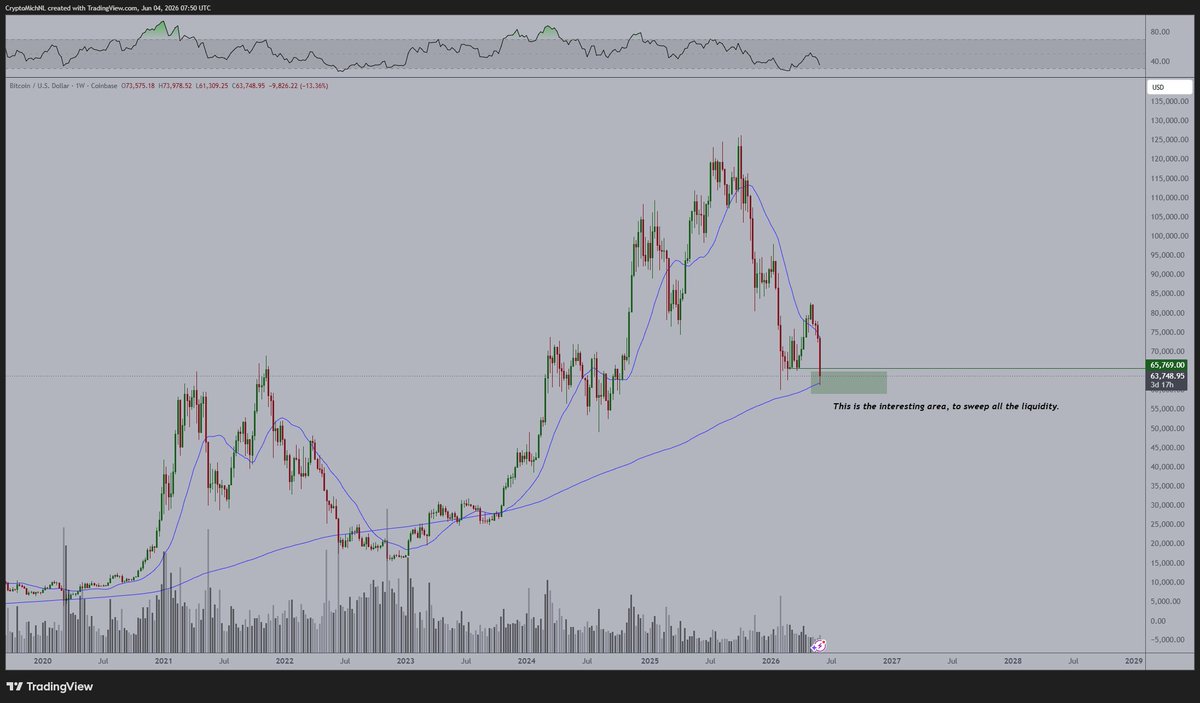
BTC/USD one-week chart. Source: Michaël van de Poppe/X
SimpleSwap is a self-custodial multi-source swap aggregator that pulls liquidity from well-known CEX and DEX sources under the hood. It is designed for direct wallet-to-wallet exchanges. Rather than holding your assets on a platform balance, the service lets you choose a crypto pair, enter a receiving wallet address, send the deposit, and receive the output asset directly in your wallet.
No manual comparison of exchanges, bridges, or swap routes needed. Routing happens under the hood across 20+ liquidity providers — you get the best available path without having to build it yourself.
SimpleSwap is most useful for straightforward crypto-to-crypto swaps, especially when you want to avoid holding funds on a centralized exchange. Of course, you can also use it to access assets that are not available or convenient to trade through your usual CEX or wallet swap tool.
Summarized briefly, some of the main points are:
- SimpleSwap supports wallet-to-wallet crypto swaps.
- Users do not need to keep a platform balance to make an exchange.
- The service aggregates liquidity from 20+ providers across CEX and DEX sources.
- Both fixed-rate and floating-rate swaps are available.
- The platform is very easy to use, rather than an order-book exchange.
Overall, the platform is well-suited to users who want a direct exchange flow, a large selection of assets, and fewer account-related steps. On the other hand, if you are looking for advanced trading tools, charting capabilities, limit orders (or more complicated order types), you might be better off with a full exchange environment.
SimpleSwap has been on the market for 8+ years, with 10M+ users. It supports 2,800+ swappable assets and aggregates liquidity from 20+ providers across CEX and DEX sources. The service is also used as a business solution by 6,000+ projects, including Exodus and Tangem.

What SimpleSwap Is
SimpleSwap is a self-custodial swap aggregator, not a custodial exchange. There is no long-term account balance to fund. Each transaction is a standalone swap: you send one asset from your wallet, and the converted asset is delivered to the receiving address you specify. No platform balance between swaps.
As you may have noticed, this is a structure that differs considerably from a centralized exchange. On a CEX, you have to deposit funds, trade within the platform interface, and withdraw later. With SimpleSwap, the exchange process is built around a single transaction flow rather than an internal trading account.
It supports a very wide range of cryptocurrency assets and uses multiple liquidity providers. SimpleSwap’s job is to find and execute a swap route in the background with the best rates.
The exchange supports two main rate types:
- Floating rate: the final amount received may vary based on market conditions and execution timing.
- Fixed rate: the rate is locked for a limited time, provided the user sends the correct amount within the required window and follows the transaction instructions.
Naturally, there are features beyond basic exchange flow. These include customer support, account-based loyalty benefits, business tools, integrations, exchange tracking, and more.
Is SimpleSwap Safe? How it Works
Yes, SimpleSwap is safe and legit – there have been no reports indicating otherwise, and the exchange has been on the market for more than 8 years, servicing over 10 million people with 99.9% uptime. The exchange flow is equally straightforward. Here is how it works:
- Select the asset to send and the asset to receive.
- Choose the amount.
- Select a floating or fixed rate, where available.
- Enter the receiving wallet address.
- Confirm the exchange details.
- Send the deposit to the address provided by SimpleSwap.
- Track the exchange status until the output transaction is completed.
That’s it. The structure makes the platform very easy to use for standard crypto-to-crypto exchanges. There is no order book to manage, and there is no need to set market or limit orders. Of course, if these are features that you are looking for, it might be a good idea to explore a conventional CEX.
The most important step is to enter the receiving address correctly. Because SimpleSwap sends the exchanged asset to the address you provide in this step, entering an incorrect one can result in a loss of funds. The same applies to network selection.
The flow, as simple as it may be, still hides some risks, so just as with anything else involving sending and receiving cryptocurrency, you have to be very careful.
Supported Coins, Pairs, and Liquidity
One of the main practical uses of SimpleSwap is in its asset coverage and liquidity aggregation. As mentioned in the introduction, the service supports 2,800+ swappable assets and aggregates liquidity from 20+ providers across CEX and DEX sources, unlocking 3.2M+ trading pairs through a single interface.
Some of the supported coins include, but are not limited to:
- Bitcoin
- Ethereum
- Ripple
- Solana
- Monero
- Dogecoin
- Stablecoins, and more.
Rather than sourcing liquidity only from a single internal market, the platform does it through multiple providers, which allows the service to search for available rates and execute swaps at the best prices.
Of course, as it is with centralized exchanges, liquidity can vary by asset and market conditions. A swap between two major assets, such as BTC and USDT, or ETH and BTC, is usually more straightforward and executed at very convenient rates. However, if you are swapping a niche cryptocurrency for another niche cryptocurrency, this might mean a wider difference between the quoted and the final amount, longer time to process, and so forth – more or less like what happens on a thin order book.
For most floating swaps, estimation accuracy reaches 99.998%, which signals strong execution consistency.
Fees, Rates, and Swap Types
SimpleSwap doesn’t position itself as an order book exchange. Therefore, it doesn’t have fixed maker and taker fees for trading. Instead, the cost of using the service is reflected in the quoted exchange amount, along with the network fees involved in sending and receiving crypto.
I will break down the factors before you commit to a swap. These include:
- The quoted amount of the asset being received.
- The rate type: fixed or floating.
- The network fee for sending the deposit.
- Any blockchain fee is included in the outgoing transaction.
- The minimum and the maximum amount for the selected pair.
- The time limit for sending the deposit is especially important for fixed-rate swaps.
As you already know, SimpleSwap offers two main swap types: fixed-rate and floating-rate.
With a floating-rate swap, the final amount can change during processing. This is because the market rate may move significantly between when the quote is shown and when the swap is executed. Floating rates may be suitable for those of you who accept that the final amount can vary. Of course, they are much less predictable during periods of serious volatility.
With a fixed-rate swap, the rate is locked for a limited time. This gives you greater certainty about the expected amount, but only if you follow the conditions of the exchange. The deposit must match the required amount and arrive within the specified window.
Now, it’s very important to note that neither option is automatically better in every single case. A floating rate may result in a higher or lower final amount depending on market movements. A fixed rate, on the other hand, gives you more certainty but may include a different quoted amount (smaller) because the provider takes on price movement risk for the period of the swap.
Custody, Privacy, and KYC
With SimpleSwap, users don’t have to maintain an ongoing balance. At no point does the exchange take custody of your funds. This reduces the need to leave assets on an exchange after the transaction is complete, and gives you full control of your crypto.
The model reduces risks tied to centralized exchange balances. Because there’s no platform-side balance, your funds never sit on SimpleSwap between swaps.
Most standard crypto-to-crypto swaps can be completed without creating an account.
From a privacy perspective, SimpleSwap collects a lot less account-level information compared to a centralized exchange during a normal swap. Of course, you still need to keep in mind that these are on-chain transactions and that you must provide a wallet address as part of the transaction.
The main takeaway here is that SimpleSwap offers a lighter account setup than traditional CEX exchanges, but it remains within the compliance environment that applies to crypto services.
Pros and Cons of SimpleSwap
Here is the honest breakdown of where the SimpleSwap crypto exchange stands out and where it falls short.
In my usage of the platform, I isolated the following benefits:
- No standard account setup is needed for basic swaps.
- Funds are not held in a long-term exchange balance.
- The platform supports virtually all assets that I wanted to swap.
- The exchange process is quick and simple.
- Fixed and floating rates offer some flexibility.
- Each exchange has a tracking and an exchange ID.
- It can be very useful for pairs that are otherwise unavailable at standard CEXs.
- Loyalty program (up to 20% discount, up to 0.4% USDT cashback)
- Integration with more than 6,000 partners (Exodus, Tangem, etc)
The drawbacks that I can think of include:
- The final rate may not always be better than competing services.
- Floating-rate swaps can result in a different received amount.
- You don’t get full control over routing or execution venue.
- There is a risk associated with inputting receiving addresses.
Who SimpleSwap is Best For
SimpleSwap is best for those of you who want to exchange crypto directly between wallets without using a full trading account. It suits people who value a simple swap flow, the option to choose between fixed and floating rates, and broad crypto support. It can also work well for users who need access to assets or pairs that are not that convenient on traditional CEX platforms.
Who SimpleSwap is Not Best For
High-frequency and professional traders are hands down better off with a more expert interface. Those of you who need limit orders, charting tools, or precise execution controls should probably consider a more sophisticated environment.
Verdict: Is SimpleSwap Legit in 2026?
Yes, SimpleSwap is legit. It is a self-custodial multi-source swap aggregator that has operated continuously since 2018, processed 20M+ swaps, and is integrated into products used by millions. For wallet-to-wallet crypto swaps where control, privacy, and speed matter, the exchange works very well.
Its main use case is obviously straightforward: choose a pair, enter a receiving address, send the deposit, and wait for the exchanged crypto to arrive.
The service is most useful for those of you who want access to many coins without maintaining balances across multiple exchanges. The fixed-rate and floating-rate options also give users some flexibility, but that depends on whether they prefer price certainty or are willing to accept market movements
Overall, this SimpleSwap review finds the service works best as a wallet-to-wallet swap aggregator for users who want broad asset access without giving up self-custody. There are no credible SimpleSwap scam signals against the platform: 8+ years on the market, 10M+ users over time, and 6,000+ partner integrations support a legit track record across cycles.
The post Is SimpleSwap Legit in 2026? A SimpleSwap Crypto Exchange Review appeared first on CryptoPotato.

Evernorth, an XRP-focused treasury company backed by Ripple, Kraken, Pantera Capital, and SBI Holdings, is telling institutional investors that real banks are already using XRP, and that the next 18 months will be defined not by whether adoption news happens, but by how much and under which ruleset.
The claim is specific: daily transactions on the XRP Ledger have surged to nearly 3 million, up from roughly 1 million in mid-2025, with Bitstamp, Ripple’s RLUSD stablecoin, and Braza Bank among the busiest names on the network. That is a real number. What it means for banking utility is a different question entirely.
The tension is structural. According to news, XRPL transaction volume has tripled in roughly 12 months, and at least one major European bank has deployed its regulated euro stablecoin on XRP, selecting it as one of four public chains for that purpose.

But XRP on-chain metrics and exchange flows tell a more complicated story about whether that volume represents persistent banking infrastructure or a concentrated surge driven by a handful of known actors. The marketing narrative and the on-chain data are not opposites. They are simply not the same thing.
Discover: The Best Crypto to Diversify Your Portfolio
XRP and Banking Rails News: What the On-Chain Data Shows
Evernorth’s chief executive, Asheesh Birla, has argued in a news outlet that XRP’s long-term value will come from banks and businesses using it as working capital, not from retail trading.
That framing matters because it sets a specific evidentiary bar: not speculative demand, not ETF flows, but bank-originated settlement volume. Against that bar, the data is partially supportive and partially aspirational.
The XRPL’s jump to nearly 3 million daily transactions is documented and real. The busiest names driving that traffic, Bitstamp, RLUSD, Braza Bank, are identifiable financial institutions, not anonymous wallets or wash-trading vectors.
In May 2026, Evernorth highlighted a tokenized U.S. Treasury redemption that coordinated Mastercard, J.P. Morgan’s Kinexys, Ondo Finance, and Ripple using XRPL as the common settlement layer, with Ripple receiving USD proceeds in Singapore outside normal banking hours.
Evernorth described XRP as “settlement infrastructure in one of the most significant cross-institutional blockchain transactions to date.” That transaction happened. It is not fabricated.
What the data does not yet confirm is whether these events represent systematic banking adoption or high-profile pilots.
Ripple’s On-Demand Liquidity service has been live in production since at least 2018, using XRP as a bridge asset across cross-border corridors in markets like the Middle East and Southeast Asia. Volume in those corridors is real but geographically concentrated, not the global banking rail the headline narrative implies.
Institutional-sized transfers on XRPL are stable in 2026, but Chainalysis data indicate they increasingly compete with USDC and wholesale CBDC projects for share of institutional settlement flow.
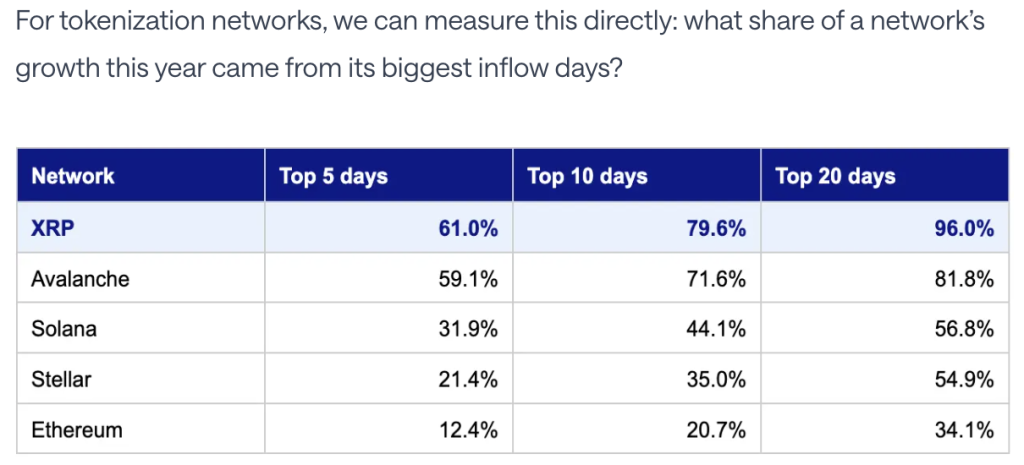
The XRPL protocol itself is being upgraded with exactly this gap in mind. Pending amendments include Token Escrow, a Permissioned DEX, and Restricted Environments, compliance infrastructure explicitly designed to give regulated institutions whitelisted venues and escrowed settlement flows on-chain.
The proposed XLS-66 XRP Lending Protocol would embed single-asset XRP vaults, fixed-term loans, and ZK-enhanced privacy directly into the ledger, eliminating external smart contracts and bridges. Validators are currently voting on XLS-66, and it requires an 80% supermajority to activate.
It is not yet live. Analysts covering the proposal have framed it as a bid to unlock a $100 billion lending and collateral opportunity on XRPL, but until consensus is reached, that is infrastructure on the drawing board, not banking activity on the ledger.
Discover: The Best Token Presales
The post XRP News Today: Ripple-Backed Firm Claims Real Banks Are Already Using XRP Daily appeared first on Cryptonews.
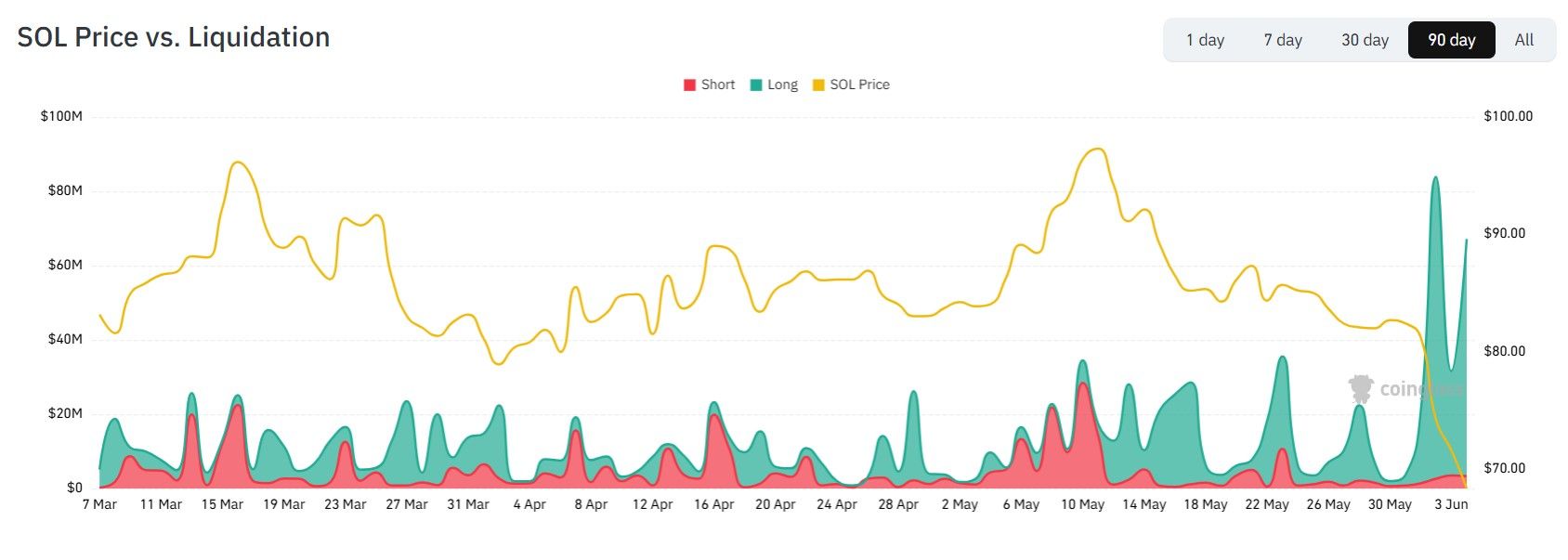
Solana (SOL) dropped to its lowest price since December 2023 this week, sliding toward $68 as more than $88 million in leveraged positions were wiped out across the market.
Long traders absorbed almost all of the damage. On-chain activity and social interest had been weakening for months before the breakdown, which suggests the selloff reflected fading demand rather than a single shock.
Long Liquidations Account for 94% of the Damage
The market liquidated $88.45 million in SOL positions over 24 hours, according to Coinglass data. Of that total, $83.53 million came from long positions against just $4.91 million in shorts.

That split means bullish traders accounted for roughly 94% of the losses. The data also shows 12,084 traders liquidated worldwide as SOL volatility passed 12% on the day.
The 90-day comparison makes the move stand out. The long liquidation spike near $84 million was the tallest reading on the entire chart, and it landed exactly as the price collapsed toward the lows.

Active Addresses Have Fallen Since February
The leverage flush did not happen in isolation. Solana network usage has been declining steadily, which points to weaker underlying demand.
Daily active addresses peaked near 5.5 million in early February, according to Santiment. The metric now sits around 2.91 million, roughly half the February high.
This matters because price held a consolidation range between $78 and $95 through spring, while usage kept falling. That divergence often warns that a sideways market lacks real support. The recent break toward fresh lows followed the same pattern flagged in earlier unstaking analysis.

Social Interest Fades as Rallies Get Sold
Crowd attention tells a similar story. Social volume has trended lower, with the latest reading down at 39, near the bottom of its three-month range.
Social dominance gained briefly in mid-May when SOL staged a short bounce, yet it has since rolled over to 0.687. The token now commands a smaller share of overall crypto conversation.
The pattern is telling. Bursts of chatter did not put a floor under price, and each spike in attention was sold into rather than bought. Fading interest leaves little fresh demand to defend support.

SOL Weekly Chart Confirms the Breakdown
The weekly chart ties the data together. SOL closed the latest candle near $68.46, down almost 17% on the week, its lowest level since December 2023.
Price has lost the 0.786 Fibonacci retracement at $73.31, turning former support into resistance. It was also rejected at the long-term resistance zone around $100, a shelf that previously acted as support in early 2024.
Weekly volume has been declining throughout the descent, which signals thin conviction behind every rally attempt. The weekly RSI has rolled into bearish territory, confirming weak momentum on the highest timeframe.
At the time of writing, Solana traded near $68.53, down about 9% over 24 hours, with a market cap close to $39.6 billion at rank seven.

For now, all four data sets point the same direction. A rebound in network usage and steady spot demand would offer the first evidence that selling pressure is starting to ease.
The post Solana (SOL) Hits Lowest Level in 2.5 Years as $88 Million in Longs Get Liquidated appeared first on BeInCrypto.


- Catapult Trade has appointed Claire “Cookie” Dang as VP of Growth and Co-Founder.
- Dang previously held growth and business development roles at Binance, KuCoin, and Crypto.com.
- The expansion is being funded in part by the KuCoin Ventures investment.
Catapult Trade has appointed Claire “Cookie” Dang as VP of Growth and Co-Founder, the latest in a series of moves that have widened the trading platform’s operations following an investment from KuCoin Ventures.
Dang held growth and business development roles at Binance, KuCoin, and Crypto.com before joining and will lead community growth and international expansion.
Her arrival has come alongside a broader push on the company’s external presence.
Catapult Trade has launched a sponsored podcast, Terminally Online, featuring Web3 founders and operators, and has assembled a media network from acquired social channels with a combined reach of over 20 million followers.
The company has also run trading activity collaborations with the exchange Gate.
The expansion is being funded in part by the KuCoin Ventures investment, disclosed earlier this year; terms were not made public, and the company said its funding round remains open, with proceeds also directed toward regional expansion in markets underserved by conventional financial infrastructure.
Catapult Trade opened to the public in December 2025 after a pre-launch incentives campaign that built its first base of traders and creators.
The platform runs on algorithmically generated price charts rather than an orderbook or live price feed.
Each session’s full price path is generated in advance and committed to a cryptographic hash published before trading begins, then revealed at settlement, letting users verify that the chart was never altered mid-session.
The company frames the design as a correction to conditions on memecoin launchpads, where hidden information has consistently worked against retail traders.
Since launch, the platform has recorded more than $1.5 billion in cumulative trading volume and over 80,000 monthly active users, with no paid acquisition behind the figures.
The platform’s chart-generation engine has passed two independent security audits, most recently by Halborn and earlier by Hashlock, with the company committing to annual reviews.
A points system has run since launch, fueling speculation about a token distribution; the company has confirmed in community sessions that a token is planned, but has released no allocation or vesting details.
A second product, Catapult Hyper, is in development and would extend the platform from synthetic charts into multichain token launches built on LayerZero’s omnichain fungible token standard.
The build-out reflects the standards now being applied to crypto products.
Where the previous cycle’s flagships rested on token speculation, the current cohort, led by names such as Hyperliquid in perpetuals and Polymarket in prediction markets, is judged on user demand and revenue.
Catapult Trade is being scaled on the same terms, in a category, gamified short-session trading on verifiable charts, that has yet to see an incumbent at scale.


The panicky action got more so overnight, with bitcoin (BTC) careening to as low as $61,400 before quickly bouncing back to $64,000.
Ahead of the open of U.S. stocks, bitcoin is headed lower again, currently trading at $62,400, down 7% over the past 24 hours.
At the center of the plunge, Strategy Executive Chairman Michael Saylor has spoken. “Capital markets are funding the AI buildout at historic scale: ~$400B over 6 months,” Saylor posted to X minutes ago. “Bitcoin ETFs have seen ~$4B of outflows since May 14, pressuring BTC,” he continued.
“This is a capital rotation, not a Bitcoin impairment. Volatility creates opportunity,” Saylor concluded.
His comments echoed much of the conventional wisdom surrounding crypto’s general price struggles in recent months, which have become particularly acute this week after Strategy sold some of its bitcoin.
MSTR shares are lower 1.8% premarket.
The largest cryptocurrency by market capitalization has been nosediving lately, with its price posting another substantial decline over the past 24 hours.
Multiple analysts believe the valuation could reach new lows in the near future, while one key indicator suggests a rebound could be on the horizon.
How Much Lower?
There’s no way to soften what’s been happening to BTC lately. Its price has lost over $20,000 in the past month alone, and several hours ago it dipped to nearly $61,000, the lowest point since early February. The reasons behind this carnage are many and various: Strategy’s historic decision to sell some Bitcoin, the escalating conflict in the Middle East, the massive outflows from spot ETFs, and the bear market reigning across the broader crypto market.
Currently, the asset trades at around $62,500, which is a slight comeback, but according to numerous industry participants, the worst is yet to come.
Ali Martinez recently claimed that the plunge below $72,000 has put BTC in “a vulnerable position.” He said that, based on the MVRV Pricing Bands, the next major support is between $50,000 and $54,000.
For his part, X user Ted argued that BTC’s “head-and-shoulders” breakdown target is still not complete. He described $49,000 as “a good bottom zone,” drawing parallels to the August 2024 low.
Somewhat expected, the major collapse of BTC’s price gave Peter Schiff the opportunity to make a highly pessimistic prediction. The well-known crypto critic and outspoken proponent of gold forecasted that the valuation could nosedive to $20,000 if it breaks $50,000.
“It should be a quick fall below $20K, which should be a big enough drop to shake the conviction of long-term HODLers, causing many to finally throw in the towel,” he added.
Light at the End of the Tunnel?
Contrary to the bloodbath and the predictions of a further collapse ahead, BTC’s Relative Strength Index (RSI) suggests it might be time for a resurgence. The technical analysis tool is often used by traders to spot potential price reversal points, as it indicates whether the asset is oversold or overbought.
It runs from 0 to 100, and anything below 30 indicates that the price has fallen too much in a short period of time and could be due for a comeback. On the other hand, readings above 70 signal that a pullback might be on the horizon. Just a few hours ago, the RSI dropped to 11, its lowest level in four months, and has since risen to approximately 16.

The post Top Bitcoin Price Predictions After BTC’s 15% Weekly Collapse appeared first on CryptoPotato.
Rocket Lab Is A Winner And The Market Knows It

CoinDesk 20 performance update: Bitcoin Cash (BCH), up 1.5%, is only gainer

Tony Hinchcliffe Lands Netflix Special After Kevin Hart Roast



-

 Tech6 days ago
Waymo dominates autonomous vehicle registrations as Tesla trails behind
-

 News Videos6 days ago
This is BROKEN! INSANE 5x MONEY CAR WASH WEEK! The NEW GTA Online UPDATE Today! (GTA5 New Update)
-
 Tech5 days ago
SpaceX just won a second Golden Dome contract. This one is $4.16 billion.
-

 Business3 days ago
Jade Biosciences, Inc. (JBIO) Discusses Positive Interim Results From JADE101 Phase I Healthy Volunteer Study and Development Plans Transcript
-

 News Videos6 days ago
SHE IS KILLING XRP!!! WATCH URGENT AND ACT FAST
-
 NewsBeat5 days ago
FIRST NIGHT REVIEW: Take That bring the Circus back to life in spectacular sun-soaked style
-

 Business5 days ago
Is the Spurs Phenom Already Better Than Prime Diesel?
-
Crypto World6 days ago
CFTC Has Approved the First Regulated Bitcoin Perpetual Contract in the U.S.
-

 Politics5 days ago
The House | Inside Andy Burnham’s Makerfield Campaign: “Nobody Thinks This Is In The Bag”
-

 Sports2 days ago
French Open 2026 results: Alexander Zverev beats Rafael Jodar and will play Jakub Mensik in semi-finals
-
 NewsBeat6 days ago
Novak Djokovic v Joao Fonseca LIVE: French Open latest scores and results after Jannik Sinner’s shocking collapse
-
 Entertainment5 days ago
Weak ‘Supergirl’ Box Office Tracking Amid Milly Alcock Backlash
-
 Crypto World6 days ago
Snowflake (SNOW) Stock Rallies on Strong Q1 Results and AI Product Growth
-

 Tech2 days ago
CryZENx Releases Fresh Playable Content Deep Inside Jabu-Jabu for His Ocarina of Time Remake
-

 Entertainment6 days ago
Maddox Jolie-Pitt Legally Requests to Drop Brad’s Surname
-

 Business5 days ago
Demand Conditions Improve In Chemicals Sector In April 2026
-
 Entertainment5 days ago
One of the Greatest Sitcoms of All Time Shoots Up Apple TV’s Charts 11 Years Later
-

 Tech6 days ago
This Week In Security: Ubiquiti Fixes, And FreeBSD Joins The Club You Don’t Want To Join
-
 Crypto World6 days ago
MicroStrategy Moves $30 Million in BTC to Coinbase Prime: Is the Bitcoin Sell-Off Already Here?
-
 Entertainment6 days ago
Bruce Willis’ Generosity Resurfaces Amid His Dementia
You must be logged in to post a comment Login