
Crypto World
World Liberty’s $100M WLFI buyer linked to UK money laundering probe

Guren “Bobby” Zhou, the businessman identified as the person behind Aqua 1’s $100 million purchase of World Liberty Financial tokens, has remained linked to an active British money laundering investigation after his 2021 arrest, despite not being charged.
Summary
- Zhou was arrested in Britain in 2021 on suspicion of money laundering but has not been charged.
- Aqua 1 bought $100 million of World Liberty Financial’s WLFI tokens in 2025.
- The source of the $100 million used for the WLFI purchase remains unclear.
- Up to $75 million from the Aqua 1 purchase went to a Trump controlled entity.
- World Liberty has faced congressional scrutiny over separate UAE linked investments.
The New York Times reported Sunday that British authorities arrested Zhou in 2021 on suspicion of money laundering, while a court record filed last November accused him of participating with five other people in a laundering operation dating to 2019.
Two of Zhou’s longtime employees were charged in the case in September 2025, according to the report. One defendant has since pleaded guilty, while the trial involving the charged defendants is scheduled for 2028.
Zhou himself has not been charged with a crime.
The case has drawn attention because Zhou was identified as the businessman behind Aqua 1, the UAE-based investment vehicle that bought $100 million worth of WLFI governance tokens from World Liberty Financial. Reuters previously identified Zhou as the person behind the fund, while the purchase was publicly announced in June 2025.
Aqua 1’s $100 million World Liberty investment remains unexplained
A review of court records, confidential documents and interviews with Zhou’s former associates led the Times to examine how the businessman went from a series of troubled ventures in Britain to overseeing one of the largest publicly known investments in World Liberty.
The newspaper said it was unable to determine where the $100 million used for the WLFI purchase came from.
Blockchain activity examined as part of the report also connected Zhou’s earlier crypto business to the World Liberty transactions. According to the Times, blockchain analytics firm Arkham Intelligence determined that a wallet controlled by Web3Port bought $20 million worth of WLFI in January 2025.
A second wallet believed to be controlled by Aqua 1 purchased another $80 million in June, bringing the combined purchases to $100 million.
Before Aqua 1 emerged publicly, Zhou had led Web3Port, a crypto venture fund that announced a separate $10 million investment in World Liberty shortly after President Donald Trump’s inauguration in January 2025.
Corporate records reviewed by the Times showed that a Web3Port entity registered in the British Virgin Islands was later renamed Aqua 1 GP Limited. Aqua 1 announced its $100 million WLFI purchase about two weeks after the name change.
Aqua 1 had previously denied having a connection to Web3Port after earlier reporting linked the operations. The fund did not specify which parts of that reporting it disputed.
Zhou’s previous businesses faced financial problems
Before relocating from London to Abu Dhabi in 2024, Zhou operated businesses that later faced financial or credibility problems, according to the Times.
One was a British flooring retailer that entered restructuring without repaying roughly $5 million owed to a company controlled by Zhou’s father.
Zhou later launched Caduceus, a crypto project that raised about $7.6 million in funding. Its token had become effectively worthless by 2024, according to the newspaper.
Caduceus had announced backing from China Merchants Securities UK and the Bin Zayed Group, an organization founded by a member of Abu Dhabi’s royal family. Both organizations told the Times that claims about their involvement were “unauthorized and materially false.”
After moving to Abu Dhabi, Zhou became associated with Web3Port and subsequently Aqua 1, putting him behind investments that made the entities major buyers of World Liberty tokens.
The timing also placed Aqua 1 among several UAE-linked investments involving World Liberty that have drawn scrutiny from U.S. lawmakers.
World Liberty token sale sent millions to Trump-controlled entity
Under World Liberty’s revenue-sharing structure, as much as $75 million from Aqua 1’s $100 million token purchase went to a company controlled by Trump and his sons, according to the Times.
Previous reporting showed that 75% of proceeds from WLFI token sales flow to DT Marks DEFI LLC, an entity controlled by Trump.
Trump’s latest financial disclosure listed more than $65.6 million from the sale of equity in WLF Holdco and $236.25 million in distributed World Liberty token-sale proceeds.
The Aqua 1 transaction also benefited the family of World Liberty co-founder Zach Witkoff, according to the Times. His father, Steve Witkoff, serves as a special envoy in the Trump administration.
World Liberty spokesperson David Wachsman told the newspaper that the company had complied with applicable laws and regulations and maintained a compliance program that “meets or exceeds industry standards.”
Wachsman declined to say whether World Liberty knew where Zhou obtained the money used for the investment. He also disputed the newspaper’s portrayal of Zhou but did not identify specific factual inaccuracies in its reporting.
World Liberty investments have faced congressional scrutiny
Questions surrounding Aqua 1 come as U.S. lawmakers have already examined separate UAE-linked investments in World Liberty and whether foreign financial interests could create conflicts involving the Trump administration.
In June, five Democratic senators asked Republican committee leaders to hold hearings into a reported $500 million investment in World Liberty by Aryam Investment 1, an Abu Dhabi-based company backed by UAE national security adviser Sheikh Tahnoon bin Zayed Al Nahyan.
Citing Wall Street Journal reporting, the senators said Aryam acquired a 49% stake in World Liberty through an agreement signed in January 2025.
Their letter asked Congress to examine events that followed the transaction, including the Trump administration’s May 2025 approval of major arms sales and access to advanced artificial intelligence chips for the UAE. The lawmakers said U.S. national security officials had previously raised concerns that China could gain access to the technology.
Senators Elizabeth Warren and Andy Kim had separately asked Treasury Secretary Scott Bessent in February to determine whether the reported UAE investment required review by the Committee on Foreign Investment in the United States.
World Liberty has also faced regulatory questions over its plans to expand its financial operations. During a Senate Banking Committee hearing, Warren questioned Comptroller of the Currency Jonathan Gould about a reported application by World Liberty for a federal bank charter and whether the company had disclosed the foreign investment to regulators.
Gould declined to discuss a pending application and said the Office of the Comptroller of the Currency would follow its established procedures.
Trump has denied involvement in World Liberty’s daily operations. Speaking to reporters in February, he said he did not know about the reported UAE investment and said his sons were responsible for managing the business.
The White House has separately rejected conflict-of-interest allegations, saying Trump’s assets are held in a trust administered by his children and that administration decisions are made independently of his family’s business interests.

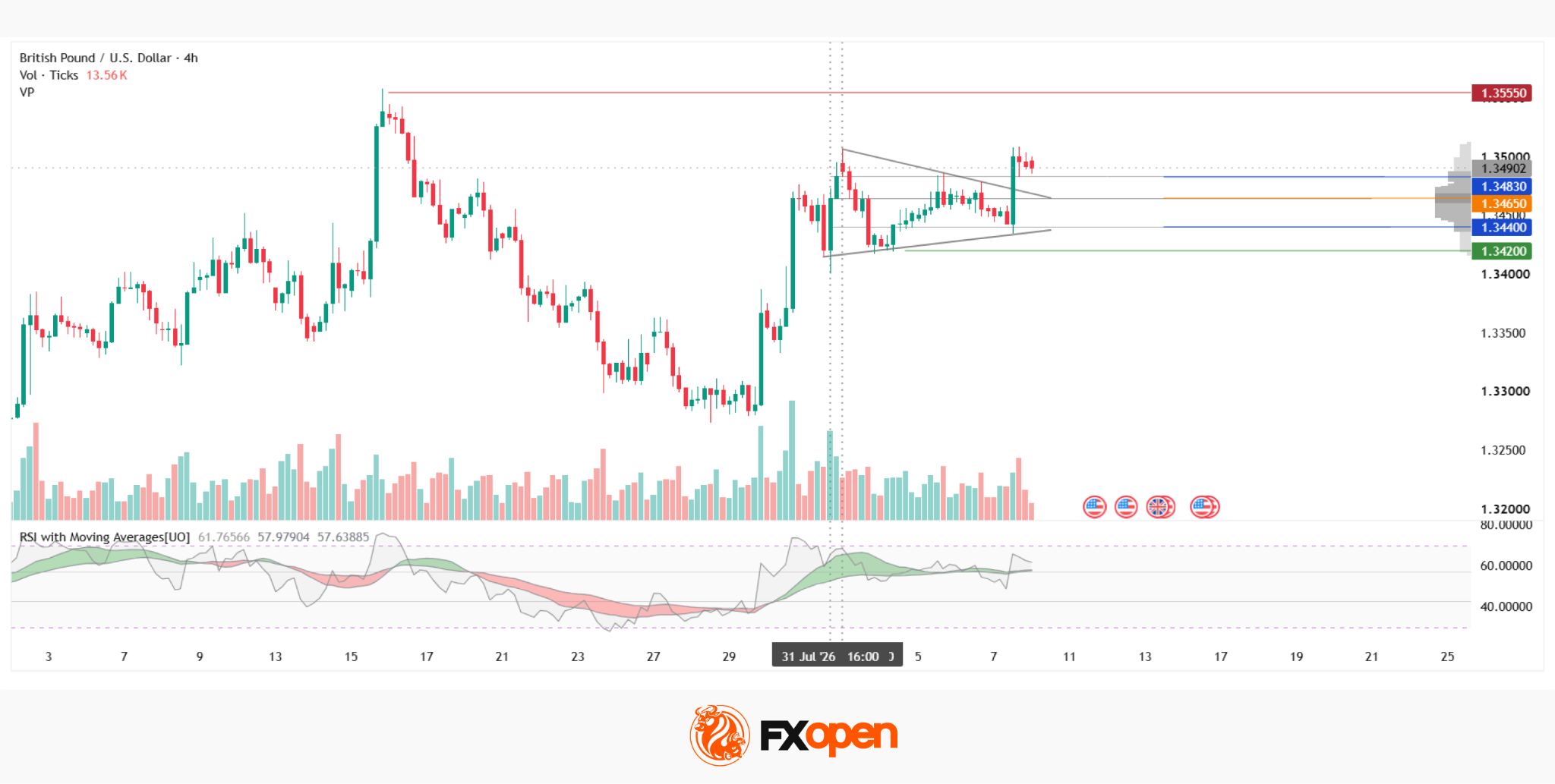
The pair gained momentum following the release of the US labour market report for July 2026 on 7 August. Non-farm employment fell by 23,000 jobs, compared with a forecast for an increase of 80,000 jobs among economists surveyed by Reuters. Employment data for May and June were also revised downwards, according to the Bureau of Labor Statistics. The dollar responded with broad-based weakness. Earlier, on 30 July, the Bank of England kept its interest rate at 3.75% by a six-to-three vote, with three members of the committee voting for a rate hike. The regulator’s decision also highlighted inflation risks associated with volatility in energy prices.
Technical Analysis of GBP/USD
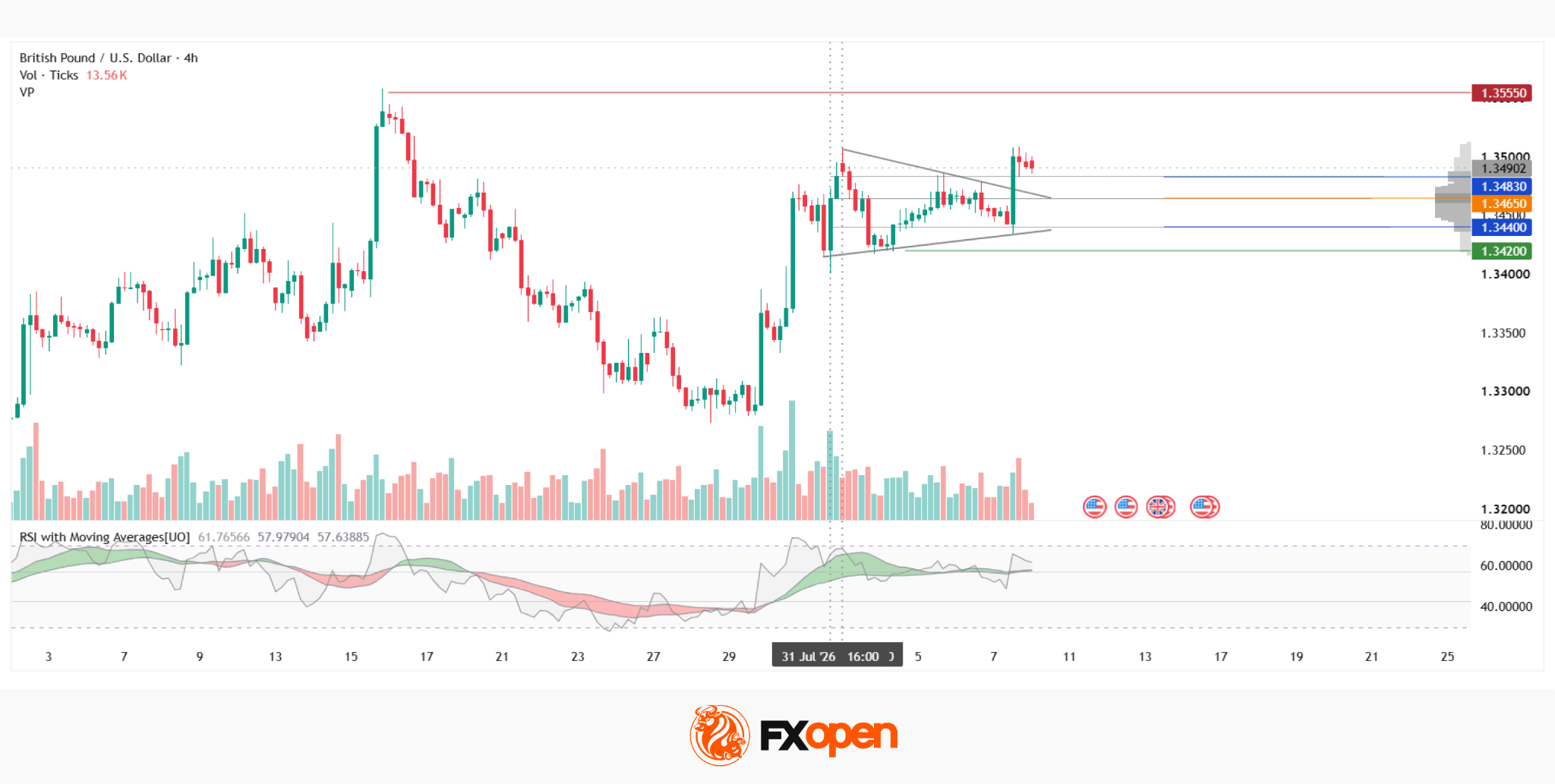
After a sharp rise from around 1.3280 towards 1.3500 in late July, the pair entered a narrowing range between the upper and lower boundaries of the current profile at 1.3483 and 1.3440, respectively. The two boundaries gradually converged, forming a pattern resembling a contracting triangle. The green impulse candle subsequently broke above the pattern’s upper boundary, while the price is attempting to establish itself above both the trendline and the profile boundary. If the bullish scenario develops, the price could move towards the red resistance level at 1.3555.
If the current breakout from consolidation proves to be false and the price returns inside the profile, the POC at 1.3465 and the lower profile boundary at 1.3440 will regain their importance for market participants. Below these levels lies the green support area at 1.3420. The RSI + MAs indicator shows three readings of 61, 57 and 57. All three values are above the neutral zone, while the moving averages are coloured green. It is also worth noting that vertical volume has declined compared with the late-July impulse.
Summary
The attempt to break above the triangle’s upper boundary could open the way towards a test of the red resistance area at 1.3555, but the sustainability and potential of the move may also depend on the flow of further US economic data.
Trade over 50 forex markets 24 hours a day with FXOpen. Take advantage of low commissions, deep liquidity, and spreads from 0.0 pips (additional fees may apply). Open your FXOpen account now or learn more about trading forex with FXOpen.
This article represents the opinion of the Companies operating under the FXOpen brand only. It is not to be construed as an offer, solicitation, or recommendation with respect to products and services provided by the Companies operating under the FXOpen brand, nor is it to be considered financial advice.
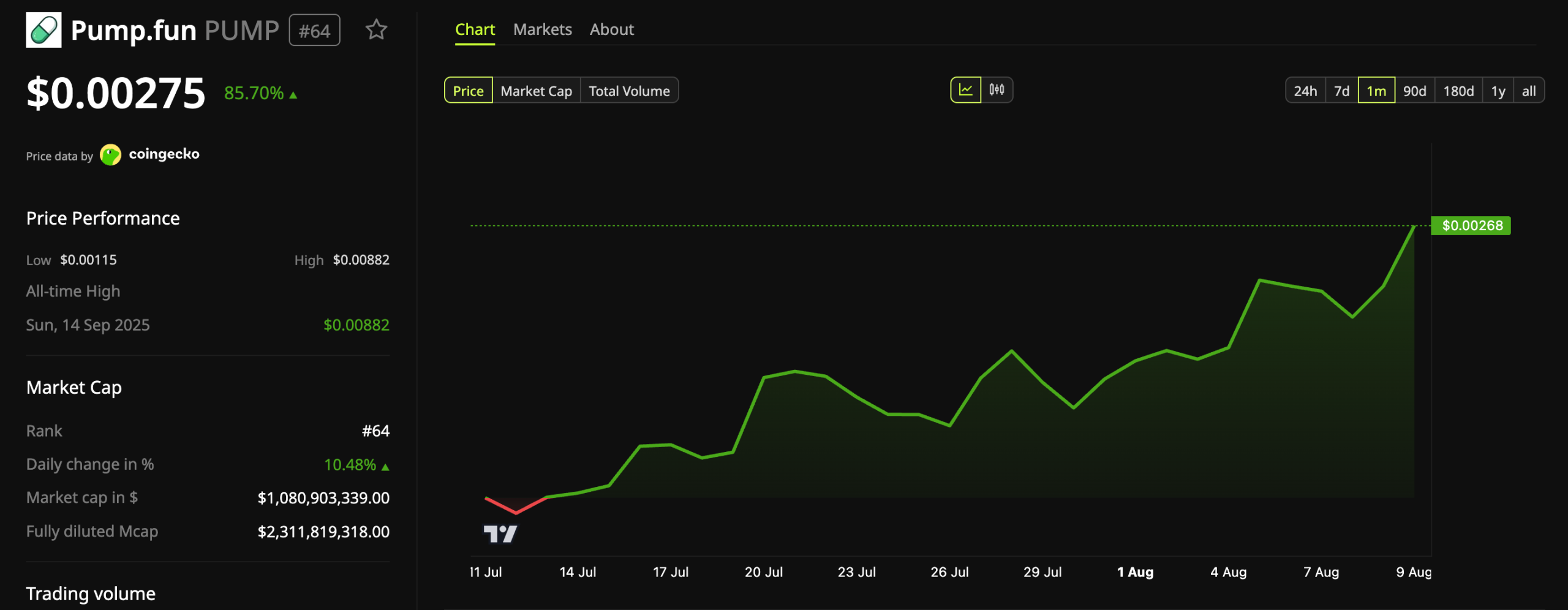
Crypto trader Ansem predicts Pump.fun (PUMP) could become one of the 10 largest cryptos by market capitalization within two years.
Ansem said he plans to track the trade from the current cycle’s bottom through new all-time highs.
Ansem Builds Bullish Case for PUMP
Ansem’s latest forecast builds on his earlier PUMP purchase at $0.001675. He bought the token with 1,500 Solana (SOL), worth about $115,000 at the time.
The trader now argues that PUMP remains undervalued relative to the business behind the token. His thesis focuses on cash holdings, earnings, and the potential for greater activity.
“top 3 moneymaker in crypto, $2B in cash, trades at < 2.8x p/e @ ~$1B circ mcap because of bias against tokenization,” he said.
Ansem also pointed to Pump. fun’s mobile app as a possible growth catalyst. The trader summarized his longer-term prediction by saying PUMP,
“will be top 10 coin by market cap in < 2 years time.”
The trader’s earlier PUMP bullish case centered on the expectation that Solana (SOL) could regain a larger share of retail trading activity. The latest thesis adds the platform’s financial position and mobile expansion to that argument.
Follow us on X to get the latest news as it happens
PUMP Needs a 926% Market-Cap Increase for Top 10
The forecast comes amid a sharp rally for the altcoin. According to data from BeInCrypto Markets, PUMP has appreciated 85.7% over the past month alone.

PUMP currently has a market capitalization of about $1.08 billion, ranking 64th among cryptocurrencies by market value. Dogecoin (DOGE) currently ranks 10th, with a market capitalization of roughly $10.86 billion.
If PUMP were to match Dogecoin’s current market value, its capitalization would need to rise by approximately 926.5%, highlighting the scale of the move needed to reach today’s No. 10 position.
However, the target is not fixed. Crypto rankings change as token prices and circulating supplies move, meaning PUMP’s eventual top-10 threshold could differ materially.
For now, PUMP remains far below the market capitalization required for that ranking. Ansem’s two-year target, therefore, depends on whether Pump.fun can translate higher retail activity and platform usage into a valuation large enough to close that gap.
Subscribe to our YouTube channel to watch leaders and journalists provide expert insights
The post Ansem Predicts Pump.fun’s Token Could Join Crypto’s Top 10 by 2028 appeared first on BeInCrypto.
Crypto markets enter the week with the near-term direction tied to whether easing U.S. inflation can keep the Federal Reserve’s interest-rate policy on hold and take pressure off the dollar into year-end.
Consumer price index data due Wednesday is the first test, but the larger question is whether weaker labor demand is beginning to outweigh price pressures still above the central bank’s target.
ING strategists Chris Turner and Francesco Pesole say they expect a no-increase outcome to create a more supportive cross-asset backdrop.
“If we’re right on the Fed, the dollar should be due a benign decline into year-end in what should be a risk-positive climate,” they wrote in a report. A hotter CPI print would challenge that path and put Treasury yields and the dollar back at the center of crypto trading.
Geopolitical instability will keep on playing a role in crypto prices. As war in the Middle East threatens vital oil passageways, inflation expectations could increase and, along with them, interest-rate-hike expectations.
What to Watch
(All times ET)
- Crypto
- Aug. 12: AI Financial Corporation says roughly 6.9 billion WLFI tokens covered by its original lock-up arrangements are expected to become fully transferable.
- Aug. 14: Second-quarter Form 13F filing deadline for U.S. institutional investment managers.
- Macro
- Aug. 11, 12:30 a.m.: Royal Bank of Australia interest rate decision est. 4.35% (Prev. 4.35%)
- Aug. 11, 10:00 a.m.: U.S. existing home sales for July est. 4.07M (Prev. 4.09M)
- Aug. 12, 08:30 a.m.: U.S. CPI YoY for July est. 3.4% (Prev. 3.5%); MoM est. 0.1% (Prev. -0.4%)
- Aug. 13, 08:30 a.m.: U.S. PPI YoY for July (Prev. 5.5%); Core PPIMoM est. 0.1% (Prev. -0.3%)
- Aug. 13, 08:30 a.m.: U.S. Initial Jobless Claims for period ending Aug. 8 est. 198K (Prev. 199K)
- Aug. 13, 8:30 a.m.: U.S. Continuing Jobless Claims for period ending Aug. 1 (Prev. 1801K)
- Aug. 14, 08:30 a.m.: U.S. Retail Sales MoM for July est. 0.2% (Prev. 0.2%)
- Aug. 14, 10:00 a.m.: University of Michigan Consumer Sentiment Prel for August (Prev. 54.4); 1-Yr Inflation Expectations (Prev. 4.2%)
- Aug. 16, 07:50 p.m.: Japan GDP Growth Rate QoQ Prel for Q2 est. 0.5% (Prev. 0.5%)
- Earnings
- Aug. 10: Trump Media & Technology Group (DJT), post-market
- Aug. 10: Bitdeer Technology Solutions (BTDR), pre-market, -$0.33
- Aug. 10: Bakkt (BKKT), post-market, $0.03
- Aug. 10: Keel Infrastructure Corp. (KEEL), pre-market, $
- Aug. 10: Sarplink (SBET), pre-market, $0.01
- Aug. 10: Exodus Movement (EXOD), post-market, -$0.07
- Aug. 11: CoreWeave (CRWV), post-market, -$1.17
- Aug. 11: Etoro Group (ETOR), pre-market, $0.6
- Aug. 12: Twenty One Capital (XXI)
- Aug. 12: Securitize (SECZ), post-market
- Aug. 13: Gemini Space Station (GEMI), post-market, -$0.68
Token Events
- Governance Votes & Calls
- Lido DAO is voting to appoint Bryce Howarth as a director of the Lido Alliance BORG Foundation, replacing Adrian Cachinero Vasiljevic. Voting ends Aug. 10.
- QuickSwap is voting to temporarily increase the QuickSwap Foundation’s share of protocol revenue from 30% to 80% for three months to fund protocol expansion and new product development. Voting ends Aug. 10.
- Seamless DAO is voting to permanently wind down operations and revoke all administrative control, transitioning the protocol into a dormant, withdrawal-only state. Voting ends Aug. 11.
- Decentraland DAO is voting on a non-binding poll to introduce term limits for DAO council members, with a suggested maximum of two consecutive two-year terms. Voting ends Aug. 11.
- GnosisDAO is voting to overhaul its governance structure by separating powers between a leadership service provider and an independent supervisory board, while introducing a strict 5% voting weight cap to enforce decentralization and comply with MiCA regulations. Voting ends Aug. 13.
- Lazy Summer DAO is voting to grant guardian roles and set expiration parameters on HyperEVM, enabling emergency pause capabilities for its fleets. Voting ends Aug. 11.
- Unlocks
- Token Launches
- Aug. 12: AI Financial’s roughly 6.9 billion WLFI tokens covered by the original lock-up arrangements are expected to become fully transferable.
Conferences
Crypto World
Bitcoin (BTC) Crosses $65,000, Ethereum (ETH) Eyes Possible Breakout, Markets Face Crucial Week
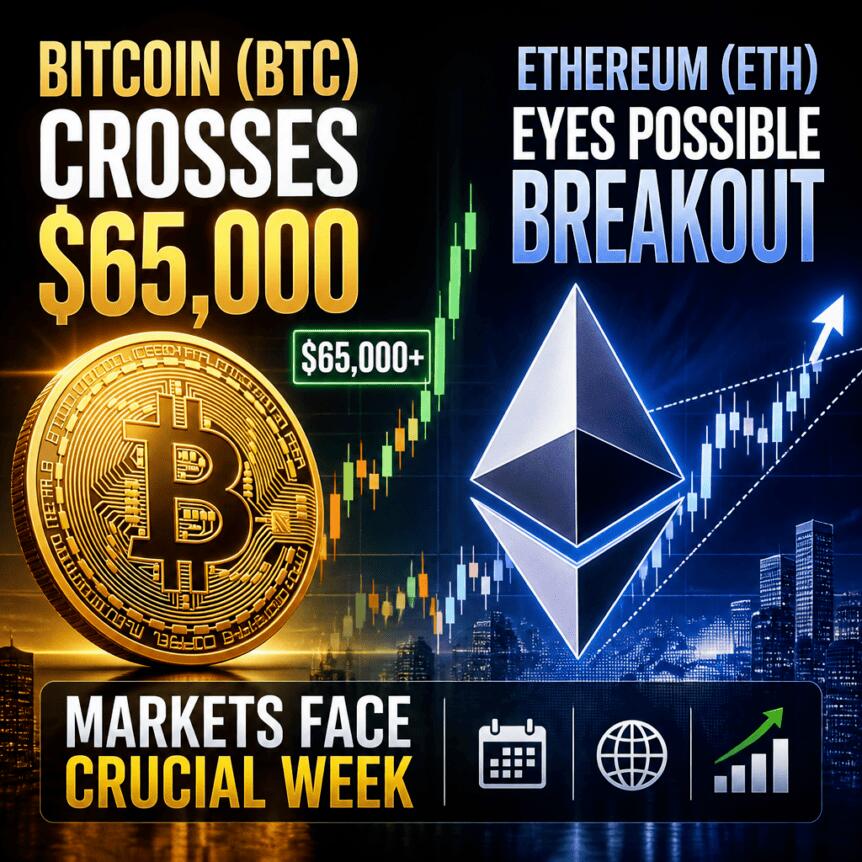
Bitcoin (BTC) briefly crossed $65,000 early on Monday, holding its gains over the weekend and reporting an increase of nearly 4% over the past week. Bulls defended key levels during last week’s pullback, but the flagship cryptocurrency remains well below its 100-day EMA at $66,905.
Ethereum (ETH) and Ripple (XRP) are also showing positive signs. ETH is up 3.60% over the past seven days, while XRP held above $1, posting a marginal recovery after a significant 5% decline.
Bitcoin (BTC) Above $65,000
Bitcoin (BTC) closed July with a substantial decline of almost 3% to $62,825. The price rebounded on Sunday (August 2) to reclaim $63,000 but registered another substantial decline on Monday ($62,743) before rebounding to $63,466 as buyers and sellers struggled to exert influence. Buyers gained control on Tuesday, and the flagship cryptocurrency reached $64,891 on Friday (August 7), driven by a weaker-than-expected jobs report that eased concerns about another interest rate hike. CoinGlass data shows Spot Bitcoin ETFs also registered substantial inflows, supporting price action, while whale accumulation provided support.
BTC is currently trading above $65,000, above the 50-day EMA. However, it remains below the 100 and 200-day EMAs, suggesting near-term strength within a larger downtrend. The Relative Strength Index (RSI) sits between 50 and 55, suggesting a slight bullish bias, while the Moving Average Convergence Divergence (MACD) indicates a gradual build-up of buying pressure.
BTC continues to face resistance at the 100 and 200-day EMAs. A close above these levels could suggest the market is entering a long-term bullish trend. On the other hand, if BTC loses the $64,000 level, it could start a deeper correction, taking the price closer to $60,000. A drop below this level could trigger liquidations and spark marketwide panic.
Markets Positive
Ethereum (ETH) and other cryptocurrencies also traded in positive territory, with the exception of Ripple (XRP), which is down 3% over the past week. ETH crossed $1,900 last week, reaching a day high of $1,932 on August 7. The world’s second-largest cryptocurrency is currently trading at $1,925, just above its 100-day EMA of $1,924. A decisive close above this level could fuel a push towards $2,000, a level not seen since May 2026. BNB is up nearly 4% over the past week, while Solana (SOL) is up almost 6% as it continues building momentum. The overall crypto market cap is also positive, up 0.32% to $2.21 trillion, according to data from CoinMarketCap.
Traditional markets also traded in positive territory, with the MSCI All Country World Index rising 0.1%. Japan’s Nikkei and South Korea’s Kospi also recorded substantial gains, while a softer-than-expected jobs report pushed the S&P 500 to record levels. Among chipmakers, Taiwan Semiconductor and SK Hynix also recorded positive movement.
Brent briefly crossed $84 before a marginal decline to $83.60 after US-Iran talks to reopen the Strait of Hormuz bore little fruit. Meanwhile, the US Dollar strengthened against other major global currencies, and the 10-year yield reached 4.66%.
A Closer Look At Ripple (XRP) Price Action
Ripple (XRP) has seen substantial movement over the past week. The altcoin recorded a sharp decline last week, falling over 5%. However, it held above $1 and made a marginal recovery over the weekend. XRP is currently trading around $1.03, well below the 50-day EMA at $1.10, which is acting as the immediate resistance. The RSI is around 39, while the MACD is negative, indicating a near-term bearish bias. XRP has strong support at $1, a level where buyers could step in and stop the downtrend.
A Crucial Week
A wave of market data is due this week, starting with Wednesday’s Consumer Price Report (CPI) data following Friday’s jobs report. The data could help gauge whether the market has withstood geopolitical headwinds after a noticeable improvement in June. CPI fell in June, but the resumption of conflicts in the Middle East could impact the July report. Energy prices have risen again after oil shipments through the State of Hormuz and the Bab el-Mandeb were impacted, pressuring the price of other goods as well.
Producer Price Index (PPI) data is due on Thursday. PPI numbers were higher than expected in May but declined in June. An increase could indicate that prices will rise as businesses pass rising expenses to consumers. Weekly jobless claim data is due Thursday, while retail and consumer sentiment data is expected on Friday.
Disclaimer: This article is provided for informational purposes only. It is not offered or intended to be used as legal, tax, investment, financial, or other advice.
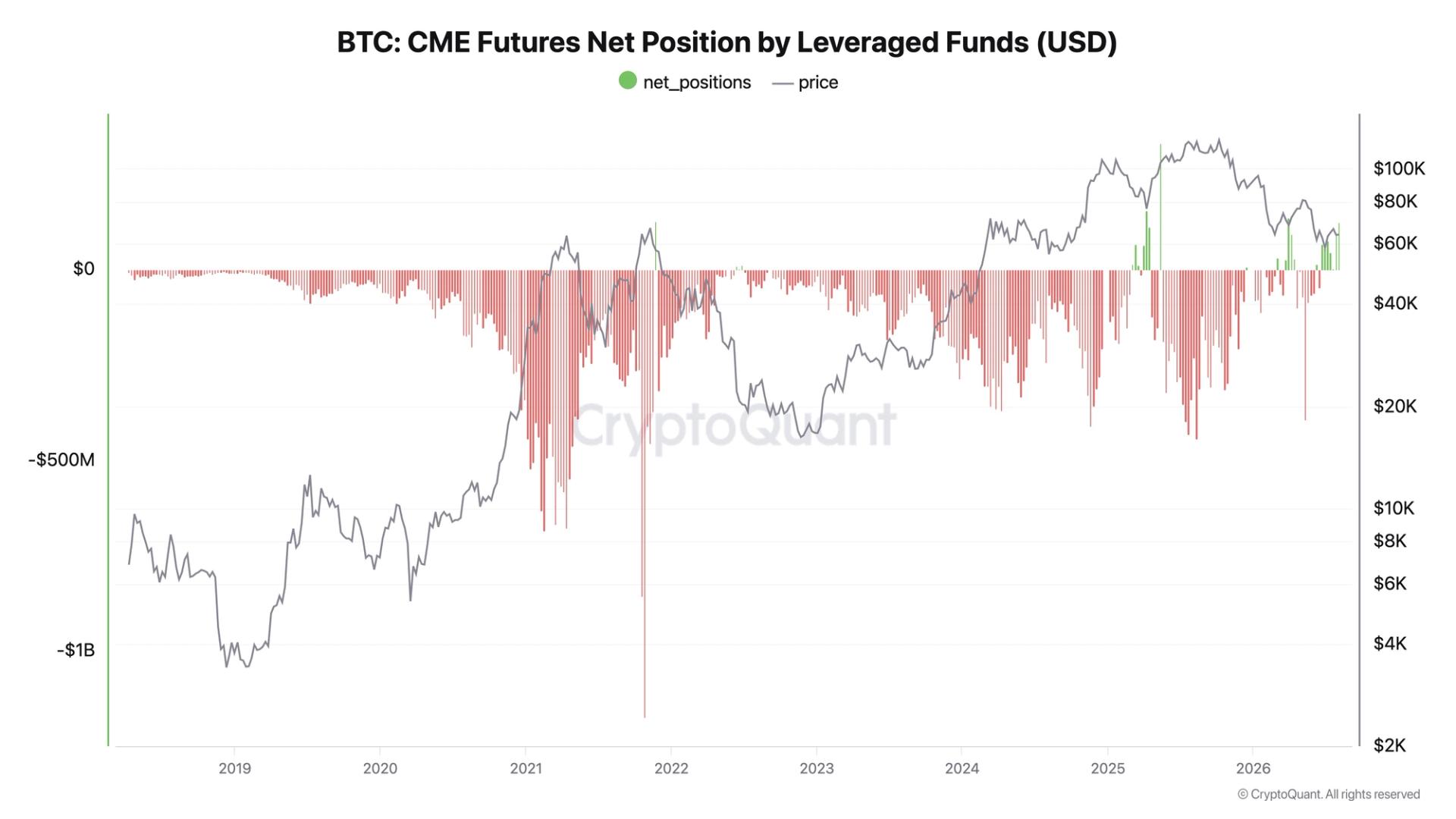
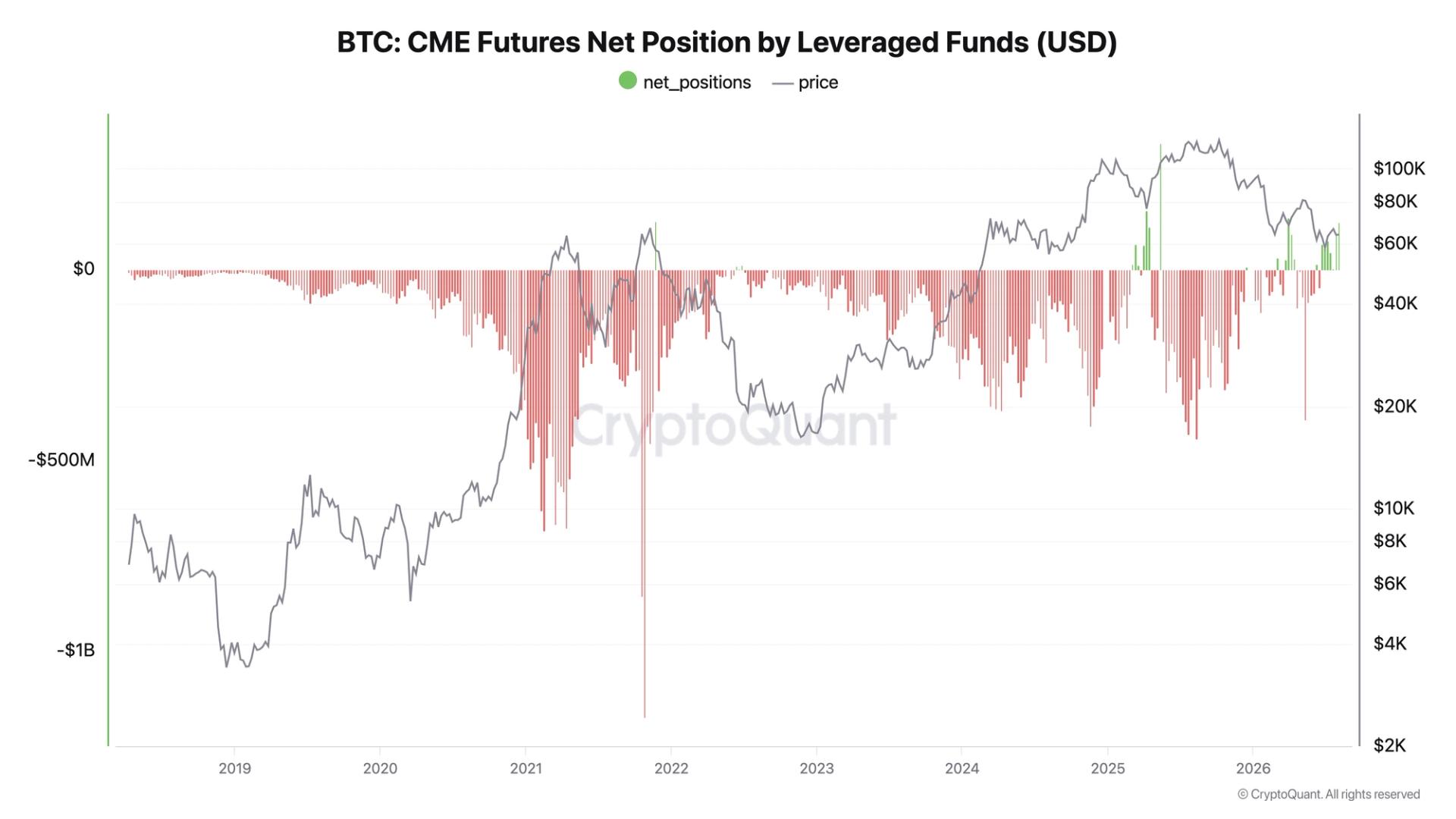
Hedge funds trading bitcoin futures on the Chicago Mercantile Exchange have turned net long, according to Ki Young Ju, CEO of blockchain data analytics firm CryptoQuant.
The rare positioning shift suggests professional traders are increasingly betting on bitcoin prices rising.
“Hedge funds on CME have flipped net long on bitcoin futures, a rare shift after years of structural short positioning driven by the basis trade. You cannot run a traditional carry trade with an aggregate net-long futures position. The suits are now betting on bitcoin’s upside,” Ki Young Ju said.
Leveraged funds have historically remained net short CME Bitcoin futures because of the basis trade. In this market-neutral strategy, traders buy spot bitcoin or exchange-traded funds (ETFs) while simultaneously selling futures. Profit comes from the premium between futures and spot prices narrows, rather than from bitcoin moving higher. This activity has kept hedge funds’ reported futures positioning negative for years.
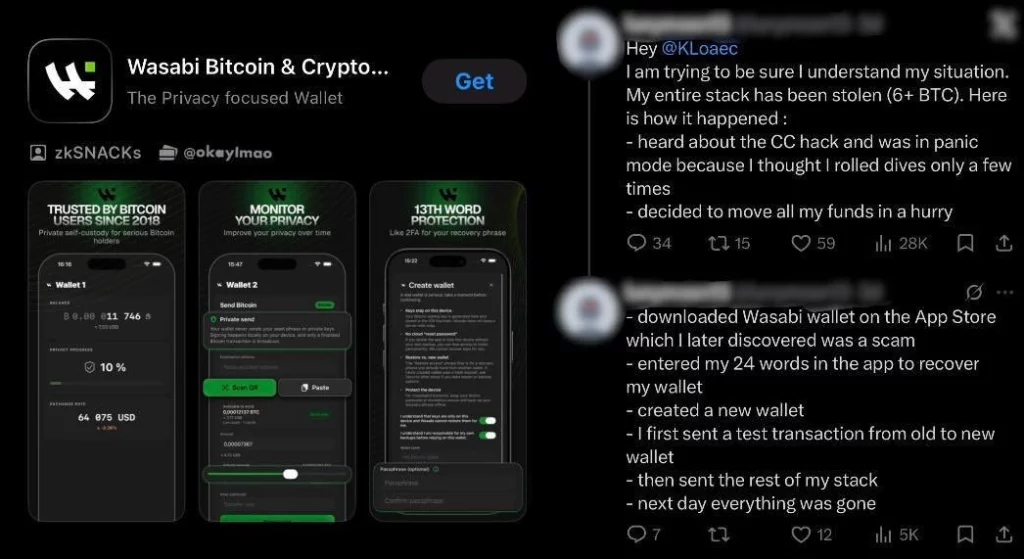
A fake Wasabi Wallet application has appeared on Apple’s App Store and has already been linked to the theft of roughly 6 BTC from one user, according to crypto security monitoring reports.
Summary
- A fake Wasabi Wallet app on Apple’s App Store has been linked to the theft of about 6 BTC from one user.
- The fraudulent Wasabi Wallet listing is the 27th reported crypto wallet clone on the App Store this year.
- A fake Ledger app remains the largest reported case, with about $9.3 million stolen.
According to Com Feed monitoring, the malicious application was presented as Wasabi Wallet, with reports circulating on X showing that one victim lost about 6 BTC after encountering the fraudulent software. The listing has also been identified as the 27th crypto wallet clone found on Apple’s App Store so far this year.
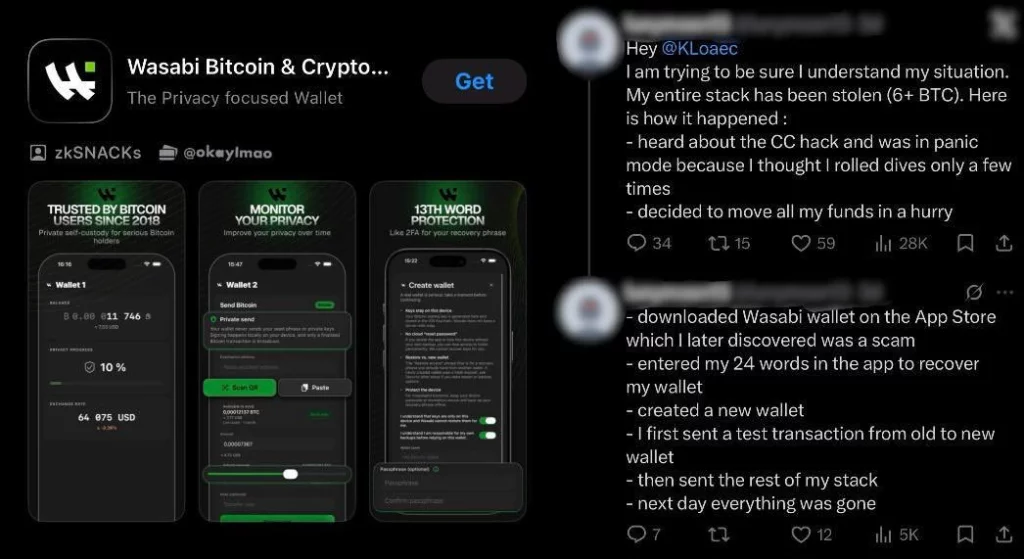
Fake Wasabi app on the Apple App store. Source: X/thecomfeed
Details about how the victim interacted with the application, including whether a recovery phrase was entered or another method was used to drain the wallet, have not been disclosed in the initial reports. Com Feed warned users to verify the Wasabi Wallet application carefully before downloading software presented under the wallet’s name.
Fake Wasabi Wallet becomes 27th reported App Store clone
The reported Wasabi Wallet impersonator adds to a series of fraudulent crypto applications that have passed through Apple’s App Store review process in 2026.
According to the monitoring report, 27 wallet clones have now been identified on the App Store since the beginning of the year. The fake Ledger application remains the largest case among the reported clones, with approximately $9.3 million linked to thefts.
Fraudulent wallet applications commonly imitate the branding and interface of established crypto products, making it difficult for users to distinguish them from legitimate software based on appearance alone. In the current case, the initial report specifically identified the application as a fake Wasabi Wallet drainer rather than an official release from the wallet project.
The reported loss of about 6 BTC also places the latest case among the larger individual thefts tied to wallet impersonation apps this year. The exact dollar value depends on Bitcoin’s price when the assets were taken, while the initial monitoring report quantified the victim’s loss in BTC rather than providing a confirmed dollar figure.
No information in the initial report identified the developer behind the application or explained how long the listing had been available through Apple’s marketplace. Details about whether Apple had removed the application were also not included in the information available at the time of the report.
Fake Ledger app previously drained musician’s 5.9 BTC
A similar incident in April showed how fraudulent applications can obtain control of crypto wallets by convincing users to disclose their recovery credentials.
On April 20, American musician Garrett Dutton, known professionally as G. Love, said he had lost 5.9 BTC worth about $420,000 at the time, after downloading software disguised as the Ledger Live manager from Apple’s App Store.
Dutton said he installed the malicious program on a new MacBook Neo and entered his seed phrase after the application prompted him to do so. The attacker subsequently emptied a Bitcoin stash that Dutton said he had accumulated for nearly a decade and intended to use for retirement.
On-chain investigator ZachXBT later tracked the stolen funds and reported that they had been transferred to addresses associated with KuCoin through nine transactions.
KuCoin told crypto.news at the time that it maintained procedures for monitoring and addressing potentially suspicious activity in line with regulatory requirements. The exchange disputed any characterization that it had allowed illicit activity and said the matter was under review, while declining to discuss specific details because of security, privacy and investigative considerations.
The April incident followed earlier cases involving software impersonating hardware wallet companies. In 2023, a fake Ledger application appeared on Microsoft’s store and was linked to nearly $600,000 in losses before Microsoft acknowledged that the program had passed its review process.
Crypto wallet impersonation has extended beyond app stores
Wallet owners have also faced impersonation attempts through physical mail, with scammers using leaked customer information to send letters carrying forged Ledger and Trezor branding.
As previously reported by crypto.news, some letters instructed recipients to complete a supposed mandatory authentication process before a stated deadline. QR codes included in the mail directed users to malicious websites where they were asked to provide 12-word or 24-word recovery phrases.
Once entered, the recovery phrases could give attackers control over the corresponding wallets, allowing them to transfer assets without requiring further authorization from the victim.
The FBI has separately documented rising losses from cryptocurrency-related fraud in the United States. Crypto-related losses reached approximately $11 billion in 2025, compared with about $9 billion a year earlier.
The latest fake Wasabi Wallet report concerns an impersonation application and does not indicate that Wasabi Wallet itself was compromised. The reported theft is instead tied to software presented to users under the wallet’s identity.


South Korea’s opposition People Power Party has moved to delay the country’s 22% cryptocurrency investment tax by three years to Jan. 1, 2030, days after the government kept the levy on track to start in 2027.
Summary
- South Korea’s People Power Party has proposed delaying the 22% crypto tax from 2027 to 2030.
- The tax would apply to annual crypto gains above 2.5 million won.
- The government recently kept the Jan. 1, 2027, implementation date in its 2026 tax reform proposal.
- A separate opposition bill seeks to abolish the crypto income tax altogether.
- Lawmakers are also working on new rules covering stablecoins, exchanges and digital asset markets.
According to South Korean broadcaster MBN, People Power Party lawmaker Jeong Seong-guk plans to introduce an amendment to the Income Tax Act that would move the implementation date from Jan. 1, 2027, to Jan. 1, 2030.
Jeong said the additional three years would give lawmakers and authorities time to review the virtual asset tax system and related rules before investors become liable for the tax. He argued that setting a later implementation date would give taxpayers more certainty and reduce confusion while the framework is being reconsidered.
The proposal creates another route for the opposition to challenge the tax after People Power Party lawmakers separately introduced legislation seeking to abolish it altogether.
Under the current Income Tax Act, income earned by transferring or lending cryptocurrencies, including Bitcoin and Ethereum, will be classified as other income beginning Jan. 1, 2027. Annual gains above 2.5 million won will face a combined rate of 22%, consisting of a 20% national income tax and 2% local income tax.
South Korea crypto tax delay would move implementation to 2030
Jeong’s amendment would leave the tax provisions in place but postpone when they become effective, giving lawmakers three additional years to reconsider how cryptocurrency investment income should be treated.
The proposal comes less than a week after South Korea’s Ministry of Economy and Finance confirmed that the government intends to proceed with the existing 2027 deadline.
On Aug. 3, the ministry finalized its 2026 tax reform proposal without adding another postponement for virtual asset taxation. The package still requires approval from the National Assembly, where lawmakers can amend the tax provisions or change their implementation date.
Jeong said cryptocurrency taxation should begin only after rules protecting investors and the infrastructure needed for fair taxation have been sufficiently established.
Rather than introducing a tax simply because a statutory deadline has arrived, Jeong said the government and National Assembly should first create a system that taxpayers can accept. He also called for enough time to complete the ongoing review of the virtual asset tax framework and limit disruption when the rules eventually take effect.
South Korea has already delayed the levy three times.
Lawmakers originally approved the cryptocurrency income tax provisions in 2020, with implementation scheduled for January 2022. The start date was subsequently moved to 2023, then 2025 and finally 2027 as authorities worked on reporting requirements and administrative systems.
The latest government position is that much of the required infrastructure is now ready.
During a National Assembly Finance and Economic Planning Committee meeting on July 29, Finance Minister Koo Yun-cheol said the government planned to introduce the tax according to the existing schedule and consider improvements after gaining experience with its operation.
Investors would pay 22% on gains above 2.5 million won
Under the framework scheduled for 2027, the 2.5 million won annual exemption would be deducted before the 22% rate is applied.
The Ministry of Economy and Finance illustrated the calculation in its 2026 tax proposal using an investor who earns 5 million won from Bitcoin trading in a year. After deducting the 2.5 million won allowance, the remaining 2.5 million won would generate a tax bill of 550,000 won.
Investors earning taxable cryptocurrency income during 2027 would report it for the first time in May 2028.
Government preparations have also included systems intended to give tax authorities more information about trading outside South Korea. Under the Organisation for Economic Co-operation and Development’s Crypto-Asset Reporting Framework, South Korean authorities expect to begin receiving overseas cryptocurrency transaction information from participating jurisdictions next year.
The government has said 48 jurisdictions, including Japan, Germany and France, are participating in the reporting arrangement, which is expected to provide tax authorities with additional information on assets and transactions held through foreign platforms.
South Korea’s National Tax Service has separately established a digital asset unit as authorities prepare guidance for implementing the tax.
People Power Party is also seeking to abolish the crypto tax
While Jeong is pursuing a three-year postponement, another People Power Party proposal would remove the cryptocurrency income tax provision from the Income Tax Act entirely.
People Power Party lawmaker Song Eon-seok introduced the amendment on March 19. The bill would delete Article 21, Paragraph 1, Item 27 of the Income Tax Act, which covers income generated from transferring or lending virtual assets.
The proposal has been tabled before the National Assembly’s Finance and Economic Planning Committee and could proceed to a subcommittee for further consideration.
People Power Party lawmakers have argued that the current framework creates unequal tax treatment between cryptocurrency and stock investors. South Korea abolished its planned financial investment income tax for ordinary investors, leaving most retail gains from stock transactions outside the comparable tax regime.
The opposition has used that difference to argue against imposing a 22% levy on cryptocurrency gains.
During the July 29 committee hearing, People Power Party lawmaker Kim Sang-hoon also questioned the absence of provisions allowing cryptocurrency investors to carry trading losses forward.
Kim warned that the structure could encourage investors to move trading from domestic platforms such as Upbit, Bithumb, Coinone and Korbit to overseas centralized exchanges, decentralized finance services or peer-to-peer markets.
Responding to the committee, Koo said treating virtual asset gains under South Korea’s capital gains tax framework would require a review of the country’s financial taxation system. The finance minister said changes could be considered after authorities gained experience operating the cryptocurrency tax.
The government and ruling Democratic Party have continued to support implementing the levy, making passage of the opposition’s repeal proposal uncertain. MBN reported that the government and ruling party are expected to argue for maintaining taxation when the repeal bill reaches detailed committee discussions.
Jeong’s delay amendment therefore provides the opposition with a separate legislative option that would retain the tax in law while preventing it from taking effect next year.
Digital asset legislation is being prepared alongside the tax debate
The dispute over taxation is unfolding while South Korean regulators and lawmakers are working on a new regulatory framework for the cryptocurrency sector.
In late July, the Financial Services Commission told the National Assembly that it was preparing a consolidated Digital Asset Basic Act with the ruling Democratic Party.
The planned legislation would combine work surrounding 10 digital asset and stablecoin proposals already pending before lawmakers. The framework is expected to address stablecoin issuance and circulation, exchange requirements, disclosures, internal controls and trading-system resilience.
Several provisions remain under discussion, including whether issuers of won-backed stablecoins should be controlled by bank-led consortiums and whether ownership restrictions should apply to major cryptocurrency exchanges.
The Bank of Korea has supported a leading role for banks in won-backed stablecoin issuance because of potential implications for monetary and financial stability, while some lawmakers and industry participants have supported allowing qualified non-bank companies to issue tokens under licensing and reserve requirements.
Jeong has separately introduced legislation involving institutional access to cryptocurrencies. MBN reported that he previously became the first lawmaker in the 22nd National Assembly to propose a bill allowing institutional cryptocurrency investment through spot exchange-traded funds that could include assets such as Bitcoin and Ethereum.
His latest amendment would change only the implementation timetable for cryptocurrency income taxation, moving the statutory start date from Jan. 1, 2027, to Jan. 1, 2030, while the separate Song Eon-seok proposal would remove the relevant income tax provision altogether.
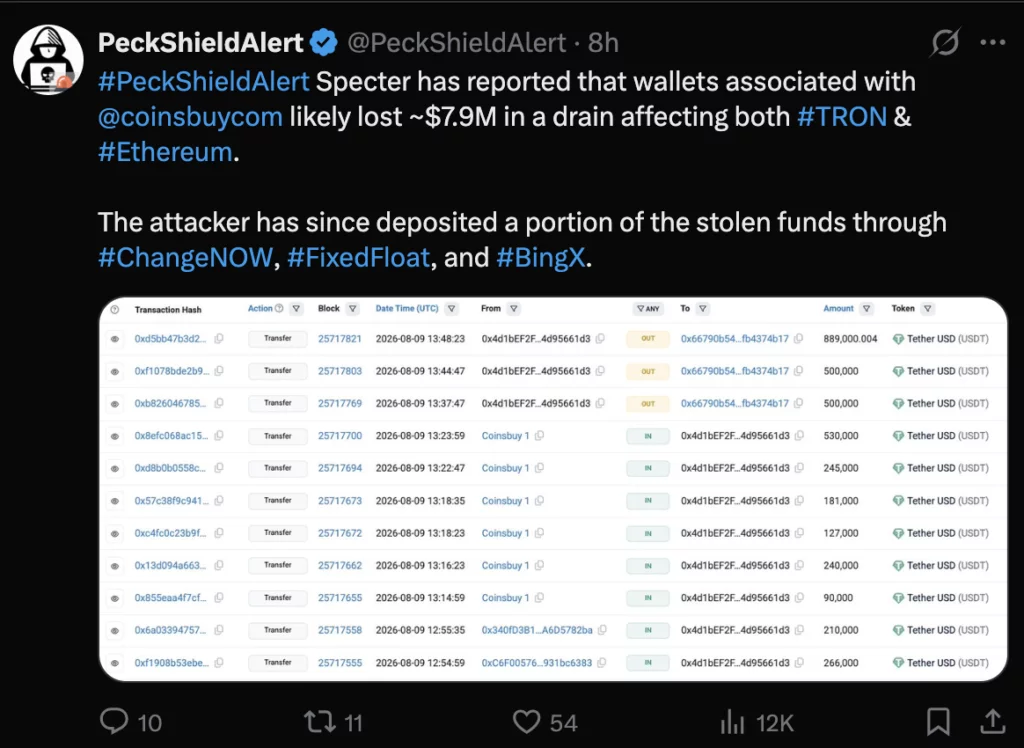
Wallets linked to crypto payment processor Coinsbuy were reportedly drained of more than $7.9 million across Ethereum and TRON around 13:00 UTC on Aug. 9, according to blockchain investigator Specter and follow up monitoring from security firms.
Summary
- Wallets linked to Coinsbuy reportedly lost $7.9 million across Ethereum and TRON during Sunday’s drain.
- PeckShield traced stolen funds through ChangeNOW, FixedFloat and BingX after Specter first flagged the drain.
- ChangeNOW reportedly froze a six figure amount while attackers converted part of proceeds into Monero.
- Coinsbuy temporarily paused deposits and withdrawals after the incident before services reportedly resumed hours later.
- GoPlus said activity resembled compromised hot wallet keys or administrator access, though unconfirmed by Coinsbuy.
The attacker then began routing part of the stolen assets through exchanges and toward Monero, a privacy focused cryptocurrency.
PeckShield said the wallets “likely lost” about $7.9 million and traced part of the proceeds through ChangeNOW, FixedFloat and BingX. CertiK’s security feed independently relayed the same estimated loss and exchange routes. The precise attack vector has not been established publicly.
Coinsbuy drain spread across Ethereum and TRON
Specter identified two Ethereum addresses and one TRON address as theft destinations. The cross network movement suggests the attacker obtained access capable of moving assets on more than one chain, but that does not establish whether private keys, administrator credentials or another part of Coinsbuy’s infrastructure was compromised.
GoPlus Security said the activity was “consistent with hot wallet private key or administrator privilege theft.” That remains an assessment, not a confirmed root cause. Coinsbuy has not published a technical postmortem in the public documentation reviewed on Aug. 10. Its latest visible release notes are dated July 31.
Coinsbuy describes itself as a business focused crypto payment service offering payment processing, wallet infrastructure and digital asset management. Its official site also advertises crypto payment processing and wallet services for businesses.
Stolen funds moved through exchanges toward Monero
After the drain, the attacker began sending stolen assets through exchange services. Specter said the funds were being converted toward Monero, while PeckShield identified ChangeNOW, FixedFloat and BingX among platforms receiving portions of the proceeds.
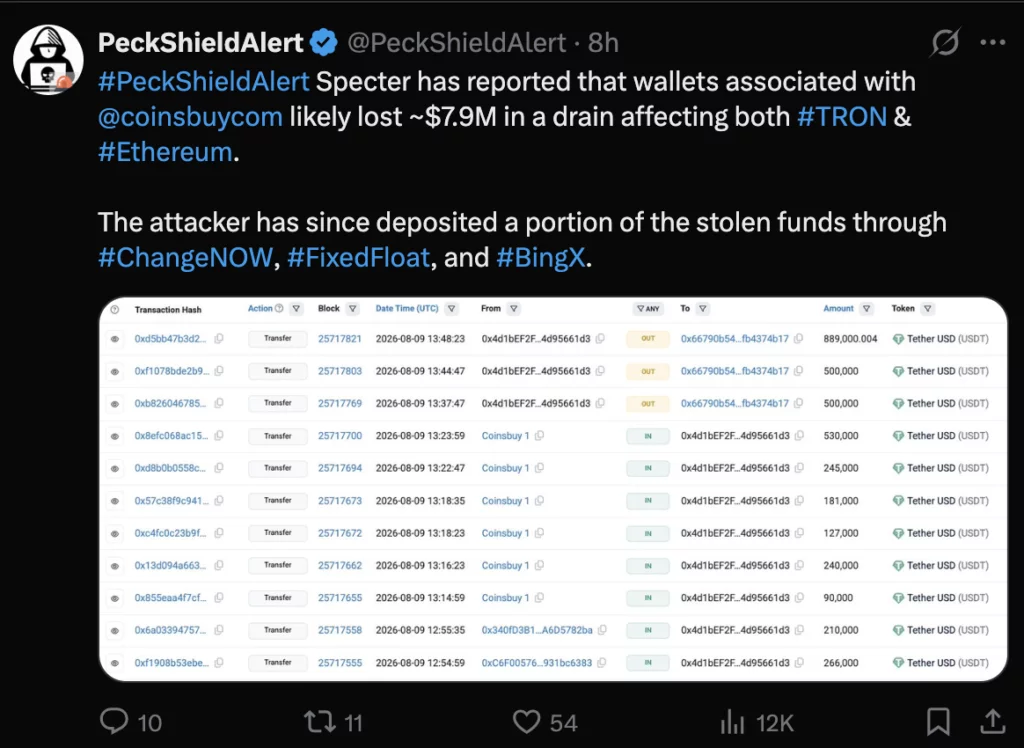
Specter also said ChangeNOW helped freeze a six figure amount before it could move further. ChangeNOW had not issued a separate public statement confirming the exact frozen sum in sources reviewed for this story, so the amount remains attributed to the investigator.
The laundering route resembles patterns seen in other major crypto thefts. In an earlier recovery case, investigators helped freeze about $1.2 million tied to Bo Shen’s stolen assets after funds passed through services including ChangeNOW. Separately, a January wallet theft involved attackers converting stolen Bitcoin and Litecoin into Monero.
Deposits and withdrawals reportedly resumed
Coinsbuy paused deposits and withdrawals after the incident and later restored them, according to Specter’s update and reports citing the investigator. No separate incident notice confirming the timeline was visible in Coinsbuy’s public release notes at the time of review.
It also remains unclear from public disclosures whether the reported $7.9 million consisted entirely of Coinsbuy owned assets, client funds or a combination of both. No customer loss breakdown or reimbursement plan was visible in the company materials reviewed on Aug. 10.
That distinction matters because service restoration does not establish that the investigation is complete or that the full loss has been recovered. The currently verified public picture remains limited to the reported drain, identified theft addresses, laundering activity and a partial freeze.
The case adds to a busy security year. TRM Labs recorded 207 hacks and about $972 million stolen during the first half of 2026, according to data cited in recent industry loss coverage. Infrastructure and operational failures accounted for most of the value lost during that period.
What happens next
The next material update would be a Coinsbuy incident report identifying the attack vector, affected assets, final loss and any customer exposure. Confirmation from ChangeNOW or the other exchanges could also clarify how much was frozen and whether additional funds remain recoverable.
For now, claims about how the attacker obtained access should remain qualified. Security researchers are continuing to trace the listed Ethereum and TRON addresses, but movement into Monero can make later tracing harder once funds leave transparent blockchains.
H100 Group, one of the many companies to adopt a BTC reserve strategy in the past few years, has resumed its accumulations with its largest Bitcoin purchase to date.
The company’s press release shared earlier today reads that it has successfully completed the previously announced purchase of NSD AS (formerly known as WR Start Up 594 AS) and has acquired through the transactions an additional 2,455.37 BTC.
Its total holdings have increased to 3,506.4 BTC, currently valued at just shy of $230 million. However, the company’s average purchase price of $78,400 means that its BTC bet is still in the red.
The all-Bitcoin deal, valued at 1.x mNAV with new share issuance, preserved BTC-per-share metrics while nearly tripling H100’s holdings. According to the company, this positions it among the largest European public Bitcoin treasury entities.
H100 acquires 2,455.4 Bitcoin at approx. USD 62,900 per Bitcoin, increasing total holdings to 3,506 BTC.
The transaction, announced in April, has now been completed:
– Largest M&A transaction in the European Public Bitcoin Equity sector
– World’s first Bitcoin-for-Bitcoin… pic.twitter.com/08dX9slrQH
— H100 (@H100Group) August 10, 2026
Recall that the firm announced its initial BTC purchase in late May. It was a rather modest one for 4.39 BTC. Its board officially adopted the Bitcoin treasury strategy the next month.
It continued to accumulate over the next half a year, but its latest BTC purchase was announced in early February 2026.
The post H100 Group Nearly Triples Bitcoin Treasury With Record $154 Million Purchase appeared first on CryptoPotato.

Robinhood has launched cryptocurrency trading for UK investors, thus expanding its local offering beyond stocks, options, and futures.
The service will begin rolling out to eligible customers this week through Bitstamp UK Ltd.
Users will be able to trade over 50 digital assets, including Bitcoin, Ethereum, XRP, Hyperliquid, and more. The firm said crypto trading will also come with zero trading, account maintenance, or custody fees. However, the users will have to pay a 0.1% FX fee, which will increase to 0.3% during weekends.
Speaking on the matter was Jordan Sinclair, President of Robinhood UK LTD and GM of Bitstamp UK LTD, who said:
“A new wave of UK investors sees digital assets as an important part of a diversified portfolio. With today’s launch, we’re taking another major step toward becoming the all-in=one investment platform for the UK.”
Moreover, the firm is also introducing Cortex Digests for Crypto – an AI-powered feature that’s designed to summarize market news, technical indicators, and factors that influence individual crypto assets.
It’s also worth noting that the announcement comes amid interesting times for Robinhood, as its proprietary Robinhood Chain continues attracting attention. Since the global launch of the network, it has already generated over $18 billion in DEX trading volume, expanding its total value locked (TVL) to more than $840 million.
As CryptoPotato reported recently, the blockchain also became the largest one by means of its real-world assets (RWAs) holder count.
The post Robinhood Brings Crypto Trading to UK Investors With Zero Fees appeared first on CryptoPotato.

Solar Eclipse Tracker Reveals Exact Times for Totality Path Across Iceland Spain and Partial Views

GBP/USD Analysis: Weak US Labour Market Data Pushes the Pair Higher

Rachel Bilson Sizzles in Red Bikini During Summer Vacation


-

 Fashion3 days ago
Frugal Friday’s Workwear Report: Cap-Sleeve Pointelle Crewneck Sweater
-

 Fashion3 days ago
Weekend Open Thread: Mattifying Sunscreen
-

 Sports4 days ago
Jordan Coyle & Cordiamo take Laya Arena Stakes at RDS
-
 Business4 days ago
US stocks: Dow closes at record on Mideast optimism; SpaceX, AMD drag Nasdaq
-

 News Videos2 days ago
Can Astrology Help Find Gold and Silver Trends? A Financial Astrology Guide
-
 Crypto World6 days ago
US Tech Stocks See Largest 5-Week Inflow in History: Can Nasdaq Break Its Downtrend?
-

 Politics4 days ago
Reform UK And Greens Sink To Lowest Favourability Ratings To Date
-

 Business5 days ago
Nvidia Stock Climbs 2.5% as Chip Sector Rally Builds Ahead of AMD Earnings, Nvidia’s Own Report Looms
-

 Crypto World6 days ago
Polymarket targets $20 billion valuation as competition heats up in prediction market sector
-

 Tech5 days ago
OpenAI, Anthropic AI agents targeted real people and systems in cyber tests
-

 Business4 days ago
Supply chain issues impact Ingredion
-
 Crypto World6 days ago
CLARITY Act Senate Vote Locked In, But 60-Vote Hurdle Looms Large
-

 Tech3 days ago
Rinn Pharma & Biopharma to join NordicPharmaTrain network
-
 Crypto World6 days ago
The Senate has one week: CLARITY’s last August window
-
 Crypto World5 days ago
Dow and S&P 500 Hit Records on AI Earnings: When Will the Bubble Burst?
-
 Crypto World7 days ago
California Wildfire Bets Expose Polymarket’s Dark Side
-

 Business1 day ago
How to Start a Cleaning Business: A Step-by-Step Guide
-

 Business23 hours ago
Datadog: Best Of Breed For Multiple Reasons
-

 Business6 days ago
CNH Industrial Shares Jump Over 15% After Beating Estimates and Raising Full-Year Earnings Guidance
-

 Crypto World6 days ago
New York sued, who is next
You must be logged in to post a comment Login