

Crypto World
XRP MVRV Sinks to 2020 Lows as Average Trader Losses Hit -47% and Fear Grips the Market


TLDR:
- XRP 30-day MVRV ratio has fallen to its lowest level recorded since December 2020 cycle lows.
- Average traders active in the past 30 days are currently holding unrealized losses of around -47%.
- Crowd sentiment dropped to 1.1 bullish comments per bearish comment, placing XRP in the FUD zone.
- Historically, deeply negative MVRV readings have preceded strong rebounds as panic selling slows down.
XRP is flashing signals that seasoned traders recognize from past market cycles. On-chain data shows the asset trading in deeply oversold territory, with both sentiment and return metrics reflecting widespread frustration among short-term holders.
At a current price of $1.35, XRP has shed more than half its market value since last summer’s peak.
Average Trader Returns Drop to Multi-Year Lows
The 30-day MVRV ratio for XRP has fallen to its lowest reading since December 2020. This metric tracks the average unrealized profit or loss among traders active within the past month. Currently, those traders are sitting on losses averaging -47%, a figure that reflects deep market pain.
According to Santiment Intelligence, MVRV ratios have historically reverted to 0% over time. This pattern means prolonged negative readings often precede recovery phases. The current reading suggests many short-term holders are capitulating or have already sold.
Much of this pressure traces back to XRP’s aggressive rally in late 2024 and early 2025. Many retail traders entered positions near local tops during that run-up. As momentum faded and repeated selloffs followed, those buyers found themselves deeply underwater.
Santiment noted that deeply negative MVRV zones tend to emerge when retail participation is exhausted. When that happens, even modest positive catalysts can spark sharp recoveries. The data does not guarantee a reversal, but it does point to reduced downside risk relative to potential upside.
Crowd Sentiment Drops Into FUD Zone
Alongside the on-chain data, social sentiment around XRP has also turned sharply negative. Santiment reported that the ratio of positive to negative commentary has dropped to just 1.1 bullish comments per bearish comment. That reading places XRP firmly in what analysts call the “FUD zone.”
Historically, this level of crowd pessimism has acted as a contrarian indicator for XRP’s price. When fear dominates social media, weak hands have typically already exited their positions. That reduces active selling pressure and often sets the stage for stabilization or a bounce.
The reverse dynamic plays out during periods of heavy optimism. When the positive-to-negative ratio climbs deep into “FOMO zone” territory, it usually marks a period where buyers are overextended. Those conditions tend to align with local price tops rather than sustainable rallies.
Despite the current negativity, some investors remain patient. Regulatory developments, ETF speculation, and Ripple’s broader adoption narrative continue to hold attention among longer-term holders.
These factors have not driven immediate price recovery, but they remain part of the broader market conversation around XRP’s trajectory.


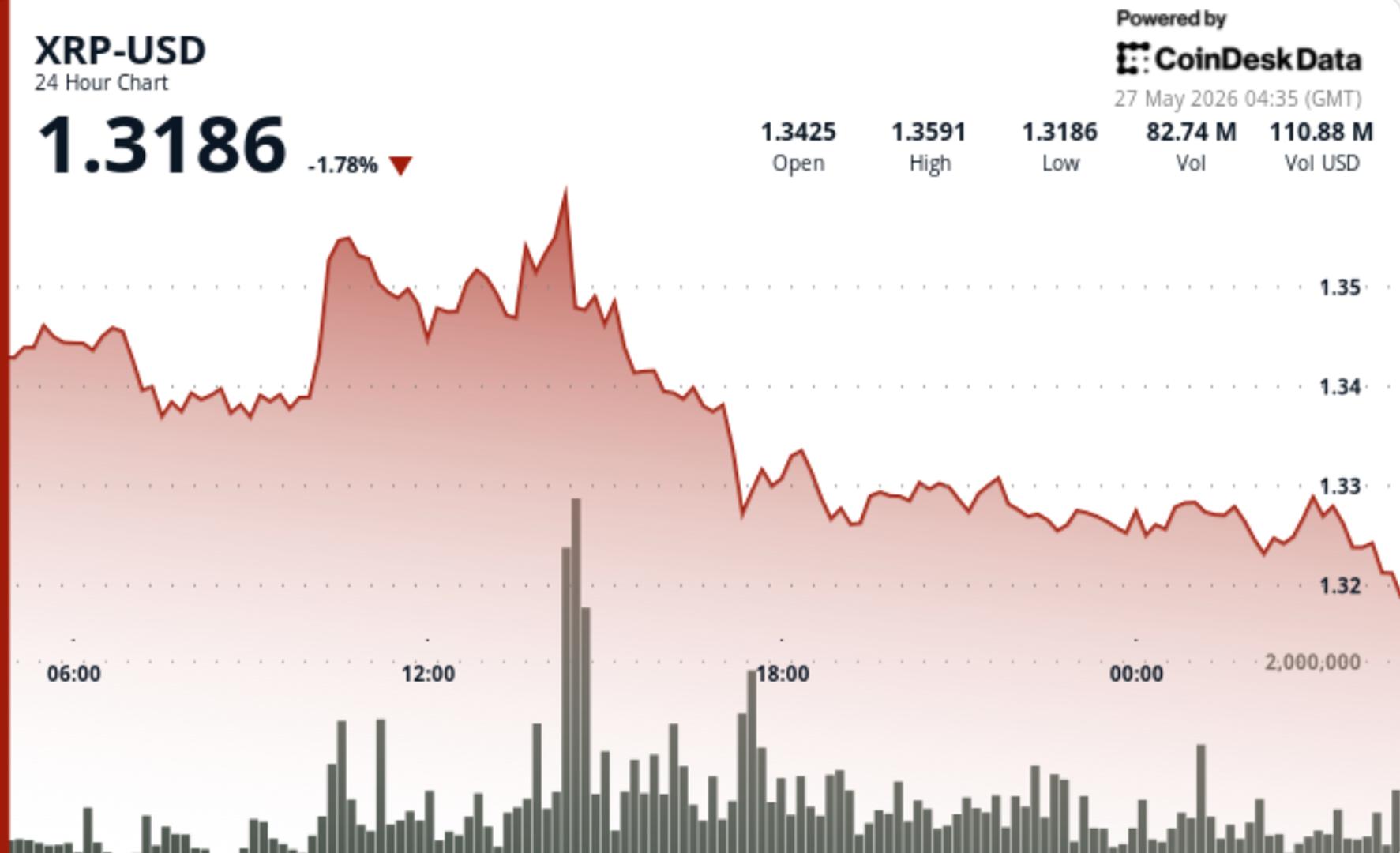
XRP keeps moving in circles around the same range that has controlled price action for months, and the latest failed breakout near $1.36 only reinforced how difficult it has become for buyers to build sustained momentum. The market is still compressing underneath resistance, though the lack of aggressive selling below $1.30 also suggests larger holders are not fully stepping away yet.
News Background
• Sentiment across crypto markets weakened during the session, with fear-driven positioning rising to the highest levels in roughly three weeks.
• On-chain data still showed XRP leaving major exchanges, a pattern some traders interpret as longer-term accumulation rather than active distribution.
• Analysts also continued highlighting a larger symmetrical triangle structure that has compressed XRP price action since early 2025.
Price Action Summary
• XRP traded between $1.3039 and $1.3429 before settling near $1.32 during the May 27 session.
• The largest volume event came during a failed breakout attempt near $1.36, where more than 62M XRP traded before price reversed lower.
• Late-session selling pushed XRP briefly below $1.324 before buyers stabilized the move near support into the close.
Technical Analysis
• XRP remains stuck inside a tightening consolidation structure between roughly $1.30 and $1.38.
• Repeated failures near $1.36 continue reinforcing that area as the market’s main resistance zone.
• Momentum still looks weak in the short term after price failed to reclaim broken support levels near $1.337.
• At the same time, support near $1.30 continues holding despite multiple retests, keeping the broader compression structure intact for now.
What traders should watch
• $1.30 remains the key support floor. Losing it would likely shift focus toward deeper downside targets in the mid-$1.20 range.
• $1.36-$1.38 stays the critical breakout zone XRP needs to clear before momentum can improve meaningfully.
• The longer the range tightens, the higher the odds of a sharper volatility expansion once price finally breaks out of consolidation.


Crypto has embedded itself in finance and politics. Now it is making a mark in sports. With the FIFA World Cup 2026 days away, firms are racing to secure a spot on football’s biggest stage.
No crypto company sits among FIFA’s seven global partners or eight official 2026 sponsors. The action has instead migrated to national federations, ad campaigns, prediction markets, and FIFA’s own blockchain experiments.
National Teams Carry the Crypto Sponsorship Story
Several federations have live crypto-linked sponsorships heading into the tournament. Argentina dominates the list. The Argentine Football Association (AFA) has stitched together a series of crypto and fintech regional deals.
LBank signed a multi-year partnership in September 2025 to become the regional sponsor of the Argentine National Team. The cryptocurrency exchange also launched a $100 million price pool.
In March 2026, Ant International, a global digital payment, digitisation, and financial technology provider, became an Official Sponsor of the Argentine National Football Team for the Asia region.
“This agreement unites the reigning FIFA World Cup Champions with one of the world’s most innovative financial technology providers. Through this partnership, Ant International secures comprehensive marketing rights to launch strategic activations across its brand portfolio, including Alipay+, Antom, Bettr and WorldFirst, by leveraging the intellectual property of the AFA and the world-class players of the Argentine National Football Team,” the press release read.
The next month, Nexo was named as the Official Regional Digital Asset Partner. BTCC, ATFX, and Deepcoin secured regional partner status. Socios.com remains the exclusive issuer of the $ARG fan token.
Notably, Chiliz/Socios.com has official partnerships with the federations of several qualified teams, and several national-team tokens have been designed.
One Prediction Market Makes The List
Crypto firms missed the official FIFA sponsor tier, but ADI Predictstreet broke through in a separate category. FIFA picked ADI Predictstreet as the Official Prediction Market Partner of the 2026 World Cup.
The deal marks FIFA’s first-ever global partner in the prediction market category. ADI Predictstreet is deployed on ADI Chain’s institutional-grade blockchain infrastructure.
Polymarket and Kalshi also continue competing without FIFA rights. The World Cup winner contracts continue to gain traction across both platforms.
Follow us on X to get the latest news as it happens
Ticket Giveaways, and More
Federation-linked sponsors and crypto platforms are increasingly rolling out World Cup-themed promotions to attract users and boost engagement.
As part of its partnership, Nexo announced a global giveaway campaign offering fans a chance to win tickets to Argentina’s FIFA World Cup matches, alongside signed national team jerseys for both new and existing users.
Similarly, Deepcoin has its “Champion Glory” campaign, featuring signed memorabilia, limited-edition merchandise, match attendance opportunities, and offline fan viewing events tied to football icons.
Meanwhile, Crypto.com offered select users in Europe and Australia a chance to win FIFA World Cup 2026 Category 1 match tickets, five nights of accommodation, and matchday transport through its Visa Card promotion.
Beyond exchange-led campaigns, the TRUMP Coin ecosystem also introduced a members-only initiative. The current headline offering is a 3-day VIP experience with a private suite for the FIFA World Cup 2026 Final in New Jersey, available to the top 19 leaderboard holders.
FIFA’s Own Crypto Play
FIFA itself has also moved deeper into blockchain. In May 2025, the federation announced the development of its own dedicated blockchain network on Avalanche. It is a custom Layer-1 designed for digital collectibles and global fan engagement.
FIFA Collect, the digital collectibles platform, was also migrated to the new chain. Moreover, FIFA President Gianni Infantino has also floated the concept of a “FIFA Coin” or “FIFA Token” on more than one occasion.
He pitched the idea at the White House Crypto Summit in March 2025 and revisited it at the World Liberty Forum at Mar-a-Lago in February 2026.
The 2026 World Cup arrives without a top-tier crypto FIFA partner. Yet the industry’s footprint is wider. From Argentina’s stacked sponsor roster to FIFA’s own blockchain, crypto is no longer just sponsoring football. It is building infrastructure inside the sport. Whether this presence translates into lasting fan engagement will define the next cycle.
Subscribe to our YouTube channel to watch leaders and journalists provide expert insights
The post Crypto is All Over the 2026 World Cup, Just Not as an Official FIFA Sponsor appeared first on BeInCrypto.


Base has launched Base MCP, a new tool that connects Base Accounts to AI agents and lets users manage crypto actions through chat.
Summary
- Base MCP lets AI agents swap, transfer, and track wallets from chat with user approvals.
- The tool supports Uniswap, Morpho, Moonwell, and other Base apps while private keys stay protected.
- Related x402 growth shows Coinbase expanding AI payments despite fresh security and malware concerns.
The Coinbase-backed Ethereum layer-2 network said the tool can support transfers, token swaps, balance checks, transaction reviews, and x402 payments.
The launch comes as Coinbase expands its role in AI-driven crypto payments. The news angle is clear: Base is trying to make crypto wallets easier to use through AI agents, while keeping user approval at the center of each transaction.
Base MCP brings wallets into AI chat
Base MCP works with AI clients that support Model Context Protocol, including ChatGPT, Claude, Codex, and Cursor. Once connected, users can ask an AI agent to track portfolios, send funds, swap tokens, check transaction history, and use supported Base apps from the same chat flow.
The system does not give the AI agent direct control over private keys. When an agent proposes a transaction, Base Account opens a separate review window where the user can confirm or reject the action. Base said every transaction shows expected asset changes before approval.
Base adds DeFi apps to AI agent access
At launch, Base MCP includes skill plugins for Moonwell, Morpho, Uniswap, Avantis, Bankr, Aerodrome, and Virtuals. These integrations allow AI agents to help users explore lending markets, manage liquidity, execute swaps, review token launches, and interact with on-chain perps markets.
Base said developers can also build custom plugins that return unsigned transaction details to Base MCP. The user still signs through Base Account, which keeps final approval outside the AI agent’s hands. That setup may help limit some wallet risks, but it still depends on clear prompts, safe plugins, and careful user review.
x402 links Base MCP to AI payments
Base MCP also supports x402 payments, which are designed for small payments by AI agents and web services. According to Base documentation, AI assistants can pay x402-enabled APIs with USDC on Base or Base Sepolia.
Coinbase has been building this stack through x402 and Agentic.market. As previously reported by crypto.news, Agentic.market lets autonomous agents find and buy services using USDC, while earlier x402 activity had reached about 165 million settled transactions across more than 480,000 agents at launch.
Moreover, AWS added Coinbase x402 to Amazon Bedrock AgentCore Payments, letting AI agents pay for services in USDC. Stripe’s x402 support on Base and AllUnity’s agentic payment layer using Coinbase’s x402 standard.
Security concerns remain part of the rollout
Base says “nothing happens onchain without your explicit approval,” and says its MCP server never holds or accesses user private keys.
Still, AI-agent security remains under scrutiny. A recent report citing researchers from Google, Meta, Gray Swan AI, EmbraceTheRed, and universities said AI agents should be treated as untrusted system components and should separate trusted instructions from untrusted data.
The warning followed another security case in which Socket reported a malware campaign targeting crypto and AI developers through malicious software packages. That report said attackers were trying to steal wallet data, SSH keys, cloud credentials, and API keys.
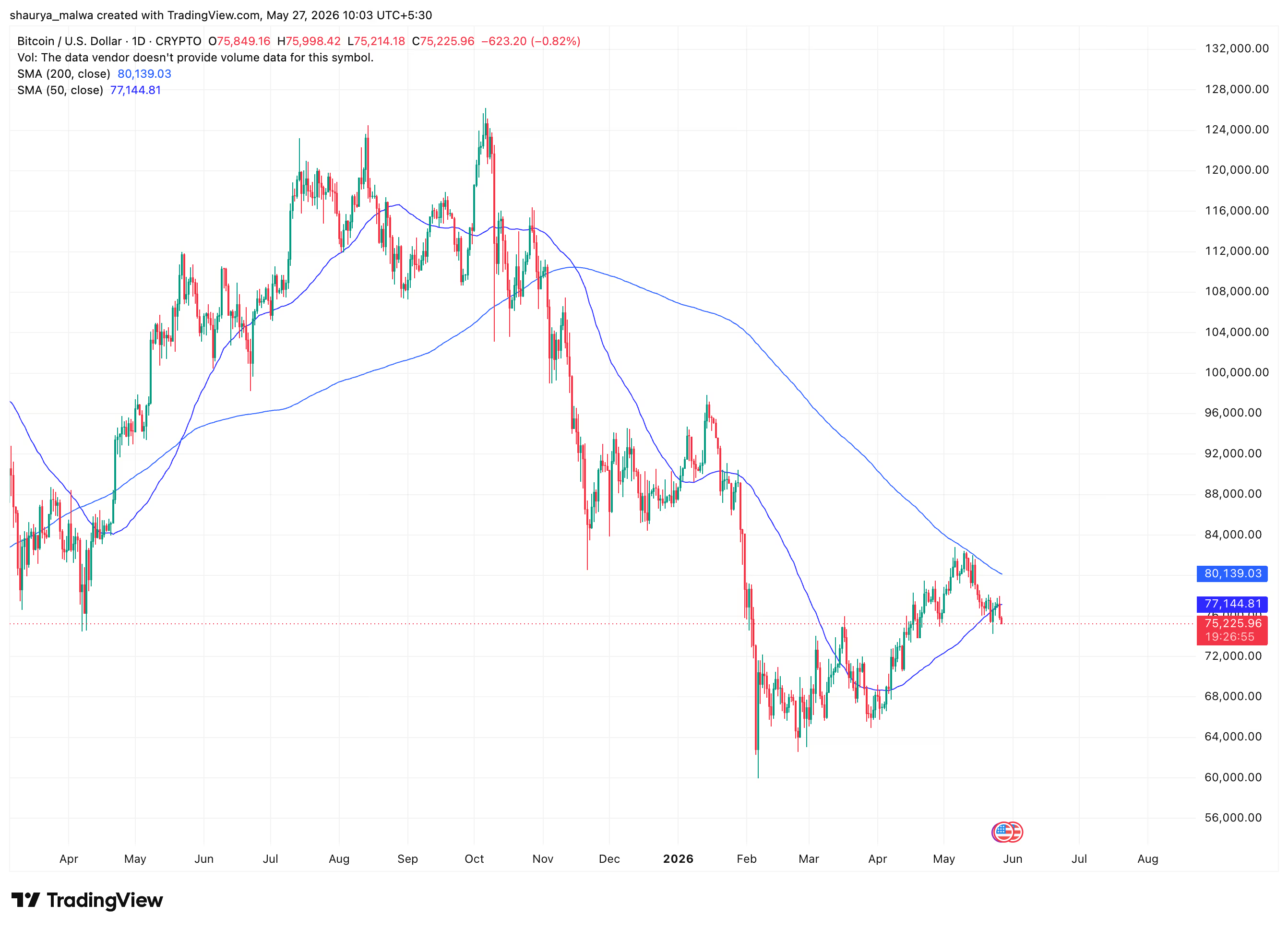
Bitcoin slid to $75,498 in Asian hours Tuesday, leaving crypto markets out of step with the equity rally that pushed global stocks to record highs overnight.
XRP, ether, and Solana were each down as much as 1% in the past day, per CoinDesk data, while Zcash (ZEC) dropped 9% to $564, the biggest single move among the top 15. Hyperliquid (HYPE) bucked the cohort at $59.99, up 1.4% on the day and now sitting just behind Dogecoin on market cap. Tron (TRX) is the quiet performer of the past week, climbing steadily as the rest of the majors held narrow ranges.
What traders are now watching is a setup forming on the bitcoin chart. FXPro analyst Alex Kuptsikevich said in an email the price is finding support near the rising 50-day moving average, while the 200-day moving average briefly acted as resistance earlier in May.
The two lines are on track to cross in the coming weeks, a setup known as a golden cross, which is generally read as a bullish signal. A break of either moving average before the cross could set the direction for crypto markets through the next several weeks, he said.

The flow data has been less encouraging. Spot bitcoin ETFs in the U.S. saw $1.74 billion in withdrawals over the past two weeks, per CryptoOnchain. Retail traders have been adding leverage in the meantime, a combination that has historically preceded sharp liquidation cascades when the market turns against the crowd.
The pattern is showing up at the same time the broader market is asking which asset gives the signal first. Joel Kruger, market strategist at LMAX Group, said ether remains the critical chart to watch, with repeated failures ahead of $2,400 reinforcing the importance of that resistance band.
A decisive daily close above $2,400 would mark a major technical shift and likely bring renewed institutional participation, Kruger said.
The U.S. Securities and Exchange Commission added another piece to the institutional puzzle on Monday, approving the listing of options on a bitcoin index calculated from BTC prices across multiple exchanges. It is the first instrument of its kind, with existing crypto options on U.S. stock exchanges limited to those tied to spot ETF shares.
Equities went the other way overnight, meanwhile.
The MSCI All Country World Index rose for a sixth straight day to a record. South Korea’s Kospi is up about 100% on the year, making it the best-performing major equity gauge globally. Micron Technology jumped 19% in U.S. trading to cross $1 trillion in market value, joining SK Hynix in the chip stocks at that level. Brent crude slipped 1.5% to $98 on signs of progress in U.S.-Iran negotiations. Treasury yields edged lower, with the 10-year at 4.47%.
Bitcoin’s lag behind equities has been one of the cleanest market signals of the past month. Whether that gap closes through a chip-led equity pullback or a bitcoin catch-up depends on which side of the moving average crosses first.

Strive purchased 1,109 Bitcoin between May 19 and May 22, increasing its holdings to 16,500 BTC, according to a Tuesday SEC filing.
The company said it held about $93.3 million in cash and cash equivalents as of May 22, alongside roughly $50.1 million in fair value tied to its holdings of Strategy’s Stretch preferred stock product, STRC. The Dallas, Texas-based company also said it is evaluating refreshed at-the-market stock sale programs that could fund additional Bitcoin (BTC) purchases.
Strive boosted its Class A common shares outstanding by more than 2.2 million shares during the period, while its SATA preferred stock count rose by about 515,000 shares, reflecting continued use of equity-linked financing tied to its Bitcoin treasury strategy.
The filing follows Strive’s announcement earlier this month that it would start paying daily dividends on its SATA preferred shares at a 13% annualized rate beginning in June. The company described SATA as the first listed US security designed to distribute dividends every business day. It also announced it had eliminated all outstanding debt.
Strive is an asset manager founded by former US presidential candidate and current Republican gubernatorial candidate in Ohio Vivek Ramaswamy that has increasingly adopted a Bitcoin treasury strategy similar to Strategy.
Data from BitcoinTreasuries.NET shows the company now ranks as the seventh-largest public corporate Bitcoin holder, with roughly $1.3 billion in BTC on its balance sheet.

Top 10 Bitcoin treasury companies. Source: BitcoinTreasuries.NET
Related: Saylor’s Strategy scoops $2B Bitcoin, holdings reach 843,738 BTC
Yield-bearing securities viewed as digital credit
Strive’s SATA product is part of a growing class of yield-bearing securities tied to corporate Bitcoin treasury strategies, an asset class that issuers are describing as “digital credit.”
Strategy, the world’s largest corporate Bitcoin holder, currently offers multiple preferred securities tied to its Bitcoin-focused capital structure, including Stretch (STRC), Stride (STRD), Strife (STRF) and Strike (STRK).
STRC has emerged as the dominant Bitcoin-linked preferred security issued by the company. Launched in July 2025, the security currently carries a variable dividend yield of about 11.5%, according to company data. Shareholders will vote next week on a proxy proposal to pay dividends on the shares twice a month.
Earlier this month, STRC recorded a record $1.53 billion in daily trading volume, with chairman Michael Saylor describing the product as Strategy’s primary vehicle for funding Bitcoin purchases in 2026.
SATA currently has a market capitalization of about $332 million, according to BitcoinTreasuries.net data, compared with more than $10 billion for Strategy’s STRC.
Speaking Tuesday on the Coin Stories podcast, Strive Chief Risk Officer Jeff Walton said BTC-backed securities could reshape traditional financial markets and credit systems.
“You can start to rethink and reimagine what money looks like, reimagine what credit looks like,” Walton said, adding that the idea was “so simple it seems like it shouldn’t work,” which he said contributes to skepticism around the emerging sector.

Jeff Walton speaking with Natalie Brunell.
Source: Coin Stories
Magazine: 5 tech predictions the mainstream media got horribly wrong
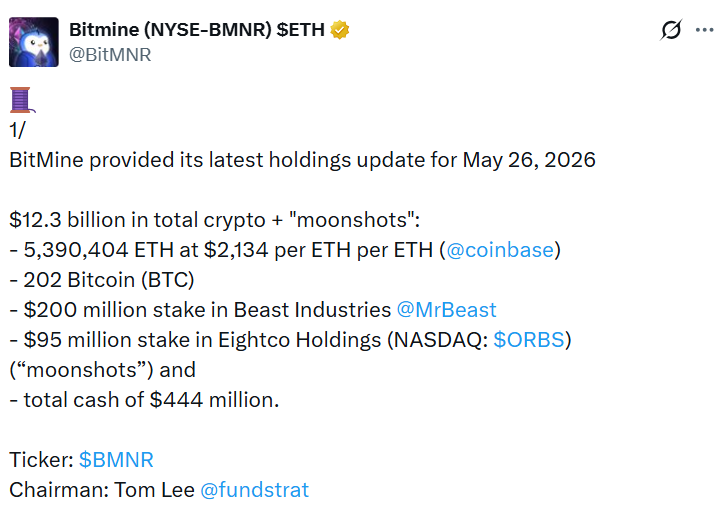
The Ether buying company Bitmine Immersion Technologies has made its biggest purchase so far in 2026 as its chairman, Tom Lee, doubled down on the idea of an impending crypto supercycle.
Lee said Tuesday that in the past week, Bitmine bought 111,942 Ether (ETH) after a recent pullback sent the token below $2,200 and presented an “attractive opportunity.” Ether has traded between $2,025 and $2,147 over the past seven days.
He also reiterated his theory of a supercycle ahead for crypto and Ether, driven by Wall Street’s interest in tokenization and artificial intelligence-powered agents.
“We continue to expect a supercycle ahead for crypto and Ethereum, driven by the dual drivers of Wall Street tokenization and agentic AI. And thus, we continue to steadily acquire ETH, with Bitmine now owning nearly 5.4 million ETH tokens,” Lee said.
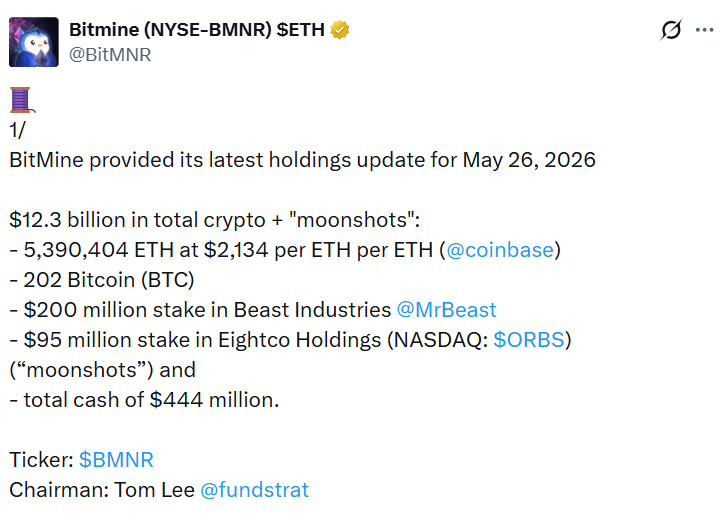
Source: Bitmine
Bitmine slowed its pace of Ether buys earlier this month after having scooped up over 100,000 ETH a week for three straight weeks. It is the largest Ether treasury company and has consistently bought crypto, even during market downturns, following a business model similar to Michael Saylor’s Bitcoin treasury firm Strategy.
Bitmine’s goal is to hold 5% of Ether’s circulating supply of 120.7 million tokens. To reach its target of more than 6 million ETH, Bitmine needs about 644,596 ETH, which Lee said will happen sometime this year.
Ether treasury firms leaning into staking
Bitmine has staked over $4.7 million of its Ether, according to the company, and expects to generate annualized staking revenues of $276 million.
Related: Bitmine’s Tom Lee hints at stock tailwinds after firm considered for Russell 3000
Staking infrastructure provider Everstake said in a report Tuesday that Ether treasury companies are under pressure to generate revenue from staking and other yield strategies as the appeal of public companies just holding the asset has been weakened by interest in spot crypto exchange-traded funds.
Across the wider ecosystem, the amount of staked Ether has hit a new high, with more than 39.2 million, or roughly 32.19% of the supply, locked in and another 3.3 million waiting in the wings, according to the Ethereum Validator Queue. At the same time, the exit queue has about 234,368 Ether waiting to leave.
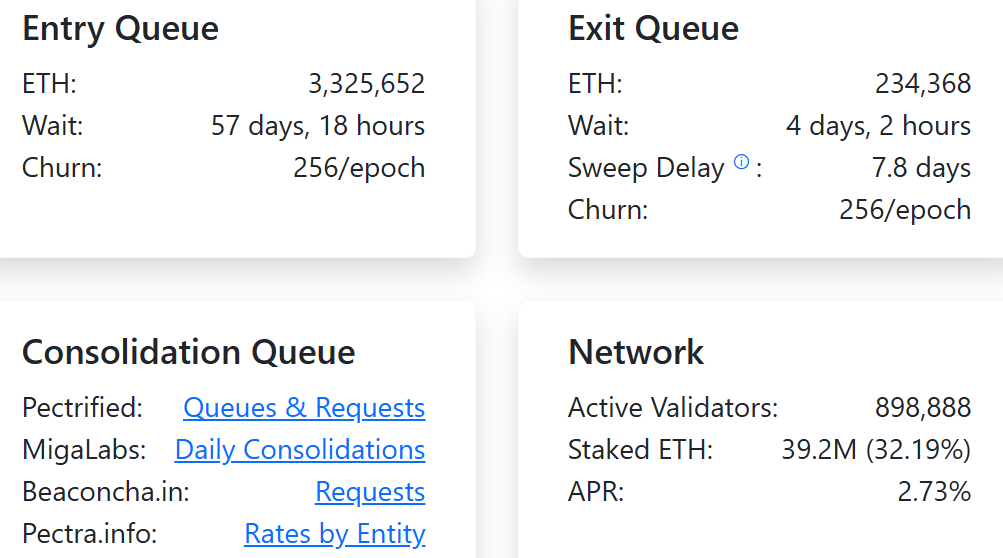
Over 39.2 million Ether is currently staked. Source: Ethereum Validator Queue
Ether reached an all-time high of $4,946 in August 2025 but has since fallen over 58%. Lee previously argued that Ether’s steep drawdowns may offer a buying opportunity.
Magazine: Polymarket seeks Japan entry, Harvard dumps entire ETH position: Hodler’s Digest, May 17 – 23


The pope has used his first encyclical to issue an unusually blunt warning on artificial intelligence, saying AI must be “disarmed” and stripped of the logics that turn it into a tool of domination, manipulation, and automated killing.
Summary
- In his encyclical Magnifica Humanitas, Pope Leo XIV calls for AI to be “disarmed,” comparing its potential to nuclear energy and demanding it be harnessed only for the common good.
- He warns that AI is already fueling conflict, misinformation, and “new forms of slavery,” and insists that delegating lethal decisions to machines is “not permissible.”
- The pope urges world leaders to slow development, build strong legal frameworks, and ensure AI serves human dignity, echoing and sharpening earlier Vatican concerns about autonomous weapons and deepfakes.
In a landmark document released on May 25, Pope Leo XIV presented Magnifica Humanitas, the first major teaching text of his papacy and a sweeping manifesto on AI, technology, and human dignity. He writes that artificial intelligence must now be “disarmed, liberated from logics that transform it into a tool for domination, exclusion, and destruction,” and pointedly compares AI to nuclear power—something that can serve everyone but, left unchecked, can also annihilate entire societies.
The encyclical warns that a global “competition for increasingly powerful algorithms and expansive datasets,” driven by geopolitical rivalry and commercial greed, is pushing humanity toward systems that optimize for control rather than care. In that race, he argues, AI has already begun to deepen global conflicts by accelerating misinformation, amplifying polarisation and lowering the psychological threshold for war when lethal decisions are delegated to code.
“No machine should ever choose to take the life of a human”
Pope Leo’s harshest language is reserved for AI in warfare and state power. Echoing earlier Vatican documents under Pope Francis, he condemns Lethal Autonomous Weapon Systems that can “identify and strike targets without direct human intervention,” calling them a “cause for grave ethical concern” and insisting it is “not permissible” to entrust irreversible, lethal decisions to machines.
Previous Vatican teaching on AI, including the note Antiqua et Nova and Francis’s World Day of Peace message on “Artificial Intelligence and Peace,” already framed autonomous weapons as an “existential risk” that could threaten the survival of entire regions or even humanity itself. Leo explicitly builds on that line, stating that “no machine should ever choose to take the life of a human being,” and calling for international law to ban systems that act as de facto automated executioners on the battlefield or in policing.
The encyclical also targets what he describes as AI-driven “new forms of slavery,” from opaque algorithmic management of workers to exploitative surveillance and deepfake pornography that strip people of control over their image and identity. These dynamics, he warns, risk creating a tiered society in which those who design and own AI systems exert unprecedented power over those who are merely measured, scored, or simulated by them.
A call to slow down—and to regulate hard
Leo’s message is not a blanket rejection of technology, but a demand that AI development be subordinated to human dignity and democratic control rather than the other way around. The encyclical calls for “strong legal frameworks, independent oversight, informed users, and a political environment that does not relinquish its obligations,” warning that governments cannot simply outsource responsibility to engineers or platform CEOs.
He urges world leaders to “slow down” the AI arms race, particularly in domains such as military systems, mass surveillance, and political manipulation, where the incentives to deploy harmful capabilities are strongest. At the same time, he acknowledges AI’s “immense potential” in medicine and social welfare so long as it remains a tool that complements human judgment instead of replacing doctor‑patient relationships or eroding face‑to‑face solidarity in moments of illness and vulnerability.
The encyclical closes by inviting other religions, civil society, and technologists themselves to treat AI not as an inevitable destiny but as a contested field of choices about what kind of civilization humanity wants. In Leo’s framing, the question is not whether AI will transform the world, that is already happening, but whether societies are willing to “disarm” it before it locks them into systems of domination that no one ever consciously chose.


Micron Technology has reportedly joined the trillion‑dollar club after an 18% single‑day surge sent its shares to around $886, capping a year‑to‑date run of more than 200% on the back of an AI‑driven memory boom.
Summary
- Bitget data suggests Micron’s stock jumped 18% to roughly $886, lifting its market value to around $1 trillion and marking yet another record high.
- The move extends a blistering rally that has already seen Micron gain more than 210% in 2026 as investors crowd into high‑bandwidth memory and DRAM suppliers to the AI buildout.
- Analysts have spent months arguing a $1 trillion valuation was plausible if MU cleared roughly $888 per share, given its 1.12 billion shares outstanding.
While most public data as of late May still showed Micron trading in the $700s with a market cap below $900 billion, analysts at Seeking Alpha and Yahoo Finance had already mapped out the math: with about 1.12 billion shares outstanding, MU needed to trade just under $890 to hit the trillion‑dollar threshold. A Barron’s report earlier this month noted the company had already smashed through $700 billion in market value after a 10% jump to $634.97, less than two months after crossing $500 billion, underscoring how violently the market has repriced Micron as the AI memory trade has gone mainstream.
The underlying story is simple. Micron sits at the center of the high‑bandwidth memory (HBM) and advanced DRAM supply chain for AI accelerators, with multiple reports suggesting its HBM capacity is fully booked through at least 2026 as hyperscalers and chipmakers race to feed data‑center‑scale models. GuruFocus and other outlets have described Micron as “positioned to ride the AI memory boom,” with some scenario analyses arguing the stock could double in 2026 alone under a bull case of persistent HBM shortages, margin expansion, and multiple rerating.
A parabolic move with very real risks attached
The speed of the move has turned Micron into one of the surprise winners of the AI hardware cycle. One Globe and Mail column noted the stock was already up nearly 700% over 12 months with a market cap “just under $850 billion” before this latest lurch higher, calling it a candidate to “join the trillion‑dollar club” on the back of its locked‑in HBM orders. Another analysis at Barchart in February flagged that MU had risen about 242% over six months yet was still trading at roughly 12.5 times forward earnings, with a highest 12‑month price target of $500 at the time—a level the stock has already blown past.
But breathless price action does not cancel basic cyclicality. Even bullish notes from GuruFocus and Forbes have stressed that Micron’s business remains exposed to the same structural risks that have wrecked memory names in past cycles: aggressive capacity build‑outs from Samsung and SK Hynix, China’s push to back its own DRAM and NAND champions, and the possibility that AI data‑center capex flattens just as new fabs come online. Analysts warn that if hyperscalers slow spending or if consumer‑side demand for PCs and smartphones weakens, memory prices could compress and turn today’s “AI super‑cycle” into another boom‑and‑bust, especially given Micron’s heavy capital‑expenditure commitments.
For now, the market is choosing to look through those risks. Commentators at The Motley Fool have called Micron “one of the best picks in 2026,” describing it as a “bargain” AI stock even after a roughly 250% gain last year, and arguing that its earnings power remains underpriced relative to the scale of the AI infrastructure buildout. With the shares now trading at levels that imply roughly a $1 trillion valuation, that optimism is finally reflected in the headline number, leaving very little room for disappointment if the memory cycle, or the AI narrative, show even a hint of slowing down.
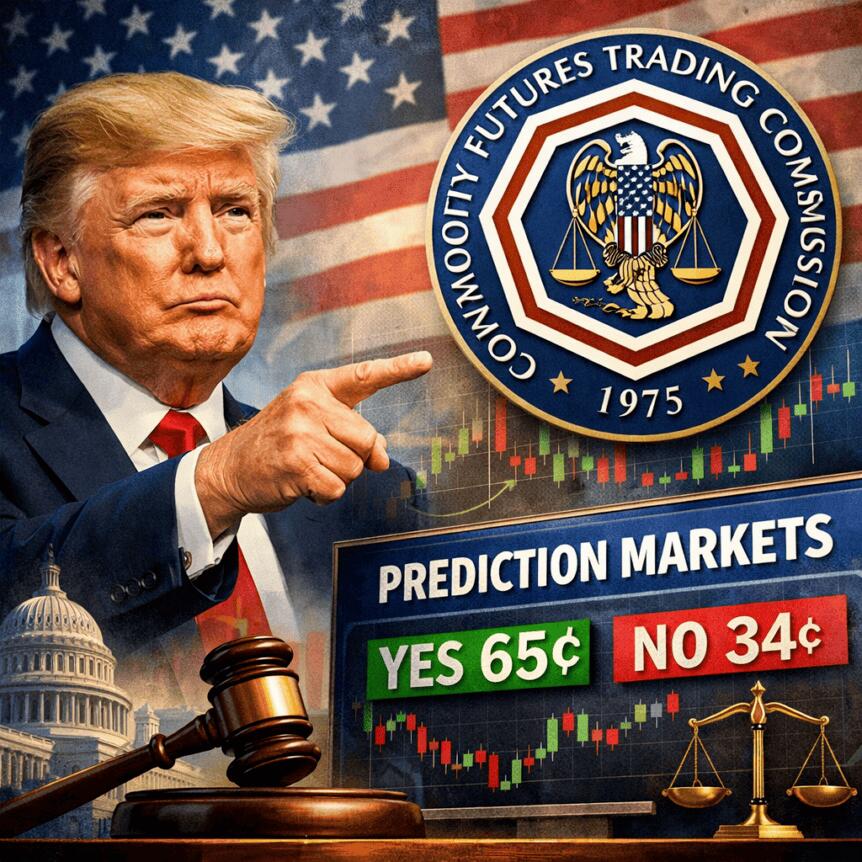
Regulatory tensions over prediction markets have escalated in the United States, as a former president publicly backs federal oversight and state authorities press legal actions against Kalshi, Polymarket, Crypto.com and Robinhood. The clash centers on who should regulate this rapidly growing crypto-adjacent sector and how rules should be enforced.
In a post on Truth Social on Tuesday, Donald Trump argued that the CFTC must retain exclusive jurisdiction over prediction markets and urged that the industry “thrive” under federal oversight. He also took aim at several state officials and lawmakers pursuing action against prediction-market platforms, saying that “we cannot have SCUM like Chris Christie, Letitia James, Tim Walz, and JB Pritzker setting the rules.” Trump’s comments add a high-profile political dimension to a case that has already seen courts and regulators circle the space.
Trump’s call comes amid a broader regulatory fight in which state authorities say prediction markets violate local gambling laws, while market participants contend they fall under the CFTC’s federally regulated derivatives framework. Kalshi and Polymarket—two of the most prominent players in this space—have pressed back against state enforcement efforts, arguing that the CFTC alone should regulate this market activity.
At the center of the regulatory battle is a dispute over jurisdiction. CFTC Chair Mike Selig has opposed the states’ actions, arguing that prediction markets fall within the agency’s exclusive purview as federally regulated designated contract markets. The agency has pursued legal action against several states for attempting to curb or ban these platforms, highlighting the ongoing friction between state and federal regulators in this evolving niche of financial markets.
Meanwhile, state authorities have pursued legal actions or cease-and-desist orders against platforms such as Kalshi, Polymarket, Crypto.com and Robinhood, arguing that these platforms operate gambling-like ventures without the proper licensing. Kalshi and Polymarket have responded by suing state authorities, asserting that the CFTC is the sole regulator for prediction market activity.
In parallel, Trump’s governance team and family ties have become part of the narrative. Reports have highlighted that Donald Trump Jr. is invested in Polymarket and serves on its advisory board, while he also acts as an adviser to Kalshi. Coverage in recent days noted that Trump Jr.’s stance on prediction markets had softened, arguing that the United States would risk being left out if it does not permit these platforms to operate. The context around these remarks underscores how political calculations may influence regulatory outcomes in this area.
Trump’s broader remarks reflect a familiar pattern in the debate over prediction markets: supporters argue that a clear federal framework fosters innovation and investor confidence, while opponents call for tighter control to address potential manipulation and consumer protections. The CFTC’s position has consistently framed prediction markets as a subset of the derivatives market governed by the Commodity Exchange Act, a view that has been used to justify federal oversight and enforcement against state-level restrictions.
Key takeaways
- Trump publicly reinforces the CFTC’s exclusive authority over prediction markets, signaling support for a federal framework amid ongoing state actions against Kalshi, Polymarket, Crypto.com and Robinhood.
- States including Minnesota, Illinois, New York and Arizona have pursued enforcement actions against prediction-market platforms, drawing legal battle lines with the federal regulator.
- Kalshi and Polymarket have countersued state authorities, asserting that regulation of prediction markets should be handled by the CFTC rather than by states’ gambling or securities laws.
- CFTC leadership has argued for preemption of state actions, positioning prediction markets within the agency’s designated contract market regime and its broader anti-manipulation and market-integrity standards.
- The ecosystem’s growth is tempered by regulatory uncertainty, as the CFTC moved to formalize oversight with a dedicated advisory team on event contracts and market integrity standards.
Trump’s position and the federal-versus-state regulatory tension
The social-media post from the former president framed the issue as a national regulatory test: safeguard a robust, federally governed market and resist the encroachment of disparate state rules. The post cited his intent to establish “rules of the road” that would serve as a Gold Standard for states, reflecting a broader push to unify the regulatory approach to prediction markets under federal supervision. The argument for federal primacy is grounded in the CFTC’s claim that these markets operate as derivatives and should be regulated as part of the national derivatives framework rather than by localized gambling laws.
On the other side of the debate, state officials argue that prediction markets can operate in a legal gray area, potentially circumventing stricter consumer protections if left under a federal umbrella without state involvement. The dispute has drawn attention to a broader question: how to balance innovation and consumer protection in a space where novel financial instruments intersect with gambling-related concerns in multiple jurisdictions.
In coverage surrounding Trump’s evolving stance, outlets noted that his own family has financial ties to Kalshi and Polymarket. Donald Trump Jr.’s involvement has fed commentary about how personal interests can intersect with policy positions, particularly as the administration or its successors weigh regulatory options for this class of markets. A separate report highlighted that Trump Jr. publicly signaled a softer stance on prediction markets, arguing that the U.S. risks losing out if it excludes these platforms from the financial landscape.
State actions, platform responses, and the federal framework
The enforcement push from state regulators has included cease-and-desist orders and licensing scrutiny aimed at Kalshi, Polymarket, and compatible platforms like Crypto.com and Robinhood. The core accusation is that these platforms offer gambling-like contract markets without the requisite licenses under state law. Kalshi and Polymarket have responded by asserting that their activities fall under the CFTC’s jurisdiction and that states lack the authority to regulate them as gambling or betting markets.
The CFTC, for its part, has pursued multiple lawsuits against states pursuing action against these platforms. The agency argues that the prediction-market market is a tightly regulated derivatives space, and that state-by-state interventions risk creating a patchwork of rules that could hinder innovation and cross-border participation. The agency’s posture emphasizes a federal standard—one designed to preserve market integrity, reduce manipulation risk, and provide consistent compliance expectations for participants and developers alike.
Beyond enforcement, the CFTC signaled a structural approach to oversight by forming an advisory team in March focused on the listing and trading of event contracts. The team is tasked with evaluating listing standards, surveillance measures, anti-manipulation controls, and overall market integrity, reinforcing a move toward formalized governance of prediction markets within the existing derivatives regime.
These developments come at a moment when participants, developers, and investors are weighing how the regulatory backdrop will shape product design, liquidity, and user access. Platforms like Kalshi and Polymarket have already built communities around real-world event contracts, and their ability to operate at scale could hinge on future court rulings, enforcement priorities, and any potential regulatory clarification from federal or state authorities.
Looking ahead: what to expect and what matters for the market
The immediate question is how the ongoing jurisdictional battle will be resolved. Courts could clarify the balance of power between federal and state authorities, potentially establishing a clearer boundary for prediction-market activities. If the federal framework prevails, platforms may enjoy greater regulatory consistency and a more predictable path to liquidity and product expansion. If state authorities maintain leverage, platforms could face continued licensing costs, compliance fragmentation, or even restricted access in certain jurisdictions.
Investors and builders should watch for regulatory clarity on several fronts: any court rulings that define the scope of the CFTC’s authority; potential settlements or settlements-in-principle between states and platforms; and any federal regulatory updates or guidance that further delineate permissible activities, licensing requirements, or safeguards against market manipulation. The coming months are likely to reveal how much of the current tension is strategic posturing and how much will translate into concrete, enforceable rules for prediction markets.
Readers should stay alert to evolving legal decisions, policy statements from the CFTC, and any new guidance that could influence platform viability, user participation, and the speed at which prediction-market products can scale across borders.
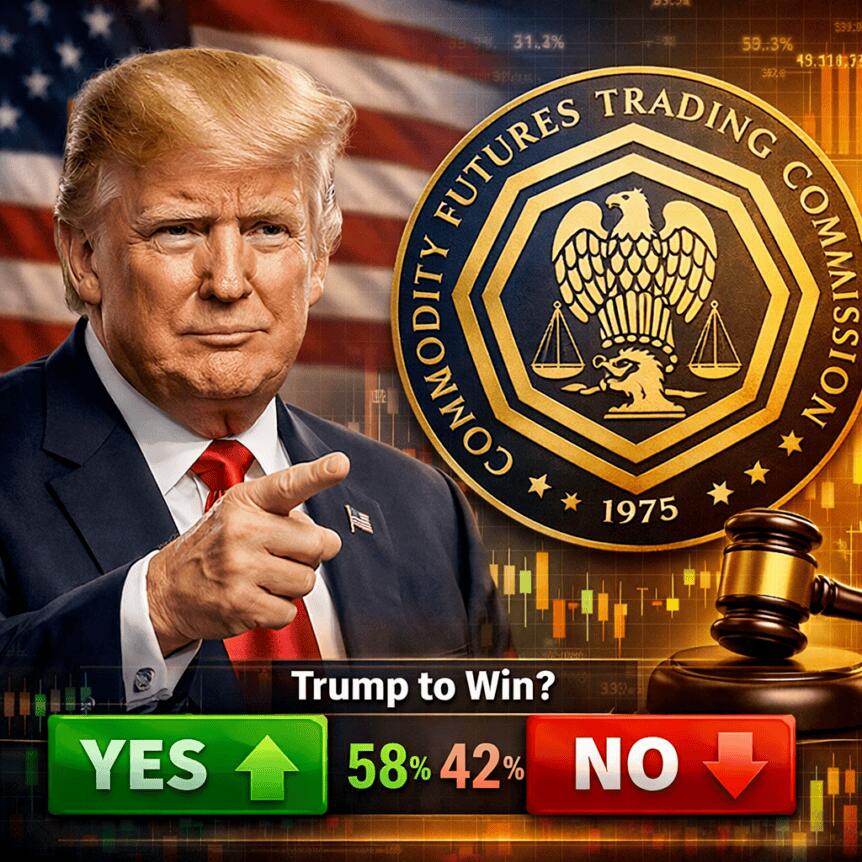
A regulatory clash over prediction markets has intensified as U.S. political signals converge with ongoing state enforcement actions. President Donald Trump reaffirmed that the Commodity Futures Trading Commission (CFTC) has exclusive authority over prediction markets, arguing that federal oversight should be maintained to ensure the industry’s viability. The stance comes at a moment when several states have moved to restrict or challenge platforms such as Kalshi, Polymarket, Crypto.com and Robinhood, claiming they operate gambling activities without proper licensing.
Trump, writing on Truth Social, emphasized the need for a unified federal framework and criticized state officials whom he portrayed as attempting to set their own rules for the sector. He asserted that under his leadership the U.S. would establish “the Gold Standard for the States” in this space and warned against “SCUM” he said were trying to shape policy. These remarks illustrate a broader political dynamic around how prediction markets should be regulated in the United States.
Multiple state authorities have argued that prediction markets violate state gambling laws and have moved to shut down or block platforms. In response, Kalshi and Polymarket have pursued litigation against certain state actions, contending that prediction markets fall squarely under the CFTC’s federal remit. The debate centers on whether state enforcement can or should override, or complement, federal regulation in this evolving market segment.
According to Cointelegraph, CFTC Chair Mike Selig has opposed the states’ efforts, arguing that the agency holds exclusive jurisdiction over prediction markets as federally regulated designated contract markets. The CFTC has pursued legal action against several states—Minnesota, Illinois, New York, and Arizona—for attempting to regulate or ban prediction-market activities within their borders.
Trump’s remarks also highlighted personal and familial ties to the sector. His son, Donald Trump Jr., is reportedly invested in and on the advisory board of Polymarket and serves as an adviser to Kalshi, underscoring the high political and commercial stakes surrounding the policy debate. In the days following his initial stance, Trump signaled a more conciliatory view, suggesting the United States risked falling behind if prediction-market platforms are excluded from the regulatory framework.
Beyond the political debate, the regulatory apparatus has taken concrete steps to structure the market. In March, the CFTC established an advisory team to oversee the listing and trading of event contracts and to ensure that participants meet anti-manipulation, surveillance, and market-integrity requirements. The agency has argued that prediction markets fit within the existing derivatives framework under the Commodity Exchange Act, reinforcing the argument for federal oversight rather than a patchwork of state rules.
Key takeaways
- President Trump reaffirmed the CFTC’s exclusive authority over prediction markets, framing federal oversight as essential to industry integrity and competitiveness.
- State regulators have pursued licensing actions, cease-and-desist orders, or bans against platforms, arguing that prediction markets operate as unlicensed gambling in their jurisdictions.
- The CFTC contends it possesses exclusive jurisdiction over prediction markets as federally regulated markets, a position supported by statements from CFTC leadership cited by Cointelegraph.
- Kalshi and Polymarket have challenged state actions in court, while Trump’s stance intersects with his family’s involvement in these platforms, signaling heightened political risk for the sector.
- March saw the CFTC establish an advisory team to govern listing and trading of event contracts and to uphold market integrity within the existing derivatives framework.
Federal jurisdiction, design markets, and enforcement posture
The central legal question concerns whether prediction markets operate primarily under federal derivatives regulation or are governed by a mosaic of state gambling laws. Proponents of federal control argue that prediction contracts are designated contract markets within the CFTC’s remit, and therefore fall under federal oversight. Critics, however, note that states have traditionally licensed and regulated gambling activities, and they have moved to apply local rules to prediction-market platforms that operate across state lines. This tension is being resolved, in part, through the CFTC’s insistence on its “exclusive jurisdiction” and the use of federal enforcement tools where states seek to assert their own regulations.
As noted by Cointelegraph, CFTC leadership has repeatedly defended the agency’s mandate in the face of state challenges. The agency has publicly pursued litigation against several states, including Minnesota, Illinois, New York, and Arizona, to counter state measures aimed at restricting or banning prediction markets. The outcome of these disputes could significantly shape how platforms structure their operations, pursue licensing where required, and design compliance programs to satisfy both federal and state regulators.
State actions versus platform adaptations and corporate ties
State authorities maintain that prediction markets operate outside licensed gambling frameworks and therefore require state authorization or prohibition. In response, platforms like Kalshi and Polymarket have contested such actions in court, asserting that they are regulated by the CFTC as designated contract markets under federal law. The legal clash reflects broader concerns about consumer protection, market integrity, and anti-manipulation standards in a rapidly evolving segment that blends financial contracts with real-world event outcomes.
The political dimension is amplified by ties between the platforms and political figures. Trump Jr.’s involvement with Polymarket and Kalshi, coupled with the former president’s shifting rhetoric, underscores a policy debate that intersects with campaign dynamics, regulatory philosophy, and the potential for regulatory alignment with broader U.S. financial-market governance. Observers note that how Congress, the executive branch, and the courts calibrate federal versus state authority will carry implications for licensing regimes, compliance burdens, and cross-border operations of prediction-platforms and related services.
Policy context, risk considerations, and market structure implications
The regulatory trajectory surrounding prediction markets sits at the intersection of several compatibility and enforcement considerations. Analysts will be watching for alignment with broader national and international regulatory frameworks, including how MiCA-style harmonization concepts could influence cross-border activity, and how U.S. agencies (including the SEC, CFTC, and DOJ) coordinate on enforcement priorities. Compliance programs for prediction-market operators must address AML/KYC requirements, anti-manipulation controls, and surveillance capabilities, while licensing regimes continue to evolve at the state and federal levels. The evolving posture also raises questions about how stablecoins, banking access, and payment rails intersect with regulatory expectations for risk management and consumer protection in prediction markets.
Regulatory clarity remains critical for institutional participants, exchanges, and financial-service providers seeking to operate or partner with prediction-market platforms. The balance between safeguarding market integrity and fostering innovation will inform licensing approaches, reporting obligations, and cross-border service provisions in a sector that continues to attract regulatory scrutiny.
Looking ahead, observers should monitor the outcome of state actions against platforms, ongoing court challenges, and any potential federal rulemaking or guidance from the CFTC that could further delineate the boundaries between federal authority and state regulation. The unfolding legal and regulatory narrative will likely influence how these markets evolve, how platforms structure compliance programs, and how traditional financial institutions assess risk and opportunity in this frontier area.
As the regulatory debate continues, the next steps—whether through court rulings, new guidance, or settlements—will shape the trajectory of prediction markets in the United States and their integration with broader financial-market infrastructure.

Ripple-linked token steadies near $1.32 after failed breakout

Mitch Marner savours trip to Stanley Cup Final: ‘There’ve been some dark moments’

Most Americans are cutting back even as US markets roar, survey shows


-

 Crypto World5 days ago
Blockchain.com files with SEC for U.S. IPO
-

 Fashion4 days ago
Holiday Weekend Open Thread – Corporette.com
-

 Business5 days ago
Dell Technologies DELL Stock Surges 15% on AI Server Momentum and Analyst Upgrades in 2026
-

 Crypto World5 days ago
Bitcoin Accumulation Weakens as BTC Realized Losses Hit $600M
-

 Crypto World4 days ago
Robinhood crypto COO Tanya Denisova exits
-

 Crypto World5 days ago
Space X IPO Is ‘Bad News’ for Tech Stocks: But What About Bitcoin?
-

 Politics4 days ago
Makerfield: a tale of two social-media histories
-

 Business2 days ago
NYT Strands Answers May 24 2026 Revealed for Puzzle No. 812 Theme Summer Essentials
-

 Tech2 days ago
Microsoft’s quiet Claude Code retreat and the real cost of enterprise AI
-

 Crypto World5 days ago
MicroStrategy’s Saylor Says Miners No Longer Set Bitcoin Price, Another Force Has Taken Over
-

 Tech5 days ago
WhatsApp ads could make Irish debut after discussions with DPC
-

 Crypto World5 days ago
AI infrastructure race heats up as IREN pitches full-stack strategy, WhiteFiber lands $160M deal
-
 Tech5 days ago
A 0.12% parameter add-on gives AI agents the working memory RAG can’t
-

 Tech5 days ago
You Can Now Add ChatGPT To PowerPoint
-
 Crypto World2 days ago
Nvidia (NVDA) CEO Calls on Super Micro to Strengthen Export Controls Amid Smuggling Probe
-
 NewsBeat6 days ago
Charity run by Reform leader Malcolm Offord accused of ‘law breaking’ over Scottish registration
-

 Business5 days ago
Trump Invests $1M-$5M in Kura Sushi USA Chain With 27 California Locations
-

 Tech2 days ago
Westone Audio and Etymotic Acquired by Fidelity Collective in Major IEM Market Move
-

 Sports5 days ago
2026 CJ Cup Byron Nelson leaderboard: Brooks Koepka finds putting stroke in Round 1
-

 Crypto World6 days ago
Exa Labs raises $250 million in funding led by a16z
You must be logged in to post a comment Login