
Crypto World
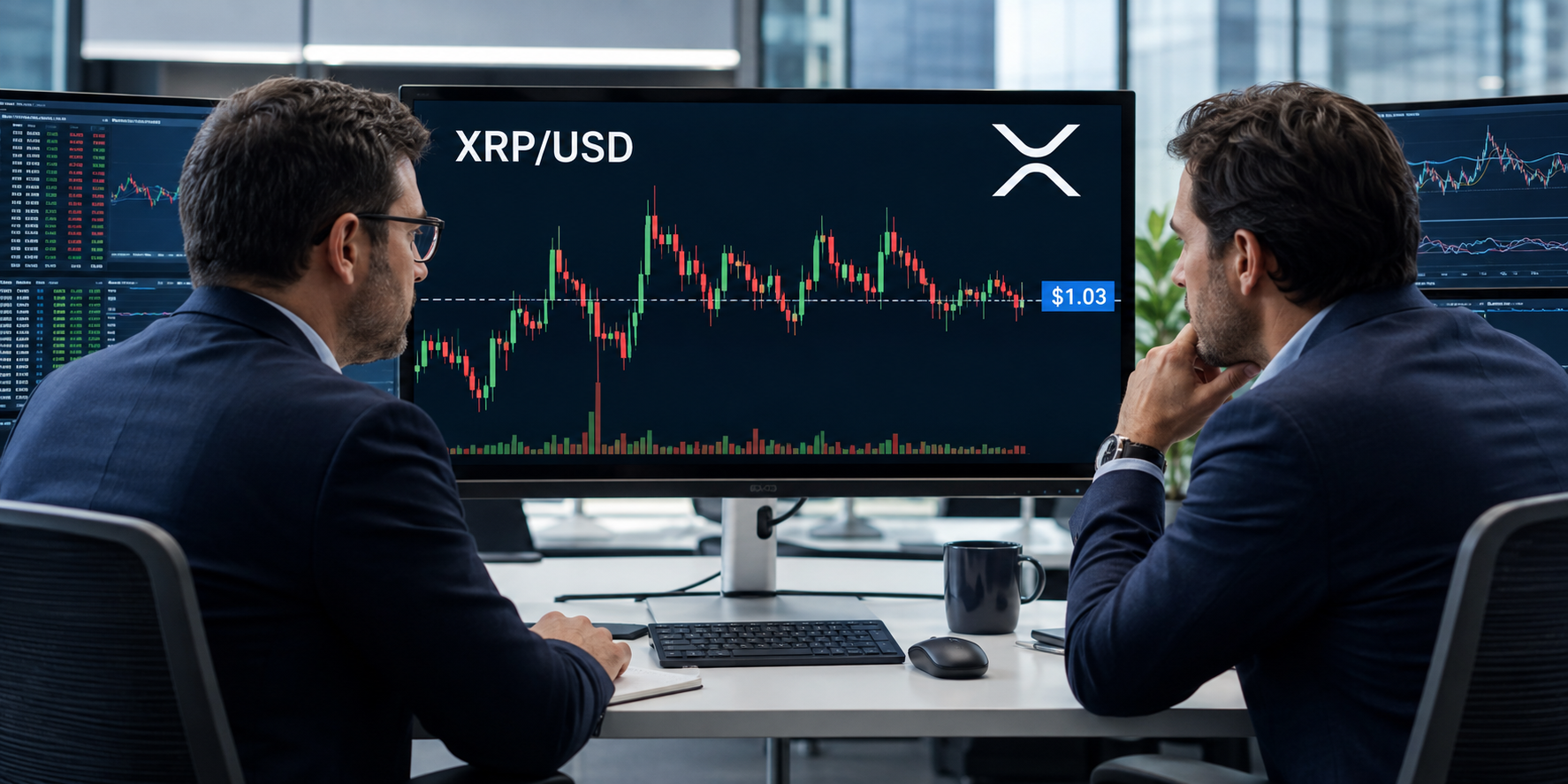
XRP rebounds to $1.03 but bearish momentum keeps $1 support at risk


Key takeaways
- XRP trades around $1.03 after falling more than 5% during the previous week.
- The token remains below its 50-day, 100-day, and 200-day EMAs, maintaining a bearish technical structure.
- An RSI reading near 39 and a negative MACD signal indicate persistent selling pressure.
XRP trades near $1.03 on Monday, recording a modest rebound after declining more than 5% during the previous week.
Despite the intraday recovery, XRP retains a bearish near-term outlook because it remains below all three major Exponential Moving Averages. Weak momentum indicators also suggest that sellers continue to control the broader price trend.
The $1.00 psychological level is now crucial. Buyers must defend this support to prevent another leg lower, while XRP needs to reclaim the 50-day EMA at $1.10 to improve its short-term outlook.
XRP remains below all major moving averages
XRP currently trades below the 50-day EMA at $1.10, the 100-day EMA at $1.18, and the 200-day EMA at $1.37
Trading below all three moving averages reflects weakness across short-, medium-, and long-term time frames.
The positioning also creates a wide zone of overhead resistance. Any XRP recovery is likely to face renewed selling as the price approaches these moving averages.
The 50-day EMA at $1.10 represents the first major test. A sustained daily close above this level would suggest that short-term momentum is beginning to improve.
XRP’s momentum indicators remain bearish despite Monday’s slight recovery. The Relative Strength Index stands near 39, below its neutral midpoint of 50.
This reading shows that selling pressure remains dominant, although XRP has not yet entered the conventional oversold zone below 30.
The Moving Average Convergence Divergence indicator is also negative, reinforcing the bearish outlook.
Together, the RSI and MACD suggest that XRP’s rebound may remain limited unless buyers return with stronger trading volume. Any short-term rallies could attract selling while the token remains beneath its major moving averages.
XRP approaches critical $1 support
The psychological and horizontal level at $1.00 provides XRP’s most important immediate support.
Buyers may attempt to defend this area because round-number levels often attract increased demand. Holding above $1 could allow XRP to consolidate and make another attempt to reclaim its 50-day EMA.
However, a decisive daily close below $1.00 would weaken the technical structure and could accelerate selling pressure.
The absence of another specified nearby support means that a breakdown could expose XRP to a deeper correction as traders search for the next demand zone.
XRP must break above the 50-day EMA at $1.10 to begin reversing its bearish short-term trend.
The move from $1.03 to $1.10 would require a gain of nearly 7%. Clearing this moving average could encourage buyers to target the 100-day EMA at $1.18.
If XRP breaks above $1.18, the horizontal resistance at $1.30 would become the next upside target.
However, each of these levels could attract profit-taking and renewed selling, making a sustained recovery dependent on strong demand and improving momentum.
The 200-day EMA at $1.37 represents XRP’s most substantial technical barrier. This moving average serves as an important gauge of the broader trend. XRP would need to reclaim it to signal a meaningful shift away from its long-term bearish structure.
Beyond $1.37, the next major resistance is located around $1.90. However, this target remains distant while XRP trades below its nearer moving-average barriers.
For now, the more immediate recovery path runs through $1.10, $1.18, and $1.30.

XRP’s technical outlook remains bearish despite its modest recovery to $1.03. The token’s position below all major moving averages and its weak momentum indicators suggest that sellers retain control. The $1.00 support level will determine whether XRP can stabilize or faces another wave of losses.
Holding above $1 could support consolidation and a recovery toward the 50-day EMA at $1.10. Conversely, a decisive breakdown would confirm renewed bearish momentum and increase the risk of a deeper correction.


SpaceX rivals Rocket Lab and AST SpaceMobile will both report earnings after the close on Monday. On Monday morning, Rocket Lab (RKLB) stock rose as much as 3% before paring gains, while AST SpaceMobile (ASTS) fell 2%, according to MarketSurge. Both stocks hit historic highs earlier in Q2, as the broader space industry experienced sectorwide excitement in the lead up to…
Copyright ©2026 Investor’s Business Daily, LLC. All rights reserved. 87990cbe856818d5eddac44c7b1cdeb8
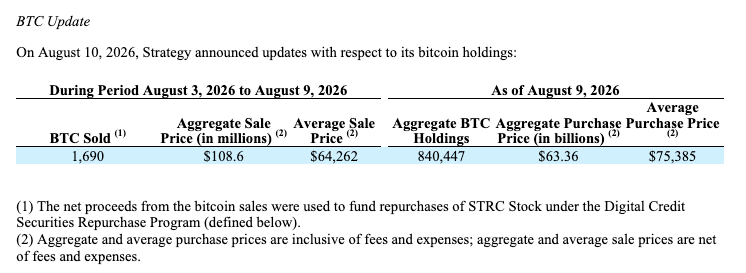
Strategy, which holds the largest corporate Bitcoin treasury, sold BTC for the second week in a row to repurchase its STRC preferred stock.
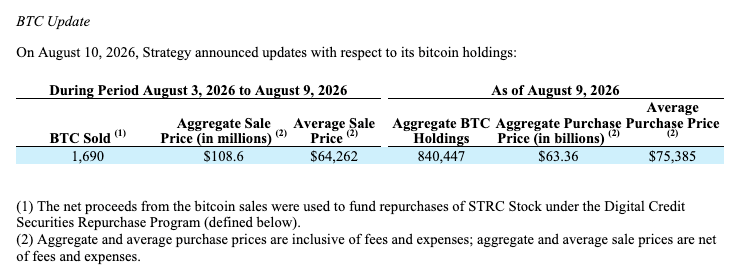
The company sold 1,690 Bitcoin for $108.6 million between Aug. 3 and Aug. 9, according to a Monday 8-K filing with the US Securities and Exchange Commission (SEC).
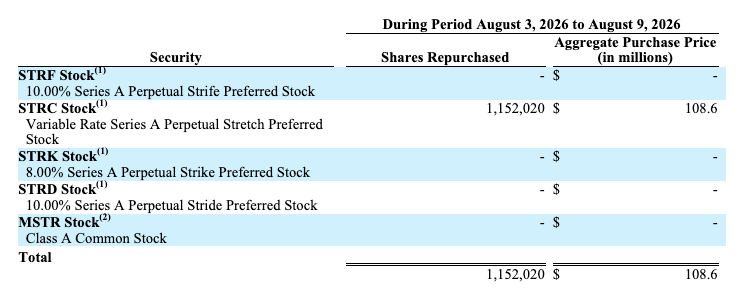
Strategy used the proceeds to buy back 1.15 million shares of its STRC preferred stock for $108.6 million. STRC is a variable-rate preferred stock designed to pay monthly dividends.
The transaction marked Strategy’s fourth disclosed Bitcoin sale of 2026, bringing its total Bitcoin sales for the year to 6,948 BTC, while the company still holds 840,447 BTC purchased for an aggregate $63.36 billion.
Bitcoin becomes part of the funding engine
Strategy sold the latest batch at an average net price of $64,262 per Bitcoin, while its total holdings carry an average purchase price of $75,385 per BTC, including fees and expenses.
Strategy’s prior disclosed sale involved 1,638 BTC for $104.73 million between July 27 and Aug. 2, when it also used Bitcoin sale proceeds to fund STRC repurchases.
Source: SEC
The latest filing shows that Strategy has $785.2 million remaining under its digital credit securities repurchase program, which covers its preferred stock, while another $1 billion remains available under its Class A common-stock repurchase program.
$4.65 billion reserve cushions preferred dividends
Strategy also continued building its US dollar reserve, reporting a balance of $4.65 billion as of Sunday, up from roughly $4 billion in the previous weekly update.
The company said $650 million of the $653.1 million in net proceeds from recent MSTR stock sales went toward the reserve, while the latest figure also includes expected proceeds from at-the-market (ATM) sales that had not yet settled.
Source: SEC
STRC shares have also rallied during Strategy’s recent buybacks, retaking $90 on Aug. 3 after rebounding 24% from their June lows.
STRC was up 0.46% at $95.45 in premarket trading Monday after closing Friday at $95, while MSTR gained 0.25% to $100.26, according to Yahoo Finance.
Magazine: Strategy became a symbol of the dot-com crash: Could history repeat?
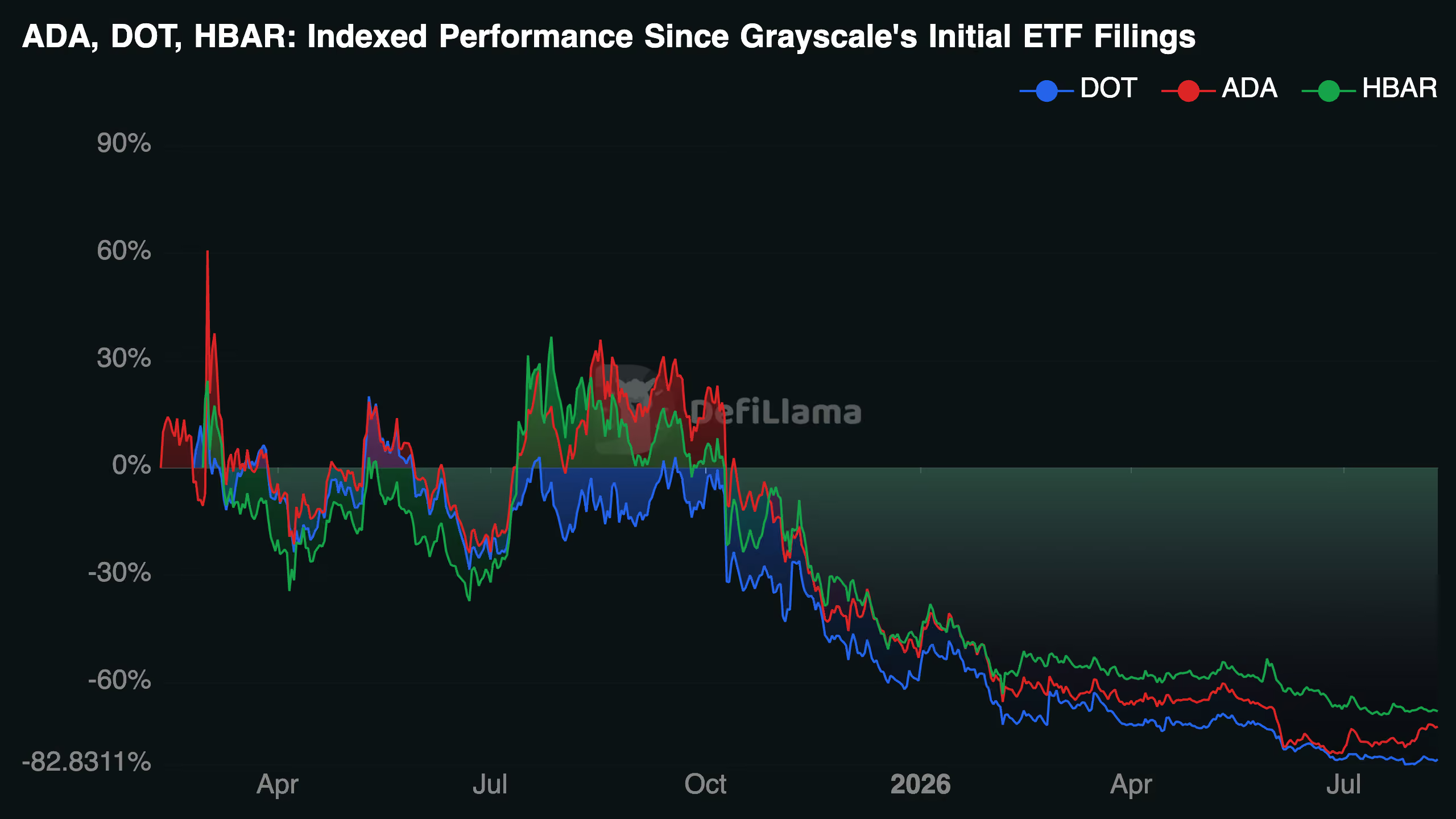
Crypto asset manager Grayscale Investments has dropped plans for exchange-traded funds tied to Cardano’s ADA, Polkadot’s DOT and Hedera’s HBAR, withdrawing three registration statements from the U.S. Securities and Exchange Commission (SEC) late Friday.
Through three separate requests with the regulator, Grayscale told the SEC it “does not intend to proceed with the planned distribution” of the shares of each trust.
The withdrawals were initiated by Grayscale and weren’t SEC rejections.
Grayscale’s initial Cardano ETF proposal came in February 2025, and its Polkadot filing later that month. Grayscale filed the corresponding ADA and DOT registration statements on Aug. 29, followed by its HBAR registration on Sept. 9.
The proposed funds were designed as passive vehicles that would track the value of their respective tokens after fees and expenses. Grayscale said it had not sold securities or distributed preliminary prospectuses under the registrations.
All three tokens have been losing value over the last few months. Year-to-date, ADA is down more than 41%, while DOT lost 54% of its value and Hedera’s HBAR lost 35%.

Since late February 2025, when the filings came in, performance has been worse. ADA endured a 70% drawdown, while DOT saw an 80% downward move. HBAR also dropped more than 70%.
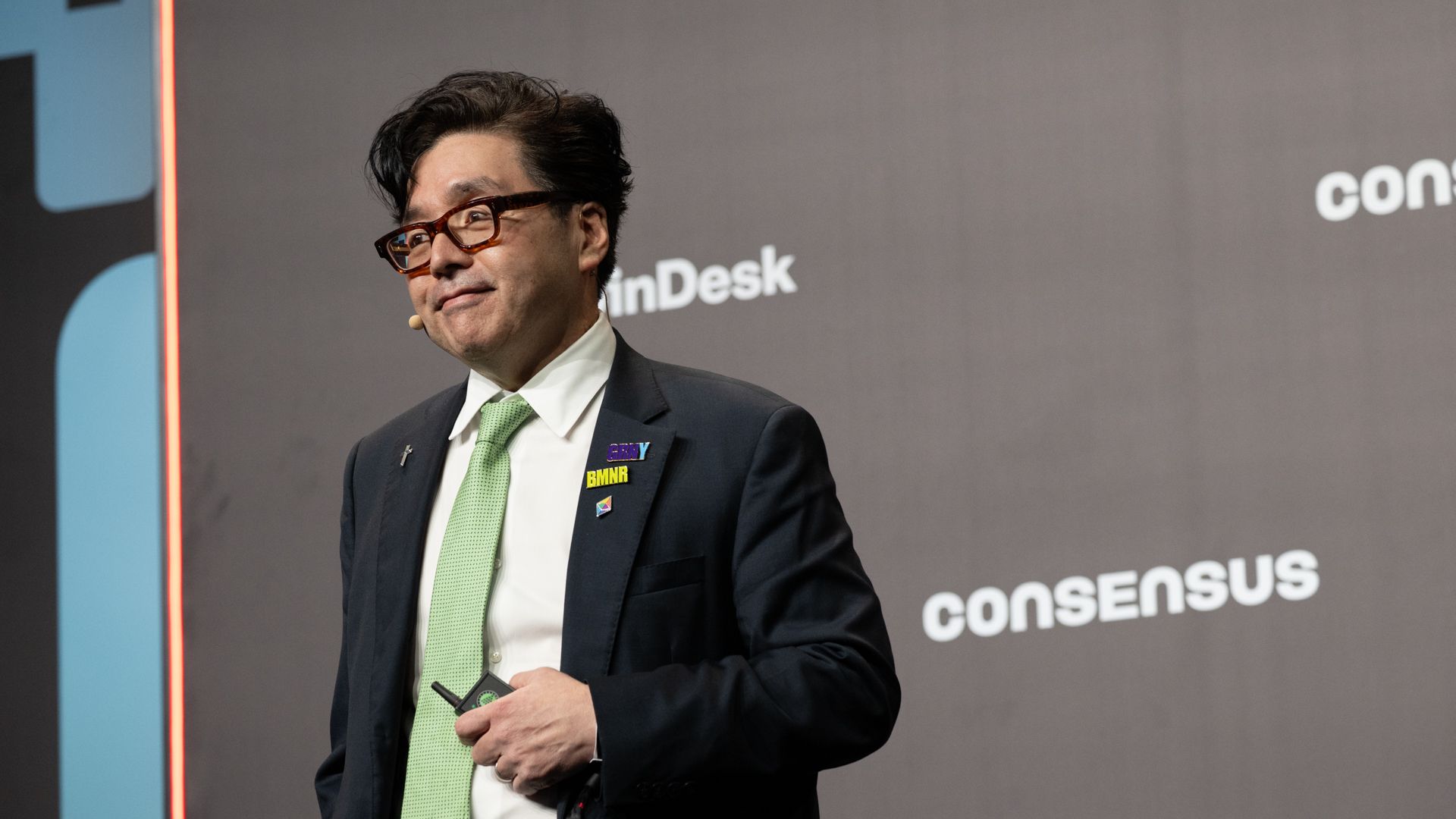
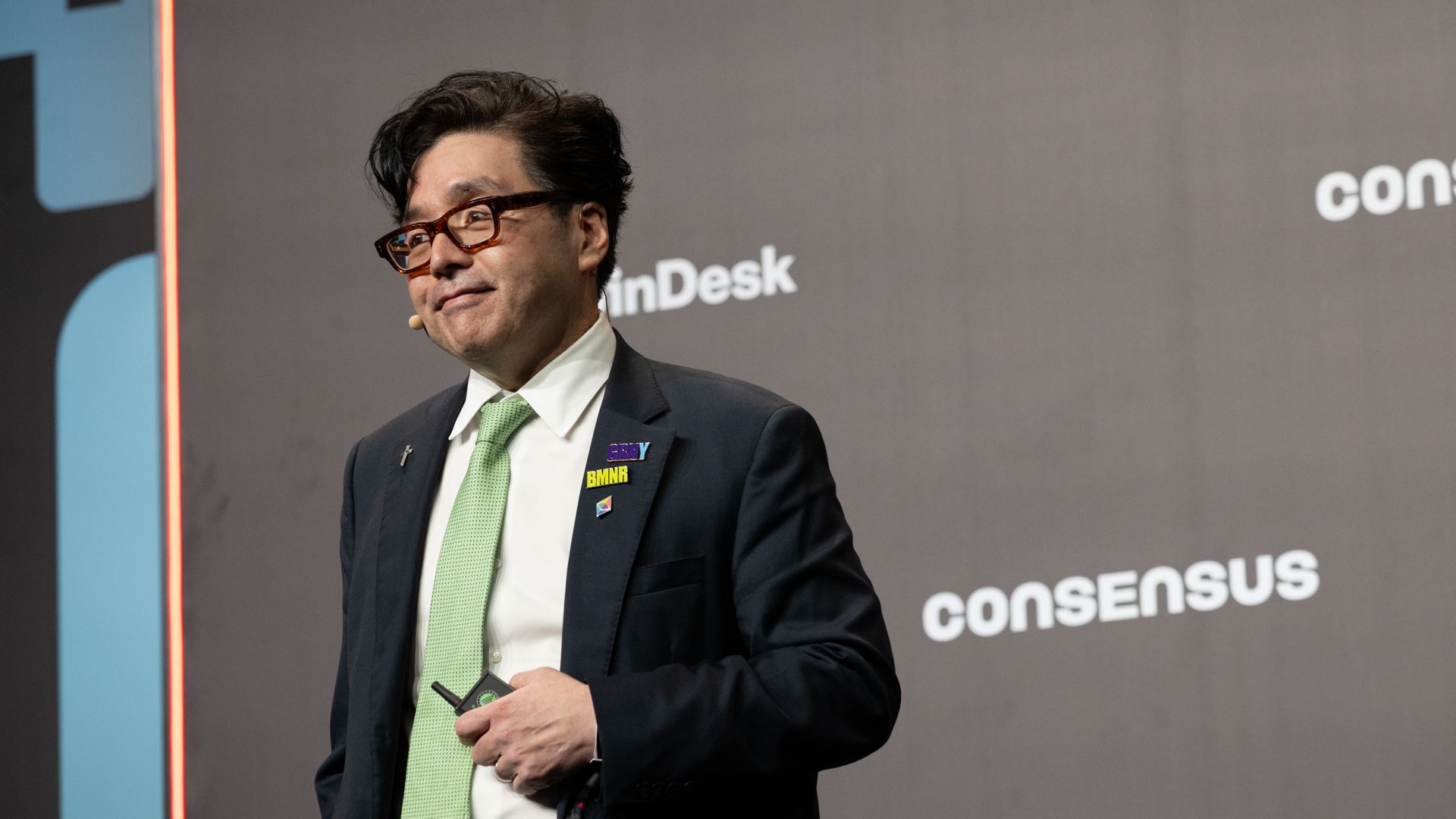
Bitmine Immersion (BMNR), the largest Ethereum treasury firm, bought another 7,391 ether last week.
The purchase, worth roughly $14.2 million at ether’s price as of writing of $1,915, lifted the company’s holdings to over 5.8 million ETH, or about 4.8% of Ethereum’s total supply.
The latest haul, which extends Bitmine’s ETH buying streak to 58 weeks, was the smallest weekly purchase through the year and remains a fraction of the 100,000-plus weekly acquisitions Bitmine made earlier this year.
Thomas Lee, chairman of Bitmine, noted earlier this year that the firm would slow the pace of crypto accumulation as it gets closer to its goal of owning 5% of ether’s supply.
Instead, the company has shifted towards buying back shares. It repurchased another 3 million shares last week, which would have cost roughly $50 million to $58 million based on the stock’s trading range during the period. Since July, the firm has bought back 19.1 million of its own shares.
Bitmine also holds 209 BTC, $104 million in cash and marketable securities and stakes in Beast Industries and Eightco Holdings.
Bitmine shares traded flat neat $18.80 in pre-market trading.
Clarity delay
Lee focused on the macro backdrop despite another setback for U.S. crypto legislation, with the CLARITY Act failing to secure a Senate vote before the August recess.

Vertex stock surged Monday after its competitor, Sionna Therapeutics (SION), missed the mark for its highly anticipated cystic fibrosis treatment. Sionna’s drug, SION-719, lowered sweat chloride by 1 millimole per liter, on average and compared to a placebo, when added to Vertex Pharmaceuticals’ (VRTX) Trikafta. Measuring chloride, or salt, in sweat is the gold standard for diagnosing cystic fibrosis, a…
Copyright ©2026 Investor’s Business Daily, LLC. All rights reserved. 87990cbe856818d5eddac44c7b1cdeb8
[PRESS RELEASE – Road Town, British Virgin Islands, August 10th, 2026]
Deposits Are Open for hBTC, the Vault Token for Hilbert Group’s BTC Basis+ Strategy
Syntetika, a tokenization hub for regulated investment strategies, opened deposits today for its first strategy: BTC Basis+, managed by the publicly traded Hilbert Group.
Syntetika makes investment strategies that run inside regulated funds accessible directly from a wallet. Each fund operates with independent custody, and each cycle its net asset value is attested by an independent third party. That attested NAV is the price at which vault tokens are issued and redeemed.
BTC Basis+ is a Bitcoin basis strategy: it holds Bitcoin exposure and captures the funding spread between spot and futures markets, with returns denominated in Bitcoin terms. Participants deposit cbBTC through the Syntetika platform in a permissionless way. Deposits are queued and subscribed into the fund at the next processing cycle, with hBTC minted at an attested NAV. Redemptions follow the same cycle.
Syntetika launches with partners Tulipa Capital on strategy curation, Ember Protocol on vault infrastructure, and Yield Network as Liquidity Syndication Partner. The platform launches on Base. Reserves behind its tokens will also become checkable by anyone through Chainlink Proof of Reserve.
“Today Syntetika opens its doors with BTC Basis+,” said Jorge Cuartero, CEO of Syntetika. “What we are really launching is the platform underneath it: infrastructure built to carry a growing set of regulated strategies onchain. This is day one of that roadmap.”
BTC Basis+ is open for deposits now at syntetika.io
About Syntetika
Syntetika is a tokenization hub for regulated investment strategies. Each strategy runs inside a regulated fund with independent custody and third-party NAV attestation, and is accessed onchain through a vault token issued and redeemed at that attested NAV.
The post Syntetika Launches Tokenization Hub Bringing Regulated Investment Strategies Onchain appeared first on CryptoPotato.
The extra yield exists only if traders actually swap through those pools, which means Jupiter not only runs Solana’s largest swap router, the software most wallets and apps use to find the best price across venues, but it also owns pools that need that flow to arrive.
The company told CoinDesk the router does not favor its own vaults and sends swaps wherever the price is best.
The risk of pairing assets falls unevenly, however. Jupiter said margin is valued using primary market oracles, or data providers, so a temporary price wobble on an exchange does not trigger anything, and a position liquidates as normal once its loan-to-value ratio passes the threshold.
A genuine depeg is different. On the debt side the borrower is protected — someone borrowing $100 split between USDC and USDT would see the pool rebalance into whichever asset held its value and still owe $100. On the collateral side there is no such protection, and a supplier carries the loss on both assets if either breaks.
That is why the design is confined to correlated pairs, stablecoins against each other and SOL against its staked versions, rather than volatile assets.
“There’s been a wall between the two primary ways people earn APY onchain, lending and LPing,” said Kash Dhanda, Jupiter’s chief operating officer, referring to lending and supplying liquidity to exchanges.
Grayscale’s XRP Trust ETF sold 103.41 million XRP worth $180.78M during the first half of 2026, reducing its holdings from 122.23 million tokens at the end of 2025 to 55.04 million by June 30, according to a Ripple SEC filing, marking a worrying drop in institutional adoption for the digital asset.
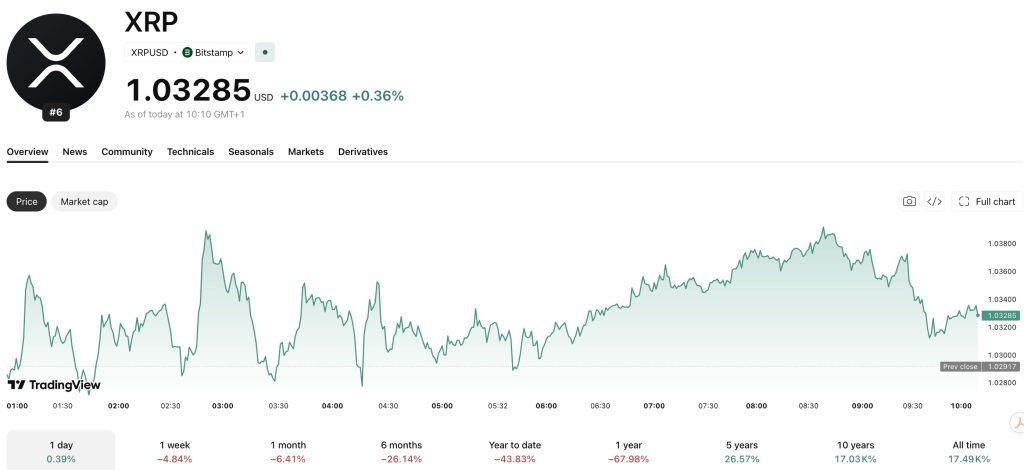
This news dropped as XRP USD trades for $1.02, dangerously close to losing its key support at $1 following a -0.2% drop overnight. Daily trading volume is sitting at $732M, up from $670M yesterday.
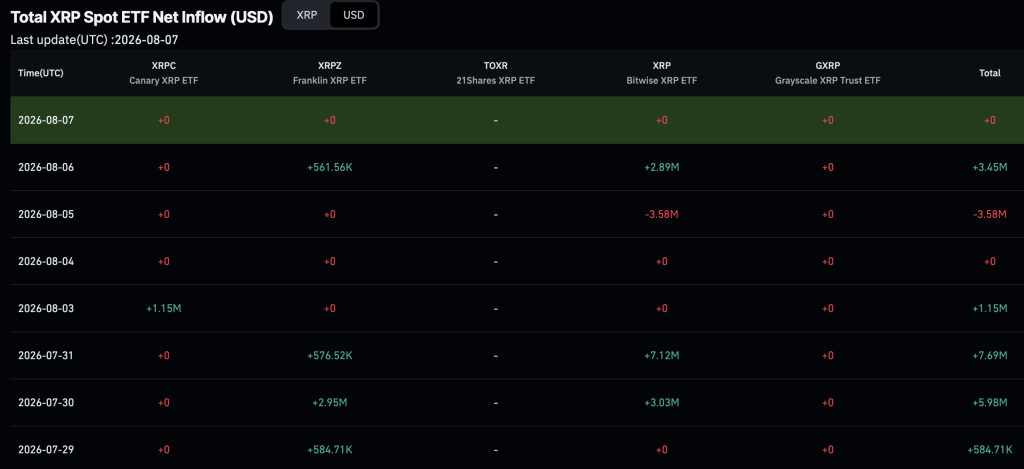
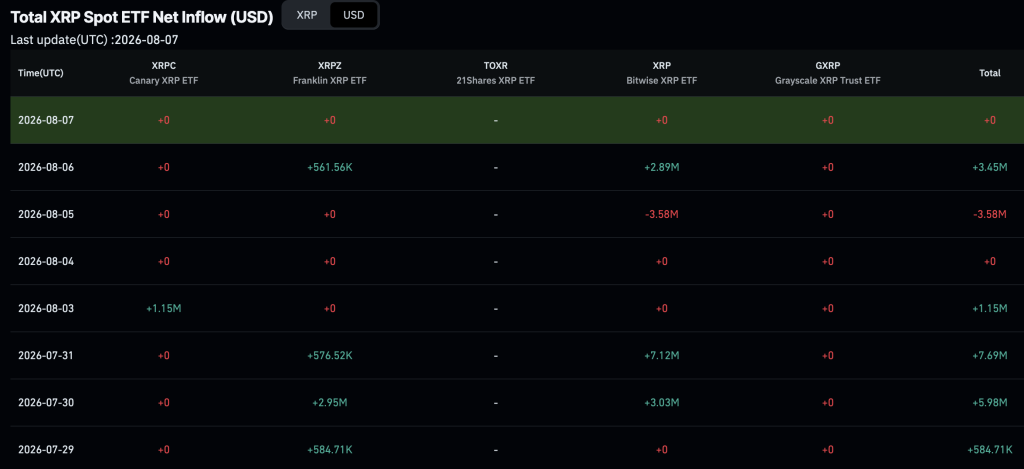
CoinGlass data shows that XRP ETF net inflows total $1.42Bn since they went live in November 2024, a healthy number that puts into perspective the size of Grayscale’s ETF selloff.
The Mechanics Behind the Contraction
The value of the trust’s XRP holdings fell from $223.36M at the end of 2025 to $57.41M on June 30, according to the SEC filing. Grayscale recorded a $34.16M realized loss on XRP sold for share redemptions, along with a $17.47 million unrealized loss on its remaining XRP position.
The trust created an additional 36.27M XRP valued at $66.58M during the six-month period, but those additions did not offset the redemptions. Outstanding shares declined from 6.30 million at the end of 2025 to 2.84 million by June 30.
The trust bought back 5.33 million shares and sold 1.87 million shares during that period. It also recorded a $39,000 realized loss on XRP sold to cover expenses.
Authorized participants are responsible for creating and redeeming shares in the trust. The filing also attributes the reduction in XRP holdings per share to periodic XRP withdrawals used to meet the sponsor’s fee.
Discover: Everyone’s Got a Take. Join Kalshi and Get a Free $25 to Actually Trade Yours
XRP Price and Fund Flows
XRP declined from $1.84 on Jan. 1 to $1.05 on June 30, a drop of more than 40%. The token traded between $1.015 and $1.041 on Aug. 7, placing it near the bottom of its 52-week range of $1.0095 to $3.3818.
Weekly inflows into XRP exchange-traded funds dropped to about $1M from $14.9M the previous week, although daily flows rebounded to roughly $3.5M on Aug. 6, according to CoinGlass data. XRP was down roughly 10% over the prior month and about 5.5% over the seven days through Friday.
The US Senate delayed consideration of the crypto market-structure legislation known as the CLARITY Act until at least September. Regulatory developments, institutional demand, and Ripple’s XRP holdings are among the factors that can influence XRP’s price.
Ripple released 1 billion XRP from escrow on Aug. 1 as part of its scheduled monthly unlock. The company has historically returned a substantial portion of its monthly releases to escrow rather than putting all of the tokens into circulation.
What the Ripple SEC Filing Establishes
The filing documents sales of XRP for share redemptions and for expenses, as well as changes in the trust’s XRP holdings and share count. Redemptions may require token sales to meet investor withdrawals, while authorized participants handle share creation and redemption.
The trust’s XRP holdings fell by more than half between the end of 2025 and June 30, while the value of those holdings declined from $223.36M to $57.41M. The filing also shows that XRP creations during the period were smaller than the XRP sold for redemptions.
Discover: Your Market Calls Are Worth Something. Start With Free $25 on Kalshi
The post XRP Trust Shares and Holdings Plunge in First-Half Filing appeared first on Cryptonews.
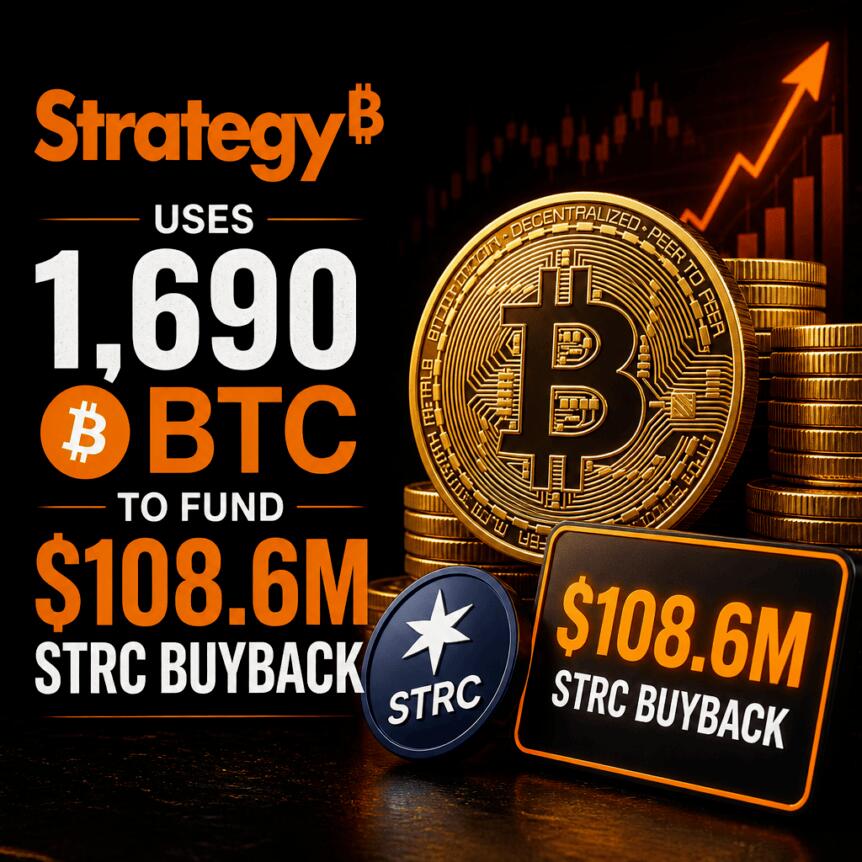
Strategy, the publicly traded firm with the largest corporate Bitcoin treasury, has again converted part of its BTC holdings into cash to support buybacks of its STRC preferred stock. In its latest SEC filing, the company reported a second consecutive week of Bitcoin sales used to fund repurchases of STRC shares.
According to a Monday 8-K filing with the US Securities and Exchange Commission (SEC), Strategy sold 1,690 Bitcoin for $108.6 million between Aug. 3 and Aug. 9. The proceeds were used to buy back 1.15 million shares of its STRC preferred stock for the same $108.6 million total.
Key takeaways
- Strategy sold 1,690 BTC for $108.6 million (Aug. 3–Aug. 9) to repurchase STRC preferred shares.
- This was the company’s fourth disclosed Bitcoin sale of 2026, bringing 2026 total BTC sales to 6,948.
- Strategy still holds 840,447 BTC with an aggregate purchase price of $63.36 billion, implying ongoing long-term exposure.
- The filing shows remaining repurchase capacity under both the preferred stock and common-stock buyback programs.
- Alongside STRC buybacks, Strategy continued building a US dollar reserve, reporting $4.65 billion as of Sunday.
Bitcoin sales tied directly to STRC buybacks
Strategy’s latest filing reinforces the company’s funding approach: using periodic Bitcoin liquidations to finance preferred stock repurchases. STRC is a variable-rate preferred stock structured to pay monthly dividends, and Strategy’s buybacks appear designed to manage capital structure while continuing dividend-related obligations.
On this occasion, the company reported an average net sale price of $64,262 per Bitcoin for the 1,690 BTC it sold. For comparison, Strategy’s broader Bitcoin cost basis is higher: the company cited an average purchase price of $75,385 per BTC for total holdings, including fees and expenses.
Strategy also previously disclosed a similar sequence. Earlier coverage noted that Strategy sold 1,638 BTC for $104.73 million between July 27 and Aug. 2, and used those proceeds to fund STRC repurchases as well. The current week’s sale follows that pattern closely—suggesting the company is maintaining an active, repeatable mechanism rather than relying on one-off treasury adjustments.
How much BTC Strategy has sold in 2026
While the latest transaction adds another step to Strategy’s 2026 funding routine, it does not represent a major shift away from holding BTC. The filing states the trade marked the company’s fourth disclosed Bitcoin sale of the year, bringing total 2026 BTC sales to 6,948 BTC.
After the latest sale, Strategy still holds 840,447 Bitcoin purchased for an aggregate $63.36 billion. That large remaining position matters for investors because Strategy’s balance sheet exposure to Bitcoin remains the dominant driver of its treasury value, even as the company periodically monetizes BTC to meet financial objectives.
From a market perspective, these disclosures also keep the question of “how much BTC is converted” in focus. If Strategy’s buyback-linked sales continue on a regular cadence, traders may increasingly weigh whether those conversions pressure sentiment around BTC liquidity at specific intervals—even if the firm’s long-term exposure remains intact.
Repurchase capacity and the dollar reserve build
Beyond the immediate buyback, the 8-K includes additional numbers that help map out how Strategy plans to fund and sustain the preferred stock program. The filing says Strategy has $785.2 million remaining under its digital credit securities repurchase program, which covers the preferred stock. It also reports another $1 billion available under its Class A common-stock repurchase program.
Strategy simultaneously continued building its US dollar reserves. The company reported a $4.65 billion balance as of Sunday, up from roughly $4 billion in the previous weekly update. In the filing, Strategy said $650 million of $653.1 million in net proceeds from recent MSTR stock sales went toward the reserve.
The reported cash number also includes expected proceeds from at-the-market (ATM) sales that had not yet settled at the time of the update. Taken together, the reserve build is relevant because it may reduce the need for frequent immediate BTC liquidations under certain market conditions—while still leaving BTC as the core long-duration holding.
STRC share momentum alongside buybacks
Strategy’s STRC buybacks come at a moment when the preferred stock has shown strength. The article cited that STRC shares rallied during Strategy’s recent repurchases, reclaiming $90 on Aug. 3 after rebounding 24% from their June lows.
In premarket trading Monday, STRC was up 0.46% to $95.45, after closing Friday at $95. According to Yahoo Finance, Strategy’s MSTR shares were also slightly higher, up 0.25% to $100.26 at the time of the report.
While price moves in any single session can’t be attributed solely to buybacks, the sequence is still notable: repurchases funded by BTC sales are arriving while market participants appear willing to bid up STRC from earlier weakness. For investors, the practical takeaway is that Strategy’s corporate actions are being tested in real time by equity market liquidity, particularly around preferred stock where dividends and variable-rate mechanics can influence demand.
Looking ahead, readers should watch two things: whether Strategy continues the pace of BTC-to-STRC conversions disclosed in its SEC filings, and how the firm’s remaining repurchase capacity and US dollar reserve evolve week to week. Any change in the cadence—or in the average net sale price compared with its cost basis—could affect how investors interpret the trade-off between maintaining BTC exposure and supporting the company’s preferred stock funding engine.


Quantum Fintech Group founder Harry Chun Tak Yeh was found dead in Paraguay after falling from his luxury 30th-floor apartment last week.
Local media reports that Yeh fell from his apartment in the early hours of the morning, either on a Tuesday or Friday, before his naked body was found covered by a black plastic bag.
Police discovered his apartment ransacked with the door wide open, and nobody else present.
Yeh’s 29-year-old partner, Isadora de Proenca Braganholo Carvalho, says she was unaware of what happened. The Brazilian national was staying in Yeh’s other apartment on the 27th floor.
Police are currently investigating whether or not Yeh’s death was an accident, suicide, or a potential murder.
Yeh made his fortune investing in BTC in 2013 when it was worth roughly $60. He then went on to found crypto hedge fund Quantum Fintech Group in 2020 and claimed to manage over $2 billion worth of funds.
Read more: Billionaire Brock Pierce did an interview with a Pro-Putin cult
One crypto developer, who goes by “@0xz80 on X,” shared some “stories” about Yeh.
Yeh supposedly gathered a group of Fantom layer-1 developers and 500 Dubai-based escorts together for an event, and joked that “Us 200 crypto nerds [had] no idea how to talk to them.”
@0xz80 also claimed that Yeh rented out an entire E11even, a famous nightclub brand and gave his developers crates full of cash.
In addition to these displays of wealth, @0xz80 added that Yeh “made it to the top of some of the sketchiest corners of crypto,” and that he was “one of the sketchiest people I’ve ever met in my life.”
Got a tip? Send us an email securely via Protos Leaks. For more informed news and investigations, follow us on X, Bluesky, and Google News, or subscribe to our YouTube channel.

Ex-Defence Secretary Fires Back After Zia Yusuf Dubs Former Tory MP ‘A Traitor To Britain’

Every NFC team’s non-quarterback MVP for the 2026 NFL season

Mach heute keinen Bitcoin-Trade, bevor du DAS gesehen hast!


-

 Fashion3 days ago
Weekend Open Thread: Mattifying Sunscreen
-

 Fashion3 days ago
Frugal Friday’s Workwear Report: Cap-Sleeve Pointelle Crewneck Sweater
-

 Sports5 days ago
Jordan Coyle & Cordiamo take Laya Arena Stakes at RDS
-

 News Videos2 days ago
Can Astrology Help Find Gold and Silver Trends? A Financial Astrology Guide
-
 Business5 days ago
US stocks: Dow closes at record on Mideast optimism; SpaceX, AMD drag Nasdaq
-
 Crypto World7 days ago
US Tech Stocks See Largest 5-Week Inflow in History: Can Nasdaq Break Its Downtrend?
-

 Politics4 days ago
Reform UK And Greens Sink To Lowest Favourability Ratings To Date
-

 Business6 days ago
Nvidia Stock Climbs 2.5% as Chip Sector Rally Builds Ahead of AMD Earnings, Nvidia’s Own Report Looms
-

 Crypto World6 days ago
Polymarket targets $20 billion valuation as competition heats up in prediction market sector
-

 Tech6 days ago
OpenAI, Anthropic AI agents targeted real people and systems in cyber tests
-

 Business5 days ago
Supply chain issues impact Ingredion
-
 Crypto World6 days ago
CLARITY Act Senate Vote Locked In, But 60-Vote Hurdle Looms Large
-

 Tech3 days ago
Rinn Pharma & Biopharma to join NordicPharmaTrain network
-

 Crypto World7 days ago
The Senate has one week: CLARITY’s last August window
-
 Crypto World6 days ago
Dow and S&P 500 Hit Records on AI Earnings: When Will the Bubble Burst?
-
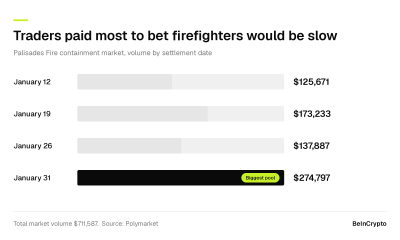
 Crypto World7 days ago
California Wildfire Bets Expose Polymarket’s Dark Side
-

 Business1 day ago
How to Start a Cleaning Business: A Step-by-Step Guide
-

 Business1 day ago
Datadog: Best Of Breed For Multiple Reasons
-

 Business7 days ago
CNH Industrial Shares Jump Over 15% After Beating Estimates and Raising Full-Year Earnings Guidance
-
 Crypto World6 days ago
Dollar Index Trapped at 100 as Hawkish Fed Meets Official Selling
You must be logged in to post a comment Login