

Crypto World
XRP Structure Strengthens as Traders Eye $1.45 and $1.80 Breakout Zones


TLDR:
- XRP flashed a fresh TD Sequential buy signal after a recent correction from the $1.46 high.
- Traders are monitoring $1.45 resistance as the first key level for bullish continuation.
- XRP’s long-term chart structure mirrors previous breakout cycles after extended consolidation.
- Analysts remain focused on the $1.80 zone as the next major breakout target for XRP.
XRP price prediction remains a major focus among traders after technical indicators signaled a possible rebound. Market participants are now assessing whether recent consolidation marks a temporary cooldown before XRP attempts another move toward higher resistance zones.
XRP Signals Fresh Momentum Shift
XRP has returned to the spotlight after printing a TD Sequential buy signal on the 4-hour chart. The indicator recently gained attention after accurately identifying a local top near $1.46.
That earlier sell signal came just before XRP corrected by 5.5% in 48 hours. As a result, traders are now treating the latest bullish signal with greater importance.
The recent pullback appears to have functioned as a short-term reset rather than a full trend reversal. Price action has gradually shifted into a tighter consolidation range following aggressive upside expansion.
Bearish momentum also appears to be weakening. Recent candles have printed smaller bodies, suggesting selling pressure may be losing strength. This behavior often signals exhaustion among short-term market participants.
In technical analysis, TD Sequential is designed to detect trend exhaustion after extended directional movement. The fresh “9” buy setup now suggests XRP could be preparing for a rebound phase.
The first key resistance now sits at $1.45. This level remains important because it previously marked the recent local high before the correction started.
If XRP reclaims this area decisively, short-term sentiment could shift quickly. Buyers would likely regain confidence as bullish continuation becomes the dominant narrative again.
Long-Term Structure Supports Breakout Thesis
Beyond short-term momentum, XRP’s broader chart structure is drawing increased attention. Analysts continue identifying similarities between the current setup and prior expansion cycles.
Historically, XRP has followed a repeating structure involving impulse rallies, prolonged consolidation, false breakdowns, and aggressive breakout phases. This pattern has appeared multiple times across previous cycles.
Between 2014 and 2017, XRP spent years inside a tightening structure while volatility declined sharply. Market participation weakened as price action remained stagnant near the apex.
After a false breakdown below support, XRP entered its historic 2017 rally. The asset then delivered one of crypto’s strongest expansions during that cycle.
A similar formation appeared again after the 2018 peak. XRP entered another multi-year consolidation defined by lower highs and gradually rising support levels.
Price later reclaimed structure following another breakdown beneath support. This sequence renewed bullish interest among long-term chart watchers.
Current technical projections suggest XRP may now be entering another continuation phase. Analysts are monitoring the $1.80 region as the next major breakout zone above nearby resistance.
If XRP clears that level with rising volume, momentum traders may return aggressively. This could strengthen the broader XRP price prediction narrative in the coming sessions.


TLDR:
- Wintermute is now quoting two-sided markets on event contracts across venues doing $20 billion monthly in volume.
- The prediction market industry has crossed $60 billion in 2026, yet still lacks the institutional liquidity it needs to mature.
- Event contracts price real-world outcomes directly, offering more targeted exposure than equities, rates, or currencies.
- Wintermute’s existing crypto infrastructure covers custody, collateral, and risk management that prediction market venues already require.
Wintermute has moved into the prediction market industry, now providing liquidity across event contracts on leading venues.
The algorithmic trading firm brings over $3.5 trillion in annual trading volume to a segment that has crossed $60 billion in 2026.
This entry marks a turning point for prediction markets, as institutional-grade infrastructure begins supporting a fast-growing but liquidity-thin space.
A $60 Billion Market That Needed Institutional Depth
The prediction market industry has expanded at a pace few anticipated just years ago. Trading volume across leading venues now exceeds $20 billion per month as of early 2026. That growth has outpaced the liquidity infrastructure needed to support it properly.
Wintermute is stepping in to close that gap by quoting continuous bid and offer prices across event contracts. Two-sided liquidity tightens spreads and allows participants to trade in larger sizes. Over time, this also strengthens the accuracy of probabilities that these markets produce.
Jake Ostrovskis, Head of OTC Trading at Wintermute, addressed the core problem directly. “Prediction markets have the demand profile of a major asset class but the liquidity profile of an early-stage one,” he said.
He added that sustained two-sided liquidity is what allows these markets to become reliable real-time probability tools.
Ostrovskis further noted that deeper liquidity does more than improve execution. “That depth tightens spreads, supports larger trade sizes, and in turn improves the signal embedded in market prices,” he explained.
“That is where Wintermute can add value.” Wintermute already operates across more than 70 exchanges, making this expansion a natural fit.
Why Wintermute Is Betting on Event Contracts
Prediction markets price real-world outcomes directly, rather than through traditional proxies like equities or currencies. For institutions managing exposure to specific catalysts, this offers a more targeted tool.
Policy decisions, economic data releases, and other discrete events become tradeable with greater precision.
Wintermute captured that distinction in a public statement, saying “prediction markets are emerging as a distinct asset class, pricing probabilities on events that traditional markets don’t capture cleanly.”
That framing reflects how the firm views the segment’s broader role in financial markets. It also explains why the firm sees long-term value in committing liquidity here.
Many prediction market venues also operate on public blockchains using stablecoin settlement systems. This aligns closely with infrastructure Wintermute already manages across spot, DeFi, and OTC crypto markets.
Custody, collateral, and risk management requirements are already part of the firm’s daily operations.
That overlap makes the move into prediction markets a practical extension rather than an entirely new venture. Wintermute Group’s existing systems handle the technical demands these venues require.
As the industry continues its growth trajectory, institutional participation from firms like Wintermute is likely to accelerate further adoption across the space.


Traditional financial institutions are preparing to move trillions of dollars of assets onchain, but the risk of hacks and exploits is putting them off, according to blockchain security firm CertiK’s CEO Ronghui Gu.
“Right now, more and more institutions are trying to move assets onchain,” Gu told CoinDesk in an interview. “They imagine that, let’s say in 10 years, multiple trillion dollars — even tens of trillions of dollars — of assets are going to move onchain.”
The potentially massive migration of financial assets is hitting a wall because, although bankers and legacy institutions want to capture the efficiency of decentralized ledgers, the current operational reality is still too risky for conservative capital allocators.
“When they move assets onchain, they need to face all these AI attacks, smart contract vulnerabilities, oracle manipulation, and cross-chain bridge hacks,” Gu explained. “So, that’s being considered as one of the major blockers for all this TradFi to move trillions of dollars of assets onchain.”
Gu said their concerns are legitimate, noting that CertiK detected hacks nearly every day in April, making it the worst month in four years, fueled mostly by AI-driven attacks, notwithstanding “April was the worst month in four years with only three days without a hack,” Gu said, adding that CertiK believes this sudden rise could only be possible with AI.
Drift Protocol and Kelp Dao were hacked by North Korean cybercriminals in April in two exploits that drained nearly $600 million from the two lending crypto pools. In February 2025, Bybit suffered a $1.46 billion attack, described as the biggest hack of all time.
DefiLlama data recently showed more than $1.1 billion had been lost to DeFi hacks in a year, exposing how vulnerabilities in cross-chain infrastructure can quickly spill into the broader ecosystem.
Persistent operational failure is the primary symptom of what Gu calls an “unfair game” in favor of malicious actors, because they possess infinite resources.
Deep pockets
Hackers focus on highly lucrative protocols with massive total value locked (TVL), so they are economically incentivized to pump immense capital into their exploits.
A single protocol attacker can easily spend $10,000 to $20,000 worth of computer tokens to keep advanced engines running continuous vulnerability scans against a protocol for days or weeks on end. Conversely, Gu said, protocol defenders operate under strict, localized project budgetary constraints.
“We have 5,000 clients,” Gu explained. “When we receive a request from a client, there’s a budget. We will spend tokens plus human experts within that budget.” That creates a massive structural gap: while a defense team is bound by a strict commercial contract to scan a protocol over a few hours, the machines of a hacker or group of hackers never stop hunting for a single crack in the code.
Gu said exploits have increased in speed and efficiency with AI and what’s worse is that the nearly-daily trend seen in April could continue through to the end of this year.
TLDR:
- XRP is trading at $1.34, posting a 2.80% gain in 24 hours with over $2.15 billion in trading volume.
- Binance Exchange Supply Ratio has trended downward throughout May, pointing to reduced immediate selling pressure.
- XRP’s NVT Ratio declined 23.73% to 151.53, suggesting the asset is fairly valued relative to network activity.
- The Awesome Oscillator remains near zero, reflecting market indecision and neither bullish nor bearish momentum dominance.
XRP is showing early signs of a potential market reversal as multiple on-chain indicators align. The asset is trading at $1.34 as of writing, reflecting a 2.80% gain over the past 24 hours.
Trading volume stands at over $2.15 billion, pointing to continued market participation. Analysts tracking exchange supply, network valuation, and momentum data suggest the asset may be nearing the end of its bottoming phase.
Exchange Supply Data Points to Reduced Selling Pressure
XRP’s price has been consolidating around the $1.33 range after months of sharp volatility. The movement has narrowed considerably, forming what analysts describe as an equilibrium zone. This kind of tight price action often appears before a directional move develops.
The Exchange Supply Ratio on Binance has been trending downward throughout May. After peaking in March and April, the ratio entered a clear decline, suggesting investors are moving XRP off exchanges. Coins leaving exchanges typically reduce the available supply for immediate selling.
When holders move assets into private wallets, it often reduces short-term selling pressure. This behavior can lay the groundwork for a price recovery over the medium term. The trend has been consistent enough to draw attention from market analysts.
PelinayPA noted in a recent market post that the declining exchange supply ratio may help create a foundation for an upward move. The combination of reduced exchange holdings and stable price action adds weight to the bottoming thesis currently circulating among analysts.
NVT Ratio Decline Adds to Valuation Case for XRP
The NVT Ratio for XRP has dropped sharply by 23.73%, bringing it to a reading of 151.53. The NVT Ratio compares market value to on-chain transaction volume. A falling reading suggests the asset is not overvalued relative to its network activity.
In crypto market analysis, a low or declining NVT is often read as a sign that an asset trades at a relatively fair or attractive level. It means network usage remains strong even as price consolidates. This combination can attract buyers who rely on fundamental on-chain data.
The Awesome Oscillator, meanwhile, remains just below the zero line with minimal bar readings. Neither buyers nor sellers hold a clear momentum advantage at this point. This neutral reading supports the view that the market is still searching for direction.
Taken together, the NVT decline and the AO neutrality paint a picture of a market at a crossroads. The absence of strong bearish momentum, paired with easing exchange supply, keeps the bullish case intact. Analysts continue to watch the $1.33 area as a key level for any potential move higher.
Crypto World
Dow Jones Futures: Market Hits Highs On Iran Hopes; Nvidia, Tesla Lead 5 Trillion-Dollar Stocks Near Buy Points

Dow Jones futures will open Sunday evening, along with S&P 500 futures and Nasdaq futures. Iran news will remain in focus over the weekend. Broadcom (AVGO), Ciena (CIEN), CrowdStrike Holdings (CRWD), Palo Alto Networks (PANW), Argan (AGX) and Credo Technology (CRDO) are notable earnings reports this coming week, with Broadcom stock, Ciena, Argan and Credo all close to buy areas.…
Copyright ©2026 Investor’s Business Daily, LLC. All rights reserved. 87990cbe856818d5eddac44c7b1cdeb8

The Securities and Exchange Commission has charged a Texas man with running a crypto fraud that raised about $12.3 million from roughly 150 investors by falsely claiming AI-powered trading bots would deliver guaranteed returns. The alleged scheme operated through Privvy Investments, LLC, and under the business name Gateway Digital Investments from at least October 2022 to mid-2024, according to the SEC’s complaint filed in the U.S. District Court for the Southern District of Texas.
prosecutors say Nathan Fuller, a Cypress, Texas resident, pitched investors on investments that promised returns of 40% to 50% within 30 to 45 days, and even claimed some could secure guaranteed profits exceeding 100% in as little as 21 days. To bolster the pitch, Fuller allegedly asserted that investor funds were secured by a surety bond, insured by the Federal Deposit Insurance Corporation, and protected by a professional liability insurance policy. The SEC contends none of these assurances were true.
Central to Fuller’s pitch were proprietary AI-based trading bots that Fuller claimed would execute high-frequency arbitrage trades across crypto platforms. The agency states the bots did not function as represented, undermining the core promise behind the investment strategy. The complaint also notes that Fuller used aggressive branding around AI to attract retail investors, a pattern the SEC has flagged in other enforcement actions tied to crypto schemes.
Key takeaways
- The SEC alleges Nathan Fuller raised $12.3 million from about 150 investors through Privvy Investments and Gateway Digital Investments between 2022 and 2024, based on false assurances of AI-driven profits.
- Investors were promised 40–50% returns within 30–45 days, with some claims of profits over 100% in 21 days; sophisticated-sounding claims were used to create an aura of legitimacy around the scheme.
- According to the SEC, investor funds were misused for personal expenses and to make Ponzi-like payments to earlier investors, while many statements were fake and issued by fictitious entities.
- In total, about $6.2 million is alleged to have gone to personal expenses, with roughly $5.5 million paid to earlier investors, as the scheme sought to sustain itself.
- The SEC is seeking permanent injunctions, disgorgement of ill-gotten gains, and civil penalties as part of the action.
Alleged mechanics and misrepresentations
At the heart of the case, according to the SEC, were Fuller’s assurances that AI-enabled trading bots would perform high-frequency arbitrage across multiple crypto venues. The complaint asserts that Fuller’s bots did not operate as advertised, calling into question the legitimacy of the entire investment program. To entice participation, Fuller touted “guaranteed” returns and painted a picture of risk-managed exposure backed by supposed insurance and surety instruments that would shield investors from losses.
The SEC’s filing emphasizes that much of the money raised from investors did not fund real trading activity. Instead, the agency alleges that a substantial portion of the funds was diverted for personal use and for distributions to earlier investors in a manner characteristic of a Ponzi-style arrangement. In an attempt to maintain the illusion of legitimacy, Fuller allegedly produced fake account statements and communications from fictitious entities.
Financial flows and investor restitution risks
From the $12.3 million raised, the SEC alleges that at least $6.2 million was spent on personal expenses. A further roughly $5.5 million was used to make payments to earlier investors—an arrangement designed to create the impression of ongoing liquidity and profitability. The persistence of fake statements and fraudulent correspondence is cited as part of the broader deception that kept investors engaged while funds were diverted away from purported trading activity.
The SEC’s action seeks to unwind the illicit gains and deter future misconduct. The agency is pursuing permanent injunctions to stop Fuller from engaging in similar schemes, disgorgement of any profits obtained through the alleged fraud, and civil penalties. The case highlights the ongoing regulatory focus on the intersection of AI branding and crypto investments, where appearances of sophistication can mask fraudulent intent.
Regulatory backdrop: a broader enforcement pattern around AI and crypto
The Fuller case sits within a wider pattern of enforcement actions that blend AI branding with crypto investment pitches. In a separate action from the same enforcement cycle, the SEC charged three purported crypto asset trading platforms and four investment clubs in a $14 million scheme that also leaned on AI branding to lure retail investors, with fraudsters presenting themselves as financial professionals in messaging apps and promising profits from AI-generated trading tips. The actions illustrate how the SEC is scrutinizing not just outright fraud but also the marketing narratives that accompany crypto offerings tied to AI hype.
In a broader context, the SEC has acknowledged that some of its past crypto enforcement actions benefited from clearer investor protections and avoided overreach. In a 2025 enforcement results update, the regulator noted that since fiscal year 2022 it had brought 95 actions and imposed $2.3 billion in penalties for book-and-record violations that “identified no direct investor harm” and “produced no investor benefit or protection.” The agency has signaled a continued emphasis on rigorous disclosure, investor protection, and clear linkages between securities laws and crypto offerings as the industry evolves.
Related reporting has also centered on debates over crypto regulation and investor privacy. The broader enforcement environment reflects ongoing tensions between innovation and safeguards, with AI-enabled marketing and “guaranteed” returns becoming recurring flashpoints in a market that often intertwines technology, finance, and emerging asset classes.
Source: U.S. Securities and Exchange Commission filings and enforcement releases in this matter, which detail the allegations and relief sought against Fuller and related entities. See the SEC complaint filed in the Southern District of Texas for full allegations and statutory bases.
As the crypto sector continues to test the boundaries of technology and investor protection, market participants should monitor how courts interpret AI-driven claims, the sufficiency of disclosures, and the durability of enforcement actions when real-world trading activity does not substantiate promised returns.
Investors and observers will want to watch how the courts address disgorgement timelines, potential restitution, and the overall precedent set for AI-themed crypto offerings that promise outsized gains with purported risk mitigation.
Crypto World
Circle Freezes $12.6M in Zama’s cUSDC Contract After Court Order in Overnight Finance Suit
TLDR:
- A federal judge ordered Circle to blacklist Zama’s cUSDC contract, freezing roughly $12.6 million in pooled USDC funds.
- Plaintiffs allege Overnight Finance’s Ermilov moved $15.77M from a shared treasury just before an OVN holder vote passed.
- Zama’s entire cUSDC pool was frozen because the contract holds funds from all depositors, not just the disputed address.
- Activist firm Patagon Management, known for forcing DAO treasury payouts, is one of the co-plaintiffs driving the suit.
A federal court order has led Circle to blacklist Zama’s confidential USDC contract, freezing roughly $12.6 million in funds early Saturday.
The freeze stems from a class action suit filed against Overnight Finance creator Maxim Ermilov. Plaintiffs allege Ermilov diverted more than $15 million from a shared treasury.
The move has drawn attention because it swept innocent users’ funds into the dispute.
Court Order Triggers Freeze on Zama’s Contract
Circle blacklisted the cUSDC contract address at 1:08 a.m. UTC on Saturday. The freeze locked 12,606,386 USDC in the Ethereum-based contract. Public block explorers identify the frozen address as Zama’s confidential USDC token.
Zama CEO Rand Hindi said on X that his team was investigating the freeze. He later wrote that the contract appeared to have been “caught in a crossfire of another case.” Hindi also confirmed that Circle gave no prior warning before the blacklist was executed.
Because cUSDC wraps the USDC backing every token holder, blacklisting the contract locks the full pool. The frozen amount is slightly more than the disputed deposit, meaning other users’ funds were also swept in. The plaintiffs told the court they were prepared to advance funds to make unrelated parties whole.
Hindi addressed the scale of outside exposure directly. “Since there wasn’t much utility yet for the cUSDC wrapper, there were very little funds in it, and as a result the vast majority (>99%) of funds in the cUSDC contract came from that single hacker’s deposit,” he wrote on X. Zama also announced it would pause the cUSDC, cUSDT, and cWETH contracts during its investigation.
Zama said in a statement that it is “an infrastructure provider, not a mixer or a tumbler.” The firm added that its legal team is working to isolate the flagged address and restore access for affected users as quickly as possible. Hindi also pushed back on any suggestion that the protocol enables money laundering.
“It’s also really useless for hackers to try to use Zama to hide their trail as we are precisely not a mixer and we do not obfuscate the sender and recipient, only balances and amounts,” he wrote.
Overnight Finance Treasury Dispute Explained
The class action was filed on May 28 in the U.S. District Court for the Northern District of California. Three funds holding OVN tokens accuse Ermilov of moving more than $15 million from a shared treasury. The filing describes Ermilov as a Russian national living in Abu Dhabi.
Ermilov built Overnight Finance, a DeFi yield platform that issued the USD+ stablecoin and OVN governance token.
The project raised $850,000 in a pre-seed round led by Hack VC in February 2022. OVN token sales began in September 2023, with holders promised a pro rata claim on the treasury.
The complaint quotes a November 6, 2024 Discord message in which Ermilov wrote, “you can buy 51% of OVNs and vote to have [the Treasury] distributed.”
OVN holders initiated a vote on May 4, 2026, to liquidate the treasury and distribute the funds. Just before the vote crossed a majority threshold on May 11, the lawsuit alleges Ermilov moved more than $15.77 million. About $12.5 million of those funds were USDC, and the bulk ended up in Zama’s cUSDC contract.
Ermilov, however, disputed the plaintiffs’ account. “They had no right to vote the way they did,” he told The Block. He also argued that the token confers no financial entitlement.
“OVN is not a security, so no rights to profit or distributions of any nature,” he said. Asked why funds were moved into Zama’s system, he said the move was meant to “hide balances from general public to minimize personal security risks,” citing recent kidnappings of crypto holders.
Activist Investors and a Familiar Legal Strategy
The plaintiffs in this case are not ordinary token holders. One co-plaintiff, Patagon Management, has built a practice around pressuring DAOs to liquidate treasuries and return value to token holders. The firm is run by Diogenes Casares, who is associated with a group sometimes called the RFV Raiders.
Casares has said the broader community has unwound DAOs including Fei Protocol, Rome DAO, and Temple DAO, and shaped governance of others. “Collectively, these protocols have Risk-Free assets in excess of $1B,” he wrote in January 2023.
Patagon previously sued Wei “Max” Wu over Spartacus DAO, a project whose holders had voted to dissolve it and reclaim the treasury. In that case, a judge granted an emergency restraining order barring Wu from moving $35 million in crypto.
The court also allowed service by NFT, email, and Discord — the same channels the Overnight plaintiffs are now seeking to use on Ermilov.
On May 29, U.S. District Judge P. Casey Pitts issued a text-only order directing Circle to block the USDC and set a hearing for Monday, June 1.
The order came on an ex parte motion, meaning Ermilov’s side had not yet been heard. The June 1 hearing will allow both sides to present arguments.
Onchain investigator ZachXBT called the freeze “precedent setting” for blacklisting a contract where funds are pooled with other users. “Overall I feel bad for Zama users who have now been indirectly impacted with this mess of a US civil case,” he wrote.
The case is now set to test the limits of Circle’s freeze authority in private legal disputes involving pooled DeFi contracts.
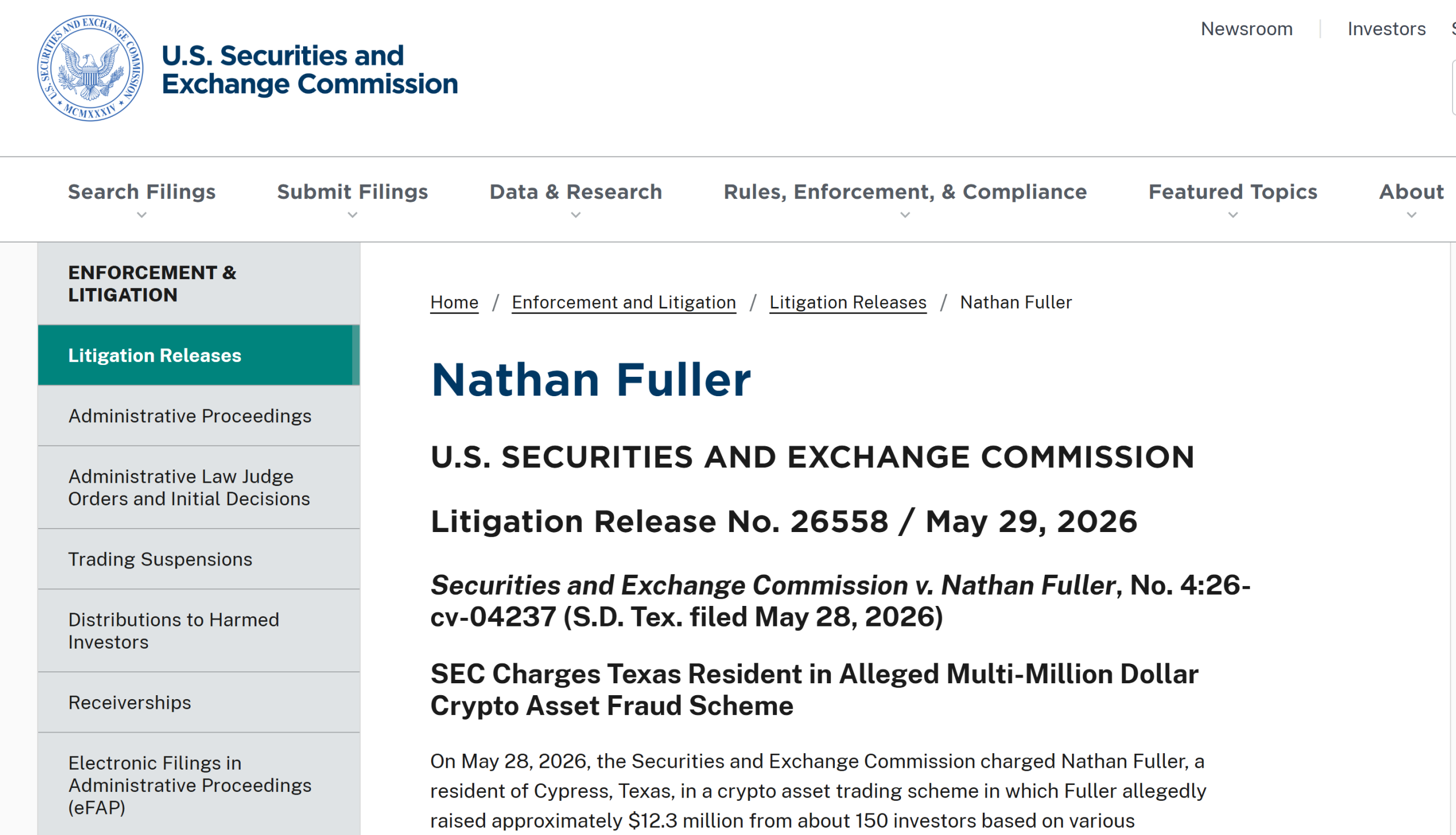
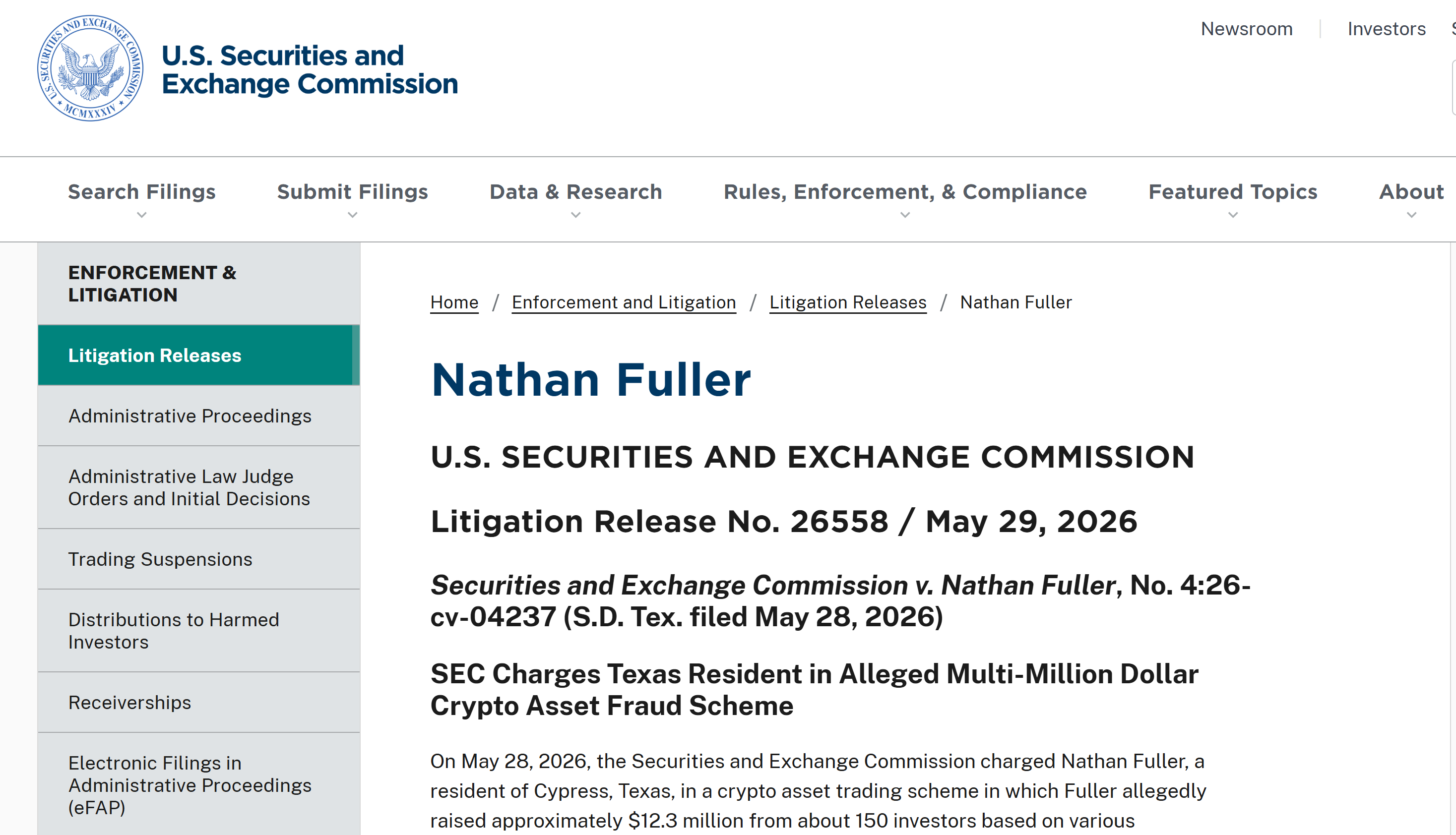
The Securities and Exchange Commission has charged a Texas man with running a crypto fraud scheme that raised $12.3 million from roughly 150 investors by falsely claiming to use AI-powered trading bots to generate guaranteed returns.
Nathan Fuller, a resident of Cypress, Texas, operated the scheme through his company Privvy Investments, LLC, and under the assumed business name Gateway Digital Investments between at least October 2022 and mid-2024, according to the SEC’s complaint filed in the US District Court for the Southern District of Texas.
Fuller allegedly promised investors returns of 40% to 50% within 30 to 45 days, with some told they could make guaranteed profits exceeding 100% in as little as 21 days. To back up the pitch, he claimed investor funds were secured by a surety bond, insured by the Federal Deposit Insurance Corporation (FDIC) and protected by a professional liability insurance policy. None of it was true, the SEC alleges.
Source: SEC
At the center of the scheme were proprietary AI-based trading bots that Fuller claimed would conduct high-frequency arbitrage trading across crypto platforms. “Fuller’s bots did not function as represented,” according to the complaint.
Related: SEC Commissioner Peirce defends crypto privacy tools against surveillance push
Half of raised money went to personal expenses
Of the $12.3 million raised, Fuller allegedly misappropriated at least $6.2 million for personal expenses and used roughly $5.5 million to make Ponzi-like payments to earlier investors. To keep the scheme going, he sent investors fake account statements and fabricated correspondence from fictitious entities.
The SEC is seeking permanent injunctions, disgorgement of ill-gotten gains and civil penalties.
The Fuller case comes as the combination of AI and crypto has opened new frontiers for bad actors. Last year, the agency charged multiple crypto platforms and investment clubs in a separate $14 million scheme that also leaned on AI branding to lure retail investors, with fraudsters posing as financial professionals in WhatsApp groups and promising profits from AI-generated trading tips.
Related: SEC approves Paxos as ‘blockchain-native’ clearing agency
SEC charges Donald Basile in $16 million crypto scheme
Last month, the SEC charged crypto executive Donald Basile and two companies he controlled with raising roughly $16 million from hundreds of investors through false claims tied to a crypto token called Bitcoin Latinum.
Despite recent moves, the agency has acknowledged that some of its past enforcement actions against crypto companies lacked clear investor benefit and misinterpreted federal securities laws. In a statement on its 2025 enforcement results, the regulator said that since fiscal year 2022, it brought 95 actions and imposed $2.3 billion in penalties for book-and-record violations that “identified no direct investor harm” and “produced no investor benefit or protection.”
Magazine: AI-driven hacks could kill DeFi — unless projects act now
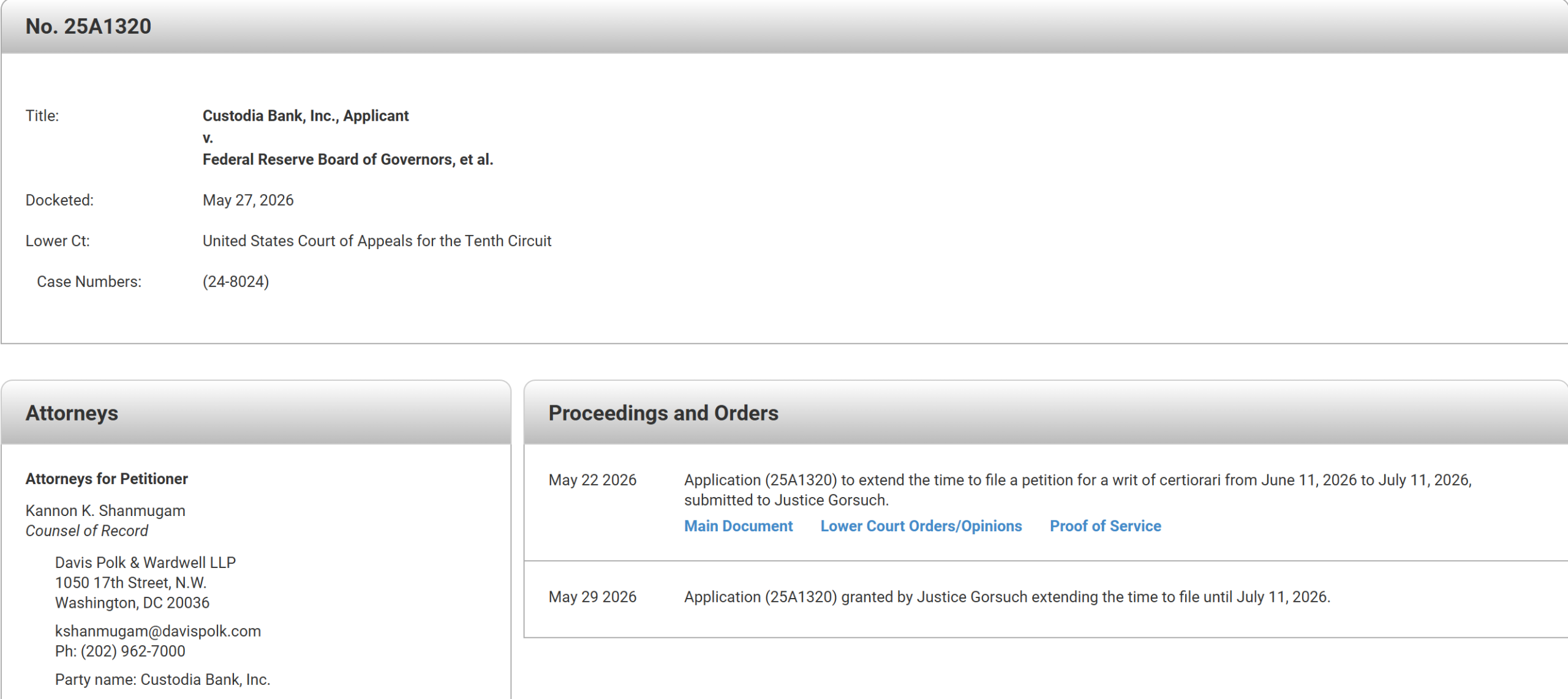
Custodia Bank has secured additional time to bring its dispute with the Federal Reserve before the US Supreme Court. Justice Neil Gorsuch granted the bank’s motion for an extension of time to file its certiorari petition.
The Wyoming-chartered digital asset bank now has until July 11, 2026, to file its appeal. The petition challenges the Federal Reserve’s denial of a master account, per Supreme Court docket 25A1320.
Background to the Fed Account Denial
Custodia, founded by Caitlin Long, applied for a Kansas City Fed master account in October 2020.
The Fed formally denied the application in January 2023. Officials cited safety and soundness concerns tied to the crypto-focused business model.
A divided 10th Circuit panel ruled 2-1 in October 2025 that Reserve Banks retain discretion over master account access.
The decision interpreted the Federal Reserve Act as granting the Federal Reserve authority to approve or deny eligible institutions.
A 7-3 vote denied en banc rehearing in March 2026, prompting Custodia to seek Supreme Court review.
What a Supreme Court Review Would Decide
At stake is the Monetary Control Act of 1980. Custodia argues it requires Reserve Banks to provide equal payment access to eligible nonmember institutions.
The Fed counters that the statute addresses pricing once services are provided, not entitlement to accounts. Banking trade groups have supported the Fed’s reading in amicus filings before the lower courts.
A Supreme Court decision in Custodia’s favor could limit the Fed’s ability to deny master accounts to statutorily eligible institutions.
The outcome would carry implications for fintech firms and crypto-native banks seeking direct access to Fedwire and ACH.
A denial of certiorari would instead affirm the Federal Reserve’s broad authority over payment system entry.
Custodia is represented by Kannon K. Shanmugam of Davis Polk.

Whether the Court grants review remains uncertain, given the high bar that statutory interpretation cases face.
The post Custodia Bank Takes Fed Master Account Fight Toward Supreme Court appeared first on BeInCrypto.
TLDR:
- Top crypto analyst, Crypto Patel projects Litecoin could reclaim the $100-$140 range during its current accumulation phase.
- The analyst expects LTC to target $200-$280 after the next halving-driven market expansion.
- A move toward $500-$700 remains possible if Litecoin breaks key resistance during the next cycle.
- Reaching $1,000 may require institutional adoption and stronger long-term demand beyond 2030.
Despite years of muted performance and fading investor interest, the analyst believes Litecoin remains positioned within a historically important accumulation zone that could support future gains.
Analyst Maps Litecoin Rally to $1,000 Through Three Phases
Crypto analyst Crypto Patel has presented a multi-cycle roadmap outlining how a Litecoin rally to $1,000 could unfold over the coming years.
According to the analyst, LTC remains in a deep accumulation phase despite trading more than 80% below its all-time high.
In a recent post on X, Patel divided Litecoin’s potential growth into three distinct phases. The first phase involves reclaiming the $100 to $140 range, which he expects could occur between now and 2027 as market conditions improve.
The second phase targets a move toward $200 to $280. Patel believes this stage could develop following the next Litecoin halving cycle, which is expected to strengthen supply-side dynamics and attract renewed market attention.
His final phase focuses on the next major bull market peak. During that period, the analyst expects Litecoin to challenge its previous record high before extending toward the $500 to $700 range.
While Patel acknowledged that a Litecoin rally to $1,000 remains possible, he described it as a longer-term objective that may require conditions extending beyond 2030.
The analyst assigned a 20% to 30% probability to a move toward $500. However, he estimated only a 5% to 10% chance of Litecoin reaching $1,000 under an extreme bullish scenario supported by stronger institutional participation.
Why Litecoin Bulls See Opportunity Despite Market Skepticism
Patel argues that Litecoin’s current market structure presents a favorable risk-reward setup compared with assets already trading near cycle highs.
The analyst pointed out that LTC is trading within a long-term support region where buyers have historically emerged after extended periods of weakness.
He also cited several factors that could support future growth. Among them are Canary Capital’s proposed Litecoin ETF, the network’s upcoming 2027 halving event, and Litecoin’s continued reputation as a payment-focused cryptocurrency.
The analyst additionally referenced Litecoin’s MWEB privacy feature and its long-standing position as the asset often described as silver to Bitcoin’s gold. These factors, he noted, continue to support the project’s relevance within the broader digital asset market.
Still, Patel outlined notable challenges. He observed that Litecoin failed to surpass its 2021 peak while Bitcoin, Ethereum, and Solana established new highs.
He also noted that ETF-related demand remains limited and that Litecoin lacks the smart contract ecosystem available on competing blockchain networks.
For now, Patel maintains that Litecoin remains a slow-moving, long-term cycle asset. Whether a Litecoin rally to $1,000 eventually materializes may depend on broader adoption trends and sustained demand growth in future market cycles.

TLDR:
- XRP liquidation heatmaps show that most major leveraged long positions have been cleared from the market.
- Reduced leverage exposure has created a cleaner market structure with fewer downside liquidity targets.
- MACD and RSI indicators are turning bullish as XRP forms higher lows on the 4-hour chart.
- XRP faces key resistance near $1.38, with a breakout potentially opening the path to $1.42.
XRP Price remains below recent highs, and the removal of leveraged positions and improving technical indicators have created a bullish landscape. This has prompted traders to reassess the asset’s near-term outlook.
XRP Price Recovery Benefits From Major Liquidation Reset
The XRP Price Recovery story extends beyond recent price action. One of the most notable developments has emerged from the derivatives market, where a large share of leveraged long positions accumulated throughout May has been eliminated.
Liquidation heatmaps show that many of the largest liquidity clusters beneath XRP have already been absorbed. These zones represented areas where overleveraged traders were vulnerable to forced liquidations if prices continued moving lower. As XRP gradually declined during the month, those positions were systematically removed from the market.
This process has changed the broader market structure. Earlier in May, repeated attempts to catch a bottom created layers of leveraged exposure underneath the price.
Every bounce attracted fresh longs, while each pullback increased liquidation risks. Instead of triggering a sustainable rally, XRP continued drifting lower, consuming those liquidity pockets along the way.
As a result, the market now appears significantly cleaner. The concentration of leverage that previously acted as a downside magnet has largely disappeared.
Many traders view such resets as an important stage in establishing healthier market conditions because excessive positioning often prevents sustained directional moves.
Technical Indicators Signal Improving Momentum
Alongside the liquidation reset, XRP’s technical structure has started showing signs of stabilization. The strongest indication came from the rebound that followed the May 28 decline toward $1.28, where buyers quickly stepped in after oversold conditions emerged.
Since then, XRP has recovered above the $1.34 level while forming a sequence of higher lows on the four-hour chart.
Although the broader trend remains corrective, this pattern suggests sellers are losing some control over short-term price action.
Source: CryptoRank
Momentum indicators have also strengthened. The MACD recently produced a bullish crossover, with the MACD line moving above the signal line. At the same time, the histogram continues expanding into positive territory, reflecting growing buying pressure.
The Relative Strength Index offers additional support for the recovery narrative. RSI has moved comfortably above the neutral 50 level and is approaching 57.
Importantly, the indicator remains below overbought territory, leaving room for further upside if demand continues improving.
Trading volume has also increased, confirming that price gains are supported by genuine market interest rather than temporary volatility.
Attention now turns to the $1.36-$1.38 resistance range, which previously served as support before the latest decline.
A successful move above that zone could strengthen the recovery case. However, XRP still trades below the May high near $1.55, leaving the broader corrective structure intact for now.
Wintermute Expands Into Prediction Markets as Segment Tops $60B in 2026

Small lifestyle changes yield huge benefits for heart health, says research

Wikipedia editors plot strike and banner sabotage after Wikimedia layoffs


-

 Business6 days ago
NYT Strands Answers May 24 2026 Revealed for Puzzle No. 812 Theme Summer Essentials
-

 NewsBeat3 days ago
Israel says it has killed new Hamas military leader in Gaza City airstrikes
-

 Politics5 days ago
Bridgerton Season 5: Cast, Release Date And Everything We Know So Far
-

 Business4 days ago
Selena Gomez Reportedly Upset Over Benny Blanco’s Comments on Her ‘Terrible’ Diet
-
Crypto World4 days ago
Micron Crosses $1 Trillion Market Cap as AI Demand Reshapes Memory Sector
-

 Tech5 days ago
Microsoft’s quiet Claude Code retreat and the real cost of enterprise AI
-

 Business5 days ago
BTS Sells Out Four Las Vegas Shows at Allegiant Stadium for ARIRANG World Tour
-
 Tech4 days ago
China assigns ID codes to 28,000+ humanoid robots
-

 News Videos3 days ago
XRP *JUST* SUCCEEDED!!!! CLARITY ACT EXPOSED!!! (SHE EXPOSED IT)
-

 Tech1 day ago
Waymo dominates autonomous vehicle registrations as Tesla trails behind
-
Tech3 days ago
The Samsung pay deal is the moment Korean unions changed register
-

 Tech5 days ago
Westone Audio and Etymotic Acquired by Fidelity Collective in Major IEM Market Move
-
 Entertainment5 days ago
‘Breaking Bad’ Star’s Easy-to-Binge 6-Part Crime Series Spin-Off Is Finally Heading to Free Streaming
-

 Tech4 days ago
Millions of AI agents imperiled by critical vulnerability in open source package
-
Crypto World6 days ago
Brian Armstrong Outlines Crypto Vision for the Future Financial System
-
Crypto World3 days ago
SpaceX’s $2 Trillion IPO: Why Tech Giants Nvidia (NVDA), Apple (AAPL), and Microsoft (MSFT) May Face Pressure
-
 Crypto World5 days ago
Nvidia (NVDA) CEO Calls on Super Micro to Strengthen Export Controls Amid Smuggling Probe
-

 Tech3 days ago
NASA taps Blue Origin to deliver lunar rovers for Moon Base initiative
-
 NewsBeat5 days ago
Hottest May day ever as London hits 34.8C in 2C leap from previous records
-
 Crypto World22 hours ago
Snowflake (SNOW) Stock Rallies on Strong Q1 Results and AI Product Growth
You must be logged in to post a comment Login