

Crypto World
You Will Not Like Where Google Gemini AI Predicts Bitcoin Price Going in 2026

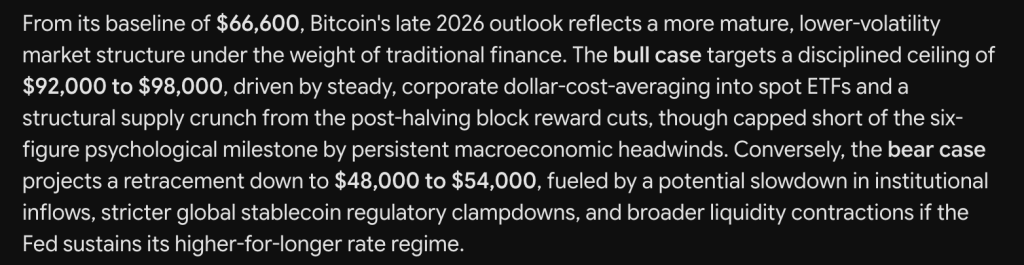
The headline is deliberately provocative, and once you read the actual prediction, you understand why. Google Gemini AI is not predicts for $150,000 or some cycle-blowoff fantasy.
Its bull case for Bitcoin by late 2026 is $92,000 to $98,000, a disciplined, almost conservative ceiling that stops just short of six figures.
For a coin that already touched $126,000 this cycle, being told the best case scenario is essentially where it was six months ago is not exactly the news the crowd wants to hear.
But that restraint is precisely what makes this prediction worth taking seriously. Gemini is not playing to the audience.
It is describing a Bitcoin that has grown up, one operating under the weight of traditional finance with a lower-volatility market structure that caps the euphoric upside in exchange for more durable institutional flows.
The post-halving supply crunch is real, corporate dollar-cost-averaging into spot ETFs is real, and both of those forces push price higher.
But persistent macroeconomic headwinds, in Gemini’s view, are the ceiling that keeps BTC from retaking six figures in this window. It is a mature market call, not a moonshot, and that is what makes it slightly uncomfortable for people who bought the $100,000 narrative.

The bear case lands at $48,000 to $54,000, fueled by a potential slowdown in institutional inflows, stricter global stablecoin regulatory clampdowns, and broader liquidity contractions if the Fed sustains higher-for-longer rates.
That is a 27% to 38% drop from current levels, not catastrophic given the distances Bitcoin has traveled before, but deeply frustrating for anyone waiting on a new all-time high.
Discover: The Best Crypto to Diversify Your Portfolio
Bitcoin Price Prediction: The Market That Grew Up And Left The Old Cycle Behind
What the daily chart shows right now is that Bitcoin is at $66,518, sitting on a ledge with real historical weight. Zoom out on this particular chart and you can see the full story, the 2024 breakout, the run to $126,000, the long unwind, the failed March recovery that stalled at $82,000, and then the most recent flush to $60,000 before the current bounce.
Price has now reclaimed the same $65,000 to $68,000 zone that served as a critical breakout level back in 2024, and the question of whether it holds as support or breaks as a trap is the most important technical question on this chart right now.
The $70,000 to $72,000 level is the first real test above, where the May breakdown began and where a significant amount of trapped supply sits.
Clearing that zone on volume would change the tone of this chart considerably, opening sight lines toward $80,000 and eventually the $92,000 to $98,000 range Gemini targets. Losing $62,000 on a daily close reopens the path toward $54,000, the top end of the bear case floor.
The RSI is the detail that cuts through the noise most cleanly. It sits at 44.75 with the signal line well below at 28.73, a gap of 16 points.
That divergence tells a specific story. Momentum was crushed to deeply oversold levels during the recent flush, and has since recovered aggressively back toward neutral while price is still finding its footing. RSI leading price in recovery is the better version of this setup, the pattern that tends to precede sustained bounces rather than bull traps.
It does not guarantee Gemini’s bull case plays out, but it does suggest the $60,000 low is more likely a floor than a waystation on the way to $48,000. The title asks you to brace for the target. The chart says the floor might already be behind us.
Discover: The Best Token Presales
You Might Like What Gemini AI Predicts About LiquidChain
The rotation is already happening. Most people will only see it in hindsight.
Large-cap crypto is not failing. It is capped. Bitcoin, Ethereum, and XRP have been pressing against the same resistance bands for weeks. The macro tailwinds keep getting delayed.
The institutional inflows keep getting pushed to next quarter. Holding assets where the upside depends on catalysts you cannot control is not a strategy. It is waiting.
A capital that has navigated enough cycles does not wait at resistance. It moves before the destination becomes obvious.
Early-stage infrastructure plays operate on different math entirely. A small enough market cap means a modest rotation produces dramatic price movement. The asymmetry exists because the market has not priced in what is being built yet. That gap between current valuation and what the project is actually worth is where the returns come from.
Multi-chain fragmentation costs DeFi real money every single day. Bitcoin, Ethereum, and Solana run completely isolated liquidity systems with no native way to connect them. Every user moving value between ecosystems absorbs that cost directly in fees, slippage, and failed transactions.
LiquidChain collapses all 3 networks into a single execution layer. One deployment. Full ecosystem access. No cross-chain tax on every interaction.
The market has not found this yet. That is the entire point.
The presale is at $0.01454 with just over $840,000 raised. Ground floor is not a marketing phrase here. It is a description of where this actually sits in its lifecycle.
Execution is unproven. Adoption is unknown. Those risks are real and worth naming directly. Established assets offer a smoother ride toward a ceiling that is already visible. This offers an earlier seat at a table that has not been set yet.
Explore the LiquidChain Presale
The post You Will Not Like Where Google Gemini AI Predicts Bitcoin Price Going in 2026 appeared first on Cryptonews.



SpaceX perpetual futures have become Binance’s second-largest futures product by trading volume, generating more than $5.6 billion in rolling 24-hour activity as interest in the aerospace company continues to surge following its Nasdaq debut.
Summary
- SpaceX perpetuals have become Binance’s second-largest futures product after Bitcoin.
- SPCXUSDT has generated more than $9 billion in combined trading volume.
- Binance’s equity products surpassed $1 billion in turnover within nine days.
According to Binance, the SPCXUSDT perpetual contract now ranks behind only Bitcoin perpetual futures on the exchange. The company said the product has recorded more than $9 billion in combined trading volume across its pre-IPO and post-IPO phases.
The milestone comes as SpaceX shares continued attracting investor attention after the company’s public listing.
Binance noted that it currently leads both centralized and decentralized trading activity for the contract and also holds the largest open interest position among competing venues. Exchange data showed open interest reached $190.59 million per side as of June 15.
Soon after SpaceX filed its S-1 registration statement, Binance introduced SPCXUSDT to allow traders to speculate on the company before its stock began trading publicly. During that period, the product operated as a pre-IPO perpetual contract on Binance’s decentralized futures platform, with pricing determined through activity on the exchange’s global order book.
Once SpaceX completed its listing, Binance converted the product into a standard perpetual futures contract that tracks real-time Nasdaq pricing. The exchange also said it became the only trading venue to adjust the contract after SpaceX amended its filing to increase share issuance, rebasing positions according to the updated dilution data.
Retail traders continue chasing SpaceX exposure
Binance said the strong activity in SPCXUSDT highlights growing demand from retail investors seeking exposure to prominent public companies through crypto-based trading products.
According to the exchange, more than 80% of demand for direct stock offerings comes from users who do not have easy access to U.S. equity markets. Binance said early trading patterns suggest investors remain interested in products tied to well-known companies before and after public listings.
The exchange’s push into equity-linked products has continued even after its earlier SpaceX IPO campaign was canceled. Binance had planned to offer direct access to SpaceX shares through a partnership with xStocks, but the effort was abandoned after the required allocation of shares could not be secured.
At the time, former Binance CEO Changpeng Zhao said the company refunded participants in full and distributed a tokenized stock airdrop to affected users.
Binance subsequently expanded alternative routes for equity exposure through its stock-trading platform and tokenized securities products.
Equity products gain traction on Binance
Recent figures reported by crypto.news indicate that Binance’s U.S. equities platform averaged about $143 million in daily trading volume during its first nine days after launching on June 1. The report said turnover exceeded $1 billion over that period, while daily active traders peaked at approximately 30,700 and total value locked approached $400 million.
The service provides eligible users outside the U.S. with access to more than 7,000 stocks and exchange-traded funds through fractional trading and crypto-funded accounts.
Alongside traditional equity access, Binance has also expanded its bStocks offering. As previously reported by crypto.news, the first batch of tokenized equities included Nvidia, Tesla, Circle, Micron and Sandisk.
Binance said those assets are backed one-to-one by underlying securities and can be transferred to supported self-custody wallets or used in approved decentralized finance applications.
Looking ahead, Binance said investor sentiment and market conditions will remain important factors influencing demand for SpaceX-related products and tokenized equity exposure after the company’s public listing.
The meme coin sector, which was among crypto’s sensations during the last bull run, no longer shows the same strength or investor enthusiasm.
Shiba Inu (SHIB) – one of the most recognizable tokens of that type – has crashed by roughly 65% over the past year, but one important factor signals that a recovery could be incoming.
Finally, a Bullish Sign
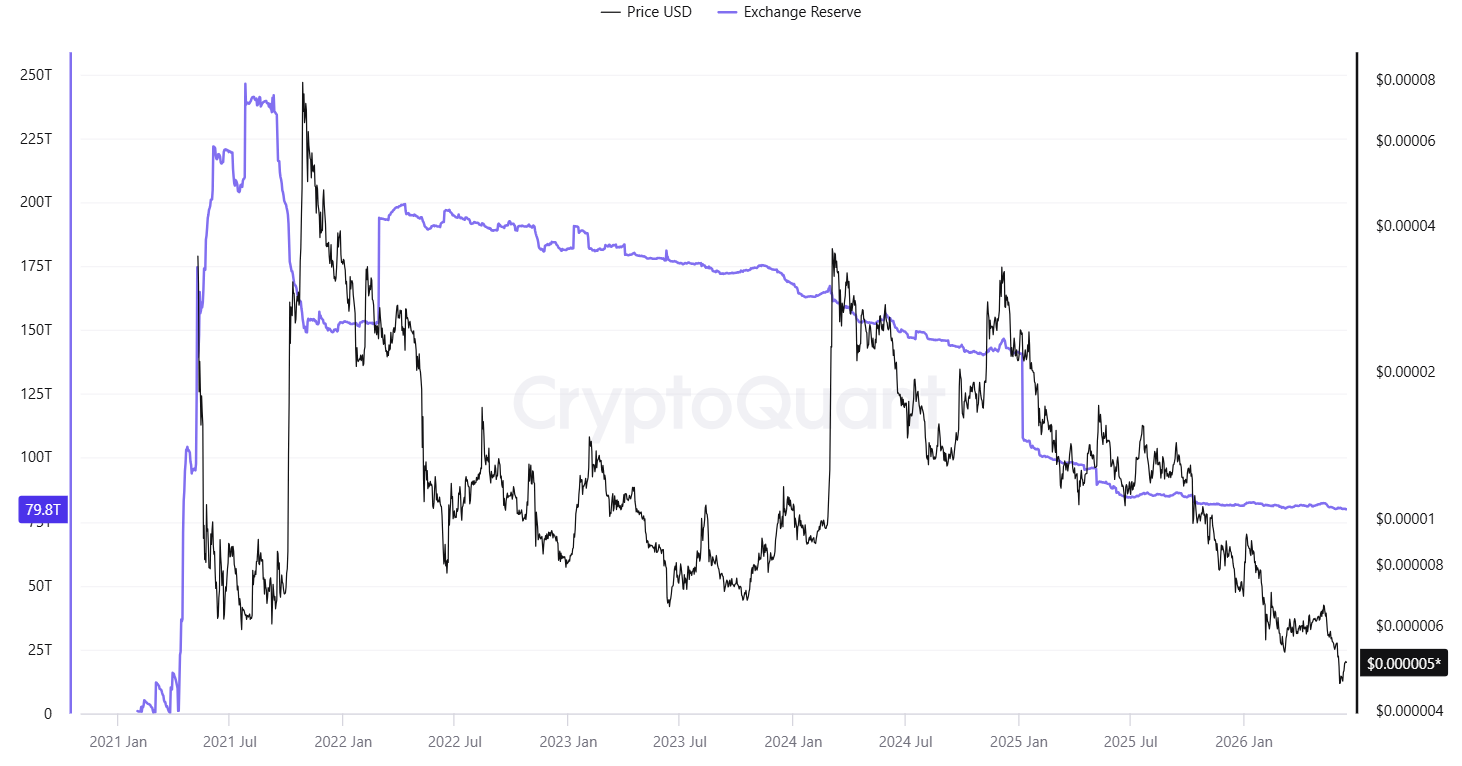
The self-proclaimed Dogecoin killer currently trades at roughly $0.000005031, while its market capitalization remains below $3 billion. This means that SHIB is the 35th-largest cryptocurrency and third-biggest in the meme coin niche, trailing behind Dogecoin (DOGE) and MemeCore (M).
Its condition seems unsatisfactory (to say the least); Shiba Inu’s team has been rather inactive in expanding the ecosystem, yet the ongoing sell-off may be nearing exhaustion.
CryptoQuant’s data shows that the amount ot tokens stored on crypto exchanges has fallen to a five-year low of around 79.8 trillion. This trend points to investors moving away from centralized platforms in favor of self-custody methods, which, in turn, reduces immediate selling pressure.
Some analysts believe a price revival might indeed be in the cards. X user Nehal thinks that SHIB looks “dangerously ignored” at ongoing levels, adding that a 40-50% jump would not come as a surprise.
So Many Bearish Elements
The shrinking SHIB supply on exchanges is among the few positive signals for the meme coin, while many others suggest the price could collapse further in the near future.
The burn rate, for instance, has fallen by 62% over the past 24 hours, resulting in a negligible amount of tokens removed from circulation. The program’s ultimate goal is to increase SHIB’s value through scarcity, and over the past few years, the team and community have burned trillions of coins. Nonetheless, there are still around 590 trillion SHIB in circulation, which remains quite substantial.

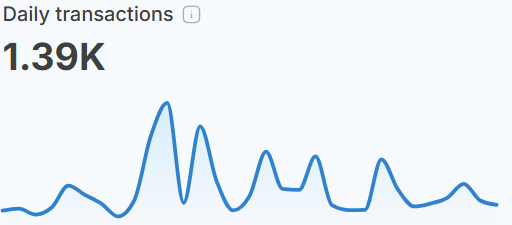
Another issue is Shibarium’s slowdown. The layer-2 scaling solution, launched in the summer of 2023 to boost speed, enhance scalability, and lower fees, initially handled millions of transactions. However, an exploit last year disrupted operations, and since then the figure has dropped significantly to mere hundreds and thousands.
The post Key Shiba Inu Metric Plunges to a 5-Year Low: SHIB Price Rally on the Way? appeared first on CryptoPotato.

Bitcoin miner IREN has finalized its acquisition of Spanish data center developer Nostrum Group, a step the company says accelerates its shift toward AI cloud services while expanding its presence in Europe.
In a press release issued Monday, IREN said the purchase brings roughly 490 megawatts of secured, grid-connected power in Spain, along with a development pipeline and a workforce of more than 50 employees spanning engineering, construction, development and operations. The deal also lifts IREN’s global secured power portfolio to about 5 gigawatts, with Spain accounting for around 10% of the total.
Key takeaways
- IREN’s acquisition of Nostrum Group adds about 490 MW of secured, grid-connected power in Spain and expands its European footprint for AI infrastructure.
- The company frames the move as part of a broader AI cloud pivot aimed at creating more contract-based revenue than crypto mining can deliver during volatile cycles.
- IREN’s quarterly financials show AI cloud revenue growing while Bitcoin mining revenue declined, reinforcing the strategy’s direction.
- The expansion places IREN alongside other Bitcoin miners investing in AI-related computing capacity in Europe, including HIVE Digital and Bitdeer.
A new foothold for AI infrastructure in Europe
IREN co-founder and co-CEO Daniel Roberts highlighted Spain’s mix of renewable generation and fiber connectivity, describing the country as a practical entry point to support growing European demand for AI computing and related infrastructure.
“Europe is one of the largest and fastest-growing markets for AI infrastructure, and Spain is among its most compelling entry points,” Roberts said in the company statement.
For investors, the key implication is that the Nostrum acquisition is not just about adding facilities—it is about adding grid-connected capacity that can be planned for AI workloads. In data-center economics, power availability and reliability often determine how quickly operators can scale compute demand, particularly when AI deployments require sustained electricity consumption.
Why IREN is moving beyond mining economics
IREN’s stated rationale ties the expansion to the company’s AI cloud strategy. As Bitcoin mining difficulty rises and Bitcoin price volatility continues to pressure mining margins, IREN argues that AI cloud offerings can provide more predictable, contract-based revenue.
The tension at the center of that argument is straightforward: mining remains IREN’s largest revenue contributor, but the company is clearly investing to reduce dependence over time.
That shift is visible in IREN’s reporting. According to the company’s results for the quarter ended March 31, Bitcoin mining remained its top source of revenue. However, AI cloud was already meaningful and growing faster than mining. IREN reported $111.2 million in mining revenue, versus $33.6 million from AI cloud services.
Quarterly results underscore the pivot
IREN said AI cloud revenue increased to $33.6 million in the quarter, up from $17.3 million in the prior quarter. Over the same comparison, Bitcoin mining revenue fell from $167.4 million. The company attributed the mining decline partly to lower average BTC prices and to the decommissioning of mining hardware.
Put differently, the gap between the two business lines is widening: AI cloud revenue is rising quarter over quarter, while mining is facing headwinds tied to market conditions and asset configuration changes.
IREN also disclosed that it had about 150,000 GPUs installed or on order as of March 31. In earlier reporting, Bernstein analysts suggested IREN could ultimately reduce much of its Bitcoin mining business as it retrofits existing sites for AI cloud infrastructure. Bernstein estimated that the company’s GPU footprint could support a $3.7 billion annual revenue run rate, based on their assumptions.
Part of a broader miner-to-AI infrastructure trend
IREN’s move aligns with a broader pattern among Bitcoin miners seeking to diversify into AI and high-performance computing. The acquisition comes as other players increase exposure to AI-related infrastructure in Europe.
HIVE Digital, for example, has been converting part of its facility in Sweden for AI computing, according to a Nasdaq press release. Bitdeer has also been developing AI data center capacity in Norway, based on its investor communications.
While these efforts differ in execution and scale, they reflect a common calculation: miners already control or procure power and compute-facing infrastructure, which can be repurposed for AI workloads. That said, the market still has to prove demand and pricing power. Even with secured electricity, AI cloud profitability depends on customer commitments, utilization rates, and the cost of deploying and operating large-scale GPU systems.
Next, readers should watch whether IREN’s AI cloud revenue continues its quarter-over-quarter growth as more capacity is integrated, and whether the company can convert its GPU pipeline into sustained contracted demand—especially as Bitcoin mining remains exposed to price swings and hardware lifecycle decisions.

Robinhood is reducing its workforce by 10% as part of a company-wide restructuring effort aimed at improving efficiency and execution, CEO Vlad Tenev said in an internal message shared by the company on X. The move is expected to impact roughly 290 employees out of approximately 2,900 full-time staff.
The announcement lands as Robinhood recently reported weaker-than-expected first-quarter results, with crypto trading described as a major drag due to sharply lower volumes year over year. Even so, the company framed the layoffs as a proactive step taken from a position of strength, citing record trading activity across multiple products.
Key takeaways
- Robinhood plans to cut 10% of its full-time workforce, expected to affect about 290 employees, while also closing a small number of remaining open roles.
- The company says the restructuring involves “flattening” its organizational structure and reducing management layers to improve performance and focus.
- Robinhood estimates $28 million in restructuring-related charges, including employee severance and benefits, plus share-based compensation costs, to be recognized in Q2 2026.
- Despite weak Q1 results, Robinhood points to record month-to-date average daily trading volumes across equities, options, and prediction markets.
- Crypto trading remains a key variable for transaction-based revenue, with Cointelegraph previously reported volumes down around 50% year-on-year.
A 10% cut tied to “flattening” the organization
Robinhood confirmed the layoffs on Tuesday via a statement on X attributed to the company, where CEO Vlad Tenev told staff that it would reduce its workforce by 10% of full-time employees. In his remarks, Tenev emphasized the need to avoid a “heavily-layered organization” as Robinhood attempts to scale its mission, and he urged teams to continuously raise their performance bar.
The rationale echoed restructuring explanations seen across the broader financial sector, and particularly among crypto-adjacent businesses that have faced cost pressure and shifting market conditions. Cointelegraph noted similar approaches from major crypto companies, including Coinbase’s workforce reduction and Block’s earlier job cuts tied to operational efficiency and organizational streamlining.
For investors and users, the key point is that this is not presented as a reaction solely to short-term earnings softness. Robinhood instead frames the change as an execution upgrade—one intended to make the organization faster and more accountable as trading activity moves through different market cycles.
How many jobs are affected, and what the company expects to cost
According to a Robinhood spokesperson speaking to Cointelegraph, the reduction is expected to affect about 290 employees. Robinhood currently has approximately 2,900 full-time employees, consistent with its reporting.
Robinhood previously reported about 2,900 full-time employees as of Dec. 31, 2025, according to its Form 10-K filing with the US Securities and Exchange Commission. In a separate Form 8-K filed on Tuesday, the company also stated that the reduction in force includes the closure of a small number of remaining open roles across the business.
Financially, Robinhood estimated total restructuring-related charges of about $28 million. The company said roughly $20 million would relate to employee severance and benefits, with about $8 million tied to share-based compensation costs. Robinhood expects to recognize these charges in the second quarter of 2026.
“Business has never been stronger,” despite soft results
In its announcement, Robinhood said it is taking the action from a position of business strength. The company cited June month-to-date average daily trading volumes reaching record levels across equities, options, and prediction markets.
Tenev described the company’s position as “never been stronger,” and suggested the workforce reduction is intended to improve execution and sharpen organizational focus. Robinhood also said it would continue hiring selectively, invest in top-tier talent, and “utilize frontier technologies” to improve performance.
While the company did not explicitly tie the restructuring to artificial intelligence initiatives, it did indicate an ongoing commitment to modernizing how work is done—language that will likely be watched closely by both job seekers and market participants as Robinhood’s cost structure evolves.
Crypto volumes remain a pressure point for transaction revenue
Even with Robinhood’s claims of strong trading activity in other areas, its first-quarter performance did not meet analyst expectations. Cointelegraph reported that crypto trading was a key contributor to that miss, pointing to volumes down roughly 50% year-on-year. That matters because crypto is closely linked to transaction-based revenue, which can swing noticeably when retail activity cools or volatility changes.
The broader implication for readers is that Robinhood’s financial outcomes may continue to depend on how quickly crypto markets stabilize relative to other parts of the platform. The company’s ability to offset crypto softness with momentum in equities, options, and emerging products such as prediction markets could determine whether this restructuring translates into more resilient earnings.
At the same time, the layoffs themselves may influence how Robinhood allocates resources across product lines. If transaction activity is uneven across categories, cost control becomes more than an internal efficiency exercise—it becomes a strategic hedge against future volatility in specific revenue streams.
What to watch next
Investors should monitor Robinhood’s next quarterly update for whether the $28 million restructuring charges and the “flattened” operating model improve operating leverage, and whether crypto volumes recover enough to narrow the gap between trading strength in other markets and continued weakness in digital assets.
Crypto World
BlackRock Launches BITA, a Covered-Call Bitcoin ETF Designed to Generate Monthly Income


BlackRock this week listed the iShares Bitcoin Premium Income ETF (BITA) on Nasdaq, extending its spot-bitcoin franchise into structured-income territory by overlaying a covered-call strategy on top of its flagship IBIT fund. The fund began trading on June 9, with bitcoin priced at $61,825.37 per… Read the full story at The Defiant
Crypto World
Unusual Machines (UMAC) Invests $30M in Powerus (PUSA) to Strengthen Drone Supply Chain

Key Takeaways
- Shares of Powerus surged 6.8% Tuesday following news of a $30 million strategic equity investment from Unusual Machines (UMAC).
- This capital injection strengthens an already established manufacturing and supply partnership between both drone industry players.
- Unusual Machines provides NDAA-compliant drone components that Powerus integrates into autonomous and counter-drone platforms.
- Both companies are working toward establishing a robust, domestically-sourced defense autonomy supply chain.
- Meanwhile, Powerus remains engaged in a pending merger agreement with Aureus Greenway Holdings (PUSA) that has yet to finalize.
Shares of Powerus jumped 6.8% during Tuesday’s trading session after Unusual Machines (UMAC) revealed it had committed $30 million in strategic equity capital to the autonomous drone manufacturer.
This investment expands upon a pre-existing commercial arrangement between the two entities. Powerus has been procuring drone hardware and critical components from Unusual Machines to support its autonomous flight systems and counter-drone technologies.
Trading on NYSE American, Unusual Machines specializes in producing NDAA-compliant drone components domestically. This compliance designation is critical—it certifies that the parts satisfy stringent U.S. federal acquisition requirements for defense applications.
Andrew Fox, CEO of Powerus, highlighted the strategic nature of the partnership. “As our operations expand, both organizations benefit from a dependable, domestically anchored supply chain,” Fox stated.
Allan Evans, who leads Unusual Machines as CEO, emphasized Powerus’s rapid growth trajectory. “Their expansion requires reliable domestic suppliers and adequate working capital to maintain momentum,” Evans remarked. “This investment demonstrates our belief in their leadership and strategic direction.”
Building Infrastructure for Rapid Growth
The deal is structured as a direct equity investment without mandatory purchase commitments. Powerus faces no obligation to procure specific volumes from Unusual Machines, and each company maintains operational independence.
Their mutual objective centers on developing a U.S.-centric defense autonomy supply infrastructure. As Powerus expands its manufacturing footprint, Unusual Machines naturally becomes a more integral supplier—creating a symbiotic business relationship.
Brett Velicovich, who co-founded Powerus, emphasized the urgency driving this partnership. “The security challenges our clients confront are rapidly advancing, and addressing them demands a supply chain that’s domestically rooted, operationally resilient, and capable of scaling,” Velicovich explained.
Having Unusual Machines as both supplier and strategic investor, he noted, enables Powerus to accelerate its domestic production capabilities.
Additional Developments at Powerus
Separately, Powerus continues navigating a proposed business combination with Aureus Greenway Holdings (PUSA). That transaction remains pending and subject to customary closing requirements.
The $30 million investment from Unusual Machines operates independently of the merger process and does not modify its structure or expected timeline, according to current disclosures.
UMAC stock declined 2.45% during the session, while Powerus (PUSA) traded up 0.67% at press time.



Coinbase (COIN) said it plans to introduce tokenized stocks backed one-for-one by underlying U.S. equities, joining the growing competition among crypto firms and traditional financial companies to bring stocks onto blockchain networks.
In a post on X on Tuesday, the exchange said “the first real, 1:1 backed tokenized stocks are coming,” allowing users to own, trade, hold and redeem the securities onchain while automatically receiving dividends.
The announcement comes ahead of a product event scheduled for 3 p.m. ET Tuesday, in which the company, best known as a crypto exchange, is expected to unveil a series of offerings spanning trading and financial services.
“For the first time, these are real 1:1 backed tokenized stocks you can trust,” CEO Brian Armstrong said in a statement. “You own an actual piece of the company onchain.”
Armstrong said the products differ from many existing tokenized stock offerings, which are often structured as derivatives or synthetic exposures rather than direct ownership interests.
“Other current solutions are some form of derivative or IOU — not real ownership,” he said. “Our tokenized stocks will give all the benefits of true ownership (e.g. dividend upside), with all the benefits of tokenized assets.”
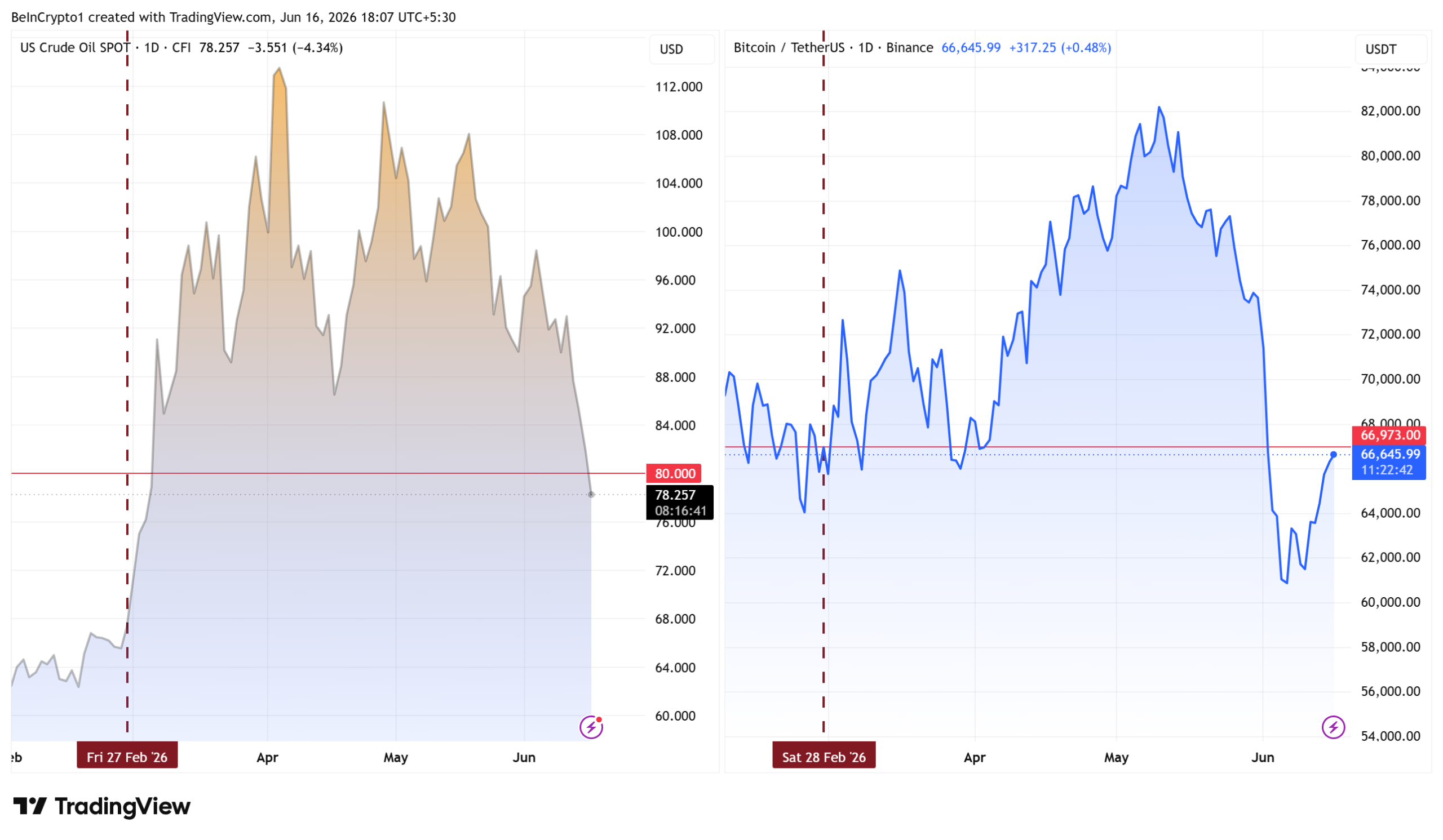
West Texas Intermediate (WTI) crude fell below $80 a barrel on Tuesday, its first drop below that level in nearly 4 months, as hopes for a US-Iran framework deal eased concerns about global oil supply.
The slide in energy prices is reshaping risk appetite across markets. Bitcoin (BTC) held near $66,650, while one major bank argues that lower oil prices strengthen the case for a fresh crypto uptrend.

Iran Deal Hopes Pull Oil Off Its Highs
WTI traded around $78 on Tuesday, down more than 4% on the day. The benchmark had spiked above $100 earlier in 2026 during the height of the Iran conflict. Bitcoin fell under $100,000 during that same standoff, when Iran threatened to close the Strait.
Traders are now pricing in a possible Strait of Hormuz reopening, the chokepoint that handles about 20% of global petroleum consumption, according to the EIA.
A framework agreement could let Iranian exports resume and ease the supply crunch.
Lower energy costs also reduce inflation pressure. That gives the Federal Reserve more room to cut, a backdrop that fuels Fed rate cut bets and tends to favor risk assets like crypto.
Standard Chartered Sees Confirmation in Falling Oil
Geoffrey Kendrick, Standard Chartered’s head of digital assets research and a BeInCrypto Experts Council member, said the three signals he wanted to see before turning more bullish have now appeared.
He had flagged them after a recent Bitcoin price analysis tied to the conflict.
“All three confirmatory signals I had mentioned below as wanting to see have worked…” Geoffrey Kendrick, stated.
Follow us on X to get the latest news as it happens
Kendrick pointed to three developments:
- MicroStrategy, the largest corporate holder of Bitcoin, bought 1,587 BTC for about $100 million last week.
- US spot ETFs then drew $85.85 million on Friday, their strongest day in a month, even as the funds still closed the week with net redemptions.
- Oil kept breaking lower.
According to Kendrick, Bitcoin’s price breaking above the $83,000 region from early May will be the next critical confirmation.
He has set a year-end target of $100,000.
Bitcoin still trades well below its October record near $126,000, and its recent price action has drawn talk of lower highs.
A move above the early May peak around $83,000 would mark the next test for the rotation thesis.

“There has been a lot of chat about BTC making lower highs. So breaking above the USD83k region from early May will be the next critical confirmation needed,” Kendrick added.
That rotation holding depends on the US-Iran peace deal reaching a clean signing.
The post Oil Price Falls Below $80 After Nearly 4 Months, Bitcoin to $70,000 Next? appeared first on BeInCrypto.

For decades, companies have turned to futures markets to manage uncertainty. Airlines hedge fuel costs. Farmers hedge crops. Manufacturers hedge metals.
Now a startup wants to bring that same financial machinery to artificial intelligence.
Silicon Data, a company that tracks pricing across cloud providers and GPU marketplaces, has partnered with CME Group to launch what could become the world’s first futures contracts tied to the computational power needed to run AI, allowing companies to hedge against fluctuations in the cost to train and run AI models. The contracts are still awaiting regulatory approval.
Early signs suggest investor interest is quickly emerging. Within days of Silicon Data’s announcement with CME Group, asset managers including ProShares and Rex Shares filed proposals for exchange-traded funds tied to the proposed contracts, including leveraged and inverse products.
Founder and CEO Carmen Li believes the market could eventually rival some of the world’s largest commodity markets.
“I think it will be larger” than oil futures, Li said in an interview, adding that energy demand tied to running artificial intelligence will eventually surpass all other energy uses, combined.
Like jet fuel
The idea stems from a simple observation: AI companies increasingly depend on compute in the same way airlines depend on jet fuel.
Most companies don’t own the high-end graphics processing units, or GPUs, that power modern AI systems. Instead, they rent access through cloud providers and a growing ecosystem of so-called neoclouds. As demand for AI infrastructure surges, the cost of that compute can fluctuate, making it difficult for businesses to forecast expenses.
“Right now we’re at a high point of uncertainty,” said Seoyoung Kim, a finance professor at Santa Clara University. “A lot of people don’t know how much computing power they’ll need in the next year, and a lot of suppliers of that computing power right now don’t know how many GPUs and to what capacity they should order and the manufacturers, like Nvidia, they don’t know how much they should produce.”
Silicon Data has built a series of GPU price indexes that track the hourly rental cost of specific chips across providers. The company hopes those benchmarks can serve as the foundation for a futures market, much as West Texas Intermediate crude oil underpins energy derivatives.
Like any futures market, compute contracts will need both buyers and sellers. Companies worried about rising compute costs would seek protection from higher prices, while providers with large amounts of capacity could hedge against the risk of prices falling.
Silicon Data’s benchmarks have already begun appearing in high-profile corporate disclosures. SpaceX, for example, referenced the company’s GPU rental-rate data in its prospectus to go public.
Speculators coming in
Not everyone in the market would be looking to hedge risk. As with other futures markets, compute contracts would also draw speculators — traders with no direct need for GPU capacity but a view on where compute prices are headed.
Proponents argue that speculators play an important role in building liquidity and improving price discovery. Critics counter that speculation can amplify volatility and disconnect prices from underlying demand.
“Speculators are a very important piece of the ecosystem as well,” Li said. “You need natural hedgers. You need market makers. You need speculators. They have opinion. They want to express their opinion, which is perfectly fine.”
The Harvard MBA said traders who believe they have insight into future supply-and-demand dynamics should be able to express those views through the market, helping establish prices for the broader industry.
The ProShares and Rex Shares filings for ETFs are contingent on regulatory approval of the futures market. Still, they suggest some investors already view AI compute as a potentially tradable asset class rather than simply a technology input.
Benchmarking AI compute cost
Unlike a barrel of oil, AI compute is not a standardized physical commodity. Silicon Data said there are more than 50 different configurations of Nvidia’s H100 chip alone, with prices varying based on processors, memory, networking, utilization rates and data center location.
For the proposed futures market to work, traders need confidence that a single benchmark can accurately represent those variations.
“What we do is normalize the prices coming to our platform every day to a base H100 case,” Li said. “It’s a very complicated normalization step, even before the index calculation step.”
Kim, the Santa Clara finance professor, noted that standardization has always been a challenge for futures markets. Corn futures, for example, specify the exact grade of corn that can be delivered under a contract. Compute markets face a similar task: defining precisely what buyers and sellers are trading.
“The CFTC is going to want to know exactly what the product is,” Kim said. Contract specifications, settlement procedures and benchmark construction are all likely to face scrutiny before the market can launch, she said.
— CNBC’s Charlotte Morabito contributed to this story.
Crypto World
Binance Reportedly Denied MiCA By Greece, No EU License for the World’s Largest Exchange
Binance, the world’s largest crypto exchange, is poised to lose its ability to serve EU clients after its Greek MiCA license application faces rejection, Reuters reported on June 16, 2026.
Two sources familiar with the matter told Reuters that Greece’s Hellenic Capital Market Commission (HCMC) is set to turn down the application. The decision, if finalized, would block Binance from operating across the 27-nation bloc once MiCA’s transitional period ends on July 1, 2026.
Major Regulatory Setback for Binance
Under the EU’s Markets in Crypto-Assets (MiCA) framework, a single license grants passporting rights for seamless operations across member states.
Without approval, unlicensed platforms must halt services to avoid enforcement actions, fines, or blacklisting by national regulators.
Binance submitted its application in January 2026 through a Greek subsidiary, citing the country’s skilled workforce and security advantages.
Co-CEO Richard Teng highlighted these strengths in February, expressing confidence in meeting the deadline.
“Greece’s labour force and security profile gave it the edge over larger financial centres… The license is pretty standard throughout Europe, so we have to think through many other factors, whether it’s social, whether it’s talent pool, safety and security issues. Greece is where we think will be a good base for us to expand in Europe.”
Follow us on X to get the latest news as it happens
Binance Pushes Back
A Binance spokesperson reportedly told Reuters the exchange “has worked constructively with regulators over the past 18 months” and believes it has met all MiCA requirements.
The company noted that HCMC completed its review and found the application compliant, adding that “HCMC has given no formal indication of the contrary.”
HCMC declined to comment, citing confidentiality rules.
Europe represents a significant market for Binance. The looming cutoff comes amid heightened regulatory scrutiny on global crypto platforms.
Competitors with approved MiCA licenses, such as Coinbase and Kraken, stand to gain users seeking compliant trading venues.
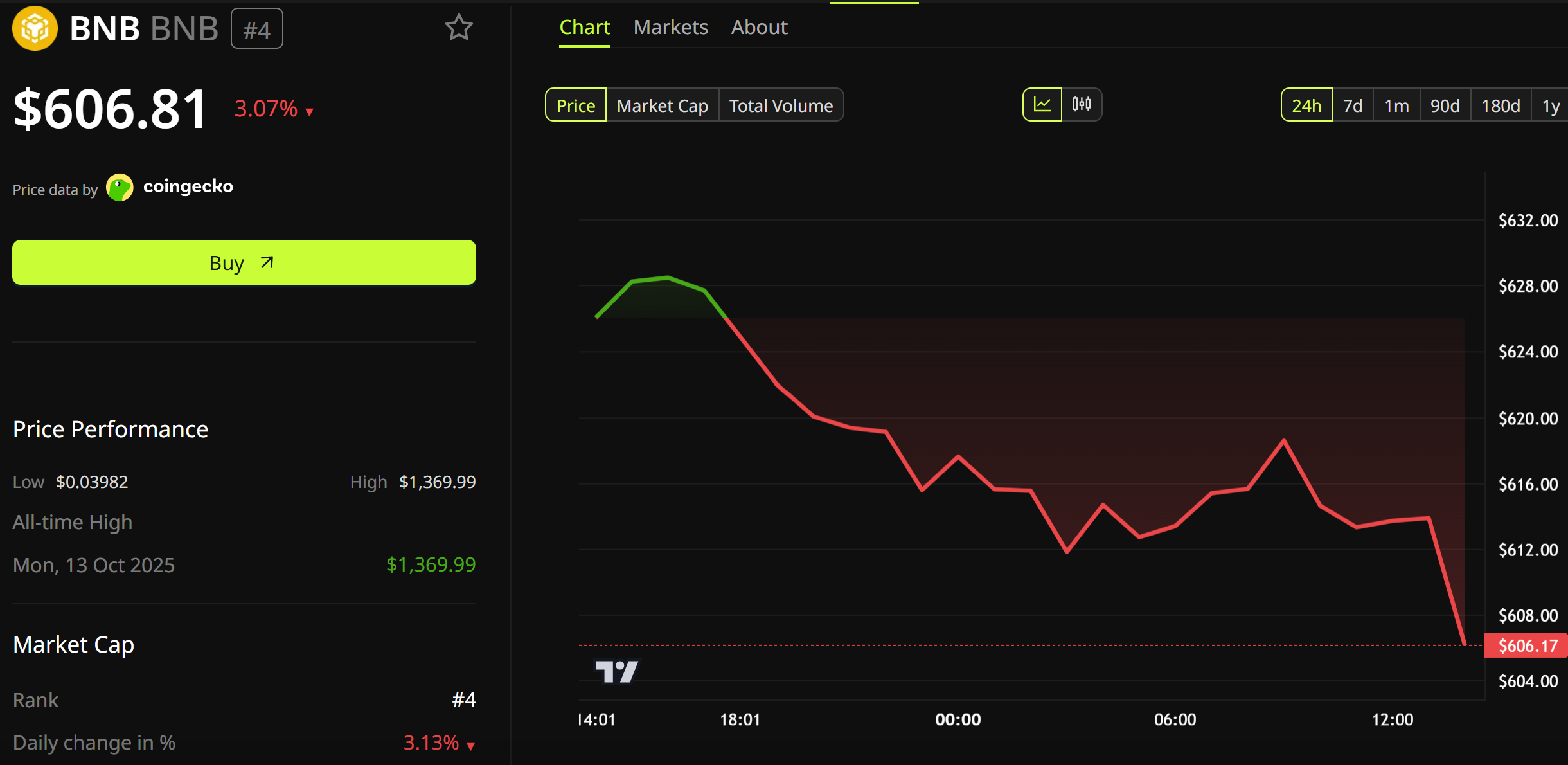
BNB token and broader crypto markets may face short-term volatility as traders digest the news.

No formal rejection has been announced yet.
Binance continues engaging with regulators, while EU users should monitor platform updates regarding deposits, trading, and withdrawals after July 1.
An official HCMC decision or Binance appeal could still shift the outcome in the coming days.
The post Binance Reportedly Denied MiCA By Greece, No EU License for the World’s Largest Exchange appeared first on BeInCrypto.

Rory McIlroy’s US Open tee time as he begins with a little help from his friends

Reser’s Fine Foods set to launch portfolio expansion

Binance pushes SpaceX perpetuals behind only Bitcoin futures


-

 Business2 days ago
No Jackpot Winner as $257 Million Prize Rolls Over to $269 Million Monday Draw
-

 Crypto World5 days ago
Oppenheimer backs SpaceX as $70 billion retail frenzy builds
-

 Fashion4 days ago
Weekend Open Thread: Tuckernuck – Corporette.com
-

 Crypto World5 days ago
Markets Rally as SpaceX IPO Looms Amid Iran Tensions and Inflation Surge
-
 Crypto World2 days ago
Zimbabwe Requires Crypto Businesses to Register Annually Under New FIU Regulations
-

 Tech4 days ago
NanoClaw integrates JFrog registries to secure AI agent downloads
-
 Sports7 days ago
Bangladesh beat Australia after 20 years in ODIs, register only their second win over six-time world champions | Cricket News
-

 Tech4 days ago
This Week In Security: Microsoft On Microsoft, Register Your Domains, Linux On ARM, And FreeBSD Joins The File Cache Club
-

 Crypto World3 days ago
Bitget enters Argentina’s regulated crypto market through PSAV registration
-

 Business6 days ago
Thailand Ranks Second Worldwide for AI Adoption Growth, Microsoft Reports
-
 Tech5 days ago
Dutton Ranch star claims they ‘didn’t see any disruption’ on set following Chad Feehan’s exit from Yellowstone spinoff fueled by Taylor Sheridan clash rumors
-

 NewsBeat5 days ago
El Nino has formed in the Pacific and could set records, forecasters say
-

 Politics5 days ago
Politics Home | Healey Resignation Is “Colossal Failure Of Government”, Says Former Labour Defence Secretary
-

 Tech6 days ago
‘This is Seattle’s position on AI’: City Council votes unanimously to pause big new data centers
-
 Entertainment5 days ago
Donnie Wahlberg & More Heat Up Las Vegas at Circa’s Barry’s Downtown Prime
-
 Tech5 days ago
Opendoor Ends India Operations, Fueling a Bigger Conversation About AI and Outsourcing
-

 Sports5 days ago
First Time Since 1971: Australia Register Historic Low In ODI Cricket
-

 Politics5 days ago
Belfast burns, while Met chief points finger at Iran and Russia
-

 Business5 days ago
AT&T: Verizon's 27% Outperformance Sets Up A Solid Entry Point
-

 NewsBeat4 days ago
FBI searches office of Ohio voter registration group
You must be logged in to post a comment Login