
Crypto World
ZachXBT Questions Arthur Hayes Over Worldcoin Exit and Token Trading Pattern Shift


TLDR:
- ZachXBT questioned Arthur Hayes over WLD exit after prior bullish statements and price targets.
- Hayes sold Worldcoin shortly after public endorsements, triggering scrutiny over timing and intent signals.
- The debate centers on whether public calls influenced retail entry before liquidity exits occurred in markets.
- Hayes defended trades, stating he sold at market price to willing buyers following his trading strategy.
On-chain investigator ZachXBT has questioned BitMEX co-founder Arthur Hayes over recent token sales involving Worldcoin and other assets.
He raised concerns about whether public commentary contributed to retail liquidity exit during volatile trading periods.
ZachXBT has previously monitored public crypto trader activity using on-chain data analysis tools, platforms, and records systems.
Hayes sold his entire Worldcoin position shortly after publicly expressing bullish views and setting price targets for the recently announced sale.
The sale followed strong social media commentary that included a $10 price target from his firm Maelstrom entity.
The Worldcoin token drew increased attention after posts from high-profile investors circulated widely across markets and exchanges.
He also exited NEAR Protocol, Hyperliquid, and Zcash within a short timeframe, according to public post records available.
The moves prompted scrutiny over consistency between public statements and subsequent trading actions across markets, according to reported analysis coverage.
ZachXBT raises concerns over trading pattern and market influence
ZachXBT referenced repeated bullish commentary on NEAR, HYPE, ZEC, and Worldcoin across multiple posts in online archives and records.
The analysts compared the timing of posts and subsequent market movements and correlations observed across trading data.
He suggested rapid reversals created questions about exit liquidity generated during volatile market conditions across trading sessions and periods.
Analysts monitored trading behavior patterns following repeated timing gaps between commentary and position closures, observations in reports.
He argued influencer commentary can affect liquidity dynamics in short-term trading environments; market conditions observed trends.
The discussion spread across crypto communities tracking on-chain data and social sentiment indicators, with metrics analysis platforms widely.
Social sentiment tools recorded heightened discussion volumes during price swings across tokens tracked in multiple datasets observed globally.
Arthur Hayes defends exits and cites market-based execution
Arthur Hayes stated he sold tokens at market price to willing buyers during trading conditions across markets globally observed.
He argued trades followed predefined objectives and were not influenced by social media reactions or online sentiment pressure factors.
His firm, Maelstrom, continues to manage investments tied to broader market positioning strategies and frameworks across portfolios globally structured.
He confirmed a full exit from Worldcoin after posting commentary on its price direction changes and recently observed trends.
Arthur Hayes also exited NEAR Protocol, Hyperliquid, and Zcash in earlier disclosed transactions, publicly reported activity logs available.
He maintained that post-trade narratives do not accurately reflect execution timing in volatile markets, according to his view.
Worldcoin experienced increased volatility following the announcement of Hayes’ full position exit disclosure across trading platforms globally reported.
Retail sentiment remained elevated while price movements continued during the same trading period observed across market data sets.
Analysts continued tracking Worldcoin volatility patterns after the announcement across derivatives and spot markets data reported across exchanges.


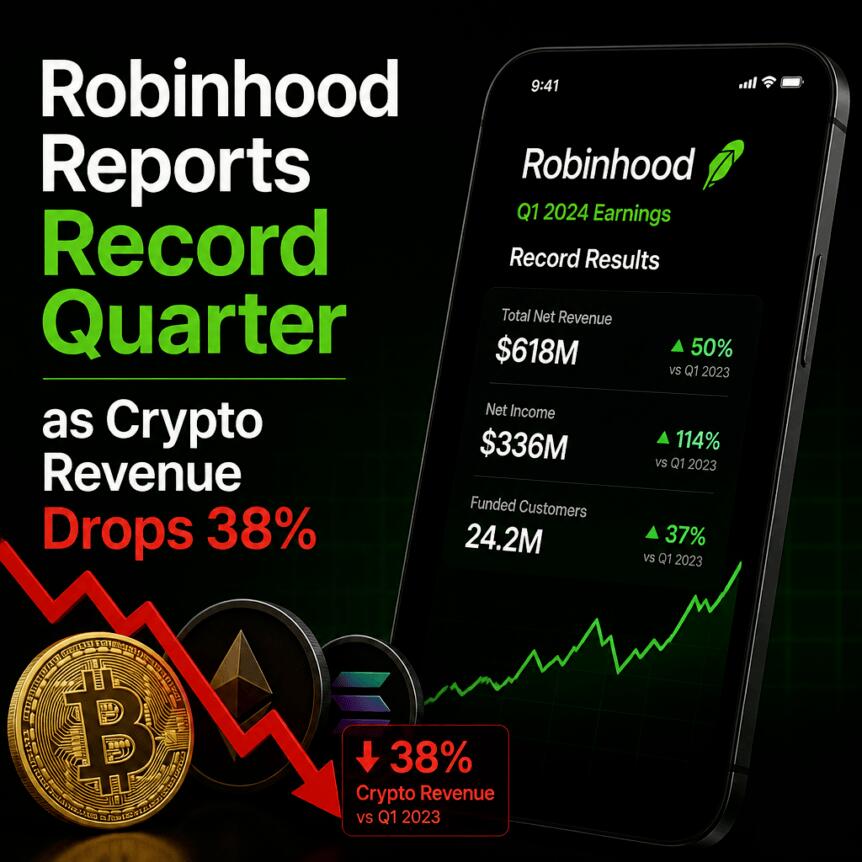
Robinhood reported record second-quarter results, highlighting strong growth in transaction-based revenue overall while acknowledging a meaningful pullback in cryptocurrency-specific earnings. In its latest earnings report, the online brokerage said crypto transaction revenue fell to $100 million, down from roughly $160 million a year earlier.
Despite the decline in crypto-related income, the company delivered an overall quarter marked by rising profitability and expanding platform activity. Total revenue climbed 32% year-over-year to $1.31 billion, and net income increased 48% to $573 million, according to the earnings release.
Key takeaways
- Crypto transaction revenue fell 38% to $100 million, even as Robinhood’s broader transaction-based revenue rose.
- Quarterly revenue and earnings reached records: revenue rose to $1.31 billion and net income grew to $573 million.
- Crypto notional trading volume totaled $40 billion: $18 billion on the Robinhood app and $22 billion via Bitstamp.
- Robinhood is scaling beyond trading: it launched parts of Robinhood Chain and introduced tokenized U.S. stocks and a decentralized lending product.
- Management reiterated a tighter cost outlook for 2026: it narrowed adjusted operating expenses and share-based compensation guidance.
Crypto revenue dips as overall transaction business grows
Robinhood’s results show a split between the performance of its crypto segment and the rest of its transaction engine. While cryptocurrency was the only major transaction category to decline during the quarter, the company pointed to strength in other areas that more than offset the weakness.
Crypto transaction revenue decreased to $100 million from about $160 million a year earlier, the company said. At the same time, transaction-based revenue rose 44% to $776 million, supported by higher contributions from categories outside digital assets.
The company also reported $40 billion in crypto notional trading volume for the quarter. Of this total, $18 billion came from the Robinhood app, down 35% year-over-year, while $22 billion came from Bitstamp. Robinhood acquired Bitstamp in June 2025, as referenced in earlier coverage here.
Market pricing reflected the mixed nature of the quarter ahead of the report: shares were down about 3.15% on Wednesday before the earnings release, based on Yahoo Finance data.
Robinhood’s crypto playbook shifts toward infrastructure and new products
Even with lower crypto transaction revenue, Robinhood used the quarter to push forward with its wider digital asset strategy. The company said it completed its acquisition of WonderFi, a Canadian crypto platform, continuing its efforts to broaden what it offers beyond pure trading.
After the quarter ended, Robinhood also rolled out additional ecosystem components. It unveiled the public mainnet of Robinhood Chain after previously reporting activity around bridged assets. The company further introduced tokenized U.S. stocks to eligible users in more than 120 countries and debuted its first decentralized lending product, Robinhood Earn.
On the Ethereum layer-2 side, DefiLlama data shows Robinhood’s new network posted $348 million in total value locked as of Thursday. The same dataset referenced stablecoins exceeding $500 million and more than $1 billion in bridged assets, illustrating that the platform’s activity is not limited to trading fees.
For investors, this matters because it reframes what “crypto performance” can mean for a brokerage. Transaction revenue can soften when market activity slows or user behavior shifts, but an expanding chain ecosystem—particularly one involving bridges and lending—can create alternative revenue pathways over time.
Non-crypto categories and platform metrics keep momentum
Robinhood’s earnings report emphasized that its broader product suite absorbed the crypto slowdown. The company said growth in event contracts, options, and equities more than offset the weakness in digital assets.
It reported that event contract revenue surged more than tenfold to $156 million, options revenue rose 29% to $342 million, and equities revenue jumped 95% to $129 million.
At the platform level, Robinhood posted record net deposits of $21.7 billion during the quarter. Total platform assets rose 32% year-over-year to $369 billion, and funded customers grew 7% to 28.4 million.
These metrics suggest that the company’s customer and balance-sheet expansion continued regardless of the crypto segment’s year-over-year revenue decline. For traders and users, that combination indicates a continued push to keep engagement broad—spreading attention across multiple asset classes and contract types rather than relying primarily on crypto transaction activity.
Guidance narrows as adjusted EBITDA grows
Robinhood also addressed expenses and profitability guidance. The company lowered and narrowed its 2026 outlook for adjusted operating expenses and share-based compensation to between $2.675 billion and $2.775 billion, down from a previously provided range of $2.7 billion to $2.825 billion.
On profitability, adjusted EBITDA rose 35% to $741 million. Total operating expenses increased 33% to $734 million, reflecting continued investment while still targeting more controlled growth at the operating level.
When viewed alongside the company’s digital asset expansion, the tighter expense guidance suggests management is trying to balance growth in new areas—like tokenization and decentralized lending—while keeping cost discipline in focus.
Going forward, investors will likely watch whether Robinhood Chain’s early traction translates into sustained engagement and monetization, and whether crypto transaction revenue stabilizes as broader platform growth continues to diversify away from purely crypto-dependent earnings.


EBC12 brings together speakers from J.P. Morgan, the Financial Conduct Authority, Invesco, Coinbase, Fidelity International, and more than 300 leaders from the banks, regulators, and asset managers shaping Europe’s digital asset market.
Barcelona, Spain, July, 2026, Eleven weeks after MiCA’s deadline, the 12th edition of the European Blockchain Convention (EBC12) returns to Barcelona. It is the region’s first major institutional gathering since the world’s first comprehensive cross-border digital asset regulation took full effect, and a key venue for digital-asset deal flow.
MiCA is now fully in force. For European markets, the focus shifts to what comes next: CASP licensing, stablecoin issuance, and the role of CBDCs in cross-border settlement. EBC12 will host that conversation this September.
Rather than chasing mandates city by city across London, Paris, Frankfurt, Zurich, and Barcelona, EBC12 compresses the European digital asset market into a single two-day commercial arena. It takes place on September 16-17, 2026 at the Palau de Congressos de Catalunya.
Europe has set the pace for compliant digital asset markets, giving the industry a clearer framework for how crypto can scale within regulation rather than around it. Recent institutional moves illustrate the shift: Deutsche Börse has invested $200 million in Kraken; Santander’s digital bank, Openbank, has expanded its crypto trading for customers across Germany and Spain. Both will be among the institutions discussing what comes next in Barcelona this September.
EBC expects 80 of Europe’s top 100 banks in Barcelona this September, up from 50 last year. Institutional interest in digital assets continues to accelerate.These institutions will gather at EBC12 to work out what comes next.
“Eight years ago, we built EBC because we believed Europe would be where this industry matured. A lot of people thought we were early. In 2026, European banks are deploying capital, institutional products are live across major markets, and the regulatory framework is in place. EBC is where the people driving that change meet once a year to do real business,” said Victoria Gago, Co-CEO of European Blockchain Convention and Digital Assets Forum.
Sessions cover institutional capital allocation, real-world asset tokenization, regulatory market structure, and the future of stablecoins and CBDCs as global settlement infrastructure.
Confirmed speakers include Emma Landriault, Head of Kinexys Labs at J.P. Morgan; Mohamad Zaraket, Head of Digital Assets Strategy EMEA at BNY; Kathleen Wrynn, Global Head of DA, Invesco; Victor Jung, Vice President, Digital Assets & Currencies, Hamilton Lane; Previn Singh from Fidelity and Colin Payne, Head of Innovation at the Financial Conduct Authority, among more than 300 speakers from across banking, asset management, infrastructure, and policy.
Alongside the main program, EBC12 features 10,000 pre-arranged one-to-one meetings, a Buy Side Breakfast for allocators and institutional investors, and a dedicated press room with direct access to speakers.
EBC12 expects over 5,000 attendees from 90+ countries for two days of market intelligence, strategic networking, and commercial momentum at the Palau de Congressos de Catalunya, a new premium venue reflecting the event’s institutional evolution.
About European Blockchain Convention
Founded in 2018, the European Blockchain Convention has grown into a key driver of European deal flow in digital assets, bringing together banks, asset managers, regulators, infrastructure providers, and builders annually, drawing over 5,000 attendees each year across its editions. Alongside EBC, the Digital Assets Forum series extends this reach across London, Abu Dhabi, and New York throughout the year.
For more information, visit eblockchainconvention.com
The post European Blockchain Convention Returns to Barcelona for Post-MiCA Gathering appeared first on BeInCrypto.

[PRESS RELEASE – Curacao, Curacao, July 30th, 2026]
BetFury, a leading crypto casino, today released its H1 2026 Performance Report, highlighting more than $140,000,000 returned to players across its casino and sportsbook between January and June 2026. The report provides a public analysis of the platform’s performance during the first half of the year, including key operational metrics, major achievements, and the company’s strategic priorities for the coming quarters.
The Half of 2026 in Numbers
Players placed over 14.1 billion bets over the six-month period with total wager volume up 15% compared to the previous half-year. Besides, the relationship between the number of bets and the total sum of withdrawals carries more weight than either figure on its own. When comparing these values to the first half of 2025, the total number of bets decreased by 6.15%, and the total amount of payouts increased by 4.36%. This indicates that the overall skill level of players has boosted significantly during the year, given the rise in profits with a smaller number of bets.
A Wider Player Base
In H1 2026, the number of registrations has increased by 40%. The number of active users also continues to grow thanks to retention, even without taking into account such a rapid expansion of the player community.
Crypto Deposits and BetFury’s GGR
The number of deposits increased by 20%. At the same time, about 84% of them are cryptocurrencies. This highlights the dominance of cryptocurrencies on modern online gaming platforms. For complete transparency, it is worth mentioning GGR. It grew by 31%. Considering other metrics such as the increased total withdrawal amount, this figure clearly argues for the stability of the platform as a healthy ecosystem.
What Do Players Choose to Play?
Among all 13,000+ games on the platform, we have identified the most popular. BetFury users made the most bets in the first half of 2026 precisely on Original titles.
Dice ✦ Limbo ✦ Keno ✦ Space Dice ✦ Plinko
A slightly different picture can be seen if you consider various games from the perspective of total wager:
Sugar Rush Super Scatter ✦ Dice ✦ Keno ✦ Space Dice ✦ 6 Jokers
This data demonstrates the high popularity of Original games created by the BetFury team for its community. They are easy to understand, have a low minimum bet threshold, high-quality design, and many in-game features.
BetFury stated that the H1 2026 results reflect continued growth, with more players, increased payouts, and an expanding user community. The company highlighted that $140 million was withdrawn by players during the six-month period, describing the milestone as part of its ongoing efforts to improve and strengthen the platform.
Looking Ahead to H2 2026
The focus for the next quarter centers on expanding into new geographic markets with localized product experiences, deepening partnerships with leading iGaming providers, and strengthening BetFury’s position as a crypto-first platform. Each of these directions builds directly on what H1 demonstrated: a growing, engaged player base that expects more from its platform.
About BetFury
BetFury is a leading crypto casino founded in 2019. The platform offers over 13,000 slots, 20+ Original games with RTP up to 99.28%, and 80+ sports for betting with odds higher than the market average. Beyond gaming, BetFury provides a full suite of crypto tools: Crypto Staking with up to 60% APR, Futures, Crypto Swap, etc. Moreover, it has a BFG Staking for accumulating more native tokens or collecting payouts in USDT, ETH, BTC, BNB, and TRX. BetFury continuously evolves based on user feedback and is committed to responsible gambling practices. User can learn more at betfury.com.
The post BetFury Releases H1 2026 Report Highlighting $140M Returned to Players appeared first on CryptoPotato.


Cryptocurrency exchange Luno is cutting about 20% of its global workforce as weaker retail trading and automation push the company toward a leaner structure and more institutional business, according to a report by Bloomberg on Thursday.
The firm’s CEO James Lanigan confirmed the cuts to Bloomberg but declined to disclose the number of employees affected. Lanigan said investments in automation and other operational improvements over the past year had changed the resources needed to run the business.
Luno will continue investing in its retail products, infrastructure and regulatory compliance while expanding its business-to-business offering.
The layoffs are Luno’s second major workforce reduction in three and a half years. The exchange cut 35% of its staff in January 2023 citing an “incredibly tough year” affecting the market.
Luno’s new structure combines its 16 million-user retail exchange with a white-label service allowing banks, fintechs and telecommunications companies to offer crypto products through their own brands. Luno supplies the liquidity, wallets and compliance infrastructure.
The weaker retail trading business reflects the broader picture across the crypto industry, which has seen exchanges BitMEX and BitMart wind down their operations.

Ethereum price is trading near $1,920, and its prediction is getting bullish. The move comes as the Ethereum Foundation signals a shift in long-term priorities. While governance changes rarely move prices immediately, they often shape the network’s future direction.
Pascal Caversaccio, better known on chain as pcaversaccio, has joined the Ethereum Foundation‘s board for an initial one-year voluntary term. He joins Aya Miyaguchi, Vitalik Buterin, and Swiss legal counsel Patrick Storchenegger on the four-member governing board. The board sets the Foundation’s vision and provides oversight of its management.
Caversaccio brings deep security experience to the role. He co-founded SEAL 911, wrote the Ethereum Cypherpunk Manifesto, and serves in the Foundation’s Silviculture Society. That group focuses on censorship resistance, privacy, open source development, and Ethereum’s long-term resilience.
Meanwhile, the appointment arrives as Ethereum navigates mixed spot ETF flows and a cautious macro backdrop. Traders are still watching how institutional demand develops after the latest Federal Reserve decision. Governance alone is unlikely to drive the next breakout, but stronger security and privacy efforts could reinforce Ethereum’s long-term investment case.
Discover: The Best Crypto to Diversify Your Portfolio
Ethereum Price Prediction: Push Toward $2,000 This Week?
ETH price has ranged between $1,875 and $1,930. That leaves the area just below $1,930 as the immediate technical hurdle. A clean close above it would put the $2,000 psychological resistance back in focus.
Near-term model projections for August still span a wide range, highlighting uncertainty rather than a clear forecast. Most estimates continue to place support around the upper $1,700s if ETH pulls back. With the current price holding comfortably above that area, the technical structure remains constructive.

The bullish case is unchanged. ETH needs to defend the $1,870 support zone and break above $1,930 with convincing volume. If buyers succeed, the next targets sit around $2,000 and $2,100. Sustained spot ETF inflows would provide another tailwind.
The base case favors continued consolidation between $1,870 and $1,930 as traders digest the latest macro developments. On the downside, a daily close below the upper $1,700s would weaken the medium-term structure. That could shift attention back toward the $1,600 to $1,680 range.
Long-term projections remain mixed. Conservative models continue to favor gradual appreciation over several years. Meanwhile, more optimistic analysts still see cycle highs reaching well above current prices if institutional adoption continues to expand.
Trade ETH on Bybit and Get a Chance to Win Our $1,000 USDT Airdrop
Maxi Doge Targets Early Mover Upside as Ethereum Tests Key Levels
ETH at $1,914 is constructive, but let’s be direct: a large-cap asset grinding toward $2,000 isn’t the kind of trade that generates life-changing asymmetry. That’s not a knock on ETH’s long-term case — it’s just math. For traders looking for the kind of early-stage exposure that blue-chip moves can’t offer, the Ethereum ecosystem’s presale layer is where that risk/reward lives right now.
Maxi Doge ($MAXI) is an ERC-20 meme token built on Ethereum, currently priced at $0.0002831 with $4.8 million raised in its presale. The project positions itself around a “1000x leverage trading mentality,” gym-bro culture meets DeFi degeneracy, with holder-only trading competitions, leaderboard rewards, and a Maxi Fund treasury earmarked for liquidity and ecosystem partnerships.
Dynamic staking APY adds a yield layer for holders who aren’t purely speculating on price. Meme tokens live and die by community momentum, and $MAXI’s viral gym-bro marketing angle. The tagline is “Never skip leg-day, never skip a pump” is self-aware enough to actually.
Research Maxi Doge before sizing any position.
Discover: The Best Token Presales
The post Ethereum Price Prediction: Foundation Adds Pascal Caversaccio to Its Board appeared first on Cryptonews.

Australia has launched legal action against Telegram over alleged failures to remove extremist content from its platform. The case comes as Russia files criminal charges against Telegram founder Pavel Durov. Meanwhile, GRAM traded at $1.41, recovering after a sharp weekly decline despite growing regulatory pressure.
Australia Targets Telegram Under Online Safety Act
Australia’s eSafety Commission has started civil penalty proceedings against Telegram in the Federal Court. The regulator alleges the messaging platform failed to meet safety obligations under the country’s Online Safety Act. Authorities are seeking penalties that could reach A$54.6 million if the court finds Telegram breached the law.
The action follows a lengthy investigation into Telegram’s handling of harmful online material. Regulators examined whether the company had effective systems to detect and remove extremist content. The review also covered child exploitation material and violent criminal content distributed through the platform.
The commission stated that Telegram left prohibited material available after receiving notifications. The regulator identified videos linked to the 2019 Christchurch mosque attack and the 2022 Buffalo shooting among the reported content. Australian authorities argue that the platform failed to meet mandatory safety standards for digital services.
Global Pressure on Pavel Durov Continues
The legal action in Australia adds to broader regulatory pressure facing Telegram and its founder, Pavel Durov. Russian authorities recently charged Durov with facilitating terrorist activities through the platform. The country’s Federal Security Service also placed him on an international wanted list after issuing an arrest warrant.
French authorities have also investigated Telegram over concerns about illegal content and cooperation with law enforcement agencies. Prosecutors examined whether the company responded adequately to official requests involving criminal investigations. Those inquiries have increased scrutiny of Telegram’s moderation practices across several jurisdictions.
Telegram has maintained its focus on user privacy despite increasing legal challenges. The company continues to oppose requests that could weaken encryption or create backdoor access. At the same time, Telegram recently introduced network improvements and reduced transaction fees on its ecosystem to almost zero.
Gram Price Recovers Despite Regulatory Challenges
GRAM traded at $1.41 during the latest session after recovering from recent losses. The token gained around 2% over several hours following a weekly decline of approximately 12%. Trading activity placed the daily range between $1.38 and $1.43.
The recovery came even as legal developments surrounding Telegram continued to dominate headlines. Market participants saw the token stabilize after sustained selling pressure during the previous week. Even so, the price remains below levels recorded before the recent decline.
GRAM has historically reacted to major developments involving Telegram because of the close association between the platform and its ecosystem. Regulatory actions have often influenced short-term market activity. However, broader market conditions also continue to affect the token’s price performance.
Australia’s latest legal action represents another significant challenge for Telegram as governments increase oversight of online platforms. Russia’s charges against Pavel Durov further add to the company’s legal and regulatory pressures across multiple jurisdictions. The combined developments highlight growing international efforts to enforce stricter online safety standards while Telegram continues to defend its privacy-focused approach.

Australia’s eSafety Commissioner has taken Telegram to court, launching civil penalty proceedings in the Federal Court over allegations that the messaging platform failed to address terrorism-linked content under the country’s Online Safety Act. The action was filed on Thursday, according to an eSafety statement.
The regulator’s complaint focuses on what it describes as repeated failures to remove pro-terror material after becoming aware of it, along with insufficient steps to prevent repeated breaches. The case is likely to add pressure to Telegram as governments across Europe and beyond continue testing how large platforms should moderate harmful content.
Key takeaways
- eSafety says Telegram breached obligations under Australia’s Online Safety Act by not responding adequately to multiple user complaints about pro-terror content.
- The regulator alleges some unlawful material remained visible for as long as three weeks after Telegram was aware of it.
- eSafety also claims Telegram did not take sufficient measures to curb repeat distribution, including removing accounts, channels, and groups tied to the content.
- The proceedings seek civil penalties, with potential fines under Australia’s online safety rules reaching up to 54.6 million Australian dollars.
- The case follows heightened legal scrutiny of Telegram and CEO Pavel Durov in other countries, including recent Russian actions.
Australia’s civil penalty case centers on alleged moderation failures
In its filing, Australia’s online safety regulator alleges Telegram failed to remove certain unlawful material after it had notice of the content. eSafety described a year-long investigation that, in its view, showed Telegram did not act in time once it became aware.
According to eSafety, the issue wasn’t limited to a single piece of content. The regulator alleged that reported pro-terror material continued to be visible for up to three weeks, even after warnings were raised. It also claims Telegram did not do enough to prevent repeat violations by adequately disrupting the accounts and communities used to distribute the content.
The allegations include failures to detect known extremist material—specifically footage connected to two major mass shootings: the 2019 Christchurch mosque attack and the 2022 Buffalo mass shooting—before the material was later removed, eSafety said.
Why this matters for Telegram users and platform compliance
Beyond the immediate legal stakes, the case underscores how regulators are increasingly tying platform expectations to concrete operational outcomes: timeliness of takedowns, responsiveness to reports, and the ability to limit repeat distribution. For Telegram users, the dispute highlights a growing tension between broad claims about speech and encryption-based design choices versus statutory duties that require platforms to manage certain categories of harmful content.
For Telegram, the compliance challenge is not only about removing content after it is identified, but also about demonstrating systems that can detect and disrupt known extremist material and prevent reappearance via networks of channels, groups, and related accounts. eSafety’s emphasis on alleged repeated violations suggests the regulator may treat moderation as an ongoing obligation rather than a one-off response to individual reports.
Regulatory pressure is widening internationally
The Australian proceedings arrive amid a broader wave of legal scrutiny targeting Telegram’s moderation approach. The case adds to pressure on both the company and its CEO, Pavel Durov, as multiple governments seek more direct accountability from major communication platforms.
eSafety’s move comes a day after Russia’s Federal Security Service (FSB) charged Durov with facilitating terrorist activity and said it had started steps to add him to an international wanted list. Russia’s allegations include claims that Telegram failed to remove channels, chats, and bots used by Ukrainian intelligence services, terrorist groups, and extremist organizations to coordinate attacks, recruit operatives, and carry out cyber fraud.
Telegram has not issued an official statement on the Australian case. However, the platform’s official X account posted content described as related to “freedom of expression.” In response to international criticism, Telegram has repeatedly framed moderation and legal pressure through the lens of free speech and user rights.
France and Russia-related cases continue to develop
Durov is also facing legal exposure in France following his August 2024 arrest at Le Bourget Airport. French prosecutors have charged him with offenses that include complicity in the distribution of illegal content, including material related to organized crime, through Telegram.
The broader regulatory environment has also shaped Telegram’s public positioning. Durov has criticized what he described as increasing threats to online privacy, arguing that governments were rolling back protections for the free internet. In a post on X dated October 2025, he warned that the promise of free information exchange was being turned into a “tool of control.”
While the Australian case is not identical to the allegations in Russia or France, the common thread is that regulators are increasingly testing whether Telegram’s platform model can meet legal expectations around harmful content—particularly content connected to terrorism and violent extremism.
As the Australian proceedings move forward, investors, traders, and builders will likely watch not only for any outcomes in court, but also for whether Telegram changes its moderation and enforcement processes in a measurable way—especially around response timelines, repeat distribution, and the handling of clearly identified extremist media.


A Russian court transferred Igor Runets, the founder of the country’s largest crypto mining company BitRiver, to a pretrial detention facility to face trial for fraud, Pravo.ru reported on Thursday.
Runets is charged with “large-scale” fraud, according to the news service. Investigators allege he caused damages exceeding 1 billion rubles ($12.5 million) by failing to deliver equipment to Infrastructure of Siberia, a subsidiary of En+, a multibillion-dollar corporation that produces 5% of the world’s aluminum and also manages digital, technology and crypto mining infrastructure projects.
Russian law enforcement officials say that in 2023, Runets entered into an equipment supply contract worth $8 million that it never fulfilled, according to Pravo.ru.
Runets, a crypto mining pioneer in Russia, was reportedly detained and placed on house arrest in February on three charges of tax evasion. The Stanford University MBA graduate began building a crypto mining data center in Siberia in 2017, the same year he founded BitRiver. He later expanded the operation to 15 data centers with more than 175,000 servers.
Following the closure of several of his crypto mining centers due to a six-year government ban across 10 regions, BitRiver began facing financial issues. A regional arbitration court opened insolvency proceedings against its controlling shareholder, Group of Companies Fox, which owns 98% of BitRiver’s authorized capital, in February.
Sen told his 270,000 X followers on Thursday that Bitcoin has just completed a multi-year cup-and-handle pattern with a breakout and perfect retest. This structure, which took years to build, has now been confirmed, he added.
“Cup-and-handle breakouts don’t move 20%, the move hundreds of percent,” he said before making a bold price prediction.
“The launch is next … $220K is the minimum target.”
Previous Patterns Ended in Big Breakouts
The cup and handle is a classic bullish continuation pattern in technical analysis. It resembles a teacup on a chart, and a breakout above the handle’s resistance often signals strong upside, with a measured target equal to the cup’s depth added to the breakout point.
I’M SORRY, BUT NOBODY IS TALKING ABOUT WHAT BITCOIN JUST DID.
MULTI-YEAR CUP AND HANDLE. COMPLETE.
BREAKOUT. DONE.
PERFECT RETEST. DONE.
STRUCTURE CONFIRMED. DONE.THIS PATTERN TOOK YEARS TO BUILD.
AND NOBODY NOTICED.
CUP AND HANDLE BREAKOUTS DON’T MOVE 20%.
THEY MOVE… pic.twitter.com/hK6LlNZk0X— Vivek Sen (@Vivek4real_) July 30, 2026
Bitcoin has formed this pattern previously, often preceding major rallies. During the 2020 to 2021 cycle, a multi-month cup formed from 2019 highs down to the 2020 low, with a handle in summer 2020. The breakout led to the run toward the peak at $69,000 in November 2021. Through 2022 and 2023, Bitcoin formed a massive, rounded bottom on the weekly chart as institutional accumulation picked up.
By early 2024, the price consolidated in the $60,000 to $69,000 range, forming the handle, before an explosive breakout to over $100,000. However, there may be a little further to go with this handle, as many analysts have targeted October as the bottom and cycle inflection point.
Swissblock reported that Bitcoin’s Risk Index peaked in late June before transitioning into low risk, “allowing selling pressure to ease and price to stabilize.”
However, a divergence is forming with Bitcoin risk remaining subdued while the VIX has returned to the fear zone. The VIX is the CBOE Volatility Index, which is often called the “fear index” as it measures the market’s expectation of 30-day forward-looking volatility in the S&P 500.
A rising VIX often signals deteriorating market conditions that weigh on BTC, while a low and stable VIX supports risk appetite favorable to crypto.
“If the VIX continues rising and Bitcoin Risk reignites, the canary will begin singing again,” said Swissblock.
The $220,000 price prediction comes just after another one, a lot more bullish, set a massive target of up to $450,000 per BTC. The time horizon for that one is by March 2028.
BTC Price Outlook
Bitcoin has been choppy over the past 24 hours following the Federal Reserve decision to keep rates unchanged. The asset tapped intraday highs of $64,500 three times before retreating to the high $63,000 zone during the Thursday morning Asian trading session.
Volatility could increase as the US has resumed military strikes on Iran late on Wednesday. “The strikes are a powerful response to yesterday’s attempted Iranian attacks on US forces based in the Middle East,” stated Central Command.
The post Completion of This Chart Pattern Could Send BTC to $220K, Says Analyst appeared first on CryptoPotato.
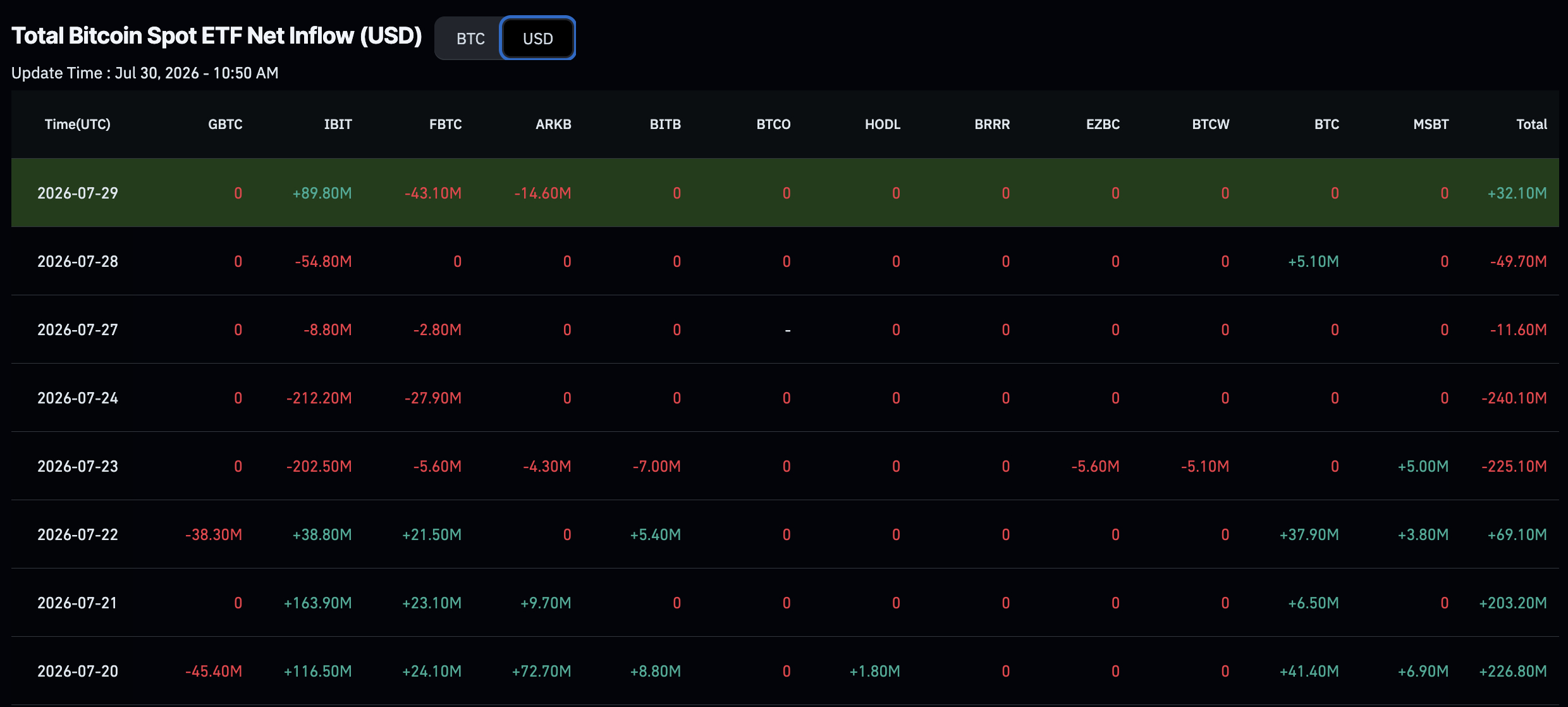
U.S.-listed Bitcoin ETFs have snapped a four-session outflow streak, and the timing matters for the Bitcoin price prediction. Bitcoin trades near $64,000, recovering after briefly slipping below that level during Wednesday’s session. The rebound in ETF flows is modest, yet the change in direction offers a clearer signal of institutional sentiment.
Wednesday’s net inflows reached $32.1 million, ending four straight sessions of outflows totaling more than $500 million. Monthly net inflows for US spot Bitcoin ETFs now stand above $220 million. Meanwhile, cumulative lifetime inflows remain above $51 billion, highlighting their growing role in Bitcoin demand.
Spot Ether ETFs moved the other way on Wednesday, recording $18.65 million in net outflows. Even so, Ether ETFs still hold stronger monthly inflows than their Bitcoin counterparts. That contrast suggests institutions remain selective instead of pulling capital from digital assets altogether.
The Crypto Fear and Greed Index remains at 28, keeping sentiment firmly in the fear zone. Still, ETF inflows returned despite cautious retail positioning. That gap between institutional buying and hesitant retail traders is the key setup heading into the FOMC decision.
Discover: The Best Token Presales
Bitcoin Price Prediction: Can BTC Reclaim $65,000 as ETF Flows Stabilize?
Bitcoin is trading near $64,000, holding within a technically important range. The session low around $63,300 tested a support zone that has repeatedly attracted buyers. Meanwhile, the intraday high near $64,400 remains intact, showing sellers are still defending overhead resistance.
ETF flows are once again acting as a real-time gauge of institutional sentiment. Earlier this year, a 13-session outflow streak erased roughly $4.3 billion before inflows finally returned. A similar pattern has emerged again on a smaller scale. BlackRock’s IBIT has led buying during each reversal, and Wednesday’s return to net inflows follows that trend.

The bullish case sees daily ETF inflows consistently exceeding $50 million, while a less hawkish Fed helps Bitcoin reclaim $65,500. That would put $68,000 into focus. The base case keeps Bitcoin between $63,000 and $65,500, allowing the price to build a stronger foundation before the next breakout.
The bearish scenario appears if the Fed surprises with a hawkish stance or ETF outflows resume. In that case, Bitcoin could lose $63,000 support and revisit the $60,000 to $61,500 demand zone. Until then, ETF flows remain one of the market’s clearest signals.
Trade Bitcoin on Bybit and Get a Chance to Win Our $1,000 USDT Airdrop
Bitcoin Hyper Targets Early Mover Upside as Bitcoin Tests Key Levels
Bitcoin’s mid-$64,000 consolidation reflects an asset at full price discovery, and $51 billion in cumulative ETF inflows already priced in. The asymmetric upside for most traders is narrowing as each ETF flow reversal generates diminishing surprise. That’s where the risk/reward calculation shifts toward earlier-stage infrastructure plays built on Bitcoin’s own rails.
Bitcoin Hyper ($HYPER) is positioning itself as exactly that. It is the first Bitcoin Layer 2 with full Solana Virtual Machine (SVM) integration, targeting the core limitations that have historically kept developers off Bitcoin: slow throughput, high fees, and limited programmability.
The architecture delivers sub-second finality and low-cost smart contract execution while inheriting Bitcoin’s security model, or a combination no other L2 has shipped. The presale has raised close to $33 million at a current price of $0.0136839, with staking already live.
Research Bitcoin Hyper as a satellite position to a core BTC holding, not a replacement for it.
Discover: The Best Crypto to Diversify Your Portfolio
The post Bitcoin Price Prediction: Bitcoin ETFs End 4 Day Outflow Streak appeared first on Cryptonews.
Michelle Hurd ‘teared up’ after receiving this thoughtful gift from a fan after her dad’s death

Same Day Flower Delivery UK: Best Last-Minute Gifts For August Birthdays & New Parents
Enterprise Products beats second quarter earnings estimates

Renter of Home in Anne Heche Crash Denies Settlement With Son

No Jackpot Winner as $257 Million Prize Rolls Over to $269 Million Monday Draw

Weekend Open Thread: Staud – Corporette.com

ANNO 1800 BEST PASSIVE MONEY MAKER!! #anno1800 #anno1800gameplay #gaming #citybuilder #money

$300,000 Of Debt To “Flee Trump’s America” | Financial Audit

what’s your favourite dream place #travel #tourism #enjoy #life #happy #money #friends #viral
-

 Fashion6 days ago
Weekend Open Thread: Brooks Brothers
-
 Sports4 days ago
Commonwealth Games boxing: Jadumani Singh seals dominant 5-0 win over Pakistan’s Sumama Rehman to enter quarter-finals | Commonwealth Games News
-

 Business14 hours ago
Why Trees Belong on the Risk Register
-

 Tech3 days ago
Intel is reversing course and bringing hyper-threading back to its server chips
-

 Politics3 days ago
Luke Littler dismantles Gerwyn Price to retain title in Blackpool
-

 Crypto World5 days ago
Ripple bought a bank in pieces. The $4 billion audit
-

 Politics2 days ago
The Part of the Electric Transition Nobody Wants to Discuss
-
 Entertainment6 days ago
A New Post-Apocalyptic Gundam Anime Series Blasts Into SDCC
-

 News Videos4 days ago
BITCOIN JUST ENTERED THIS CRITICAL ZONE…
-

 Fashion6 days ago
16 Dresses for the High Summer Event
-

 Sports6 days ago
2026 3M Open leaderboard: Scottie Scheffler finds putter in Round 1, sits three back
-

 News Videos7 days ago
The Peugeot Family: How 200 Years of an “Old Money” Dynasty Died in A Boardroom
-

 Business1 day ago
Major shareholder moves on Canyon
-

 Crypto World4 days ago
XRP Ledger adds $2.6B as RWA inflows rank second
-

 Politics4 days ago
Spain sweeps the board at 2026 World Cup with individual awards
-

 Crypto World7 days ago
Uniswap (UNI) pushes deeper into tokenized RWAs with permissioned trading pools
-
 Entertainment2 days ago
‘Stargate’ Creator’s New Sci-Fi Series Returns for Season 3 Tomorrow
-

 Tech5 days ago
Anthropic launches Claude Opus 5, a cheaper AI model for coding, agents and enterprise workflows
-

 Entertainment4 days ago
Sara Gilson Killed By Husband After Viral “Pedophile” TikTok Video
-

 Crypto World1 day ago
Kraken Enables Retail Access to Jersey Mike’s IPO via Tokenized Shares
You must be logged in to post a comment Login