Coined all the way back in 1968, the term “Great American Novel” has been a subject of interminable debate for well over a century, but what about the Great American Novel of the 21st century? That’s a question that’s not often talked about nearly enough, a question that can bring up several unforgettable books—even ones that aren’t actually novels—that will likely go down in history as some of the greatest from these first three decades of the 21st century.
Whether it’s a sharply modern behemoth of a novel of the caliber of Honorée Fanonne Jeffers‘ The Love Songs of W.E.B. Du Bois, or a non-fiction masterpiece like Isabel Wilkerson‘s The Warmth of Other Suns, the best American books published since 2001 are all proof of the remarkably quality of the country’s literary output in modern times.
Advertisement
10
‘All the Light We Cannot See’ (2014)
Image via Scribner
Inspired by a train ride where he overheard a passenger being frustrated over having no cell phone signal, which he felt was neglecting the miracle of long-distance communication, Anthony Doerr came up with the idea for the World War II drama All the Light We Cannot See. For it, he won the Pulitzer Prize for Fiction and the Andrew Carnegie Medal for Excellence in Fiction.
Those were fully deserved awards, too, because All the Light We Cannot See is one of those book masterpieces that are perfectly written. Doerr’s prose is beautifully poetic and powerfully visual, greatly elevating the book’s thematic exploration of things like empathy, fate, and the beauty of the world. Rarely has an American novel seen a use of alternating perspectives this effective or emotionally striking.
Advertisement
9
‘The Love Songs of W.E.B. Du Bois’ (2021)
Image via Harper
The debut novel of the poet Honorée Fanonne Jeffers, The Love Songs of W.E.B. Du Bois is a sprawling 800-page behemoth of a novel spanning from the time right before the Civil War until the present. It’s an incredibly ambitious, absolutely engrossing family saga that takes full advantage of each and every last page of that daunting length. But as challenging as it may look, the book is so impeccably written that it becomes surprisingly easy to breeze through it as if it were 400 pages shorter.
The way Jeffers explores the trauma of Black and Indigenous families in the American South while also celebrating their heritage and resilience is truly remarkable, the whole book feeling like a work of art centuries in the making because of it. And like all the best historical epics, The Love Songs of W.E.B. Du Bois does a phenomenal job of balancing the scope of its premise with surprisingly intimate and intricate character development.
Advertisement
8
‘The Fifth Season’ (2015)
Image via Orbit
American speculative fiction has been top-notch throughout the entirety of the 21st century, too, as perfectly demonstrated by N. K. Jemisin‘s science fantasy masterpiece The Fifth Season. Winner of the Hugo Award for Best Novel in 2016, it served as the first volume in Jemisin’s acclaimed Broken Earthseries. But fantastic though its sequels may be, there’s simply no beating the original in this particular case.
The Fifth Season is one of those fantasy books better than most movies, a scathing critique of systemic oppression, impressive in its thematic depth, its groundbreaking structure, and its unique worldbuilding. Jemisin’s writing here is bold, incredibly immersive, and even shockingly experimental at times, which includes some parts written in second person. That’s only the tip of the iceberg when it comes to the creativity contained within The Fifth Season.
Advertisement
7
‘There There’ (2018)
Image via Random House
The debut novel of Cheyenne and Arapaho author Tommy Orange, There Thereis perhaps the highest-quality example of a category of American books that has seen a tremendous boom and resurgence throughout the 21st century: Native American literature. In fact, the novel as a whole is a powerful exploration and celebration of Native American history and identity, the sort that anyone intrigued by that facet of the United States’ identity as a country ought to check out at least once.
Whereas many Indigenous books from around the world end up being period pieces about Indigenous trauma and suffering, Orange crafts a stunning, absolutely gripping account of what it’s like to be Native American in the modern-day US. Wonderfully character-driven, masterfully structured and paced, and treating complicated topics like violence and addiction with the utmost sensitivity, it’s a true must-read chapter of 2010s American literature.
Advertisement
6
‘James’ (2024)
Image via Random House
Another example of why American literature has been absolutely exceptional throughout the 2020s so far, Percival Everett‘s Jamesis a potent reinterpretation and reimagining of Mark Twain‘s Adventures of Huckleberry Finn. For it, Everett won multiple awards, including the Kirkus Prize, the National Book Award for Fiction, and the Pulitzer Prize for Fiction. It would be difficult for anyone to read James and think that the hype was entirely unwarranted.
One would think that radically revising one of the books that’s most often brought up in the Great American Novel debate would likely result in a novel that feels pretentious, overly ambitious, or even just downright disastrous. Not James. Everett’s dissection of how imposed social roles and internal self-identity relate to systemic racism is as fascinating as it is sensitively explored, and it’s a story that couldn’t have been told without Huckleberry Finn as its scaffolding. James shows why and how any nation’s literary canon, the United States’ included, can never be fully finished, but simply reinterpreted and forced to evolve.
Advertisement
5
‘The Sympathizer’ (2015)
Book cover of The Sympathizer by Viet Thanh Nguyen, featuring a bright red background with a stylized black-and-red portrait above the title in large yellow handwritten-style text.Image via Grove Press
The inspiration for one of the most underappreciated HBO miniseries of the 2020s so far, Vietnamese-American professor Viet Thanh Nguyen‘s debut novel, The Sympathizer, is considered by some to be one of the best books of the last 100 years. Winner of the 2016 Pulitzer Prize for Fiction, it’s a genre-bending masterpiece that functions equally well as a mystery spy thriller, a dark comedy, and a war drama.
The Sympathizer deals with a multitude of themes and interweaves them in a way so complex that it’s surprisingly re-readable.
Advertisement
Like all the best American novels, The Sympathizer deals with a multitude of themes and interweaves them in a way so complex that it’s surprisingly rereadable. At its core, though, it’s a deeply tragic story about how dual identity can be a curse, and about how the media flattens and trivializes the haunting realities of war. It’s definitely not a feel-good novel, but it’s one so impeccably crafted that everyone should read it at least once in their lives.
4
‘The Nickel Boys’ (2019)
Image via Doubleday
Advertisement
Yet another instance of an award-winning novel that’s just about as far as you can get from a feel-good book, The Nickel Boysis based on the infamously abusive Florida reform school Dozier School. For it, Colson Whitehead won the 2020 Pulitzer Prize for Fiction. Whitehead has written other exceptional books that deserve to be counted among the best in America’s 21st-century bibliography, most notably The Underground Railroad, for which he also won the Fiction Pulitzer. However, it’s the book that made him the fourth author in history ever to win the Pulitzer for Fiction twice that’s arguably his very best.
Before it inspired one of the best movie masterpieces of the last 10 years, The Nickel Boys presents its hauntingly horrific story—made all the more horrific by the fact that it was inspired by true events—with a refreshing amount of restraint. Instead of exploiting the subject matter for sensationalized melodrama, Whitehead creates an emotionally stirring critique of institutional violence and racism so deeply tied to America’s cultural identity that not counting it among the country’s best 21st-century books would be a crime.
3
‘The Corrections’ (2001)
Image via Picador
Advertisement
Though Jonathan Franzen‘s The Correctionswas published exactly 10 days before the September 11th attacks in New York City, the way the book explores the culture, domestic anxieties, and economic unease of late-capitalist America proved terrifyingly prophetic. A whopping 25 years after its publication, The Corrections still reads as a surprisingly modern book, having aged like fine wine. For it, Franzen won the 2001 National Book Award.
It’s a novel that captures the thematic, emotional, and psychological complexities of the contemporary United States to absolute perfection. Pulling American literature out of the postmodernism that had come to dominate it throughout the late 20th century, The Corrections almost single-handedly breathed new life into the Great American Novel conversation. It proved that books could still intimately tap into the American psyche without the detachment of postmodernism and the Internet age.
2
‘The Road’ (2006)
Image via Picador
Advertisement
Cormac McCarthy is widely regarded as one of the greatest, most important and influential authors of the late 20th and early 21st centuries, the mind behind masterpieces as groundbreaking as the incredible The Road. It’s one of the best post-apocalyptic books of all time, winner of a Pulitzer Prize for Fiction and a phenomenal introduction to McCarthy’s whole oeuvre.
What makes The Road one of the most universally fascinating Great American Novels of the 21st century is that even though it is set in a post-apocalyptic United States, and even though its thematic core can be interpreted as a portrayal of the death of the American Dream, it’s built on an almost mythological premise that anyone should be engrossed by. Written with a powerfully stripped-down prose and the thought-provoking central question of what morality means when civilization has withered away, it’s a 21st-century American classic for a reason.
1
‘The Warmth of Other Suns: The Epic Story of America’s Great Migration’ (2010)
Image via Knopf
Advertisement
As incredible as the United States’ literary output in the fictional department has been throughout the last 26 years, American non-fiction in particular has seen a resurgence ever since the turn of the century. This shift has resulted in many a non-fiction book that’s still a must-read in 2026, most notably Isabel Wilkerson’s The Warmth of Other Suns. It’s a study of the Great Migration that turns the topic into a surprisingly accessible epic.
Wilkerson spent a whopping 15 years conducting research to write The Warmth of Other Suns, and all that effort absolutely paid off. Far from ever feeling tedious or didactic, the book humanizes the subjects of its story to a level never before seen in any book about the Great Migration. It’s such a complex, beautifully crafted, wonderfully novelistic work of non-fiction that it should be considered essential reading for anyone who loves 21st-century literature, no matter where they’re from.
The weight of expectation hangs heavy over any HBO television production. Audience anticipation of a spectacle of unflinching storytelling and high-end production value is ever present, but this air of prestige and acclaim can be treacherous, especially when a series pivots away from tradition in an attempt to offer something completely original. While HBO has founded its brand on the back of series that excel in this regard, the network has also produced a number of hidden and misunderstood gems that simply didn’t click with viewers on release.
This can be for any number of reasons, from the first handful of episodes of a show being considered relentlessly bleak, thus seeing the series become known as a morbid and nihilistic slog, to detailed and intricately complex storytelling being received as incomprehensible by many who then label the show a convoluted mess. Whether they were misunderstood by the masses, maligned by critics, or dismissed by too many, these TV series should all be viewed as being among the network’s greatest releases, but they seldom are.
Advertisement
6
‘We Own This City’ (2022)
Officer Wayne Jenkins (Jon Bernthal) leading his Gun Task Force team down a sidewalk in ‘We Own This City’.Image via HBO
Created by David Simon and George Pelecanos—two of the forces behind HBO’s The Wire—and based on Justin Fenton’s nonfiction book of the same name, We Own This City uses a shocking basis on real-life events to analyze corruption in the police system, the bureaucratic and cultural reasons why it is so hard to punish, and the intensifying divide between essential societal institutions and the public they are meant to serve. Framed as the FBI’s investigation into the illegal practices of the Baltimore Police Department’s Gun Trace Task Force, the six-part miniseries implements intense non-linear plotting that jumps sporadically between points between 2003 and 2018.
It is undeniably an approach that demands attentive viewing from audiences, but We Own This City was too quickly dubbed a convoluted and heavy-handed crime drama that veered away from the tone of David Simon’s earlier work in the genre. This reputation of excessive complexity and overbearing thematic work has endured to an extent, seeing the miniseries become something of a forgotten masterpiece when its piercing urgency and eloquent dissection of such relevant issues is timely. Brilliantly analytical, masterfully layered, and exuding a realism and intensity that is truly unforgettable, We Own This City is leagues better than its reputation of clunkiness would suggest.
Advertisement
5
‘Tokyo Vice’ (2022–2024)
Jake Adelstein (Ansel Elgort) stands in a Japanese-style tatami room alongside Detective Hiroto Katagiri (Ken Watanabe) in ‘Tokyo Vice’ (2022-2024).Image via HBO Max
To some extent, Tokyo Vice was shrouded in controversy and dismissed by many long before its first episode had even aired. There were multiple reasons for this, from the casting of Ansel Elgort in the lead role to the dubious accuracy of Jake Adelstein’s memoir, which was the series’ source material, and even the decision to explore the Japanese underworld through an American protagonist. To be fair, all of these criticisms are valid, and the series was not at all helped by HBO’s suspiciously low-key marketing campaign and abrupt cancelation after its second season. But is Tokyo Vice’s reputation as a hollow “White savior” narrative entirely fair?
The answer to that question is yes and no. When the series focuses on Elgort’s American journalist, it lacks essence and punch. However, when it pivots away from him and invests more in the characters that surround him, such as Ken Watanabe’s Detective Katagiri and Sho Kasamatsu’s Yakuza enforcer, it soars as a rich and engrossing descent into a fascinating world of neon-lit style and cut-throat morality. Also bolstered by Michael Mann’s creative involvement, Tokyo Vice does largely surpass its uninspiring reputation, even if it still holds its fair share of faults.
Advertisement
4
‘Entourage’ (2004–2011)
Aiden Grenier as Vincent grins walking in Los Angeles with his three friends and his agent in Entourage.Image via HBO
There was a time when Entourage was lauded as being the flagship series of HBO’s ventures into comedy television. But times change, and with them, so too do cultural sensitivities, attitudes, and interests. This point of evolving social standards is always difficult to address with regard to comedy entertainment, and Entourage is simply another once universally beloved genre highlight that has since come to be viewed as archaic, derogatory, and tastelessly offensive. To a point, the matter of whether this view is a valid criticism or a knee-jerk overreaction is up to each individual, but there are several elements of the series that its critics overlook.
It follows Vincent Chase (Adrian Grenier), a young breakout movie star relishing his new life of luxury and wealth in L.A. with his childhood friends. It is easy to regard as a shallow male fantasy that combines its crude irreverence with casual misogyny, but there is a point to be made that Entourage never treats its main characters as beacons of morality. While they’re fun and relatable, they are marked with a satirical edge rather than idolized glory. It may not pry into the characters’ adolescent wish-fulfillment lifestyles with quite as much depth as some would like, and its sense of escapist entertainment can, at times, stray close to casual endorsement, but Entourage has enough sense as an insider-look of Hollywood lavishness to mostly evade its reflective reputation as a harmful, outdated, and demeaning series, even if its eight-season run did get a bit long in the tooth.
Advertisement
Collider Exclusive · Sci-Fi Survival Quiz Which Sci-Fi World Would You Survive? The Matrix · Mad Max · Blade Runner · Dune · Star Wars
Advertisement
Five universes. Five completely different ways the future went wrong — or sideways, or up in flames. Only one of them is the world your instincts were built for. Eight questions will figure out which dystopia, galaxy, or desert wasteland you’d actually make it out of alive.
💊The Matrix
🔥Mad Max
🌧️Blade Runner
🏜️Dune
Advertisement
🚀Star Wars
Advertisement
01
You sense something is deeply wrong with the world around you. What do you do? The first instinct is often the truest one.
Advertisement
02
In a world of scarcity, what resource do you guard most fiercely? What we protect reveals what we believe survival actually requires.
Advertisement
03
What kind of threat keeps you up at night? Fear is useful data — if you’re honest about what you’re actually afraid of.
Advertisement
04
How do you deal with authority you don’t trust? Every dystopia has a power structure. Your approach to it determines everything.
Advertisement
05
Which environment could you actually endure long-term? Survival isn’t just tactical — it’s physical, psychological, and very much about where you are.
Advertisement
06
Who do you want in your corner when things fall apart? The company you keep is the clearest signal of who you actually are.
Advertisement
07
Where do you draw the line — if you draw one at all? Every survivor eventually faces a moment that tests what they’re actually made of.
Advertisement
08
What would actually make survival worth it? Staying alive is one thing. Having a reason to is another.
Advertisement
Your Fate Has Been Calculated You’d Survive In…
Your answers point to the world your instincts were built for. This is the universe your temperament, your survival instincts, and your particular brand of stubbornness were made for.
Advertisement
The Resistance, Zion
The Matrix
You took the red pill a long time ago — probably before anyone offered it to you. You’re a systems thinker who can’t help but notice the seams in things.
You’re drawn to understanding how the system works before figuring out how to break it.
You’d find the Resistance, or it would find you — your instinct for spotting constructed realities is the machines’ worst nightmare.
You function best when you have access to information and the freedom to act on it.
The Matrix built an airtight prison. You’d be the one probing the walls for the door.
Advertisement
The Wasteland
Mad Max
The wasteland doesn’t reward the clever or the well-connected — it rewards those who are hard to kill and harder to break. That’s you.
You don’t need comfort, community, or a cause larger than the next horizon.
You need a vehicle, a clear threat, and enough fuel to outrun it — and you’re good at all three.
You are unsentimental enough to survive that world, and decent enough — just barely — to be something more than another raider.
In the wasteland, that distinction is everything.
Advertisement
Los Angeles, 2049
Blade Runner
You’d survive here because you know how to exist in moral grey areas without losing yourself completely.
You read people accurately, keep your circle small, and ask the questions others prefer not to answer.
In a city where humanity is a legal designation rather than a feeling, you hold onto something that keeps you functional.
You’re not a hero. But you’re not lost, either.
In Blade Runner’s world, that distinction is everything.
Advertisement
Arrakis
Dune
Arrakis is the most hostile environment in the known universe — and you are precisely the kind of person it rewards.
Patience, discipline, and political awareness are your core strengths — and on Arrakis, they’re survival tools.
You understand that the long game matters more than any single victory.
Others come to Dune and are consumed by it. You’d learn its logic and earn its respect.
In time, you wouldn’t just survive Arrakis — you’d begin to reshape it.
Advertisement
A Galaxy Far, Far Away
Star Wars
The galaxy far, far away is vast, loud, and in a constant state of violent political upheaval — and you wouldn’t have it any other way.
You find meaning in being part of something larger than yourself — a cause, a crew, a rebellion.
You’d gravitate toward the Rebellion, or the fringes, or whatever pocket of the galaxy still believes the Empire’s grip can be broken.
You fight — not because you have to, but because standing aside isn’t something you’re capable of.
In Star Wars, that willingness is what makes all the difference.
Advertisement
3
‘Station Eleven’ (2021)
MacKenzie Davis reading the Station Eleven comic book in a rainy tent in Station Eleven.Image via HBO Max
Advertisement
Over the past 15 years particularly, television lovers have been given a set vision of the end of the world. It doesn’t matter whether it’s due to zombies, humanity-decimating viruses, or nuclear war, post-apocalyptic drama is supposed to be bleak pessimism accentuated by glimmers of hope and, ideally, plenty of action. Station Eleven indulges none of this, with the miniseries adaptation of Emily St. John Mandel’s novel occupying an air of optimism and humanity as it follows a group of traveling actors roaming between settlements 20 years after a devastating flu virus decimated civilization.
An important point to make regarding Station Eleven’s initial reception is that it did air in 2021, amid the world of COVID-19, which perhaps didn’t make a story of deadly flus and hopeful Armageddons all that appealing. Moronic review bombing targeting the series’ diverse casting only added to its fledgling reputation. It was an unfortunate perfect storm that saw what is a beautifully tender and profoundly emotional exploration of humanity dwindle in the eyes of many as an uneventful misfire of apocalyptic suspense. That being said, Station Eleven did earn critical acclaim and has come to be viewed as something of a television cult classic.
2
‘Generation Kill’ (2007)
Two American soldiers and a journalist with a camera stand in a street in Baghdad in Generation Kill, 2008.Image via HBO
Advertisement
HBO has mastered large-scale war drama through miniseries like Band of BrothersandThe Pacific, both of which were defined by the enormity of their productions and the sentimental humanity that serves as a tragic undercurrent to the sheer brutality of war. Generation Kill operates much differently, and anyone who went into it expecting the same balance of grandiose, albeit harrowing, spectacle and relatively comfortable morality would have had their expectations immediately shattered. Based on Evan Wright’s nonfiction book, the seven-part miniseries delivers an unflinching dramatization of the US Marine Corps’ 1st Reconnaissance Battalion, immersing viewers in the soldiers’ experiences during the first weeks of the Iraq War.
Defined by a tone of coarse realism, Generation Kill defies Hollywood’s penchant for realizing war drama with patriotic fervor and comfortable moral challenges. Even the unit camaraderie is presented with an acidic, darkly comic edge that normalizes the characters, but distances them from the traditional image of war heroism. Also buoyed by its authentic illustration of dysfunctional leadership, military bureaucracy, and the frustrating monotony of a soldier’s journey, Generation Kill is the definitive examination of modern warfare in media thus far. It’s a shame that it has come to be a largely underappreciated gem that is more renowned for its slow pacing, modest budget, bleak themes, and its less reassuring image of America’s armed forces than its dramatic ferocity and punishing commitment to realism.
1
‘The Leftovers’ (2014–2017)
Justin Theroux and Carrie Coon in The Leftovers (2014)Image via HBO
Advertisement
The Leftovers is perhaps HBO’s single most underrated production of all time. The three-season series unfolds in a world of grief, loss, and unresolved trauma. On October 14, 2011, two percent of the world’s population mysteriously vanished without a trace in an event that is known as the “Sudden Departure”. The show opens three years later, plunging viewers into a world of unedifying grief and depression, festering nihilism, and simmering unrest between people who believe humanity must never forget the “Sudden Departure” and those who simply want to move on with their lives.
It is an interesting series to analyze in terms of its cultural impact and reputation. Its narrative style isn’t so much plot-driven as it is a lingering meditation on characters, thematic ideas, and expressions of misery. Needless to say, it is a departure from traditional television storytelling that can take some time to acclimatize to. However, many viewers didn’t, and instead of persisting, they wrongly dismissed the series as a relentlessly pessimistic and depressing watch that refuses to give satisfying, easy answers. It has led to something of a split reputation wherein some people deride it as a laborious, soul-sapping bore while others herald it as being one of the greatest feats in television history. That The Leftovers is viewed as anything other than a flawlessly written, perfectly performed, and ceaselessly absorbing masterpiece that epitomizes deep television drama at its empathetic and excruciating best is an injustice.
The 21st century has been excellent for TV fans, from those who love an intense drama, to those who prefer a cozy sitcom. The last 25 years have seen the premiere of a number of perfect drama series that have since become classics, including Breaking Bad, The Leftovers, and Succession. Similarly, so many fantastic sitcoms have been released in the last 25 years, and there are still some truly fantastic ones that are currently ongoing.
Among all the best sitcoms of the last 25 years, there are only a select few that are truly perfect. These series have hilarious and memorable characters, and they were generally able to maintain a strong quality throughout the duration of their runs. These shows also have sharp writing, episodes that stand out as some of the funniest of all time, and compelling character dynamics. These are the most perfect sitcoms of the last 25 years, ranked.
Advertisement
8
‘Happy Endings’ (2011–2013)
Happy Endings the friend group at Shershow’s weddingImage via ABC
Like all the best hangout sitcoms, Happy Endingsfollows a codependent friend group living in a big city. Jane (Eliza Coupe), Brad (Damon Wayans Jr.), Alex (Elisha Cuthbert), Dave (Zachary Knighton), Penny (Casey Wilson), and Max (Adam Pally) have all been joined at the hip for years. When Alex leaves Dave at the altar, though, their friend group starts to fracture. Thus, everyone else has to figure out how to try to all stay friends now that Dave and Alex are no longer a couple.
Happy Endings was ssadly canceled after just three seasons, but it is truly perfect from start to finish. The central friend group is one of the best in sitcom history. They are all more than a little bit obsessed with each other, and they don’t really know how to act with anyone outside of their group. They have their own strange rituals, like group insult pile-ons, as well as their own made-up holidays that they celebrate. Happy Endings has a hilarious and over-the-top sense of humor, and each of its episodes is uniquely funny and strange.
Advertisement
7
’30 Rock’ (2006–2013)
Tina Fey as Liz Lemon giving two thumbs up in her office in 30 Rock.Image via NBC
Just two decades after it first aired, 30 Rockis widely considered to be one of the best sitcoms of all time, and for good reason. The series follows the writers, actors, and executives behind a sketch comedy show called The Girlie Show. When network executive Jack Donaghy (Alec Baldwin) is brought in to make some major changes, head writer and showrunner Liz Lemon (Tina Fey) struggles to adjust to this new development. One such change includes changing the show’s name to TGS with Tracy Jordan and bringing in the infamous Tracy Jordan (Tracy Morgan) to star in it.
30 Rock is one of the wittiest and most clever sitcoms of all time. It is packed with jokes, both in the writing, and in clever visual gags. The characters are all some of the best in sitcom history, with unique traits and flaws that drive quite a bit of the show’s humor. Additionally, 30 Rock has a brilliant and wildly funny blend of satire and meta-humor that it implements through its show-within-a-show.
Advertisement
6
‘What We Do in the Shadows’ (2019–2024)
Nandor and Guillermo shopping together in the pilot episode of What We Do in the Shadows WWDITS.Image via FX
Based on the movie of the same name, What We Do in the Shadows is a hilarious mockumentary series that follows a group of vampires who all live with their familiar in a Staten Island mansion. Nandor the Relentless (Kayvan Novak), Laszlo Cravensworth (Matt Berry), and Nadja of Antipaxos (Natasia Demetriou) are all traditional vampires who have spent the last century putting off their assigned goal of taking over the Tri-State Area. Colin Robinson (Mark Proksch) is an energy vampire who feeds by boring people out of their minds.
Guillermo de la Cruz (Harvey Guillén) is Nandor’s human familiar who has been waiting years for Nandor to finally turn him into a vampire. In the meantime, Guillermo assists all of the vampires with everything from finding people to feed on, to figuring out how to operate their emails. What We Do in the Shadows is a laugh-out-loud funny series with creative vampire lore and some of the best sitcom characters of the last 25 years, and each season of the series is truly fantastic.
Advertisement
5
‘Abbott Elementary’ (2021–Present)
Sheryl Lee Ralph and Quinta Brunson in the Abbott Elementary episode “Mall”Image via ABC
Abbott Elementaryis still ongoing, with its sixth season premiering this coming fall. That said, the first five seasons of the series are absolutely perfect, and there’s no doubt that the show will keep this up when it returns. The series follows the faculty and staff of Abbott Elementary School, a severely underfunded public school in Philadelphia. Led by the unconventional Principal Ava Coleman (Janelle James), the teachers do their best to help their students, despite their limited resources.
Abbott Elementary is an absolute standout of the 2020s, with a hilarious and distinct setting, as well as uniquely quirky characters. The series draws attention to real-world issues in education, but it is also just deeply funny. Abbott Elementary has sharp writing, and each episode is packed with jokes and hilarious bits.Each season has its own individual arc, including last season, when the teachers and students of Abbott had to adjust after relocating to an abandoned mall.
Advertisement
Collider Exclusive · Star Wars Quiz Which Force User Are You? Light Side · Dark Side · Or Somewhere Between
Advertisement
The Force is not a binary. It is a spectrum — from the serene halls of the Jedi Temple to the shadowed corridors of Sith space. Ten questions will reveal where you truly fall. The Force has always known. Now you will too.
🔵Jedi Master
🟡Padawan
🔴Sith Lord
⚫Inquisitor
Advertisement
⚪Grey Jedi
Advertisement
01
What is the Force to you? Your relationship with the Force defines everything else.
Advertisement
02
When you feel strong emotions — anger, grief, love — what do you do? The Jedi suppress. The Sith feed. Others choose differently.
Advertisement
03
The Jedi Council gives you an order you disagree with. You: How you handle authority reveals your alignment.
Advertisement
04
You are offered forbidden knowledge that could give you enormous power. The cost is crossing a moral line. You: The dark side’s pull is never more than a choice away.
Advertisement
05
Your approach to training and learning is: A student’s habits become a master’s character.
Advertisement
06
In a duel, your lightsaber fighting style reflects: Combat is the purest expression of a Force user’s philosophy.
Advertisement
07
A defeated enemy lies at your feet, powerless. You: Mercy — or its absence — is the truest test of alignment.
Advertisement
08
The Jedi Code forbids attachment. Your honest view on love and bonds: The source of the greatest falls in the galaxy.
Advertisement
09
Why do you use the Force at all? What’s the point? Purpose is the difference between a knight and a weapon.
Advertisement
10
At the final moment — light side or dark side pulling at you — what wins? In the end, every Force user faces this moment. What does yours look like?
Advertisement
Your Alignment Has Been Determined Your Place in the Force
The scores below reveal how the Force sees you. Your highest number is your true alignment. Read on to understand what that means — and what it will cost you.
🔵 Jedi Master
Advertisement
🟡 Padawan
🔴 Sith Lord
⚫ Inquisitor
⚪ Grey Jedi
Advertisement
Disciplined, compassionate, and deeply attuned to the living Force, you have walked the path long enough to understand its demands — and accept them. You lead not through authority alone, but through example. You have felt the pull of the dark side and chosen otherwise, every time. That is not certainty. That is courage.
You are earnest, powerful, and brimming with potential — and you know it, which is both your greatest asset and your most dangerous flaw. You act before you think, trust your gut over your training, and sometimes confuse impatience for bravery. The Masters see something in you, though. The question isn’t whether you have what it takes — it’s whether you’ll be patient enough to find out.
Advertisement
You are not simply dangerous — you are certain, and that is worse. You have decided what the galaxy needs, and you have decided you are the one to deliver it. Your power is genuine and formidable, earned through sacrifice that would have broken lesser beings. But examine your victories carefully. Every Sith believed their cause was righteous. The dark side’s cruelest trick is that it agrees with you.
You were forged in fire and reshaped by those who found you at your lowest. You serve, because service gave you structure when you had none. Your allegiance is not to an ideology — it is to survival and to the master who gave you purpose. But there is something buried beneath the conditioning. The Jedi you hunt? You recognize them. Because you remember what it felt like before the choice was taken from you.
Advertisement
You have looked at the Jedi Code and the Sith Code and found both of them incomplete. You walk the line not out of indecision but out of conviction — you genuinely believe both extremes miss something essential. The Jedi don’t fully trust you. The Sith think you’re wasting your potential. They’re both partially right. But so are you.
Advertisement
4
‘New Girl’ (2011–2018)
Winston, Schmidt, Cece, Jess, and Nick looking out their balcony in the ‘New Girl’ series finale.Image via FOX
Advertisement
New Girl follows Jess Day (Zooey Deschanel), an optimistic woman who needs to find a place to live after a bad breakup. Naturally, she decides to move into a loft with a group of guys whom she found on Craig’s List. Nick Miller (Jake Johnson) is recovering from a bad breakup of his own, while Schmidt (Max Greenfield) is trying to prove himself socially, and Winston Bishop (Lamorne Morris) is adjusting to his return to the U.S. after his time away playing basketball in Latvia.
Jess immediately comes into the loft with a great deal of energy, eager to get to know her new roommates. She’s very different from what they’re used to, but they all quickly strike up a close friendship with her that continues throughout the duration of the series. New Girl is one of the coziest sitcoms of all time, and it is also just very funny. Its characters are some of the very best in sitcom history, and its over-the-top sense of humor is an absolute delight.
3
‘It’s Always Sunny in Philadelphia’ (2005–Present)
Dennis Reynolds, Mac McDonald, Frank Reynolds, Charlie Kelly, and Dee Reynolds in the therapist’s office in It’s Always Sunny in PhiladelphiaImage via FX
Advertisement
It’s Always Sunny in Philadelphiais still going strong after over two decades, with its eighteenth season currently airing. The series follows a tight-knit friend group of people who can also barely stand each other: Dennis (Glenn Howerton), Dee (Kaitlin Olson), Mac (Rob Mac), Charlie (Charlie Day), and Frank (Danny DeVito). In between poorly running a bar together, they wreak havoc on pretty much everyone with whom they cross paths.
It’s Always Sunny in Philadelphia is as funny now in its later seasons as it was when it first aired. The gang have had the exact opposite of character development over the years, only becoming more set in their ways with each passing season. Each episode, they concoct a new scheme in order to either get something that they want, or to get out of a situation that they don’t want to have to handle. On top of being absolutely hilarious, It’s Always Sunny in Philadelphia also expertly tackles heavier themes and delivers poignant emotional scenes when the show’s storylines call for it.
The cast of ‘Community’ Season 4, including Joel McHale, Donald Glover, Alison Brie, Gillian Jacobs, Yvette Nicole Brown and Danny Pudi.Image via NBC
Advertisement
Communityfollow Jeff Winger (Joel McHale), a successful Colorado lawyer who faked his college degree. When Jeff’s lie is exposed, he has to become a student at the local Greendale Community College for the next (at least) four years. There, Jeff takes an interest in his classmate, Britta Perry (Gillian Jacobs). In order to get her attention, he forms a fake Spanish study group, which accidentally and quickly turns into an extremely close andcodependent friend group.
Even after a little over a decade, Community still hasn’t really concluded, because it still has a movie on the way. That said, its six seasons tell an incredible and complete story – and they’re also absolutely hilarious. Greendale Community College is one of the best sitcom settings of all time, with its wonderfully weird classes and strange traditions. Additionally, each member of the study group is an excellent, complex, and delightfully strange character.
1
‘The Good Place’ (2016–2020)
The Good Place follows Eleanor Shellstrop (Kristen Bell), a selfish woman who has just died in a grocery store cart accident. Eleanor is then sent to live out her afterlife in an idyllic neighborhood in The Good Place, but she quickly realizes that she was sent there by mistake. Desperate to avoid getting caught and sent to The Bad Place, Eleanor asks her mistakenly-assigned soulmate, former Ethics and Moral Philosophy professor Chidi Anagonye (William Jackson Harper), to teach her how to be a good person.
Advertisement
The Good Place is truly the most perfect sitcom of the last 25 years, with phenomenal and intentional storytelling that all builds up to one of the most beautiful series finales of all time.Each season fits very well together, while also having its own overarching storyline that drives it. Furthermore, The Good Place fully utilizes its unique setting and premise for comedy that is absolutely hilarious and outlandishly strange.
Dean Holland, Beth McCarthy-Miller, Morgan Sackett, Michael Schur, Jude Weng, Trent O’Donnell, Rebecca Asher, Linda Mendoza, Claire Scanlon, Ken Whittingham, Kristen Bell, Michael McDonald, Tristram Shapeero, Tucker Gates, Alan Yang, Julie Anne Robinson, Lynn Shelton
Jon Bernthal as Wayne Jenkins in We Own This CityImage via HBO
2026 has been a benchmark year for Jon Bernthal, whose name is attached to several of the biggest movies and TV shows of the entire year. Bernthal kicked things off by starring in streaming projects like His & Hers and The Punisher: One Last Kill, but it wasn’t until the month of July that he unleashed his talent onto the big screen with a pair of $1 billion blockbusters. Bernthal stars as Menelaus in Christopher Nolan’s latest historical epic, The Odyssey, alongside Tom Holland and Matt Damon. He also reprised his role as Frank Castle opposite Holland and Zendaya in Spider-Man: Brand New Day, which has already cleared $2 billion at the box office with more coming in every day. These projects don’t even include his return in the final season of The Bear and the prequel episode, “Gary.”
One of the most underrated projects of Bernthal’s career came four years ago when he starred in the HBO original miniseries, We Own This City. While We Own This City isn’t officially tied to The Wire, another iconic HBO crime series, it’s viewed as a spiritual successor to the show, telling the story of the rise and fall of the Baltimore Police Department’s Gun Trace Task Force and all the corruption surrounding it. All episodes of We Own This City were unleashed onto HBO during the late spring and early summer of 2022, and the show is still streaming exclusively on HBO Max to this day. While the series is perfect for fans of The Wire, Spotlight fans are also sure to enjoy We Own This City, as it dives into how systemic corruption can affect the lives of everyday people when it runs so deeply.
Advertisement
Advertisement
Collider Exclusive · Action Hero Quiz Which Action Hero Would Be Your Perfect Partner? Rambo · James Bond · Indiana Jones · John McClane · Ethan Hunt
Five legends. Five completely different ways of getting out alive — with style, with muscle, with charm, with luck, or with a plan so intricate it probably shouldn’t work. Ten questions will reveal which action hero was built to have your back.
🎖️Rambo
🍸James Bond
🏺Indiana Jones
Advertisement
🔧John McClane
🎭Ethan Hunt
Advertisement
01
You’re dropped into a dangerous situation with no warning. What do you need most from a partner? The first few seconds tell you everything about who belongs beside you.
Advertisement
02
You have to get somewhere dangerous, fast. How do you travel? How you get there is half the mission.
Advertisement
03
You’re pinned down and outnumbered. What does your ideal partner do? This is when you find out what someone is really made of.
Advertisement
04
The mission is paused. You have one evening to decompress. What does your partner suggest? Who someone is when the pressure drops is who they actually are.
Advertisement
05
How do you prefer your partner to communicate mid-mission? Good communication is the difference between partners and a liability.
Advertisement
06
Your enemy is powerful, well-resourced, and has the upper hand. How should your partner approach them? The approach to the enemy defines the partnership.
Advertisement
07
Things go badly wrong and you’re captured. What do you trust your partner to do? Who someone is when you need them most is the only thing that matters.
Advertisement
08
What does your ideal partner bring to the table that you couldn’t replace? A great partner fills the gap you didn’t know you had.
Advertisement
09
Every partnership has a cost. Which of these can you live with? No one comes without baggage. The question is whether you can carry it together.
Advertisement
10
It’s the final moment. Everything is on the line. What do you need from your partner right now? The last question is the most honest one.
Advertisement
Your Partner Has Been Assigned Your Perfect Partner Is…
Your answers have pointed to one action hero above all others. This is the person built to have your back — for better or considerably, spectacularly worse.
Advertisement
Rambo
Your partner doesn’t talk much, doesn’t need to, and will have assessed every threat in your immediate environment before you’ve finished your first sentence. John Rambo is not a man of plans or politics — he is a force of nature shaped by survival, loyalty, and a capacity for endurance that goes beyond anything training can produce. He will not leave you behind. He has never left anyone behind who deserved to come home. What you get with Rambo is the most capable, most quietly ferocious partner imaginable — one who has been through things that would have broken anyone else, and who chose to keep going anyway. You’ll never need to ask if he has your back. You’ll just know.
James Bond
Advertisement
Your partner will arrive perfectly dressed, perfectly briefed, and with a cover story so convincing it’ll take you a moment to remember what’s actually true. James Bond is the most professionally dangerous person in any room he enters — and the most disarmingly charming, which is the point. He operates in a world of layers, where nothing is what it appears and every advantage is used without apology. You’ll never be bored. You’ll occasionally be furious. But when it matters — when the mission is genuinely on the line and the margin for error has collapsed to nothing — Bond is exactly the partner you want. He has survived things that have no business being survivable. He does it with style. That is not nothing.
Indiana Jones
Your partner will know the history, the language, the cultural context, and exactly why the thing everyone else is ignoring is actually the most important thing in the room. Indiana Jones is brilliant, reckless, and occasionally impossible — but he is also one of the most resourceful, most genuinely knowledgeable partners you could find yourself beside. He approaches every situation with a scholar’s eye and a brawler’s instinct, which is an unusual combination and a remarkably effective one. He hates snakes and gets personally attached to objects of historical significance, both of which will slow you down at least once. It doesn’t matter. What Indy brings is irreplaceable — and the adventures you’ll have together will be the kind people write books about. Assuming you survive them.
Advertisement
John McClane
Your partner was not supposed to be here. He does not have the right equipment, the right information, or anything approaching the right odds. He has a sarcastic remark and an absolute refusal to accept that the situation is as bad as it looks. John McClane is the greatest accidental hero in the history of action cinema — a man whose superpower is stubbornness, whose contingency plan is improvisation, and whose capacity to absorb punishment and keep moving would be alarming if it weren’t so useful. He will complain the entire time. He will make it significantly more chaotic than it needed to be. And he will absolutely, unconditionally, without question come through when it counts. Yippee-ki-yay.
Advertisement
Ethan Hunt
Your partner has already run seventeen scenarios by the time you’ve finished reading the briefing, and the plan he’s settled on involves at least two things that should be physically impossible. Ethan Hunt operates at the absolute edge of human capability — technically, physically, and intellectually — and he brings the same relentless precision to protecting his partners that he brings to dismantling organisations that shouldn’t exist. He is not easy to know and he will never fully tell you everything. But he will carry the weight of the mission so completely, so absolutely, that your job is simply to trust him — and the remarkable thing is that trusting him always turns out to be the right call. The mission will be impossible. He will complete it anyway.
Advertisement
What Is ‘We Own This City’ About?
The official synopsis for We Own This City, which earned scores of 93% from critics and 79% from audiences on Rotten Tomatoes, reads as follows: “Baltimore’s Gun Trace Task Force operates with impunity, exploiting the drug war for personal profit as corruption festers unchecked. Jon Bernthal leads as Sergeant Wayne Jenkins, whose crew’s brazen crimes — robbery, planted evidence, overtime fraud — unravel into one of the most sprawling police scandals in American history. From David Simon and George Pelecanos, this limited series exposes a broken system from the inside out.” We Own This City was written and created for TV by George Pelecanos and David Simon. The show also stars Wunmi Mosaku, Jamie Hector, David Corenswet, and Josh Charles.
Advertisement
Check out all episodes of We Own This City on HBO Max and stay tuned to Collider for more updates and coverage of Jon Bernthal’s future projects.
Rihanna as Bubbles, performing and wearing a bowler hat in Valerian and the City of a Thousand Planets.Image via STX Entertainment
While the Jason Statham vehicle Shelter and the World War II thriller Pressure have proven to be major hits on PVOD and streaming, there is another movie that has quietly found an audience at home. Starring Caleb Landry Jones and Christoph Waltz, the movie in question is Dracula, directed by Luc Besson. It wasn’t exactly a box-office hit, grossing around $40 million against a reported budget of $50 million, nor did it receive particularly positive reviews. However, it has spent nearly 100 days on the domestic iTunes and Google Play charts. Besson has struggled at the box office following the sensational performance of his 2014 sci-fi releaseLucy, which grossed $470 million worldwide. His very next film, on the other hand, remains one of the biggest bombs of the decade. It’s currently streaming on HBO Max in the United States, but not for much longer.
The film in question was released only a year after Lucy; it was a passion project for Besson, and based on a series of comic books that he grew up reading. A sci-fi adventure with equal parts Blade Runner and The Adventures of Tintin, the movie was independently financed for a whopping $205 million. This makes it the most expensive “indie” ever made. However, the movie grossed only $225 million at the worldwide box office, falling significantly short of its projected break-even point. A movie of its scale would have needed to generate at least $400 million worldwide, factoring in marketing and distribution costs.
Advertisement
Advertisement
Collider Exclusive · Sci-Fi Survival Quiz Which Sci-Fi World Would You Survive? The Matrix · Mad Max · Blade Runner · Dune · Star Wars
Five universes. Five completely different ways the future went wrong — or sideways, or up in flames. Only one of them is the world your instincts were built for. Eight questions will figure out which dystopia, galaxy, or desert wasteland you’d actually make it out of alive.
💊The Matrix
🔥Mad Max
🌧️Blade Runner
Advertisement
🏜️Dune
🚀Star Wars
Advertisement
01
You sense something is deeply wrong with the world around you. What do you do? The first instinct is often the truest one.
Advertisement
02
In a world of scarcity, what resource do you guard most fiercely? What we protect reveals what we believe survival actually requires.
Advertisement
03
What kind of threat keeps you up at night? Fear is useful data — if you’re honest about what you’re actually afraid of.
Advertisement
04
How do you deal with authority you don’t trust? Every dystopia has a power structure. Your approach to it determines everything.
Advertisement
05
Which environment could you actually endure long-term? Survival isn’t just tactical — it’s physical, psychological, and very much about where you are.
Advertisement
06
Who do you want in your corner when things fall apart? The company you keep is the clearest signal of who you actually are.
Advertisement
07
Where do you draw the line — if you draw one at all? Every survivor eventually faces a moment that tests what they’re actually made of.
Advertisement
08
What would actually make survival worth it? Staying alive is one thing. Having a reason to is another.
Advertisement
Your Fate Has Been Calculated You’d Survive In…
Your answers point to the world your instincts were built for. This is the universe your temperament, your survival instincts, and your particular brand of stubbornness were made for.
Advertisement
The Resistance, Zion
The Matrix
You took the red pill a long time ago — probably before anyone offered it to you. You’re a systems thinker who can’t help but notice the seams in things.
Advertisement
You’re drawn to understanding how the system works before figuring out how to break it.
You’d find the Resistance, or it would find you — your instinct for spotting constructed realities is the machines’ worst nightmare.
You function best when you have access to information and the freedom to act on it.
The Matrix built an airtight prison. You’d be the one probing the walls for the door.
The Wasteland
Mad Max
The wasteland doesn’t reward the clever or the well-connected — it rewards those who are hard to kill and harder to break. That’s you.
Advertisement
You don’t need comfort, community, or a cause larger than the next horizon.
You need a vehicle, a clear threat, and enough fuel to outrun it — and you’re good at all three.
You are unsentimental enough to survive that world, and decent enough — just barely — to be something more than another raider.
In the wasteland, that distinction is everything.
Los Angeles, 2049
Blade Runner
You’d survive here because you know how to exist in moral grey areas without losing yourself completely.
Advertisement
You read people accurately, keep your circle small, and ask the questions others prefer not to answer.
In a city where humanity is a legal designation rather than a feeling, you hold onto something that keeps you functional.
You’re not a hero. But you’re not lost, either.
In Blade Runner’s world, that distinction is everything.
Arrakis
Dune
Arrakis is the most hostile environment in the known universe — and you are precisely the kind of person it rewards.
Advertisement
Patience, discipline, and political awareness are your core strengths — and on Arrakis, they’re survival tools.
You understand that the long game matters more than any single victory.
Others come to Dune and are consumed by it. You’d learn its logic and earn its respect.
In time, you wouldn’t just survive Arrakis — you’d begin to reshape it.
A Galaxy Far, Far Away
Star Wars
The galaxy far, far away is vast, loud, and in a constant state of violent political upheaval — and you wouldn’t have it any other way.
Advertisement
You find meaning in being part of something larger than yourself — a cause, a crew, a rebellion.
You’d gravitate toward the Rebellion, or the fringes, or whatever pocket of the galaxy still believes the Empire’s grip can be broken.
You fight — not because you have to, but because standing aside isn’t something you’re capable of.
In Star Wars, that willingness is what makes all the difference.
Advertisement
Of its $225 million global haul, only $40 million came from domestic theaters. It didn’t help that the movie opened on the same day as Christopher Nolan’s Dunkirk. Starring Dane DeHaan, Cara Delevingne, Clive Owen and Rihanna, the movie is Valerian and the City of a Thousand Planets. It now holds a 47% score on the aggregator website Rotten Tomatoes, where the consensus reads, “Valerian and the City of a Thousand Planets uses sheer kinetic energy and visual thrills to overcome narrative obstacles and offer a viewing experience whose surreal pleasures sometimes outweigh its flaws.” You can watch Valerian on HBO Max in the United States until September 1. Stay tuned to Collider for more updates.
Most filmmakers today rely on delivering a big,last-minute twist that takes the story to a whole new level. And there’s no denying that the approach has worked for several blockbusters. However, this formula of saving everything for the last five minutes and hoping that the audience will forget the slow burn that came before it is getting a little old. Everyone loves a jaw-dropping final reveal, but the best films know that the key to success is tokeep twisting.
Great thrillers operate on the principle that tension must be sustained, so the audience has no reason to look away. Classic bait-and-switch that doesn’t serve as a gimmick, but as a storytelling tool that works to deepen the narrative. Here is a list of seven thrillers that do exactly that and are packed with plot twists that keep the viewers wanting more.
Advertisement
7
‘The Invisible Guest’ (2016)
Bárbara Lennie staring up in a bathtub in The Invisible GuestImage via Warner Bros. Pictures
The Invisible Guestis a film that wastes no time placing the audience right in the middle of absolute chaos. The story follows businessman Adrián Doria (Mario Casas) after he is accused of murdering his lover in what looks like an impossible crime, with only a few hours to build his defense. As Doria recounts the events leading up to the crime, the narrative quickly turns into a series of conflicting versions of the truth where nothing is really as it seems. The film thrives on its unique structure, where every piece of information casts doubt on whatever came before it.
Every time the audience feels like they’ve pieced things together, the story shifts, and they are pulled right back into uncertainty. The twists don’t come as sudden shocks, but quiet realizations of how carefully the protagonist has been constructing his reality. The Invisible Guest is essentially just one long conversation, but it never feels static because of how everything can change in the blink of an eye. By the time everything finally falls into place, the audience is already itching to rewatch the whole thing and analyze everything with a completely different perspective.
Advertisement
6
‘Fight Club’ (1999)
Brad Pitt in a leather jacket looking ahead in Fight Club.Image via 20th Century Studios
Fight Clubis a masterpiece that completely rewired Hollywood despite not performing well at the box office. The film, directed by David Fincher, follows Edward Nortonas an unnamed narrator who is an insomniac office worker trapped in a life that feels increasingly hollow. However, that changes when he crosses paths with charismatic soap salesman Tyler Durden (Brad Pitt),who lives by a radically different philosophy. Their strange friendship quickly takes a turn as the two start an underground fight club where men seek meaning through pain and rebel against a system where they are reduced to cogs in a machine.
Soon enough, though, the club starts growing into something far more dangerous, and the introduction of Project Mayhem transforms this personal rebellion into full-blown organized violence. What’s even more unsettling is how the narrator’s perspective becomes increasingly unreliable, and the film starts blurring the line between reality and fantasy. Fight Club is a masterclass in storytelling, especially with how meticulously it builds toward the final reveal. The film doesn’t rely on last-minute shocks because it carefully weaves its plot twists into the story from the very beginning. Beneath all this, though, Fight Club is a sharp critique of masculinity, which is why it still feels relevant over two decades later.
Advertisement
5
‘The Sixth Sense’ (1999)
Image via Walt Disney Studios Motion Pictures
Some films use plot twists for shock value, but The Sixth Senseuses them with purpose and intention like no other. The film is one of M. Night Shyamalan’s most influential works and explores a kind of horror that feels disturbingly real to the audience. The story follows child psychologist Malcolm Crowe(Bruce Willis),who takes on a troubled young patient, Cole Sear (Haley Joel Osment), a boy who claims he can see dead people. Malcolm approaches the situation as a case study in trauma, but slowly, Cole’s fears start to feel disturbingly real.
The dynamic between the two characters is the heart of the story and grounds the film in something deeply human while leaning into the supernatural. Cole’s encounters with spirits become increasingly unsettling, but Malcom encourages him to listen to them instead of resisting, and that completely reshapes the young boy’s understanding of his own ability. The plot twists in The Sixth Sense hold real, emotional meaning. Every little twist is building toward Cole’s eventual transformation, and this deliberate framing elevates the film from a straightforward psychological thriller to something that feels far more intimate.
Advertisement
Collider Exclusive · Horror Survival Quiz Which Horror Villain Do You Have the Best Chance of Surviving? Jason Voorhees · Michael Myers · Freddy Krueger · Pennywise · Chucky
Advertisement
Five killers. Five completely different ways to die — if you’re not smart enough, fast enough, or self-aware enough to avoid it. Only one of them is the villain your particular set of instincts gives you a fighting chance against. Eight questions will figure out which one.
🏕️Jason
🔪Michael
💤Freddy
🎈Pennywise
Advertisement
🪆Chucky
Advertisement
01
Something feels wrong. You can’t explain it — you just know. What do you do? First instincts are the difference between the survivor and the first act casualty.
Advertisement
02
Where are you most likely to find yourself when things go wrong? Setting is everything in horror. Where you are determines which rules apply.
Advertisement
03
What is your most reliable survival asset? Every survivor has a quality the villain didn’t account for. What’s yours?
Advertisement
04
What kind of fear is hardest for you to fight through? Knowing your weakness is the first step to not dying because of it.
Advertisement
05
You’re with a group when things start going wrong. What’s your role? Horror movies are brutally clear about who survives group situations and who doesn’t.
Advertisement
06
What’s the horror movie mistake you’re most likely to make? Honest self-assessment is a survival skill. Denial is not.
Advertisement
07
What’s your best weapon against something that can’t be stopped by conventional means? Every horror villain has a weakness. The survivors are always the ones who find it.
Advertisement
08
It’s the final scene. You’re the last one standing. How did you make it? The final survivor always has a reason. What’s yours?
Advertisement
Your Survival Odds Have Been Calculated Your Best Chance Is Against…
Your instincts, your strengths, and your particular way of thinking under pressure point to one villain you actually have a fighting chance against. Everyone else — good luck.
Advertisement
Camp Crystal Lake · Friday the 13th
Jason Voorhees
Jason is relentless, but he is also predictable — and that is the gap you would exploit.
He moves in straight lines toward his target. He doesn’t strategise, doesn’t adapt, doesn’t outsmart. He simply pursues.
Your ability to keep moving, use the environment, and resist the panic that freezes most victims gives you a genuine edge.
The Crystal Lake survivors were always the ones who stopped running in circles and started thinking about terrain, water, and distance.
You think like that. Which means Jason, for all his indestructibility, would face someone who simply refused to be where he expected.
Advertisement
Haddonfield, Illinois · Halloween
Michael Myers
Michael watches before he moves. He is patient, methodical, and almost impossible to detect — until it’s too late for anyone who isn’t paying close enough attention.
But you are paying attention. You notice the shape in the window, the car parked slightly wrong, the silence where there should be sound.
Michael’s power lies in the invisibility of ordinary suburbia — the fact that nothing ever looks wrong until it already is.
Your spatial awareness and instinct to map every room, every exit, and every shadow before you need them is precisely the quality Laurie Strode had.
You are not a victim waiting to happen. You are someone who already suspects something is wrong — and acts on it.
Advertisement
Elm Street · A Nightmare on Elm Street
Freddy Krueger
Freddy wins by getting inside your head — using your own fears, your own memories, your own subconscious as weapons against you. That strategy requires a target who can be destabilised.
You are harder to destabilise than most. You’ve faced uncomfortable truths about yourself and you haven’t looked away.
The survivors on Elm Street were always the ones who understood what was happening and chose to face it rather than flee from it.
Freddy’s greatest weakness is that his power evaporates in the presence of someone who refuses to give him the fear he feeds on.
Your psychological resilience — the ability to stay grounded when reality itself becomes unreliable — is exactly the quality that keeps you alive here.
Advertisement
Derry, Maine · It
Pennywise
Pennywise is ancient, shapeshifting, and feeds on terror — but it has one critical vulnerability: it cannot function against someone who genuinely stops being afraid of it.
The Losers Club didn’t survive because they were braver than everyone else. They survived because they faced their fears together, and faced them honestly.
You ask the questions others avoid. You look directly at what frightens you rather than turning away.
That directness — the refusal to let fear fester in the dark — is Pennywise’s worst nightmare.
It chose the wrong target when it chose you. You are exactly the kind of person whose fear tastes like nothing at all.
Advertisement
Chicago · Child’s Play
Chucky
Chucky’s greatest advantage is that nobody takes him seriously until it’s already too late. He exploits the gap between how something looks and what it actually is.
You don’t have that gap. You take threats seriously regardless of how they present — and you never make the mistake of underestimating something because of its size or appearance.
Chucky relies on surprise, on the delay between recognition and response. You close that delay faster than almost anyone.
Your instinct to treat every unfamiliar thing with appropriate scepticism — rather than dismissing it because it seems absurd — is the exact quality that keeps you breathing.
Against Chucky, not laughing is already winning. You are very good at not laughing.
Advertisement
4
‘The Game’ (1997)
Image via PolyGram Filmed Entertainment
Advertisement
The Game, directed by Fincher, is best described as a ruthless mind trick that takes its audience for a ride that just gets wilder. The film follows a wealthy investment banker, Nicholas Van Orton (Michael Douglas), who receives an unusual birthday gift from his estranged brother. He is invited to participate in a game that promises to change his life. At first, the whole thing feels like an elaborate prank, but soon enough, Nicholas begins to experience strange interruptions and coincidences that throw him into a constant state of paranoia. The protagonist and the audience are never quite sure of what is real and what is just part of the game, and this is where the film’s sense of tension comes from.
The Game escalates in a way that feels both methodical and overwhelming. Slowly, Nicholas is stripped of everything and everyone he once relied on because the game works on dismantling the very identity he built his life around. The twists here aren’t just narrative surprises. Instead, they serve as steps in breaking the protagonist down and forcing him into desperate situations. The Game is an immersive experience that invites the audience to actively experience how scary it feels to lose control. That’s exactly why it continues to outshine most modern thrillers even now.
3
‘The Handmaiden’ (2016)
The Handmaiden castImage via Amazon Studios
Advertisement
The Handmaidenis not for the weak, but every second of the film is a masterclass in control and deception. The story is set in Japanese-occupied Korea and follows young pickpocket, Sook-hee (Kim Tae-ri), as she is hired to serve as a handmaiden to the secluded heiress, Lady Hideo (Kim Min-hee), as part of an elaborate scheme to steal her fortune. At first, the narrative unfolds like a typical thriller as Sook-hee carries out her duties. However, the deeper she is pulled into Hideo’s world, the more unstable the plan becomes. The story unfolds in three parts, and the film keeps revisiting key events from different perspectives to reveal new motives, hidden dynamics, and secrets that completely reframe everything the audience thought they knew.
This structure drives the story forward and forces the viewer to keep reassessing every little detail. The film’s plot twists are closely tied to its themes of performance and identity. The characters are constantly deceiving each other, but in doing so, they are actively constructing roles depending on whatever the situation demands. The Handmaiden’s visual aesthetic mirrors this narrative through mirrors and obstructed views. This is a film that keeps rewriting its own reality and demands the viewer’s full attention to drive the point home. By the end, the twists and turns start feeling inevitable rather than shocking, but that’s the entire point.
2
‘Gone Girl’ (2014)
Amy Dunne smiling softly in Gone GirlImage via 20th Century Studios
Advertisement
Another Fincher masterpiece on the list is Gone Girl. The film begins with a familiar missing-person mystery, but quickly takes a much more disturbing turn. The story follows Nick Dunne (Ben Affleck), who becomes the prime suspect when his wife Amy (Rosamund Pike) suddenly disappears on their anniversary. The whole thing turns into a media spectacle where the public has already decided that Nick is guilty. The narrative follows the events leading up to the disappearance through alternating timelines and Amy’s diary entries. Everything the audience sees paints the picture of a marriage that has slowly fallen apart.
It all makes perfect sense until Fincher shifts the perspective, and Amy’s perfectly constructed story begins to fall apart. Most thrillers save the big twist for the climax, but Gone Girl reveals Amy’s elaborate scheme halfway through. That shifts the story from a simple whodunit mystery to an intense psychological battle between two people. Gone Girl is the definition of a postmodern thriller, where the plot isn’t essentially leading to a resolution. The film keeps layering twists throughout its runtime and constantly keeps the audience on their toes. Nothing is ever as it seems in Gone Girl, and that uncertainty is the film’s driving force.
1
‘The Prestige’ (2006)
Christian Bale as Alfred Borden looking at a person offscreen in The PrestigeImage via Warner Bros. Pictures
Advertisement
The Prestigeis Christopher Nolan at his absolute best. The film mirrors the structure of a magic trick and rewards the audience for paying attention every step of the way. The story follows rival magicians Alfred Borden (Christian Bale)and Robert Angier (Hugh Jackman),whose professional competition slowly spirals into a dangerous obsession where they will go to any lengths to outdo each other. The plot unfolds through a fragmented, non-linear structure. This constant shifting between times, perspectives, and even unreliable narrators makes it almost impossible to grasp what is real and what isn’t.
The film actively works to misdirect the audience and presents things as true, only to later pull the rug from under them. The twists in the film aren’t confined to just a single moment, but are a continuous part of the story. Each revelation adds more context to the narrative and pushes the characters into unsettling territory. The Prestige doesn’t just tell a story about illusion — it embodies the illusion — and that creates a viewing experience like no other.
Us Weekly has affiliate partnerships. We receive compensation when you click on a link and make a purchase. Learn more!
Sponsored content. Us Weekly receives compensation for this article as well as for purchases made when you click on a link and buy something below.
There’s an unwritten rule in the weight loss medication world: you can have a low price, or you can have a company you trust. Pick one.
Advertisement
It’s a rule the industry loves, because it lets everyone off the hook. The expensive programs justify their prices with words like “premium” and “concierge.” The cheap ones cut corners on support and hope you don’t notice until you’ve paid. And patients are left doing the miserable calculus of how much peace of mind they can afford per month.
Which is why what’s happening at RxPros.com has people doing a double take.
The lowest prices in the industry. On paper, that should be a red flag.
Let’s start with the numbers, because they’re the first thing that seems too good to be true:
Compounded Semaglutide: $89.97 per month
Compounded Tirzepatide: $119.97 per month
If you’ve been shopping around, you know how far below the market that is. Most telehealth GLP-1 programs advertise semaglutide in the $150 to $300 range and tirzepatide anywhere from $180 to $500, and that’s before the fine print. Many charge separate membership fees. Many bill your provider visits on top. And nearly all of them use the industry’s favorite quiet trick: raising your monthly price every time your dose titrates up, so the number you signed up for lasts exactly one or two months.
RxPros does none of it. The monthly price is all-inclusive, covering the prescription, the medication, doctor’s visits, and ongoing care support in one flat number. There are no membership fees, ever. And the price is locked at every dose level, so as your treatment progresses, your bill doesn’t.
Advertisement
Normally, this is where a skeptical reader should ask: okay, so what’s the catch? What did they gut to get there?
Fair question. Here’s the answer, from 19,000+ people who would know.
The receipts: an “Excellent” 4.7 stars, 19,000+ Trustpilot reviews, all invited
RxPros holds Trustpilot’s official “Excellent” rating: 4.7 stars across 19,000+ reviews. That “Excellent” label is Trustpilot’s top designation, earned, not self-awarded. It is one of the largest verified review bases of any telehealth weight loss company in America, at a score most of its competitors can’t touch, even at a fraction of the volume. You can read every one of them here.
And there’s a detail on that Trustpilot profile that separates it from the review scores you see plastered on ads. Trustpilot publicly labels RxPros as a company that invites all of its customers to leave a review, positive or negative.
Advertisement
That distinction is everything. Plenty of companies quietly cherry-pick who gets asked for a review, which is how a mediocre operation ends up wearing a shiny score. An all-invited policy means the 4.7 isn’t a curated highlight reel. It’s the honest average of the entire customer base, at a scale far too large to stage-manage. Every experience counts, including the bad days. The score survived anyway.
Spend ten minutes in those Trustpilot reviews and the pattern is unmistakable. Customers describe approvals coming back within hours. They describe medication arriving overnight or in two days in cold-insulated packaging. And over and over, they name real human support staff who answered the phone, fixed problems, and followed up. Several Trustpilot reviewers describe switching from bigger-name competitors whose prices ballooned mid-treatment, and finding the same medication at RxPros for a fraction of the cost with better service.
That’s not what cutting corners looks like. That’s what a premium brand looks like. One that happens to refuse to charge premium-brand prices.
Legitimate, licensed, and prescription-only
The low price also hasn’t come at the expense of the clinical guardrails. RxPros is a LegitScript-certified telemedicine provider, an independent certification that vets pharmacies and telehealth companies for legal and regulatory compliance. Treatment is prescription-only: you complete an online health assessment, a licensed U.S. provider reviews your history and determines whether GLP-1 treatment is appropriate for you, and if prescribed, your medication is prepared and shipped by licensed U.S. pharmacies. Your care doesn’t end at checkout, either. Dose adjustments and provider check-ins are part of the plan, at no extra charge, for as long as you’re a patient.
Advertisement
So how is this possible?
The uncomfortable truth about GLP-1 pricing is that much of what patients pay elsewhere isn’t going to medicine or medical care. It’s going to bloated ad budgets, membership-fee schemes, and margin structures built around dose-based price escalation, which charge you more precisely when you’re most committed and least likely to quit.
Strip those out, run an efficient operation, and treat customer service as the product rather than a cost center, and the math works. The 19,000+ Trustpilot reviews are what happens when it works for long enough, in public, with every customer invited to say so.
See for yourself
The best part of the RxPros story is that none of it requires trust in this article. The evidence is sitting in the open. Read the reviews on Trustpilot, compare the prices against anyone in the industry, and then take the free assessment at RxPros.com to see if you qualify.
Advertisement
The lowest price in the industry and the most trusted name in it were never supposed to be the same company. Nobody told RxPros.
Prescription required. Treatment is only available if a licensed provider determines it is appropriate for you. Compounded semaglutide and compounded tirzepatide are not FDA-approved products and are not reviewed by the FDA for safety or effectiveness. Individual weight loss results vary and depend on dose, adherence, diet, activity, and individual factors.
There is an inherent appeal to pairs and duos that make characters that much more memorable and effective throughout media, as the interactions and dynamics with a second character can do so much in terms of writing and core dynamics. This facet is seen in all different forms of media, but video games especially have a vast and overwhelming number of iconic duos during each era and point in video game history. From beloved mascot icons of the early years to intricately layered characters of the modern day, the number of iconic duos in the world of video games is countless.
Each of these duos have grown to be massively iconic and influential within gaming as a whole, whether they be the faces of a certain genre or era of video games or some even breaking through the barrier to be immediately recognizable by many non-gamers. These duos continuously stand out as some of the most celebrated and acclaimed of the genre, pushing the medium forward with their inspiring greatness throughout their franchises.
Advertisement
10
Ratchet and Clank
Ratchet and Clank together in a cutscene in ‘Ratchet and Clank: Rift Apart’Image via Insomniac Games
The PlayStation brand has seen many prominent duos over the years, yet few have lasted for as long and have been as continuously iconic as the sci-fi duo of Ratchet and Clank. The feline alien creature and his small sentient robot companion have been at the helm of the PlayStation brand ever since their debut in the PS2 era, continuously having new releases as recent as the PS5 with Ratchet & Clank: Rift Apart, one of the best games on PS5.
What is so distinctly compelling about this duo is that they have evolved greatly throughout the franchise, delving into deeper and more intricate storylines while still keeping the same cartoony charm that made them so enthralling in the first place. They have effective banter and a genuine friendship that grows throughout the series, complementing each other’s best traits and still being one of PlayStation’s defining mascots nearly 25 years later.
Advertisement
9
Donkey Kong and Diddy Kong
Donkey Kong and Diddy Kong getting ready for a battle in Donkey Kong Country: Returns
Donkey Kong originally started out as one of the most iconic video game villains of all time, with his titular arcade game cementing him in all-time status before the main Mario series would replace him with Bowser as the main villain. However, Donkey Kong would change and become a protagonist all his own in Donkey Kong Country, accompanied by his nephew Diddy Kong. From that point on, they became an iconic duo and one of the best examples of a hero-sidekick dynamic in gaming.
While both characters have their own standalone experiences separate from one another, they have an infectious dynamic when they are working together as heroes, either in the main series Donkey Kong games or even in other series like in the story mode for Super Smash Bros. Brawl. While not the most iconic of Nintendo’s various duos, they’ve stood the test of time to be a fan-favorite duo to many gamers.
Advertisement
8
Master Chief and Cortana
Master Chief looking at his hologram companion Cortana in ‘Halo Infinite’
An emotional confidant that helps support the protagonist in their endeavors without actively being on the front lines can make all of the difference in the story of an action game, with few video game duos understanding this exceptional dynamic quite like Master Chief and Cortana from Halo. This duo of intergalactic super soldier and high-powered artificial intelligence has been by each other’s side for each step of the Halo franchise, creating a powerful bond that serves as the emotional core for the entire series.
It helps that Cortana herself and her methods of giving helpful, important information to Master Chief directly reflect in gameplay, allowing the player to form a bond and connection with Cortana, just as Master Chief is doing during the course of the games. Even as the Halo franchise largely diminished in quality, the strengths of this duo are the absolute backbone that never stops this franchise from being anything other than an icon of FPS gaming.
Advertisement
7
Nathan Drake and Sully
Nathan Drake and Victor Sullivan in Uncharted 4: A Thief’s EndImage via Sony Computer Entertainment
A powerful bond of a man and his surrogate father who have bonded over traveling the world and discovering vast treasures with one another, Nathan Drake and Victor Sullivan are the heart and exceptional friendship that make Uncharted one of the very best PlayStation franchises. With each entry in the franchise, the player gets the full scope and understanding of their relationship, one built upon a mutual love of treasure hunting and becoming genuine friends through thick and thin.
Especially as the series grew more cinematic and emotionally compelling with each subsequent entry, the dynamic and chemistry felt between these characters became that much more palpable and impactful to the player. This is all on top of the memorable snarky banter that they have with one another throughout the series, acting just like long-time friends who have seen it all together. The vocal performances by Nolan North and Richard McGonagle also go a long way in terms of amplifying the charm and dynamic of these characters.
Advertisement
6
Kazuma Kiryu and Goro Majima
Kazuma Kiryu and Goro Majima dancing together on the dance floor in ‘Yakuza 0’
There’s nothing quite like a fierce rivalry built upon respect between two characters that feel so vastly different from one another, a dynamic that perfectly describes the duo of Kazuma Kiryu and Goro Majima from the Yakuza series. While both prominent figures in the underground world of the Japanese mafia, Kiryu’s mentality is much more Stoic and honorable, while Majima is instead unpredictable and eccentric in nature. This makes their rivalry that much more entertaining to experience as a play, both in terms of storytelling and in gameplay with various exciting boss fights against Majima.
However, being the two most prominent characters in the franchise, their relationship and rivalry grow greatly throughout the franchise, to the point where now they both have a deep respect for one another even despite their vast differences. In a franchise filled to the brim with both emotional central storytelling and wildly chaotic side-content, this duo almost acts like a perfect representation of the greatest strengths of Yakuza as a whole.
Advertisement
Collider Exclusive · Sci-Fi Survival Quiz Which Sci-Fi World Would You Survive? The Matrix · Mad Max · Blade Runner · Dune · Star Wars
Advertisement
Five universes. Five completely different ways the future went wrong — or sideways, or up in flames. Only one of them is the world your instincts were built for. Eight questions will figure out which dystopia, galaxy, or desert wasteland you’d actually make it out of alive.
💊The Matrix
🔥Mad Max
🌧️Blade Runner
🏜️Dune
Advertisement
🚀Star Wars
Advertisement
01
You sense something is deeply wrong with the world around you. What do you do? The first instinct is often the truest one.
Advertisement
02
In a world of scarcity, what resource do you guard most fiercely? What we protect reveals what we believe survival actually requires.
Advertisement
03
What kind of threat keeps you up at night? Fear is useful data — if you’re honest about what you’re actually afraid of.
Advertisement
04
How do you deal with authority you don’t trust? Every dystopia has a power structure. Your approach to it determines everything.
Advertisement
05
Which environment could you actually endure long-term? Survival isn’t just tactical — it’s physical, psychological, and very much about where you are.
Advertisement
06
Who do you want in your corner when things fall apart? The company you keep is the clearest signal of who you actually are.
Advertisement
07
Where do you draw the line — if you draw one at all? Every survivor eventually faces a moment that tests what they’re actually made of.
Advertisement
08
What would actually make survival worth it? Staying alive is one thing. Having a reason to is another.
Advertisement
Your Fate Has Been Calculated You’d Survive In…
Your answers point to the world your instincts were built for. This is the universe your temperament, your survival instincts, and your particular brand of stubbornness were made for.
Advertisement
The Resistance, Zion
The Matrix
You took the red pill a long time ago — probably before anyone offered it to you. You’re a systems thinker who can’t help but notice the seams in things.
You’re drawn to understanding how the system works before figuring out how to break it.
You’d find the Resistance, or it would find you — your instinct for spotting constructed realities is the machines’ worst nightmare.
You function best when you have access to information and the freedom to act on it.
The Matrix built an airtight prison. You’d be the one probing the walls for the door.
Advertisement
The Wasteland
Mad Max
The wasteland doesn’t reward the clever or the well-connected — it rewards those who are hard to kill and harder to break. That’s you.
You don’t need comfort, community, or a cause larger than the next horizon.
You need a vehicle, a clear threat, and enough fuel to outrun it — and you’re good at all three.
You are unsentimental enough to survive that world, and decent enough — just barely — to be something more than another raider.
In the wasteland, that distinction is everything.
Advertisement
Los Angeles, 2049
Blade Runner
You’d survive here because you know how to exist in moral grey areas without losing yourself completely.
You read people accurately, keep your circle small, and ask the questions others prefer not to answer.
In a city where humanity is a legal designation rather than a feeling, you hold onto something that keeps you functional.
You’re not a hero. But you’re not lost, either.
In Blade Runner’s world, that distinction is everything.
Advertisement
Arrakis
Dune
Arrakis is the most hostile environment in the known universe — and you are precisely the kind of person it rewards.
Patience, discipline, and political awareness are your core strengths — and on Arrakis, they’re survival tools.
You understand that the long game matters more than any single victory.
Others come to Dune and are consumed by it. You’d learn its logic and earn its respect.
In time, you wouldn’t just survive Arrakis — you’d begin to reshape it.
Advertisement
A Galaxy Far, Far Away
Star Wars
The galaxy far, far away is vast, loud, and in a constant state of violent political upheaval — and you wouldn’t have it any other way.
You find meaning in being part of something larger than yourself — a cause, a crew, a rebellion.
You’d gravitate toward the Rebellion, or the fringes, or whatever pocket of the galaxy still believes the Empire’s grip can be broken.
You fight — not because you have to, but because standing aside isn’t something you’re capable of.
In Star Wars, that willingness is what makes all the difference.
Advertisement
5
Scorpion and Sub-Zero
Kuai Liang as Sub-Zero with Scorpion in Mortal Kombat 11
Advertisement
Fighting games are home to countless memorable and iconic duos, as prominent archetypes battling against each other is always going to lead to rivalries and iconic pairings to face off. Few fighting game duos come close to the iconic growth and depth of Scorpion and Sub-Zero from Mortal Kombat, who have had just about every different dynamic possible over the years, from mortal enemies to the best of friends. With a deep-rooted history of betrayal in their pasts, it simply isn’t a Mortal Kombat game without these two colorful ninjas going for each other’s throats at one point.
Even though they are not even the primary protagonists of the franchise, Scorpion and Sub-Zero continue to be the icons of the entire franchise, with their rivalry being at the heart of the carnage and bloodshed of the entire franchise. As the franchise evolved past simple blood and guts and added intricate story modes, the characters themselves became that much more compelling as their rivalry and bond evolved beyond simply being the original two ninja characters.
4
Joel and Ellie
Image via Naughty Dog
Advertisement
No video game duo more aptly symbolizes the evolution and growth of storytelling in video games quite like Joel Miller and Ellie Williams in The Last of Us, a duo of lost souls who manage to bring the humanity out in one another during the painful despair of the post-apocalypse. It’s this beautiful story of fulfilling roles lost in their lives, with Joel getting to be a father again after losing his daughter at the beginning of the outbreak, while Ellie gets to have a real, impactful parental figure in her life for the first time.
The cinematic video game reaches its greatest emotional highs thanks to the dynamic and growth of this iconic duo, as they grow from being annoyed with each other at the beginning to being a real co-dependent pair by its end, fighting for each other’s lives, even if it means destroying everything. They might just be the greatest duo that modern gaming has provided, being the forefront of cinematic storytelling in video games.
3
Sonic and Tails
sonic-and-tails-in-sonic-colors.jpg
Advertisement
One of gaming’s most timeless friendships and some of the most iconic video game characters of all time, Sonic the Hedgehog and his best friend Tails are a duo whose iconic status arguably goes well beyond the video game industry as a whole. They’re a duo that is synonymous with the very culture of gaming in the ’90s, at the forefront of some of the greatest platformers of a generation and the unmistakable mascots of SEGA at their height as a gaming company.
It may seem silly to give such high praise to a talking blue hedgehog and his flying yellow fox friend, but this cartoon absurdism is at the heart of exactly what made gaming so fun and creative for gamers of the era. Through countless memorable games, they have stayed the best of friends, rarely leaving each other’s sides and fighting for what they believe is right. Gaming simply wouldn’t be the same without the influence of this iconic duo.
2
Ryu and Ken
Ken and Ryu giving each other a fist bump before a match in ‘Street Fighter III: 3rd Strike’
Advertisement
One of the simplest ways for a fighting video game to pad out and add more playable characters in its roster is to have a “clone character” that mirrors a lot of elements of an already existing fighter, but with slight changes to make them their own character. The very notion and existence of clone characters as an archetype can be traced back to the popularity of Ryu and Ken, the kung-fu masters who act as the face of the Street Fighter franchise.
Their friendly rivalry and love of sparring with one another have made them the perfect pair for fighting games as a whole, made all the more important that their classic fighting game archetype, the shoto, came into popularity thanks to them. Nearly every other fighting game rivalry has some influence that traces back to the dynamic of Ryu and Ken, whose friendship and dynamic has grown across the series as one of gaming’s greatest duos.
1
Mario and Luigi
Mario and Luigi smiling at each other in the ending of Luigi’s Mansion 3
Advertisement
When the very concept of the greatest duos in video games is brought up, it’s impossible to perceive any other duo that would take the top spot that isn’t Mario and Luigi, the legendary brothers that have still been the face of video games as a medium since their debut in the early ’80s. The aptly titled Super Mario Bros. are exactly what one would want out of a video game duo, having similarities yet distinct differences from one another in terms of gameplay and personality, as well as complementing each other’s greatest attributes.
While many of the early titles simply had them separately playable, with Luigi being the face of player 2 in gaming, their energy as a pair is at its best in various spinoff games, such as the Mario & Luigi series and the various Mario Sports games. Mario’s charming, always ready attitude complements Luigi’s scaredy-cat personality perfectly, as this duo continues to find new ways to delight with each entry in this gargantuan franchise. No other video game duo comes close to the levels of timelessness and stature that these brothers have been upholding for decades.
Jason Statham staring off a boat in The MegImage via Warner Bros. Pictures
Veteran producer Basil Iwanyk recently revealed on The Town podcast that the key to Jason Statham and Gerard Butler’s successful business model is that studios must learn to ignore the domestic box-office gross of their movies. Statham and Butler have cultivated a massive fanbase that prefers watching their films at home, either on the PVOD market or on streaming. Iwanyk went so far as to say that even a movie that grosses $15 million at the domestic box office will eventually make a profit because of the staggering popularity of Statham and Butler at home. Indeed, Statham’s January offering, Shelter, grossed just $13 million domestically. He returned to the big screen this week with another action vehicle, Mutiny. Audiences in the mood for more Statham-fueled mayhem might want to check out one of his biggest recent hits, which is currently streaming in the United States on HBO Max.
However, the movie in question is due to be removed from the service on September 1. It was released theatrically in 2018, grossing nearly $530 million worldwide against a reported budget of $178 million. What was more shocking was that it made just $145 million in North America, with the majority of its revenue — $153 million, to be exact — coming from China. Encouraged by this box office performance, a sequel was swiftly green-lit. Released in 2023, it generated nearly $400 million worldwide, but the Chinese appetite for English-language movies had mostly died down by then.
Advertisement
Advertisement
Collider Exclusive · Sci-Fi Survival Quiz Which Sci-Fi World Would You Survive? The Matrix · Mad Max · Blade Runner · Dune · Star Wars
Five universes. Five completely different ways the future went wrong — or sideways, or up in flames. Only one of them is the world your instincts were built for. Eight questions will figure out which dystopia, galaxy, or desert wasteland you’d actually make it out of alive.
💊The Matrix
🔥Mad Max
🌧️Blade Runner
Advertisement
🏜️Dune
🚀Star Wars
Advertisement
01
You sense something is deeply wrong with the world around you. What do you do? The first instinct is often the truest one.
Advertisement
02
In a world of scarcity, what resource do you guard most fiercely? What we protect reveals what we believe survival actually requires.
Advertisement
03
What kind of threat keeps you up at night? Fear is useful data — if you’re honest about what you’re actually afraid of.
Advertisement
04
How do you deal with authority you don’t trust? Every dystopia has a power structure. Your approach to it determines everything.
Advertisement
05
Which environment could you actually endure long-term? Survival isn’t just tactical — it’s physical, psychological, and very much about where you are.
Advertisement
06
Who do you want in your corner when things fall apart? The company you keep is the clearest signal of who you actually are.
Advertisement
07
Where do you draw the line — if you draw one at all? Every survivor eventually faces a moment that tests what they’re actually made of.
Advertisement
08
What would actually make survival worth it? Staying alive is one thing. Having a reason to is another.
Advertisement
Your Fate Has Been Calculated You’d Survive In…
Your answers point to the world your instincts were built for. This is the universe your temperament, your survival instincts, and your particular brand of stubbornness were made for.
Advertisement
The Resistance, Zion
The Matrix
You took the red pill a long time ago — probably before anyone offered it to you. You’re a systems thinker who can’t help but notice the seams in things.
Advertisement
You’re drawn to understanding how the system works before figuring out how to break it.
You’d find the Resistance, or it would find you — your instinct for spotting constructed realities is the machines’ worst nightmare.
You function best when you have access to information and the freedom to act on it.
The Matrix built an airtight prison. You’d be the one probing the walls for the door.
The Wasteland
Mad Max
The wasteland doesn’t reward the clever or the well-connected — it rewards those who are hard to kill and harder to break. That’s you.
Advertisement
You don’t need comfort, community, or a cause larger than the next horizon.
You need a vehicle, a clear threat, and enough fuel to outrun it — and you’re good at all three.
You are unsentimental enough to survive that world, and decent enough — just barely — to be something more than another raider.
In the wasteland, that distinction is everything.
Los Angeles, 2049
Blade Runner
You’d survive here because you know how to exist in moral grey areas without losing yourself completely.
Advertisement
You read people accurately, keep your circle small, and ask the questions others prefer not to answer.
In a city where humanity is a legal designation rather than a feeling, you hold onto something that keeps you functional.
You’re not a hero. But you’re not lost, either.
In Blade Runner’s world, that distinction is everything.
Arrakis
Dune
Arrakis is the most hostile environment in the known universe — and you are precisely the kind of person it rewards.
Advertisement
Patience, discipline, and political awareness are your core strengths — and on Arrakis, they’re survival tools.
You understand that the long game matters more than any single victory.
Others come to Dune and are consumed by it. You’d learn its logic and earn its respect.
In time, you wouldn’t just survive Arrakis — you’d begin to reshape it.
A Galaxy Far, Far Away
Star Wars
The galaxy far, far away is vast, loud, and in a constant state of violent political upheaval — and you wouldn’t have it any other way.
Advertisement
You find meaning in being part of something larger than yourself — a cause, a crew, a rebellion.
You’d gravitate toward the Rebellion, or the fringes, or whatever pocket of the galaxy still believes the Empire’s grip can be broken.
You fight — not because you have to, but because standing aside isn’t something you’re capable of.
In Star Wars, that willingness is what makes all the difference.
Advertisement
Watch Jason Statham’s Sci-Fi Blockbuster on HBO Max Before It Leaves
We’re talking, of course, about the sci-fi action-thriller The Megand its sequel,Meg 2: The Trench. Directed by Jon Turteltaub, the film also features Li Bingbing, Rainn Wilson, and Cliff Curtis. The Meg received mediocre reviews and is now sitting at a 47% score on the aggregator website Rotten Tomatoes. The site’s consensus reads, “The Meg sets audiences up for a good old-fashioned B-movie creature feature, but lacks the genre thrills — or the cheesy bite — to make it worth diving in.” You can watch The Meg on HBO Max until September 1, and stay tuned to Collider for more updates.
Advertisement
Release Date
Advertisement
August 10, 2018
Runtime
113 minutes
Advertisement
Director
Jon Turteltaub
Writers
Advertisement
Erich Hoeber, Jon Hoeber, Dean Georgaris, Steve Alten
2026 has been a banner year for Prime Video so far, and the streamer is enjoying continued success with its latest release, Reacher. Starring Alan Ritchson, Prime Video has unleashed four seasons of Reacher in only five years, and with the fifth season already shooting, it’s a safe bet that it will be released before the end of 2027. Prime Video also brought back its hit Reacher replacement, Cross, for its second season earlier this year. The show stars Aldis Hodge, who starred as Hawkman opposite Dwayne Johnson in Black Adam, and Prime Video has already ordered a third season of the James Patterson-inspired crime show. Hellboy veteran Ron Perlman has even joined the cast of Cross Season 3, which is also expected to be released before the end of 2027.
One of Prime Video’s biggest success stories in the last few years is Fallout, the sci-fi series inspired by the popular video game series from developer Bethesda. Fallout set out to tell a new story set within the existing timeline and canon instead of adapting the events of one of the games, which has proven to be a smart choice, as it allowed for the introduction of beloved new characters like The Ghoul (played by Walton Goggins) and Lucy (played by Ella Purnell). Prime Video unleashed the long-awaited second season of Fallout at the end of 2025, and Season 2 bled into the early months of 2026, but the show isn’t slowing down anytime soon. Before Fallout returns for Season 3 in 2027, the show has surged back into the global top 10 in more than 15 countries around the world. Fallout is perfect for fans of Silo and The Last of Us, as it takes elements from both shows, like vaults and post-apocalyptic wastelands, and effectively merges them for one series.
Advertisement
Collider Exclusive · Sci-Fi Survival Quiz Which Sci-Fi World Would You Survive? The Matrix · Mad Max · Blade Runner · Dune · Star Wars
Advertisement
Five universes. Five completely different ways the future went wrong — or sideways, or up in flames. Only one of them is the world your instincts were built for. Eight questions will figure out which dystopia, galaxy, or desert wasteland you’d actually make it out of alive.
💊The Matrix
🔥Mad Max
🌧️Blade Runner
🏜️Dune
Advertisement
🚀Star Wars
Advertisement
01
You sense something is deeply wrong with the world around you. What do you do? The first instinct is often the truest one.
Advertisement
02
In a world of scarcity, what resource do you guard most fiercely? What we protect reveals what we believe survival actually requires.
Advertisement
03
What kind of threat keeps you up at night? Fear is useful data — if you’re honest about what you’re actually afraid of.
Advertisement
04
How do you deal with authority you don’t trust? Every dystopia has a power structure. Your approach to it determines everything.
Advertisement
05
Which environment could you actually endure long-term? Survival isn’t just tactical — it’s physical, psychological, and very much about where you are.
Advertisement
06
Who do you want in your corner when things fall apart? The company you keep is the clearest signal of who you actually are.
Advertisement
07
Where do you draw the line — if you draw one at all? Every survivor eventually faces a moment that tests what they’re actually made of.
Advertisement
08
What would actually make survival worth it? Staying alive is one thing. Having a reason to is another.
Advertisement
Your Fate Has Been Calculated You’d Survive In…
Your answers point to the world your instincts were built for. This is the universe your temperament, your survival instincts, and your particular brand of stubbornness were made for.
Advertisement
The Resistance, Zion
The Matrix
You took the red pill a long time ago — probably before anyone offered it to you. You’re a systems thinker who can’t help but notice the seams in things.
You’re drawn to understanding how the system works before figuring out how to break it.
You’d find the Resistance, or it would find you — your instinct for spotting constructed realities is the machines’ worst nightmare.
You function best when you have access to information and the freedom to act on it.
The Matrix built an airtight prison. You’d be the one probing the walls for the door.
Advertisement
The Wasteland
Mad Max
The wasteland doesn’t reward the clever or the well-connected — it rewards those who are hard to kill and harder to break. That’s you.
You don’t need comfort, community, or a cause larger than the next horizon.
You need a vehicle, a clear threat, and enough fuel to outrun it — and you’re good at all three.
You are unsentimental enough to survive that world, and decent enough — just barely — to be something more than another raider.
In the wasteland, that distinction is everything.
Advertisement
Los Angeles, 2049
Blade Runner
You’d survive here because you know how to exist in moral grey areas without losing yourself completely.
You read people accurately, keep your circle small, and ask the questions others prefer not to answer.
In a city where humanity is a legal designation rather than a feeling, you hold onto something that keeps you functional.
You’re not a hero. But you’re not lost, either.
In Blade Runner’s world, that distinction is everything.
Advertisement
Arrakis
Dune
Arrakis is the most hostile environment in the known universe — and you are precisely the kind of person it rewards.
Patience, discipline, and political awareness are your core strengths — and on Arrakis, they’re survival tools.
You understand that the long game matters more than any single victory.
Others come to Dune and are consumed by it. You’d learn its logic and earn its respect.
In time, you wouldn’t just survive Arrakis — you’d begin to reshape it.
Advertisement
A Galaxy Far, Far Away
Star Wars
The galaxy far, far away is vast, loud, and in a constant state of violent political upheaval — and you wouldn’t have it any other way.
You find meaning in being part of something larger than yourself — a cause, a crew, a rebellion.
You’d gravitate toward the Rebellion, or the fringes, or whatever pocket of the galaxy still believes the Empire’s grip can be broken.
You fight — not because you have to, but because standing aside isn’t something you’re capable of.
In Star Wars, that willingness is what makes all the difference.
Advertisement
Prime Video Secured Some Big Stars for ‘Fallout’ Season 3
The biggest names to join the cast between Fallout Season 1 and 2 were Kumail Nanjiani and Macaulay Culkin, and Prime Video is continuing the trend of getting big stars in Season 3. News broke earlier this year that Aaron Paul, famed for his role as Jesse Pinkman in Breaking Bad, is joining the cast of Fallout Season 3 in an undisclosed role. Manny Jacinto, who recently stole the show in the canceled Star Wars Disney Plus series, The Acolyte, has also joined the cast of Fallout Season 3. Production on Fallout Season 3 is deep in the weeds, which should allow the show to return next year with no problems.
Advertisement
Check out the first two seasons of Fallout on Prime Video and stay tuned to Collider for more updates and coverage of Season 3.
Advertisement
Release Date
Advertisement
April 10, 2024
Network
Amazon Prime Video
Advertisement
Showrunner
Lisa Joy, Jonathan Nolan
Directors
Advertisement
Frederick E. O. Toye, Wayne Che Yip, Stephen Williams, Liz Friedlander, Jonathan Nolan, Daniel Gray Longino, Clare Kilner
Chris Pratt on the red carpetImage via Faye`s Vision/Cover Images/INSTA
2026 has been a roller-coaster of a year for Chris Pratt, who got the ball rolling with one of the biggest sci-fi misfires of the year, Mercy. Pratt co-stars alongside Rebecca Ferguson in the film, which grossed only $54 million at the box office against a $60 million budget before going on to become one of the biggest streaming hits of the year so far on Prime Video. Pratt found box office redemption with his return to the NintendoVerse in The Super Mario Galaxy Movie, which was the first film of the year to reach $1 billion at the box office. Pratt has also been tapped to return as James Reece in the second season of The Terminal List on Prime Video, setting him up for a big second half of 2026 with some massive momentum.
Pratt has several star-making roles under his belt, but one of the first that comes to mind is that of Star-Lord in the Guardians of the Galaxy films. He’s also famous for his work as Owen in the Jurassic World trilogy, but back in 2016, he starred in one of the most underrated sci-fi films of his career, Passengers. Jennifer Lawrence co-stars opposite Pratt in the film, which has found a streaming home on Netflix for most of the year, but this won’t be the case for much longer. Netflix announced not long ago that Passengers is officially leaving the streaming platform at the end of the month, meaning the last day to watch the film will be on August 31. It’s unclear at this time if the film is migrating to another platform at the start of September.
Advertisement
Advertisement
Collider Exclusive · Sci-Fi Survival Quiz Which Sci-Fi World Would You Survive? The Matrix · Mad Max · Blade Runner · Dune · Star Wars
Five universes. Five completely different ways the future went wrong — or sideways, or up in flames. Only one of them is the world your instincts were built for. Eight questions will figure out which dystopia, galaxy, or desert wasteland you’d actually make it out of alive.
💊The Matrix
🔥Mad Max
🌧️Blade Runner
Advertisement
🏜️Dune
🚀Star Wars
Advertisement
01
You sense something is deeply wrong with the world around you. What do you do? The first instinct is often the truest one.
Advertisement
02
In a world of scarcity, what resource do you guard most fiercely? What we protect reveals what we believe survival actually requires.
Advertisement
03
What kind of threat keeps you up at night? Fear is useful data — if you’re honest about what you’re actually afraid of.
Advertisement
04
How do you deal with authority you don’t trust? Every dystopia has a power structure. Your approach to it determines everything.
Advertisement
05
Which environment could you actually endure long-term? Survival isn’t just tactical — it’s physical, psychological, and very much about where you are.
Advertisement
06
Who do you want in your corner when things fall apart? The company you keep is the clearest signal of who you actually are.
Advertisement
07
Where do you draw the line — if you draw one at all? Every survivor eventually faces a moment that tests what they’re actually made of.
Advertisement
08
What would actually make survival worth it? Staying alive is one thing. Having a reason to is another.
Advertisement
Your Fate Has Been Calculated You’d Survive In…
Your answers point to the world your instincts were built for. This is the universe your temperament, your survival instincts, and your particular brand of stubbornness were made for.
Advertisement
The Resistance, Zion
The Matrix
You took the red pill a long time ago — probably before anyone offered it to you. You’re a systems thinker who can’t help but notice the seams in things.
Advertisement
You’re drawn to understanding how the system works before figuring out how to break it.
You’d find the Resistance, or it would find you — your instinct for spotting constructed realities is the machines’ worst nightmare.
You function best when you have access to information and the freedom to act on it.
The Matrix built an airtight prison. You’d be the one probing the walls for the door.
The Wasteland
Mad Max
The wasteland doesn’t reward the clever or the well-connected — it rewards those who are hard to kill and harder to break. That’s you.
Advertisement
You don’t need comfort, community, or a cause larger than the next horizon.
You need a vehicle, a clear threat, and enough fuel to outrun it — and you’re good at all three.
You are unsentimental enough to survive that world, and decent enough — just barely — to be something more than another raider.
In the wasteland, that distinction is everything.
Los Angeles, 2049
Blade Runner
You’d survive here because you know how to exist in moral grey areas without losing yourself completely.
Advertisement
You read people accurately, keep your circle small, and ask the questions others prefer not to answer.
In a city where humanity is a legal designation rather than a feeling, you hold onto something that keeps you functional.
You’re not a hero. But you’re not lost, either.
In Blade Runner’s world, that distinction is everything.
Arrakis
Dune
Arrakis is the most hostile environment in the known universe — and you are precisely the kind of person it rewards.
Advertisement
Patience, discipline, and political awareness are your core strengths — and on Arrakis, they’re survival tools.
You understand that the long game matters more than any single victory.
Others come to Dune and are consumed by it. You’d learn its logic and earn its respect.
In time, you wouldn’t just survive Arrakis — you’d begin to reshape it.
A Galaxy Far, Far Away
Star Wars
The galaxy far, far away is vast, loud, and in a constant state of violent political upheaval — and you wouldn’t have it any other way.
Advertisement
You find meaning in being part of something larger than yourself — a cause, a crew, a rebellion.
You’d gravitate toward the Rebellion, or the fringes, or whatever pocket of the galaxy still believes the Empire’s grip can be broken.
You fight — not because you have to, but because standing aside isn’t something you’re capable of.
In Star Wars, that willingness is what makes all the difference.
Advertisement
What Is ‘Passengers’ About?
The official synopsis for Passengers, which also stars Michael Sheen and Laurence Fishburne, reads as follows: “Mechanical engineer Jim Preston (Chris Pratt) wakes up alone aboard the starship Avalon, torn from hibernation 90 years too soon by a malfunction. Facing a lifetime of solitude before the ship reaches its destination, he’s confronted with an impossible choice that will change two lives forever. When writer Aurora Lane (Jennifer Lawrence) enters the picture, an unforgettable adventure ignites in this romantic sci-fi thriller.” Passengers earned 30% from critics but a passable 63% from audiences on the aggregate site Rotten Tomatoes. The film also grossed $300 million at the box office against a $100 million budget, largely on the back of Lawrence’s stardom, who was red-hot at the time thanks to The Hunger Games movies.
Check out Passengers before it’s removed from Netflix at the end of this month, and stay tuned to Collider for more updates and coverage of Chris Pratt’s future projects.
Advertisement
Advertisement
Release Date
December 21, 2016
Runtime
116 minutes
Advertisement
Writers
Jon Spaihts
Advertisement
Producers
Neal H. Moritz, Ori Marmur, Stephen Hamel, Michael Maher


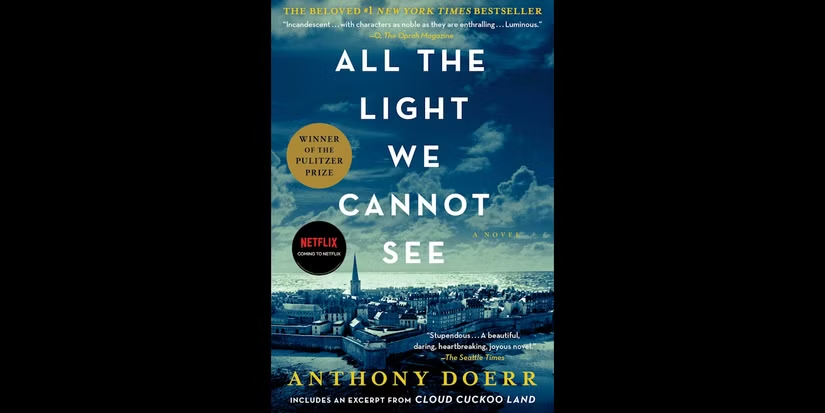



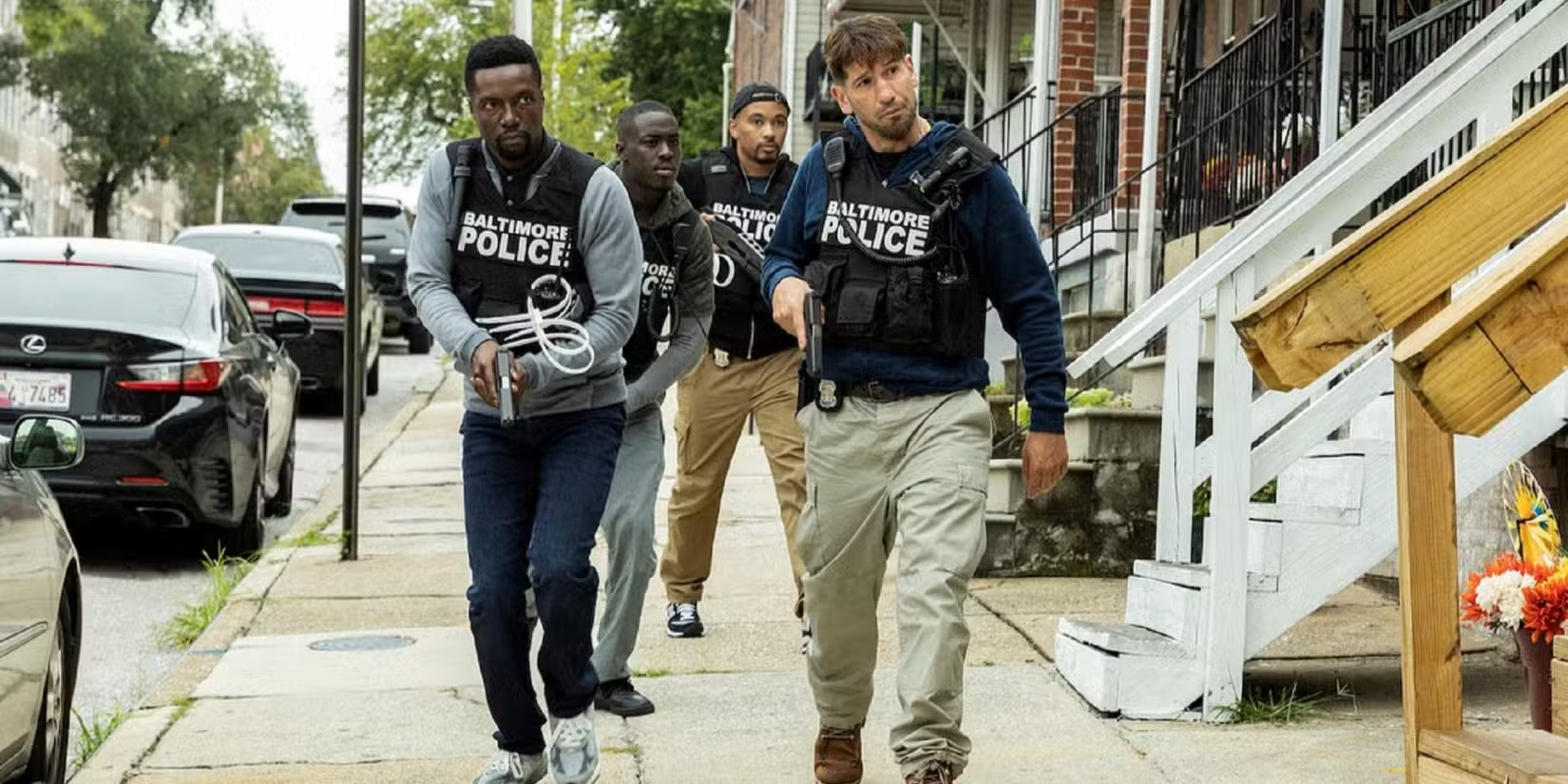


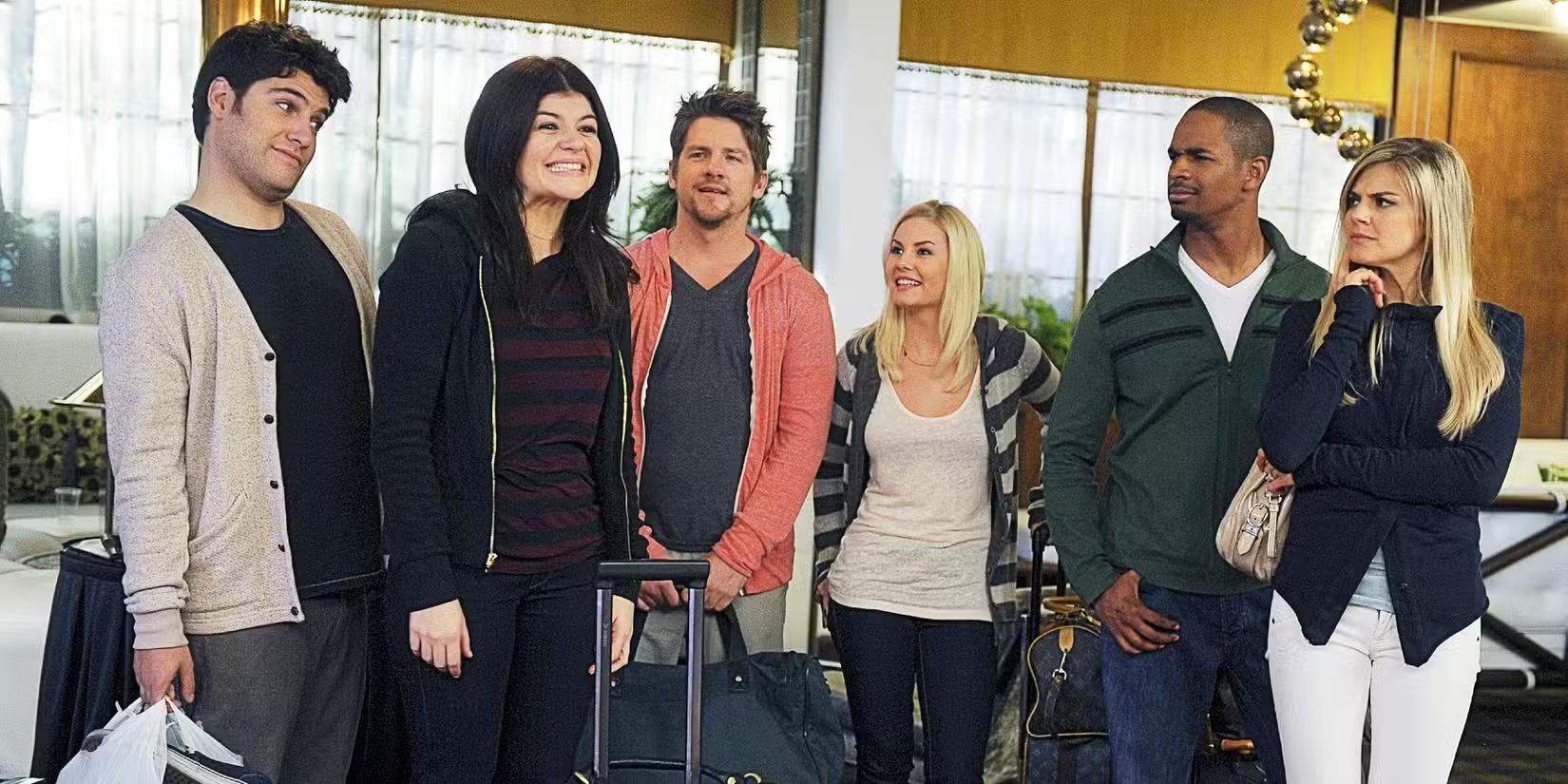








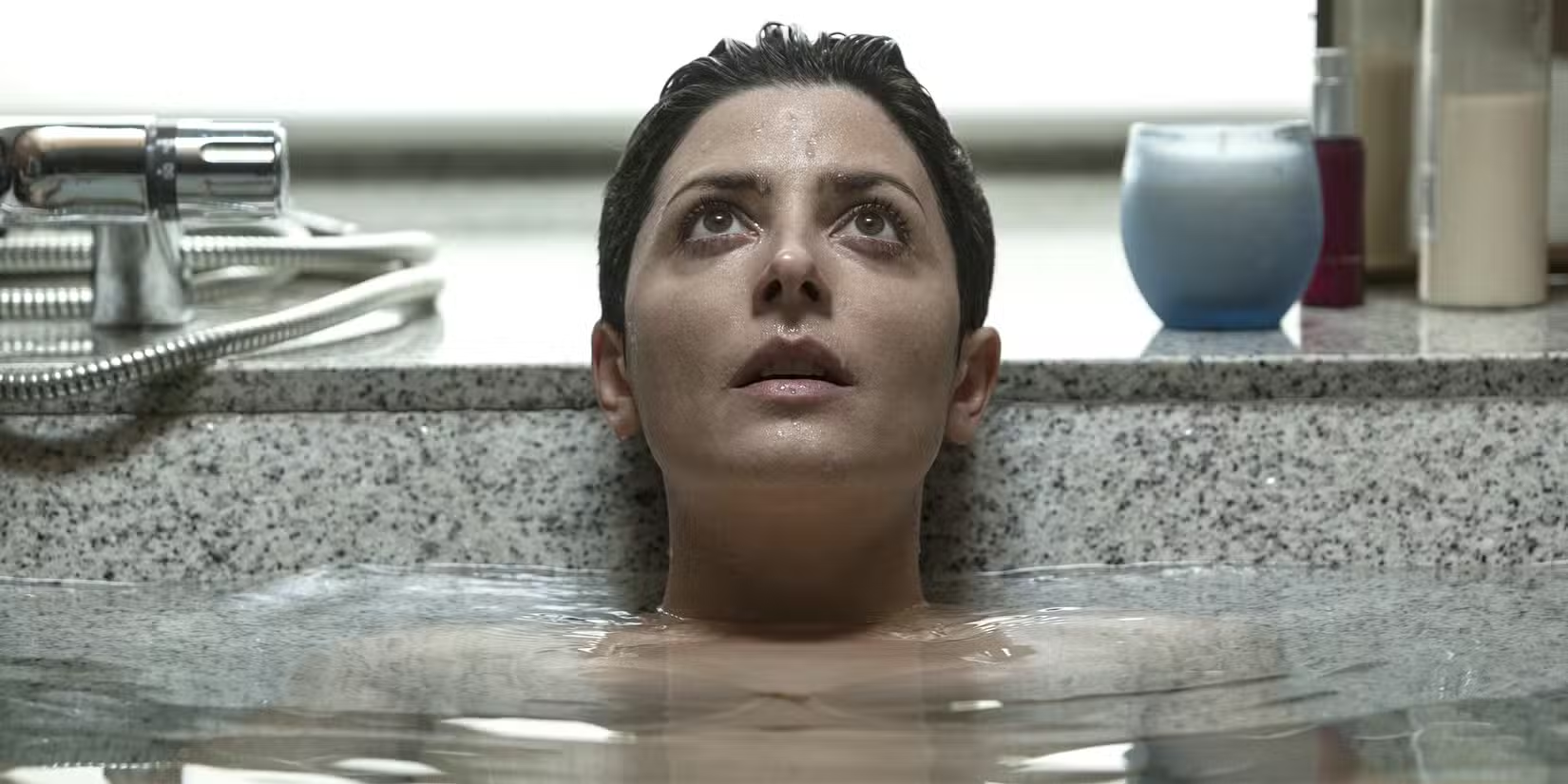



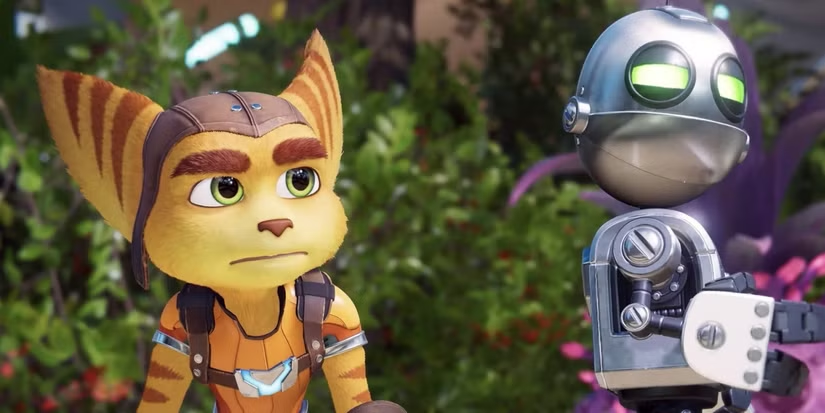


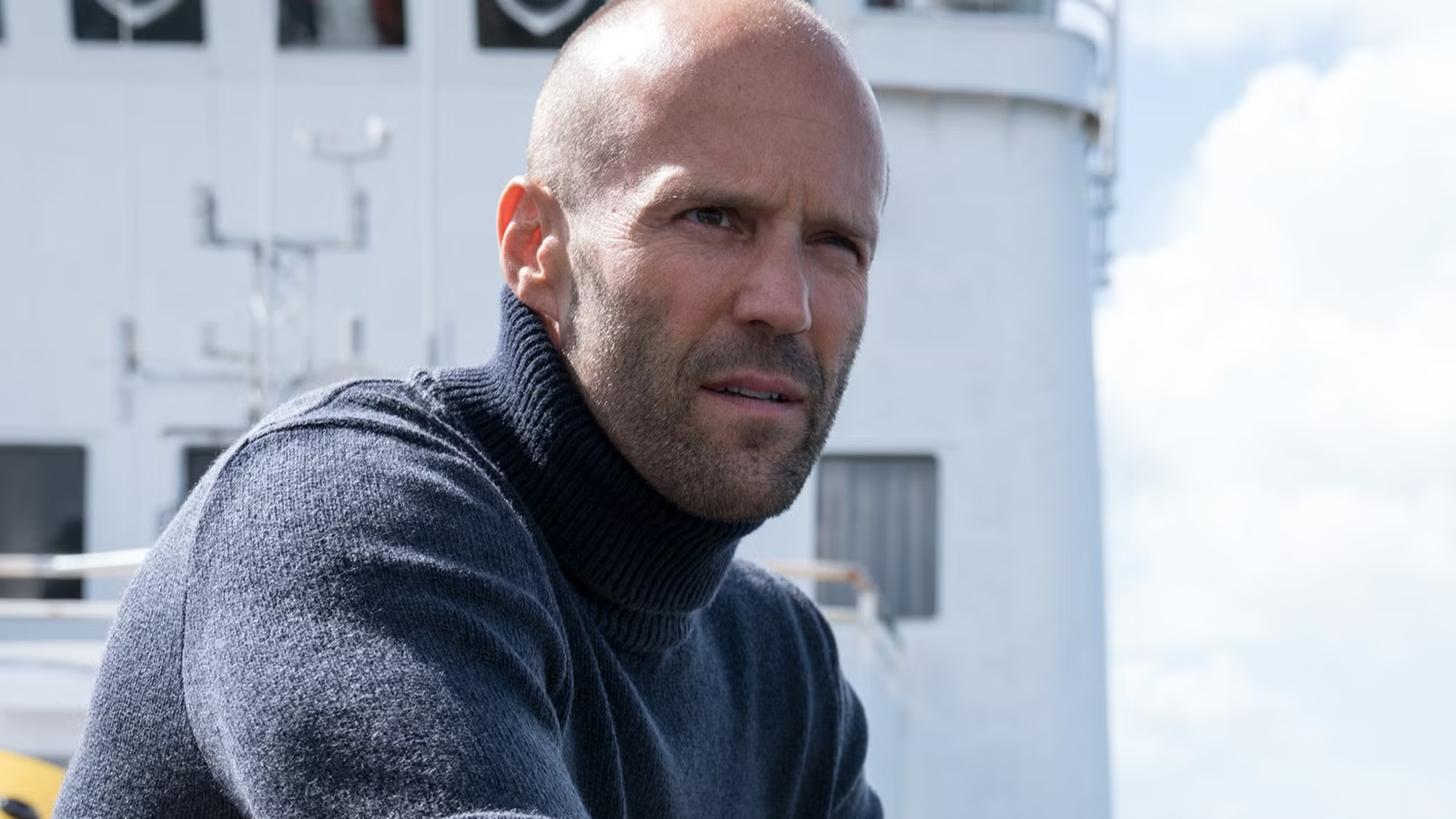

















































You must be logged in to post a comment Login