
Related: Actress Janel Parrish Dances With Sasha Farber After Chris Long Split
Advertisement



Thriller anticipation is different from normal hype. With superhero movies or giant fantasy films, people get excited over scale first. Thrillers have to earn excitement through promise. A setup. A pairing. A trailer beat. A director’s rhythm. One image that tells you the movie might actually get under your skin instead of just filling release-calendar space. That is why ranking upcoming thrillers is so fun and so dangerous. You are not only guessing what will be good. You are guessing which projects already feel like they have tension in their bloodstream.
And 2026 is shaping up to be a very particular kind of thriller year. There is glossy literary psychodrama, post-apocalyptic menace, star-driven action paranoia, one big Guy Ritchie covert-op play, at least one high-concept bank-heist crowd-pleaser, and a couple of projects that feel one trailer away from either exploding or completely disappearing. So this ranking is not about prestige on paper. It is about the projects that, right now, feel most likely to make thriller fans start leaning forward.

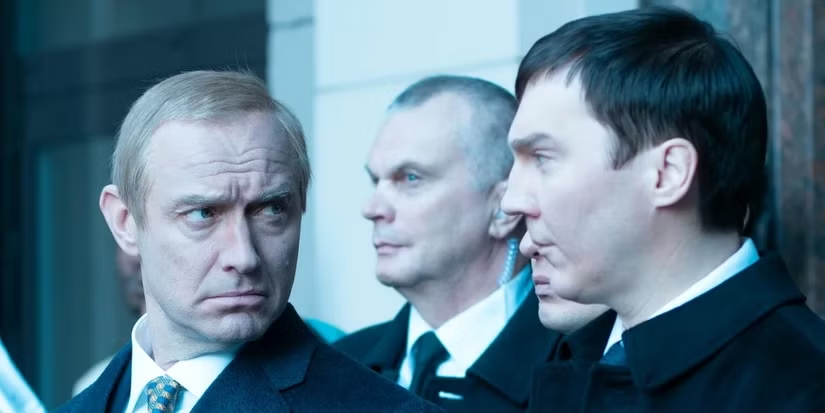
The Wizard of the Kremlin is last only because the anticipation feels cooler and more wary than the title should inspire. On paper, Olivier Assayas directing Paul Dano and Jude Law in a political thriller about power formation around Putin should be catnip. And there is real intrigue in that setup. Jude Law as young Putin is exactly the kind of casting that makes you want to see at least one scene immediately. Vertical acquired North American rights for a 2026 release, so it is not some vapor project drifting in development fog. It is a real movie with a real runway.
But the anticipation is complicated because it has already premiered abroad and the response sounds more mixed than electric. That’s crucial feedback. A thriller lives or dies on urgency, and when the early conversation tilts toward interesting rather than “you have to see this,” the pulse drops a bit. I am still curious, absolutely. Political thrillers with rot at the center always tempt me. But among these eight, this is the one where my anticipation is powered more by concept and cast than by the feeling of an incoming knockout.

Runner has the kind of setup that can suddenly become way more exciting once you imagine the movie moving. Alan Ritchson plays a former soldier thrown into a brutal race against time, and Owen Wilson is there too, which immediately gives the whole thing a slightly weirder flavor than standard action-thriller muscle. Angel Studios added it to its 2026 slate for September 11, and the cast additions make it sound like the film knows exactly what kind of stripped-down pursuit engine it wants to be.
Why is it not higher? Since it still feels a little like a bet on ingredients rather than a bet on identity. Ritchson in danger is easy to buy. A brutal timed mission is easy to buy. Scott Waugh can absolutely deliver physical momentum. But I still need that one detail, the one story kink, one tonal choice, one trailer moment, that turns “this sounds solid” into “I need this now.” Right now, Runner feels promising in a very efficient way. I can already see it being a good night at the movies. I just cannot yet see it being a thriller event.

Mutiny starts with a combination that is already enough to make my pulse pick up a little. Jason Statham plus Jean-François Richet is a strong beginning. The premise helps too: Statham’s character is framed for the murder of his billionaire boss and uncovers an international conspiracy while trying to clear his name. That is old-school thriller fuel in the best sense. Lionsgate has dated it for August 21, 2026, and the project has been steadily locking in cast and release movement rather than wobbling around in rumor territory.
What I like here is that the movie sounds one notch more conspiracy-driven than some recent Statham vehicles, which matters. He is at his best when the action has a little institutional grime under it, when it is not just “one man kills many men,” but one man is being squeezed by a bigger machine and decides to break the machine instead. Mutiny sounds like it might give him exactly that lane. I am not ranking it higher only because Statham thrillers have become a little too automatic as an anticipation object for me. I trust the baseline. I am waiting to see whether this one has an actual nasty streak.

Cliffhanger is a dangerous pick because it could still go completely wrong, but that risk is part of the anticipation. The reboot stars Lily James and Pierce Brosnan, with Jaume Collet-Serra directing, and the released setup is pure high-altitude nightmare: a luxury Dolomites trip turns into a kidnapping ambush, one daughter escapes, and now has to save her father and sister from the mountain and the gang. That is wonderfully direct thriller architecture. Heights, family, isolation, pursuit, exposure, all the old fear buttons lit at once. It is currently lined up for an August 28, 2026 U.S. release, though trade reporting has also noted the distributor situation has had instability, which is worth keeping in mind.
Honestly, the anticipation here is almost entirely tonal. If Collet-Serra really leans into mountain dread, physical geography, and the humiliating terror of vertical vulnerability, this could be terrific. If it goes generic, it is dead. That edge makes it exciting to me. I do not want a prestige reimagining. I want a beautiful panic machine where every step and ledge matters. With James and Brosnan, there is at least a chance the movie understands both glamour and danger. That is enough to push it this high.

How to Rob a Bank already feels fun in the bloodstream. David Leitch directing a heist thriller with Nicholas Hoult, Anna Sawai, Zoë Kravitz, Pete Davidson, John C. Reilly, Christian Slater, and others is such an immediately alive piece of studio scheduling. Amazon MGM has dated it for September 4, 2026, and the trade coverage makes it clear this is not being sold as some small-bore programmer. This is a big Labor Day play with a crowd-friendly engine. The social-media-hooked heist premise only adds to that.
Why is it top three? Since Leitch has the exact kind of skill set that can make this premise sing, not just action fluency, but rhythm, ensemble deployment, vibe control. And Hoult is having a very specific kind of career right now where he keeps feeling one role away from becoming the guy who can anchor slick, dangerous, half-winking thrillers without losing his edge. Add Sawai and Kravitz and suddenly the whole movie starts sounding like one of those criminal-good-time thrillers where attractiveness, velocity, and betrayal all arrive together. This could be empty fun. It could also be really good empty fun, which is one of cinema’s noblest forms.

The Dog Stars is the one some people will call more sci-fi drama than thriller, but the anticipation is absolutely thriller anticipation for me. Ridley Scott directing a post-apocalyptic story about a pilot, a dog, a devastated world, and the possibility of better life beyond the current perimeter already sounds like a movie built around tension and longing in equal measure. Then you add Jacob Elordi, Josh Brolin, Margaret Qualley, Allison Janney, Guy Pearce, and Benedict Wong, and suddenly the whole thing starts looking like one of those intimidatingly stacked projects that either becomes a major late-period Scott triumph or a fascinating near-miss. 20th Century has it dated for August 28, 2026, after moving it from an earlier slot, and CinemaCon footage is already out there teasing its mood.
The reason it is this high is emotional threat. A lot of thrillers promise adrenaline. The Dog Stars promises dread, solitude, and the possibility that one human connection in a broken world might feel more dangerous than gunfire. That is my kind of anticipation. Ridley Scott working in post-apocalyptic mode can still be deeply potent when the imagery and melancholy lock together, and this source material has exactly that kind of bruised scope. Of all the titles here, this is the one that feels most likely to leave me staring at the screen afterward rather than just grinning through the ride.

Verity had to be number one. It just had to. Not because it is guaranteed to be the best movie here, but because in pure anticipation terms it already has the most dangerous cocktail: literary fandom, psychological-thriller architecture, a loaded love triangle, a “hidden manuscript” hook that is basically engineered to make people scream in a theater, and a cast built to weaponize ambiguity. The film stars Dakota Johnson, Anne Hathaway, and Josh Hartnett, with Michael Showalter directing, and Amazon MGM has it dated for October 2, 2026. The teaser is already out, and the early coverage is doing exactly what a thriller campaign should do, selling unease, erotic shadow, and the feeling that the house itself may be keeping score.
And the reason I am most excited for it is that the premise is so gloriously impolite. A struggling writer enters the home of an injured bestselling author to finish her work, finds a manuscript that may or may not reveal monstrous truth, and gets pulled into a family dynamic that already looks diseased before the real suspense even starts. That is catnip. Hathaway playing Verity is catnip. Hartnett back in this kind of dark-romantic-danger lane is catnip. This is the one on the list that most fully feels like a proper: clear the room, I need to see this opening weekend thriller. It has the strongest current under it already.

October 1, 2026
Michael Showalter
Nick Antosca, Colleen Hoover
Anne Hathaway, Stacey Sher, Alex Hedlund, Jordana Mollick, Colleen Hoover, Michael Showalter, Nick Antosca

Janel Parrish and ex-husband Chris Long have finalized their divorce — but neither will legally be considered single for months.
Parrish, 37, and Long revealed in a Monday, June 1, filing obtained by Us Weekly that “unhappy differences have arisen” between that pair that make it “impossible to live together as spouses.”
As such, the estranged couple separated on April 4, officially filing for divorce on April 28.
A judge ruled on Monday that Parrish and Long’s “dissolution of marriage” has been entered into the Superior Court of California County Los Angeles records.
The marital status will be “terminated” and Parrish and Long will be “restored” to single status on October 29, 2026, per the filing.
The exes’ divorce agreement revealed that “spousal support is waived by both parties.”
When it comes to marital assets, both Parrish and Long were awarded “all household furniture, furnishings, artwork, appliances, clothing, jewelry, personal effects, and personal property in [their] physical possession and control,” according to the court docs.

Janel Parrish and Chris Long. Courtesy of Janel Parrish/Instagram
The Pretty Little Liars alum was also awarded her 2019 Audio SQ7, the checking and savings accounts in her name, as well as a pension, retirement and 401K listed in her name.
The exes agreed that Parrish will receive “any and all interests” in the project Sydney vs. Sean.
Long was awarded the checking and savings accounts in his name, pension, retirement and 401K in his name and “any and all equity interest in Apex Water and Process Inc.,” per the docs.
Parrish and Long, who wed in September 2018, will also keep “half interest” in their joint Los Angeles home and half of their Chase Joint Checking Account, which will be “divided” upon the sale of the California property.

Actress Janel Parrish is dancing up a storm with Sasha Farber after her split from husband Chris Long. In a clip posted via Farber’s Instagram on Thursday, April 9, the Pretty Little Liars alum, 37, appeared with the Dancing With the Stars pro, 41, as they danced in a parking lot. “She’s still got it @janelparrish […]
The agreement confirmed that Long is currently living in the L.A. home, but plans to move out this month.
The former spouses agreed to list their shared residence by no later than June 19, which Us can confirm is listed as “coming soon” on Redfin for $3.299 million. The house has four bedrooms, five bathrooms, a pool and two-car garage.
Parrish and Long were married for seven years before news broke of their split. The actress broke her silence on the breakup on April 10.

“Thank you all for the incredibly kind and supportive messages, they’ve truly meant the world,” she wrote via Instagram. “After 10 beautiful years together, including seven years of marriage, Chris and I made the difficult decision to end our marriage.”


The Hallmark actress added, “There is still so much love and respect between us, and I’m deeply grateful for everything we built together. This chapter of my life, and Chris, will always mean so much to me. Thank you all again for the messages of love and support.”
Parrish has since moved on romantically with Dancing With the Stars pro Sasha Farber.
Us Weekly has reached out to Parrish’s attorney for comment.

Mackenzie Shirilla is already complaining of cabin fever as she serves two concurrent sentences of 15 years to life for double murder.
According to a jail audio call obtained by TMZ on Monday, June 1, Mackenzie, 21, complained to her mother, Natalie Shirilla, about her downtime behind bars. Mackenzie expressed frustration that she doesn’t have access to her commissary, an in-facility store that allows incarcerated individuals to purchase various items, including snacks, hygiene products, writing materials and more.
“How am I going to make this one book stretch?” Mackenzie asked, adding that she was not planning on “reading the same book over and over again.”
Mackenzie also told her mother that they need to “figure out this iPad s**t ASAP” so she can communicate with her mother and friends while in prison.

Mackenzie Shirilla opened up about her concerns for the future during a phone call from behind bars, revealing that she is afraid she won’t “be able to have kids” because she would be “old” when she’s released. In the undated jail call between her and her mother, Natalie Shirilla, Mackenzie, 21, discussed the hard realities […]
At one point in their conversation, Mackenzie — who has faced multiple disciplinary actions since her incarceration — complained about how slow the day was going for her.
“Like it’s only 3:30, how is it only 3:30?” she asked. “For real I did not even know it was 3:30 I thought it was like 5. It’s 3:30.”
When her mom asked if she could get a job in prison to help pass the time, Mackenzie claimed she didn’t think it was allowed.
“No, ‘cause of the charges that I have, they don’t let people with charges like me get jobs, so I’m told. I haven’t asked the staff yet though,” she said. “But I probably can’t get a f**king job cause I’m on the seventh floor. They’re probably not gonna let me get a job.”
Mackenzie shared that she was “so irritated” and wanted another book or cards to pass the time.
“Like literally there is nothing for me to do in my room, nothing,” she said.
Mackenzie is currently behind bars at the Ohio Reformatory for Women. She was convicted of 12 felony charges, including murder, during a 2023 bench trial after she drove her Toyota Camry at over 100 mph into a brick wall while her boyfriend, Dominic Russo, and friend Davion Flanagan were passengers in the vehicle when she was 17.

Convicted murderer Mackenzie Shirilla is revealing her post-prison plans, should she ever secure her release. “I’ma be a life coach and stuff,” Shirilla, 21, reportedly told her mom, Natalie Shirilla, via phone from the Ohio Reformatory for Women in Marysville, Ohio, according to audio obtained by TMZ and published on Saturday, May 30. “I’m just […]
Russo and Flanagan were not wearing seatbelts and died as a result of the accident. Mackenzie was the only one to survive despite sustaining severe injuries. Authorities, and later a judge, determined that Mackenzie had intentionally crashed the vehicle and purposefully caused the boys’ deaths.
Mackenzie, who tested positive for marijuana at the time of the incident, has maintained her innocence, claiming she cannot remember the crash. Her case entered the pop culture zeitgeist after it was the subject of the Netflix documentary The Crash.
Unfortunately for Mackenzie, her boredom behind bars is going to remain a constant as she is not eligible for parole until October 2037.
:max_bytes(150000):strip_icc():format(jpeg)/on-screen-couples-reunion-movies-052226-a6411a7bf1274931901b2c3ac17ed8e8.jpg)
Years apart made these superstars’ hearts grow fonder — mostly.
By Chris Snellgrove
| Published

If you didn’t already know, Star Trek has had some truly weird team-ups with Marvel over the years. In Star Trek/X-Men, we got a one-shot comic in which Charles Xavier’s band of merry mutants crossed through time and space to fight alongside (and sometimes with) Captain Kirk and the Enterprise crew. In the later book Planet X, the X-Men had a similar encounter with Captain Picard and his Enterprise-D crew. Of course, these adventures are non-canonical, and we never really got to see any fun live-action crossovers (and no, having Patrick Stewart play Professor X doesn’t count!).
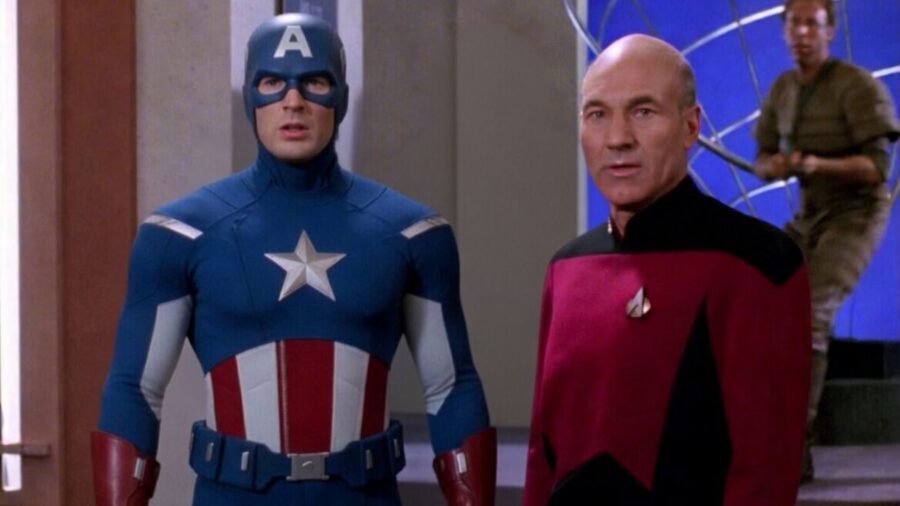
However, in a forgotten Star Trek: The Next Generation episode, we got the closest thing to a live-action crossover with Marvel. In “The Hunted,” the crew must match wits with Roga Danar, a former soldier and fugitive on the run. He ends up being a one-man wrecking machine who fights practically every officer on the entire Enterprise, singlehandedly. How did he pull off such a feat? It turns out that he was a biologically enhanced super-soldier, and this episode was Trek’s way of secretly giving us Captain Picard versus Captain America!

“The Hunted” begins with the Enterprise visiting Angosia III, a planet angling to join the Federation. The planet’s prime minister asks Captain Picard for help with a seemingly routine matter: apprehending an escaped fugitive. This proves easier said than done, and after the crew finally captures this man, Roga Danar, he reveals that the planetary government provided biological enhancements to turn him into a super-soldier. But they were also given psychological conditioning that made them unsuited for peacetime, so when the war was over, they were forcibly resettled. Eventually, Danar frees some fellow soldiers and attacks the capital, and Picard refuses to intervene, claiming this is an internal matter for the planet.
He only appears in Star Trek for a single episode, but Roga Danar is one of the coolest characters in the entire franchise. Once the Enterprise tries to catch him, the former soldier seems hopelessly outmatched. But with strength, speed, and cunning, he frequently foils the high-tech security measures of the Enterprise-D. By the time he’s captured, he goes down swinging: it takes no less than five of Worf’s best security officers to drag this man to the brig (plus, he successfully busts out later). As recorded in Captain’s Logs: The Unauthorized Complete Star Trek Voyages, even showrunner Michael Piller agreed that “the best soldier ever created bringing the Enterprise to its knees is a little hard to believe.”

What made him so unstoppable? While Roga Danar is naturally brilliant and has extensive wartime experience, he also has an ace up his sleeve: he was biologically enhanced by the government of Angosia III to be one of their nearly unstoppable super soldiers. While it’s not name-checked in the episode, this seems like the kinds of Khan-esque genetic modifications that are completely banned in the Federation. That explains why the Enterprise D had trouble catching this guy. To them, he’s a one-of-a-kind soldier. In this way, he is arguably the closest thing that Star Trek has ever had to a Captain America, with this episode foreshadowing some of the Marvel hero’s later onscreen adventures.
What are the parallels between Roga Danar and Captain America? First, each one has been transformed into a super-soldier in order to win a war. Second, each has trouble integrating into society after the war. Danar is forcibly resettled to a different planet, and Cap is put on ice, only to awaken decades later into a very different world. Additionally, Danar discovers he was betrayed by the government. The same thing happens to Cap in the comics when he discovers the president is part of the evil Secret Empire, and in the MCU when he discovers Hydra’s infiltration of S.H.I.E.L.D.

In the Civil War arc of both the comics and the MCU, Cap also has some Danar-esque clashes with otherwise good people because of disagreements about how the government treats enhanced beings like himself. In that regard, at least, Star Trek offers a more optimistic ending. While Cap’s onscreen Civil War struggle ended with his friends in jail and him on the run, The Next Generation showed how Captain Picard tacitly supported Danar’s revolution against his own corrupt government. Showrunner Michael Piller later admitted that some on the staff disagreed with this decision, but he thought adherence to the Prime Directive was “an important enough theme that I cannot explore enough.”
While Picard’s decision was quite surprising, it was arguably still in line with the franchise’s values of respect, diplomacy, and dignity for all living creatures. Captain Picard might have had to fight a thinly-veiled Captain America stand-in, but he managed to save the day by simply listening to what this supersoldier had to say. That showed remarkable restraint considering how many men Roga Danar beat up in his attempts to escape. As a lifelong fan of both Marvel and Star Trek, I’m left with one question: how far could Danar have made it if he had replicated himself a vibranium shield?!?

Euphoria‘s series finale left fans divided — but some viewers are on the same page about a possible spinoff following Jessica Treska‘s fictional religious character who is removed from society.
Treska’s Daisy Miller was introduced in the season 3 premiere as Rue (Zendaya) left the Miller family homestead behind. She later referenced the place many times while calling it the most “peaceful” area she ever visited. Daisy, for her part, showed an interest in Rue’s life since she was so disconnected from the modern world.
Daisy was reintroduced in the finale when Ali (Colman Domingo) visited the farm after avenging Rue’s death by killing her boss Alamo Brown in an epic showdown. He merely told Daisy that her friend was “in a better place” and Daisy was visibly shaken by the news as the group said a prayer in Rue’s honor.
“Why do I suddenly feel like SHE’S gonna become the next narrator replacing Rue,” read a post via X from a viewer. “The way the camera focused on her this episode felt way too intentional.”
While some social media users agreed that there could be more episodes focused on Daisy, others were quick to point out that Euphoria was officially done. Creator Sam Levinson confirmed the news after the Sunday, May 31, finale killed off Rue.
“The honest ending is that people like Rue don’t make it,” Levinson said in a post-finale segment. “People relapse and they f*** up. They’re not ready to get clean. And they weren’t dying like they are now with the influx of fentanyl into this country.”
Levinson recalled his own struggles with addiction.
“I could say with absolute certainty that if I was going through what I went through when I was younger now then I wouldn’t be here either,” he added before referencing Angus Cloud‘s death from an accidental overdose. “There’s no reason to sugarcoat it. I wanted to tell the story for Angus and for people who weren’t granted a second chance.”
Levinson called the finale “an honest ending.” He previously mentioned his plan to dedicate the season to Cloud, who died at age 25 before filming on the final episodes started. During one of Rue’s final moments, she has a flashback to a moment shared with Cloud’s character, Fezco “Fez” O’Neill.
“Some people ask why it took so long between seasons 2 and 3. There were obvious factors — the strikes, trying to make a schedule work with our very in-demand cast, but the real time was in trying to figure out how to find a way to pay respect to those who we lost,” Levinson said at the April premiere event for season 3.
He added: “When Angus died, it was tough. I loved him deeply, and I fought hard to keep him clean. The year he died, in 2023, he was one of 73,000 people in America who died of a fentanyl overdose. I learned a whole lot that year, but what I realized more than anything is that death is what gives life meaning. You can’t be arrogant about existence. You’re forced to reckon with the fact that life itself is a wonder, a gift, a profound blessing.”
Euphoria is now streaming on HBO Max.
:max_bytes(150000):strip_icc():format(jpeg)/Euphoria-Season-3-033026-2-e28085723ea2445880ec562d6a7b0823.jpg)
“I broke down when I read Cassie’s ending,” Sydney Sweeney said.
:max_bytes(150000):strip_icc():format(jpeg)/GettyImages-2205960737-e00340bfd8f6478b9723d40562d1fe29.jpg)
The comedian previously announced a break from the talk show.

By Chris Snellgrove
| Published

Sometimes, the most vulgar phrases happen to be the perfect description of something very specific. For example, what would you call movies like Porky’s, American Pie, and Road Trip? Some critics prefer cagey terms like “raunchy, coming-of-age films;” others prefer simpler descriptors, like “sex romp.” But would you like to know the absolute best term for vulgar, nudity-filled movies aimed squarely at the male gaze? “Boner comedies.” While this genre has been slowly dying thanks to studios shying away from making R-rated content, such films were an absolute staple of the ‘80s, the ‘90s, and the early aughts.
Maybe it’s for the best that they died off, though, as this movie formula was absolutely perfected in 2004. That was the year we got EuroTrip, which seemed at first like a cash-in ripoff of the highly successful Road Trip. But EuroTrip soon proved itself to be the better film thanks to its superior writing, charismatic performances, and beautiful exotic locales. Oh, and an earworm of a song sung by Matt Damon in one of his best (or at least, most hilarious) performances. Fortunately, the best boner comedy ever made is streaming for free on YouTube, meaning you can take this EuroTrip from the comfort of your favorite couch.

The premise of EuroTrip is that a young man named Scotty gets dumped right after he graduates high school. He gets sympathy from a German pen pal named Mieke, who suggests they meet in person. Scotty, thinking his pen pal is a weird sex predator, fires off a cruel response. Soon afterward, his younger brother points out that Mieke is a girl’s name, and Scotty belatedly realizes he has feelings for her. So, he solves his problem the only way he knows how: by traveling through Europe with three of his best friends, with the goal of finally taking a bite out of his pen pal’s very tasty German cake.
As you might have guessed, Scotty’s straightforward plan to meet this girl quickly goes awry, and he and his buddies are sent careening on an insane trip throughout Europe. This leads to most of EuroTrip’s most bonkers comedic moments, like the group accidentally befriending some soccer hooligans in London and doing some absinthe-powered incestuous makeouts in Slovakia. The Eurotripping comedy arguably reaches its peak when Scotty is mistaken for the new Pope, turning his simple quest for booty into a bona fide international incident.

Speaking of international incidents, the best part of EuroTrip might be a running gag in the form of a song. You see, Scotty doesn’t just get dumped: he finds out his girlfriend is cheating on him when the other man (Matt Damon, playing hilariously against type) turns their affair into an insanely catchy song called “Scotty doesn’t know.” Scotty hears it performed live at a party, and it’s such an earworm that even his friends are singing it later. Later, the whole crew discovers that “Scotty Doesn’t Know” has become a chart-topping musical hit that people jam out to, all across the world. Trust me: by that point, you won’t know whether to laugh or simply sing along!
Matt Damon’s not the only one absolutely killing it in EuroTrip. Scott Mechlowicz is perfect as the hangdog Scotty, a kind of beleaguered straight man for his friends to bounce off of. His closest friend is played by Jacob Pitts, whose character is basically a boner comedy mascot: absolutely obsessed with sex and weirdly adept at getting women to expose themselves. The other friends are fraternal twins, with one played by Travis Wester (who plays an open-minded geek who’s still down to clown) and the other played by the late, great Buffy the Vampire Slayer icon, Michelle Trachtenberg (whose character will do almost anything to not be seen as one of the guys).

When EuroTrip came out, it was far from a critical darling. In fact, this movie currently has a 47 percent on Rotten Tomatoes, with critics complaining about the film’s tasteless jokes and abundant nudity. However, these are staples of the boner comedy genre: nobody is watching movies like this for intellectual stimulation or in-depth plots. No, we’re watching this to enjoy hilariously raunchy jokes punctuated by scenes of beautiful naked women, and EuroTrip delivers this double dose (or should that be Double D?) throughout its entire svelte runtime. For this reason, the film quickly became a cult hit, one that has led to decades of fans screaming “Scotty doesn’t know!” at Matt Damon.
Part of why EuroTrip is the best boner comedy ever made is that it doesn’t pretend to have any real goal other than making you laugh. There’s no American Pie-style platitudes about coming-of-age and discovering true love, and there’s no 40-Year-Old Virgin pieties about challenging the way we think about sex and sexuality. No, this film simplifies everything down to the driving ethos of the male gaze: boobs are fun, d*cks are funny, and getting laid is everything. If that sounds offensive, then you should skip this film. If I had you at “boobs,” though, then you should check out EuroTrip right away!

Ready to travel around the world without leaving your couch? No, I’m not talking about drugs, though they might just make your viewing experience that much crazier. I’m talking about watching EuroTrip, which is currently streaming on YouTube. It’s a movie that has a little bit of everything: a cuck hero, a killer song, and Michelle Trachtenberg in a bikini. Plus, you can stream the whole thing for free, which leaves more room for the important things in life. Like, you know, ordering some pizza once the drugs kick in!


By Robert Scucci
| Published

For years, I’ve been saying that YouTube creators, specifically those focusing on analog horror, will be the future of cinema. This past weekend, Backrooms proved my point, and I’m fighting back the urge to spend this entire article gloating about it. But the truth is, I have no right to brag. I’m just a guy who watches a lot of movies. The real hero of the story is Kane Parsons, who built out the Backrooms lore on YouTube and now has his name attached to a directorial debut that brought in $118 million on its opening weekend against a $10 million budget.
He proved the concept that I have been championing for some time now: kids on YouTube have their finger on the pulse, and Hollywood doesn’t.
So, does Backrooms live up to its hype? In so many words, yes. In addition to absolutely cleaning up at the box office, the film currently boasts an intimidating 90 percent critical score on Rotten Tomatoes. It’s worth noting, however, that the Popcornmeter score currently sits at 74 percent. As far as I could surmise, this dip in reception comes from long-time fans of the YouTube series who felt underwhelmed by the film.

Of course, you’ll get avid defenders of all things Backrooms saying that the haters “lack media literacy.” The problem is that nobody knows what “media literacy” means. People are allowed to dislike or feel underwhelmed by things that you like, and calling them “media illiterate” is just a cheap way to avoid engaging with valid criticism, and opening up a wider discussion on something that we’re all rooting for.
As somebody who has been following The Backrooms YouTube series since the early days, I think Backrooms played out exactly how I expected. But I am expecting more at some point, and I’m framing this review around its potential rather than what I got. Kane Parsons has said that he’s not finished, so let’s celebrate the fact that the concept has been proven and see where he takes it.

There have already been countless thought-pieces on Backrooms, so here’s my take. Parsons triumphantly took his vision to the big screen, but it felt like there were caveats. Not in the form of studio interference or anything like that, but in the form of trying to get this thing to appeal to a wide, mainstream audience. The original series on YouTube is a niche thing for an online audience. Distilling its essence down to the most oversimplified terms, it’s found-footage content of a person running through an endless labyrinth of yellow corridors. The environment is oppressively liminal. Its eeriness comes from the fact that everything looks so familiar, yet so uncanny at the same time.
It’s House of Leaves, if House of Leaves could ever successfully be turned into a visual project (it can’t).
But therein lies the problem. While The Backrooms became incredibly popular with online communities, there’s no way to make it appeal to a wide audience without some concessions being made. Think about it. If you’re primed for innovative found-footage experiments set in a liminal hellscape, then you’re already all in.

For a wide release to work, however, there needs to be characterization and some semblance of a story arc. Yes, there’s lore about the Async Research Institute in the original web series, but that’s not enough to get the average person, who maybe watches two or three horror movies a year, invested. So what’s the solution? Clark (Chiwetel Ejiofor) and his therapist, Dr. Mary Kline (Renate Reinsve).
The film tells the story of a bitter, divorced, alcoholic furniture store owner facing bankruptcy, and his accidental discovery of the Backrooms while searching for an electrical disturbance at Cap’n Clark’s Ottoman Empire, the furniture store in which he currently lives after losing his house. There’s obvious tension between him and Mary, who doesn’t believe him when he says he found a seemingly endless stretch of yellow hallways beneath his store, and the film spends a lot of time playing with that dynamic and its inevitable fallout.

While Chiwetel Ejiofor and Renate Reinsve deserve all the praise that’s being thrown at them, their characters’ individual stories are not what drew people into the original YouTube series. It’s the liminal spaces and the never-ending sense of dread that something is always creeping around the next corner, ready to pounce, forcing you to run without thinking, only for you to find yourself even more lost and even more terrified. It’s a feedback loop of nightmare fuel that works exceptionally well in the form of an online mini series.
However, the concept of a Backrooms feature film first had to be proven to put Kane Parsons on the map. There needs to be an actual story to introduce this universe to a mainstream audience, and Will Soodik’s screenplay does so by giving us a compelling narrative about Clark, Mary, and the few other characters they interact with. They both experience a slow-burn psychological horror buildup driven by past traumas and present shortcomings, which manifest within the mysterious realm hidden beneath Clark’s furniture store. In my efforts to keep this spoiler-free, I’ll leave it at this: we get a good story, but I don’t think that’s what people want here.

I’m conflicted in my assessment of Backrooms because I feel like Parsons and Soodik had a pretty impossible task ahead of them. They had to reconcile the sheer vibe and mystery of the YouTube series with a mainstream audience’s need for conventional storytelling. We’re talking about an intellectual property centered around an insidious company trying to map out an endless, theoretically impossible space that looks like an alternate reality that some people just so happen to walk into without any rhyme or reason.
That’s an incredibly hard sell.
That’s like saying, “Hey Mom! You love horror. You have to check out this new movie.” And when she asks you what it’s about, you answer, “Hallways and stuff.” That’s not how a low-budget horror movie makes back 12 times its budget (and counting).

Knowing this, Soodik and Parsons give us Clark and Mary, along with Mark Duplass’ Phil, one of the researchers working for Async. It succeeds with a mainstream audience because it attaches a human element to a place that lacks humanity. And if you want up-and-coming filmmakers to have a chance at all, their debut can’t just appeal to your niche interests. Your mom, or whoever in your mind is a casual genre fan, needs to buy into it too.
So, did Backrooms live up to the hype? Absolutely. More importantly, it proved that esoteric concepts coming from teenagers on YouTube are helping pave the way for a horror renaissance, and we have Kane Parsons, who was 17 years old when he started posting the shorts to YouTube, to thank for that. He took something niche and put it in front of a wide audience, and generally speaking, they’re gobbling it up. Now that the concept has been proven, I hope Parsons is given total creative freedom he deserves to continue building this thing out.

For now, I feel confident in my assessment that Backrooms needed its storytelling to succeed and capture the world’s attention and imagination. Now that general audiences know what the Backrooms are as a concept, I think Parsons is smart enough to run with the premise and keep building it out however he sees fit. This is the start of something beautiful, and any disappointment you have about how the storytelling was handled in the film should be gut-checked with the following question: If the whole thing played out like an extended version of the YouTube shorts, would your mom even consider watching it?
In this case, we need to think about Backrooms, not in terms of the movie that diehard fans want to see, but rather the movie that mainstream audiences need to see.

Backrooms saw its theatrical release on May 29, 2026.
It all began with a goatee-wearing Spock (Leonard Nimoy) in the Star Trek Mirror Universe. The concept of the Mirror Universe within Star Trek premiered in 1967, and it didn’t just introduce parallel worlds to sci-fi television—it essentially invented the visual language of the evil counterpart. The iconic Mirror Universe will forever be known as the multiverse genre’s godfather, but that concept has only shown up as a recurring guest star across different eras and shows—rarely as the main character.
The same is true for Doctor Who, a show that has happily hopped into parallel worlds for decades now but treats them more like vacation destinations than home addresses. While the show is a landmark, in this list, we’re celebrating those that didn’t just visit the multiverse but found a home and made it their storytelling engine. These are the greatest sci-fi shows with parallel universes, ranked from lighthearted escape to emotional ruin.

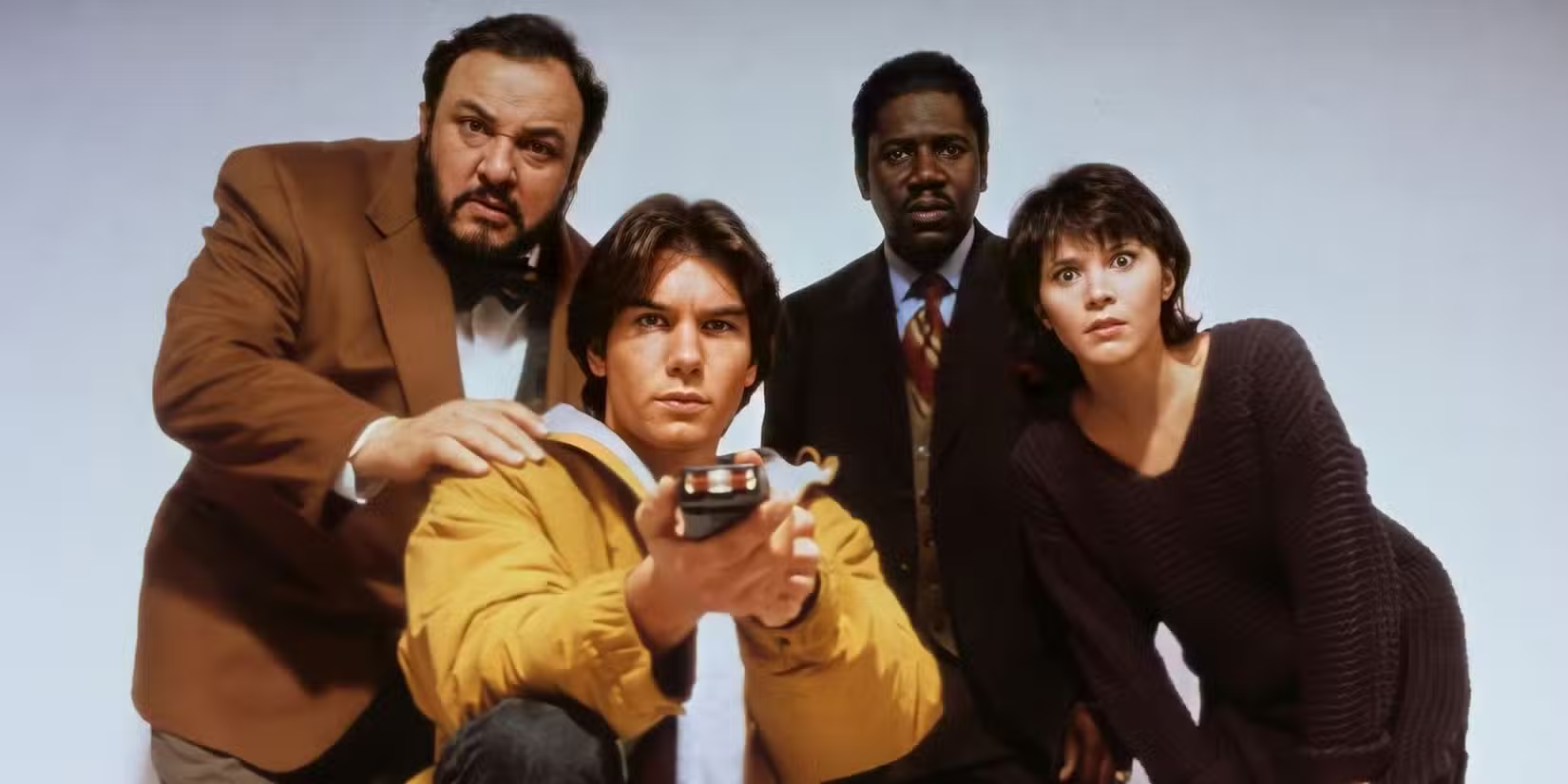
Sliders is an accessible, entry-level parallel universe show, and it earns its place as the tenacious trailblazer that walked so others could run. It was never the most sophisticated version of the concept; the later seasons, in particular, leaned heavily on camp, while behind-the-scenes chaos and mid-show changes saw key cast members leaving. It was canceled after five seasons, but for what it’s worth, we can’t mention the history of multiverse television without mentioning this scrappy little show. Ambitiously written, Sliders was one of the shows that made folks in the ’90s fall in love with sci-fi.
Sliders follows brilliant graduate student Quinn Mallory (Jerry O’Connell), who invents a device to travel between parallel Earths. While at first, he and his ragtag group of friends hop over to parallel worlds seamlessly, the tech malfunctions and forgets their real dimension. Every episode brings a new “what if” into the mix, from Soviet-controlled America and a dinosaur-populated Earth to a world where time runs backwards, transforming philosophical thought experiments into Saturday afternoon adventure.

Dark Matter is less about jumping between wildly different Earths and more about the creeping terror of infinite roads not taken. The protagonist goes through an infinite number of “what ifs,” which sometimes turns into a terrifying metaphor for the paralysis of regret. The series, starring Joel Edgerton in a dual role and Jennifer Connelly as the woman at the center of the drama, is a tightly written paranoid thriller that, while seemingly predictable, never reveals its next move.
Dark Matter is based on Blake Crouch‘s novel of the same name (Crouch also wrote the show’s script). It follows physics professor Jason Dessen (Edgerton), a well-off family man who is kidnapped, drugged, and awakens in an alternate Chicago where he is celebrated as a scientific genius—but his wife is not his wife. The kicker? He was kidnapped by another version of himself, a Jason who had made a different romantic choice fifteen years before and created a machine that opens doors to distinct, fully realized parallel universes. If you like this premise, Dark Matter promises a hard sci-fi story that will make you consider your own “what ifs.” Season 2 is coming soon, and it will go beyond the novel’s conclusion, making this a box that is just being opened.

The Man in the High Castle is not a show about scientists hopping through a multiverse; rather, it is a slow-burn espionage thriller in which knowledge of another reality is the most dangerous weapon possible. The series deserves its place because it successfully combines high-concept sci-fi with a grounded, character-driven story about fascism and resistance. Its parallel universe element is powerful, albeit sparingly used, and the show is first and foremost a dystopian masterpiece, then a multiverse story. However, the multiverse aspect is central to its resistance, making it difficult to separate from the genre.
The Man in the High Castle, based on Philip K. Dick‘s novel of the same name, is a dystopian nightmare that introduces one of the most chilling “what ifs” in modern history: what if the Axis powers won World War II? The series is set in a meticulously imagined 1960s America ruled by Japanese and Nazi forces, and it features various characters from both the resistance and the establishment. When a parallel universe is discovered in mysterious film reels, including one in which the Allies triumph, the films become a form of contraband and spiritual totems that prove a better world exists somewhere—igniting the desire to fight. The Man in the High Castle is not your typical parallel universe show, but it’s one of the best.

It’s almost cheating to include Rick and Morty because the show is more akin to Doctor Who—until a very specific point when its protagonists settle in a parallel universe. Rick Sanchez (Justin Roiland and Ian Cardoni), the protagonist, owns a portal gun, allowing him to travel to a new universe every week. However, his actions force him and his family to permanently abandon their original dimension and move to a replacement one. This doesn’t just happen once, either, but twice, and Rick’s family now has to inhabit multiple, alternate universes.
Rick and Morty follows Rick, the most intelligent man in the universe, and his meek grandson Morty (Roiland and Harry Belden), who travel between realities and engage in various adventures and mishaps; most of the show focuses on their individual journeys, but some parts have an impact on the bigger picture. Their multiverse hopping is a fact that the show uses to create everything from wildly inventive sci-fi concepts to the darkest possible nihilistic comedy. The multiverse is both a playground and an existential loophole; Rick and Morty isn’t about settling into one parallel world but about the nihilistic freedom of knowing that no single reality matters.
Loki is a prime example of Marvel’s multiverse, and its genius lies in its design. Set in a retro-futurist world, the show’s visual language makes the infinite feel claustrophobic while never revealing its true location in time and space; Tom Hiddleston delivers a career-best performance as the character he is best known for. Loki is a standalone story about parallel universes that happens to be part of a larger franchise, and while its inherent affiliation with a corporate machine makes any anti-corporate messages seem like an oxymoron, it still succeeds as a visual and narrative triumph.
Loki follows Loki, the God of Mischief himself, getting arrested for crimes against the multiverse. During the events of Avengers: Endgame, he is plucked from his timeline and transported to the bureaucratic nightmare of the Time Variance Authority, an organization that trims any timeline that does not adhere to the predetermined “Sacred Timeline.” What follows is a breathtaking two-season journey that transforms Loki from a narcissistic trickster to a man literally holding the fabric of reality together; it demonstrates how a Marvel villain can become an (anti)hero and how any character can be redeemable if they make the right moral decision.

His Dark Materials features parallel worlds that don’t just feel like copies of Earth but have distinct and meticulous world-building; from the haunting, specter-infested city of Cittàgazze to the Land of the Dead, each realm has its own mythology and physical laws. The show uses the multiverse to employ themes of consciousness, authority, and free will, producing an adaptation that upholds its source material’s unwavering critique of organized religion and blind dogma. It’s a full-fledged, satisfying journey that leans slightly more toward fantasy than pure sci-fi but is a stunning achievement regardless.
His Dark Materials is a BBC and HBO adaptation of Philip Pullman’s beloved trilogy, following young Lyra Belacqua (Dafne Keen), a child of a world that looks similar to ours but is run by a totalitarian regime, and every human has an animal daemon—a physical manifestation of their soul. Lyra is prophesied to be a human who will change the world, and those around her are either working with or against her to achieve their ultimate goal. It’s entertaining, lore-heavy, and stars a fantastic cast; shame it’s heavily underseen.

J. J. Abrams‘ Fringe didn’t just play with the idea of a parallel universe; it centered its entire emotional core on it. The premise appears deceptively simple: members of an FBI “Fringe Division” investigate bizarre, scientifically flawed cases, but the show gradually unravels a devastating saga about two universes—ours and the Other Side—locked in a slow-motion collision, a war that began when someone from our world tampered with the events of the Other Side, causing havoc and precipitating an unavoidable collision of worlds. It’s emotionally devastating television and a watershed moment in science fiction.
Fringe‘s third season especially has entire episodes devoted to the Other Side’s point of view. Anna Torv portrays FBI agent Olivia Dunham and her alternate “Fauxlivia” with completely different body language and emotional registers, while John Noble‘s two Walter Bishops are a masterclass in duality. The alternate universe is more than just a reflection; it’s a fully realized world with its own history, including an oxidized bronze Statue of Liberty rather than green. Fringe makes you fall in love with both universes before asking you to watch them destroy each other, doubling the stakes and creating incredible, memorable television.

The German Netflix masterpiece Dark is a work of narrative genius. From screenwriting to meticulous casting, every aspect of this show culminates in an emotionally cathartic and philosophically breathtaking finale. The show uses its parallel world as a piece of a puzzle to explore themes of fate, free will, and the lengths people will go to avoid pain. It’s a three-season work of art that demands and rewards complete attention (and repeat viewings). Dark is, by any standard, one of the greatest science-fiction achievements in television history.
Dark is, on the surface, a time-travel story about four interconnected families in the small German town of Winden. At its heart is Jonas (Louis Hofmann), a teenage boy who discovers a cave in the woods near Winden, revealing several tragic timelines that were unintentionally broken by a grieving scientist. There’s also Jonas’ romantic interest, Martha (Lisa Vicari), who becomes integral to a parallel universe, a priest affiliated with a time-traveling cult, and a child who appears to be the cause of the tear in the multiverse. Dark is a meticulously crafted web that ultimately feels like its creators’ magnum opus, as well as a series that they themselves are still struggling to understand.

Counterpart is an underappreciated series, which is a bummer because it’s one of the best sci-fi shows ever made. It depicts parallel universes that have been transformed into starkly different environments over decades of tampering, but the show’s true genius lies in watching J. K. Simmons play two different versions of the same man: one broken and the other a hardened, ruthless spy. The show gradually reveals to us that they are both, in their own ways, the same wounded soul. Counterpart is a spy thriller, a philosophical reflection on human nature, and a tragedy about the life choices we don’t get to experience. The show was cancelled after only two perfect seasons, which could be the cruelest thing to happen in any universe.
Counterpart stars Simmons in two roles: Howard Silk, a meek, low-level bureaucrat at a mysterious Berlin-based UN agency, and Howard Silk Prime, his counterpart from a parallel Earth created when a Cold War experiment went wrong. For thirty years, the two worlds communicated through a checkpoint in a basement, resulting in espionage between the two dimensions, raising mistrust and wreaking havoc; Howard meets Howard Prime, and the two begin looking for the true purpose of the checkpoint. Counterpart is perfect for so many reasons, from its beautiful precision and impressive performances to its unexpected but heartfelt humanity.




Israel says it has killed new Hamas military leader in Gaza City airstrikes


NASA taps Blue Origin to deliver lunar rovers for Moon Base initiative


This is BROKEN! INSANE 5x MONEY CAR WASH WEEK! The NEW GTA Online UPDATE Today! (GTA5 New Update)


XRP *JUST* SUCCEEDED!!!! CLARITY ACT EXPOSED!!! (SHE EXPOSED IT)

Micron Crosses $1 Trillion Market Cap as AI Demand Reshapes Memory Sector


Selena Gomez Reportedly Upset Over Benny Blanco’s Comments on Her ‘Terrible’ Diet

SpaceX just won a second Golden Dome contract. This one is $4.16 billion.


Waymo dominates autonomous vehicle registrations as Tesla trails behind


Days of our Lives 2-Week Spoilers May 25-June 5: Gwen Rages, Abe Confesses & 2 Tragic Anniversaries!


SHE IS KILLING XRP!!! WATCH URGENT AND ACT FAST

FIRST NIGHT REVIEW: Take That bring the Circus back to life in spectacular sun-soaked style


The Samsung pay deal is the moment Korean unions changed register


Millions of AI agents imperiled by critical vulnerability in open source package


Jade Biosciences, Inc. (JBIO) Discusses Positive Interim Results From JADE101 Phase I Healthy Volunteer Study and Development Plans Transcript
SpaceX’s $2 Trillion IPO: Why Tech Giants Nvidia (NVDA), Apple (AAPL), and Microsoft (MSFT) May Face Pressure
CFTC Has Approved the First Regulated Bitcoin Perpetual Contract in the U.S.


Family pay tribute to Eston ‘murder’ victim Peter Phillips


Spain blocks prediction markets Polymarket Kalshi

Bitcoin’s April recovery showed signs of structural accumulation
The Most Misunderstood Sci-Fi Horror Movie of the Last 10 Years Just Took Over Netflix
You must be logged in to post a comment Login