The run-up to the 2026 Commonwealth Games was dominated by one question: Where would India’s medals come from?
The reduced 10-sport programme meant several disciplines that have traditionally driven India’s success at the Games, such as shooting, wrestling, badminton, table tennis, hockey and cricket, were no longer part of the schedule. Together, those sports accounted for 31 of India’s 61 medals — just over 50 per cent — at the Birmingham Commonwealth Games in 2022, forcing disciplines such as athletics, weightlifting and boxing to shoulder a greater share of the medal burden.
While athletics and weightlifting delivered, India’s boxers produced one of the country’s finest Commonwealth Games campaigns in Glasgow, contributing 10 medals, including seven gold and three silver. More significantly, every Indian medallist reached the final, underlining the depth and consistency of the programme across weight categories.
Over the last five editions of the Commonwealth Games, boxing has emerged as one of India’s most dependable medal-winning disciplines. The trend is visible not just in the number of medals won but also in the efficiency with which the national programme has converted its squads into podium finishes, the growing contribution from the women’s team and the sustained consistency across major international competitions.
The numbers suggest Glasgow was not the beginning of India’s boxing success but the latest milestone in a programme that has steadily expanded its talent pool and competitive depth. With seven gold medals, India’s boxers enjoyed their most successful Commonwealth Games campaign, reinforcing the country’s status as one of the leading boxing nations in the competition.
Full list of India’s medal winners in boxing at the Commonwealth Games 2026:
Medal |
Event |
Athlete |
Gold |
Women’s 51kg |
Preeti Pawar |
Gold |
Women’s 54kg |
Sakshi Chaudhary |
Gold |
Women’s 57kg |
Jaismine Lamboria |
Gold |
Women’s 60kg |
Priya Ghanghas |
Gold |
Women’s 66kg |
Arundhati Choudhary |
Gold |
Men’s 55kg |
Sachin Siwach |
Gold |
Men’s 65kg |
Ankush Panghal |
Silver |
Women’s 75kg |
Lovlina Borgohain |
Silver |
Men’s 50kg |
Jadumani Singh |
Silver |
Men’s 90+kg |
Narender Berwal |
How India improved their medal conversion
Success at a multi-sport event is often measured by the number of medals a team wins. That metric, however, says little about how effectively a programme has performed.
A stronger indicator is medal conversion — the percentage of athletes selected who return with a medal. The measure removes much of the noise associated with squad sizes and offers a clearer picture of how efficiently a national programme turns opportunity into success.
That is where Glasgow 2026 marks a significant step forward.
India travelled to the Birmingham Commonwealth Games in 2022 with a 12-member boxing contingent and returned with seven medals, giving the team a medal conversion rate of 58.3 per cent. Four years later, 10 of the 14 selected boxers finished on the podium, lifting the conversion rate to 71.4 per cent.
The improvement becomes more significant when viewed alongside the larger squad size. Bigger contingents generally make it harder to maintain a high medal conversion because success has to be spread across more weight categories. India’s ability to improve both its medal tally and conversion rate suggests the country’s boxing programme has developed greater depth across the squad rather than relying on a handful of elite performers.
India’s boxing medal conversion: Birmingham 2022 vs Glasgow 2026
Edition |
Contingent |
Medallists |
Medal conversion (%) |
Birmingham 2022 |
12 |
7 |
58.3 |
Glasgow 2026 |
14 |
10 |
71.4 |
Improving the selection process
One reason behind India’s improved performance has been the increasingly competitive domestic selection process. Unlike previous Olympic cycles, places in the national team are no longer secured by reputation alone. Regular national championships and selection trials have created greater competition in every weight category, forcing even established internationals to consistently earn their place.
That competition appears to have raised the overall standard of the squad that travelled to Glasgow. Instead of relying on a handful of proven names, India fielded genuine medal contenders across almost every division, reducing the gap between its leading boxers and the rest of the national team.
The result was a campaign in which success was spread across the contingent rather than concentrated among a few individuals. That may ultimately prove to be Glasgow’s biggest takeaway because programmes capable of converting a greater proportion of their squads into medallists tend to sustain success longer than those dependent on exceptional athletes.
The rise of female boxers
If Glasgow had one defining feature, it was the growing influence of India’s women’s boxing programme.
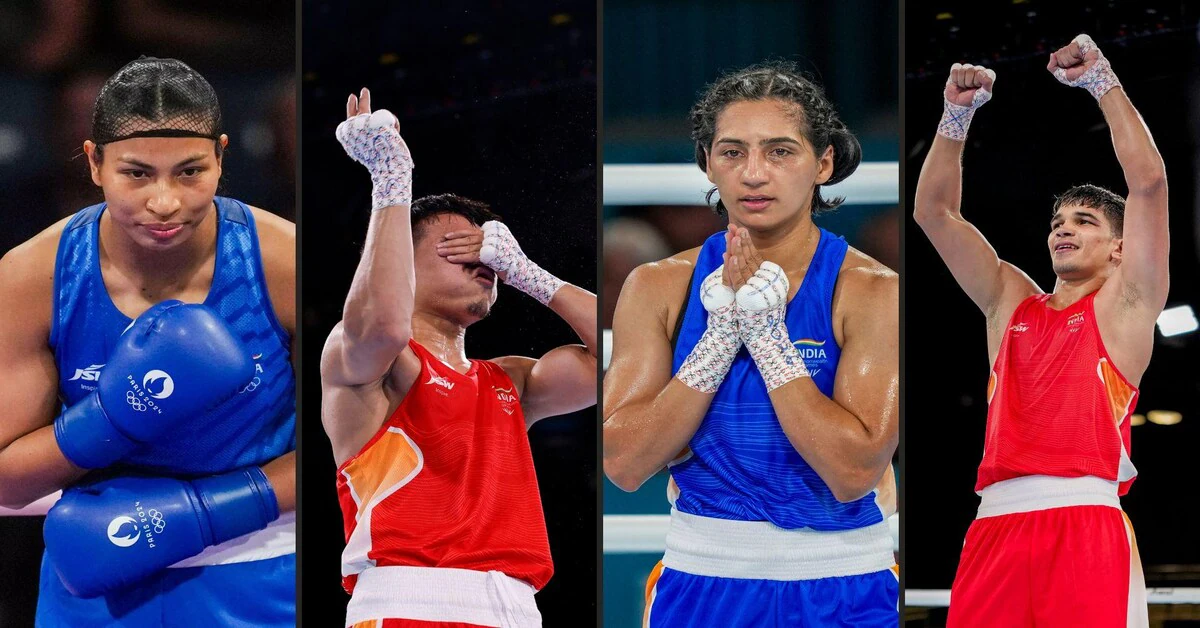
At Birmingham, women contributed three of India’s seven boxing medals despite making up less than half of the contingent. Four years later, they went a step further, winning six of India’s 10 boxing medals, including five gold medals, making them the driving force behind India’s most successful Commonwealth Games boxing campaign.
The shift is significant because it has fundamentally changed the way India approaches a boxing competition. Success is no longer expected to come primarily from a handful of experienced male boxers. Instead, the women’s team has emerged as the backbone of India’s medal challenge.
The transformation has been driven by continuity rather than one exceptional generation.
The success of Olympic medallist Lovlina Borgohain has been complemented by the emergence of a younger group featuring Preeti Pawar, Sakshi Chaudhary, Jaismine Lamboria, Priya Ghanghas and Arundhati Choudhary. Unlike previous Commonwealth Games cycles, where India’s medal hopes often centred on one or two established names, Glasgow saw multiple women reach the podium across different weight categories.
That depth has not emerged overnight. Successive performances at the World Championships and Asian Championships have provided younger boxers with exposure against stronger opposition before arriving at the Commonwealth Games. More importantly, internal competition within the women’s squad has intensified, making national selection considerably more competitive than it was four years ago.
For Indian boxing, that may be the biggest shift since Birmingham. The women’s programme is no longer complementing the men’s team. It is increasingly setting the benchmark for the entire squad.
India’s women boxers with Commonwealth Games 2026 medals (PIC: PTI)
Women’s contribution to India’s boxing campaign: Birmingham 2022 vs Glasgow 2026
Edition |
Women in squad |
Women medallists |
Women’s share (%) |
Birmingham 2022 |
5 |
3 |
42.9 |
Glasgow 2026 |
7 |
6 |
60 |
Greater squad depth
One of the biggest limitations of Birmingham was India’s dependence on a relatively small group of proven international boxers. While experienced names delivered medals, the gap between the leading athletes and the rest of the squad remained evident.
Glasgow painted a different picture.
India’s campaign was built across almost every section of the draw, with both experienced campaigners and younger boxers contributing to the medal tally. That spread reduced the programme’s dependence on individual champions and provided greater insurance against early exits in any one weight category.
The change reflects improvements in the domestic system as much as performances inside the ring.
Competition at the national championships and selection trials has become increasingly intense, with several weight categories featuring multiple international-standard boxers. Securing a place in the Commonwealth Games squad has therefore become a significant achievement in itself, forcing athletes to maintain consistency rather than rely on past performances.
That internal competition has also accelerated the transition between generations.
Instead of waiting for established boxers to retire before introducing replacements, the programme has gradually integrated younger athletes into senior international competitions. As a result, Glasgow featured several first-time Commonwealth Games boxers who arrived with experience from World Boxing events, Asian competitions and overseas exposure tours rather than making an abrupt jump from the domestic circuit.
The wider talent pool also gave the coaching staff greater flexibility while selecting the squad. While that may not always guarantee a higher medal tally, it creates a programme that is considerably more resilient over an Olympic cycle.
When success is spread across the squad rather than concentrated among a few individuals, fluctuations in form or injuries become less damaging to the team’s overall performance. India’s 10-medal haul in Glasgow suggests the boxing programme has developed the depth required to remain a consistent medal contender at major multi-sport events.
Squad comparison: Birmingham 2022 vs Glasgow 2026
Metric |
Birmingham 2022 |
Glasgow 2026 |
Total contingent |
12 |
14 |
Men |
7 |
7 |
Women |
5 |
7 |
Medallists |
7 |
10 |
Medal conversion (%) |
58.3 |
71.4 |
International performances and a stronger support system
Glasgow may have been where India’s progress became most visible, but the foundations had been laid much earlier.
The success at the Commonwealth Games did not emerge in isolation. Over the previous two years, India’s performances across major international competitions had already pointed to a deeper and more competitive talent pool than the one that travelled to Birmingham in 2022.
The biggest gains came from the women’s programme. India returned from the 2025 World Boxing Championships with four medals, including world titles for Jaismine Lamboria and Minakshi Hooda, reaffirming its ability to compete well beyond the Commonwealth circuit. The momentum continued at the Asian Boxing Championships, where India finished with 16 medals. More importantly, the success extended beyond a handful of established names, indicating that the pipeline of international-level boxers had grown stronger.
The men’s team followed a similar trajectory. While it did not enjoy the same medal haul as the women at the World Championships, a younger group gained valuable experience through World Boxing events, Asian competitions and overseas training camps. By the time the Commonwealth Games began, several of India’s first-time campaigners had already faced opponents of a higher standard than those they encountered in Glasgow.
The coaching effect
The Boxing Federation of India also reshaped the coaching structure ahead of the 2026 Commonwealth Games, bringing back Dronacharya awardee CA Kuttappa to head the men’s team while Santiago Nieva returned to oversee the women’s programme. Although both appointments came only months before Glasgow and cannot solely explain the team’s success, they inherited a system that was already moving in the right direction.
Equally important was the continuity in preparation. Unlike previous Olympic cycles, when changes in coaching and administration often disrupted momentum, the current group benefited from a more structured calendar of national camps, international exposure and regular competition. That consistency helped narrow the gap between domestic success and international readiness, allowing more boxers to arrive in Glasgow with experience against quality opposition.
India’s 10-medal haul, including seven gold medals, was therefore not the result of a single successful tournament. Instead, it reflected the steady progress of a programme that had strengthened its talent pipeline, improved its preparation and created a system capable of producing medal contenders across multiple weight categories.
Commonwealth success still needs an Olympic answer
Glasgow answered many of the questions that followed Birmingham. It did not answer the biggest one.
Indian boxing has long enjoyed success at the Commonwealth Games, but translating that form to the Olympics and the Asian Games has proved considerably more difficult. The reasons extend beyond India’s own programme.
The Commonwealth boxing field is significantly smaller and does not include several of the world’s strongest nations, including Uzbekistan, Kazakhstan, Cuba, China and Japan. Those countries have dominated Olympic and World Championship boxing over the past decade, meaning Indian boxers often face a much tougher path at those events than they do at the Commonwealth Games.
That difference does not diminish India’s achievement of winning 10 medals, including seven golds, in Glasgow, but it does place the performance in perspective.
The improvement from Birmingham suggests India has strengthened its domestic pipeline, expanded the depth of its women’s programme and created greater competition within the national squad. Those are essential ingredients for sustained success, but they are not, by themselves, proof that India has closed the gap on the world’s leading boxing nations.
The next stage of this programme will therefore be measured away from the Commonwealth Games. The challenge for the Boxing Federation of India and the new coaching setup will be to ensure the depth visible in Glasgow is reflected at the World Championships, the Asian Games and, ultimately, the Los Angeles Olympics in 2028.
If Birmingham was about rebuilding confidence, Glasgow was about demonstrating the progress that Indian boxing has made. A record haul of 10 medals and seven golds suggests the programme is moving in the right direction. Whether that progress translates into sustained success against the world’s strongest boxing nations will determine the true significance of Glasgow 2026.























































You must be logged in to post a comment Login