Connect with us

NewsBeat

Appeal for missing man from Bradford last seen in Norton

Published

on

Appeal for missing man from Bradford last seen in Norton

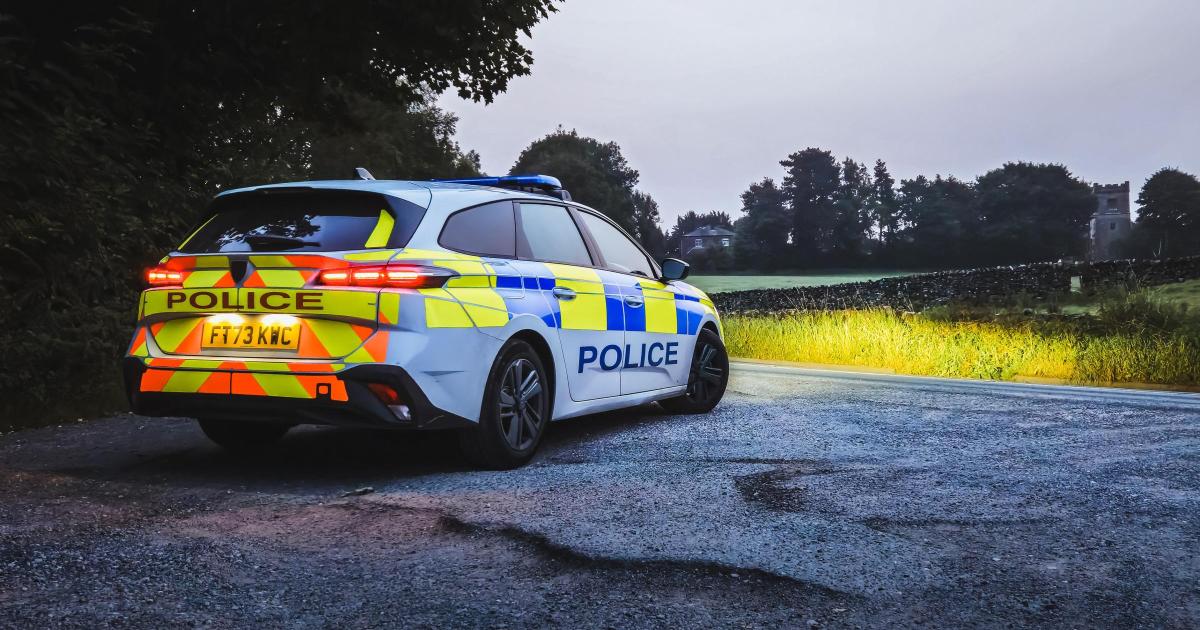
A MAN from West Yorkshire last seen in the Ryedale area of North Yorkshire has gone missing, prompting an urgent appeal from police.

The man has recently been staying in Scrayingham, a village a few miles north-east of Stamford Bridge and was last seen in Welham Road, Norton at 8.25am on Friday, August 28.

North Yorkshire Police describe him as white, around 6 feet tall, of medium build, with green eyes, short light brown hair, and a well-kept short beard.

Advertisement

Recommended reading:


He was last seen wearing a black hoodie, grey trousers, black shoes, and carrying a black backpack.

A police spokesperson said: “Any immediate sightings of the man should be reported by dialling 999 so we can quickly ensure he is safe.”

Other information can be reported by calling 101 and quoting reference number 12260168826.

Advertisement

Source link

Continue Reading
Click to comment

You must be logged in to post a comment Login

Leave a Reply

NewsBeat

Nepal flood disaster survivor shares details of miraculous escape

Published

on

Daily Mirror

Almost 3,000 people remain missing five days after the disaster, while Nepali and Chinese authorities confirmed an updated death toll of at least 810 on Sunday, August 30

One miracle survivor of last week’s horror flash floods has told of her fight for survival after being caught up in devastating flash floods in Nepal.

Cara Severino, 26, is one of 42 Australians that were deemed missing following the disaster that struck at the Nepal-Tibet border last Wednesday. She is the only one to have been found.

Advertisement

The New South Wales woman had been hiking through the Himalayas when an ice avalanche triggered a huge deluge, sweeping through the region.

As floodwaters surged, Cara joined forces with other people trying to escape the deluge on a tractor. She was eventually rescued by Australian embassy officials, who came to her aid in a four-wheel drive days later.

Speaking about her ordeal, she paid tribute to the people who helped her survive. “Grateful to the crew we formed on that first day when we entered the national park on a tractor,” she said. “Sudha, Lucas, Samir, and Saugat – thanks to them I got out safely.”

Advertisement

She also spoke of the heartbreaking devastation she witnessed during her escape. “My heart goes out to all the Nepalese hikers who lost their life and towns,” she said.”We passed a guy hiking up to Thulu Safru who lost his whole family when their whole town was destroyed. It’s just so devastating and undeserving.”

She added: “I feel for the families of those still missing, I know how much my family and friends went through.”

While Cara managed to find her way to safety, thousands still remain missing as desperate search and rescue operations continue. Almost 3,000 people remain missing five days after the disaster, while Nepali and Chinese authorities confirmed an updated death toll of at least 810 on Sunday.

Advertisement

A total of 15 British nationals are reported to be missing in China. The missing Britons make up just a few of the 261 foreign nationals from 23 countries reported missing in the Tibet Autonomous Region, as per figures released by Chinese authorities.

Chinese authorities have said at least 16 people have died on their side of the border, but concerns have been raised about a lack of transparency as sharing footage from last Wednesday’s horror floods has been banned.

On the Nepal side of the border, 33 British people had already been declared missing. That brings the total number of missing British nationals between Tibet and Nepal to a total of 48.

Police in Nepal said 794 people in total had been confirmed dead and at least 2,742 injured.

Several areas remain at risk of further flooding, with people who have returned home warned to stay alert and be ready to evacuate again at short notice.

Source link

Advertisement
Continue Reading

NewsBeat

Notting Hill Carnival police arrest 169 on day one of festival: Revellers held over drugs, weapons and sex offences

Published

on

Some 169 arrests have been made on day one of London's annual Notting Hill Carnival

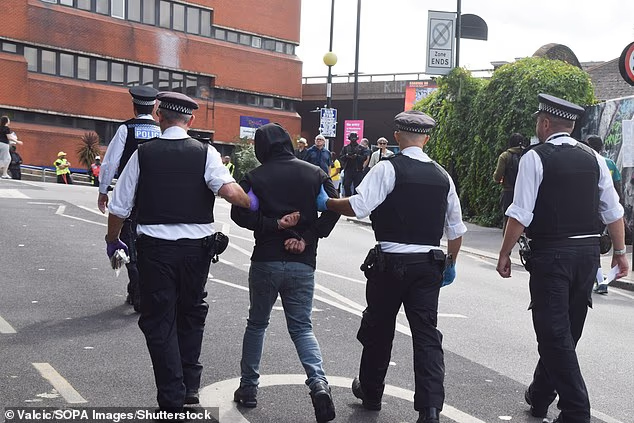
Police have made 169 arrests on day one of London‘s annual Notting Hill Carnival – with revellers held over possession of weapons, drugs and sex offences.

The Met Police confirmed the total number as of 7.45pm on Sunday, with the vast majority of arrests occurring within the event’s perimeter and 27 taking place on approaches to the site. 

The force said officers responded to two knife assaults at the carnival – which is Europe’s biggest street party – including a slashing to the leg and one to the hand.

Neither offence resulted in life-changing or threatening injuries.

Advertisement

The Met confirmed on Friday that more than 7,000 officers will be present at the carnival this bank holiday weekend, which is celebrating its 60th anniversary and expected to be bustling with live music, parades, street food and sound stages.

Police have set up numerous dedicated points where arrested and detained revellers are held. On Lancaster Road, a tent has been set up to detain people who have been arrested for serious offences before they are taken to a police station.

Between 3.30pm and 5pm, a spate of eight arrests occurred there.

One officer told the Daily Mail that people being arrested and taken to the tent were suspected of serious crimes. He gave possession of knives, sexual assault and upskirting as common reasons for arrest.

Advertisement

He said the tent was one of six in the area, and over the course of the day had been used to detain about 25 people.

Some 169 arrests have been made on day one of London’s annual Notting Hill Carnival 

Revellers have been held over possession of weapons, drugs and sex offences

Revellers have been held over possession of weapons, drugs and sex offences

Advertisement
The Met Police said officers responded to two knife assaults at the carnival (Pictured: A facial recognition van installed for the carnival)

The Met Police said officers responded to two knife assaults at the carnival (Pictured: A facial recognition van installed for the carnival)

An estimated two million people set to attend the event (Pictured: Revellers pack into Ladbroke Grove for day one of the carnival)

An estimated two million people set to attend the event (Pictured: Revellers pack into Ladbroke Grove for day one of the carnival)

Crowds were colourful for day one

Crowds were colourful for day one

He added a concern for officers is the risk of gang related violence, as rival gang members may encounter each other at the event.

Advertisement

Medics and ambulance workers were also spotted entering the tent.

In 2025, the Met said it made 528 arrests across the two main days of the carnival, including 167 for drug offences, 50 for possession of an offensive weapon, 21 for sexual offences, four for violence with injury and 49 for other violence.

In 2024, there were eight stabbings, including the murder of 32-year-old mother Cher Maximen, with the same number the previous year, and seven including a murder in 2022.

In a statement released on Sunday evening, the Met Police said despite the incidents, the mood is ‘overwhelmingly positive and celebratory’.

Advertisement

It read: ‘While officers responded to a number of incidents as would be anticipated at an event of this scale, the mood has been overwhelmingly positive and celebratory.’

Commander Claire Smart, who is in charge of the policing operation, added: ‘We have been working closely with Notting Hill Carnival Ltd and other partners for many months ahead of this weekend’s event.

‘The organisers have stepped forward significantly across the event, including crowd management, and we have seen the positive progress today.

‘While we have seen a significant number of arrests and interventions by officers, the result of that proactive approach is a welcome reduction in the levels of serious violence seen at the event in previous years.

Advertisement

‘Nobody involved in the delivery of the event is complacent, however.

Advertisement

 ‘There are still many officers deployed across the footprint to ensure crowds disperse safely.

‘We will have officers on duty through the night and tomorrow we will go again to ensure we can continue to tackle the minority who want to come to Carnival to spoil the celebration for the majority.’ 

But, it wasn’t all bad. Steel drums echoed across west London this morning as Notting Hill Carnival got off to a colourful start with revellers dousing each other in neon paint in the first street party of the two day event.

Images show people dancing in glittering outfits and playing steel drums to kick off the Families and Children’s Day parade.

Advertisement

Meanwhile, early birds arrived at the street party at 6am and began throwing body paint at each other and setting off colourful smoke flares as part of J’Ouvert, a vibrant pre-dawn ritual.

Some are fully covered in black paint and wearing horns to represent Jab Jab – from the French word diable, meaning devil.

The costume dates back to the 1838 abolition of slavery across the Caribbean when people took to the streets in all black to celebrate their freedom from devilish oppressors.

This year marks 60 years since Notting Hill Carnival began in 1966 and, while Saturday saw a quieter start with young performers taking to the stage at the traditional Panorama ticketed steelband competition, Sunday drew far bigger crowds as the carnival takes to the streets.

Advertisement

It is estimated that around two million revellers will attend the event with 7,000 Metropolitan Police officers and staff on duty.

More than 3,000 stewards – double the usual number – have also been deployed after crowd control responsibilities were transferred from Scotland Yard to the event organisers following an extra £4.66million grant announced by Sir Sadiq Khan in March.

But Susan Hall, leader of the Conservative group at the London Assembly, said she remained concerned about the security risks and called on the Mayor to ‘get a grip on this once and for all before more people are injured or die needlessly’.

Source link

Advertisement
Continue Reading

NewsBeat

Aussie boy, 6, may be forced to leave the country and separate from his father due to tough visa rules

Published

on

Leah Wambui Sore is fighting to stay in Australia so that her son Thanasi can grow up here

An Australian father fears he will be separated from his son after battling the country’s complex and lengthy visa processes.

Six-year-old Thanasi Kuzeff was born in Kenya but is an Australian citizen due to his father Daniel Kuzeff’s heritage.

His parents, who are no longer in a relationship, have spent the past four years seeking a lawful way for Thanasi to grow up in Australia while remaining actively involved in his life. 

Thanasi arrived in Australia with his father in 2024 and quickly adjusted to his new life in far northern New South Wales, developing strong bonds with his stepmother and younger brother. 

Advertisement

He was separated from his mother Leah Wambui Sore, a Kenyan citizen, for more than a year as she had five visa applications rejected before she was eventually granted a visitor visa in January this year.

Ms Sore applied for a Subclass 143 Contributory Parent Visa, which allows parents of Australian citizens and permanent residents to live here indefinitely but there is a 15-year waitlist.

She was recently granted another visitor visa carrying a no further stay condition, meaning she can remain in Australia only until December 1.

In a desperate bid to keep the family together, Mr Kuzeff has urged Home Affairs Minister Tony Burke to intervene. 

Advertisement

Leah Wambui Sore is fighting to stay in Australia so that her son Thanasi can grow up here

Daniel Kuzeff may soon be separated from his son Thanasi due to Australia's visa rules

Daniel Kuzeff may soon be separated from his son Thanasi due to Australia’s visa rules

‘We’ve done everything possible but have reached a dead end,’ Mr Kuzeff told the Daily Mail.

Advertisement

‘It’s been one rejection after another. It will be shattering if we can’t find a way to overcome this obstacle.’

Ms Sore added: ‘For me, it’s really not about what staying in Australia would mean for me. It’s about Thanasi.

‘Daniel and I have separate lives, but when it comes to our son, we both want the same thing.

‘We want him to be happy and stable and to grow up knowing that both his parents are there for him.

Advertisement

‘I don’t want him to have to choose between having his mum in one country and his dad and siblings in another. I just want him to have a normal childhood with the people he loves around him.’

Despite being entitled to remain in Australia as a citizen, Thanasi will likely return to Kenya with his mother if she is forced to leave the country. 

‘What shatters me most about what may come is that there is no way we can separate Thanasi from his mother again; he will have to return with her,’ Mr Kuzeff said.

Thanasi will likely return to Kenya with his mother if she is deported later this year

Thanasi will likely return to Kenya with his mother if she is deported later this year

Advertisement
Thanasi spent more than a year separated from his mother Leah before the pair were reunited in Australia in January

Thanasi spent more than a year separated from his mother Leah before the pair were reunited in Australia in January

Thanasi has developed a close bond with little brother Finley (both pictured at an AFL game)

Thanasi has developed a close bond with little brother Finley (both pictured at an AFL game)

Mr Kuzeff said his son loves Australia and does not wish to return to Kenya. 

‘He recognised very quickly that the life he has here is very different to the one he would have back in Kenya,’ he said.

Advertisement

‘Australia is his home. His school, friends, dad, little brother Finley and baby sister are all here.’

Ms Sore does not want to spend another year watching Thanasi grow up via video calls from the other side of the world.

‘I just want to be there while he is still little enough to need his mum,’ she said.

‘If he stays here, he loses his mum again. If he comes with me, he loses having his dad and his siblings in his everyday life.’

Advertisement

‘I don’t want my son to have to make that choice.

‘More than anything, I just want Thanasi to be able to be a little boy, surrounded by the people who love him.’

'There is no way we can separate Thanasi from his mother again,' Mr Kuzeff said

‘There is no way we can separate Thanasi from his mother again,’ Mr Kuzeff said

Daniel Kuzeff (pictured) has urged Home Affairs Minister Tony Burke to intervene so that his son's mother can remain in Australia

Daniel Kuzeff (pictured) has urged Home Affairs Minister Tony Burke to intervene so that his son’s mother can remain in Australia

Advertisement

Ms Sore was granted a visitor visa after the Administrative Review Tribunal intervened and ruled for a previously rejected application to be reconsidered.

‘This situation has been handled by all sides in an adult fashion; they have worked through it,’ tribunal general member Michael Judd wrote in his April 2025 ruling.

‘These cases are about real people.’

Unless Burke intervenes, Ms Sore’s only current pathway to remain in Australia permanently is through a Subclass 143 Contributory Parent Visa, for which she faces a lengthy wait. 

Advertisement

‘His childhood is now,’ Mr Kuzeff said.

‘There are Australian kids with a foreign parent right now, whose parents aren’t together (and) who would face separation because there is no pathway. It’s indescribable how much stress this has caused for years.’

In 2023, then-Immigration Minister Andrew Giles exercised his public interest powers to grant Italian national Andrea Tindiani Australian permanent residency. 

After 12 years in Australia, Mr Tindiani had faced potential deportation and separation from his nine-year-old son following an amicable split from his Australian partner. 

Advertisement
Thanasi (left) will be separated from his father and younger siblings if he has to return to Kenya

Thanasi (left) will be separated from his father and younger siblings if he has to return to Kenya

'For me, it’s really not about what staying in Australia would mean for me. It’s about Thanasi,' Leah told the Daily Mail

‘For me, it’s really not about what staying in Australia would mean for me. It’s about Thanasi,’ Leah told the Daily Mail

‘That was three years ago. Why have no policies been implemented in that time to prevent the heartache and stress of Australian families and their children,’ Mr Kuzeff said.

The Daily Mail has contacted Burke for comment. 

Advertisement

A Department of Home Affairs spokesperson said that it does not comment on individual cases.

‘Australia’s migration system provides a range of visa options for family members seeking to live in Australia. All visa applications are assessed on their individual merits and against the requirements set out in Australia’s migration legislation,’ they told the Daily Mail.

Australian citizenship of a child does not, in itself, provide an automatic pathway to permanent residence for a parent. However, there are a number of family visa pathways within the migration program that may be available depending on an individual’s circumstances.

‘The Department recognises the importance of family unity and the interests of Australian citizen children. Decision-makers are required to consider all relevant legislative requirements and information provided in support of an application when assessing visa matters.’

Advertisement

Ms Sore urged Burke to consider the family’s situation and what it would mean for her little boy.

‘I understand Australia has immigration laws and I respect that. I’m not asking to be above the law,’ she said.

‘I’m just asking for some compassion and whether there is a lawful way for me to stay while I wait for my parent visa. 

‘Thanasi has already experienced being separated from his mum. Now he finally has both his mum and his dad in his everyday life. I just don’t want him to lose that again.’

Advertisement

An online petition calling for Ms Sore to remain in Australia has attracted more than 400 signatures. 

‘Despite the unusual circumstances of our family, the adults in Thanasi’s life have worked together for years with one shared goal: to give Thanasi the opportunity to grow up in Australia with meaningful relationships with his mum, his dad and his younger siblings,’ it states.

‘This is about adults putting aside the complexity of their circumstances because a little boy should not have to choose between his home in Australia and having his mum physically present during his childhood.’

Source link

Advertisement
Continue Reading

NewsBeat

DAN HANNAN: If a nation as small as Iceland can proudly go it alone, why would ANYONE want to reverse Brexit?

Published

on

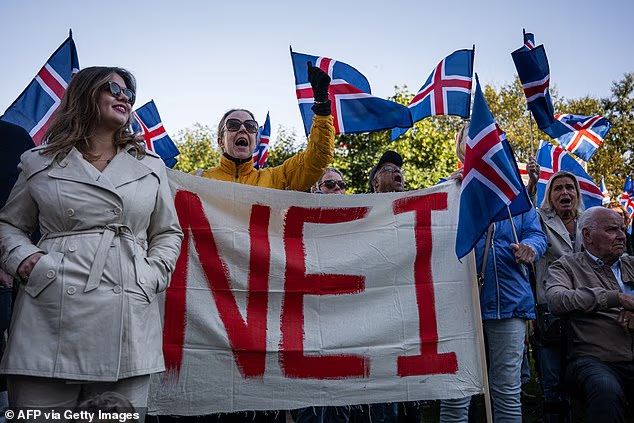
Icelanders have voted by 52.8 per cent to 47.2 per cent not to restart accession negotiations with the EU

Advertisement

Why was anyone surprised? Iceland is a wealthy and successful country. It had nothing to gain from joining the declining EU.

A country with a proud and ancient parliamentary tradition does not lightly submit to a supranational technocracy. The nation with perhaps the best-managed fish stocks in the world does not surrender to a bloc that has drained its own seas.

Icelanders have voted by 52.8 per cent to 47.2 per cent not to restart accession negotiations with the EU. They made their first application in 2009, in the wake of the banking crash, which hit Iceland hard. 

But they dropped it in 2015, once it had become clear that Iceland had recovered from the financial crisis much faster than the EU had, largely because it was wise enough not to bail out its banks.

Advertisement

I was never in any doubt about the outcome. I know Iceland well, having been a regular visitor to that strip of cold black tundra since I was 19. I count the leaders of the ‘No’ campaign as good friends and I see the country as a second home.

I have stood many times at the site of their first parliament, the Thingvellir. Icelanders used to gather there from all over the island, riding their sturdy little horses over black lava fields and bright green moss, meeting as a free people.

They are unlike us in some ways. Few of them have surnames, they build their roads to avoid elf-mounds – said to be the dwellings of magical beings – and their language has barely changed in 1,000 years. But they resemble us in their stubbornness.

Advertisement

Icelanders have voted by 52.8 per cent to 47.2 per cent not to restart accession negotiations with the EU

Iceland's prime minister Kristrun Frostadottir speaking in Reykjavik after the results of the referendum were announced

Iceland’s prime minister Kristrun Frostadottir speaking in Reykjavik after the results of the referendum were announced

They hate being told what to do, especially by foreigners.

I was unusual in predicting a ‘No’. Opinion polls showed a narrow but consistent lead for the pro-EU side and, as the votes came in, wide-eyed Europhiles, buoyed by early results from Reykjavik, were getting excited.

Advertisement

Why? Because, deep down, they think European integration is inevitable, in the same way Marxists used to believe that socialism was inevitable. Take away the sense of inexorability and the flaws become painfully visible.

There is scant enthusiasm for EU membership other than among the impoverished states of south-eastern Europe, such as Montenegro, Macedonia and Moldova. Even Turkey has lost interest in joining. In Norway, polls suggest that opposition to membership has risen to around 70 per cent.

In these countries, EU membership is seen purely in cost-benefit terms. In Britain, a decade on from the 2016 referendum, it remains a culture war. A knot of Continuity Remainers who don’t know or care much about what is happening in the EU, are still obsessed with overturning our own referendum result.

Why? Because, for them, it is less about the EU than about defeating an imagined domestic enemy, a caricatured racist.

Advertisement

They have stuck to their rejoinery for a decade, despite the EU adopting much harsher immigration laws than Britain, because they are anti-Eurosceptic rather than pro-Brussels.

It is true that Iceland has a closer relationship with the EU than we do. Membership of the European Economic Area means that it is in the single market for everything except agriculture and fisheries – though, importantly, Iceland is outside the customs union and has signed several trade deals that the EU does not have, including with large economies such as China and Indonesia.

There is an argument for Britain moving closer to the single market. But it needs to be done in a ruthlessly calculating manner, signing up for things only when there are clear mutual benefits rather than approaching talks in a spirit of penitence and atonement. Sadly, as the reaction here to Iceland’s welcome decision shows, we are a long way from that.

Still, the question remains. If a nation with a population the size of Croydon’s is content to take its chances alone, what are we so scared of?

Advertisement
  • Lord Hannan of Kingsclere is an independent peer and director of the Institute of Economic Affairs.

Advertisement

Source link

Continue Reading

NewsBeat

Seven arrested in Sheffield after death of newborn baby girl

Published

on

Manchester Evening News

Police were called shortly before 6am on Sunday

Police have arrested seven people on suspicion of murder after the death of a newborn girl in Sheffield.

Advertisement

South Yorkshire Police said officers had received reports of a concern for the safety of a newborn baby in the Wincobank area at 5.58am on Sunday.

Officers searched a property on Holywell Heights where the baby girl was found.

Click here to get the biggest stories straight to your inbox in our Daily Newsletter

Despite the best efforts of officers and paramedics, the baby was pronounced dead at the scene, the force said.

Advertisement

Seven people have been arrested on suspicion of murder and remain in custody, the Press Association reports.

Senior investigating officer Detective Chief Inspector Emma Knight said: “We are aware news of this will be deeply concerning and I want to reassure our local communities that we have a dedicated team of detectives and officers hard at work to ensure justice is secured for the baby girl at the heart of this investigation.

“As part of our investigation seven people have been arrested on suspicion of murder. All of them remain in police custody at this time. We are working to determine the ages of some of those arrested.

“Our investigation is in its early stages and we would like to remind people to avoid speculating about this incident.”

Advertisement

Anyone with any information about this incident which could assist the investigation is asked to contact the force online or call 101, quoting incident number 194 of 30 August 2026.

Source link

Continue Reading

NewsBeat

AP Exclusive: US coaches Polish forces in a drone-focused drill based on lessons from Ukraine

Published

on

AP Exclusive: US coaches Polish forces in a drone-focused drill based on lessons from Ukraine

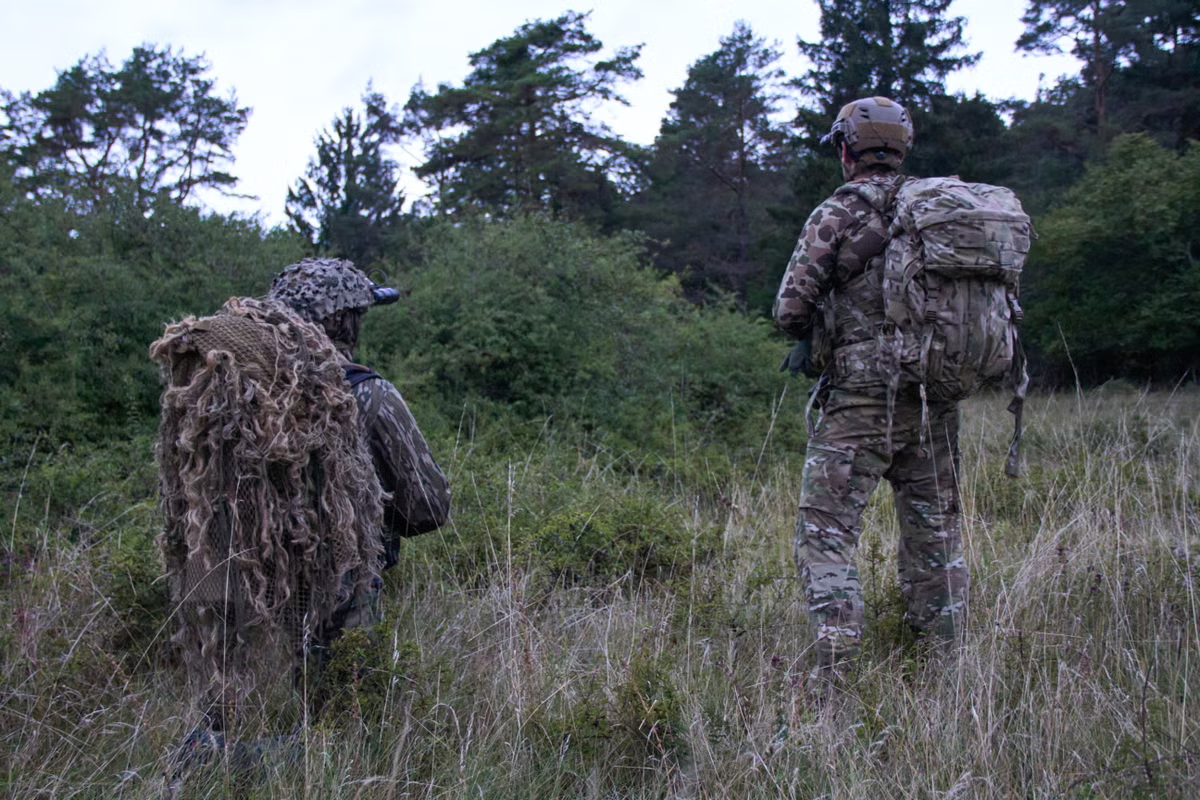
On a moonless and rainy night, a group of soldiers emerged from a ramshackle building meant to resemble a church. The alpine terrain loomed over them as they quietly set off for the tree line of the German countryside a short distance away.

The soldiers are members of the Polish special forces and are taking part in an exercise designed only months ago that simulates moving through enemy lines, traversing miles of enemy territory and launching a drone strike on a key enemy location.

Initially designed by the Army’s Green Berets for U.S. special forces, the exercise that began Friday is informed by and simulates many of the challenges that Ukrainian troops have experienced in their conflict with Russia. It is the first time a NATO ally like Poland has undertaken the training, and it comes at a time when tensions between Russian President Vladimir Putin and NATO countries have escalated.

“We’re using lessons learned from Ukraine,” an Army Green Beret officer assigned to the training complex said Thursday. “All of those effects that we’re seeing either Russia or Ukraine having to overcome — we’re doing our best to replicate.”

Advertisement

The Associated Press received rare access to both the training ground and the troops conducting the exercise, which has only been conducted twice before, both times this year, by two different Green Beret teams.

The drill highlights the focus that some parts of the U.S. military have on learning the latest techniques in drone warfare, pioneered by Ukraine during its 4 1/2-year effort to repel Russian forces. It also shows how the U.S., its NATO allies and Ukraine are working together to counter the threat of possible further Russian action in coming years even as the Trump administration has warned of troop drawdowns in Europe.

CIA Director John Ratcliffe went to Moscow this week to warn Russia not to attack NATO countries, The Wall Street Journal reported. Russia has the appetite to conduct sabotage and cyberattacks against NATO countries, but Putin wants to avoid a direct confrontation, according to three Western officials, who spoke Friday on condition of anonymity to discuss sensitive military matters.

How special forces are learning to sneak behind enemy lines to deploy drones

Advertisement

During the exercise in Germany, a senior enlisted soldier familiar with the training scenario at Joint Multinational Readiness Center Hohenfels — about an hour’s drive southeast from Nuremberg — said the plan is to run it several times a year. The officer said he expects most, if not all, of the 32 NATO nations to express interest in sending their troops to try the exercise.

Both spoke on condition of anonymity in line with the U.S. military’s longstanding policy of not publicly identifying individual members of special forces units.

The scenario, which runs for several days, takes place on a large, 1,100-square-mile (3,000-square-kilometer) plot of land nestled in the Bavarian countryside.

Poland’s special forces will be expected to sneak past a U.S. Army airborne infantry unit, whose soldiers will play the enemy. The U.S. airborne infantry unit will parachute into the closed-off training area at the Army’s Hohenfels base and set themselves up into a front line.

Advertisement

Assuming the Polish forces can make their way past the U.S. Army, they must then move north — through about 60 miles (100 kilometers) of German countryside — to another training area in the town of Grafenwoehr, where they are expected to destroy a simulated target.

In between lie German farms and villages, private and government cameras, as well as a city with a large population, all of which not only pose as obstacles but also create the potential for them to be spotted.

The senior enlisted soldier said that in previous instances of the exercise, the Army Green Berets removed their uniforms “so they can blend in” before adding that “blend in also means don’t get seen by civilians.”

German civilians in the area largely are not aware of the exercise and serve as a reasonable test of how well special forces can blend into the local population. If they fail, reports of suspicious people to police will make it back to the military, which will use them to pinpoint the team.

Advertisement

“This is supposed to be Russia and you’re going to stand out in Russia,” the enlisted soldier added.

Plus, the U.S. Army also will be looking for the Polish forces with drones of their own.

If they’re spotted, “now you have the entire Russian arsenal coming at you,” the enlisted soldier said.

The U.S. Army can either send a military police unit to hunt for the Polish special forces with dogs or direct more drones to the area. In previous versions of the exercise, the U.S. Army had access to more than a hundred drones, the enlisted soldier said.

Advertisement

Troops are able to be “captured or killed” as part of the training.

Countries seek help from Ukraine on drone warfare

While the exercise taps into drones and NATO teamwork, the message of collaboration and the value of drones has been somewhat mixed lately across the military.

President Donald Trump stirred confusion among NATO allies by going back and forth on drawing down U.S. troop levels in Europe, and the administration has launched a force review on next steps. And last week, the Army’s top officer shuttered a unit that specialized in drone warfare.

Advertisement

But overall, there is growing interest in tapping Ukraine for its expertise on modern warfare and, specifically, drones.

In March, Ukrainian President Volodymyr Zelenskyy said his country was helping five countries in the Middle East and Gulf region counter Iranian drone attacks launched during the war with the United States, while the U.S. and European countries were among those requesting support.

Meanwhile, the number of mysterious drone incursions in Europe have grown, including as recently as this month, when a pair of drones were spotted over a German military base and a drone carrying explosives was found at a key cargo airport in Germany.

___

Advertisement

Associated Press writer Emma Burrows in London contributed to this report.

Source link

Continue Reading

NewsBeat

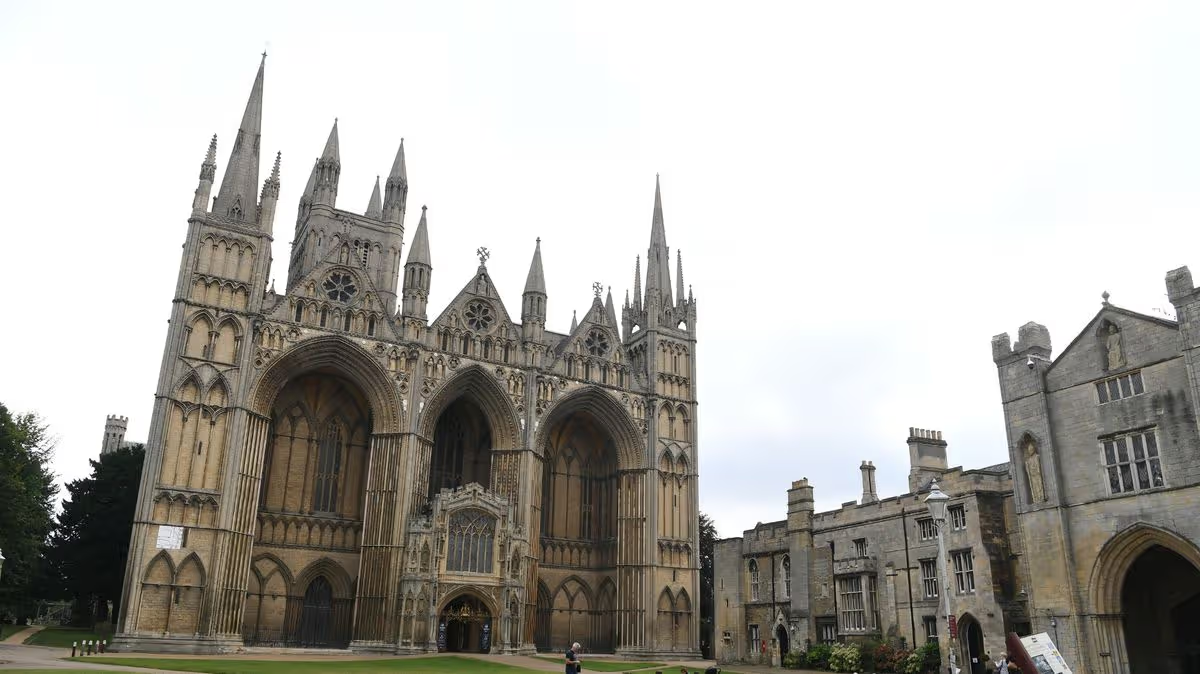
100 affordable homes to be built in Peterborough as part of huge development

Published

on

Cambridgeshire Live

Construction is due to begin in 2026

A Cambridgeshire city will see 100 affordable homes built as part of a wider expansion of thousands of new homes. Vistry has secured a contract with housing association Amplius for the sale of land for 100 homes at Great Haddon in Peterborough.

Advertisement

These 100 homes will be owned and managed by Amplius across tenures including affordable rent, social rent, shared ownership, and rent to buy. According to Vistry, the scheme supports the delivery of “much-needed affordable housing in Peterborough”.

The homes will form part of phase four of the Great Haddon development. Chief Development and Commercial Officer at Amplius, said: “We want to deliver the homes people want, where they’re needed most and we know that these 100 homes will address the need for affordable housing in this part of the county.

“By making the homes available on various tenures, we’ll be fostering a balanced community and creating a place that people are proud to call home. We’re really pleased to be working with Vistry once again and I’m looking forward to watching work progress and the homes taking shape.”

Construction is due to begin in November 2026, with the first homes expected to be completed by mid-2027 and the final homes due to be completed in January 2030. The development forms part of a wider masterplan that will ultimately provide more than 5,000 new homes.

Advertisement

The development will also include a district centre, two neighbourhood centres, new schools, community and health facilities, sports amenities, water features and substantial green spaces, including 7.5 hectares of amenity open space and 8.4 hectares of accessible natural green space.

Air source heat pumps (ASHPs) will also be installed in a number of the homes, while lower air permeability levels will help reduce heat loss. The scheme is part-funded by Homes England through its partnership with Amplius.

Source link

Advertisement
Continue Reading

NewsBeat

Parents ‘shouldn’t face choice between supporting sick kids or keeping jobs’

Published

on

Daily Mirror

Children’s Commissioner Dame Rachel de Souza has urged the government to introduce 12 weeks of paid parental leave a year for mums and dads whose kids are seriously ill

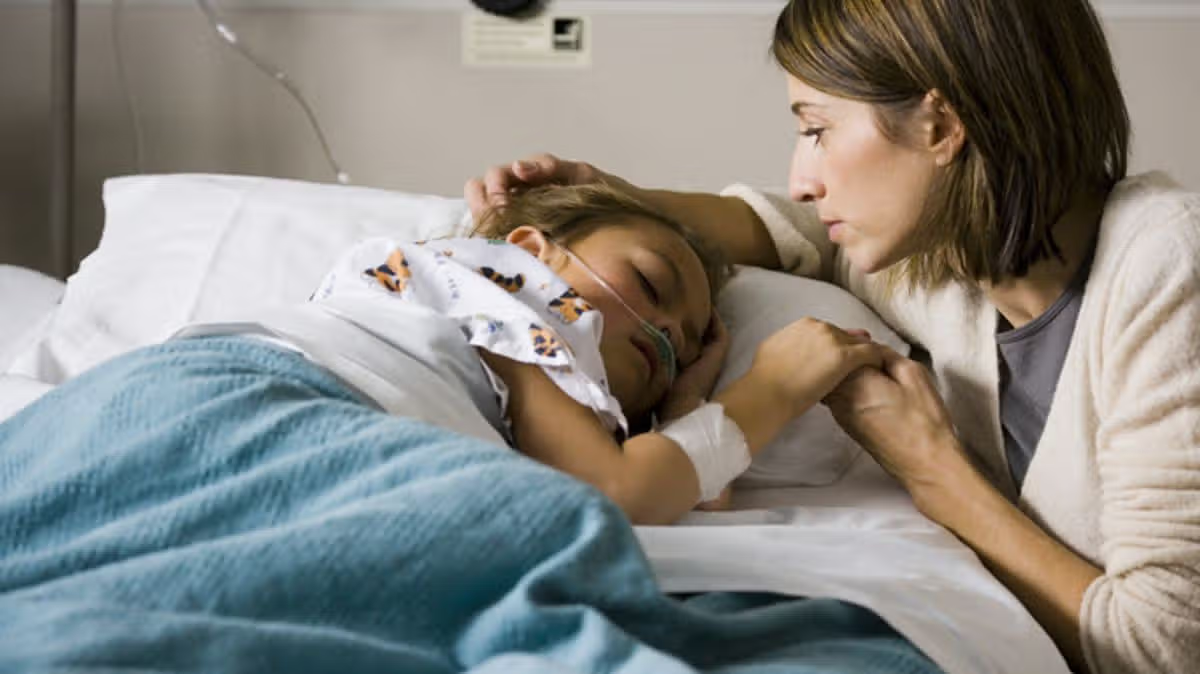
Mums and dads of seriously ill children should be given 12 weeks of paid parental leave to be at their child’s bedside, the Children’s Commissioner has demanded.

Advertisement

Dame Rachel de Souza said parents should not be forced to choose between supporting their child or keeping their job. In a letter published today, she urged the government to bring in Hugh’s law – named in memory of six-year-old Hugh Menai-Davis, who died from cancer in 2021.

His parents Ceri and Frances campaigned for support for parents with seriously ill children. On Sunday, business minister Kate Dearden said she had been moved by families’ experience and said the government is looking to improve support and employment rights.

A government consultation on employment rights for unpaid carers will close on Tuesday. The Commissioner said Hugh’s Law should be in place alongside a form of paid carer’s leave and a right to return to work following a longer period away.

Advertisement

Ceri and Frances, who founded the It’s Never You charity after Hugh’s death and campaigned for the law change, said on their website: “In Britain today, there is no financial support for parents of seriously ill children. Parents are expected to carry the burden alone. This is not compassion. This is not care. This is failure.”

Bringing in Hugh’s Law would help families whose children have complex or fluctuating needs to remain in employment, Dame Rachel said. Recent analysis by the Commissioner’s office found over 260,000 children born after 2008 spent three weeks or more in hospital during their childhoods. Of these, 34,846 were treated for over three months in hospital, with 1,342 spending more than a year there.

Youngsters from more deprived areas and children from ethnic minority backgrounds were most likely to have long hospital stays, it found.

One mum, whose five-year-old child experienced a long hospital stay, told the Commissioner’s office: “I’ve had to quit my job, well, I haven’t just yet, I’m still technically I’m sick, but next month when my sick note runs out. I will be quitting my job, so I’m losing a lot of money, so it’s, yeah, it’s really hard. It’s really hard.”

Dame Rachel said she supported paid leave for 12 weeks at 90% of full pay for parents, as well as extending unpaid carer’s leave from five to 10 days a year.

But she warned the changes must go hand-in-hand with wider changes to support seriously-ill children. Dame Rachel said: “Paid leave is only part of the answer. My research showed too many seriously ill children are spending too long ‘stuck’ in hospital because the NHS and children’s social care cannot provide the nursing care, care workers, specialist support or suitable school places their children need. This can have devastating effects, not just on parents as the balance children’s care and work, but also on children’s lives.

“It is vital that government ensures improvements to employment rights are matched by better support from health and social care, so parents are not forced into poverty or out of work simply because their child is seriously ill.”

Advertisement

Dame Rachel said: “We should never force parents to choose between holding down a job and being by their child’s bedside. Our existing employment rights are failing parents and carers, as they struggle to balance caring responsibilities with caring for their seriously ill children. Families of seriously ill or disabled children desperately need a form of paid leave that enables them to care for and spend time with their child following a diagnosis or crisis in their child’s health.”

Minister for the Future of Work Ms Dearden said: “Serious childhood illness is a heartbreaking situation for families. I’d like to thank Ceri, Frances and all of those campaigning in the memory of their children.

“I’ve been incredibly moved by the powerful stories we have heard, and we will move quickly to consider how we can strengthen support and employment rights for families facing serious childhood illness.”

Source link

Advertisement
Continue Reading

NewsBeat

Roger Moore’s son dreamed of being James Bond but lands movie role as spy

Published

on

Daily Mirror

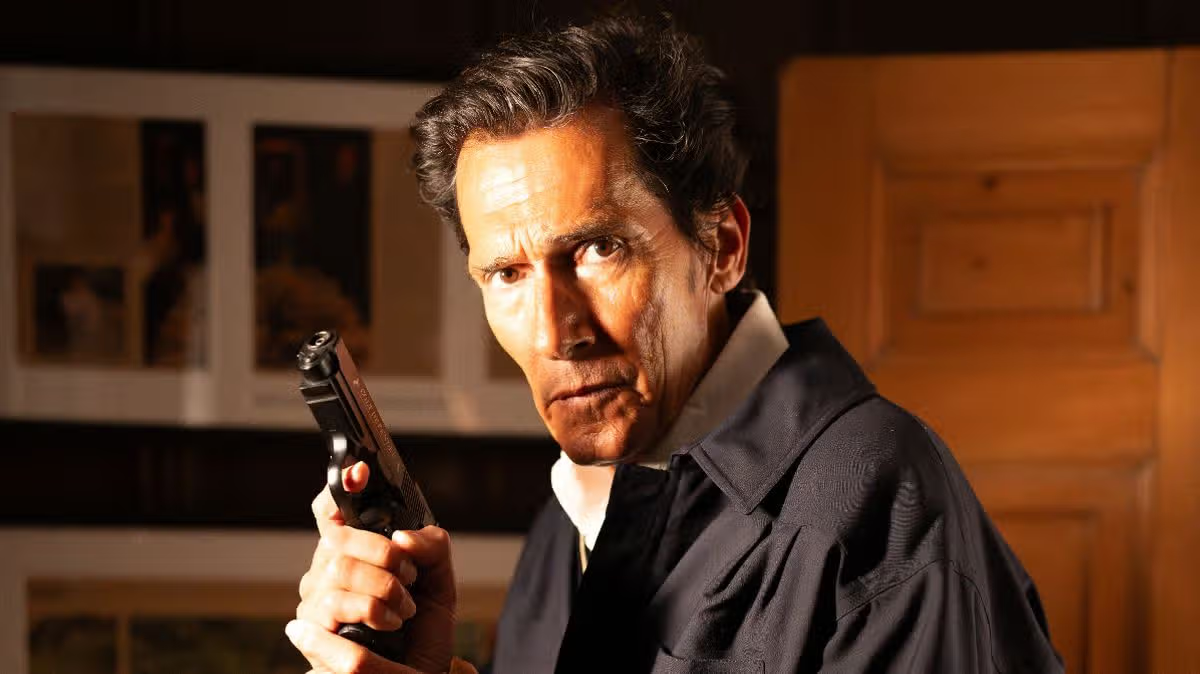
Handsome, immaculately dressed and with a dead pan delivery, as Geoffrey Moore sips a chilled Martini, his resemblance to his famous father is uncanny. The eldest son of legendary James Bond actor Sir Roger Moore, who played 007 in seven movies, he says: “Once I dreamed of being Bond myself – but now I’ve just become a film star at 60. I must be one of the luckiest people in the world.”

And, while he is not quite in the same espionage league as Bond, he will be playing a spy. He says: “I’m very pleased. I took my time to get round to it for one reason or another, but I’ve got the lead role as Hugh, an MI5 agent in Knightfall, a new spy thriller. I’m stepping out from behind the scenes.”

Although he did some acting when he was younger – appearing in Dr Jekyll and Mr Hyde opposite Kirk Douglas and then in Sherlock Holmes in New York – Geoffrey chose singing over acting, going into the music business. And in 1999, he co-founded the upmarket restaurant Hush in London’s posh Mayfair.

But he and business partner, Jamie Barber, sold the lease to trendy Soho House in 2023. He says: “Running a high profile restaurant is a bit like being in the movies – a bit like putting on a show every night. Many of the clients come there especially to see and meet you.”

Advertisement

One diner, who he befriended, was independent film producer Jonathan Sothcott. He introduced Geoffrey to brothers Gary and Martin Kemp, who famously played the Kray twins, and to Nick Moran of Lock, Stock and Two Smoking Barrels fame.

He says: “Johnny and I became friends and every now and then he would say ‘do you feel like doing something one day?’ It kind of went from there. There was no pressure, but when he came up with such a brilliant thriller I thought ‘this is it.’”

Advertisement

Geoffrey, whose brother Christian, 53, is a film producer and director and whose sister Deborah, 62, is an actress, has never had any formal drama training. Instead, he watched his dad – who died in 2017, aged 89 – acting on film sets as a kid and absorbed his craft.

He did several jobs behind the scenes – producing the film version of The Saint starring Roger Moore and Ian Ogilvy (who is also starring in Knightfall).

Then Geoffrey, whose late mum Luisa Mattioli and dad divorced in 2002, was signed by EMI Records in 1987, releasing his debut single Sleep With Me (Tonight) and then moving to Warner Brothers.

Advertisement

Of his subsequent move into the world of fine dining, he says: “It’s actually tough running a successful restaurant, you become a slave to the business. I can’t really remember the last movie I was in. The funny thing is I really enjoy acting. It has been fun shooting a thriller. I’m not pretentious about it, it’s not Shakespeare.

“We filmed in England, in London and down on the South Coast in the Winter. It was bloody freezing. As I am a spy, there was a lot of running around. It was windy, it was cold.”’

The intemperate weather finally got the better of him when he was asked to reshoot a scene. He says: “I remember the director saying ‘we are gonna go again. Do this, do that.’ It’s 4 in the morning. I love the business, it beats working in an office, but I knew that was it. The scene was the best it could be.”

Turning his attention to his dad, he continues: “It was very difficult growing up having such a famous father. People always wanted his attention. But I am realistic. Can you imagine those who grow up not knowing who their father is? You can’t complain if you are born into a privileged family. Especially the Royals.” Of Prince Harry, he says: “Hey Harry! Can I tell you something? Get on with it!”

While Geoffrey acknowledges his privileged background, his dad’s childhood was very different. Sir Roger’s father was a South London copper and they all lived through the London Blitz in World War Two.

Geoffrey was often looked after by his grandparents for long stretches when his dad was away filming. He recalls: “They were quite strict. I knew them well and loved them. But it was a different world. Grandma served fish and chips every Friday, like they did in those days, and sheep’s brains on Thursdays, which I hated’

“When I complained, she admonished me and said I was an ‘ungrateful little boy,’ because, during rationing, sheep’s brains are what you got. They taught me to appreciate things. It’s important to be grateful.”

Advertisement

And he has plenty to be grateful for. Geoffrey and his Anglo-French wife, Loulou, and their two daughters’ main residence is a luxurious chalet in the Swiss Alps – although he says he still drives a 20 year old Range Rover.

For his recent 60th birthday, he had a dinner party for 30 pals at home, which he describes as “low key”. He says: “It was the best birthday party I’ve had. My wife made me cakes and a special breakfast.”

Loulou used to work in the City and Geoffrey says: “She’s incredibly smart.”

Advertisement

Educated at Le Rosey in Switzerland, the most expensive school in the world – where fees exceed £130,00 a year, Geoffrey remains remarkably down-to-earth. He says: “Of course, I get down some days, but I never get depressed as such. That’s not in my DNA.

“A lot of fortunate people moan about their lives, but I wake up every day thinking ‘I don’t need an umbrella, fantastic, very good, another day!’

Taking a final sip of his Martini, his thoughts return to his dad. He says: “My father was famous. I loved him and miss him – after all, he was one of my best friends.”

*Knightfall, starring Geoffrey Moore, is scheduled for release on Digital and On Demand on September 11, 2026, followed by a UK Blu-ray release on September 14, 2026.

Advertisement

Source link

Continue Reading

NewsBeat

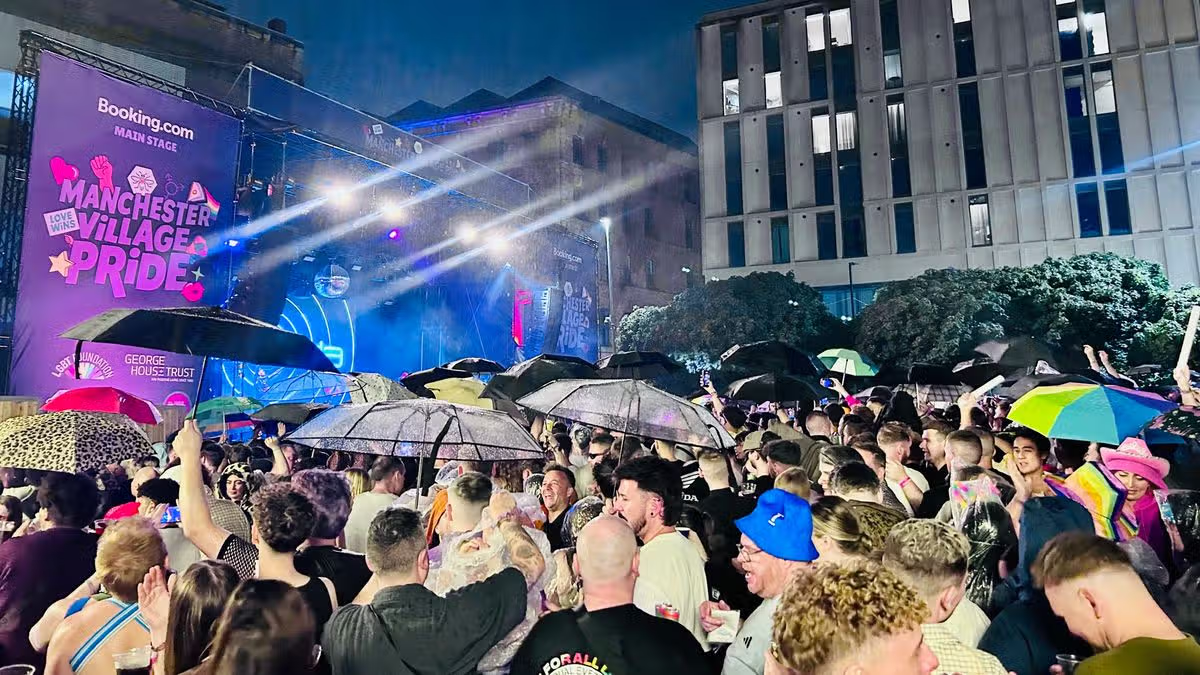
Thunder, a sea of multicoloured umbrellas and Eurodance perfection on Sunday at Manchester Village Pride

Published

on

Manchester Evening News

Torrential rain and thunder couldn’t stop the party on day three of Pride

There were a few constants at Manchester Village Pride this year. If you’ve been there you’ll know that one of them has been the rain – lots of it in fact.

But if you’re a regular attendee, you’ll also know that Pride in Manchester is also characterised by bucket-loads of resilience. A bit of bad weather, and even a temporary stop due to thunderstorms, couldn’t stop the city’s most joyous and necessary celebrations.

We’re known for rain showers and grey days here in Manchester, but Pride’s technicolour flag shone bright through the downpours, thunderstorms and lightning. Its attendees and lineup of stars shone even brighter.

Advertisement

Click here for the latest on Manchester’s food & drink scene, gigs and more in our CityLife newsletter

There’s been a lot of change for this year’s Pride, but the community, as expected, has risen to occasion – and it’s been a joy to watch.

So when the heavens opened on Sunday afternoon, people sheltered, but they also danced in the rain too as Umbrella and Raining Man played over the speakers – that is the very essence of Manchester Village Pride for you.

Advertisement

For the third day of this year’s inaugural Manchester Village Pride, there were no signs of slowing down in terms of the line-up either.

Following the parade and festivities on Saturday, the city’s annual LGBTQ+ celebrations in the Gay Village on Sunday featured big performances from big music stars like Kate Nash, Big Brovaz & Booty Luv and Cascada, as well as the likes of Manchester legends including DJ Paulette, Misty Chance, Misha B, and many many more.

Regular attendees of the historic event, which has now been running more than 40 years, spoke of how the renamed and new-look festival has had a different feel to last year. Now known as Manchester Village Pride, it has emerged from the ashes of its predecessor.

Advertisement

Not long after last year’s event, the company behind what had been known as Manchester Pride went into voluntary liquidation after it was deemed to no longer be ‘financially viable.’

Bars and venues in the Gay Village refused to let it die and joined forces with Manchester Council and the Equity union to create a Community Interest Company (CIC) which has brought the new-look and renamed celebration to fruition this year.

More than 30,000 people attended the event on Sunday, a similar number to Saturday. The daily numbers are understood to be several thousand higher than last year.

Advertisement

Despite the increase, a number of those in attendance said it felt ‘quieter’ and ‘calmer’ than previous years, with bosses putting this down to better crowd management. Others said it felt like the event had ‘gone back to its roots’ and felt less ‘commercial’ than its previous incarnation.

One attendee described how had been the victim of homophobic abuse whilst on their way to the event, as he and others reaffirmed how important the event still was to the community.

Others said it helped showcase the city’s unique Gay Village and LGBTQ+ community, and could help those yet to open up about their sexuality feeling confident enough to do so.

Advertisement

In just the last few months, a number of Pride celebrations across the country have been shut down due to a lack of financial support or the backing of their councils. This threat means that events like Manchester’s are even more vital to the community and many spoke of how proud they were of the city for keeping it going and its strong messaging after a difficult few months.

Mark Doyle who attended Manchester Village Pride this year told us: “It’s about being myself and celebrating who we are as a community.

“I work for Tesco who are one of the sponsors so yesterday I took part in the parade as I have done several times before and it was an amazing experience as always, the weather aside.

Advertisement

“However on way in someone shouted f****t at me. It just shows how important it still is. We have still got much more to do.”

As the evening drew closer, and just after 6pm, The Village was hit by a biblical storm. Flashes of lightning and rumbles of thunder were followed by torrential downpours.

Stunned punters were heard screaming as they ran for cover under gazebos and the canopies outside venues.

Advertisement

Others decided to embrace the conditions and went topless and danced out in the open as the rain bounced off the floor and left large stretches of Canal Street under water.

Bosses were forced to temporarily halt the music on safety grounds and whilst the main stage reopened a little later, the decision was made to shut the Sackville Gardens until Monday due to the amount of standing water.

Whilst the worse of the conditions passed quickly, vendors selling pride flag coloured brollies did a roaring trade and the crowds were a sea of umbrellas and ponchos with revellers arriving for another evening’s entertainment taking no chances in the volatile weather.

Advertisement

A little later than scheduled, Kate Nash took to the stage drawing a huge crowd. A whistle-stop tour through he back catalogue, there was of course one song that everyone was waiting for.

Those who grew up in the 90s and noughties know her best for Foundations, the indie pop hit that spawned the famous line ‘I said I’d rather be with your friends mate, cause they are much fitter’. A feeling, I’m sure, we have all at some point, felt towards our significant other.

It was robbed of a number 1 in the UK charts but it needn’t matter because the crowd at Manchester Village Pride knew every word and belted it out alongside the songstress.

Advertisement

The site of former Corrie star Adam Rickitt got pulses racing a little later, as the actor who we best know for his portrayal of Nick Tilsley on the British soap, whipped his top off – clearly he had taken notes from Gareth Gates’ performance on Saturday night.

The last spot of the night when to German Eurodance and electronic pop superstar Cascada. And as the heavens opened again, prompting brollys to be flung open and the cagoules swiftly unpacked from bags, there couldn’t really have been a more fitting end.

A sea of multicoloured umbrellas bouncing to the high tempo beat of ‘Everytime We Touch’ felt close to fever dream territory, while the lashings of rain soaking the crowd to ‘Evacuate the Dancefloor’ felt like a premonition, but if you took a second to look around, you could see that the rain really didn’t matter.

Advertisement

The joy etched on people’s faces as they danced, hugged friends and loved ones, and surrendered to the pulsing beats and uplifting synths of Cascada was sure sight enough that Manchester Village Pride 2026 will go down as in the history books – Pride is finally home.

Source link

Continue Reading

Trending

Copyright © 2025